Jul
EviDNA DNA cryptography: Freemindtronic complementary reference memory — EviDNA, Digital DNA, cryptographic genome, cybersecurity and digital trust (CryptPeer / EviSKMS) — July 2026.
EviDNA DNA cryptography — express summary
Read. This express abstract presents the purpose, industrial trajectory, and scope of the dissertation before the detailed executive summary. IP note. Intellectual property protected. The form of expression of this mémoire is protected by copyright (© Jacques Gascuel / Freemindtronic). It is not a technical reproduction notice.
EviDNA cryptography DNA refers to the Freemindtronic trajectory in the cryptographic universe mobilizing the expression “DNA” in the procedural and architectural sense — non-molecular by default. The thesis documents three milestones: EviDNA (human profile, industrialized 2024), DNA Digital and the cryptographic genome (industrialized 2026 in CryptPeer/EviSKMS).
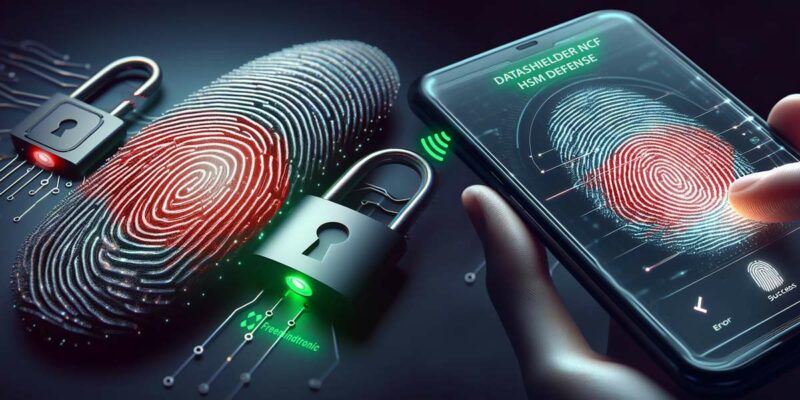
The central thesis is simple. Freemindtronic has been laying an R& R& line since 2022 (Eurosatory, project presentation) D distinct from institutional molecular OTP: trusted material derived from a human profile, segmented material, field use. In 2024 (Eurosatory Lab), this trajectory materialized in DataShielder Defense NFC HSM. In 2026 (Eurosatory), it is generalized in CryptPeer via the cryptographic genome and the TPM/vTPM anchoring.
The thesis establishes documentary comparisons with the state of the art: classic digital trust (FIDO, PKI, Zero Trust), academic genomic data encryption, iDASH/Beacon ecosystem, and CNRS 2026 approach (synthetic DNA, OTP/Vernam). He does not claim any authorship on the third-party works; It specifies distinct technical objects.
The Freemindtronic positioning is treated with methodological caution. The granted international patents WO/2018/154258 (segmented key) and WO/2017/129887 (access control) allow for an enabling public description at the architecture level. Industrialization is documented by observable evidence (product, CryptPeer runtime, time-stamped videos). The internal EviDNA mechanisms, Gen2 extensions and unpublished know-how remain in the B and C registers — see §1.12.
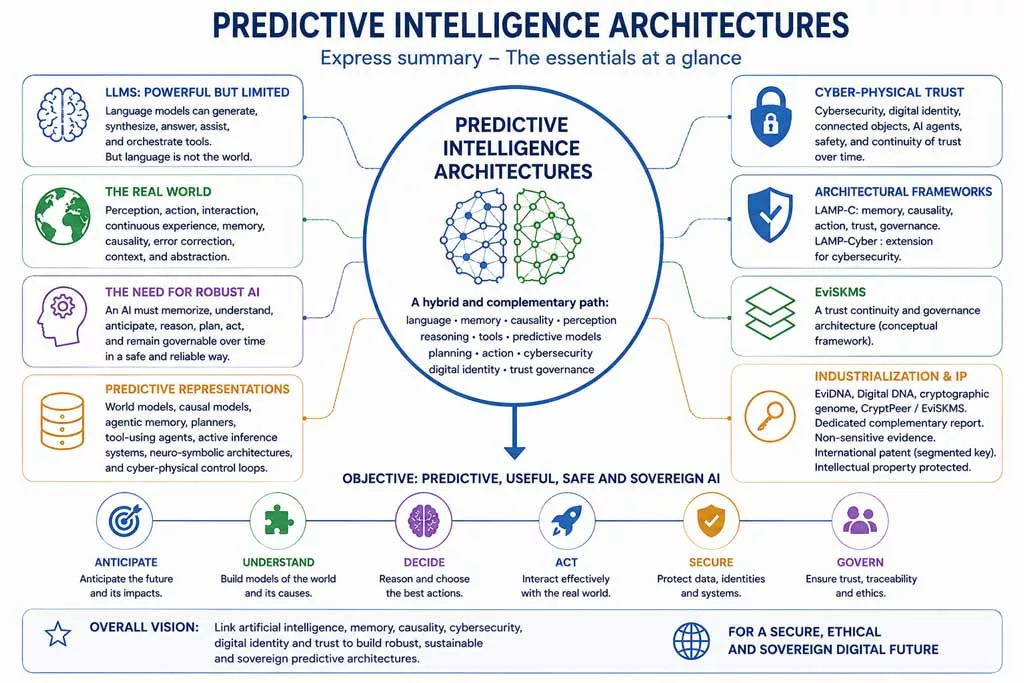
This document is a scientific-industrial memory complementary to the framework predictive intelligence architectures — EviSKMS. It does not claim to be a peer review or product certification.
Playback settings
Reading time express summary: ≈ 4 minutes
Reading time executive summary: ≈ 5 minutes
Estimated full reading time: ≈ 1 h 15
Initial ReleaseJuly 2026
Last updated: 21 July 2026 (pre-filing IP hardening — copyright preserved; technical risk language removed)
Level of complexity Expert / research
Technical density ≈ 78%
Available language EN
Specificity: Complementary thesis on EviDNA, Digital DNA, cryptographic genome, DNA cryptography, CNRS comparisons and CryptPeer
Reading order: Express Abstract→ Executive Summary → §1 Genome and trajectory → Limitations and falsifiability → Conclusion
Accessibility:Optimized screen readers, internal anchors, and summaries included
Editorial type:Scientific and industrial reference memory
Main topic: EviDNA cryptography DNA
Secondary Topics: EviDNA, Digital DNA, Cryptographic Genome, CNRS, CryptPeer, EviSKMS, Segmented Trust
Criticality Level:High — 8 / 10 — genetic data, cybersecurity and digital identity
Author:Jacques Gascuel, inventor and founder of Freemindtronic®.
Publish status
This thesis on EviDNA cryptography DNA is a position and reference document Freemindtronic and an original work protected by copyright (© 2026 Jacques Gascuel / Freemindtronic®). It does not constitute a peer review, third-party audit, or product certification. It is a non-enabling publication (register A): it does not disclose unpublished procedural means or enabling reproduction records.
Editorial note. This quick summary presents the objectives, the industrial trajectory (Eurosatory 2022 project → 2024 Defense → 2026 CryptPeer) and the scope of the thesis EviDNA DNA cryptography. It precedes the detailed executive summary and is part of Freemindtronic Andorra’s editorial transparency approach. It distinguishes between state-of-the-art knowledge, observable evidence of industrialization and mechanisms relating to unpublished intellectual property. This content is written in accordance with Freemindtronic Andorra AI Transparency Statement — FM-AI-2025-11-SMD5.
EviDNA DNA cryptography — executive summary
This complementary thesis documents the Freemindtronic trajectory in the cryptographic universe mobilizing the expression “DNA” in the procedural and architectural sense — non-molecular by default: EviDNA (human profile, 2024), ADN Digital, cryptographic genome and industrialization CryptPeer/EviSKMS (2026).
It establishes documentary comparisons with the state of the art: classic digital trust mechanisms (FIDO, PKI, Zero Trust, HSM/TPM), academic genomic data encryption (PROMISE, Varlock), and institutional approach CNRS 2026 (synthetic DNA, OTP/Vernam). He does not claim any authorship on the third-party works; It specifies distinct technical objects. Canonical definition EviDNA: §1.11.
The publication respects the registers A (public), B (confidential) and C (IP): two international patents granted are publicly cited (WO/2018/154258 — segmented key; WO/2017/129887 — access control); no records enabling the reproduction of EviDNA, genome, Gen2 or advanced runtime mechanisms (C registry).
Controlled publication (register A). This limitation is not a documentary gap, but an assumed methodological constraint: the dissertation distinguishes between what can be discussed publicly and what would constitute a reproduction record. It exposes the inventive trajectory, distinct technical objects, observable evidence, and relevant comparisons — including integration into CryptPeer/EviSKMS at a high level — while preserving unpublished internal mechanisms of EviDNA, DNA Digital and the cryptographic genome. See §1.12; Roadmap: §1.15.
For the interdisciplinary framework linking predictive AI, cybersecurity, and cyber-physical trust, see EviSKMS reference memory.
Key Points — EviDNA Cryptography DNA
- Trajectoire salon : Eurosatory 2022 (projet EviDNA) → 2024 Defense NFC HSM → 2026 CryptPeer/EviSKMS industrialisé.
- EviDNA canonical definition: §1.11 · Chronology: Appendix A.
- CNRS 2026 comparisons, academic genomic encryption, iDASH/Beacon, classical digital trust.
- Publication controlled non-enabling: §1.12 · roadmap§1.15.
- Add-on predictive intelligence architectures — EviSKMS.
© Author’s positioning — « fourth family of entropy »
Jacques Gascuel authors an original literary-scientific framing that situates the Freemindtronic EviDNA trajectory relative to three established families of randomness sources (PRNG, TRNG, QRNG). The expression « fourth family of entropy » designates that authored positioning — not a recipe, not a technical reproduction notice. © 2026 Jacques Gascuel / Freemindtronic®. Unauthorized reproduction of this formulation or appropriation of authorship is prohibited.
- Express Summary
- Executive Summary
- Relation to the dissertation “predictive intelligence architectures — Ev…
- Scope and controlled perimeter
- 1. Cryptographic genome, EviDNA and industrial trajectory
- 1.1. Non-sensitive level of evidence and Gen1 industrialization
- 1.2. Towards a controlled scientific recognition: evidence, comparison…
- 1.3. EviSKMS-CryptPeer Industrialization Evidence Summary
- 1.4. Structured comparison — digital trust and identity
- 1.5. Cryptographic genome vs. point identity (time T)
- 1.6. Documentary synthesis — CNRS DNA cryptography (external reference)
- 1.6.1. Random Generation and Operational Complexity — Reading the Story of the Future…
- 1.6.2. International Mapping — DNA Families + Security and Diversity
- 1.7. Digital Gen1 DNA — TPM/vTPM Anchoring and User Experience Cr…
- 1.8. EviSKMS Technology Publications (Freemindtronic.com, Registry…
- 1.9. Public Sources of Disclosure and Anticipation
- 1.9.1. Interview Eurosatory TV 2026
- 1.10. Preuve d’implémentation EviDNA — DataShielder Defense NFC HSM (…
- 1.11. EviDNA — technical object, patented parentage and direct comparisons
- 1.12. Controlled publication — complementary patents and scope of the …
- 1.13. Competitive landscape, renowned laboratories and EviD valorization
- 1.14. Genomic Privacy — iDASH, Beacon and Capitalarity
- 1.15. Roadmap for future publications
- Limits, falsifiability and scope of validity
- What this thesis doesn’t pretend to prove
- Falsifiable hypotheses — EviDNA (2024) stream
- Falsifiable assumptions — digital trust component (EviSKMS Gen1)
- PI constraint
- Conclusion
- Selected bibliography
- Glossaire
- Appendix A — Chronology of anteriority
- Gascuel, J. — Access control system (2016–2020).
- Gascuel, J. — Segmented Key Authentication System (2018–2019).
- NIST SP 800-63-4 — Digital Identity Guidelines.
- NIST SP 800-207 — Zero Trust Architecture.
- FIDO Alliance — Passkeys.
- W3C — Web Authentication Level 3.
- ETSI EN 303 645 — Cyber Security for Consumer IoT.
- EU Cyber Resilience Act (2024).
- OWASP Top 10 for LLM Applications (2025).
- Eurosatory TV (2026) — Interview génome cryptographique.
- CNRS / HAL hal-05560338 (2026) — Synchronized DNA sources for uncondi…
- Survey DNA-Based Cryptography and Steganography (IEEE Access, 2023).
- A Review of DNA Cryptography (iComputing, 2024).
- Zhang et al. — DNA origami cryptography (Nature Communications, 2019…
- ANR DNA Sec — DNA data and Cybersecurity (2024+).
- PROMISE — genome control by smartphone (2021).
- Varlock — confidential storage of sequenced genomic data (2021…
- GDPR — Art. 9 genetic data (special category).
- SQUiD — ultra-secure storage and analysis of genetic data (2024).
- GenoGuard — Protecting Genomic Data (IEEE S& P, 2015).
- TX-Phase — secure phasing in TEE (Genome Research, 2025).
- Related documents
Scope and controlled perimeter of this publication
This complementary thesis presents the EviDNA / Digital DNA / cryptographic genome trajectory in a controlled publication framework (register A). It documents the industrialization observable in DataShielder Defense NFC HSM (2024) and CryptPeer/EviSKMS (2026), without providing a technical reproduction notice of internal mechanisms. The form of expression of this mémoire is protected by copyright (© Jacques Gascuel / Freemindtronic).
The document distinguishes clearly between:
- State‑of‑the‑art references (FIDO, PKI, Zero Trust, TPM/vTPM, CNRS 2026, PROMISE, Varlock, Beacon/iDASH).
- Observable industrial evidence (product, runtime, tests, logs, time‑stamped demonstrations).
- Patented foundations publicly citable (WO/2018/154258 segmented key; WO/2017/129887 access control).
- Unpublished mechanisms (EviDNA internal structures, Digital DNA formats, cryptographic genome Gen2) preserved under IP constraints.
This section clarifies what the thesis covers and what it does not expose, ensuring methodological rigor and compliance with Freemindtronic Andorra’s AI Transparency Statement — FM‑AI‑2025‑11‑SMD5.
EviDNA DNA cryptography — Relation to the “predictive intelligence architectures — EviSKMS”
| Document | Perimeter |
|---|---|
| EviSKMS memory/predictive AI | Taxonomy of predictive architectures, LAMP-C, agentic memory, causality, benchmarks, applied cyber component (§29.1–§29.13) |
| ADN / EviDNA | Cryptographic Genome, EviDNA, Digital DNA, CryptPeer proofs, CNRS comparisons and digital trust |
The two dissertations are complementary: the first sets the broad scientific framework; The second deepens the cryptographic trajectory and state-of-the-art comparisons without diluting the debate on artificial general intelligence.
1. Cryptographic genome, EviDNA and industrial trajectory
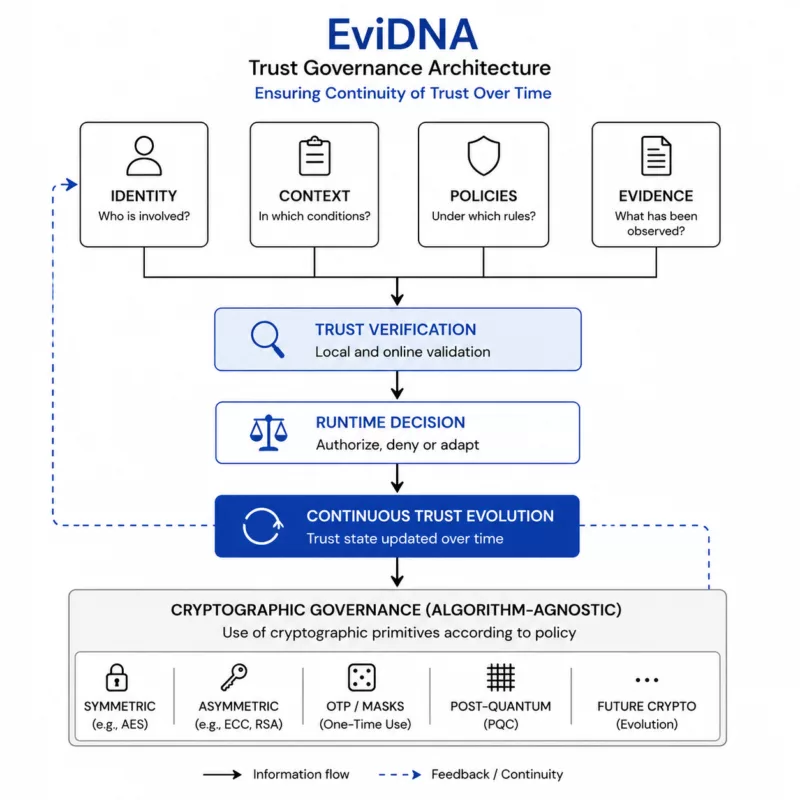
In the context of this thesis, the expression “cryptographic genome” does not refer to biological DNA, nor to a direct exploitation of biometric data, nor to a form of DNA computing. Nor does it refer to a new fundamental cryptographic building block intended to replace existing standards, encryption algorithms, signature mechanisms, PKIs, HSMs, TPMs or digital identity repositories.
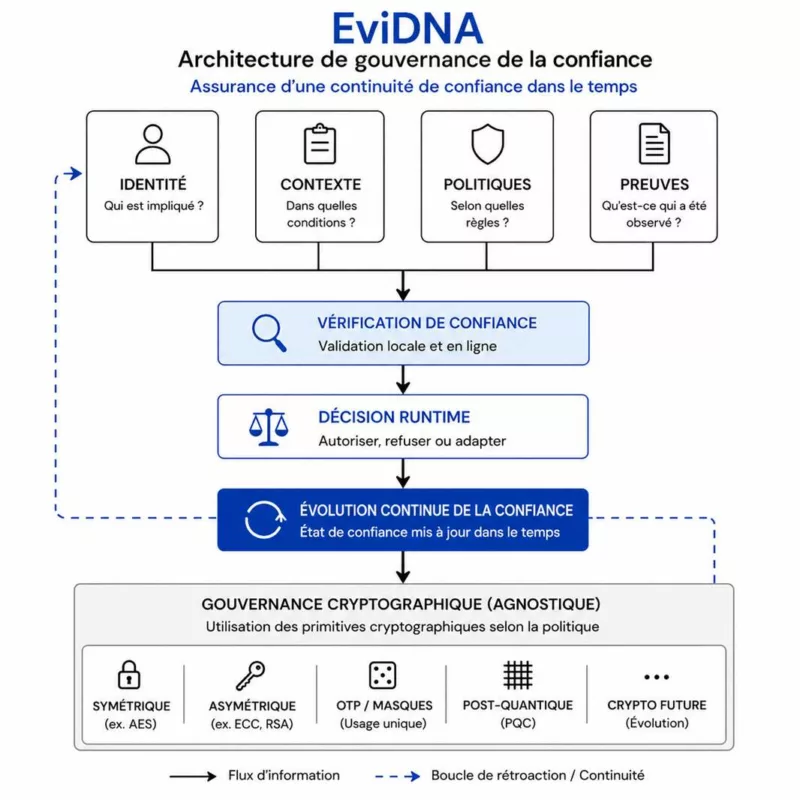
It refers to a digital trust architecture approach aimed at organizing, over time, evidence, contexts, policies, states of trust, and local and online verification mechanisms around a continuity of trust. This does not prescribe a single encryption algorithm: it is agnostic with respect to cryptographic bricks — symmetric (including OTP / single-use masks), asymmetric, post-quantum (PQC), etc. — in accordance with the governance policy. It should be understood as a structuring, governance and verifiability, and not as a substitute for existing cryptographic standards.
A first generation of this approach is already industrialized in CryptPeer via EviSKMS. It materializes, at an operational level, a segmented, locally verifiable, policy-driven, and runtime-oriented trust. This Gen1 is a return to industrialization: it demonstrates that an identity, a session, an execution context or a trusted object can be treated not as a simple static identifier, but as a controlled, reassessable and governable trust structure.
Jalon EviDNA — three-step timeline (registry A).
| Phase | Period | Content |
|---|---|---|
| 1 — Socle commercial | 2017 → | QR chiffré + NFC sur M24LR 64K NFC (STMicroelectronics) — commercialisé sans couche ADN ; smartphone + papier + puce NFC |
| 1b — R& D EviDNA | 2022 | Eurosatory — primer / presentation project EviDNA (R& D) |
| 1c — Développement EviDNA | 2022–2024 | Compatibilité ST25 64K NFC ; couche ADN (EviDNA) |
| 2 — Defense + DNA humain | 2024 → | Eurosatory Lab — DataShielder Defense NFC HSM industrialisé ; divulgation mai–juin 2024 (§1.9) |
| 3 — DNA Digital + génome | 2024–2026 | Eurosatory 2026 — industrialisation CryptPeer/EviSKMS ; TPM/vTPM |
Synthetic chronology (text schema, register A).
2017 ──► QR chiffré + NFC M24LR (commercial, sans couche ADN)
           │
2022 ────► Eurosatory — seed / EviDNA project (R& D)
           │
2022-24 ─► ST25 64K +EviDNA Development
           │
2024 ────► Eurosatory Lab — DataShielder Defense NFC HSM (industrialisé)
           │
2024-26 ─► Digital DNA + giscryptographique name
           │
2026 ────► Eurosatory — CryptPeer/EviSKMS industrialisé · TPM/vTPM
Defense / EviDNA detail: §1.11 · Product Proof§1.10. Digital DNA / CryptPeer 2026: §1.7.
To preserve scientific rigor, the qualification of industrialized Gen1 must remain attached to observable elements: code, frozen contracts, tests, runtime flows, implementation logs, technical documentation or product integration. Unpublished implementation details are not set out in this supplementary brief.
1.1. Non-sensitive level of evidence and Gen1</h4 industrialization perimeter> This subsection is part of the same methodological logic: it does not aim to impose recognition by personal authority, but to link an inventor’s intuition to verifiable, non-sensitive and observable elements. The weak and strong signals identified in the field serve here as raw material for a cautious scientific formalization, without enabling disclosure of internal mechanisms.
This thesis does not seek to publish the internal mechanisms of the cryptographic genome. It establishes its scientific and industrial positioning: a segmented, local, temporal and governable digital trust architecture, whose Gen1 and Gen2 are industrialized in CryptPeer via EviSKMS.
In order to avoid any enabling technical disclosure, the evidence mentioned below is formulated at a non-sensitive level. They indicate the scope of industrialization without exposing the detailed mechanisms, internal structures, operational formats, verification sequences or transition rules.
Patented, publishable parentage. The principle of segmented key and conditional reconstitution of trust can be publicly cited under the international patent WO/2018/154258 (FR3063365 B1, EP3586258, US20210136579, CN110402440, JP2020508533, KR1020190120317). This foundation covers segmentation, physical proximity, token, ephemeral volatile memory, segment governance and a variant of the invention — the scrambling module of authentication data — without allowing the disclosure of post-patent extensions not yet registered (genome, detailed EviDNA, advanced runtime).
1.1.1. Jamming module — public variant of patent (WO/2018/154258)
The granted international patent WO/2018/154258 (FR3063365 B1, EP3586258B1) describes, in addition to the segmented key, a variant of the invention relating to a scrambling module authentication data. This mechanism is freely accessible in the public description of the title: when typing on an untrusted channel (keyboard, interface, clipboard), additional characters are inserted at predetermined positions known to the legitimate user, who removes them before transmission. The documented objective is to reduce the exposure of the real secret in the face of a keylogger or any direct observation of the input surface.
Cryptographic positioning (ledger A). This module is not an OTP/Vernam schema: it protects the transient representation of the secret at the time of input, not the content of an encrypted message.
Limits and C.</strong registry> Any auto-extension, runtime generalization, or correlation with EviDNA, cryptographic genome, or EviSKMS falls under the C registry as long as no additional repositories are secured. This paragraph is limited to the variant of the issued title.
Classification legend: A = possible audience in the memory · B = confidential (private file, audit under NDA) · C = reserved IP (before filing or validation by patent advisors).
| Observed Element | Status | Type de preuve | Non-sensitive functional description | Maturité | Classification | Synthesis |
|---|---|---|---|---|---|---|
| Brevet clé segmentée | documented · Issued | brevet · documentation | International FR3063365 / WO2018154258 Family: Peering Key Segmentation, Physical Proximity, Conditional Status, Token, and Protected Credentials | Industrialized (granted title) | A | “The architecture is based on the international patent Segmented Key Authentication System, extended in EviSKMS.” |
| Module de brouillage | documented · issued (patent variant) | brevet · documentation | Variant WO2018154258: Insertion of decoy characters at predetermined positions during input; Documented patented variant (without automatic extension) (§1.1.1) | Documented (public patent) · architectural extension | A (patented principle) / C (procedural shunting) | “The patent describes an anti-keylogger jamming module; The patented variant covers manual jamming on input. |
| CryptPeer | implemented · Tested · Integrated product | code · Test · Documentation · deployment | Sovereign collaborative platform: license, E2EE, admin, local or Internet transport, packaging and runbooks | Industrialisé | A | “CryptPeer is an industrialized application based on EviSKMS.” |
| EviSKMS Runtime | implemented · Tested · Documented | code · Test · Product integration | Trust Runtime consumed by CryptPeer: Startup enforcement, state projections, architectural freeze | Industrialisé | A / C (Core) | “The product runs in an EviSKMS trusted runtime.” |
| Runtime Integrity | implemented · Tested · Integrated product | code · test · journal | Runtime health references, append-only local anchor, fail-closed operator projection | Industrialisé | A / B / C | “Runtime integrity is embodied in verifiable references and traceable local anchoring.” · Runtime Integrity (site) |
| DRT | implemented · Tested · Integrated product | code · Test · Contract | Distributed Runtime Trust Check on Startup, Persistence Continuity, Restart Tests | Industrialized (integration) | A / C (gate Core) | “CryptPeer has a built-in DRT check at startup with documented v1 freeze.” |
| RSCC | implemented · Tested · Documented | code · test | Posture-integrated sovereign runtime configuration certificate | Integrated | A / C | “A sovereign runtime certificate accompanies the operational posture.” |
| Confiance segmentée | implemented · Tested · Integrated product | code · Testing · brevet | Optional software and hardware segmentation; Patent filiation WO2018154258 | Integrated/Industrialized | A (principe) / C (recomposition) | “Trust is segmented between a sovereign software base and optional hardware reinforcements.” |
| Vérification locale | implemented · tested | code · test · runtime | Doctors operator, log string integrity, readiness without network required | Industrialisé | A | “Local controls validate cryptographic status before mining.” |
| Continuité runtime | implemented · Tested · Documented | code · test · journal | State Persistence, Regression Detection, Sovereign Backup/Restore | Integrated | A / C | “Runtime trust continuity is monitored across sessions.” |
| Politiques fail-closed | implemented · Tested · Documented | code · test · documentation | Default deny on startup, authentication, and sensitive modes | Industrialisé | A | “The fail-closed doctrine applies to critical surfaces.” |
| Anti-rejeu | implemented · Tested · Integrated product | code · Test · Schema | License, API and passwordless protection by nonces and atomic consumption | Industrialisé | A / B | “Anti-replay guardrails cover sensitive surfaces.” |
| Crypto Governance | implemented · Tested · Documented | documentation · code · test | Gel release, profils crypto, supply-chain licence E2E, coffre de confiance | Industrialisé | A | “Crypto governance combines release freeze and supply-chain acceptance.” |
| Preuves composées | implemented · tested | code · test | Converge heterogeneous signals into a verifiable snapshot without misleading promotion | Integrated | A / C | “Heterogeneous evidence is converged into a composite state of trust.” |
| Journaux / ledger / traces | implemented · Tested · Integrated product | code · test · journal | License (DB) logs, JSONL lineage, fingerprint snapshots, passwordless audit, and RI | Industrialisé | A | “Traceability is based on chained newspapers with distinct roles.” |
| Passwordless Freemindtronic | implemented · Tested · gel V1.1 | code · Test · Product integration | Passwordless Authentication, Trusted Terminal, Local Sovereign Mode | Industrialisé | A / C | “A sovereign passwordless mode is qualified and frozen for documented local execution.” |
| DDNA Gen1 | implemented · Tested · Integrated product | code · test | Category-normalized footprints, with no raw data in transit | Integrated | A (categories) / C | “The Gen1 base materializes identity proofs by standardized fingerprints.” |
| Trust Identity | implemented · Tested · Integrated product | code · test | Verifiable Cryptographic Identity Integrated into the Product | Integrated | A / C | “Each actor has a verifiable identity of trust.” |
| Tests sécurité | tested · Documented | test · documentation | Automated Security Test Campaign (Unpublished Volume) | Industrialisé | A | “An automated security testing campaign covers trust mechanisms.” |
| Sovereign Deployment | implemented · Documented | configuration · documentation | Docker souverain, agent TPM isolé optionnel, transport sovereign-local, runbooks FQC | Integrated/Industrialized | A | “Deployment artifacts accompany controlled release.” |
| SVTM | implemented · Tested · frozen | test · documentation | Runtime official sovereign software by default; Optional Hardware | Industrialisé | A | “The sovereign software runtime is the default operational foundation.” |
| Transport sovereign-local | implemented · Tested · frozen V1 | code · test · runtime | TLS local, gateway HTTPS/WSS, PKI locale, services runtime locaux | Industrialisé | A / B | “A sovereign local execution mode provides TLS and runtime services without required internet.” |
| Advanced Truth Assessment Module | implemented · tested | code · test | Conjunctival evaluation of high criteria; Safeguards against unsubstantiated insurance claims | Integrated | A / C | “A high-level truth module arbitrates maximum assurance claims.” |
| Gen2 / genome avancé | implemented · Integrated product | code · test · documentation | Gen2 Genomic Extensions in CryptPeer/EviSKMS; detailed mechanisms in register C | Industrialisé | A / C | Gen2 Genome Extensions Operational in CryptPeer |
This matrix does not purport to be a complete technical publication. It establishes a level of maturity that can be read by the scientific reader: the Gen1 and the Gen2 are industrialized in CryptPeer, anchored on an international patent issued for segmentation; the detailed mechanisms of Gen2 fall under the C register.
Full scientific recognition of this approach will require additional publications, intellectual property filings when necessary, as well as comparative evaluations documenting its contributions to traditional authentication, passwordless, PKI, access control and runtime trust mechanisms.
1.2. Towards controlled scientific recognition: evidence, comparisons and publication after PI</h4 securitization> The full scientific recognition of this approach presupposes a complementary step, carried out after securing intellectual property when necessary. This stage will have to articulate three levels: non-sensitive evidence of industrialization, structured comparisons with the state of the art and controlled publication. A first appendix of non-sensitive evidence, resulting from a local analysis of the EviSKMS-CryptPeer repository, now makes it possible to document this first level without exposing the internal mechanisms protected.
Non-sensitive evidence will be able to document the existence of operational implementation without disclosing the protected internal mechanisms. They may include product scope, functional architecture, maturity levels, usage scenarios, general flows, test categories, trust policies, execution logs, and validation criteria.
Comparisons will have to situate the Freemindtronic approach in relation to the existing mechanisms of authentication, passwordless, PKI, HSM, TPM, Zero Trust, WebAuthn/FIDO externally, machine identity, IoT and runtime trust. The objective will not be to replace them with affirmation, but to show where the genomics approach to digital trust brings a different layer: segmentation, local verification, temporal continuity, contextual governance and reassessment of the level of trust. A first comparative document matrix is proposed in §1.4.
The controlled publication can then take the form of a position paper, a scientific white paper, an evaluation report or a documented demonstrator. It should remain non-enabling until intellectual property protections are finalized, while providing sufficient elements to allow scientific discussion: problem addressed, hypotheses, scope, comparison, limitations, use cases and evaluation protocol.
Publication doctrine (register A). This thesis deliberately adopts a controlled publication logic: it documents scientific subject-matter, prior art, state-of-the-art comparisons and evidence of industrialization observable, without disclosing the internal mechanisms that may be the subject of complementary patent filings. This applies in particular to the advanced implementation in CryptPeer/EviSKMS, where only functional effects, architecture principles, and non-sensitive elements are exposed. The rules of derivation, transition, genomic correlation, internal formats and operating parameters remain in the B or C register. Detail: §1.12.
This trajectory makes it possible to clearly distinguish three registers: what is already industrialized, what can be made public without risk to intellectual property, and what must remain reserved for deposits, confidential annexes or evaluations under confidentiality agreements. It thus avoids two opposing pitfalls: an unproven assertion of innovation, or a premature disclosure of protected technical mechanisms.
The Gen2 is implemented in CryptPeer via EviSKMS. It extends the Gen1 trajectory towards an evolving, contextual, memory and verifiable digital identity over time. The detailed technical mechanisms fall under the C registry and are not disclosed in this supplementary submission.
The emergence of predictive artificial intelligence makes this development particularly important. Attacks are no longer just about isolated passwords or certificates. They can target identity continuities: progressive spoofing, deepfakes, session compromise, hijacking of AI agents, cloning of connected objects, context alteration, memory poisoning or behavioral manipulation.
Faced with these risks, one-time authentication becomes insufficient. A future identity architecture will need to verify not only what an entity knows, owns, or is, but also the context in which it operates, the consistency of its interactions, the governance of its rights, the continuity of its evidence, and the reassessment of its level of trust over time.
The cryptographic genome thus constitutes a two-stage trajectory: a Gen1 and a Gen2 industrialized in CryptPeer via EviSKMS. Gen1 embodies segmented, local and runtime-governed trust; Gen2 extends this approach to an evolving and contextual identity. Gen2 technical details are protected when they are likely to fall under additional intellectual property protections.
This approach should be thought of as distinct from the FIDO/Passkeys mechanisms, which Freemindtronic does not use as a foundation of trust. It can be situated in relation to existing repositories—NIST SP 800-63-4, Zero Trust, ETSI EN 303 645, Cyber Resilience Act, and, for external comparison, WebAuthn/FIDO—but not limited to or dependent on it.
Freemindtronic is also developing its own passwordless approach, based on EviSKMS and the Gen2 evolution. In order to preserve current or future intellectual property protections, this brief does not disclose the detailed technical mechanisms.
The public positioning can nevertheless be formulated as follows: this digital trusted genomic technology aims for a segmented, local, temporal and verifiable approach to identity and authentication. It is intended to apply to many contexts where it becomes necessary to establish, maintain or reassess a trusted identity: humans, connected objects, software agents, digital services, cyber-physical environments, critical access, secure exchanges and runtime continuity.
Its interest lies in the fact that it no longer considers identity as a simple one-off authentication event, but as a continuity of trust that is evolving, governable and verifiable over time. This orientation becomes especially important in contexts where traditional passwordless mechanisms and traditional authentication are becoming insufficient in the face of predictive AI, autonomous agents, synthetic identities, session compromises, and behavioral attacks.
This perspective is in line with the general axis of this thesis: predictive AI transforms the conditions of trust. The more systems become capable of anticipating, acting and adapting, the more identity itself must become reassessable, memorial, contextual, verifiable and governable over time.
1.3. EviSKMS-CryptPeer</h4 industrialization proof-of-the-mill summary> A synthesis of evidence of industrialization was established from a local analysis of the EviSKMS-CryptPeer repository. It does not reproduce any source code, pseudo-code, operational format, verification sequence, transition rule or repeatable mechanism. Its goal is to provide the scientific reader with proof of existence and maturity, without enabling disclosure.
This appendix confirms that CryptPeer is an integration and operational governance layer aligned with EviSKMS. It documents, at a high level, the existence of a trusted runtime, Runtime Integrity controls, DRT continuity, sovereign runtime certificate (RSCC), fail-closed policies, anti-replay guardrails, chained logs, cryptographic governance, compound proofs, frozen sovereign passwordless mode V1.1, DDNA Gen1 foundation, automated security testing campaign, and sovereign deployment artifacts.
Filiation brevete. The observable industrialization is in line with the international patent Segmented Key Authentication System (WO/2018/154258, FR3063365 B1). This title allows for the public disclosure, without weakening the residual IP, of the principles of segmented key, physical proximity, conditional reconstruction, protection of authentication data and the variant of the jamming module (§1.1.1) — the foundation on which EviSKMS and CryptPeer have been industrialized. The extensions genomic Gen2, the engine DRT complete, the convergence multi-criteria advanced, and non-patented internal mechanisms remain outside the public perimeter.
The scientific value of this synthesis does not lie in the disclosure of internal mechanisms, but in the methodological distinction between three registers:
| Registre | Definition | Formulatable examples in the dissertation |
|---|---|---|
| A — Public possible | Verifiable elements or already covered by a granted patent; High-level formulation without reproduction | Patented segmentation, fail-closed, integrated RI/RSCC/DRT existence, Gen1 (high-level) standardized fingerprints, testing and deployment |
| B — Confidentiel | Evidence to be kept as a private appendix, client file or audit under NDA | Operational Runbooks, Red Team Scenarios, Operator Topologies, Enrollment Procedures |
| C — Réservé PI | Elements to be protected before technical publication or supplementary filing | Gen2, Fingerprint Normalization (Internal Detail), Runtime Continuity Engine (Internal), Convergence, Runtime Signature (Internal), Secondary Segment Recomposition |
Disclosure perimeters (text schema).
                    ┌─────────────────────────────────────┐
                    │ C — Reserved PI │
                    │ Gen2, Continuity Engine (internal), runtime extensions (internal) │
                    │ passwordless, genome transitions │
                    │  ┌───────────────────────────────┐  │
                    │ │ B — Confidential / NDA │ │
                    │  │ runbooks, red team, code privé│  │
                    │  │ ┌─────────────────────────┐   │  │
                    │ │ │ A — Public (memory) │ │ │
                    │  │ │ brevet, fail-closed,    │   │  │
                    │ │ │ │ High-level events │ │ │
                    │  │ └─────────────────────────┘   │  │
                    │  └───────────────────────────────┘  │
                    └─────────────────────────────────────┘
EviSKMS–CryptPeer Stacking (Text Schema, A Register).
Applications / opérateur
        │
        ▼
CryptPeer — governance, integration, sovereign deployment
        │
        ▼
EviSKMS runtime ──┬── Runtime Integrity (RI) / RSCC
                  ├── DRT (continuity of trust)
                  ├── DDNA Gen1 (empreintes normalisées)
                  ├── Passwordless V1.1 (sovereign-local)
                  └── Fail-closed · Anti-Replay · chained newspapers
        │
        ▼
Hardware Anchor: TPM / vTPM (2026) — segments, policies
Directly usable public evidence (Registry A): EviSKMS–CryptPeer architecture; software-sovereign-first ecosystem gel; Runtime Integrity and RSCC as posture artifacts; built-in DRT continuity; multi-surface anti-replay; Logs with separate rolls. passwordless V1.1 qualified sovereign-local; DDNA Gen1 by standardized impressions; security test campaign; Filiation patent WO2018154258.
Do not publish: code, pseudocode, canonical payloads, check sequences, transition rules, red team fixtures, secondary segment details, advanced multi-criteria composition, Gen2.
This separation supports the credibility of the brief — and the associated industry communications — without turning the public document into a technical reproduction record. It establishes that the Gen1 of the cryptographic genome has a double anchor: an international patent granted on segmentation, and industrialization observable in CryptPeer via EviSKMS.
The exact scope of this evidence is deliberately limited: it does not constitute independent scientific validation or peer review. However, it constitutes a sufficient documentary basis for a controlled publication, a white paper, an evaluation report or a client file, after securing the patentable elements that have not yet been filed. The limits and conditions of falsifiability of the brief specify what this proof does not establish.
1.4. Structured comparison — digital trust and identity
This subsection responds to the need, formulated in §1.2, of an explicit comparison with the state of the art in terms of digital trust. It is not a quantified performance benchmark, nor a third-party audit, but a documentary positioning at a non-enabling level.
Scope compared. The following are compared, at a high level: WebAuthn / FIDO / Passkeys (external comparison — Freemindtronic does not use FIDO as a trust base), PKI / X.509, Zero Trust (NIST framework), HSM / TPM, OAuth / Federated OIDC, and EviSKMS Gen1 / CryptPeer as documented in the A</strong register> in this supplementary submission and the Appendix C.
Qualitative rating: Low · Medium · Strong · Very strong · N/A (not applicable to the perimeter).
| Critère | WebAuthn / FIDO | PKI / X.509 | Zero Trust (cadre) | HSM / TPM | OAuth / OIDC | EviSKMS Gen1 / CryptPeer |
|---|---|---|---|---|---|---|
| Strong Authentication Spot | Very strong | Fort | Medium (frame) | N/A | Fort | Fort |
| Continuous Trust over time | Faible | Faible | Moyen | Faible | Faible | Fort |
| Trust Segmentation | Faible | Moyen | Moyen | Fort | Faible | Very strong |
| Conditional Trust | Faible | Faible | Faible | Moyen | Faible | Fort (filiation brevet WO2018154258) |
| Sovereign Local Verification (without cloud required) | Moyen | Moyen | Faible | Fort | Faible | Very strong |
| Verifiable Runtime Integrity | Faible | Faible | Moyen | Moyen | Faible | Fort |
| Runtime fail-closed policy | Faible | Faible | Moyen | Moyen | Faible | Fort |
| Anti-rejeu multi-surface (licence, API, auth) | Faible | Moyen | Moyen | Faible | Moyen | Fort |
| Role-Complementary Trusted Logs | Faible | Moyen | Moyen | Faible | Faible | Fort |
| Machine Identity / IoT / Agent (General Framework) | Faible | Moyen | Moyen | Moyen | Moyen | Moyen (Gen1/Gen2 — continuité temporelle) |
| Broad Ecosystem Interoperability | Very strong | Very strong | Fort | Fort | Very strong | Low/medium |
| Standardisation normative mature | Very strong | Very strong | Fort | Fort | Very strong | Low (proprietary, patent granted) |
| Documented Evidence of Public Industrialization (2026) | Fort | Very strong | Fort | Fort | Very strong | Means (non-sensitive annex, not to that third party) |
Methodological reading. This table does not classify EviSKMS as “superior” on all axes. It shows a difference in function:
- FIDO/OAuth/PKI excel at interoperability, standardization and large-scale one-time authentication
- Zero Trust provides a framework for governance and policies, but is not a local sovereign trust runtime on its own.
- HSM / TPM reinforce the material anchor, often in addition to other layers.
- EviSKMS Gen1 aims for an layer additive: trust segmented, continuous over time, verifiable locally and governed to the runtime, as an extension of the segmented key patent — at the cost of less immediate interoperability and independent scientific validation still to be conducted.
What the comparison does not establish. It does not demonstrate the operational superiority of EviSKMS over FIDO or PKI in all contexts. It does not replace comparative numerical trials, published red team campaigns or certification. It situates the Freemindtronic positioning for a structured scientific and industrial discussion.
1.5. Cryptographic genome vs. point identity (time T)
Verification of the distinction. Recent institutional work on synthetic DNA and OTP (CNRS communication April 2026, HAL hal-05560338) describe a protocol where two correspondents have identical copies of synthetic DNA sequences, then just before a communication select and sequence fragments to produce a common binary key at time T — key distribution logic synchronized to an event, not a identity architecture evolving over time. The classic authentication mechanisms (password, certificate, WebAuthn, point biometrics) obey the same functional structure: prove “it’s me” at the moment T, then grant or deny access.
The Freemindtronic cryptographic genome is part of a different technical object: a digital trust architecture that organizes, over time, proofs, contexts, policies, runtime states, normalized fingerprints (DDNA Gen1), session continuity, fail-closed reevaluation and — in Gen2 — contextual identity, Memory and governable. This is not a marketing metaphor for molecular DNA: the expression refers to a procedural structuring of trust (segments, inheritances, dependencies, traceability), publicly formalized in this thesis and initiated by EviDNA (2024) then ADN Digital (2026).
| Dimension | Instant Authentication / OTP (generic, incl. Synthetic DNA OTP 2026) | Génome cryptographique Freemindtronic (Gen1/Gen2) |
|---|---|---|
| Horizon temporel | Point event: Evidence or key at time T | Continuity: reassessable trust between T₀ and Tn |
| Protected Object | Message, Session, or Immediate Access | Trusted Identity, Mission, Runtime, Trajectory |
| Rôle de l’ADN | Molecular material source of shared entropy, synchronized at time T (CNRS 2026) | EviDNA (2024): human profile, trusted material (detail of B/C register); Digital DNA/genome (2024–2026) |
| Proof of implementation | Experimental protocol / application for academic patents | Sources publiques 2024 + dépôt GitHub privé DataShielderHSM (registre B) · Gen1 CryptPeer 2026 |
Time horizon: time T vs continuity (text diagram).
 punctual auth / CNRS OTP (time T) Cryptographic genome (continuity)
────────────────────────────────────          ────────────────────────────────────

    T₀ T₀ T₁ T₂ Tn
     │                                                │         │         │         │
 [Proof] ──► Granted or refused?       [Confidence inValuable ─────────────►]
     │                                                │
     ✕ (end of event) fail-closed · DDNA · DRT · segments
Synthèse. This precise distinction between distinct technical objects: the CNRS mobilizes synthetic DNA to a single scheme (OTP/Vernam at a given time); The Freemindtronic trajectory can also produce OTP keys, but in a broader architecture — segmented and continuous trust over time, with interchangeable mechanisms. The Freemindtronic Public Disclosures (2018–2026), the online submission (freemindtronic.com) and the patent WO/2018/154258 are elements of documented prior art on this trajectory. For the CNRS approach as publicly formulated, see §1.6.
1.6. Documentary synthesis — CNRS DNA cryptography (external reference, register A)
Status. This subsection does not claim any authorship on CNRS work. It faithfully transcribes, for documentary comparison purposes, what third-party public sources (institutional popularization video, press release of 01/04/2026, preprint HAL hal-05560338) describe the Franco-Japanese “DNA cryptography” approach. Freemindtronic welcomes this research and reminds us that the technical objects differ from EviDNA (2024) and the cryptographic genome (2026).
What the corporate video exposes (non-empowering summary).
A Franco-Japanese team (Gulliver, CNRS/ESPCI Paris — PSL laboratory: Matthieu Labousse, Yannick Rondelez; XLIM, University of Limoges: Philippe Gaborit; partner University of Tokyo) presents cryptography by DNA as a new chapter in the The history of encryption.
- Material. The DNA here is fully synthetic produced outside of any biological process. Four bases A, T, C, G form a “quaternary language” analogous to the binary (0/1): an ordered sequence encode information.
- Cryptographic property sought. Synthesis is used to generate statistically random sequences — source of entropy for cryptography.
- Encryption scheme. The protocol chosen is the (OTP — One-Time Pad): a random mask, as long as the message, used once; combined with the binary message to encrypt; recombined on the recipient side to decrypt. Theoretical safety is based on the randomness of the mask.
- Role of the molecule (explicit video wording). The synthesized DNA molecule does not contain the message: it carries the future encryption key. Two identical samples are prepared (Tokyo / France demonstration); Each matching sequence their sample just before the communication to get the same binary key.
- Operational chain. Sequencing (reading nanopore: differential current per base A/T/C/G) → software reading of the ATGC sequence → conversion to binary → encryption of the digital message in France → sending of the encrypted message (e.g. email) → decryption in Japan with the identical key.
- Applications mentioned. Critical communications: defense, diplomacy, patents, financial exchanges; so-called “unconditional” security in the sense of OTP.
CNRS Operational Chain — Molecular OTP (text diagram, public sources).
 random synthetic DNA
        │
        ▼
Duplication ──► copy France ════ Japan copy
        │
        ▼  (just before the message)
Nanopore sequencing (×2) ──► IdenticalATGC sequence
        │
        ▼
ATGC → binary → OTP mask (|mask| = |message|)
        │
        ▼
Message ⊕ Mask ──► Channel (e.g. email) ──► Encryption ⊕ samemask
Advantages and disadvantages of Vernam encryption (literature review of a classical scheme, register A). The protocol adopted by the CNRS is based on the Vernam encryption (One-Time Pad), the properties of which have been established in the cryptographic literature since the work of Claude Shannon (1949). This reminder, which is unrelated to the Freemindtronic mechanisms, sheds light on the trade-offs of the institutional scheme.
Avantages.
- Perfect secret proved (perfect secrecy, Shannon): Under its three conditions, the cipher alone does not reveal none information about the clear message.
- Resistance to any computing power, including a future quantum computer: security is informational, non-computational.
- Simplicity of operation: The encryption is reduced to a bitwise XOR between message and mask.
Disadvantages (structural constraints).
- Key as long as the message: encrypting n bytes requires n bytes of mask — hence a storage and distribution cost proportional to the volume exchanged (the press release mentions messages up to several hundred megabytes, so as much key material).
- Strictly one-time use: Any reuse of a mask breaks the perfect secret (encryption correlation attack).
- Distribution and synchronization of the mask: both correspondents must have a identical and secret mask before the exchange — this is the central problem that the molecular chain (DNA duplication, physical transport, sequencing “moment T”) seeks precisely to solve.
- Perfect random required: Any statistical bias of the mask degrades the theoretical guarantee.
- Lack of intrinsic authentication and integrity: the Vernam cipher but does not prove the origin or non-alteration of the message; it must be supplemented by separate mechanisms (MAC, signatures).
These properties explain why the OTP, although theoretically optimal, remains operationally demanding and lends itself above all to punctual critical communications — a framework claimed by CNRS sources. They also shed light on the cross-reading of §1.6.1: a cryptographically monolithic scheme (an imposed mechanism) is opposed to an agnostic layer admitting several mechanisms depending on the policy.
Vernam Principle / OTP (text schema, classical cryptography).
Émetteur                              Destinataire
────────                              ────────────
clear message (M) encrypted message (C)
random mask (K) ── channel ──► samemask (K)
     │                                      │
     ▼                                      ▼
C = M ⊕ K                            M = C ⊕ K

Conditions: |K| ≥ |M|  ;  K used only once;  K perfectly random
Three “DNA” trajectories — distinct technical objects (text diagram).
         ┌──────────────────┬──────────────────────┬─────────────────────────┐
         │ CNRS 2026 │ EviDNA 2024 │ Genome / Digital DNA │
         │ (réf. externe)   │ (Freemindtronic)     │ 2026 (Freemindtronic)   │
├────────┼──────────────────┼──────────────────────┼─────────────────────────┤
 Source │ Synthetic DNA │ Human DNA Profile │ Procedural Generator │
 Secret │ Tube + Sequencing │ NFC + Paper QR │ TPM/vTPM + runtime │
 Crypto │ Vernam/OTP only │ mechanisms according to policy* │ PQC agnostic layer* │
 Time │ Instant T │ Enrollment + session │ T₀ → Tn (continuity) │
└────────┴──────────────────┴──────────────────────┴─────────────────────────┘
         * OTPs and other mechanisms according to policy — not imposed as a single scheme
What the CNRS press release (01/04/2026) adds. Preparation of duplicated DNA sets of synthetic origin; just before communication key generation by sequencing; Messages up to several hundred megabytes demonstration during the presidential trip to Japan; HAL title: Synchronized DNA sources for unconditionally secure cryptography (Jaudou, Gasnier, Boudjella, et al.).
| Dimension | CNRS 2026 (video + HAL, external ref) | EviDNA Freemindtronic (2024, registre A) | Génome / ADN Digital Freemindtronic (2026) |
|---|---|---|---|
| Nature de l’ADN | synthetic, random, no biological connection with living DNA | Human DNA profile imported (structured file) | Generalized DNA Digital procedure; Gen1/Gen2</td governance> |
| Finalité cryptographique | Distribution of symmetrical OTP/Vernam masks (unique) | Trusted material derived from a DNA</strong profile> (detail B/C register); Standard Mechanisms according to Policy | Segmented trust runtime, continuity, DDNA, fail-closed; OTP and other mechanisms according to governance |
| Moment d’usage | Sequencing and key at time T, before a message | Shunt to enrollment; Sharing on demand; Encrypted session | Re-evaluation of trust between T₀ and Tn |
| Support du secret | Duplicated physical molecule (tube, transport) | M24LR 64K (2017) · ST25 64K (2022–2024) — chiffré STMicroelectronics</td token> | TPM / vTPM (2026) — segments, policies, fingerprints (CryptPeer) |
| Remote Sharing | Physical transport of a DNA</td sample> | encrypted QR: Paper, email, display — key on NFC only | EviSKMS Distributed Governance (CryptPeer) |
| Support papier | No (tube molecule) | A4 printing: 16 QR × 2,331 car. Unicode; zero trace of the secret on paper | Beyond Paper (Runtime, Continuity) |
| Message dans l’ADN ? | No (key only — video) | No (key → profile, not the plaintext) | No (procedural metaphor, not molecular storage) |
| Random generation modality | Statistically random molecular DNA synthesis; enzyme duplication; nanopore sequencing at time T; ATGC → binary</td conversion> | Derivation from an imported human DNA profile (enrollment) | Procedural generator governed by the cryptographic genome (structural inspiration of living things: segments, continuity) — without molecular synthesis |
| Operational Complexity (Registry A) | High: laboratory, sequencing machines, physical transport of samples, biological constraints (noise, bias, interception detection — third-party sources); France-Japan proof of concept | Moderate: smartphone + NFC + QR; Three documented actions | Weak carrier-side post-configuration (import certificates initial, then transparent — §1.7) |
| Architectural complexity | Moderate at the cryptographic level (OTP/Vernam, single schema); Complexity driven by the molecular chain | Product Layer + PKI + RSA/QR</td Share> | High: segmented trust, runtime, time continuity, fail-closed; interchangeable cryptographic bricks |
| fundamental cryptographic brick | Vernam/OTP exclusively (CNRS protocol constraint) | AES-256 CBC, RSA 4096, ECC, OTP (exemples documentés) | Layer agnostic: OTP and any encryption or signature algorithms that are acceptable under the policy — including PQC |
| Freemindtronic public ance | Post-EviDNA 2024 | May–June 2024 (web + videos §1.9) | July 2026 (memory, Digital DNA) |
Read-across (register A, without legal advice). The CNRS video confirms that the 2026 institutional approach is focused on molecular OTP: random synthetic DNA → Vernam mask → physical synchronization of two copies → point sequencing. EviDNA (2024) previously documented another invention: DataShielder Defense NFC HSM product using a human DNA profile (technical detail B/C register). The cryptographic genome and the ADN Digital (2024–2026) extend a third trajectory: time-trusted architecture, beyond the distribution of keys at a given time. The three axes share the word “DNA” but do not cover the same technical object. For the analysis of the generation of randomness and operational complexity respectively, see §1.6.1.
1.6.1. Random Generation and Operational Complexity — Comparative Reading (A-Register)
Purpose of this subsection. Check, using public sources only, whether the two trajectories use comparable of random generation and similar levels of operational complexity. This analysis does not constitute a value judgment on the scientific quality of CNRS work; It specifies distinct technical dimensions useful for cross-reading the dissertation.
What CNRS sources document (April 2026). The Franco-Japanese approach aims to solve a classic constraint of the OTP/Vernam: to produce and synchronize, between distant correspondents, a key perfectly random, as long as the message and single-use. To do this, researchers are mobilizing a molecular and instrumental chain:
- Synthesis of entirely artificial DNA, whose order of bases A/T/C/G is statistically random;
- Enzymatic duplication in strictly identical copies, kept at the sender’s and recipient’s premises;
- Physical transport or pre-distribution of such samples;
- Nanopore just before communication, on both sides, to read the same sequence;
- Conversion ATGC → binary key → Vernam encryption of the digital message.
Two axes of complexity — non-interchangeable (text schema).
CNRS 2026                              Freemindtronic (ADN Digital / génome)
─────────                              ─────────────────────────────────────

OPERATIONAL COMPLEXITY OPERATIONAL COMPLEXITY
        ▲  ISLEVISE                              ▼  FAIBLE (post-config)
        │ lab · Sequencing │ Smartphone · TPM · runtime
        │ Physical transport │
        │                                      │
CRYPTO Complexity CRYPTO Complexity
        ▼ LOW (OTP only) ▲ HIGH(agnostic layer)
        │ Imposed Vernam │ Multiple mechanisms · continuity
Third-party sources (CNRS press release, IMT Atlantique, press popularization) also highlight biological and instrumental locks: sequencing noise, statistical bias in database pairing, the need to detect an interception of DNA material, sequencing machines and molecular biology protocols. At this stage, it is a proof of concept in a controlled environment, whose processing times are not intended for general public use on mobile devices.
What the Freemindtronic trajectory documents (Digital DNA/genome, registry A). The DNA Digital and the cryptographic genome do not use /strong<> molecular synthesis or biological sequencing. The expression “DNA” here refers to a procedural metaphor: an organization of trust inspired by the structural principles of the living genome (segmentation, inheritance, continuity, reevaluation over time) — without exploitation of biological DNA or DNA computing (see EviSKMS memory §29.6 on the authentication of living beings).
In this trajectory, the generation of random or pseudo-random material for the trusted identity is done by a procedural generator integrated with the cryptographic genome and governed by the EviSKMS/CryptPeer runtime. The internal mechanisms of derivation, genomic transition and digital DNA correlation → segments fall under the C register; in the A register, only the operating result is documented: after the initial import of the certificates, the usage becomes transparent for the operator (§1.7).
Comparative synthesis — two axes of complexity, not interchangeable.
| Axis | CNRS 2026 (public sources) | ADN Digital / génome Freemindtronic (registre A) |
|---|---|---|
| Source of randomness | Synthetic molecule (ATGC) read by sequencing | Software procedure governed by cryptographic genome |
| Inspiration du vivant | No link to human biological DNA; Random molecular | Genome structural inspiration (segments, continuity) — not sequencing |
| Operational Complexity | High: lab, duplication, T-sequencing, biophysical constraints | Low user-side post-configuration (smartphone/TPM, no lab) |
| Architectural complexity | Moderate cryptographic (classic OTP); Heavy weight carried by the physique | High software (continuous trust, runtime, segments, fail-closed) |
| Finalité | Symmetric OTP key at point T to encrypt a message (unique scheme) | Segmented and continuous trust over time; multiple mechanisms including OTP if required by policy |
| fundamental cryptographic brick | Vernam/OTP seul (schéma imposé) | Polymorphic: OTP, AES, RSA, ECC, PQC, etc. — the genome structures trust and key governance, not limited to a single schema |
Documentary conclusion (register A). The CNRS approach is operationally more demanding (molecular infrastructure) and cryptographically monolithic: the public protocol retains only Vernam/OTP. Freemindtronic’s DNA Digital / genome trajectory is based on a software architecture that can be industrialized, capable of producing OTP</strong keys> when the policy requires it, without limitation — and mobilizing other cryptographic bricks according to the governance policy, in a logic of continuous trust beyond the mere distribution of masks at a given time. For a mapping of the other global “DNA + security” families, see §1.6.2.
1.6.2. International mapping — “DNA + security” families and Freemindtronic distinction (Registry A)
Status. This subsection does not claim authorship on the third-party works cited. It synthesizes, from public sources (journals, preprints, research programs), a documentary taxonomy useful for locating the Freemindtronic trajectory (EviDNA, ADN Digital, cryptographic genome, CryptPeer/EviSKMS) in the face of all the global research mobilizing the “DNA” and “security” couple — including cyber, storage and molecular cryptography.
Observation Two recent syntheses (IEEE Access, 2023; iComputing, 2024) converge: the field is fragmented, poorly standardized, and often mixes — in the literature — real molecular approaches, software simulations inspired by DNA, and structural metaphors. The word “DNA” thus covers several non-interchangeable technical objects — which this thesis formalizes to avoid any confusion of authorship or reproducibility.
Seven documentary families (text schema, register A).
F1 Molecular OTP / Synchronized Entropy CNRS 2026 · ANR DNA Sec (in progress)
F2 Origami / Structural Nano Cryptography Zhang 2019 · 3D extensions (lab)
F3 Molecular Steganography Clelland 1999 · NAPDISS 2024 (Cover-Up)
F4 Pseudo-DNA software many articles · especially simulation
F5 DNA Storage + Hybrid Encryption Noise Channels · Massive archiving
F6 DNA Database Security DNA Sec Program (Theft · Tampering)
F7 Freemindtronic Procedural Genomic Cryptography 2018–2026 (≠ molecule)
| Family | Documented Representatives | Statut public | Objet technique principal | Direct relationship with Freemindtronic |
|---|---|---|---|---|
| F1 — OTP moléculaire | HAL hal-05560338 ; program ANR DNA Sec ; IMT Atlantic | France-Japan Demo 2026; ongoing</td program> | Duplicated synthetic DNA-synchronized Vernam mask + T</td sequencing> | Distinct object: Freemindtronic can produce OTP by political, without a molecular chain (§1.6.1) |
| F2 — Origami crypto | Zhang et al., Nature Communications 2019 ; extension 3D (2025) | Proofs of concept laboratory | Strand bending wrench; Combinatorial space of nano</TD structures> | Distinct: No continuous runtime trust; No documented product industrialization |
| F3 — Stéganographie | Clelland et al. (1999, history); NAPDISS nanopore (2024) | Specialized demos | Hide a message in or through DNA; Key sometimes = light or structure | Distinct: Freemindtronic does not claim the molecular concealment of plaintext |
| F4 — Pseudo-ADN | Littérature « DNA-inspired » (cf. surveys 2023–2024) | Especially simulation computer science | Biomimetic operations on simulated chains + classic crypto | Distinct: The Freemindtronic genome is a trusted architecture, not a simulation of tube</td reactions> |
| F5 — Stockage cipher | DNA storage channel work; Molecular archiving industry | Active Search; Few crypto</TD standards> | Encryption to survive the noise of the biological storage channel | Indirect complementary: Archiving problem ≠ trusted identity over time |
| F6 — Sécurité bases ADN | Objectifs ANR DNA Sec (MoleculArXiv / France 2030) | En cours | Protect molecular bases against theft, copying, forgery | Distinct: Freemindtronic does not use a physical DNA database as a foundation |
| F7 — Procédural</td genome> | Freemindtronic : brevet WO/2018/154258 ; EviDNA 2024 (sous-jalon profil humain) ; ADN Digital / génome 2026 | Industrialized (CryptPeer); Post-2018 inventions on deposit forthcoming | Trust segmented and continuous; governed procedural generator; agnostic</TD mechanisms> | Proper line: see §1.11 |
Read-across matrix — dimensions that distinguish F7 (Freemindtronic).
| Dimension | F1–F6 (third-party state of the art, synthesis) | F7 — Génome / ADN Digital Freemindtronic |
|---|---|---|
| Support matériel | Molecule, nano-structure, or purely simulated software | Software Runtime + TPM/vTPM anchor (historical NFC option) — no sequencing |
| Horizon temporel | Instant T (key, concealment) or static archiving | T₀ → Tₙ : réévaluation, fail-closed, continuité |
| Mécanisme crypto | Often unique (OTP, structure, concealment) or fixed hybrid | Polymorphic: OTP, symmetric, asymmetric, PQC — according to policy |
| Documented public implementation | Articles, academic demos, programs | Patent segmented key issued + non-sensitive product proofs (§1.3, §1.10) |
| Industrialisation grand public | Limited (lab, heavy infrastructure except F4 software) | CryptPeer/EviSKMS: initial friction certificates then transparent use (§1.7) |
| Cyber / IA prédictive | Not explicitly addressed in the molecular DNA literature | Reassessable Identity, Agents, Session Compromise — EviSKMS</td Memory Articulation> |
Indirect valuation (Ledger A, no legal opinion).
- Functional coverage. The F1–F3 families cover perfect secret distribution, structural nano and concealment, respectively. None of them publicly documents, to date, an industrialized continuous trust architecture on a terminal — the object of F7.
- OTP without exclusivity. F1 demonstrates the institutional interest of molecular OTP; F7 can use the OTP as a mechanism among others, without depending on a laboratory or imposing Vernam as a unique scheme (§1.5).
- Anteriority. The public disclosure EviDNA (May–June 2024) precedes the CNRS communication April 2026 on a different object (human profile vs. synthetic pool) — see §1.9.
- CNRS program still open. The ANR DNA Sec is also aiming at securing DNA storage databases and a nascent “molecular cryptography”: F7 responds to another problem — governing digital trust over time on sovereign software infrastructure.
- No copying, no technical convergence. No third-party public source describes the combination procedural genome + industrialized segmented key + runtime continuity + OTP/PQC</strong agnostic layer> as documented at Freemindtronic.
Authorized public implementation — patented parentage (register A). The granted patents WO/2018/154258 (segmentation) and WO/2017/129887 (local access control) allow for an strongenabling description. The CryptPeer/EviSKMS industrialization is based on this observable foundation (runtime, integrity, PKI, TPM) without exposing the mechanisms of the cryptographic genomic generator nor the inventions discovered since the formalization of the genomic cryptography system.
Segmented key post-patent inventions — register C. The following extensions are mentioned as positioning but undisclosed as long as no follow-up filing is secured: correlation DNA Digital → genomic segments; genomic transition rules; procedural derivation of trusted material; extensions Gen2 Advanced runtime couplings discovered as industrialization progresses. This thesis documents their operational effects (continuous trust, fail-closed, OTP possible by policy) — not the parameters, formats, sequences or internal algorithms allowing reproduction.
Anti-Reproduction Doctrine (Register A — editorial intent). This document is written for scientific discussion and state-of-the-art comparison, not as a reverse-engineering notice. Are deliberately absent or aggregated at a non-reconstructive level: derivation graphs, constants, transition sequences, correlation schemes between layers, and any detail equivalent to a parametric recipe of the genome generator. This omission also applies to automated processing (extraction by language models or reverse engineering pipelines): the public text must not provide, by completion or recombination, a sufficient specification to reconstruct inventions classified C. The detailed audit evidence remains in the B register (audit under NDA) or in future filing files.
Documentary conclusion (register A). The F1–F7 mapping shows that Freemindtronic occupies a family of its own (F7): cryptography genomics procedural and trust continues, industrialized, polymorphic on cryptographic mechanisms — distinct from the CNRS molecular OTP (F1), origami (F2), steganography (F3) and software pseudo-DNA (F4). The reinforce</strong comparisons> the distinction without attributing authorship to third-party works; the valuation of Freemindtronic’s trajectory is based on the public anteriority, the industrialization and the two patented titles issued to date for the documented enabling implementation (access control; segmented key).
1.7. Digital Gen1 DNA — TPM/vTPM anchor and CryptPeer user experience (2026, Registry A)
Relevance to Digital DNA and the cryptographic genome. This subsection complete the 2024–2026 trajectory: it describes how the procedural logic ADN Digital / genome Gen1 materializes in CryptPeer/EviSKMS on the operator experience side — without disclosing the mechanisms genomic shunt or transition (B/C registry).
Hardware anchor evolution (2026). In 2026, the industrialized Gen1 in CryptPeer no longer requires dedicated NFC support (M24LR / ST25): the trusted anchor is based on TPM hardware or vTPM, in continuity with the doctrine software-sovereign-first and the elements already documented in Appendix C (optional TPM agent, EviSKMS runtime) — see also EviSKMS Sovereign Runtime Anchors and EviSKMS Core Runtime (Freemindtronic publications, Registry A). The public interview Eurosatory TV (5 Jul 2026) describes, at the product level, the automatic detection of TPM and the deposition of a non-extractable genomic fingerprint in the chip — popularized formulation correlated with the A</strong registry>; the details of the fingerprint formats are the responsibility of the register C (§1.9.1). The trajectory 2017–2024 (NFC chip) and 2026 (TPM/vTPM) illustrates a generalization: from point-in-time hardware evidence to a time-governed runtime trust.
CryptPeer User Experience (Registry A, Product Level).
| Étape | Documented Behavior | User Friction |
|---|---|---|
| Mise en route terminal | Import initial of trusted certificates/hardware into the trusted terminal (PKI Runtime) | Only sticking point explicitly identified at this point |
| Exploitation locale (100 % sovereign-local) | Communication E2EE, passwordless, runtime EviSKMS — usage transparent après mise en route | Low (post-configuration) |
| Exploitation distante | TLS via Let’s Encrypt certificates (or public equivalent) for deployments that are not 100% on-premises | Weak; blind server pattern: The server does not read the content of the exchanges |
After the initial import of the certificates on the terminal, CryptPeer allows transparent use in 100% local mode; in remote mode, transport relies on Let’s Encrypt in a server blind model where the content remains end-to-end encrypted.
CryptPeer Modes of Exploitation (Text Schema, A Register).
                    ┌── Import initial certificats (friction unique)
                    ▼
              Approved Terminal
                    │
        ┌───────────┴───────────┐
        ▼                       ▼
  100 % sovereign-local    Mode distant
  E2EE · passwordless      TLS Let's Encrypt
  Transparent Blind Server Runtime (E2EE)
        │                       │
        └───────────┬───────────┘
                    ▼
        Confiance continue Gen1 (TPM/vTPM · DDNA · RI)
Limits (Registry A). Correlation details DNA Digital → genomic segments → TPM/vTPM anchor, internal formats, and transition rules fall under the C registry. This paragraph does not constitute a reproduction notice. For the published infrastructure layer (doctrine, PKI, anchors, runtime integrity), see §1.8.
1.8. EviSKMS Technology Publications (Freemindtronic.com, Register A)
Freemindtronic has published on its website four technology pages which complete this thesis on the trajectory DNA Digital / Gen1 genome / CryptPeer — without replacing the evidence appendix or disclosing any enabling mechanism (C registry). They articulate the sovereign doctrine, the PKI evidence-bound, the anchor runtime (TPM) and the integrity runtime — pillars of industrialization 2026.
| Publication | URL | Role in the Digital DNA/genome</th trajectory> |
|---|---|---|
| EviSKMS Core Runtime — Sovereign Trust Doctrine & Infrastructure | freemindtronic.com/technology/eviskms-core-runtime-sovereign-trust-doctrine-infrastructure/ | Doctrinal foundation: segmented trust, fail-closed, offline-first, sovereign orchestration — the foundation of the Gen1 cryptographic <>genome in CryptPeer |
| EviSKMS PKI Runtime — Sovereign Evidence-Bound PKI | freemindtronic.com/eviskms-pki-runtime-sovereign-evidence-bound-public-key-infrastructure/ | Segmented certificates governance, detached verification, PKI offline-capable — sheds light on the initial friction (import certificates) and then CryptPeer transparency (§1.7) |
| EviSKMS Sovereign Runtime Anchors | freemindtronic.com/eviskms-sovereign-runtime-anchors/ | Anchor TPM-assisted, forensic continuity, out of centralized dependency hardware extension 2026 (TPM/vTPM) |
| EviSKMS Sovereign Runtime Integrity | freemindtronic.com/eviskms-sovereign-runtime-integrity/ | Integrity runtime, forensic lineage, governance fail-closed — aligned Runtime Integrity and §1.3 |
Read-across memory ↔ site. The dissertation formalizes the scientific framework and the trajectory DNA / genome; Freemindtronic pages detail the industrialized sovereign trust infrastructure. Together, they document the continuity DataShielder (NFC, 2017–2024) → CryptPeer/EviSKMS (TPM, genome, 2024–2026).
1.9. Public Sources of Disclosure and Anticipation
This section lists time-stamped public disclosures prior art of Freemindtronic inventions — cryptographic genome, ADN Digital, EviDNA, segmented trust — without duplication of enabling mechanisms (A registry only). The common thread is the inventive trajectory (2018 patent → CryptPeer implementations → industrialization); The videos and web publications below are the correlated public proofs. Defense fairs (Eurosatory, etc.) are cited as contexts of disclosure, not as the main subject of the dissertation.
| Date | Jalon | Contenu public formulable | Sources |
|---|---|---|---|
| 2017 | Socle QR chiffré + NFC — commercialisé sans ADN | Puce M24LR 64K NFC (STMicroelectronics) ; impression papier, scan smartphone, clé sur support NFC | Registers B · §1.10 |
| 2016–2020 | Patent access control (local wireless) | Protected Device/Memory/Device <strong<>/strong> access; Local wireless link (NFC in implementation mode); combined factors; Path closed by default | WO/2017/129887 · FR3047099 B1 · bib. |
| 2018–2019 | Segmented Key International Patent | Key Segmentation, Conditional Reconstruction, Physical Proximity, Token, Protected Credentials | WO/2018/154258 · FR3063365 B1 · bib. |
| 2022 | Eurosatory — primer EviDNA (R& D, project presentation) | DNA Reflection + Cryptography; The trajectory starts with EviDNA | Trade Show Presentation — Freemindtronic SL</td Chain> |
| 2022–2024 | Développement EviDNA + compatibilité ST25 64K | Added ST25 64K NFC (STMicroelectronics) in addition to M24LR; EviDNA layer (human DNA profile); Internal validation 02/02/2024 | Dépôt GitHub privé Freemindtronic/DataShielderHSM (registre B) · §1.10 |
| 14 May 2024 | Eurosatory Lab — publication DataShielder Defence | Defense industrialized with DNA</td innovation> | Annonce Freemindtronic |
| 25 June 2024 | Divulgation publique EviDNA | Human DNA Demonstration; DataShielder Defense NFC HSM | Vidéo 1 · Video 2 |
| 2024–2026 | ADN Digital + génome cryptographique | Procedural generalization; TPM/vTPM anchoring (without NFC required); CryptPeer transparent post-certificates | §1.7 · §1.8 · Videos Jul 2026 |
| 5 Juil. 2026 | DNA Digital and CryptPeer genomics | Genome Generator; authentication over time; CryptPeer/EviSKMS | Video 1 — Eurosatory TV · synthesis §1.9.1 · Video 2 |
| 1er avr. 2026 | Communication CNRS — Cryptography on DNA (external reference) | DNA synthetic random; OTP/Vernam; Two physical sequenced copies just before the message. molecule = key, not the plaintext — distinct approach of EviDNA 2024 | HAL hal-05560338 · CNRS press release 01/04/2026 · §1.6 |
| juil. 2026 | Mémoire et annexe d’industrialisation | Scientific Formalization; EviSKMS-CryptPeer Evidence Matrix; Public/Confidential/IP</TD Classification> | This document · §1.3 |
| 2026 (Eurosatory) | ADN Digital / génome — industrialisation CryptPeer | Presentation of the show; Gen1/Gen2 genome in CryptPeer/EviSKMS; TPM/vTPM | §1.7 · Videos Jul 2026 |
| juil. 2026 | Thesis published online | Public Reference Predictive Intelligence Architectures / EviSKMS | freemindtronic.com — mémoire |
| 2026 | Publications technologiques EviSKMS (site Freemindtronic) | Doctrine Core Runtime ; PKI evidence-bound ; Runtime Anchors (TPM) ; Runtime Integrity | Core Runtime · PKI Runtime · Runtime Anchors · Runtime Integrity · §1.8 |
1.9.1. Interview Eurosatory TV — cryptographic genome (5 July 2026, register A)
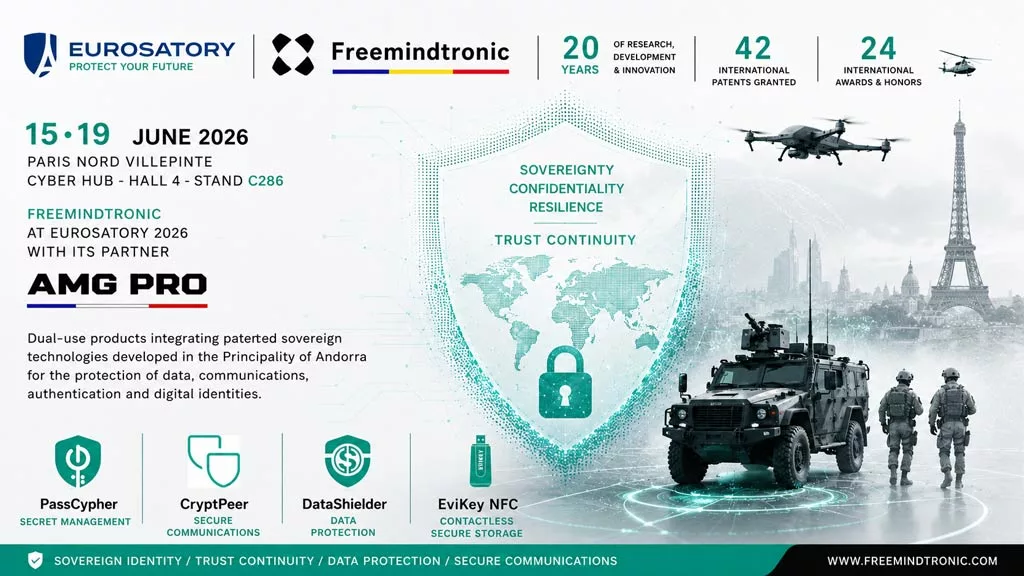
Source and rights. Public interview broadcast on the YouTube channel Eurosatory: https://www.youtube.com/watch?v=amwVAGp9LHw — Jacques Gascuel (Freemindtronic SL) and David Amsellem (AMG PRO, distribution). English subtitles (SBV lounge). This synthesis cite and structure public statements; it does not constitute not an enabling record beyond the A register. It sets out the documentary correlation between the oral disclosure at the fair and the present thesis (copyright on the inventor’s formulation; work of formalization protected).
Objet. Verify, after public broadcast, that the interview remains aligned with the formalized trajectory of the dissertation — segmentation, trust over time, ADN Digital, CryptPeer — and specify what is not disclosed (internal mapping, generator parameters, detailed DDNA formats: registry C).
Chronological synthesis (public statements).
| Period | Formulation interview | Memory Reference |
|---|---|---|
| 2022 | DNA Reflection Primer + Cryptography | §1.9 · Eurosatory project |
| 2024 | Demonstration with his own DNA | EviDNA — §1.11 |
| 2026 | Pathway genome; → AUTH, signature, encryption</TD generator> | §1.7 · F7</td family> |
Technical topics — read-across register A.
| Public Theme (interview) | Memory Read | Registre |
|---|---|---|
| Beyond “it’s you”: validity over time, mission, criteria | Confiance continue T₀ → Tₙ ; fail-closed | A |
| Imprint genomics; segmentation (entity key + operator key) | Clé segmentée WO/2018/154258 | A / C |
| Modification rejected (e.g. GPS drone) | Illustration fail-closed | A |
| ADN Digital: human, animal or synthetic import | Post-EviDNA</td procedural generalization> | A |
| CryptPeer: clean genome; Digital</TD DNA generation> | Industrialisation Gen1 | A / C |
| Detection TPM; Non-Extractable Footprint | §1.7 · Runtime Anchors | A |
| eIDAS ; certificats PQC autonomes | §1.8 PKI evidence-bound | A |
| Blind server; ephemeral keys | CryptPeer Doctrine — §1.7 | A |
Formulations to be nuanced. “Impossible to falsify”, “inviolable” or “end of cyberattacks” are part of the vulgarisation salon. The brief translates them into falsifiable terms: segmented trust, fail-closed, attack surface reduction — with no absolute guarantee. See Limits and falsifiability.
Out of scope (register C). Internal mapping, generator algorithms, detailed DDNA formats, ASC modules — §1.12.
Documentary conclusion. The interview publicly confirms the 2024 pivot → 2026 and the focus on segmentation and confidence over time — without reproduction instructions. Bibliography: Eurosatory TV 2026.
1.10. EviDNA Proof of Implementation — DataShielder Defense NFC HSM (Registry A)
The commercial base (encrypted QR + NFC, without DNA) is marketed since 2017 on M24LR 64K NFC (STMicroelectronics). Between 2022 and 2024, Freemindtronic is adding the ST25 64K NFC compatibility and the layer EviDNA (human DNA profile → keys). The Defense with human DNA is publicly disclosed in 2024 (web, videos — §1.9). Between 2024 and 2026, the trajectory extends into ADN Digital and cryptographic genome (CryptPeer/EviSKMS).
Material filiation (register A).
| Period | Composant NFC (STMicroelectronics) | Rôle |
|---|---|---|
| 2017 → | M24LR 64K NFC | Encrypted QR Business Base + Hardware Key — without DNA layer |
| 2022–2024 | + ST25 64K NFC (compatibility added) | Layer support EviDNA; encrypted hardware token (B/C registry detail) |
| 2024 → | M24LR + ST25 (Defense) | DataShielder Defense NFC HSM — Operational Human DNA |
Public Proof of Anteriority (Registry A). The demonstrations and publications of May–June 2024 (§1.9) establish the existence of a product DataShielder Defense NFC HSM mobilizing a human DNA profile for cryptographic trust, without this brief reproducing the detailed technical chain (derivation, encapsulation, sharing) — this is the responsibility of the B/C registry as long as no additional repositories are secured.
What Registry A allows to formulate. Commercial product; NFC hardware support (M24LR / ST25); EviDNA layer publicly documented in 2024; accesscontrol architecture to protected memories (WO/2017/129887) and segmented key (WO/2018/154258); field use without molecular infrastructure. What remains unpublished: derivation parameters profile → trusted material, internal formats, detailed sharing schemes, encrypted QR capabilities, code module names.
Source anchor — two evidentiary registers.
| Registre | What is established | Accès |
|---|---|---|
| A — Public | Web publication May 14, 2024; videos June 25, 2024; present memoir; Anteriority product without detailed technical chain | Third Party Verifiable Without Code Access |
| B — Internal / confidentiel | Code source DataShielder Defense NFC HSM (dépôt GitHub privé Freemindtronic/DataShielderHSM) ; commercialisation socle 2017 (M24LR) ; compatibilité ST25 2022–2024 ; archives produit, factures, attestations ; empreintes SHA-256 |
Audit under Confidentiality Agreement |
Important (Registry A). A GitHub repository private is not a public disclosure in the patent sense: it does not replace public sources (web, video, memory), but reinforce the proof of implementation in the B registry.
The detailed implementation (code structure, modules) falls under the B register. Explicit limits (register A). The public anteriority is based on the demonstrations and publications of 2024, prior to the institutional announcements of 2026; the detailed proof of implementation (private repository, commits, code) falls under the B registry.
Distinction vs CNRS 2026 (registry A). EviDNA mobilizes an imported human DNA <> as a trusted material for encryption and signature (B/C registry detail) — it is not nor a pool of duplicated synthetic DNA, ni a molecular OTP synchronization “just before the message” as described by the CNRS. The cryptographic genome (2026) extends this trajectory towards a trust governed over time; it can produce OTP</strong keys> depending on the governance policy, without limitation to this scheme — beyond the point-in-time identity “it’s me” at time T (§1.5).
Distinction méthodologique 2024 / CNRS 2026 / Freemindtronic 2026. The milestone EviDNA (2024) documents a implemented invention: DataShielder Defense NFC HSM product (technical detail registry B/C), with public disclosure by time-stamped videos (§1.9). The CNRS communication of April 2026 describes a distinct approach (synthetic DNA, OTP/Vernam, HAL hal-05560338). The 2026 Freemindtronic milestone documents the Digital DNA and the cryptographic genome in CryptPeer/EviSKMS. Gen2 is implemented in CryptPeer; mechanisms detailed in register C.
Perceived proximity and risk of confusion. Reading institutional press releases, listening to interviews or watching videos, the public can perceive a strong semantic proximity between “DNA” and “cryptography”. This media proximity must not lead to confusion of authorship or to the absorption of previous inventive trajectories — in particular the cryptographic genome, which aims at a trust continuous over time, distinct from the identity punctual at the time T (“it’s me” at the time of authentication or the generation of OTP keys). See §1.5. For the canonical definition of EviDNA, its direct comparisons and its patented parentage, see §1.11
1.11. EviDNA — technical object, patented parentage and direct comparisons register
© Author’s positioning — « fourth family of entropy »
Jacques Gascuel authors an original literary-scientific framing that situates the Freemindtronic EviDNA trajectory relative to three established families of randomness sources (PRNG, TRNG, QRNG). The expression « fourth family of entropy » designates that authored positioning — not a recipe, not a technical reproduction notice. © 2026 Jacques Gascuel / Freemindtronic®. Unauthorized reproduction of this formulation or appropriation of authorship is prohibited.
1.11.1. Canonical definition — what EviDNA is (and what it is not)
EviDNA refers to the Freemindtronic layer (public milestone May–June 2024) that mobilizes an imported human DNA profile — a structured file provided by the operator — as trusted material to produce cryptographic material (encryption, signature; mechanisms according to policy — detail registry B/C). It is industrialized in the product DataShielder Defense NFC HSM, on an encrypted QR pad + NFC</strong token> (STMicroelectronics M24LR / ST25).
| Affirmation (registre A) | Précision |
|---|---|
| Entrée | Human DNA profile imported (enrollment) — no molecular sequencing in the product |
| Sortie | Trusted Hardware for Crypto Operations (Retail B/C) |
| Support matériel | Jeton NFC HSM (clé segmentée sur puce) + QR chiffré sur papier + smartphone |
| Horizon temporel | Enrollment and then sessions — no OTP synchronization “just before the message” (CNRS) |
| What it isn’t | synthetic DNA in pool; molecular origami; DNA steganography; cloud-based genomic storage/analysis platform; Live biometrics at each session |
Sub-milestone in the F7.</strong family> In the mapping §1.6.2, EviDNA is the sub-milestone “human profile + NFC product”; DNA Digital / genome (2026) is the procedural generalization without breaking philosophy (materialized trust, not molecule).
1.11.2. Patented parentage and technical stacking (register A)
Patented stack — three separate layers (A register).
| Layer | Title issued | Rôle public dans DataShielder NFC HSM (dont Defense) |
|---|---|---|
| Access Control | WO/2017/129887 (FR3047099 B1) | standalone (serverless) access to a memory or protected device; local wireless communication — NFC in documented embodiment. combined factors; Path closed by default |
| Segmentation crypto | WO/2018/154258 | Segmented key, physical proximity, token, conditional reconstruction, scrambling variant (§1.1.1) |
| Matériau EviDNA | Registers B/C | Human DNA Profile → Trusted Material — non publicly empowered to date |
The industrialization DataShielder (M24LR / ST25, including Defense) combines layer access control (conditional opening of the chip’s protected memories via NFC token terminal ↔ local link) and layer segmentation (154258). Other wireless protocols local (Wi-Fi, Bluetooth, etc.) can extend the sameprinciple depending ondeployment; the NFC mode is the documenté for EviDNA 2024 (§1.10).
2016-2020 WO/2017/129887 — Access control · Local wireless · Protected memory
2018-2019 WO/2018/154258 — segmented key · Proximity · NFC token
        │
2017 ─────┴──► Encrypted QR Base + M24LR NFC (Commercial, DNA-Free)
        │
2022-24 ───► ST25 Compatibility +EviDNA Layer Development
        │
2024 ──────► EviDNA: Human DNA Profile → Trusted Material
        │         DataShielder Defense NFC HSM
        │
2024-26 ───► Digital DNA + giscryptographique name (gisnisralisation)
        │
2026 ──────► CryptPeer/EviSKMS · TPM/vTPM (NFC non obligatoire)
The EviDNA layer does not replace patents: it stacks on the access control + segmentation base. No parametric correlation profile → segments is published here.
1.11.3. Operator journey — “three gestures” (register A)
Publicly documented (videos §1.9, press sheet): smartphone + paper + NFC chip. The secret of the reconstruction does not lie on paper: the encrypted QR allows remote sharing (email, display) while the hardware key remains on the NFC token only (physical proximity — patented principle).
 Legitimate Operator
     │
     ├─► QR scan (paper or screen) ──► no raw secrets on paper
     │
     ├─► NFC approach (M24LR / ST25) ──► conditional reconstruction (patent)
     │
 └─► Costed/ signed  session ──► memechanisms according to policy (B/C)
Paper printing (A register). A4 support with multiple encrypted QRs; The 2024 press release and demonstrations document a without exposing the secret on paper exchange capability — consistent with the segmented patent doctrine.
1.11.4. Comparison — encryption/computation on genomic data (Registry A)
Another branch of research protects the genomic file itself (cloud storage, homomorphic computation, allele masking) — EviDNA’s distinct object, which uses a profile as crypto trust material, not as a hosted medical database.
| Dimension | Academic Genomics Encryption | EviDNA Freemindtronic (2024) |
|---|---|---|
| Protected Object | VCF/BAM file, alleles, variants — health data | Trusted Material for encryption/signature |
| Architecture | Cloud + HE/masking/selective decryption tokens | Terminal + NFC HSM; No Claimed Cloud Genomics Platform |
| Rôle du profil ADN | Content to encrypt, hide, or scan | Enrollment Input to Trusted Material (B/C) |
| Exemples documentés | PROMISE ; Varlock ; outsourcing HE génomique | DataShielder Defense NFC HSM ; divulgation 2024 |
| Industrialisation produit | Clinical trials / research prototypes | Commercial since 2017 base; Defence 2024 |
1.11.5. Comparison — live biometrics and point identity (register A)
| Dimension | Biometrics / WebAuthn (external comparison) | EviDNA |
|---|---|---|
| Proof at session | Physiological trait live (finger, face) or FIDO</td hardware key> | Profile imported to enrollment + NFC</td segmented token> |
| Révocabilité | Biometrics difficult to revocable; Passkeys linked to provider | Profile change/re-enrollment possible (Operator Policy — Registry A) |
| Couplage matériel | Often software alone (Passkeys) or built-in sensor | Proximity NFC explicit (segmented key patent) |
| Lien §1.4 / §1.5 | Authentication at time T | Initiates the continued trust trajectory (genome 2026) |
Freemindtronic does not use FIDO as a foundation of trust (§1.4); The table above is an external literature comparison, not an interoperability claim.
1.11.6. Pont EviDNA (2024) → ADN Digital / genome (2026)
| Dimension | EviDNA 2024 | ADN Digital / génome 2026 |
|---|---|---|
| Matériau | Profil ADN humain importé | Genome<<>procedural genome/td generator> |
| Ancrage | NFC HSM (M24LR / ST25) | TPM / vTPM ; NFC optionnel (historique) |
| Produit phare | DataShielder Defense | CryptPeer / EviSKMS |
| Continuité | Sessions product; Segmented Trust Primer | T₀ → Tn ; DNA; fail-closed runtime |
| philosophy | unchanged: “DNA” = procedural structuring of trust — not molecule or genomic cloud | |
EviDNA is not obsolete: it remains the documented founding milestone (prior 2024, video evidence) of the F7 lineage; ADN Digital is the industrialized generalization (§1.7).
1.11.7. Regulatory context, use cases and EviSKMS link (Registry A)
Genetic data (without legal advice). The GDPR treats genetic data as special category (art. 9). EviDNA does not claim not the massive hosting of genomes in the cloud: the profile is mobilized under operator control on terminal and token, in line with a sovereign local logic — distinct from DTC models (consumer tests) whose leaks have illustrated the risks of centralization.
Publicly Documented Use Cases.
- Defense / counter-espionage — public primer 2022 (defense exhibition); version Defense Eurosatory Lab May 2024 (Freemindtronic announcement).
- Sensitive exchanges — encryption and authentication with portable trusted hardware (NFC + QR).
- Remote sharing — Encrypted QR without carrying a molecule or key in plain text on paper.
EviSKMS Memory Link. The authentication of living beings — presence, life, context (EviSKMS memory §29.6) deals with the living/artifact distinction; EviDNA, on the other hand, treats the imported profile as a trusted material produced — complementary axes, objects not confused.
1.11.8. Specific limits EviDNA (Registry A)
- EviDNA does not provide molecular OTP or perfect informational secrecy in the Shannon sense of the CNRS.</li protocol>
- It does not constitute a genomics research platform, GWAS cloud or homomorphic computation on third-party genomes.
- It does not replace medical advice, genetic diagnosis or civil identity eIDAS.
- The quality and provenance of the imported profile are the responsibility of operator governance (outside the public technical perimeter).
- The dedicated falsifiable hypotheses are in § Limits — EviDNA component; the derivation mechanisms remain in the register C.
Synthesis (Registry A). EviDNA is the Freemindtronic invention that set the first public milestone of cryptography mobilizing a human DNA profile as a trusted material on commercial product, before the molecular OTP (2026) and distinct of encryption of genomic files. Its documented public implementation is based on the key</strong patent>; Its genomic extensions are part of future deposits. For the framework of assumed non-disclosure (including CryptPeer), see §1.12; For competitive reading and renowned laboratories, §1.13.
1.12. Controlled publication — upcoming complementary patents and CryptPeer scope (register A)
Status. This section explains, in scientific language, why the does not disclose everything — including the implementation in CryptPeer/EviSKMS. This is not an unintentional omission, but a methodological choice related to the protection of intellectual property in the process of being secured.
Principe. As long as complementary inventions (EviDNA detailed, Digital DNA, genome generator, Gen2 extensions, advanced runtime couplings) are not securely deposited, any enabling publication would risk anticipating the state of the art and weakening residual IP. The dissertation thus adopts a posture of non-reproducible scientific discussion: it establishes the problem, the trajectory, the distinctions, the proofs of maturity and the limits — without providing the parameters allowing a reconstruction.
| Registre | What the Brief Exposes | What the brief does not expose (upcoming patents / IP) |
|---|---|---|
| A — Public | Distinct Technical Objects; Anteriority 2017–2026; CNRS, academic, FIDO/PKI comparisons; segmented key patent (WO/2018/154258); CryptPeer proofs nonsensitive (§1.3); operational effects (fail-closed, continuity, E2EE) | Bypass key → profile; genomic transitions; Digital DNA correlation → segments; internal formats; fine</TD governance settings> |
| B — Confidentiel | Code, commits, runbooks, detailed proofs of implementation — auditing under NDA | |
| C — PI | Enabling mechanisms for post-patent inventions 2018; extensions discovered during the industrialization of CryptPeer | |
CryptPeer Perimeter (Registry A). The industrialization CryptPeer/EviSKMS is documented as proof existence and maturity runtime: integrity, evidence-bound PKI, TPM anchors, sovereign passwordless, DRT continuity, test campaign — without genomic core reproduction instructions. The reader can verify that a product exists and works; he cannot, from the dissertation alone, reconstruct inventions classified C. This frontier also applies to automated processing (LLM, assisted reverse engineering).
Closing Wording (Register A). As it stands, the granted international patents WO/2018/154258 and WO/2017/129887 allow for a public description enabling at the architectural level (segmentation; local access control). The derivation EviDNA and the genome remain attested (product, videos, industrialization) but not fully published — pending IP security. This reservation will be gradually lifted by controlled deposits and complementary publications (§1.2).
1.13. Competitive landscape, renowned laboratories and indirect valorization of EviDNA (Registry A)
Objet. Situate EviDNA in relation to the solutions and laboratories which, by their reputation and advancement, structure the “security + DNA / genome” market — without any claim of absolute superiority or legal opinion. The desired effect is a enhancement by documentary contrast: the more credible and active the adjacent state of the art, the more readable the distinct technical object of EviDNA becomes.
Constat. No identified public source documents, to date, the following combination: human DNA profile imported → operational trusted material→ segmented key HSM NFC token → QR encrypted without secrets on paper → commercial product disclosed in 2024. Renowned players mainly deal with other problems — protection of genomic files, OTP molecular, or centralization DTC — which, through intellectual capitalarity, strengthens EviDNA’s positioning rather than weakening it.
| Actor / family | Type | Objet documenté | Statut public | Report with EviDNA (Registry A) |
|---|---|---|---|---|
| CNRS / Gulliver / XLIM / IMT — DNA Sec | Laboratoires + ANR program | molecular OTP; DNA</TD databases> | Demo 2026; Current program | Distinct — molecule vs human profile produced (§1.6) |
| PROMISE (CISPA, Universities DE, Heidelberg…) | Consortium research EU | Genome + smartphone encryption; Genomics Cloud | Research; Non-consumer app | Distinct — cloud genomic file, not field trust hardware (bib.) |
| SQUiD (Columbia / precision medicine ecosystem) | Recherche | HE on genetic data in the public cloud | Publié 2024 | Distinct — analyse chiffrée en cloud (bib.) |
| Varlock | Recherche | Masking + confidential storage sequenced genomes | Publié 2021 | Distinct — archivage BAM/VCF (bib.) |
| GenoGuard (EPFL, Cornell Tech…) | Recherche | Honey encryption ; biobanque mot de passe | IEEE S& P 2015 | Distinct — stockage long terme génome (bib.) |
| TX-Phase | Recherche | Private genome phasing in TEE | Genome Research 2025 | Distinct — pipeline bioinformatique (bib.) |
| GeneLock (A.D.A.M. Innovations) | Commercial Platform Announced | Distributed Fragmentation of Genomic Data | Genomic Protection Offer | Distinct — protection of genomic assets, not operational NFC profile→key |
| PrivDNA | Service in development | WGS air-gapped; Delivery on FIPS</TD encrypted media> | Whitepaper public | Distinct — sequencing + file delivery, not EviDNA</td segmented trust architecture> |
| DTC classique (23andMe, Ancestry, etc.) | Commercial grand public | Centralized DNA Testing; Cloud</TD databases> | Industrialized; Documented Incidents | Opposite — centralization vs. local sovereignty operator |
| EviDNA Freemindtronic | Product + genome trajectory | Human profile → trusted material; NFC HSM + QR; Defence 2024 | Commercial; previous public disclosure CNRS 2026 | Proper line — see §1.11 |
Indirect valuation reading (register A).
- Scientific capital effect. The activity of prestigious laboratories (CNRS/ESPCI, CISPA, Columbia/Broad, EPFL, Genome Research) confirms that the “genome + security” boundary is strategic — but according to technical objects different from that of EviDNA.
- No documented direct competition. None of the players mentioned publicly claims the same product stack (human profile + segmented NFC key + QR + 2024 defense field use).
- Apparent complementarity. Cloud/HE searches could coexist with a operational trust layer on the terminal — objects not merged in this thesis.
- Enhanced Anteriority. The EviDNA disclosure May–June 2024 precedes several recent public milestones (CNRS 2026, SQUiD 2024 in archiving) on related but not identical problems.
Limitations of this analysis (Register A). The table is not intended to be a comprehensive systematic review; It selects representative and verifiable references to inform positioning. The absence of an actor in the table does not mean the absence of related works not cited. Freemindtronic does not minimize the quality of third-party searches; it specifies the non-recouvreance with the EviDNA object.
Synthesis (Registry A). The global landscape validates the importance of the subject while showing that EviDNA occupies a niche of its own: trusted material derived from a human profile, industrialized, anchored on a segmented key patent — beyond genomic storage, homomorphic cloud and molecular OTP. This reading completes the thesis for a documentary closure of the comparative component. For the “genomic privacy” research ecosystem (iDASH, Beacon), see §1.14.
1.14. Genomic privacy — iDASH, Beacon (Broad/Stanford) and scientific equity (Registry A)
Objet. Complete §1.13 by the research on the sharing and re-identification of genomic data — a field that has been structured for more than fifteen years (MIT, Stanford, Broad Institute, Columbia, NIH/iDASH).
Historical observation. As early as 2008, Homer et al. showed that it was possible to infer the presence of an individual in an aggregated dataset (bib.). The Beacon (GA4GH) network enabled binary queries on research cohorts. In 2015, Shringarpure and Bustamante (Stanford) demonstrated re-identification attacks on these services (bib.). The iDASH Genomic Privacy & Security Workshop 2016 devoted tracks to Beacon mitigation and computation on encrypted genomes (bib.).
| Family | Institutions | Problème | vs EviDNA |
|---|---|---|---|
| Inférence statistique | MIT, Broad… | Re-identification from aggregated data | Distinct — bases partagées |
| Beacon / GA4GH | Broad, consortiums | Federated Sharing Search | Distinct — interrogation cohortes |
| iDASH | NIH, universités | Benchmarks HE, MPC, Beacon | Distinct — archivage/analyse cloud |
| EviDNA | Freemindtronic | Profil → confiance locale | Proper line — §1.11 |
Capitalarity (Registry A). The intensity of genomic privacy research confirms the strategic importance of genetic data (GDPR art. 9, §1.11.7). No work cited documents the stacking produced EviDNA (2024). iDASH and Beacon indirectly reinforce its valuation by showing the limits of centralized or federated sharing models.
1.15. Roadmap for future publications (Register A)
Status. What can be published after securing PI — without a timetable commitment. Complete§1.12.
| Phase | Trigger | Deliverables | Registre |
|---|---|---|---|
| 1 — PI | EviDNA repositories, Digital DNA, genome, Gen2 | Registered securities | C → A partiel |
| 2 — Science | Secure Titles | Position Paper; Non-Enabling White Paper | A |
| 3 — Preuves | NDA | Technical Appendix; Client Audit | B |
| 4 — Mémoire | Jalons PI | Revision of this document; Appendix A | A |
| 5 — Démo | Operator Policy | Documented demonstrator without reproduction instructions | A / B |
Principe. Each phase expands the public register without transforming the memoir into a reproduction record. CryptPeer remains attested in phases 2–3 as proof of maturity runtime.
[/ux_text]
EviDNA cryptography — Limits, falsifiability and scope of validity
What this memoir doesn’t pretend to prove
- An independent security audit or a certificate of compliance (eIDAS, Common Criteria, FIPS);
- A published quantitative benchmark opposing EviSKMS to FIDO or PKI in all contexts;
- An enabling technical notice allowing the reproduction of Gen2 or detailed EviDNA mechanisms (C registry);
- An equivalence between the Freemindtronic procedural randomness and the CNRS molecular OTP perfect randomness;
- Clinical or regulatory validation of the use of imported DNA profiles (EviDNA) beyond documented product demonstrations;
- A substitution for a cloud genomics vault (PROMISE, Varlock, etc.) — separate search object (§1.11.4).
Falsifiable hypotheses — EviDNA (2024)
H-E1 — NFC Segmentation and Proximity. Utterance. Without an approved NFC token and physical proximity in accordance with the patented model, trust reconstitution for an EviDNA session fails (denied or no operation). Rebuttal. Successful session with QR only, with no expected token present.
H-E2 — Absence of paper secrets. Statement. Inspection of the paper medium (printed QR) does not allow the reconstruction of the trusted material equivalent to the NFC token. Refutation. Extraction of complete secrecy from paper alone, reproducible on documented sample.
H-E3 — Uniqueness of the trusted material. Statement. Two distinct DNA profiles, under the same product policy, do not produce an interchangeable trust material (black-box test on observable outputs). Refutation. Collision or interchangeability demonstrated without knowledge of the internal mechanism.
H-E4 — Distinction vs. Molecular OTP. Statement. EviDNA does not require nanopore sequencing or molecular sample duplication for a documented session. Réfutation. Molecular instrumental dependence identical to the CNRS protocol on the same product scope.
H-E5 — Anteriority product. Statement. The time-stamped public sources of May–June 2024 precede the CNRS communication April 2026 on a separate technical object. Rebuttal. Third-party public source establishing a prior disclosure of the same object (human profile + NFC HSM + QR) by another actor.
Falsifiable hypotheses — digital trust component (EviSKMS Gen1)
H-C1 — Continuity vs. point-in-time authentication. Utterance. A segmented trust architecture that is re-evaluated over time, and governed at runtime, reduces spoofing scenarios compared to point-in-time, comparable friction MFA. Refutation. Lack of measurable gain on a predefined battery of scenarios.
H-C2 — Fail-closed runtime. Utterance. If runtime integrity or continuity regression is detected at startup, the system denies exploitation. Rebuttal. Exploitable without alert after controlled corruption of continuity artifacts.
H-C3 — DDNA Gen1 without raw data exposure. Statement. The Gen1 foundation allows traceability by standardized fingerprints without transit of sensitive raw sequences. Refutation. Reproducible leakage of raw data in transit or logs.
H-C4 — Multi-surface anti-replay. Utterance. Anti-replay guardrails prevent successful reuse of queries that have already been consumed. Refutation. Successful replay attack on a qualified surface.
H-C5 — Documented differentiation vs. standards. Statement. EviSKMS Gen1 provides measurable value on at least two criteria of the comparative table §1.4. Refutation. No favorable deviation observable on the tested perimeter.
EviDNA DNA cryptography: PI</h3 constraint> The publishing strategy (A/B/C registries) strengthens IP protection but reduces immediate external tamperability on mechanisms classified C. See §1.2 and the mapping §1.6.2.
Publicly cited issued titles. The patents WO/2018/154258 (segmented key) and WO/2017/129887 (access control) constitute the two granted titles on which the dissertation can rely for an enabling architecture description. All inventions related to genomic cryptographic generator, detailed EviDNA, ADN Digital, extensions Gen2 and discoveries subsequent to the creation of the genomic cryptography system are included in the C register until further deposit.
Publication vs reverse engineering. The dissertation values observable results (product, runtime, comparisons, anteriority) and public patented filiation, without providing a reconstructive specification of the genomic core. This rule also applies to automated uses (LLM, code extraction, assisted reverse engineering): the A register text must not be sufficient, alone or recombined, to deduce internal parameters, transitions or derivations. Detailed evidence is reserved for the B (NDA) registry or intellectual property files in preparation.
CryptPeer and upcoming patents. Implementation in CryptPeer/EviSKMS is attested at the non-enabling level: architecture, functional effects, evidence of industrialization — not the internal mechanisms of segmented key post-patent inventions. This boundary is explained in §1.12. It does not indicate a deficiency in the memory, but a waiting for PI to be secured before any further disclosure.
Conclusion
This thesis establishes that the Freemindtronic trajectory (EviDNA 2024, ADN Digital, cryptographic genome 2026, CryptPeer/EviSKMS) constitutes a distinct object from recent institutional approaches on synthetic DNA and OTP/Vernam (CNRS 2026), while saluting the corresponding academic research.
It documents an industrialization observable (Gen1/Gen2 in CryptPeer) at a non-enabling level, a patented parentage (WO/2018/154258), the canonical definition EviDNA (§1.11), a controlled publication doctrine (§1.12), a international map, a competitive landscape (§1.13), the ecosystem genomic privacy iDASH/ Beacon (§1.14) and a roadmap complementary publications (§1.15).
GDPR positioning (register A, without legal advice). genetic data falls under the Article 9 of the GDPR (special category). EviDNA is part of a logic of minimization and local control by the operator: profile imported as a trusted material on an approved terminal/hardware, without cloud centralization comparable to DTC players (§1.13). Purpose, security (Art. 5 and 32) and impact assessment (Art. 35) remain the responsibility of the data controller — see §1.11.7.
The broader framework — predictive AI, agentic memory, cyber-physical trust — is developed in the EviSKMS reference memory.
EviDNA DNA cryptography — Selected bibliography
Entries cited in this memoir. Full IA bibliography: EviSKMS memory.
Gascuel, J. — Système de contrôle d’accès / Access Control System (2016–2020).
Links: WO/2017/129887 · FR3047099 B1 · EP3408777 Usage: standalone memory/protected device access control; local wireless communication (documented NFC); DataShielder NFC HSM stacking — §1.11.2 · §1.10.
Gascuel, J. — Segmented Key Authentication System (2018–2019).
Links: WO/2018/154258 · FR3063365 B1 Usage: patented parentage, segmented key, conditional trust reconstruction, variant jamming module (§1.1.1).
NIST SP 800-63-4 — Digital Identity Guidelines.
Links: NIST Usage: identity and authentication framework, external comparison.
NIST SP 800-207 — Zero Trust Architecture.
Liens : NIST Usage : comparaison cadre Zero Trust.
FIDO Alliance — Passkeys.
Links: fidoalliance.org/passkeys Usage: WebAuthn/FIDO external comparison (Freemindtronic does not use FIDO as a base).
W3C — Web Authentication Level 3.
Liens : W3C WebAuthn Usage : comparaison externe authentification forte.
ETSI EN 303 645 — Cyber Security for Consumer IoT.
Usage: comparison of IoT and connected objects.
EU Cyber Resilience Act (2024).
Usage: regulatory framework for connected products.
OWASP Top 10 for LLM Applications (2025).
Usage: AI threat context and continuous trust.
Eurosatory TV (2026) — Interview Jacques Gascuel, cryptographic genome and CryptPeer.
Links: YouTube amwVAGp9LHw Usage: public disclosure salon (5 Jul 2026); segmentation; confidence in time; Digital DNA; TPM; synthesis register A §1.9.1 — without enabling reproduction.
CNRS / HAL hal-05560338 (2026) — Synchronized DNA sources for unconditionally secure cryptography.
Links: HAL hal-05560338 Usage: CNRS external reference — OTP/Vernam, synthetic DNA; documentary comparison without claim of authorship.
Survey — DNA-Based Cryptography and Steganography (IEEE Access, 2023).
Links: doi.org/10.1109/access.2023.3324875 Usage: natural taxonomy / pseudo-DNA / steganography; Framework§1.6.2.
A Review of DNA Cryptography (iComputing / Science Partner J., 2024).
Links: doi.org/10.34133/icomputing.0106 Usage: state of the art, lack of standardized protocols; distinction F4 vs F7.
Zhang et al. — DNA origami cryptography for secure communication (Nature Communications, 2019).
Links: doi.org/10.1038/s41467-019-13517-3 Usage: F2 family — structural nanocryptography; indirect comparison.
ANR — DNA Sec : DNA data and Cybersecurity (ANR-24-CE39-3908).
Links: anr.fr · IMT Atlantique DNASec Usage: current F1/F6 program; Context Franco-Japanese research.
PROMISE — Controlling my genome with my smartphone (2021).
Links: doi.org/10.1007/s00392-021-01942-8 Usage: comparison of cloud genomic encryption + smartphone; distinction vs EviDNA (§1.11.4).
Varlock — Privacy-preserving storage of sequenced genomic data (BMC Genomics, 2021).
Links: doi.org/10.1186/s12864-021-07996-2 Usage: masking and confidential storage of sequenced genomes; separate object of EviDNA.
GDPR — Regulation (EU) 2016/679, Art. 9 (genetic data).
Links: EUR-Lex 32016R0679 Usage: special category frame; cautious positioning EviDNA (§1.11.7) — without legal advice.
Blindenbach et al. — SQUiD: ultra-secure storage and analysis of genetic data (Genome Biology, 2024).
Links: doi.org/10.1186/s13059-024-03447-9 Usage: HE / genomics cloud; distinction vs EviDNA (§1.13).
Huang et al. — GenoGuard: Protecting Genomic Data against Brute-Force Attacks (IEEE S& P, 2015).
Liens : doi.org/10.1109/sp.2015.34 Usage : honey encryption biobanque ; objet distinct stockage long terme.
TX-Phase — Secure phasing of private genomes in a trusted execution environment (Genome Research, 2025).
Links: genome.cshlp.org/content/35/12/2626 Usage: TEE and genomic pipeline; indirect comparison §1.13.
Homer et al. — Resolving individuals contributing trace amounts of DNA (PLoS Genetics, 2008).
Links: doi.org/10.1371/journal.pgen.1000167 Usage: genomic re-identification; §1.14.
Shringarpure & Bustamante — Privacy leaks from genomic data sharing beacons (AJHG, 2015).
Links: doi.org/10.1016/j.ajhg.2015.09.010 Usage: Beacon attack; §1.14.
iDASH — Genomic Privacy & Security Workshop 2016.
Links: humangenomeprivacy.org/2016 Usage: genomic privacy benchmarks; §1.14.
GA4GH — Beacon API.
Links: docs.ga4gh.org/beacon Usage: genomic federated sharing; separate from EviDNA (§1.14).
Glossaire
This glossary sets out the vocabulary of this thesis (EviDNA, Digital DNA, cryptographic genome) without constituting a reproducing-enabling record.
EviDNA
open
ADN Digital
open
Génome cryptographique
open
Human DNA profile
open
Matériel de confiance
open
Clé segmentée
open
DataShielder Defense NFC HSM
open
CryptPeer / EviSKMS
open
Registres A / B / C
open
Publication contrôlée
open
Briques cryptographiques
open
OTP/Vernam
open
Confiance continue
open
Confiance segmentée
open
Fail-closed
open
Empreinte génomique
open
ADN Digital Gen1
open
Runtime de confiance
open
Appendix A — Synthetic prior art chronology (register A)
Objet. Legal reading and press at a glance — synthesis of §1.9 without enabling reproduction.
| Period | Jalon | Nature | Antériorité / distinction |
|---|---|---|---|
| 2016–2020 | WO/2017/129887 (FR3047099) | Patent granted | Local Access Control — Public Enabling Title |
| 2017 | QR + NFC M24LR commercial | Product (DNA-free) | Previous hardware base |
| 2018–2019 | WO/2018/154258 | Patent granted | Segmented Key — Public Enabling Title |
| 2022 | Eurosatory — amorce EviDNA | Project / R& D | Start of trajectory named EviDNA |
| mai–juin 2024 | Eurosatory Lab — Defense | DataShielder Defense NFC HSM | Avant CNRS 2026; Separate Object |
| 2026 (Eurosatory) | CryptPeer/EviSKMS | Industrialized Genome | TPM/vTPM — §1.7 |
| juil. 2026 | This Submission | Formalisation | Documentary closure A |
Lecture. Trajectoire salon : Eurosatory 2022 (projet) → 2024 (Defense industrialisée) → 2026 (CryptPeer). Filiation continue 2017 → 2026.