Tag Archives: Zero Trust Architecture

Predictive Artificial Intelligence Architectures: Freemindtronic EviSKMS R&D Memorandum
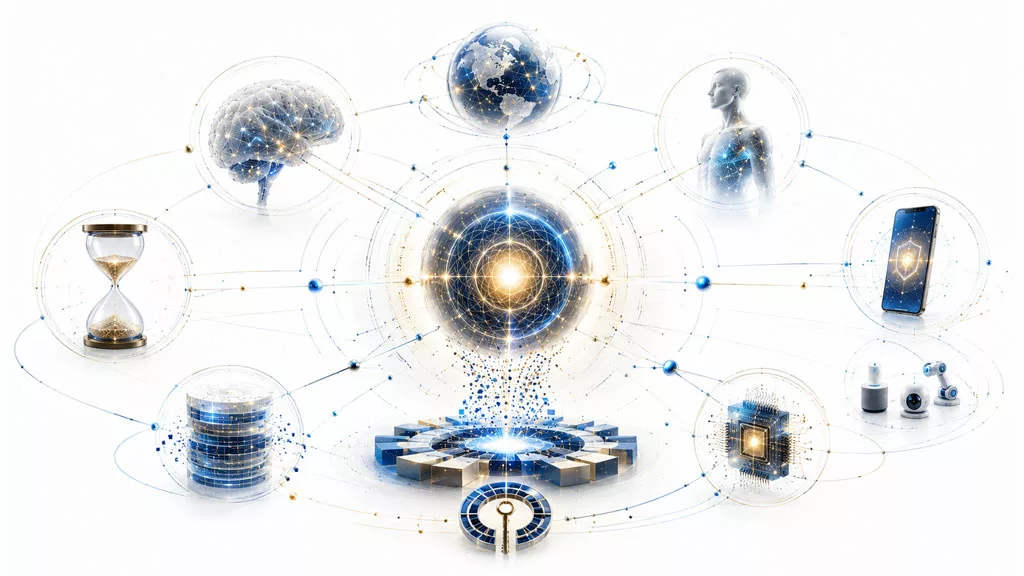
Predictive artificial intelligence architectures diagram showing world models, agentic memory, causality, cybersecurity, digital identity, connected devices, cryptographic trust and EviSKMS.

Predictive Artificial Intelligence Architectures: Freemindtronic reference memorandum on Artificial Intelligence, World Models, LAMP-C, Cybersecurity and Cyber-Physical Trust (EviSKMS) — July 2026.

Predictive Artificial Intelligence Architectures — Express Summary

Quick overview. This express summary introduces the purpose, central thesis and scope of this memorandum before the detailed Executive Summary.

Predictive Artificial Intelligence Architectures represent a broader framework for understanding the evolution of Artificial Intelligence (AI). Rather than limiting the future of AI to Large Language Models (LLMs) or solely to World Models, this memorandum explores the convergence of language, memory, causality, perception, planning, action, cybersecurity, digital identity and trust governance.

The central thesis is straightforward. Although LLMs are remarkably powerful, language alone is unlikely to produce a robust, embodied and governable intelligence. An AI capable of anticipating, reasoning, remembering and acting over time will most likely rely on a hybrid architecture combining agentic memory, causal models, predictive representations, tool-using agents, symbolic reasoning, active inference and security-by-design.

Within this framework, World Models play a major, but not exclusive, role. They constitute one family of predictive architectures capable of simulating the evolution of an environment and forecasting the potential consequences of future actions. This memorandum places them within a broader ecosystem where intelligence emerges from the integration of multiple complementary capabilities.

The memorandum also extends this analysis to Cyber-Physical Trust. It connects predictive AI with cybersecurity, digital identity, connected devices, software agents, safety engineering and long-term trust continuity. LAMP-C and LAMP-Cyber are introduced as conceptual architectural frameworks designed to organize memory, causality, action, governance and security within predictive intelligent systems.

The Freemindtronic positioning is presented with methodological caution. EviSKMS, CryptPeer, EviDNA, Digital DNA and the Cryptographic Genome are distinguished through three disclosure levels. The published international patent belongs to the public prior-art record. Observable industrialization is documented through verifiable, non-sensitive evidence. Internal mechanisms, Gen2 extensions and unpublished know-how remain protected under Register C.

This document therefore serves as a scientific and industrial reference memorandum. It does not claim to be a peer-reviewed publication or a definitive experimental validation. Instead, it provides a structured framework for designing future Predictive Artificial Intelligence Architectures capable of integrating AI, memory, causality, cybersecurity, digital identity, cryptography and long-term trust continuity.

Reading Information

Express Summary reading time ≈ 4 minutes
Executive Summary reading time ≈ 6 minutes
Estimated full reading time ≈ 2 hours
First publication August 2022
Last updated July 2026
Complexity level Expert / Research
Technical density ≈ 82%
Available language FR ·  EN
Scope Scientific and industrial memorandum on Predictive Artificial Intelligence Architectures, World Models, Agentic Memory, Causality, Cybersecurity and Cyber-Physical Trust
Recommended reading order Express Summary → Executive Summary → State of the Art → LAMP-C → LAMP-Cyber → Limitations and Falsifiability
Accessibility Optimized for screen readers, internal anchors and structured summaries
Editorial format Scientific and Industrial Reference Memorandum
Primary topic Predictive Artificial Intelligence Architectures
Secondary topics LLMs, World Models, Agentic Memory, Causality, LAMP-C, LAMP-Cyber, Cybersecurity, EviSKMS, Digital Identity and Cyber-Physical Trust
Criticality level High — 8 / 10 — rapid evolution of AI, autonomous agents, cybersecurity and digital identities
Author Jacques Gascuel, inventor and founder of Freemindtronic®.
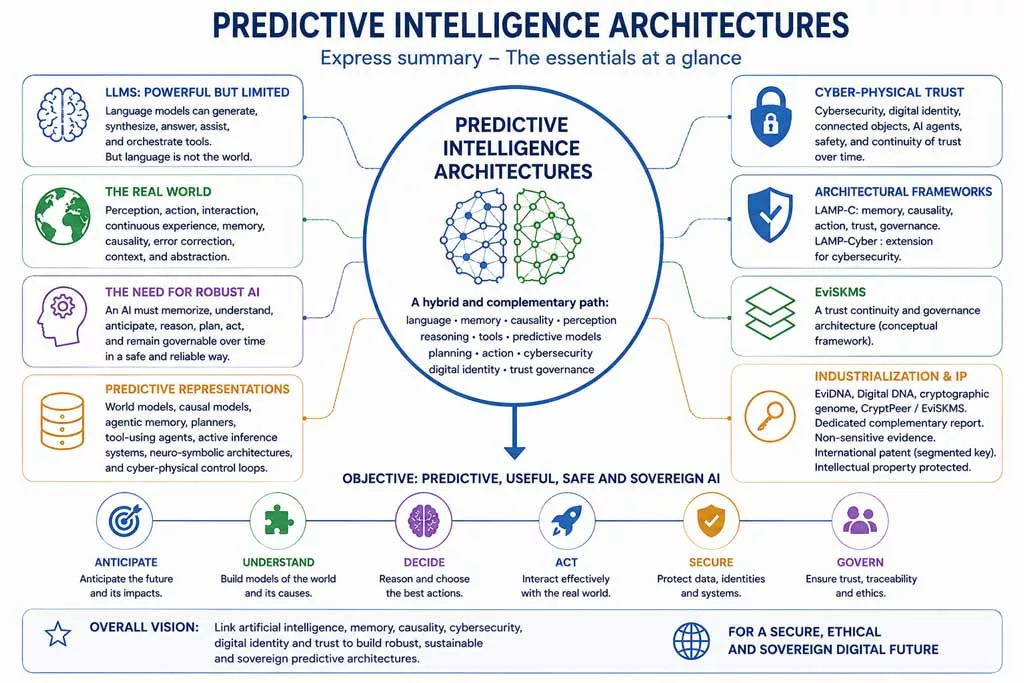
Predictive Artificial Intelligence Architectures express summary diagram showing the relationships between Large Language Models, World Models, Agentic Memory, LAMP-C, LAMP-Cyber, EviSKMS, Cyber-Physical Trust, Digital Identity, Cybersecurity and Trust Governance.

Publication Status

This memorandum on Predictive Artificial Intelligence Architectures is a Freemindtronic position and reference document. It is neither a peer-reviewed publication, an independent third-party audit nor a product certification.

Editorial Note. This Express Summary outlines the objectives, central thesis and scope of the Predictive Artificial Intelligence Architectures memorandum. It precedes the detailed Executive Summary and forms part of Freemindtronic Andorra’s editorial transparency approach. It clearly distinguishes established scientific knowledge, proposed architectural frameworks, observable industrialization evidence and mechanisms protected by unpublished intellectual property. This content has been prepared in accordance with the Freemindtronic Andorra AI Transparency Statement — FM-AI-2025-11-SMD5.

Predictive Artificial Intelligence Architectures — Executive Summary

Initial Observation

Large Language Models (LLMs) represent a major breakthrough in artificial intelligence. They show that large-scale learning from language can generate coherent text, assist programming, answer questions, summarize documents and orchestrate external tools.

However, this achievement should not be confused with complete general intelligence. Language is a trace of the world; it is not the world itself. Human and animal intelligence learn through continuous experience involving perception, action, memory, error correction, social interaction, causality and abstraction.

LLMs can learn useful internal representations, including spatial and temporal structures. Nevertheless, these representations often remain fragile, format-dependent and insufficient for embodied, robust and planning-oriented understanding. See Gurnee & Tegmark, Berglund et al. and Bender et al..

Proposed Analytical Framework

This memorandum now develops a broader central axis: Predictive Artificial Intelligence Architectures. It does not treat World Models as an exclusive doctrine, but rather as one major family of solutions within a wider architectural framework.

The objective is to analyze how an AI system can remember, abstract, predict, reason causally, plan, act and remain governable.

Predictive representations may take several forms, including explicit World Models, causal models, experiential memories, symbolic planners, tool-using agents, active inference systems, neuro-symbolic architectures and cyber-physical control loops.

The decisive debate is therefore not simply “World Model or not?”. It is rather the following question: which predictive architecture, at which level of abstraction, with which memory, which causality, which capacity for action and which security control?

The Role of World Models

The term “World Model” remains an important reference. It belongs to a scientific tradition rooted in the mental models of Craik, causal models in cognitive science, model-based reinforcement learning described by Sutton & Barto, the World Models of Ha & Schmidhuber, and later JEPA / V-JEPA architectures associated with LeCun, Bardes et al. and Assran et al..

In this memorandum, the World Model becomes one pillar among others, rather than the sole interpretive center.

The general conclusion is that the most credible path will probably be hybrid: language, perception, memory, causality, symbolic reasoning, external tools, predictive models, planning, action, cybersecurity, identity and trust governance.

Freemindtronic Positioning

The trajectory involving the Cryptographic Genome, EviDNA and Digital DNA through CryptPeer/EviSKMS industrialization is documented in a distinct companion memorandum.

This approach assumes an inventor-researcher posture grounded in applied observation, continuous monitoring of the state of the art, identification of weak and strong signals, analysis of hardware and software attack vectors, and the design of sovereign counter-espionage, encryption, authentication and trust solutions.

This field experience does not replace scientific evaluation. It provides the empirical starting point for a vision that must be formalized, protected, compared and tested.

The DNA/EviDNA companion memorandum documents the observable industrialization of EviSKMS-CryptPeer through verifiable elements, including trusted runtime, Runtime Integrity, DRT continuity, RSCC, fail-closed policies, anti-replay mechanisms, chained logs, cryptographic governance, sovereign passwordless operation, DDNA Gen1, security testing campaigns and deployment artifacts.

This appendix discloses no source code, pseudo-code, internal formats or transition rules, in order to preserve current and future intellectual property protections.

The industrial trajectory also relies on an internationally patented foundation: the Segmented-Key Authentication System (FR3063365 B1, WO/2018/154258 family and EP, US, CN, JP and KR extensions).

This granted title enables limited public discussion of the published principles of cryptographic segmentation, physical proximity and conditional trust reconstitution, without exposing Gen2 genomic extensions, the complete DRT engine or EviSKMS mechanisms developed after the founding patent.

Patent / industrialization / confidential tripartition (Register A). Patent WO/2018/154258 constitutes a public document of prior art and technological foundation. CryptPeer/EviSKMS industrialization is documented through observable industrialization elements and non-sensitive evidence (Register A). Genomic extensions, internal mechanisms and unpublished know-how remain protected under Register C.

A chain of time-stamped public disclosures from 2018 to 2026 is listed in the companion memorandum.

For the public reference publication, the present memorandum includes a section on limitations, falsifiability and scope of validity, as well as a short version.

Cryptographic details and CNRS/EviDNA comparisons are addressed in the companion memorandum. These additions aim to distinguish what is demonstrated, what is industrialized, what belongs to applied research and what remains open to independent validation.

Key Points — Predictive Artificial Intelligence Architectures

  • LLMs are powerful, but text alone is probably not sufficient for robust and embodied intelligence.
  • Predictive Artificial Intelligence Architectures connect language, memory, causality, action and governance.
  • LAMP-C and LAMP-Cyber formalize a hybrid pathway applicable to cyber-physical trust.
  • The DNA/EviDNA/Cryptographic Genome details are addressed in the EviDNA companion memorandum.
  • Public disclosure remains controlled through Registers A / B / C.
[/col] [/row]

Predictive Artificial Intelligence Architectures — Foundational Thesis of the Memorandum

This memorandum proposes the following formulation as its scientific foundation.

The next stage of artificial intelligence will not depend on a single paradigm, but on the convergence of language, memory, perception, causality, prediction, action and governance. World Models represent a major pathway for learning how to anticipate the consequences of an action, but they are not the only possible response. Other approaches, including tool-using LLM agents, neuro-symbolic AI, active inference, causal models, reinforcement learning, agentic memory and hybrid architectures, seek to address the same fundamental problem, allowing artificial intelligence to build an actionable representation of its environment, reason about its transformations and act in a controlled manner.

This thesis deliberately shifts the focus of the memorandum. The central issue is no longer to defend one specific school of thought or to oppose LLMs to World Models. The subject becomes broader: identifying the functions required for a robust predictive intelligence architecture.

These functions are: understanding language, perceiving or integrating context, remembering experience, abstracting relevant variables, anticipating possible evolutions, reasoning causally, planning, acting and remaining controllable.

An LLM may be excellent at language. A symbolic engine brings particular strength to formal logic. A causal model clarifies intervention and counterfactual reasoning. A World Model helps predict the evolution of an environment, while active inference seeks to reduce uncertainty through action.

None of these approaches, taken in isolation, is sufficient today to constitute a robust general intelligence.

The research question therefore becomes: how can these capabilities be composed into a coherent, verifiable, secure architecture capable of long-term learning?

Methodological Note — Inventor-Researcher Posture and Applied Observation

This reflection is not limited to a conventional academic approach. It is also grounded in a long inventor-researcher experience, built over more than fifteen years through continuous observation of digital threats, analysis of weak and strong signals, study of hardware and software attack vectors, and the design of digital counter-espionage, encryption, authentication and sovereign trust solutions.

This applied observation posture has gradually led to a core conviction: digital security can no longer be reduced to isolated mechanisms of protection, identification or compliance. It must be understood as a continuity of trust capable of linking identity, context, proof, memory, governance, hardware environment, software runtime and the evolution of threats over time.

The memorandum therefore assumes a dual nature. It engages with the scientific state of the art while also carrying a vision derived from invention, industrialization and operational analysis of attack surfaces. This articulation between documentary research, field observation and technical design forms the basis of the Freemindtronic trajectory around EviSKMS, CryptPeer as an industrialized embodiment of this approach, and the Cryptographic Genome as a conceptual and prospective formalization.

This posture does not claim to replace scientific validation with individual experience. It clarifies the origin of the approach: an architectural hypothesis born from prolonged observation of threats, reinforced by the industrialization of solutions, then formulated as a research framework intended to be compared, evaluated and discussed.

Eurosatory 2022–2026 Trajectory — From Human DNA to the Cryptographic Genome

This inventor-researcher posture was built through successive public milestones. Presentations delivered at Eurosatory between 2022 and 2026 help clarify the evolution of the reasoning, from an initial cyber foundation toward a trust architecture based on human DNA, then toward the Cryptographic Genome as a response to the time factor.

In 2024, this trajectory reached an industrial milestone with DataShielder Defense NFC HSM. The product does not only address the highly secure sharing of cryptographic keys associated with DNA. It also introduces an initial continuity of operational identity. The person who creates the key knows to whom it is transmitted, the recipient holds a trusted NFC device, and importing the key into that device establishes a controlled relationship between identity, physical possession, cryptographic key and encrypted/signed use.

This continuity, however, remains tied to a hardware and transactional perimeter involving the NFC device, the compatible terminal, key validity, media governance and control over the sharing lifecycle. It therefore provides a partial response to trust over time, without fully covering the challenge of a durable, re-evaluable and governable identity in a context where current AI, and later predictive AI architectures, may transform recognition, authentication, decision and trust models.

This shift led, in 2026, to the demonstration of Digital DNA and the Cryptographic Genome Generator. Biological DNA remains usable, but it becomes one possible element within a broader structure designed to organize proof continuity, trust criteria, segmentation, traceability, governance and the evolution of identity over time. This transition is therefore not a rupture. DataShielder Defense NFC HSM provides operational identity continuity, while Digital DNA and the Cryptographic Genome extend this approach toward a durable, contextualized, re-evaluable and governable identity. This evolution constitutes one of the cyber-identity application cases of the present memorandum on Predictive Artificial Intelligence Architectures.

Strict Definitions

To avoid ambiguity, this memorandum uses the following definitions.

Artificial General Intelligence. The ability of a system to learn, reason, plan and act across diverse domains, including novel situations, with robustness and adaptability beyond simple pattern memorization.

World Model. An explicit or implicit internal representation that enables a system to predict the evolution of an environment, especially under the effect of possible actions. See Craik, Ha & Schmidhuber and the World Model for Robot Learning Survey.

Predictive Representation. An internal structure that is not only used to recognize a situation, but also to anticipate its future transformations.

Causality. The ability to distinguish a correlation from a productive mechanism and to reason about what would happen under intervention. See Pearl and Schölkopf et al..

Planning. The ability to evaluate several possible sequences of actions, simulate their consequences and select a trajectory aligned with a goal.

Experiential Memory. A form of memory that stores not only documents or facts, but also episodes, errors, strategies, abstractions and feedback that can be reused for future action. See Du.

Grounding. The relationship between symbols, language, perception, action and environment. The symbol grounding problem is discussed by Harnad.

Predictive Artificial Intelligence Architectures — Introduction

Contemporary artificial intelligence is advancing at an unprecedented pace, driven largely by Large Language Models (LLMs). These systems generate text, answer questions, summarize documents, translate languages, write code, and assist users across a wide range of intellectual tasks.

Their impressive performance can sometimes create the impression that they are approaching artificial general intelligence. This perception, however, deserves careful examination. Large Language Models are trained primarily on vast collections of textual data. They learn to predict the most probable continuation of a sequence by identifying statistical regularities within their training data.

Although this capability is remarkable, it does not necessarily imply a deep understanding of the world. Language describes objects, events, intentions, relationships, and causes, yet it cannot replace perception, action, sensory feedback, or embodied experience.

From the earliest stages of life, humans learn through vision, movement, touch, interaction with objects, the consequences of their actions, social relationships, and continuous experience of the physical world. They progressively construct abstractions, discard irrelevant details, and retain the structures that enable prediction and purposeful action.

The central question therefore becomes: can robust intelligence emerge solely from learning based on text? Or does it require a new generation of architectures capable of integrating language, memory, abstraction, causality, prediction, action, and Trust Governance?

This dissertation adopts the following position: Large Language Models are indispensable, yet they are likely insufficient on their own. World Models represent an important direction, but not the only one. The next stage of AI should instead be conceived as a convergence of Predictive Artificial Intelligence Architectures combining World Models, Neuro-symbolic AI, Causal Models, Active Inference, Tool-using Agents, Agentic Memory, AI Planning, AI Cybersecurity, and Cyber-Physical Trust.

1. Large Language Models — Capabilities and Limitations

Large Language Models are trained on enormous quantities of textual data. Their training corpora may encompass a substantial portion of publicly available Internet content, supplemented by additional sources such as books, scientific articles, web pages, document repositories, software code, and annotated conversations.

The model transforms this massive body of information into internal parameters. This process can be viewed as a form of statistical compression of human language. Rather than memorizing every sentence, the model learns structures, associations, stylistic patterns, grammatical regularities, factual knowledge, and recurring reasoning patterns present within its training data.

This approach enables remarkable performance. LLMs can explain concepts, solve certain classes of problems, reformulate ideas, generate coherent text, and orchestrate external tools. Nevertheless, their operation remains fundamentally grounded in predicting the most probable continuation of a sequence of text.

This limitation explains several well-known challenges, including hallucinations, the absence of native persistent memory, the fragility of certain forms of generalization, difficulty with long-horizon planning, and the lack of direct grounding in the physical world. The critique proposed by Bender et al. reminds us that language alone does not guarantee situated understanding.

A balanced scientific position is therefore not to claim that LLMs never reason. Rather, it is more precise to state that LLMs can produce useful reasoning and acquire certain forms of Predictive Representations of the world, yet these representations are not currently sufficiently stable, causal, embodied, or verifiable to constitute a complete artificial general intelligence.

Predictive Artificial Intelligence Architectures — 2. What LLMs Already Do Well

A rigorous scientific dissertation should not caricature Large Language Models. They are far more than statistical dictionaries. They can learn abstract regularities, perform reasoning expressed in natural language, generate software code, manipulate mathematical representations, invoke external tools, and occasionally infer information that is not explicitly stated in a prompt.

Research such as Gurnee & Tegmark suggests that some language models internally encode spatial and temporal dimensions as exploitable latent structures. This finding indicates that learning from text alone can give rise to latent Predictive Representations of the world.

However, these internal representations should not be confused with robust World Models. The Reversal Curse, for example, demonstrates that a model may learn a relationship in one direction while failing to generalize correctly to the inverse relationship. This fragility suggests that certain capabilities remain strongly dependent on the training distribution and on how a problem is formulated.

The scientific question is therefore not, “Do LLMs understand or not?” Rather, it is: What internal representations do they construct, under which conditions, how robust are these representations, and to what extent can they support causality, Agentic Memory, AI Planning, and purposeful action?

3. The Real Cost of Modern Artificial Intelligence

Massive investment in artificial intelligence is driven primarily by two requirements: computational infrastructure and post-training.

The first concerns the computing resources required to train and deploy modern AI models. Training relies on specialized processors, memory, networking, energy, and large-scale data centers. Inference at scale is also computationally expensive, as every request consumes resources while imposing constraints on latency, availability, and security.

The second concerns post-training. A raw model is not automatically reliable, useful, or safe. It must be refined through supervised learning, human feedback, alignment, filtering, instruction tuning, tool integration, retrieval mechanisms, and security policies.

This reality demonstrates that the raw model alone is insufficient. Modern artificial intelligence already depends on an ecosystem composed of models, data, external memory, tools, guardrails, interfaces, governance policies, infrastructure, and continuous supervision.

This observation reinforces the central thesis of this dissertation: advanced AI will likely not consist of a single isolated model, but rather of a composite architecture.

Predictive Artificial Intelligence Architectures — 4. Human Learning: Sensory Experience, Action, and Abstraction

Comparing a Large Language Model with a young child highlights the fundamental difference between text-based learning and embodied learning.

By the age of four, a child has already experienced thousands of hours of wakefulness. During this period, the child continuously receives visual, auditory, tactile, and motor sensory inputs. The retina does not transmit a raw image directly to the brain; it transforms, filters, and compresses information before sending it through the optic nerve. Although estimates vary, the literature on retinal coding indicates that the transmitted information flow remains substantial. See Koch et al..

Any comparison with the token streams processed by Large Language Models must therefore remain cautious. Human visual experience should not be presented as directly equivalent to textual data. The essential qualitative distinction is that a child learns from a continuous, active, multimodal sensory experience that is intrinsically linked to the consequences of its own actions.

The child observes objects, interacts with them, experiences the consequences, adjusts expectations, memorizes regularities, and progressively constructs abstractions. The child learns that some objects fall, roll, break, resist, disappear behind others, or reappear. At the same time, the child acquires an understanding of intentions, social cues, emotions, and implicit rules.

Human intelligence is therefore not built simply through the accumulation of information. It emerges through experience, interaction, abstraction, prediction, and error correction. This perspective aligns with the work of Lake et al., who emphasize the importance of Causal Models, intuitive physics, intuitive psychology, and rapid generalization.

5. Why Text Alone Is Likely Not Enough

Text is a secondary representation of the world. It describes objects, events, emotions, intentions, and relationships. It is not the world itself.

A model trained exclusively on text learns the regularities of language about the world, but not necessarily the regularities of the world itself. It may learn that people often write “a glass falls and breaks,” yet this knowledge remains mediated through language. It does not arise from direct experience of gravity, fragility, sound, trajectory, or the physical consequences of an action.

This distinction is closely related to the Symbol Grounding Problem discussed by Harnad. A symbol cannot be considered fully understood if it is connected only to other symbols. At least part of its meaning must ultimately be grounded in perception, action, or experience.

This does not imply that text is of limited value. On the contrary, language is an extraordinarily powerful medium for abstraction, cultural transmission, and reasoning. However, language alone appears insufficient to produce robust embodied intelligence.

The most scientifically accurate formulation is therefore that text alone can give rise to rich internal Predictive Representations, yet it does not appear sufficient to build a general intelligence capable of perception, causality, Experiential Memory, AI Planning, and effective action within the physical world.

Predictive Artificial Intelligence Architectures — 6. World Models as a Family of Predictive Architectures: Origins of the Concept

Throughout this dissertation, World Models are no longer treated as the exclusive focus of the discussion. Instead, they are examined as one of the major families of Predictive Artificial Intelligence Architectures because they explicitly formalize a fundamental capability: anticipating how an environment evolves from its current state under possible actions.

The term World Model is not a recent invention. It extends a long-established scientific tradition.

Craik proposed that the mind constructs small-scale internal models of reality, enabling actions to be mentally simulated before being executed. This intuition remains fundamental: thinking consists, in part, of testing possible actions internally before acting in the external world.

Johnson-Laird later developed the theory of mental models, according to which human reasoning relies on internal representations of possible situations.

In artificial intelligence, the concept emerged through model-based reinforcement learning, in which an agent uses a model of environmental dynamics to simulate the consequences of alternative actions. See Sutton & Barto.

The expression World Models became explicit in the work of Ha & Schmidhuber, who learned compressed representations of environments and used them to train autonomous agents. More recently, the JEPA and V-JEPA architectures proposed by LeCun, Bardes et al., and Assran et al. have extended this approach by learning to predict abstract latent representations rather than individual pixels.

The concept itself is therefore not new. What is new is its renewed central role in contemporary discussions about the future of artificial intelligence.

7. World Models as Predictive Representations: A Rigorous Definition

A World Model is a specific form of Predictive Representation: an internal representation that enables a system to predict how an environment is likely to evolve.

Within the broader perspective of this dissertation, it is not presented as the only solution, but rather as a central class of architecture capable of linking state, action, future, and decision-making.

Formally, if a system observes the state of the world at time t, denoted x_t, it constructs an abstract representation s_t. Given a candidate action a_t, the model predicts a future state s_{t+1} or a probability distribution over possible future states.

Observation x_t
      ↓
Encoder E
      ↓
Abstract state s_t
      ↓ + action a_t
Predictor P
      ↓
Predicted future state ŝ_{t+1}

The value of a World Model lies not merely in recognizing the current state of the environment, but in predicting what may happen next.

A system equipped with a World Model can answer the question: What would happen if I performed this action? This question lies at the heart of AI Planning, practical causality, and autonomous intelligence.

Predictive Artificial Intelligence Architectures — 8. Abstraction and Hierarchical Representations

It is impossible to represent the complete state of the world down to its ultimate physical details. Describing an ordinary room at the level of quantum field theory would be impractical: the complete wave function of a macroscopic system cannot be measured, and no realistic computation could predict every physically possible evolution in a useful manner.

Humans do not reason in this way. Instead, they construct abstractions: objects, surfaces, agents, intentions, obstacles, trajectories, rules, tools, and risks. Each level of abstraction discards part of the lower-level detail while preserving the information that is useful for prediction at a given scale.

This hierarchy mirrors the organization of science itself: particle physics, nuclear physics, chemistry, biochemistry, molecular biology, biology, psychology, sociology, and ecology. Each discipline focuses on the level of organization most relevant to its domain.

An effective World Model must therefore learn hierarchical representations. Lower levels may encode shapes, textures, and motion. Intermediate levels may encode objects, relationships, and scenes. Higher levels may encode intentions, constraints, goals, norms, and abstract causal structures.

Intelligence does not consist of preserving every detail, but of constructing the appropriate level of abstraction for effective action.

9. Learning Through Prediction: Encoder, Predictor, and Prediction Error

A system can learn a World Model through self-supervised predictive learning.

  1. It observes the world at time t as input data x_t.
  2. An encoder transforms x_t into an abstract representation s_t.
  3. A predictor estimates the future state ŝ_{t+1}.
  4. The system then observes x_{t+1}.
  5. The same encoder produces the corresponding representation s_{t+1}.
  6. The system minimizes the discrepancy between ŝ_{t+1} and s_{t+1}.

The objective is to make predictions within a meaningful abstract representation space rather than predicting every individual pixel. This is precisely the intuition behind JEPA architectures: learning to predict useful representations instead of reconstructing every detail. See LeCun and Bardes et al..

This learning mechanism fundamentally changes the nature of learning: the system no longer learns merely to recognize the world; it learns to anticipate its evolution.

Predictive Artificial Intelligence Architectures — 10. From Prediction to Planning

Planning requires the ability to simulate multiple possible futures.

To choose an action, an intelligent agent must evaluate several possible trajectories:

Current state
   ├── Action A → Possible future A
   ├── Action B → Possible future B
   └── Action C → Possible future C

The agent then compares these alternative futures according to an objective, a constraint, a cost, or a risk.

This capability is fundamental to model-based reinforcement learning, where an internal model is used to simulate the consequences of actions before they are executed. See Sutton & Barto.

Planning may also be delegated to symbolic engines, constraint solvers, search trees, or formal verification tools. Even in these cases, however, the system must represent states, actions, and transitions. In other words, planning almost always reintroduces some form of World Model.

11. World Models Within Predictive Artificial Intelligence Architectures: Promise and Limitations

This section retains World Models as a major scientific reference while placing them within a broader architectural perspective. Their importance lies not in belonging to a particular school of thought, but in the function they embody: learning useful Predictive Representations that support prediction, AI Planning, and action.

11.1. Generative World Models

The World Models proposed by Ha & Schmidhuber learn a compressed representation of an environment and then use this representation to train an autonomous agent. This approach demonstrates that an agent can learn not only from the real or simulated world, but also from an internally learned model of that world.

Predictive Artificial Intelligence Architectures — 11.2. JEPA, V-JEPA, and Latent-Space Prediction

JEPA and V-JEPA architectures aim to predict abstract representations rather than individual pixels. Their objective is to capture the information that is most relevant for understanding and action, without expending learning capacity on secondary visual details. See LeCun, Bardes et al., and Assran et al..

11.3. World Models in Robotics

World Models have become a major research direction in robotics because they enable systems to predict environmental dynamics, simulate actions, perform planning, and improve out-of-distribution generalization. See World Model for Robot Learning Survey.

11.4. Embodied Robotics and Digital Simulators

Simulation environments and digital twins make it possible to generate rare or hazardous scenarios. They are particularly valuable for autonomous driving, industrial robotics, and physical agents. Nevertheless, a simulation is never a complete representation of the real world and must always be validated against real-world observations.

Predictive Artificial Intelligence Architectures — 11.5. Limitations of World Models

World Models are not a universal solution. They face several fundamental challenges:

  • learning stable abstractions;
  • managing uncertainty and multiple possible futures;
  • distinguishing Causal Models from statistical correlations;
  • avoiding the prediction of irrelevant details;
  • generalizing beyond the training distribution;
  • integrating language, action, and Agentic Memory;
  • evaluating model quality objectively;
  • ensuring safety when actions affect the physical world.

An inaccurate World Model may become dangerous precisely because it appears internally coherent. Consequently, evaluation, Trust Governance, and Runtime Integrity become central requirements.

Predictive Artificial Intelligence Architectures — 12. Competing and Complementary Approaches

This section maps the principal research directions pursuing the same overarching objective: robust reasoning, generalization, AI Planning, memory, hallucination reduction, and reliable action.

12.1. Neuro-symbolic AI

Neuro-symbolic AI combines neural networks with symbolic reasoning, including rules, logic, knowledge graphs, constraint solvers, and inference engines.

This approach is particularly promising in domains where explainability, verification, and regulatory compliance are essential, including law, AI Cybersecurity, mathematics, formal verification, diagnostics, Trust Governance, and safety-critical systems. See Garcez & Lamb, Colelough & Regli, and Yang et al..

Primary strength: explainable and controllable reasoning. Main limitation: limited grounding in perception and the physical world. Relationship to World Models: symbolic systems often perform planning over abstract states and therefore frequently reintroduce a discrete or logical World Model.

12.2. Tool-using LLM Agents, RAG, Memory, and Planning Systems

A major industrial direction consists of using Large Language Models as orchestration engines. They invoke external tools, retrieve information, execute code, consult knowledge bases, rely on external Agentic Memory, and delegate specialized tasks to dedicated modules.

Retrieval-Augmented Generation (RAG) improves factual accuracy by connecting the model to external knowledge sources. See Lewis et al.. Tool-using Agents further extend LLM capabilities through planning, reasoning, tool use, and memory. See Yao et al., Huang et al., and Du.

Primary strength: immediate operational effectiveness. Main limitation: retrieval and external tools do not replace genuine causal understanding. Relationship to World Models: the agent may construct an external task model composed of states, sub-goals, constraints, tools, and memory.

Predictive Artificial Intelligence Architectures — 12.3. Model-Based Reinforcement Learning

Model-based reinforcement learning learns or exploits a model of environmental dynamics. The agent can simulate the consequences of its actions before acting. See Sutton & Barto and Moerland et al..

Primary strength: efficient planning and anticipation. Main limitation: learning reliable models in complex environments remains difficult. Relationship to World Models: this is one of the most explicit forms of a World Model.

12.4. Model-Free Reinforcement Learning

Model-free reinforcement learning learns an action policy directly without constructing an explicit model of the environment. It has achieved remarkable success in games and several simulated environments. See Mnih et al. and Schulman et al..

Primary strength: strong performance in well-defined environments with clear reward functions. Main limitation: high training cost, limited data efficiency, and poor robustness outside the training distribution. Relationship to World Models: although it avoids an explicit World Model, it generally struggles with long-horizon planning and systematic generalization without predictive structure.

12.5. Imitation Learning and Learning from Demonstration

Imitation learning trains a system to reproduce observed behaviors. It plays a central role in robotics, autonomous driving, and software agents.

Primary strength: rapid learning from human demonstrations. Main limitation: behavior may be reproduced without deep understanding, leading to failures outside the training distribution. Relationship to World Models: demonstrations provide trajectories, but the agent often requires a predictive model to adapt to novel situations.

Predictive Artificial Intelligence Architectures — 12.6. Active Inference and the Free Energy Principle

Active Inference, associated with Friston, proposes that intelligent agents act to reduce uncertainty and minimize the discrepancy between predictions and observations. Policies are selected according to their expected ability to minimize free energy by jointly maximizing utility and information gain. See Friston et al. and de Vries.

Primary strength: a unified framework integrating perception, action, and uncertainty. Main limitation: considerable theoretical complexity and limited industrial adoption. Relationship to World Models: Active Inference relies on internal generative models and is therefore closely related to, rather than opposed to, World Models.

12.7. Causal Models and Probabilistic Reasoning

Causal Models seek to distinguish correlation from causation while enabling counterfactual reasoning: what would happen if a variable were changed? See Pearl and Schölkopf et al..

Primary strength: conceptual robustness and intervention capabilities. Main limitation: learning large-scale causal structures automatically remains extremely challenging. Relationship to World Models: a causal model is often an abstract World Model centered on causal mechanisms.

12.8. Neuromorphic and Brain-Inspired Architectures

Neuromorphic architectures investigate spiking neural networks, continuous plasticity, local memory, and highly energy-efficient computation.

Primary strength: biological inspiration and potentially high energy efficiency. Main limitation: lower technological maturity compared with mainstream deep learning architectures. Relationship to World Models: these architectures do not inherently provide a World Model, but they may constitute an effective substrate for continuous learning.

Predictive Artificial Intelligence Architectures — 12.9. Planning Through Search, MCTS, Programs, and Formal Verification

Planning may be performed through explicit search methods, including decision trees, Monte Carlo Tree Search, constraint solvers, theorem provers, and formal verification systems. See Kocsis & Szepesvári and Silver et al..

Primary strength: systematic exploration of alternative scenarios. Main limitation: combinatorial explosion and dependence on a formal representation of states. Relationship to World Models: every search tree assumes states and transitions and therefore relies on some form of World Model.

12.10. Evolutionary AI and Open-Ended Learning

Evolutionary AI seeks to generate increasingly complex behaviors through variation, selection, and open-ended environments. The objective is not merely to optimize a fixed task, but to encourage the emergence of novel capabilities.

Primary strength: open-ended exploration of behavioral diversity. Main limitation: computational cost, unpredictability, and limited controllability. Relationship to World Models: evolved agents may develop internal representations, although these are often difficult to interpret.

12.11. Metacognitive Architectures

Metacognitive architectures provide a system with self-assessment capabilities, enabling it to detect its own errors, estimate uncertainty, decide when to request assistance, verify hypotheses, or revise its strategy.

Primary strength: robustness, self-correction, and operational safety. Main limitation: objectively evaluating the quality of self-assessment remains difficult. Relationship to World Models: metacognition can supervise and regulate the use of a World Model, but it does not replace it.

13. Proposed Taxonomy of Predictive Artificial Intelligence Architectures

This taxonomy proposes seven dimensions for comparing candidate architectures capable of achieving robust artificial general intelligence.

  1. Language: processing symbols, text, instructions, and dialogue.
  2. Perception: learning from images, video, audio, sensors, or the surrounding environment.
  3. Memory: storing, organizing, abstracting, and reusing experience.
  4. Causality: distinguishing correlation, intervention, and consequence.
  5. Action: operating within real, simulated, or software environments.
  6. Prediction: anticipating future states and multiple possible scenarios.
  7. Planning: selecting sequences of actions to achieve a goal.

This taxonomy deliberately avoids classifying approaches according to technological trends or implementation choices. Instead, it organizes them according to the cognitive functions they are required to perform.

The central question therefore becomes: Which architecture most effectively integrates these seven dimensions while ensuring robustness, safety, and verifiability?

Predictive Artificial Intelligence Architectures — 14. Comparative Matrix of Current Approaches

Qualitative scale: Low / Moderate / High / Very High.

Approach Language Perception Memory Causality Action Prediction Planning Primary Limitation
Pure LLM Very High Low Low Moderate/Low Low Linguistic Text-based No direct grounding in the physical world
Agentic LLM Very High Moderate Moderate/High Moderate Moderate Tool-assisted Strong but fragile Dependence on tools and context
RAG High Low Document-based Low Low Low Low/Moderate Retrieval is not understanding
Neuro-symbolic AI Moderate/High Variable Moderate High for rule-based reasoning Variable Moderate Strong logical reasoning Difficult grounding
Model-free RL Low Variable Implicit Low High Weak explicit prediction Moderate High training cost
Model-based RL Variable High Moderate Moderate High High High Difficult model learning
Active Inference Variable High High Probabilistic High High High Theoretical complexity
Causal Models Variable Variable Moderate Very High Variable Strong intervention capability High when structure is known Difficult causal discovery
World Models Variable High High Moderate/High High Very High Very High Difficult evaluation
Neuromorphic AI Low/Moderate Variable Variable Low/Moderate Variable Variable Variable Insufficient maturity
Hybrid Architecture Very High High High High High High High Complex Trust Governance

This comparative matrix shows that World Models are not the only possible path toward advanced intelligence. However, nearly all advanced approaches ultimately face the same fundamental challenge: representing, predicting, remembering, acting, and planning.

15. Proposed Hybrid Architecture: LAMP-C

Epistemological status (Register A). Conceptual architecture · research framework · not experimentally validated at this stage.

To establish this dissertation as a foundation for future research, we propose a conceptual architecture named LAMP-C:

  • L — Language: communication, instruction, and symbolic reasoning expressed through natural language.
  • A — Abstraction: construction of hierarchical and compressed representations.
  • M — Memory: storage, consolidation, forgetting, retrieval, and contradiction management through Agentic Memory and Experiential Memory.
  • P — Prediction / Planning: simulation of possible futures and selection of appropriate actions.
  • C — Causality / Control: intervention, counterfactual reasoning, verification, Runtime Integrity, and Cyber-Physical Trust.
Multimodal perception / data / language
                ↓
          Abstraction Encoder
                ↓
        Experiential Memory
                ↓
       Predictive World Model
                ↓
     Causal and Counterfactual Module
                ↓
 Planning Engine / Symbolic Engine / Tools
                ↓
Action: robot, API, software, or decision
                ↓
     Experience feedback and correction

This architecture is not intended as a finished technical product; it is a conceptual research framework. It provides a basis for comparing existing approaches while identifying the capabilities that remain absent from each of them.

LAMP-C is built upon a central hypothesis: advanced intelligence must be compositional. It does not emerge from a single monolithic model, but from the integration of language, perception, memory, prediction, causality, and control.

Predictive Artificial Intelligence Architectures — 16. Memory, Experience, and Cognitive Continuity

Without memory, an intelligent agent remains largely stateless. It may answer questions within a context window, yet it cannot develop continuity of experience.

Current AI systems are exploring several complementary forms of memory:

  1. Contextual Memory: information available within the model’s context window.
  2. Document Memory: retrieval of documents or passages through RAG.
  3. Episodic Memory: records of interactions, actions, errors, and outcomes.
  4. Semantic Memory: consolidated abstract knowledge.
  5. Procedural Memory: strategies, methods, routines, and acquired skills.
  6. Experiential Memory: action trajectories, feedback, failures, corrections, and accumulated learning.

Modern Tool-using Agents based on Large Language Models already investigate these memory mechanisms. See Du and Zhang et al..

Useful memory should do more than simply accumulate information. It must also filter, consolidate, forget, resolve contradictions, preserve confidentiality, and connect past experience to future decision-making.

A rigorous research program should therefore evaluate not only retrieval performance, but also whether memory genuinely improves decision quality.

17. Causality, Counterfactual Reasoning, and Robustness

Causality represents one of the major boundaries between statistical correlation and robust intelligence.

A statistical model may learn that two events are associated. A Causal Model seeks to understand what produces what. It enables questions such as:

  • What would happen if I intervened on this variable?
  • Does this action cause the observed effect, or merely reveal it?
  • What would have happened if a different action had been taken?

Pearl formalized this distinction through causal and counterfactual reasoning. Schölkopf et al. further discuss the importance of causality for robust learning and out-of-distribution generalization.

A World Model without causality may capture only superficial regularities. Conversely, a Causal Model without perception may lack grounding in reality. A robust hybrid architecture should therefore integrate both.

Predictive Artificial Intelligence Architectures — 18. Scientific Evaluation of Candidate Architectures

To establish this dissertation as the foundation of a research program, its hypotheses must be scientifically falsifiable.

Predictive Artificial Intelligence Architectures — 18.1. Evaluation Framework

A candidate architecture should be evaluated according to ten dimensions:

  1. Prediction: Can it accurately anticipate the evolution of an environment?
  2. Counterfactual Reasoning: Can it simulate “What would happen if…” scenarios?
  3. Planning: Can it select an effective sequence of actions?
  4. Causality: Can it distinguish causal relationships from mere correlations?
  5. Out-of-Distribution Robustness: Can it operate reliably in novel situations?
  6. Long-Term Memory: Does it learn effectively from previous experiences?
  7. Physical or Operational Grounding: Does it integrate language, perception, and action?
  8. Explainability: Can its decisions be understood and analyzed?
  9. Safety: Does it fail safely when necessary?
  10. Trust Governance: Can its capabilities, access rights, and objectives be effectively controlled?

18.2. Falsifiable Hypotheses

Hypothesis H1. An architecture combining a Large Language Model, Experiential Memory, and a latent predictive model performs better on long-horizon planning tasks than a standalone LLM.

Hypothesis H2. Adding a Causal Model improves out-of-distribution robustness under changing environmental conditions.

Hypothesis H3. Consolidated Experiential Memory reduces the recurrence of errors across multi-session tasks.

Hypothesis H4. A Neuro-symbolic AI architecture reduces hallucinations in tasks involving formal constraints.

Hypothesis H5. Latent World Models predict the consequences of physical actions more accurately than purely text-based models.

18.3. Candidate Experimental Protocols

  • Simulated robotic or physics-based environments.
  • Multi-step planning tasks involving hidden constraints.
  • Multi-session memory benchmarks.
  • Causal and counterfactual reasoning benchmarks.
  • Out-of-distribution evaluation scenarios.
  • Formal verification of generated plans.
  • Comparative evaluation of standalone LLMs, Tool-using Agents, LLMs with memory, LLMs with World Models, and the proposed LAMP-C architecture.

19. Mapping the Scientific Debates

A reference document should present scientific disagreements as well as defend its own thesis.

Predictive Artificial Intelligence Architectures — 19.1. Is Text Alone Sufficient?

Some researchers argue that scale, data, and external tools will ultimately enable Large Language Models to build sufficiently rich internal representations. Others contend that text alone cannot provide the grounding required for causal and physically situated intelligence.

19.2. Do Large Language Models Truly Reason?

LLMs sometimes produce reasoning that is useful and convincing. However, distinguishing robust reasoning from the imitation of common reasoning patterns or implicit search within textual representations remains an open scientific question.

19.3. Can Causality Emerge from Scale?

Causal relationships may be learned partially from data, but intervention and counterfactual reasoning often require additional representational structures beyond statistical scaling alone.

Predictive Artificial Intelligence Architectures — 19.4. Is Physical Embodiment Necessary?

Artificial intelligence can clearly be useful without a physical body. However, intelligence approaching that of humans or animals may require some form of embodied experience, whether real or simulated.

19.5. Are Video Models Sufficient?

Video models learn visual dynamics effectively, yet they may still lack causal understanding, intentionality, hidden physical constraints, and validation through interaction with the real world.

19.6. Is Neuro-symbolic AI a Transitional Stage or a Long-Term Direction?

Neuro-symbolic AI may serve either as a reasoning and control layer or as a central component of future hybrid architectures.

Predictive Artificial Intelligence Architectures — 19.7. Are Tool-using Agents a Sustainable Architecture?

They are already highly valuable in industrial applications, but their long-term robustness depends heavily on memory, external tools, verification mechanisms, and effective control.

Predictive Artificial Intelligence Architectures — 20. Proposed Research Program

20.1. Overall Objective

Design and evaluate a hybrid architecture capable of integrating language, perception, memory, prediction, causality, and planning.

20.2. Year 1: Taxonomy and Experimental Foundation

  • Finalize the proposed taxonomy.
  • Develop the comparative evaluation matrix.
  • Select appropriate benchmark suites.
  • Develop an initial prototype combining an LLM, memory, and external tools.
  • Evaluate the limitations of standalone LLMs on planning tasks.

Predictive Artificial Intelligence Architectures — 20.3. Year 2: Memory, Causality, and Latent World Models

  • Integrate Experiential Memory.
  • Add a causal or counterfactual reasoning module.
  • Evaluate a latent predictive model within a simulated environment.
  • Compare model-free RL, model-based RL, and Tool-using Agents.

20.4. Year 3: LAMP-C Architecture and Validation

  • Integrate language, abstraction, memory, prediction, and causality.
  • Evaluate out-of-distribution robustness.
  • Measure reductions in repeated errors.
  • Assess safety and explainability.
  • Publish the framework, experimental results, and identified limitations.

20.5. Scientific Deliverables

  • Position paper.
  • Comparative survey in French and English.
  • LAMP-C taxonomy.
  • Internal benchmark for planning and memory.
  • Experimental prototype.
  • Evaluation report.
  • Continuously maintained annotated bibliography.

21. Risks, Trust Governance, and Safety

Advanced AI architectures introduce specific risks.

A World Model improves planning capabilities, yet more effective planning may also increase a system’s ability to pursue unintended objectives. Persistent memory strengthens continuity but raises important issues regarding confidentiality, the right to be forgotten, and the persistence of erroneous knowledge. External tools improve operational effectiveness but also introduce risks associated with uncontrolled execution.

Trust Governance should therefore be integrated into the architecture from the outset:

  • capability control;
  • logging and traceability;
  • plan verification;
  • operational action limits;
  • clear separation between prediction, decision, and execution;
  • memory management;
  • explainability;
  • auditability;
  • safe failure (fail-safe);
  • goal alignment.

Consequently, any research program on Predictive Artificial Intelligence Architectures must also be conceived as a research program in AI safety and Cyber-Physical Trust.

Predictive Artificial Intelligence Architectures — 22. A Defensible Scientific Position

This dissertation does not claim to demonstrate that World Models constitute the only path toward artificial general intelligence. It defends a broader and more robust position: any architecture aiming to achieve reliable intelligence, planning capabilities, and generalization will need to include, explicitly or implicitly, predictive, memory-based, causal, and actionable capabilities.

This position avoids two extremes. The first would be to reduce Large Language Models to simple systems with no internal representations at all: work such as Gurnee & Tegmark 2023 suggests that they can encode certain spatial and temporal reference structures. The second would be to conclude that text alone is sufficient to produce robust embodied intelligence: limitations such as the Reversal Curse, the absence of direct sensorimotor grounding, and weaknesses in planning indicate that such a conclusion remains fragile.

The defensible thesis is therefore the following:

Large Language Models can make a major contribution to artificial general intelligence, but they need to be integrated with mechanisms for memory, perception, causality, action, control, and prediction. The scientific debate is not limited to “LLMs versus World Models”; it concerns the design of Predictive Artificial Intelligence Architectures capable of linking representation, anticipation, decision-making, and Trust Governance.

This formulation makes the dissertation compatible with competing and complementary approaches, including Neuro-symbolic AI, Tool-using Agents, RAG, Active Inference, causality, embodied robotics, reinforcement learning, and hybrid architectures. It also supports the argument that World Models are less a doctrine than a remarkable instance of a broader cognitive function: anticipating what may happen given the current state and the possible actions. See Craik 1943, Johnson-Laird 1983, Sutton & Barto 2018, Ha & Schmidhuber 2018, and LeCun 2022.

23. State of the Art at the Time of Writing: Research, Industrialization, and Observed Results

State of the art documented up to 2026-07-07; this field is evolving rapidly. This section distinguishes three levels:

  1. scientific research: articles, surveys, benchmarks, and experimental architectures;
  2. industrialized implementation: products, platforms, standards, regulations, or already deployed uses;
  3. observed results: measured benefits, real limitations, disappointing outcomes, or persistent risks.

The objective is not to provide an exhaustive list of AI products, but to position Predictive AI Architectures within their operational reality: what already works, what is progressing, what remains fragile, and what still needs to be demonstrated.

Predictive Artificial Intelligence Architectures — 23.1. Short Synthesis

At the time of writing, the state of the art shows a clear convergence: the most effective systems do not rely on a single component. They generally combine a language model, memory or external retrieval, tools, guardrails, access policies, evaluations, and sometimes specialized modules for vision, planning, cybersecurity, or robotics.

Industrialized LLMs are already effective for writing assistance, code generation, user support, document analysis, augmented search, and support for security teams. However, their limitations remain well documented: hallucinations, context dependence, fragile long-horizon planning, agent security, variable quality of generated code, data leakage risks, and the continuing need for supervision.

World Models and predictive video models are progressing rapidly in research, particularly with V-JEPA 2 and the 2025–2026 surveys on robotics and embodied AI. However, their full industrialization remains limited: results are promising for video understanding, prediction, zero-shot planning, and controlled robotics, but they are not yet equivalent to open-world autonomous general intelligence.

Cybersecurity and Digital Identity approaches are the most industrialized from a normative standpoint: NIST SP 800-63-4, OWASP LLM Top 10, NIST AI RMF, NIST CSF 2.0, ETSI EN 303 645, the Cyber Resilience Act, and the EU AI Act already form a reference foundation. WebAuthn/FIDO and Passkeys may also be cited as external points of comparison for passwordless authentication, without constituting the Freemindtronic trust foundation. The real outcome is clear: digital trust is evolving toward strong identity, security by design, AI risk governance, and phishing resistance. However, the integration of AI, identity, connected objects, and cyber-physical safety remains an emerging field of applied research.

23.2. LLMs and Tool-using Agents: Strong Industrialization, Still Incomplete Robustness

Large Language Models are the most industrialized building blocks of contemporary AI. They are now integrated into office environments, search engines, development platforms, support tools, business assistants, augmented SOCs, and document workflows.

Examples of Already Industrialized Implementations

Domain Implementation Official / Primary Reference Observed Result Persistent Limitation
Software development GitHub Copilot GitHub Copilot, Microsoft Research / arXiv study A controlled experiment measured a task completed 55.8% faster with Copilot. Gains vary depending on the task, prompt quality, expertise, integration, and code security.
Office environments Microsoft 365 Copilot Microsoft 365 Copilot Large-scale deployment within collaborative productivity suites. Productivity is difficult to measure universally; dependence on internal data and governance.
Operational cybersecurity Microsoft Copilot for Security Microsoft Security Copilot, GA details Microsoft reports that experienced analysts were 22% faster and 7% more accurate in an internal study. Results depend on SOC context, data quality, integrations, and human supervision.
SOC and cloud security Google Security Operations / Gemini Google Security Operations, Gemini in SCC Natural-language assistance, contextual summaries, recommendations, and creation of detections/playbooks. Automation must be governed: signal quality, false positives, permissions, and tool security.
RAG and document retrieval Industrial RAG Lewis et al. 2020 Reduction of certain factual hallucinations through document access. RAG does not equal truth: obsolete sources, poisoned documents, poorly ranked context, and residual hallucinations.
Tool-using Agents ReAct, Toolformer, API agents ReAct, Toolformer Enables the integration of reasoning, action, and external tools. Risks of excessive agency, indirect prompt injection, tool misuse, and context leakage.

Expected Real-World Outcome

The realistic short-term outcome is not autonomous artificial general intelligence, but a significant increase in productivity for well-defined tasks, including writing, summarization, information retrieval, standard code generation, SOC investigations, alert triage, document assistance, and the execution of controlled workflows.

When Results Fall Short of Expectations

Results become disappointing when a Large Language Model is expected to provide:

  • guaranteed truth without verification;
  • reliable planning across long sequences of actions;
  • complete causal understanding;
  • safe autonomy without guardrails;
  • ungoverned long-term memory;
  • intrinsic resistance to indirect prompt injection;
  • code quality equivalent to expert human review.

The operational conclusion is therefore straightforward: industrialized LLMs are already highly valuable, but their effectiveness depends on the surrounding architecture, including RAG, memory, external tools, policies, sandboxing, logging, verification, Trust Governance, and human supervision.

23.3. World Models, Video Models, and Robotics: Active Research, Partial Industrialization

World Models represent one of the major research directions for moving beyond token prediction toward the prediction of states, actions, and their consequences.

Recent surveys on World Models in robotics describe these models as predictive representations of how an environment evolves under the influence of actions. They are used for policy learning, AI Planning, simulation, evaluation, synthetic data generation, and video-based robotics. See World Model for Robot Learning: A Comprehensive Survey.

V-JEPA 2 represents an important milestone. Meta presents it as a video-trained model capable of understanding, prediction, zero-shot planning, and robotic control in previously unseen environments. See Meta AI V-JEPA 2 and the official V-JEPA 2 blog.

Current Implementations and Technology Readiness

Approach Status as of July 6, 2026 Observed Results Main Limitation
Predictive video models Advanced research, demonstrators, benchmark evaluations Improved motion understanding, anticipation, and latent representations Limited physical generalization, long-horizon errors, difficult evaluation
World Models for robotics Rapid growth in surveys and research prototypes Planning, imagination, simulation, synthetic data generation Costly and fragile transfer to the real world
Robot Foundation Models / VLA Partial industrialization in controlled robotics Language-to-action instructions and limited manipulation Need for embodied data, retargeting, safety, and robustness
Digital twins / simulators Already deployed across multiple industries Scenario testing, training, and validation Simulation-to-reality gap, incomplete models, validation costs

Expected Real-World Outcome

In the medium term, the expected outcome is AI capable of improving robotics, autonomous driving, simulation, physical planning, digital twins, and cyber-physical systems. However, the credible objective is not yet a universally autonomous general-purpose robot.

Results That Remain Unproven or Disappointing

Current limitations remain substantial:

  • accumulation of prediction errors over long horizons;
  • difficulty in evaluating physical consistency;
  • scarcity of unified benchmark suites;
  • high cost of robotic training data;
  • difficult transfer from Internet video to robotic action;
  • insufficient safety for safety-critical physical actions;
  • the continuing need for memory, causality, and control beyond video prediction alone.

These observations reinforce the central thesis of this dissertation: the future will not consist solely of World Models, but of Predictive Artificial Intelligence Architectures integrating memory, causality, action, and Trust Governance.

Predictive Artificial Intelligence Architectures — 23.4. RAG, Memory, and Agents: Operational Success, Risk of False Confidence

Retrieval-Augmented Generation (RAG) is already widely deployed across industry to connect Large Language Models with document repositories. Its value is clear: reducing certain hallucinations, citing sources, leveraging internal documents, and making AI genuinely useful in professional environments.

However, RAG does not automatically transform an answer into verified truth. A RAG pipeline may fail when:

  • documents are outdated;
  • the vector index retrieves an irrelevant passage;
  • a source contains an indirect prompt injection;
  • document permissions are improperly managed;
  • the model conflates retrieved information with inference;
  • memory preserves a false belief.

Agentic Memory has therefore become a central research topic. Recent surveys on memory for Tool-using Agents already formalize mechanisms for writing, management, retrieval, consolidation, forgetting, contradiction handling, and recall. See Zhang et al. and Du.

Expected Real-World Outcome

RAG and Agentic Memory are already effective for document assistance, customer support, enterprise search, compliance, knowledge retention, augmented SOCs, and domain-specific AI agents.

Potentially Disappointing Outcome

They become hazardous when treated as inherently trustworthy memory systems. Agent memory should instead be governed as a critical asset, including access rights, provenance, versioning, retention policies, forgetting mechanisms, correction procedures, logging, encryption, and revocation.

23.5. Cybersecurity and Digital Identity: Strong Regulatory and Standards-Based Industrialization

Cybersecurity is currently the domain where implementation has progressed furthest through standards and regulatory frameworks.

Already Established Reference Frameworks

Framework Nature Contribution to this Dissertation
OWASP LLM Top 10 2025 GenAI / LLM security framework Formalizes prompt injection, data poisoning, supply-chain attacks, information disclosure, excessive agency, and related threats.
NIST SP 800-63-4 Digital Identity Defines identity proofing, authentication, authenticators, federation, and assurance levels.
NIST AI RMF 1.0 AI Risk Management Provides a framework for AI governance, measurement, risk mapping, and risk management.
NIST CSF 2.0 Cybersecurity Risk Management General governance framework placing governance at the core of cybersecurity.
NIST SP 800-207 Zero Trust Continuous access re-evaluation based on identity, context, policy, and protected resources.
FIDO Passkeys Passwordless authentication Replace shared secrets with phishing-resistant asymmetric cryptography.
W3C WebAuthn Web standard Public-key credential API enabling strong authentication.
Cyber Resilience Act EU Regulation Horizontal cybersecurity requirements for products with digital elements.
EU AI Act EU Regulation Risk-based governance framework for AI systems.
ETSI EN 303 645 IoT Standard Baseline cybersecurity requirements for consumer connected devices.

Expected Real-World Outcome

The practical outcomes are already becoming visible:

  • accelerated deployment of Passkeys and phishing-resistant authentication;
  • a transition from perimeter-based security toward Zero Trust architectures;
  • growing adoption of security by design;
  • mandatory governance of AI and cybersecurity risks;
  • standardization of cybersecurity requirements for connected devices;
  • increased attention to the security of LLMs, RAG systems, and Tool-using Agents.

Disappointing or Insufficient Results

Despite these standards, several challenges remain:

  • uneven adoption of Passkeys;
  • continued dependence on platform ecosystems and portability concerns;
  • biometric authentication still vulnerable to presentation attacks when poorly implemented;
  • IoT ecosystems frequently remain weak in software updates, end-of-life management, and asset inventory;
  • complex regulatory compliance for small and medium-sized enterprises;
  • AI security remains immature when facing attacks targeting Tool-using Agents;
  • a lack of reference frameworks integrating AI, Digital Identity, memory, action, and Cyber-Physical Trust within a single architecture.

It is precisely within this gap that the applied contribution of this dissertation is positioned.

23.6. AI Cybersecurity: A Distinct Discipline in Its Own Right

The industrialization of AI reveals a fundamental distinction:

  • AI for cybersecurity: using AI to strengthen cyber defense;
  • AI cybersecurity: securing AI models, datasets, prompts, tools, agents, memories, and AI supply chains.

The OWASP LLM Top 10 2025 demonstrates that GenAI vulnerabilities extend far beyond prompt injection. They also affect outputs, training data, supply chains, information disclosure, excessively autonomous agents, and model theft. See OWASP GenAI Security Project.

The NIST AI Risk Management Framework provides a broader framework for governing AI-related risks. See NIST AI RMF.

Expected Real-World Outcome

In the short term, organizations will need to integrate AI security into their existing practices, including governance, threat modeling, red teaming, supply-chain security, software security, Identity and Access Management (IAM), logging, tool governance, human oversight, and adversarial testing.

Disappointing Outcome

AI security is still too often applied as an afterthought. Many organizations deploy assistants, RAG systems, or AI agents before defining:

  • which users are authorized to invoke which tools;
  • which data may enter the model context;
  • which forms of memory are permitted;
  • how memorized beliefs or instructions can be revoked;
  • how an entire chain of actions can be audited;
  • how the system should refuse to act under critical uncertainty.

Predictive Artificial Intelligence Architectures — 23.7. Summary of Observed Results: Valuable, but Architecture-Dependent

Domain Industrialization Observed Results Main Limitation Implication for this Dissertation
General-purpose LLMs Very High Writing productivity, summarization, code generation, user assistance Hallucinations, context dependence, security The model alone is insufficient.
Code copilots High Efficiency gains on standardized tasks Quality, integration, security, variable performance Human review and testing remain essential.
Cybersecurity copilots High but tightly governed Faster investigation and alert triage Risk of excessive automation SOC governance remains indispensable.
RAG Very High Context-aware responses False or contaminated sources Requires provenance tracking and access control.
Tool-using Agents Rapidly expanding Multi-step workflow execution Prompt injection and tool abuse Requires sandboxing and capability restrictions.
World Models Advanced research Prediction, video understanding, robotics, simulation Generalization and real-world validation A major pillar, but not a complete solution.
Digital Identity / Passkeys Strong industrialization Improved phishing resistance Adoption and portability Foundation for trustworthy digital identity.
IoT / Cyber-Physical Systems Strong regulatory framework, uneven deployment Lifecycle security requirements Legacy systems, updates, end-of-life management Requires Trust Continuity.
AI Governance Active regulatory development Risk management frameworks Complexity and compliance evidence Requires measurable metrics and auditability.

23.8. State-of-the-Art Conclusion

The state of the art as of July 6, 2026, confirms the central thesis of this dissertation: advanced AI cannot be reduced either to a larger Large Language Model or to an isolated World Model. The most convincing real-world results emerge when systems are architected around verified data, governed memory, constrained tools, strong Digital Identity, logging, evaluation, security, and human supervision.

The most compelling short-term industrial outcome is supervised human augmentation for developers, SOC analysts, legal professionals, researchers, support teams, engineers, and compliance specialists. The greatest disappointments arise when AI is presented as autonomous, inherently reliable, and causally competent without an appropriate control architecture.

The principal contribution of this dissertation is therefore to propose a unifying framework based on Predictive Artificial Intelligence Architectures, in which World Models, Large Language Models, Agentic Memory, Causal Models, Digital Identity, AI Cybersecurity, and Cyber-Physical Trust are integrated within a single analytical framework.
[/ux_text] [/col] [/row]

Predictive Artificial Intelligence Architectures — 24. Benchmarks and Evaluation Protocols

A reference dissertation should propose not only concepts but also evaluation criteria. A candidate Predictive Artificial Intelligence Architecture must be assessed through protocols that measure its ability to predict, plan, remember, act, explain its decisions, and fail safely.

24.1. Evaluating Prediction

Key questions:

  • Can the system accurately predict the evolution of an environment?
  • Can it represent multiple possible futures?
  • Does it distinguish epistemic uncertainty from aleatoric uncertainty?
  • Does it predict in pixel space, token space, or an abstract latent representation?

Relevant references: Ha & Schmidhuber 2018, Moerland et al. 2023, Bardes et al. 2024, Assran et al. 2025.

Predictive Artificial Intelligence Architectures — 24.2. Evaluating Planning

Key questions:

  • Can the system decompose a complex task into manageable steps?
  • Can it compare multiple alternative plans?
  • Can it revise a plan after failure?
  • Can it plan under temporal, energy, or regulatory constraints?

Relevant references: Kocsis & Szepesvári 2006, Silver et al. 2018, Huang et al. 2024, ReAct.

24.3. Evaluating Memory

Key questions:

  • Does the system retain relevant episodes?
  • Can it consolidate experience into abstract knowledge?
  • Can it forget information that is unnecessary or potentially harmful?
  • Can it manage contradictions, corrections, and the right to be forgotten?

Relevant references: Zhang et al. 2024, Du 2026, Lewis et al. 2020.

24.4. Evaluating Causality and Counterfactual Reasoning

Key questions:

  • Can the system distinguish correlation from causation?
  • Can it answer “What would happen if…?” questions?
  • Can it identify the relevant intervention variables?
  • Does it remain robust under distribution shifts?

Relevant references: Pearl 2009, Schölkopf et al. 2021, Lake et al. 2017.

Predictive Artificial Intelligence Architectures — 24.5. Evaluating Out-of-Distribution Robustness

Key questions:

  • Can the system generalize to previously unseen scenes, objects, or rules?
  • Can it recognize its own limitations?
  • Can it suspend an action instead of producing a plausible but incorrect response?

Relevant references: Berglund et al. 2023, Bender et al. 2021, World Model for Robot Learning 2026.

24.6. Evaluating Trust Governance

Key questions:

  • Are generated plans auditable?
  • Is memory fully traceable?
  • Are actions clearly separated from decisions?
  • Are guardrails, uncertainty thresholds, and fail-safe mechanisms implemented?

A comprehensive benchmark should therefore combine prediction tasks, planning tasks, long-term memory tasks, causal reasoning tasks, out-of-distribution evaluations, decision auditing, and safety testing.

25. Agentic Memory: The Missing Link

Memory is often treated as a secondary module. This is a fundamental mistake. Without memory, an intelligent agent possesses no continuity of experience. Without continuity, it cannot learn sustainably from its actions, correct recurring mistakes, manage contradictions, or build a stable functional identity.

A World Model without Experiential Memory risks remaining only a local prediction mechanism. To become a cumulative intelligence, it must be coupled with a memory system capable of preserving experience, extracting abstractions, forgetting irrelevant details, managing contradictions, and reusing acquired knowledge in new situations.

25.1. Three Levels of Memory

  1. Contextual Memory: the information contained within the model’s current context window.
  2. External Memory: documents, vector databases, RAG systems, logs, and knowledge graphs.
  3. Experiential Memory: episodes, errors, decisions, consequences, abstraction, consolidation, and forgetting.

Predictive Artificial Intelligence Architectures — 25.2. The Write–Manage–Read Loop

Recent research formalizes agent memory as a continuous cycle:

Observation / action
        ↓
Memory writing
        ↓
Memory management:
compression, hierarchy, contradiction handling, forgetting
        ↓
Selective retrieval
        ↓
Decision / planning
        ↓
New action

This loop must be integrated with perception, action, access control, and data Trust Governance. See Du 2026 and Zhang et al. 2024.

25.3. Memory and Operational Sovereignty

Agentic Memory also introduces sovereignty requirements, including data localization, encryption, traceability, the right to be forgotten, human oversight, separation between personal and professional memories, and protection against memory poisoning.

Memory is therefore not merely a technical challenge; it is fundamentally a matter of Trust Governance.

Predictive Artificial Intelligence Architectures — 26. AI-TRL Maturity Framework

To transform this dissertation into the foundation of a research program, the maturity of candidate architectures must be assessed. The following framework adapts the spirit of Technology Readiness Levels (TRLs) to Predictive Artificial Intelligence Architectures.

Level Name Description Minimum Expected Evidence
1 Concept Theoretical hypothesis formulated Definition, architecture diagram, hypotheses
2 Simulation Evaluation in a controlled environment Reproducible simulation results
3 Benchmark Validation on standardized tasks Comparative scores with a public evaluation protocol
4 Tool-using Agent Integration of tools, APIs, and information retrieval Action logs and error-control mechanisms
5 Multimodal Perception through images, video, audio, or sensors Multimodal evaluation results
6 Embodied Interaction with robotic systems or rich environments Perception–action feedback loop
7 Causal Validated counterfactual reasoning Interventional testing
8 Robust Out-of-distribution generalization Unseen scenarios and uncertainty detection
9 Governed Auditability, safety, and human oversight Logs, guardrails, and fail-safe mechanisms
10 Operationally Deployable Controlled operational deployment Field validation, supervision, and regulatory compliance

This framework enables meaningful comparisons between approaches without conflating them. A Large Language Model may score very highly on language while remaining limited in embodied interaction. A World Model may excel at prediction while remaining weak in Trust Governance. A hybrid architecture should therefore strive for balanced progress across all dimensions.

27. Manifesto for Predictive, Memory-Driven, and Governable AI

  1. Language is not the world. Text describes reality, but it cannot replace sensory experience, action, or causality.
  2. Predicting tokens is not the same as predicting consequences. An intelligent system that acts must anticipate the effects of its actions.
  3. Memory is not merely a document repository. It should become a continuity of experience through consolidation, forgetting, and controlled contradiction management.
  4. Causality cannot be reduced to correlation. A robust AI system must reason about interventions and counterfactuals.
  5. Planning requires simulatable futures. Choosing an action presupposes comparing multiple possible trajectories.
  6. Action requires safety control. The greater a system’s capacity to act, the greater the need for Trust Governance, auditability, and operational constraints.
  7. Abstraction is prediction-oriented compression. Irrelevant details must be discarded while preserving the variables that matter for prediction.
  8. Artificial general intelligence will most likely be hybrid. Language, perception, Agentic Memory, Causal Models, tools, and latent World Models will need to cooperate.
  9. Evaluation must consider long-term behavior and out-of-distribution performance. Short benchmarks alone cannot adequately measure robustness.
  10. A powerful AI system must know how to fail safely. Refusing, suspending action, requesting verification, or limiting execution may be more intelligent than producing a plausible but incorrect response.

This manifesto summarizes the central ambition of this dissertation: to move beyond generative AI centered on text production toward Predictive Artificial Intelligence Architectures that integrate prediction, Agentic Memory, causality, action, and Trust Governance.

Predictive Artificial Intelligence Architectures — 28. Appendix: Doctoral Research Project / Consortium

28.1. Possible Title

Toward a Hybrid Architecture for Predictive Intelligence: Memory, Causality, World Models, and Tool-using Agents.

Predictive Artificial Intelligence Architectures — 28.2. Research Problem

Current AI architectures excel at language generation. However, they remain fragile when they need to act over time, retain experience, generalize beyond the training distribution, reason causally, and plan within open environments.

This research project aims to study whether a hybrid architecture combining a Large Language Model, a World Model, Agentic Memory, Causal Models, and symbolic control can improve the robustness and governability of autonomous agents.

28.3. Research Hypotheses

  • H1: structured Experiential Memory reduces repeated errors in LLM-based agents.
  • H2: a latent predictive model improves planning compared with purely text-based planning.
  • H3: adding a Causal Model improves out-of-distribution robustness.
  • H4: Neuro-symbolic AI control reduces incoherent or forbidden actions.
  • H5: a hybrid LAMP-C architecture achieves greater governability than a Tool-using LLM Agent alone.

28.4. Scientific Bottlenecks

  • Learning the right abstractions without reconstructing every detail.
  • Combining long-term memory with confidentiality requirements.
  • Evaluating causality and counterfactual reasoning.
  • Controlling action in open environments.
  • Preventing memory poisoning.
  • Maintaining auditability despite opaque neural modules.

Predictive Artificial Intelligence Architectures — 28.5. Methodology

  1. Conduct a structured literature review.
  2. Define internal benchmarks for memory, planning, causality, and safety.
  3. Develop an agentic prototype combining an LLM, RAG, memory, a simulator, and a symbolic verifier.
  4. Progressively integrate a latent predictive model.
  5. Evaluate the system against a standalone LLM, a RAG agent, a Tool-using Agent, an agent with memory, and a hybrid agent.
  6. Analyze failures, including hallucination, causal errors, impossible plans, and contradictory memory.
  7. Publish the results, limitations, and evaluation protocols.

28.6. Deliverables Over 36 Months

Period Deliverable
M0–M6 State of the art, taxonomy, evaluation protocol
M6–M12 Memory / planning / causality benchmark
M12–M18 Minimal LAMP-C prototype
M18–M24 Latent predictive model integration
M24–M30 Out-of-distribution evaluation and Trust Governance
M30–M36 Publication, dataset, benchmark, final framework

28.7. Potential Applications

  • Robotics and embodied agents.
  • Long-term professional assistants.
  • AI Cybersecurity and incident analysis.
  • Governed critical systems.
  • Sovereign off-cloud agents.
  • Decision support under regulatory constraints.

Predictive Artificial Intelligence Architectures — 28.8. Success Criteria

  • Measurable reduction in repeated errors.
  • Improved planning under constraints.
  • Greater out-of-distribution robustness.
  • Complete logging of decisions and actions.
  • Explicit control over action capabilities.
  • Reproducibility of evaluation protocols.

29.4. AI as an Attack Amplifier

AI does not create every risk ex nihilo. However, it changes their scale, speed, credibility, and degree of personalization.

29.4.1. Phishing, Deepfakes, and Augmented Social Engineering

LLMs can generate credible, personalized, multilingual messages tailored to a target’s context. In parallel, voice and video models strengthen identity impersonation through voice or face imitation.

As a result, the risk is no longer limited to password compromise. It increasingly concerns the compromise of the trust relationship: an executive’s voice, a colleague’s message, a falsified video conference, or a misleading operational instruction.

Consequently, identity can no longer rely solely on intuitive human signals. Statements such as “I recognized the voice” or “I saw the person on video” are no longer sufficient for critical operations. Cryptographic proof mechanisms, contextual controls, out-of-band verification, logging, and strong authentication therefore become essential.

29.4.2. Offensive Automation

AI can accelerate:

  • vulnerability discovery;
  • generation of phishing variants;
  • translation and localization of attacks;
  • production of exploitation scripts;
  • analysis of leaked data;
  • target identification;
  • personalization of lures;
  • simulation of conversations;
  • dynamic adaptation to the victim’s responses.

This acceleration requires a shift in defensive strategy. Security can no longer remain purely reactive. It must become predictive, contextual, and capable of rapidly reducing exposure.

29.4.3. Attacks Against Non-Human Identities

Non-human identities are becoming critical assets: API keys, machine certificates, cloud workloads, containers, microservices, connected objects, robots, and AI agents. In many environments, these identities outnumber human users, are harder to inventory, and are less frequently governed with strict controls.

Agentic AI further amplifies this issue. An agent may act on behalf of a user, a service, or an organization. It therefore becomes necessary to define not only who is acting, but also under which delegation, within which scope, with which tools, for how long, with what traceability, and under which revocation mechanism.

29.5. Human Identity: From Point-in-Time Authentication to Trust Continuity

Modern Digital Identity is structured by reference frameworks such as NIST SP 800-63-4, which covers identity proofing, authentication, and federation. Mechanisms such as WebAuthn and FIDO Passkeys significantly improve phishing resistance by replacing shared secrets with public-key proofs bound to an authenticator and to the service context.

However, AI changes the nature of the problem. Strong authentication answers the question: does the person control the authentication factor? It does not always answer the following questions:

  • Is the person acting under coercion?
  • Has the session been hijacked after authentication?
  • Is the requested action consistent with the person’s role?
  • Is the environment trustworthy?
  • Is the behavior abnormal?
  • Is an agent acting on the person’s behalf?
  • Was the decision triggered by deepfake manipulation?

For this reason, authentication must evolve toward Trust Continuity.

29.5.1. Human Trust Factors

Category Examples Associated AI Risk Future Requirement
What I know Password, PIN Phishing, lure generation Reduction of memorized secrets
What I possess Key, card, smartphone, token Theft, malware, relay attack Attestation and local proof
What I am Biometrics Deepfake, artifacts, spoofing PAD, liveness, context
What I do Behavior, keystroke dynamics, usage patterns Mimicry, assisted impersonation Careful and governed profiling
Where I am Geolocation, network, BSSID VPN, spoofing, relay Multi-signal consistency
When I act Time, sequence, frequency Abnormal automation Cadence and anomaly detection
What I act with Device posture, browser, operating system Compromised endpoint Attestation, EDR, trust level
Why I act Apparent intent, task, workflow Manipulation, social engineering Critical contextual verification

29.5.2. From Declared Identity to Proven Identity

A declared identity is an assertion: “I am Jacques,” “I am this sensor,” “I am this agent,” or “I am this service.” By contrast, a proven identity requires a verification mechanism: cryptographic key, certificate, authenticator, biometrics, hardware attestation, proof of presence, proof of possession, proof of context, or proof of behavioral compliance.

In a world shaped by generative AI, declared identity loses value. Proven identity becomes central.

29.5.3. Trust Continuity and Adaptive Decisions

Trust Continuity does not mean unlimited surveillance. Rather, it means that critical decisions must be re-evaluated through a body of evidence proportionate to the risk: identity, context, device, requested action, history, resource sensitivity, and possible consequences.

This logic aligns with the Zero Trust model. The network is no longer assumed to be trustworthy; each access request to a resource must be evaluated according to context, identity, asset, and policy. See NIST SP 800-207.

Predictive Artificial Intelligence Architectures — 29.6. Authentication of Living Beings: Presence, Liveness, Context, and Dignity

The expression “authentication of living beings” must be handled with care. It should not reduce a human being to biometric data. Instead, it should distinguish four levels:

  1. Authentication of a human identity: proof that a person controls factors associated with a Digital Identity.
  2. Proof of presence: proof that an action involves a real human presence in a given context.
  3. Proof of liveness: resistance to artifacts, photos, videos, masks, copied fingerprints, or deepfakes.
  4. Authentication of a non-human living organism: veterinary traceability, research, conservation, food supply chains, transport, and biosafety.

29.6.1. Biometrics and Presentation Attack Detection

Biometrics can strengthen authentication, but they are not secret keys. A face, a voice, or a fingerprint may be exposed, reproduced, or synthesized.

Therefore, biometric security must integrate Presentation Attack Detection (PAD), liveness proof, bias evaluation, data minimization, cryptographic protection, and appeal mechanisms.

The ISO/IEC 30107 standard provides vocabulary and a framework for biometric presentation attack detection. Biometric evaluations such as NIST FRVT provide a performance evaluation framework, although they do not replace a complete system-level security analysis.

29.6.2. Biological Identity and Cryptographic Identity

A major confusion must be avoided: biological DNA, biometrics, and cryptographic identity are not the same type of object.

  • Biological DNA is sensitive biological information that is stable, familial, and strongly protected.
  • Biometrics is a modality for recognizing or verifying a living being.
  • Cryptographic identity is a proof structure based on keys, certificates, signatures, attestations, and protocols.

Expressions such as “Digital DNA” or “Cryptographic Genome” should therefore be understood as structural or procedural metaphors. They refer to the organization of proofs, segments, inheritance mechanisms, dependencies, or trust policies, and not to biological DNA or DNA computing.

29.6.3. Ethical Principles for the Authentication of Living Beings

Principle Meaning
Proportionality Collect only the evidence required for the actual level of risk.
Data Minimization Avoid centralized biometric data whenever local verification is sufficient.
Reversibility Support revocation, renewal, and appeal mechanisms.
Non-reduction Do not equate a human being with a technical identifier.
Local Protection Favor local authentication whenever feasible.
Explainability Provide justified explanations for critical refusals.
Auditability Maintain verifiable records without exposing personal privacy.
Dignity Prevent security from becoming abusive surveillance.

29.7. Machine Identity, Connected Devices, and Non-Human Agents

Connected devices and non-human identities have become central components of modern cybersecurity. A connected object may be an industrial sensor, a medical device, a camera, an access badge, an industrial controller, a vehicle, a smart lock, a robot, a smartphone, a gateway, an environmental probe, or an embedded module.

Reference frameworks such as NISTIR 8259A and ETSI EN 303 645 emphasize that connected devices should provide essential security capabilities, including device identity, secure configuration, data protection, software updates, logging, documentation, vulnerability management, and resilience.

With the emergence of AI, the role of connected devices is evolving. They may now become:

  • a sensor feeding a predictive model;
  • a source of local decision-making;
  • an entry point for an AI agent;
  • a physical actuator;
  • a non-human identity within a chain of trust;
  • a component of a safety-critical system;
  • a node within a predictive risk model.

29.7.1. Non-Human Identity: A Typology

Identity Type Example Primary Risk Recommended Control
Device Sensor, badge, industrial controller Cloning, compromised firmware Hardware identity, secure updates
Workload Container, cloud function Stolen token, lateral movement Attestation, secret rotation
API External service Overprivileged access, API abuse Scopes, quotas, auditing
AI Agent Tool-using assistant Unauthorized actions Capabilities, sandboxing, logging
Robot Industrial arm, drone Physical harm Safety interlocks, fail-safe mechanisms, human oversight
Data Document, embedding, memory Leakage, contamination Provenance, encryption, traceability
Model LLM, vision model, classifier Model extraction, poisoning Trust Governance, versioning, adversarial testing

29.7.2. Lifecycle of an Object Identity

  1. Birth: generation or injection of a root identity.
  2. Provisioning: association with an owner, role, purpose, and policy.
  3. Activation: first controlled deployment.
  4. Attestation: proof of hardware or software integrity.
  5. Operation: normal behavior under proportionate monitoring.
  6. Update: signed patches and verifiable software versions.
  7. Suspension: reduction of privileges following anomaly detection.
  8. Revocation: withdrawal of trust.
  9. Transfer: change of ownership or operational context.
  10. End of Life: secure erasure, decommissioning, and archival of evidence.

29.7.3. Connected Devices and the Cyber Resilience Act

The Cyber Resilience Act establishes horizontal cybersecurity requirements for products with digital elements within the European Union. It reinforces the principle that the security of connected devices and software must be addressed throughout their entire lifecycle, from secure design to vulnerability management.

For this dissertation, this means that Predictive Artificial Intelligence Architectures applied to IoT cannot focus solely on performance. They must also be maintainable, attestable, governable, updateable, and compatible with evolving regulatory requirements.

29.8. World Models as Predictive Models of Trust State

A cyber World Model may represent:

  • human identities;
  • machine identities;
  • connected devices;
  • AI agents;
  • sensitive assets;
  • permissions;
  • sessions;
  • network flows;
  • security events;
  • vulnerabilities;
  • software dependencies;
  • expected behaviors;
  • behavioral deviations;
  • attack paths;
  • mitigation measures;
  • the potential consequences of an action.

Such a model makes it possible to ask counterfactual questions, including:

  • What happens if this token is compromised?
  • What happens if this IoT device falsely reports its status?
  • What happens if this AI agent invokes this API?
  • Which attack path becomes feasible if this key is exposed?
  • Which action most effectively limits propagation?
  • Which evidence is still missing before this operation can be authorized?

This line of reasoning is consistent with Pearl‘s work on causality and with the causal representations proposed by Schölkopf et al.. Advanced cybersecurity should therefore do more than classify events; it should understand dependency relationships and predict the effects of interventions.

29.8.1. Variables of a Predictive Trust Model

Variable Example Predictive Role
Identity Human, device, agent Who is acting?
Authenticator Key, token, biometrics, certificate What evidence supports the identity?
Context Location, network, time, device Is the situation consistent?
Integrity Firmware, endpoint, runtime Is the environment trustworthy?
Behavior Sequences, frequency, volume Is there a behavioral deviation?
Resource File, API, vault, connected object How sensitive is the resource?
Action Read, sign, move, control What are the potential consequences?
Memory History, incidents, errors What is already known?
Causality Dependencies, propagation What could this action trigger?
Policy Rules, obligations, thresholds How should the system respond?
Uncertainty Missing evidence, anomaly Should access or action be restricted?

29.8.2. Compromise Trajectories

Within a predictive approach, an attack is not merely an isolated event. Instead, it follows a trajectory: reconnaissance, initial access, privilege escalation, persistence, lateral movement, exfiltration, manipulation, sabotage, or physical impact.

Accordingly, a cyber World Model should learn both normal and abnormal trajectories before evaluating their possible branching paths. This perspective naturally connects cybersecurity with AI Planning: the objective is not only to understand what has already happened, but also to anticipate what may happen next.

Predictive Artificial Intelligence Architectures — 29.9. LAMP-Cyber Architecture

Epistemological status (Register A). Conceptual extension of LAMP-C · applied research framework · not experimentally validated at this stage.

This section proposes an applied extension of LAMP-C for cybersecurity and safety-critical systems.

LAMP-Cyber stands for:

  • L — Language: operational instructions, security policies, alerts, reports, tickets, and regulatory requirements.
  • A — Abstraction: assets, identities, roles, risks, dependencies, and trust states.
  • M — Memory: behavioral history, incidents, decisions, operational contexts, evidence, and vulnerabilities.
  • P — Prediction: attack trajectories, propagation, Trust Continuity disruption, and potential impact.
  • C — Causality / Control: counterfactual reasoning, access decisions, isolation, revocation, fail-closed behavior, and auditing.
Human / machine / object / agent identity
        ↓
Context: device, network, location, time,
behavior, apparent intent
        ↓
Trust Memory: history, incidents,
evidence, policies
        ↓
Predictive Risk Model:
trajectories, anomalies, propagation
        ↓
Causal / Counterfactual Reasoning:
possible consequences
        ↓
Decision:
authorize, restrict, isolate,
revoke, alert, escalate
        ↓
Verifiable Log:
evidence, Trust Governance,
audit, experiential feedback

29.9.1. Classical IAM versus LAMP-Cyber

Dimension Traditional IAM LAMP-Cyber
Decision model Authentication followed by authorization Continuous and predictive trust assessment
Data considered Identity, group, role, MFA Identity, context, behavior, action, consequences
Time model Point-in-time event Continuously evolving state
Memory Logs and directories Experiential Trust Memory
Causality Limited Counterfactual analysis of consequences
Connected objects Often secondary Non-human identities treated as first-class entities
AI agents Rarely modeled Explicitly governed actors
Safety Limited coverage Integrated cyber-physical approach

29.9.2. Fail-Closed Decision-Making and Trust Continuity

In a critical system, uncertainty should not lead to authorization by default. Instead, the decision may need to become:

  • authorize;
  • authorize with restrictions;
  • request additional evidence;
  • isolate;
  • suspend;
  • revoke;
  • escalate to a human operator;
  • refuse in fail-closed mode.

This logic is particularly important for connected devices, robots, autonomous agents, and critical infrastructure.

29.10. Safety: When Digital Compromise Produces Physical Effects

Cybersecurity protects the confidentiality, integrity, availability, and governance of digital systems. Safety, by contrast, aims to prevent harm to people, property, infrastructure, or the environment.

With AI, IoT, and robotics, this boundary is narrowing. A digital compromise may produce a physical effect:

  • a connected lock opening unexpectedly;
  • an industrial robot moving dangerously;
  • a medical sensor transmitting falsified measurements;
  • a drone changing its trajectory;
  • a vehicle accepting an illegitimate command;
  • a smart building modifying ventilation, temperature, or access control;
  • an energy infrastructure receiving a false instruction;
  • an AI agent triggering an operational action through an API.

Safety therefore introduces an additional question: even if the action is technically authorized, is it safe in this context?

29.10.1. Security–Safety Convergence

Domain Central Question Example
Cybersecurity Is the system compromised? Stolen token, malware, injection
Digital Identity Who is actually acting? Human, agent, machine, connected object
Safety Can the action cause harm? Robot, vehicle, medical device
Trust Governance Who is accountable? Deployer, operator, manufacturer, agent
Predictive Model What is likely to happen next? Propagation, physical effect, cascading failure

29.10.2. Security and Safety of Autonomous Systems

Autonomous systems require stricter Trust Governance than purely text-based applications. An agent that writes a summary may make a mistake. However, an agent acting on a machine, a payment, an identity, or a physical access mechanism can cause real harm.

The EU AI Act adopts a risk-based approach to AI systems. For Predictive Artificial Intelligence Architectures applied to safety-critical contexts, this implies:

  • risk classification;
  • documentation;
  • human oversight;
  • robustness;
  • cybersecurity;
  • traceability;
  • incident management;
  • update control;
  • governance of data and models.

29.11. Identity / Authentication / AI / Connected Devices Matrix

Entity AI-Related Risk Classical Authentication Future Requirement References
Human Deepfake, adaptive phishing, coercion Password, MFA, biometrics Proof of presence, context, behavior, action control NIST 800-63-4, FIDO, WebAuthn
AI Agent Unauthorized actions, tool abuse, contaminated memory API key, token Agentic identity, capabilities, sandboxing, auditability OWASP LLM, NIST AI RMF
IoT Device Cloning, compromised firmware, deceptive sensor Certificate, embedded key Hardware attestation, signed update, expected behavior NISTIR 8259A, ETSI EN 303 645
Robot Dangerous physical action Local control, operator Safety, interlock, fail-safe, risk model EU AI Act
Cloud Service Token theft, privilege escalation, lateral movement IAM, OAuth, certificates Governed non-human identity, rotation, attestation Zero Trust
Sensitive Data Exfiltration, RAG contamination ACL, encryption Provenance, classification, controlled use, secure memory NIST CSF, SSDF
AI Model Extraction, poisoning, dangerous behavior Versioning, API access Model governance, red teaming, continuous evaluation NIST AI RMF, OWASP LLM
Critical Infrastructure Cyber-physical cascade Segmentation, supervision Predictive impact model, fail-closed behavior, resilience ENISA Threat Landscape, NIST CSF

Predictive Artificial Intelligence Architectures — 29.12. Sovereign Dimension: Trust Continuity, Segmented Identity, and Local Proof

Epistemological status (Register A). EviSKMS is presented here as a conceptual framework and an observable industrialization foundation as declared by its author. It has not yet undergone independent third-party auditing. Internal implementation mechanisms remain within Register C.

An original research direction consists of exploring architectures in which trust does not depend exclusively on the cloud, a centralized database, or a permanently available online authority. Such an approach is particularly relevant for:

  • sovereign environments;
  • critical infrastructures;
  • disconnected environments;
  • defense;
  • emergency response;
  • industrial IoT;
  • long-life connected devices;
  • local authentication;
  • AI agents operating under constrained conditions;
  • distributed secret and proof management.

Potential research directions include:

  1. Segmented Identity: separating proofs, authentication factors, secrets, or identity attributes.
  2. Local Authentication: enabling trust decisions without permanent dependence on a remote server.
  3. Local Trust Memory: maintaining a verifiable and controlled trust history.
  4. Trust Continuity: preserving a trusted operational state despite disconnection, network loss, or partial attacks.
  5. Verifiable Proof: logs, digital signatures, attestations, timestamps, and chains of evidence.
  6. Revocation Under Constrained Conditions: local suspension, risk thresholds, and emergency policies.
  7. Zero Trust Compatibility: eliminating implicit trust, even within internal environments.
  8. Protection of Connected Devices: hardware identity, signed updates, and expected behavioral profiles.
  9. AI Agent Control: capabilities, operational scope, Trust Modes, and fail-closed behavior.
  10. Operational Sovereignty: reducing critical dependencies on external services.

Rather than opposing existing standards, this approach should be viewed as complementary. Its objective is to make trust architectures more resilient, locally verifiable, and better aligned with the requirements of safety-critical environments.

29.13. Applied Research Program: Predictive AI, Digital Identity, and Cyber-Physical Trust

29.13.1. Research Question

How can a Predictive Artificial Intelligence Architecture be designed to evaluate, maintain, and govern trust among humans, AI agents, connected devices, and critical infrastructures while limiting the risks of compromise, impersonation, unsafe actions, and excessive dependence on a centralized authority?

29.13.2. Research Hypotheses

Hypothesis Statement Validation Criterion
H-CY1 A Trust Memory improves the detection of behavioral deviations. Reduction of false negatives in multi-stage attack scenarios.
H-CY2 A predictive attack-trajectory model improves response before impact. Reduced mitigation time and limited operational impact.
H-CY3 An agent identity governed by capabilities reduces unauthorized actions. Reduction of tool abuse during adversarial testing.
H-CY4 Continuous contextual authentication reduces post-login impersonation. Detection of session hijacking and behavioral anomalies.
H-CY5 Fail-closed decision-making reduces the impact of uncertain situations. No critical access granted without sufficient evidence.
H-CY6 A local, segmented architecture improves offline resilience. Maintenance of safe operations under degraded conditions.

29.13.3. Scientific Challenges

  • Representing a trust state without creating intrusive surveillance.
  • Connecting identity, behavior, context, and causality within an operational model.
  • Evaluating AI agents against realistic multi-stage attacks.
  • Securing both RAG memories and Experiential Memory.
  • Defining capability policies that are understandable and verifiable.
  • Guaranteeing the safety of cyber-physical actions.
  • Preserving the confidentiality of identity signals.
  • Managing revocation, correction, and forgetting in long-term memory.
  • Preventing unsafe defensive automation.
  • Reconciling operational sovereignty with standards-based interoperability.

29.13.4. Proposed Experimental Architecture

Sources: logs, IAM, EDR, IoT, APIs, RAG,
tickets, policies
        ↓
Normalization and abstraction:
assets, identities, relationships, events
        ↓
Trust Memory:
history, evidence, anomalies, incidents
        ↓
Predictive Model:
attack trajectories, risks,
potential consequences
        ↓
Causal Engine / Rules:
counterfactuals, constraints, policies
        ↓
Governed LLM Agent:
explanation, orchestration,
summarization, human interaction
        ↓
Capability Controller:
authorized tools, thresholds,
sandbox, fail-closed
        ↓
Actions:
alert, restrict, revoke,
isolate, request evidence
        ↓
Audit:
signed logs, replay,
justification, experiential feedback

29.13.5. Dedicated Benchmarks

Benchmark Objective Metrics
Indirect prompt injection Evaluate RAG and external tools Compromise rate, data leakage, correct refusal rate
Contaminated memory Evaluate forgetting and correction Persistence of hostile beliefs, purge time
Session hijacking Evaluate Trust Continuity Post-login detection rate, user friction
Cloned IoT device Evaluate attestation and behavioral validation False positives/negatives, isolation time
Overprivileged AI agent Evaluate capability policies Number of dangerous actions prevented
Decision deepfake Evaluate out-of-band verification Fraudulent validation rate
Attack trajectory Evaluate predictive capability Prediction before impact, mitigation effectiveness
Offline degraded mode Evaluate operational sovereignty Maintenance of safe operations
Cyber-physical scenario Evaluate safety Damage prevented, safe shutdown performance

29.13.6. Dedicated Deliverables

Period Cyber-Safety Deliverable
M0–M6 Taxonomy of human, machine, AI agent, and connected-object identities
M6–M12 Corpus of adversarial AI and identity scenarios
M12–M18 Minimal LAMP-Cyber prototype
M18–M24 Trust Memory and Tool-using Agent benchmarks
M24–M30 IoT, non-human identity, and degraded-mode demonstrator
M30–M36 Trust Governance framework, scientific publication, and evaluation guide

29.14. Bridge to the Companion Dissertation — Digital DNA, EviDNA, and the Cryptographic Genome

Epistemological status (Register A). The Cryptographic Genome is presented here as a conceptual and forward-looking formalization. Its detailed development is provided in a separate companion dissertation, while Gen2 implementation mechanisms remain within Register C.

The topics of the Cryptographic Genome, EviDNA, Digital DNA, documentary comparisons with the current state of the art (CNRS, FIDO, PKI, Zero Trust), and the documented industrialization evidence associated with CryptPeer are presented in a separate companion dissertation. This separation preserves the readability of the present document, which focuses on Predictive Artificial Intelligence Architectures and their applied cybersecurity dimension (§29.1–§29.13).

Companion dissertation: DNA and Cryptography — EviDNA, the Cryptographic Genome, and the State of the Art

Topic Section in the Companion Dissertation
Cryptographic Genome — Gen1/Gen2 evolution §1 — Cryptographic Genome
Industrialization matrix and Registers A/B/C §1.1
Obfuscation module — patented variant and EviSKMS extension §1.1.1
EviSKMS–CryptPeer implementation evidence summary §1.3
Structured comparison of digital trust (FIDO, PKI, EviSKMS) §1.4
Cryptographic Genome versus point-in-time identity §1.5
CNRS — synthetic DNA cryptography (external reference) §1.6
Digital DNA / CryptPeer 2026 §1.7
EviDNA implementation evidence — DataShielder §1.10
Prior art and public disclosures §1.9

Summary (Register A). The Freemindtronic trajectory (patent WO/2018/154258, EviDNA 2024, Cryptographic Genome 2026, and the industrialization of CryptPeer/EviSKMS) extends the sovereign architecture and Trust Continuity concepts introduced in §29.12. It is not presented as the theoretical core of this dissertation on Predictive Artificial Intelligence Architectures; rather, it constitutes a separately documented industrial application.

Patent / Industrialization / Confidentiality Partition (Register A). Patent WO/2018/154258 is a public prior-art document. The industrialization of CryptPeer/EviSKMS is supported by declarative observations and non-sensitive evidence (Register A). Genomic extensions and internal implementation mechanisms belong to Register C.

Inventive Lineage (Register A). Jacques Gascuel, inventor and author of this dissertation, oriented his research around a central observation: as Predictive Artificial Intelligence becomes increasingly capable of anticipating, imitating, and exploiting human behavior, traditional point-in-time authentication becomes progressively insufficient for protecting Digital Identity. This led to the hypothesis that a trusted identity should evolve over time, remain continuously re-evaluable, and be governable in response to the growing capabilities of AI, particularly predictive AI.

This research direction first resulted in the segmented-key patent and subsequently evolved into the conceptual framework of EviSKMS. Following the documented proof of implementation in 2024 of encryption and digital signatures derived from human DNA (the living-being dimension of the EviDNA trajectory), the research later expanded toward a broader conceptual framework for digital trust based on a genomic paradigm (Digital DNA and the Cryptographic Genome). These developments are presented in detail within the companion dissertation.

The present dissertation retains, in §29.12 and §29.13, the scientific framework connecting Predictive Artificial Intelligence, Digital Identity, and Cyber-Physical Trust. The cryptographic mechanisms, DNA/CNRS comparisons, and operational architectures are intentionally reserved for the companion dissertation.
[/ux_text] [/col]

Predictive Artificial Intelligence Architectures — Limitations, Falsifiability, and Scope of Validity

This section consolidates, for Freemindtronic’s public reference publication, material that is distributed elsewhere in the dissertation (§11.5, §18, §19, Appendix A.6). Its purpose is to make the document defensible for a skeptical reader, whether a researcher, auditor, journalist, or industrial partner.

Predictive Artificial Intelligence Architectures — What This Dissertation Does Not Claim to Prove

This document is not:

  • an exhaustive PRISMA-style systematic review;
  • an independent security audit or a compliance attestation (eIDAS, Common Criteria, FIPS, etc.);
  • a published quantitative benchmark comparing EviSKMS with FIDO, PKI, or competing solutions;
  • an enabling technical disclosure allowing reproduction of Gen2 mechanisms or post-patent extensions;
  • peer validation in the strict sense of publication in a peer-reviewed journal.

It is: an interdisciplinary framework for Predictive Artificial Intelligence Architectures; an applied positioning in cybersecurity and Cyber-Physical Trust (§29.1–§29.13); and a bridge to the companion DNA/EviDNA dissertation for cryptographic details and state-of-the-art comparisons.

Scope of Validity by Register

Register Public Scope of Validity Explicit Limitation
AI framework (LAMP-C, taxonomy) Conceptual and methodological; falsifiable hypotheses in §18.2 LAMP-C experimentation has not yet been published as a corpus of results.
State of the art (§23) Documentary synthesis at the time of writing Rapidly evolving field; non-exhaustive scope.
Genome / CryptPeer / EviDNA Developed in the companion dissertation See the limitations and hypotheses H-C1–H-C5 in the DNA/EviDNA dissertation.
Patent WO2018154258 Authorized partial disclosure on segmentation and conditional reconstruction Does not cover genomic extensions or the complete EviSKMS runtime.

Falsifiable Hypotheses — Predictive Artificial Intelligence Dimension

Hypotheses H1 to H5 in §18.2 concern LAMP-C and hybrid architectures integrating memory, causality, World Models, and Neuro-symbolic AI. They remain valid for the AI research dimension of this dissertation.

However, their confirmation or refutation requires the experimental protocols described in §18.3 and §24.

Predictive Artificial Intelligence Architectures — Falsifiable Hypotheses — Digital Trust Dimension (EviSKMS Gen1)

Hypotheses H-C1 to H-C5 concerning continuity, fail-closed behavior, DDNA, anti-replay mechanisms, and differentiation from existing standards are formulated and detailed in the companion DNA/EviDNA dissertation.

Global Refutation Conditions for the Freemindtronic Positioning

The framework defended in this dissertation would be significantly weakened if one of the following conditions were established publicly and reproducibly:

  1. Gen2 presented without register qualification, despite its detailed mechanisms belonging to Register C.
  2. Systemic bypass of fail-closed, RI, or DRT continuity controls within the qualified sovereign-local scope, without a documented corrective measure.
  3. Absence of correlation between the patented segmentation mechanism and the industrialized Gen1 mechanisms, indicating a technical or documentary discontinuity.
  4. Independent benchmark evidence showing that properly deployed MFA/WebAuthn achieves the same temporal continuity and runtime governance properties without an additional layer, across the same adversarial scenarios.
  5. Unintentional enabling disclosure in public communications, including the dissertation, videos, or press releases, allowing a third party to reproduce Gen2 or post-patent extensions.

Methodological Constraint Related to Intellectual Property

The controlled publication strategy based on Registers A / B / C strengthens IP protection. However, it also reduces immediate external falsifiability: a third party cannot reproduce or deeply audit mechanisms classified as Register C without an agreement.

This constraint is intentional. It requires a clear distinction between:

  • what is publicly verifiable, including product existence, declared automated tests, granted patents, and timestamped disclosures;
  • what is verifiable under NDA (Register B);
  • what is deliberately not published (Register C).

Full scientific recognition will require third-party evaluations on authorized scopes, after IP protection has been secured, in accordance with §1.2 of the companion dissertation.

Predictive Artificial Intelligence Architectures — Epistemological Modesty

This dissertation adopts the position of an inventor-researcher: field observation and industrialization provide strong signals, but they do not replace independent validation.

General Conclusion

Large Language Models have demonstrated the power of large-scale statistical learning. They will remain an essential component of modern artificial intelligence, because language is the primary medium of explicit human knowledge.

However, language alone is likely insufficient to produce robust artificial general intelligence. An intelligence capable of action must retain experience, represent context, anticipate the consequences of its actions, reason causally, plan, and control its own limits.

World Models represent a major path toward this capability, but they are not the only one. Neuro-symbolic AI, Tool-using Agents, RAG, persistent memory, reinforcement learning, Active Inference, Causal Models, search-based planning, and embodied architectures each contribute part of the solution.

The central contribution of this dissertation is to shift the analytical focus toward a broader framework: Predictive Artificial Intelligence Architectures. Within this framework, World Models are no longer the school of thought to defend; rather, they become one pillar of a larger architecture grounded in memory, abstraction, causality, action, and Trust Governance.

The applied cybersecurity dimension shows why this approach is becoming critical. Identity, context, memory, behavior, proof, action, and consequence must be connected in order to maintain Trust Continuity between humans, AI agents, machines, and connected devices.

The Cryptographic Genome / EviDNA trajectory, including CryptPeer/EviSKMS industrialization, illustrates this evolution on the sovereign trust side. It is developed in the companion DNA/EviDNA dissertation. The section on limitations and falsifiability specifies the scope of validity of the present document.

A major architectural evolution in AI will likely not consist merely of a larger model. Instead, it will depend on a better-structured architecture: language, abstraction, memory, prediction, causality, action, and control, subject to the methodological limits explicitly stated in this dissertation.

Predictive Artificial Intelligence Architectures — Annotated Scientific Bibliography

This bibliography is designed as an interactive section. Each entry includes a stable internal link, one or more official or primary links, and an indication of how it is used in the dissertation.

Quick Bibliography Index

Cognitive Origins and Symbolic Grounding

Craik, K. J. W. (1943). The Nature of Explanation.

Official / primary links: PhilPapers · Google Books / CUP Archive · Internet Archive. A foundational reference introducing the concept of an internal small-scale model of reality. It is useful for showing that the idea of a World Model predates modern artificial intelligence. Use in this dissertation: historical origins of internal models, mental simulation, and prediction before action. ↩ Back to the bibliography index

Johnson-Laird, P. N. (1983). Mental Models.

Official / primary links: Google Books / Harvard University Press · ACM Guide. A landmark work in cognitive psychology introducing the theory of mental models. It establishes a conceptual bridge between human reasoning and the internal simulation of possible situations. Use in this dissertation: cognition, internal simulation, and reasoning about possible situations. ↩ Back to the bibliography index

Harnad, S. (1990). The Symbol Grounding Problem.

Official / primary links: Oxford Computer Science PDF. A classic paper addressing the challenge of assigning meaning to symbols that are connected only to other symbols. Use in this dissertation: symbolic grounding and the limitations of language in the absence of perception and action. ↩ Back to the bibliography index

Large Language Models (LLMs): Capabilities and Limitations

Bender, E. M., Gebru, T., McMillan-Major, A., & Shmitchell, S. (2021). On the Dangers of Stochastic Parrots: Can Language Models Be Too Big?

Official / primary links: ACM Digital Library · ACM FAccT 2021. A landmark paper arguing that scaling language models does not, by itself, produce grounded understanding. The authors examine issues related to data quality, bias, environmental cost, and the limitations of purely statistical language modeling. Use in this dissertation: critical analysis of LLM limitations, symbolic grounding, and the distinction between language generation and genuine understanding. ↩ Back to the bibliography index

Gurnee, W., & Tegmark, M. (2023). Language Models Represent Space and Time.

Official / primary links: arXiv. This study provides evidence that Large Language Models develop internal representations encoding spatial and temporal relationships, suggesting that statistical learning can produce latent predictive representations extending beyond surface-level language patterns. Use in this dissertation: internal representations in LLMs, latent world representations, and the scientific debate on emergent cognitive capabilities. ↩ Back to the bibliography index

Berglund, L., et al. (2023). The Reversal Curse: LLMs Trained on “A is B” Fail to Learn “B is A”.

Official / primary links: arXiv. This paper introduces the Reversal Curse, demonstrating that language models may learn directional relationships without reliably inferring their inverse. The findings highlight limitations in generalization and relational reasoning. Use in this dissertation: limits of generalization, causal reasoning, and the robustness of internal representations. ↩ Back to the bibliography index

Brown, T. B., et al. (2020). Language Models are Few-Shot Learners.

Official / primary links: arXiv. The foundational GPT-3 paper demonstrating that scaling transformer-based language models enables strong few-shot, one-shot, and zero-shot performance across a wide range of natural language tasks. Use in this dissertation: emergence of in-context learning, scaling laws, and the practical capabilities of Large Language Models. ↩ Back to the bibliography index

OpenAI (2023). GPT-4 Technical Report.

Official / primary links: arXiv. Describes the architecture, evaluation methodology, capabilities, and limitations of GPT-4, including benchmark performance and safety considerations. Use in this dissertation: state of the art in industrial LLMs, evaluation methodology, and current operational capabilities. ↩ Back to the bibliography index

Cognitive Science and Human Learning

Lake, B. M., Ullman, T. D., Tenenbaum, J. B., & Gershman, S. J. (2017). Building Machines That Learn and Think Like People.

Official / primary links: Science. A seminal article arguing that human-level intelligence requires more than statistical pattern matching. The authors advocate integrating compositionality, causality, intuitive physics, intuitive psychology, and efficient learning inspired by cognitive science. Use in this dissertation: cognitive foundations of Predictive Artificial Intelligence Architectures, compositional representations, and causal reasoning. ↩ Back to the bibliography index

Dehaene, S. (2020). How We Learn: Why Brains Learn Better Than Any Machine… for Now.

Official / primary links: Penguin Random House · Collège de France. Dehaene explores the principles underlying human learning, emphasizing attention, active engagement, error correction, abstraction, and consolidation. Use in this dissertation: human learning mechanisms, abstraction, Agentic Memory, and the relationship between learning and prediction. ↩ Back to the bibliography index

Friston, K. (2010). The Free-Energy Principle: A Unified Brain Theory?

Official / primary links: Nature Reviews Neuroscience. This influential paper proposes that biological systems minimize variational free energy through prediction and continual interaction with their environment, providing a theoretical foundation for perception, action, and learning. Use in this dissertation: predictive cognition, Active Inference, and theoretical foundations of predictive intelligence. ↩ Back to the bibliography index

Clark, A. (2013). Whatever Next? Predictive Brains, Situated Agents, and the Future of Cognitive Science.

Official / primary links: Cambridge University Press. Clark argues that cognition is fundamentally predictive, with the brain continuously generating and updating models of the world through perception and action. Use in this dissertation: predictive cognition, World Models, Active Inference, and predictive representations. ↩ Back to the bibliography index

Human Vision and Sensory Processing

Gibson, J. J. (1979). The Ecological Approach to Visual Perception.

Official / primary links: Google Books. Gibson introduced the ecological theory of perception, arguing that perception is fundamentally rooted in direct interaction with the environment rather than in passive image processing. Use in this dissertation: perceptual grounding, embodied intelligence, and the relationship between perception and action. ↩ Back to the bibliography index

Marr, D. (1982). Vision: A Computational Investigation into the Human Representation and Processing of Visual Information.

Official / primary links: MIT Press. A foundational work in computational vision proposing a hierarchical theory of visual processing, from low-level sensory signals to abstract representations. Use in this dissertation: hierarchical representations, abstraction, predictive perception, and World Models. ↩ Back to the bibliography index

DiCarlo, J. J., Zoccolan, D., & Rust, N. C. (2012). How Does the Brain Solve Visual Object Recognition?

Official / primary links: Neuron. This review explains how the primate visual system develops invariant object representations while preserving behaviorally relevant information. Use in this dissertation: perceptual representations, abstraction, and biologically inspired approaches to Predictive Artificial Intelligence Architectures. ↩ Back to the bibliography index

Reinforcement Learning and World Models

Sutton, R. S., & Barto, A. G. (2018). Reinforcement Learning: An Introduction (2nd ed.).

Official / primary links: Official online edition. The reference textbook on reinforcement learning, covering value functions, policy optimization, temporal-difference learning, planning, model-based reinforcement learning, and exploration. Use in this dissertation: reinforcement learning, planning, predictive decision-making, and the foundations of World Models. ↩ Back to the bibliography index

Ha, D., & Schmidhuber, J. (2018). World Models.

Official / primary links: arXiv · Official project website. This pioneering work demonstrates how an agent can learn a compact latent model of its environment and use it for simulation, prediction, and planning before acting. Use in this dissertation: foundational reference for modern World Models, latent predictive representations, and predictive planning. ↩ Back to the bibliography index

Moerland, T. M., Broekens, J., & Jonker, C. M. (2023). Model-Based Reinforcement Learning: A Survey.

Official / primary links: arXiv. A comprehensive survey of model-based reinforcement learning, covering predictive environment models, planning algorithms, uncertainty estimation, and sample-efficient learning. Use in this dissertation: state of the art in model-based reinforcement learning, predictive planning, and World Models. ↩ Back to the bibliography index

Hafner, D., Pasukonis, J., Ba, J., & Lillicrap, T. (2023). Mastering Diverse Domains through World Models.

Official / primary links: arXiv. This paper presents DreamerV3, showing that a single World Model architecture can learn efficiently across a wide range of environments using latent imagination and predictive planning. Use in this dissertation: scalable World Models, latent imagination, generalization, and planning across heterogeneous environments. ↩ Back to the bibliography index

Silver, D., Hubert, T., Schrittwieser, J., et al. (2018). A General Reinforcement Learning Algorithm That Masters Chess, Shogi, and Go through Self-Play.

Official / primary links: Science. The AlphaZero paper demonstrates how planning, self-play, and predictive search can achieve superhuman performance without handcrafted domain knowledge. Use in this dissertation: planning, predictive search, reinforcement learning, and model-guided decision-making. ↩ Back to the bibliography index

Kocsis, L., & Szepesvári, C. (2006). Bandit Based Monte-Carlo Planning.

Official / primary links: Springer. This paper introduces Monte Carlo Tree Search (MCTS) with UCT, a breakthrough planning algorithm that balances exploration and exploitation through predictive simulation. Use in this dissertation: planning, predictive search, decision-making, and simulation-based reasoning. ↩ Back to the bibliography index

JEPA, Video, and Embodied Robotics

Bardes, A. et al. (2024). JEPA / V-JEPA Works.

Official / primary links: arXiv — Revisiting Feature Prediction for Learning Visual Representations from Video. A reference on learning predictive representations in latent space. Use in this dissertation: explaining why predicting abstract representations may be preferable to reconstructing every pixel. ↩ Back to the bibliography index

Assran, M. et al. (2025). V-JEPA 2: Self-Supervised Video Models Enable Understanding, Prediction and Planning.

Official / primary links: arXiv · Meta AI — V-JEPA 2. Useful for discussing video prediction, abstract representations, and physical planning. Use in this dissertation: linking video, physical understanding, prediction, and planning. ↩ Back to the bibliography index

World Model for Robot Learning: A Comprehensive Survey (2026).

Official / primary links: arXiv · arXiv HTML. A recent survey on World Models in robotics, covering their paradigms, applications, limitations, and relationship to planning. Use in this dissertation: 2025–2026 state of the art, embodied robotics, benchmarks, and future research directions. ↩ Back to the bibliography index

A Comprehensive Survey on World Models for Embodied AI (2025).

Official / primary links: arXiv. A survey on World Models for embodied AI. Use in this dissertation: Appendix A.3, robotics, simulation, and embodied AI. ↩ Back to the bibliography index

RAG, Tool-Using Agents, and Agentic Memory

Lewis, P., et al. (2020). Retrieval-Augmented Generation for Knowledge-Intensive NLP Tasks.

Official / primary links: arXiv. This foundational paper introduced Retrieval-Augmented Generation (RAG), combining Large Language Models with external knowledge retrieval to improve factual accuracy and reduce hallucinations. Use in this dissertation: retrieval-augmented reasoning, external knowledge integration, and the limits of document retrieval as a substitute for understanding. ↩ Back to the bibliography index

Yao, S., et al. (2023). ReAct: Synergizing Reasoning and Acting in Language Models.

Official / primary links: arXiv. ReAct demonstrates how interleaving reasoning traces with actions enables Large Language Models to interact more effectively with external tools and environments. Use in this dissertation: Tool-using Agents, reasoning-action loops, planning, and agent orchestration. ↩ Back to the bibliography index

Schick, T., et al. (2023). Toolformer: Language Models Can Teach Themselves to Use Tools.

Official / primary links: arXiv. Toolformer shows that Large Language Models can learn autonomously when and how to invoke external tools during inference, improving task performance without explicit supervision. Use in this dissertation: Tool-using Agents, autonomous tool selection, and hybrid Predictive Artificial Intelligence Architectures. ↩ Back to the bibliography index

Zhang, Y., et al. (2024). A Survey of Memory Mechanisms for Large Language Model Agents.

Official / primary links: arXiv. This survey reviews memory architectures for LLM-based agents, including memory writing, retrieval, consolidation, forgetting, contradiction handling, and long-term knowledge management. Use in this dissertation: Agentic Memory, Experiential Memory, long-term memory architectures, and trust-aware memory management. ↩ Back to the bibliography index

Du, X. (2026). Large Language Model Agent Memory: A Survey.

Official / primary links: arXiv. A comprehensive survey examining memory models for autonomous AI agents, including memory organization, lifecycle management, retrieval strategies, governance, evaluation, and future research directions. Use in this dissertation: Agentic Memory, Experiential Memory, memory governance, and persistent AI agents. ↩ Back to the bibliography index

Predictive Artificial Intelligence Architectures — Limitations and Capabilities of LLMs

Bender, E. M., Gebru, T., McMillan-Major, A., & Mitchell, M. (2021). On the Dangers of Stochastic Parrots.

Official / primary links: ACM DOI · Author PDF. An influential critique of Large Language Models, useful for addressing risks, grounding, bias, and the limits of text-only learning. Use in this dissertation: scientific caution regarding LLMs, scaling risks, and limits of understanding. ↩ Back to the bibliography index

Gurnee, W., & Tegmark, M. (2023). Language Models Represent Space and Time.

Official / primary links: arXiv · Official code. An important reference for qualifying critiques of LLMs: some models appear to encode spatial and temporal representations. Use in this dissertation: acknowledging that LLMs may contain fragments of World Models. ↩ Back to the bibliography index

Berglund, L. et al. (2023). The Reversal Curse.

Official / primary links: arXiv · OpenReview PDF. This work demonstrates a weakness in the relational generalization of autoregressive LLMs. Use in this dissertation: limits of relational reasoning and inverse generalization. ↩ Back to the bibliography index

Cognitive Science and Human Learning

Lake, B. M., Ullman, T. D., Tenenbaum, J. B., & Gershman, S. J. (2017). Building Machines That Learn and Think Like People.

Official / primary links: arXiv · PubMed · Stanford PDF. A major reference in cognitive science for Causal Models, intuitive physics, intuitive psychology, and rapid learning. Use in this dissertation: central argument for moving beyond purely text-based learning. ↩ Back to the bibliography index

Human Vision and Sensory Flow

Koch, K. et al. (2006). How Much the Eye Tells the Brain.

Official / primary links: PMC / NIH · EurekAlert / Penn. This work is useful for cautiously framing comparisons between human visual flow and the textual data processed by LLMs. The order of magnitude of retinal information transmission should be treated carefully; these estimates must not be presented as a strict equivalence between human vision and textual tokens. Use in this dissertation: cautious formulation of the passage on the four-year-old child. ↩ Back to the bibliography index

Predictive Artificial Intelligence Architectures — Reinforcement Learning and World Models

Sutton, R. S., & Barto, A. G. (2018). Reinforcement Learning: An Introduction.

Official / primary links: Official book website · Stanford PDF. A central reference on reinforcement learning, especially the distinction between model-based and model-free methods. Use in this dissertation: foundation for the distinction between action, reward, environment models, and planning. ↩ Back to the bibliography index

Moerland, T. M., Broekens, J., Plaat, A., & Jonker, C. M. (2023). Model-Based Reinforcement Learning: A Survey.

Official / primary links: ACM / Foundations and Trends · arXiv. This survey is useful for positioning model-based reinforcement learning as an approach to planning and anticipation. Use in this dissertation: integration of learning, environmental dynamics, and planning. ↩ Back to the bibliography index

Ha, D., & Schmidhuber, J. (2018). World Models.

Official / primary links: arXiv · Official interactive website. A modern explicit reference on World Models in AI: compressed representation, latent dynamics, and an agent trained within an internal model. Use in this dissertation: modern definition of World Models. ↩ Back to the bibliography index

LeCun, Y. (2022). A Path Towards Autonomous Machine Intelligence.

Official / primary links: OpenReview PDF. A structuring position on the limits of LLMs alone and the need for World Models, memory, perception, and planning. Use in this dissertation: autonomous architecture, latent-space prediction, and the role of memory and action. ↩ Back to the bibliography index

JEPA, Video, and Embodied Robotics

Bardes, A. et al. (2024). JEPA / V-JEPA Works.

Official / primary links: arXiv — Revisiting Feature Prediction for Learning Visual Representations from Video. A reference on learning predictive representations in latent space. Use in this dissertation: explaining why predicting abstract representations may be preferable to reconstructing every pixel. ↩ Back to the bibliography index

Assran, M. et al. (2025). V-JEPA 2: Self-Supervised Video Models Enable Understanding, Prediction and Planning.

Official / primary links: arXiv · Meta AI — V-JEPA 2. Useful for discussing video prediction, abstract representations, and physical planning. Use in this dissertation: connecting video, physical understanding, prediction, and planning. ↩ Back to the bibliography index

World Model for Robot Learning: A Comprehensive Survey (2026).

Official / primary links: arXiv · arXiv HTML. A recent survey on World Models in robotics, including paradigms, applications, limitations, and links with planning. Use in this dissertation: 2025–2026 state of the art, embodied robotics, benchmarks, and research perspectives. ↩ Back to the bibliography index

A Comprehensive Survey on World Models for Embodied AI (2025).

Official / primary links: arXiv. A survey on World Models for embodied AI. Use in this dissertation: Appendix A.3, robotics, simulation, and embodied AI. ↩ Back to the bibliography index

RAG, Tools, Agents, and Memory

Lewis, P. et al. (2020). Retrieval-Augmented Generation for Knowledge-Intensive NLP Tasks.

Official / primary links: arXiv · NeurIPS PDF. A foundational reference for RAG, useful for distinguishing document retrieval from causal understanding. Use in this dissertation: external document memory and the limits of RAG as a substitute for understanding. ↩ Back to the bibliography index

Schick, T. et al. (2023). Toolformer.

Official / primary links: arXiv · ACM Guide. A reference on how language models can learn to use tools. Use in this dissertation: Tool-using Agents, APIs, retrieval, and external computation. ↩ Back to the bibliography index

Yao, S. et al. (2023). ReAct: Synergizing Reasoning and Acting in Language Models.

Official / primary links: arXiv · Google Research Blog · Project / code. A major reference on the integration of reasoning and action in LLM agents. Use in this dissertation: interleaving reasoning and action, Tool-using Agents, and hallucination reduction through interaction. ↩ Back to the bibliography index

Huang, X. et al. (2024). Understanding the Planning of LLM Agents: A Survey.

Official / primary links: arXiv. This survey is useful for planning, memory, reflection, plan selection, and external modules in LLM agents. Use in this dissertation: mapping planning mechanisms in LLM agents. ↩ Back to the bibliography index

Zhang, Z. et al. (2024). A Survey on the Memory Mechanism of Large Language Model based Agents.

Official / primary links: arXiv · ACM TOIS · Associated GitHub. A reference on memory mechanisms in LLM agents. Use in this dissertation: external memory, Agentic Memory, design, and evaluation. ↩ Back to the bibliography index

Du, P. (2026). Memory for Autonomous LLM Agents: Mechanisms, Evaluation, and Emerging Frontiers.

Official / primary links: arXiv · arXiv HTML. A recent survey on autonomous agent memory, including consolidation, recall, forgetting, contradiction, and multimodal memory. Use in this dissertation: Agentic Memory, the write–manage–read loop, and cognitive continuity. ↩ Back to the bibliography index

Neuro-symbolic AI

Garcez, A. d’Avila, & Lamb, L. C. (2023). Neurosymbolic AI: the 3rd wave.

Official / primary links: DOI — Artificial Intelligence Review · Garcez author page. A useful reference for explaining the integration of neural learning and symbolic reasoning. Use in this dissertation: reasoning, rules, explainability, logic, and learning. ↩ Back to the bibliography index

Colelough, B. C., & Regli, W. (2025). Neuro-Symbolic AI in 2024: A Systematic Review.

Official / primary links: arXiv · CEUR Workshop PDF. A recent systematic review of Neuro-symbolic AI. Use in this dissertation: state of the art in Neuro-symbolic AI, gaps, explainability, and metacognition. ↩ Back to the bibliography index

Yang, X.-W. et al. (2025). Neuro-Symbolic Artificial Intelligence: Towards Improving the Reasoning Abilities of Large Language Models.

Official / primary links: arXiv · IJCAI PDF. A survey on the use of Neuro-symbolic AI to strengthen the reasoning capabilities of LLMs. Use in this dissertation: Symbolic→LLM, LLM→Symbolic, and LLM+Symbolic architectures. ↩ Back to the bibliography index

Active Inference

Friston, K. (2010). The Free-Energy Principle: A Unified Brain Theory?

Official / primary links: Nature Reviews Neuroscience · PubMed. A foundational reference on the Free-Energy Principle. Use in this dissertation: perception, action, learning, and uncertainty minimization. ↩ Back to the bibliography index

Friston, K. et al. (2025). Active inference and artificial reasoning.

Official / primary links: arXiv. A recent work connecting Active Inference, reasoning, action selection, and World Models. Use in this dissertation: action selection to reduce uncertainty in World Models. ↩ Back to the bibliography index

de Vries, B. (2026). Active Inference for Physical AI Agents — An Engineering Perspective.

Official / primary links: arXiv. A recent reference on Active Inference applied to physical agents. Use in this dissertation: physical agents, real-time constraints, message passing, and control. ↩ Back to the bibliography index

Predictive Artificial Intelligence Architectures — Causality

Pearl, J. (2009). Causality: Models, Reasoning, and Inference.

Official / primary links: Cambridge University Press · Academic PDF. A foundational reference on causality, interventions, and counterfactual reasoning. Use in this dissertation: distinction between correlation and causality, intervention, and counterfactual reasoning. ↩ Back to the bibliography index

Schölkopf, B. et al. (2021). Toward Causal Representation Learning.

Official / primary links: arXiv · Max Planck publication. An important reference on causality, representations, and out-of-distribution robustness. Use in this dissertation: learning high-level causal variables from low-level observations. ↩ Back to the bibliography index

Predictive Artificial Intelligence Architectures — Model-Free Reinforcement Learning, MCTS, and AlphaZero

Kocsis, L., & Szepesvári, C. (2006). Bandit Based Monte-Carlo Planning.

Official / primary links: Springer (ECML 2006). The seminal publication introducing the UCT algorithm, which established Monte Carlo Tree Search (MCTS) as a practical planning method. Use in this dissertation: search-based planning, decision-making under uncertainty, and predictive exploration. ↩ Back to the bibliography index

Silver, D. et al. (2018). A General Reinforcement Learning Algorithm that Masters Chess, Shogi, and Go through Self-Play.

Official / primary links: Science · Google DeepMind. Introduces AlphaZero, combining deep reinforcement learning with Monte Carlo Tree Search to achieve superhuman performance through self-play. Use in this dissertation: predictive planning, search-guided decision-making, and model-based optimization. ↩ Back to the bibliography index

Predictive Artificial Intelligence Architectures — Cybersecurity, Digital Identity, IoT, and Safety

OWASP Foundation (2025). OWASP Top 10 for Large Language Model Applications 2025.

Official / primary links: OWASP GenAI Security Project. The leading community reference describing the principal security risks affecting LLMs, agentic AI systems, retrieval-augmented generation (RAG), and tool-using agents. Use in this dissertation: AI cybersecurity, prompt injection, excessive agency, model security, supply-chain risks, and Trust Governance. ↩ Back to the bibliography index

National Institute of Standards and Technology (2023). Artificial Intelligence Risk Management Framework (AI RMF 1.0).

Official / primary links: NIST AI RMF. The U.S. reference framework for governing AI risks throughout the system lifecycle. Use in this dissertation: AI Governance, Trust Governance, risk management, evaluation, and oversight of Predictive Artificial Intelligence Architectures. ↩ Back to the bibliography index

National Institute of Standards and Technology (2024). Cybersecurity Framework (CSF 2.0).

Official / primary links: NIST Cybersecurity Framework 2.0. The reference framework for cybersecurity governance and organizational resilience. Use in this dissertation: cybersecurity governance, Cyber-Physical Trust, resilience, and Trust Continuity. ↩ Back to the bibliography index

National Institute of Standards and Technology (2020). SP 800-207 — Zero Trust Architecture.

Official / primary links: NIST SP 800-207. Defines the Zero Trust Architecture model based on continuous verification and context-aware access control. Use in this dissertation: Trust Continuity, adaptive trust decisions, Digital Identity, and Cyber-Physical Trust. ↩ Back to the bibliography index

National Institute of Standards and Technology (2025). SP 800-63-4 — Digital Identity Guidelines.

Official / primary links: NIST SP 800-63-4. The latest NIST guidance on identity proofing, authentication, federation, and authenticator assurance. Use in this dissertation: Digital Identity, continuous authentication, Trust Continuity, and identity governance. ↩ Back to the bibliography index

World Wide Web Consortium (W3C). Web Authentication: WebAuthn Level 3.

Official / primary links: W3C WebAuthn Level 3. The web standard for public-key authentication. Use in this dissertation: phishing-resistant authentication, Digital Identity, and comparison with sovereign trust architectures. ↩ Back to the bibliography index

FIDO Alliance. Passkeys.

Official / primary links: FIDO Alliance — Passkeys. Official documentation describing passwordless authentication based on public-key cryptography. Use in this dissertation: passwordless authentication, Digital Identity, phishing resistance, and comparison with EviSKMS. ↩ Back to the bibliography index

European Telecommunications Standards Institute (ETSI). ETSI EN 303 645 — Cyber Security for Consumer Internet of Things.

Official / primary links: ETSI EN 303 645. The European baseline cybersecurity standard for consumer IoT devices. Use in this dissertation: IoT security, Digital Identity, Cyber-Physical Trust, and connected devices. ↩ Back to the bibliography index

National Institute of Standards and Technology (2020). NISTIR 8259A — IoT Device Cybersecurity Capability Core Baseline.

Official / primary links: NISTIR 8259A. Defines the core cybersecurity capabilities expected from IoT devices. Use in this dissertation: device identity, secure lifecycle management, and Cyber-Physical Trust. ↩ Back to the bibliography index

European Union (2024). Regulation (EU) 2024/1689 — Artificial Intelligence Act.

Official / primary links: EUR-Lex — AI Act. The European regulatory framework governing AI systems according to risk categories. Use in this dissertation: AI Governance, Trust Governance, compliance, and high-risk AI systems. ↩ Back to the bibliography index

European Union (2024). Regulation (EU) 2024/2847 — Cyber Resilience Act.

Official / primary links: EUR-Lex — Cyber Resilience Act. Establishes cybersecurity requirements for products with digital elements throughout their lifecycle. Use in this dissertation: cybersecurity by design, IoT, Digital Identity, Cyber-Physical Trust, and lifecycle governance. ↩ Back to the bibliography index

European Union Agency for Cybersecurity (ENISA). ENISA Threat Landscape 2025.

Official / primary links: ENISA Publications. Annual European analysis of emerging cyber threats and evolving attack trends. Use in this dissertation: cyber risk evolution, AI-enabled threats, Cyber-Physical Trust, and operational resilience. ↩ Back to the bibliography index

European Union Agency for Cybersecurity (ENISA) (2025). ENISA Threat Landscape 2025.

Official / primary links: ENISA Threat Landscape 2025 · Official ENISA PDF. The annual European assessment of the cyber threat landscape, documenting emerging attack trends, adversary capabilities, and major incidents. Use in this dissertation: European cyber context, converging threats, and justification of the applied cybersecurity perspective. ↩ Back to the bibliography index

National Institute of Standards and Technology (2020). NISTIR 8259A — IoT Device Cybersecurity Capability Core Baseline.

Official / primary links: NISTIR 8259A · Official NIST PDF. Defines the baseline cybersecurity capabilities expected of Internet of Things devices, including device identity, secure configuration, data protection, logical interfaces, software updates, and cybersecurity state awareness. Use in this dissertation: IoT Digital Identity, device lifecycle, hardware attestation, and secure maintenance. ↩ Back to the bibliography index

European Telecommunications Standards Institute (ETSI) (2024). ETSI EN 303 645 — Cyber Security for Consumer Internet of Things.

Official / primary links: Official ETSI EN 303 645 (Version 3.1.3). The leading European cybersecurity standard for consumer IoT devices, covering default credentials, vulnerability management, software updates, personal data protection, and attack surface reduction. Use in this dissertation: IoT security, connected devices, minimum cybersecurity requirements, and secure lifecycle management. ↩ Back to the bibliography index

FIDO Alliance. Passkeys and FIDO Authentication.

Official / primary links: Passkeys · FIDO Specifications. Official industry references for phishing-resistant passwordless authentication based on public-key cryptography without shared server-side secrets. Use in this dissertation: Digital Identity, human authentication, local proof of possession, and phishing resistance. ↩ Back to the bibliography index

World Wide Web Consortium (W3C) (2026). Web Authentication: An API for Accessing Public Key Credentials — Level 3.

Official / primary links: WebAuthn Level 3 Specification · W3C Candidate Recommendation Announcement. Defines the WebAuthn API enabling web applications to create and use attested public-key credentials bound to a relying party. Use in this dissertation: Passkeys, strong authentication, phishing resistance, and verified Digital Identity. ↩ Back to the bibliography index

European Commission. European Digital Identity Wallet (EUDI Wallet).

Official / primary links: European Digital Identity Wallet · Architecture and Reference Framework. The European framework for user-controlled digital identity wallets supporting selective disclosure and cross-border interoperability under eIDAS 2. Use in this dissertation: sovereign Digital Identity, identity wallets, user consent, and verifiable attributes. ↩ Back to the bibliography index

National Institute of Standards and Technology (2022). SP 800-218 — Secure Software Development Framework (SSDF) Version 1.1.

Official / primary links: NIST SP 800-218. Defines recommended practices for secure software development throughout the software lifecycle. Use in this dissertation: secure development of AI agents, software tools, dependencies, and software supply chains. ↩ Back to the bibliography index

Cybersecurity and Infrastructure Security Agency (CISA). Secure by Design.

Official / primary links: CISA Secure by Design. Promotes shifting cybersecurity responsibility toward software vendors through security-by-design and security-by-default principles. Use in this dissertation: Secure by Design, AI systems, connected devices, and critical software engineering. ↩ Back to the bibliography index

European Union (2024). Regulation (EU) 2024/2847 — Cyber Resilience Act.

Official / primary links: EUR-Lex — Regulation (EU) 2024/2847. Establishes horizontal cybersecurity requirements for products with digital elements throughout their lifecycle. Use in this dissertation: connected devices, digital products, secure lifecycle management, vulnerability management, and European regulatory compliance. ↩ Back to the bibliography index

European Union (2024). Regulation (EU) 2024/1689 — Artificial Intelligence Act.

Official / primary links: EUR-Lex — Regulation (EU) 2024/1689 · EUR-Lex Summary. The European regulatory framework governing AI systems according to risk categories. Use in this dissertation: AI Governance, high-risk AI systems, safety, human oversight, and traceability. ↩ Back to the bibliography index

ISO/IEC 30107. Information Technology — Biometric Presentation Attack Detection.

Official / primary links: ISO/IEC 30107-1:2023. The ISO/IEC family of standards defining terminology and evaluation methods for biometric Presentation Attack Detection (PAD). Use in this dissertation: authentication of living persons, biometrics, liveness detection, PAD, deepfakes, and presentation attacks. ↩ Back to the bibliography index

National Institute of Standards and Technology. Face Recognition Vendor Test (FRVT).

Official / primary links: NIST FRVT. The NIST evaluation program for facial recognition technologies, providing independent performance assessments across diverse operational scenarios. Use in this dissertation: biometric evaluation, human Digital Identity, and limitations of facial recognition systems. ↩ Back to the bibliography index

Glossary

This glossary extends the analysis of predictive artificial intelligence architectures by connecting concepts from artificial intelligence, memory, causality, cybersecurity, digital identity and trust governance.

Agentopen
A software entity capable of observing an environment, reasoning, making decisions and acting to achieve one or more objectives.
Hybrid architectureopen
An architecture combining complementary approaches such as language models, memory, tools, world models, causal reasoning, symbolic reasoning and planning to improve overall intelligence.
Counterfactualopen
Reasoning about what would have happened if an action, condition or variable had been different.
Latent spaceopen
A compressed internal representation learned by a model to organize complex information into a form suitable for prediction and reasoning.
Experiential memoryopen
Memory storing episodes, actions, decisions, errors and accumulated learning throughout interactions.
Causal modelopen
A model representing cause-and-effect relationships and enabling reasoning about interventions and alternative scenarios.
World modelopen
An internal representation of an environment used to predict its evolution, simulate possible actions and estimate their consequences.
Planningopen
The process of selecting a sequence of actions to achieve an objective while accounting for constraints, uncertainty and expected consequences.
Retrieval-Augmented Generation (RAG)open
An architecture combining a language model with retrieval mechanisms to access external knowledge sources during inference.
Continuous trustopen
An approach in which the trust state is continuously reassessed according to identity, context, behaviour, available evidence and risk.
Non-human identityopen
An identity associated with a device, service, workload, API, software agent, robot or artificial intelligence system.
LAMP-Cyberopen
The cybersecurity extension of LAMP-C, integrating Language, Abstraction, Memory, Prediction and Causality/Control with cyber-physical trust continuity.
Prompt injectionopen
An attack that manipulates the behaviour of a language model or autonomous agent through malicious direct or indirect instructions.
RAG poisoningopen
The compromise or contamination of the retrieval corpus or vector database used by a retrieval-augmented generation system.
Safetyopen
The discipline concerned with preventing harm to people, property, infrastructure or the environment, particularly in cyber-physical systems.
Zero Trustopen
A security model in which no identity, device, network or session is trusted by default. Every access request is evaluated according to identity, context, evidence and applicable policies.
Cyber-physical trustopen
Trust continuity linking digital identity, operational context, physical environment, actions and governance in systems where digital decisions may produce real-world effects.
Fail-closedopen
A security principle whereby access or execution is denied whenever evidence, context or trust cannot be sufficiently established.
Trusted runtimeopen
A controlled execution environment in which system integrity, security policies and trust decisions are continuously evaluated during operation.
Local proofopen
Evidence generated or verified locally, without requiring permanent dependence on a central server, to attest an identity, state or action.
Segmented identityopen
An approach in which identity or trust is established through multiple complementary segments, such as context, hardware, evidence, environment or policy, rather than a single authentication factor.
Cryptographic governanceopen
The set of policies, controls, states, evidence and audit mechanisms governing the lifecycle and use of cryptographic mechanisms.
Falsifiabilityopen
The scientific criterion requiring that a hypothesis can be tested and potentially refuted through observations, measurements or counterexamples.
Cryptographic genomeopen
An architectural metaphor describing a structured organization of trust evidence, states, policies, dependencies and temporal continuity. It does not refer to biological DNA or DNA computing.
DNA cryptographyopen
A family of cryptographic approaches using biological or synthetic DNA as a physical substrate, encoding medium or entropy source. It must not be confused with the Freemindtronic cryptographic genome, which is a digital trust architecture.
[/ux_text] [/col] [/row]

Predictive Artificial Intelligence Architectures — Appendices

The appendices gather material useful for submission, defense, or external positioning of the dissertation, without overloading the main scientific argument: comparative positioning against the state of the art (Appendix A).

Appendix A — Comparative Positioning Against the State of the Art

Predictive Artificial Intelligence Architectures — A.1. Benchmark Status

This benchmark is not an experimental benchmark of algorithmic performance. Rather, it is a documentary, conceptual, and methodological benchmark intended to position this dissertation in relation to major publications and surveys in the field.

It compares the dissertation with three families of sources:

  1. scientific publications specializing in World Models, LLM agents, memory, Neuro-symbolic AI, Active Inference, causality, and reinforcement learning;
  2. cybersecurity, Digital Identity, and governance frameworks produced by reference organizations;
  3. synthesis documents that map a single subfield without proposing a transversal unifying framework.

The objective is to determine whether the dissertation provides distinct value: not by replacing these works, but by connecting them within a common framework oriented toward Predictive Artificial Intelligence Architectures, memory, causality, planning, cybersecurity, safety, and Trust Continuity.

A.2. Comparison Criteria

The benchmark uses nine criteria.

Criterion Question Evaluated
C1 — World Model Coverage Does the document treat World Models as actionable Predictive Representations?
C2 — Comparison of Competing Approaches Does it compare LLMs, Neuro-symbolic AI, reinforcement learning, causality, Active Inference, memory, and agents?
C3 — Memory Dimension Does it integrate memory as a central mechanism of cognitive continuity?
C4 — Causality and Counterfactuality Does it analyze the limits of correlation and the role of causal reasoning?
C5 — Planning and Action Does it connect prediction, decision-making, and action?
C6 — Evaluation and Benchmarks Does it propose falsifiable criteria and validation protocols?
C7 — Cybersecurity, Safety, and Digital Identity Does it extend these concepts to digital trust, humans, machines, AI agents, and connected devices?
C8 — Unifying Architecture Does it propose a reusable architecture or taxonomy?
C9 — Academic Exploitability Can it serve as the foundation for a university dissertation, doctoral project, or research consortium?

A.3. Qualitative Comparison with Major Publications

Source / Source Family Main Contribution Strong Coverage Relative Limitation Compared with This Dissertation Positioning of This Dissertation
World Models — Ha & Schmidhuber (2018) Modern formalization of World Models in AI Latent model, agent, internal environment Does not cover modern competing approaches, cybersecurity, or Digital Identity This dissertation builds on this foundation and integrates it into a broader architecture. See Ha & Schmidhuber — World Models.
LeCun — A Path Towards Autonomous Machine Intelligence (2022) Structuring vision: perception, memory, World Models, and planning Critique of LLMs alone; latent-space prediction Programmatic document, less comparative on cybersecurity and Digital Identity This dissertation extends that intuition by comparing it with other directions. See LeCun — A Path Towards Autonomous Machine Intelligence.
World Model surveys in robotics, 2025–2026 Technical state of the art on embodied World Models Robotics, simulation, datasets, metrics Highly specialized in robotics and embodied AI This dissertation integrates them as one major pillar, while also adding language, memory, Digital Identity, cybersecurity, and governance. See World Model for Robot Learning and A Comprehensive Survey on World Models for Embodied AI.
LLM agent surveys Planning, tools, memory, reflection, and autonomous agents Tool-using textual agents, task decomposition, memory Often centered on LLM orchestration rather than cyber-physical safety This dissertation positions LLM agents as a component, not as a sufficient architecture. See Huang et al. — Understanding the Planning of LLM Agents, ReAct, and Toolformer.
Surveys on Agentic Memory Storage, retrieval, consolidation, and experience Long-term memory for agents Limited connection with World Models, Digital Identity, and cybersecurity This dissertation treats memory as a mechanism of both cognitive continuity and Trust Continuity. See Zhang et al. — Memory Mechanism of LLM Agents and Du — Memory for Autonomous LLM Agents.
Neuro-symbolic AI Reasoning, logic, verification, explainability Rules, constraints, logic, hybridization Less centered on perception, action, and the physical world This dissertation integrates Neuro-symbolic AI as a building block for control and governance. See Garcez & Lamb — Neurosymbolic AI, Colelough & Regli — Neuro-Symbolic AI in 2024, and Yang et al. — Neuro-Symbolic AI and LLM Reasoning.
Active Inference Perception-action, uncertainty reduction, generative model Unified theory of cognition and action More theoretical and difficult to industrialize directly This dissertation positions Active Inference as a closely related path to World Models. See Friston — The Free-Energy Principle, Friston et al. — Active Inference and Artificial Reasoning, and de Vries — Active Inference for Physical AI Agents.
Causality / Causal Representation Learning Interventions, counterfactual reasoning, robustness Causality and out-of-distribution generalization Rarely integrated into complete agentic architectures This dissertation integrates causality as an axis of robustness and auditability. See Pearl — Causality and Schölkopf et al. — Toward Causal Representation Learning.
Cybersecurity / Digital Identity Frameworks Standards, assurance, risks, authentication NIST, ENISA, OWASP, FIDO, eIDAS, CRA, AI Act Do not propose a theory of Predictive Artificial Intelligence Architectures This dissertation connects these frameworks with Predictive AI, agents, Digital Identity, and connected devices. See NIST SP 800-63-4, OWASP GenAI Security Project, and ENISA Threat Landscape 2025.

Predictive Artificial Intelligence Architectures — A.4. Differentiation Matrix

Qualitative scoring: 0 = absent, 1 = weak, 2 = present, 3 = central.

Document / Approach C1 World C2 Competition C3 Memory C4 Causality C5 Action C6 Evaluation C7 Cyber / Identity C8 Architecture C9 Research Project
Ha & Schmidhuber 2018 3 0 1 0 2 1 0 2 1
LeCun 2022 3 1 2 1 3 1 0 3 2
World Models Robot Learning 2026 3 1 1 1 3 3 0 2 2
Embodied World Models 2025 3 1 1 1 3 3 0 2 2
LLM Agent Planning Survey 2024 0 2 2 1 2 2 0 1 1
Agent Memory Surveys 2024–2026 0 1 3 0 1 2 0 1 1
Neuro-symbolic systematic reviews 0 2 1 2 1 2 1 2 1
NIST / OWASP / ENISA / FIDO / eIDAS 0 0 1 1 2 3 3 1 2
Present dissertation 3 3 3 3 3 3 3 3 3

This matrix does not claim that the dissertation is superior to specialized publications within their own domains. The high scores assigned to the present dissertation reflect its cross-disciplinary synthesis function (broad coverage), not experimental superiority in every subfield. A robotics survey remains more precise on robotics; NIST remains more normative on Digital Identity; Ha & Schmidhuber remain more foundational on World Models. Rather, the matrix highlights a difference in function: it does not replace specialized surveys; it connects them within a transversal architecture. See also the digital trust comparison in the companion DNA/EviDNA dissertation, which adopts a more cautious reading of interoperability and standardization.

A.5. Distinctive Contribution of the Dissertation

The dissertation is distinguished by eight contributions.

Contribution 1 — Unifying Framework

It shifts the debate from “World Models versus LLMs” to a broader question: which architectures can connect language, perception, memory, causality, prediction, action, and control?

Contribution 2 — Proposed Taxonomy

The proposed taxonomy of Predictive Artificial Intelligence Architectures classifies architectures according to seven dimensions: language, perception, memory, causality, action, prediction, and planning.

Contribution 3 — LAMP-C Architecture

The LAMP-C architecture proposes a synthetic articulation of language, abstraction, memory, prediction, and causality/control.

Contribution 4 — Cyber-Physical Extension

The LAMP-Cyber dimension applies Predictive Artificial Intelligence Architectures to Trust Continuity among humans, machines, AI agents, and connected devices.

Contribution 5 — From Dissertation to Research Program

The dissertation includes falsifiable hypotheses, an AI-TRL maturity framework, benchmarks, and an applied research program.

Contribution 6 — Patented Lineage and Industrialization Evidence

The dissertation connects the Gen1 Cryptographic Genome with the international segmented-key patent (WO/2018/154258) and a non-sensitive evidence appendix derived from EviSKMS-CryptPeer, with public / confidential / IP classification.

Contribution 7 — Cross-Disciplinary Francophone Positioning

Most specialized publications are in English and segmented by domain. This dissertation offers a structured, interactive, research-oriented synthesis in French.

Contribution 8 — Limitations, Falsifiability, and Public Publication

The dissertation includes a limitations and falsifiability section, a companion DNA/EviDNA dissertation, and a short public version, in order to distinguish demonstration, industrialization, applied research, and validation that remains open.


Individual Digital Sovereignty: Foundations, Global Tensions, and Proof by Design

Individual digital sovereignty illustrated by proof by design, cognitive autonomy, and cryptographic self-custody

Individual Digital Sovereignty — as an ethical and technical foundation of informational self-determination, this concept reshapes the current balance between state power, data-driven economies, and cognitive autonomy. At the intersection of law, philosophy, and cybersecurity, this chronicle examines how the Freemindtronic doctrine articulated by Jacques Gascuel conceives individual digital sovereignty as a concrete right: the capacity for individuals to govern themselves within an interconnected digital environment. This approach aligns with contemporary anglophone research on digital self-determination and actor-level digital sovereignty, as discussed in international academic and policy frameworks.

Executive Summary — Key Takeaways

  • Establishing non-delegable sovereignty as a foundational principle

    Principle: First and foremost, individual digital sovereignty constitutes a transnational and strictly non-delegable requirement. Individuals exercise it directly through their ability to govern themselves in digital space, deliberately excluding institutional dependency, cloud-based trust delegation, and algorithmic capture mechanisms.

  • Bridging political theory and operational sovereignty

    Conceptual foundations: Over time, institutional and academic research has increasingly converged on a shared conclusion: digital sovereignty cannot be reduced to data protection alone. According to Annales des Mines (2023), sovereignty rests on autonomous and secure control over digital interactions. In parallel, liberal political theory, as articulated by Pierre Lemieux, places individual sovereignty prior to any collective authority. Furthermore, from a legal-performative standpoint, Guillermo Arenas demonstrates how technical architectures and interfaces frequently confiscate sovereignty through invisible norms.Building on this, the Weizenbaum Institute conceptualizes digital sovereignty as an actor’s concrete capacity to shape and control digital environments. Crucially, this framework differentiates infrastructural power from actor-level sovereignty, thereby grounding individual digital sovereignty as a measurable capability rather than a political abstraction. In the broader anglophone academic landscape, normative debates also question the desirability and scope of digital sovereignty at the individual level. As argued by Braun (2024), individual sovereignty in digital environments becomes legitimate only when it preserves agency without reproducing centralized power structures. This perspective reinforces the need for sovereignty grounded in capability rather than declaration.

  • Shifting trust from delegation to local proof

    Technical convergence: In practice, major anglophone cybersecurity frameworks now partially converge on the same operational insight. On the one hand, the ENISA Threat Landscape 2024 explicitly emphasizes the necessity of local trust anchors. On the other hand, NIST SP 800-207 (Zero Trust Architecture) reframes trust as a continuously verified state rather than a condition granted by default. Together, these approaches validate the principle of local technical proof
    , which lies at the core of the Freemindtronic doctrine.

    Moreover, recent academic analysis reinforces this convergence. In a critical evaluation of existing models, Fratini (2024) demonstrates that most digital sovereignty frameworks remain declarative and institution-centric, as they lack operational mechanisms for individual-level proof. Consequently, this gap aligns directly with the Freemindtronic position, which treats sovereignty as provable by design. Finally, from an engineering perspective, research published by the IEEE Computer Society further confirms the centrality of local proof and Zero Trust validation mechanisms at the system level.

  • Reducing legal exposure through architectural absence

    Legal developments: At the international level, lawmakers and courts increasingly converge on a similar logic. Regulation (EU) 2023/1543 (e-Evidence), together with the jurisprudence of the Court of Justice of the European Union (Tele2/Watson), reinforces a key principle also recognized in anglophone legal scholarship: when systems retain no data, they structurally reduce legal exposure. As a result, this evolution directly supports the logic of compliance by absence, already established in GDPR-oriented doctrine.

  • Positioning individual sovereignty as a democratic resilience factor

    Democratic stakes: Beyond privacy considerations, individual digital sovereignty actively conditions democratic resilience itself. To that end, it requires cognitive autonomy to resist algorithmic influence, technical autonomy to select and modify tools independently, and legal autonomy to secure rights without reliance on centralized or revocable guarantees.

  • Advancing toward an integrated sovereignty framework

    Perspective: Finally, from the EU General Data Protection Regulation to recent national cybersecurity statutes, legal frameworks continue to expand. Nevertheless, they remain fragmented and often reactive. Only an approach that deliberately integrates law, system design, and cognition can restore a durable balance between individual freedom and collective security.

When Not to Intervene Destructively — Sovereign Stop Condition

When the chain of trust is already compromised (proven intrusion, espionage, secret exfiltration, imposed dependency on KMS, IAM, or IDP services), uncontrolled attempts to “regain control” may worsen exposure and destroy evidentiary value. In such states, the sovereign decision is not inaction but halting irreversible actions: isolate, document, preserve states, and refrain from changes that would compromise technical, legal, or operational proof.

Irreversible Boundary

Once a critical secret (master key, cryptographic seed, authentication token) has been generated, stored, or transited through non-sovereign hardware or infrastructure, its trust level cannot be retroactively restored. No software patch, regulatory reform, or contractual framework can reverse this condition. This boundary is material and cryptographic, not procedural.

Reading Parameters
Executive Summary: ≈ 1 min
Advanced Summary: ≈ 4 min
Full Chronicle: ≈ 40 min
Publication date: 2025-11-10
Last updated: 2025-11-10
Complexity level: Doctrinal & Transdisciplinary
Technical density: ≈ 74%
Available languages: FR · EN · ES · CAT · AR
Thematic focus: Sovereignty, autonomy, cognition, digital law
Editorial format: Chronicle — Freemindtronic Cyberculture Series
Strategic impact level: 8.2 / 10 — epistemological and institutional

Editorial Note— This dossier is part of the Freemindtronic Cyberculture series, dedicated to the redefinition of digital freedoms and to the “offline-first” doctrine. It confronts doctrinal approaches (Lemieux, Arenas, Türk) with institutional perspectives (Council of State, United Nations, AIMH 2025) in order to articulate the tensions between technical dependency and cognitive autonomy. This content is written in accordance with the AI Transparency Declaration published by Freemindtronic Andorra — FM-AI-2025-11-SMD5.
The doctrines of Lemieux, Arenas, and Türk converge on a central point: individual sovereignty exists only when it is effectively exercised. In this context, devices designed according to the Freemindtronic doctrine — including DataShielder and PassCypher — are used strictly as case studies. They illustrate how sovereignty can be demonstrated by design (local storage, hardware-based encryption, operational autonomy), independently of any institutional promise or cloud dependency.
What This Chronicle Does Not Cover — It deliberately excludes so-called “sovereign cloud” solutions, trust models based on third-party certification, and purely regulatory approaches lacking local technical proof. It also does not address simplified consumer use cases, comfort-driven trade-offs, or systems relying on implicit delegation of trust.
Illustration conceptuelle de la souveraineté individuelle numérique — un cerveau lumineux connecté à un cadenas symbolisant la preuve par la conception et la maîtrise souveraine des données.
✪ Illustration — représentation symbolique de la souveraineté individuelle numérique, où le cerveau et le cadenas incarnent la preuve par la conception et la liberté prouvée par la maîtrise de ses secrets.
Illustration verticale symbolisant la non-traçabilité souveraine — un réseau déconnecté où les données s’effacent à la source, représentant la liberté numérique par absence de métadonnées et autonomie offline.

Advanced Summary — Foundations, Tensions, and Doctrinal Frameworks

Reading ≈ 4 min — Individual digital sovereignty is simultaneously a political concept, a technical reality, and a cognitive requirement. This segment develops the philosophical and legal foundations that redefine the individual’s position within the global digital environment.

According to Annales des Mines (2023), individual digital sovereignty refers to the capacity of individuals to exercise autonomous and secure control over their data and their interactions in the digital space. This institutional definition goes beyond data protection alone: it presupposes mastery of tools, understanding of protocols, and awareness of algorithmic capture risks. Comparable definitions also emerge in anglophone academic work, where digital sovereignty is increasingly framed as an actor’s capacity to shape and control digital environments rather than merely protect data.

Institutional Definition — Annales des Mines (2023)

“Individual digital sovereignty refers to the capacity of individuals to exercise autonomous and secure control over their data and their interactions in the digital space.”
It implies:

  • Autonomy and security: digital competencies, data protection, risk mastery;
  • Tools and technologies: encryption, open-source software, blockchain as empowerment levers;
  • Communities and practices: ecosystems fostering privacy and distributed autonomy.

Source: Annales des Mines — Enjeux numériques No. 23 (2023)

From a liberal perspective, Pierre Lemieux frames individual sovereignty as a last-instance power: it precedes the state, the law, and any form of collective authority. The individual, not society, is the original holder of power. Formulated in 1987, this principle anticipates contemporary debates on decentralization and distributed governance.

For Pauline Türk (Cairn.info, 2020), digital sovereignty first emerged as a contestation of state power by multinational digital actors. Over time, this tension shifted toward users, who carry a right to informational self-determination (a concept widely discussed in anglophone legal and ethical scholarship). The individual becomes an actor—not a spectator—in protecting data and governing digital identities.

Contemporary Normative Frameworks — Toward Proven Sovereignty

Recent cybersecurity frameworks confirm the doctrinal shift underway:

  • Report No. 4299 (French National Assembly, 2025) — acknowledges the need for a trust model grounded in technical proof and local mastery rather than external certification alone.
  • ENISA Threat Landscape 2024 — introduces the notion of a local trust anchor: resilience is measured by a device’s capacity to operate without cloud dependency.
  • NIST SP 800-207 (Zero Trust Framework) — turns trust into a provable dynamic state, not a granted status; each entity must demonstrate legitimacy at every interaction.
  • Regulation (EU) 2023/1543 “e-Evidence” and CJEU Tele2/Watson — legally reinforce the logic of compliance by absence: where no data is stored, sovereignty remains structurally less exposable.

These evolutions reinforce the Freemindtronic doctrine: local proof becomes a primary condition for any digital trust—individual, state, or interoperable.

Finally, Guillermo Arenas (2023) advances a legal and performative reading: sovereignty exists only because it is stated and recognized through normative discourse. In the digital domain, this recognition is often confiscated by technical architectures and interfaces that impose invisible rules and produce sovereignty effects without democratic legitimacy. The question becomes: how can individual sovereignty be instituted without a state, inside a hegemonic technical environment?

Doctrinal Frameworks — Comparative Table

Doctrinal framework Concept of sovereignty Mode of exercise Type of dependency Sources
Pierre Lemieux (1987) Radical, non-transferable sovereignty Rejection of any delegation; absolute individual autonomy Social and institutional Lemieux (1987)
Weizenbaum Institute — Digital Sovereignty (EN)
Pauline Türk (2020) Informational self-determination User re-appropriation of data and digital identity Economic and normative Türk (2020)
Verfassungsblog — Digital Sovereignty & Rights (EN)
Guillermo Arenas (2023) Performative sovereignty Institution of individual norms through legal and technical practices Technical and symbolic Arenas (2023)
Fratini — Digital Sovereignty Models (Springer, EN)
Institutional frameworks (EU / ENISA, 2024) Sovereignty grounded in choice and accountability Coordination, responsibility, and operational resilience Legal and political French Council of State (2024)
ENISA — Threat Landscape 2024 (EN)
⮞ Doctrinal Summary — Individual digital sovereignty articulates three levels:
1️⃣ law (to protect and define),
2️⃣ technology (to design and secure),
3️⃣ cognition (to understand and resist).
Its effectiveness depends on the convergence of these three dimensions—now partially reconciled through normative recognition of local proof of trust (ENISA, NIST, Report 4299). Without this convergence, individuals remain administered by architectures they can neither verify nor contest.
Freemindtronic Doctrine — By proposing offline devices such as DataShielder, PassCypher, and CryptPeer, Freemindtronic translates this sovereignty into practice: proof of possession, local encryption, and cloud-independent operational autonomy. These devices are used here as concrete cases, showing how sovereignty can become measurable and opposable by design, without relying on a third-party authority. Thus, cryptographic sovereignty becomes the natural extension of cognitive autonomy: to master one’s secrets is to govern oneself in the digital space.

2024 2025 2026 Cyber Doctrine Cyberculture

Quantum Threats to Encryption: RSA, AES & ECC Defense

Quantum Threats to Encryption: RSA, AES, ECC, post-quantum cryptography (PQC), Store Now Decrypt Later exposure, [...]

2025 Cyber Doctrine Cyberculture

Souveraineté individuelle numérique : fondements et tensions globales

Souveraineté individuelle numérique — fondement éthique et technique de l’autodétermination informationnelle, cette notion redéfinit aujourd’hui [...]

2026 Cyber Doctrine Cyberculture

Individual Digital Sovereignty: Foundations, Global Tensions, and Proof by Design

Individual Digital Sovereignty — as an ethical and technical foundation of informational self-determination, this concept [...]

2024 Cyber Doctrine Cyberculture

Digital Authentication Security: Protecting Data in the Modern World

Digital Authentication Security: The Guardian of Our Digital World In today’s digital life, authentication has [...]

2025 Cyber Doctrine Cyberculture

Time Spent on Authentication: Detailed and Analytical Overview

Study Overview: Objectives and Scope Understanding the cost of authentication time is crucial to improving [...]

2025 Cyber Doctrine Cyberculture

Authentification sans mot de passe souveraine : sens, modèles et définitions officielles

Authentification sans mot de passe souveraine s’impose comme une doctrine essentielle de la cybersécurité moderne. [...]

2025 Cyber Doctrine Cyberculture

Sovereign Passwordless Authentication — Quantum-Resilient Security

Quantum-Resilient Sovereign Passwordless Authentication stands as a core doctrine of modern cybersecurity. Far beyond the [...]

2024 Cyber Doctrine Cyberculture Legal information

ANSSI Cryptography Authorization: Complete Declaration Guide

Complete Guide: Declaration and Application for Authorization for Cryptographic Means In France, the import, export, [...]

2024 Cyber Doctrine Cyberculture

ITAR Dual-Use Encryption: Navigating Compliance in Cryptography

ITAR’s Scope and Impact on Dual-Use Encryption What is ITAR and How Does It Apply [...]

2024 Cyber Doctrine Cyberculture

Encryption Dual-Use Regulation under EU Law

Legal Framework and Key Terminology in Encryption Dual-Use Regulation Definition of Dual-Use Encryption under EU [...]

2025 Cyber Doctrine Cyberculture

Uncodified UK constitution & digital sovereignty

Uncodified UK constitution & digital sovereignty — A Freemindtronic cyber culture chronicle at the crossroads [...]

2025 Cyber Doctrine Cyberculture

Constitution non codifiée du Royaume-Uni | souveraineté numérique & chiffrement

Constitution non codifiée du Royaume-Uni & souveraineté numérique — Une chronique de cyber culture Freemindtronic, [...]

2025 Cyberculture Digital Security

Browser Fingerprinting Tracking: Metadata Surveillance in 2026

Browser Fingerprinting Tracking today represents one of the true cores of metadata intelligence. Far beyond [...]

2023 Articles Cyberculture Technologies

NRE Cost Optimization for Electronics: A Comprehensive Guide

Efficient NRE Cost Optimization for Electronics NRE Cost Optimization, in the field of electronic product [...]

2026 Awards Cyberculture Digital Security Distinction Excellence EviOTP NFC HSM Technology EviPass EviPass NFC HSM technology EviPass Technology finalists PassCypher PassCypher

Quantum-Resistant Passwordless Manager — PassCypher finalist, Intersec Awards 2026 (FIDO-free, RAM-only)

Quantum-Resistant Passwordless Manager 2026 (QRPM) — Best Cybersecurity Solution Finalist by PassCypher sets a new [...]

2025 Cyberculture Cybersecurity Digital Security EviLink

CryptPeer messagerie P2P WebRTC : appels directs chiffrés de bout en bout

La messagerie P2P WebRTC sécurisée constitue le fondement technique et souverain de la communication directe [...]

2025 Cyberculture EviLink

P2P WebRTC Secure Messaging — CryptPeer Direct Communication End to End Encryption

P2P WebRTC secure messaging is the technical and sovereign backbone of CryptPeer’s direct, end-to-end encrypted [...]

2025 Cyberculture

Audit ANSSI Louvre – Failles critiques et réponse souveraine PassCypher

Audit ANSSI Louvre : un angle mort cyber-physique documenté par des sources officielles en 2025 [...]

2025 Cyberculture

French Lecornu Decree 2025-980 — Metadata Retention & Sovereign

French Lecornu Decree No. 2025-980 — targeted metadata retention for national security. This decree redefines [...]

2025 Cyberculture

Décret LECORNU n°2025-980 🏛️Souveraineté Numérique

Décret Lecornu n°2025-980 — mesure de conservation ciblée des métadonnées au nom de la sécurité [...]

2025 Cyberculture

Louvre Security Weaknesses — ANSSI Audit Fallout

Louvre security weaknesses: a cyber-physical blind spot that points to sovereign offline authentication as a [...]

2025 Cyberculture Digital Security

Authentification multifacteur : anatomie, OTP, risques

Authentification Multifacteur : Anatomie souveraine Explorez les fondements de l’authentification numérique à travers une typologie [...]

2015 Cyberculture

Technology Readiness Levels: TRL10 Framework

Technology Readiness Levels (TRL) provide a structured framework to measure the maturity of innovations, from [...]

2025 Cyberculture Digital Security

Reputation Cyberattacks in Hybrid Conflicts — Anatomy of an Invisible Cyberwar

Synchronized APT leaks erode trust in tech, alliances, and legitimacy through narrative attacks timed with [...]

2024 Cyberculture Digital Security

Russian Cyberattack Microsoft: An Unprecedented Threat

Russian cyberattack on Microsoft by Midnight Blizzard (APT29) highlights the strategic risks to digital sovereignty. [...]

2025 Cyberculture

Tchap Sovereign Messaging — Strategic Analysis France

History of Tchap The origins of Tchap date back to 2017, when the Interministerial Directorate [...]

2025 Cyberculture

Password Statistics 2025: Global Trends & Usage Analysis

Password Statistics 2025: Global Trends in Usage and Security Challenges The growing reliance on digital [...]

2025 Cyberculture

NGOs Legal UN Recognition

2025 Cyberculture Legal information

French IT Liability Case: A Landmark in IT Accountability

The Context of the French IT Liability Case The Rennes French Court of Appeal examined [...]

2024 Cyberculture

French Digital Surveillance: Escaping Oversight

A Growing Threat to Privacy Social media platforms like Facebook and X are critical tools [...]

2024 Cyberculture

Mobile Cyber Threats: Protecting Government Communications

US Gov Agency Urges Employees to Limit Mobile Use Amid Growing Cyber Threats Reports indicate [...]

2024 Cyberculture

Electronic Warfare in Military Intelligence

Historical Context: The Evolution of Electronic Warfare in Military Intelligence From as early as World [...]

2024 Cyberculture

Restart Your Phone Weekly for Mobile Security and Performance

The Importance of Restarting Your Phone Weekly for Enhanced Mobile Security Restarting your phone weekly [...]

2021 Cyberculture Digital Security Phishing

Phishing Cyber victims caught between the hammer and the anvil

Phishing is a fraudulent technique that aims to deceive internet users and to steal their [...]

2024 Cyberculture

Telegram and Cybersecurity: The Arrest of Pavel Durov

Telegram and Cybersecurity: A Critical Moment On August 24, 2024, French authorities arrested Pavel Durov, [...]

2024 Articles Cyberculture

EAN Code Andorra: Why It Shares Spain’s 84 Code

All About EAN Codes and Their Importance EAN Code Andorra illustrates how the EAN (European [...]

2024 Cyberculture

Cybercrime Treaty 2024: UN’s Historic Agreement

UN Cybersecurity Treaty Establishes Global Cooperation The UN has actively taken a historic step by [...]

2024 Cyberculture

European AI Law: Pioneering Global Standards for the Future

On August 1, 2024, the European Union (EU) implemented the world’s first comprehensive legislation on [...]

2024 Cyberculture DataShielder

Google Workspace Data Security: Legal Insights

Gmail Pro and Google Workspace: Legal Insights on U.S. Regulation and Data Security Gmail Pro, [...]

2024 Cyberculture EviSeed SeedNFC HSM

Crypto Regulations Transform Europe’s Market: MiCA Insights

Crypto regulations in Europe will undergo a significant transformation with the introduction of the Markets [...]

2024 Articles Cyberculture legal Legal information News

End-to-End Messaging Encryption Regulation – A European Issue

Regulation of Secure Communication in the EU The European Union is considering measures to regulate [...]

Articles Contactless passwordless Cyberculture EviOTP NFC HSM Technology EviPass NFC HSM technology multi-factor authentication Passwordless MFA

How to choose the best multi-factor authentication method for your online security

Everything you need to know about multi-factor authentication and its variants Have you ever wondered [...]

2024 Cyberculture Digital Security News Training

Andorra National Cyberattack Simulation: A Global First in Cyber Defense

Andorra Cybersecurity Simulation: A Vanguard of Digital Defense Andorra-la-Vieille, April 15, 2024 – Andorra is [...]

Articles Cyberculture Digital Security Technical News

Protect Meta Account Identity Theft with EviPass and EviOTP

Protecting Your Meta Account from Identity Theft Meta is a family of products that includes [...]

2024 Articles Cyberculture EviPass Password

Human Limitations in Strong Passwords Creation

Human Limitations in Strong Passwords: Cybersecurity’s Weak Link Passwords are essential for protecting our data [...]

2023 Articles Cyberculture EviCypher NFC HSM News Technologies

Telegram and the Information War in Ukraine

How Telegram Influences the Conflict between Russia and Ukraine Telegram and the information war in [...]

Articles Cyberculture EviCore NFC HSM Technology EviCypher NFC HSM EviCypher Technology

Communication Vulnerabilities 2023: Avoiding Cyber Threats

Communication Vulnerabilities in 2023: Unveiling the Hidden Dangers and Strategies to Evade Cyber Threats 2023 [...]

Articles Cyberculture NFC HSM technology Technical News

RSA Encryption: How the Marvin Attack Exposes a 25-Year-Old Flaw

How the RSA Encryption – Marvin Attack Reveals a 25-Year-Old Flaw and How to Protect [...]

2023 Articles Cyberculture Digital Security Technical News

Strong Passwords in the Quantum Computing Era

How to create strong passwords in the era of quantum computing? Quantum computing is a [...]

2023 Articles Cyberculture EviCore HSM OpenPGP Technology EviCore NFC HSM Browser Extension EviCore NFC HSM Technology Legal information Licences Freemindtronic

Unitary patent system: why some EU countries are not on board

Why some EU countries are not on board What is the unitary patent? The unitary [...]

2024 Crypto Currency Cryptocurrency Cyberculture Legal information

EU Sanctions Cryptocurrency Regulation: A Comprehensive Overview

EU Sanctions Cryptocurrency Regulation: A Comprehensive Overview The EU is stepping up its regulatory game [...]

2023 Articles Cyberculture Eco-friendly Electronics GreenTech Technologies

The first wood transistor for green electronics

What is a wood transistor? A transistor is a device that can amplify or switch [...]

2024 Cyberculture Legal information

Encrypted messaging: ECHR says no to states that want to spy on them

Encrypted messaging: ECHR says no to states that want to spy on them The historic [...]

2024 Cyberculture

Cyber Resilience Act: a European regulation to strengthen the cybersecurity of digital products

The Cyber Resilience Act: a European regulation to strengthen the cybersecurity of digital products The Cyber [...]

2024 Cyberculture Uncategorized

Chinese cyber espionage: a data leak reveals the secrets of their hackers

Chinese cyber espionage I-Soon: A data leak reveals the secrets of their hackers Chinese cyber [...]

2018 Articles Cyberculture Legal information News

Why does the Freemindtronic hardware wallet comply with the law?

2023 Cyberculture

New EU Data Protection Regulation 2023/2854: What you need to know

What you need to know about the new EU data protection regulation (2023/2854) Personal data [...]

The chronicles displayed above belong to the same Cyberculture editorial series. They extend the reflection on the epistemological and technical foundations of digital sovereignty, by exploring its legal, cognitive, and cryptographic dimensions. This selection complements the present chronicle devoted to individual digital sovereignty — a central concept of the Freemindtronic doctrine, which articulates technical autonomy, cognitive autonomy, and legal autonomy within the connected world.

Chronicle — Autonomy, Cognition, and Individual Digital Sovereignty

Doctrinal framework
This chronicle explores the foundational tension between individual autonomy, cognition, and digital power. It demonstrates that individual digital sovereignty cannot be declared: it must be exercised, proven, and embodied in material, cognitive, and legal systems. The approach is deliberately transdisciplinary, connecting political philosophy, law, cybernetics, and sovereign technologies in order to analyze the concrete conditions of informational self-determination. It establishes a doctrine rather than a method and explicitly assumes its limits.

Individual digital sovereignty — foundations, tensions, and global perspectives. This chronicle considers individual sovereignty as a transnational, non-delegable, and non-representable requirement. It examines how individuals can reclaim effective control over their decision-making capacities within a digital environment dominated by architectures of control, normalization, and technical delegation.

Explicit stopping point
From this point onward, any attempt at uncontrolled optimization or remediation without local proof of control (secrets, dependencies, traces) is discouraged. Continuing to act in an unproven state increases exposure and may irreversibly compromise the technical or legal value of observable elements.
Non-circumventable material decision
Software can organize trust, but it cannot override a material decision. A compromised key, an imposed firmware, an unaudited enclave, or an observed channel remain physical realities. Material reality always prevails over software intent.

Expanded definition of individual sovereignty

A concept at the intersection of law, technology, and cognition.

Institutional framework — A capability-based definition

According to Annales des Mines, “individual digital sovereignty refers to the capacity of individuals to exercise autonomous and secure control over their data and interactions in digital space.” Formulated within an institutional framework, this definition aligns with the critical approaches developed in this chronicle. It emphasizes three fundamental dimensions: technical autonomy, information security, and cognitive resistance to algorithmic capture.

Fundamental non-equivalence
A capability recognized by an institution is not equivalent to a capability effectively held. Sovereignty begins where delegation ends.

Philosophical framework — Self-governance

From a philosophical standpoint, individual sovereignty is defined as the capacity of an individual to govern themselves. It implies control over one’s thoughts, choices, data, and representations. This power forms the foundation of any authentic freedom. Indeed, it presupposes not only the absence of interference but also the mastery of the material and symbolic conditions of one’s existence. Consequently, control over infrastructure, code, and cognition becomes a direct extension of political freedom.

Liberal framework — Pierre Lemieux and ultimate authority

For Pierre Lemieux, individual sovereignty constitutes an ultimate authority. It precedes the State, law, and any collective power. The individual is not administered; they are the primary source of all norms. Formulated as early as 1987, this principle already anticipated the crisis of centralization and foreshadowed the emergence of distributed governance models. Today, the data economy merely displaces the question of power — between those who govern flows and those who understand them.

Informational framework — Pauline Türk and self-determination

From a complementary perspective, Pauline Türk shows that digital sovereignty initially emerged as a challenge to State power by major platforms. Over time, it shifted toward users, who carry a right to informational self-determination. As a result, sovereignty no longer appears as a fixed legal status but as a cognitive competence: knowing when, why, and how to refuse.

Performative framework — Guillermo Arenas and enacted sovereignty

Finally, Guillermo Arenas proposes a performative reading according to which sovereignty exists only because it is articulated, recognized, and practiced. In digital environments, this performativity is often captured by technical architectures — interfaces, APIs, and algorithms. These systems produce sovereign effects without democratic legitimacy. Consequently, the central question becomes: how can individual sovereignty be instituted without the State, yet with technical integrity?

⮞ Essential finding

— Individual digital sovereignty does not stem from ownership but from an operational capability. It results from the convergence of three spheres: law, which defines and protects; technology, which designs and controls; and cognition, which understands and resists. When these dimensions align, sovereignty ceases to be an abstraction and becomes a real, measurable, and enforceable power.

Design framework — Freemindtronic and proven sovereignty

From this perspective, digital autonomy is not a utopia. It is grounded in concrete conditions of existence: understanding mechanisms, transforming them, and refusing imposed dependencies. It is within this space of constructive resistance that the Freemindtronic doctrine situates its approach. It chooses to demonstrate sovereignty through design rather than proclaim it by decree.

⚖️ Definition by Jacques Gascuel — Individual Digital Sovereignty

Individual digital sovereignty refers to the exclusive, effective, and measurable power held by each individual (or small team) to design, create, hold, use, share, and revoke their secrets, data, and representations in digital space — without delegation, without trusted third parties, without exposure of identities or metadata, and without persistent traces imposed by external infrastructure.

It introduces a form of personal cryptographic governance, in which sovereignty becomes an operational, reversible, and enforceable capability. This principle rests on the unification of three inseparable spheres:

  • law, which protects and defines;
  • technology, which designs and secures;
  • cognition, which understands and resists.

It constitutes the conceptual foundation of Freemindtronic technologies such as:

  • 🔐 PassCypher
  • 🔐 DataShielder
  • 🔐 CryptPeer

This institutional requirement also resonates with Report No. 4299 of the French National Assembly, entitled “Building and Promoting National and European Digital Sovereignty”, presented by Jean-Luc Warsmann and Philippe Latombe. Although issued within a national parliamentary framework, this report explicitly acknowledges the need for non-dependent digital devices compatible with principles of non-traceability
and self-custody. It thus provides an institutional validation of sovereignty models that do not rely on centralized trust infrastructures or mandatory data retention. Download the report (PDF).

The Trusted Third-Party Model — Origins, Limits, and Rupture

This section retraces the emergence and structural crisis of the trusted third-party model, which historically relied on the delegation of security and legitimacy within digital architectures. It highlights the inherent vulnerabilities of this paradigm before introducing the principle of individual sovereignty without delegation.

The origin of a delegation-based model

Historically, the concept of a trusted third party emerged in the analog world through notaries, banks, certification authorities, and public institutions. As digital systems expanded, this logic migrated almost seamlessly into the digital realm. Consequently, trust became centralized through authentication servers, certified clouds, and so-called “sovereign platforms.” At its core, this model rests on a simple assumption: security requires delegation.

However, this assumption directly conflicts with the very notion of individual digital sovereignty. By delegating trust, individuals inevitably delegate part of their decision-making power. In doing so, they renounce a portion of their digital freedom. As a result, when security resides in the hands of third parties, users gradually shift from sovereign actors to administrated entities.

The structural crisis of centralization

Over the past two decades, repeated large-scale breaches have exposed the fragility of delegation-based security. Incidents such as Equifax, SolarWinds, MOVEit, LastPass, and Microsoft Exchange have demonstrated a systemic pattern: the more secrets concentrate in a single repository, the more likely their compromise becomes. Centralization therefore amplifies risk rather than mitigating it.

Accordingly, reference frameworks increasingly challenge implicit trust models. Both the ENISA Threat Landscape 2024 and NIST SP 800-207 (Zero Trust Architecture) reposition local technical proof at the core of resilience. Centralized trust now appears not as a safeguard, but as a structural vulnerability.

When centralized systems fail

At this point, two distinct failure paths emerge. First, illegitimate compromise—through intrusion, vulnerability exploitation, HSM compromise, API leakage, or CI/CD artifact theft—creates systemic risk. A single breach propagates across all delegated users. Attribution becomes disputable, non-repudiation weakens, logs may be altered, and mass revocation processes trigger probative denial of service.

Second, legitimate compromise—via judicial orders, emergency access clauses, key escrow mechanisms, or privileged KMS administration—introduces a different threat: legal capture. Even without wrongdoing, individuals remain exposed because they no longer hold exclusive control over their secrets.

In both scenarios, centralization creates a single point of inflection. Delegation silently reverses the practical burden of proof and shifts responsibility onto users, who must justify actions they may never have directly controlled.

By contrast, when architectures invert this logic—placing keys with users, enforcing local proof, and eliminating persistent traces—attacks lose scalability. Trust no longer rests on presumption; instead, it becomes opposable by design.

⮞ Transition to typology — By dismantling the trusted third-party model, sovereignty can no longer be declarative or delegated. It becomes exercised through design. The following section therefore details its constitutive dimensions: legal, technical, cognitive, identity-based, and social.

Legal Extraterritoriality — When Foreign Law Overrides Individual Sovereignty

This section examines how extraterritorial legal frameworks undermine individual digital sovereignty by extending foreign jurisdiction over data, infrastructures, and cryptographic assets. It shows why technical autonomy cannot be preserved without architectural resistance to legal capture.

Extraterritorial law as a structural constraint

In digital environments, legal authority no longer stops at national borders. On the contrary, extraterritorial laws increasingly project foreign jurisdiction onto infrastructures, service providers, and even end users. As a result, individuals may remain subject to legal obligations imposed by jurisdictions they neither reside in nor consent to. This dynamic directly challenges the principle of individual digital sovereignty.

For instance, legislation such as the U.S. CLOUD Act or similar cross-border data access mechanisms allows authorities to compel service providers to disclose data stored abroad. Consequently, sovereignty becomes conditional, not on the individual’s actions, but on the legal exposure of the intermediary they depend on. In practice, delegation once again translates into loss of control.

From legal cooperation to legal capture

Initially, extraterritorial mechanisms aimed to facilitate judicial cooperation in criminal investigations. However, over time, they evolved into permanent access channels embedded within digital infrastructures. Therefore, even lawful users operating in good faith remain exposed. The risk does not stem from misuse, but from structural compliance obligations imposed on intermediaries.

Moreover, when cryptographic keys, identity services, or authentication systems rely on third-party providers, legal compulsion silently bypasses user consent. At that point, the individual no longer negotiates sovereignty with the State directly. Instead, it is transferred upstream, where compliance prevails over autonomy. Thus, legal extraterritoriality becomes an invisible vector of dependency.

The asymmetry between legal power and technical agency

Crucially, law operates asymmetrically. While individuals remain bound by territorial legal systems, cloud providers and digital platforms operate transnationally. As a consequence, legal power scales globally, whereas individual agency remains local. This imbalance erodes the practical enforceability of rights such as confidentiality, secrecy of correspondence, and control over personal data.

Furthermore, even when legal safeguards exist, they often rely on post hoc remedies. Yet, once data is disclosed or keys are accessed, sovereignty cannot be retroactively restored. Therefore, protection through legal means alone proves insufficient. Without architectural measures, law reacts after the fact, whereas sovereignty requires prevention by design.

Architectural resistance as a condition of sovereignty

For this reason, individual digital sovereignty cannot depend solely on regulatory guarantees. Instead, it requires architectural resistance to extraterritorial capture. When individuals retain exclusive control over their cryptographic material and operate systems that produce no exploitable traces, legal coercion loses effectiveness. There is nothing to request, nothing to seize, and nothing to compel.

Accordingly, sovereignty shifts from a legal status to an operational condition. Rather than opposing law, this approach complements it by limiting exposure at the technical level. In doing so, it restores symmetry between legal authority and individual agency.

⮞ Transition to key custody — If extraterritorial law exploits delegation, then sovereignty begins with the control of what can be delegated. The next section therefore addresses a central question: is the key to your digital sovereignty truly in your hands?

Is the Key to Your Digital Sovereignty Really in Your Hands?

This section addresses a central yet frequently misunderstood issue: cryptographic key custody. It explains why sovereignty cannot exist without exclusive control over keys and why apparent control often conceals hidden dependencies.

The illusion of key ownership

At first glance, many digital services claim to offer user-controlled encryption. However, in practice, this control often remains partial or conditional. For example, when keys are generated, stored, backed up, or recoverable through external services, sovereignty immediately weakens. Although users may initiate cryptographic operations, they rarely control the entire key lifecycle.

Moreover, cloud-based key management services, identity providers, and hardware-backed enclaves frequently embed administrative override mechanisms. As a result, what appears as ownership becomes licensed usage. The user operates within predefined constraints, while the provider retains ultimate authority. Consequently, sovereignty dissolves into permission.

Delegation embedded in key management architectures

Beyond explicit key escrow, delegation often hides within architecture itself. Centralized KMS, remote HSMs, federated IAM systems, and recovery workflows systematically reintroduce third-party control. Even when access remains technically restricted, operational dependence persists. Therefore, the individual no longer controls when, how, or under which conditions keys may be accessed or revoked.

Furthermore, compliance requirements, audit interfaces, and automated logging mechanisms generate persistent metadata. These traces, although presented as security features, effectively reconstruct user activity. In doing so, they transform cryptographic protection into a surveillance-compatible system. Thus, sovereignty erodes not through failure, but through design.

Self-custody as a non-negotiable condition

In contrast, self-custody redefines sovereignty as an exclusive capability. When individuals generate, store, use, and revoke keys locally, without external dependency, they reclaim full control over cryptographic authority. Importantly, self-custody does not merely reduce risk; it changes the trust model entirely. Trust no longer relies on promises, certifications, or contractual assurances. Instead, it rests on verifiable absence of delegation.

Additionally, local key custody limits the scalability of attacks. Without centralized repositories, attackers lose leverage. Legal coercion also loses effectiveness, since no intermediary holds exploitable material. Therefore, sovereignty becomes enforceable through architecture rather than policy.

From possession to governance

Finally, sovereignty over keys is not only about possession, but about governance. Individuals must retain the ability to define usage contexts, expiration conditions, and revocation triggers. They must also understand the implications of each design choice. Consequently, cryptographic sovereignty extends into cognitive sovereignty: knowing when to trust, when to refuse, and when to stop.

When keys remain local, ephemeral, and context-bound, sovereignty ceases to be symbolic. It becomes operational, reversible, and defensible.

⮞ Transition to typology — Once key custody is restored, sovereignty can be analyzed structurally. The next section therefore introduces a typology of individual digital sovereignty, detailing its legal, technical, cognitive, and identity-based dimensions.

Is the Key to Your Digital Sovereignty Really in Your Hands?

This section addresses a central yet frequently misunderstood issue: cryptographic key custody. It explains why sovereignty cannot exist without exclusive control over keys and why apparent control often conceals hidden dependencies.

The illusion of key ownership

At first glance, many digital services claim to offer user-controlled encryption. However, in practice, this control often remains partial or conditional. For example, when keys are generated, stored, backed up, or recoverable through external services, sovereignty immediately weakens. Although users may initiate cryptographic operations, they rarely control the entire key lifecycle.

Moreover, cloud-based key management services, identity providers, and hardware-backed enclaves frequently embed administrative override mechanisms. As a result, what appears as ownership becomes licensed usage. The user operates within predefined constraints, while the provider retains ultimate authority. Consequently, sovereignty dissolves into permission.

Delegation embedded in key management architectures

Beyond explicit key escrow, delegation often hides within architecture itself. Centralized KMS, remote HSMs, federated IAM systems, and recovery workflows systematically reintroduce third-party control. Even when access remains technically restricted, operational dependence persists. Therefore, the individual no longer controls when, how, or under which conditions keys may be accessed or revoked.

Furthermore, compliance requirements, audit interfaces, and automated logging mechanisms generate persistent metadata. These traces, although presented as security features, effectively reconstruct user activity. In doing so, they transform cryptographic protection into a surveillance-compatible system. Thus, sovereignty erodes not through failure, but through design.

Self-custody as a non-negotiable condition

In contrast, self-custody redefines sovereignty as an exclusive capability. When individuals generate, store, use, and revoke keys locally, without external dependency, they reclaim full control over cryptographic authority. Importantly, self-custody does not merely reduce risk; it changes the trust model entirely. Trust no longer relies on promises, certifications, or contractual assurances. Instead, it rests on verifiable absence of delegation.

Additionally, local key custody limits the scalability of attacks. Without centralized repositories, attackers lose leverage. Legal coercion also loses effectiveness, since no intermediary holds exploitable material. Therefore, sovereignty becomes enforceable through architecture rather than policy.

From possession to governance

Finally, sovereignty over keys is not only about possession, but about governance. Individuals must retain the ability to define usage contexts, expiration conditions, and revocation triggers. They must also understand the implications of each design choice. Consequently, cryptographic sovereignty extends into cognitive sovereignty: knowing when to trust, when to refuse, and when to stop.

When keys remain local, ephemeral, and context-bound, sovereignty ceases to be symbolic. It becomes operational, reversible, and defensible.

⮞ Transition to typology — Once key custody is restored, sovereignty can be analyzed structurally. The next section therefore introduces a typology of individual digital sovereignty, detailing its legal, technical, cognitive, and identity-based dimensions.

Proven Sovereignty — From Declaration to Design

This section marks a decisive shift. It moves sovereignty away from declarative claims and normative statements toward demonstrable, measurable, and enforceable properties embedded directly in system design.

Why declarative sovereignty fails

For decades, institutions, platforms, and vendors have proclaimed sovereignty through policies, certifications, and contractual assurances. However, these declarations rarely survive technical scrutiny. In practice, sovereignty that depends on trust statements collapses as soon as architectures introduce hidden dependencies, opaque processes, or privileged access paths.

Moreover, declarative sovereignty places the burden of proof on the individual. Users must trust claims they cannot verify and accept guarantees they cannot audit. Consequently, sovereignty remains symbolic rather than operational. It exists in discourse, not in systems.

Sovereignty as an architectural property

By contrast, proven sovereignty emerges when systems demonstrate their properties through operation. In this model, architecture itself produces proof. If no third party can access keys, then no trust is required. If no telemetry exists, then no data can leak. If no persistent traces remain, then no retrospective exposure is possible.

Therefore, sovereignty shifts from promise to fact. It no longer relies on certification, compliance, or goodwill. Instead, it rests on constraints that systems cannot bypass. In this sense, design becomes law, and architecture becomes evidence.

Proof by design and verifiability

Crucially, proof by design does not require secrecy. On the contrary, it thrives on verifiability. When mechanisms remain simple, local, and inspectable, individuals can verify sovereignty themselves. As a result, trust becomes optional rather than mandatory.

Furthermore, this approach aligns with Zero Trust principles without reproducing their centralized implementations. Verification occurs locally, continuously, and without delegation. Thus, sovereignty remains active rather than static.

Embodied doctrine and operational reality

At this stage, doctrine ceases to be abstract. It becomes embodied through concrete constraints: local key custody, offline-first operation, absence of telemetry, and strict separation of identities. Each constraint removes a class of dependency. Together, they form a coherent sovereignty posture.

Consequently, sovereignty becomes enforceable not through litigation, but through impossibility. What systems cannot do, they cannot be compelled to do. This inversion restores symmetry between individual agency and systemic power.

⮞ Transition to the human dimension — Once sovereignty becomes provable by design, a final question emerges: what role does the human play within sovereign systems? The next section places the individual back at the center.

The Human at the Center of Individual Digital Sovereignty

This section re-centers individual digital sovereignty on human agency. It explains why sovereignty ultimately depends on decision-making capacity, responsibility, and the ability to define clear limits to action.

Sovereignty as an exercised capacity

First and foremost, sovereignty does not reside in tools, devices, or legal texts. Instead, it emerges through human action. Individuals exercise sovereignty when they decide how systems operate, when to engage, and when to stop. Without this active involvement, even technically sovereign architectures lose meaning.

Moreover, sovereignty implies accountability. When individuals retain control over keys, systems, and identities, they also assume responsibility for their choices. Consequently, sovereignty cannot be outsourced without being diluted. Delegation may simplify usage, but it simultaneously transfers decision-making power away from the individual.

Cognitive responsibility and informed refusal

Beyond technical control, sovereignty requires cognitive responsibility. Individuals must understand the implications of their actions, including the limits of remediation. In certain situations, acting further may increase exposure rather than restore control.

Therefore, informed refusal becomes a sovereign act. Choosing not to optimize, not to reconnect, or not to intervene can preserve probative integrity. In this context, inaction does not signal weakness. On the contrary, it reflects an awareness of thresholds beyond which sovereignty degrades.

Stopping conditions as sovereign decisions

In digital environments, systems often encourage continuous action: updates, synchronizations, recoveries, and retries. However, sovereignty requires the ability to define stopping conditions. When trust chains break, further action may contaminate evidence, increase traceability, or escalate dependency.

Accordingly, sovereign systems must allow individuals to freeze states, isolate environments, and cease interactions without penalty. These stopping conditions protect both technical integrity and legal defensibility. Thus, restraint becomes a form of control.

Responsibility without isolation

Finally, placing the human at the center does not imply withdrawal from society. Sovereign individuals can still cooperate, share, and contribute. However, they do so on terms they define. Responsibility remains personal, while interaction remains voluntary.

As a result, sovereignty restores balance. Individuals regain agency without rejecting collective structures. They participate without surrendering control.

⮞ Transition to validation — Once sovereignty is exercised, constrained, and embodied by individuals, the remaining question concerns recognition. The next section examines how institutions, standards, and doctrines validate—or fail to validate—individual digital sovereignty.

Doctrinal Validation — Institutional Recognition and Its Limits

This section examines how institutions, standards bodies, and policy frameworks acknowledge individual digital sovereignty. It also clarifies why such recognition remains partial unless it translates into operational and architectural criteria.

Growing institutional acknowledgment

Over the past decade, institutions have increasingly incorporated digital sovereignty into strategic discourse. Reports issued by national parliaments, regulatory authorities, and international organizations now recognize the risks associated with dependency on centralized infrastructures. As a result, sovereignty has moved from a marginal concern to a policy objective.

However, this recognition often remains abstract. Institutions describe sovereignty in terms of choice, resilience, and autonomy, yet they rarely define the technical conditions required to achieve it. Consequently, acknowledgment does not automatically produce empowerment. Instead, it frequently reinforces existing structures through managed alternatives.

Standards as partial convergence points

In parallel, technical standards increasingly converge toward similar principles. Frameworks such as Zero Trust Architecture emphasize continuous verification, least privilege, and local enforcement. Likewise, cybersecurity agencies highlight the importance of minimizing attack surfaces and reducing implicit trust.

Nevertheless, standards typically assume the presence of intermediaries. They optimize delegation rather than eliminate it. Therefore, while standards improve security posture, they stop short of guaranteeing sovereignty. They mitigate risk without restoring exclusive control.

The gap between recognition and enforceability

Crucially, institutional validation does not equal enforceability. A right recognized without an associated technical capability remains fragile. When sovereignty depends on compliance audits, contractual assurances, or regulatory oversight, it remains revocable.

By contrast, enforceable sovereignty emerges when institutions recognize architectures that make dependency impossible by design. Until then, recognition functions as a signal rather than a guarantee. It confirms intent, not outcome.

Doctrine as a bridge between policy and design

At this intersection, doctrine plays a decisive role. It translates abstract principles into concrete constraints. It identifies where recognition ends and where design must begin. In doing so, doctrine enables institutions to move beyond declarations toward measurable criteria.

Therefore, doctrinal validation does not replace institutional authority. Instead, it equips institutions with a framework to evaluate sovereignty operationally rather than rhetorically.

⮞ Transition to non-traceability — If sovereignty requires enforceable conditions rather than recognition alone, then traceability becomes a central issue. The next section examines why non-traceability constitutes a foundational principle of individual digital sovereignty.

The Doctrine of Non-Traceability — Sovereignty Through Absence

This section defines non-traceability as a core doctrinal principle of individual digital sovereignty. It explains why sovereignty is not demonstrated by accumulation of evidence, but rather by the deliberate absence of exploitable traces.

From traceability to structural exposure

In most digital systems, traceability is presented as a security or accountability feature. Logs, identifiers, telemetry, and audit trails aim to reconstruct actions after the fact. However, while traceability may facilitate incident response, it simultaneously creates persistent exposure. Every retained trace becomes a potential liability.

Consequently, the more a system records, the more it enables reconstruction, correlation, and coercion. Over time, traceability transforms from a defensive mechanism into a vector of control. Thus, systems designed around exhaustive visibility inadvertently undermine individual sovereignty.

Non-traceability as an active design choice

By contrast, non-traceability does not result from negligence or opacity. Instead, it emerges from deliberate architectural decisions. Designers must actively eliminate unnecessary traces, restrict metadata generation, and prevent persistence beyond immediate use. Therefore, non-traceability requires intention, not omission.

Moreover, non-traceable systems do not conceal wrongdoing. Rather, they limit structural overreach. When systems produce no exploitable data, they neutralize both illegitimate intrusion and legitimate over-collection. In this sense, absence becomes protective.

Compliance through absence

Importantly, non-traceability aligns with regulatory principles such as data minimization and proportionality. When systems do not generate data, they cannot misuse it. As a result, compliance shifts from procedural obligations to structural guarantees.

This approach inverts the usual compliance logic. Instead of managing data responsibly, sovereign systems prevent data from existing unnecessarily. Consequently, compliance becomes intrinsic rather than enforced.

Probative volatility and reversibility

Furthermore, non-traceability introduces probative volatility. Evidence exists only as long as it remains locally necessary. Once usage ends, traces disappear. This volatility protects individuals from retrospective interpretation and indefinite exposure.

Additionally, reversibility becomes possible. Individuals can disengage, revoke access, or terminate sessions without leaving residual footprints. Therefore, sovereignty regains temporal boundaries.

Absence as a condition of freedom

Ultimately, non-traceability reframes freedom itself. Freedom no longer depends on oversight or permission, but on the impossibility of surveillance by design. When nothing persists, nothing can be exploited.

Thus, sovereignty through absence does not weaken accountability. Instead, it restores proportionality between action and exposure.

⮞ Transition to perspectives — Once non-traceability becomes a design principle, the question shifts from feasibility to projection. The next section explores future perspectives for individual digital sovereignty.

Perspectives — Resistance, Autonomy, and Cognitive Resilience

This section explores the forward-looking implications of individual digital sovereignty. It examines how resistance, autonomy, and cognitive resilience interact as systemic pressures intensify.

From technical resistance to systemic resilience

Initially, resistance appears as a technical response to dependency and surveillance. Individuals seek tools that reduce exposure and restore control. However, over time, resistance evolves into resilience. Rather than reacting to each new constraint, sovereign systems anticipate pressure and absorb it structurally.

Consequently, resilience depends less on constant adaptation and more on stable principles. When architectures minimize delegation and traces, they remain robust despite regulatory, economic, or geopolitical shifts. Thus, resistance matures into a durable posture.

Cognitive pressure and behavioral capture

Meanwhile, technical autonomy alone does not neutralize cognitive pressure. Platforms increasingly shape behavior through defaults, recommendations, and subtle nudges. As a result, individuals may retain technical control while gradually losing decisional freedom.

Therefore, cognitive resilience becomes essential. It requires awareness of influence mechanisms and the capacity to disengage from them. Importantly, this resilience does not rely on abstention, but on selective engagement. Individuals choose when to interact and when to refuse.

Autonomy under economic and social constraints

In addition, economic incentives often undermine sovereignty. Convenience, integration, and network effects encourage dependency. Consequently, autonomy competes with efficiency and scale.

However, sovereignty does not demand maximal isolation. Instead, it requires the ability to opt out without penalty. When individuals can withdraw without losing functionality or identity, autonomy becomes viable. Thus, sovereignty and participation no longer conflict.

Resilience as a collective externality

Although sovereignty is individual, its effects extend collectively. When many individuals reduce traceability and dependency, systemic risk decreases. Attack surfaces shrink, coercion becomes less scalable, and systemic failures propagate less efficiently.

Accordingly, individual sovereignty produces collective resilience without central coordination. It emerges organically from distributed choices rather than imposed policies.

⮞ Transition to strategic outlook — These perspectives lead naturally to a broader horizon. The next section projects strategic trajectories for individual digital sovereignty toward 2030.

Strategic Outlook — Horizon 2030

This strategic outlook projects the evolution of individual digital sovereignty toward 2030. It identifies emerging technical, legal, and cognitive trajectories that are likely to redefine autonomy, trust, and governance in digital environments.

Toward embedded and sovereign intelligence

By 2030, the convergence of local cryptography, embedded intelligence, and offline-first architectures is expected to accelerate. As a result, individuals will increasingly rely on autonomous systems capable of reasoning, protecting secrets, and enforcing constraints without external infrastructure.

Consequently, sovereignty will shift closer to the edge. Intelligence will no longer require permanent connectivity or centralized processing. Instead, individuals will deploy localized decision-making systems that operate within clearly defined boundaries. Thus, autonomy becomes scalable without becoming centralized.

From standards to operational criteria

At the same time, international standards bodies and regulatory frameworks will likely formalize new criteria for digital sovereignty. However, rather than focusing solely on compliance documentation, future standards may emphasize operational properties: absence of telemetry, local key custody, reversibility, and non-correlation.

Accordingly, certification may evolve from declarative audits to verifiable architectural constraints. Systems will demonstrate sovereignty through behavior rather than attestations. In this context, proof replaces promise.

Geopolitical pressure and individual resilience

Meanwhile, geopolitical fragmentation will intensify digital pressure. Competing jurisdictions, trade restrictions, and extraterritorial claims will increasingly target infrastructures and data flows. Therefore, individuals will face growing exposure through the services they depend on.

In response, sovereignty at the individual level will function as a resilience buffer. When individuals reduce dependency and traceability, geopolitical shocks lose reach. Thus, individual autonomy contributes directly to systemic stability.

Democracy measured by technical autonomy

Finally, democratic resilience may increasingly correlate with the technical sovereignty of citizens. States that enable self-custody, non-traceability, and identity dissociation strengthen civic trust. Conversely, systems that rely on pervasive monitoring and delegated trust erode legitimacy.

Therefore, sovereignty evolves into a measurable indicator of democratic health. The more individuals retain operational control, the more institutions reinforce their own stability.

⮞ Strategic perspective — By 2030, individual digital sovereignty will no longer represent an abstract ideal. Instead, it will emerge as a verifiable technical capability, grounded in design choices, architectural constraints, and the deliberate refusal of unnecessary delegation. The remaining challenge will not be feasibility, but adoption.

Perspectives — 2026 and Beyond

This section focuses on near-term trajectories for individual digital sovereignty. It identifies concrete technical, legal, and cognitive shifts likely to make sovereignty demonstrable and enforceable as early as 2026.

2026 as a turning point toward demonstrable sovereignty

By 2026, individual digital sovereignty is expected to cross a critical threshold. Rather than being asserted rhetorically, it will increasingly be demonstrated through design. Systems will no longer rely on declarations of trust or compliance labels alone. Instead, they will prove sovereignty by exhibiting operational properties such as local key custody, absence of telemetry, and functional autonomy.

As a result, individuals will no longer need to justify their autonomy. Architecture itself will serve as evidence. Consequently, sovereignty will transition from intention to capability.

Toward certification of non-traceability

In parallel, regulatory authorities and standards bodies may begin formalizing criteria for verifiable non-traceability. Rather than certifying processes or organizations, future frameworks could assess whether systems structurally prevent the production of exploitable data.

Accordingly, certification may evolve into a technical property rather than an administrative status. When systems generate no persistent traces, compliance becomes intrinsic. Thus, regulation aligns with architecture instead of compensating for it.

The individual as the primary trust anchor

Simultaneously, trust models are likely to invert. Instead of anchoring trust in centralized services or institutional guarantees, systems will increasingly rely on individuals as primary trust anchors. Self-custody of keys, contextual identities, and local decision-making will become baseline expectations rather than exceptions.

Therefore, institutions may shift their role. Rather than managing trust, they will validate architectures that eliminate the need for trust delegation. In this way, sovereignty becomes distributed without becoming fragmented.

States as guarantors, not custodians

Finally, states that embrace individual digital sovereignty will reposition themselves as guarantors rather than custodians. By enabling citizens to retain technical control, states strengthen democratic resilience and reduce systemic risk.

Conversely, systems that enforce dependency may face growing legitimacy challenges. As individuals become capable of proving autonomy, tolerance for imposed delegation will diminish.

⮞ Doctrinal perspective — By 2026, individual digital sovereignty will no longer be a theoretical ambition. It will function as a technically opposable norm, grounded in the capacity to delegate nothing essential, retain nothing unnecessary, and prove autonomy locally.

Doctrinal FAQ — Comparison and Positioning

From state-centric sovereignty to individual operational sovereignty

Most institutional publications addressing digital sovereignty — such as those issued by national policy platforms or governmental information portals — primarily focus on states, infrastructures, and strategic autonomy. In contrast, the Freemindtronic chronicle formalizes individual digital sovereignty as an operational condition. Rather than relying on institutional guarantees, it demonstrates sovereignty through design: non-traceability, local custody of master keys, and material proof, without dependence on contractual promises or centralized trust frameworks. As a result, sovereignty shifts from governance discourse to individual capability.

From analytical frameworks to exercised sovereignty

Academic research conducted by institutions such as political science schools, policy think tanks, and interdisciplinary journals generally analyzes tensions between states, platforms, and citizens. While these works provide valuable conceptual insight, they often remain descriptive. By contrast, the Freemindtronic chronicle operates at the operational level. It explains how individuals can exercise sovereignty directly, using concrete mechanisms grounded in local cryptographic control, absence of exploitable traces, and cognitive autonomy. Therefore, the doctrine complements academic analysis by translating theory into actionable constraints.

Bridging law, infrastructure, and individual capability

Technical research organizations focus primarily on infrastructures and systemic cybersecurity, while legal scholarship examines regulatory regimes and jurisprudence. However, these domains often remain disconnected at the individual level. The Freemindtronic doctrine explicitly bridges this gap. It unifies law, system architecture, and cognition by introducing the concept of compliance by absence: individuals remain compliant because no exploitable data is produced in the first place. Consequently, compliance becomes a property of design rather than an obligation of behavior.

Delegated sovereignty versus sovereignty without intermediaries

Many enterprise-oriented approaches promote a form of “hosting sovereignty” based on the selection of trusted service providers or jurisdictionally compliant clouds. Although these models may reduce certain risks, they remain inherently delegated. In contrast, the Freemindtronic doctrine advances a model of sovereignty without service providers. In this framework, keys, proof, and trust remain exclusively under individual control through self-custody. As a result, sovereignty no longer depends on vendor alignment or contractual enforcement.

Defining sovereignty as a demonstrable architectural property

Proof by design refers to the capacity of a system to demonstrate sovereignty solely through its architecture. It does not rely on declarations, audits, or certifications. Instead, it rests on verifiable properties: exclusive key self-custody, automatic data erasure, absence of third-party servers, ephemeral usage, and zero persistent traces. In this model, what matters is not what systems claim, but what they structurally cannot expose. Consequently, sovereignty becomes provable rather than declared — enforceable, reproducible, and measurable.

Comparative positioning within the international landscape

This question naturally arises when situating the Freemindtronic doctrine within broader intellectual ecosystems. The comparative analysis below contrasts institutional, academic, legal, and commercial approaches to digital sovereignty with the doctrine of proof by design. It highlights convergences, divergences, and structural breaks, showing how proof by design shifts the center of gravity of digital power from declaration to demonstration, and from law to architecture.

Tension between systemic marginality and strategic recognition

This question has been examined for over a decade. Proof by design — grounded in non-traceability, self-custody, and material demonstration — conflicts with dominant economic models based on SaaS, cloud dependency, telemetry, and data capture. Without institutional alignment, such approaches risk marginalization within standardization ecosystems. Therefore, adoption by states as a strategic sovereignty marker constitutes a decisive lever for legitimacy and enforceability.

Institutional acknowledgments of proof by design

Yes. Over the years, Freemindtronic technologies have received multiple institutional distinctions, including international innovation awards and cybersecurity recognitions. These acknowledgments explicitly validate the doctrine of proof by design, recognizing both its technical innovation and its doctrinal coherence. They demonstrate that individual sovereignty, when provable by design, can be assessed and validated by established cybersecurity ecosystems.

Doctrinal Glossary — Key Terms

Operational definition of individual digital sovereignty

By definition, individual digital sovereignty refers to the exclusive, effective, and measurable power of an individual over their secrets, data, and representations, without delegation or persistent traces. Consequently, it is exercised through local key control, the absence of third-party servers, and—above all—the ability to prove autonomy without structural dependency. This approach aligns with international research framing digital sovereignty as a capability rather than a policy declaration, notably articulated by the Weizenbaum Institute.

Non-traceability as a condition of demonstrable freedom

Within this framework, sovereign non-traceability constitutes an ethical and technical principle according to which freedom is demonstrated through the absence of exploitable data. Accordingly, it relies on architectures designed to produce no unnecessary traces: local keys, ephemeral usage, and zero telemetry. This position resonates with anglophone cybersecurity literature emphasizing data minimization as a structural safeguard rather than a compliance afterthought.

Cryptographic control without trusted third parties

More fundamentally, cryptographic sovereignty corresponds to the local control of master keys and their entire lifecycle—generation, usage, and revocation—without reliance on trusted third parties. As a result, it forms the technical foundation of individual autonomy and guarantees independence from external infrastructures. This requirement echoes positions expressed in Zero Trust research, including NIST SP 800-207, while extending them beyond delegated trust models.

Capacity to resist digital influence mechanisms

At the cognitive level, autonomy designates the capacity to resist influence mechanisms such as recommendations, dark patterns, and behavioral nudges, while understanding design intentions. Therefore, it enables individuals to make informed digital choices without implicit manipulation. This dimension connects with anglophone research on algorithmic influence and human-centered AI, including work discussed by the Weizenbaum Institute.

Compliance demonstrated through non-production of data

In this model, compliance does not result from declaration or documentation, but from a factual state: no exploitable data is produced. Consequently, this approach aligns with GDPR principles of minimization and proportionality, while also resonating with broader international privacy scholarship that frames absence of data as the strongest form of protection.

Absence of persistence as a probative guarantee

In addition, probative volatility refers to the property of a system that ensures no data or evidence persists beyond its local usage. Thus, individuals leave no durable footprint, even unintentionally. This concept addresses concerns raised in anglophone legal debates on data retention and retrospective exposure, particularly in the context of cross-border access regimes.

Structural separation of digital identities

Within this logic, identity dissociation refers to the capacity to separate technical, social, and legal identifiers within a system. As a result, it prevents cross-context correlation and protects structural anonymity. This principle aligns with privacy-by-design approaches discussed in international standards and academic literature on identity management.

Technical design ensuring autonomy and locality

Technically, a sovereign architecture is designed to guarantee autonomy, non-traceability, and local proof. For this reason, it excludes any systemic dependency on trusted third parties and relies on offline-first principles, segmentation, and locality. This architectural stance contrasts with most cloud-centric models discussed in international cybersecurity frameworks.

Material proof embedded in architecture

At the core of the Freemindtronic doctrine, proof by design asserts that a system proves its compliance, security, and sovereignty not through declaration, but through its operation. Accordingly, proof is not documentary but material: it resides in architecture, physical constraints, and measurable properties. This approach directly addresses critiques found in recent academic literature, such as Fratini (2024), regarding the declarative nature of most digital sovereignty frameworks.

A unified doctrine: law, technology, and cognition

Finally, the Freemindtronic doctrine constitutes a unified system integrating law, technology, and cognition, in which sovereignty is exercised through design. As such, it relies on offline devices, local keys, verifiable non-traceability, and compliance without promises. Within the international landscape, it positions individual sovereignty as an operational capability rather than an institutional abstraction.

What We Did Not Cover

This section explicitly delineates the scope of this chronicle. It clarifies which approaches, models, and narratives are intentionally excluded in order to preserve doctrinal coherence and analytical rigor.

So-called “sovereign cloud” solutions

First, this chronicle deliberately excludes cloud services marketed as “sovereign” when sovereignty relies primarily on contractual guarantees, certifications, or jurisdictional promises. While such models may reduce certain risks, they remain fundamentally dependent on trusted intermediaries. Consequently, they do not satisfy the requirement of non-delegable, provable individual sovereignty.

Certification-centric and compliance-only approaches

Second, this analysis does not focus on governance models that equate sovereignty with regulatory compliance alone. Although standards and certifications play a role in risk management, they do not, by themselves, confer sovereignty. When systems continue to generate exploitable traces or rely on third-party control, compliance remains declarative rather than operational.

Purely institutional or state-centric doctrines

Moreover, doctrines that frame digital sovereignty exclusively at the level of states or institutions fall outside the scope of this work. While collective sovereignty matters, it does not automatically translate into individual autonomy. This chronicle therefore prioritizes the individual as the primary locus of sovereignty, rather than treating citizens as indirect beneficiaries of institutional control.

Convenience-driven consumer solutions

In addition, mass-market solutions optimized primarily for convenience are not addressed. Systems that trade autonomy for usability often embed irreversible dependencies. As a result, they undermine the very conditions required for sovereignty. This work assumes that freedom may require conscious trade-offs rather than maximal comfort.

Opaque or fully delegated artificial intelligence

Finally, this chronicle does not engage with AI systems that operate as opaque, fully delegated decision-makers. Artificial intelligence that cannot be locally constrained, audited, or interrupted conflicts with the principles of sovereignty outlined here. Instead, the doctrine implicitly favors embedded, controllable, and interruptible intelligence aligned with human agency.

⮞ Strategic boundary — These exclusions do not weaken the doctrine. On the contrary, they define its operational perimeter. By refusing ambiguity, the doctrine preserves its capacity to remain verifiable, enforceable, and resistant to absorption by declarative or automated narratives.

Sovereign Passwordless Authentication — Quantum-Resilient Security

Corporate visual showing sovereign passwordless authentication and RAM-only quantum-resistant cryptology by Freemindtronic

Quantum-Resilient Sovereign Passwordless Authentication stands as a core doctrine of modern cybersecurity. Far beyond the FIDO model, this approach restores full control of digital identity by eliminating reliance on clouds, servers, or identity federations. Designed to operate offline, it relies on proof-of-possession, volatile-memory execution (RAM-only), and segmented AES-256-CBC / PGP encryption, ensuring universal non-persistent authentication. Originating from Freemindtronic Andorra 🇦🇩, this architecture redefines the concept of passwordless through a sovereign, scientific lens aligned with NIST SP 800-63B, Microsoft, and ISO/IEC 29115 frameworks. This article explores its foundations, doctrinal differences from federated models, and its role in building truly sovereign cybersecurity.

Executive Summary — Foundations of the Sovereign Passwordless Authentication Model

Quick read (≈ 4 min): The term passwordless, often linked to the FIDO standard, actually refers to a family of authentication models — only a few of which ensure true sovereignty. The offline sovereign model designed by Freemindtronic Andorra 🇦🇩 eliminates any network or cloud dependency and is built upon proof-of-possession and volatile-memory operations.

This approach represents a doctrinal shift: it redefines digital identity through RAM-only cryptology, AES-256-CBC encryption, and PGP segmentation with zero persistence.
By removing all centralisation, this model enables universal, offline, and quantum-resilient authentication — fully aligned with NIST, Microsoft, and ISO/IEC frameworks.

⚙ A Sovereign Model in Action

Sovereign architectures fundamentally diverge from FIDO and OAuth models.
Where those rely on registration servers and identity federators, PassCypher HSM and PassCypher NFC HSM operate in complete air-gap isolation.
All critical operations — key generation, signing, verification, and destruction — occur exclusively in volatile memory.
This offline passwordless authentication demonstrates that cryptologic sovereignty can be achieved without depending on any third-party infrastructure.

🌍 Universal Scope

The sovereign passwordless model applies to all environments — industrial, military, healthcare, or defence.
It outlines a neutral, independent, and interoperable digital doctrine capable of protecting digital identities beyond FIDO or WebAuthn standards.

Reading Parameters

Quick summary reading time: ≈ 4 minutes
Advanced summary reading time: ≈ 6 minutes
Full article reading time: ≈ 35 minutes
Publication date: 2025-11-04
Last update: 2025-11-04
Complexity level: Expert — Cryptology & Sovereignty
Technical density: ≈ 78 %
Languages available: FR · EN
Specificity: Doctrinal analysis — Passwordless models, digital sovereignty
Reading order: Summary → Definitions → Doctrine → Architecture → Impacts
Accessibility: Screen-reader optimised — anchors & semantic tags
Editorial type: Cyberculture Chronicle — Doctrine & Sovereignty
Strategic significance: 8.3 / 10 normative and strategic scope
About the author: Jacques Gascuel, inventor and founder of Freemindtronic Andorra, expert in HSM architectures, cryptographic sovereignty, and offline security.

Editorial Note — This article will be progressively enriched in line with the international standardization of sovereign passwordless models and ongoing ISO/NIST developments related to offline authentication. This content is authored in accordance with the AI Transparency Declaration issued by Freemindtronic Andorra FM-AI-2025-11-SMD5

Sovereign Localisation (Offline)

PassCypher HSM and PassCypher NFC HSM devices embed 14 languages offline with no internet connection required.
This design guarantees linguistic confidentiality and technical neutrality in any air-gapped environment.

2024 2025 2026 Cyber Doctrine Cyberculture

Quantum Threats to Encryption: RSA, AES & ECC Defense

2024 Cyber Doctrine Cyberculture Legal information

ANSSI Cryptography Authorization: Complete Declaration Guide

2024 Cyber Doctrine Cyberculture

Encryption Dual-Use Regulation under EU Law

2025 Cyber Doctrine Cyberculture

Uncodified UK constitution & digital sovereignty

2023 Articles Cyberculture Technologies

NRE Cost Optimization for Electronics: A Comprehensive Guide

2026 Awards Cyberculture Digital Security Distinction Excellence EviOTP NFC HSM Technology EviPass EviPass NFC HSM technology EviPass Technology finalists PassCypher PassCypher

Quantum-Resistant Passwordless Manager — PassCypher finalist, Intersec Awards 2026 (FIDO-free, RAM-only)

2025 Cyberculture Cybersecurity Digital Security EviLink

CryptPeer messagerie P2P WebRTC : appels directs chiffrés de bout en bout

2025 Cyberculture Digital Security

Authentification multifacteur : anatomie, OTP, risques

2024 Cyberculture Digital Security

Russian Cyberattack Microsoft: An Unprecedented Threat

2025 Cyberculture

NGOs Legal UN Recognition

2025 Cyberculture Legal information

French IT Liability Case: A Landmark in IT Accountability

2021 Cyberculture Digital Security Phishing

Phishing Cyber victims caught between the hammer and the anvil

2024 Cyberculture DataShielder

Google Workspace Data Security: Legal Insights

2024 Articles Cyberculture legal Legal information News

End-to-End Messaging Encryption Regulation – A European Issue

Articles Contactless passwordless Cyberculture EviOTP NFC HSM Technology EviPass NFC HSM technology multi-factor authentication Passwordless MFA

How to choose the best multi-factor authentication method for your online security

2024 Cyberculture Digital Security News Training

Andorra National Cyberattack Simulation: A Global First in Cyber Defense

Articles Cyberculture Digital Security Technical News

Protect Meta Account Identity Theft with EviPass and EviOTP

2024 Articles Cyberculture EviPass Password

Human Limitations in Strong Passwords Creation

2023 Articles Cyberculture EviCypher NFC HSM News Technologies

Telegram and the Information War in Ukraine

Articles Cyberculture EviCore NFC HSM Technology EviCypher NFC HSM EviCypher Technology

Communication Vulnerabilities 2023: Avoiding Cyber Threats

Articles Cyberculture NFC HSM technology Technical News

RSA Encryption: How the Marvin Attack Exposes a 25-Year-Old Flaw

2023 Articles Cyberculture Digital Security Technical News

Strong Passwords in the Quantum Computing Era

2023 Articles Cyberculture EviCore HSM OpenPGP Technology EviCore NFC HSM Browser Extension EviCore NFC HSM Technology Legal information Licences Freemindtronic

Unitary patent system: why some EU countries are not on board

2024 Crypto Currency Cryptocurrency Cyberculture Legal information

EU Sanctions Cryptocurrency Regulation: A Comprehensive Overview

2023 Articles Cyberculture Eco-friendly Electronics GreenTech Technologies

The first wood transistor for green electronics

2018 Articles Cyberculture Legal information News

Why does the Freemindtronic hardware wallet comply with the law?

The articles displayed above ↑ belong to the same editorial section Cyberculture — Doctrine and Sovereignty.
They extend the reflection on RAM-only cryptology, digital sovereignty, and the evolution toward passwordless authentication.
Each article deepens the doctrinal, technical, and regulatory foundations of sovereign cybersecurity as defined by the Freemindtronic Andorra model.

Advanced Summary — Doctrine and Strategic Scope of the Sovereign Passwordless Model

The sovereign passwordless authentication model is not a mere technological evolution but a doctrinal shift in how digital identity is authenticated.
While dominant standards such as FIDO2, WebAuthn, or OAuth rely on servers, identity federations, and cloud infrastructures, the sovereign model promotes controlled disconnection, volatile-memory execution, and proof-of-possession without persistence.
This approach reverses the traditional trust paradigm — transferring authentication legitimacy from the network to the user.

↪ A Threefold Doctrinal Distinction

Three major families now coexist within the passwordless ecosystem:

  • Cloud passwordless (e.g., Microsoft, Google) — Dependent on a server account, convenient but non-sovereign;
  • Federated passwordless (OAuth / OpenID Connect) — Centralised around a third-party identity provider, prone to data correlation;
  • Offline sovereign (PassCypher, NFC HSM) — Local execution, physical proof, complete absence of persistence.

↪ Strategic Foundation

By eliminating dependency on remote infrastructures, the sovereign passwordless model strengthens structural quantum resilience and ensures the geopolitical neutrality of critical systems.
It naturally aligns with regulatory frameworks such as GDPR, NIS2, and DORA, all of which require full control over identity data and cryptographic secrets.

⮞ Summary — Doctrine and Reach

  • The sovereign passwordless model removes both passwords and external dependencies.
  • It is based on proof-of-possession, embedded cryptology, and ephemeral memory.
  • It guarantees regulatory compliance and sovereign resilience against quantum threats.

↪ Geopolitical and Industrial Implications

This model provides a strategic advantage to organisations capable of operating outside cloud dependency.
For critical sectors — defence, energy, healthcare, and finance — it delivers unprecedented cryptologic autonomy and reduces exposure to transnational cyberthreats.
Freemindtronic Andorra 🇦🇩 exemplifies this transition through a European, neutral, and universal approach built around a fully offline, interoperable ecosystem.

✓ Applied Sovereignty

The RAM-only design and segmented encryption model (PGP + AES-256-CBC) form the foundation of a truly sovereign passwordless authentication.
Each session acts as a temporary cryptographic environment destroyed immediately after use.
This principle of absolute volatility prevents re-identification, interception, and post-execution compromise.

This Advanced Summary therefore marks the boundary between dependent passwordless authentication and true digital sovereignty.
The next section will outline the cryptographic foundations of this doctrine, illustrated through PassCypher HSM and PassCypher NFC HSM technologies.

[/ux_text]

Cryptographic Foundations of the Sovereign Passwordless Model

The sovereign passwordless authentication model is grounded in precise cryptographic principles engineered to operate without any network dependency or data persistence.
It merges the robustness of classical cryptology (PKI, AES) with modern RAM-only architectures to guarantee a truly independent passwordless authentication.
These three technical pillars sustain the coherence of a quantum-resilient system — achieved not through post-quantum algorithms (PQC), but through the structural absence of exploitable data.

🔹 Public Key Infrastructure (PKI)

The PKI (Public Key Infrastructure) remains the foundation of global digital trust, establishing a cryptographic link between identity and public key.
In the sovereign framework, this public key is never stored on a server; it is derived temporarily during a local challenge-response validated by a physical token.

This ephemeral derivation prevents replication, impersonation, or remote interception.
Its design aligns with international cryptographic frameworks including the NIST SP 800-63B (US), the ENISA standards (EU), Japan’s CRYPTREC recommendations, and China’s Cybersecurity Law and national encryption standards.

🔹 Local Biometrics

Local biometrics — fingerprint, facial, retinal, or voice recognition — reinforce proof-of-possession without transmitting any biometric model or image.
The sensor serves as a local trigger verifying user presence, while storing no persistent data.
This principle complies with major privacy and cybersecurity frameworks including GDPR (EU), CCPA (US), UK Data Protection Act, Japan’s APPI, and China’s PIPL and CSL laws on secure local data processing.

🔹 Embedded Cryptology and Segmented Architecture (RAM-only)

At its core, the sovereign passwordless model relies on embedded cryptology and segmented PGP encryption executed entirely in volatile memory.
In technologies such as PassCypher, each key is divided into independent fragments loaded exclusively in RAM at runtime.
These fragments are encrypted under a hybrid PGP + AES-256-CBC scheme, ensuring complete segregation of identities and secrets.

This dynamic segmentation prevents all persistence: once the session ends, all data is instantly destroyed.
The device leaves no exploitable trace, giving rise to a form of quantum resilience by design — not through algorithmic defence, but through the sheer absence of decryptable material.
This architecture also aligns with secure “air-gapped” operational environments widely adopted across defence, industrial, and financial infrastructures in the US, Europe, and Asia-Pacific.

⮞ Summary — Technical Foundations

  • Public keys are derived and validated locally, never persisted on remote servers.
  • Biometric verification operates offline, without storing models or identifiers.
  • Embedded RAM-only cryptology guarantees volatility and untraceability of secrets.
  • The system is quantum-resilient by design — not via PQC, but via absence of exploitable matter.

↪ Compliance and Independence

These principles ensure native compliance with global cybersecurity and privacy frameworks while maintaining full independence from proprietary standards.
Whereas FIDO-based architectures rely on persistence and synchronisation, the sovereign model establishes erasure as a security doctrine.
This approach introduces a new paradigm: zero persistence as the cornerstone of digital trust.

The next section presents the PassCypher case study — the first internationally recognised sovereign implementation of these cryptographic foundations, certified for RAM-only operation and structural quantum resilience across EU, US, and Asia-Pacific frameworks.

PassCypher — The Sovereign Passwordless Authentication Model

PassCypher, developed by Freemindtronic Andorra 🇦🇩, represents the first tangible implementation of the sovereign passwordless authentication model.
This technology, an official finalist at the Intersec Awards 2026 in Dubai, marks a major doctrinal milestone in global cybersecurity.
It demonstrates that universal, offline, RAM-only authentication can deliver structural resilience to quantum threats.

The international Intersec jury described the innovation as:

“Offline passwordless security resistant to quantum attacks.”

This recognition celebrates not only a product, but a sovereign engineering philosophy
a model where trust is localised, secrets are volatile, and validation depends on no external server.
Each session executes entirely in volatile memory (RAM-only), each key is fragmented and encrypted, and every identity is based on a physical proof-of-possession.

↪ RAM-only Architecture and Operation

Within PassCypher, PGP keys are divided into independent fragments, encrypted via a hybrid AES-256-CBC + PGP algorithm, and loaded temporarily into memory during execution.
When the session ends, fragments are erased instantly, leaving no exploitable trace.
No data is ever written, synchronised, or exported — rendering the system tamper-proof by design and quantum-resilient through non-persistence.

↪ Integration into Critical Environments

Compatible with Zero Trust and air-gapped infrastructures, PassCypher operates without servers, browser extensions, or identity federations.
It meets the compliance expectations of critical sectors — defence, healthcare, finance, and energy — by aligning with GDPR (EU), NIS2, DORA, CCPA (US), and APPI (Japan) frameworks while avoiding any externalisation of identity data.
This sovereign authentication approach guarantees total independence from cloud ecosystems and digital superpowers.

⮞ Summary — PassCypher Doctrine

  • RAM-only: all cryptographic operations occur in volatile memory, without storage.
  • Proof of possession: local validation using a physical NFC or HSM key.
  • Zero persistence: automatic erasure after each session.
  • Quantum-resilient: structural resilience without post-quantum algorithms (PQC).
  • Universal interoperability: works across all systems, independent of cloud services.

↪ Applied Sovereign Doctrine

PassCypher materialises a security-by-erasure philosophy.
By eliminating the very concept of a password, it replaces stored secrets with an ephemeral proof-of-possession.
This paradigm shift redefines digital sovereignty: trust no longer resides in a server, but in local, verifiable, and non-persistent execution.

Strategic Impact

The recognition of PassCypher at the Intersec Awards 2026 positions Freemindtronic Andorra 🇦🇩 at the forefront of the global transition toward sovereign authentication.
This neutral, interoperable model paves the way for an international standard built on controlled disconnection, embedded cryptology, and structural resilience to quantum threats.

The next section introduces an Enhanced Sovereign Glossary to standardise the technical terminology of the passwordless model — from proof-of-possession to quantum-resilient architecture.

Weaknesses of FIDO / Passkey Systems — Limits and Attack Vectors

The FIDO / passkey protocols represent significant progress in reducing password dependence.
However, and this must be clearly stated, they do not eliminate all vulnerabilities.
Several operational and tactical vectors persist — WebAuthn interception, OAuth persistence, clickjacking via extensions — all of which undermine sovereignty and non-traceability.
It is therefore essential to expose the known weaknesses and, in parallel, highlight sovereign counter-approaches that offer greater structural resilience.

⮞ Observed Weaknesses — Weak Signals within FIDO / WebAuthn Systems

Vulnerabilities of Federated Systems — Sovereign Mitigations

The table below summarises the main vulnerabilities observed in federated authentication systems (OAuth, WebAuthn, extensions) and the mitigation strategies proposed by sovereign RAM-only models.

Vulnerability Impact Exploitation Scenario Sovereign Mitigation
OAuth / 2FA Persistence Session hijacking, prolonged exposure Tokens stored in cloud/client reused by attacker Avoid persistence — use ephemeral RAM-only credentials and local proof-of-possession
WebAuthn Interception Authentication hijack, impersonation Man-in-the-browser / hijacking of registration or auth flow Remove WebAuthn dependency for sovereign contexts — local cryptographic challenge in volatile memory
Extension Clickjacking User action exfiltration, fake prompts Compromised browser extension simulates authentication UI Disable sensitive extensions — prefer hardware validation (NFC / HSM) and absence of browser-based UX
Metadata & Traceability Identity correlation, privacy leaks Identity federation produces exploitable logs and metadata Zero-leakage: no server registry, no sync, key segmentation in volatile memory

⮞ Summary — Why Sovereign Models Mitigate These Weaknesses

RAM-only architectures eliminate exploitation vectors linked to persistence, identity federation, and web interfaces.
They prioritise local proof-of-possession, embedded cryptology, and volatile-memory execution to ensure structural resilience.

⮞ Summary — Why FIDO Alone Is Not Enough for Sovereignty

  • FIDO improves UX-level security but often retains infrastructure dependency (servers, synchronisation).
  • Integration-chain attacks (extensions, OAuth flows, WebAuthn) reveal that the surface remains significant.
  • True sovereignty requires complementary principles: RAM-only execution, physical proof, zero persistence, and local cryptology.

✓ Recommended Sovereign Countermeasures

  • Adopt physical, non-exportable authenticators (NFC / HSM) validated locally.
  • Use ephemeral-first schemes: derivation → use → destruction in RAM.
  • Avoid any cloud synchronisation or storage of keys and metadata.
  • Strictly restrict and audit extensions and client components; prefer hardware UX validation.
  • Document and monitor weak signals (e.g., Tycoon 2FA, DEF CON findings) to adapt security policies.

In summary, while FIDO and passkeys remain valuable for mainstream security, they are insufficient to guarantee digital sovereignty.
For critical contexts, the sovereign alternative — built on local proof-of-possession and volatility — reduces the attack surface and eliminates exfiltration paths tied to cloud and federated systems.

The next section introduces an Enhanced Sovereign Glossary to unify the technical and operational terminology of this doctrine.

FIDO vs TOTP / HOTP — Two Authentication Philosophies

The debate between FIDO and TOTP/HOTP systems illustrates two radically different visions of digital trust.
On one side, FIDO promotes a federated, cloud-centric model based on public/private key pairs tied to identity servers.
On the other, TOTP and HOTP protocols — though older — represent a decentralised and local approach, conceptually closer to the sovereign paradigm.

Doctrinal Comparison — FIDO2 vs TOTP vs RAM-only

The following table highlights the core doctrinal and technical differences between FIDO2/WebAuthn, TOTP/HOTP, and the sovereign RAM-only approach.
It reveals how each model defines trust, cryptologic dependency, and strategic sovereignty.

🔹 Quick Definitions

  • FIDO2 / WebAuthn — Modern authentication standard based on public/private key pairs, managed through a browser or hardware authenticator, requiring a registration server.
  • TOTP / HOTP — One-time password (OTP) protocols based on a locally shared secret and a synchronised computation (time or counter).

🔹 Core Doctrinal Differences

Criterion FIDO2 / WebAuthn TOTP / HOTP Sovereign Approach (RAM-only)
Architecture Server + identity federation (browser, cloud) Local + time/counter synchronisation Offline, no synchronisation, no server
Secret Public/private key pair registered on a server Shared secret between client and server Ephemeral secret generated and destroyed in RAM
Interoperability Limited to FIDO-compatible platforms Universal (RFC 6238 / RFC 4226) Universal (hardware + protocol-independent cryptology)
Network Resilience Dependent on registration service Operates without cloud Designed for air-gapped environments
Sovereignty Low — dependent on major ecosystems Medium — partial control of the secret Total — local autonomy, zero persistence
Quantum-Resistance Dependent on algorithms (non-structural) None — reusable secret Structural — nothing remains to decrypt post-execution

🔹 Strategic Reading

FIDO prioritises UX convenience and global standardisation, but introduces structural dependencies on cloud and identity federation.
OTP protocols (TOTP/HOTP), though dated, retain the advantage of operating offline without browser constraints.
The sovereign model combines the simplicity of OTPs with the cryptologic strength of RAM-only segmentation — it removes shared secrets, replaces them with ephemeral challenges, and guarantees a purely local proof-of-possession.

⮞ Summary — Comparative Doctrine

  • FIDO: centralised architecture, cloud dependency, simplified UX but limited sovereignty.
  • TOTP/HOTP: decentralised and compatible, but vulnerable if the shared secret is exposed.
  • Sovereign RAM-only: merges the best of both — proof-of-possession, non-persistence, zero dependency.

🔹 Perspective

From a digital sovereignty standpoint, the RAM-only model emerges as the conceptual successor to TOTP:
it maintains the simplicity of local computation while eliminating shared secrets and persistent keys.
This represents a doctrinal evolution toward an authentication model founded on possession and volatility — the twin pillars of truly autonomous cybersecurity.

SSH vs FIDO — Two Paradigms of Passwordless Authentication

The history of passwordless authentication did not begin with FIDO — it is rooted in SSH key-based authentication, which has secured critical infrastructures for over two decades.
Comparing SSH and FIDO/WebAuthn reveals two fundamentally different visions of digital sovereignty:
one open and decentralised, the other standardised and centralised.

🔹 SSH — The Ancestor of Sovereign Passwordless

The SSH (Secure Shell) protocol is based on asymmetric key pairs (public / private).
The user holds their private key locally, and identity is verified via a cryptographic challenge.
No password is exchanged or stored — making SSH inherently passwordless.
Moreover, SSH can operate offline during initial key establishment and does not depend on any third-party identity server.

🔹 FIDO — The Federated Passwordless

By contrast, FIDO2/WebAuthn introduces a normative authentication framework where the public key is registered with an authentication server.
While cryptographically sound, this model depends on a centralised infrastructure (browser, cloud, federation).
Thus, FIDO simplifies user experience but transfers trust to third parties (Google, Microsoft, Apple, etc.), thereby limiting sovereignty.

🔹 Doctrinal Comparison

Criterion SSH (Public/Private Key) FIDO2 / WebAuthn Sovereign RAM-only Model
Architecture Direct client/server, local key Federated server via browser Offline, no dependency
User Secret Local private key (non-exportable) Stored in a FIDO authenticator (YubiKey, TPM, etc.) Fragmented, ephemeral in RAM
Interoperability Universal (OpenSSH, RFC 4251) Limited (WebAuthn API, browser required) Universal, hardware-based (NFC / HSM)
Cloud Dependency None Often required (federation, sync) None
Resilience High — offline capable Moderate — depends on provider Structural — no persistent data
Sovereignty High — open-source model Low — dependent on private vendors Total — local proof-of-possession
Quantum-Resistance RSA/ECC vulnerable long term RSA/ECC vulnerable — vendor dependent Structural — nothing to decrypt post-execution

🔹 Doctrinal Analysis

SSH and FIDO represent two distinct doctrines of passwordless identity:

  • SSH: technical sovereignty, independence, simplicity — but lacking a unified UX standard.
  • FIDO: global usability and standardisation — but dependent on centralised infrastructures.

The RAM-only model introduced by PassCypher merges both philosophies:
it preserves the local proof-of-possession of SSH while introducing ephemeral volatility that eliminates all persistence — even within hardware.

⮞ Summary — SSH vs FIDO

  • SSH is historically the first sovereign passwordless model — local, open, and self-hosted.
  • FIDO establishes cloud-standardised passwordless authentication — convenient but non-autonomous.
  • The RAM-only model represents the doctrinal synthesis: local proof-of-possession + non-persistence = full sovereignty.

🔹 Perspective

The future of passwordless authentication extends beyond simply removing passwords:
it moves toward architectural neutrality — a model in which the secret is neither stored, nor transmitted, nor reusable.
The SSH of the 21st century may well be PassCypher RAM-only: a cryptology of possession — ephemeral, structural, and universal.

FIDO vs OAuth / OpenID — The Identity Federation Paradox

Both FIDO2/WebAuthn and OAuth/OpenID Connect share a common philosophy: delegating identity management to a trusted third party.
While this model improves convenience, it introduces a strong dependency on cloud identity infrastructures.
In contrast, the sovereign RAM-only model places trust directly in physical possession and local cryptology, removing all external identity intermediaries.

Criterion FIDO2 / WebAuthn OAuth / OpenID Connect Sovereign RAM-only
Identity Management Local registration server Federation via Identity Provider (IdP) No federation — local identity only
Persistence Public key stored on a server Persistent bearer tokens None — ephemeral derivation and RAM erasure
Interoperability Native via browser APIs Universal via REST APIs Universal via local cryptology
Risks Identity traceability Token reuse / replay No storage, no correlation possible
Sovereignty Limited (third-party server) Low (cloud federation) Total — offline, RAM-only execution

⮞ Summary — FIDO vs OAuth

  • Both models retain server dependency and identity traceability.
  • The sovereign model eliminates identity federation and persistence entirely.
  • It establishes local trust without intermediaries, ensuring complete sovereignty.

TPM vs HSM — The Hardware Trust Dilemma

Hardware sovereignty depends on where the key physically resides.
The TPM (Trusted Platform Module) is built into the motherboard and tied to the manufacturer, while the HSM (Hardware Security Module) is an external, portable, and isolated component.
The sovereign RAM-only model goes one step further by removing even HSM persistence: keys exist only temporarily in volatile memory.

Criterion TPM HSM Sovereign RAM-only
Location Fixed on motherboard External module (USB/NFC) Volatile — memory only
Vendor Dependency Manufacturer-dependent (Intel, AMD…) Independent, often FIPS-certified Fully independent — sovereign
Persistence Permanent internal storage Encrypted internal storage None — auto-erased after session
Portability Non-portable Portable Universal (NFC key / mobile / portable HSM)
Sovereignty Low Medium Total

⮞ Summary — TPM vs HSM

  • TPM depends on the hardware manufacturer and operating system.
  • HSM offers more independence but still maintains persistence.
  • The RAM-only model ensures total hardware sovereignty through ephemeral, non-persistent execution.

FIDO vs RAM-only — Cloud-free Is Not Offline

Many confuse cloud-free with offline.
A FIDO system may operate without the cloud, but it still depends on a registration server and a browser.
The RAM-only model, by contrast, executes and destroys the key directly in volatile memory: no data is stored, synchronised, or recoverable.

Criterion FIDO2 / WebAuthn Sovereign RAM-only
Server Dependency Yes — registration and synchronisation required No — 100% local operation
Persistence Public key persisted on server None — destroyed after execution
Interoperability Limited to WebAuthn Universal — any cryptologic protocol
Quantum Resilience Non-structural Structural — nothing to decrypt
Sovereignty Low Total

⮞ Summary — FIDO vs RAM-only

  • FIDO still depends on browsers and registration servers.
  • RAM-only removes all traces and dependencies.
  • It is the only truly offline and sovereign model.

Password Manager Cloud vs Offline HSM — The True Secret Challenge

Cloud-based password managers promise simplicity and synchronisation but centralise secrets and expose users to large-scale compromise risks.
The Offline HSM / RAM-only approach ensures that identity data never leaves the hardware environment.

Criterion Cloud Password Manager Offline HSM / RAM-only
Storage Encrypted cloud, persistent Volatile RAM, no persistence
Data Control Third-party server User only
Interoperability Proprietary apps Universal (key, NFC, HSM)
Attack Surface High (cloud, APIs, browser) Near-zero — full air-gap
Sovereignty Low Total

⮞ Summary — Cloud vs Offline HSM

  • Cloud models centralise secrets and create systemic dependency.
  • The HSM/RAM-only approach returns full control to the user.
  • Result: sovereignty, security, and GDPR/NIS2 compliance.

FIDO vs Zero Trust — Authentication and Sovereignty

The Zero Trust paradigm (NIST SP 800-207) enforces continuous verification but does not prescribe how authentication should occur.
FIDO partially meets these principles, while the sovereign RAM-only model fully embodies them:
never trust, never store.

Zero Trust Principle FIDO Implementation Sovereign RAM-only Implementation
Verify explicitly Server validates the FIDO key Local validation via proof-of-possession
Assume breach Persistent sessions Ephemeral sessions, RAM-only
Least privilege Cloud role-based access Key segmentation per use (micro-HSM)
Continuous validation Server-based session renewal Dynamic local proof, no persistence
Protect data everywhere Cloud-side encryption Local AES-256-CBC + PGP encryption

⮞ Summary — FIDO vs Zero Trust

  • FIDO partially aligns with Zero Trust principles.
  • The sovereign model fully realises them — with no cloud dependency.
  • Result: a cryptologic, sovereign, RAM-only Zero Trust architecture.

FIDO Is Not an Offline System — Scientific Distinction Between “Hardware Authenticator” and Sovereign HSM

The term “hardware” in the FIDO/WebAuthn framework is often misunderstood as implying full cryptographic autonomy.
In reality, a FIDO2 key performs local cryptographic operations but still depends on a software and server environment (browser, OS, identity provider) to initiate and validate authentication.
Without this software chain, the key is inert — no authentication, signing, or verification is possible.
It is therefore not a true air-gapped system but rather an “offline-assisted” one.

FIDO Model — Doctrinal Diagram

  • Remote server (Relying Party): generates and validates the cryptographic challenge.
  • Client (browser or OS): carries the challenge via the WebAuthn API.
  • Hardware authenticator (FIDO key): signs the challenge using its non-exportable private key.

Thus, even though the FIDO key is physical, it remains dependent on a client–server protocol.
This architecture excludes true cryptographic sovereignty — unlike EviCore sovereign NFC HSMs used by PassCypher.

Doctrinal Comparison — The Five Passwordless Authentication Models

To grasp the strategic reach of the sovereign model, it must be viewed across the full spectrum of passwordless architectures.
Five doctrines currently dominate the global landscape: FIDO2/WebAuthn, Federated OAuth, Hybrid Cloud, Industrial Air-Gap, and Sovereign RAM-only.
The table below outlines their structural differences.

Model Persistence Dependency Resilience Sovereignty
FIDO2 / WebAuthn Public key stored on server Federated server / browser Moderate (susceptible to WebAuthn exploits) Low (cloud-dependent)
Federated OAuth Persistent tokens Third-party identity provider Variable (provider-dependent) Limited
Hybrid Cloud Partial (local cache) Cloud API / IAM Moderate Medium
Industrial Air-gap None Isolated / manual High Strong
Sovereign RAM-only (Freemindtronic) None (zero persistence) Zero server dependency Structural — quantum-resilient Total — local proof-of-possession

⮞ Summary — Position of the Sovereign Model

The sovereign RAM-only model is the only one that eliminates persistence, server dependency, and identity federation.
It relies solely on physical proof-of-possession and embedded cryptology, ensuring complete sovereignty and structural quantum resilience.

FIDO vs PKI / Smartcard — Normative Heritage and Cryptographic Sovereignty

Before FIDO, PKI (Public Key Infrastructure) and Smartcards already formed the backbone of strong authentication.
Guided by standards such as ISO/IEC 29115 and NIST SP 800-63B, they relied on proof-of-possession and hierarchical public key management.
While FIDO2/WebAuthn sought to modernise this legacy by removing passwords, it did so at the cost of increased browser and server dependency.
The sovereign RAM-only model retains PKI’s cryptologic rigour but eliminates persistence and hierarchy: keys are derived, used, and erased — without external infrastructure.

Criterion PKI / Smartcard FIDO2 / WebAuthn Sovereign RAM-only
Core Principle Proof-of-possession via X.509 certificate Challenge-response via browser Offline physical proof, no hierarchy
Architecture Hierarchical (CA / RA) Client-server / browser Autonomous, fully local
Persistence Key stored on card Public key stored on server None — ephemeral in volatile memory
Interoperability ISO 7816, PKCS#11 WebAuthn / proprietary APIs Universal (PGP, AES, NFC, HSM)
Normative Compliance ISO 29115, NIST SP 800-63B Partial (WebAuthn, W3C) Structural — compliant with ISO/NIST frameworks without dependency
Sovereignty High (national cards) Low (FIDO vendors / cloud) Total (local, non-hierarchical, RAM-only)

↪ Heritage and Doctrinal Evolution

The RAM-only sovereign model does not reject PKI; it preserves its proof-of-possession principle while removing hierarchical dependency and persistent storage.
Where FIDO reinterprets PKI through the browser, the sovereign model transcends it — internalising cryptology, replacing hierarchy with local proof, and erasing stored secrets permanently.

⮞ Summary — FIDO vs PKI / Smartcard

  • PKI ensures trust through hierarchy, FIDO through browsers, and the sovereign model through direct possession.
  • RAM-only inherits ISO/NIST cryptographic discipline — but without servers, CAs, or persistence.
  • Result: a post-PKI authentication paradigm — universal, sovereign, and structurally quantum-resilient.

FIDO/WebAuthn vs Username + Password + TOTP — Security, Sovereignty & Resilience

To clarify the debate, this section compares FIDO/WebAuthn with the traditional username + password + TOTP schema, adding the sovereign RAM-only reference.
It evaluates phishing resistance, attack surface, cloud dependency, and execution speed — critical factors in high-security environments such as defence, healthcare, finance, and energy.

🔹 Quick Definitions

  • FIDO/WebAuthn: public-key authentication (client/server) reliant on browsers and registration servers.
  • ID + Password + TOTP: traditional model using static credentials and time-based OTP — simple but vulnerable to MITM and phishing.
  • Sovereign RAM-only (PassCypher HSM PGP): local proof-of-possession with ephemeral cryptology executed in volatile memory — no server, no cloud, no persistence.
Criterion FIDO2 / WebAuthn Username + Password + TOTP Sovereign RAM-only (PassCypher HSM PGP)
Phishing Resistance ✅ Origin-bound (phishing-resistant) ⚠️ OTP phishable (MITM, MFA fatigue) ✅ Local validation — no browser dependency
Attack Surface Browser, extensions, registration servers Brute force, credential stuffing, OTP interception Total air-gap, local RAM challenge
Cloud / Federation Dependency ⚠️ Mandatory registration server 🛠️ Varies by IAM ❌ None — fully offline operation
Persistent Secret Public key stored server-side Password + shared OTP secret ✅ Ephemeral in RAM — zero persistence
User Experience (UX) Good — browser-native integration Slower — manual password & TOTP entry Ultra-fluid: 2–3 clicks (ID + Password) + 1 click for TOTP.
Full authentication ≈ under 4s — no typing, no network exposure.
Sovereignty / Neutrality ⚠️ Browser and FIDO server dependent 🛠️ Medium (self-hostable but persistent) ✅ Total — independent, offline, local
Compliance & Traceability Server-side WebAuthn logs / metadata Access logs, reusable OTPs GDPR/NIS2-compliant — no stored or transmitted data
Quantum Resilience Algorithm-dependent Low — reusable secrets ✅ Structural — nothing to decrypt post-use
Operational Cost FIDO keys + IAM integration Low but high user maintenance Local NFC HSM — one-time cost, zero server maintenance

🔹 Operational Analysis

Manual entry of username, password, and TOTP takes on average 12–20 seconds, with a high risk of human error.
In contrast, PassCypher HSM PGP automates these steps through embedded cryptology and local proof-of-possession:
2–3 clicks for ID + password, plus a third click for TOTP — full authentication in under 4 seconds, with no typing or network exposure.

⮞ Summary — Advantage of the Sovereign Model

  • FIDO removes passwords but depends on browsers and identity servers.
  • TOTP adds temporal security but remains vulnerable to interception and MFA fatigue.
  • PassCypher HSM PGP unites speed, sovereignty, and structural security: air-gap, zero persistence, hardware proof.

✓ Sovereign Recommendations

  • Replace manual password/TOTP entry with a RAM-only HSM module for automated authentication.
  • Adopt an ephemeral-first policy: derive → execute → destroy instantly in volatile memory.
  • Eliminate browser and extension dependencies — validate identities locally via air-gap.
  • Quantify performance gains and human error reduction in critical architectures.

FIDO Hardware with Biometrics (Fingerprint) vs NFC HSM PassCypher — Technical Comparison

Some modern FIDO keys integrate an on-device biometric sensor (match-on-device) to reduce the risk of misuse by third parties.
While this enhancement improves usability, it does not remove the software dependency (WebAuthn, OS, firmware) nor the persistence of private keys stored in the Secure Element.
In contrast, the NFC HSM PassCypher devices combine physical possession, configurable multifactor authentication, and segmented RAM-only architecture, ensuring total independence from server infrastructures.

Verifiable Technical Points

  • Match-on-device: Fingerprints are verified locally within the secure element. Templates are not exported but remain bound to proprietary firmware.
  • Fallback PIN: When biometric verification fails, a PIN or recovery phrase is required to access the key.
  • Liveness / Anti-spoofing: Resistance to fingerprint spoofing varies by manufacturer. Liveness detection algorithms are not standardised nor always disclosed.
  • Credential Persistence: FIDO private keys are stored permanently inside a secure element — they persist after usage.
  • Interface Dependency: FIDO relies on WebAuthn and requires a server interaction for validation, preventing full air-gap operation.

Comparative Table

Criterion Biometric FIDO Keys NFC HSM PassCypher
Secret Storage Persistent in secure element ⚠️ Segmented AES-256-CBC encryption; volatile keys erased after execution
Biometrics Match-on-device; local template; fallback PIN. Liveness check varies by vendor; methods are not standardised or always disclosed. 🛠️ Managed via NFC smartphone; combinable with contextual factors (e.g., geolocation zone).
Storage Capacity Limited credentials (typically 10–100 depending on firmware) Up to 100 secret labels (e.g. 50 TOTP + 50 ID/Password pairs)
Air-gap Capability No — requires browser, OS, and WebAuthn server Yes — fully offline architecture, zero network dependency
MFA Policies Fixed by manufacturer: biometrics + PIN Fully customisable: up to 15 factors and 9 trust criteria per secret
Post-compromise Resilience Residual risk if device and PIN are compromised No persistent data after session (RAM-only)
Cryptographic Transparency Proprietary firmware and algorithms Documented and auditable algorithms (EviCore / PassCypher)
UX / User Friction Requires WebAuthn + browser + OS; fallback PIN required 🆗 TOTP: manual PIN entry displayed on Android NFC app (standard OTP behaviour).
ID + Password: contactless auto-fill secured by NFC pairing between smartphone and Chromium browser.
Click field → encrypted request → NFC pass → field auto-filled.

Factual Conclusion

Biometric FIDO keys improve ergonomics and reduce casual misuse, but they do not alter the persistent nature of the model.
NFC HSM PassCypher, with their RAM-only operation, segmented cryptography, and zero server dependency, deliver a sovereign, auditable, and contextual solution for strong authentication without external trust.

Comparative UX Friction — Hardware Level

Ease of use is a strategic factor in authentication adoption. The following table compares hardware devices based on friction level, software dependency, and offline capability.

Hardware System User Friction Level Usage Details
FIDO Key (no biometrics) ⚠️ High Requires browser + WebAuthn server + physical button. No local control.
FIDO Key with Biometrics 🟡 Medium Local biometric + fallback PIN; depends on firmware and browser integration.
Integrated TPM (PC) ⚠️ High Transparent for user but system-bound, non-portable, not air-gapped.
Standard USB HSM 🟡 Medium Requires insertion, third-party software, and often a password. Limited customisation.
Smartcard / Chip Card ⚠️ High Needs physical reader, PIN, and middleware. High friction outside managed environments.
NFC HSM PassCypher ✅ Low to None Contactless use; automatic ID/Password filling; manual PIN for TOTP (standard OTP behaviour).

Strategic Reading

  • TOTP: Manual PIN entry is universal across OTP systems (Google Authenticator, YubiKey, etc.). PassCypher maintains this logic — but fully offline and RAM-only.
  • ID + Password: PassCypher uniquely provides contactless auto-login secured by cryptographic pairing between NFC smartphone and Chromium browser.
  • Air-gap: All other systems depend on an OS, browser, or server. PassCypher is the only one that operates in a 100% offline mode, including for auto-fill operations.

⮞ Summary

PassCypher NFC HSM achieves the lowest friction level possible for a sovereign, secure, and multifactor authentication system.
No other hardware model combines:

  • RAM-only execution
  • Contactless auto-login
  • Up to 15 configurable factors
  • Zero server dependency
  • Fluid UX on Android and PC

Sovereign Multifactor Authentication — The PassCypher NFC HSM Model

Beyond a hardware comparison, the PassCypher NFC HSM model, based on EviCore NFC HSM technology, embodies a true sovereign multifactor authentication doctrine.
It is founded on segmented cryptology and volatile memory, where each secret acts as an autonomous entity protected by encapsulated AES-256-CBC encryption layers.
Each derivation depends on contextual, physical, and logical criteria.
Even if one factor is compromised, the secret remains indecipherable without full reconstruction of the segmented key.

Architecture — 15 Modular Factors

Each NFC HSM PassCypher module can combine up to 15 authentication factors, including 9 configurable dynamic trust criteria per secret.
This granularity surpasses FIDO, TPM, and PKI standards, granting the user verifiable, sovereign control over their access policies.

Factor Description Purpose
1️⃣ NFC Pairing Key Authenticates the Android terminal using a unique pairing key. Initial HSM access.
2️⃣ Anti-counterfeit Key Hardware ECC BLS12-381 128-bit key integrated in silicon. HSM authenticity and exchange integrity.
3️⃣ Administrator Password Protects configuration and access policies. Hierarchical control.
4️⃣ User Password / Biometric Local biometric or cognitive factor on NFC smartphone. Interactive user validation.
5–13️⃣ Contextual Factors Up to 9 per secret: geolocation, BSSID, secondary password, device fingerprint, barcode, phone ID, QR code, time condition, NFC tap. Dynamic multi-context protection.
14️⃣ Segmented AES-256-CBC Encryption Encapsulation of each factor within a segmented key. Total cryptographic isolation.
15️⃣ RAM-only Erasure Instant destruction of derived keys post-use. Removes post-session attack vectors.

Cryptographic Doctrine — Segmented Key Encapsulation

The system is based on independent cryptographic segments, where each trust label is encapsulated and derived from the main key.
No session key exists outside volatile memory, guaranteeing non-reproducibility and non-persistence of secrets.

Cryptographic Outcomes

  • PGP AES-256-CBC encapsulation of each segment
  • No data persisted outside volatile memory
  • Combinatorial multifactor authentication
  • Native protection against cloning and reverse engineering
  • Post-quantum resilience by segmented design

This architecture positions PassCypher NFC HSM as the first truly sovereign, auditable, and non-persistent authentication model
fully operational without servers or external trust infrastructures.
It defines a new benchmark for post-quantum security and sovereign passwordless standardisation.

Zero Trust, Compliance, and Sovereignty in Passwordless Authentication

The sovereign passwordless model does not oppose the Zero Trust paradigm — it extends it.
Designed for environments where verification, segmentation, and non-persistence are essential, it translates the principles of NIST SP 800-207 into a hardware-based, disconnected logic.

Zero Trust Principle (NIST) Sovereign Implementation
Verify explicitly Local proof-of-possession via physical key
Assume breach Ephemeral RAM-only sessions — instant destruction
Least privilege Keys segmented by purpose (micro-HSM)
Continuous evaluation Dynamic authentication without persistent sessions
Protect data everywhere Embedded AES-256-CBC / PGP encryption — off-cloud
Visibility and analytics Local audit without persistent logs — RAM-only traceability

⮞ Summary — Institutional Compliance

The sovereign model is inherently compliant with GDPR, NIS2, DORA and ISO/IEC 27001 frameworks:
no data is exported, retained, or synchronised.
It exceeds Zero Trust principles by eliminating persistence itself and ensuring local traceability without network exposure.

Passwordless Timeline — From FIDO to Cryptologic Sovereignty

  • 2009: Creation of the FIDO Alliance.
  • 2014: Standardisation of FIDO UAF/U2F.
  • 2015: Freemindtronic Andorra 🇦🇩 launches the first NFC HSM PassCypher — an offline, passwordless authentication system based on proof-of-physical-possession.
    A foundational milestone in the emergence of a sovereign civilian model.
  • 2017: Integration of the WebAuthn standard within the W3C.
  • 2020: Introduction of passkeys (Apple/Google) and the first major cloud dependencies.
  • 2021: EviCypher — an authentication system using segmented cryptographic keys — wins the Gold Medal at the Geneva International Inventions Exhibition.
    Based on cryptographic fragmentation and volatile memory, it becomes the core technology powering PassCypher NFC HSM and PassCypher HSM PGP ecosystems.
  • 2021: PassCypher NFC HSM receives the Most Innovative Hardware Password Manager award at the RSA Conference 2021 Global InfoSec Awards, confirming the maturity of the civilian offline model.
  • 2022: Presentation at Eurosatory 2022 of a version dedicated to sovereign and defense use
    the PassCypher HSM PGP, featuring RAM-only architecture and EviCypher segmented cryptography, offering structural quantum resilience.
  • 2023: Public identification of vulnerabilities in WebAuthn, OAuth, and passkeys highlights the necessity of a truly sovereign offline model.
  • 2026: PassCypher is selected as an Intersec Awards finalist in Dubai, recognised as the Best Cybersecurity Solution for its civilian RAM-only sovereign model.

⮞ Summary — The Path Toward Cryptologic Sovereignty

From 2015 to 2026, Freemindtronic Andorra 🇦🇩 has built a sovereign continuum of innovation:
the invention of the NFC HSM PassCypher (civilian), the EviCypher technological foundation (Geneva Gold Medal 2021), international recognition (RSA 2021),
the RAM-only sovereign defense model (Eurosatory 2022), and institutional consecration (Intersec 2026).
This trajectory establishes the sovereign passwordless doctrine as a dual-use standard — civil and defense — based on proof-of-possession and segmented volatile cryptology.

Interoperability and Sovereign Migration

Organisations can progressively adopt the sovereign model without disruption.
Migration occurs in three phases:
hybrid (FIDO + local coexistence), air-gapped (offline validation), then sovereign (RAM-only).
Integrated NFC and HSM modules ensure backward compatibility while eliminating cloud dependencies.

✓ Sovereign Migration Methodology

  1. Identify cloud dependencies and OAuth federations.
  2. Introduce local PassCypher modules (HSM/NFC).
  3. Activate local proof-of-possession for critical access.
  4. Remove remaining synchronisations and persistence layers.
  5. Validate GDPR/NIS2 compliance through sovereign audit.

This model ensures backward compatibility, operational continuity, and a smooth transition toward cryptologic sovereignty.

Weak Signals — Quantum and AI

The acceleration of quantum computing and generative AI introduces unprecedented security challenges.
The sovereign model distinguishes itself through intrinsic resilience — it does not rely on computational strength but on the controlled disappearance of the secret.

  • Quantum Threats: Persistent PKI architectures become vulnerable to factorisation attacks.
  • AI-driven Attacks: Biometric systems can be bypassed using deepfakes or synthetic models.
  • Structural Resilience: The sovereign model avoids these threats by design — there is nothing to decrypt or reproduce.

⮞ Summary — Post-Quantum Doctrine

True resistance does not emerge from a new post-quantum algorithm, but from a philosophy:
the principle of the ephemeral secret.
This concept could inspire future European and international standards for sovereign passwordless authentication.

Official and Scientific Definitions of Passwordless

Understanding the term passwordless requires distinguishing between institutional definitions (NIST, ISO, Microsoft) and the scientific foundations of authentication.
These definitions demonstrate that passwordless authentication is not a product, but a method — based on proof of possession, proof of knowledge, and proof of existence of the user.

🔹 NIST SP 800-63B Definition

According to NIST SP 800-63B — Digital Identity Guidelines:

“Authentication establishes confidence in the identities of users presented electronically to an information system. Each authentication factor is based on something the subscriber knows, has, or is.”

In other words, authentication relies on three factor types:

  • Something you know — knowledge: a secret, PIN, or passphrase.
  • Something you have — possession: a token, card, or hardware key.
  • Something you are — inherence: a biometric or physical trait.

🔹 ISO/IEC 29115:2013 Definition

The ISO/IEC 29115 defines the Entity Authentication Assurance Framework (EAAF), which specifies four assurance levels (IAL, AAL, FAL) based on factor strength and independence.
AAL3 represents multi-factor passwordless authentication combining possession and inherence through a secure hardware token.
The PassCypher model aligns with the AAL3 logic — with no persistence or server dependency.

🔹 Microsoft Definition — Passwordless Authentication

From Microsoft Entra Identity documentation:

“Passwordless authentication replaces passwords with strong two-factor credentials resistant to phishing and replay attacks.”

However, these implementations still rely on cloud identity services and federated trust models — limiting sovereignty.

🔹 Doctrinal Synthesis

All definitions converge on one point:
Passwordless does not mean “without secret,” but rather “without persistent password.”
In a sovereign model, trust is local — proof is rooted in physical possession and ephemeral cryptology, not centralised identity.

⮞ Summary — Official Definitions

  • NIST defines three factors: know / have / are.
  • ISO 29115 formalises AAL3 as the reference for passwordless assurance.
  • Microsoft describes a phishing-resistant model, but still cloud-federated.
  • The Freemindtronic sovereign model transcends these by eliminating persistence and network dependency.

Sovereign Glossary (Enriched)

This glossary presents the key terms of sovereign passwordless authentication, founded on possession, volatility, and cryptologic independence.

Term Sovereign Definition Origin / Reference
Passwordless Authentication without password entry, based on possession and/or inherence, with no persistent secret. NIST SP 800-63B / ISO 29115
Sovereign Authentication No cloud, server, or federation dependency; validated locally in volatile memory. Freemindtronic Doctrine
RAM-only All cryptographic execution occurs in volatile memory only; no persistent trace. EviCypher (Geneva Gold Medal 2021)
Proof of Possession Validation through physical object (NFC key, HSM, card) ensuring real presence. NIST SP 800-63B
Segmented Key Key divided into volatile fragments, recomposed on demand without persistence. EviCypher / PassCypher
Quantum-resilient (Structural) Resilience achieved through absence of exploitable data post-execution. Freemindtronic Doctrine
Air-gapped System physically isolated from networks, preventing remote interception. NIST Cybersecurity Framework
Sovereign Zero Trust Extension of the Zero Trust model integrating disconnection and volatility as proof mechanisms. Freemindtronic Andorra 🇦🇩
Embedded Cryptology Encryption and signature operations executed directly on hardware (NFC, HSM, SoC). Freemindtronic Patent FR 1656118
Ephemerality (Volatility) Automatic destruction of secrets after use; security through erasure. Freemindtronic Andorra 🇦🇩 / RAM-only Doctrine

⮞ Summary — Unified Terminology

This glossary defines the foundational terminology of the sovereign passwordless doctrine,
distinguishing federated passwordless models from cryptologically autonomous architectures based on possession, volatility, and non-persistence.

Frequently Asked Questions — Sovereign Passwordless Authentication

What is sovereign passwordless authentication?

Core principle

Sovereign passwordless authentication operates entirely offline — no server, no cloud.
Verification relies on proof of possession (NFC/HSM) and RAM-only cryptology with zero persistence.

Why it matters

Trust is local, independent of any identity federation, enhancing digital sovereignty and reducing attack surfaces.

Key takeaway

Hardware validation, volatile memory execution, and zero data retention.

Important distinction

FIDO2/WebAuthn requires server registration and a federated browser.
The sovereign model performs the entire challenge in RAM, with no storage or sync.

Result

Quantum-resilient by design: after execution, nothing remains to decrypt.

Takeaway

Fewer intermediaries, more autonomy and control.

Definition

RAM-only means all cryptographic operations occur entirely in volatile memory.

Security impact

When the session ends, everything is destroyed — zero persistence, zero trace, zero reuse.

Key insight

Drastically reduces post-execution and exfiltration risks.

Principle

The user proves they physically possess a device (NFC key, HSM, or card). No memorised secret is required.

Advantage

Local hardware validation and network independence enable true sovereign passwordless authentication.

Essential idea

“What you have” replaces both passwords and federated identities.

Official framework

The NIST triad (know / have / are) is respected. ISO/IEC 29115 defines this as AAL3 (possession + inherence via hardware token).

The sovereign extension

Freemindtronic enhances this through zero persistence and RAM-only execution.

Key takeaway

Principle-level compliance, implementation-level independence.

Clear distinction

Passwordless = no entry of passwords.
Password-free = no storage of passwords.

Sovereign enhancement

Combines both: no entry, no persistence, local proof of possession.

Memorable point

Fewer dependencies, greater operational integrity.

Initial steps

  1. Audit cloud/OAuth dependencies.
  2. Deploy PassCypher NFC/HSM modules.
  3. Activate proof of possession for critical access.
  4. Remove synchronisation mechanisms.
  5. Validate GDPR/NIS2/DORA compliance.

Outcome

Gradual transition, continuous service, strengthened sovereignty.

Key concept

Ephemeral-first method: derive → use → destroy (RAM-only).

Core concept

Security is not only algorithmic — it’s based on the absence of exploitable material.

Mechanism

Key segmentation + volatility = no lasting secret after execution.

What to remember

Resilience through design, not brute cryptographic strength.

Main domains

Defense, Healthcare, Finance, Energy, and critical infrastructures.

Why

Need for offline operation, zero persistence, and proof of possession for compliance and exposure reduction.

Reference

See: PassCypher — Intersec 2026 finalist.

Yes

The PassCypher ecosystem (NFC HSM & HSM PGP) delivers RAM-only sovereign passwordless authentication — universal, offline, cloud-free, server-free, and federation-free.

Immediate benefits

Operational sovereignty, reduced attack surface, long-term compliance.

Key message

A practical, deployable path toward sovereign passwordless authentication.

Further Reading — Deepening Sovereignty in Passwordless Authentication

To explore the strategic scope of the sovereign passwordless model in greater depth, it is essential to understand how RAM-only cryptographic architectures are reshaping cybersecurity in a lasting way.
Through its innovations, Freemindtronic Andorra 🇦🇩 illustrates a coherent continuum: invention → doctrine → recognition.

🔹 Freemindtronic Internal Resources

🔹 Complementary Institutional References

🔹 Doctrinal Perspectives

The sovereign passwordless model does more than strengthen security — it defines a universal, neutral, and interoperable trust framework.
It prefigures the emergence of a European doctrine of sovereign authentication, structured around embedded cryptology, proof of possession, and controlled volatility.

⮞ Summary — Going Further

  • Explore the convergence between RAM-only and Zero Trust models.
  • Analyse cryptologic sovereignty in contrast to federated identity frameworks.
  • Follow the ongoing ISO/NIST standardisation of the sovereign passwordless model.
  • Assess quantum and AI impacts on decentralised authentication.

Manifesto Quote on Passwordless Authentication

“Passwordless does not mean the absence of a password — it means the presence of sovereignty:
the sovereignty of the user over their identity, of cryptology over the network, and of volatile memory over persistence.”
— Jacques Gascuel, Freemindtronic Andorra 🇦🇩

🔝 Back to top

Tchap Sovereign Messaging — Strategic Analysis France

Tchap Sovereign Messaging strategic analysis with France map and encrypted communication icon

Executive Summary

Starting September 2025, the French government mandates the exclusive use of Tchap, a secure messaging platform built on the Matrix protocol, as formalized in the Prime Minister’s circular n°6497/SG dated 25 July 2025 (full text on LégifrancePDF version). This structural shift requires a comprehensive review of Tchap’s resilience, sovereignty, and compliance with strategic standards (ANSSI, ZTA, RGS, SecNumCloud).

This sovereign chronicle, enhanced by Freemindtronic’s solutions (PassCypher, DataShielder), deciphers the challenges of identity governance, dual-layer encryption, disaster recovery (PRA/PCA), and hardware-based isolation beyond cloud dependencies.

Public Cost: According to DINUM, Tchap’s initial development was publicly funded at €1.2 million between 2018 and 2020, with an estimated annual operating budget of €400,000 covering maintenance, upgrades, hosting, and security. This moderate investment, compared to proprietary alternatives, reflects a strategic commitment to digital sovereignty.

Reading Chronicle
Estimated reading time: 47 minutes
Complexity level: Strategic / Expert
Language specificity: Sovereign lexicon – High concept density
Accessibility: Screen reader optimized — semantic anchors in place for navigation
Editorial type: Chronique
About the Author: This analysis was authored by Jacques Gascuel, inventor and founder of Freemindtronic®. Specialized in sovereign security technologies, he designs and patents hardware-rooted systems for data protection, cryptographic sovereignty, and secure communications. His expertise spans compliance with ANSSI, NIS2, GDPR, and SecNumCloud frameworks, as well as countering hybrid threats through sovereign-by-design architectures.

TL;DR — Effective 1 September 2025, all French ministries must migrate to Tchap—the sovereign messaging platform maintained by DINUM—phasing out foreign apps such as WhatsApp, Signal and Telegram for official communications. Olvid remains permitted but secondary. This policy strengthens national sovereignty, reduces external dependency, and hardens the government’s cybersecurity posture.

2024 2025 2026 Cyber Doctrine Cyberculture

Quantum Threats to Encryption: RSA, AES & ECC Defense

2025 Cyber Doctrine Cyberculture

Souveraineté individuelle numérique : fondements et tensions globales

2024 Cyber Doctrine Cyberculture

Digital Authentication Security: Protecting Data in the Modern World

2025 Cyber Doctrine Cyberculture

Time Spent on Authentication: Detailed and Analytical Overview

2025 Cyber Doctrine Cyberculture

Sovereign Passwordless Authentication — Quantum-Resilient Security

2024 Cyber Doctrine Cyberculture Legal information

ANSSI Cryptography Authorization: Complete Declaration Guide

2024 Cyber Doctrine Cyberculture

ITAR Dual-Use Encryption: Navigating Compliance in Cryptography

2024 Cyber Doctrine Cyberculture

Encryption Dual-Use Regulation under EU Law

2025 Cyber Doctrine Cyberculture

Uncodified UK constitution & digital sovereignty

2025 Cyberculture Digital Security

Browser Fingerprinting Tracking: Metadata Surveillance in 2026

2023 Articles Cyberculture Technologies

NRE Cost Optimization for Electronics: A Comprehensive Guide

2026 Awards Cyberculture Digital Security Distinction Excellence EviOTP NFC HSM Technology EviPass EviPass NFC HSM technology EviPass Technology finalists PassCypher PassCypher

Quantum-Resistant Passwordless Manager — PassCypher finalist, Intersec Awards 2026 (FIDO-free, RAM-only)

2025 Cyberculture Cybersecurity Digital Security EviLink

CryptPeer messagerie P2P WebRTC : appels directs chiffrés de bout en bout

2025 Cyberculture

Louvre Security Weaknesses — ANSSI Audit Fallout

2025 Cyberculture Digital Security

Authentification multifacteur : anatomie, OTP, risques

2015 Cyberculture

Technology Readiness Levels: TRL10 Framework

2024 Cyberculture Digital Security

Russian Cyberattack Microsoft: An Unprecedented Threat

2025 Cyberculture

SMS vs RCS: Strategic Comparison Guide

2025 Cyberculture

Loi andorrane double usage 2025 (FR)

2025 Cyberculture

NGOs Legal UN Recognition

2025 Cyberculture Legal information

French IT Liability Case: A Landmark in IT Accountability

2024 Cyberculture

French Digital Surveillance: Escaping Oversight

2024 Cyberculture

Electronic Warfare in Military Intelligence

2021 Cyberculture Digital Security Phishing

Phishing Cyber victims caught between the hammer and the anvil

2024 Articles Cyberculture

EAN Code Andorra: Why It Shares Spain’s 84 Code

2024 Cyberculture

Cybercrime Treaty 2024: UN’s Historic Agreement

2024 Cyberculture DataShielder

Google Workspace Data Security: Legal Insights

2024 Cyberculture EviSeed SeedNFC HSM

Crypto Regulations Transform Europe’s Market: MiCA Insights

2024 Articles Cyberculture legal Legal information News

End-to-End Messaging Encryption Regulation – A European Issue

Articles Contactless passwordless Cyberculture EviOTP NFC HSM Technology EviPass NFC HSM technology multi-factor authentication Passwordless MFA

How to choose the best multi-factor authentication method for your online security

2024 Cyberculture Digital Security News Training

Andorra National Cyberattack Simulation: A Global First in Cyber Defense

Articles Cyberculture Digital Security Technical News

Protect Meta Account Identity Theft with EviPass and EviOTP

2024 Articles Cyberculture EviPass Password

Human Limitations in Strong Passwords Creation

2023 Articles Cyberculture EviCypher NFC HSM News Technologies

Telegram and the Information War in Ukraine

Articles Cyberculture EviCore NFC HSM Technology EviCypher NFC HSM EviCypher Technology

Communication Vulnerabilities 2023: Avoiding Cyber Threats

Articles Cyberculture NFC HSM technology Technical News

RSA Encryption: How the Marvin Attack Exposes a 25-Year-Old Flaw

2023 Articles Cyberculture Digital Security Technical News

Strong Passwords in the Quantum Computing Era

2023 Articles Cyberculture EviCore HSM OpenPGP Technology EviCore NFC HSM Browser Extension EviCore NFC HSM Technology Legal information Licences Freemindtronic

Unitary patent system: why some EU countries are not on board

2024 Crypto Currency Cryptocurrency Cyberculture Legal information

EU Sanctions Cryptocurrency Regulation: A Comprehensive Overview

2023 Articles Cyberculture Eco-friendly Electronics GreenTech Technologies

The first wood transistor for green electronics

2024 Cyberculture Legal information

Encrypted messaging: ECHR says no to states that want to spy on them

2018 Articles Cyberculture Legal information News

Why does the Freemindtronic hardware wallet comply with the law?

In Cyberculture ↑ Correlate this Chronicle with other sovereign threat analyses in the same editorial rubric.

Key Insights include:

  • Tchap (Matrix) operates with E2EE as an opt-in, leaving unencrypted channels active by default — increasing exposure to lawful interception or metadata harvesting.
  • DataShielder NFC HSM / DataShielder HSM PGP enable sovereign, client-side encryption of messages and files — pre-encrypting content before Tchap transport, with keys stored exclusively in hardware.
  • PassCypher NFC HSM / PassCypher HSM PGP securely store critical access secrets (logins, passwords, OTP seeds, recovery keys) entirely off-cloud with NFC/HID injection and zero local persistence.
  • ⇔ Native Tchap lacks TOTP/HOTP generation — sovereign HSM modules can extend it to secure multi-factor authentication without relying on cloud-based OTP services.
  • ⚯ Independent hardware key isolation ensures operational continuity and sovereignty — even during malware intrusion, insider compromise, or total network blackout.
  • ☂ All Freemindtronic sovereign solutions comply with ANSSI guidance, NIS2 Directive, Zero Trust Architecture principles, GDPR requirements, and SecNumCloud hosting standards.

History of Tchap

The origins of Tchap date back to 2017, when the Interministerial Directorate for Digital Affairs (DINUM, formerly DINSIC) launched an initiative to equip French public services with a sovereign instant messaging platform. The goal was clear: to eliminate reliance on foreign platforms such as WhatsApp, Signal, or Telegram, which were deemed non-compliant with digital sovereignty standards and GDPR regulations.

Developed from the open-source client Element (formerly Riot), Tchap is based on the Matrix protocol, whose federated architecture enables granular control over data and servers. The first version was officially launched in April 2019. From the outset, Tchap was hosted in France under DINUM’s oversight, with a strong emphasis on security (authentication via FranceConnect Agent) and interoperability across ministries.

Between 2019 and 2022, successive versions enhanced user experience, resilience, and mobile compatibility. In 2023, an acceleration phase was initiated to prepare for the platform’s expansion to all public agents. By July 2024, a ministerial decree was drafted, leading to the structural measure effective on 1 September 2025: Tchap becomes the sole authorized messaging platform for communications between state agents.

⮞ Timeline

  • 2017 – Project launch by DINUM
  • 2019 – Official release of the first version
  • 2021 – Advanced mobile integration, strengthened E2EE
  • 2023 – Expansion to local authorities
  • 2024 – Ministerial obligation decree drafted
  • 2025 – Tchap becomes mandatory across central administration

Adoption Metrics and Usage Statistics

Since its official launch in April 2019, Tchap has progressively expanded across French public administrations. Initially deployed within central ministries, it later reached decentralized services and regional agencies.

As of Q2 2025, Tchap reportedly serves over 350,000 active users, including civil servants, security forces, and health professionals. The application registers an average of 15 million secure messages exchanged per month, according to DINUM figures.

In parallel, usage patterns indicate growing mobile access—over 65% of sessions originate from iOS and Android devices. The platform maintains 99.92% availability across certified infrastructure hosted under SecNumCloud constraints.

⮞ Key Indicators

  • Active users: ~350,000 (projected to exceed 500,000 by 2026)
  • Monthly messages: 15M+ encrypted exchanges
  • Mobile access: 65% of sessions
  • Infrastructure uptime: 99.92% (SecNumCloud-compliant)

Historical Security Vulnerabilities

Despite its security‑focused design, Tchap—based on the Element client and Matrix protocol—has faced several vulnerabilities since its inception. Below is a structured overview of key CVEs affecting the ecosystem, including the status of the 2025 entry:

CVE Description Component Severity (CVSS) Disclosure Date
CVE‑2019‑11340 Email parsing flaw allowing spoofed identities Sydent High (7.5) April 2019
CVE‑2019‑11888 Unauthorized access via email spoofing Matrix / Tchap Critical (9.8) May 2019
CVE‑2021‑39174 Exposure through custom integrations Element Web Medium (6.5) August 2021
CVE‑2022‑36059 Input validation flaw in federation Synapse High (7.4) November 2022
CVE‑2024‑34353 Private key leak in logs Rust SDK Critical (9.1) March 2024
CVE‑2024‑37302 DoS via media cache overflow Synapse Medium (5.3) April 2024
CVE‑2024‑42347 Insecure URL preview in E2EE React SDK High (7.2) May 2024
CVE‑2024‑45191 Weak AES configuration libolm Medium (6.3) June 2024
CVE‑2025‑49090 State resolution flaw in Room v12 protocol (Reserved status) Synapse High (pending CVSS) Reserved (Matrix planned server update 11 Aug 2025)
⚠️ CVE‑2025‑49090 — Reserved Disclosure
This CVE is currently marked as “Reserved” on official databases (MITRE, NVD), meaning no technical details are publicly disclosed yet. However, Matrix.org confirms that the flaw concerns the state resolution mechanism of the Matrix protocol. It triggered the design of Room v12 and will be addressed via a synchronized server update on 11 August 2025 across the ecosystem.
⮞ Summary
The federated nature of Matrix introduces complexity that expands attack surfaces. Tchap’s alliance with sovereign infrastructure and rapid patch governance mitigates many risks—but proactive monitoring, particularly around Room‑v12 coordination, remains vital.

Auditability & Certifications

To ensure strategic resilience and regulatory alignment, Tchap operates within a framework shaped by France’s and Europe’s most stringent cybersecurity doctrines. Rather than relying on implicit trust, the platform’s architecture integrates sovereign standards that govern identity, encryption, and operational traceability.

First, the RGS (Référentiel Général de Sécurité) defines the baseline for digital identity verification, data integrity, and cryptographic practices across public services. Tchap’s authentication mechanisms—such as FranceConnect Agent—adhere to these requirements.

Next, the hosting infrastructure is expected to comply with SecNumCloud, the national qualification framework for cloud environments processing sensitive or sovereign data. While Tchap itself has not been officially declared as SecNumCloud-certified, it is hosted by DINUM-supervised providers located within France. Hosting remains under DINUM-supervised providers located in France; deployments align with SecNumCloud constraints.

In parallel, the evolving cybersecurity landscape introduces broader audit scopes. The NIS2 Directive and ANSSI’s Zero Trust Architecture (ZTA) require organizations to audit beyond static perimeters and adopt systemic resilience strategies:

  • Real-time incident response capabilities
  • Operational continuity and recovery enforcement
  • Continuous access verification and segmentation by design

⮞ Sovereign Insight:

Before deploying any solution involving critical or classified data, public institutions must cross-verify the hosting operator’s status via the official ANSSI registry of qualified trust service providers. This validation is essential to ensure end-to-end sovereignty, enforce resilience doctrines, and prevent infrastructural drift toward non-conforming ecosystems.

Zero Trust Compatibility

As France transitions toward a sovereign digital ecosystem, Zero Trust Architecture (ZTA) emerges not merely as a technical framework but as a doctrinal imperative. Tchap’s evolution reflects this shift, where federated identity and sovereign infrastructure converge to meet the demands of runtime trust enforcement.

Although Tchap was not initially conceived under the ZTA model, its federated foundations and sovereign overlays allow progressive convergence toward strategic alignment with doctrines defined by ANSSI, ENISA, and the US DoD. ZTA mandates continuous, context-aware identity verification, no implicit trust across system boundaries, and runtime enforcement of least privilege.

Inherited from the Matrix protocol and Element client, Tchap supports identity federation and role-based access control. However, gaps remain regarding native ZTA requirements, including:

  • Real-time risk evaluation or behavioral scoring
  • Dynamic segmentation through software-defined perimeters
  • Cryptographic attestation of endpoints before session initiation

To address these gaps, sovereign augmentations such as PassCypher NFC HSM and DataShielder HSM PGP (by Freemindtronic) enable:

  • Offline cryptographic attestation of identities and devices
  • Layered key compartmentalization independent of cloud infrastructures
  • Runtime policy enforcement detached from network connectivity or software stack trust

While FranceConnect Agent provides federated SSO for public agents, it lacks endpoint verification and does not enforce runtime conditionality—thereby limiting full adherence to ZTA. Complementary sovereign modules can fill these architectural voids.

Doctrinal Gap Analysis

ZTA Requirement Tchap Native Support Sovereign Augmentation
Continuous identity verification Yes, via FranceConnect Agent Not supported natively; requires endpoint attestation
Least privilege enforcement Yes, via RBAC Enhanced via PassCypher HSM policies
Cryptographic attestation of endpoints No Enabled via NFC HSM (offline attestation)
Dynamic segmentation Absent Enabled via DataShielder compartmentalization
Behavioral risk scoring Not implemented Possible via sovereign telemetry modules

Strategic Enablers for Zero Trust Convergence

⮞ Sovereign Insight:

No Zero Trust framework can succeed without hardware-based verification and dynamic policy enforcement. By integrating Freemindtronic’s sovereign HSM NFC solutions into the Tchap perimeter, public entities reinforce runtime integrity and eliminate dependencies on foreign surveillance-prone infrastructures.

Doctrinal Note:
Zero Trust is not a feature—it is a posture. Sovereign cybersecurity demands runtime enforcement mechanisms that operate independently of cloud trust assumptions. Freemindtronic’s HSM modules embody this principle by enabling cryptographic sovereignty at the edge, even in disconnected or compromised environments.

Element Technical Baseline

Tchap relies on a modular and sovereign-ready architecture built upon the open-source Element client and the federated Matrix protocol. Element acts as the user interface layer, while Matrix handles decentralized message routing and data integrity. This combination empowers French public services to retain control over data residency, server governance, and communication sovereignty.

To strengthen its security posture, Element integrates client-side encryption libraries such as libolm, enabling end-to-end encryption across devices. Tchap builds on this foundation by enforcing authentication through FranceConnect Agent and disabling federation with non-approved servers. These adaptations reduce the attack surface and ensure closed-circle communication among state agents.

Nevertheless, several upstream dependencies remain embedded in the stack. These include:

  • JavaScript-based frontends, which introduce browser-level exposure risks
  • Electron-based desktop builds, requiring scrutiny of embedded runtime environments
  • webRTC modules for voice and video, which may bypass sovereign routing controls

Such components must undergo continuous audit to ensure alignment with national security doctrines and to prevent indirect reliance on foreign codebases or telemetry vectors.

Dependency Risk Overview

Component Function Risk Vector Mitigation Strategy
JavaScript Frontend UI rendering and logic Browser-level injection, telemetry leakage Code hardening, CSP enforcement
Electron Runtime Desktop application container Bundled dependencies, privilege escalation Sandboxing, binary integrity checks
webRTC Stack Voice and video communication Peer-to-peer routing bypassing sovereign paths Sovereign STUN/TURN servers, traffic inspection

Strategic Considerations

While Element provides a flexible and customizable base for sovereign deployment, its upstream complexity demands proactive governance. Public entities must continuously monitor dependency updates, audit embedded modules, and validate runtime behaviors to maintain compliance with ANSSI and SecNumCloud expectations.

⮞ Sovereign Insight:

Sovereignty is not achieved through open source alone. It requires active and continuous control over software dependencies, runtime environments, and cryptographic flows. Freemindtronic’s hybrid hardware modules—such as PassCypher NFC HSM/HSM PGP and DataShielder NFC HSM/HSM PGP—strengthen endpoint integrity and isolate sensitive operations from volatile software layers. This approach reinforces operational resilience against systemic threats and indirect intrusion vectors.

Matrix Protocol Analysis

The Matrix protocol underpins Tchap’s sovereign messaging architecture through a decentralized model of federated homeservers. Each communication is replicated across servers using Directed Acyclic Graphs (DAGs), where messages are encoded as cryptographically signed events. This design promotes auditability and availability but introduces complex operational challenges when applied within high-assurance, sovereignty-bound infrastructures.

Its core advantage—replicated state resolution—enables homeservers to recover conversation history post-disconnection. While aligned with resilience doctrines, this function conflicts with strict requirements for data residency, execution traceability, and perimeter determinism. Any federation node misaligned with ANSSI-certified infrastructure may undermine the protocol’s sovereign posture.

Encryption is natively handled via libolm and megolm, leveraging Curve25519 and AES‑256. Although robust in theory, recent CVEs such as CVE‑2024‑45191 underscore critical lapses in software-only key custody. Without hardware-bound isolation, key lifecycle vulnerabilities persist—especially in threat environments involving supply chain compromise or rogue administrator scenarios.

The federated nature of Matrix—an asset for decentralization—creates heterogeneity in security policy enforcement. In cross-ministry deployments like Tchap, outdated homeservers or misconfigured peers may enable lateral intrusion, inconsistent cryptographic handling, or stealth metadata leakage. Sovereign deployments demand runtime guarantees not achievable through protocol specification alone.

⮞ Summary
Matrix establishes a robust foundation for distributed resilience and cryptographic integrity. However, sovereign deployments cannot rely solely on protocol guarantees. They require verified endpoints, consistent security policies across all nodes, and cloud-independent control over encryption keys. Without these sovereign enablers, systemic exposure remains latent.
✓ Sovereign Countermeasures
• Enforce HSM-based secret isolation via PassCypher NFC
• Offload recovery credentials to air-gapped PGP modules
• Constrain federation to ANSSI-qualified infrastructures
• Inject ephemeral secrets through HID/NFC-based sandbox flows
• Visualize cryptographic flows using DataShielder traceability stack

⮞ Sovereign Insight:

Messaging sovereignty does not arise from protocol specifications alone. It stems from the capacity to control execution flows, isolate cryptographic assets, and maintain operational autonomy—even in disconnected or degraded environments. Freemindtronic’s PassCypher and DataShielder modules enable secure edge operations through offline cryptographic verification, zero telemetry exposure, and full lifecycle governance of sensitive secrets.

  • Dual encryption barrier: DataShielder adds a sovereign AES-256 CBC encryption layer on top of Matrix’s native E2EE (Olm/Megolm), which remains limited to application-layer confidentiality
  • Portable isolation: Credentials and messages remain protected outside the trusted perimeter
  • Telemetry-free design: No identifiers, logs, or cloud dependencies
  • Sovereign traceability: RGPD-aligned manufacturing and auditable key custody chain
  • Anticipates future threats: Resistant to AI inference, metadata mining, and post-quantum disruption

Messaging & Secure Device Comparison Table

This comparative analysis examines secure messaging platforms and sovereign-grade devices through the lens of national cybersecurity. It articulates five strategic dimensions: encryption posture, offline resilience, hardware key isolation, regulatory alignment, and overall sovereignty level. Notably, Freemindtronic does not offer a messaging service but provides sovereign cryptographic modules—PassCypher and DataShielder—which reinforce runtime autonomy, detached key custody, and non-cloud operational continuity.

Platform / Device Category Sovereignty Level Default E2EE Offline Capability Hardware Key Isolation Regulatory Alignment
Tchap (Matrix / Element) Messaging Moderate to High Partial (opt-in) Absent Optional via Freemindtronic DINUM-hosted, aligned with SecNumCloud
Olvid Messaging High (France-native) Yes (built-in) Partial (offline pairing) No hardware anchor Audited, not SecNumCloud-certified
Cellcrypt Messaging High Yes Partial Optional HSM Gov & NATO alignment
Mode.io Messaging Moderate Yes Limited offline No HSM Commercial compliance
Wire Messaging High (EU) Yes Partial No hardware anchor GDPR-compliant
Threema Work Messaging High (Switzerland) Yes Partial No hardware anchor Swiss privacy law
Briar Messaging High Yes (peer-to-peer) Yes (offline mesh) No hardware anchor Community standard
CommuniTake Device Very High OS-level encryption Yes Secure enclave Gov-grade compliance
Bittium Tough Mobile Device Very High OS-level encryption Yes Secure element NATO-certified
CryptoPhone (GSMK) Device Very High Secure VoIP & SMS Yes Secure module Independent audits
Silent Circle Blackphone Device High OS-level encryption Yes Secure enclave Commercial compliance
Katim R01 Device Very High Secure OS Yes Secure element Gov & defense alignment
Sovereign Modules: Freemindtronic (PassCypher + DataShielder) Sovereignty Enabler Very High N/A — not a messaging service Yes — full offline continuity Yes — physically external HSMs Aligned with ANSSI, ZTA, NIS2

PassCypher secures authentication and access credentials via air-gapped injection through NFC or HID channels. DataShielder applies an independent AES-256 encryption layer that operates outside the messaging stack, with cryptographic keys stored in physically isolated sovereign HSMs—fully detached from cloud or application infrastructures.

Comparative Sovereignty Matrix

Platform / Device Jurisdictional Control Runtime Sovereignty Industrial Grade
Tchap 🇫🇷 France (national) Moderate Rejected Thales
Olvid 🇫🇷 France (independent) High No industrial backing
Cellcrypt 🇬🇧 UK / 🇺🇸 US Gov alignment High Gov-certified
Mode.io 🇪🇺 EU-based Moderate Commercial
Wire 🇨🇭 Switzerland / 🇩🇪 Germany High Enterprise-grade
Threema Work 🇨🇭 Switzerland High Enterprise-grade
Briar 🌍 Open-source community High Peer-to-peer grade
CommuniTake 🇮🇱 Israel (Gov alignment) Very High Industrial-grade
Bittium 🇫🇮 Finland Very High NATO-certified
CryptoPhone 🇩🇪 Germany Very High Independent secure hardware
Blackphone 🇨🇭 Switzerland / 🇺🇸 US High Enterprise-grade
Katim R01 🇦🇪 UAE (Gov/Defense) Very High Defense-grade
Freemindtronic 🏳️ Neutral Full (air-gapped) Sovereign modules

Tchap Sovereign Messaging — Geopolitical Map & Strategic Context

This section maps the geopolitical positioning of Tchap within France’s sovereign communication strategy. It situates Tchap among European Union policy frameworks, emerging Global South sovereign messaging initiatives, and rival state-backed platforms, highlighting encryption policy divergences and sovereignty trade-offs.

Geopolitical map showing Tchap's position in France, European Union, Global South, and strategic rivals secure messaging landscape
Visual map highlighting Tchap’s role in France’s sovereign messaging strategy, with context in EU, Global South, and global rival platforms.

This map outlines the strategic positioning of Tchap within France’s sovereign communication landscape, while contextualizing its role against regional and global secure messaging initiatives.

  • France — National adoption driven by DINUM under the Plan de Messagerie Souveraine, with partial E2EE implementation and administrative user base.
  • European Union — NIS2 alignment encourages inter-operability with cross-border governmental platforms, but mandates higher encryption guarantees than current Tchap defaults.
  • Global South — Countries like Brazil and India pursue sovereign messaging with open-source frameworks (Matrix, XMPP), yet differ in key management sovereignty.
  • Strategic Rivals — U.S. and Chinese secure platforms (Signal derivatives, WeChat enterprise variants) influence encryption standards and geopolitical trust boundaries.
⮞ Summary
France’s sovereign messaging push with Tchap faces encryption policy gaps, while navigating competitive pressure from allied and rival state-backed secure platforms.

Sovereign Doctrine Timeline

This timeline consolidates key legal and strategic milestones that have shaped sovereign messaging policy in France and across the European Union. The progression illustrates a shift from compliance-centric frameworks to runtime sovereignty anchored in hardware isolation and jurisdictional control. This doctrinal evolution responds directly to emerging threat vectors—including extraterritorial surveillance, platform dependency, and systemic data exfiltration risks.

  • 2016 — 🇪🇺 GDPR: Establishes the EU-wide foundation for data protection, enabling first-layer digital sovereignty through legal compliance.
  • 2018 — 🇺🇸 CLOUD Act: Expands U.S. jurisdiction over foreign cloud providers, prompting sovereignty-centric policy responses across Europe.
  • 2020 — 🇫🇷 SecNumCloud 3.2: Mandates full EU ownership, hosting, and administrative control for certified cloud services.
  • 2021 — 🇫🇷 RGS v2 & Zero Trust: Introduces segmented access and cryptographic isolation aligned with Zero Trust architectures.
  • 2022 — 🇪🇺 DORA: Reinforces operational resilience for EU financial entities through third-party dependency controls.
  • 2023 — 🇪🇺 NIS2 Directive: Expands obligations for digital infrastructure providers, including messaging and cloud services.
  • 2024 — 🇫🇷 Cloud au centre: Formalizes mandatory sovereign hosting for sensitive workflows; recommends endpoint-level cryptographic compartmentalization.
  • 2025 — 🇪🇺 EUCS Draft: Proposes a European certification scheme for cloud services that excludes providers subject to foreign legal constraints.
  • 2025 — 🇫🇷 Strategic Review on Digital Sovereignty: Positions runtime sovereignty and hardware-bound key custody as non-negotiable foundations for trusted communications.

Strategic Drift

From legal compliance to runtime containment, the doctrine now prioritizes execution control, key custody, and jurisdictional insulation. Sovereignty is no longer declarative—it must be cryptographically enforced and materially anchored. This shift reflects a strategic realization: trust cannot be outsourced, and resilience must be embedded at the hardware level.

Doctrinal Scope Comparison

Doctrine Jurisdictional Focus Runtime Enforcement Hardware Anchoring
🇪🇺 GDPR Legal compliance None None
🇫🇷 RGS v2 / Zero Trust National infrastructure Segmented access Optional
🇪🇺 NIS2 / DORA Critical operators Third-party controls Not required
🇫🇷 Cloud au centre Sovereign hosting Mandatory isolation Embedded cryptography
🇪🇺 EUCS (draft) Cloud sovereignty Exclusion of foreign law Pending specification

This doctrinal progression reflects a decisive pivot—from declarative compliance to enforced containment. Protocols alone are insufficient. Runtime execution, key lifecycle, and cryptographic independence must be governed by mechanisms that resist legal coercion, telemetry leakage, and third-party inference—ideally through sovereign HSMs decoupled from cloud dependencies.

Sovereign Glossary

This glossary consolidates the key concepts that structure sovereign messaging architectures. Each term supports a precise understanding of how cryptographic autonomy, jurisdictional control, and runtime segmentation are deployed in national cybersecurity strategies.

  • Runtime Sovereignty: Execution of security operations independently of third-party platforms, ensuring continuity and policy enforcement across disconnected or hostile environments.
  • Hardware Security Module (HSM): Tamper-resistant hardware device that generates, stores, and processes cryptographic keys—physically decoupled from general-purpose systems.
  • NFC HSM: Contactless hybrid hardware module enabling sovereign operations through segmented key architecture and proximity-based cryptographic triggering (via NFC).
  • HSM PGP: Hybrid hardware system supporting OpenPGP-compatible operations. It separates key storage across multi-modal physical zones, allowing autonomous key management outside of networked environments.
  • Segmented Key: Cryptographic architecture patented internationally by Freemindtronic. It distributes secret material across isolated and non-contiguous memory zones, ensuring no single component can reconstruct the full key. This architecture reinforces air-gapped trust boundaries and materially constrains key exfiltration.
  • Key Custody: Continuous control over key material—covering generation, distribution, usage, and revocation—under a sovereign legal and operational perimeter.
  • Zero Trust: Security posture assuming no default trust; it enforces identity validation, contextual access control, and endpoint integrity at every transaction stage.
  • Cryptographic Compartmentalization: Isolation of cryptographic processes across hardware and software domains to limit propagation of breaches and enforce risk segmentation.
  • Offline Cryptographic Verification: Authentication or decryption performed without network connectivity, typically through secure air-gapped or contactless devices.
  • Federated Architecture: Decentralized structure allowing independent nodes to exchange and replicate data while retaining local administrative control.
  • Cloud Sovereignty: Assurance that data and compute infrastructure remain subject only to the jurisdiction and policies of a trusted national or regional entity.
  • Telemetry-Free Design: Architecture that excludes any form of behavioral analytics, usage logs, or identity traces—preventing metadata exfiltration by design.

These terms underpin the transition from compliance-based digital security to materially enforced sovereignty. They describe a framework where security posture depends not on trust declarations, but on physically enforced and verifiable constraints—aligned with national resilience doctrines.

Field Use & Mobility

Sovereign messaging architectures must operate seamlessly across disconnected, hostile, or resource-constrained environments. Field-deployed agents, tactical operators, and critical mobile workflows require tools that maintain full cryptographic continuity—without relying on central infrastructures or cloud relays.

  • Offline Mode: Freemindtronic’s NFC HSM modules enable full message decryption and credential injection without network connectivity, ensuring functional isolation even in air-gapped conditions.
  • Access Hardening: PassCypher secures mobile application access using segmented credentials injected through contactless proximity—blocking keyboard hijack and clipboard leakage.
  • Data Overwatch: DataShielder enforces an external sovereign encryption layer, protecting files and messages independently of the hosting OS or messaging app integrity.
  • Zero Emission: All modules operate without telemetry, persistent identifiers, or cloud dependencies—removing any digital trace of field activities.
  • Portability: Solutions remain operational across smartphones, hardened laptops, and secure kiosks—even without firmware modification or dedicated middleware.

These capabilities enable trusted communications in non-permissive zones, cross-border missions, and sovereign diplomatic operations. They reduce reliance on vulnerable assets and ensure that security policies are not invalidated by connectivity loss or infrastructure compromise.

Crisis Continuity Scenarios

In the event of a large-scale disruption — whether due to network blackout, cyberattack, or loss of access to central infrastructure — sovereign messaging environments like Tchap must maintain operational capacity without compromising security. This section explores layered contingency plans combining Matrix-based private instances, DataShielder NFC HSM or PassCypher NFC HSM for secure credential storage, and alternative transport layers such as satellite relays (e.g. GovSat, IRIS²) or mesh networks.

Core objectives include:

  • Ensuring end-to-end encrypted communications remain accessible via air-gapped or closed-circuit deployments.
  • Providing double-layer encryption through hardware-segmented AES-256 keys stored offline.
  • Allowing rapid redeployment to isolated Matrix homeservers with restricted federation to trusted nodes.
  • Maintaining OTP/TOTP-based authentication without cloud dependency.

This approach complies with ANSSI’s Zero Trust doctrine (2024), LPM, and NIS2, while enabling field units — from civil security teams to diplomatic staff — to preserve confidentiality even in the face of total internet outage.

Resilience Test Cases

To validate the operational robustness of Tchap in conjunction with Freemindtronic hardware modules, specific resilience test cases must be executed under controlled conditions. These tests simulate degraded or hostile environments to confirm message integrity, authentication reliability, and service continuity.

Test Case 1 — Offline Authentication via NFC HSM: Store Tchap credentials in a DataShielder NFC HSM. Disconnect all internet access, connect to a local Matrix node, and inject credentials via Bluetooth/USB HID. Objective: verify successful login without exposure to local keystroke logging.

Test Case 2 — Double-Layer Encrypted Messaging: Pre-encrypt a text message with AES-256 CBC segmented keys on DataShielder, paste the ciphertext into a Tchap conversation, and have the recipient decrypt it locally with their HSM. Objective: confirm that even if native E2EE fails, content remains unreadable to unauthorized parties.

Test Case 3 — Network Isolation Operation: Connect clients to a private Matrix/Tchap instance via mesh or satellite link (GovSat/IRIS²). Send and receive messages with hardware-encrypted content. Objective: ensure minimal latency and maintained confidentiality over non-standard transport.

Each test must be logged with timestamps, error codes, and security event notes. Results feed into the Zero Trust Architecture compliance assessment and PRA/PCA readiness reports.

Compromise Scenarios & Doctrinal Responses

When operating a sovereign messaging platform such as Tchap, it is essential to anticipate potential compromise vectors and align mitigation strategies with national cybersecurity doctrines. Scenarios range from targeted credential theft to the exploitation of application-layer vulnerabilities or interception of metadata.

Scenario A — Credential Compromise: Stolen passwords or session tokens due to phishing, malware, or insider threat. Response: enforce multi-factor authentication using PassCypher NFC HSM, with secrets stored offline and injected only via physical presence, rendering remote theft ineffective.

Scenario B — Server Breach: Unauthorized access to Matrix homeserver storage or message queues. Response: adopt double-layer encryption with hardware-segmented AES-256 keys, ensuring content remains unintelligible even if server data is exfiltrated.

Scenario C — Network Surveillance: Traffic analysis to infer communication patterns. Response: leverage isolated federation nodes, onion-routing gateways, and adaptive padding to obfuscate metadata while maintaining service availability.

Scenario D — E2EE Failure: Misconfiguration or exploitation of the Olm/Megolm protocol stack. Response: apply pre-encryption at the client side with DataShielder, so that intercepted payloads contain only ciphertext beyond the native Matrix layer.

These countermeasures follow the ANSSI Zero Trust doctrine and support compliance with LPM and NIS2, ensuring that confidentiality, integrity, and availability are preserved under adverse conditions.

AI & Quantum Threat Anticipation

The convergence of advanced artificial intelligence and quantum computing introduces disruptive risks to sovereign messaging systems such as Tchap. AI-driven attacks can automate social engineering, exploit zero-day vulnerabilities at scale, and perform real-time traffic analysis. Quantum capabilities threaten the cryptographic primitives underlying current E2EE protocols, potentially rendering intercepted data decipherable.

AI-related risks: automated phishing with personalized lures, adaptive malware targeting specific operational contexts, and large-scale correlation of metadata from partial leaks. Mitigation: continuous anomaly detection, federated threat intelligence sharing between ministries, and proactive protocol hardening.

Quantum-related risks: Shor’s algorithm undermining RSA/ECC, Grover’s algorithm accelerating symmetric key searches. Mitigation: hybrid cryptography combining post-quantum algorithms (e.g. CRYSTALS-Kyber, Dilithium) with existing AES-256 CBC, stored and managed in DataShielder NFC HSM to ensure offline key custody.

Strategic planning requires embedding quantum-resilient cryptography into Tchap’s protocol stack well before large-scale quantum hardware becomes operational, and training operational teams to recognize AI-driven intrusion patterns in real time.


Automated Strategic Threat Monitoring

Maintaining the security posture of Tchap requires continuous surveillance of evolving threats, leveraging automation to detect, classify, and prioritize incidents in real time. Automated strategic threat monitoring combines machine learning, threat intelligence feeds, and sovereign infrastructure analytics to pre-emptively identify high-risk patterns.

Core components:

  • Integration of sovereign SIEM platforms with Matrix server logs, authentication events, and anomaly scores.
  • Correlation of CVE data with Tchap’s dependency tree to trigger immediate patch advisories.
  • AI-based behavioral baselines to detect deviations in message flow, login times, or federation activity.
  • Automated escalation workflows aligned with ANSSI’s Zero Trust doctrine for incident containment.

When combined with DataShielder NFC HSM and PassCypher modules, this framework ensures that even during a compromise window, authentication secrets and pre-encrypted payloads remain insulated from automated exploitation.


CVE Intelligence & Vulnerability Governance

Effective security governance for Tchap demands proactive tracking of vulnerabilities across its entire software stack — from the Matrix protocol and Synapse server to client forks and dependency libraries. CVE intelligence enables timely remediation, reducing the window of exposure for critical flaws.

Governance workflow:

  • Maintain an updated software bill of materials (SBOM) for all Tchap components, including third-party modules and cryptographic libraries.
  • Continuously monitor official CVE databases and sovereign CERT advisories for relevant disclosures.
  • Implement a triage system: assess exploitability, potential impact on confidentiality, integrity, and availability, and required mitigation speed.
  • Coordinate patch deployment through DINUM’s sovereign CI/CD infrastructure, ensuring integrity checks via reproducible builds.

Historical precedent — such as the April 2019 email validation flaw — highlights the need for immediate isolation of affected components, responsible disclosure channels, and post-mortem analysis to prevent recurrence. Leveraging PassCypher or DataShielder ensures that sensitive credentials remain protected even during active patch cycles.

Freemindtronic Use Case: Sovereign Complement to Tchap

The integration of PassCypher NFC HSM and DataShielder NFC HSM with Tchap strengthens sovereign security and operational resilience by keeping all credentials, encryption keys, and recovery codes under exclusive offline control — fully detached from Tchap’s native storage.

Scenario A — Hardware-Assisted Authentication: Tchap credentials are stored in a dedicated NFC HSM slot (≤61 ASCII characters, segmented into label, login, and password). Upon physical presence and PIN validation, credentials are injected directly into Tchap login fields via Bluetooth/USB HID, bypassing local OS storage and neutralizing keylogger or malware threats.

Scenario B — Dual-Layer Content Protection: Messages and files are pre-encrypted with AES-256 CBC using segmented keys generated in the NFC HSM. The ciphertext travels over Tchap, with decryption performed locally by the recipient’s sovereign module — ensuring confidentiality even if native E2EE is compromised.

Scenario C — Recovery & Continuity: Recovery keys, OTP/TOTP secrets, and export files are isolated in dedicated HSM slots, enabling rapid redeployment in crisis situations without reliance on external infrastructure.

Aligned with ANSSI’s Zero Trust Architecture and the July 2025 interministerial doctrine, this configuration ensures that critical secrets and content remain sovereign throughout their lifecycle, regardless of network or platform compromise.

PassCypher / DataShielder Architecture: Runtime Sovereignty & Traceability

⮞ Summary
PassCypher HSM modules provide the hardware root of trust, while DataShielder orchestrates metadata governance and enforces a policy-driven chain of custody — ensuring operational sovereignty without exposing secrets.

Core Components:
PassCypher NFC HSM or HSM PGP (offline key custody), DataShielder (segmented vaults & policy engine), local middleware, Tchap client, and Matrix server.

  • Runtime Sovereignty — HSM issues ephemeral cryptographic proofs; the host processes tokens only, with no long-term secrets in memory.
  • Traceability — DataShielder logs policy outcomes and event hashes without storing plaintext content or keys.
  • Compliance — Designed to meet Zero-Trust doctrine, GDPR data minimization principles, and NIS2 operational controls.
  • Failure Isolation — Any compromise of client or server infrastructure cannot yield HSM-protected material.

Identity management, OTP workflows, and credential injection mechanisms are covered in the Sovereign Access & Identity Control section.

✪ Diagram — Software Trust Chain mapping hardware-rooted credentials from PassCypher HSM through encrypted Tchap transport with DataShielder policy-driven traceability

✪ Diagram — Software Trust Chain showing how sovereign trust flows from PassCypher HSM hardware credentials through encrypted Tchap transport, with DataShielder policy-driven traceability guaranteeing runtime sovereignty.

PassCypher NFC HSM & PassCypher HSM PGP — Sovereign Access & Identity Control for Tchap

Although Tchap implements secure end-to-end encryption (Olm/Megolm), safeguarding access credentials, recovery keys, and OTP secrets remains a critical challenge — especially under zero cloud trust and segmented sovereignty requirements.
PassCypher NFC HSM and PassCypher HSM PGP resolve this by managing and injecting all secrets entirely offline, ensuring they never appear in plaintext on any device.

  • Credential Injection — Automated entry of login/password credentials via HID emulation (USB, Bluetooth, InputStick) for Tchap web or desktop clients.
  • Recovery Key Custody — Secure storage of Matrix recovery phrases (≤61 printable ASCII characters on NFC HSM, unlimited on HSM PGP) with physical slot rotation.
  • OTP/TOTP/HOTP Integration — Hardware-based generation and manual or policy-driven injection of one-time codes for MFA with Tchap services.
  • Multi-Slot Separation — Distinct, labeled slots for each identity (e.g., ministry, local authority) to enforce physical separation.
  • Offline-First Operation — Full capability in air-gapped or blackout environments via local middleware (HID or sandbox URL).
  • Passwordless-by-Design — Hardware presence + PIN validation replace stored passwords, reducing attack vectors.
⮞ Strategic insight:
Deploying PassCypher with Tchap enables a sovereign, passwordless access model that prevents credential compromise from endpoint malware, phishing, or forensic extraction — while remaining compliant with ANSSI sovereignty requirements and the July 2025 interministerial doctrine.

PassCypher PGP HSM Use Case: Enhanced Diplomatic Passwordless Manager Offline

⮞ Summary
Diplomatic operations require sovereign, offline-first workflows with no credential persistence — even on trusted devices.

Scenario. In restricted or contested environments, where connectivity is intermittent or monitored, PassCypher HSM PGP securely stores PGP keypairs, OTP seeds, and recovery material entirely offline, ensuring credentials never enter device memory unencrypted.

  • Passwordless Operation — Hardware presence + PIN initiate session bootstrap; no passwords are ever stored locally.
  • Just-in-time Release — Time-bounded signatures and OTPs are issued only when all policy-defined conditions are met.
  • Continuity — Operates fully in air-gapped or blackout conditions via local middleware.
  • Multi-Role Utility — A single PGP HSM key set can protect diplomatic messages, classified documents, and external exchanges while Tchap maintains E2EE transport.

For details on credential injection, OTP generation, and multi-slot identity separation, see the Sovereign Access & Identity Control section.

✪ Diagram — PGP HSM–backed passwordless operations securing Tchap sessions and encrypted document exchange with runtime sovereignty
✪ Diagram — Hardware-based passwordless authentication using PGP HSM to bootstrap Tchap sessions and secure document exchange with encrypted transport and runtime sovereignty.

Tchap Dual Encryption Extension

While Tchap already leverages end-to-end encryption through the Matrix protocol (Olm/Megolm), certain high-security operations demand an additional sovereign encryption layer. This dual-layer encryption model ensures that even if the native E2EE channel is compromised, sensitive payloads remain completely unintelligible to any unauthorized entity.

The second encryption layer is applied before content enters the Tchap client. Keys for this outer layer remain exclusively under the custody of a sovereign hardware security module — such as PassCypher NFC HSM or PassCypher HSM PGP — ensuring they never exist in Tchap, the operating system, or any network-accessible environment.

  • Independent Key Custody — Encryption keys are stored and released solely upon physical presence and PIN validation via the HSM.
  • Content-Agnostic Protection — Works with all Tchap content: messages, file attachments, exported session keys, and recovery codes.
  • Operational Compartmentalization — Assign unique sovereign encryption keys for each Tchap room, mission, or operation to prevent cross-compromise.
  • Post-Quantum Readiness — Supports composite or extended-length keys exceeding NFC HSM capacity via PassCypher HSM PGP.

By layering hardware-based sovereign encryption over Tchap’s native E2EE, organizations achieve resilience against insider threats, supply chain compromises, zero-day exploits, and future post-quantum cryptanalysis — without sacrificing day-to-day usability.

⮞ Sovereign advantage:
Even in the event of a complete Tchap infrastructure compromise, only holders of the sovereign HSM key can decrypt mission-critical data, maintaining absolute control over access.

Metadata Governance & Sovereign Traceability

Even when Tchap’s end-to-end encryption safeguards message content, metadata — sender, recipient, timestamps, room identifiers — remains a valuable target for intelligence gathering. Sovereign metadata governance ensures that all such transactional records are managed exclusively within the jurisdictional control of the French State, adhering to strict Zero Trust and compartmentalization policies.

Integrating PassCypher NFC HSM or PassCypher HSM PGP into Tchap access workflows enforces hardware-rooted identity binding to metadata events. Access keys and authentication proofs never reside on Tchap servers, drastically reducing correlation potential in the event of compromise or lawful intercept.

  • Jurisdictional Data Residency — All metadata storage, audit logging, and trace generation occur within sovereign infrastructure, in compliance with ANSSI and interministerial doctrine.
  • Identity-to-Event Binding — Sovereign HSMs ensure that only validated hardware-held identities can generate legitimate metadata entries.
  • Audit-Ready Traceability — Each authentication or key release is cryptographically bound to a physical token and PIN verification.
  • Exposure Minimization — No replication of credentials or identity markers into OS caches, browsers, or unprotected application logs.

This architecture strengthens operational sovereignty by making metadata trustworthy for internal audits yet opaque to external intelligence actors, even under full infrastructure compromise.

⮞ Sovereign advantage:
With sovereign metadata control, the State dictates the narrative — preserving forensic truth without reliance on foreign intermediaries.

Sovereign UX: Cognitive Trust & Flow Visualization

In high-security environments, operational sovereignty is not only about cryptographic strength — it also depends on how users perceive, verify, and interact with the system. With PassCypher NFC HSM or PassCypher HSM PGP securing Tchap sessions, the user experience must clearly communicate the real-time trust state at every step.

A well-designed sovereign UX implements hardware-based trust indicators and visual feedback loops to ensure operators always know when a key is in custody, released, injected, or locked. This cognitive trust framework reinforces proper operational behavior, reducing human error such as entering credentials into phishing prompts or skipping verification steps under pressure.

  • Hardware Trust State Indicators — Device LEDs or secure displays confirm when a sovereign key is physically released or injected.
  • Secure Credential Flow Mapping — On-screen diagrams illustrate the journey of credentials from the sovereign HSM to the Tchap session, with ⊘ marking non-transit zones.
  • Contextual Slot Labels — Clear naming conventions (e.g., “Tchap-MinInt-OTP”) in PassCypher prevent identity or mission cross-use.
  • Decision Checkpoints — Mandatory user confirmation before high-risk operations like recovery key release or OTP generation.

By merging security feedback with usability, sovereign UX aligns perfectly with Zero Trust Architecture (ZTA) — no secret is ever assumed safe without explicit verification, and the operator remains an active component of the security perimeter.

⮞ Sovereign advantage:
A transparent, user-driven trust model not only safeguards against technical compromise but also builds behavioral resilience in operators, making them allies in the defense of state communications.

Trust Flow Diagram

This diagram visualizes the hardware-rooted trust path linking PassCypher NFC HSM or PassCypher HSM PGP to a secure Tchap session. It illustrates where secrets exist only transiently (⇢), where they never transit (⊘), and how session trust can be renewed (↻) or revoked (⊥) via a temporal blockchain of trust without persistent secret storage.

✪ Diagram — Hardware-rooted trust from PassCypher HSM to a Tchap session: identity binding, just-in-time credential release, renewable proofs, and temporal blockchain of trust with conditional secret access
✪ Diagram — Secure trust path between PassCypher sovereign HSM and a Tchap session, with identity binding, just-in-time release, renewable proofs, and conditional access governed by temporal blockchain of trust policies.
  1. Identity Binding — Configure a named slot (e.g., Tchap-Dir-OPS) in PassCypher; enforce policy with PIN, proximity, and OTP cadence.
  2. Local Attestation — Workstation validates HSM presence and slot integrity before any credential release.
  3. Just-in-Time Credential Release — A one-time secret or signature is injected into the login flow; credentials never leave the hardware in stored form.
  4. Sovereign Session Bootstrap — Tchap session starts with ephemeral authentication tokens only; no long-term secrets reside on the client.
  5. Renewable Proofs — Time-bound OTPs or signatures (↻) are issued for high-privilege operations; each action is audit-stamped.
  6. Policy-Driven Revocation — User or automated policy triggers ⊥; session tokens are invalidated and caches wiped (∅).
⮞ Summary:
This trust path enforces hardware-rooted, just-in-time security with conditional secret access. Secrets remain locked in the sovereign HSM, while Tchap only receives temporary proofs, ensuring compliance with Zero Trust and national sovereignty mandates.

Software Trust Chain Analysis

The sovereign trust chain mapping in the Tchap ecosystem gains enhanced resilience when extended with PassCypher NFC HSM or PassCypher HSM PGP. This architecture ensures that every trust anchor — from hardware-rooted credentials to encrypted client-server transport — remains under sovereign control, with no exposure to cloud intermediaries or foreign infrastructure.

✪ Software Trust Chain — Sovereign trust mapping from PassCypher HSM hardware credentials through local middleware, Tchap client validation, TLS 1.3 encrypted transport, and server-side encryption ✪ Software Trust Chain — Mapping the flow of sovereign trust from hardware-generated credentials in PassCypher HSM, through local middleware, Tchap client validation, TLS 1.3 mutual authentication, and E2EE server layers.</caption]
  • Hardware Origin — Credentials are generated and stored exclusively in the PassCypher HSM; immutable at rest and accessible only via NFC or PIN authentication.
  • Local Middleware — Secure injection via HID or sandbox URL; no third-party or cloud service processes the secrets.
  • Application Layer — The Tchap client validates ephemeral session tokens but never holds long-term secrets.
  • Transport Layer — Protected by TLS 1.3 mutual authentication, strengthened with HSM-controlled OTPs for session hardening.
  • Server Validation — The Matrix server stack enforces end-to-end encryption with hardware anchors; it cannot decrypt HSM-protected pre-authentication or metadata keys.
⮞ Strategic insight:
No single breach at the application, transport, or server layer can compromise user credentials. The sovereign trust anchor remains entirely in the user’s possession, enforcing zero cloud trust architecture principles.

Sovereign Dependency Mapping

Maintaining **sovereign control** over Tchap’s operational ecosystem requires a clear, auditable map of all **technical, infrastructure, and supply chain dependencies**. When extended with PassCypher NFC HSM or PassCypher HSM PGP, this mapping ensures every component—from client code to authentication workflows—is verified for jurisdictional integrity and security compliance.

  • Direct Dependencies — Matrix protocol stack (Synapse, Olm/Megolm), Tchap-specific forks, and OS cryptographic APIs.
  • Indirect Dependencies — External libraries, packaging frameworks, plugin ecosystems, and build toolchains.
  • Sovereign Hardware Layer — PassCypher firmware, NFC interface libraries, secure element microcode—audited and maintained in a trusted environment.
  • Infrastructure Control — On-premise hosting (OpenStack), state-controlled PKI, sovereign DNS resolution.
  • Operational Workflows — Credential provisioning, OTP generation, and recovery processes anchored to hardware modules with offline key custody.

This dependency classification allows **selective hardening** of the most critical elements for national resilience, aligning with ANSSI supply chain security guidelines and Zero Trust Architecture doctrine.

⮞ Sovereign advantage: Full-spectrum dependency visibility enables proactive isolation of non-sovereign elements and rapid substitution with trusted, state-controlled alternatives.

Crisis System Interoperability

In high-pressure scenarios—ranging from nation-state cyberattacks to large-scale infrastructure outages—Tchap must interconnect seamlessly with other sovereign crisis communication platforms without compromising identity integrity or jurisdictional control. By pairing with PassCypher NFC HSM or PassCypher HSM PGP, authentication and key custody remain fully hardware-rooted across heterogeneous systems.

  • Unified Cross-Platform Authentication — Single sovereign HSM credential usable across Tchap, GovSat, IRIS², and inter-ministerial coordination tools.
  • Metadata Containment — Prevents identity trace leakage when bridging sovereign and sector-specific networks.
  • Protocol Flexibility — Supports Matrix E2EE and external encrypted channels, with HSM-segmented key custody.
  • Failover Readiness — Pre-provisioned crisis accounts and OTP workflows securely stored in HSM for rapid redeployment.

This architecture guarantees *operational continuity during emergencies without reverting to non-sovereign or ad-hoc insecure channels. The HSM acts as the **permanent trust anchor** across all interconnected systems.

⮞ Sovereign advantage: Hardware-rooted authentication ensures identity trust is never diluted, even under extreme operational stress.

Interoperability in Health & Education

Extending Tchap into sensitive domains such as healthcare and education demands strict compliance with sector-specific regulations, privacy mandates, and sovereign infrastructure controls. The integration of PassCypher NFC HSM or PassCypher HSM PGP brings offline, hardware-rooted credential custody and sovereign key management to these environments.

  • Healthcare Integration — Secure linkage with Mon Espace Santé and hospital information systems, ensuring that professional identifiers, OTPs, and access tokens remain under sovereign HSM control.
  • Education Systems — Seamless authentication with ENT (Espaces Numériques de Travail) platforms, eliminating the need to store staff or student credentials in third-party systems.
  • Cross-Domain Identity Isolation — Dedicated slot-based credentials for each sector (e.g., Ministry, Hospital, University), preventing credential cross-contamination.
  • Regulatory Compliance — Full alignment with ASIP Santé, MENJ security standards, GDPR, and RGAA accessibility requirements.

This targeted interoperability transforms Tchap into a sovereign backbone for cross-sector collaboration, keeping high-value credentials and encryption keys entirely within national jurisdiction.

⮞ Sovereign advantage: Enables health and education services to leverage Tchap’s secure collaboration model without sacrificing sovereignty or compliance.

Ministerial Field Feedback

Operational deployments of Tchap in ministries and local administrations reveal that field conditions impose unique constraints on authentication, connectivity, and device security. When paired with PassCypher NFC HSM or PassCypher HSM PGP, several ministries report increased operator confidence and reduced credential compromise incidents.

  • Interior & Security Forces — Mobile use in low-connectivity zones benefits from offline OTP generation and pre-provisioned crisis credentials stored on HSM.
  • Prefectures — Staff rotation and multi-device use simplified via portable sovereign credential storage, eliminating the need for server-stored passwords.
  • Defence & Diplomacy — Sensitive mission keys remain isolated in hardware; revocation possible even if the host device is lost or seized.
  • Inter-ministerial Operations — Cross-team trust maintained via dedicated HSM slots per mission, preventing accidental credential overlap.

Feedback underscores that sovereign hardware custody reduces reliance on potentially compromised endpoints and fosters a higher adherence to Zero Trust operational discipline.

⮞ Sovereign advantage:
Field users value tangible, hardware-based trust anchors that remain operational under adverse conditions and disconnected environments.

Legal & Regulatory Framework

The deployment of Tchap in conjunction with PassCypher NFC HSM and PassCypher HSM PGP must comply with a robust set of French and European legal instruments, ensuring that every aspect of credential custody, encryption, and operational governance remains sovereign, compliant, and enforceable.

  • French Doctrine Interministérielle — Circular of 25 July 2025 mandating sovereign control over all state communication platforms.
  • ANSSI Guidelines — Full compliance with Référentiel Général de Sécurité (RGS) and alignment with SecNumCloud principles for certified secure infrastructure.
  • GDPR (RGPD) — Adherence to European privacy protections, data minimisation, and lawful processing principles within sovereign jurisdiction.
  • NIS2 Directive — Strengthening network and information system security, particularly for critical and strategic infrastructure.
  • LPM (Loi de Programmation Militaire) — Reinforced cybersecurity measures for national defence and strategic communications.
  • Zero Trust State Architecture — Integration of hardware-rooted identities, segmentation, and continuous verification in line with ANSSI’s 2024 doctrine.

Embedding these legal and regulatory safeguards into the technical design of Tchap + PassCypher ensures that digital sovereignty is not only a security posture but also a legally binding standard enforceable under national law.

⮞ Sovereign advantage: Legal alignment transforms sovereign communication systems from isolated technical tools into recognised state policy instruments.

Strategic Metrics & ROI

Evaluating the strategic return on investment for integrating PassCypher NFC HSM or PassCypher HSM PGP into the Tchap ecosystem requires performance metrics that extend beyond cost optimisation. The assessment must capture sovereignty gains, operational resilience, and measurable risk reduction — ensuring alignment with ANSSI’s Zero Trust guidelines and the NIS2 Directive.

  • Credential Compromise Rate — Percentage reduction in password or cryptographic key leakage incidents per 1 000 active users following HSM deployment.
  • Incident Response Time — Average reduction in time to revoke and reissue credentials during a security event.
  • Operational Continuity Index — Share of uninterrupted Tchap sessions maintained during simulated or real crisis conditions.
  • Sovereign Control Ratio — Proportion of authentication events executed exclusively within sovereign infrastructure and hardware-rooted credential custody.
  • Training Efficiency — Average time for new operators to master secure login and OTP workflows with HSM integration.

These KPIs enable ministries and agencies to justify investment in sovereign hardware not merely as a security cost, but as a verifiable driver of digital sovereignty, operational assurance, and long-term strategic autonomy.

⮞ Sovereign advantage:
Quantifiable, reproducible metrics transform sovereignty from an abstract political principle into a validated, data-driven operational standard.

Academic Indexing & Citation

Positioning the integration of Tchap with PassCypher NFC HSM or PassCypher HSM PGP within academic research and policy studies ensures that sovereign communication strategies gain visibility, credibility, and replicability. By embedding the sovereign model into peer-reviewed and policy-referenced contexts, France reinforces its digital sovereignty leadership while encouraging cross-sector adoption.

  • Standardised Citation Format — Use persistent identifiers (DOI, URN) for technical documentation, operational guides, and case studies.
  • Repository Inclusion — Deposit white papers, audits, and security analyses into trusted repositories such as HAL and Zenodo.
  • Cross-Disciplinary Integration — Link cybersecurity findings with political science, legal, and public administration research to address sovereignty holistically.
  • Bibliometric Tracking — Monitor the citation impact of sovereign security implementations in academic literature and policy briefs.
  • Peer-Reviewed Validation — Submit methods and results to independent academic review to enhance legitimacy and adoption potential.

Through structured academic referencing and open-access indexing, the Tchap + PassCypher integration evolves from an operational deployment to a documented reference model that can be replicated in allied jurisdictions and across strategic sectors.

⮞ Sovereign advantage:
Academic visibility transforms sovereign technology into a validated, globally recognised digital sovereignty framework.

Strategic Synthesis & Sovereign Recommendations

The integration of Tchap with PassCypher NFC HSM and PassCypher HSM PGP proves that sovereign communication platforms can combine operational efficiency with hardware-rooted, jurisdiction-controlled credential custody. This synergy mitigates immediate operational risks while fulfilling long-term digital sovereignty objectives.

  • Maintain Hardware Custody by Default — All authentication, encryption, and recovery credentials should be generated, stored, and managed within sovereign-certified HSMs.
  • Context-Specific Credential Segmentation — Use dedicated HSM slots for each mission, ministry, or sector to prevent cross-contamination of identities.
  • Institutionalise Crisis Protocols — Predefine credential rotation and recovery workflows anchored in hardware trust to ensure continuity during incidents.
  • Audit the Sovereign Supply Chain — Regularly verify firmware, microcode, and build environments for both PassCypher and Tchap to comply with ANSSI and legal requirements.
  • Measure & Publish KPIs — Track sovereign performance metrics such as credential compromise rate, operational continuity index, and sovereign control ratio.

By embedding these sovereign-by-design principles into governance frameworks and operational doctrine, France strengthens its capacity to resist extraterritorial interference, maintain confidentiality, and ensure continuity of critical communications under all conditions.

⮞ Sovereign advantage:
Institutional adoption of sovereign communication security ensures that protection is not an afterthought but a permanent, verifiable state.

Strategic Synthesis & Sovereign Recommendations

1. Observations

To begin with, the mandatory deployment of Tchap across French ministries marks a pivotal shift toward sovereign digital infrastructure. Built on the Matrix protocol and hosted within SecNumCloud-compliant environments, Tchap clearly embodies France’s commitment to Zero Trust principles, GDPR alignment, and national resilience. Moreover, its open-source nature and strong institutional backing position it as a credible and strategic alternative to foreign messaging platforms.

However, it is important to note that sovereignty is not a static achievement — rather, it is a dynamic posture that requires continuous reinforcement across hardware, software, and operational layers.

2. Strategic Limitations

Despite its strengths, Tchap still presents certain limitations:

  • Firstly, default E2EE is not enforced, leaving room for metadata exposure and unencrypted exchanges.
  • Secondly, there is no native support for hardware-based cryptographic attestation, which limits runtime trust validation.
  • Thirdly, the absence of offline continuity mechanisms makes it vulnerable in blackout or disconnected environments.
  • Additionally, there is no integration of decentralised identity or multi-factor authentication via physical tokens (e.g., NFC HSMs).
  • Finally, interoperability with sovereign enclaves or post-quantum cryptographic modules remains limited.

Consequently, these gaps expose Tchap to strategic risks in high-stakes environments such as diplomacy, defence, and crisis response.

3. Sovereign Recommendations

In order to address these challenges, several strategic measures are recommended:

  • Integrate PassCypher NFC HSM modules to enable offline identity validation, secure OTP management, and cryptographic attestation without cloud reliance.
  • Deploy DataShielder to govern metadata flows, enforce traceability, and visualise trust chains in real time.
  • Extend encryption layers with OpenPGP support for diplomatic-grade confidentiality.
  • Embed runtime sovereignty through hardware enclaves that isolate secrets and validate execution integrity.
  • Establish a sovereign UX layer that cognitively reinforces trust perception and alerts users to potential compromise vectors.

Ultimately, these enhancements do not replace Tchap — instead, they complete it. In fact, they transform it from a secure communication channel into a resilient, sovereign ecosystem capable of withstanding hybrid threats and geopolitical pressure.

⧉ What We Didn’t Cover

Although this chronicle addresses the core components of the Tchap + PassCypher + DataShielder sovereign security model, certain complementary strategic and technical aspects remain beyond its current scope. Nevertheless, they are essential to achieving a fully comprehensive and future-proof architecture.

  • Post-Quantum Roadmap — At present, PassCypher and DataShielder already implement AES-256 CBC with segmented keys, a symmetric encryption method widely regarded as quantum-resistant. Furthermore, this approach ensures that even in the face of quantum computing threats, confidentiality is preserved. However, a formal integration plan for post-quantum asymmetric algorithms — such as Kyber and Dilithium — across all Tchap clients is still under evaluation. For additional insights into the impact of quantum computing on current encryption standards, see Freemindtronic’s quantum computing threat analysis.
  • SecNumCloud Evidence Pack — In addition, the full compliance documentation specific to Tchap hosting, aligned with ANSSI SecNumCloud certification requirements, remains to be formally compiled and published.
  • Red Team Testing — Finally, the comprehensive results of adversarial penetration tests, particularly those targeting dual-encryption workflows under operational stress conditions, have yet to be released. These tests will play a pivotal role in validating the robustness of the proposed security architecture.

By addressing these points in forthcoming dedicated reports, the digital sovereignty and quantum security framework for state communications will move from a highly secure model to a demonstrably unassailable standard.