EviBLE HID — Sovereign Secure Bluetooth Keyboard

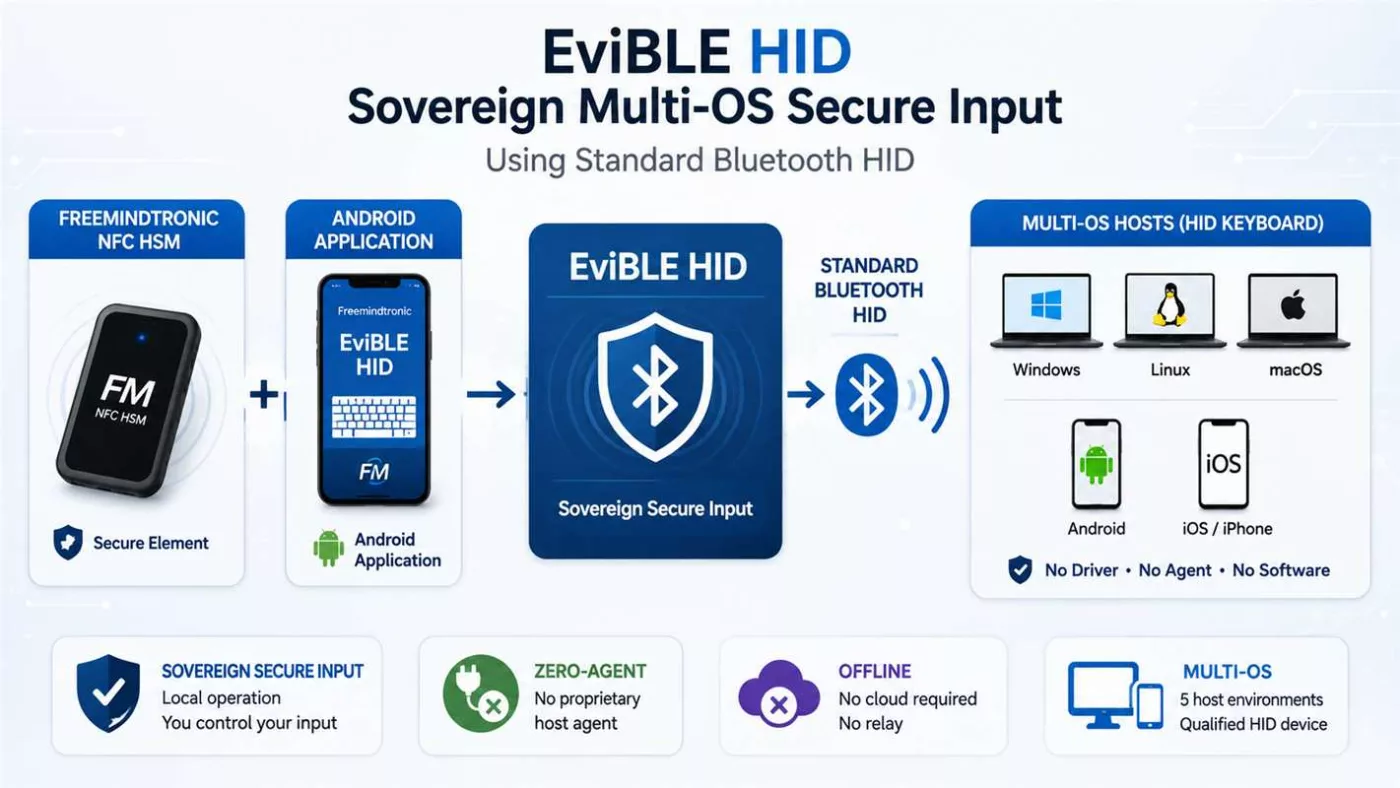
EviBLE HID transforms a compatible Android device into a sovereign Bluetooth HID keyboard for secure, offline and Zero-Agent input. Therefore, users can send deterministic keyboard input to supported terminals without installing Freemindtronic software on the host.

Sovereign

Offline by design

Zero-Agent

No host software

Adaptive

Host layout profiles

Secure

Fail-closed input

Native HID

Bluetooth keyboard

Air-Gap

No cloud required


What Is EviBLE HID?

TL;DR — EviBLE HID is Freemindtronic’s sovereign Bluetooth Human Interface Device technology. It turns a compatible Android device into a secure keyboard interface and therefore removes the need for a dedicated USB InputStick dongle on supported workflows. Moreover, EviBLE HID operates locally, requires no cloud connection and can remember a validated keyboard layout profile for each host.

EviBLE HID focuses on the final secure-input path between a Freemindtronic-controlled Android environment and a target terminal. Instead of copying credentials through a clipboard or synchronizing them through an online service, EviBLE HID converts authorized input into standard keyboard reports and sends them directly through Bluetooth HID.

Furthermore, the technology separates sensitive data ownership from transport. Freemindtronic applications and NFC HSM technologies remain responsible for secrets, authentication and user authorization, while EviBLE HID acts only as the controlled HID delivery layer.

Key capabilities

  • Bluetooth HID keyboard without a USB dongle
  • Zero-Agent operation on the target host
  • Offline and air-gapped workflows
  • Adaptive keyboard layout selection per terminal
  • Persistent validated host profiles
  • Fail-closed Secure Send gating
  • Caps Lock safety controls
  • Multiple known Bluetooth hosts
  • International layout Factory
  • NFC HSM and FMT Secure Input integration path
⚠ Security boundary —
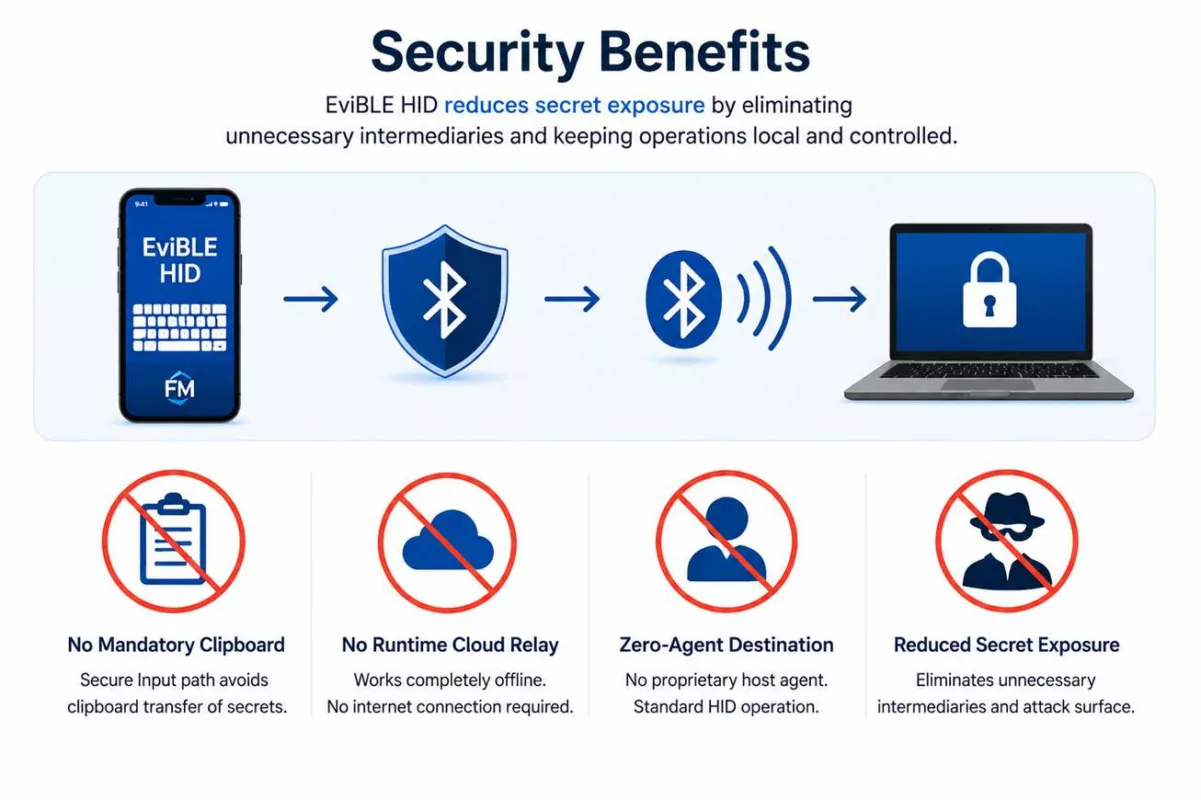
EviBLE HID reduces exposure by avoiding clipboard workflows, cloud transport and unnecessary host software. However, standard HID cannot make a compromised host trustworthy. Consequently, malware running on the destination system may still observe keyboard events, application fields or screen content.


EviBLE HID Sovereign Bluetooth HID Architecture

⮞ Summary —
EviBLE HID uses the standard Bluetooth HID model while keeping secret management outside the HID transport layer.

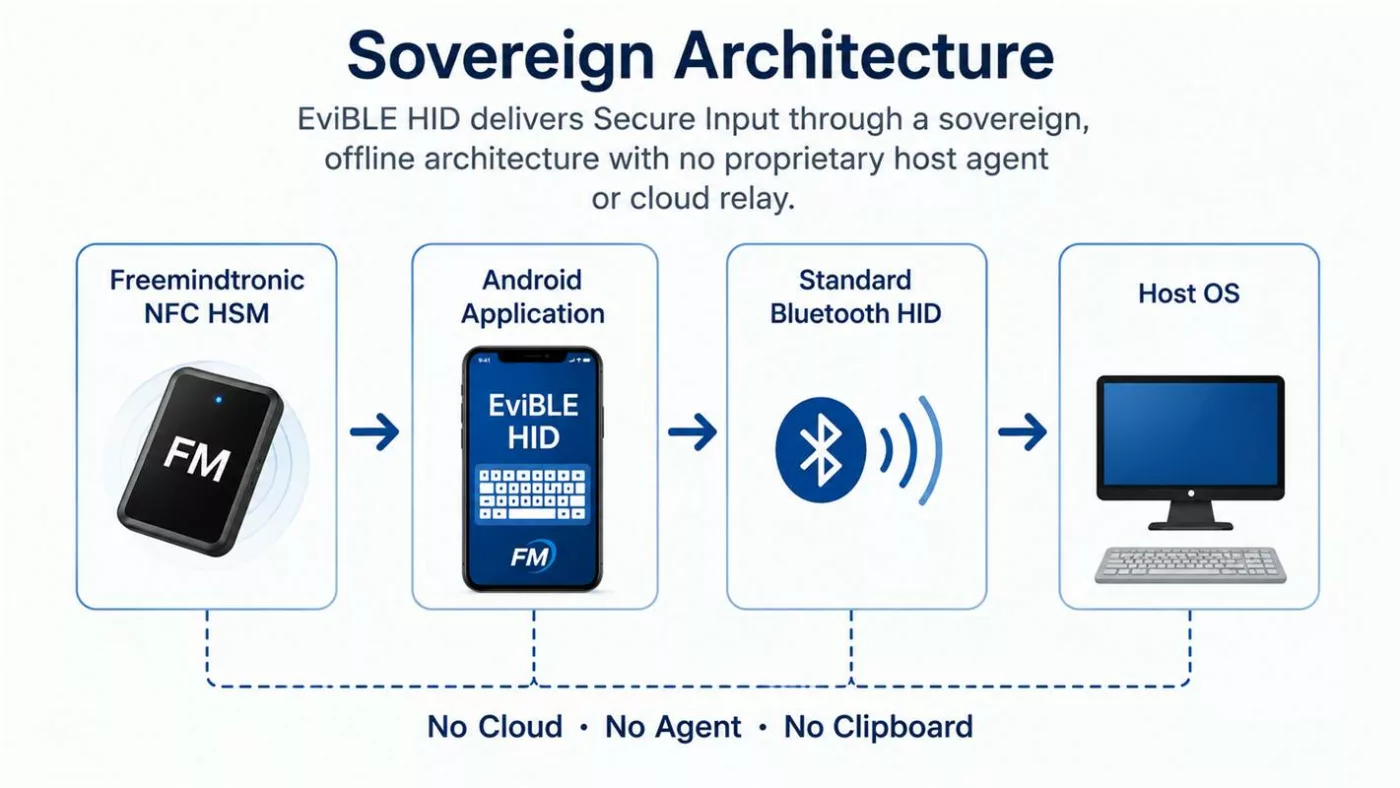
EviBLE HID makes the Android source device behave as a Bluetooth keyboard toward the destination terminal. Therefore, the host interacts with a standard HID device instead of a proprietary credential protocol. This design reduces host-side dependencies and, importantly, keeps deployment simple.

The technology does not need a cloud relay. Moreover, the destination computer does not need an EviBLE driver, browser extension, password-manager plugin or background agent. Once Bluetooth pairing exists, EviBLE HID can establish the HID session and send validated keyboard reports to the selected active host.

A separated trust chain

Layer Responsibility Security principle
NFC HSM / Freemindtronic Secret ownership and authorization Secrets stay under Freemindtronic control
FMT Secure Input Chooses the authorized input operation Explicit user-controlled action
EviBLE HID Transforms approved input into HID reports No secret persistence in the HID provider
Bluetooth HID Delivers standard keyboard events Host compatibility without an agent
Host terminal Receives keyboard input Must still be treated as an independent trust domain


Zero-Agent Keyboard Layout Selection

⮞ Summary —
EviBLE HID can identify the appropriate keyboard layout with minimal user interaction and then reuse a validated profile automatically on later connections.

A standard Bluetooth HID connection does not tell a keyboard which operating-system layout the host currently uses. Consequently, blindly sending the same HID sequence can produce the wrong character on another layout.

EviBLE HID solves this problem with its Zero-Agent calibration architecture. For an unknown terminal, EviBLE can send carefully selected, non-sensitive HID probes inside a dedicated calibration workflow. The user then confirms the visible result. Therefore, the system can progressively narrow the candidate layouts without installing software on the host.

First connection

First, EviBLE identifies the Bluetooth host. Next, it checks whether a validated profile already exists. If no HIGH-confidence profile exists, EviBLE starts calibration. Then, it uses a small number of safe observations to identify the keyboard layout. Finally, the user confirms the result before Secure Send becomes available.

Later connections

Once EviBLE stores a valid HIGH-confidence profile, it can verify the host identity and layout metadata on reconnect. Consequently, a known unchanged terminal can reach AUTO_SELECTED / HIGH without sending another calibration probe.

Validated Windows behavior —
The Windows Zero-Agent v1 qualification demonstrated profile persistence, reconnect restoration, zero-probe auto-selection and fail-closed behavior for ambiguous or interrupted calibration paths.


Secure Send with Fail-Closed HID Input

⮞ Summary —
EviBLE HID blocks sensitive Secure Send operations whenever the keyboard state or layout confidence is not sufficiently validated.

Correct character mapping matters especially when users inject passwords, recovery codes or administrative commands. Therefore, EviBLE HID does not treat an uncertain keyboard layout as acceptable for sensitive input.

The Secure Send gate uses explicit confidence states. A HIGH state means EviBLE has a sufficiently validated host-layout profile. Conversely, LOW or NONE keeps sensitive Secure Send blocked. Additionally, recalibration clears the previously trusted state until the new result receives explicit confirmation.

Safety conditions

  • HIGH: Secure Send may proceed.
  • LOW: EviBLE still requires confirmation or disambiguation.
  • NONE: no trusted layout exists.
  • Caps Lock ON: sensitive keyboard input is blocked.
  • Caps Lock UNKNOWN in strict mode: sensitive input is blocked.
  • Abort or Other: calibration fails closed.
  • Interrupted calibration: no stale HIGH state is created.


International HID Keyboard Layout Factory

⮞ Summary —
EviBLE HID uses a data-driven layout Factory instead of maintaining one software implementation for every keyboard language.

International keyboards map the same physical HID usage to different characters. Therefore, reliable multilingual Secure Input requires more than a translation table.

Freemindtronic built a common layout architecture that converts pinned operating-system layout sources into validated EviBLE layout packs. Moreover, Windows, Linux and macOS adapters feed the same canonical runtime model. Consequently, new keyboard layouts can scale through data and provenance rather than through duplicated Java classes.

Current validated baseline

Platform family Validated packs Current baseline
Windows 11 en-US, fr-FR, de-DE, es-ES, it-IT, pt-PT, ro-RO, ca-ES, ru-RU, uk-UA, Arabic
Linux 11 Equivalent canonical host-layout families
macOS 11 Equivalent canonical host-layout families where native sources were validated
Total 33 Runtime parity validated

Furthermore, the Factory verifies provenance, hashes, deterministic regeneration, coverage and runtime compatibility. Therefore, the architecture can expand toward a broader international catalog without redesigning the HID engine.

Some writing systems depend heavily on host IMEs. Consequently, EviBLE does not claim arbitrary Unicode typing through standard HID where the host input method remains essential.


Bluetooth Host Pairing, Switching and Reconnection

⮞ Summary —
EviBLE HID can remember multiple known hosts while maintaining one explicit active HID target at a time.

Users may pair EviBLE HID with several computers or terminals. However, the source device keeps an explicit active target for keyboard delivery. Therefore, a Secure Input operation cannot accidentally broadcast to every bonded host.

When a known host reconnects, EviBLE can restore its persisted layout profile if the profile identity, Factory epoch and layout fingerprint still match. Consequently, validated hosts can return directly to the correct keyboard configuration without repeating calibration.

Existing Bluetooth bonding also remains usable. In other words, Zero-Agent calibration does not require users to delete and recreate a previously established pairing.


Offline and Air-Gapped Secure Keyboard Operation

⮞ Summary —
EviBLE HID runs without cloud services, online layout lookup or host-side downloads.

The runtime operates locally. Therefore, authentication workflows do not depend on an internet connection, DNS service, external API or cloud account.

Furthermore, keyboard layout resources travel with the validated application build. The production terminal does not fetch mappings from the internet. Consequently, EviBLE HID remains suitable for isolated workstations, restricted environments and offline administrative workflows.

This architecture does not magically make every Bluetooth environment an electromagnetic air gap. Instead, it provides network-independent secure input while keeping the application workflow autonomous from IP networks and cloud infrastructure.


EviBLE HID and Freemindtronic NFC HSM

⮞ Summary —
EviBLE HID is designed as a Secure Input transport layer for Freemindtronic technologies rather than as a password database.

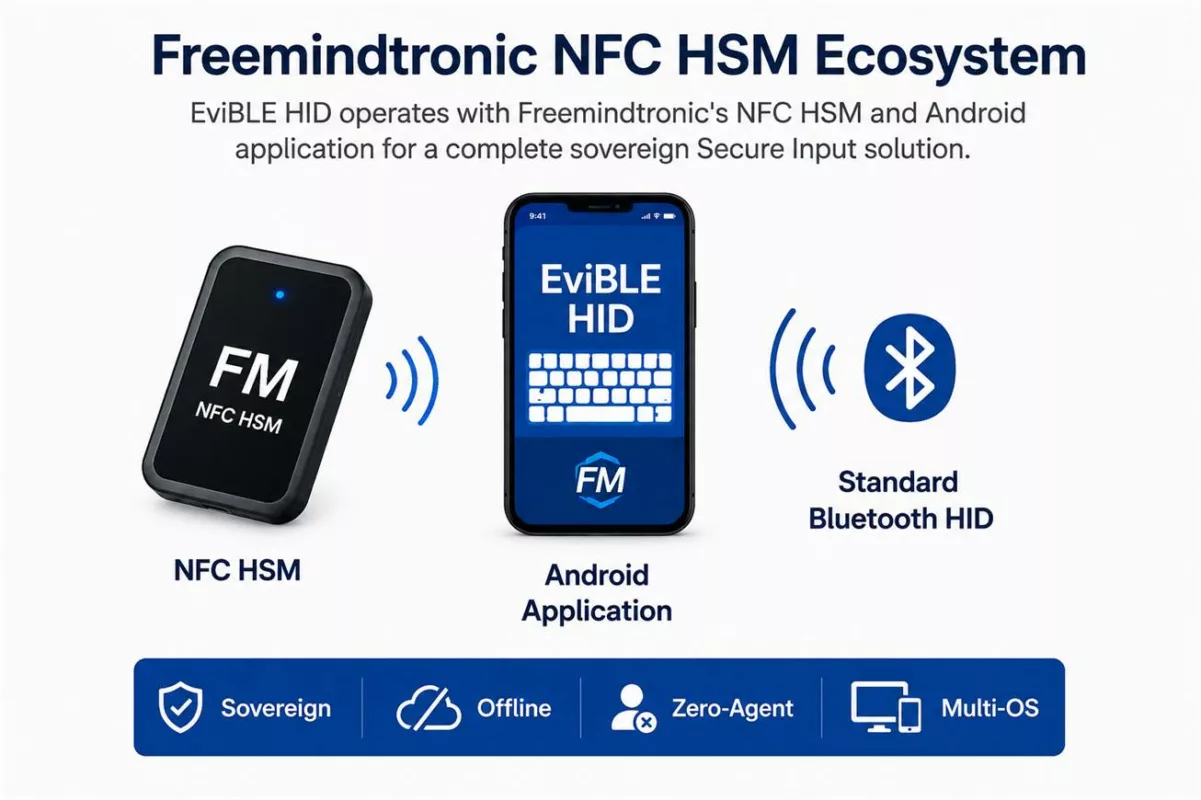
Freemindtronic NFC HSM technologies can authorize access to protected credentials or operational data. Then, the application can route an authorized Secure Input operation through EviBLE HID.

Importantly, EviBLE HID does not need to become the long-term owner of those secrets. Instead, the Secure Input provider receives the authorized operation and emits the corresponding keyboard reports. Therefore, secret management and HID transport remain separated by design.

Integration model

NFC HSM → Freemindtronic App → Secure Input → EviBLE HID → Bluetooth HID → Host

Moreover, Freemindtronic can keep InputStick as a permanent alternative provider. Consequently, users can choose the HID route that best matches their equipment without abandoning existing deployments.


Secure Bluetooth HID Use Cases

⮞ Summary —
EviBLE HID targets secure keyboard delivery wherever installing a host-side agent would be undesirable, impossible or operationally expensive.

Secure credential input

Users can deliver authorized credentials through keyboard input without first copying them into the destination clipboard. Therefore, the workflow reduces exposure to clipboard history, synchronization utilities and copy-paste interception.

Administrative and privileged access

Administrators can use EviBLE HID on supported login forms, local administration consoles and isolated workstations. Moreover, the Zero-Agent approach reduces deployment dependencies on the destination terminal.

BitLocker and pre-login fields

Where the destination environment accepts standard Bluetooth HID input at the relevant stage, EviBLE can provide deterministic keyboard reports. However, actual pre-boot Bluetooth support depends on the host firmware and platform implementation.

Industrial and OT environments

EviBLE HID can support terminals where operators want to reduce software installation and network dependency. Consequently, the technology is relevant to selected SCADA, ICS, embedded and maintenance workflows, subject to the HID capability and security policy of the target equipment.

Emergency access

Offline Secure Input can also complement break-glass procedures because it avoids dependence on cloud connectivity. Nevertheless, organizations should still apply their normal operational controls, auditing and endpoint protection.


EviBLE HID Technical Datasheet

Property EviBLE HID
Technology type Bluetooth Human Interface Device keyboard technology
Source platform Compatible Android device with Bluetooth HID Device capability
Host software No Freemindtronic host agent required for standard HID operation
Internet requirement None at runtime
Cloud dependency None at runtime
Primary HID interface Keyboard
Host management Multiple known/bonded hosts, one explicit active HID target
Layout engine Data-driven LayoutDescriptor architecture
Validated layout baseline 33 packs across Windows, Linux and macOS layout families
Zero-Agent calibration Minimal safe HID observations for unknown layouts
Known-host restore Persistent validated profile with zero-probe auto-selection when still valid
Secure Send policy Fail-closed unless layout confidence meets required state
Caps Lock handling LED state monitoring with strict UNKNOWN policy available
Secret persistence in HID provider Not required by the architecture
Runtime architecture Local and autonomous


EviBLE HID vs InputStick BLE USB

⮞ Summary —
Both technologies provide HID input paths for the Freemindtronic ecosystem; however, they solve the transport problem differently.
Capability EviBLE HID InputStick BLE USB
Extra USB hardware No dedicated InputStick required InputStick USB dongle required
Host-side Freemindtronic agent No No
Transport architecture Android acts as Bluetooth HID device Android communicates with InputStick, which exposes USB HID
Zero-Agent layout calibration Yes, EviBLE architecture Not the same host-fingerprinting architecture
Per-host validated layout profile Yes Layout selection follows the InputStick integration model
Secure Send fail-closed layout gate Yes Different architecture
Existing Freemindtronic deployments New additional provider Permanent supported provider

Therefore, EviBLE HID does not replace InputStick by architectural necessity. Instead, Freemindtronic can expose both through a common Secure Input abstraction and allow users to select the appropriate provider.


Security by Design

⮞ Summary —
EviBLE HID reduces unnecessary exposure while explicitly preserving the destination host as a separate trust domain.
  • No mandatory clipboard: Secure Input can generate HID events directly.
  • No cloud dependency: runtime decisions remain local.
  • No host agent: the terminal does not need Freemindtronic software for standard HID input.
  • Explicit active host: EviBLE targets one selected HID host.
  • Fail-closed layout gate: sensitive input stays blocked when the mapping remains uncertain.
  • Caps Lock control: ambiguous or unsafe LED states can block Secure Send.
  • No content retry after send failure: the HID sequence stops instead of repeating sensitive content.
  • No GET_REPORT key history: host requests do not expose previously typed secrets.
Important limitation —
EviBLE HID cannot protect a secret after a compromised destination has legitimately received its keystrokes. A host keylogger, malicious application, compromised field or screen-capture mechanism may still observe resulting input. Therefore, EviBLE HID reduces the attack surface; it does not claim invulnerability against a hostile endpoint.


EviBLE HID Glossary

EviBLE HID
Open definition
Freemindtronic technology that enables a compatible Android device to operate as a controlled Bluetooth HID input provider.
Zero-Agent
Open definition
An architecture that performs host-compatible HID input without installing a Freemindtronic application, service, extension or driver on the destination terminal.
Layout Fingerprinting
Open definition
A calibration method that uses safe HID observations to distinguish candidate host keyboard layouts without reading the host operating-system layout directly.
HIGH Confidence
Open definition
The validated state required by the Zero-Agent Secure Send policy before sensitive keyboard input can proceed.
Fail-Closed
Open definition
A security behavior that blocks sensitive input when EviBLE cannot establish the required layout, host or keyboard-state confidence.
Secure Input Provider
Open definition
The abstraction through which Freemindtronic applications can use different secure HID providers such as EviBLE HID or InputStick without mixing secret management with transport.


EviBLE HID FAQ

EviBLE HID is Freemindtronic’s sovereign Bluetooth HID technology. It enables a compatible Android device to act as a controlled Bluetooth keyboard for secure input workflows.
No. Unlike the InputStick path, EviBLE HID uses the Android device’s supported Bluetooth HID Device capability directly. Therefore, a dedicated InputStick USB dongle is not required for the EviBLE path.
No Freemindtronic host-side agent is required for standard Bluetooth HID operation. Consequently, the destination receives EviBLE as a keyboard rather than through a proprietary application protocol.
Not directly through standard HID because Bluetooth HID does not expose the active OS keyboard layout. Instead, EviBLE uses Zero-Agent calibration for unknown terminals. Once the user validates the result, EviBLE can remember that host profile and automatically restore it on later connections when the profile remains valid.
The Windows v1 design limits calibration to a small number of safe observations. Some layouts can resolve quickly, while ambiguous families may require additional selection or explicit confirmation. Importantly, EviBLE never treats an uncertain result as trusted Secure Send input.
No. A previously validated HIGH-confidence profile can be restored automatically if the host identity and layout metadata still match. Therefore, a known host may reconnect with zero calibration probes.
Yes. The runtime architecture is designed to operate without cloud services, network APIs or online layout downloads.
The HID provider does not need to act as a password database. Secret ownership and authorization remain responsibilities of the Freemindtronic Secure Input and NFC HSM layers.
EviBLE can use the keyboard LED state to detect Caps Lock. Therefore, sensitive Secure Send operations can be blocked when Caps Lock is ON or when its state remains unknown under strict policy.
EviBLE reduces exposure to clipboard-based and cloud-based attack paths. However, it cannot make a compromised destination trustworthy. Malware on the host may still observe keyboard events or the resulting application field.
No. Freemindtronic can keep InputStick and EviBLE HID as permanent Secure Input providers. Consequently, existing InputStick deployments remain supported while EviBLE adds a native Bluetooth HID path.
Yes. EviBLE uses a data-driven international layout Factory. The validated baseline currently contains 33 Windows, Linux and macOS host-layout packs, while further international expansion can use the same industrialized pipeline.
Standard HID alone cannot guarantee arbitrary Unicode text for writing systems that depend heavily on a host IME. Therefore, EviBLE explicitly distinguishes direct HID mappings from workflows that require the destination input method.

EviBLE HID: A Sovereign Secure Input Layer

EviBLE HID moves secure keyboard delivery closer to the Freemindtronic-controlled device while keeping the destination terminal free from proprietary host software. Therefore, it creates a practical bridge between sovereign NFC HSM workflows and standard human-interface protocols.

Moreover, Zero-Agent host-layout calibration addresses a problem that conventional HID keyboards usually leave to the user: selecting the correct mapping for each terminal. Once EviBLE validates that mapping, it can remember the host and restore the correct profile later.

Ultimately, EviBLE HID combines standard Bluetooth keyboard compatibility, offline operation, international keyboard intelligence, explicit fail-closed Secure Send and Freemindtronic NFC HSM integration in one sovereign Secure Input architecture.

Leave a Reply

Your email address will not be published. Required fields are marked *

This site uses Akismet to reduce spam. Learn how your comment data is processed.