
May
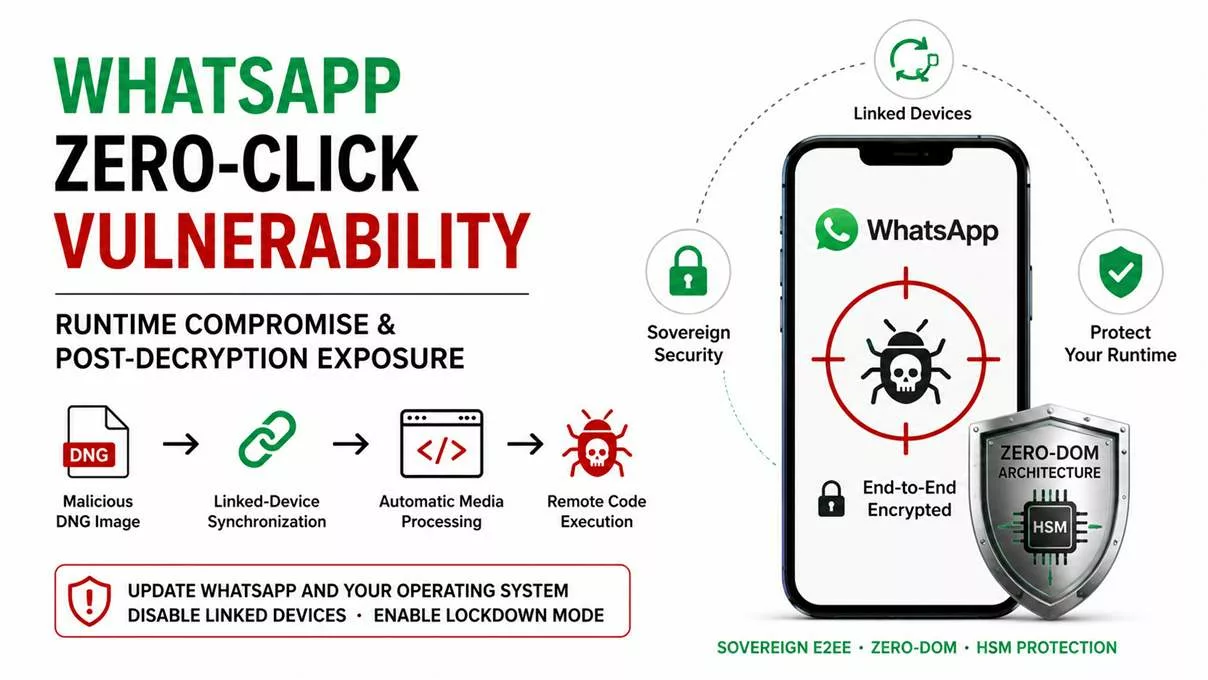
WhatsApp zero-click vulnerability — the critical flaw CVE-2025-55177, chained with Apple CVE-2025-43300, enables remote code execution through malicious DNG images abusing linked-device synchronization and automatic media processing. This attack highlights the limits of traditional E2EE once the mobile runtime itself becomes compromised. Update WhatsApp and your operating system immediately.
Executive Summary — WhatsApp Zero-Click Vulnerability, Runtime Compromise & Sovereign E2EE
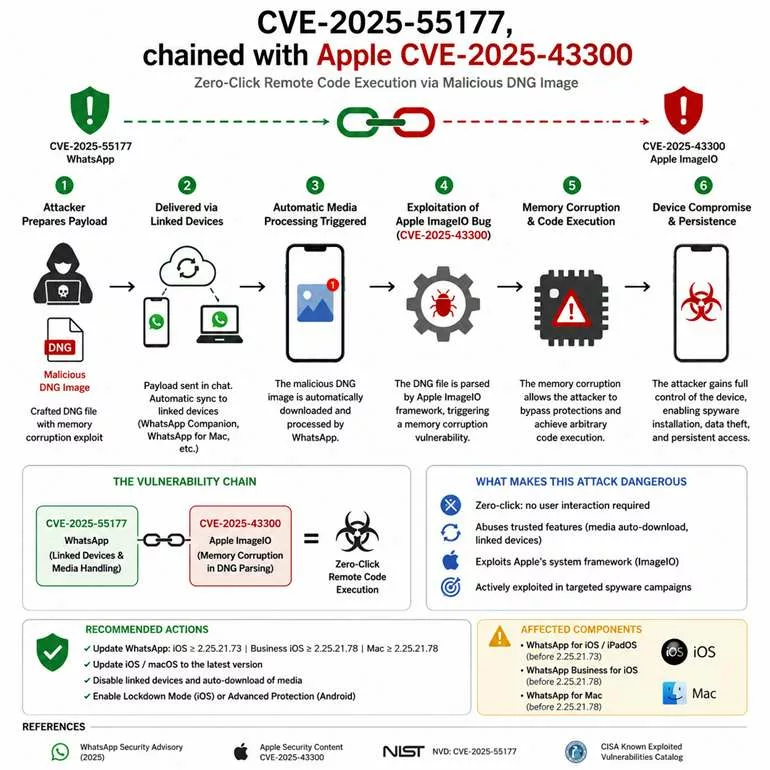
The WhatsApp zero-click vulnerability (CVE-2025-55177 chained with Apple CVE-2025-43300) enables arbitrary remote code execution through a specially crafted DNG image without requiring any user interaction. By abusing linked-device synchronization and automatic media processing, attackers can remotely trigger malicious parsing operations capable of compromising the runtime itself.
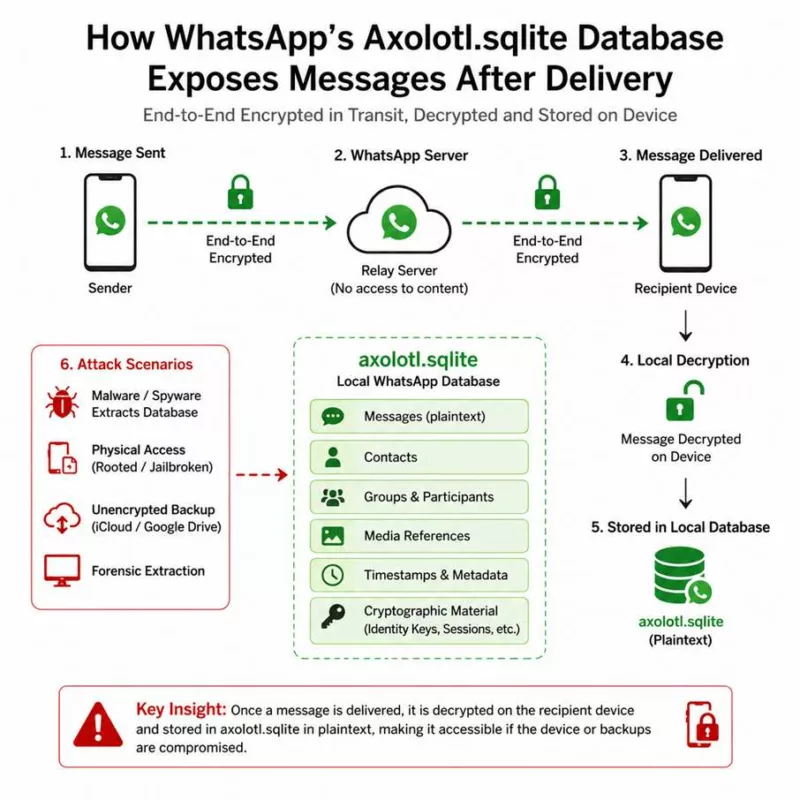
This attack is strategically important because it demonstrates a growing reality in modern cybersecurity: end-to-end encryption protects communications during transport, but it does not necessarily protect already decrypted data once the runtime environment becomes compromised.
Meta confirmed active exploitation against high-risk targets. Patched versions are available:
- WhatsApp for iOS ≥ 2.25.21.73
- WhatsApp Business iOS ≥ 2.25.21.78
- WhatsApp for Mac ≥ 2.25.21.78
Critical advisory — immediate action required
This vulnerability should not be viewed solely as a messaging application flaw, but as a runtime compromise threat capable of exposing already decrypted information.
High-risk users should:
- update WhatsApp and the operating system immediately;
- temporarily disable linked devices and automatic media downloads;
- enable Apple Lockdown Mode or Android Advanced Protection;
- isolate sensitive communications using sovereign Zero-DOM architectures and NFC/HSM segmented-key protection.
Reading Parameters
Executive summary reading time: 3 minutes
Full article estimated reading time: 18 minutes
Initial publication: 30 September 2025
Last update: 26 May 2026
Complexity level: Expert
Languages available: FR · EN · ES · CAT
Editorial format: Strategic cybersecurity analysis
Primary topic: WhatsApp zero-click vulnerability
Secondary topics: runtime compromise, sovereign E2EE, post-decryption security, Zero-DOM
About the author: Jacques Gascuel, inventor and founder of Freemindtronic®, architect of sovereign cybersecurity infrastructures and creator of NFC & PGP HSM technologies dedicated to Zero-DOM protection of critical secrets.
Key takeaways
The WhatsApp zero-click vulnerability reveals a much broader evolution in mobile cybersecurity. Modern attacks increasingly target the runtime environment itself rather than the encrypted transport channel alone.
Once a runtime becomes compromised, already decrypted information may become exposed through memory buffers, synchronization mechanisms, media parsers or local caches.
This fundamentally changes the security model of modern E2EE communications and validates the growing importance of:
- Zero-DOM architectures;
- segmented key infrastructures;
- offline HSM protection;
- post-decryption security models;
- sovereign runtime trust architectures.
New warning — local runtime exposure and unencrypted chat concerns
Recent analyses suggest that some WhatsApp conversations may become locally accessible without effective encryption in specific runtime contexts associated with the Meta ecosystem.
This does not directly break transport-layer E2EE. However, it confirms a critical strategic reality, the WhatsApp zero-click vulnerability becomes dramatically more dangerous once a compromised runtime gains access to already decrypted data.
Transport encryption alone is no longer sufficient when the operating environment itself can become hostile.

2026 Digital Security
EviDNA DNA Cryptography | Jacques Gascuel Memory
EviDNA DNA cryptography: Freemindtronic complementary reference memory — EviDNA, Digital DNA, cryptographic genome, cybersecurity and [...]
Jul
2022 2026 Digital Security
EviDNA cryptographie ADN | mémoire Jacques Gascuel
EviDNA cryptographie ADN : mémoire complémentaire de référence Freemindtronic — EviDNA, ADN Digital, génome cryptographique, [...]
Jul

2022 2026 Digital Security
Predictive Artificial Intelligence Architectures: Freemindtronic EviSKMS R&D Memorandum
Predictive Artificial Intelligence Architectures: Freemindtronic reference memorandum on Artificial Intelligence, World Models, LAMP-C, Cybersecurity and [...]
Jul

2022 2026 Digital Security
Architectures intelligence artificielle prédictive : mémoire EviSKMS R&D Freemindtronic
Architectures intelligence artificielle prédictive : mémoire de référence Freemindtronic sur l’IA, les modèles du monde, [...]
Aug

2025 2026 Digital Security Technical News
Quantum computer 6100 qubits ⮞ Historic 2025 breakthrough
A 6,100-qubit neutral-atom array marks a major scaling milestone in quantum computing, raising new strategic [...]
Oct

2025 2026 Digital Security
Vulnérabilité WhatsApp zero-click — Actions, contremesures et sécurité E2EE souveraine
Vulnérabilité WhatsApp zero-click — la faille critique CVE-2025-55177, associée à Apple CVE-2025-43300, permet l’exécution de [...]
Sep
2025 2026 Digital Security
WhatsApp zero-click vulnerability and runtime compromise
WhatsApp zero-click vulnerability — the critical flaw CVE-2025-55177, chained with Apple CVE-2025-43300, enables remote code [...]
May

2026 Cyber Doctrine Digital Security
Whisper Leak side-channel and LLM token leakage
Whisper Leak side-channel: token-length leakage, semantic inference, and the structural limits of HTTPS in large [...]
Feb

2023 2026 Digital Security Phishing
BITB Attacks: How to Avoid Phishing by iFrame
Browser-in-the-Browser (BITB) attacks: interface forgery through redirection iframes and the structural limits of browser trust. [...]
May

2026 Digital Security
Zero-knowledge vulnérable : attaques par downgrade contre Bitwarden, LastPass et Dashlane
Zero-knowledge vulnérable : les attaques par downgrade contre Bitwarden, LastPass et Dashlane révèlent comment la [...]
Feb

2026 Digital Security
Zero-Knowledge Downgrade Attacks — Structural Risks
Zero-Knowledge Downgrade Attacks: downgrade paths against Bitwarden, LastPass, and Dashlane show how cryptographic backward compatibility [...]
Feb

2025 Digital Security
Clickjacking des extensions DOM : DEF CON 33 révèle 11 gestionnaires vulnérables
Clickjacking d’extensions DOM : DEF CON 33 révèle une faille critique et les contre-mesures Zero-DOM
Aug

2025 Cyberculture Digital Security
Browser Fingerprinting Tracking: Metadata Surveillance in 2026
Browser Fingerprinting Tracking today represents one of the true cores of metadata intelligence. Far beyond [...]
Feb

2026 Digital Security
Browser Fingerprinting : le renseignement par métadonnées en 2026
Le browser fingerprinting constitue aujourd’hui l’un des instruments centraux du renseignement par métadonnées appliqué aux [...]
Jan

2023 2026 Digital Security
CVE-2023-32784 : Pourquoi PassCypher protège vos secrets
PassCypher HSM protège les secrets numériques. Il protège vos secrets numériques hors du périmètre du [...]
May

2023 2026 Digital Security
CVE-2023-32784 Protection with PassCypher NFC HSM
CVE-2023-32784 Protection with PassCypher NFC HSM safeguards your digital secrets. It protects your secrets beyond [...]
May

2026 Digital Security
Cyber espionnage zero day : marché, limites et doctrine souveraine
Cyber espionnage zero day : la fin des spywares visibles marque l’entrée dans une économie [...]
Jan
2026 Digital Security
Cyberattaque HubEE : Rupture silencieuse de la confiance numérique
Cyberattaque HubEE : rupture silencieuse de la confiance numérique. Cette attaque, qui a permis l’exfiltration [...]
Jan
2025 Digital Security
Persistent OAuth Flaw: How Tycoon 2FA Hijacks Cloud Access
Persistent OAuth Flaw — Tycoon 2FA Exploited — When a single consent becomes unlimited cloud [...]
Oct
2025 Digital Security
Tycoon 2FA failles OAuth persistantes dans le cloud | PassCypher HSM PGP
Faille OAuth persistante — Tycoon 2FA exploitée — Quand une simple autorisation devient un accès [...]
Oct

2025 Digital Security
OpenAI fuite Mixpanel : métadonnées exposées, phishing et sécurité souveraine
OpenAI fuite Mixpanel rappelle que même les géants de l’IA restent vulnérables dès qu’ils confient [...]
Dec

2025 Digital Security
OpenAI Mixpanel Breach Metadata – phishing risks and sovereign security with PassCypher
AI Mixpanel breach metadata is a blunt reminder of a simple rule: the moment sensitive [...]
Jan

2026 Crypto Currency Cryptocurrency Digital Security
Ledger Security Breaches from 2017 to 2026: How to Protect Yourself from Hackers
Ledger Security Breaches have become a major indicator of vulnerabilities in the global crypto ecosystem. [...]
Dec

2026 Digital Security
Failles de sécurité Ledger : Analyse 2017-2026 & Protections
Les failles de sécurité Ledger sont au cœur des préoccupations des investisseurs depuis 2017. Cette [...]
Jan

2025 Digital Security
Bot Telegram Usersbox : l’illusion du contrôle russe
Le bot Telegram Usersbox n’était pas un simple outil d’OSINT « pratique » pour curieux [...]
Nov
2025 Digital Security
Espionnage invisible WhatsApp : quand le piratage ne laisse aucune trace
Espionnage invisible WhatsApp n’est plus une hypothèse marginale, mais une réalité technique rendue possible par [...]
Dec

2025 Digital Security
Fuite données ministère interieur : messageries compromises et ligne rouge souveraine
Fuite données ministère intérieur. L’information n’est pas arrivée par une fuite anonyme ni par un [...]
Jan

2026 Digital Security
Silent Whisper espionnage WhatsApp Signal : une illusion persistante
Silent Whisper espionnage WhatsApp Signal est présenté comme une méthode gratuite permettant d’espionner des communications [...]
Jan

2026 Awards Cyberculture Digital Security Distinction Excellence EviOTP NFC HSM Technology EviPass EviPass NFC HSM technology EviPass Technology finalists PassCypher PassCypher
Quantum-Resistant Passwordless Manager — PassCypher finalist, Intersec Awards 2026 (FIDO-free, RAM-only)
Quantum-Resistant Passwordless Manager 2026 (QRPM) — Best Cybersecurity Solution Finalist by PassCypher sets a new [...]
Nov

2025 Cyberculture Cybersecurity Digital Security EviLink
CryptPeer messagerie P2P WebRTC : appels directs chiffrés de bout en bout
La messagerie P2P WebRTC sécurisée constitue le fondement technique et souverain de la communication directe [...]
Nov
2025 CyptPeer Digital Security EviLink
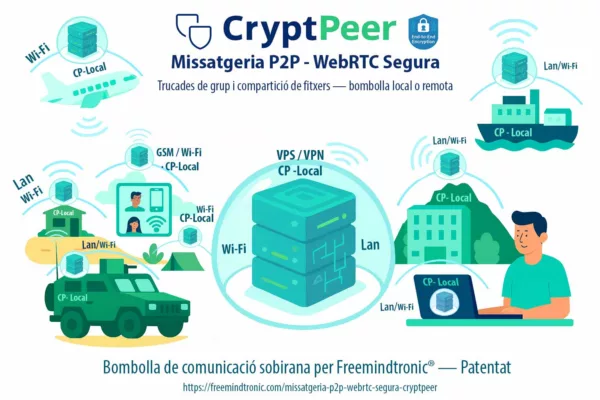
Missatgeria P2P WebRTC segura — comunicació directa amb CryptPeer
Missatgeria P2P WebRTC segura al navegador és l’esquelet tècnic i sobirà de la comunicació directa [...]
Nov
2025 Digital Security
Russia Blocks WhatsApp: Max and the Sovereign Internet
Step by step, Russia blocks WhatsApp and now openly threatens to “completely block” the messaging [...]
Nov

2020 Digital Security
WhatsApp Gold arnaque mobile : typologie d’un faux APK espion
WhatsApp Gold arnaque mobile — clone frauduleux d’application mobile, ce stratagème repose sur une usurpation [...]
Nov
2025 Digital Security
Spyware ClayRat Android : faux WhatsApp espion mobile
Spyware ClayRat Android illustre la mutation du cyberespionnage : plus besoin de failles, il exploite [...]
Oct

2025 Digital Security
Android Spyware Threat Clayrat : 2025 Analysis and Exposure
Android Spyware Threat: ClayRat illustrates the new face of cyber-espionage — no exploits needed, just [...]
Oct
2023 Digital Security
WhatsApp Hacking: Prevention and Solutions
WhatsApp hacking zero-click exploit (CVE-2025-55177) chained with Apple CVE-2025-43300 enables remote code execution via crafted [...]
Jan
2025 Digital Security Technical News
Sovereign SSH Authentication with PassCypher HSM PGP — Zero Key in Clear
SSH Key PassCypher HSM PGP establishes a sovereign SSH authentication chain for zero-trust infrastructures, where [...]
Oct

2025 Digital Security Tech Fixes Security Solutions Technical News
SSH Key PassCypher HSM PGP — Sécuriser l’accès multi-OS à un VPS
SSH Key PassCypher HSM PGP fournit une chaîne souveraine : génération locale de clés SSH [...]
Oct

2025 Digital Security Technical News
Générateur de mots de passe souverain – PassCypher Secure Passgen WP
Générateur de mots de passe souverain PassCypher Secure Passgen WP pour WordPress — le premier [...]
Oct

2025 Digital Security Technical News
Ordinateur quantique 6100 qubits ⮞ La percée historique 2025
Ordinateur quantique 6100 qubits marque un tournant dans l’histoire de l’informatique, soulevant des défis sans [...]
Oct
2025 Cyberculture Digital Security
Authentification multifacteur : anatomie, OTP, risques
Authentification Multifacteur : Anatomie souveraine Explorez les fondements de l’authentification numérique à travers une typologie [...]
Sep

2025 Digital Security
Clickjacking extensions DOM: Vulnerabilitat crítica a DEF CON 33
DOM extension clickjacking — el clickjacking d’extensions basat en DOM, mitjançant iframes invisibles, manipulacions del [...]
Aug

2025 Digital Security
DOM Extension Clickjacking — Risks, DEF CON 33 & Zero-DOM fixes
DOM extension clickjacking — a technical chronicle of DEF CON 33 demonstrations, their impact, and [...]
Aug

2025 Digital Security
Chrome V8 Zero-Day CVE-2025-10585 — Ton navigateur était déjà espionné ?
Chrome V8 zero-day CVE-2025-10585 — Votre navigateur n’était pas vulnérable. Vous étiez déjà espionné !
Sep

2025 Digital Security
Confidentialité métadonnées e-mail — Risques, lois européennes et contre-mesures souveraines
La confidentialité des métadonnées e-mail est au cœur de la souveraineté numérique en Europe : [...]
Sep

2025 Digital Security
Email Metadata Privacy: EU Laws & DataShielder
Email metadata privacy sits at the core of Europe’s digital sovereignty: understand the risks, the [...]
Sep

2025 Digital Security
Chrome V8 confusió RCE — Actualitza i postura Zero-DOM
Chrome V8 confusió RCE: aquesta edició exposa l’impacte global i les mesures immediates per reduir [...]
Sep

2025 Digital Security
Chrome V8 confusion RCE — Your browser was already spying
Chrome v8 confusion RCE: This edition addresses impacts and guidance relevant to major English-speaking markets [...]
Sep


2025 Digital Security
Passkeys Faille Interception WebAuthn | DEF CON 33 & PassCypher
Conseil RSSI / CISO – Protection universelle & souveraine EviBITB (Embedded Browser‑In‑The‑Browser Protection) est une [...]
Aug

2025 Cyberculture Digital Security
Reputation Cyberattacks in Hybrid Conflicts — Anatomy of an Invisible Cyberwar
Synchronized APT leaks erode trust in tech, alliances, and legitimacy through narrative attacks timed with [...]
Jul

2025 Digital Security
APT28 spear-phishing: Outlook backdoor NotDoor and evolving European cyber threats
Russian cyberattack on Microsoft by Midnight Blizzard (APT29) highlights the strategic risks to digital sovereignty. [...]
Apr

2024 Cyberculture Digital Security
Russian Cyberattack Microsoft: An Unprecedented Threat
Russian cyberattack on Microsoft by Midnight Blizzard (APT29) highlights the strategic risks to digital sovereignty. [...]
Jul

2024 Digital Security
Midnight Blizzard Cyberattack Against Microsoft and HPE: What are the consequences?
Midnight Blizzard Cyberattack against Microsoft and HPE: A detailed analysis of the facts, the impacts [...]
Mar

2025 Digital Security
eSIM Sovereignty Failure: Certified Mobile Identity at Risk
Runtime Threats in Certified eSIMs: Four Strategic Blind Spots While geopolitical campaigns exploit the [...]
Jul
2025 Digital Security
ToolShell SharePoint vulnerability: NFC HSM mitigates token forgery & zero-day RCE
Jul


2025 Digital Security
APT29 Exploits App Passwords to Bypass 2FA
A silent cyberweapon undermining digital trust Two-factor authentication (2FA) was supposed to be the cybersecurity [...]
Jun

2015 Digital Security
Darknet Credentials Breach 2025 – 16+ Billion Identities Stolen
Underground Market: The New Gold Rush for Stolen Identities The massive leak of over 16 [...]
Jun
2025 Digital Security
Signal Clone Breached: Critical Flaws in TeleMessage
TeleMessage: A Breach That Exposed Cloud Trust and National Security Risks TeleMessage, marketed as a [...]
May
2025 Digital Security
APT29 Spear-Phishing Europe: Stealthy Russian Espionage
APT29 SpearPhishing Europe: A Stealthy LongTerm Threat APT29 spearphishing Europe campaigns highlight a persistent and [...]
Apr
2025 Digital Security
APT36 SpearPhishing India: Targeted Cyberespionage | Security
Understanding Targeted Attacks of APT36 SpearPhishing India APT36 cyberespionage campaigns against India represent a focused [...]
May

2025 Digital Security
Microsoft Outlook Zero-Click Vulnerability: Secure Your Data Now
Microsoft Outlook Zero-Click Vulnerability: How to Protect Your Data Now A critical Zero-Click vulnerability (CVE-2025-21298) [...]
Jan

2025 Digital Security
Microsoft Vulnerabilities 2025: 159 Flaws Fixed in Record Update
Microsoft: 159 Vulnerabilities Fixed in 2025 Microsoft has released a record-breaking security update in January [...]
Jan

2025 Digital Security
APT44 QR Code Phishing: New Cyber Espionage Tactics
APT44 Sandworm: The Elite Russian Cyber Espionage Unit Unmasking Sandworm’s sophisticated cyber espionage strategies and [...]
Feb

2025 Digital Security
BadPilot Cyber Attacks: Russia’s Threat to Critical Infrastructures
BadPilot Cyber Attacks: Sandworm’s New Weaponized Subgroup Understanding the rise of BadPilot and its impact [...]
Feb

2024 Digital Security
Salt Typhoon & Flax Typhoon: Cyber Espionage Threats Targeting Government Agencies
Salt Typhoon – The Cyber Threat Targeting Government Agencies Salt Typhoon and Flax Typhoon represent [...]
Nov

2024 Digital Security
BitLocker Security: Safeguarding Against Cyberattacks
Introduction to BitLocker Security If you use a Windows computer for data storage or processing, [...]
Feb


2024 Digital Security
Cyberattack Exploits Backdoors: What You Need to Know
Cyberattack Exploits Backdoors: What You Need to Know In October 2024, a cyberattack exploited backdoors [...]
Oct

2021 Cyberculture Digital Security Phishing
Phishing Cyber victims caught between the hammer and the anvil
Phishing is a fraudulent technique that aims to deceive internet users and to steal their [...]
May

2024 Digital Security
Google Sheets Malware: The Voldemort Threat
Sheets Malware: A Growing Cybersecurity Concern Google Sheets, a widely used collaboration tool, has shockingly [...]
Sep

2024 Articles Digital Security News
Russian Espionage Hacking Tools Revealed
Russian Espionage Hacking Tools: Discovery and Initial Findings Russian espionage hacking tools were uncovered by [...]
Aug

2024 Digital Security Spying Technical News
Side-Channel Attacks via HDMI and AI: An Emerging Threat
Understanding the Impact and Evolution of Side-Channel Attacks in Modern Cybersecurity Side-channel attacks, also known [...]
Aug

Digital Security Spying Technical News
Are fingerprint systems really secure? How to protect your data and identity against BrutePrint
Fingerprint Biometrics: An In-Depth Exploration of Security Mechanisms and Vulnerabilities It is a widely recognized [...]
Oct

2024 Digital Security Technical News
Apple M chip vulnerability: A Breach in Data Security
Apple M chip vulnerability: uncovering a breach in data security Researchers at the Massachusetts Institute [...]
Mar

Digital Security Technical News
Brute Force Attacks: What They Are and How to Protect Yourself
Brute-force Attacks: A Comprehensive Guide to Understand and Prevent Them Brute Force: danger and protection [...]
Nov

2024 Digital Security
OpenVPN Security Vulnerabilities Pose Global Security Risks
Critical OpenVPN Vulnerabilities Pose Global Security Risks OpenVPN security vulnerabilities have come to the forefront, [...]
Aug

2024 Digital Security
Google Workspace Vulnerability Exposes User Accounts to Hackers
How Hackers Exploited the Google Workspace Vulnerability Hackers found a way to bypass the email [...]
Aug

2023 Digital Security
Predator Files: The Spyware Scandal That Shook the World
Predator Files: How a Spyware Consortium Targeted Civil Society, Politicians and Officials Cytrox: The maker [...]
Oct

2023 Digital Security
5Ghoul: 5G NR Attacks on Mobile Devices
5Ghoul: How Contactless Encryption Can Secure Your 5G Communications from Modem Attacks 5Ghoul is a [...]
Dec

2024 Digital Security
Leidos Holdings Data Breach: A Significant Threat to National Security
A Major Intrusion Unveiled In July 2024, the Leidos Holdings data breach came to light, [...]
Jul

2024 Digital Security
RockYou2024: 10 Billion Reasons to Use Free PassCypher
RockYou2024: A Cybersecurity Earthquake The RockYou2024 data leak has shaken the very foundations of global [...]
Jul

2024 Digital Security
Europol Data Breach: A Detailed Analysis
May 2024: Europol Security Breach Highlights Vulnerabilities In May 2024, Europol, the European law enforcement [...]
May
2024 Digital Security
Dropbox Security Breach 2024: Phishing, Exploited Vulnerabilities
Phishing Tactics: The Bait and Switch in the Aftermath of the Dropbox Security Breach The [...]
May

Digital Security EviToken Technology Technical News
EviCore NFC HSM Credit Cards Manager | Secure Your Standard and Contactless Credit Cards
EviCore NFC HSM Credit Cards Manager is a powerful solution designed to secure and manage [...]
Jun

2024 Digital Security
Kapeka Malware: Comprehensive Analysis of the Russian Cyber Espionage Tool
Kapeka Malware: The New Russian Intelligence Threat In the complex world of cybersecurity, a [...]
Apr

2024 Cyberculture Digital Security News Training
Andorra National Cyberattack Simulation: A Global First in Cyber Defense
Andorra Cybersecurity Simulation: A Vanguard of Digital Defense Andorra-la-Vieille, April 15, 2024 – Andorra is [...]
Apr
Articles Digital Security EviVault Technology NFC HSM technology Technical News
EviVault NFC HSM vs Flipper Zero: The duel of an NFC HSM and a Pentester
EviVault NFC HSM vs Flipper Zero: The duel of an NFC HSM and a Pentester [...]
Jul

Articles Cryptocurrency Digital Security Technical News
Securing IEO STO ICO IDO and INO: The Challenges and Solutions
Securing IEO STO ICO IDO and INO: How to Protect Your Crypto Investments Cryptocurrencies are [...]
Jun

2023 Articles Digital Security Technical News
Remote activation of phones by the police: an analysis of its technical, legal and social aspects
What is the new bill on justice and why is it raising concerns about privacy? [...]
Jun

Articles Cyberculture Digital Security Technical News
Protect Meta Account Identity Theft with EviPass and EviOTP
Protecting Your Meta Account from Identity Theft Meta is a family of products that includes [...]
May

2024 Digital Security
Cybersecurity Breach at IMF: A Detailed Investigation
Cybersecurity Breach at IMF: A Detailed Investigation Cybersecurity breaches are a growing concern worldwide. The [...]
Mar

2023 Articles Cyberculture Digital Security Technical News
Strong Passwords in the Quantum Computing Era
How to create strong passwords in the era of quantum computing? Quantum computing is a [...]
May

2024 Digital Security
PrintListener: How to Betray Fingerprints
PrintListener: How this Technology can Betray your Fingerprints and How to Protect yourself PrintListener revolutionizes [...]
Feb
The chronicles displayed above ↑ belong to the Digital Security section. They extend the analysis of zero-click exploits, mobile spyware, runtime compromise, sovereign E2EE and post-decryption security. This selection complements the present chronicle dedicated to the WhatsApp zero-click vulnerability, CVE-2025-55177, Apple CVE-2025-43300 and the systemic risks linked to linked-device synchronization, malicious DNG media processing and compromised mobile runtimes.
- Executive Summary
- Runtime compromise & post-decryption exposure
- Critical advisory
- Affected versions
- Immediate defensive actions
- Human error & social engineering
- Modern attack techniques
- Weak signals observed
- Monitoring tools & misuse risks
- Sovereign countermeasures
- Why Zero-DOM matters
- Related vulnerabilities
- FAQ
- Strategic outlook
- Toward sovereign E2EE
Why the WhatsApp Zero-Click Vulnerability Goes Beyond Traditional E2EE
What makes this attack exceptional?
Unlike traditional phishing campaigns, victims may never see the malicious payload. A single crafted DNG image processed automatically through linked-device synchronization can silently trigger runtime compromise without any click, download confirmation or visible warning.
The WhatsApp zero-click vulnerability demonstrates a fundamental limitation of modern messaging architectures: end-to-end encryption primarily protects data during transport, but not necessarily once information has already been decrypted inside the runtime environment.
For the first time, a mainstream messaging ecosystem demonstrates at scale how transport-layer E2EE can remain technically intact while already decrypted information becomes exposed through runtime compromise.
Recent findings concerning potentially unencrypted local WhatsApp chat exposure reinforce this issue. A compromised runtime may potentially access:
- memory buffers;
- temporary cryptographic material;
- local caches;
- media processing pipelines;
- linked-device synchronization mechanisms.
This vulnerability also illustrates a broader phenomenon: the gradual collapse of implicit trust in modern mobile runtimes.
Smartphones now integrate:
- complex media parsers;
- cloud synchronization layers;
- cross-application communication;
- persistent session management;
- AI-assisted processing pipelines.
- AI-assisted media classification;
As a result, protecting communications alone is no longer sufficient. Security architectures must also protect the operational environment manipulating sensitive information after decryption.
Critical distinction — software vulnerability vs structural runtime exposure
A software vulnerability and a runtime exposure problem are not the same category of risk.
For example, macOS CVE-2026-28910 involved a genuine sandbox bypass vulnerability requiring active exploitation of a software flaw.
By contrast, analyses such as the Mysk findings reveal a structural trust problem: already decrypted data may remain exposed because of runtime assumptions, local storage models and application-level permissions.
A fully patched system may therefore still expose sensitive information if runtime memory and local processing mechanisms remain accessible.
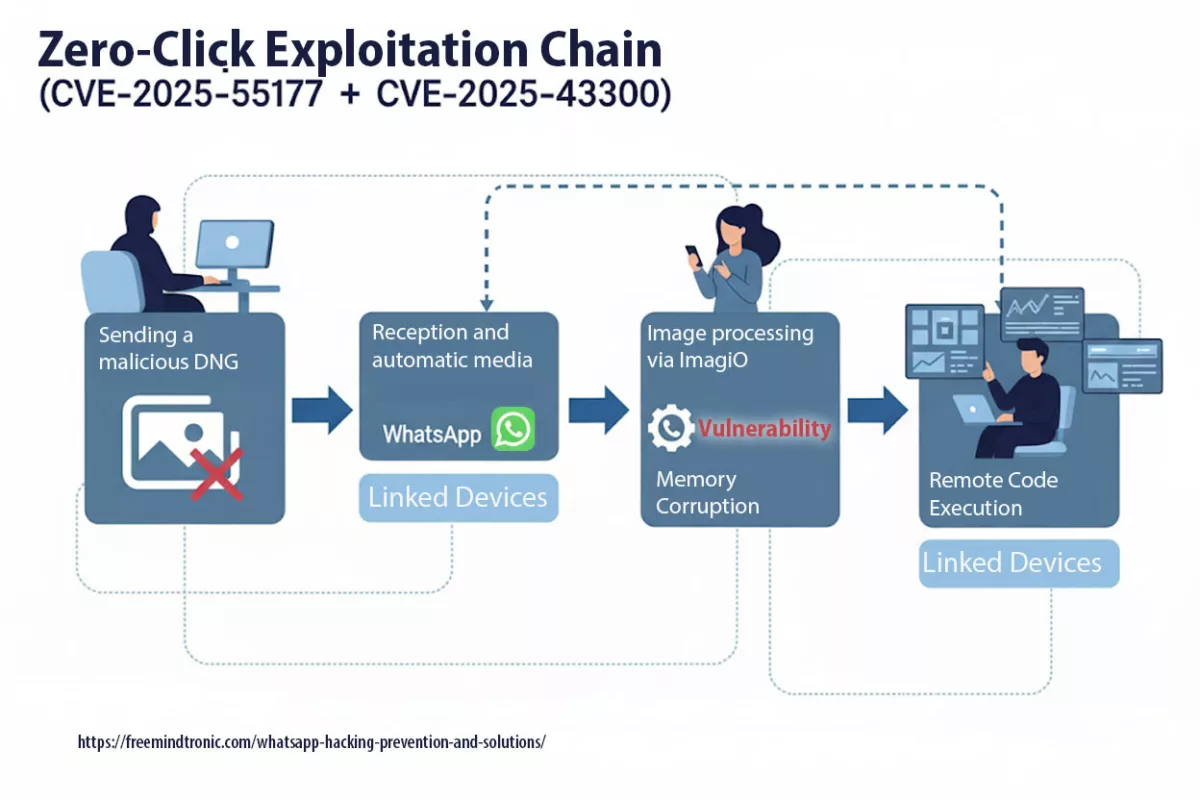
Critical Update — WhatsApp Zero-Click Vulnerability CVE-2025-55177
The vulnerability chain combines WhatsApp CVE-2025-55177 with Apple CVE-2025-43300 through malicious DNG media processing. By abusing linked-device synchronization and automatic media parsing, attackers can remotely trigger runtime compromise without any user interaction. Meta confirmed active exploitation in real-world spyware campaigns targeting high-risk profiles. The vulnerability is also listed in the CISA Known Exploited Vulnerabilities catalog, confirming its operational relevance.
Affected versions
- WhatsApp for iOS prior to 2.25.21.73
- WhatsApp Business for iOS prior to 2.25.21.78
- WhatsApp for Mac prior to 2.25.21.78
Immediate defensive actions
The first priority remains immediate patching of WhatsApp and the operating system. For sensitive environments, additional measures are recommended:
- disable linked-device synchronization temporarily;
- disable automatic media downloads;
- activate Apple Lockdown Mode or Android Advanced Protection;
- rotate critical credentials from a clean environment;
- monitor suspicious linked-device activity.
Forensics & Incident ResponseIf compromise is suspected:
- preserve logs, timestamps, filenames and suspicious URLs;
- capture affected network traces and DNS resolutions;
- revoke WhatsApp Web sessions immediately;
- rotate sensitive credentials from a clean device;
- perform forensic acquisition before any factory reset.
Human Error Remains a Persistent Attack Vector
Social-engineering attacks requesting six-digit verification codes remain extremely effective. Trusted-contact impersonation and fake support operations continue enabling account takeover despite modern security improvements. Two-step verification reduces the risk but cannot eliminate social-engineering exposure entirely.
Modern Attack Techniques Behind WhatsApp Zero-Click Campaigns
Modern zero-click attacks no longer target messaging applications alone. They increasingly seek to compromise the mobile runtime itself in order to access already decrypted information, active sessions and memory-resident secrets. Attackers now exploit:
- linked-device synchronization abuse;
- trusted-group delivery and auto-download trust abuse;
- malicious DNG image parsing;
- automatic media processing;
- runtime memory corruption;
- remote arbitrary URL fetching;
- cross-runtime spyware delivery chains.
Some campaigns also targeted Samsung image parsers through DNG files delivered via WhatsApp, demonstrating that the attack surface extends far beyond the messaging application itself. Other campaigns abuse official WhatsApp pairing mechanisms through so-called GhostPairing techniques, silently attaching remote browsers or systems to an active victim session.
Emerging account-hijacking techniques targeting trusted mobile sessions
Recent security reports describe increasingly sophisticated WhatsApp account hijacking campaigns targeting mobile users through linked-device abuse, trusted-session persistence and runtime manipulation techniques.
These reports should be distinguished from the officially documented vulnerability chain involving WhatsApp CVE-2025-55177 and Apple CVE-2025-43300, which concerns malicious DNG media processing, linked-device synchronization abuse and runtime compromise.
While distinct from officially documented zero-click CVEs, these operations reinforce a broader strategic trend:
modern messaging attacks increasingly target synchronization trust mechanisms and runtime exposure rather than transport-layer encryption itself.
Weak Signals Observed
- Steganographic payloads embedded inside DNG/RAW media targeting mobile parsers.
- QR-to-Web attack loops abusing trusted redirect wrappers.
- Growing demand for zero-days targeting messaging media-processing pipelines.
Legitimate Monitoring Tools and Misuse Risks
Some parental-control and monitoring applications may also be abused for covert surveillance or privacy violations. Examples include:
- mSpy
- FlexiSPY
- Spyera
- Hoverwatch
- KidsGuard
While some uses may be legitimate under legal supervision frameworks, these ecosystems increasingly intersect with spyware, credential theft and covert runtime surveillance practices.
Sovereign Countermeasures — CryptPeer & EviSKMS
The WhatsApp zero-click vulnerability demonstrates why traditional application-layer E2EE is no longer sufficient against modern runtime compromise attacks. Traditional E2EE messaging platforms primarily secure communications during transport. However, once the runtime, operating system or application becomes compromised, already decrypted information may remain accessible through memory, caches or synchronization services.
Why Zero-DOM Architectures Are Becoming Necessary
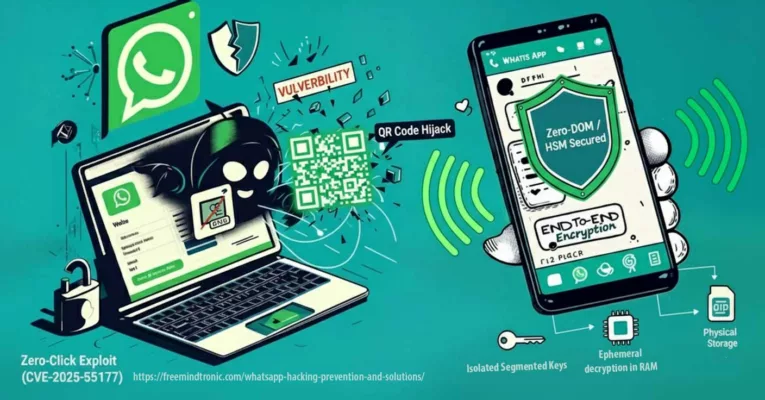
Zero-DOM architectures are not designed to replace traditional E2EE, but to address one of its fundamental limitations: once information has already been decrypted inside a compromised runtime, it may remain exploitable. The objective therefore shifts from protecting transport confidentiality alone toward materially limiting post-decryption exposure. CryptPeer/EviSKMS adopts a fundamentally different security model. Critical secrets never depend on a single software context. Keys are segmented, isolated and contextually validated through Zero-DOM architectures and NFC HSM infrastructures. Reconstruction only exists ephemerally in RAM without persistent exploitable storage. This architecture significantly reduces exposure to runtime compromise, memory exfiltration, linked-device abuse, post-decryption attacks and mobile spyware persistence.
Even in the event of browser-side arbitrary code execution, zero-click compromise or encrypted blob exfiltration, attackers cannot reconstruct or operationally exploit secrets without sovereign hardware proof provided by the HSM environment.
Recent WhatsApp Vulnerabilities Related to Runtime Exposure
CVE-2025-55179
WhatsApp also patched CVE-2025-55179 affecting WhatsApp for iOS, WhatsApp Business for iOS and WhatsApp for Mac.
This vulnerability involved incomplete validation of rich response messages, potentially allowing arbitrary remote media processing through attacker-controlled URLs.
While Meta reported no active exploitation, the flaw remains strategically linked to:
- runtime exposure;
- automatic media processing;
- linked-device synchronization abuse.
CVE-2025-30401 — WhatsApp for Windows
WhatsApp also patched a spoofing vulnerability affecting WhatsApp for Windows.
An inconsistency between displayed MIME type and actual file handling behavior could lead users to execute arbitrary code disguised as benign content.
Even though this was not a pure zero-click attack, it further illustrates the growing risks associated with excessive trust in runtime content-processing mechanisms.
FAQ — WhatsApp Zero-Click Vulnerability
Yes. The attack chain abuses linked-device synchronization and automatic media parsing to trigger malicious processing without user interaction.
No. E2EE mainly protects communications during transport. Once the runtime itself becomes compromised, already decrypted information may become exposed.
For high-risk profiles and sensitive environments, temporarily disabling linked devices is strongly recommended.
Post-decryption security refers to the protection of sensitive information after it has already been decrypted inside a runtime environment.
Zero-DOM is a sovereign runtime security architecture designed to isolate secrets from browser DOMs, persistent application memory and cloud telemetry surfaces.
Strategic Doctrine
“The future of cybersecurity no longer depends exclusively on encrypted transport, but on preventing secret exploitation after decryption.”
Strategic Outlook — Toward Sovereign Runtime Security
The WhatsApp zero-click vulnerability illustrates a major transformation in cybersecurity doctrine. Modern attacks no longer primarily seek to break encryption itself. They increasingly target the runtime environments capable of manipulating already decrypted information. This evolution marks the emergence of post-decryption cybersecurity. Application memory, synchronization layers, temporary buffers and runtime processing pipelines have become critical exposure surfaces. Protecting only the transport channel is no longer sufficient. Security architectures must now survive partial runtime compromise.
Toward Sovereign E2EE and Post-Decryption Cybersecurity
The future of secure communications no longer depends exclusively on transport confidentiality, but on the ability to prevent secret exploitation after decryption. CryptPeer/EviSKMS addresses this shift through:
- segmented key infrastructures;
- Zero-DOM isolation;
- contextual hardware validation;
- ephemeral RAM-only decryption;
- distributed sovereign runtime trust.
Further Reading — Sovereign Runtime Trust Doctrine
The future of cybersecurity no longer relies solely on encrypting communications, but on preserving sovereign control over the runtime environment manipulating critical secrets.