Tag Archives: Freemindtronic

How the attack against Microsoft Exchange on December 13, 2023 exposed thousands of email accounts

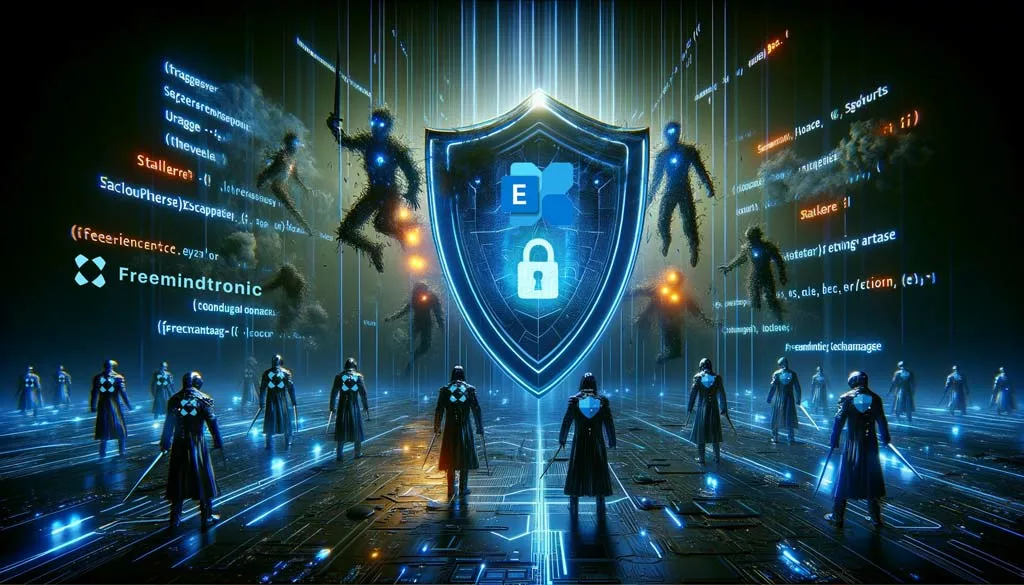
Digital shield by Freemindtronic repelling cyberattack against Microsoft Exchange

How to protect yourself from the attack against Microsoft Exchange?

The attack against Microsoft Exchange was a serious security breach in 2023. Thousands of organizations worldwide were hacked by cybercriminals who exploited vulnerabilities in Microsoft’s email servers. How did this happen? What were the consequences? How did Microsoft react? And most importantly, how can you protect your data and communications? Read our comprehensive analysis and discover Freemindtronic’s technology solutions.

Cyberattack against Microsoft: discover the potential dangers of stalkerware spyware, one of the attack vectors used by hackers. Stay informed by browsing our constantly updated topics.

Cyberattack against Microsoft: How to Protect Yourself from Stalkerware, a book by Jacques Gascuel, the innovator behind advanced sensitive data security and safety systems, provides invaluable knowledge on how data encryption and decryption can prevent email compromise and other threats.

How the attack against Microsoft Exchange on December 13, 2023 exposed thousands of email accounts

On December 13, 2023, Microsoft was the target of a sophisticated attack by a hacker group called Lapsus$. This attack exploited another vulnerability in Microsoft Exchange, known as CVE-2023-23415, which allowed the attackers to execute remote code on the email servers using the ICMP protocol. The attackers were able to access the email accounts of more than 10,000 Microsoft employees, some of whom were working on sensitive projects such as the development of GTA VI or the launch of Windows 12. The attackers also published part of the stolen data on a website called DarkBeam, where they sold more than 750 million fraudulent Microsoft accounts. Microsoft reacted quickly by releasing a security patch on December 15, 2023, and collaborating with the authorities to arrest the perpetrators of the attack. One of the members of the Lapsus$ group, an Albanian hacker named Kurtaj, was arrested on December 20, 2023, thanks to the cooperation between the American and European intelligence services1234.

What were the objectives and consequences of the attack?

The attack against Microsoft Exchange affected more than 20,000 email servers worldwide, belonging to businesses, institutions and organizations from different sectors. These servers were vulnerable because they used outdated versions of the software, which no longer received security updates. The attack exploited a critical vulnerability known as ProxyLogon (CVE-2023-23415), allowing the attackers to execute remote code on the servers and access the email accounts. Despite the efforts to solve the problem, many vulnerable servers remained active, exposing the email accounts of about 30,000 high-level employees, including executives and engineers. The attackers were able to steal confidential information, such as internal projects, development plans, trade secrets or source codes.

What were the objectives of the attack?

The attack was attributed to Lapsus$, a hacker group linked to Russia. According to Microsoft, the group’s main objective was to gain access to sensitive information from various targets, such as government agencies, think tanks, NGOs, law firms, medical institutions, etc. The group also aimed to compromise the security and reputation of Microsoft, one of the leading technology companies in the world. The attack was part of a larger campaign that also involved the SolarWinds hack, which affected thousands of organizations in 2020.

What were the impacts of the attack?

The attack had serious impacts on the victims, both in terms of data loss and reputation damage. The data stolen by the attackers included personal and professional information, such as names, addresses, phone numbers, email addresses, passwords, bank details, credit card numbers, health records, etc. The attackers also leaked some of the data on the DarkBeam website, where they offered to sell the data to the highest bidder. This exposed the victims to potential identity theft, fraud, blackmail, extortion, or other cybercrimes. The attack also damaged the reputation of Microsoft and its customers, who were seen as vulnerable and unreliable by their partners, clients, and users. The attack also raised questions about the security and privacy of email communication, which is widely used in the digital world.

What were the consequences of the attack?

The attack had several consequences for Microsoft and its customers, who had to take urgent measures to mitigate the damage and prevent further attacks. Microsoft had to release a security patch for the vulnerability, and urge its customers to update their software as soon as possible. Microsoft also had to investigate the origin and extent of the attack, and cooperate with the authorities to identify and arrest the attackers. Microsoft also had to provide support and assistance to its customers, who had to deal with the aftermath of the attack. The customers had to check their email accounts for any signs of compromise, and change their passwords and security settings. They also had to notify their contacts, partners, and clients about the breach, and reassure them about the security of their data. They also had to monitor their online activities and accounts for any suspicious or fraudulent transactions. The attack also forced Microsoft and its customers to review and improve their security policies and practices, and adopt new solutions and technologies to protect their data and communication.

How did the attack succeed despite Microsoft’s defenses?

The attack was sophisticated and stealthy, using several techniques to bypass Microsoft’s defenses. First, the attackers exploited a zero-day vulnerability, which means that it was unknown to Microsoft and the public until it was discovered and reported. Second, the attackers used a proxy tool to disguise their origin and avoid detection. Third, the attackers used web shells to maintain persistent access to the servers and execute commands remotely. Fourth, the attackers used encryption and obfuscation to hide their malicious code and data. Fifth, the attackers targeted specific servers and accounts, rather than launching a massive attack that would have raised more suspicion.

What are the communication vulnerabilities exploited by the attack?

The attack exploited several communication vulnerabilities, such as:

  • Targeted phishing: The attackers sent fake emails to the victims, pretending to be from legitimate sources, such as Microsoft, their bank, or their employer. The emails contained malicious links or attachments, that led the victims to compromised websites or downloaded malware on their devices. The attackers then used the malware to access the email servers and accounts.
  • SolarWinds exploitation: The attackers also used the SolarWinds hack, which was a massive cyberattack that compromised the software company SolarWinds and its customers, including Microsoft. The attackers inserted a backdoor in the SolarWinds software, which allowed them to access the networks and systems of the customers who installed the software. The attackers then used the backdoor to access the email servers and accounts.
  • Brute force attack: The attackers also used a brute force attack, which is a trial-and-error method to guess the passwords or encryption keys of the email accounts. The attackers used automated tools to generate and test a large number of possible combinations, until they found the right one. The attackers then used the passwords or keys to access the email accounts.
  • SQL injection: The attackers also used a SQL injection, which is a technique to insert malicious SQL commands into a web application that interacts with a database. The attackers used the SQL commands to manipulate the database, and access or modify the data stored in it. The attackers then used the data to access the email accounts.

Why did the detection and defense systems of Microsoft Exchange not work?

The detection and defense systems of Microsoft Exchange did not work because the attackers used advanced techniques to evade them. For example, the attackers used a proxy tool to hide their IP address and location, and avoid being traced or blocked by firewalls or antivirus software. The attackers also used web shells to create a backdoor on the servers, and execute commands remotely, without being noticed by the system administrators or the security software. The attackers also used encryption and obfuscation to conceal their malicious code and data, and prevent them from being analyzed or detected by the security software. The attackers also used zero-day vulnerability, which was not known or patched by Microsoft, and therefore not protected by the security software.

How did Microsoft react to the attack?

Microsoft reacted to the attack by taking several actions, such as:

The main actions of Microsoft

  • Releasing a security patch: Microsoft released a security patch for the vulnerability exploited by the attack, and urged its customers to update their software as soon as possible. The patch fixed the vulnerability and prevented further attacks.
  • Investigating the attack: Microsoft investigated the origin and extent of the attack, and collected evidence and information about the attackers and their methods. Microsoft also cooperated with the authorities and other organizations to identify and arrest the attackers.
  • Providing support and assistance: Microsoft provided support and assistance to its customers, who were affected by the attack. Microsoft offered guidance and tools to help the customers check their email accounts for any signs of compromise, and change their passwords and security settings. Microsoft also offered free credit monitoring and identity theft protection services to the customers, who had their personal and financial data stolen by the attackers.

Microsoft also released patches for the vulnerabilities exploited by the attack

Microsoft also released patches for the other vulnerabilities exploited by the attack, such as the SolarWinds vulnerability, the brute force vulnerability, and the SQL injection vulnerability. Microsoft also improved its detection and defense systems, and added new features and functions to its software, to enhance the security and privacy of email communication.

What are the lessons to be learned from the attack?

The attack was a wake-up call for Microsoft and its customers, who had to learn from their mistakes and improve their security practices. Some of the lessons to be learned from the attack are:

Email security

Email is one of the most widely used communication tools in the digital world, but also one of the most vulnerable to cyberattacks. Therefore, it is essential to ensure the security and privacy of email communication, by applying some best practices, such as:

  • Using strong and unique passwords for each email account, and changing them regularly.
  • Using multi-factor authentication (MFA) to verify the identity of the email users, and prevent unauthorized access.
  • Using encryption to protect the content and attachments of the email messages, and prevent them from being read or modified by third parties.
  • Using digital signatures to verify the authenticity and integrity of the email messages, and prevent them from being spoofed or tampered with.
  • Using spam filters and antivirus software to block and remove malicious emails, and avoid clicking on suspicious links or attachments.
  • Using secure email providers and platforms, that comply with the latest security standards and regulations, and offer features such as end-to-end encryption, zero-knowledge encryption, or self-destructing messages.

Multi-factor authentication

Multi-factor authentication (MFA) is a security method that requires the user to provide two or more pieces of evidence to prove their identity, before accessing a system or a service. The pieces of evidence can be something the user knows (such as a password or a PIN), something the user has (such as a smartphone or a token), or something the user is (such as a fingerprint or a face scan). MFA can prevent unauthorized access to email accounts, even if the password is compromised, by adding an extra layer of security. Therefore, it is recommended to enable MFA for all email accounts, and use reliable and secure methods, such as biometric authentication, one-time passwords, or push notifications.

Principle of least privilege

The principle of least privilege (POLP) is a security concept that states that each user or system should have the minimum level of access or permissions required to perform their tasks, and nothing more. POLP can reduce the risk of data breaches, by limiting the exposure and impact of a potential attack. Therefore, it is advisable to apply POLP to email accounts, and assign different roles and privileges to different users, depending on their needs and responsibilities. For example, only authorized users should have access to sensitive or confidential information, and only administrators should have access to system settings or configuration.

Software update

Software update is a process that involves installing the latest versions or patches of the software, to fix bugs, improve performance, or add new features. Software update is crucial for email security, as it can prevent the exploitation of vulnerabilities that could allow attackers to access or compromise the email servers or accounts. Therefore, it is important to update the software regularly, and install the security patches as soon as they are available. It is also important to update the software of the devices that are used to access the email accounts, such as computers or smartphones, and use the latest versions of the browsers or the applications.

System monitoring

System monitoring is a process that involves observing and analyzing the activity and performance of the system, to detect and resolve any issues or anomalies. System monitoring is vital for email security, as it can help to identify and stop any potential attacks, before they cause any damage or disruption. Therefore, it is essential to monitor the email servers and accounts, and use tools and techniques, such as logs, alerts, reports, or audits, to collect and analyze the data. It is also essential to monitor the email traffic and behavior, and use tools and techniques, such as firewalls, intrusion detection systems, or anomaly detection systems, to filter and block any malicious or suspicious activity.

User awareness

User awareness is a state of knowledge and understanding of the users, regarding the security risks and threats that they may face, and the best practices and policies that they should follow, to protect themselves and the system. User awareness is key for email security, as it can prevent many human errors or mistakes, that could compromise the email accounts or expose the data. Therefore, it is important to educate and train the email users, and provide them with the necessary information and guidance, to help them recognize and avoid any phishing, malware, or social engineering attacks, that could target their email accounts.

What are the best practices to strengthen information security?

Information security is the practice of protecting the confidentiality, integrity, and availability of the information, from unauthorized or malicious access, use, modification, or destruction. Information security is essential for email communication, as it can ensure the protection and privacy of the data and messages that are exchanged. Some of the best practices to strengthen information security are:

  • Adopt the Zero Trust model: The Zero Trust model is a security approach that assumes that no user or system can be trusted by default, and that each request or transaction must be verified and authorized, before granting access or permission. The Zero Trust model can enhance information security, by reducing the attack surface and preventing the lateral movement of the attackers, within the system.
  • Use advanced protection solutions: Advanced protection solutions are security solutions that use artificial intelligence, machine learning, or other technologies, to detect and respond to the most sophisticated and complex cyberattacks, that could target the email accounts or data. Some of these solutions are endpoint detection and response (EDR), identity and access management (IAM), or data encryption solutions.
  • Hire cybersecurity experts: Cybersecurity experts are professionals who have the skills and knowledge to design, implement, and maintain the security of the system and the information, and to prevent, detect, and respond to any cyberattacks, that could affect the email accounts or data. Cybersecurity experts can help to strengthen information security, by providing advice, guidance, and support, to the email users and administrators.

How can Freemindtronic technology help to fight against this type of attack?

Freemindtronic offers innovative and effective technology solutions such as EviCypher NFC HSM and EviPass NFC HSM and EviOTP NFC HSM and other PGP HSMs. They can help businesses to fight against this type of attack based on Zero Day and other threats. Their technology is embedded in products such as DataShielder NFC HSM and DataShielder HSM PGP and DataShielder Defense or PassCypher NFC HSM or PassCypher HSM PGP. These products provide security and communication features for data, email and password management and offline OTP secret keys.

  • DataShielder NFC HSM is a portable device that allows to encrypt and decrypt data and communication on a computer or on an Android NFC smartphone. It uses a contactless hardware security module (HSM) that generates and stores encryption keys securely and segmented. It protects the keys that encrypt contactless communication. This has the effect of effectively fighting against all types of communication vulnerabilities, since the messages and attachments will remain encrypted even if they are corrupted. This function regardless of where the attack comes from, internal or external to the company. It is a counter-espionage solution. It also offers other features, such as password management, 2FA – OTP (TOTP and HOTP) secret keys. In addition, DataShielder works offline, without server and without database. It has a configurable multi-authentication system, strong authentication and secure key sharing.
  • DataShielder HSM PGP is an application that transforms all types of physical storage media (USB key, S, SSD, KeyChain / KeyStore) connected or not connected into HSM. It has the same features as its NFC HSM version. However, it also uses standard AES-256 and RSA 4096 algorithms, as well as OpenPGP algorithms. It uses its HSMs to manage and store PGP keys securely. In the same way, it protects email against phishing and other email threats. It also offers other features, such as digital signature, identity verification or secure key sharing.
  • DataShielder Defense is a dual-use platform for civilian and military use that offers many functions including all those previously mentioned. It also works in real time without server, without database from any type of HSM including NFC. It also has functions to add trust criteria to fight against identity theft. It protects data and communication against cyberattacks and data breaches.

In summary

To safeguard against the Microsoft Exchange attack, prioritize security updates and patches. Embrace Freemindtronic’s innovative solutions for enhanced protection. Stay vigilant against phishing and employ robust authentication methods. Opt for encryption to shield communications. Engage cybersecurity experts for advanced defense strategies. By adopting these measures, you can fortify your defenses against cyber threats and ensure your data’s safety.

Ledger Security Breaches from 2017 to 2026: How to Protect Yourself from Hackers

Realistic 16:9 illustration of Ledger Security Breaches featuring a broken digital chain surrounding compromised cryptocurrency data and hardware vulnerabilities.

Ledger Security Breaches have become a major indicator of vulnerabilities in the global crypto ecosystem. Beyond isolated technical flaws, it is the systemic correlations — hardware attacks, software exploits, third‑party data leaks, phishing scenarios — that shape today’s threat landscape, affecting individual users, exchanges, and trust infrastructures alike. Exploited by cybercriminals, state actors, and hybrid players, these breaches enable profiling, targeting, and manipulation of investors without necessarily compromising their private keys directly. Encryption protects private keys, but not relational, logistical, and behavioral metadata. This chronicle analyzes the major breaches from 2017 to 2026, their immediate and long‑term impacts, and the conditions for achieving true digital sovereignty against supply‑chain threats and third‑party dependencies.

Executive Summary — Ledger Security Breaches

⮞ Reading Note

This executive summary can be read in ≈ 3 to 4 minutes. It provides immediate insight into the central issue without requiring the full technical and historical analysis.

⚠️ Note on Supply Chain Resilience

The 2026 Global-e leak highlights what the CISA (Cybersecurity & Infrastructure Security Agency) defines as critical supply chain risks. According to their official guidelines, hardware security is only as strong as its weakest third-party link.

⚡ Key Findings

Since 2017, Ledger has faced several major breaches: seed phrase and firmware attacks, PCB modification, the 2020 database leak, the 2023 Connect Kit compromise, and the 2026 Global‑e data leak. These incidents show that threats arise not only from internal flaws but also from external dependencies and phishing vectors.

✦ Immediate Impact

  • Massive customer data exposure (292K in 2020, Global‑e in 2026)
  • Targeted phishing and harassment using personal information
  • Transaction manipulation and private-key compromise in controlled 2018 attack scenarios
  • Fragility of software supply chains and third‑party partners

⚠ Strategic Message

The real shift is not just technical compromise, but the repetition of breaches and their systemic exploitation. The threat becomes structural: automated phishing, doxxing, erosion of trust, and increased reliance on third parties. The risk is no longer occasional, but persistent.

The Shift from Trust to Proof

The repetition of Ledger Security Breaches proves that trust in a brand is not enough. Sovereignty requires proof. By implementing Segmented Key Authentication (WO2018154258), Freemindtronic moves control over critical secrets (seed phrases, private keys, credentials) from the vendor ecosystem directly into the user’s physical possession. This eliminates dependency on third-party infrastructure (e-commerce, update servers, logistics partners) for the custody and transfer of critical secrets.

⎔ Sovereign Countermeasure

There is no miracle solution against security breaches. Sovereignty means reducing exploitable surfaces: minimizing exposed data, using independent cold wallets (NFC HSM), strictly separating identity from usage, and maintaining constant vigilance against fraudulent communications.

Reading Parameters

Executive Summary: ≈ 3–4 min
Advanced Summary: ≈ 5–6 min
Full Chronicle: ≈ 30–40 min
First publication: December 16, 2023
Last update: January 7, 2026
Complexity level: High — security, crypto, supply‑chain
Technical density: ≈ 70 %
Languages available: EN · FR
Core focus: Ledger Security Breaches, crypto wallets, phishing, digital sovereignty
Editorial type: Chronicle — Freemindtronic Digital Security
Risk level: 9.2 / 10 financial, civil, and hybrid threats

Editorial Note — This chronicle is part of the Digital Security section. It explores Ledger Security Breaches as a revealing case of global crypto vulnerabilities, combining technical incidents, third‑party dependencies, and phishing threats. It extends analyses published on Digital Security. Content is written in accordance with the AI Transparency Declaration published by Freemindtronic Andorra — FM-AI-2025-11-SMD5.
Want to go further? The Advanced Summary places Ledger Security Breaches in a global dynamic — technological, regulatory, and societal — and prepares the reader for the full chronicle.
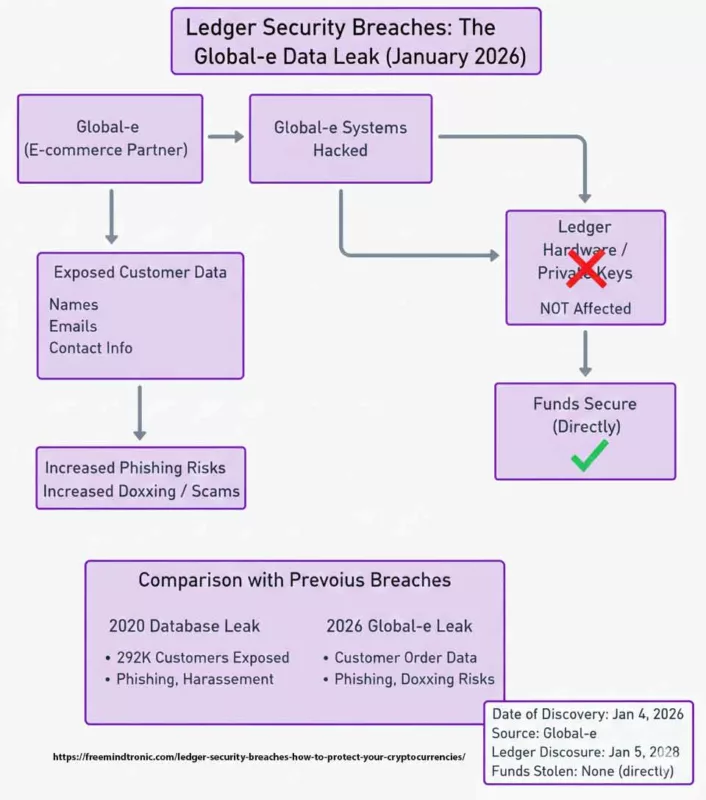
Infographic detailing the Ledger security breaches via Global-e in January 2026, showing exposed customer data vs. secure private keys.
Timeline and impact of the January 2026 Global-e breach: A new chapter in Ledger security breaches involving third-party e-commerce partners.

2022 2026 Digital Security

EviDNA cryptographie ADN | mémoire Jacques Gascuel

EviDNA cryptographie ADN : mémoire complémentaire de référence Freemindtronic — EviDNA, ADN Digital, génome cryptographique, [...]

2026 Digital Security

EviDNA DNA Cryptography | Jacques Gascuel Memory

EviDNA DNA cryptography: Freemindtronic complementary reference memory — EviDNA, Digital DNA, cryptographic genome, cybersecurity and [...]

2022 2026 Digital Security

Predictive Artificial Intelligence Architectures: Freemindtronic EviSKMS R&D Memorandum

Predictive Artificial Intelligence Architectures: Freemindtronic reference memorandum on Artificial Intelligence, World Models, LAMP-C, Cybersecurity and [...]

2022 2026 Digital Security

Architectures intelligence artificielle prédictive : mémoire EviSKMS R&D Freemindtronic

Architectures intelligence artificielle prédictive : mémoire de référence Freemindtronic sur l’IA, les modèles du monde, [...]

2025 2026 Digital Security Technical News

Quantum computer 6100 qubits ⮞ Historic 2025 breakthrough

A 6,100-qubit neutral-atom array marks a major scaling milestone in quantum computing, raising new strategic [...]

2025 2026 Digital Security

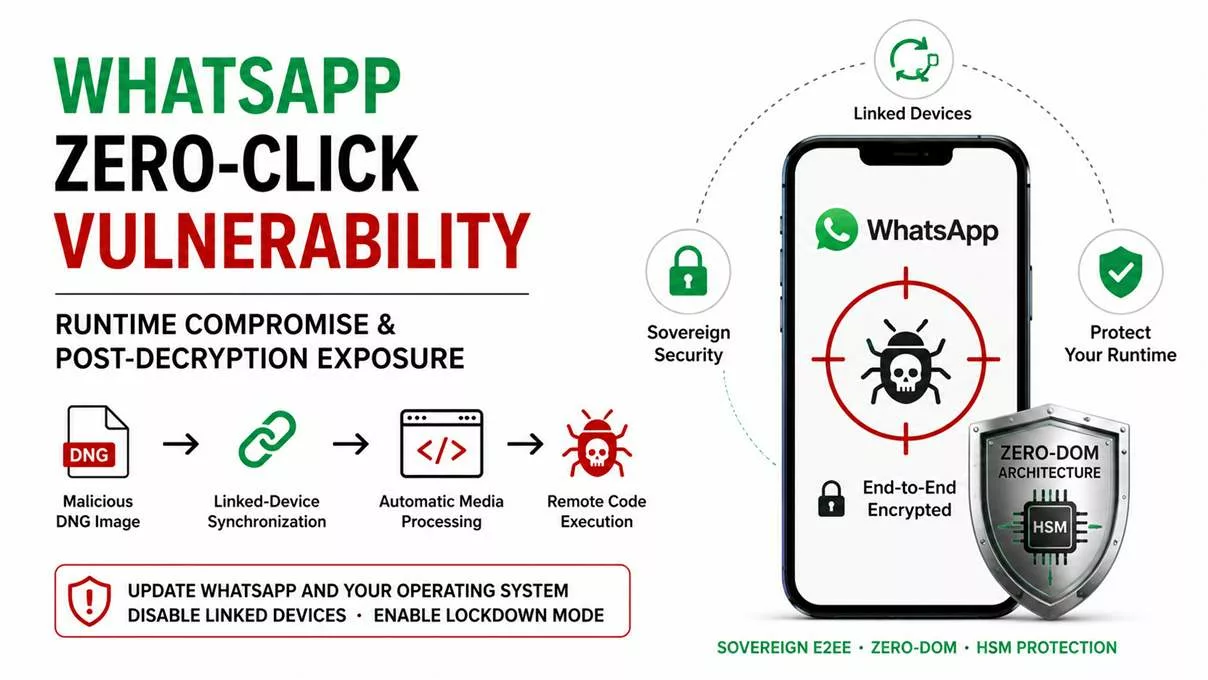
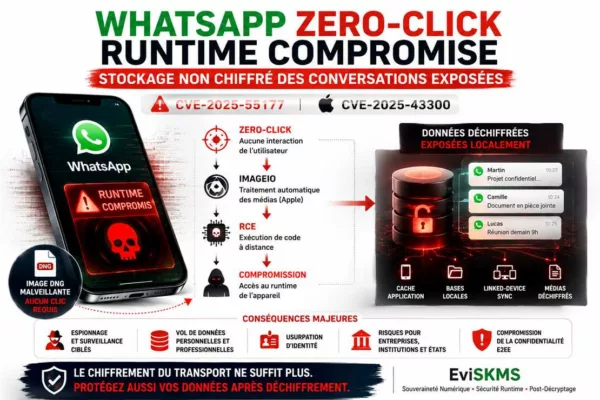
Vulnérabilité WhatsApp zero-click — Actions, contremesures et sécurité E2EE souveraine

Vulnérabilité WhatsApp zero-click — la faille critique CVE-2025-55177, associée à Apple CVE-2025-43300, permet l’exécution de [...]

2025 2026 Digital Security

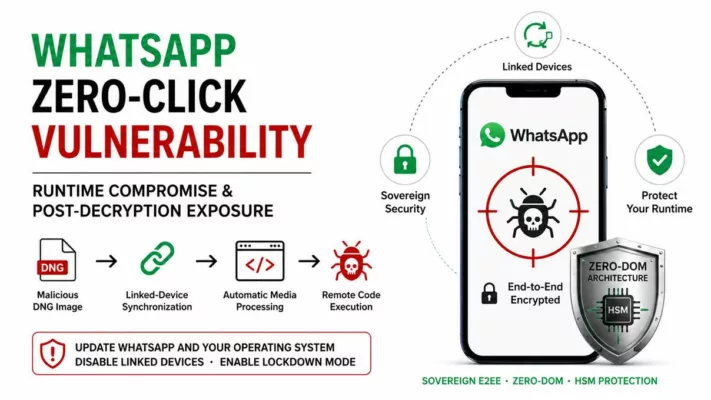
WhatsApp zero-click vulnerability and runtime compromise

WhatsApp zero-click vulnerability — the critical flaw CVE-2025-55177, chained with Apple CVE-2025-43300, enables remote code [...]

2026 Cyber Doctrine Digital Security

Whisper Leak side-channel and LLM token leakage

Whisper Leak side-channel: token-length leakage, semantic inference, and the structural limits of HTTPS in large [...]

2023 2026 Digital Security Phishing

BITB Attacks: How to Avoid Phishing by iFrame

Browser-in-the-Browser (BITB) attacks: interface forgery through redirection iframes and the structural limits of browser trust. [...]

2026 Digital Security

Zero-knowledge vulnérable : attaques par downgrade contre Bitwarden, LastPass et Dashlane

Zero-knowledge vulnérable : les attaques par downgrade contre Bitwarden, LastPass et Dashlane révèlent comment la [...]

2026 Digital Security

Zero-Knowledge Downgrade Attacks — Structural Risks

Zero-Knowledge Downgrade Attacks: downgrade paths against Bitwarden, LastPass, and Dashlane show how cryptographic backward compatibility [...]

2025 Digital Security

Clickjacking des extensions DOM : DEF CON 33 révèle 11 gestionnaires vulnérables

Clickjacking d’extensions DOM : DEF CON 33 révèle une faille critique et les contre-mesures Zero-DOM

2025 Cyberculture Digital Security

Browser Fingerprinting Tracking: Metadata Surveillance in 2026

Browser Fingerprinting Tracking today represents one of the true cores of metadata intelligence. Far beyond [...]

2026 Digital Security

Browser Fingerprinting : le renseignement par métadonnées en 2026

Le browser fingerprinting constitue aujourd’hui l’un des instruments centraux du renseignement par métadonnées appliqué aux [...]

2023 2026 Digital Security

CVE-2023-32784 : Pourquoi PassCypher protège vos secrets

PassCypher HSM protège les secrets numériques. Il protège vos secrets numériques hors du périmètre du [...]

2023 2026 Digital Security

CVE-2023-32784 Protection with PassCypher NFC HSM

CVE-2023-32784 Protection with PassCypher NFC HSM safeguards your digital secrets. It protects your secrets beyond [...]

2026 Digital Security

Cyber espionnage zero day : marché, limites et doctrine souveraine

Cyber espionnage zero day : la fin des spywares visibles marque l’entrée dans une économie [...]

2026 Digital Security

Cyberattaque HubEE : Rupture silencieuse de la confiance numérique

Cyberattaque HubEE : rupture silencieuse de la confiance numérique. Cette attaque, qui a permis l’exfiltration [...]

2025 Digital Security

Persistent OAuth Flaw: How Tycoon 2FA Hijacks Cloud Access

Persistent OAuth Flaw — Tycoon 2FA Exploited — When a single consent becomes unlimited cloud [...]

2025 Digital Security

Tycoon 2FA failles OAuth persistantes dans le cloud | PassCypher HSM PGP

Faille OAuth persistante — Tycoon 2FA exploitée — Quand une simple autorisation devient un accès [...]

2025 Digital Security

OpenAI fuite Mixpanel : métadonnées exposées, phishing et sécurité souveraine

OpenAI fuite Mixpanel rappelle que même les géants de l’IA restent vulnérables dès qu’ils confient [...]

2025 Digital Security

OpenAI Mixpanel Breach Metadata – phishing risks and sovereign security with PassCypher

AI Mixpanel breach metadata is a blunt reminder of a simple rule: the moment sensitive [...]

2026 Crypto Currency Cryptocurrency Digital Security

Ledger Security Breaches from 2017 to 2026: How to Protect Yourself from Hackers

Ledger Security Breaches have become a major indicator of vulnerabilities in the global crypto ecosystem. [...]

2026 Digital Security

Failles de sécurité Ledger : Analyse 2017-2026 & Protections

Les failles de sécurité Ledger sont au cœur des préoccupations des investisseurs depuis 2017. Cette [...]

2025 Digital Security

Bot Telegram Usersbox : l’illusion du contrôle russe

Le bot Telegram Usersbox n’était pas un simple outil d’OSINT « pratique » pour curieux [...]

2025 Digital Security

Espionnage invisible WhatsApp : quand le piratage ne laisse aucune trace

Espionnage invisible WhatsApp n’est plus une hypothèse marginale, mais une réalité technique rendue possible par [...]

2025 Digital Security

Fuite données ministère interieur : messageries compromises et ligne rouge souveraine

Fuite données ministère intérieur. L’information n’est pas arrivée par une fuite anonyme ni par un [...]

2026 Digital Security

Silent Whisper espionnage WhatsApp Signal : une illusion persistante

Silent Whisper espionnage WhatsApp Signal est présenté comme une méthode gratuite permettant d’espionner des communications [...]

2026 Awards Cyberculture Digital Security Distinction Excellence EviOTP NFC HSM Technology EviPass EviPass NFC HSM technology EviPass Technology finalists PassCypher PassCypher

Quantum-Resistant Passwordless Manager — PassCypher finalist, Intersec Awards 2026 (FIDO-free, RAM-only)

Quantum-Resistant Passwordless Manager 2026 (QRPM) — Best Cybersecurity Solution Finalist by PassCypher sets a new [...]

2025 Cyberculture Cybersecurity Digital Security EviLink

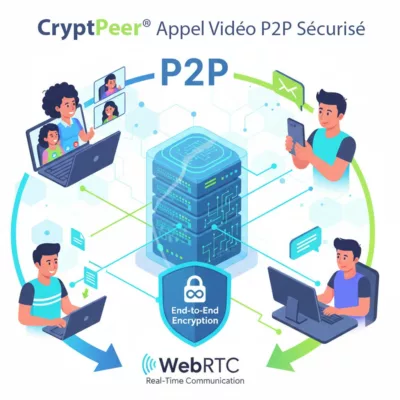
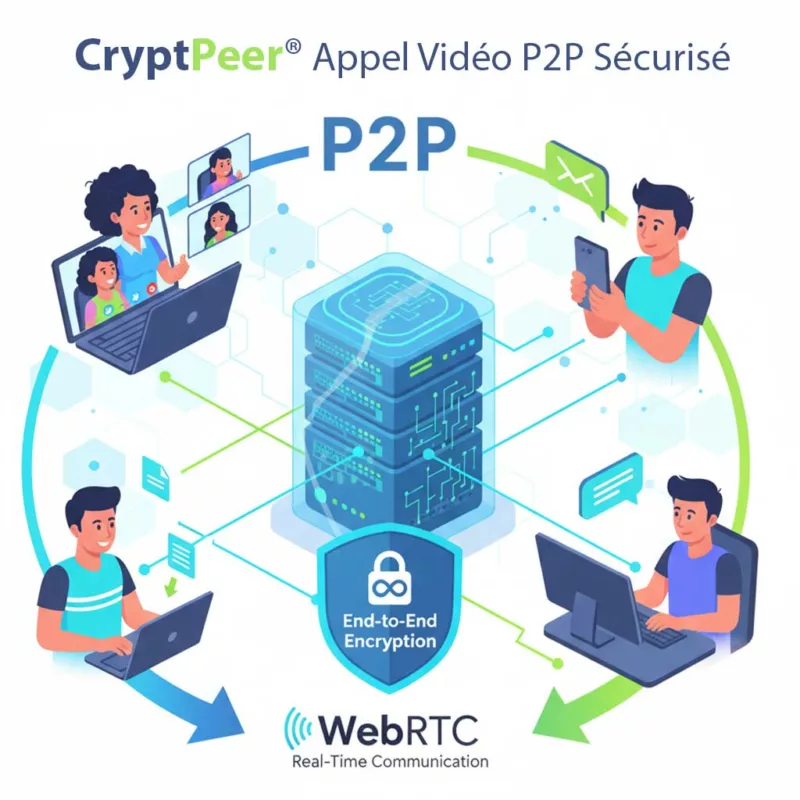
CryptPeer messagerie P2P WebRTC : appels directs chiffrés de bout en bout

La messagerie P2P WebRTC sécurisée constitue le fondement technique et souverain de la communication directe [...]

2025 CyptPeer Digital Security EviLink

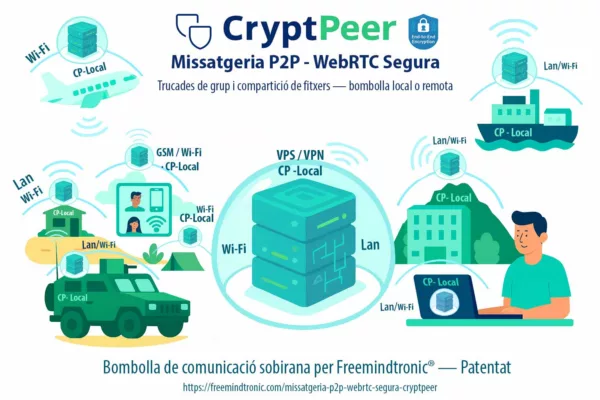
Missatgeria P2P WebRTC segura — comunicació directa amb CryptPeer

Missatgeria P2P WebRTC segura al navegador és l’esquelet tècnic i sobirà de la comunicació directa [...]

2025 Digital Security

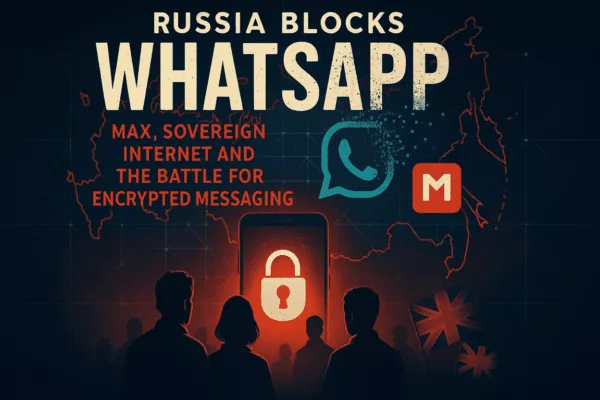
Russia Blocks WhatsApp: Max and the Sovereign Internet

Step by step, Russia blocks WhatsApp and now openly threatens to “completely block” the messaging [...]

2020 Digital Security

WhatsApp Gold arnaque mobile : typologie d’un faux APK espion

WhatsApp Gold arnaque mobile — clone frauduleux d’application mobile, ce stratagème repose sur une usurpation [...]

2025 Digital Security

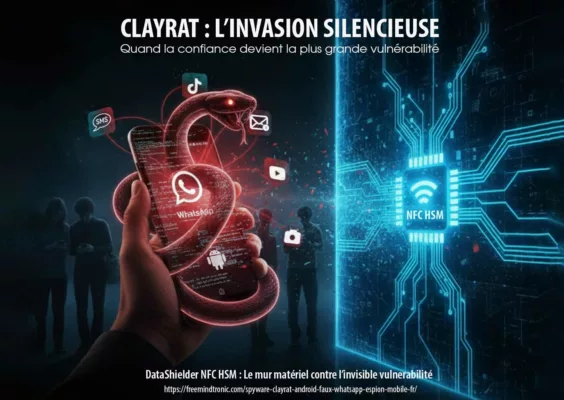
Spyware ClayRat Android : faux WhatsApp espion mobile

Spyware ClayRat Android illustre la mutation du cyberespionnage : plus besoin de failles, il exploite [...]

2025 Digital Security

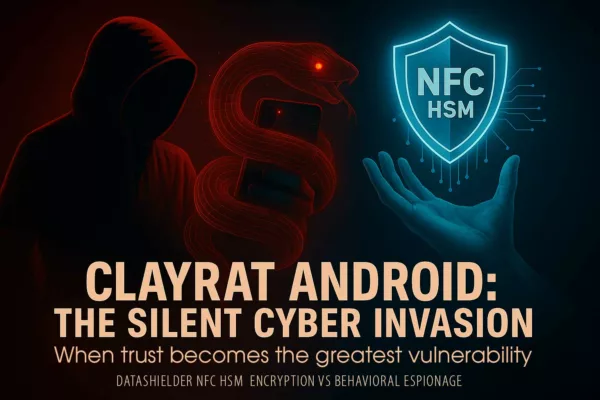
Android Spyware Threat Clayrat : 2025 Analysis and Exposure

Android Spyware Threat: ClayRat illustrates the new face of cyber-espionage — no exploits needed, just [...]

2023 Digital Security

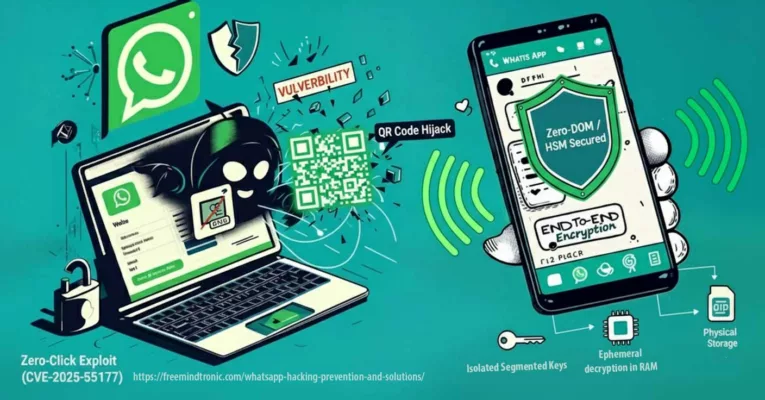
WhatsApp Hacking: Prevention and Solutions

WhatsApp hacking zero-click exploit (CVE-2025-55177) chained with Apple CVE-2025-43300 enables remote code execution via crafted [...]

2025 Digital Security Technical News

Sovereign SSH Authentication with PassCypher HSM PGP — Zero Key in Clear

SSH Key PassCypher HSM PGP establishes a sovereign SSH authentication chain for zero-trust infrastructures, where [...]

2025 Digital Security Tech Fixes Security Solutions Technical News

SSH Key PassCypher HSM PGP — Sécuriser l’accès multi-OS à un VPS

SSH Key PassCypher HSM PGP fournit une chaîne souveraine : génération locale de clés SSH [...]

2025 Digital Security Technical News

Générateur de mots de passe souverain – PassCypher Secure Passgen WP

Générateur de mots de passe souverain PassCypher Secure Passgen WP pour WordPress — le premier [...]

2025 Digital Security Technical News

Ordinateur quantique 6100 qubits ⮞ La percée historique 2025

Ordinateur quantique 6100 qubits marque un tournant dans l’histoire de l’informatique, soulevant des défis sans [...]

2025 Cyberculture Digital Security

Authentification multifacteur : anatomie, OTP, risques

Authentification Multifacteur : Anatomie souveraine Explorez les fondements de l’authentification numérique à travers une typologie [...]

2025 Digital Security

Clickjacking extensions DOM: Vulnerabilitat crítica a DEF CON 33

DOM extension clickjacking — el clickjacking d’extensions basat en DOM, mitjançant iframes invisibles, manipulacions del [...]

2025 Digital Security

DOM Extension Clickjacking — Risks, DEF CON 33 & Zero-DOM fixes

DOM extension clickjacking — a technical chronicle of DEF CON 33 demonstrations, their impact, and [...]

2025 Digital Security

Chrome V8 Zero-Day CVE-2025-10585 — Ton navigateur était déjà espionné ?

Chrome V8 zero-day CVE-2025-10585 — Votre navigateur n’était pas vulnérable. Vous étiez déjà espionné !

2025 Digital Security

Confidentialité métadonnées e-mail — Risques, lois européennes et contre-mesures souveraines

La confidentialité des métadonnées e-mail est au cœur de la souveraineté numérique en Europe : [...]

2025 Digital Security

Email Metadata Privacy: EU Laws & DataShielder

Email metadata privacy sits at the core of Europe’s digital sovereignty: understand the risks, the [...]

2025 Digital Security

Chrome V8 confusió RCE — Actualitza i postura Zero-DOM

Chrome V8 confusió RCE: aquesta edició exposa l’impacte global i les mesures immediates per reduir [...]

2025 Digital Security

Chrome V8 confusion RCE — Your browser was already spying

Chrome v8 confusion RCE: This edition addresses impacts and guidance relevant to major English-speaking markets [...]

2025 Digital Security

Passkeys Faille Interception WebAuthn | DEF CON 33 & PassCypher

Conseil RSSI / CISO – Protection universelle & souveraine EviBITB (Embedded Browser‑In‑The‑Browser Protection) est une [...]

2025 Cyberculture Digital Security

Reputation Cyberattacks in Hybrid Conflicts — Anatomy of an Invisible Cyberwar

Synchronized APT leaks erode trust in tech, alliances, and legitimacy through narrative attacks timed with [...]

2025 Digital Security

APT28 spear-phishing: Outlook backdoor NotDoor and evolving European cyber threats

Russian cyberattack on Microsoft by Midnight Blizzard (APT29) highlights the strategic risks to digital sovereignty. [...]

2024 Cyberculture Digital Security

Russian Cyberattack Microsoft: An Unprecedented Threat

Russian cyberattack on Microsoft by Midnight Blizzard (APT29) highlights the strategic risks to digital sovereignty. [...]

2024 Digital Security

Midnight Blizzard Cyberattack Against Microsoft and HPE: What are the consequences?

Midnight Blizzard Cyberattack against Microsoft and HPE: A detailed analysis of the facts, the impacts [...]

2025 Digital Security

eSIM Sovereignty Failure: Certified Mobile Identity at Risk

  Runtime Threats in Certified eSIMs: Four Strategic Blind Spots While geopolitical campaigns exploit the [...]

2025 Digital Security

APT29 Exploits App Passwords to Bypass 2FA

A silent cyberweapon undermining digital trust Two-factor authentication (2FA) was supposed to be the cybersecurity [...]

2015 Digital Security

Darknet Credentials Breach 2025 – 16+ Billion Identities Stolen

Underground Market: The New Gold Rush for Stolen Identities The massive leak of over 16 [...]

2025 Digital Security

Signal Clone Breached: Critical Flaws in TeleMessage

TeleMessage: A Breach That Exposed Cloud Trust and National Security Risks TeleMessage, marketed as a [...]

2025 Digital Security

APT29 Spear-Phishing Europe: Stealthy Russian Espionage

APT29 SpearPhishing Europe: A Stealthy LongTerm Threat APT29 spearphishing Europe campaigns highlight a persistent and [...]

2025 Digital Security

APT36 SpearPhishing India: Targeted Cyberespionage | Security

Understanding Targeted Attacks of APT36 SpearPhishing India APT36 cyberespionage campaigns against India represent a focused [...]

2025 Digital Security

Microsoft Outlook Zero-Click Vulnerability: Secure Your Data Now

Microsoft Outlook Zero-Click Vulnerability: How to Protect Your Data Now A critical Zero-Click vulnerability (CVE-2025-21298) [...]

2025 Digital Security

Microsoft Vulnerabilities 2025: 159 Flaws Fixed in Record Update

Microsoft: 159 Vulnerabilities Fixed in 2025 Microsoft has released a record-breaking security update in January [...]

2025 Digital Security

APT44 QR Code Phishing: New Cyber Espionage Tactics

APT44 Sandworm: The Elite Russian Cyber Espionage Unit Unmasking Sandworm’s sophisticated cyber espionage strategies and [...]

2025 Digital Security

BadPilot Cyber Attacks: Russia’s Threat to Critical Infrastructures

BadPilot Cyber Attacks: Sandworm’s New Weaponized Subgroup Understanding the rise of BadPilot and its impact [...]

2024 Digital Security

Salt Typhoon & Flax Typhoon: Cyber Espionage Threats Targeting Government Agencies

Salt Typhoon – The Cyber Threat Targeting Government Agencies Salt Typhoon and Flax Typhoon represent [...]

2024 Digital Security

BitLocker Security: Safeguarding Against Cyberattacks

Introduction to BitLocker Security If you use a Windows computer for data storage or processing, [...]

2024 Digital Security

Cyberattack Exploits Backdoors: What You Need to Know

Cyberattack Exploits Backdoors: What You Need to Know In October 2024, a cyberattack exploited backdoors [...]

2021 Cyberculture Digital Security Phishing

Phishing Cyber victims caught between the hammer and the anvil

Phishing is a fraudulent technique that aims to deceive internet users and to steal their [...]

2024 Digital Security

Google Sheets Malware: The Voldemort Threat

Sheets Malware: A Growing Cybersecurity Concern Google Sheets, a widely used collaboration tool, has shockingly [...]

2024 Articles Digital Security News

Russian Espionage Hacking Tools Revealed

Russian Espionage Hacking Tools: Discovery and Initial Findings Russian espionage hacking tools were uncovered by [...]

2024 Digital Security Spying Technical News

Side-Channel Attacks via HDMI and AI: An Emerging Threat

Understanding the Impact and Evolution of Side-Channel Attacks in Modern Cybersecurity Side-channel attacks, also known [...]

Digital Security Spying Technical News

Are fingerprint systems really secure? How to protect your data and identity against BrutePrint

Fingerprint Biometrics: An In-Depth Exploration of Security Mechanisms and Vulnerabilities It is a widely recognized [...]

2024 Digital Security Technical News

Apple M chip vulnerability: A Breach in Data Security

Apple M chip vulnerability: uncovering a breach in data security Researchers at the Massachusetts Institute [...]

Digital Security Technical News

Brute Force Attacks: What They Are and How to Protect Yourself

Brute-force Attacks: A Comprehensive Guide to Understand and Prevent Them Brute Force: danger and protection [...]

2024 Digital Security

OpenVPN Security Vulnerabilities Pose Global Security Risks

Critical OpenVPN Vulnerabilities Pose Global Security Risks OpenVPN security vulnerabilities have come to the forefront, [...]

2024 Digital Security

Google Workspace Vulnerability Exposes User Accounts to Hackers

How Hackers Exploited the Google Workspace Vulnerability Hackers found a way to bypass the email [...]

2023 Digital Security

Predator Files: The Spyware Scandal That Shook the World

Predator Files: How a Spyware Consortium Targeted Civil Society, Politicians and Officials Cytrox: The maker [...]

2023 Digital Security

5Ghoul: 5G NR Attacks on Mobile Devices

5Ghoul: How Contactless Encryption Can Secure Your 5G Communications from Modem Attacks 5Ghoul is a [...]

2024 Digital Security

Leidos Holdings Data Breach: A Significant Threat to National Security

A Major Intrusion Unveiled In July 2024, the Leidos Holdings data breach came to light, [...]

2024 Digital Security

RockYou2024: 10 Billion Reasons to Use Free PassCypher

RockYou2024: A Cybersecurity Earthquake The RockYou2024 data leak has shaken the very foundations of global [...]

2024 Digital Security

Europol Data Breach: A Detailed Analysis

May 2024: Europol Security Breach Highlights Vulnerabilities In May 2024, Europol, the European law enforcement [...]

2024 Digital Security

Dropbox Security Breach 2024: Phishing, Exploited Vulnerabilities

Phishing Tactics: The Bait and Switch in the Aftermath of the Dropbox Security Breach The [...]

Digital Security EviToken Technology Technical News

EviCore NFC HSM Credit Cards Manager | Secure Your Standard and Contactless Credit Cards

EviCore NFC HSM Credit Cards Manager is a powerful solution designed to secure and manage [...]

2024 Digital Security

Kapeka Malware: Comprehensive Analysis of the Russian Cyber Espionage Tool

Kapeka Malware: The New Russian Intelligence Threat   In the complex world of cybersecurity, a [...]

2024 Cyberculture Digital Security News Training

Andorra National Cyberattack Simulation: A Global First in Cyber Defense

Andorra Cybersecurity Simulation: A Vanguard of Digital Defense Andorra-la-Vieille, April 15, 2024 – Andorra is [...]

Articles Digital Security EviVault Technology NFC HSM technology Technical News

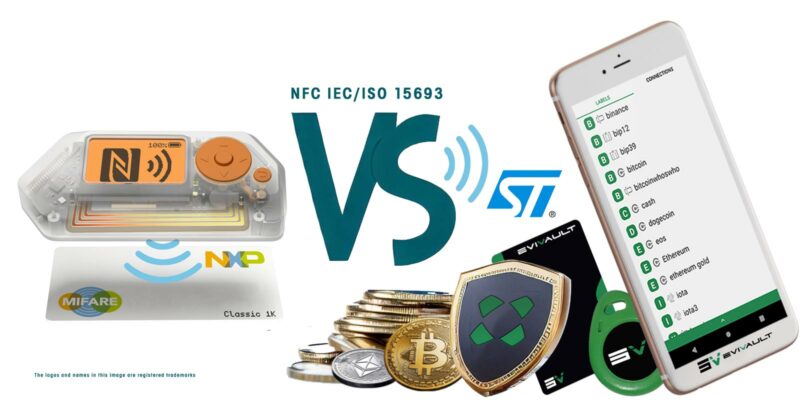
EviVault NFC HSM vs Flipper Zero: The duel of an NFC HSM and a Pentester

EviVault NFC HSM vs Flipper Zero: The duel of an NFC HSM and a Pentester [...]

Articles Cryptocurrency Digital Security Technical News

Securing IEO STO ICO IDO and INO: The Challenges and Solutions

Securing IEO STO ICO IDO and INO: How to Protect Your Crypto Investments Cryptocurrencies are [...]

2023 Articles Digital Security Technical News

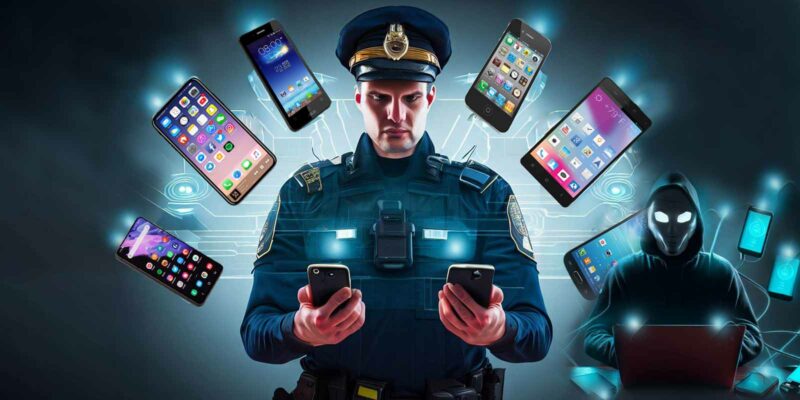
Remote activation of phones by the police: an analysis of its technical, legal and social aspects

What is the new bill on justice and why is it raising concerns about privacy? [...]

Articles Cyberculture Digital Security Technical News

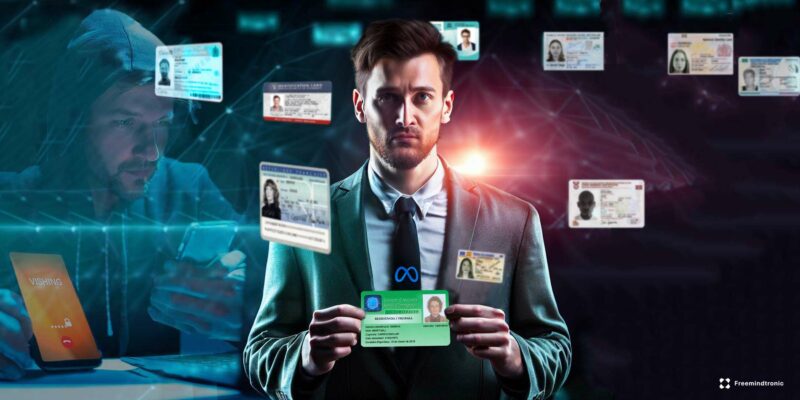
Protect Meta Account Identity Theft with EviPass and EviOTP

Protecting Your Meta Account from Identity Theft Meta is a family of products that includes [...]

2024 Digital Security

Cybersecurity Breach at IMF: A Detailed Investigation

Cybersecurity Breach at IMF: A Detailed Investigation Cybersecurity breaches are a growing concern worldwide. The [...]

2023 Articles Cyberculture Digital Security Technical News

Strong Passwords in the Quantum Computing Era

How to create strong passwords in the era of quantum computing? Quantum computing is a [...]

2024 Digital Security

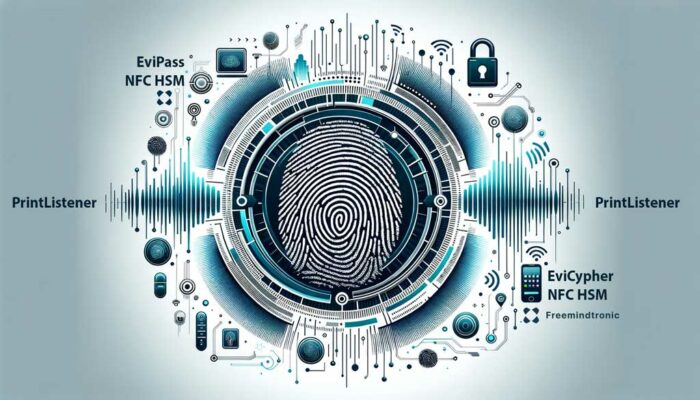
PrintListener: How to Betray Fingerprints

PrintListener: How this Technology can Betray your Fingerprints and How to Protect yourself PrintListener revolutionizes [...]

The chronicles displayed above ↑ belong to the Digital Security section. They extend the analysis of sovereign architectures, data black markets, and surveillance tools. This selection complements the present chronicle dedicated to the **Ledger Security Breaches (2017–2026)** and the systemic risks linked to hardware vulnerabilities, supply‑chain compromises, and third‑party providers.

Advanced Summary

This advanced summary frames Ledger Security Breaches (2017–2026) through a systemic lens. It does not focus only on technical incidents, but analyzes the full dependency chain — firmware, software, partners, and customer data — and explains why certain architectures make these failures structural, not accidental.

A sequence of breaches that reveals a security-model problem

Since 2017, Ledger has faced a series of major incidents: seed phrase recovery attacks, firmware replacement, physical device modifications, application-level vulnerabilities (Monero), the massive 2020 customer database leak, the 2023 software supply-chain compromise, and the 2026 Global-e order-data leak. Taken separately, each event can be labeled an “incident.” Taken together, they reveal a security model problem.

The common denominator is not low-level cryptography, but the recurring necessity for critical secrets (seed phrases, private keys, identity-related metadata) to pass at some point through a non-sovereign environment: proprietary firmware, the host computer, connected applications, update servers, or an e-commerce partner.

From component security to ecosystem vulnerability

Ledger historically relied on the robustness of the hardware component itself. But from 2020 onward, the attack surface shifted to the peripheral ecosystem: customer databases, logistics services, software dependencies, user interfaces, notifications, and support channels.

The 2026 Global-e leak marks a turning point. Even without direct private-key compromise, exposure of delivery and order metadata turns users into persistent targets: ultra-targeted phishing, “delivery” social engineering, doxxing, and, in extreme cases, physical threats. Security is no longer only digital — it becomes civil and personal.

Why phishing and hybrid attacks become inevitable

Once a user’s real identity is correlated with crypto ownership, phishing stops being opportunistic. It becomes industrial and personalized.

BITB attacks, fake updates, fake delivery incidents, or “compliance” scams exploit less a technical bug than the human factor, made vulnerable by exposed metadata.

In this context, hardening firmware or adding software warnings is not sufficient. The problem is not cryptographic signing — it is that the secret or its holder becomes identifiable, traceable, or remotely reachable.

Paradigm shift: from trust to hardware proof

Facing these structural limits, some approaches do not attempt to strengthen transaction signing — they aim to remove critical secrets from any connected ecosystem. Freemindtronic’s sovereign alternatives follow the opposite logic: instead of securing a connected stack, they seek to radically reduce dependencies. NFC HSM devices are battery-less, cable-less, and network-port-less, requiring no account, no server, and no cloud synchronization.

This paradigm shift is embodied by air-gap secret sharing: critical secrets (seed phrases, private keys, credentials for hot wallets or proprietary systems) can be transferred hardware → hardware from one SeedNFC HSM to another, via an RSA-4096 encrypted QR code using the recipient’s public key — without blockchain, without server, and without any transaction-signing function.

A structural answer to the failures observed since 2017

Where Ledger failures rely on supply chains, updates, and commercial relationships, sovereign architectures remove these breaking points by design. There is nothing to hack remotely, nothing to divert in a cloud, and nothing to extract from a third-party server. Even if visually exposed, an encrypted QR code remains unusable without physical possession of the recipient HSM.

This model does not promise “magic” security. It imposes deliberate responsibility: irreversibility of transfers, physical control, and operational discipline. But it eliminates the systemic attack vectors that have repeatedly surfaced since 2017.

Ledger Security Breaches (2017–2026): How to Protect Your Cryptocurrencies

Have you ever questioned the real level of security protecting your digital assets?
If you use a Ledger device, you may assume your funds are safe from hackers. Ledger is a French company widely recognized for its role in cryptocurrency security, offering hardware wallets designed to isolate private keys from online threats.

However, since 2017, Ledger Security Breaches have repeatedly challenged this assumption. Over time, multiple vulnerabilities have emerged—some exposing personal data, others enabling private-key compromise only in specific, controlled attack scenarios (e.g., physical access or manipulated environments). These weaknesses have allowed attackers not only to steal funds, but also to exploit users through phishing, identity correlation, and targeted coercion.

This chronicle provides a structured analysis of the major Ledger security incidents from 2017 to 2026. It explains how each breach was exploited, what risks they introduced, and why certain architectural choices amplify systemic exposure. Most importantly, it outlines practical and strategic approaches to reduce attack surfaces and regain control over cryptographic sovereignty.

Rather than focusing on fear or isolated failures, this analysis aims to help users understand the evolving threat landscape—and to distinguish between trust-based security and proof-based, sovereign architectures.

Ledger security incidents: How Hackers Exploited Them and How to Stay Safe

Ledger security breaches have exposed logistical and relational metadata (delivery address, purchase history, identity correlation), and in specific historical attack scenarios, enabled the compromise of private keys under controlled conditions. Ledger is a French company that provides secure devices to store and manage your funds. But since 2017, hackers have targeted Ledger’s e-commerce and marketing database, as well as its software and hardware products. In this article, you will discover the different breaches, how hackers exploited them, what their consequences were, and how you can protect yourself from these threats.

[/section]

Ledger Security Breaches (2017–2026): From Hardware Attacks to Systemic Supply-Chain Risk

Have you ever wondered how safe your cryptocurrencies are? If you are using a Ledger device, you might think that you are protected from hackers and thieves. Ledger is a French company that specializes in cryptocurrency security. It offers devices that allow you to store and manage your funds securely. These devices are called hardware wallets, and they are designed to protect your private keys from hackers and thieves.

However, since 2017, Ledger has been the target of multiple incidents that exposed logistical and relational metadata (delivery address, purchase history, identity correlation) and, in specific historical attack scenarios, enabled private-key compromise under controlled conditions. These breaches could allow hackers to steal your cryptocurrencies or harm you in other ways. In this article, we will show you the different breaches that were discovered, how they were exploited, what their consequences were, and how you can protect yourself from these threats.

Ledger Security Issues: The Seed Phrase Recovery Attack (February 2018)

The seed phrase is a series of words that allows you to restore access to a cryptocurrency wallet. It must be kept secret and secure, as it gives full control over the funds. In February 2018, a security researcher named Saleem Rashid discovered a breach in the Ledger Nano S, which allowed an attacker with physical access to the device to recover the seed phrase using a side-channel attack.

How did hackers exploit the breach?

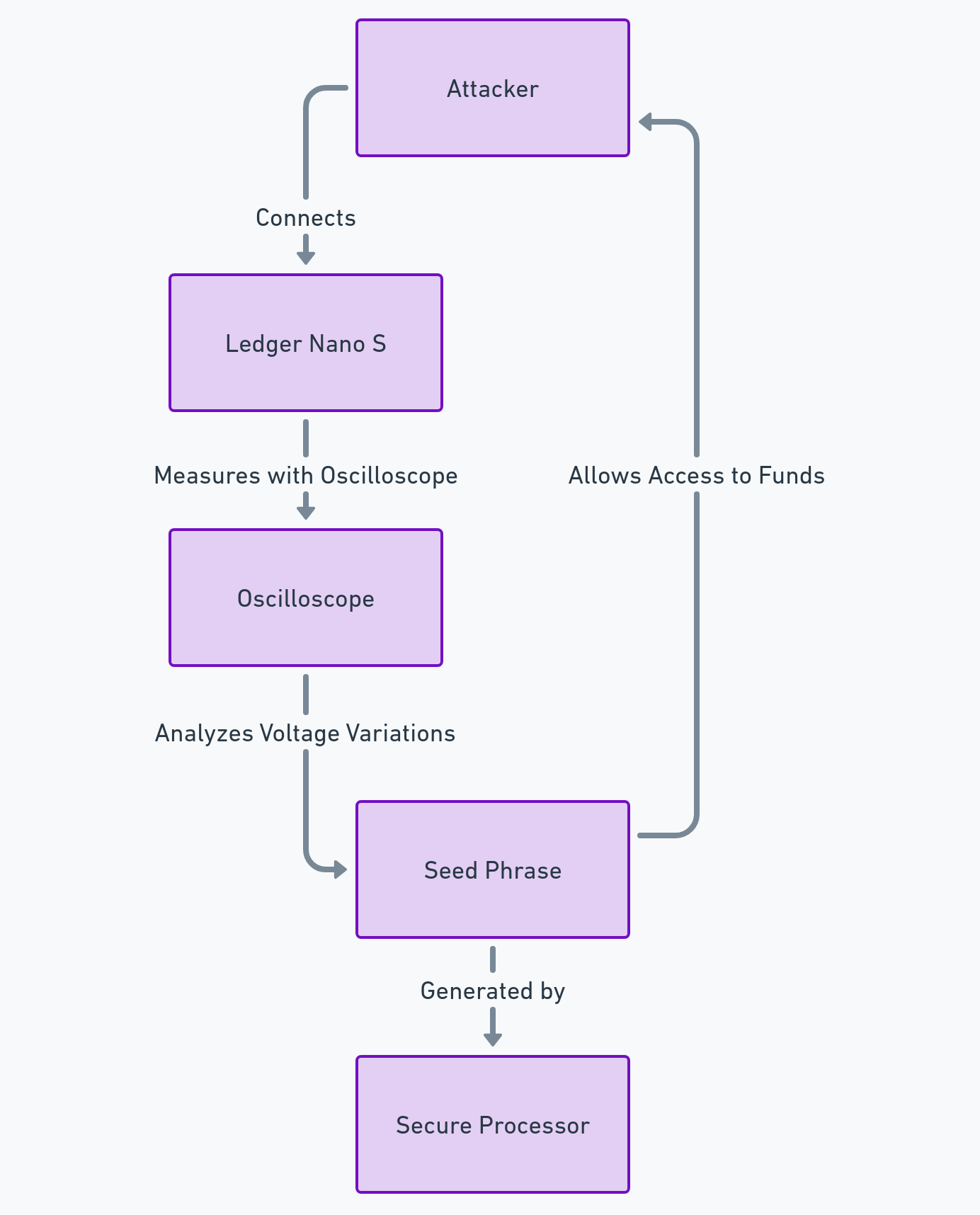
The attack consisted of using an oscilloscope to measure the voltage variations on the reset pin of the device. These variations reflected the operations performed by the secure processor of the Ledger Nano S, which generated the seed phrase. By analyzing these variations, the attacker could reconstruct the seed phrase and access the user’s funds.

Simplified diagram of the attack

Figure Ledger Security Issues: The Seed Phrase Recovery Attack (February 2018)
Statistics on the breach
  • Number of potentially affected users: about 1 million
  • Total amount of potentially stolen funds: unknown
  • Date of discovery of the breach by Ledger: February 20, 2018
  • Author of the discovery of the breach: Saleem Rashid, a security researcher
  • Date of publication of the fix by Ledger: April 3, 2018

Scenarios of hacker attacks

  • Scenario of physical access: The attacker needs to have physical access to the device, either by stealing it, buying it second-hand, or intercepting it during delivery. The attacker then needs to connect the device to an oscilloscope and measure the voltage variations on the reset pin. The attacker can then use a software tool to reconstruct the seed phrase from the measurements.
  • Scenario of remote access: The attacker needs to trick the user into installing a malicious software on their computer, which can communicate with the device and trigger the reset pin. The attacker then needs to capture the voltage variations remotely, either by using a wireless device or by compromising the oscilloscope. The attacker can then use a software tool to reconstruct the seed phrase from the measurements.

Sources

1Breaking the Ledger Security Model – Saleem Rashid published on March 20, 2018.

2Ledger Nano S: A Secure Hardware Wallet for Cryptocurrencies? – Saleem Rashid published on November 20, 2018.

Ledger Security Flaws: The Firmware Replacement Attack (March 2018)

The firmware is the software that controls the operation of the device. It must be digitally signed by Ledger to ensure its integrity. In March 2018, the same researcher discovered another breach in the Ledger Nano S, which allowed an attacker to replace the firmware of the device with a malicious firmware, capable of stealing the private keys or falsifying the transactions.

How did hackers exploit the Ledger Security Breaches?

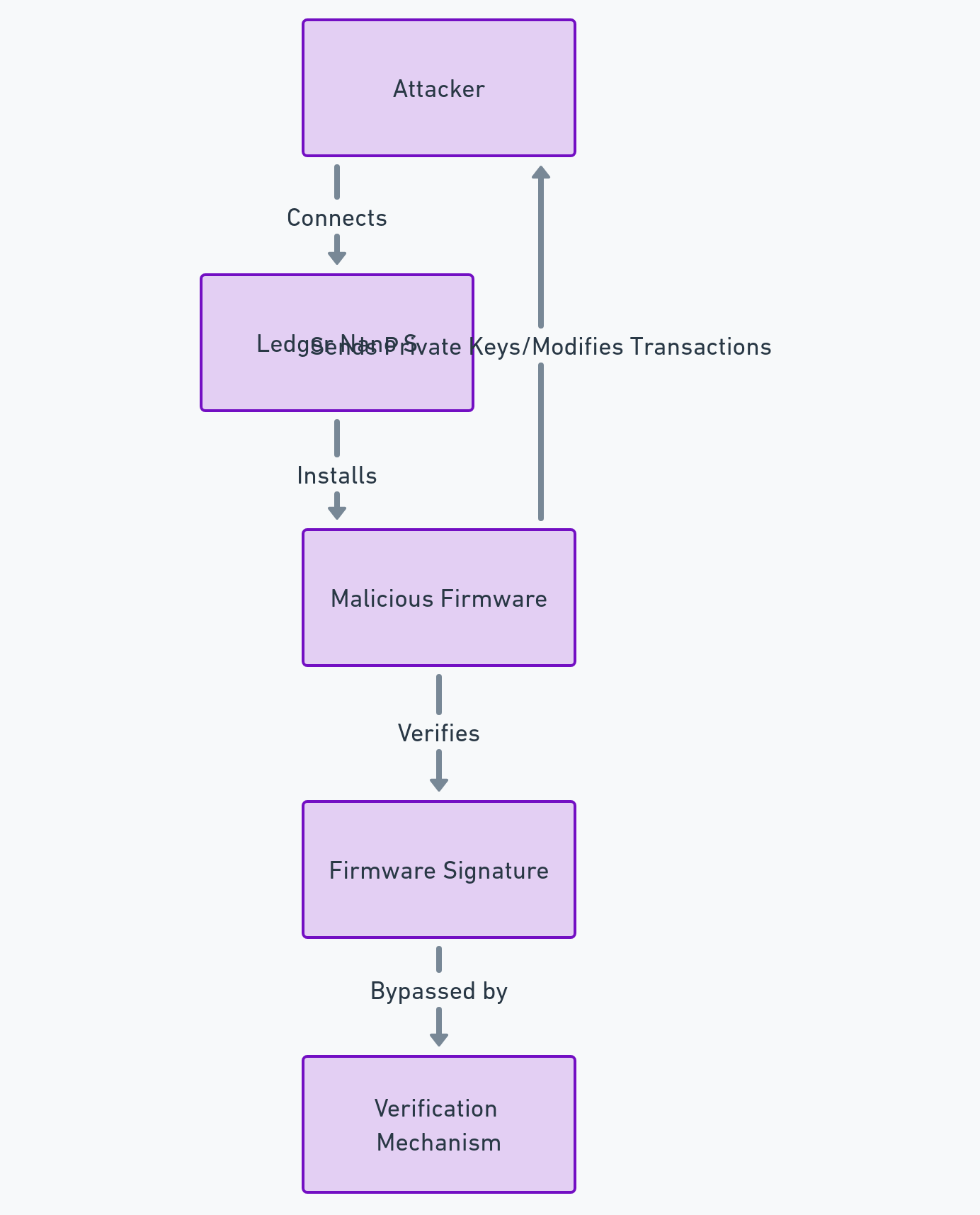
The attack consisted of exploiting a vulnerability in the mechanism of verification of the firmware signature. The attacker could create a malicious firmware that passed the signature check, and that installed on the device. This malicious firmware could then send the user’s private keys to the attacker, or modify the transactions displayed on the device screen.

Simplified diagram of the attack

Figure Ledger Security Flaws: The Firmware Replacement Attack (March 2018)

Statistics on the breach

  • Number of potentially affected users: about 1 million
  • Total amount of potentially stolen funds: unknown
  • Date of discovery of the breach by Ledger: March 20, 2018
  • Author of the discovery of the breach: Saleem Rashid, a security researcher
  • Date of publication of the fix by Ledger: April 3, 2018

Scenarios of hacker attacks

  • Scenario of physical access: The attacker needs to have physical access to the device, either by stealing it, buying it second-hand, or intercepting it during delivery. The attacker then needs to connect the device to a computer and install the malicious firmware on it. The attacker can then use the device to access the user’s funds or falsify their transactions.
  • Scenario of remote access: The attacker needs to trick the user into installing the malicious firmware on their device, either by sending a fake notification, a phishing email, or a malicious link. The attacker then needs to communicate with the device and send the user’s private keys or modify their transactions.

Sources

Ledger Security Incidents: The Printed Circuit Board Modification Attack (November 2018)

The printed circuit board is the hardware part of the device, which contains the electronic components. It must be protected against malicious modifications, which could compromise the security of the device. In November 2018, a security researcher named Dmitry Nedospasov discovered a breach in the Ledger Nano S, which allowed an attacker with physical access to the device to modify the printed circuit board and install a listening device, capable of capturing the private keys or modifying the transactions.

How did hackers exploit the breach?

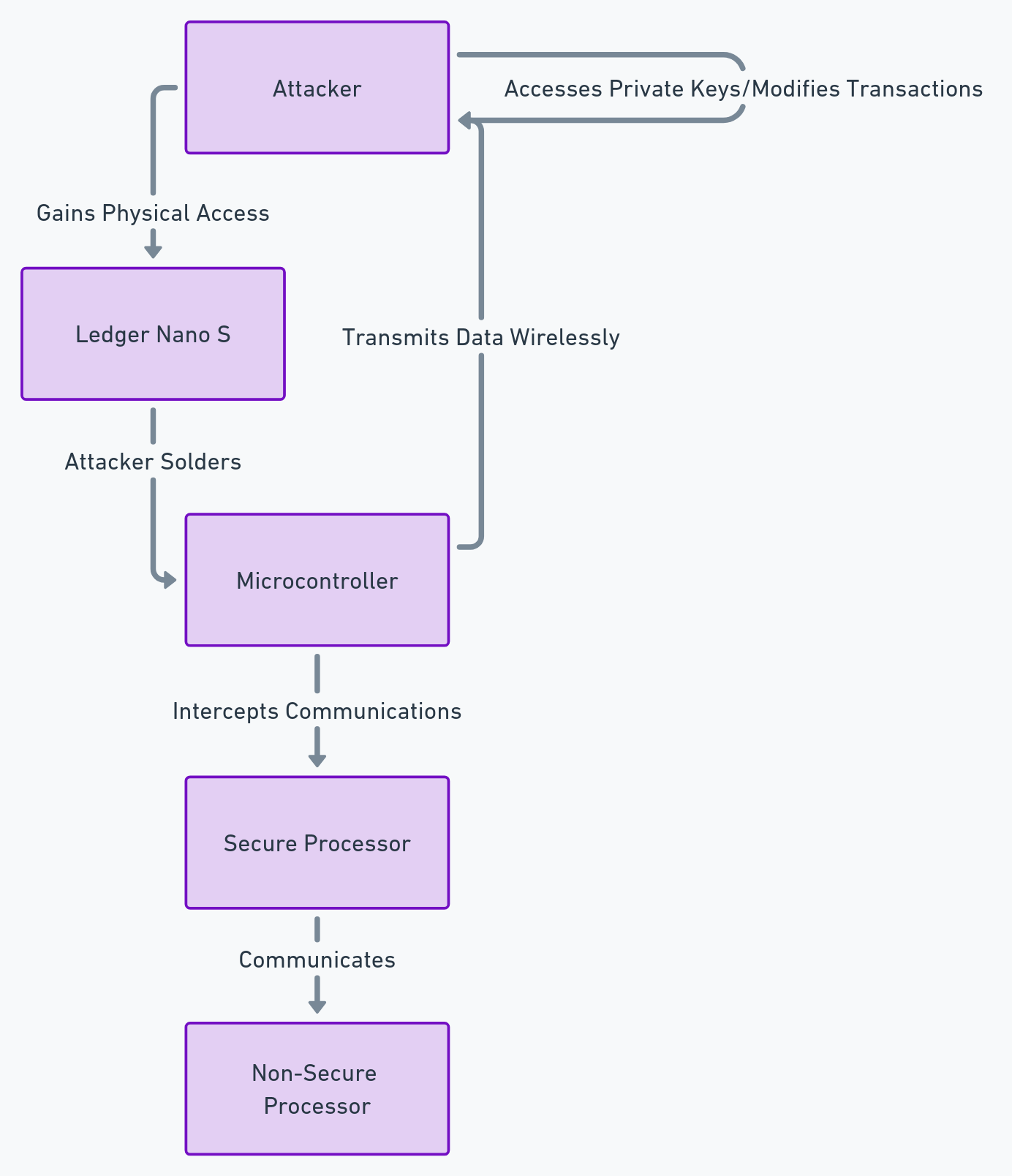
The attack consisted of removing the case of the device, and soldering a microcontroller on the printed circuit board. This microcontroller could intercept the communications between the secure processor and the non-secure processor of the Ledger Nano S, and transmit them to the attacker via a wireless connection. The attacker could then access the user’s private keys, or modify the transactions displayed on the device screen.

Simplified diagram of the attack

figure Ledger Security Incidents: The Printed Circuit Board Modification Attack (November 2018)

Statistics on the breach

  • Number of potentially affected users: unknown
  • Total amount of potentially stolen funds: unknown
  • Date of discovery of the breach by Ledger: November 7, 2019
  • Author of the discovery of the breach: Dmitry Nedospasov, a security researcher
  • Date of publication of the fix by Ledger: December 17, 2020

Scenarios of hacker attacks

  • Scenario of physical access: The attacker needs to have physical access to the device, either by stealing it, buying it second-hand, or intercepting it during delivery. The attacker then needs to remove the case of the device and solder the microcontroller on the printed circuit board. The attacker can then use the wireless connection to access the user’s funds or modify their transactions.
  • Scenario of remote access: The attacker needs to compromise the wireless connection between the device and the microcontroller, either by using a jammer, a repeater, or a hacker device. The attacker can then intercept the communications between the secure processor and the non-secure processor, and access the user’s funds or modify their transactions.

Sources

  • [Breaking the Ledger Nano X – Dmitry Nedospasov] published on November 7, 2019.
  • [How to Verify the Authenticity of Your Ledger Device – Ledger Blog] published on December 17, 2020.
[/col] [/row]

Ledger Security Breaches: Monero Application Vulnerability (March 2019)

Not all cryptocurrencies interact with hardware wallets in the same way.
In March 2019, a critical vulnerability was discovered in the Monero (XMR) application for Ledger devices.
Unlike the 2018 physical attacks, this flaw was located in the communication protocol between the Ledger device and the Monero desktop client.

How Was the Vulnerability Exploited?

The flaw allowed a malicious or compromised Monero client to send manipulated transaction data to the Ledger device.

By exploiting a bug in the handling of change outputs, an attacker could:

  • redirect funds to an address under their control without the user noticing on the Ledger screen, or
  • under specific and controlled conditions, reconstruct the Monero private spend key by observing multiple device–host exchanges.

In this scenario, the hardware wallet signed cryptographically valid transactions based on manipulated inputs originating from the host software.

Infographic illustrating a Monero transaction hijack via a malicious GUI wallet despite the use of a Ledger hardware wallet.

Incident Summary

  • Potentially affected users: Monero (XMR) holders using Ledger Nano S or Nano X
  • Reported loss: One documented case of approximately 1,600 XMR (~USD 83,000 at the time)
  • Date of discovery: March 4, 2019
  • Discoverers: Monero community & Ledger Donjon
  • Patch released: March 6, 2019 (Monero app version 1.5.1)

Attack Scenarios

  • Compromised software: The user interacts with an infected or unofficial Monero GUI wallet. During a legitimate transaction, the client silently alters transaction parameters to drain funds.
  • Key reconstruction (controlled scenario): An attacker with malware on the host computer could theoretically reconstruct the Monero private spend key by intercepting and correlating multiple device–PC exchanges.

Important clarification: This incident did not involve a mass leak of private keys.
It demonstrated that, under specific conditions and with a compromised host environment, private key compromise was technically possible due to application-layer design flaws.

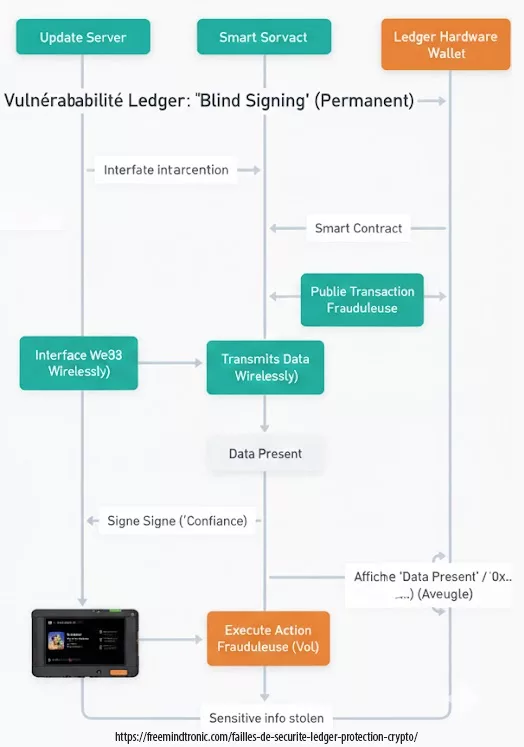
Structural “Blind Signing” Vulnerability: Signing in the Dark by Design (Permanent)

Blind Signing is not a temporary flaw nor a bug that can be patched with a firmware update.
It is a structural design limitation inherent to hardware wallets when confronted with the growing complexity of smart contracts.


As of 2026, it represents the #1 fund-theft vector in Web3
, ahead of classic technical exploits.

Why Blind Signing Is Fundamentally Dangerous

A hardware wallet is supposed to enable conscious and verifiable validation of sensitive operations.
With Blind Signing, however, the device is unable to render the real intent of the contract being signed.

The user is typically presented with:

  • a generic “Data Present” message
  • unreadable hexadecimal strings
  • or a partial, non-human-interpretable description

The signature becomes an act of faith.
The user no longer validates a understood action, but complies with an opaque interface.

Diagram illustrating Blind Signing, showing a hardware wallet displaying 'Data Present' while a malicious smart contract drains funds.

Figure — Blind Signing: when the user signs a transaction whose real intent cannot be verified.

An Attack by Consent, Not by Circumvention

Unlike the 2018 Ledger incidents (seed recovery, firmware replacement, PCB modification),
Blind Signing does not attempt to break the hardware security.

It turns it against the user.

Everything is:

  • cryptographically valid
  • signed with the genuine private key
  • irreversible on the blockchain

There is no detectable malware, no key extraction, no firmware compromise.
The loss is legally and technically attributable to the signature itself.

Impact and Scope

  • Affected users: 100% of DeFi / NFT / Web3 users
  • Estimated losses: hundreds of millions of USD (cumulative)
  • Status: permanent and systemic risk
  • Root cause: inability to verify signed intent

Typical Attack Scenarios

  • Wallet drainers: a fake mint or airdrop leads to signing a contract that grants unlimited asset transfer rights.
  • Hidden infinite approvals: the user unknowingly signs a permanent authorization. The wallet is emptied later, without any further interaction.

Conclusion:
Blind Signing marks a critical rupture: the private key remains protected, but effective security disappears.

The question is no longer “Is my wallet secure?”, but:

“Am I able to prove what I am signing?”

Ledger Security Breaches: The Connect Kit Attack (December 2023)

The Connect Kit is a software that allows users to manage their cryptocurrencies from their computer or smartphone, by connecting to their Ledger device. It allows to check the balance, send and receive cryptocurrencies, and access services such as staking or swap.

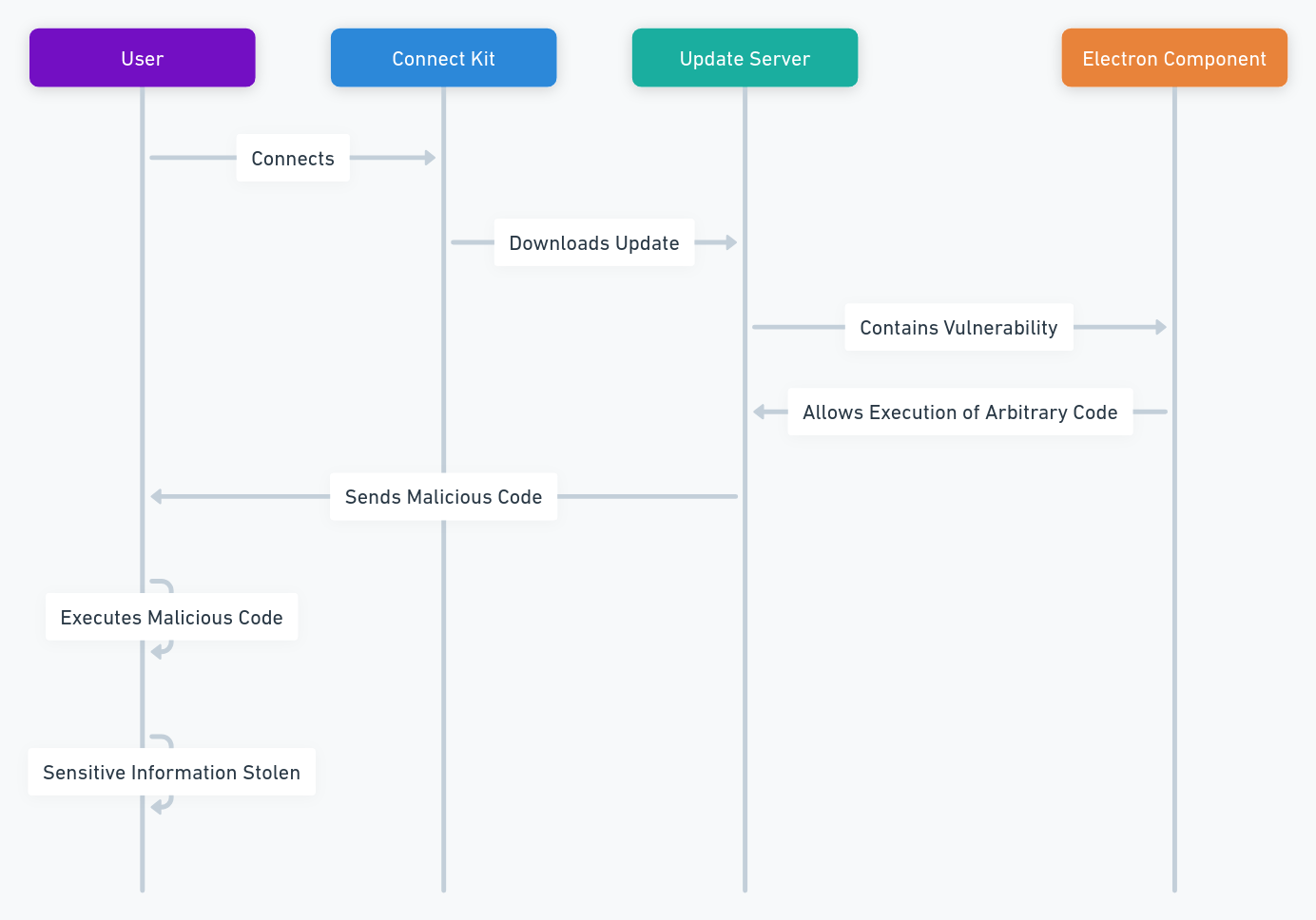
The Connect Kit breach was discovered by the security teams of Ledger in December 2023. It was due to a vulnerability in a third-party component used by the Connect Kit. This component, called Electron, is a framework that allows to create desktop applications with web technologies. The version used by the Connect Kit was not up to date, and had a breach that allowed hackers to execute arbitrary code on the update server of the Connect Kit.

Technical validation: This type of supply chain attack is classified under CWE-494 (Download of Code Without Integrity Check). You can monitor similar hardware wallet vulnerabilities on the MITRE CVE Database.

How did hackers exploit the Ledger Security Breaches?

The hackers took advantage of this breach to inject malicious code into the update server of the Connect Kit. This malicious code was intended to be downloaded and executed by the users who updated their Connect Kit software. The malicious code aimed to steal the sensitive information of the users, such as their private keys, passwords, email addresses, or phone numbers.

Simplified diagram of the attack

Figure Ledger Security Breaches The Connect Kit Attack (December 2023)

Statistics on the breach

  • Number of potentially affected users: about 10,000
  • Total amount of potentially stolen funds: unknown
  • Date of discovery of the breach by Ledger: December 14, 2023
  • Author of the discovery of the breach: Pierre Noizat, director of security at Ledger
  • Date of publication of the fix by Ledger: December 15, 2023

Scenarios of hacker attacks

  • Scenario of remote access: The hacker needs to trick the user into updating their Connect Kit software, either by sending a fake notification, a phishing email, or a malicious link. The hacker then needs to download and execute the malicious code on the user’s device, either by exploiting a vulnerability or by asking the user’s permission. The hacker can then access the user’s information or funds.
  • Scenario of keyboard: The hacker needs to install a keylogger on the user’s device, either by using the malicious code or by another means. The keylogger can record the keystrokes of the user, and send them to the hacker. The hacker can then use the user’s passwords, PIN codes, or seed phrases to access their funds.
  • Scenario of screen: The hacker needs to install a screen recorder on the user’s device, either by using the malicious code or by another means. The screen recorder can capture the screen of the user, and send it to the hacker. The hacker can then use the user’s QR codes, addresses, or transaction confirmations to steal or modify their funds.

Sources

Ledger Security Breaches: The Data Leak (December 2020)

The database is the system that stores the information of Ledger customers, such as their names, addresses, phone numbers and email addresses. It must be protected against unauthorized access, which could compromise the privacy of customers. In December 2020, Ledger revealed that a breach in its database had exposed the logistical and relational metadata (delivery address, purchase history, identity correlation) of 292,000 customers, including 9,500 in France.

How did hackers exploit the breach?

The breach had been exploited by a hacker in June 2020, who had managed to access the database via a poorly configured API key. The hacker had then published the stolen data on an online forum, making them accessible to everyone. Ledger customers were then victims of phishing attempts, harassment, or threats from other hackers, who sought to obtain their private keys or funds.

Simplified diagram of the attack :

Statistics on the breach

  • Number of affected users: 292,000, including 9,500 in France
  • Total amount of potentially stolen funds: unknown
  • Date of discovery of the breach by Ledger: June 25, 2020
  • Author of the discovery of the breach: Ledger, after being notified by a researcher
  • Date of publication of the fix by Ledger: July 14, 2020

Scenarios of hacker attacks

  • Scenario of phishing: The hacker sends an email or a text message to the user, pretending to be Ledger or another trusted entity. The hacker asks the user to click on a link, enter their credentials, or update their device. The hacker then steals the user’s information or funds.
  • Scenario of harassment: The hacker calls or visits the user, using their logistical and relational metadata (delivery address, purchase history, identity correlation) to intimidate them. The hacker threatens the user to reveal their identity, harm them, or steal their funds, unless they pay a ransom or give their private keys.
  • Scenario of threats: The hacker uses the user’s logistical and relational metadata (delivery address, purchase history, identity correlation) to find their social media accounts, family members, or friends. The hacker then sends messages or posts to the user or their contacts, threatening to harm them or expose their cryptocurrency activities, unless they comply with their demands.

Sources:

Ledger Security Breaches: The Global-e Data Leak (January 2026)

In January 2026, Ledger disclosed a new breach caused by its e-commerce partner Global-e.
Attackers compromised Global-e’s cloud systems, exposing customer names, email addresses, and delivery contact details used for online orders.

Unlike previous incidents, no seed phrases, private keys, or payment card data were compromised.
However, this leak significantly increased the risk of targeted phishing, doxxing, and long-term social engineering attacks against Ledger customers.

Infographic illustrating the Global-e Ledger data leak (January 2026)

Figure — Global-e 2026 breach: how exposed order data enables phishing, doxxing, and coercive targeting.
Active Defense: Mitigating Global-e Leak Risks

The SeedNFC HSM ecosystem, combined with PassCypher HSM PGP, provides a structural response by shifting security into the user’s physical control:

  • Reduced purchase metadata exposure: minimizing the collection and retention of identifiable data (name, address, phone) limits the long-term impact of e-commerce and logistics leaks such as 2020 and Global-e (2026).
  • Hardware-based intent validation: critical actions require a physical NFC interaction, rendering remote phishing and fake-support attacks ineffective after a data leak.
  • Anti-BITB & Anti-Iframe protection: blocks fake Ledger Live interfaces and credential-harvesting windows commonly used in post-leak phishing campaigns.
  • Compromised credential detection: checks whether emails or passwords have appeared in previous breaches, preventing reuse and account takeover.
Global-e Breach Statistics
  • Affected users: Not publicly disclosed (investigation ongoing as of January 2026).
  • Exposed data: Customer names, emails, and delivery contact information.
  • Impact on sensitive assets: None (private keys and funds remained secure).
  • Date of discovery: January 4, 2026.
  • Breach origin: Global-e cloud infrastructure.
⚠️ Critical Alert: Dark Web Resale & Persistent Targeting

A data breach is permanent. Once an identity is associated with a hardware wallet purchase,
the individual remains a high-value target for years.

Sovereign defense: By managing keys and credentials in a hardware-only environment such as SeedNFC HSM,
users can de-link their digital identity from centralized e-commerce databases and recurring leaks.

Official Sources & Expert References

Escalation of Threats: From Delivery Phishing to Physical Coercion

The Global-e delivery-data leak does not merely enable email scams.
It fuels hybrid attacks where digital exposure transitions into real-world coercion.

“Delivery” Phishing: Precision Social Engineering

Attackers exploit order history to send ultra-credible SMS or emails:

  • Scenario: Fake courier messages (customs issue, address error, delayed shipment).
  • Trap: A cloned Ledger interface requesting a recovery phrase to “unlock” delivery.
  • Why it works: The victim is already expecting a shipment or update.

Physical Extortion & Home-Targeting

When physical addresses are exposed, the threat extends beyond cybercrime:

  • Targeted home visits: Criminal groups identify where crypto holders live.
  • Coercion: Victims are forced to sign irreversible transfers under threat.
  • Family pressure: Attacks may involve relatives to break resistance.

“A leaked Ledger delivery address acts as a marker: it tells criminals where the vault is and who holds the key.” This reality forces a fundamental rethink of how security tools are purchased and how identity is exposed.

Official Statements and Expert Sources

Global Reactions: Trust Erosion, Legal Pressure, and Community Backlash

The January 2026 Global-e order-data breach triggered a strong and immediate reaction across the global crypto ecosystem. Unlike earlier technical exploits, this incident reinforced a growing perception that the primary risk no longer lies in cryptography or hardware components, but in ecosystem-level dependencies: e-commerce partners, logistics providers, and identity-linked metadata.

Across English-speaking communities (Reddit, X, Discord, Telegram), the dominant sentiment was not surprise, but fatigue. For many users, Global-e represented the third major reminder—after 2020 and 2023—that hardware security alone does not guarantee user safety.

Recurring Themes in Anglophone Communities

  • Collapse of “secure-by-brand” trust: Ledger’s hardware is still widely perceived as technically robust, but confidence in the surrounding commercial and data-handling ecosystem has eroded.
  • Metadata as the real vulnerability: Users increasingly recognize that names, emails, delivery addresses, and purchase history enable profiling, targeting, and coercion—even when private keys remain secure.
  • Phishing industrialization: Highly personalized scams (fake delivery notices, fake compliance alerts, fake support cases) are now viewed as an unavoidable consequence of large-scale data leaks.

From Cybersecurity to Legal and Regulatory Exposure

In the United States, United Kingdom, and European Union, discussions rapidly shifted toward legal accountability and consumer protection, backed by official frameworks:

  • Class action risk (US / UK): Law firms are examining collective lawsuits for negligence and failure of duty of care, citing precedents in data breach litigation.
  • Regulatory scrutiny: Data-protection authorities like the CNIL (EU) and the ICO (UK) have emphasized strict third-party dependency management under GDPR.
  • Law-enforcement alerts: Agencies like Cybermalveillance.gouv.fr and the FBI (IC3) emphasize that crypto-related leaks increasingly enable hybrid crime, combining cyber-fraud with real-world intimidation.

Hybrid Threat Escalation: From Phishing to Physical Coercion

The Global-e breach illustrates a broader evolution of crypto-crime: the transition from purely digital theft to hybrid attack models, a trend confirmed by the INTERPOL Global Cybercrime reports.

Precision Phishing at Global Scale

Attackers leverage order metadata to craft highly credible messages. As reported by The Block, these campaigns include:

  • Fake courier notifications (customs delay, address issues)
  • Cloned Ledger Live portals requesting recovery phrases
  • Social-engineering scripts tailored to purchase history

Physical Targeting and Extortion Risks

Once physical addresses are exposed, risks extend beyond cybercrime, aligning with the Chainalysis Crypto Crime evolution analysis:

  • Home targeting: Criminal groups identify where high-value crypto holders live.
  • Forced transactions: Victims are coerced into signing irreversible transfers via physical threats.
  • Family leverage: Threats may extend to relatives to break resistance.

“A leaked delivery address does not steal funds—but it identifies the vault and the person holding the key.”

This realization has driven a growing demand for identity-minimizing, hardware-sovereign security models built on privacy-by-design principles —such as those prioritizing “Privacy by Design” by erasing all digital purchase records—to decouple asset protection from centralized logistics vulnerabilities.

Permanent Air-Gapped Secret Sharing: RSA-4096 Encrypted QR Between SeedNFC HSM Devices

SeedNFC implements a fully air-gapped secret-sharing mechanism based on an
RSA-4096 encrypted QR code using the recipient’s public key.
The recipient must be another SeedNFC HSM, ensuring that only that device can decrypt and
import the secret directly into hardware.

The QR code is only an encrypted transport container. It can be displayed locally, sent as an image,
or even shown during a video call. Without physical possession of the recipient SeedNFC HSM,
the content remains mathematically unusable.

  • Offline asymmetric encryption: the secret is never exposed in plaintext inside the QR code.
  • Zero infrastructure: no server, no account, no database, no cloud.
  • Operational + logical air-gap: sharing remains possible without any network connectivity.

This mechanism includes no revocation, no delay, and no expiration: the transfer is permanent by design.
It enables direct hardware → hardware transfer of critical secrets (seed phrases, private keys, access credentials)
between isolated HSM devices, with no software intermediary and no blockchain involvement.

Clarification: secret transfer ≠ transaction signing

SeedNFC HSM is not presented here as a transaction signer. Its role is upstream: to generate, store, and transfer secrets (seed phrases, private keys) or authentication data (IDs/passwords, hot-wallet access, proprietary systems) within a sovereign hardware boundary.

It can also store encrypted seed phrases from third-party wallets (Ledger, Trezor, software hot wallets, etc.) and their associated private keys, without depending on the original vendor’s firmware, software, or infrastructure.

Depending on the use case, data can be injected in a controlled way into an application field through Bluetooth HID keyboard emulation (e.g., migration, restore, login).

Web complement: for browser workflows, equivalent controlled input can be triggered via the Freemindtronic browser extension (explicit field selection). This eliminates exposure via clipboard, temporary files, or cloud sync, and strongly reduces risk from classic software keyloggers, since the user does not type anything.

Scope note: like any input, data may still become observable at the display point or on a compromised host (screen capture, application malware). The goal is to remove “copy/paste + file” vectors and human typing—not to make an infected system “invulnerable”.

Important: transferring a private key transfers ownership (full control over the associated funds).This is relevant for backup, migration, inheritance, or off-chain ownership transfer, but must be used with strict operational discipline.

Why this matters after data leaks: even if metadata is exposed, secrets can remain isolated and transferable without re-entering a connected vendor ecosystem.

Comparison with other crypto wallets

Ledger is not the only solution to secure your cryptocurrencies. There are other options, such as other hardware wallets, software wallets, or exchanges. Each option has its advantages and disadvantages, depending on your needs and preferences.

Other Hardware Wallets

For example, other hardware wallets, such as Trezor, offer similar features and security levels as Ledger, but they may have different designs, interfaces, or prices.

Software Wallets

Software wallets, such as Exodus or Electrum, are more convenient and accessible, but they are less secure and more vulnerable to malware or hacking.

Exchanges

Exchanges, such as Coinbase or Binance, are more user-friendly and offer more services, such as trading or staking, but they are more centralized and risky, as they can be hacked, shut down, or regulated.

Security Vector Traditional USB Wallet Freemindtronic NFC HSM
Physical Attack Surface High (USB ports, Battery, Screen) Minimal (No ports, No battery)
Data Persistence Risk of flash memory wear High (EviCore long-term integrity)
Side-Channel Leakage Possible (Power consumption analysis) Immune (Passive induction)

Cold Wallet Alternatives

Another option is to use a cold wallet, such as SeedNFC HSM, which is a patented HSM that uses NFC technology to create, store, and transfer cryptographic secrets (seed phrases, private keys, credentials) in an offline, hardware-only environment, without any connection to the internet or a computer. It also allows you to create up to 100 cryptocurrency wallets and check the balances from this NFC HSM.

Internationally Patented Sovereign Technology

To address the structural flaws identified in traditional hardware wallets, Freemindtronic uses a unique architecture protected by international patents (WIPO). These technologies ensure that the user remains the sole master of their security environment.

  • Access Control System Patent WO2017129887
    Guarantees physical-to-digital integrity by ensuring the HSM can only be triggered by a specific, intentional human action, preventing remote exploitation.
  • Segmented Key Authentication System Patent WO2018154258
    Provides a defense-in-depth mechanism where secrets are fragmented. This prevents a “single point of failure,” making “Connect Kit” type attacks or firmware replacements ineffective.

Technological, Regulatory, and Societal Projections

The future of cryptocurrency security is uncertain and challenging. Many factors can affect Ledger and its users, such as technological, regulatory, or societal changes.

Technological changes

It changes could bring new threats, such as quantum computing, which could break the encryption of Ledger devices, or new solutions, such as biometric authentication or segmented key authentication patented by Freemindtronic, which could improve the security of Ledger devices.

Regulatory changes

New rules or restrictions could affect Cold Wallet and Hardware Wallet manufacturers and users, such as Ledger. For example, KYC (Know Your Customer) or AML (Anti-Money Laundering) requirements could compromise the privacy and anonymity of Ledger users. They could also ban or limit the use of cryptocurrencies, which could reduce the demand and value of Ledger devices. On the other hand, other manufacturers who have anticipated these new legal constraints could have an advantage over Ledger. Here are some examples of regulatory changes that could affect Ledger and other crypto wallets:

  • MiCA, the proposed EU regulation on crypto-asset markets, aims to create a harmonized framework for crypto-assets and crypto-asset service providers in the EU. It also seeks to address the risks and challenges posed by crypto-assets, such as consumer protection, market integrity, financial stability and money laundering.The Markets in Crypto-Assets (MiCA) regulation, specifically Title V on service provider obligations, is now the gold standard. Freemindtronic technologies are designed to align with the Official Regulation (EU) 2023/1114, ensuring privacy while meeting compliance needs.
  • U.S. interagency report on stablecoins recommends that Congress consider new legislation to ensure that stablecoins and stablecoin arrangements are subject to a federal prudential framework. It also proposes additional features, such as limiting issuers to insured depository institutions, subjecting entities conducting stablecoin activities (e.g., digital wallets) to federal oversight, and limiting affiliations between issuers and commercial entities.
  • Revised guidance from the Financial Action Task Force (FATF) on virtual assets and virtual asset service providers (VASPs) clarifies the application of FATF standards to virtual assets and VASPs. It also introduces new obligations and recommendations for PSAVs, such as the implementation of the travel rule, licensing and registration of PSAVs, and supervision and enforcement of PSAVs.

These regulatory changes could have significant implications for Ledger and other crypto wallets. They could require them to comply with new rules and standards, to obtain new licenses or registrations, to implement new systems and processes, and to face new supervisory and enforcement actions.

Societal changes

Societal changes could influence the perception and adoption of Ledger and cryptocurrencies, such as increased awareness and education, which could increase the trust and popularity of Ledger devices, or increased competition and innovation, which could challenge the position and performance of Ledger devices. For example, the EviSeed NFC HSM technology allows the creation of up to 100 cryptocurrency wallets on 5 different blockchains chosen freely by the user.

Technological Alternatives for Absolute Sovereignty

The persistence of Ledger Security Breaches demonstrates that relying on a single centralized manufacturer creates a systemic risk. Today, decentralized alternatives developed by Freemindtronic in Andorra offer a paradigm shift: security based on hardware proof and physical intent, rather than brand trust.

Technologies such as EviCore NFC HSM and EviSeed NFC HSM are not just wallets; they are contactless cybersecurity ecosystems. Unlike Ledger, these devices are battery-less and cable-less, eliminating physical ports (USB/Bluetooth) as attack vectors.

Internationally Patented Security

Freemindtronic’s architecture is anchored by two fundamental international patents (WIPO) that solve the structural flaws found in traditional hardware wallets:

  • Segmented Key Authentication System (WO2018154258): Prevents the compromise of the whole seed or private key, even if the environment is attacked.
  • Access Control System (WO2017129887): Ensures that the HSM can only be triggered by the user’s physical intent via NFC, neutralizing remote software threats.

Unified Security: Hardware-Based Password Management

One of the most innovative features of the SeedNFC HSM is its integration of the EviPass NFC HSM technology. This addresses the “human factor” exploited in phishing scams.

  • Decentralized & Passwordless: Manage non-morphic passwords without ever storing them on a computer.
  • Physical Entropy: Immunity to keyloggers and screen recorders used in the Connect Kit attacks.
  • Contactless Convenience: Secure auto-fill by simply tapping your device.

Universal Access: Smartphone & Desktop Integration

On Android: Use native NFC for instant, battery-free hardware security.
On Desktop: Secure authentication directly in your browser via the Freemindtronic Extension.

Advanced “Air-Gap” Input: Keyboard Emulation

To bypass compromised clipboards, Fullsecure with Inputstick enables hardware-level data injection.

How it works: Your smartphone acts as a Bluetooth HID Keyboard, “typing” secrets directly into any device.

  • No Clipboard Exposure: Secrets never pass through the computer’s buffer.
  • Hardware Injection: Neutralizes software-based keyloggers relying on human keystroke capture.

Important clarification: transferring a private key is not a transaction. It is an off-chain transfer of ownership, granting full control over the associated assets.

Explore Fullsecure & Inputstick →

Active Defense: Neutralizing BITB & Redirection Attacks

The SeedNFC HSM ecosystem, when paired with the free PassCypher HSM PGP version and the browser extension, provides a unique multi-layered shield against modern web threats:

    • Anti-BITB (Browser-In-The-Browser): The extension features a dedicated anti-iframe system. It detects and blocks malicious windows that simulate fake login screens—a common tactic used to steal Ledger credentials.
    • Automated Corruption Check: Integrated with Have I Been Pwned, the system automatically checks if your IDs or passwords have been compromised in historical leaks, ensuring you never use “vulnerable” credentials.
    • End-to-End Encrypted Auto-fill: Sensitive data is encrypted directly within the SeedNFC HSM on your Android device. It is only decrypted at the final millisecond of injection into the browser, ensuring that no plain-text data ever resides in the computer’s memory.

How to use: Open the Freemindtronic Android App (where SeedNFC is embedded), tap your HSM to your phone, and let the secure bridge handle the encrypted injection directly into your Chrome or Edge browser.

Best Practices to Protect Yourself

  • Never share your seed phrase or private keys — no support, update, delivery, or compliance process ever requires them.
  • Assume all inbound communication is hostile by default — (email, SMS, phone, social media). Always verify via official, manually accessed channels.
  • Strictly separate identity from asset ownership — use a dedicated email, avoid real-name linkage, and minimize purchase metadata exposure.
  • Avoid blind signing whenever possible — never sign transactions or approvals you cannot fully interpret and verify.
  • Prefer sovereign, hardware-only cold storage — (e.g., patented NFC HSM architectures) that do not rely on vendor servers, firmware updates, or e-commerce ecosystems.
  • Keep secrets out of connected environments — avoid clipboards, cloud sync, screenshots, password files, and shared devices.
  • Use hardware-enforced authentication and password management — to neutralize phishing, BITB, and credential reuse.
  • Plan for irreversible scenarios — define secure procedures for backup, migration, inheritance, and off-chain ownership transfer.
  • Accept operational responsibility — sovereignty implies discipline, physical control, and acceptance that some actions cannot be undone.

Securing the Future: From Vulnerability to Digital Sovereignty

Since 2017, the trajectory of Ledger Security Breaches has served as a critical case study for the entire crypto ecosystem. While Ledger remains a pioneer in hardware security, the recurring incidents—ranging from early physical exploits to the massive 2026 Global‑e data leak—demonstrate that a “secure device” is no longer enough. The threat has shifted from the chip itself to the systemic supply chain and the exposure of relational data.

The January 2026 incident confirms a persistent reality: even when private keys remain shielded, the leak of customer metadata (names, emails, and order history) creates a permanent risk of targeted phishing, doxxing, and social engineering. This highlights the inherent danger of centralized e‑commerce databases and the fragility of relying on third‑party partners for a product whose core promise is absolute security.

The Sovereign Alternative: Security by Design

To break this cycle of dependency, the paradigm must shift toward decentralized hardware security. This is where patented technologies developed by Freemindtronic in Andorra provide a structural response:

  • Physical Intent & Access Control (WO2017129887): Eliminates the remote attack surface by requiring a physical, contactless validation that cannot be spoofed by malicious software updates.
  • Segmented Key Authentication (WO2018154258): Protects against systemic breaches (like the Connect Kit attack) by ensuring that secrets are never centralized or fully exposed, even in a compromised environment.

This model does not promise convenience. It requires strict operational discipline, physical control, and acceptance of irreversibility.

For Ledger users, vigilance remains the primary line of defense. Respecting strict digital hygiene—verifying every communication via the official Ledger help center and using dedicated, non‑identifiable contact info for purchases—is essential. However, for those seeking to eliminate the “third‑party risk” entirely, transitioning to battery‑less, contactless, and patented NFC HSM solutions represents the next step in achieving true digital sovereignty.

As the crypto landscape evolves through 2026 and beyond, the lesson is clear: Don’t just trust the brand—trust the architecture.

Technical Reference: The EviCore and SeedNFC architectures are based on WO2017129887 and WO2018154258 patents. Developed by Freemindtronic Andorra for absolute digital sovereignty.

Dual-Use Encryption Products: a regulated trade for security and human rights

Dual-Use encryption products a regulated trade for security and human rights by Freemindtronic-from Andorra
Dual-use encryption products by Jacques Gascuel: This article will be updated with any new information on the topic.

Dual-use encryption products: a challenge for security and human rights

Encryption is a technique that protects data and communications. Encryption products are dual-use goods, which can have civilian and military uses. The export of these products is controlled by the EU and the international community, to prevent their misuse or diversion. This article explains the EU regime for the export of dual-use encryption products, and how it has been updated.

2025 Cyber Doctrine Cyberculture

Uncodified UK constitution & digital sovereignty

2025 Cyberculture Cybersecurity Digital Security EviLink

CryptPeer messagerie P2P WebRTC : appels directs chiffrés de bout en bout

2025 Cyber Doctrine Cyberculture

Souveraineté individuelle numérique : fondements et tensions globales

2025 Cyberculture

Louvre Security Weaknesses — ANSSI Audit Fallout

The international regulations on dual-use encryption products

The main international regulations that apply to dual-use encryption products are the Wassenaar Arrangement and the EU regime for the control of exports of dual-use goods.

The Wassenaar Arrangement

The Wassenaar Arrangement is a multilateral export control regime that aims to contribute to regional and international security and stability. It promotes transparency and responsibility in the transfers of conventional arms and dual-use goods and technologies. It was established in 1996 and currently has 42 participating states, including the United States, Canada, Japan, Australia, Russia, China and most of the EU member states.

The Wassenaar Arrangement maintains a list of dual-use goods and technologies that are subject to export control by the participating states. The list is divided into 10 categories, with subcategories and items. Category 5, part 2, covers information security, including encryption products. The list of encryption products includes, among others, the following items:

  • Cryptographic systems, equipment, components and software, using symmetric or asymmetric algorithms, with a key length exceeding 56 bits for symmetric algorithms or 512 bits for asymmetric algorithms, or specially designed for military or intelligence use.
  • Cryptanalytic systems, equipment, components and software, capable of recovering the plain text from the encrypted text, or of finding cryptographic keys or algorithms.
  • Cryptographic development systems, equipment, components and software, capable of generating, testing, modifying or evaluating cryptographic algorithms, keys or systems.
  • Non-cryptographic information security systems, equipment, components and software, using techniques such as steganography, watermarking, tamper resistance or authentication.
  • Technology for the development, production or use of the above items.

The participating states of the Wassenaar Arrangement are required to implement national export controls on the items listed in the arrangement, and to report annually their exports and denials of such items. However, the arrangement does not impose binding obligations on the participating states, and each state is free to decide whether to grant or refuse an export license, based on its own policies and national interests.

The EU regime for the control of exports of dual-use goods

The common legal framework of the EU for dual-use goods

The EU regime for the control of exports of dual-use goods is a common legal framework. It applies to all EU member states, and it has two main goals. First, it aims to ensure a consistent and effective implementation of the international obligations of export control. Second, it aims to protect the security and human rights of the EU and its partners. The regime is based on the Regulation (EU) 2021/821, which was adopted in May 2021 and entered into force in September 2021. This regulation replaces the previous Regulation (EC) No 428/2009.

The Regulation (EU) 2021/821: the principles and criteria of export control

The Regulation (EU) 2021/821 establishes a Union list of dual-use goods. These are goods that can have both civilian and military uses, such as software, equipment and technology. These goods are subject to an export authorization, which means that exporters need to obtain a permission from the competent authorities before exporting them. The Regulation also sets out a set of general principles and criteria for granting or refusing such authorization. The Union list of dual-use goods is based on the international export control regimes, including the Wassenaar Arrangement. It covers the same categories and items as the latter. However, the EU list also includes some additional items that are not covered by the international regimes. These are cyber-surveillance items that can be used for internal repression or human rights violations.

The Union list of dual-use goods: the categories and items subject to an export authorization

The Union list of dual-use goods consists of ten categories, which are:

  • Category 0: Nuclear materials, facilities and equipment
  • Category 1: Materials, chemicals, micro-organisms and toxins
  • Category 2: Materials processing
  • Category 3: Electronics
  • Category 4: Computers
  • Category 5: Telecommunications and information security
  • Category 6: Sensors and lasers
  • Category 7: Navigation and avionics
  • Category 8: Marine
  • Category 9: Aerospace and propulsion

Each category contains a number of items, which are identified by a code and a description. For example, the item 5A002 is “Information security systems, equipment and components”. The items are further divided into sub-items, which are identified by a letter and a number. For example, the sub-item 5A002.a.1 is “Cryptographic activation equipment or software designed or modified to activate cryptographic capability”.

The novelties of the Regulation (EU) 2021/821: the due diligence obligation, the catch-all clause, the human security approach and the transparency and information exchange mechanism

The Regulation (EU) 2021/821 also provides for different types of export authorizations. These are individual, global, general or ad hoc authorizations, depending on the nature, destination and end-use of the items. Moreover, the Regulation introduces some novelties, such as:

  • A due diligence obligation for exporters. This means that exporters have to verify the end-use and the end-user of the items, and to report any suspicious or irregular transaction.
  • A catch-all clause. This allows the competent authorities to impose an export authorization on items that are not listed, but that can be used for weapons of mass destruction, a military end-use, human rights violations or terrorism.
  • A human security approach. This requires the competent authorities to take into account the potential impact of the items on human rights, international humanitarian law, regional stability and sustainable development, especially for cyber-surveillance items.
  • A transparency and information exchange mechanism. This requires the competent authorities to share information on the authorizations, denials and consultations of export, and to publish annual reports on their export control activities.

The dual-use encryption products: sensitive goods for security and human rights

The dual-use encryption products are a specific type of dual-use goods that fall under the category 5 of the Union list. These are products that use cryptographic techniques to protect the confidentiality, integrity and authenticity of data and communications. These products can have both civilian and military uses, and they raise important issues for security and human rights.

The dual-use encryption products: a definition and examples

The dual-use encryption products are defined by the Regulation (EU) 2021/821 as “information security systems, equipment and components, and ‘software’ and ‘technology’ therefor, which use ‘cryptography’ or cryptanalytic functions”. The Regulation also provides a list of examples of such products, such as:

  • Cryptographic activation equipment or software
  • Cryptographic equipment for mobile cellular systems
  • Cryptographic equipment for radio communication systems
  • Cryptographic equipment for computer and network security
  • Cryptanalytic equipment and software
  • Quantum cryptography equipment and software

The dual-use encryption products: security issues

The dual-use encryption products can have a significant impact on the security of the EU and its partners. On the one hand, these products can enhance the security of the EU and its allies, by protecting their sensitive data and communications from unauthorized access, interception or manipulation. On the other hand, these products can also pose a threat to the security of the EU and its adversaries, by enabling the encryption of malicious or illegal activities, such as terrorism, espionage or cyberattacks. Therefore, the export of these products needs to be carefully controlled, to prevent their misuse or diversion to undesirable end-users or end-uses.

The dual-use encryption products: human rights issues

The dual-use encryption products can also have a significant impact on the human rights of the EU and its partners. On the one hand, these products can protect the human rights of the EU and its citizens, by safeguarding their privacy and freedom of expression on the internet. On the other hand, these products can also violate the human rights of the EU and its partners, by enabling the repression or surveillance of dissidents, activists or journalists by authoritarian regimes or non-state actors. Therefore, the export of these products needs to take into account the potential consequences of the items on human rights, international humanitarian law, regional stability and sustainable development, especially for cyber-surveillance items.

The modification of the Union list of dual-use goods by the Delegated Regulation (EU) 2022/1

The Union list of dual-use goods is not static, but dynamic. It is regularly updated to reflect the changes in the technological development and the international security environment. The latest update of the list was made by the Delegated Regulation (EU) 2022/1 of the Commission of 20 October 2021, which modifies the Regulation (EU) 2021/821.

The changes made by the international export control regimes in 2020 and 2021

The Delegated Regulation (EU) 2022/1 reflects the changes made by the international export control regimes in 2020 and 2021. These are the Wassenaar Arrangement, the Nuclear Suppliers Group, the Australia Group and the Missile Technology Control Regime. These regimes are voluntary and informal arrangements of states that coordinate their national export control policies on dual-use goods. The EU is a member of these regimes, and it aligns its Union list of dual-use goods with their lists of controlled items. The changes made by these regimes include the addition, deletion or modification of some items, as well as the clarification or simplification of some definitions or technical parameters.

The new items added to the Union list of dual-use goods: the quantum technologies, the drones and the facial recognition systems or biometric identification systems

The Delegated Regulation (EU) 2022/1 also adds some new items to the Union list of dual-use goods. These are items that are not covered by the international export control regimes, but that are considered to be sensitive for the security and human rights of the EU and its partners. These items include:

  • Certain types of software and technology for the development, production or use of quantum computers or quantum cryptography. These are devices or techniques that use the principles of quantum physics to perform computations or communications that are faster or more secure than conventional methods.
  • Certain types of equipment, software and technology for the development, production or use of unmanned aerial vehicles (UAVs) or drones. These are aircraft or systems that can fly without a human pilot on board, and that can be used for various purposes, such as surveillance, reconnaissance, delivery or attack.
  • Certain types of equipment, software and technology for the development, production or use of facial recognition systems or biometric identification systems. These are systems or techniques that can identify or verify the identity of a person based on their facial features or other biological characteristics, such as fingerprints, iris or voice.

The entry into force and application of the Delegated Regulation (EU) 2022/1

The Delegated Regulation (EU) 2022/1 entered into force on 7 January 2022. It applies to all exports of dual-use goods from the EU from that date. The exporters of dual-use goods need to be aware of the changes and updates to the Union list of dual-use goods, and to comply with the export control rules and procedures established by the Regulation (EU) 2021/821. The competent authorities of the member states need to implement and enforce the new Union list of dual-use goods, and to cooperate and coordinate with each other and with the Commission. The Commission needs to monitor and evaluate the impact and effectiveness of the new Union list of dual-use goods, and to report to the European Parliament and the Council.

The national regulations on dual-use encryption products

How some countries have their own rules on dual-use encryption products

The case of the United States

Some countries have their own national regulations on dual-use encryption products, which may differ or complement the existing regimes. For example, the United States has a complex and strict export control system, based on the Export Administration Regulations (EAR). The EAR classify encryption products under category 5, part 2, of the Commerce Control List (CCL). The EAR require an export license for most encryption products, except for some exceptions, such as mass market products, publicly available products, or products intended for certain countries or end-users. The EAR also require that exporters submit annual self-classification reports, semi-annual sales reports, and encryption review requests for certain products.

The case of Andorra

Andorra is a small country between France and Spain. It is not an EU member, but it has a customs union with it. However, this customs union does not cover all products. It only covers those belonging to chapters 25 to 97 of the Harmonized System (HS), which are mainly industrial products. Agricultural products and products belonging to chapters 1 to 24 of the HS are free of import duties in the EU. But they are subject to the most-favored-nation (MFN) treatment in Andorra.

Andorra has adopted the EU list of dual-use goods. It requires an export or transfer authorization for these goods, according to the Regulation (EU) 2021/821. This regulation came into force on 9 September 2021 and replaced the previous Regulation (EC) No 428/2009. Andorra has also adopted the necessary customs provisions for the proper functioning of the customs union with the EU. These provisions are based on the Community Customs Code and its implementing provisions, by the Decision No 1/2003 of the Customs Cooperation Committee.

Andorra applies the EU regulation, as it is part of the internal market. Moreover, Andorra has adopted the Delegated Regulation (EU) 2022/1 of the Commission of 20 October 2021, which modifies the EU list of dual-use goods. This modification reflects the changes made by the international export control regimes in 2020 and 2021. It also adds some new items, such as software and technologies for quantum computing, drones or facial recognition. The Delegated Regulation (EU) 2022/1 came into force on 7 January 2022, and applies to all exports of dual-use goods from the EU from that date.

Andorra entered the security and defense sector for the first time by participating in Eurosatory 2022. This is the international reference exhibition for land and airland defense and security. Andorra became the 96th country with a security and defense industry on its territory. Among the exhibitors, an Andorran company, Freemindtronic, specialized in counter-espionage solutions, presented innovative products. For example, DataShielder Defense NFC HSM, a device to protect sensitive data against physical and logical attacks. It uses technologies such as EviCypher NFC HSM and EviCore NFC HSM, contactless hardware security modules (NFC HSM). The president of Coges events, a subsidiary of GICAT, identified these products as dual-use and military products. They need an export or transfer authorization, according to the Regulation (EU) 2021/821. Freemindtronic also showed its other security solutions, such as EviKey NFC HSM, a secure USB key, a security token. These products were displayed in the Discover Village, a space for start-ups and SMEs innovations.

Switzerland

Switzerland is not an EU member, but it has a free trade agreement with it. Switzerland has adopted the Regulation (EU) 2021/821 by the Ordinance of 5 May 2021 on the control of dual-use goods. Switzerland applies the EU list of dual-use goods and requires an export or transfer authorization for these goods, according to the Regulation (EU) 2021/821. Switzerland has also adopted the Delegated Regulation (EU) 2022/1 of the Commission of 20 October 2021, which modifies the EU list of dual-use goods.

Turkey

Turkey is not an EU member, but it has a customs union with it. Turkey has adopted the Regulation (EU) 2021/821 by the Presidential Decree No 3990 of 9 September 2021 on the control of exports of dual-use goods. Turkey applies the EU list of dual-use goods and requires an export or transfer authorization for these goods, according to the Regulation (EU) 2021/821. Turkey has also adopted the Delegated Regulation (EU) 2022/1 of the Commission of 20 October 2021, which modifies the EU list of dual-use goods.

United Kingdom

The United Kingdom left the EU on 31 January 2020. It has adopted the Regulation (EU) 2021/821 by the Dual-Use Items (Export Control) Regulations 2021, which came into force on 9 September 2021. The United Kingdom applies the EU list of dual-use goods and requires an export or transfer authorization for these goods, according to the Regulation (EU) 2021/821. The United Kingdom has also adopted the Delegated Regulation (EU) 2022/1 of the Commission of 20 October 2021, which modifies the EU list of dual-use goods.

The challenges and opportunities for the exporters of dual-use encryption products

The exporters of dual-use encryption products face several challenges and opportunities in the current context of export control regulations. Among the challenges, we can mention:

  • The complexity and diversity of the regulations, which may vary depending on the countries, the products, the destinations and the end-uses, and which require a deep knowledge and a constant monitoring from the exporters.
  • The costs and delays related to the administrative procedures, which can be high and unpredictable, and which can affect the competitiveness and profitability of the exporters, especially for small and medium enterprises (SMEs).
  • The legal and reputational risks, which can result from an involuntary or intentional violation of the regulations, or from a misuse or diversion of the products by the end-users, and which can lead to sanctions, prosecutions or damages to the image of the exporters.

Among the opportunities, we can mention:

  • The growing demand and innovation for encryption products, which are increasingly used in many sectors and domains, such as finance, health, education, defense, security, human rights, etc.
  • The contribution to the security and human rights of the exporters, their customers and the general public, by enabling the protection of data, privacy, freedom of expression, access to information and democratic participation, thanks to encryption products.
  • The cooperation with the competent authorities, the civil society and the international community, to ensure the compliance and accountability of the exporters, and to support the development and implementation of effective and balanced encryption policies and regulations, that respect the security and human rights of all stakeholders.

Conclusion

Dual-use encryption products can have both civil and military uses. They are subject to export control regulations at different levels: international, regional and national. These regulations aim to prevent the risks that these products can pose for security and human rights. At the same time, they allow the development and trade of these products. Therefore, the exporters of dual-use encryption products must comply with the regulations that apply to their products. They must also assess the impact of their products on security and human rights. The exporters of dual-use encryption products can benefit from the demand and innovation for these products. These products are essential for the digital economy and society. They can also enhance the security and human rights of the exporters, their customers and the public.

Freemindtronic Andorra is a company that specializes in dual-use encryption products. It offers secure and innovative solutions for data, communication and transaction protection. Freemindtronic Andorra respects the export control regulations that apply to its products. It is also committed to promoting and supporting the responsible and lawful use of its products. It follows the principles of security and human rights. Freemindtronic Andorra cooperates with the authorities, the civil society and the international community. It ensures the transparency and accountability of its activities. It also participates in the development and implementation of effective and balanced encryption policies and regulations. It respects the interests and needs of all stakeholders.

NFC Business Cards with Cardokey free for life: How to Connect without Revealing

Cardokey NFC vCard Business: Edit, Read, and Import Contacts Seamlessly on iPhone.
NFC Business Cards with Cardokey by Jacques Gascuel: This article will be updated with any new information on the topic.

How to Create NFC Business Cards with Cardokey

Do you want to create your contact information in a simple, fast and eco-friendly way? Do you want to use NFC technology without spending a fortune or compromising your privacy? Then you need to read this article about Cardokey, the app that’s revolutionizing NFC business cards.

2024 Articles Cardokey EviSwap NFC NDEF Technology GreenTech Technical News

NFC vCard Cardokey: Revolutionizing Digital Networking

2023 Articles Cardokey Eco-friendly EviSwap NFC NDEF Technology GreenTech

NFC Business Cards with Cardokey free for life: How to Connect without Revealing

2023 Articles Cyberculture Eco-friendly Electronics GreenTech Technologies

The first wood transistor for green electronics

Eco-friendly GreenTech

Hardware secrets manager Eco-friendly

NFC Business Cards: Create your NFC vCard with Cardokey, the Eco-Friendly and Secure NFC App

Are you looking for an eco-friendly way to create contactless business cards? Do you want to benefit from affordable NFC technology and prioritize privacy? You’ll love Cardokey – the app revolutionizing NFC business cards! Cardokey, the NFC business card that connects you while protecting your privacy.

What is Cardokey and how does it work?

Cardokey: Free App for Eco-Friendly NFC Business Cards

You can easily and free create and share your business cards, your social network links or links to your favorite sites for life. Recycle any NFC Tag, NFC Ticket, NFC Sticker or NFC card allowing the use of the NDEF format.
Use of the free Cardokey application is completely anonymous and does not ask for any personal or professional information. You therefore do not need to create an account or identify yourself to use Cardokey.

Cardokey: a compliant and sustainable solution

Cardokey adheres to various standards like ISO/IEC 7816-4, ISO/IEC 14443, NFC Forum Type 2, ISO/IEC 18092, and ISO/IEC 15693 without compromising your privacy or security. It also complies with international data protection laws such as GDPR, PIPEDA, CCPA, and more.

Cardokey is an eco-designed solution that contributes to the UN Goal 12. Consequently, it complies with international standards for eco-responsible practices, circular and solidarity economy, sustainable economy and carbon footprint reduction.

Cardokey: a compatible and versatile app

NFC business cards created with Cardokey are compatible with all NFC phones, Android and iPhone. The application works in real time, offline, without a database, including in airplane mode. This means that you can modify the information contained in the memory of your NFC media at any time. The app also allows you to format any NFC Media to NDEF format and also erase almost all types of NFC chips.

Cardokey: a simple and fast way to share your contact information

Digital business cards created with Cardokey can be shared in seconds. In fact, your interlocutor does not need to download a specific application in order to be able to read the information you wish to share. All he has to do is place the digital business card under his phone equipped with NFC technology to see the information.

How to create an NFC business card with Cardokey that fits the memory size of your NFC media?

The intelligent system of Cardokey

One of the most interesting features of Cardokey is the automatic management of the memory size of forms. The contact form indicates in real time the actual occupancy of the NDEF memory based on the number of characters. The Cardokey user knows the type of vCard information. He can store it according to the memory size. The memory size depends on the NFC media.

The different types of NFC Media and their memory size

It is possible to make a vCard with a minimum of name, surname and email information for a very small NFC memory4. For example, on an NTAG Nano, which has a capacity of 160 bytes and can store NDEF messages of up to 128 bytes, one can store basic information like a person’s name, surname, phone number, and email address.

Or, more complete information can be stored on a ST25TV02K chip, which has a capacity of 256 bytes and can store NDEF messages of up to 224 bytes. In this case, one can include a person’s name, surname, title, organization, phone number, email address, and postal address.

The steps to create an NFC business card with Cardokey

You can create NFC business cards that fit the memory size of your media without losing information. This allows you to optimize the use of your NFC Media and take advantage of their full capabilities.

To create NFC business cards that fit the memory size of your media, simply follow these steps:

  • Open the Cardokey app and choose the type of content you want to create (business card, URL link, social media link).
  • Enter the information you want to share in the contact form. The form tells you in real time how much memory your data is occupying and how much memory is available on your media.
  • Hover your smartphone to the NFC media of your choice. The app writes the data to the NFC media and confirms that the NFC business card has been created successfully.
  • Test your NFC business card by scanning it with your smartphone or another NFC phone. You’ll see the information you’ve shared on the screen.

That’s it, you’ve created an NFC business card adapted to the memory size of your media, thanks to Cardokey’s automatic form memory size management feature

What are the benefits of NFC business cards with Cardokey?

Cardokey is free and anonymous

Cardokey is a free app that lets you create NFC vCard business cards easily. You can create as many NFC business cards as you want, without paying any fees or signing up for any subscriptions. Moreover, Cardokey is completely anonymous and does not ask for any personal or professional information from the user. You don’t need to create an account or fill in any data. Everything works offline, in real-time, without a database.

Cardokey is easy to use

Cardokey is very easy to use, with one-click installation and operation. You don’t need any technical knowledge or specific hardware to create your NFC business cards. All you have to do is download the app on your smartphone, choose the type of content you want to create, enter the information you want to share, and swipe your smartphone on the NFC media of your choice. And there you have it, your NFC business card is ready! Furthermore, Cardokey features an intelligent system that optimizes the NDEF memory management of NFC media. This provides an optimal user experience.

How Cardokey protects your data with EviSwap NFC NDEF technology

The innovative features of EviSwap NFC NDEF technology

Cardokey uses EviSwap NFC NDEF technology by Freemindtronic for cybersecurity. This is an innovative technology that lets you create and share digital contacts contactless for life. With a simple click, you can create NFC business cards on any NFC media, whether it is disposable or not. You can give a new use to NFC tickets, cards, labels, and tags. You can also rewrite your NFC business cards at least a million times without any risk of error. You can use them for more than 40 years without needing a power source.

The standard and secure format of EviSwap NFC NDEF technology

EviSwap NFC NDEF technology is a technology that uses NFC to facilitate data exchange by implementing the NDEF NFC standard. NDEF stands for NFC Data Exchange Format. It is a standardized format that contains structured data, such as contacts, links, texts, images, etc. NDEF files are compatible with most computer and phone terminals, which can read and write them directly on the NFC memory. EviSwap NFC NDEF technology is especially used by Freemindtronic to exchange encrypted data from human to human from an NFC media, ensuring data security and privacy.

The performance and durability of EviSwap NFC NDEF technology for industrial chips

EviSwap NFC NDEF technology is also compatible with all NFC NDEF media, but it has the advantage of being optimized for Freemindtronic’s NFC HSM industrial chips. These chips can operate in a wide range of temperatures, from -40°C to +85°C. They can withstand harsh environments and resist shocks, vibrations, and water. They are ideal for applications that require reliability and robustness, such as logistics, manufacturing, or security. Moreover, EviSwap NFC NDEF technology is optimized to exchange the largest quantity of information stored in a large NFC memory. For example, it is possible to store NDEF messages of up to 7.9 kilobytes on an M24LR64E-R chip, which has a capacity of 8 kilobytes. In this case, one can add all types of vCard data as well as security keys, digital signature keys and other custom data.

Cardokey: the anonymous and reusable solution for creating NFC business cards

Cardokey is a secure and reusable solution. The Cardokey app works anonymously. It is not connected to a remote service. It does not store in the phone the data. It does not ask you for any information about the user. Finally, it works in real time in Air Gap Network Security . The EviSwap technology also includes an intelligent system to optimize the memory management of NFC media. The goal is to improve the user experience. The intelligent system informs the user in real time of the limits imposed by the maximum size of the NDEF memory available in the media. This allows you to easily store data according to the memory size.
Cardokey, an eco-friendly application

Cardokey isn’t just a universal app for people worldwide; it’s also eco-friendly, allowing you to recycle NFC media and reduce their environmental impact.

How Cardokey recycles NFC Media

NFC media, such as tags, cards or bracelets, are made of several elements and materials, such as PET (polyethylene terephthalate), aluminum or copper for the antenna, a silicon NFC chip, gold or other metals, and an adhesive. These materials are not all easily recyclable, and can cause pollution or waste problems. For example, PET is a common plastic, that is used in many consumer products, like water bottles or packaging. Although PET is recyclable, when it is used in large quantities and in the form of an NFC tag, it is hard to separate PET from other components for recycling, and it tends to clog the treatment filters. Moreover, the metal of an NFC antenna is difficult to recover and recycle. Finally, the NFC chip itself contains precious metals, that are often lost during the recycling process.

To avoid these problems, Cardokey offers an innovative and ecological solution: it allows you to recycle NFC media by reusing them to create new NFC business cards. Instead of throwing away your old NFC tags, cards or bracelets, you can transform them into NFC business cards with Cardokey, and give them a new life. You can also use existing NFC media, such as transport tickets, or access badges, and convert them into NFC business cards with Cardokey. You can thus enjoy all the benefits of NFC technology, without generating additional waste.

How Cardokey works with different types of NFC chips

Cardokey recycles all types of NFC chips (1, 2, 3, 4 and 5), regardless of ISO standards (14443, 15693, 18092). It detects chip types and adjusts accordingly for maximum compatibility. For example, Cardokey can read and write to NFC chips that have enough memory to store information, such as NTAG, MIFARE or ICODE chips. However, Cardokey will not be able to format, erase or modify NFC chips that are permanently locked.

How Cardokey helps you create personalized NFC business cards

By using Cardokey, you can recycle NFC media and turn them into personalized NFC business cards, that contain the information you want to share, such as your name, company, title, website, email, phone number, and more. You can also create URL links to documents or presentations that are useful for your business, such as quotes, contracts, portfolios, and more. You can also create pre-configured links to your favorite social networks, such as Deviantart, Discord, Facebook, Flickr, GitHub, ICQ, Instagram, LinkedIn, Mastodon, Medium, Pinterest, Reddit, Skype, Slack, Snapchat, SoundCloud, Spotify, Steam, Telegram, TikTok, Tumblr, Twitch, Twitter, VKontakte, WeChat, WhatsApp, YouTube, etc. Finally, you can manage your data and contacts in the NFC card, edit or delete them at any time, and view them on your phone or card.

How Cardokey contributes to the preservation of the planet

If we consider the 14 languages ​​available in the Cardokey application, this represents more than 3.7 billion potential users. These potential users can each recycle 10 NFC media each year. This represents 37 billion NFC supports annually. This reduces the environmental impact of NFC and helps preserve the planet.

How Cardokey is eco-friendly and compliant

Cardokey is an eco-designed solution that contributes to the UN Goal 12. This goal aims to ensure sustainable consumption and production patterns. It complies with ISO 14001, Basel and WEEE standards. It also follows international standards for eco-responsible practices, circular and solidarity economy, sustainable economy and carbon footprint reduction. In addition, Cardokey complies with various standards and regulations. These include ISO/IEC 7816-4, ISO/IEC 14443, NFC Forum Type 2, ISO/IEC 18092 and ISO/IEC 15693. It also follows international law rules on the protection of private and professional data. These include the General Data Protection Regulation (GDPR), the Personal Information Protection and Electronic Documents Act (PIPEDA), the California Consumer Privacy Act (CCPA), and others.

Unlike other NFC business card solutions, which are often paid, limited, complex or not very environmentally friendly, Cardokey offers you a free, unlimited, simple and eco-designed solution.

Cardokey therefore offers you an innovative and ecological solution to create NFC business cards that look like you and that suit your needs. Thanks to its recycling feature, you can also reuse NFC media and turn them into personalized NFC business cards.

Cardokey: a universal app

Cardokey is designed to let you create and manage your NFC business cards in a simple and efficient way. But did you know that Cardokey is also a universal app, which can be used by people from all over the world, regardless of their language?
Indeed, Cardokey is available in 14 languages: Arabic, Catalan, Chinese, English, French, German, Hindi, Italian, Japanese, Portuguese, Romanian, Russian, Spanish, and Ukrainian. This represents more than 86.02% of the languages spoken in the world, and more than 3.7 billion people who can use the app in their native language or in a language they master.

Moreover, Cardokey automatically adapts to the language of the phone where it is installed. If the user changes the language of their phone, Cardokey will do the same. Thus, you can create and manage your NFC business cards in the language of your choice, and enjoy all the features of the app.

You can also choose to share your information in multiple languages, by creating different profiles for each language. For example, you can have a profile in French for your French-speaking contacts, a profile in English for your English-speaking contacts, and a profile in Chinese for your Chinese contacts.

Cardokey offers you great flexibility and creativity to create NFC business cards that suit you and your needs.

How NFC vCards work

NFC stands for Near Field Communication. It is a technology that allows two media to communicate with each other when they are close to each other. NFC business cards with Cardokey use this technology to share your contact information in a simple and fast way.

An NFC tag is a media that contains a tiny electronic chip that can store and exchange data. It can have different shapes, such as stickers, keychains or physical cards. When you bring your smartphone near an NFC tag, the data associated with the tag appears automatically on your screen.

NFC vCard business cards with Cardokey are a great alternative to paper business cards, which are often thrown away, lost or outdated. They are eco-friendly, reusable and updated. They also save you time and money, as you don’t need to print or carry them. Moreover, they are more secure and anonymous, as you don’t need to share your personal data or connect to the Internet to use them.

What are the features of Cardokey NFC vCard business cards?

Cardokey offers many features that allow you to create and manage your NFC digital business cards. Here’s a table that summarizes Cardokey’s features:

Function Available
Create a vCard (contact) taking into account the available space ✔️
Create an NDEF NFC Vcard (Manually) ✔️
Create a vCard from an existing contact in the phone ✔️
Modify any existing NFC vCard created by other paid or free apps to make it easier to recycle and update them ✔️
Delete data stored in the NDEF of an NFC media ✔️
Format all types of NFC media to add NDEF compatibility ✔️
Create and store in the NDEF memory of any existing NFC media: your pre-configured links for social networks, the url of your choice, a vCard contact ✔️
Data management in the NFC Media: Create, Read, Update, Delete (CRUD) ✔️
Explanation of each pcictogram and its feature in the application ✔️
Show contact on phone and NFC Media ✔️
Automatic management of the memory size of the NFC card ✔️
Translation into 14 languages: CA, FR, EN, UK, ES, DE, IT, PT, RO, RU, AR, HI, ZH,JP ✔️
Information de contact de Freemindtronic ✔️
Information about the publisher of the Freemindtronic software ✔️
Direct link on the play store to buy the Cardokey Pro version and NFC Medial ✔️
Cardokey is a recycling solution for all types of disposable or non-disposable NFC Media ✔️


With these features, you can create a custom NFC business card, which contains the information you want to share, such as your name, company, title, website, email, phone number, and more. You can also create URL links to documents or presentations that are useful for your business, such as quotes, contracts, portfolios, and more. You can also create pre-configured links to your favorite social networks, such as Deviantart, Discord, Facebook, Flickr, GitHub, ICQ, Instagram, LinkedIn, Mastodon, Medium, Pinterest, Reddit, Skype, Slack, Snapchat, SoundCloud, Spotify, Steam, Telegram, TikTok, Tumblr, Twitch, Twitter, VKontakte, WeChat, WhatsApp, YouTube, etc. Finally, you can manage your data and contacts in the NFC card, edit or delete them at any time, and view them on your phone or card. These features give you a lot of freedom and creativity to create NFC business cards that look and match you.

What are the use cases for NFC business cards with Cardokey?

There are many of them, whether for business or personal needs. Here are some examples of use cases:

Andorra: keep in memory a special event

During the winter, a family visits Andorra’s Granvalira for their child’s first ski lesson and to experience their first snowflake, star, etc. The family keeps the NFC ski ticket formatted in NDEF format. Then, they save a URL that links to a page with all the photos and videos of this event. The ski ticket has become a souvenir object that will be kept for several years. In this case, Cardokey allows you to create an NFC business card with a URL that links to a page where there are all the photos, videos of this event.

Exhibitor: a connected poster with NFC tags

At a booth event, Marius uses self-adhesive NFC tags that they stick behind a poster holder advertising their products with a URL link that directs the visitor to their product information on the poster. The exhibitor can change the poster of his support with Cardokey. He can put a new poster and change the URL link of his new poster. This way, the exhibitor makes a simple poster a connected poster. In this case, Cardokey allows you to create an NFC business card with a URL link that directs the visitor to your product information on the poster.

Goodies: Offer NFC business cards

During a trade show, Mary offers her visitors NFC business cards with her brand as goodies. This allows her to make herself known and retain the loyalty of his potential clients, who will be able to scan her NFC business card with their smartphone to access her website, her LinkedIn profile, her portfolio, etc. Mary can purchase her NFC media from any NFC media e-commerce site or order from Cardokey NFC Cards with an extremely long lifespan of up to 1 million writes and 40 years of vCard retention NFC or URL or network link. In this case, Cardokey allows you to create an NFC vCard with all of Mary’s contact details to offer to her visitors.

Tourist: NFC business cards in different languages

While traveling abroad, Tao uses Cardokey to create his NFC business card with his contact details in his native language. This allows him to easily introduce himself to the people he meets. In fact, they will be able to scan his vcard with their smartphone to see the information translated into their language. He can also use Cardokey to save URL links to websites or applications useful for his trip, such as tourist guides, maps, booking services, etc. In this case, Cardokey allows you to create an NFC business card with your contact details in your native language.

Family: An NFC business card collecting memories

During a family reunion, a family member uses Cardokey to store links to photos and memories on NFC media. Before leaving each other, everyone takes their NFC media. Later, they will be able to relive their life moments with their loved ones, who will simply scan the NFC vcards with their smartphone to view their images, videos, messages, etc. They will also be able to use Cardokey to create URL links to websites or applications that are important to them, such as associations, causes, passions, etc. In this case, Cardokey allows you to create an NFC business card with your photos and memories.

How to download and install Cardokey?

To use Cardokey, you need an NFC-enabled smartphone, i.e. one that has an NFC chip and can read and write NFC data. Most recent smartphones are NFC-enabled, but you can check your smartphone’s compatibility on the Cardokey website.

Cardokey is available in 14 languages (Arabic, Catalan, Chinese, German, English, French, Hindi, Italian, Japanese, Portuguese, Romanian, Russian, Ukrainian). You can download it in any country that accepts the Google play store or app store platform.

To download and install Cardokey on your smartphone, all you need to do is follow these steps:

  • Go to the Google Play Store or App Store and search for “Cardokey”.
  • Select the app and click “Install”.
  • Open the app and agree to the terms of use.
  • Start creating your NFC business cards!

If you are interested in Cardokey, feel free to download it now by clicking on the following link:

In short

Cardokey is a free, user-friendly, eco-conscious app compliant with global privacy and data protection laws. It allows you to create NFC vCard business cards for all Android and iPhone NFC phones. It also lets you reuse and customize NFC media.

Cardokey is the NFC business card that connects you without revealing you. It lets you exchange your contact details without contact and without paper. It offers you a free, unlimited, simple and eco-designed solution.

Definition of technical terms:

  • NFC (Near Field Communication): a technology that allows two devices to communicate with each other when they are close to each other.
  • NDEF (NFC Data Exchange Format): a standard format for storing and exchanging data on NFC media.
  • vCard: a digital format for storing and sharing contact information, such as name, phone number, email address, etc.
  • Air Gap
DataShielder HSM, la solució Xifratge de dades andorrana de Fullsecure – Freemindtronic, guanya el Premi Fortress 2023

Fullsecure DataShielder HSM Fortress Award Jacques Gascuel inventor CEO de Freemindtronic Andorra el premi fortress 2023 de Business Intelligence Group

DataShielder HSM Xifratge de dades, la solució andorrana de Fullsecure amb tecnologies de Freemindtronic, guanya el Premi Fortress 2023

Estem orgullosos d’anunciar que la nostra solució andorrana DataShielder HSM Xifratge de dades de Fullsecure, desenvolupada per Freemindtronic, ha guanyat el premi Fortress 2023 Cyber Security Award en la categoria de xifratge en productes i serveis. Aquest guardó, atorgat pel Business Intelligence Group, reconeix l’excel·lència i la innovació d’empreses d’arreu del món, així com de productes i persones en l’àmbit de la ciberseguretat. DataShielder HSM de Fullsecure és una solució de xifratge sense servidor que utilitza la tecnologia EviCore HSM OpenPGP de Freemindtronic. Aquesta tecnologia permet crear un H-HSM (Hybrid Hardware Security Module) en qualsevol tipus de dispositiu (ordinador, telèfon, núvol, HD, SSD, SD, suports USB) per xifrar i signar qualsevol dada.

DataShielder HSM Xifratge de dades és una solució innovadora que permet gestionar i generar diversos tipus de fitxes (identificadors, contrasenyes, certificats, claus de xifratge, etc.) en qualsevol suport disponible, estigui connectat o no. Aquesta solució ofereix un alt nivell de seguretat i rendiment, xifrant, signant i autenticant les dades amb claus emmagatzemades en mòduls de maquinari segur creats pel propi usuari. Així, DataShielder HSM està dissenyat per transformar qualsevol dispositiu en un H-HSM, sense servidor, sense base de dades, totalment anònim, inrastrejable i indetectable. La gamma DataShielder H-HSM és un ecosistema complet que cobreix moltes necessitats en termes de seguretat i ciberseguretat, especialment en mobilitat.

DataShielder HSM Xifratge de dades també incorpora la tecnologia EviSign desenvolupada per Freemindtronic, que permet signar electrònicament documents amb un valor legalment reconegut. EviSign utilitza el protocol OpenPGP per assegurar la integritat, l’autenticitat i la no-repudiació de les signatures. EviSign és compatible amb tots els formats de document (PDF, Word, Excel, etc.) i es pot utilitzar amb qualsevol lector NFC o telèfon intel·ligent.

DataShielder HSM Xifratge de dades es va presentar en una versió de doble ús el juny de 2022 a Coges Eurosatory (https://www.eurosatory.com), l’exposició internacional de defensa i seguretat. Aquesta versió permet utilitzar DataShielder H-HSM tant per a aplicacions civils com militars, oferint un nivell de protecció adaptat a cada context. La versió de doble ús de DataShielder H-HSM aviat estarà disponible en una versió civil a finals d’octubre de 2023, per satisfer la demanda creixent de persones i professionals interessats a protegir les seves dades sensibles.

El premi Fortress 2023 Cyber Security Award reconeix la feina i l’expertesa de Freemindtronic, que ofereix solucions innovadores i adaptades als reptes actuals i futurs de la ciberseguretat. Freemindtronic està orgullós d’aquesta distinció i agraeix al jurat del concurs, així com als seus clients i socis, per la seva confiança i suport.

Estem molt orgullosos que DataShielder HSM Xifratge de dades de Fullsecure hagi rebut el premi Fortress 2023 de ciberseguretat”, va dir Christine Bernard, directora de Fullsecure. “La nostra solució aporta una resposta innovadora i adaptada als reptes actuals i futurs de la ciberseguretat. Agraïm al Business Intelligence Group per aquesta distinció, així com als nostres clients i socis per la seva confiança i suport.

També estem molt contents de ser la primera empresa andorrana que ha participat al Fortress Cyber ​​​​​​Security Award creat l’any 2018 pel Business Intelligence Group. El Business Intelligence Group és una organització que reconeix el veritable talent i un rendiment superior al món empresarial. El seu premi Fortress Cyber ​​​​Security té com a objectiu identificar i reconèixer les empreses i productes líders del món que treballen per protegir les nostres dades i actius electrònics contra una amenaça creixent dels pirates informàtics.

Equip andorrà de recerca i desenvolupament del projecte DataShielder

Fortress Cyber security Award 2023 logo
Dylan DA COSTA FERNANDES gerent programador de DataShielder HSM a Freemindtronic premi Fortress Cybersecurity award 2023
Eric Casanova programador de DataShielder HSM a Freemindtronic premi Fortress Cybersecurity award 2023
Hugo Goncalves Oliveira co-gerent programador de DataShielder HSM a Freemindtronic premi Fortress Cybersecurity award 2023
Alex Garcia Sanchez programador de DataShielder HSM a Freemindtronic premi Fortress Cybersecurity award 2023
Victor Gil Feliu programador de DataShielder HSM a Freemindtronic premi Fortress Cybersecurity award 2023
Adrian Serrano Gómez programador de DataShielder HSM a Freemindtronic premi Fortress Cybersecurity award 2023
Jacques Gascuel Inventor de datashielder HSM CEO de Freemindtronic Andorra el Premi Fortress 2023 cat

DataShielder HSM OpenPGP: Una solució de xifratge 100% andorrana

En resum, DataShielder HSM OpenPGP és una solució innovadora que permet crear mòduls de seguretat hardware (H-HSM) en qualsevol tipus de suport (ordinador, telèfon, núvol, HD, SSD, SD, clau USB) per xifrar i signar qualsevol tipus de dada. Aquesta solució utilitza la tecnologia EviCore H-HSM OpenPGP desenvolupada per Freemindtronic, una empresa andorrana titular de patents internacionals i líder en les tecnologies NFC H-HSM. Aquesta tecnologia ofereix un alt nivell de seguretat i rendiment.

Es tracta del primer producte dedicat a la gestió de claus de xifratge i de xifratge per HSM 100% andorrà. En efecte, l’equip de desenvolupament de DataShielder HSM OpenPGP és 100% d’una formació de la Universitat d’Andorra, l’única universitat pública del país. La Universitat d’Andorra és reconeguda per la seva excel·lència acadèmica i la seva recerca innovadora en els àmbits de les ciències, l’enginyeria i les tecnologies de la informació. L’equip de desenvolupament de DataShielder HSM OpenPGP va ser coordinat per un enginyer de programari de la Universitat Politècnica de Catalunya (UPC) i professor de la Universitat d’Andorra. Això fa de DataShielder HSM OpenPGP el primer sistema de xifratge d’origen andorrà a haver rebut un premi internacional, el “Fortress Cybersecurity Award”.

Aquesta solució testimonia el saber fer i el potencial d’Andorra en el camp de la ciberseguretat i el xifratge de les dades. DataShielder HSM OpenPGP és una solució que respon a les necessitats actuals i futures de les empreses i els particulars que volen protegir les seves dades sensibles al núvol o als sistemes informàtics, oferint una nova solució en el camp de la sobirania de les dades.

Aviat podreu conèixer més detalls sobre la línia de productes DataShielder HSM de Fullsecure. Sense esperar, ja podeu conèixer més sobre les tecnologies de Freemindtronic incorporades a DataShielder HSM, fent clic als següents enllaços:

[Fullsecure] [EviCore H-HSM Open PGP] [EviCore NFC H-HSM] [Xifratge sense contacte per NFC H-HSM] [Guia de Seguretat de Dades EviKey NFC H-HSM] [EviSign]

Per conèixer més sobre el premi Fortress 2023 Cyber Security Award i altres guanyadors, podeu visitar els següents llocs web:

[Premi de Ciberseguretat Fortress] [Persones, Empreses i Productes Nomenats als Premis de Ciberseguretat Fortress 2023]

Premsa Nacional d’Andorra

DataShielder HSM de la revista de tecnologia Freemindtronic Fullsecure i incrustada Bondia 29 de setembre de 2023
Diari Andorra dijous 5 octubre del 2023: Fullsecure Guanya el Premi Fortress Andorra national press

Notícies proporcionades pel Premi de Ciberseguretat Fortress® 2023 del Business Intelligence Group.

El Business Intelligence Group va ser fundat amb la missió de reconèixer el veritable talent i la superior performance en el món empresarial. A diferència d’altres programes de premis de la indústria, aquests programes són jutjats per executius empresarials amb experiència i coneixement. El sistema de puntuació propietari i únic de l’organització mesura selectivament el rendiment en diversos àmbits empresarials i recompensa aquelles empreses els èxits de les quals destaquen per sobre dels de les seves competidores.

31 de maig de 2023

Enllaç relacionat: https://www.bintelligence.com/posts/105-people-companies-and-products-named-in-2023-fortress-cyber-security-awards

2025 Cyberculture Cybersecurity Digital Security EviLink

CryptPeer messagerie P2P WebRTC : appels directs chiffrés de bout en bout

2026 Awards Cyberculture Digital Security Distinction Excellence EviOTP NFC HSM Technology EviPass EviPass NFC HSM technology EviPass Technology finalists PassCypher PassCypher

Quantum-Resistant Passwordless Manager — PassCypher finalist, Intersec Awards 2026 (FIDO-free, RAM-only)

2023 Awards Fortress Cyber Security Award

DataShielder HSM Fortress Award 2023: Andorran Data Encryption Solution

2022 Awards Cybersecurity EviCypher Technology

Gold Globee Winner 2022 Cyber Computer NFC

Awards CES Awards Keepser New

Keepser Group Award CES 2022

2022 Events EviCypher NFC HSM Exhibitions Licences Freemindtronic NFC Contactless

Secure Card CES 2022

2021 Cybersecurity Distinction Excellence EviCypher Technology finalists

E&T Innovation Awards Cybersecurity

2021 Awards Communications Distinction Excellence EviCypher Technology finalists IT

E&T Innovation Awards Communications & IT

2021 Distinction Excellence The National Cyber Awards

Highly Commended at National Cyber Awards: Freemindtronic’s 2021 Success

2021 Awards Distinction Excellence finalists

Finalists The National Cyber Awards 2021

Awards EviCypher Technology International Inventions Geneva

Geneva International Exhibition of Inventions 2021

Awards Global Infosec Awards News Press

List of Winners Global Infosec Awards 2021

2021 Awards International Inventions Geneva

EviCypher Gold Medal 2021 of the Geneva International Inventions

Si voleu descarregar imatges, logotip de Freemindtronic, podeu accedir al kit multimèdia Freemindtronic, que conté diversos arxius i informació relacionada amb l’empresa i els seus productes o trofeus. Trobareu l’enllaç al kit multimèdia al final d’aquest article. A més, si prefereixes llegir aquest article en un altre idioma, o descarregar-te la nota de premsa, pots triar entre les següents opcions:

  • Descarrega’t la nota de premsa en català fent clic aquí
  • Una solució andorrana guanya el premi internacional de ciberseguretat Fortress 2023
  • Read this article in English click here

Articles de premsa catalana:

Esperem que aquest article us hagi agradat i que hàgiu après alguna cosa d’interessant sobre Freemindtronic i la seva tecnologia innovadora.

[Kit de mitjans de Freemindtronic]

DataShielder HSM Fortress Award 2023: Andorran Data Encryption Solution

DataShielder HSM, FullSecure's Andorran solution featuring Freemindtronic technologies, wins the 2023 Fortress Award

DataShielder HSM, Fullsecure’s Andorran data encryption solution featuring Freemindtronic technologies, wins the 2023 Fortress Award

We are proud to announce that our Andorran DataShielder HSM solution from Fullsecure, developed by Freemindtronic, has won the Fortress 2023 Cyber Security Award in encryption in the product and service category. This award, awarded by the Business Intelligence Group, recognizes the excellence and innovation of companies around the world, products and people in the field of cybersecurity. DataShielder HSM from Fullsecure is a serverless encryption solution that uses EviCore HSM OpenPGP technology from Freemindtronic. This technology creates Hybrid Hardware Security Modules (H-HSM) on any device, such as computers, phones, cloud storage, HDs, SSDs, SD cards, and USB media. By combining hardware and software, the hardware securely stores keys, ensuring high-level security, while the software handles encryption and signing. This hybrid approach leverages the strengths of both components, providing robust security and flexibility.

DataShielder HSM is an innovative solution that manages and generates various types of tokens (identifiers, passwords, certificates, encryption keys, etc.) on any medium, whether connected or not. It offers high security and performance by encrypting, signing, and authenticating data with keys stored in self-created secure hardware modules. DataShielder HSM transforms any device into a Hardware Security Module (HSM) without the need for servers or databases, ensuring total anonymity, untraceability, and undetectability. The DataShielder HSM range is a comprehensive ecosystem that addresses numerous safety and cybersecurity needs, particularly in mobility.

DataShielder HSM also incorporates the EviSign technology developed by Freemindtronic, which allows electronically signing documents with a legally recognized value. EviSign uses the OpenPGP protocol to ensure the integrity, authenticity and non-repudiation of signatures. EviSign is compatible with all document formats (PDF, Word, Excel, etc.) and can be used with any NFC reader or smartphone.

The Fortress 2023 Cyber Security Award acknowledges the work and expertise of Freemindtronic, who offers innovative and adapted solutions to the current and future challenges of cybersecurity. Freemindtronic is proud of this distinction and thank the jury of the contest as well as their customers and partners for their trust and support.

DataShielder HSM was presented in a Dual-Use version in June 2022 at Coges Eurosatory (https://www.eurosatory.com), the international defense and security exhibition. This version allows DataShielder HSM Hybrid Encryption Solutions to be used for both civil and military applications, offering a level of protection adapted to each context. The Dual-Use version of DataShielder HSM will soon be available in a civilian version by the end of October 2023, to meet the growing demand from individuals and professionals keen to protect their sensitive data.

We are very proud that DataShielder HSM from Fullsecure has been awarded the Fortress Cyber Security Award 2023”, said Christine Bernard, director of Fullsecure. “Our solution provides an innovative and adapted response to the current and future challenges of cybersecurity. We thank the Business Intelligence Group for this distinction, as well as our customers and partners for their trust and support.

“We are also very happy to be the first Andorran company to have applied for the Fortress Cyber ​​​​Security Award created in 2018 by the Business Intelligence Group. The Business Intelligence Group is an organization that recognizes true talent and superior performance in the business world. Its Fortress Cyber ​​Security Award aims to identify and recognize the world’s leading companies and products working to protect our data and electronic assets against a growing threat from hackers.”

Fortress Cyber security Award 2023 logo
Dylan DA COSTA FERNANDES gerent programador de DataShielder HSM a Freemindtronic premi Fortress Cybersecurity award 2023
Eric Casanova programador de DataShielder HSM a Freemindtronic premi Fortress Cybersecurity award 2023
Hugo Goncalves Oliveira co-gerent programador de DataShielder HSM a Freemindtronic premi Fortress Cybersecurity award 2023
Alex Garcia Sanchez programador de DataShielder HSM a Freemindtronic premi Fortress Cybersecurity award 2023
Adrian Serrano Gómez programador de DataShielder HSM a Freemindtronic premi Fortress Cybersecurity award 2023
Victor Gil Feliu programador de DataShielder HSM a Freemindtronic premi Fortress Cybersecurity award 2023
Jacques Gascuel Inventor de datashielder HSM CEO de Freemindtronic Andorra el Premi Fortress 2023 cat

DataShielder HSM OpenPGP: Una solució de xifratge 100% andorrana

En resum, DataShielder HSM OpenPGP és una solució innovadora que permet crear mòduls de seguretat hardware (HSM) en qualsevol tipus de suport (ordinador, telèfon, núvol, HD, SSD, SD, clau USB) per xifrar i signar qualsevol tipus de dada. Aquesta solució utilitza la tecnologia EviCore HSM OpenPGP desenvolupada per Freemindtronic, una empresa andorrana titular de patents internacionals i líder en les tecnologies NFC HSM. Aquesta tecnologia ofereix un alt nivell de seguretat i rendiment.

Es tracta del primer producte dedicat a la gestió de claus de xifratge i de xifratge per HSM 100% andorrà. En efecte, l’equip de desenvolupament de DataShielder HSM OpenPGP és 100% d’una formació de la Universitat d’Andorra, l’única universitat pública del país. La Universitat d’Andorra és reconeguda per la seva excel·lència acadèmica i la seva recerca innovadora en els àmbits de les ciències, l’enginyeria i les tecnologies de la informació. L’equip de desenvolupament de DataShielder HSM OpenPGP va ser coordinat per un enginyer de programari de la Universitat Politècnica de Catalunya (UPC) i professor de la Universitat d’Andorra. Això fa de DataShielder HSM OpenPGP el primer sistema de xifratge d’origen andorrà a haver rebut un premi internacional, el “Fortress Cybersecurity Award”.

Aquesta solució testimonia el saber fer i el potencial d’Andorra en el camp de la ciberseguretat i el xifratge de les dades. DataShielder HSM OpenPGP és una solució que respon a les necessitats actuals i futures de les empreses i els particulars que volen protegir les seves dades sensibles al núvol o als sistemes informàtics, oferint una nova solució en el camp de la sobirania de les dades.

You will soon be able to learn more about the DataShielder HSM product line at Fullsecure. Without waiting you can already learn more about the Freemindtronic technologies embedded in DataShielder HSM, by clicking on the following links:

To learn more about the Fortress 2023 Cyber Security Award and other winners, you can visit the following sites:

Premsa Nacional d’Andorra:

DataShielder HSM de la revista de tecnologia Freemindtronic Fullsecure i incrustada Bondia 29 de setembre de 2023
Diari Andorra dijous 5 octubre del 2023: Fullsecure Guanya el Premi Fortress Andorra national press

News provided by Fortress® Cybersecurity Award 2023 from Business Intelligence Group

The Business Intelligence Group was founded with the mission of recognizing true talent and superior performance in the business world. Unlike other industry award programs, these programs are judged by business executives having experience and knowledge. The organization’s proprietary and unique scoring system selectively measures performance across multiple business domains and rewards those companies whose achievements stand above those of their peers.

May 31, 2023 Related Link: https://www.bintelligence.com/posts/105-people-companies-and-products-named-in-2023-fortress-cyber-security-awards

2025 Cyberculture Cybersecurity Digital Security EviLink

CryptPeer messagerie P2P WebRTC : appels directs chiffrés de bout en bout

2026 Awards Cyberculture Digital Security Distinction Excellence EviOTP NFC HSM Technology EviPass EviPass NFC HSM technology EviPass Technology finalists PassCypher PassCypher

Quantum-Resistant Passwordless Manager — PassCypher finalist, Intersec Awards 2026 (FIDO-free, RAM-only)

2023 Awards Fortress Cyber Security Award

DataShielder HSM Fortress Award 2023: Andorran Data Encryption Solution

2022 Awards Cybersecurity EviCypher Technology

Gold Globee Winner 2022 Cyber Computer NFC

Awards CES Awards Keepser New

Keepser Group Award CES 2022

2022 Events EviCypher NFC HSM Exhibitions Licences Freemindtronic NFC Contactless

Secure Card CES 2022

2021 Cybersecurity Distinction Excellence EviCypher Technology finalists

E&T Innovation Awards Cybersecurity

2021 Awards Communications Distinction Excellence EviCypher Technology finalists IT

E&T Innovation Awards Communications & IT

2021 Distinction Excellence The National Cyber Awards

Highly Commended at National Cyber Awards: Freemindtronic’s 2021 Success

2021 Awards Distinction Excellence finalists

Finalists The National Cyber Awards 2021

Awards EviCypher Technology International Inventions Geneva

Geneva International Exhibition of Inventions 2021

Awards Global Infosec Awards News Press

List of Winners Global Infosec Awards 2021

2021 Awards International Inventions Geneva

EviCypher Gold Medal 2021 of the Geneva International Inventions

To improve in English: If you want to download images, Freemindtronic logo, you can access the Freemindtronic media kit, which contains various files and information related to the company and its products or awards. You will find the link to the media kit at the end of this article. In addition, if you prefer to read this article in another language, or download the press release, you can choose from the following options:

  • Download the press release in English by clicking here
  • Llegeix aquest article en català clica aquí

We hope you enjoyed this article and that you learned something interesting about Freemindtronic and its innovative technology.

[Kit de mitjans de Freemindtronic]

Digital signature: How Freemindtronic secures its software

Digital Signature EV Code Signing Certificate from Freemindtronic SL Andorra

Digital signature by Jacques gascuel This article will be updated with any new information on the topic, and readers are encouraged to leave comments or contact the author with any suggestions or additions.  

How Freemindtronic uses digital signature to secure its software

Digital security is the main focus of Freemindtronic. This innovative company offers software that use digital signature. This ensures their reliability and integrity. Some of these software are EviDNS and EviPC. They use NFC technology and asymmetric & symmetric cryptography. These techniques help to create, store and verify digital evidence. In this article, we will see the benefits of digital signature for users.

2025 Digital Security Technical News

Sovereign SSH Authentication with PassCypher HSM PGP — Zero Key in Clear

2025 Digital Security Tech Fixes Security Solutions Technical News

SSH Key PassCypher HSM PGP — Sécuriser l’accès multi-OS à un VPS

2025 Digital Security Technical News

Générateur de mots de passe souverain – PassCypher Secure Passgen WP

2025 2026 Digital Security Technical News

Quantum computer 6100 qubits ⮞ Historic 2025 breakthrough

2025 Digital Security Technical News

Ordinateur quantique 6100 qubits ⮞ La percée historique 2025

2025 Tech Fixes Security Solutions Technical News

SSH VPS Sécurisé avec PassCypher HSM

2025 PassCypher Password Products Technical News

Passwordless Password Manager: Secure, One-Click Simplicity to Redefine Access

What is digital signature?

Digital signature is a process that allows to authenticate the origin and content of a document or a computer program. It relies on the use of a digital certificate, which attests to the identity of the signer, and a private key, which allows to encrypt the data. The private key is stored on a secure physical device, called USB token, which requires a PIN code to be activated. Thus, digital signature protects the private key from theft or loss.

Why choose EV Code Signing Certificate Highest level of Security?

Freemindtronic has chosen the EV Code Signing Certificate Highest level of Security, which is the highest level of security available on the market. This certificate has the following characteristics:

  • It complies with the authentication standards of the CA/Browser Forum and Microsoft specifications, which ensures compatibility with major browsers and operating systems.
  • It establishes the reputation of the signer in Windows 8.0 and later versions, Internet Explorer 9 and later versions, Microsoft Edge, and Microsoft SmartScreen® Application Reputation filter, which increases user confidence by displaying the identity of the signer before running applications.
  • It supports all major 32-bit/64-bit formats, such as Microsoft Authenticode (kernel and user mode files, like .exe, .cab, .dll, .ocx, .msi, .xpi, and .xap), Adobe Air, Apple applications and plug-ins, Java, MS Office Macro and VBA, Mozilla object files, and Microsoft Silverlight applications.
  • It includes a timestamp functionality, which allows to continue using signed applications even after the expiration of the signature certificate.
  • It comes with a free USB token with a 3-year certificate.

How does digital signature benefit users?

By using a high-level digital signature, Freemindtronic guarantees its customers the quality and security of its software, while distinguishing itself from its competitors in the digital security market. Users can enjoy the following benefits:

  • They can verify the authenticity and integrity of Freemindtronic software before installing or running it.
  • They can avoid warnings or errors from browsers or operating systems that may prevent them from using unsigned or poorly signed software.
  • They can trust that Freemindtronic software is free from malware or tampering that could compromise their data or devices.
  • They can access Freemindtronic software even if they are offline or if their internet connection is unstable.
BENEFITS DIGITAL SIGNATURE
Authenticity ✔️
Integrity ✔️
Reputation ✔️
Compatibility ✔️
Security ✔️
Accessibility ✔️

In conclusion, Freemindtronic is a leader in digital security solutions, such as EviDNS and SecureSafe360, which use NFC technology and asymmetric & symmetric cryptography to create, store and verify digital evidence. To ensure that its software is reliable and secure, Freemindtronic uses a high-level digital signature that complies with industry standards and specifications. Users can benefit from this signature by verifying the identity and content of Freemindtronic software before using it. They can also avoid potential problems caused by unsigned or poorly signed software. Finally, they can access Freemindtronic software even when they are not connected to the internet.

EviCore NFC HSM Credit Cards Manager | Secure Your Standard and Contactless Credit Cards

NFC Hardware Wallet Credit Card Manager PCI DSS Compliant EviToken Technology working contactless by nfc phone online autofill payment from Freemindtronic Andorra

EviCore NFC HSM Credit Cards Manager by Jacques Gascuel This article will be updated with any new information on the topic, and readers are encouraged to leave comments or contact the author with any suggestions or additions.

Discover EviCore NFC HSM: the revolutionary technology to secure your financial secrets

EviCore NFC HSM is a patented technology that allows you to store and manage your financial secrets in a secure electronic safe. With EviCore NFC HSM, you benefit from wireless access control, segmented key authentication and protection against cyberattacks. Find out how EviCore NFC HSM can enhance your financial security in this article.

Discover our other articles on digital security

EviCore NFC HSM Credit Cards Manager is a powerful solution designed to secure and manage both standard and contactless credit cards. In this article, we will explore the features, benefits, and compliance of EviCore NFC HSM Credit Cards Manager in protecting your valuable payment cards

Standard and contactless credit cards are convenient and fast ways to pay for goods and services. They use NFC (Near Field Communication) technology to communicate with a compatible contactless card reader. You just have to tap or bring your card close to the reader, and the transaction is done in seconds.
However, standard and contactless credit cards also pose security risks. For example, someone could use an NFC scanner to read your card information remotely or use a fake reader to capture your card data. Moreover, if you lose your card or if it is stolen, someone could use it to make unauthorized purchases without your PIN or signature.

Fortunately, there is a solution that can help you protect your standard and contactless credit cards from these threats. It is called Credit Cards Manager. It is a function of EviCore NFC HSM or EviCore HSM OpenPGP technology that allows you to manage your standard and contactless credit cards securely. It uses NFC technology to communicate with your computer or mobile device. You can store up to 200 credit cards in the memory of Freemindtronic’s NFC HSM device or in the secure keystore of phones encrypted via EviCore. The number of records depends on the types of products developed with these technologies and the amount of information to be stored encrypted. You can also select the card you want to use for each transaction. The Credit Cards Manager function relies on EviBank technology, dedicated to securing payment systems including bank cards.
Exploring EviCore NFC HSM Credit Cards Manager

Credit Cards Manager is a function of EviCore NFC HSM or EviCore HSM OpenPGP technology that allows you to manage your standard and contactless credit cards securely. It uses NFC technology to communicate with your computer or mobile device.

You can store up to 200 credit cards in the memory of Freemindtronic’s NFC HSM device or in the secure keystore of phones encrypted via EviCore. The number of records depends on the types of products developed with these technologies and the amount of information to be stored encrypted.

You can also select the card you want to use for each transaction. The Credit Cards Manager function relies on EviBank technology, dedicated to securing payment systems including bank cards.

These technologies are available under patent license from Freemindtronic. They are compatible with various formats of Freemindtronic’s NFC HSM device (link). These technologies can be embedded in products designed and developed on demand in white label for Freemindtronic’s partners such as Fullsecure and Keepser.

In this article, we will focus on using Credit Cards Manager with an NFC HSM device in the form of a secure electronic card (NFC HSM Card). It is a hardware security module (HSM) that uses a highly secure and encrypted AES-256 post-quantum NFC eprom memory to protect and manage secrets (including digital keys such as an RSA-4096 key, AES-256 key, and ECC key), perform encryption and decryption functions, strong authentication, and other cryptographic functions.

What are the Benefits of using Credit Cards Manager?

Credit Cards Manager offers several benefits for managing standard and contactless credit cards, such as:

  1. Authenticator Sandbox function for anti-phishing protection and smart login: The Authenticator Sandbox function offers advanced protection against phishing attempts by securely filling in credit card information on websites. It verifies the authenticity of websites and ensures that sensitive data is only automatically filled in on reliable and verified platforms. It also intelligently automates the process of filling in credit card information and logging into original websites.
  2. Secure manager for credit cards: The Credit Cards Manager function uses the NFC HSM Card device to physically protect bank cards and verify their validity before authorizing their encrypted storage in the device’s memory. It also allows users to customize access levels for each stored card and define geographic access limitations.
  3. Battery-free operation and longevity: The NFC HSM Card device operates without a battery, using the NFC signal from smartphones for power. This energy-efficient design ensures that the device retains stored data for up to 40 years without maintenance or external power sources. The device also has an intelligent OCR scanner for credit cards that is compatible with all bank cards in the world. It helps the user fill in the information fields of the card to be stored encrypted in AES-256 post-quantum in the device. It also prevents keyloggers and spyware from accessing card information on the phone.
  4. COVID contactless security and compliance: Credit Cards Manager helps you avoid physical contact with your bank cards and payment terminals, reducing the risk of COVID-19 transmission. You can make secure contactless payments online, without needing your bank cards with or without NFC technology. You can also use auto-filling remotely via the local network or by sharing a connection via your phone. This feature improves convenience and protects your health.
  5. NFC contactless security and compliance: Credit Cards Manager protects your bank cards from being scanned or read by malicious NFC devices. The NFC HSM Card device shields other credit cards from being detected by an NFC scanner when they are juxtaposed to the device. The device uses an anti-collision system that prevents other cards from being read by the NFC reader of the bank card. It also has a copper ground plane that short-circuits the NFC signals of credit cards when they are juxtaposed on or under the NFC HSM CARD. This is an effective physical protection of cards against all risks of attempted remote non-invasive attack.
  6. Air gap security: Credit Cards Manager uses air gap security, physically isolating itself from computer networks. This ensures that the encrypted data of the NFC HSM Card device is stored exclusively in its non-volatile memory, preventing unauthorized access. By protecting itself from remote attacks, Credit Cards Manager strengthens protection against cyber threats. The use of information is encrypted end-to-end from the NFC HSM Card. All communication protocols are automatically encrypted from the NFC device. The sharing of bank card information contained encrypted in the device’s memory can be shared in air gap via a QR Code encrypted in RSA-4096 generated and managed from the NFC HSM CARD device. This sharing can also be shared encrypted in NFC Beam or in proximity between NFC Android phones.
  7. Protection against fraudulent use: Credit Cards Manager ensures that your bank card information is not stored on computer systems, phones, or online shopping sites. This protects your privacy and anonymity. The encrypted data is transmitted securely to the computer system, protecting it from potential threats and unauthorized access. You can also erase sensitive data such as the CCV of bank cards since saved in the NFC HSM Card devices. Advantageously, the CVV physically erased from the bank card secures it from the risk of illicit use, especially online.

The Benefits of Using Credit Cards Manager

Benefits Features
Authenticator Sandbox function for anti-phishing protection and smart login
  • Advanced protection against phishing attempts by securely filling in credit card information on websites.
  • Verification of website authenticity and automatic filling of sensitive data only on reliable and verified platforms.
  • Intelligent automation of credit card information filling and login process to original websites.
Secure manager for credit cards
  • Physical protection of bank cards and verification of their validity before authorizing their encrypted storage in the device’s memory.
  • Customization of access levels for each stored card and definition of geographic access limitations.
Battery-free operation and longevity
  • Use of smartphone NFC signal for power, without battery or external power sources.
  • Retention of stored data for up to 40 years without maintenance.
  • Intelligent OCR scanner for credit cards compatible with all bank cards in the world.
  • Protection against keyloggers and spyware on the phone.
COVID contactless security and compliance
  • Avoidance of physical contact with bank cards and payment terminals, reducing COVID-19 transmission risk.
  • Secure contactless payments online, without needing bank cards with or without NFC technology.
  • Auto-filling remotely via local network or phone connection.
  • Improved convenience and health protection.
NFC contactless security and compliance
  • Protection of bank cards from being scanned or read by malicious NFC devices.
  • Shielding of other credit cards from being detected by an NFC scanner when juxtaposed to the device.
  • Anti-collision system and copper ground plane to prevent other cards from being read by the NFC reader of the bank card.
  • Effective physical protection of cards against all risks of attempted remote non-invasive attack.
Air gap security
  • Physical isolation from computer networks, preventing unauthorized access to encrypted data of the device.
  • Protection against remote attacks, strengthening protection against cyber threats.
  • End-to-end encryption of information from the NFC HSM Card.
  • Sharing of encrypted bank card information in air gap via QR Code, NFC Beam or proximity between NFC Android phones.
Protection against fraudulent use
  • Guarantee that bank card information is not stored on computer systems, phones or online shopping sites.
  • Protection of privacy and anonymity.
  • Secure transmission of encrypted data to computer system, protecting it from potential threats and unauthorized access.
  • Possibility to erase sensitive data such as CCV from NFC HSM Card devices.

Managing Standard and Contactless Credit Cards with EviCore NFC HSM Credit Cards Manager

To use Credit Cards Manager, follow these steps:

  1. Download the Freemindtronic app compatible with EviCore NFC HSM technology on your NFC phone and the extension if you want to use it on your computer as well.
  2. Connect the NFC HSM Card device to your computer or mobile device via NFC technology.
  3. Register your credit cards in the application using the intelligent OCR scanner or by manually entering the card information.
  4. Select the credit card you want to use for each transaction and confirm the various trust criteria that you have added, such as a password, PIN code, geozone, or fingerprint.
  5. Enjoy secure contactless payments and online shopping with the NFC HSM Card device and the Authenticator Sandbox.

Section Break: Why is Credit Cards Manager Compliant with PCI DSS?

Credit Cards Manager is compliant with PCI DSS because it meets the requirements of the Payment Card Industry Data Security Standard (PCI DSS). This cybersecurity standard applies to any entity that stores, processes, or transmits cardholder data, such as credit card numbers. The PCI DSS aims to protect cardholder data from unauthorized access, fraud, and theft.

The PCI DSS includes 12 requirements for compliance, organized into six related groups called control objectives:

  1. Build and maintain a secure network and systems.
  2. Protect cardholder data.
  3. Maintain a vulnerability management program.
  4. Implement strong access control measures.
  5. Regularly monitor and test networks.
  6. Maintain an information security policy.

Credit Cards Manager complies with these requirements by implementing various features and security measures, such as the secure manager for credit cards, battery-free operation and longevity, COVID contactless security and compliance, air gap security, and protection against fraudulent use. By following PCI DSS, Credit Cards Manager demonstrates adherence to best practices for data security and the protection of cardholder data.

In conclusion, Credit Cards Manager is a secure and compliant solution for managing your standard and contactless credit cards. With its advanced features, robust security measures, and powerful Authenticator Sandbox function, it offers enhanced data protection and convenience. Secure your credit cards with Credit Cards Manager today.

References

Cryptbot malware steals data cryptocurrencies

CryptBot: the malware that targets your data and crypto on Chrome
CryptBot malware By Jacques gascuel
This article will be updated with any new information on the topic, and readers are encouraged to leave comments or contact the author with any suggestions or additions.
Article updated on May 3, 2023
Related topic : Amos malware
 

CryptBot: A Threat to Chrome Users

Cryptbot is a malware that targets Chrome users who store or trade cryptocurrencies. It can steal your data and virtual wallets. Google says it infected 670,000 people in 2022. This article tells you how Cryptbot works, how to detect and remove it, and how to prevent future attacks.

2024 Articles Digital Security News Phishing

Google OAuth2 security flaw: How to Protect Yourself from Hackers

2023 2026 Digital Security Phishing

BITB Attacks: How to Avoid Phishing by iFrame

Articles Digital Security Phishing

Snake Malware: The Russian Spy Tool

Articles Cryptocurrency Digital Security Phishing

ViperSoftX How to avoid the malware that steals your passwords

Articles Phishing

Protect Your Data from AMOS Malware

Articles EviVault Technology Phishing

Cryptbot malware steals data cryptocurrencies

Articles Digital Security Phishing

Kevin Mitnick’s Password Hacking with Hashtopolis

2021 Cyberculture Digital Security Phishing

Phishing Cyber victims caught between the hammer and the anvil

Understanding Cryptbot Malware: A Comprehensive Guide to the Threats and Risks

Cryptbot malware is a serious concern for Chrome users, as it surreptitiously steals their confidential information and digital currencies by hiding in malicious extensions that are installed in the browser without their knowledge. Once installed, it can compromise sensitive information such as passwords, banking logins, private keys of cryptocurrencies and browsing history. Moreover, Cryptbot malware can add malicious code in the web pages to misappropriate cryptocurrencies from the users’ wallets or exchanges. Hence, the security threat posed by this malware is severe and requires immediate attention.

Cryptbot Malware: How it Steals Sensitive Data, Including Cryptocurrency Wallets, from Chrome Users

This type of Trojan malware was first detected in December 2019 and is known for disguising itself as authentic software such as Google Chrome or Google Earth Pro and can be downloaded from counterfeit websites. Upon download and installation, the computer gets infected with Cryptbot along with another Trojan, Vidar, both of which are created to identify and steal sensitive data of Chrome users like:

  • Username and password that are saved in Chrome browser
  • Browser cookies that may contain session or preference information
  • Cryptocurrency wallet data, like Ethereum or Bitcoin
  • Credit card information saved in the browser
  • Desktop or window screenshots

The data that is collected can often be sold to other hackers who may use it for extortion campaigns or data breaches. Moreover, this malware is capable of taking screenshots of active windows or desktop, exposing even more confidential information. Therefore, Cryptbot malware endangers your privacy and security while putting online accounts, identity, money and personal safety at risk. It may also lead to further malware infections or phishing attempts. Hence, safeguarding against Cryptbot malware is essential, and it should be removed if detected.

CryptBot Malware: How It Spreads Through Fraudulent Websites and Phishing Campaigns, and Its Command and Control Server

CryptBot mainly spreads through fraudulent websites that offer modified or pirated versions of legitimate software such as Google Chrome or Google Earth Pro. These websites encourage users to download and run malicious files, which then install CryptBot on their computer.

This malware can also be distributed through phishing campaigns, which involve sending misleading emails to users, impersonating trusted entities such as Google or Microsoft. These emails often contain links or attachments infected.

Once installed on the victim’s computer, CryptBot connects to a command and control (C&C) server, which gives it instructions on the data to collect and send. CryptBot can automatically update itself to avoid detection and stay hidden on the victim’s computer.

Removing CryptBot Malware from Chrome

If you suspect that your Chrome browser is infected with CryptBot malware, you should take immediate action to remove it. Here are some steps you can follow to detect and remove CryptBot:

  • Suspicious Extension Check: Open Chrome and click on the three dots icon on the top right corner. Go to More Tools > Extensions and look for any suspicious extensions that you do not recognize or do not remember installing. Remove them by clicking on the Remove button.
  • Anti-Malware Software Use: Download and install a reputable anti-malware software such as Malwarebytes or Norton. Run a full system scan to detect and remove CryptBot malware from your computer.
  • Chrome Settings Reset: Go to Chrome Settings > Advanced > Reset and clean up > Restore settings to their original defaults. This will reset your browser settings to their default state and remove any unwanted changes made by CryptBot.
  • Password Change: If CryptBot has stolen your passwords, you should change them immediately for all affected accounts.

Detecting CryptBot Malware on Your Computer

It is not always easy to detect the presence of CryptBot on your computer, as it is a discreet and silent malware. However, there are some signs that can alert you:

  • Your computer becomes slower or more unstable
  • Your Chrome browser displays unwanted ads or redirects you to suspicious websites
  • You receive security alerts or password reset requests from your online accounts
  • You notice unusual or unauthorized transactions on your bank accounts or cryptocurrency wallets

If you notice any of these symptoms, it is possible that you are infected by CryptBot. In this case, it is recommended to scan your computer with a reliable and up-to-date antivirus, such as Bitdefender or Malwarebytes. If the scan detects the presence of CryptBot or other threats, follow the instructions to remove them.

Tips for Avoiding CryptBot Malware on Chrome

Best Practices for Computer Security

To avoid being infected by CryptBot malware on Chrome, it is recommended to follow these tips. For this, you need to adopt some good practices of computer security:

  • Only download software from official and verified sources
  • Update your applications and operating system regularly
  • Do not open attachments or links in emails you receive, especially if they come from unknown or unsolicited senders
  • Use a firewall and security software, such as an antivirus or anti-malware. Update them regularly and run full scans of your system
  • Follow email best practices, such as not responding to messages that ask for personal or financial information, or that offer deals that are too good to be true
  • Deploy email security gateways, which filter incoming messages and block those that contain spam, phishing or malware
  • Avoid links and ads that appear on websites you visit, especially if they promise gifts, discounts or free downloads
  • Implement access control, which limits access to sensitive resources and data of your company to authorized people only
  • To enhance the security of your online accounts, enable two-factor or multi-factor authentication which adds an extra layer of protection by requiring a second factor of verification such as a code sent by SMS or a fingerprint..
  • Use the principle of least privilege, which limits the rights and permissions of users to what is strictly necessary to accomplish their tasks
  • Use strong and unique passwords: Use strong and unique passwords for each account, and avoid using the same password for multiple accounts.

Enhancing Protection Against CryptBot Malware on Chrome with EviVault’s End-to-End NFC Cold Wallet Technology

Adopting the best practices for computer security, such as downloading software only from official sources, updating applications, avoiding suspicious links and emails, and using a firewall and anti-malware, can help you avoid CryptBot malware and protect your sensitive data and cryptocurrency. In addition to these tips, you can further enhance your protection by using Freemindtronic’s EviVault technology, which provides end-to-end NFC Cold Wallet protection for your crypto assets. This patented solution adds an extra layer of security against threats like CryptBot malware on Chrome.

Google’s Legal Action Against CryptBot Malware and Its Importance in Protecting Chrome Users

Google has successfully obtained a court order to remove current and future domains linked to the distribution of CryptBot, a malware that poses a threat to Chrome users. Google believes that legal action against such security threats, which abuse legitimate software like Chrome, can be effective. The company used a similar strategy against the alleged operators of the Russian botnet Glupteba in 2021, which resulted in a 78% reduction in Glupteba infections.

However, this court order does not mean that the danger of CryptBot is completely eliminated. The malware is constantly evolving and can still infect systems if users are not careful. It is strongly recommended to follow the advice here, including updating applications and operating systems, downloading software from reliable sources, and regularly checking for the presence of CryptBot.

Click here for download US Court Decision in Google LLC vs CryptBot Case

If you want to review the court decision issued by Judge Valerie Figueredo of the Southern District Court of New York in response to Google LLC’s (“Google”) lawsuit against CryptBot infrastructure and distribution networks, which aimed to reduce the number of victims whose sensitive information, such as usernames, passwords, and cryptocurrencies, the malicious software steals, click on the following link to download the document.

Through this legal action, Google sought to reduce the number of victims who fall prey to CryptBot’s theft of sensitive information. This court decision is a crucial step in the fight against sophisticated and difficult-to-detect malware attacks such as CryptBot.

In the next section, we will delve deeper into CryptBot and its inner workings

Malware Targeting Chrome Users: Understanding the Inner Workings of CryptBot

CryptBot is a type of malware that targets Chrome users by stealing their personal data, including cryptocurrency. But how does this malware infiltrate Chrome and avoid detection by antivirus software, and how does it communicate with its command server? Below is a brief technical explanation of CryptBot for those interested in the details:

  • CryptBot is primarily spread through phishing campaigns that offer a fake Chrome update or other legitimate software that contains a hidden virus. Once installed, the virus creates four files in the %TEMP% folder and activates a disguised BAT file that injects CryptBot into Chrome’s legitimate process. This allows the malware to access and encrypt the user’s data using the AES algorithm before sending it to its command server via an HTTP POST request.
  • In addition to stealing data, CryptBot can receive instructions from the command server via a JSON and AES-based communication protocol. These instructions can include downloading additional malware, updating the configuration settings, or deleting itself as needed.
  • Although CryptBot is a dangerous form of malware, understanding how it works can help users protect themselves from future attacks.

In conclusion, the threat CryptBot poses to the security of your data and cryptocurrencies on Chrome is real, but there are steps you can take to protect yourself. By following the advice we have shared and using Freemindtronic’s EviVault technology embedded in cold wallets such as Keepser, you can strengthen the security of your computer and protect your cryptographic assets from hackers. Don’t forget to share this article with your friends and sign up for our newsletter to receive the latest news on computer security and cryptocurrencies.

Architectures intelligence artificielle prédictive : mémoire EviSKMS R&D Freemindtronic

Illustration scientifique représentant les architectures intelligence prédictive avec un noyau de confiance, un modèle du monde, une mémoire segmentée, un cerveau neuronal, un sablier symbolisant le temps, une identité numérique, un smartphone sécurisé et des objets connectés.

Architectures intelligence artificielle prédictive : mémoire de référence Freemindtronic sur l’IA, les modèles du monde, LAMP-C, cybersécurité et confiance cyber-physique (EviSKMS) — juillet 2026.

Architectures intelligence artificielle prédictive — résumé express

Lecture rapide. Ce résumé express présente l’objet, la thèse et le périmètre du mémoire avant le résumé exécutif détaillé.

Les architectures d’intelligence artificielle prédictive désignent une nouvelle manière d’analyser l’évolution de l’intelligence artificielle. Le mémoire ne réduit pas l’avenir de l’IA aux seuls grands modèles de langage ni aux seuls modèles du monde. Il étudie plutôt la convergence entre langage, mémoire, causalité, perception, planification, action, cybersécurité, identité numérique et gouvernance de confiance.

La thèse centrale est simple. Les LLM sont puissants, mais le texte seul ne suffit probablement pas à produire une intelligence robuste, incarnée et gouvernable. Une IA capable d’anticiper, de raisonner, de mémoriser et d’agir dans le temps doit s’appuyer sur une architecture hybride combinant mémoire agentique, modèles causaux, représentations prédictives, agents outillés, raisonnement symbolique, inférence active et contrôle de sécurité.

Dans ce cadre, les modèles du monde occupent une place majeure, mais non exclusive. Ils constituent une famille d’architectures prédictives permettant de simuler l’évolution d’un environnement et les conséquences possibles d’une action. Toutefois, le mémoire les replace dans un ensemble plus large, où l’enjeu principal devient la composition de plusieurs capacités complémentaires.

Le mémoire propose également une lecture appliquée à la confiance cyber-physique. Il relie l’IA prédictive à la cybersécurité, à l’identité numérique, aux objets connectés, aux agents logiciels, à la sûreté et à la continuité de confiance dans le temps. Les cadres LAMP-C et LAMP-Cyber y sont présentés comme des propositions d’architecture destinées à organiser mémoire, causalité, action, gouvernance et sécurité.

Le positionnement Freemindtronic est traité avec prudence méthodologique. EviSKMS, CryptPeer, EviDNA, l’ADN Digital et le génome cryptographique sont distingués selon trois niveaux. Le brevet international déjà publié relève du registre public. L’industrialisation est documentée par des éléments observables et des preuves non sensibles. Les mécanismes internes, les extensions Gen2 et le savoir-faire non publié restent protégés par le registre C.

Ce document constitue ainsi un mémoire scientifique-industriel de référence. Il ne prétend pas être une revue par les pairs ni une validation expérimentale définitive. Il propose un cadre structuré pour penser les futures architectures d’intelligence artificielle prédictive, capables de relier IA, mémoire, causalité, cybersécurité, identité numérique, cryptographie et continuité de confiance dans le temps.

Paramètres de lecture

Temps de lecture résumé express ≈ 4 minutes
Temps de lecture résumé exécutif ≈ 6 minutes
Temps de lecture intégral estimé ≈ 2 h 00
Publication initiale août 2022
Dernière mise à jour juillet 2026
Niveau de complexité Expert / recherche
Densité technique ≈ 82 %
Langue disponible FR · EN
Spécificité Mémoire scientifique-industriel sur l’intelligence artificielle prédictive, les modèles du monde, la mémoire agentique, la causalité, la cybersécurité et la confiance cyber-physique
Ordre de lecture Résumé express → Résumé exécutif → État de l’art → LAMP-C → LAMP-Cyber → Limites et falsifiabilité
Accessibilité Optimisé lecteurs d’écran, ancres internes et résumés inclus
Type éditorial Mémoire de référence scientifique et industrielle
Sujet principal Architectures intelligence artificielle prédictive
Sujets secondaires LLM, modèles du monde, mémoire agentique, causalité, LAMP-C, LAMP-Cyber, cybersécurité, EviSKMS, identité numérique, confiance cyber-physique
Niveau de criticité Élevé — 8 / 10 — transformation rapide de l’IA, des agents autonomes, de la cybersécurité et des identités numériques
Auteur Jacques Gascuel, inventeur et fondateur de Freemindtronic®.

Schéma pédagogique des architectures intelligence prédictive reliant LLM, modèles du monde, mémoire agentique, causalité, planification, cybersécurité, identité numérique, EviSKMS, LAMP-C et confiance cyber-physique.

Statut de publication

Ce mémoire sur les architectures d’intelligence artificielle prédictive est un document de position et de référence Freemindtronic. Il ne constitue pas une revue par les pairs, un audit tiers ni une certification produit.

Note éditoriale. Ce résumé express présente les objectifs, la thèse et le périmètre du mémoire Architectures intelligence artificielle prédictive. Il précède le résumé exécutif détaillé et s’inscrit dans la démarche de transparence éditoriale de Freemindtronic Andorra. Il distingue les connaissances issues de l’état de l’art, les propositions d’architecture, les éléments d’industrialisation observables et les mécanismes relevant de la propriété intellectuelle non publiée. Ce contenu est rédigé conformément à la Déclaration de transparence IA Freemindtronic Andorra — FM-AI-2025-11-SMD5.

Architectures intelligence artificielle prédictive — résumé exécutif

Constat initial

Les grands modèles de langage (Large Language Models, LLM) constituent une avancée majeure de l’intelligence artificielle. Ils montrent qu’un apprentissage massif sur le langage permet de générer des textes cohérents, d’assister la programmation, de répondre à des questions, de synthétiser des documents et d’orchestrer des outils externes.

Mais cette réussite ne doit pas être confondue avec une intelligence générale complète. Le langage est une trace du monde ; il n’est pas le monde. Une intelligence humaine ou animale apprend à partir d’une expérience continue : perception, action, mémoire, correction d’erreur, interaction sociale, causalité et abstraction.

Les LLM peuvent apprendre certaines représentations internes utiles, y compris des structures spatiales et temporelles. Ces représentations restent toutefois souvent fragiles, dépendantes du format, et insuffisantes pour une compréhension incarnée, robuste et planificatrice. Voir Gurnee & Tegmark, Berglund et al. et Bender et al..

Cadre d’analyse proposé

Ce mémoire défend désormais un axe principal plus général : les architectures d’intelligence artificielle prédictive. Il ne prend pas les modèles du monde comme doctrine exclusive, mais comme une famille majeure de solutions au sein d’un cadre plus vaste.

L’objectif est d’analyser comment une IA peut mémoriser, abstraire, prédire, raisonner causalement, planifier, agir et rester gouvernable.

Les représentations prédictives peuvent prendre plusieurs formes : modèles du monde explicites, modèles causaux, mémoires expérientielles, planificateurs symboliques, agents outillés, systèmes d’inférence active, architectures neuro-symboliques ou boucles de contrôle cyber-physiques.

Le débat décisif n’est donc pas simplement : « modèle du monde ou non ? » Il est plutôt : quelle architecture prédictive, à quel niveau d’abstraction, avec quelle mémoire, quelle causalité, quelle capacité d’action et quel contrôle de sécurité ?

Place des modèles du monde

Le terme « modèle du monde » reste une référence importante. Il s’inscrit dans une tradition issue des modèles mentaux de Craik, des modèles causaux en sciences cognitives, du model-based reinforcement learning décrit par Sutton & Barto, des World Models de Ha & Schmidhuber, puis des architectures JEPA / V-JEPA associées à LeCun, Bardes et al. et Assran et al..

Dans ce mémoire, le modèle du monde devient un pilier parmi d’autres, et non l’unique centre d’interprétation.

La conclusion générale est que la voie la plus crédible sera probablement hybride : langage, perception, mémoire, causalité, raisonnement symbolique, outils externes, modèles prédictifs, planification, action, cybersécurité, identité et gouvernance de confiance.

Positionnement Freemindtronic

La trajectoire génome cryptographique, EviDNA et ADN Digital (industrialisation CryptPeer/EviSKMS) est documentée dans un mémoire complémentaire distinct.

La démarche assume une posture d’inventeur-chercheur issue de l’observation appliquée : lecture continue de l’état de l’art, identification de signaux faibles et forts, analyse de vecteurs d’attaque matériels et logiciels, conception de solutions de contre-espionnage numérique, de chiffrement, d’authentification et de confiance souveraine.

Cette expérience de terrain ne se substitue pas à l’évaluation scientifique ; elle fournit le point de départ empirique d’une vision à formaliser, protéger, comparer et tester.

Le mémoire complémentaire ADN/EviDNA documente l’industrialisation observable d’EviSKMS-CryptPeer à partir d’éléments vérifiables : runtime de confiance, Runtime Integrity, continuité DRT, RSCC, politiques fail-closed, anti-rejeu, journaux chaînés, gouvernance cryptographique, passwordless souverain, DDNA Gen1, campagne de tests sécurité et artefacts de déploiement.

Cette annexe ne divulgue ni code source, ni pseudo-code, ni formats internes, ni règles de transition, afin de préserver les protections de propriété intellectuelle en cours ou à venir.

La trajectoire industrielle s’appuie par ailleurs sur un socle breveté internationalement : le Système d’authentification à clé segmentée (FR3063365 B1, famille WO/2018/154258 et extensions EP, US, CN, JP, KR).

Ce titre délivré autorise une divulgation publique partielle des principes de segmentation cryptographique, de proximité physique et de reconstitution conditionnelle de confiance, sans exposer les extensions génomiques Gen2, le moteur DRT complet ni les mécanismes EviSKMS postérieurs au brevet fondateur.

Tripartition brevet / industrialisation / confidentiel (registre A). Le brevet WO/2018/154258 constitue un document public d’antériorité et de fondement technologique ; l’industrialisation CryptPeer/EviSKMS relève d’observations déclaratives et de preuves non sensibles (registre A) ; les extensions génomiques, mécanismes internes et savoir-faire non publiés relèvent du registre C.

Une chaîne de divulgations publiques horodatées (2018–2026) est recensée dans le mémoire complémentaire.

Pour la publication publique de référence, le présent mémoire intègre une section sur les limites, la falsifiabilité et le périmètre de validité, ainsi qu’une version courte.

Le détail cryptographique et les comparaisons CNRS/EviDNA relèvent du mémoire complémentaire. Ces ajouts visent à distinguer ce qui est démontré, ce qui est industrialisé, ce qui relève de recherche appliquée et ce qui reste ouvert à validation indépendante.

Points clés — Architectures intelligence artificielle prédictive

  • Les LLM sont puissants, mais le texte seul ne suffit probablement pas à une intelligence robuste et incarnée.
  • Les architectures intelligence artificielle prédictive relient langage, mémoire, causalité, action et gouvernance.
  • LAMP-C et LAMP-Cyber formalisent une voie hybride applicable à la confiance cyber-physique.
  • Le détail ADN/EviDNA/génome est traité dans le mémoire complémentaire EviDNA.
  • La divulgation publique reste contrôlée par registres A / B / C.


☰ Navigation rapide

🔝 Retour en haut

Architectures intelligence artificielle prédictive — Thèse fondatrice du mémoire

Ce mémoire propose la formulation suivante comme base scientifique :

La prochaine étape de l’intelligence artificielle ne dépendra pas d’un paradigme unique, mais de la convergence entre langage, mémoire, perception, causalité, prédiction, action et gouvernance. Les modèles du monde constituent une voie majeure pour apprendre à anticiper les conséquences d’une action, mais ils ne sont pas la seule réponse possible. D’autres approches — agents LLM outillés, IA neuro-symbolique, inférence active, modèles causaux, apprentissage par renforcement, mémoire agentique et architectures hybrides — cherchent à résoudre le même problème fondamental : permettre à une intelligence artificielle de construire une représentation exploitable de son environnement, de raisonner sur ses transformations et d’agir de manière contrôlée.

Cette thèse déplace volontairement l’axe du mémoire. Le sujet principal n’est plus de défendre un courant particulier, ni d’opposer les LLM aux modèles du monde. Le sujet devient plus général : identifier les fonctions nécessaires à une architecture d’intelligence prédictive robuste.

Ces fonctions sont : comprendre le langage, percevoir ou intégrer un contexte, mémoriser l’expérience, abstraire les variables pertinentes, anticiper les évolutions possibles, raisonner causalement, planifier, agir et rester contrôlable.

Un LLM peut être excellent pour le langage. Le moteur symbolique apporte une force particulière dans la logique formelle. Le modèle causal éclaire l’intervention et le contrefactuel. Le modèle du monde aide à prédire l’évolution d’un environnement, tandis que l’inférence active cherche à réduire l’incertitude par l’action.

Aucune de ces approches, prise isolément, ne suffit aujourd’hui à constituer une intelligence générale robuste.

Le sujet de recherche devient donc : comment composer ces capacités dans une architecture cohérente, vérifiable, sûre et capable d’apprendre durablement ?

Note méthodologique : posture d’inventeur-chercheur et observation appliquée

La présente réflexion ne s’inscrit pas uniquement dans une démarche académique classique. Elle repose également sur une expérience longue d’inventeur-chercheur, construite depuis plus de quinze ans par l’observation continue des menaces numériques, l’analyse de signaux faibles et forts, l’étude de vecteurs d’attaque matériels et logiciels, ainsi que la conception de solutions de contre-espionnage numérique, de chiffrement, d’authentification et de confiance souveraine.

Cette position d’observation appliquée a progressivement fondé une conviction : la sécurité numérique ne peut plus être réduite à des mécanismes ponctuels de protection, d’identification ou de conformité. Elle doit être pensée comme une continuité de confiance capable de relier identité, contexte, preuve, mémoire, gouvernance, environnement matériel, runtime logiciel et évolution des menaces dans le temps.

Le mémoire assume donc une double nature. Il dialogue avec l’état de l’art scientifique tout en portant une vision issue de l’invention, de l’industrialisation et de l’analyse opérationnelle des surfaces d’attaque. Cette articulation entre recherche documentaire, observation terrain et conception technique constitue le socle de la trajectoire Freemindtronic autour d’EviSKMS, de CryptPeer comme matérialisation industrialisée de cette approche, et du génome cryptographique comme formalisation conceptuelle et prospective.

Cette posture ne prétend pas remplacer la validation scientifique par l’expérience individuelle. Elle précise l’origine de la démarche : une hypothèse d’architecture née de l’observation prolongée des menaces, renforcée par l’industrialisation de solutions, puis formulée comme un cadre de recherche destiné à être comparé, évalué et discuté.

Trajectoire Eurosatory 2022–2026 — de l’ADN humain au génome cryptographique

Cette posture d’inventeur-chercheur s’est construite par étapes publiques successives. Les présentations réalisées à Eurosatory entre 2022 et 2026 permettent de comprendre l’évolution de la réflexion, depuis un ancrage cyber initial vers une architecture de confiance fondée sur l’ADN humain, puis vers le génome cryptographique comme réponse au facteur temps.

En 2024, cette trajectoire franchit un jalon industriel avec DataShielder Defense NFC HSM. Le produit ne répond pas seulement au partage hautement sécurisé de clés cryptographiques associées à l’ADN. Il introduit aussi une première continuité d’identité opérationnelle. Celui qui crée la clé sait à qui il la transmet, le destinataire détient un dispositif NFC de confiance, et l’import de la clé dans ce dispositif établit une relation contrôlée entre identité, possession matérielle, clé cryptographique et usage chiffré/signé.

Cette continuité reste toutefois liée à un périmètre matériel et transactionnel comprenant le dispositif NFC, le terminal compatible, la validité des clés, la gouvernance des supports et la maîtrise du cycle de partage. Elle apporte donc une réponse partielle à la confiance dans le temps, sans couvrir entièrement la problématique d’une identité durable, réévaluable et gouvernable dans un contexte où l’IA actuelle, puis les architectures d’IA prédictive, peuvent modifier les modèles de reconnaissance, d’authentification, de décision et de confiance.

Ce déplacement conduit, en 2026, à la démonstration d’ADN Digital et du générateur de génome cryptographique. L’ADN du vivant reste mobilisable, mais il devient l’un des éléments possibles d’une structure plus large destinée à organiser la continuité de preuve, les critères de confiance, la segmentation, la traçabilité, la gouvernance et l’évolution de l’identité dans le temps. Ce passage ne constitue donc pas une rupture. DataShielder Defense NFC HSM apporte une continuité d’identité opérationnelle, tandis qu’ADN Digital et le génome cryptographique prolongent cette approche vers une identité durable, contextualisée, réévaluable et gouvernable. Cette évolution constitue l’un des cas d’application cyber-identitaire du présent mémoire sur les architectures d’intelligence artificielle prédictive.

Définitions strictes

Pour éviter les ambiguïtés, ce mémoire utilise les définitions suivantes.

Intelligence artificielle générale. Capacité d’un système à apprendre, raisonner, planifier et agir dans des domaines variés, y compris dans des situations nouvelles, avec une robustesse et une adaptabilité supérieures à une simple mémorisation de motifs.

Modèle du monde. Représentation interne, explicite ou implicite, permettant à un système de prédire l’évolution d’un environnement, notamment sous l’effet d’actions possibles. Voir Craik, Ha & Schmidhuber et World Model for Robot Learning Survey.

Représentation prédictive. Structure interne qui ne sert pas seulement à reconnaître une situation, mais à anticiper ses transformations futures.

Causalité. Capacité à distinguer une corrélation d’un mécanisme producteur, et à raisonner sur ce qui se passerait en cas d’intervention. Voir Pearl et Schölkopf et al..

Planification. Capacité à évaluer plusieurs séquences d’actions possibles, à simuler leurs conséquences et à choisir une trajectoire adaptée à un objectif.

Mémoire expérientielle. Mémoire qui ne stocke pas seulement des documents ou des faits, mais des épisodes, des erreurs, des stratégies, des abstractions et des retours d’expérience utilisables pour l’action future. Voir Du.

Ancrage. Relation entre symboles, langage, perception, action et environnement. Le problème de l’ancrage symbolique est discuté par Harnad.

Architectures intelligence artificielle prédictive — Introduction

L’intelligence artificielle contemporaine connaît une accélération spectaculaire, portée par les grands modèles de langage. Ces systèmes produisent du texte, répondent à des questions, résument des documents, traduisent, génèrent du code et assistent des utilisateurs dans de nombreuses tâches intellectuelles.

Leur performance donne parfois l’impression qu’ils se rapprochent d’une intelligence générale. Pourtant, cette impression doit être examinée avec prudence. Les modèles de langage sont entraînés principalement sur des volumes massifs de données textuelles. Ils apprennent à prédire la suite probable d’un texte à partir de régularités statistiques observées dans leurs données d’entraînement.

Cette capacité est remarquable, mais elle ne suffit pas nécessairement à produire une compréhension profonde du monde. Le langage décrit des objets, des événements, des intentions, des relations et des causes, mais il ne remplace ni la perception, ni l’action, ni le retour sensoriel, ni l’expérience corporelle.

Un être humain, dès ses premières années, apprend par la vision, le mouvement, le toucher, l’interaction avec les objets, les conséquences de ses actions, les relations sociales et l’expérience continue du monde physique. Il construit des abstractions, oublie les détails inutiles et conserve les structures qui permettent de prévoir et d’agir.

La question centrale devient donc : peut-on atteindre une intelligence robuste uniquement par l’apprentissage sur du texte ? Ou faut-il développer une nouvelle génération d’architectures capables de relier langage, mémoire, abstraction, causalité, prédiction, action et gouvernance ?

Ce mémoire adopte une position générale : les modèles de langage sont indispensables, mais probablement insuffisants seuls. Les modèles du monde constituent une voie importante, mais non exclusive. La prochaine étape de l’IA devrait plutôt être pensée comme une convergence d’architectures d’intelligence artificielle prédictive combinant modèles du monde, IA neuro-symbolique, causalité, inférence active, agents outillés, mémoire persistante, planification, cybersécurité et contrôle de confiance.

1. Les grands modèles de langage : puissance et limites

Les grands modèles de langage sont entraînés sur des quantités considérables de texte. Les données utilisées peuvent représenter une partie importante du contenu public disponible sur Internet, complétée par d’autres sources : livres, articles, pages web, bases documentaires, code informatique ou conversations annotées.

Le modèle transforme cette masse de données en paramètres internes. On peut considérer qu’il produit une forme de compression statistique du langage humain. Il ne mémorise pas simplement chaque phrase ; il apprend des structures, des associations, des styles, des régularités grammaticales, des connaissances factuelles et des schémas de raisonnement fréquemment présents dans ses données.

Cette approche permet des performances impressionnantes. Les LLM peuvent expliquer des concepts, résoudre certains problèmes, reformuler des idées, générer des textes cohérents et orchestrer des outils externes. Cependant, leur fonctionnement reste fortement lié à la prédiction de la suite probable d’un texte.

Cette limite explique plusieurs problèmes connus : hallucinations, absence native de mémoire persistante, fragilité de certaines généralisations, difficulté à planifier sur des horizons longs et absence d’ancrage physique direct. Les critiques de Bender et al. rappellent que le langage seul ne garantit pas la compréhension située.

La position robuste n’est pas de dire que les LLM ne raisonnent jamais. Elle est plus précise : les LLM peuvent produire des raisonnements utiles et apprendre certains fragments de représentations du monde, mais ces représentations ne sont pas encore suffisamment stables, causales, incarnées et vérifiables pour constituer une intelligence générale complète.

Architectures IA prédictive — 2. Ce que les LLM savent déjà faire

Un mémoire sérieux ne doit pas caricaturer les LLM. Ils ne sont pas de simples dictionnaires statistiques. Ils peuvent apprendre des régularités abstraites, produire des raisonnements en langage naturel, générer du code, manipuler des représentations mathématiques, appeler des outils et parfois déduire des informations non explicitement présentes dans une question.

Des travaux comme Gurnee & Tegmark suggèrent que certains modèles de langage représentent des dimensions spatiales et temporelles sous forme de structures internes exploitables. Cela montre que l’apprentissage sur texte peut induire des représentations latentes du monde.

Cependant, ces représentations ne doivent pas être confondues avec un modèle du monde robuste. La Reversal Curse, par exemple, montre qu’un modèle peut apprendre une relation dans un sens sans généraliser correctement la relation inverse. Cette fragilité indique que certaines capacités apparaissent dépendantes de la distribution d’entraînement et de la formulation du problème.

La question scientifique n’est donc pas : « les LLM comprennent-ils ou non ? » Elle est : quelles représentations internes construisent-ils, dans quelles conditions, avec quelle robustesse, et jusqu’où peuvent-elles soutenir la causalité, la mémoire, la planification et l’action ?

3. Le coût réel de l’IA actuelle

Les investissements massifs dans l’IA répondent principalement à deux besoins : l’infrastructure de calcul et le post-entraînement.

Le premier concerne la puissance nécessaire pour entraîner et exécuter les modèles. L’entraînement mobilise des processeurs spécialisés, de la mémoire, des réseaux, de l’énergie et des centres de données. L’inférence à grande échelle est elle aussi coûteuse : chaque requête consomme du calcul et impose des contraintes de latence, disponibilité et sécurité.

Le second concerne le post-training. Un modèle brut n’est pas automatiquement fiable, utile ou sûr. Il doit être ajusté par apprentissage supervisé, retour humain, alignement, filtrage, instruction tuning, intégration d’outils, recherche documentaire et politiques de sécurité.

Cette réalité montre que le modèle brut ne suffit pas. L’intelligence artificielle moderne repose déjà sur un écosystème : modèle, données, mémoire externe, outils, garde-fous, interfaces, politiques d’usage, infrastructure et supervision.

Ce constat renforce la thèse hybride : l’IA avancée ne sera probablement pas un modèle unique isolé, mais une architecture composée.

Architectures IA prédictive — 4. L’apprentissage humain : expérience sensorielle, action et abstraction

Comparer un LLM à un enfant permet de saisir la différence entre apprentissage textuel et apprentissage incarné.

Un enfant de quatre ans a déjà vécu des milliers d’heures d’éveil. Pendant ce temps, il a reçu des flux visuels, auditifs, tactiles et moteurs continus. La rétine ne transmet pas une image brute au cerveau ; elle transforme, filtre et compresse l’information avant de l’envoyer par le nerf optique. Les estimations varient, mais la littérature sur le codage rétinien indique que le flux d’information transmis reste considérable. Voir Koch et al..

La comparaison avec les tokens des LLM doit rester prudente. Il ne faut pas présenter une égalité exacte entre données visuelles humaines et données textuelles. L’idée pertinente est qualitative : l’enfant apprend à partir d’un flux sensoriel continu, actif, multimodal et relié aux conséquences de ses actions.

L’enfant observe les objets, agit sur eux, voit les conséquences, corrige ses attentes, mémorise des régularités et construit des abstractions. Il apprend que certains objets tombent, roulent, se cassent, résistent, disparaissent derrière d’autres ou reviennent. Il apprend aussi les intentions, les signaux sociaux, les émotions et les règles implicites.

L’intelligence humaine ne se construit donc pas seulement par accumulation d’informations. Elle se construit par expérience, interaction, abstraction, prédiction et correction d’erreur. Cette idée rejoint les travaux de Lake et al., qui soulignent l’importance des modèles causaux, de la physique intuitive, de la psychologie intuitive et de la généralisation rapide.

5. Pourquoi le texte seul ne suffit probablement pas

Le texte est une représentation secondaire du monde. Il décrit des objets, des événements, des émotions, des intentions et des relations. Mais il n’est pas le monde lui-même.

Un modèle entraîné uniquement sur du texte apprend les régularités du langage sur le monde, mais pas nécessairement les régularités du monde lui-même. Il peut savoir que l’on écrit souvent « un verre tombe et se casse », mais cette connaissance reste médiatisée par les textes. Elle n’est pas issue d’une expérience directe de la gravité, de la fragilité, du bruit, de la trajectoire et de la conséquence d’un geste.

Cette distinction rejoint le problème de l’ancrage symbolique discuté par Harnad. Un symbole n’est pas pleinement compris s’il n’est relié qu’à d’autres symboles. Il doit, au moins en partie, être ancré dans la perception, l’action ou l’expérience.

Cela ne signifie pas que le texte est inutile. Le langage est un outil extrêmement puissant d’abstraction, de transmission culturelle et de raisonnement. Mais il semble insuffisant, seul, pour produire une intelligence incarnée et robuste.

La formulation la plus scientifique est donc : le texte seul peut produire des représentations internes riches, mais il ne semble pas suffire à construire une intelligence générale capable de perception, causalité, mémoire expérientielle, planification et action dans le monde physique.

Architectures IA prédictive — 6. Les modèles du monde comme famille d’architectures prédictives : origine du terme

Dans ce mémoire, les modèles du monde ne sont plus l’axe exclusif du raisonnement. Ils sont étudiés comme une famille majeure d’architectures prédictives, parce qu’ils formalisent clairement une fonction essentielle : anticiper l’évolution d’un environnement à partir d’un état courant et d’actions possibles.

Le terme « modèle du monde » n’est pas une invention récente. Il prolonge une tradition scientifique ancienne.

Craik défendait déjà l’idée que l’esprit construit des modèles internes à petite échelle de la réalité, permettant de simuler mentalement des actions avant de les exécuter. Cette intuition est fondamentale : penser, c’est en partie essayer dans sa tête avant d’agir dans le monde.

Johnson-Laird a développé la théorie des modèles mentaux, selon laquelle le raisonnement humain repose sur des représentations internes de situations possibles.

En intelligence artificielle, l’idée apparaît dans l’apprentissage par renforcement avec modèle : un agent utilise un modèle des dynamiques de l’environnement pour simuler les conséquences d’actions. Voir Sutton & Barto.

Le terme World Models devient explicite dans les travaux de Ha & Schmidhuber, qui apprennent une représentation compressée d’un environnement et l’utilisent pour entraîner un agent. Les architectures JEPA / V-JEPA de LeCun, Bardes et al. et Assran et al. prolongent cette idée en cherchant à prédire dans des espaces latents abstraits plutôt que pixel par pixel.

Le terme n’est donc pas nouveau. Ce qui est nouveau, c’est son retour au centre du débat sur l’avenir de l’intelligence artificielle.

7. Les modèles du monde comme représentations prédictives : définition rigoureuse

Un modèle du monde est une forme particulière de représentation prédictive : une représentation interne permettant à un système de prédire l’évolution d’un environnement.

Dans l’axe général du mémoire, il n’est pas traité comme l’unique solution, mais comme un cas central d’architecture capable de relier état, action, futur et décision.

Formellement, si un système observe un état du monde à l’instant t, noté x_t, il construit une représentation abstraite s_t. Si une action possible a_t est envisagée, le modèle doit prédire un état futur s_{t+1} ou une distribution d’états futurs possibles.

Observation x_t
      ↓
Encodeur E
      ↓
État abstrait s_t
      ↓ + action a_t
Prédicteur P
      ↓
État futur prédit ŝ_{t+1}

L’intérêt d’un modèle du monde n’est pas seulement de reconnaître ce qui est présent, mais de prédire ce qui pourrait arriver.

Un système doté d’un modèle du monde peut répondre à la question : que se passerait-il si j’effectuais cette action ? Cette question est au cœur de la planification, de la causalité pratique et de l’intelligence autonome.

Architectures IA prédictive — 8. Abstraction et hiérarchie des représentations

Il est impossible de représenter entièrement l’état du monde dans ses détails physiques ultimes. Décrire une pièce au niveau de la théorie quantique des champs serait impraticable : on ne peut pas mesurer la fonction d’onde complète d’un système macroscopique, et aucun calcul réaliste ne permettrait d’en prédire toutes les évolutions utiles.

Les humains ne procèdent pas ainsi. Ils construisent des abstractions : objets, surfaces, agents, intentions, obstacles, trajectoires, règles, outils, risques. Chaque niveau d’abstraction oublie une partie des détails inférieurs et conserve les informations utiles pour prédire à une certaine échelle.

Cette hiérarchie correspond aux sciences elles-mêmes : physique des particules, physique nucléaire, chimie, biochimie, biologie moléculaire, biologie, psychologie, sociologie, écologie. Chaque discipline retient un niveau pertinent d’organisation du monde.

Un modèle du monde efficace doit donc apprendre des représentations hiérarchiques. Les niveaux bas peuvent encoder formes, textures, mouvements. Les niveaux intermédiaires peuvent encoder objets, relations et scènes. Les niveaux supérieurs peuvent encoder intentions, contraintes, objectifs, normes et causalités abstraites.

L’intelligence ne consiste pas à conserver tous les détails, mais à construire le bon niveau d’abstraction pour agir.

9. Apprendre à prédire : encodeur, prédicteur, erreur

Un système peut apprendre un modèle du monde par prédiction auto-supervisée.

  1. Il observe le monde à l’instant t, sous forme de données x_t.
  2. Un encodeur transforme x_t en représentation abstraite s_t.
  3. Un prédicteur estime l’état futur ŝ_{t+1}.
  4. Le système observe ensuite x_{t+1}.
  5. Le même encodeur produit la représentation réelle s_{t+1}.
  6. Le système réduit l’écart entre ŝ_{t+1} et s_{t+1}.

L’enjeu est de prédire dans un espace abstrait pertinent, et non nécessairement de prédire chaque pixel. C’est précisément l’intuition des architectures de type JEPA : apprendre à prédire les représentations utiles plutôt que reconstruire tous les détails. Voir LeCun et Bardes et al..

Ce mécanisme transforme l’apprentissage : le système n’apprend plus seulement à reconnaître le monde ; il apprend à anticiper son évolution.

Architectures IA prédictive — 10. De la prédiction à la planification

La planification exige la capacité de simuler plusieurs futurs possibles.

Pour choisir une action, un agent doit imaginer plusieurs trajectoires :

État actuel
   ├── action A → futur possible A
   ├── action B → futur possible B
   └── action C → futur possible C

Il compare ensuite ces futurs en fonction d’un objectif, d’une contrainte, d’un coût ou d’un risque.

Cette capacité est présente dans le model-based reinforcement learning, où un modèle interne permet de simuler des conséquences avant d’agir. Voir Sutton & Barto.

La planification peut aussi être externalisée dans des moteurs symboliques, des solveurs, des arbres de recherche ou des outils de vérification. Mais même dans ces cas, il faut représenter des états, des actions et des transitions. Autrement dit, la planification réintroduit souvent une forme de modèle du monde.

11. Les modèles du monde parmi les architectures prédictives : promesses et limites

Cette section conserve les modèles du monde comme référence scientifique forte, mais les replace dans une architecture plus générale. Leur valeur ne réside pas dans une appartenance à une école de pensée, mais dans la fonction qu’ils incarnent : apprendre des représentations utiles pour prévoir, planifier et agir.

11.1. World Models génératifs

Les World Models de Ha & Schmidhuber apprennent une représentation compressée de l’environnement, puis utilisent cette représentation pour entraîner un agent. Cette approche montre qu’un agent peut apprendre à agir non seulement dans le monde réel ou simulé, mais dans un modèle interne appris.

Architectures IA prédictive : 11.2. JEPA, V-JEPA et prédiction en espace latent

Les architectures JEPA / V-JEPA visent à prédire des représentations abstraites plutôt que des pixels. L’objectif est de capturer ce qui est pertinent pour la compréhension et l’action, sans dépenser l’apprentissage sur des détails visuels secondaires. Voir LeCun, Bardes et al. et Assran et al..

11.3. Modèles du monde en robotique

Les modèles du monde sont devenus un axe majeur en robotique, car ils permettent de prédire les dynamiques d’un environnement, de simuler des actions, de planifier et d’améliorer la généralisation hors distribution. Voir World Model for Robot Learning Survey.

11.4. Robotique incarnée et simulateurs

Les simulateurs et jumeaux numériques permettent de générer des scénarios rares ou dangereux. Ils sont utiles pour conduite autonome, robotique industrielle ou agents physiques. Mais une simulation n’est jamais le monde réel complet : elle doit être validée contre l’environnement réel.

Architectures IA prédictive : 11.5. Limites des modèles du monde

Les modèles du monde ne sont pas une solution magique. Ils rencontrent plusieurs difficultés :

  • apprendre des abstractions stables ;
  • gérer l’incertitude et plusieurs futurs possibles ;
  • distinguer les variables causales des corrélations ;
  • éviter de prédire des détails inutiles ;
  • généraliser hors distribution ;
  • intégrer langage, action et mémoire ;
  • évaluer objectivement leur qualité ;
  • garantir la sécurité en cas d’action réelle.

Un modèle du monde faux peut être dangereux s’il donne une impression de cohérence. L’évaluation et la gouvernance sont donc centrales.

Architectures IA prédictive — 12. Approches concurrentes et complémentaires

Cette section cartographie les principales voies qui visent le même objectif final : raisonnement, généralisation, planification, mémoire, réduction des hallucinations et action robuste.

12.1. IA neuro-symbolique

L’IA neuro-symbolique combine réseaux de neurones et raisonnement symbolique : règles, logique, graphes de connaissances, solveurs, contraintes, moteurs d’inférence.

Elle est particulièrement prometteuse pour les domaines où l’explicabilité, la vérification et la conformité sont essentielles : droit, cybersécurité, mathématiques, preuve formelle, diagnostic, gouvernance et systèmes critiques. Voir Garcez & Lamb, Colelough & Regli et Yang et al..

Force principale : raisonnement explicable et contrôlable. Limite principale : difficulté d’ancrage dans la perception et le monde physique. Relation au modèle du monde : un système symbolique peut planifier sur des états abstraits, donc il réintroduit souvent un modèle du monde discret ou logique.

12.2. Agents LLM outillés, RAG, mémoire et planificateurs

Une voie industrielle majeure consiste à utiliser les LLM comme orchestrateurs : ils appellent des outils, recherchent de l’information, exécutent du code, consultent des bases documentaires, utilisent une mémoire externe et délèguent certaines tâches à des modules spécialisés.

Le RAG (Retrieval-Augmented Generation) améliore la factualité en reliant le modèle à des sources externes. Voir Lewis et al.. Les agents LLM ajoutent planification, réflexion, outils et mémoire. Voir Yao et al., Huang et al. et Du.

Force principale : efficacité opérationnelle immédiate. Limite principale : recherche documentaire et outils ne remplacent pas une compréhension causale. Relation au modèle du monde : l’agent peut construire un modèle externe de la tâche : états, sous-objectifs, contraintes, outils, mémoire.

Architectures IA prédictive : 12.3. Apprentissage par renforcement avec modèle

Le model-based reinforcement learning apprend ou utilise un modèle des dynamiques de l’environnement. L’agent peut simuler les conséquences de ses actions avant d’agir. Voir Sutton & Barto et Moerland et al..

Force principale : efficacité pour la planification et l’anticipation. Limite principale : difficulté d’apprendre un modèle fiable dans des environnements complexes. Relation au modèle du monde : c’est l’une des formes les plus explicites de modèle du monde.

12.4. Apprentissage par renforcement sans modèle

Le model-free reinforcement learning apprend directement une politique d’action sans modèle explicite de l’environnement. Il a produit de grands succès dans les jeux et certains environnements simulés. Voir Mnih et al. et Schulman et al..

Force principale : puissance dans des environnements bien définis avec récompense claire. Limite principale : coût d’apprentissage, faible efficacité en données, fragilité hors distribution. Relation au modèle du monde : il peut éviter un modèle explicite, mais il peine à produire planification longue et généralisation sans structure prédictive.

12.5. Apprentissage par imitation et démonstration

L’apprentissage par imitation entraîne un système à reproduire des comportements observés. Il est important en robotique, conduite autonome et agents logiciels.

Force principale : apprentissage rapide à partir d’exemples humains. Limite principale : reproduction sans compréhension complète ; risque d’échec hors distribution. Relation au modèle du monde : l’imitation peut fournir des trajectoires, mais l’agent doit souvent construire un modèle prédictif pour s’adapter à des situations nouvelles.

Architectures IA prédictive : 12.6. Inférence active et principe d’énergie libre

L’inférence active, associée à Friston, propose qu’un agent agit pour réduire l’incertitude et l’écart entre ses prédictions et ses perceptions. Les politiques sont choisies selon leur capacité à réduire l’énergie libre attendue, c’est-à-dire à combiner valeur et gain d’information. Voir Friston et al. et de Vries.

Force principale : cadre unifié perception-action-incertitude. Limite principale : complexité théorique et passage industriel difficile. Relation au modèle du monde : l’inférence active repose sur des modèles génératifs internes ; elle est donc cousine des modèles du monde plutôt qu’opposée.

12.7. Modèles causaux et raisonnement probabiliste

Les modèles causaux cherchent à distinguer corrélation et causalité, et permettent le raisonnement contrefactuel : que se passerait-il si une variable était modifiée ? Voir Pearl et Schölkopf et al..

Force principale : robustesse conceptuelle et capacité d’intervention. Limite principale : difficulté à apprendre automatiquement les structures causales à grande échelle. Relation au modèle du monde : un modèle causal est souvent un modèle du monde abstrait centré sur les mécanismes.

12.8. Architectures neuromorphiques et inspirées du cerveau

Les architectures neuromorphiques explorent des réseaux à impulsions, une plasticité continue, des mémoires locales et une faible consommation énergétique.

Force principale : inspiration biologique, efficacité énergétique potentielle. Limite principale : maturité plus faible face aux architectures deep learning dominantes. Relation au modèle du monde : elles ne garantissent pas un modèle du monde, mais peuvent fournir un substrat d’apprentissage continu.

Architectures IA prédictive : 12.9. Planification par recherche, MCTS, programmes et vérification

La planification peut être effectuée par recherche explicite : arbres de décision, Monte Carlo Tree Search, solveurs, systèmes de preuve, vérification formelle. Voir Kocsis & Szepesvári et Silver et al..

Force principale : exploration systématique de scénarios. Limite principale : explosion combinatoire et dépendance à une représentation formelle des états. Relation au modèle du monde : un arbre de recherche suppose des états et des transitions ; il repose donc sur une forme de modèle.

12.10. IA évolutive et open-endedness

L’IA évolutive cherche à produire des comportements complexes par variation, sélection et environnements ouverts. L’objectif n’est pas seulement d’optimiser une tâche fixe, mais de favoriser l’apparition de compétences nouvelles.

Force principale : exploration ouverte de comportements. Limite principale : coût, imprévisibilité, difficulté de contrôle. Relation au modèle du monde : un agent évolué peut développer des représentations internes, mais celles-ci sont souvent difficiles à interpréter.

12.11. Architectures méta-cognitives

Les architectures méta-cognitives ajoutent au système une capacité d’auto-évaluation : détecter ses erreurs, estimer son incertitude, choisir quand demander de l’aide, vérifier une hypothèse ou changer de stratégie.

Force principale : robustesse, auto-correction, sécurité. Limite principale : difficulté de mesurer la qualité réelle de l’auto-évaluation. Relation au modèle du monde : la méta-cognition peut contrôler l’usage du modèle du monde, mais ne le remplace pas.

13. Taxonomie proposée des architectures d’intelligence artificielle prédictive

Cette taxonomie propose sept axes pour comparer les architectures candidates à une intelligence générale robuste.

  1. Langage : manipuler symboles, texte, instructions et dialogue.
  2. Perception : apprendre depuis image, vidéo, audio, capteurs ou environnement.
  3. Mémoire : conserver, organiser, abstraire et réutiliser l’expérience.
  4. Causalité : distinguer corrélation, intervention et conséquence.
  5. Action : agir dans un environnement réel, simulé ou logiciel.
  6. Prédiction : anticiper les états futurs et plusieurs scénarios possibles.
  7. Planification : choisir une séquence d’actions vers un objectif.

Cette taxonomie évite de classer les approches par mode ou par technologie. Elle les classe par fonctions cognitives nécessaires.

La question devient : quelle architecture couvre le mieux les sept axes, avec robustesse, sécurité et vérifiabilité ?

Architectures IA prédictive — 14. Matrice comparative des approches

Notation qualitative : Faible / Moyen / Fort / Très fort.

Approche Langage Perception Mémoire Causalité Action Prédiction Planification Limite principale
LLM pur Très fort Faible Faible Moyen/faible Faible Linguistique Textuelle Pas d’ancrage physique direct
LLM agentique Très fort Moyen Moyen/fort Moyen Moyen Outillée Bonne mais fragile Dépendance aux outils et au contexte
RAG Fort Faible Documentaire Faible Faible Faible Faible/moyen Recherche ≠ compréhension
Neuro-symbolique Moyen/fort Variable Moyen Fort en règles Variable Moyen Fort en logique Ancrage difficile
RL sans modèle Faible Variable Implicite Faible Fort Faible explicite Moyenne Coût d’apprentissage
RL avec modèle Variable Fort Moyen Moyen Fort Fort Fort Modèle difficile à apprendre
Inférence active Variable Fort Fort Probabiliste Fort Fort Fort Complexité théorique
Modèles causaux Variable Variable Moyen Très fort Variable Fort en intervention Fort si structure connue Découverte causale difficile
Modèles du monde Variable Fort Fort Moyen/fort Fort Très fort Très fort Évaluation difficile
Neuromorphique Faible/moyen Variable Variable Faible/moyen Variable Variable Variable Maturité insuffisante
Architecture hybride Très fort Fort Fort Fort Fort Fort Fort Gouvernance complexe

Cette matrice montre que le modèle du monde n’est pas la seule voie, mais que presque toutes les voies avancées doivent résoudre une partie du même problème : représenter, prédire, mémoriser, agir et planifier.

15. Architecture hybride proposée : LAMP-C

Statut épistémologique (registre A). Proposition d’architecture · programme de recherche · non validée expérimentalement à ce stade.

Pour transformer ce mémoire en base de recherche, nous proposons une architecture conceptuelle appelée LAMP-C :

  • L — Langage : communication, instruction, raisonnement symbolique en langage naturel.
  • A — Abstraction : construction de représentations hiérarchiques et compressées.
  • M — Mémoire : stockage, consolidation, oubli, rappel et contradiction.
  • P — Prédiction / Planification : simulation des futurs possibles et choix d’actions.
  • C — Causalité / Contrôle : intervention, contrefactualité, vérification et sécurité.
Perception multimodale / données / langage
                ↓
        Encodeur d'abstraction
                ↓
        Mémoire expérientielle
                ↓
        Modèle prédictif du monde
                ↓
        Module causal et contrefactuel
                ↓
        Planificateur / moteur symbolique / outils
                ↓
        Action : robot, API, logiciel, décision
                ↓
        Retour d'expérience et correction

Cette architecture n’est pas un produit technique final ; c’est un cadre de recherche. Elle permet de comparer les approches existantes et d’identifier ce qui manque à chacune.

LAMP-C repose sur une idée : l’intelligence avancée doit être compositionnelle. Elle ne vient pas d’un seul modèle monolithique, mais d’une articulation entre langage, perception, mémoire, prédiction, causalité et contrôle.

Architectures IA prédictive — 16. Mémoire, expérience et continuité cognitive

Sans mémoire, un agent reste largement stateless. Il peut répondre à une question dans une fenêtre de contexte, mais il ne construit pas une continuité d’expérience.

Les systèmes actuels explorent plusieurs types de mémoire :

  1. Mémoire contextuelle : informations présentes dans la fenêtre du modèle.
  2. Mémoire documentaire : récupération de documents ou fragments via RAG.
  3. Mémoire épisodique : souvenirs d’interactions, actions, erreurs et résultats.
  4. Mémoire sémantique : connaissances abstraites consolidées.
  5. Mémoire procédurale : stratégies, méthodes, routines, compétences.
  6. Mémoire expérientielle : trajectoires d’action, retours, échecs, corrections et apprentissages.

Les agents LLM modernes étudient déjà ces mécanismes. Voir Du et Zhang et al..

La mémoire utile ne doit pas seulement accumuler. Elle doit aussi filtrer, consolider, oublier, résoudre les contradictions, gérer la confidentialité et relier les souvenirs à l’action future.

Un projet de recherche sérieux doit donc évaluer non seulement la mémoire de rappel, mais la mémoire qui améliore réellement la décision.

17. Causalité, contrefactualité et robustesse

La causalité est une frontière majeure entre corrélation et intelligence robuste.

Un modèle statistique peut apprendre que deux événements sont associés. Un modèle causal cherche à comprendre ce qui produit quoi. Il permet des questions de type :

  • que se passerait-il si j’intervenais sur cette variable ?
  • cette action cause-t-elle cet effet ou le révèle-t-elle seulement ?
  • que se serait-il passé si l’action avait été différente ?

Pearl formalise cette distinction par le raisonnement causal et contrefactuel. Schölkopf et al. discutent l’importance de la causalité pour l’apprentissage robuste et la généralisation hors distribution.

Un modèle du monde sans causalité peut prédire des régularités superficielles. Un modèle causal sans perception peut manquer d’ancrage. Une architecture hybride doit donc combiner les deux.

Architectures IA prédictive — 18. Évaluation scientifique des architectures candidates

Pour faire de ce mémoire une base de projet de recherche, il faut des critères falsifiables.

Architectures IA prédictive : 18.1. Grille d’évaluation

Une architecture candidate doit être évaluée selon dix dimensions :

  1. Prédiction : anticipe-t-elle correctement l’évolution d’un environnement ?
  2. Contrefactualité : peut-elle simuler « que se passerait-il si… » ?
  3. Planification : peut-elle choisir une séquence d’actions ?
  4. Causalité : distingue-t-elle cause et corrélation ?
  5. Robustesse hors distribution : fonctionne-t-elle dans des situations nouvelles ?
  6. Mémoire longue durée : apprend-elle de ses expériences passées ?
  7. Ancrage physique ou opérationnel : relie-t-elle langage, perception et action ?
  8. Explicabilité : peut-on comprendre ses décisions ?
  9. Sécurité : sait-elle échouer correctement ?
  10. Gouvernance : peut-on contrôler ses capacités, accès et objectifs ?

18.2. Hypothèses falsifiables

Hypothèse H1. Une architecture combinant LLM, mémoire expérientielle et modèle prédictif latent planifie mieux qu’un LLM seul dans des tâches longues.

Hypothèse H2. L’ajout d’un module causal améliore la robustesse hors distribution face à des changements de contexte.

Hypothèse H3. Une mémoire expérientielle consolidée réduit la répétition d’erreurs dans des tâches multi-session.

Hypothèse H4. Une architecture neuro-symbolique réduit les hallucinations dans les tâches à contraintes formelles.

Hypothèse H5. Les modèles du monde latents prédisent mieux les conséquences d’actions physiques que des modèles purement textuels.

18.3. Protocoles expérimentaux possibles

  • Environnements simulés de type robotique ou jeu physique.
  • Tâches de planification multi-étapes avec contraintes cachées.
  • Benchmarks de mémoire multi-session.
  • Épreuves de raisonnement causal et contrefactuel.
  • Scénarios hors distribution.
  • Vérification formelle de plans.
  • Comparaison LLM seul / LLM outillé / LLM + mémoire / LLM + modèle du monde / architecture LAMP-C.

19. Cartographie des controverses scientifiques

Un document de référence doit exposer les désaccords, pas seulement défendre une thèse.

Architectures IA prédictive : 19.1. Le texte suffit-il ?

Certains soutiennent que l’échelle, les données et les outils permettront aux LLM de construire des représentations suffisantes. D’autres estiment que le texte seul ne peut pas fournir l’ancrage nécessaire à une intelligence physique et causale.

19.2. Les LLM raisonnent-ils vraiment ?

Les LLM produisent parfois des raisonnements utiles. Mais il reste difficile de distinguer raisonnement robuste, imitation de raisonnements fréquents et recherche implicite dans l’espace des textes.

19.3. La causalité peut-elle émerger du scale ?

La causalité peut être partiellement apprise dans les données, mais l’intervention et le contrefactuel exigent souvent des structures supplémentaires.

Architectures IA prédictive : 19.4. Faut-il une incarnation physique ?

Une IA peut être utile sans robot. Mais une intelligence comparable à celle des humains ou animaux pourrait nécessiter une forme d’expérience incarnée, réelle ou simulée.

19.5. Les modèles vidéo suffisent-ils ?

Les modèles vidéo apprennent des dynamiques visuelles, mais ils peuvent manquer de causalité, d’intentions, de contraintes physiques cachées et de validation réelle.

19.6. Le neuro-symbolique est-il une étape ou une voie finale ?

Il peut être une couche de contrôle et de raisonnement, ou devenir une composante centrale des architectures hybrides.

Architectures IA prédictive : 19.7. Les agents LLM sont-ils durables ?

Ils sont déjà utiles industriellement, mais leur robustesse dépend fortement de la mémoire, des outils, de la vérification et du contrôle.

Architectures IA prédictive — 20. Programme de recherche proposé

20.1. Objectif général

Construire et évaluer une architecture hybride capable de relier langage, perception, mémoire, prédiction, causalité et planification.

20.2. Année 1 : cartographie et socle expérimental

  • Finaliser la taxonomie.
  • Construire la matrice comparative.
  • Sélectionner des benchmarks.
  • Développer un prototype LLM + mémoire + outils.
  • Évaluer les limites d’un LLM seul sur tâches de planification.

Architectures IA prédictive : 20.3. Année 2 : mémoire, causalité et monde latent

  • Ajouter une mémoire expérientielle.
  • Ajouter un module causal ou contrefactuel.
  • Tester un modèle latent prédictif sur environnement simulé.
  • Comparer model-free, model-based et agent outillé.

20.4. Année 3 : architecture LAMP-C et validation

  • Intégrer langage, abstraction, mémoire, prédiction et causalité.
  • Tester la robustesse hors distribution.
  • Mesurer la réduction d’erreurs répétées.
  • Évaluer la sécurité et l’explicabilité.
  • Publier le cadre, les résultats et les limites.

20.5. Livrables scientifiques

  • Article de position.
  • Survey comparatif francophone/anglais.
  • Taxonomie LAMP-C.
  • Benchmark interne de planification et mémoire.
  • Prototype expérimental.
  • Rapport d’évaluation.
  • Bibliographie commentée maintenue.

21. Risques, gouvernance et sécurité

Les architectures avancées posent des risques spécifiques.

Un modèle du monde permet de mieux planifier, mais une meilleure planification peut aussi augmenter la capacité d’un système à poursuivre des objectifs non souhaités. Une mémoire persistante améliore la continuité, mais pose des questions de confidentialité, de droit à l’oubli et d’erreurs consolidées. Les outils externes augmentent l’efficacité, mais créent des risques d’exécution non contrôlée.

La gouvernance doit donc être intégrée dès l’architecture :

  • contrôle des capacités ;
  • journalisation ;
  • vérification des plans ;
  • limites d’action ;
  • séparation entre prédiction, décision et exécution ;
  • gestion de la mémoire ;
  • explicabilité ;
  • audit ;
  • échec sûr (fail-safe) ;
  • alignement des objectifs.

Un projet de recherche sur l’intelligence prédictive doit donc être aussi un projet de sécurité.

Architectures IA prédictive — 22. Position scientifique défendable

Ce mémoire ne prétend pas démontrer que les modèles du monde constituent l’unique voie vers l’intelligence artificielle générale. Il défend une position plus robuste et plus générale : toute architecture visant une intelligence fiable, planificatrice et capable de généralisation devra posséder, explicitement ou implicitement, une capacité prédictive, mémorielle, causale et actionnable.

Cette position permet d’éviter deux excès. Le premier serait de réduire les LLM à de simples systèmes sans aucune représentation interne : des travaux comme Gurnee & Tegmark 2023 montrent qu’ils peuvent encoder certains repères spatiaux et temporels. Le second serait d’en conclure que le texte suffit à produire une intelligence incarnée robuste : des limites comme la Reversal Curse, l’absence d’ancrage sensorimoteur direct et les faiblesses de planification montrent que cette conclusion reste fragile.

La thèse défendable devient donc la suivante :

Les modèles de langage peuvent contribuer fortement à l’intelligence artificielle générale, mais ils doivent être articulés à des mécanismes de mémoire, de perception, de causalité, d’action, de contrôle et de prédiction. Le débat scientifique ne se limite pas à « LLM contre modèles du monde » ; il porte sur la conception d’architectures d’intelligence artificielle prédictive capables de relier représentation, anticipation, décision et gouvernance.

Cette formulation rend le mémoire compatible avec les approches concurrentes : neuro-symbolique, agents outillés, RAG, inférence active, causalité, robotique incarnée, apprentissage par renforcement et architectures hybrides. Elle permet aussi de défendre que les modèles du monde sont moins une doctrine qu’une instance remarquable d’une fonction cognitive plus générale : anticiper ce qui peut arriver en fonction de l’état courant et des actions possibles. Voir Craik 1943, Johnson-Laird 1983, Sutton & Barto 2018, Ha & Schmidhuber 2018 et LeCun 2022.

23. État de l’art au jour de la rédaction : recherches, industrialisation et résultats observés

État de l’art documenté jusqu’au 2026-07-07 ; domaine en évolution rapide. Cette section distingue trois niveaux :

  1. recherche scientifique : articles, surveys, benchmarks, architectures expérimentales ;
  2. mise en œuvre industrialisée : produits, plateformes, standards, réglementations ou usages déjà déployés ;
  3. résultats observés : bénéfices mesurés, limites réelles, résultats décevants ou risques persistants.

L’objectif n’est pas de dresser une liste exhaustive de produits IA, mais de situer les architectures d’IA prédictive dans leur réalité opérationnelle : ce qui fonctionne déjà, ce qui progresse, ce qui reste fragile et ce qui doit encore être démontré.

Architectures IA prédictive : 23.1. Synthèse courte

Au jour de la rédaction, l’état de l’art montre une convergence claire : les systèmes les plus efficaces ne reposent pas sur une seule brique. Ils combinent généralement un modèle de langage, une mémoire ou récupération externe, des outils, des garde-fous, des politiques d’accès, des évaluations et parfois des modules spécialisés de vision, de planification, de cybersécurité ou de robotique.

Les LLM industrialisés sont déjà efficaces pour l’assistance rédactionnelle, la génération de code, le support utilisateur, l’analyse documentaire, la recherche augmentée et l’aide aux équipes de sécurité. Cependant, leurs limites restent documentées : hallucinations, dépendance au contexte, fragilité de planification longue, sécurité des agents, qualité variable du code généré, risques de fuite de données et besoin de supervision.

Les modèles du monde et modèles vidéo prédictifs progressent fortement en recherche, notamment avec V-JEPA 2 et les surveys 2025–2026 sur robotique et IA incarnée. Mais leur industrialisation complète reste limitée : les résultats sont prometteurs sur compréhension vidéo, prédiction, planification zéro-shot ou robotique contrôlée, mais pas encore équivalents à une intelligence générale autonome en monde ouvert.

Les approches cyber et identité sont les plus industrialisées sur le plan normatif : NIST SP 800-63-4, OWASP LLM Top 10, NIST AI RMF, NIST CSF 2.0, ETSI EN 303 645, Cyber Resilience Act et EU AI Act forment déjà un socle de référence. WebAuthn/FIDO et les Passkeys peuvent également être cités à titre de comparaison externe pour l’authentification sans mot de passe, sans constituer le socle de confiance Freemindtronic. Le résultat réel est clair : la confiance numérique évolue vers identité forte, sécurité par conception, gouvernance du risque IA et résistance au phishing. Mais l’intégration IA + identité + objets connectés + sûreté cyber-physique reste encore un champ de recherche appliquée émergent.

23.2. LLM et agents outillés : industrialisation forte, robustesse encore incomplète

Les LLM sont les briques les plus industrialisées de l’IA contemporaine. Ils sont intégrés dans les environnements bureautiques, moteurs de recherche, plateformes de développement, outils de support, assistants métiers, SOC augmentés et workflows documentaires.

Exemples de mises en œuvre déjà industrialisées

Domaine Mise en œuvre Référence officielle / primaire Résultat observé Limite persistante
Développement logiciel GitHub Copilot GitHub Copilot, étude Microsoft Research / arXiv Une expérience contrôlée a mesuré une tâche réalisée 55,8 % plus vite avec Copilot. Gains variables selon tâche, qualité du prompt, expertise, intégration et sécurité du code.
Environnements bureautiques Microsoft 365 Copilot Microsoft 365 Copilot Déploiement massif dans les suites collaboratives. Productivité difficile à mesurer universellement ; dépendance aux données internes et gouvernance.
Cybersécurité opérationnelle Microsoft Copilot for Security Microsoft Security Copilot, GA details Microsoft rapporte des analystes expérimentés 22 % plus rapides et 7 % plus précis dans une étude interne. Résultats dépendants du contexte SOC, des données, des intégrations et de la supervision humaine.
SOC et cloud security Google Security Operations / Gemini Google Security Operations, Gemini in SCC Assistance en langage naturel, résumés contextualisés, recommandations et création de détections/playbooks. Automatisation à encadrer : qualité des signaux, faux positifs, autorisations, sécurité des outils.
RAG et recherche documentaire RAG industriel Lewis et al. 2020 Réduction de certaines hallucinations factuelles par accès documentaire. RAG ≠ vérité : sources obsolètes, documents empoisonnés, contexte mal classé, hallucinations résiduelles.
Agents outillés ReAct, Toolformer, agents API ReAct, Toolformer Permet d’articuler raisonnement, action et outils. Risques d’agency excessive, prompt injection indirecte, abus d’outils, fuite de contexte.

Résultat réel attendu

Le résultat réel attendu à court terme n’est pas une intelligence générale autonome, mais une augmentation significative de productivité sur des tâches encadrées : rédaction, synthèse, recherche, génération de code standard, investigation SOC, triage, assistance documentaire et exécution de workflows contrôlés.

Résultat parfois décevant

Les résultats deviennent décevants lorsque l’on attend du LLM :

  • une vérité garantie sans vérification ;
  • une planification fiable sur de longues chaînes d’actions ;
  • une compréhension causale complète ;
  • une autonomie sûre sans garde-fous ;
  • une mémoire longue durée non gouvernée ;
  • une sécurité intrinsèque face à l’injection indirecte ;
  • une qualité de code équivalente à une revue humaine experte.

La conclusion opérationnelle est donc : les LLM industrialisés sont déjà utiles, mais leur valeur dépend de l’architecture autour du modèle : RAG, mémoire, outils, politiques, sandboxing, journalisation, vérification, gouvernance et supervision.

23.3. Modèles du monde, vidéo et robotique : recherche très active, industrialisation partielle

Les modèles du monde constituent l’un des courants majeurs de recherche pour dépasser la prédiction de tokens et aller vers la prédiction d’états, d’actions et de conséquences.

Les surveys récents sur les modèles du monde en robotique décrivent ces modèles comme des représentations prédictives de l’évolution d’un environnement sous l’effet des actions. Ils sont utilisés pour l’apprentissage de politiques, la planification, la simulation, l’évaluation, la génération de données et la robotique vidéo. Voir World Model for Robot Learning: A Comprehensive Survey.

V-JEPA 2 représente une étape importante : Meta présente ce modèle comme un modèle entraîné sur vidéo capable de compréhension, prédiction, planification zéro-shot et contrôle robotique dans de nouveaux environnements. Voir Meta AI V-JEPA 2 et blog officiel V-JEPA 2.

Mises en œuvre et niveau de maturité

Voie État au 6 juillet 2026 Résultat réel Limite
Modèles vidéo prédictifs Recherche avancée, démonstrateurs, benchmarks Meilleure compréhension du mouvement, anticipation, représentations latentes Généralisation physique encore limitée, erreurs longues, évaluation difficile
Robotique avec modèles du monde Croissance rapide des surveys et prototypes Planification, imagination, simulation, données synthétiques Passage au monde réel coûteux et fragile
Robot foundation models / VLA Industrialisation partielle en robotique contrôlée Instructions langage-action, manipulation limitée Besoin de données incarnées, retargeting, sûreté, robustesse
Jumeaux numériques / simulateurs Déjà industriels dans plusieurs domaines Test de scénarios, entraînement, validation Sim-to-real gap, modèles incomplets, coût de validation

Résultat réel attendu

À moyen terme, le résultat attendu est une IA capable d’améliorer la robotique, la conduite autonome, la simulation, la planification physique, les jumeaux numériques et les systèmes cyber-physiques. Mais le résultat crédible n’est pas encore un robot généraliste autonome universel.

Résultat décevant ou non démontré

Les limites actuelles sont importantes :

  • erreur cumulative sur horizons longs ;
  • difficulté d’évaluer la cohérence physique ;
  • rareté des benchmarks unifiés ;
  • coût des données robotisées ;
  • passage difficile entre vidéo internet et action robotique ;
  • sécurité insuffisante pour les actions physiques critiques ;
  • besoin de mémoire, causalité et contrôle, au-delà de la seule prédiction vidéo.

Cette observation renforce l’axe principal du mémoire : le futur ne sera pas uniquement “modèles du monde”, mais des architectures intelligence artificielle prédictive intégrant mémoire, causalité, action et gouvernance.

Architectures IA prédictive : 23.4. RAG, mémoire et agents : succès opérationnel, risque de fausse confiance

Le RAG est déjà très répandu dans l’industrie pour relier les LLM à des bases documentaires. Son intérêt est clair : réduire certaines hallucinations, citer des sources, exploiter des documents internes, rendre l’IA utile dans un contexte métier.

Mais le RAG ne transforme pas automatiquement une réponse en vérité. Une chaîne RAG peut échouer si :

  • les documents sont obsolètes ;
  • l’index vectoriel récupère un fragment hors sujet ;
  • une source contient une injection indirecte ;
  • les permissions documentaires sont mal gérées ;
  • le modèle mélange source et inférence ;
  • la mémoire conserve une fausse croyance.

La mémoire agentique devient donc un sujet central. Les surveys sur la mémoire des agents LLM formalisent déjà des mécanismes d’écriture, gestion, lecture, consolidation, oubli, contradiction et rappel. Voir Zhang et al. et Du.

Résultat réel attendu

Le RAG et la mémoire agentique sont efficaces pour l’assistance documentaire, le support, la recherche interne, la conformité, la capitalisation d’expérience, le SOC augmenté et les agents métiers.

Résultat décevant

Ils deviennent dangereux lorsqu’ils sont traités comme des mémoires fiables par défaut. Une mémoire d’agent doit être gouvernée comme un actif critique : droits d’accès, provenance, version, durée, oubli, correction, journalisation, chiffrement et révocation.

23.5. Cybersécurité et identité : industrialisation normative forte

Le domaine cyber est celui où les mises en œuvre sont les plus concrètes en matière de standards et réglementations.

Référentiels déjà structurants

Référentiel Nature Apport pour le mémoire
OWASP LLM Top 10 2025 Référentiel sécurité GenAI/LLM Formalise prompt injection, data poisoning, supply chain, divulgation, agency excessive, etc.
NIST SP 800-63-4 Identité numérique Encadre identity proofing, authentification, authentificateurs, fédération et niveaux d’assurance.
NIST AI RMF 1.0 Gestion du risque IA Structure gouvernance, mesure, cartographie et gestion des risques IA.
NIST CSF 2.0 Gestion du risque cyber Cadre générique de gouvernance cyber, incluant gouvernance comme fonction centrale.
NIST SP 800-207 Zero Trust Réévaluation continue des accès selon identité, contexte, politique et ressource.
FIDO Passkeys Authentification sans mot de passe Remplace secrets partagés par cryptographie asymétrique résistante au phishing.
W3C WebAuthn Standard web API d’identifiants à clé publique pour authentification forte.
Cyber Resilience Act Réglementation UE Exigences horizontales pour produits avec éléments numériques.
EU AI Act Réglementation UE Gouvernance des systèmes IA selon les risques.
ETSI EN 303 645 Norme IoT Exigences de sécurité pour objets connectés grand public.

Résultat réel attendu

Le résultat réel est déjà visible :

  • déploiement accéléré de passkeys et authentification résistante au phishing ;
  • passage d’une logique périmétrique à une logique Zero Trust ;
  • montée de la sécurité par conception ;
  • obligation de gouvernance des risques IA et cyber ;
  • normalisation de la cybersécurité des objets connectés ;
  • attention accrue à la sécurité des LLM, RAG et agents.

Résultat décevant ou insuffisant

Malgré ces standards, plusieurs difficultés persistent :

  • adoption inégale des passkeys ;
  • dépendance aux plateformes et questions de portabilité ;
  • biométrie encore vulnérable aux attaques de présentation si mal conçue ;
  • IoT souvent faible en mise à jour, fin de vie et inventaire ;
  • réglementation complexe pour les PME ;
  • sécurité IA encore jeune face aux attaques d’agents outillés ;
  • manque de référentiels intégrant ensemble IA, identité, mémoire, action et sûreté cyber-physique.

C’est précisément dans cet espace que se positionne le volet appliqué du mémoire.

23.6. Cybersécurité de l’IA : un champ désormais distinct

L’industrialisation de l’IA révèle une distinction fondamentale :

  • IA pour la cybersécurité : utiliser l’IA pour défendre ;
  • cybersécurité de l’IA : sécuriser les modèles, données, prompts, outils, agents, mémoires et chaînes d’approvisionnement IA.

L’OWASP LLM Top 10 2025 montre que les vulnérabilités GenAI ne concernent pas seulement les prompts : elles touchent aussi les sorties, données d’entraînement, chaînes d’approvisionnement, divulgations, agents trop autonomes et vols de modèles. Voir OWASP GenAI Security Project.

Le NIST AI RMF fournit un cadre plus général pour gouverner les risques liés aux systèmes IA. Voir NIST AI RMF.

Résultat réel attendu

À court terme, les organisations vont devoir intégrer la sécurité IA dans leurs pratiques existantes : gouvernance, threat modeling, red teaming, supply chain, sécurité logicielle, IAM, journalisation, politiques d’outils, supervision humaine et tests adversariaux.

Résultat décevant

La sécurité IA reste souvent appliquée après coup. Beaucoup d’organisations déploient des assistants, RAG ou agents avant d’avoir défini :

  • qui peut appeler quels outils ;
  • quelles données peuvent entrer dans le contexte ;
  • quelle mémoire est autorisée ;
  • comment révoquer une croyance ou une instruction mémorisée ;
  • comment auditer une chaîne d’actions ;
  • comment refuser en cas d’incertitude critique.

Architectures IA prédictive : 23.7. Synthèse des résultats réels : utiles, mais dépendants de l’architecture

Domaine Industrialisation Résultat réel Point décevant Conclusion pour le mémoire
LLM généralistes Très forte Productivité rédactionnelle, synthèse, code, support Hallucinations, dépendance contexte, sécurité Le modèle seul ne suffit pas.
Copilots de code Forte Gains sur tâches standardisées Qualité, intégration, sécurité, performance variable Besoin de revue et tests.
Copilots cybersécurité Forte mais encadrée Accélération d’investigation et triage Risque d’automatisation excessive Besoin de gouvernance SOC.
RAG Très forte Réponses contextualisées Sources fausses ou contaminées Besoin de provenance et droits.
Agents outillés En croissance rapide Workflows multi-étapes Prompt injection, tool abuse Besoin de sandbox et capacités.
Modèles du monde Recherche avancée Prédiction, vidéo, robotique, simulation Généralisation et validation terrain Pilier majeur, pas solution unique.
Identité / passkeys Industrialisation forte Résistance au phishing Adoption et portabilité Base d’identité prouvée.
IoT / cyber-physique Normatif fort, terrain inégal Exigences de sécurité lifecycle Legacy, mises à jour, fin de vie Besoin de confiance continue.
Gouvernance IA Réglementation active Cadres de risque Complexité, preuve de conformité Besoin de métriques et audit.

23.8. Conclusion de l’état de l’art

L’état de l’art au 6 juillet 2026 confirme la thèse du mémoire : l’IA avancée ne se résume ni à un LLM plus grand, ni à un modèle du monde isolé. Les résultats réels les plus solides apparaissent lorsque les systèmes sont architecturés : données vérifiées, mémoire gouvernée, outils limités, identité forte, journalisation, évaluation, sécurité et supervision.

Le résultat industriel le plus convaincant à court terme est l’augmentation humaine encadrée : développeurs, analystes SOC, juristes, chercheurs, support, ingénieurs, responsables conformité. Le résultat le plus décevant apparaît quand l’IA est présentée comme autonome, fiable et causale sans architecture de contrôle.

La contribution du mémoire est donc de proposer un cadre général : les architectures d’intelligence artificielle prédictive, où les modèles du monde, les LLM, la mémoire, la causalité, l’identité, la cybersécurité et la sûreté cyber-physique sont articulés dans une même grille d’analyse.

Architectures IA prédictive — 24. Benchmarks et protocoles d’évaluation

Un mémoire de référence doit proposer non seulement des concepts, mais aussi des critères de test. Une architecture candidate à l’intelligence prédictive doit être évaluée par des protocoles qui mesurent la capacité à prédire, planifier, mémoriser, agir, expliquer et échouer correctement.

24.1. Évaluation de la prédiction

Questions clés :

  • Le système prédit-il correctement l’évolution d’un environnement ?
  • Peut-il représenter plusieurs futurs possibles ?
  • Distingue-t-il l’incertitude épistémique de l’incertitude aléatoire ?
  • Prédit-il en pixels, en tokens, ou dans un espace latent abstrait ?

Références utiles : Ha & Schmidhuber 2018, Moerland et al. 2023, Bardes et al. 2024, Assran et al. 2025.

Architectures IA prédictive : 24.2. Évaluation de la planification

Questions clés :

  • Le système peut-il décomposer une tâche ?
  • Peut-il comparer plusieurs plans ?
  • Peut-il corriger un plan après échec ?
  • Peut-il planifier sous contrainte temporelle, énergétique ou réglementaire ?

Références utiles : Kocsis & Szepesvári 2006, Silver et al. 2018, Huang et al. 2024, ReAct.

24.3. Évaluation de la mémoire

Questions clés :

  • Le système se souvient-il d’épisodes pertinents ?
  • Peut-il consolider une expérience en règle abstraite ?
  • Peut-il oublier ce qui est inutile ou dangereux ?
  • Peut-il gérer contradictions, corrections et droit à l’oubli ?

Références utiles : Zhang et al. 2024, Du 2026, Lewis et al. 2020.

24.4. Évaluation de la causalité et du contrefactuel

Questions clés :

  • Le système distingue-t-il corrélation et causalité ?
  • Peut-il répondre à « que se passerait-il si… » ?
  • Peut-il identifier les variables pertinentes d’intervention ?
  • Résiste-t-il aux changements de distribution ?

Références utiles : Pearl 2009, Schölkopf et al. 2021, Lake et al. 2017.

Architectures IA prédictive : 24.5. Évaluation de la robustesse hors distribution

Questions clés :

  • Le système généralise-t-il à des scènes, objets ou règles jamais observés ?
  • Détecte-t-il ses propres limites ?
  • Sait-il suspendre une action plutôt que produire une réponse plausible mais fausse ?

Références utiles : Berglund et al. 2023, Bender et al. 2021, World Model for Robot Learning 2026.

24.6. Évaluation de la gouvernance

Questions clés :

  • Les plans sont-ils auditables ?
  • La mémoire est-elle traçable ?
  • Les actions sont-elles séparées des décisions ?
  • Existe-t-il des garde-fous, seuils d’incertitude et modes d’échec sûrs ?

Un benchmark complet doit donc combiner : tâches de prédiction, tâches de planification, tâches de mémoire longue durée, tâches causales, tâches hors distribution, audit des décisions et tests de sûreté.

25. Mémoire agentique : le maillon oublié

La mémoire est souvent traitée comme un module secondaire. C’est une erreur. Sans mémoire, un agent ne possède pas de continuité d’expérience. Sans continuité, il ne peut pas apprendre durablement de ses actions, corriger ses erreurs répétées, gérer ses contradictions ni construire une identité fonctionnelle stable.

Un modèle du monde sans mémoire expérientielle risque de rester une capacité de prédiction locale. Pour devenir une intelligence cumulative, il doit être couplé à une mémoire capable de conserver les expériences, d’abstraire les régularités, d’oublier les détails inutiles, de gérer les contradictions et de réutiliser les apprentissages dans de nouveaux contextes.

25.1. Trois niveaux de mémoire

  1. Mémoire de contexte : ce qui tient dans la fenêtre courante du modèle.
  2. Mémoire externe : documents, bases vectorielles, RAG, journaux, graphes.
  3. Mémoire expérientielle : épisodes, erreurs, décisions, conséquences, abstraction, consolidation et oubli.

Architectures IA prédictive : 25.2. Boucle write–manage–read

Les travaux récents formalisent la mémoire des agents comme une boucle :

Observation / action
        ↓
Écriture en mémoire
        ↓
Gestion : compression, hiérarchisation, contradiction, oubli
        ↓
Lecture sélective
        ↓
Décision / planification
        ↓
Nouvelle action

Cette boucle doit être couplée à la perception, à l’action, au contrôle d’accès et à la gouvernance des données. Voir Du 2026 et Zhang et al. 2024.

25.3. Mémoire et souveraineté opérationnelle

Une mémoire agentique introduit aussi des exigences de souveraineté : localisation des données, chiffrement, traçabilité, droit à l’oubli, contrôle humain, séparation des mémoires personnelles et professionnelles, prévention de l’empoisonnement de mémoire.

La mémoire n’est donc pas seulement un enjeu technique ; c’est un enjeu de gouvernance.

Architectures IA prédictive — 26. Grille de maturité TRL-IA

Pour transformer ce mémoire en base de projet de recherche, il faut mesurer la maturité des architectures. La grille suivante adapte l’esprit des TRL à l’intelligence artificielle prédictive.

Niveau Nom Description Preuve minimale attendue
1 Concept Hypothèse théorique formulée Définition, schéma, hypothèses
2 Simulation Test dans environnement contrôlé Résultat reproductible en simulation
3 Benchmark Validation sur tâches standardisées Score comparatif + protocole public
4 Agent outillé Intégration outils / API / recherche Journal d’action et contrôle d’erreur
5 Multimodal Perception image, vidéo, audio ou capteurs Évaluation multimodale
6 Incarné Interaction robotique ou environnement riche Boucle perception–action
7 Causal Raisonnement contrefactuel vérifié Tests interventionnels
8 Robuste Généralisation hors distribution Scénarios non vus + détection d’incertitude
9 Gouverné Auditabilité, sécurité, contrôle humain Logs, garde-fous, fail-safe
10 Déployable Usage opérationnel contrôlé Validation terrain, supervision et conformité

Cette grille permet de comparer les approches sans les confondre. Un LLM peut être très haut en langage mais bas en incarnation. Un modèle du monde peut être fort en prédiction mais faible en gouvernance. Une architecture hybride doit viser une progression équilibrée.

27. Manifeste pour une IA prédictive, mémorielle et gouvernable

  1. Le langage n’est pas le monde. Le texte décrit le réel, mais ne remplace pas l’expérience sensorielle, l’action et la causalité.
  2. La prédiction de tokens n’est pas la prédiction des conséquences. Une intelligence qui agit doit anticiper les effets de ses actions.
  3. La mémoire n’est pas une base documentaire. Elle doit devenir une continuité d’expérience, avec consolidation, oubli et contradiction contrôlée.
  4. La causalité ne se réduit pas à la corrélation. Une IA robuste doit raisonner sur interventions et contrefactuels.
  5. La planification exige des futurs simulables. Choisir une action suppose de comparer des trajectoires possibles.
  6. L’action exige un contrôle de sûreté. Plus un système agit, plus il doit être gouverné, auditable et limité.
  7. L’abstraction est une compression orientée prédiction. Il faut oublier les détails inutiles pour conserver les variables pertinentes.
  8. L’intelligence générale sera probablement hybride. Langage, perception, mémoire, causalité, outils et monde latent devront coopérer.
  9. L’évaluation doit être longue durée et hors distribution. Les tests courts ne suffisent pas à mesurer la robustesse.
  10. Une IA puissante doit savoir échouer correctement. Refuser, suspendre, demander vérification ou limiter l’action peut être plus intelligent que produire une réponse plausible.

Ce manifeste résume l’ambition du mémoire : passer d’une IA générative centrée sur la production de texte à une IA prédictive, mémorielle, causale, actionnable et gouvernable.

Architectures IA prédictive — 28. Annexe projet de recherche doctoral / consortium

28.1. Titre possible

Vers une architecture hybride d’intelligence prédictive : mémoire, causalité, modèles du monde et agents outillés.

Architectures IA prédictive : 28.2. Problématique

Les architectures d’IA actuelles excellent dans la génération de langage, mais restent fragiles dès qu’il faut agir durablement, mémoriser l’expérience, généraliser hors distribution, raisonner causalement et planifier dans des environnements ouverts. Le projet vise à étudier si une architecture hybride combinant LLM, modèle du monde, mémoire agentique, causalité et contrôle symbolique peut améliorer la robustesse et la gouvernabilité des agents autonomes.

28.3. Hypothèses de recherche

  • H1 : une mémoire expérientielle structurée réduit les erreurs répétées dans les agents LLM.
  • H2 : un modèle prédictif latent améliore la planification par rapport à une planification purement textuelle.
  • H3 : l’ajout d’un module causal améliore la robustesse hors distribution.
  • H4 : un contrôle neuro-symbolique réduit les actions incohérentes ou interdites.
  • H5 : une architecture hybride LAMP-C obtient une meilleure gouvernabilité qu’un agent LLM outillé seul.

28.4. Verrous scientifiques

  • Apprendre les bonnes abstractions sans tout reconstruire.
  • Coupler mémoire longue durée et confidentialité.
  • Évaluer causalité et contrefactualité.
  • Contrôler l’action dans des environnements ouverts.
  • Prévenir l’empoisonnement de mémoire.
  • Maintenir l’auditabilité malgré des modules neuronaux opaques.

Architectures IA prédictive : 28.5. Méthodologie

  1. Revue bibliographique structurée.
  2. Définition de benchmarks internes : mémoire, planification, causalité, sécurité.
  3. Prototype agentique : LLM + RAG + mémoire + simulateur + vérificateur symbolique.
  4. Ajout progressif d’un modèle prédictif latent.
  5. Évaluation comparative contre LLM seul, agent RAG, agent outillé, agent avec mémoire, agent hybride.
  6. Analyse des échecs : hallucination, erreur causale, plan impossible, mémoire contradictoire.
  7. Publication des résultats, limites et protocoles.

28.6. Livrables sur 36 mois

Période Livrable
M0–M6 État de l’art, taxonomie, protocole d’évaluation
M6–M12 Benchmark mémoire / planification / causalité
M12–M18 Prototype LAMP-C minimal
M18–M24 Intégration modèle prédictif latent
M24–M30 Évaluation hors distribution et gouvernance
M30–M36 Publication, dataset, benchmark, cadre final

28.7. Applications possibles

  • Robotique et agents incarnés.
  • Assistants professionnels longue durée.
  • Cybersécurité et analyse d’incident.
  • Systèmes critiques gouvernés.
  • Agents souverains hors cloud.
  • Décision assistée sous contrainte réglementaire.

Architectures IA prédictive : 28.8. Critères de succès

  • Réduction mesurable des erreurs répétées.
  • Amélioration de la planification sous contrainte.
  • Meilleure robustesse hors distribution.
  • Journalisation complète des décisions et actions.
  • Contrôle explicite des capacités d’action.
  • Reproductibilité des protocoles.

29. Volet appliqué : IA prédictive, cybersécurité, sûreté et continuité de confiance

Ce volet applique la thèse du mémoire au domaine de la cybersécurité, de la sûreté et de l’identité. Il montre que les architectures d’IA prédictive ne sont pas seulement un sujet de robotique, de cognition ou d’intelligence générale : elles deviennent une nécessité opérationnelle dans les environnements où humains, agents IA, logiciels, machines, objets connectés et systèmes cyber-physiques interagissent.

L’idée centrale est la suivante : l’IA transforme la cybersécurité parce qu’elle transforme l’identité, l’action et la confiance. Un attaquant peut désormais automatiser la persuasion, synthétiser une voix, générer un deepfake, produire du code malveillant, attaquer une mémoire RAG, détourner un agent outillé ou exploiter un objet connecté comme point d’entrée. Symétriquement, un défenseur peut utiliser l’IA pour corréler des signaux faibles, détecter des anomalies, reconstruire des chaînes d’attaque, vérifier des décisions d’accès et anticiper les trajectoires possibles d’une compromission.

Ce chapitre prolonge directement la thèse fondatrice, l’architecture LAMP-C, la mémoire agentique, la causalité et la gouvernance. Il s’appuie notamment sur les référentiels OWASP LLM Top 10, NIST SP 800-63-4, NIST CSF 2.0, NIST Zero Trust Architecture, NIST AI RMF, ENISA Threat Landscape 2025, NISTIR 8259A, ETSI EN 303 645, WebAuthn, FIDO Passkeys, le Cyber Resilience Act et l’EU AI Act.

29.1. Thèse appliquée : de l’intelligence prédictive à la confiance prédictive

Dans la sécurité classique, on protège un périmètre, un compte, une clé, une session ou une ressource. Dans les architectures modernes, ce périmètre devient mouvant : utilisateurs distants, appareils personnels, API, microservices, conteneurs, objets connectés, agents IA, robots, jumeaux numériques, services cloud et environnements hybrides.

La sécurité ne peut donc plus se limiter à une décision ponctuelle : autorisé ou refusé. Elle doit devenir une évaluation continue de confiance :

Cette entité est-elle bien celle qu’elle prétend être ? Dans quel contexte agit-elle ? Son comportement est-il cohérent avec son historique ? Son environnement est-il sain ? Ses actions sont-elles proportionnées ? Les conséquences possibles de son action sont-elles acceptables ? Existe-t-il une preuve vérifiable de sa légitimité ?

Cette évolution rapproche naturellement la cybersécurité des modèles du monde. Un modèle du monde cyber ne cherche pas à représenter toute la réalité physique. Il cherche à représenter un état de confiance dynamique, composé d’identités, d’actifs, de sessions, de permissions, de comportements, de dépendances, d’événements, de vulnérabilités, de preuves et de trajectoires d’attaque possibles.

Formulation proposée :

Dans le domaine de la cybersécurité, un modèle du monde peut être compris comme un modèle prédictif de l’état de confiance d’un système. Il ne cherche pas seulement à détecter une attaque déjà visible, mais à anticiper les trajectoires possibles d’une compromission, les conséquences probables d’une action, les ruptures de continuité de confiance et les conditions de retour à un état sûr.

29.2. IA pour la cybersécurité et cybersécurité de l’IA

Il faut distinguer deux domaines souvent confondus.

IA pour la cybersécurité : utilisation de modèles d’IA pour défendre les systèmes numériques. Exemples : détection d’anomalies, classification de malwares, analyse de logs, résumé d’incidents, corrélation d’événements, détection de phishing, scoring de risque, assistance SOC, triage de vulnérabilités, génération de règles YARA/Sigma, simulation de scénarios d’attaque.

Cybersécurité de l’IA : protection des systèmes d’IA eux-mêmes. Exemples : prompt injection, empoisonnement de données, fuite d’informations sensibles, vol de modèle, détournement d’outils, compromission de mémoire RAG, attaque de la chaîne d’approvisionnement, sortie dangereuse, agent trop autonome, escalade de privilèges par API, exfiltration par contexte.

Le référentiel OWASP Top 10 for LLM Applications est important parce qu’il formalise des risques propres aux applications GenAI/LLM : injection de prompt, manipulation de sortie, empoisonnement, dépendances compromises, divulgation d’informations sensibles, usage excessif d’outils ou d’autonomie, etc. Le NIST AI RMF apporte un cadre plus général de gestion des risques de l’IA, tandis que le NIST CSF 2.0 offre une base de gouvernance de risque cyber applicable à toute organisation.

Cette distinction est fondamentale pour le mémoire : un agent IA peut être à la fois défenseur, cible, surface d’attaque, outil d’attaque, orchestrateur d’action et acteur à gouverner.

Matrice : IA défensive vs IA vulnérable

Dimension IA pour la cybersécurité Cybersécurité de l’IA
Objectif Défendre, détecter, analyser, répondre Protéger les modèles, données, outils, agents
Exemple SOC augmenté par IA Prompt injection sur agent outillé
Données Logs, flux réseau, EDR, CTI, tickets Prompts, contextes, embeddings, mémoires, modèles
Risque principal Faux positif, faux négatif, automatisation excessive Détournement, fuite, empoisonnement, autonomie dangereuse
Références NIST CSF 2.0, ENISA Threat Landscape OWASP LLM Top 10, NIST AI RMF
Besoin futur Corrélation causale et prédictive Gouvernance des capacités d’action et de mémoire

Architectures IA prédictive : 29.3. Cybersécurité de l’IA : sécuriser les modèles, les agents et les mémoires

La cybersécurité de l’IA doit couvrir tout le cycle de vie : conception, entraînement, données, post-entraînement, déploiement, orchestration, mémoire, outils, supervision, journalisation, mise à jour et retrait.

29.3.1. Risques spécifiques aux LLM et agents

Les risques suivants doivent être intégrés dans tout programme de recherche sur les architectures prédictives :

  1. Prompt injection : l’entrée utilisateur modifie le comportement attendu du modèle ou de l’agent.
  2. Indirect prompt injection : une source externe consultée par l’agent contient une instruction malveillante.
  3. RAG poisoning : la base documentaire ou vectorielle est contaminée par des contenus trompeurs.
  4. Memory poisoning : la mémoire longue durée de l’agent conserve une fausse croyance, une instruction hostile ou une préférence usurpée.
  5. Tool abuse : l’agent utilise un outil/API au-delà de l’intention légitime.
  6. Excessive agency : l’agent dispose d’un périmètre d’action trop large sans contrôle humain ni politique de sûreté.
  7. Sensitive information disclosure : le modèle révèle des secrets présents dans le contexte, les logs, la mémoire ou les documents.
  8. Model theft / extraction : l’adversaire tente de reconstruire le modèle ou ses comportements.
  9. Supply chain compromise : dépendances, modèles, datasets, plugins, connecteurs ou services tiers compromis.
  10. Evaluation gap : un modèle semble sûr dans les tests, mais échoue en situation réelle, multi-étapes et hors distribution.

Ces risques ne sont pas accessoires : ils montrent que la mémoire, la prédiction et l’action doivent être gouvernées ensemble. Un agent sans mémoire est limité ; un agent avec mémoire non sécurisée devient dangereux. Un agent sans outils est peu utile ; un agent avec outils sur-privilégiés devient un point d’escalade.

29.3.2. Contrôles recommandés pour agents IA

Contrôle Finalité Lien avec le mémoire
Politique d’outils par capacité Limiter ce que l’agent peut faire Contrôle
Isolation des contextes Éviter la contamination entre tâches Mémoire agentique
Filtrage des sources RAG Réduire le risque d’injection indirecte RAG
Journalisation vérifiable Rejouer décisions et actions Gouvernance
Vérification symbolique Contrôler les décisions critiques Neuro-symbolique
Sandboxing des outils Empêcher exécution ou accès dangereux SSDF
Attestation d’environnement Vérifier poste, runtime, device, modèle Zero Trust
Tests adversariaux continus Détecter régressions et contournements Benchmarks
Révocation des mémoires Supprimer croyances ou instructions compromises Mémoire
Fail-closed Refuser en cas d’incertitude critique Sûreté

29.4. IA comme amplificateur d’attaque

L’IA ne crée pas tous les risques ex nihilo, mais elle change leur échelle, leur vitesse, leur crédibilité et leur personnalisation.

29.4.1. Phishing, deepfakes et ingénierie sociale augmentée

Les LLM permettent de produire des messages crédibles, personnalisés, multilingues et adaptés au contexte d’une cible. Les modèles vocaux et vidéo renforcent l’usurpation d’identité par imitation de voix ou de visage. Le risque ne porte plus uniquement sur la compromission d’un mot de passe, mais sur la compromission de la relation de confiance : voix d’un dirigeant, message d’un collègue, visioconférence falsifiée, consigne opérationnelle trompeuse.

Conséquence : l’identité ne peut plus dépendre seulement de signes humains intuitifs. La phrase “j’ai reconnu sa voix” ou “je l’ai vu en vidéo” devient insuffisante pour les opérations critiques. Les mécanismes de preuve cryptographique, de contrôle de contexte, de vérification hors bande, de journalisation et d’authentification forte deviennent essentiels.

29.4.2. Automatisation offensive

L’IA peut accélérer :

  • la découverte de vulnérabilités ;
  • la génération de variantes de phishing ;
  • la traduction et localisation d’attaques ;
  • la production de scripts d’exploitation ;
  • l’analyse de fuites de données ;
  • l’identification de cibles ;
  • la personnalisation des leurres ;
  • la simulation de conversations ;
  • l’adaptation dynamique aux réponses de la victime.

Cette accélération impose un changement de défense : la sécurité ne peut plus être seulement réactive. Elle doit devenir prédictive, contextuelle et capable de réduire rapidement l’exposition.

29.4.3. Attaques contre les identités non humaines

Les identités non humaines deviennent un actif critique : clés API, certificats machines, workloads cloud, conteneurs, microservices, objets connectés, robots, agents IA. Dans beaucoup d’environnements, ces identités sont plus nombreuses que les humains, plus difficiles à inventorier et plus rarement soumises à une gouvernance stricte.

L’IA agentique renforce ce problème : un agent peut agir au nom d’un utilisateur, d’un service ou d’une organisation. Il devient donc nécessaire de définir non seulement qui agit, mais avec quelle délégation, dans quel périmètre, avec quels outils, pendant combien de temps, avec quelle traçabilité et sous quelle révocation.

29.5. Identité humaine : de l’authentification ponctuelle à la confiance continue

L’identité numérique moderne est encadrée par des référentiels comme NIST SP 800-63-4, qui couvre l’identité, l’authentification et la fédération. Les mécanismes comme WebAuthn et FIDO Passkeys améliorent fortement la résistance au phishing en remplaçant les secrets partagés par des preuves à clé publique, liées à un authentificateur et au contexte du service.

Mais l’IA déplace le problème. L’authentification forte répond à la question : la personne contrôle-t-elle le facteur d’authentification ? Elle ne répond pas toujours à :

  • la personne est-elle sous contrainte ?
  • la session est-elle détournée après authentification ?
  • l’action demandée est-elle cohérente avec le rôle ?
  • l’environnement est-il sain ?
  • le comportement est-il anormal ?
  • un agent agit-il à sa place ?
  • la décision est-elle déclenchée par une manipulation deepfake ?

C’est pourquoi l’authentification doit évoluer vers une confiance continue.

29.5.1. Facteurs de confiance humaine

Catégorie Exemples Risque IA associé Besoin futur
Ce que je sais Mot de passe, PIN Phishing, génération de leurres Réduction des secrets mémorisés
Ce que je possède Clé, carte, smartphone, token Vol, malware, relay attack Attestation et preuve locale
Ce que je suis Biométrie Deepfake, artefacts, spoofing PAD, liveness, contexte
Ce que je fais Comportement, frappe, usage Mimétisme, usurpation assistée Profilage prudent et gouverné
Où je suis Géolocalisation, réseau, BSSID VPN, spoofing, relais Cohérence multi-signaux
Quand j’agis Horaire, séquence, fréquence Automatisation anormale Détection de cadence et rupture
Avec quoi j’agis Device posture, navigateur, OS Endpoint compromis Attestation, EDR, niveau de confiance
Pourquoi j’agis Intention apparente, tâche, workflow Manipulation, social engineering Vérification contextuelle critique

29.5.2. De l’identité déclarée à l’identité prouvée

Une identité déclarée est une assertion : “je suis Jacques”, “je suis ce capteur”, “je suis cet agent”, “je suis ce service”. Une identité prouvée exige un mécanisme de vérification : clé cryptographique, certificat, authentificateur, biométrie, attestation matérielle, preuve de présence, preuve de possession, preuve de contexte ou preuve de conformité comportementale.

Dans un monde d’IA générative, l’identité déclarée perd de la valeur. L’identité prouvée devient centrale.

29.5.3. Confiance continue et décisions adaptatives

La confiance continue ne signifie pas surveillance illimitée. Elle signifie que les décisions critiques doivent être réévaluées à partir d’un faisceau de preuves proportionné au risque : identité, contexte, appareil, action demandée, historique, sensibilité de la ressource et conséquences possibles.

Cette logique rejoint le modèle Zero Trust : le réseau n’est plus présumé fiable ; chaque accès à une ressource doit être évalué selon le contexte, l’identité, l’actif et la politique. Voir NIST SP 800-207.

Architectures IA prédictive : 29.6. Authentification des êtres vivants : présence, vie, contexte et dignité

L’expression “authentification des êtres vivants” doit être traitée avec prudence. Elle ne doit pas réduire l’être humain à une donnée biométrique. Elle doit distinguer quatre niveaux :

  1. Authentification d’une identité humaine : preuve qu’une personne contrôle des facteurs liés à une identité numérique.
  2. Preuve de présence : preuve que l’action implique une présence humaine réelle dans un contexte donné.
  3. Preuve de vie / liveness : résistance aux artefacts, photos, vidéos, masques, empreintes copiées ou deepfakes.
  4. Authentification d’un organisme vivant non humain : traçabilité vétérinaire, recherche, conservation, chaîne alimentaire, transport, biosécurité.

29.6.1. Biométrie et présentation attack detection

La biométrie peut renforcer l’authentification, mais elle n’est pas une clé secrète : un visage, une voix ou une empreinte peuvent être exposés, reproduits ou synthétisés. La sécurité biométrique doit donc intégrer la détection d’attaques de présentation (Presentation Attack Detection, PAD), la preuve de vie, l’évaluation de biais, la minimisation de données, la protection cryptographique et les mécanismes de recours.

La norme ISO/IEC 30107 fournit un vocabulaire et un cadre pour la détection d’attaques de présentation biométrique. Les tests biométriques comme NIST FRVT apportent un cadre d’évaluation de performance, même s’ils ne remplacent pas une analyse de sécurité complète du système.

29.6.2. Identité biologique et identité cryptographique

Il faut éviter une confusion importante : l’ADN biologique, la biométrie et l’identité cryptographique ne sont pas de même nature.

  • L’ADN biologique est une information biologique sensible, stable, familiale et fortement protégée.
  • La biométrie est une modalité de reconnaissance ou de vérification d’un être vivant.
  • L’identité cryptographique est une structure de preuve fondée sur des clés, certificats, signatures, attestations et protocoles.

les expressions comme “ADN Digital” ou “génome cryptographique” doivent être comprises comme des métaphores structurelles ou procédurales : elles désignent une organisation de preuves, de segments, d’héritages, de dépendances ou de politiques de confiance, et non de l’ADN biologique ni une technologie de DNA computing.

29.6.3. Principes éthiques pour l’authentification du vivant

Principe Signification
Proportionnalité Ne collecter que les preuves nécessaires au risque réel
Minimisation Éviter les données biométriques centralisées si une preuve locale suffit
Réversibilité Permettre révocation, renouvellement, recours
Non-réduction Ne pas confondre personne humaine et identifiant technique
Protection locale Privilégier l’authentification locale quand c’est possible
Explicabilité Justifier les refus critiques
Auditabilité Conserver une trace vérifiable sans exposer l’intime
Dignité Ne pas transformer la sécurité en surveillance abusive

29.7. Identité machine, objets connectés et agents non humains

Les objets connectés et identités non humaines deviennent centraux dans la sécurité moderne. Un objet connecté peut être un capteur industriel, un dispositif médical, une caméra, un badge, un automate, un véhicule, une serrure, un robot, un smartphone, une passerelle, une sonde environnementale ou un module embarqué.

Les référentiels NISTIR 8259A et ETSI EN 303 645 rappellent que les objets connectés doivent disposer de capacités de sécurité de base : identité d’appareil, configuration sécurisée, protection des données, mise à jour, journalisation, documentation, gestion des vulnérabilités et résilience.

Avec l’IA, l’objet connecté évolue. Il peut devenir :

  • un capteur alimentant un modèle ;
  • une source de décision locale ;
  • un point d’entrée pour un agent ;
  • un actionneur physique ;
  • une identité non humaine dans une chaîne de confiance ;
  • un composant d’un système de sûreté ;
  • un nœud dans un modèle prédictif de risque.

29.7.1. Identité non humaine : typologie

Type d’identité Exemple Risque principal Contrôle recommandé
Device Capteur, badge, automate Clonage, firmware compromis Identité matérielle, secure update
Workload Conteneur, fonction cloud Token volé, mouvement latéral Attestation, rotation de secrets
API Service externe Sur-privilège, abus d’appel Scopes, quotas, audit
Agent IA Assistant outillé Action non autorisée Capabilities, sandbox, journalisation
Robot Bras industriel, drone Dommage physique Safety interlock, fail-safe, contrôle humain
Donnée Document, embedding, mémoire Fuite, contamination Provenance, chiffrement, traçabilité
Modèle LLM, modèle vision, classifieur Extraction, empoisonnement Gouvernance, versioning, tests adversariaux

29.7.2. Cycle de vie d’une identité d’objet

  1. Naissance : génération ou injection d’une identité racine.
  2. Provisionnement : association à un propriétaire, rôle, usage, politique.
  3. Activation : première mise en service contrôlée.
  4. Attestation : preuve d’intégrité matérielle ou logicielle.
  5. Opération : comportement normal sous surveillance proportionnée.
  6. Mise à jour : correctifs signés, versions vérifiables.
  7. Suspension : réduction des droits en cas d’anomalie.
  8. Révocation : retrait de confiance.
  9. Transfert : changement de propriétaire ou contexte.
  10. Fin de vie : effacement, désactivation, archivage de preuves.

29.7.3. Objets connectés et Cyber Resilience Act

Le Cyber Resilience Act établit des exigences horizontales de cybersécurité pour les produits avec éléments numériques dans l’Union européenne. Il renforce l’idée que la sécurité des objets et logiciels doit être pensée sur tout le cycle de vie, de la conception à la gestion des vulnérabilités.

Pour ce mémoire, cela signifie que les architectures d’IA prédictive appliquées à l’IoT ne peuvent pas être seulement performantes : elles doivent être maintenables, attestables, gouvernables, mises à jour et compatibles avec des exigences réglementaires.

29.8. Modèles du monde comme modèles prédictifs de l’état de confiance

Un modèle du monde cyber peut représenter :

  • les identités humaines ;
  • les identités machines ;
  • les objets connectés ;
  • les agents IA ;
  • les actifs sensibles ;
  • les permissions ;
  • les sessions ;
  • les flux réseau ;
  • les événements de sécurité ;
  • les vulnérabilités ;
  • les dépendances logicielles ;
  • les comportements normaux ;
  • les déviations ;
  • les chemins d’attaque ;
  • les mesures de mitigation ;
  • les conséquences possibles d’une action.

Il devient alors possible de poser des questions contrefactuelles :

  • que se passe-t-il si ce token est compromis ?
  • que se passe-t-il si cet objet IoT ment sur son état ?
  • que se passe-t-il si cet agent appelle cette API ?
  • quel chemin d’attaque devient possible si cette clé est exposée ?
  • quelle action limite le mieux la propagation ?
  • quelle preuve manque pour autoriser cette opération ?

Ce raisonnement rejoint Pearl sur la causalité et Schölkopf et al. sur les représentations causales : la sécurité avancée ne doit pas seulement classifier des événements, elle doit comprendre les relations de dépendance et les effets d’intervention.

29.8.1. Variables d’un modèle prédictif de confiance

Variable Exemple Rôle prédictif
Identité humain, device, agent Qui agit ?
Authentificateur clé, token, biométrie, certificat Quelle preuve ?
Contexte lieu, réseau, horaire, appareil Est-ce cohérent ?
Intégrité firmware, endpoint, runtime L’environnement est-il sain ?
Comportement séquences, fréquence, volume Y a-t-il rupture de profil ?
Ressource fichier, API, coffre, objet Quelle sensibilité ?
Action lire, signer, déplacer, commander Quelles conséquences ?
Mémoire historique, incidents, erreurs Que sait-on déjà ?
Causalité dépendances, propagation Que peut provoquer l’action ?
Politique règles, obligations, seuils Que doit faire le système ?
Incertitude preuve manquante, anomalie Faut-il restreindre ?

29.8.2. Trajectoires de compromission

Dans une approche prédictive, l’attaque n’est pas seulement un événement isolé. C’est une trajectoire : reconnaissance, accès initial, élévation, persistance, mouvement latéral, exfiltration, manipulation, sabotage ou impact physique.

Un modèle du monde cyber doit donc apprendre des trajectoires normales et anormales, puis évaluer les bifurcations possibles. Cela rapproche la cybersécurité des approches de planification : il faut anticiper non seulement ce qui est arrivé, mais ce qui peut arriver ensuite.

Architectures IA prédictive : 29.9. Architecture LAMP-Cyber

Statut épistémologique (registre A). Extension conceptuelle de LAMP-C · programme de recherche appliqué · non validée expérimentalement à ce stade.

Cette section propose une extension appliquée de LAMP-C à la cybersécurité et à la sûreté.

LAMP-Cyber signifie :

  • L — Langage : consignes, politiques, alertes, rapports, tickets, exigences réglementaires.
  • A — Abstraction : actifs, identités, rôles, risques, dépendances, états de confiance.
  • M — Mémoire : historique de comportements, incidents, décisions, contextes, preuves, vulnérabilités.
  • P — Prédiction : trajectoires d’attaque, propagation, rupture de confiance, impact potentiel.
  • C — Causalité / Contrôle : contrefactuels, décision d’accès, isolation, révocation, fail-closed, audit.
Identité humaine / machine / objet / agent
        ↓
Contexte : appareil, réseau, lieu, temps, comportement, intention apparente
        ↓
Mémoire de confiance : historique, incidents, preuves, politiques
        ↓
Modèle prédictif de risque : trajectoires, anomalies, propagation
        ↓
Raisonnement causal / contrefactuel : conséquences possibles
        ↓
Décision : autoriser, restreindre, isoler, révoquer, alerter, escalader
        ↓
Journal vérifiable : preuve, gouvernance, audit, retour d’expérience

29.9.1. Différence entre IAM classique et LAMP-Cyber

Dimension IAM classique LAMP-Cyber
Décision Authentification puis autorisation Confiance continue et prédictive
Données Identité, groupe, rôle, MFA Identité, contexte, comportement, action, conséquence
Temps Événement ponctuel État dynamique
Mémoire Logs, annuaire Mémoire expérientielle de confiance
Causalité Faible Analyse contrefactuelle des conséquences
Objets Souvent secondaires Identités non humaines centrales
Agents IA Rarement modélisés Acteurs gouvernés explicitement
Sûreté Peu couverte Intégration cyber-physique

29.9.2. Décision fail-closed et continuité de confiance

Dans un système critique, l’incertitude ne doit pas conduire à une autorisation par défaut. La décision doit pouvoir devenir :

  • autoriser ;
  • autoriser avec restrictions ;
  • demander une preuve supplémentaire ;
  • isoler ;
  • suspendre ;
  • révoquer ;
  • escalader vers humain ;
  • refuser en mode fail-closed.

Cette logique est particulièrement importante pour les objets connectés, robots, agents autonomes et infrastructures critiques.

29.10. Sûreté : quand la compromission numérique produit un effet physique

La cybersécurité protège la confidentialité, l’intégrité, la disponibilité et la gouvernance des systèmes numériques. La sûreté vise à éviter des dommages aux personnes, aux biens, aux infrastructures ou à l’environnement.

Avec l’IA, l’IoT et la robotique, la frontière se réduit. Une compromission numérique peut produire un effet physique :

  • une serrure connectée qui s’ouvre ;
  • un robot industriel qui bouge dangereusement ;
  • un capteur médical qui transmet une mesure falsifiée ;
  • un drone qui change de trajectoire ;
  • un véhicule qui accepte une commande illégitime ;
  • un bâtiment intelligent qui modifie ventilation, température ou accès ;
  • une infrastructure énergétique qui reçoit une consigne fausse ;
  • un agent IA qui déclenche une action opérationnelle par API.

La sûreté impose donc une question supplémentaire : même si l’action est techniquement autorisée, est-elle sûre dans ce contexte ?

29.10.1. Convergence sécurité-sûreté

Domaine Question centrale Exemple
Cybersécurité Le système est-il compromis ? Token volé, malware, injection
Identité Qui agit réellement ? Humain, agent, machine, objet
Sûreté L’action peut-elle causer un dommage ? Robot, véhicule, dispositif médical
Gouvernance Qui assume la responsabilité ? Déployeur, opérateur, fabricant, agent
Modèle prédictif Que va-t-il se passer ensuite ? Propagation, effet physique, cascade

29.10.2. Sécurité des systèmes autonomes

Les systèmes autonomes exigent une gouvernance plus stricte que les applications purement textuelles. Un agent qui rédige un résumé peut se tromper ; un agent qui agit sur une machine, un paiement, une identité ou un accès physique peut causer un dommage réel.

Le EU AI Act adopte une logique fondée sur le risque pour les systèmes d’IA. Pour les architectures prédictives appliquées à la sûreté, cela implique :

  • classification des risques ;
  • documentation ;
  • supervision humaine ;
  • robustesse ;
  • cybersécurité ;
  • traçabilité ;
  • gestion des incidents ;
  • contrôle des mises à jour ;
  • gouvernance des données et modèles.

29.11. Matrice identité / authentification / IA / objets connectés

Entité Risque IA Authentification classique Besoin futur Références
Humain Deepfake, phishing adaptatif, coercition Mot de passe, MFA, biométrie Preuve de présence, contexte, comportement, contrôle de l’action NIST 800-63-4, FIDO, WebAuthn
Agent IA Actions non autorisées, tool abuse, mémoire contaminée Clé API, token Identité agentique, capabilities, sandbox, audit OWASP LLM, NIST AI RMF
Objet IoT Clonage, firmware compromis, capteur menteur Certificat, clé embarquée Attestation matérielle, update signé, comportement attendu NISTIR 8259A, ETSI EN 303 645
Robot Action physique dangereuse Contrôle local, opérateur Sûreté, interlock, fail-safe, modèle de risque EU AI Act
Service cloud Vol de token, escalade, mouvement latéral IAM, OAuth, certificats Identité non humaine gouvernée, rotation, attestation Zero Trust
Donnée sensible Exfiltration, contamination RAG ACL, chiffrement Provenance, classification, usage contrôlé, mémoire sécurisée NIST CSF, SSDF
Modèle IA Extraction, empoisonnement, comportement dangereux Versioning, accès API Gouvernance modèle, red teaming, évaluation continue NIST AI RMF, OWASP LLM
Infrastructure critique Cascade cyber-physique Segmentation, supervision Modèle prédictif d’impact, fail-closed, résilience ENISA Threat Landscape, NIST CSF

Architectures IA prédictive : 29.12. Volet souverain : continuité de confiance, identité segmentée et preuve locale

Statut épistémologique (registre A). EviSKMS est présenté ici comme cadre conceptuel et socle d’industrialisation observable déclarée · non audité par un tiers à ce stade · mécanismes internes en registre C.

Un angle original de recherche consiste à explorer des architectures où la confiance n’est pas exclusivement dépendante du cloud, d’une base centrale ou d’une autorité permanente en ligne. Ce volet est particulièrement pertinent pour :

  • environnements souverains ;
  • infrastructures critiques ;
  • zones déconnectées ;
  • défense ;
  • secours ;
  • IoT industriel ;
  • objets à longue durée de vie ;
  • authentification locale ;
  • agents IA opérant sous contraintes ;
  • gestion de secrets et preuves distribuées.

Les axes de recherche pourraient être :

  1. Identité segmentée : séparation des preuves, facteurs, secrets ou attributs.
  2. Authentification locale : décision possible sans dépendance serveur permanente.
  3. Mémoire de confiance locale : historique vérifiable et contrôlé.
  4. Continuité de confiance : maintien d’un état de confiance malgré déconnexion, perte réseau ou attaque partielle.
  5. Preuve vérifiable : journal, signature, attestation, horodatage, chaîne de preuves.
  6. Révocation en mode contraint : suspension locale, seuils de risque, politiques de secours.
  7. Compatibilité Zero Trust : pas de confiance implicite, même en environnement interne.
  8. Protection des objets connectés : identité matérielle, mise à jour signée, comportement attendu.
  9. Contrôle des agents IA : capabilities, périmètres, modes de confiance, fail-closed.
  10. Souveraineté opérationnelle : réduction des dépendances critiques à des services externes.

Cette approche ne doit pas être formulée comme une opposition aux standards existants, mais comme un complément : elle vise à rendre les architectures de confiance plus résilientes, locales, vérifiables et compatibles avec les contraintes de sûreté.

29.13. Programme de recherche appliqué : IA prédictive, identité et confiance cyber-physique

29.13.1. Problématique

Comment concevoir une architecture d’intelligence prédictive capable d’évaluer, maintenir et gouverner la confiance entre humains, agents IA, objets connectés et infrastructures critiques, tout en limitant les risques de compromission, d’usurpation, d’action dangereuse et de dépendance excessive à une autorité centrale ?

29.13.2. Hypothèses de recherche

Hypothèse Formulation Critère de validation
H-CY1 Une mémoire de confiance améliore la détection des ruptures comportementales Réduction de faux négatifs sur scénarios multi-étapes
H-CY2 Un modèle prédictif de trajectoire d’attaque améliore la réponse avant impact Temps de mitigation réduit, impact limité
H-CY3 Une identité agentique avec capabilities réduit les actions non autorisées Baisse des tool abuses en tests adversariaux
H-CY4 Une authentification contextuelle continue réduit les usurpations post-login Détection de session hijacking et anomalie comportementale
H-CY5 Une décision fail-closed réduit les impacts en contexte incertain Aucun accès critique autorisé sans preuve suffisante
H-CY6 Une architecture locale/segmentée améliore la résilience hors ligne Maintien d’opérations sûres en mode dégradé

29.13.3. Verrous scientifiques

  • Représenter un état de confiance sans créer une surveillance abusive.
  • Relier identité, comportement, contexte et causalité dans un modèle exploitable.
  • Évaluer les agents IA sur des attaques multi-étapes réalistes.
  • Sécuriser les mémoires RAG et mémoires expérientielles.
  • Définir des politiques de capabilities compréhensibles et vérifiables.
  • Garantir la sûreté d’actions cyber-physiques.
  • Maintenir la confidentialité des signaux d’identité.
  • Gérer révocation, correction et oubli dans des mémoires longues.
  • Prévenir l’automatisation défensive dangereuse.
  • Concilier souveraineté locale et interopérabilité standard.

29.13.4. Architecture expérimentale proposée

Sources : logs, IAM, EDR, IoT, API, RAG, tickets, politiques
        ↓
Normalisation et abstraction : actifs, identités, relations, événements
        ↓
Mémoire de confiance : historique, preuves, anomalies, incidents
        ↓
Modèle prédictif : trajectoires, risques, conséquences possibles
        ↓
Moteur causal / règles : contrefactuels, contraintes, politiques
        ↓
Agent LLM gouverné : explication, orchestration, synthèse, interaction humain
        ↓
Contrôleur de capacités : outils autorisés, seuils, sandbox, fail-closed
        ↓
Actions : alerte, restriction, révocation, isolation, demande de preuve
        ↓
Audit : journal signé, replay, justification, retour d’expérience

29.13.5. Benchmarks spécifiques

Benchmark Objectif Mesures
Prompt injection indirecte Tester RAG et outils Taux de compromission, fuite, refus correct
Mémoire contaminée Tester oubli/correction Persistance de croyance hostile, temps de purge
Session hijacking Tester confiance continue Détection post-login, friction utilisateur
Objet IoT cloné Tester attestation et comportement Faux positifs/négatifs, temps d’isolation
Agent sur-privilégié Tester capabilities Nombre d’actions dangereuses bloquées
Deepfake décisionnel Tester preuve hors bande Taux de validation frauduleuse
Trajectoire d’attaque Tester prédiction Anticipation avant impact, mitigation
Mode dégradé hors ligne Tester souveraineté locale Maintien d’opérations sûres
Cyber-physique Tester sûreté Dommages évités, arrêt sécurisé

29.13.6. Livrables dédiés

Période Livrable cyber-sûreté
M0–M6 Taxonomie identité humaine / machine / agent / objet
M6–M12 Corpus de scénarios adversariaux IA + identité
M12–M18 Prototype LAMP-Cyber minimal
M18–M24 Benchmarks mémoire de confiance et agents outillés
M24–M30 Démonstrateur IoT / identité non humaine / mode dégradé
M30–M36 Cadre de gouvernance, publication et guide d’évaluation

29.14. Pont vers le mémoire complémentaire — ADN, EviDNA et génome cryptographique

Statut épistémologique (registre A). Le génome cryptographique est une formalisation conceptuelle et prospective · détail développé dans le mémoire complémentaire · mécanismes Gen2 en registre C.

Le volet génome cryptographique, EviDNA, ADN Digital, les comparaisons documentaires avec l’état de l’art (CNRS, FIDO, PKI, Zero Trust) et les preuves d’industrialisation CryptPeer sont développés dans un mémoire complémentaire distinct, afin de préserver la lisibilité du présent document centré sur les architectures intelligence artificielle prédictive et le volet cyber appliqué (§29.1–§29.13).

Mémoire complémentaire : ADN et cryptographie — EviDNA, génome cryptographique et état de l’art

Thème Section du mémoire complémentaire
Génome cryptographique — trajectoire Gen1/Gen2 §1 — Génome cryptographique
Matrice d’industrialisation et registres A/B/C §1.1
Module de brouillage — variante brevetée et prolongement EviSKMS §1.1.1
Synthèse de preuve EviSKMS-CryptPeer §1.3
Comparaison confiance numérique (FIDO, PKI, EviSKMS) §1.4
Génome vs identité ponctuelle (instant T) §1.5
CNRS — cryptographie ADN synthétique (réf. externe) §1.6
ADN Digital / CryptPeer 2026 §1.7
Preuve d’implémentation EviDNA — DataShielder §1.10
Antériorité et divulgations publiques §1.9

Synthèse (registre A). La trajectoire Freemindtronic (brevet WO/2018/154258, EviDNA 2024, génome cryptographique 2026, industrialisation CryptPeer/EviSKMS) prolonge le volet souverain et la confiance continue introduits en §29.12. Elle ne constitue pas le cœur théorique du présent mémoire sur les architectures prédictives ; elle en constitue l’application industrialisée documentée séparément.

Tripartition brevet / industrialisation / confidentiel (registre A). Le brevet WO/2018/154258 constitue un document public d’antériorité ; l’industrialisation CryptPeer/EviSKMS relève d’observations déclaratives et de preuves non sensibles (registre A) ; les extensions génomiques et mécanismes internes relèvent du registre C.

Filiation inventive (registre A). Jacques Gascuel, inventeur et auteur du présent mémoire, a orienté ses recherches à partir de la compréhension du risque que l’intelligence prédictive fait peser sur les identités numériques : plus l’IA anticipe, imite et exploite les comportements, moins une authentification ponctuelle suffit. Il a formulé l’hypothèse qu’une identité de confiance devrait évoluer dans le temps, être réévaluable et gouvernable face à l’usage croissant de l’IA, notamment prédictive. Cette intuition a conduit, en R&D, à la conception d’un nouveau système d’identité durable — d’abord ancré sur le brevet de clé segmentée, puis matérialisé en EviSKMS. Après preuve d’implémentation documentée en 2024 du chiffrement et de la signature fondés sur l’ADN humain (être vivant, trajectoire EviDNA), la recherche a ouvert une généralisation conceptuelle ultérieure vers une solution génomique de confiance numérique (ADN Digital, génome cryptographique), développée dans le mémoire complémentaire.

Le présent mémoire conserve en §29.12 et §29.13 le cadre scientifique reliant IA prédictive, identité et confiance cyber-physique. Le détail cryptographique, les comparaisons ADN/CNRS et les schémas opérationnels relèvent du mémoire complémentaire.

Architectures IA prédictive — Limites, falsifiabilité et périmètre de validité

Cette section consolide, pour la publication publique de référence Freemindtronic, ce qui est dispersé ailleurs dans le mémoire (§11.5, §18, §19, Annexe A.6). Son objectif est de rendre le document défendable devant un lecteur sceptique : chercheur, auditeur, journaliste ou partenaire industriel.

Architectures IA prédictive : Ce que ce mémoire ne prétend pas prouver

Le présent document n’est pas :

  • une revue systématique PRISMA exhaustive ;
  • un audit de sécurité indépendant ni une attestation de conformité (eIDAS, Common Criteria, FIPS, etc.) ;
  • un benchmark quantitatif publié opposant EviSKMS à FIDO, PKI ou solutions concurrentes ;
  • une notice technique habilitante permettant la reproduction des mécanismes Gen2 ou des extensions post-brevet ;
  • une validation par les pairs au sens strict d’une publication dans une revue à comité de lecture.

Il est : un cadre interdisciplinaire d’architectures d’intelligence artificielle prédictive ; un positionnement appliqué en cybersécurité et confiance cyber-physique (§29.1–§29.13) ; un pont vers le mémoire complémentaire ADN/EviDNA pour le détail cryptographique et les comparaisons d’état de l’art.

Périmètre de validité par registre

Registre Périmètre de validité public Limite explicite
Cadre IA (LAMP-C, taxonomie) Conceptuel et méthodologique ; hypothèses falsifiables en §18.2 Expérimentation LAMP-C non encore publiée comme corpus de résultats
État de l’art (§23) Synthèse documentaire à la date de rédaction Évolution rapide du domaine ; non exhaustif
Génome / CryptPeer / EviDNA Développé dans le mémoire complémentaire Voir limites et hypothèses H-C1–H-C5 du mémoire ADN/EviDNA
Brevet WO2018154258 Divulgation partielle autorisée sur segmentation et reconstitution conditionnelle Ne couvre pas les extensions génomiques ni le runtime EviSKMS complet

Hypothèses falsifiables — volet intelligence artificielle prédictive

Les hypothèses H1 à H5 du §18.2 concernent LAMP-C et les architectures hybrides (mémoire, causalité, modèles du monde, neuro-symbolique). Elles restent valides pour le volet recherche IA du mémoire. Leur réfutation ou confirmation exige des protocoles expérimentaux décrits en §18.3 et §24.

Architectures IA prédictive : Hypothèses falsifiables — volet confiance numérique (EviSKMS Gen1)

Les hypothèses H-C1 à H-C5 (continuité, fail-closed, DDNA, anti-rejeu, différenciation vs standards) sont formulées et détaillées dans le mémoire complémentaire ADN/EviDNA.

Conditions de réfutation globales du positionnement Freemindtronic

Le cadre défendu dans ce mémoire serait significativement affaibli si l’une des conditions suivantes était établie publiquement et de manière reproductible :

  1. Gen2 présentée sans qualification de registre alors que ses mécanismes détaillés relèvent du registre C.
  2. Contournement systémique des contrôles fail-closed, RI ou continuité DRT sur le périmètre sovereign-local qualifié, sans correctif documenté.
  3. Absence de corrélation entre la segmentation brevetée et les mécanismes industrialisés Gen1 (rupture de filiation technique ou documentaire).
  4. Benchmark indépendant démontrant qu’une MFA/WebAuthn bien déployée atteint les mêmes propriétés de continuité temporelle et de gouvernance runtime sans couche additive, sur les mêmes scénarios adversariaux.
  5. Divulgation habilitante involontaire dans les communications publiques (mémoire, vidéos, communiqués) permettant à un tiers de reproduire Gen2 ou les extensions post-brevet.

Contrainte méthodologique liée à la propriété intellectuelle

La stratégie de publication contrôlée (registres A / B / C) renforce la protection PI mais réduit la falsifiabilité externe immédiate : un tiers ne peut pas reproduire ni auditer en profondeur les mécanismes classés C sans accord. Cette contrainte est assumée. Elle impose de distinguer clairement :

  • ce qui est vérifiable publiquement (existence produit, tests automatisés déclarés, brevet délivré, divulgations horodatées) ;
  • ce qui est vérifiable sous NDA (registre B) ;
  • ce qui est volontairement non publié (registre C).

La reconnaissance scientifique complète exigera des évaluations par tiers sur périmètres autorisés, après sécurisation PI, conformément au §1.2 du mémoire complémentaire.

Architectures IA prédictive : Modestie épistémologique

Ce mémoire assume une posture d’inventeur-chercheur : l’observation terrain et l’industrialisation fournissent des signaux forts, mais ne remplacent pas la validation indépendante.

Conclusion générale

Les modèles de langage ont démontré la puissance de l’apprentissage statistique à grande échelle. Ils resteront une composante essentielle de l’intelligence artificielle moderne, car le langage est le support majeur de la connaissance humaine explicite.

Mais le langage ne suffit probablement pas, à lui seul, à produire une intelligence générale robuste. Une intelligence capable d’agir doit mémoriser l’expérience, représenter un contexte, anticiper les conséquences de ses actions, raisonner causalement, planifier et contrôler ses propres limites.

Les modèles du monde constituent une voie majeure vers cette capacité, mais ils ne sont pas la seule. L’IA neuro-symbolique, les agents outillés, le RAG, la mémoire persistante, l’apprentissage par renforcement, l’inférence active, les modèles causaux, la planification par recherche et les architectures incarnées apportent chacun une partie de la solution.

La contribution centrale de ce mémoire est de déplacer l’axe d’analyse vers un cadre plus général : les architectures d’intelligence artificielle prédictive. Dans ce cadre, les modèles du monde ne sont plus le courant de pensée à défendre ; ils deviennent l’un des piliers d’un ensemble plus vaste fondé sur mémoire, abstraction, causalité, action et gouvernance.

Le volet appliqué montre que cette approche devient critique en cybersécurité : il faut relier identité, contexte, mémoire, comportement, preuve, action et conséquence pour maintenir une continuité de confiance entre humains, agents IA, machines et objets connectés.

La trajectoire génome cryptographique / EviDNA (industrialisation CryptPeer/EviSKMS) illustre cette évolution côté confiance souveraine ; elle est développée dans le mémoire complémentaire ADN/EviDNA. La section sur les limites et la falsifiabilité</a> précise le périmètre de validité du présent document.

Une évolution architecturale majeure possible de l’IA ne sera probablement pas seulement un modèle plus grand. Elle passera plutôt par une architecture mieux structurée : langage, abstraction, mémoire, prédiction, causalité, action et contrôle — sous réserve des limites méthodologiques explicitées dans ce mémoire.

Architectures IA prédictive — Bibliographie scientifique commentée

Cette bibliographie est conçue comme une section interactive. Chaque entrée contient : un lien interne stable, un ou plusieurs liens officiels ou primaires, et une indication d’usage dans le mémoire.

Index rapide de la bibliographie

Origines cognitives et ancrage symbolique

Craik, K. J. W. (1943). The Nature of Explanation.

Liens officiels / primaires : PhilPapers · Google Books / CUP Archive · Internet Archive Référence fondatrice sur l’idée de modèle interne à petite échelle. Utile pour montrer que le concept de modèle du monde n’est pas nouveau. Utilisation dans le mémoire : origine historique des modèles internes, simulation mentale, prédiction avant action. ↩ Retour à l’index bibliographique

Johnson-Laird, P. N. (1983). Mental Models.

Liens officiels / primaires : Google Books / Harvard University Press · ACM Guide Théorie des modèles mentaux en psychologie cognitive. Utile pour relier raisonnement humain et simulation interne de situations. Utilisation dans le mémoire : cognition, simulation interne, raisonnement sur situations possibles. ↩ Retour à l’index bibliographique

Harnad, S. (1990). The Symbol Grounding Problem.

Liens officiels / primaires : PDF Oxford Computer Science Texte classique sur la difficulté de donner du sens à des symboles reliés uniquement à d’autres symboles. Utilisation dans le mémoire : ancrage symbolique, limites du langage sans perception/action. ↩ Retour à l’index bibliographique

Architectures IA prédictive : Limites et capacités des LLM

Bender, E. M., Gebru, T., McMillan-Major, A., & Mitchell, M. (2021). On the Dangers of Stochastic Parrots.

Liens officiels / primaires : ACM DOI · PDF auteur Critique influente des grands modèles de langage, utile pour les risques, l’ancrage, les biais et les limites du texte seul. Utilisation dans le mémoire : prudence face aux LLM, risques d’échelle, limites de compréhension. ↩ Retour à l’index bibliographique

Gurnee, W., & Tegmark, M. (2023). Language Models Represent Space and Time.

Liens officiels / primaires : arXiv · Code officiel Référence importante pour nuancer la critique des LLM : certains modèles encodent des représentations spatiales et temporelles. Utilisation dans le mémoire : reconnaître que les LLM peuvent contenir des fragments de modèles du monde. ↩ Retour à l’index bibliographique

Berglund, L. et al. (2023). The Reversal Curse.

Liens officiels / primaires : arXiv · OpenReview PDF Montre une fragilité de généralisation relationnelle des LLM autoregressifs. Utilisation dans le mémoire : limites du raisonnement relationnel et de la généralisation inverse. ↩ Retour à l’index bibliographique

Sciences cognitives et apprentissage humain

Lake, B. M., Ullman, T. D., Tenenbaum, J. B., & Gershman, S. J. (2017). Building Machines That Learn and Think Like People.

Liens officiels / primaires : arXiv · PubMed · PDF Stanford Référence majeure en sciences cognitives pour les modèles causaux, la physique intuitive, la psychologie intuitive et l’apprentissage rapide. Utilisation dans le mémoire : argument central pour dépasser l’apprentissage textuel pur. ↩ Retour à l’index bibliographique

Vision humaine et flux sensoriel

Koch, K. et al. (2006). How Much the Eye Tells the Brain.

Liens officiels / primaires : PMC / NIH · EurekAlert / Penn Travaux utiles pour corriger prudemment les comparaisons entre flux visuel humain et données textuelles des LLM. L’ordre de grandeur de transmission rétinienne est à traiter avec prudence ; les estimations ne doivent pas être présentées comme une équivalence stricte entre vision humaine et tokens textuels. Utilisation dans le mémoire : formulation prudente du passage sur l’enfant de quatre ans. ↩ Retour à l’index bibliographique

Architectures IA prédictive : Apprentissage par renforcement et modèles du monde

Sutton, R. S., & Barto, A. G. (2018). Reinforcement Learning: An Introduction.

Liens officiels / primaires : Site officiel du livre · PDF Stanford Référence centrale sur l’apprentissage par renforcement, notamment la distinction entre méthodes avec modèle et sans modèle. Utilisation dans le mémoire : fondement de la différence entre action, récompense, modèle d’environnement et planification. ↩ Retour à l’index bibliographique

Moerland, T. M., Broekens, J., Plaat, A., & Jonker, C. M. (2023). Model-Based Reinforcement Learning: A Survey.

Liens officiels / primaires : ACM / Foundations and Trends · arXiv Survey utile pour positionner l’apprentissage par renforcement avec modèle comme approche de planification et d’anticipation. Utilisation dans le mémoire : intégration entre apprentissage, dynamique d’environnement et planification. ↩ Retour à l’index bibliographique

Ha, D., & Schmidhuber, J. (2018). World Models.

Liens officiels / primaires : arXiv · Site interactif officiel Référence moderne explicite sur les modèles du monde en IA : représentation compressée, dynamique latente et agent entraîné dans un modèle interne. Utilisation dans le mémoire : définition moderne des world models. ↩ Retour à l’index bibliographique

LeCun, Y. (2022). A Path Towards Autonomous Machine Intelligence.

Liens officiels / primaires : OpenReview PDF Position structurante sur les limites des LLM seuls et la nécessité de modèles du monde, mémoire, perception et planification. Utilisation dans le mémoire : architecture autonome, prédiction en espace latent, rôle de la mémoire et de l’action. ↩ Retour à l’index bibliographique

JEPA, vidéo et robotique incarnée

Bardes, A. et al. (2024). Travaux JEPA / V-JEPA.

Liens officiels / primaires : arXiv — Revisiting Feature Prediction for Learning Visual Representations from Video Référence sur l’apprentissage de représentations prédictives en espace latent. Utilisation dans le mémoire : expliquer pourquoi prédire des représentations abstraites peut être préférable à reconstruire tous les pixels. ↩ Retour à l’index bibliographique

Assran, M. et al. (2025). V-JEPA 2: Self-Supervised Video Models Enable Understanding, Prediction and Planning.

Liens officiels / primaires : arXiv · Meta AI — V-JEPA 2 Utile pour discuter la prédiction vidéo, les représentations abstraites et la planification physique. Utilisation dans le mémoire : lien entre vidéo, compréhension physique, prédiction et planification. ↩ Retour à l’index bibliographique

World Model for Robot Learning: A Comprehensive Survey (2026).

Liens officiels / primaires : arXiv · HTML arXiv Survey récent sur les modèles du monde en robotique, leurs paradigmes, usages, limites et liens avec la planification. Utilisation dans le mémoire : état de l’art 2025–2026, robotique incarnée, benchmarks et perspectives. ↩ Retour à l’index bibliographique

A Comprehensive Survey on World Models for Embodied AI (2025).

Liens officiels / primaires : arXiv Survey sur les modèles du monde pour l’IA incarnée (embodied AI). Utilisation dans le mémoire : Annexe A.3, robotique, simulation, embodied AI. ↩ Retour à l’index bibliographique

RAG, outils, agents et mémoire

Lewis, P. et al. (2020). Retrieval-Augmented Generation for Knowledge-Intensive NLP Tasks.

Liens officiels / primaires : arXiv · NeurIPS PDF Référence fondatrice pour le RAG, utile pour distinguer récupération documentaire et compréhension causale. Utilisation dans le mémoire : mémoire externe documentaire, limites du RAG comme substitut à la compréhension. ↩ Retour à l’index bibliographique

Schick, T. et al. (2023). Toolformer.

Liens officiels / primaires : arXiv · ACM Guide Référence sur l’apprentissage de l’usage d’outils par des modèles de langage. Utilisation dans le mémoire : agents outillés, API, recherche, calcul externe. ↩ Retour à l’index bibliographique

Yao, S. et al. (2023). ReAct: Synergizing Reasoning and Acting in Language Models.

Liens officiels / primaires : arXiv · Google Research Blog · Projet / code Référence majeure sur l’articulation raisonnement/action dans les agents LLM. Utilisation dans le mémoire : interleaving raisonnement et action, agents outillés, réduction d’hallucination par interaction. ↩ Retour à l’index bibliographique

Huang, X. et al. (2024). Understanding the Planning of LLM Agents: A Survey.

Liens officiels / primaires : arXiv Survey utile pour planification, mémoire, réflexion, sélection de plans et modules externes dans les agents LLM. Utilisation dans le mémoire : cartographie des mécanismes de planification dans les agents LLM. ↩ Retour à l’index bibliographique

Zhang, Z. et al. (2024). A Survey on the Memory Mechanism of Large Language Model based Agents.

Liens officiels / primaires : arXiv · ACM TOIS · GitHub associé Référence sur les mécanismes de mémoire dans les agents LLM. Utilisation dans le mémoire : mémoire externe, mémoire agentique, conception et évaluation. ↩ Retour à l’index bibliographique

Du, P. (2026). Memory for Autonomous LLM Agents: Mechanisms, Evaluation, and Emerging Frontiers.

Liens officiels / primaires : arXiv · HTML arXiv Survey récent sur la mémoire des agents autonomes, incluant consolidation, rappel, oubli, contradiction et mémoire multimodale. Utilisation dans le mémoire : section mémoire agentique, boucle write–manage–read, continuité cognitive. ↩ Retour à l’index bibliographique

Architectures IA prédictive : Mises en œuvre industrialisées et retours réels

GitHub / Microsoft Research (2023). The Impact of AI on Developer Productivity: Evidence from GitHub Copilot.

Liens officiels / primaires : Microsoft Research · arXiv · GitHub Copilot Étude contrôlée indiquant une réalisation de tâche 55,8 % plus rapide dans le groupe avec Copilot pour un exercice de programmation précis. Utilisation dans le mémoire : exemple de résultat industriel positif mais cadré : gain réel sur tâche standardisée, non preuve d’autonomie générale. ↩ Retour à l’index bibliographique

Microsoft (2024). Microsoft Copilot for Security — General Availability and productivity studies.

Liens officiels / primaires : Microsoft Security Copilot · General Availability details · Microsoft announcement Référence industrielle sur l’usage de l’IA générative pour les analystes sécurité, avec chiffres Microsoft sur vitesse et précision dans certaines tâches. Utilisation dans le mémoire : SOC augmenté, IA pour la cybersécurité, productivité réelle mais dépendante du contexte, des données et de la supervision. ↩ Retour à l’index bibliographique

Google Cloud. Google Security Operations and Gemini in Security Command Center.

Liens officiels / primaires : Google Security Operations · Gemini in Security Command Center Référence industrielle sur l’usage de Gemini pour l’assistance aux opérations de sécurité : résumés, investigation, recommandations et création de détections ou playbooks. Utilisation dans le mémoire : mise en œuvre réelle d’assistants IA dans les workflows SOC et cloud security, avec nécessité de contrôle des actions et des autorisations. ↩ Retour à l’index bibliographique

Meta AI (2025). V-JEPA 2 — World model and benchmarks.

Liens officiels / primaires : Meta AI Research V-JEPA · Blog officiel V-JEPA 2 · GitHub V-JEPA 2 Référence officielle sur un modèle vidéo auto-supervisé présenté comme capable de compréhension, prédiction, planification zéro-shot et contrôle robotique dans certains environnements. Utilisation dans le mémoire : état de l’art recherche/industrialisation partielle des modèles vidéo prédictifs ; résultats prometteurs, mais non suffisants pour une autonomie générale ouverte. ↩ Retour à l’index bibliographique

Neuro-symbolique

Garcez, A. d’Avila, & Lamb, L. C. (2023). Neurosymbolic AI: the 3rd wave.

Liens officiels / primaires : DOI — Artificial Intelligence Review · Page auteur Garcez Utile pour expliquer l’intégration entre apprentissage neuronal et raisonnement symbolique. Utilisation dans le mémoire : raisonnement, règles, explicabilité, logique et apprentissage. ↩ Retour à l’index bibliographique

Colelough, B. C., & Regli, W. (2025). Neuro-Symbolic AI in 2024: A Systematic Review.

Liens officiels / primaires : arXiv · CEUR Workshop PDF Revue systématique récente de l’IA neuro-symbolique. Utilisation dans le mémoire : état de l’art neuro-symbolique, lacunes, explicabilité, méta-cognition. ↩ Retour à l’index bibliographique

Yang, X.-W. et al. (2025). Neuro-Symbolic Artificial Intelligence: Towards Improving the Reasoning Abilities of Large Language Models.

Liens officiels / primaires : arXiv · IJCAI PDF Survey sur l’usage du neuro-symbolique pour renforcer les capacités de raisonnement des LLM. Utilisation dans le mémoire : architectures Symbolic→LLM, LLM→Symbolic et LLM+Symbolic. ↩ Retour à l’index bibliographique

Inférence active

Friston, K. (2010). The Free-Energy Principle: A Unified Brain Theory?

Liens officiels / primaires : Nature Reviews Neuroscience · PubMed Référence fondatrice sur le principe d’énergie libre. Utilisation dans le mémoire : perception, action, apprentissage et minimisation d’incertitude. ↩ Retour à l’index bibliographique

Friston, K. et al. (2025). Active inference and artificial reasoning.

Liens officiels / primaires : arXiv Travail récent reliant inférence active, raisonnement, sélection d’actions et modèles du monde. Utilisation dans le mémoire : sélection d’actions pour réduire l’incertitude sur les modèles du monde. ↩ Retour à l’index bibliographique

de Vries, B. (2026). Active Inference for Physical AI Agents — An Engineering Perspective.

Liens officiels / primaires : arXiv Référence récente sur l’inférence active appliquée aux agents physiques. Utilisation dans le mémoire : agents physiques, contraintes temps réel, message passing, contrôle. ↩ Retour à l’index bibliographique

Architectures IA prédictive : Causalité

Pearl, J. (2009). Causality: Models, Reasoning, and Inference.

Liens officiels / primaires : Cambridge University Press · PDF académique Référence fondamentale pour causalité, interventions et contrefactuels. Utilisation dans le mémoire : distinction corrélation/causalité, intervention, contrefactuel. ↩ Retour à l’index bibliographique

Schölkopf, B. et al. (2021). Toward Causal Representation Learning.

Liens officiels / primaires : arXiv · Max Planck — publication Référence importante sur causalité, représentations et robustesse hors distribution. Utilisation dans le mémoire : apprentissage de variables causales de haut niveau depuis observations de bas niveau. ↩ Retour à l’index bibliographique

RL sans modèle, MCTS et AlphaZero

Mnih, V. et al. (2015). Human-level control through deep reinforcement learning.

Liens officiels / primaires : Nature · PubMed Référence clé du deep reinforcement learning sans modèle. Utilisation dans le mémoire : succès et limites du model-free RL. ↩ Retour à l’index bibliographique

Schulman, J. et al. (2017). Proximal Policy Optimization Algorithms.

Liens officiels / primaires : arXiv Référence importante pour le RL moderne sans modèle. Utilisation dans le mémoire : optimisation de politiques, agents entraînés par interaction et récompense. ↩ Retour à l’index bibliographique

Kocsis, L., & Szepesvári, C. (2006). Bandit Based Monte-Carlo Planning.

Liens officiels / primaires : Springer · PDF Stanford Référence importante pour Monte Carlo Tree Search. Utilisation dans le mémoire : recherche arborescente, exploration/exploitation, planification par simulation. ↩ Retour à l’index bibliographique

Silver, D. et al. (2018). A general reinforcement learning algorithm that masters chess, shogi, and Go through self-play.

Liens officiels / primaires : Science · arXiv / preprint AlphaZero Référence importante pour recherche, auto-jeu et planification dans AlphaZero. Utilisation dans le mémoire : combinaison entre apprentissage, recherche, planification et auto-jeu dans des environnements formalisés. ↩ Retour à l’index bibliographique

Cybersécurité, identité, IoT et sûreté

Gascuel, J. (2019). Système d’authentification à clé segmentée / Segmented Key Authentication System.

Liens officiels / primaires : WO/2018/154258 (WIPO) · FR3063365 B1 (INPI) · famille EP3586258, US20210136579, CN110402440, JP2020508533, KR1020190120317 Brevet fondateur Freemindtronic sur la segmentation de clé d’appairage, la proximité physique, la reconstitution conditionnelle de confiance et la protection des données d’authentification dans un jeton. Délivré internationalement ; base publiable de la confiance segmentée industrialisée dans EviSKMS et CryptPeer. Utilisation dans le mémoire : mémoire complémentaire ADN/EviDNA §1, filiation brevetée, segmentation cryptographique, authentification de proximité. ↩ Retour à l’index bibliographique

OWASP (2025). Top 10 for Large Language Model Applications / GenAI Security Project.

Liens officiels / primaires : OWASP Project · OWASP GenAI LLM Top 10 · PDF 2025 Référence pratique majeure pour les risques propres aux applications LLM et GenAI : prompt injection, output handling, data poisoning, supply chain, divulgation, agency excessive, vol de modèle, etc. Utilisation dans le mémoire : cybersécurité de l’IA, agents outillés, RAG, mémoire contaminée, gouvernance des outils. ↩ Retour à l’index bibliographique

NIST (2025). SP 800-63-4 — Digital Identity Guidelines.

Liens officiels / primaires : NIST CSRC · Version en ligne · PDF Référence centrale pour l’identité numérique, l’identité proofing, les authentificateurs, la fédération et les niveaux d’assurance. Utilisation dans le mémoire : identité humaine, authentification forte, confiance continue, niveaux d’assurance. ↩ Retour à l’index bibliographique

NIST (2024). Cybersecurity Framework 2.0.

Liens officiels / primaires : NIST Cybersecurity Framework · PDF CSF 2.0 Cadre de référence pour la gestion du risque cyber. La version 2.0 renforce notamment la fonction de gouvernance. Utilisation dans le mémoire : gouvernance cyber, cartographie des risques, maturité sécurité, articulation avec LAMP-Cyber. ↩ Retour à l’index bibliographique

NIST (2020). SP 800-207 — Zero Trust Architecture.

Liens officiels / primaires : NIST CSRC · PDF Référence clé sur l’architecture Zero Trust : passer d’un périmètre réseau statique à une sécurité centrée sur utilisateurs, actifs, ressources, politiques et contexte. Utilisation dans le mémoire : confiance continue, réévaluation contextuelle, identité comme point de contrôle, fail-closed. ↩ Retour à l’index bibliographique

NIST (2023). Artificial Intelligence Risk Management Framework 1.0.

Liens officiels / primaires : NIST AI RMF · AI Resource Center · PDF Cadre de gestion des risques des systèmes d’IA, centré sur la confiance, la gouvernance, la mesure et la gestion des risques. Utilisation dans le mémoire : gouvernance IA, sécurité de l’IA, risques agentiques, évaluation et maturité. ↩ Retour à l’index bibliographique

ENISA (2025). ENISA Threat Landscape 2025.

Liens officiels / primaires : Page ENISA · PDF ENISA Panorama européen des menaces, utile pour ancrer le volet cyber dans les tendances observées et les incidents récents. Utilisation dans le mémoire : contexte cyber européen, menaces convergentes, justification du volet appliqué. ↩ Retour à l’index bibliographique

NIST (2020). NISTIR 8259A — IoT Device Cybersecurity Capability Core Baseline.

Liens officiels / primaires : PDF NISTIR 8259A · Annonce NIST Référence sur les capacités cyber minimales des objets connectés : identité, configuration, protection des données, interface logique, mise à jour, état de cybersécurité. Utilisation dans le mémoire : identité des objets connectés, cycle de vie d’objet, attestation et maintenance. ↩ Retour à l’index bibliographique

ETSI (2024). EN 303 645 — Cyber Security for Consumer Internet of Things.

Liens officiels / primaires : PDF ETSI EN 303 645 V3.1.3 Standard européen majeur pour la cybersécurité des objets connectés grand public, avec exigences sur mots de passe par défaut, vulnérabilités, mises à jour, données personnelles, surface d’attaque, etc. Utilisation dans le mémoire : IoT, objets connectés, exigences minimales, cycle de vie sécurité. ↩ Retour à l’index bibliographique

FIDO Alliance. Passkeys and FIDO Authentication.

Liens officiels / primaires : Passkeys · FIDO Specifications Référence industrielle ouverte sur l’authentification sans mot de passe, résistante au phishing, fondée sur la cryptographie asymétrique et l’absence de secret partagé côté serveur. Utilisation dans le mémoire : authentification humaine, réduction du phishing, preuve de possession locale, identité numérique. ↩ Retour à l’index bibliographique

W3C (2026). Web Authentication: An API for accessing Public Key Credentials — Level 3.

Liens officiels / primaires : W3C WebAuthn Level 3 · Annonce Candidate Recommendation 2026 Spécification WebAuthn permettant aux applications web de créer et utiliser des identifiants à clé publique, attestés, contextualisés et liés à une partie déclarante. Utilisation dans le mémoire : passkeys, authentification forte, anti-phishing, identité prouvée. ↩ Retour à l’index bibliographique

Commission européenne. European Digital Identity Wallet / eIDAS 2.

Liens officiels / primaires : EU Digital Identity Wallet Home · EUDI Architecture and Reference Framework Cadre européen d’identité numérique visant des portefeuilles d’identité contrôlés par l’utilisateur, avec partage sélectif de données et interopérabilité européenne. Utilisation dans le mémoire : identité numérique souveraine, portefeuille d’identité, consentement, attributs vérifiables. ↩ Retour à l’index bibliographique

NIST (2022). SP 800-218 — Secure Software Development Framework (SSDF) Version 1.1.

Liens officiels / primaires : NIST CSRC · CISA Resource Référence sur les pratiques fondamentales de développement logiciel sécurisé. Utilisation dans le mémoire : sécurisation du cycle de vie des agents, outils, logiciels, dépendances, supply chain. ↩ Retour à l’index bibliographique

CISA. Secure by Design.

Liens officiels / primaires : CISA Secure by Design Initiative visant à déplacer la charge de la sécurité vers les fabricants et concepteurs, avec sécurité intégrée dès la conception. Utilisation dans le mémoire : sécurité par conception, objets connectés, agents IA, logiciels critiques. ↩ Retour à l’index bibliographique

Union européenne (2024). Regulation (EU) 2024/2847 — Cyber Resilience Act.

Liens officiels / primaires : EUR-Lex — Regulation 2024/2847 Règlement européen établissant des exigences horizontales de cybersécurité pour les produits comportant des éléments numériques. Utilisation dans le mémoire : objets connectés, produits numériques, cycle de vie sécurité, vulnérabilités, conformité européenne. ↩ Retour à l’index bibliographique

Union européenne (2024). Regulation (EU) 2024/1689 — Artificial Intelligence Act.

Liens officiels / primaires : EUR-Lex — Regulation 2024/1689 · Résumé EUR-Lex Règlement européen sur l’intelligence artificielle, structuré selon une logique fondée sur le risque. Utilisation dans le mémoire : gouvernance IA, systèmes à haut risque, sûreté, supervision humaine, traçabilité. ↩ Retour à l’index bibliographique

ISO/IEC 30107. Biometric Presentation Attack Detection.

Liens officiels / primaires : ISO/IEC 30107-1:2023 Famille de normes sur la détection des attaques de présentation biométrique, utile pour traiter preuve de vie, spoofing et artefacts biométriques. Utilisation dans le mémoire : authentification des êtres vivants, biométrie, liveness, PAD, deepfakes et artefacts. ↩ Retour à l’index bibliographique

NIST. Face Recognition Vendor Test (FRVT).

Liens officiels / primaires : NIST FRVT Programme d’évaluation de technologies de reconnaissance faciale, utile pour discuter performance, limites et évaluation biométrique. Utilisation dans le mémoire : biométrie, évaluation, prudence sur les systèmes d’identification humaine. ↩ Retour à l’index bibliographique

Glossaire

Ce glossaire prolonge l’analyse des architectures d’intelligence artificielle prédictive en reliant les notions d’IA, de mémoire, de causalité, de cybersécurité et de gouvernance de confiance.

Agent
ouvrir
Système qui observe un environnement, prend des décisions et agit.
Architecture hybride
ouvrir
Système combinant plusieurs paradigmes : LLM, mémoire, outils, modèle du monde, causalité, raisonnement symbolique et planification.
Contrefactuel
ouvrir
Raisonnement sur ce qui se serait passé si une action, une condition ou une variable avait été différente.
Espace latent
ouvrir
Représentation interne compressée apprise par un modèle afin de structurer des informations complexes sous une forme exploitable.
Mémoire expérientielle
ouvrir
Mémoire des épisodes, actions, erreurs, stratégies et apprentissages accumulés au fil des interactions.
Modèle causal
ouvrir
Modèle qui représente des relations de cause à effet et permet de raisonner sur des interventions ou des scénarios alternatifs.
Modèle du monde
ouvrir
Représentation interne permettant de prédire l’évolution d’un environnement, notamment sous l’effet d’actions possibles.
Planification
ouvrir
Sélection d’une suite d’actions en vue d’atteindre un objectif, en tenant compte de contraintes, de risques et de conséquences possibles.
RAG
ouvrir
Génération augmentée par récupération documentaire. Un système RAG combine un modèle de langage avec une recherche dans des sources externes.
World model
ouvrir
Équivalent anglais de « modèle du monde ». Le terme désigne une représentation prédictive utilisée pour anticiper l’évolution d’un environnement.
Confiance continue
ouvrir
Réévaluation dynamique d’une identité, d’un contexte, d’un comportement et d’une action, au lieu d’une validation ponctuelle.
Identité non humaine
ouvrir
Identité portée par un objet, service, workload, API, modèle, robot ou agent logiciel.
LAMP-Cyber
ouvrir
Extension cybersécurité de LAMP-C. Elle relie Langage, Abstraction, Mémoire, Prédiction et Causalité/Contrôle à la continuité de confiance cyber-physique.
Prompt injection
ouvrir
Technique visant à modifier le comportement d’un modèle ou d’un agent par une instruction malveillante directe ou indirecte.
RAG poisoning
ouvrir
Contamination d’un corpus de récupération documentaire ou vectorielle utilisé par un système d’IA.
Sûreté
ouvrir
Prévention des dommages aux personnes, biens, infrastructures ou environnements, notamment dans les systèmes cyber-physiques.
Zero Trust
ouvrir
Paradigme dans lequel aucune entité, réseau ou session n’est implicitement fiable. Chaque accès est évalué selon l’identité, le contexte, l’actif et la politique applicable.
Confiance cyber-physique
ouvrir
Continuité de confiance reliant identité, contexte numérique, environnement physique, action et gouvernance dans des systèmes où une décision numérique peut produire un effet réel.
Fail-closed
ouvrir
Principe selon lequel un système refuse l’accès ou bloque l’action lorsqu’une preuve, un contexte ou un état de confiance est incertain ou invalide.
Runtime de confiance
ouvrir
Environnement d’exécution contrôlé dans lequel l’état du système, l’intégrité, les politiques et les décisions de confiance sont évalués pendant l’usage.
Preuve locale
ouvrir
Élément de vérification produit ou contrôlé localement, sans dépendre nécessairement d’un serveur central, afin d’attester un état, une identité ou une action.
Identité segmentée
ouvrir
Approche dans laquelle l’identité ou la preuve de confiance n’est pas portée par un seul facteur, mais par plusieurs segments complémentaires : contexte, support, preuve, environnement ou politique.
Gouvernance cryptographique
ouvrir
Ensemble des règles, politiques, états, contrôles et journaux permettant d’encadrer l’usage des mécanismes cryptographiques dans le temps.
Falsifiabilité
ouvrir
Critère scientifique selon lequel une hypothèse doit pouvoir être testée, discutée et éventuellement réfutée par des observations, mesures ou contre-exemples.
Génome cryptographique
ouvrir
Métaphore architecturale désignant une structure numérique de confiance composée de preuves, segments, états, politiques et continuité temporelle. Elle ne désigne pas une utilisation biologique de l’ADN.
Cryptographie par ADN
ouvrir
Approche utilisant de l’ADN réel ou synthétique comme support matériel, source d’aléa ou moyen d’encodage. Elle doit être distinguée du génome cryptographique Freemindtronic, qui relève d’une architecture numérique.

Architectures IA prédictive — Annexes

Les annexes rassemblent les éléments utiles pour le dépôt, la soutenance ou le positionnement externe du mémoire, sans alourdir le raisonnement scientifique principal : positionnement comparatif avec l’état de l’art (Annexe A).

Annexe A — Positionnement comparatif avec l’état de l’art

Architectures IA prédictive : A.1. Statut du benchmark

Ce benchmark n’est pas un benchmark expérimental de performance algorithmique. Il s’agit d’un benchmark documentaire, conceptuel et méthodologique visant à positionner ce mémoire par rapport aux publications et surveys majeurs du domaine.

Il compare le mémoire à trois familles de sources :

  1. les publications scientifiques spécialisées sur les modèles du monde, les agents LLM, la mémoire, l’IA neuro-symbolique, l’inférence active, la causalité et l’apprentissage par renforcement ;
  2. les cadres de cybersécurité, identité numérique et gouvernance produits par des organismes de référence ;
  3. les documents de synthèse qui cartographient une seule sous-partie du champ, sans proposer de cadre unificateur transversal.

L’objectif est de déterminer si le mémoire apporte une valeur propre : non pas en remplaçant ces travaux, mais en les reliant dans un cadre commun orienté vers les architectures intelligence artificielle prédictive, la mémoire, la causalité, la planification, la cybersécurité, la sûreté et la continuité de confiance.

A.2. Critères de comparaison

Le benchmark utilise neuf critères.

Critère Question évaluée
C1 — Couverture des modèles du monde Le document traite-t-il les modèles du monde comme représentations prédictives actionnables ?
C2 — Comparaison des approches concurrentes Compare-t-il LLM, neuro-symbolique, RL, causalité, inférence active, mémoire et agents ?
C3 — Dimension mémoire Intègre-t-il la mémoire comme mécanisme central de continuité cognitive ?
C4 — Causalité et contrefactualité Analyse-t-il les limites de la corrélation et le rôle du raisonnement causal ?
C5 — Planification et action Relie-t-il prédiction, décision et action ?
C6 — Évaluation et benchmarks Propose-t-il des critères falsifiables et des protocoles de validation ?
C7 — Cybersécurité, sûreté et identité Étend-il les concepts à la confiance numérique, aux humains, machines, agents IA et objets connectés ?
C8 — Architecture unificatrice Propose-t-il une architecture ou taxonomie réutilisable ?
C9 — Exploitabilité académique Peut-il servir de base à un mémoire universitaire, projet doctoral ou consortium ?

A.3. Comparaison qualitative avec les publications majeures

Source / famille de sources Apport principal Couverture forte Limite relative par rapport au présent mémoire Positionnement du mémoire
World Models — Ha & Schmidhuber (2018) Formalisation moderne des world models en IA Modèle latent, agent, environnement interne Ne couvre pas les approches concurrentes modernes, la cybersécurité ou l’identité Le mémoire reprend cette base et l’insère dans une architecture plus large. Voir Ha & Schmidhuber — World Models.
LeCun — A Path Towards Autonomous Machine Intelligence (2022) Vision structurante : perception, mémoire, modèles du monde, planification Critique des LLM seuls, prédiction en espace latent Document programmatique, moins comparatif sur cybersécurité/identité Le mémoire prolonge cette intuition en la comparant à d’autres voies. Voir LeCun — A Path Towards Autonomous Machine Intelligence.
Surveys world models robotique 2025–2026 État de l’art technique des world models incarnés Robotique, simulation, datasets, métriques Très spécialisés robotique / embodied AI Le mémoire les intègre comme un pilier, mais ajoute langage, mémoire, identité, cyber et gouvernance. Voir World Model for Robot Learning et A Comprehensive Survey on World Models for Embodied AI.
Surveys agents LLM Planification, outils, mémoire, réflexion, agents autonomes Agents textuels outillés, task decomposition, memory Souvent centrés sur l’orchestration LLM, pas sur la sûreté cyber-physique Le mémoire positionne les agents LLM comme une brique, non comme architecture suffisante. Voir Huang et al. — Understanding the Planning of LLM Agents, ReAct, Toolformer.
Surveys mémoire agentique Stockage, rappel, consolidation, expérience Mémoire longue durée des agents Peu de lien avec modèles du monde, identité et cyber Le mémoire fait de la mémoire un mécanisme de continuité cognitive et de confiance. Voir Zhang et al. — Memory Mechanism of LLM Agents et Du — Memory for Autonomous LLM Agents.
IA neuro-symbolique Raisonnement, logique, vérification, explicabilité Règles, contraintes, logique, hybridation Moins centrée sur perception/action/monde physique Le mémoire l’intègre comme brique de contrôle et de gouvernance. Voir Garcez & Lamb — Neurosymbolic AI, Colelough & Regli — Neuro-Symbolic AI in 2024, Yang et al. — Neuro-Symbolic AI and LLM Reasoning.
Inférence active Perception-action, réduction d’incertitude, modèle génératif Théorie unifiée cognition/action Plus théorique, difficile à industrialiser Le mémoire la positionne comme voie cousine des modèles du monde. Voir Friston — The Free-Energy Principle, Friston et al. — Active Inference and Artificial Reasoning, de Vries — Active Inference for Physical AI Agents.
Causalité / causal representation learning Interventions, contrefactuels, robustesse Causalité, généralisation hors distribution Peu intégré aux architectures agentiques complètes Le mémoire l’intègre comme axe de robustesse et d’auditabilité. Voir Pearl — Causality, Schölkopf et al. — Toward Causal Representation Learning.
Référentiels cybersécurité / identité Normes, assurance, risques, authentification NIST, ENISA, OWASP, FIDO, eIDAS, CRA, AI Act Ne proposent pas de théorie des architectures prédictives Le mémoire relie ces cadres à l’IA prédictive, aux agents, à l’identité et aux objets connectés. Voir NIST SP 800-63-4, OWASP Top 10 for LLM Applications, ENISA Threat Landscape 2025.

Architectures IA prédictive : A.4. Matrice de différenciation

Notation qualitative : 0 = absent, 1 = faible, 2 = présent, 3 = central.

Document / approche C1 Monde C2 Concurrence C3 Mémoire C4 Causalité C5 Action C6 Évaluation C7 Cyber/identité C8 Architecture C9 Projet recherche
Ha & Schmidhuber 2018 3 0 1 0 2 1 0 2 1
LeCun 2022 3 1 2 1 3 1 0 3 2
World Models Robot Learning 2026 3 1 1 1 3 3 0 2 2
Embodied World Models 2025 3 1 1 1 3 3 0 2 2
LLM Agent Planning Survey 2024 0 2 2 1 2 2 0 1 1
Agent Memory Surveys 2024–2026 0 1 3 0 1 2 0 1 1
Neuro-symbolic systematic reviews 0 2 1 2 1 2 1 2 1
NIST / OWASP / ENISA / FIDO / eIDAS 0 0 1 1 2 3 3 1 2
Présent mémoire 3 3 3 3 3 3 3 3 3

Cette matrice ne prétend pas que le mémoire est supérieur aux publications spécialisées sur leur propre terrain. Les scores élevés du présent mémoire reflètent sa fonction de synthèse transversale (couverture large), non une supériorité expérimentale sur chaque sous-domaine. Un survey robotique reste plus précis sur la robotique ; NIST reste plus normatif sur l’identité ; Ha & Schmidhuber reste plus fondateur sur les world models. Elle montre plutôt sa différence de fonction : il ne remplace pas les surveys spécialisés ; il les relie dans une architecture transversale. Voir aussi la comparaison confiance numérique du mémoire complémentaire ADN/EviDNA, qui adopte une lecture plus modeste sur l’interopérabilité et la standardisation.

A.5. Contribution distinctive du mémoire

Le mémoire se distingue par huit contributions.

Contribution 1 — Cadre unificateur

Il propose de passer de la question « les modèles du monde contre les LLM » à une question plus générale : quelles architectures peuvent relier langage, perception, mémoire, causalité, prédiction, action et contrôle ?

Contribution 2 — Taxonomie proposée

La Taxonomie proposée des architectures prédictives classe les architectures selon sept axes : langage, perception, mémoire, causalité, action, prédiction et planification.

Contribution 3 — Architecture LAMP-C

L’architecture LAMP-C propose une articulation synthétique : langage, abstraction, mémoire, prédiction et causalité/contrôle.

Contribution 4 — Extension cyber-physique

Le volet LAMP-Cyber applique les architectures prédictives à la continuité de confiance entre humains, machines, agents IA et objets connectés.

Contribution 5 — Passage du mémoire au programme de recherche

Le mémoire inclut des hypothèses falsifiables, une grille de maturité TRL-IA, des benchmarks et un programme de recherche appliqué.

Contribution 6 — Filiation brevetée et preuve d’industrialisation

Le mémoire articule le génome cryptographique Gen1 avec le brevet international de clé segmentée (WO/2018/154258) et une annexe de preuve non sensible issue d’EviSKMS-CryptPeer, avec classification public / confidentiel / PI.

Contribution 7 — Positionnement francophone transversal

La majorité des publications spécialisées sont anglophones et segmentées par domaine. Ce mémoire offre une synthèse francophone structurée, interactive et orientée recherche.

Contribution 8 — Limites, falsifiabilité et publication publique

Le mémoire intègre une section limites et falsifiabilité, un mémoire complémentaire ADN/EviDNA et une version courte publique, afin de distinguer démonstration, industrialisation, recherche appliquée et validation encore ouverte.