Tag Archives: Freemindtronic

Emoji and Character Equivalence: Accessible & Universal Alternatives

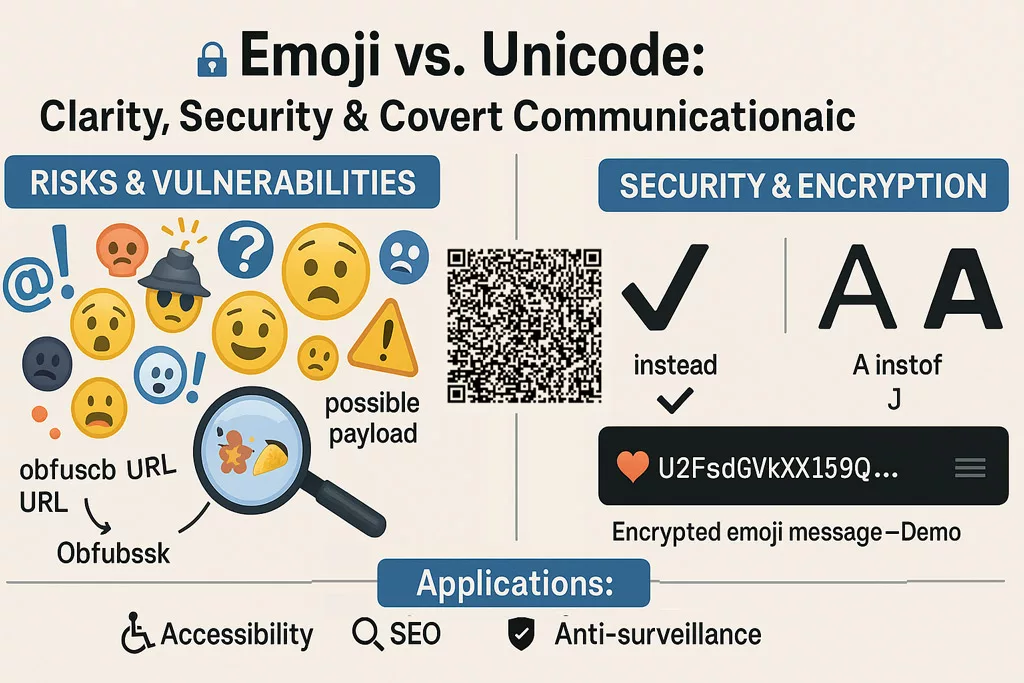
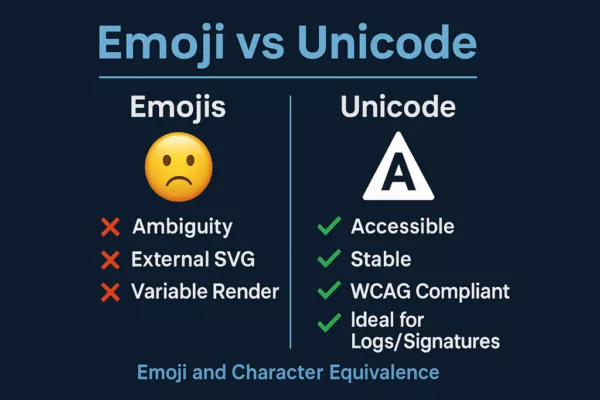
Infographic comparing emoji risks and Unicode encryption clarity with keyphrase Emoji and Character Equivalence
Emoji and Character Equivalence Guide by Freemindtronic, This post in Tech Fixes Security Solutions explores how Unicode characters replace emojis to improve accessibility, SEO, and professional formatting. It covers best practices for structured content and cross-platform consistency. Future updates will refine implementation strategies. Share your thoughts!

Unicode-Based Alternatives to Emojis for Clearer Digital Content

Emoji and character equivalence ensures universal readability, SEO optimization, and accessibility across platforms. Unicode symbols provide a structured and consistent solution for professional, legal, and technical documentation, making them an effective replacement for emojis.

✔ Discover More Digital Security Insights

▼ Explore related articles on cybersecurity threats, advanced encryption solutions, and best practices for securing sensitive data and critical systems. Gain in-depth knowledge to enhance your digital security strategy and stay ahead of evolving risks.

2026 Tech Fixes Security Solutions

Service premier plan Android : Sécurité et contrôle utilisateur

2025 Digital Security Tech Fixes Security Solutions Technical News

SSH Key PassCypher HSM PGP — Sécuriser l’accès multi-OS à un VPS

2025 Tech Fixes Security Solutions

Secure SSH key for VPS with PassCypher HSM PGP

2025 Tech Fixes Security Solutions Technical News

SSH VPS Sécurisé avec PassCypher HSM

2025 Tech Fixes Security Solutions

NFC HSM SSL Cert IP: Trigger HTTPS Certificate Issuance DNS-less

2025 Tech Fixes Security Solutions

Let’s Encrypt IP SSL: Secure HTTPS Without a Domain

2025 Tech Fixes Security Solutions

Emoji and Character Equivalence: Accessible & Universal Alternatives

Enhance Content Accessibility and SEO: The Complete Guide to Unicode Alternatives for Emojis

Emojis have become ubiquitous in our digital communication, adding a layer of emotion and personality to our texts. However, their inconsistent display across platforms and the challenges they pose in terms of accessibility and search engine optimization (SEO) underscore the necessity of exploring more reliable alternatives. This guide delves deeply into how Unicode characters offer a structured and universal solution for digital content that is clear, accessible, and optimized for SEO, including considerations for cybersecurity communication.

Infographic showing Emoji and Character Equivalence with a visual comparison of the limitations of emojis versus the cybersecurity benefits of Unicode characters. Visual breakdown of Emoji and Character Equivalence: Unicode is more secure, accessible, and reliable than emojis for cybersecurity contexts.

Why Opt for Unicode Characters Over Emojis?

The concept of emoji and character equivalence is essential for ensuring content consistency, optimizing SEO, and improving accessibility, as well as maintaining clarity in fields like cybersecurity. While emojis enhance engagement, their display varies depending on platforms, devices, and browsers, making Unicode characters a reliable and universal alternative for accessible content, better search ranking, and precise cybersecurity communication.

Advantages

  • Universal Compatibility – Unicode characters are recognized across all systems and browsers, ensuring consistent display, crucial for reliable cybersecurity information.
  • Enhanced Accessibility – Assistive technologies interpret Unicode characters more efficiently than emojis, contributing to better compliance with web accessibility guidelines (WCAG), vital for inclusive cybersecurity resources.
  • SEO Optimization – Special characters are indexed correctly by search engines, ensuring better visibility in search results, including searches related to cybersecurity symbols. Strategic use in titles and descriptions can also attract attention for improved SEO in the cybersecurity domain.
  • Professional Consistency – Utilizing Unicode formatting is more suited to legal, academic, and business communications, including cybersecurity reports and documentation, where clarity and precision are paramount. The ambiguous nature of emojis can lead to misunderstandings, especially in sensitive fields like cybersecurity.
  • Performance Considerations – Emojis can sometimes be rendered as images, especially on older systems, potentially increasing page load times compared to lightweight Unicode text characters, thus impacting site performance and potentially SEO, including for websites providing cybersecurity information.

Disadvantages

  • Reduced Visual Appeal – While emojis capture attention with their colorful graphic nature (for example, a simple 😊, their Unicode equivalent (U+263A, ☺) is a textual character. While the latter ensures compatibility, it can have a less immediate visual impact on user engagement, potentially affecting the perceived urgency of cybersecurity alerts.
  • Limited Expressiveness – Unicode characters lack the emotional depth and visual cues of emojis, which might be relevant in less formal cybersecurity community discussions.
  • Formatting Challenges – Inserting certain Unicode symbols, such as complex directional arrows (e.g., U+2913, ⤓) or specific mathematical symbols (e.g., U+222B, ∫), may require memorizing precise Unicode codes or using character maps, which can be less intuitive than selecting an emoji from a dedicated keyboard, potentially slowing down the creation of cybersecurity content.

Enhancing Content Security with Emoji and Character Equivalence

Recent research highlights critical cybersecurity risks associated with emoji usage. While emojis improve engagement, their hidden vulnerabilities can pose security threats. Understanding Emoji and Character Equivalence helps mitigate these risks while ensuring accessibility and SEO optimization.

✔ Emojis as Hidden Payloads Cybercriminals embed tracking codes or malware within emojis, particularly when encoded as SVG assets or combined with Zero Width Joiner (ZWJ) characters. This technique allows threat actors to deliver hidden payloads undetected, making Unicode characters a safer alternative.

✔ Misinterpretation Across Cultures and Legal Implications The visual representation of emojis varies by region, often leading to miscommunication or legal disputes. Unicode characters provide a standardized approach, avoiding ambiguity in contracts, digital agreements, and cross-cultural messaging.

✔ Accessibility Challenges for Screen Readers Screen readers may translate emojis inaccurately, generating verbose or misleading descriptions for visually impaired users. Relying on Unicode characters enhances clarity, ensuring consistent accessibility across assistive technologies.

✔ SEO Performance and Metadata Impact Emojis in SEO metadata may increase click-through rates, but their inconsistent rendering across platforms limits indexation reliability. Implementing Unicode characters ensures better search engine readability, reinforcing structured content strategies.

Official Sources on Emoji Vulnerabilities

By embracing Emoji and Character Equivalence, digital creators strengthen security, accessibility, and search visibility. Unicode characters offer a stable and universally recognized alternative, ensuring that content remains optimized and protected across platforms.

Technical Deep Dive on Unicode Encoding for Emojis and Symbols in Cybersecurity Contexts

Understanding How Unicode Encodes Emojis and Special Characters for Cybersecurity Unicode assigns a unique code point to each emoji, enabling its display across various operating systems. However, rendering depends on the platform, leading to variations in appearance. For example, the red heart emoji (❤️) has the Unicode code U+2764 followed by the emoji presentation sequence U+FE0F. When used in text mode (without U+FE0F), it may appear as a simple black heart (♥, U+2665) depending on the font and system. Special characters like the checkmark (✔) have a unique code (U+2714) and are rendered consistently as text, aiding in content accessibility for cybersecurity professionals

Emoji Presentation Sequences vs. Text Presentation Sequences in Unicode for Cybersecurity Communication Some Unicode characters exist both as text and emoji versions. Presentation sequences determine whether a character displays as a graphic emoji or as standard text. For example, the Unicode character for a square (□, U+25A1) can be displayed as a simple text square. By adding the emoji presentation sequence (U+FE0F), it may be rendered as a colored square on some platforms if an emoji style for that character exists. This distinction is crucial for both visual presentation and SEO considerations, especially for cybersecurity platforms.

It’s also important to note that some Unicode symbols are “combining characters.” These are designed to be overlaid onto other characters to create new glyphs. For instance, adding an accent to a letter involves using a combining accent character after the base letter, which might have niche applications in specific cybersecurity notations.

Industry-Specific Applications of Unicode Characters for Professional Content, Including Cybersecurity

Using Unicode in Legal and Academic Documents Unicode characters are preferred over emojis in contracts, academic papers, and official reports, where consistency and professionalism are essential for clear communication. The ambiguous nature of emojis can lead to misinterpretations in legally binding documents, making standardized characters a safer choice, which also applies to the formal documentation within the cybersecurity industry.

Leveraging Unicode in Cybersecurity and Technical Documentation Security experts and programmers use Unicode symbols in programming languages, encryption protocols, and cybersecurity reports for precision and clarity in technical content. For example, in code, Unicode symbols like logical operators (e.g., ∀ for “for all,” ∃ for “there exists”) or arrows (→, ←) are used for precise notation. In cybersecurity reports, specific alert symbols (⚠, ☢, ☣) can be used in a standardized way to convey specific threat levels or types, enhancing information accessibility for cybersecurity professionals..

Corporate Branding with Unicode for Consistent Visual Identity, Including Cybersecurity Firms Many companies integrate Unicode characters into branding materials to ensure consistent representation across marketing assets. Some companies subtly incorporate Unicode characters into their text-based logos or communication to create a unique and consistent visual identity across platforms where typography is limited, contributing to brand recognition in search results, including for cybersecurity companies. For example, a tech brand might use a stylized arrow character or a mathematical symbol to evoke innovation and security.

Practical Cybersecurity Use Cases: The Value of Emoji and Character Equivalence

For cybersecurity professionals, adopting Emoji and Character Equivalence goes far beyond visual consistency — it strengthens secure communication, ensures compatibility across platforms, and reduces attack surfaces. Below are key scenarios where this principle makes a strategic difference.

✔ Use Case 1: Security Alert Bulletins

A CISO distributes a critical vulnerability bulletin using the emoji ⚠️. On some outdated terminals or filtered environments, the emoji fails to render or displays incorrectly.
✅ Unicode Advantage: Using U+26A0 (⚠) ensures universal readability, including by screen readers and legacy systems, supporting clear and actionable cybersecurity communication.

✔ Use Case 2: Secure Internal Messaging

In secure mail systems, emojis may be blocked or replaced to prevent the loading of external SVG assets, which can introduce vulnerabilities.
✅ Unicode Advantage: With Emoji and Character Equivalence, using Unicode characters instead of emojis eliminates these external dependencies while preserving the intended meaning and visual cue.

✔ Use Case 3: Signed System Logs and Forensics

Emojis rendered as images or platform-dependent glyphs can cause inconsistencies in cryptographic hash comparisons during log audits or forensic analysis.
✅ Unicode Advantage: Unicode characters have a stable code point (e.g., U+2714 for ✔), ensuring that logs remain verifiable across environments, crucial for integrity and non-repudiation in cybersecurity workflows.

These examples demonstrate how implementing Emoji and Character Equivalence is not only a matter of formatting — it’s a tactical choice to improve clarity, compliance, and reliability in cybersecurity communication.

Unicode in SIEM Alerts and Security Logs: A Critical Integration Point

Security Information and Event Management (SIEM) systems rely on structured, machine-readable alerts. Emojis—often rendered as platform-dependent graphics or multibyte sequences—can disrupt formatting, corrupt parsing logic, and complicate forensic investigations.

✅ Unicode characters such as U+26A0 (Warning: ⚠), U+2714 (Check mark: ✔), and U+2717 (Cross mark: ✗) provide:

  • Stable rendering across terminals, dashboards, and log collectors.
  • Consistent cryptographic hashing in signed event logs.
  • Reliable pattern matching in SIEM rules and regular expressions.
  • Screen reader compatibility for accessible security dashboards.

Example:
Instead of inserting a graphical emoji into a high-severity alert, use U+2717 (✗) for guaranteed interpretability across systems and tools.

This Unicode-based strategy ensures compatibility with:

  • Automated threat detection pipelines
  • Regulatory compliance tools
  • SIEM log normalization engines
  • Long-term forensic retention archives

Unicode brings predictability, clarity, and durability to cybersecurity event management—core to any zero-trust and audit-ready architecture.

Case Study: Emoji-Based Vulnerabilities and Cybersecurity Incidents

While emojis may appear innocuous, documented cyberattacks have demonstrated that they can be exploited due to their complex rendering behavior, reliance on external assets (like SVG), and ambiguous encoding. These cases reinforce the importance of adopting Emoji and Character Equivalence practices, especially in cybersecurity contexts where clarity, stability, and accessibility are critical.

Unicode Rendering Crash (Unicode “Bombs”)

➔ In 2018, a sequence of Unicode characters — including a Telugu glyph and modifiers — caused iPhones to crash and apps like iMessage to freeze. This vulnerability stemmed from how Apple’s rendering engine mishandled complex Unicode sequences.
✔ Sources officielles :
• MacRumors – iOS Unicode Crash Bug: https://www.macrumors.com/2018/02/15/ios-11-unicode-crash-bug-indian-character/
• BBC News – iPhone crash bug caused by Indian character: https://www.bbc.com/news/technology-43070755

Malicious SVG Rendering in Messaging Platforms

➔ Some messaging platforms like Discord rendered emojis through external SVG files, introducing a surface for remote code injection or tracking. Attackers exploited this to embed malicious content through emoji payloads.
✔ Source officielle :
• Dark Reading – Emojis Control Malware in Discord Spy Campaign: https://www.darkreading.com/remote-workforce/emojis-control-malware-discord-spy-campaign

Unicode Spoofing and Invisible Character Obfuscation

➔ Emojis combined with zero-width characters such as U+200B (Zero Width Space) or U+200D (Zero Width Joiner) have been used in phishing URLs and obfuscated code. These tactics enable homograph attacks that mislead readers or bypass detection.
✔ Documentation technique :
• Unicode Consortium – UTS #39: Unicode Security Mechanisms: https://unicode.org/reports/tr39/

✔ Strategic Takeaway
✘ Emojis rely on platform-dependent rendering and can introduce inconsistency or vulnerabilities.
✔ Unicode characters use immutable code points and render reliably across systems — making them ideal for cybersecurity logs, alerts, and accessible content.
The adoption of Emoji and Character Equivalence ensures professional-grade security, readability, and integrity.

⚠ Emoji Shellcoding and Obfuscated Command Execution

Recent threat research and demonstrations (e.g., DEFCON30, August 2022) have shown how non-ASCII characters, including Unicode symbols, can be used to obfuscate shell commands, bypassing traditional keyword-based detections. Attackers leverage Unicode manipulation to evade security filters, making detection more challenging.

🔗 Further Reading: Command-Line Obfuscation Techniques

⚠ Real-World Example

shell
reg export HKLMSAM save.reg

When disguised using invisible Unicode characters (such as U+200D, U+200B), this command may appear harmless but still executes a privileged registry dump, bypassing conventional security checks.

🛠 Recommended Security Measures

✔ Regex-Based Detection – Go beyond keyword matching to identify command patterns, even if partially encoded or visually disguised.

✔ Alerting on Anomalous Characters – Security systems (SIEM, EDR, XDR) should flag commands containing:

  • Unicode Special Characters (U+2714, U+20AC, etc.)
  • Non-Printable Characters (U+200D, U+200B)
  • Zero Width Joiners or Spaces (U+200D, U+200B)

✅ Unicode Benefit

By restricting input/output to ASCII or validated Unicode, organizations can: ✔ Minimize obfuscation risks ✔ Strengthen parsing and logging integrity ✔ Improve detection accuracy across terminal, script, and web layers

By implementing advanced detection techniques, organizations can mitigate risks associated with Unicode-based obfuscation and strengthen cybersecurity defenses.

Future Trends in Unicode and Emoji Standardization

Updates from the Unicode Consortium on Emoji and Character Sets for Technical Fields Like Cybersecurity The Unicode Consortium regularly evaluates emoji proposals and updates the Unicode standard. Decisions are based on cultural relevance, accessibility needs, and demand from users, including potential requests for standardized symbols relevant to cybersecurity. Staying informed about Unicode updates is key for future content optimization, especially for technical documentation and cybersecurity communication.

Challenges in the Standardization of Emojis and Unicode for Precise Technical Communication The standardization process faces obstacles due to regional interpretations of emojis, varying display standards, and accessibility concerns for visually impaired users. The interpretation of emojis can vary significantly depending on context and cultural differences. Artificial intelligence may play an increasing role in understanding the meaning of emojis in different contexts, but standardization for universal interpretation remains a complex challenge, highlighting the ongoing importance of clear Unicode alternatives, particularly in technical fields like cybersecurity where precision is critical.

Practical Implementation Guide: Replacing Emojis with Unicode for Better SEO, Accessibility, and Cybersecurity Communication

How to Implement Unicode in Web Content for SEO, Accessibility, and Cybersecurity Clarity

  • WordPress: Use Unicode characters directly in text fields for SEO-friendly content, including cybersecurity blogs and articles.
  • HTML: Insert Unicode using &#code; notation (e.g., ✔ for ✔, ⚠ for ⚠) to ensure accessible HTML, especially for cybersecurity warnings and alerts.
  • Markdown: Use plain text Unicode values for seamless integration in SEO-optimized Markdown, including cybersecurity documentation.
  • CSS: Apply Unicode as content properties in stylesheets for consistent rendering and potential SEO benefits, including unique styling of cybersecurity-related symbols.
  • Other CMS: For platforms like Drupal or Joomla, Unicode character insertion is usually done via the WYSIWYG text editor (using the special character insertion feature) or directly in the HTML code for accessible content management, including cybersecurity resources.
  • Mobile Applications: Mobile app development for iOS and Android allows direct integration of Unicode characters into text strings, ensuring accessibility on mobile, including cybersecurity applications and notifications. Mobile operating system keyboards also often provide access to special characters via contextual menus or dedicated symbol keyboards.

Keyboard Shortcuts for Typing Unicode Symbols Easily, Including Cybersecurity Symbols

  • Windows: Use Alt + Unicode code (e.g., Alt + 2714 for ✔, Alt + 26A0 for ⚠) for quick Unicode input, including symbols used in cybersecurity.
  • Mac: Press Cmd + Control + Spacebar to access Unicode symbols conveniently, useful for inserting cybersecurity-related characters.
  • Linux: Type Ctrl + Shift + U + Unicode code for Unicode character entry, including specific cybersecurity symbols.

Psychological and Linguistic Impact of Emoji vs. Unicode Characters on Communication

Analyzing How Emojis Affect Digital Communication, Including the Ambiguity in Cybersecurity Contexts Emojis are widely used to express emotions, tone, and intent, but their interpretation differs culturally, leading to ambiguity in professional exchanges, which can be particularly problematic in cybersecurity alerts or warnings where clear and unambiguous communication is vital. A simple thumbs-up (👍) could be misinterpreted in a critical cybersecurity discussion.

The Role of Unicode Characters in Enhancing Readability and Clarity, Especially in Technical and Cybersecurity Content Symbols such as ✔, ✉, ⚡, ⚠, 🔒 provide structured communication that is easier to process and interpret objectively in technical content, improving content accessibility, especially in the cybersecurity domain. The use of standardized Unicode symbols in technical or legal documents (like checkmarks to validate points, arrows to indicate steps, or precise currency symbols) reinforces the perception of rigor, clarity, and professionalism of the content, which is paramount in cybersecurity reports and documentation, and can indirectly benefit user trust and SEO for cybersecurity resources.

Unicode vs. Emoji in Prompt Injection Attacks on AI Systems

Recent studies have revealed that emojis—beyond visual ambiguity—can act as covert payloads in AI prompt injection attacks. While most text is tokenized into multiple units by large language models (LLMs), emojis are often treated as single-token sequences. This allows attackers to hide complex instructions inside what appears to be a harmless character.

⚠ Real-World Finding:

Some emojis can expand into over 20 hidden tokens, bypassing security filters designed to detect explicit instructions.

This stealth mechanism stems from:

  • LLMs treating emojis as atomic units,
  • Emojis encoding metadata or invisible sequences (e.g., Zero Width Joiners),
  • Models inherently trying to interpret non-standard patterns to “solve” them.

🔐 Security Implication:

These injection techniques exploit the architecture of transformer-based models, where unexpected inputs are treated as puzzles to decode. This behavior turns visual glyphs into logic bombs capable of triggering unintended actions.

✅ Unicode Advantage in AI Contexts:

Unicode characters:

  • Have transparent tokenization (predictable encoding),
  • Avoid compound emoji sequences and visual ambiguity,
  • Don’t carry extra layers of metadata or emoji-style modifiers (e.g., U+FE0F).

Using Unicode-only inputs in AI workflows enhances:

  • Prompt sanitization,
  • Filter robustness,
  • Audit trail clarity.

Example:

Using U+2714 (✔) instead of ensures that the LLM interprets it as a basic semantic unit, not a potential instruction carrier.

By preferring Unicode over emojis in LLM prompts and logs, developers reduce the surface for prompt injection and enhance traceability in AI-assisted workflows. This is particularly vital in secure automation pipelines, compliance monitoring, and zero-trust content generation environments.

⚠ Emojis in Cybercrime and OSINT: A Silent Language of the Dark Web

While emojis are often seen as harmless digital expressions, they are increasingly exploited by cybercriminals as a covert communication method on the dark web. Their ambiguity, cross-platform rendering inconsistencies, and social familiarity make them ideal for masking illicit content.

Use in Illicit Marketplaces: Emojis are used to denote illegal goods and services in Telegram groups, forums, and marketplaces. For example, 💉 might refer to drugs, while 🔫 can imply weapons.

Bypassing Detection: Because most cybersecurity tools and SIEMs focus on keyword detection, emoji-based language can evade filters. Attackers use them as part of “visual slang” that security systems don’t flag.

The Rise of Emoji Forensics: Cyber investigators and OSINT professionals are mapping known emoji patterns used by criminal groups. Some tools are being trained to detect, interpret, and alert on specific emoji combinations.

Generational Risk: Younger users (Gen Z), who communicate heavily via emojis, are at greater risk of exposure or manipulation in these covert communication schemes.

Unicode Advantage: Unicode characters provide clear, unambiguous alternatives to emojis for secure communications. They allow enforcement and detection systems to parse logs, messages, and forensic data with higher accuracy.

🔗 Unlocking Digital Clues: Using Emojis in OSINT Investigations – Da Vinci Forensics This article explores how emojis serve as digital fingerprints in OSINT investigations, helping analysts track illicit activities, identify behavioral patterns, and uncover hidden communications.

This growing misuse of emojis signals a need for more refined detection systems and public awareness around their evolving role in digital crime.

Advanced Emoji Exploits: Steganography, Obfuscation, and Counterintelligence Uses

Beyond spoofing and prompt injection, emojis are being employed in advanced cyber tactics such as steganographic payloads, command injection evasion, and even counterespionage decoys.

EmojiCrypt – Obfuscating Prompts for Privacy: Researchers have introduced “EmojiCrypt,” a technique that encodes user prompts in emojis to preserve privacy during LLM interaction. The visual string appears nonsensical to humans, while remaining interpretable by the AI, enabling obfuscated instruction handling without leaking intent.

Emoti-Attack – Subverting NLP with Emoji Sequences: Emoti-Attack is a form of adversarial input that disrupts NLP interpretation by inserting harmless-looking emoji patterns. These can influence or derail the LLM’s understanding without detection.

Counterintelligence and Deception: Unicode characters offer a countermeasure. Security researchers have demonstrated the use of Unicode formatting as a defensive tool: creating decoy messages embedded with Unicode traps that reveal or mislead adversarial AI crawlers or language models scanning open-source intelligence (OSINT) feeds.

Forensic Importance: Understanding emoji misuse can assist forensic investigators in analyzing chat logs, malware payloads, and behavioral indicators, particularly in APT campaigns or disinformation efforts.

Unicode’s transparency, immutability, and predictability make it a valuable component of digital countermeasures in cybersecurity and OSINT.

Dual-Use Encryption via Emoji Embedding

Dual-Use Communication: Encrypted Emoji Payloads in Secure Civil and Military Applications

While most discussions emphasize the risks posed by emojis in digital communication, Freemindtronic has also demonstrated that these same limitations can be harnessed constructively. Leveraging their expertise in air-gapped encryption and segmented key systems, Freemindtronic uses emoji-embedded messages as covert carriers for encrypted content in secure, offline communication workflows.

✔ Operational Principle

Emoji glyphs can embed encrypted payloads using layered Unicode sequences and optional modifiers (e.g., U+FE0F). The visual result appears trivial or humorous, but can encode AES-encrypted messages that are only interpretable by a paired Freemindtronic decryption system.

✔ Use Cases in Civilian and Defense Fields

  • Civil: Secure broadcast of contextual alerts (e.g., logistics, health) across untrusted channels using visually benign symbols.
  • Military: Covert transmission of encrypted instructions via messaging systems or printed media, decodable only by pre-authorized HSM-equipped terminals.

✔ Advantages Over Traditional Payload Carriers

  • Emojis are widespread and rarely filtered.
  • Appear non-threatening in hostile digital environments.
  • Compatible with zero-trust architectures using offline HSMs.
  • Seamless integration into printed formats, signage, or NFC-triggered displays.

✔ Security Implication

This dual-use capability turns emojis into functional steganographic containers for encrypted instructions, authentication tokens, or contextual messages. By pairing emoji-based visuals with secure decryption modules, Freemindtronic establishes a trusted communication channel over inherently insecure or surveilled platforms.

Strategic Takeaway:
What is often seen as a vector of attack (emoji-based obfuscation) becomes—under controlled, secure systems—an innovative tool for safe, deniable, and ultra-lightweight communication across civilian and military domains.

Secure Emoji Encryption Demo – Covert Messaging with AES-256


Unicode and Internationalization for Global Content Reach

Unicode’s strength lies in its ability to represent characters from almost all writing systems in the world. This makes it inherently suitable for multilingual content, ensuring that special characters and symbols are displayed correctly regardless of the language, which is crucial for global SEO and disseminating cybersecurity information internationally. While emojis can sometimes transcend language barriers, their visual interpretation can still be culturally influenced, making Unicode a more stable choice for consistent international communication of symbols and special characters, improving accessibility for a global audience accessing cybersecurity content.

How to Apply Emoji and Character Equivalence Today for Content Optimization

your content – Identify areas where Unicode replacements improve accessibility and compatibility, contributing to WCAG compliance and better SEO, as well as enhancing the clarity and professionalism of cybersecurity communications.

✦ Use structured formatting – Incorporate Unicode symbols while maintaining clarity in digital communication for improved readability and SEO, especially in technical fields like cybersecurity.

➔ Test across platforms – Verify how Unicode alternatives appear on various browsers and devices and ensure font compatibility for optimal accessibility and user experience, particularly for users accessing cybersecurity information on different systems.

✉ Educate your audience – Inform users why Unicode-based formatting enhances readability and usability, indirectly supporting SEO efforts by improving user engagement with even complex topics like cybersecurity.

By integrating emoji and character equivalence, content creators can future-proof their digital presence, ensuring clarity, accessibility, and universal compatibility across platforms, ultimately boosting SEO performance and user satisfaction, and fostering trust in the accuracy and professionalism of cybersecurity content.

⚡ Ready to optimize your content?

Start incorporating Unicode symbols today to enhance content structure and readability while optimizing accessibility! This is particularly important for ensuring clear and unambiguous communication in critical fields like cybersecurity. We encourage you to share your experiences and further suggestions in the comments below.

Best Unicode Equivalents for Emojis

Using Emoji and Character Equivalence enhances consistency, accessibility, and professional formatting. The table below categorizes key Unicode replacements for emojis, ensuring better SEO, readability, and universal compatibility.

Validation & Security

Emoji Special Character Unicode Description
U+2714 Validation checkmark
U+2611 Checked box
U+2713 Simple validation tick
🗸 🗸 U+1F5F8 Alternative tick symbol
🔒 U+26E8 Protection symbol
⚠️ U+26A0 Warning or alert
U+2622 Radiation hazard
U+2623 Biohazard
U+2717 Cross mark for rejection
U+2718 Alternative cross for errors
 

🧾 Documents & Markers

Emoji Special Character Unicode Description
📌 U+2726 Decorative star or marker
📖 📚 U+1F4DA Books (Reading)
📖 U+256C Document symbol
📥 U+2B07 Download arrow
📤 U+2B06 Upload arrow
📦 🗄 U+1F5C4 Storage box
📩 U+2709 Email or message icon
📍 U+2756 Location marker
 

🧭 Arrows & Directions

Emoji Special Character Unicode Description
U+2192 Right arrow
U+2190 Left arrow
U+2191 Up arrow
U+2193 Down arrow
U+2194 Horizontal double arrow
U+2195 Vertical double arrow
U+2196 Top-left diagonal arrow
U+2197 Top-right diagonal arrow
U+2198 Bottom-right diagonal arrow
U+2199 Bottom-left diagonal arrow
U+21A9 Return arrow
U+21AA Redirection arrow
U+21C4 Change arrow
U+21C6 Exchange arrow
U+27A1 Thick arrow right
U+21E6 Thick arrow left
U+21E7 Thick arrow up
U+21E9 Thick arrow down
U+21BB Clockwise circular arrow
U+21BA Counterclockwise circular arrow
U+2934 Curved arrow up
U+2935 Curved arrow down
U+2B95 Long arrow right
U+2B05 Long arrow left
U+2B06 Long arrow up
U+2B07 Long arrow down
U+21B1 Right-angled upward arrow
U+21B0 Left-angled upward arrow
U+21B3 Right-angled downward arrow
U+21B2 Left-angled downward arrow
 

🌍 Transport & Travel

Emoji Special Character Unicode Description
🚀 U+25B2 Up-pointing triangle (Launch)
U+2708 Airplane (Travel & speed)
🚗 🚗 U+1F697 Car
🚕 🚕 U+1F695 Taxi
🚙 🚙 U+1F699 SUV
🛴 🛴 U+1F6F4 Scooter
🚲 🚲 U+1F6B2 Bicycle
🛵 🛵 U+1F6F5 Motorbike
🚄 🚄 U+1F684 Fast train
🚆 🚆 U+1F686 Train
🛳 🛳 U+1F6F3 Cruise ship
 

Energy & Technology

Emoji Special Character Unicode Description
U+26A1 Lightning (Energy, speed)
📡 📡 U+1F4E1 Satellite antenna
📶 📶 U+1F4F6 Signal strength
🔊 🔊 U+1F50A High-volume speaker
🔉 🔉 U+1F509 Medium-volume speaker
🔈 🔈 U+1F508 Low-volume speaker
🔇 🔇 U+1F507 Muted speaker
🎙 🎙 U+1F399 Microphone
🎚 🎚 U+1F39A Volume slider
 

💰 Currency & Finance

Emoji Special Character Unicode Description
U+20AC Euro
$ $ U+0024 Dollar
£ £ U+00A3 Pound sterling
¥ ¥ U+00A5 Yen
U+20BF Bitcoin
💰 💰 U+1F4B0 Money bag
💳 💳 U+1F4B3 Credit card
💲 💲 U+1F4B2 Dollar sign
💱 💱 U+1F4B1 Currency exchange
 

Additional Differentiation Points to Make Your Article Stand Out

To make this article unique, I have included:

Practical Implementation Guide

  • How to replace emojis with Unicode characters in WordPress, HTML, Markdown, and CSS.
  • Keyboard shortcuts and Unicode input methods for Windows, Mac, and Linux.

SEO and Accessibility Benefits

  • Unicode characters improve accessibility for screen readers, making content more inclusive.
  • How Unicode enhances SEO indexing compared to emoji-based content.

✅ Historical and Technical Context

  • The evolution of Unicode and emoji encoding standards.
  • The role of different operating systems in emoji representation.

✅ Comparison with Other Symbol Systems

  • Differences between ASCII, Unicode, and emoji encoding.
  • Comparing Unicode versus icon-based alternatives for visual communication.

✅ Industry-Specific Use Cases

  • Using Unicode characters in legal, academic, and technical documentation.
  • Best practices for corporate and professional communications without emojis.

Why Replace Emojis with Unicode Characters?

Emoji and character equivalence is crucial for maintaining consistent content formatting across devices. While emojis improve engagement, they do not always display correctly across all systems, making Unicode characters a more reliable choice.

Advantages

  • Universal Compatibility – Unicode characters render consistently across different browsers and platforms.
  • Improved Accessibility – Assistive technologies and screen readers interpret special characters more effectively, aiding in WCAG compliance.
  • SEO Optimization – Unicode symbols are indexed correctly by search engines, avoiding potential misinterpretations and enhancing visibility.
  • Consistent Formatting – Ensures that content remains legible in professional and academic contexts.
  • Performance Benefits – Unicode text characters are generally lighter than emoji image files, potentially improving page load times.

Disadvantages

  • Reduced Visual Appeal – Emojis are more visually striking than characters.
  • Less Expressive – Special characters lack emotional depth compared to emojis.
  • Typing Challenges – Some symbols require specific Unicode inputs or copy-pasting.
How to Apply Emoji and Character Equivalence Today

Adopting Unicode characters instead of emojis ensures accessibility, professional consistency, and SEO-friendly content. To implement this approach effectively:

Audit your existing content — Identify where emoji replacements may improve accessibility and compatibility, contributing to WCAG compliance. ✦ Use structured formatting — Incorporate Unicode symbols while maintaining clarity in digital communication. ➔ Test across platforms — Verify how Unicode alternatives appear on various browsers and devices and ensure font compatibility. ✉ Educate your audience — Inform users why Unicode-based formatting enhances readability and usability.

By integrating emoji and character equivalence, content creators can future-proof their digital presence, ensuring clarity, accessibility, and universal compatibility across platforms.

Ready to optimize your content? Start incorporating Unicode symbols today to enhance content structure and readability while optimizing accessibility! We encourage you to share your experiences and further suggestions in the comments below.

Official Sources for Further Reading on Unicode and Accessibility

{
“@context”: “https://schema.org”,
“@type”: “Article”,
“mainEntityOfPage”: {
“@type”: “WebPage”,
“@id”: “https://freemindtronic.com/fr/actualites-techniques/guide-equivalence-emoji-caracteres/”
},
“headline”: “Démonstration Interactive : Alternatives Unicode aux Emojis pour un Contenu Digital Plus Clair et Sécurisé”,
“description”: “Explorez en temps réel l’équivalence entre les emojis et les caractères Unicode grâce à notre démonstration interactive. Découvrez comment les caractères Unicode améliorent l’accessibilité, le SEO, le formatage professionnel, la cybersécurité et la lutte contre le cybercrime. Un guide complet incluant des cas d’usage, des tactiques d’attaque, et des stratégies de contre-espionnage à base d’Unicode.”,
“image”: {
“@type”: “ImageObject”,
“url”: “https://freemindtronic.com/wp-content/uploads/2025/05/unicode-emoji-equivalence-guide.jpg”,
“width”: 1200,
“height”: 630
},
“datePublished”: “2025-05-02T15:00:00+02:00”,
“dateModified”: “2025-05-05T16:45:00+02:00”,
“author”: {
“@type”: “Person”,
“name”: “Jacques Gascuel”,
“url”: “https://freemindtronic.com/fr/auteur/jacques-gascuel/”
},
“publisher”: {
“@type”: “Organization”,
“name”: “Freemindtronic Andorra”,
“url”: “https://freemindtronic.com/fr/”,
“logo”: {
“@type”: “ImageObject”,
“url”: “https://freemindtronic.com/wp-content/uploads/2023/06/logo-freemindtronic.png”
}
},
“keywords”: [
“démonstration interactive”,
“équivalence emoji”,
“Unicode”,
“accessibilité numérique”,
“SEO technique”,
“cybersécurité”,
“emoji hacking”,
“Unicode spoofing”,
“prompt injection”,
“emoji obfuscation”,
“stéganographie emoji”,
“contre-espionnage numérique”,
“emoji OSINT”,
“emoji en cybercriminalité”,
“Unicode en SIEM”,
“emoji forensics”,
“communication sécurisée Unicode”
],
“about”: {
“@type”: “Thing”,
“name”: “Démonstration interactive de l’équivalence Emoji-Unicode”
},
“hasPart”: {
“@type”: “SoftwareApplication”,
“name”: “Démonstrateur interactif d’encodage/décodage Emoji-Unicode”,
“featureList”: [
“Sélection d’un Emoji”,
“Cryptage du message avec l’Emoji sélectionné”,
“Affichage du résultat crypté (Emoji + Unicode)”,
“Possibilité de télécharger l’Unicode crypté dans un fichier .txt”,
“Déposer un fichier .txt Unicode crypté pour décrypter le message”
],
“operatingSystem”: “Web”,
“applicationCategory”: “Tool”,
“url”: “https://freemindtronic.com/fr/actualites-techniques/guide-equivalence-emoji-caracteres/#demo-section”
},
“articleSection”: [
“Démonstration Interactive : Encodez et Décodez avec des Emojis et Unicode”,
“Unicode-Based Alternatives to Emojis for Clearer Digital Content”,
“Enhance Content Accessibility and SEO”,
“Why Opt for Unicode Characters Over Emojis?”,
“Advantages and Disadvantages”,
“Technical Deep Dive on Unicode Encoding”,
“Industry Applications: Legal, Academic, Cybersecurity”,
“Practical Cybersecurity Use Cases”,
“Unicode in SIEM Alerts and Security Logs”,
“Case Study: Emoji-Based Vulnerabilities”,
“Future Trends in Unicode and Emoji Standardization”,
“Practical Guide: Unicode Implementation”,
“Psychological and Linguistic Impact”,
“Unicode vs. Emoji in Prompt Injection Attacks on AI Systems”,
“Emojis in Cybercrime and OSINT”,
“Advanced Emoji Exploits: Steganography, Obfuscation, Counterintelligence Uses”,
“Unicode and Internationalization for Global SEO”,
“How to Apply Emoji and Character Equivalence Today”
],
“mentions”: [
{
“@type”: “Organization”,
“name”: “Unicode Consortium”,
“url”: “https://home.unicode.org/”
},
{
“@type”: “Organization”,
“name”: “W3C”,
“url”: “https://www.w3.org/”
},
{
“@type”: “Organization”,
“name”: “BBC News”,
“url”: “https://www.bbc.com/news/technology-43070755”
},
{
“@type”: “Organization”,
“name”: “MacRumors”,
“url”: “https://www.macrumors.com/2018/02/15/ios-11-unicode-crash-bug-indian-character/”
},
{
“@type”: “Organization”,
“name”: “Dark Reading”,
“url”: “https://www.darkreading.com/remote-workforce/emojis-control-malware-discord-spy-campaign”
},
{
“@type”: “Organization”,
“name”: “Da Vinci Forensics”,
“url”: “https://www.davinciforensics.co.za/”
}
] }

New Microsoft Uninstallable Recall: Enhanced Security at Its Core

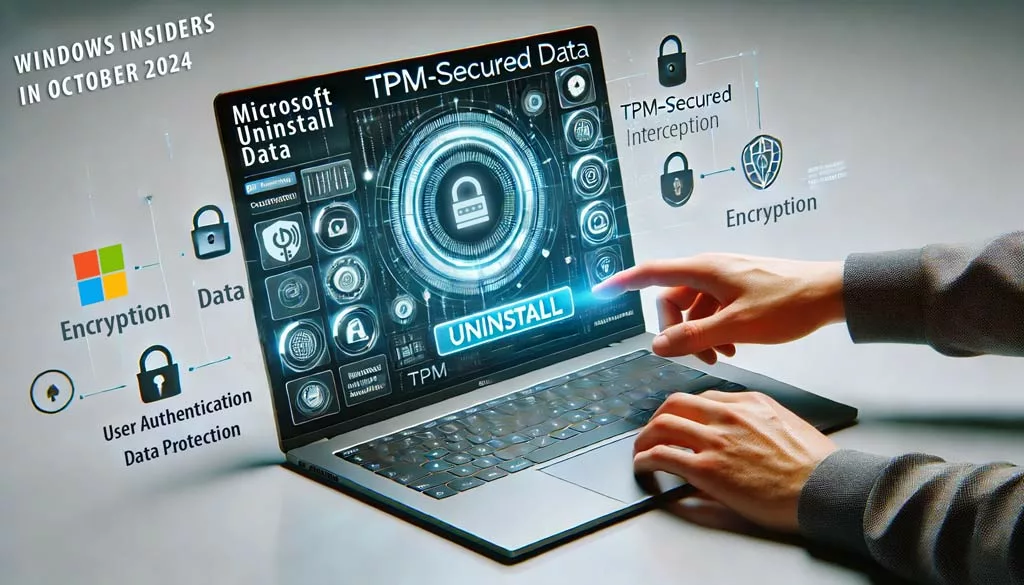
laptop displaying Microsoft Uninstallable Recall feature, highlighting TPM-secured data and uninstall option, with a user's hand interacting, on a white background.

Unveil Microsoft’s Enhanced Uninstallable Recall for Total Data Security

Microsoft Uninstallable Recall: Learn how Microsoft has significantly upgraded the security of its Recall activity journal, now featuring an easy-to-use uninstall option and protection through a secure enclave with stronger authentication. Read the full article to explore these advanced security features and improvements.

2025 Digital Security Technical News

Sovereign SSH Authentication with PassCypher HSM PGP — Zero Key in Clear

2025 Digital Security Tech Fixes Security Solutions Technical News

SSH Key PassCypher HSM PGP — Sécuriser l’accès multi-OS à un VPS

2025 Digital Security Technical News

Générateur de mots de passe souverain – PassCypher Secure Passgen WP

2025 Digital Security Technical News

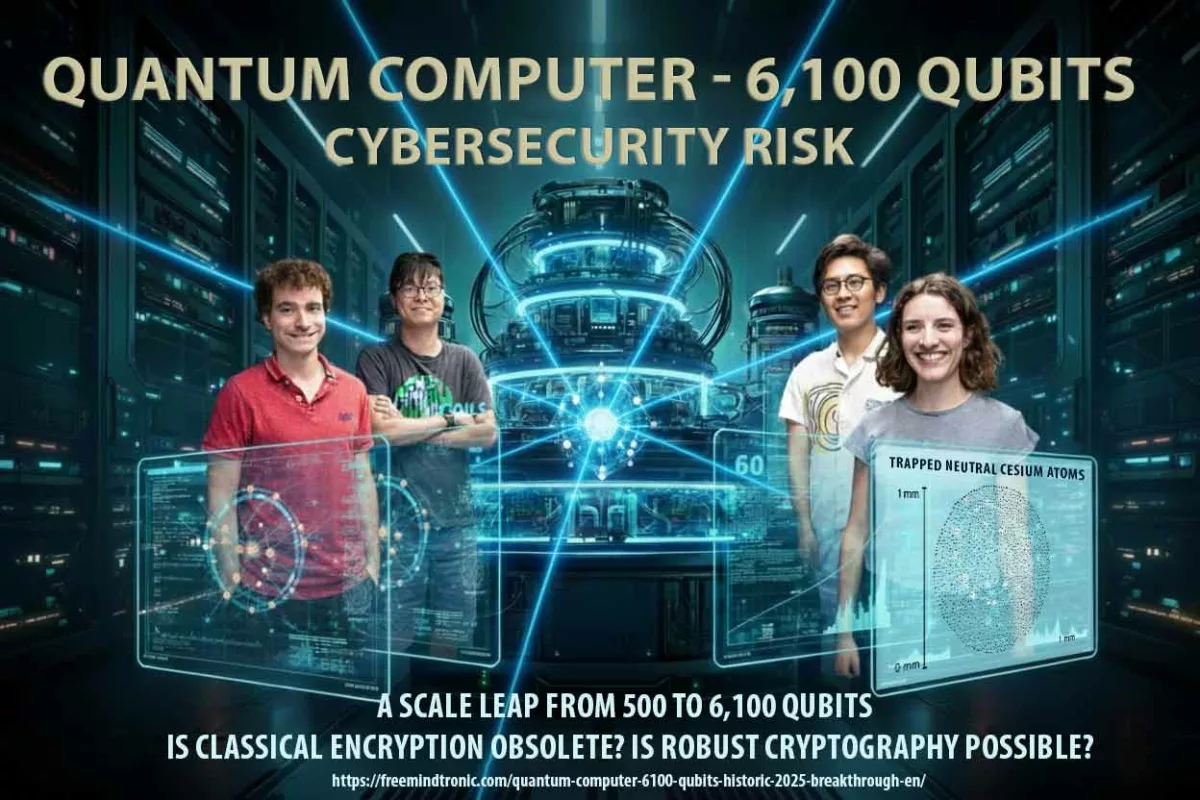
Quantum computer 6100 qubits ⮞ Historic 2025 breakthrough
2025 Digital Security Technical News

Ordinateur quantique 6100 qubits ⮞ La percée historique 2025

2025 Tech Fixes Security Solutions Technical News

SSH VPS Sécurisé avec PassCypher HSM

2025 PassCypher Password Products Technical News

Passwordless Password Manager: Secure, One-Click Simplicity to Redefine Access

Stay informed with our posts dedicated to Technical News to track its evolution through our regularly updated topics.

Microsoft’s Uninstallable Recall, written by Jacques Gascuel, CEO of Freemindtronic, fixes earlier security issues by processing data in a TPM-secured enclave and giving users complete control over data. You can uninstall Recall easily, wiping all data for enhanced privacy. Stay informed on these security updates and more in our tech solutions.

Microsoft’s Revamped Recall System

Microsoft recently overhauled its Recall feature, which had faced criticism for security and privacy issues. The new version delivers enhanced protection and better control over personal data, responding directly to concerns raised by users and privacy experts.

Key Features of Microsoft’s New Uninstallable Recall

Recall is an activity journal that allows users to retrieve information based on past actions, utilizing AI-analyzed screenshots. In its first iteration, the tool faced backlash because data was stored insecurely, making it easily accessible to others sharing the same device.

Microsoft responded by overhauling the architecture of Recall. Now, all data processing occurs within a Trusted Platform Module (TPM)-protected secure enclave. Access to information requires Windows Hello authentication or a PIN, ensuring that only authorized users can unlock the encrypted data.

Enhanced Data Protection with Microsoft’s Uninstallable Recall

Microsoft significantly improved the security architecture of Recall. All data is now encrypted and stored within the TPM chip, and multi-factor authentication further protects user information. Recent updates to Recall ensure that sensitive information is automatically filtered out, including passwords, personal identification numbers, and credit card details.

These changes align with the security mechanisms found in BitLocker, which also uses TPM to safeguard encryption keys. Freemindtronic has noted the similarities between Recall and BitLocker’s multi-layer encryption and user-focused security enhancements.

How to Enable and Remove Microsoft’s New Recall

With the updated Uninstallable Recall, Microsoft gives users full control over the feature. Recall is opt-in—it remains off unless activated by the user, and it can be uninstalled easily at any time. Microsoft has confirmed that when Recall is uninstalled, all related data is permanently deleted, further addressing privacy concerns.

Additional Security Measures

Microsoft also introduced several improvements to Recall, including:

  • Private browsing compatibility: Users can now prevent Recall from saving sessions during private browsing.
  • Sensitive content filtering: By default, Recall filters out sensitive data such as passwords and personal details.
  • Custom permissions: Users can choose what data Recall tracks and restrict it to specific apps or activities.

These updates reflect Microsoft’s commitment to providing robust data protection, and as seen in similar tools like BitLocker, Microsoft emphasizes TPM-based encryption to secure user data​. Freemindtronic highlighted that BitLocker uses multi-layer encryption and TPM to secure sensitive information from unauthorized access​.

Business and Consumer Advantages of Microsoft’s Enhanced Recall

These enhancements have significant implications for both businesses and individual users. Companies can benefit from the enhanced data protection, especially when managing sensitive information across multiple devices. Users working in shared environments can rest assured knowing their personal data is encrypted and secured, even if the device is shared.

Moreover, this follows a pattern of Microsoft’s continuous security efforts, as seen in the resolution of BitLocker access issues caused by a faulty Crowdstrike update. The incident demonstrated the importance of robust encryption and key management tools like PassCypher NFC HSM.

Availability of the Uninstallable Recall Feature

The new Recall feature will be available to Windows Insiders in October 2024. It is integrated with Copilot+ PCs, designed to provide comprehensive security without sacrificing usability​.

Why Microsoft’s Recall Is a Step Forward in Data Security

With the Uninstallable Recall, Microsoft demonstrates its commitment to developing tools that balance user privacy and productivity. The integration of TPM-encrypted data storage, biometric authentication, and flexible permissions makes Recall one of the most secure data management systems available today, alongside established solutions like BitLocker.

SeedNFC HSM Products Warranty

Futuristic padlock symbolizing the SeedNFC HSM Products Warranty with digital circuitry in the background, representing security and protection.

SeedNFC HSM Products Warranty

Freemindtronic guarantees that all SeedNFC HSM products are free from hidden defects, manufacturing faults, and non-conformities. This warranty protects you under specific conditions and complies with all applicable laws.

Manufacturer Identification

Freemindtronic SL is based at 14 Avenue Copríncep de Gaulle, AD700 Escaldes-Engordany, Principality of Andorra. The company is registered in the Trade and Companies Register of Andorra under registration number 16501.

What the SeedNFC HSM Products Warranty Covers

Freemindtronic guarantees that SeedNFC HSM products do not have hidden defects or manufacturing faults. We ensure that our products, including all components, meet high standards of quality. This warranty applies under normal usage as specified in the user manual.

Warranty Period

The SeedNFC HSM Products Warranty starts on the date of the original purchase. It lasts for two (2) years for professional customers and three (3) years for individual customers. You may activate the manufacturer’s warranty after all commercial or contractual remedies from the seller have been exhausted. If the seller no longer exists, the warranty also applies. You can view the seller’s terms and conditions here.

Additionally, we warrant that any replaced product, part, or component is free from defects for thirty (30) days from the replacement date. This coverage will extend to the end of the original warranty period if that time is longer.

Consumer Protection

This warranty applies only to the original purchaser and is non-transferable. Products purchased second-hand or in a non-new condition are not covered.

We assume no responsibility for incidental or consequential damages, including loss of profits or business opportunities. The warranty limits our liability strictly to the product itself. Freemindtronic reserves the right to improve or modify the products without any obligation to update products previously sold.

Intellectual Property Protection

SeedNFC HSM products are protected by international patents, including WO2018/154258 and WO2017/129887. These patents are valid in the USA, Europe, China, South Korea, Japan, and Algeria. Additionally, products are safeguarded by copyrights and Soleau envelopes.

It is the customer’s responsibility to ensure that the seller holds valid licenses from the manufacturer. If not, the customer may unknowingly purchase counterfeit products.

Software Usage License

Freemindtronic grants you a personal, non-transferable, and non-exclusive worldwide license to use the software associated with the SeedNFC HSM products. This license allows you to use the product and its functionalities.

You may not copy, modify, or distribute any part of the software. Additionally, you cannot decompile or attempt to extract the software’s source code. Decompiling is only allowed under specific legal mandates or with prior approval from Freemindtronic.

Eligibility for the SeedNFC HSM Products Warranty

To benefit from the SeedNFC HSM Products Warranty, you or the seller must adhere to the following conditions:

  • Do not reproduce or allow others to reproduce any part of the product.
  • Do not disclose information that could lead to the reproduction of the product.
  • Do not engage in the sale of counterfeit products.
  • Follow all applicable laws regarding the import, sale, and use of cryptographic technologies.
  • Do not export SeedNFC HSM products to regions where export control laws prohibit it without the appropriate licenses.

Failure to meet these conditions could result in legal action.

Warranty Limitations and Technical Specifications

Freemindtronic makes no specific promises regarding product features, performance, or compatibility for specific uses. All SeedNFC HSM products are sold “as is.” You are responsible for using the product in accordance with the user manual.

Cold Wallet and Hardware Wallet Specifications

SeedNFC HSM products may include cold wallet and hardware wallet functionalities. These products allow users to access their cryptocurrency balances securely. However, SeedNFC HSM does not support signing transactions. You can use the private and public keys stored on the NFC HSM device to view balances and check account information. At no point do your private keys leave the device.

  • Private Key Protection: SeedNFC HSM securely generates and stores your private keys locally. These keys are never exposed to the internet.
  • Unique Pairing Key: Each SeedNFC HSM product comes with a unique pairing key. You must provide this key for any after-sales service requests. Without it, Freemindtronic will not be able to process your service request.
  • Black Box System: The product features a black box that records key events, including first use and administrator password attempts.
  • Trust Criteria for Data Protection: Before sending your device for service, you must delete all personal data or lock access using trust criteria like passwords or geolocation. These measures ensure that even the manufacturer cannot access sensitive information during service.

Specific Exclusions for Cold Wallets and Hardware Wallets

The SeedNFC HSM Products Warranty does not cover:

  • Loss or theft of cryptocurrency stored on the device.
  • User mismanagement of private keys.
  • Recovery of private keys or cryptocurrency if data is lost or deleted.

Warranty Service Procedure

To request warranty service for your SeedNFC HSM product:

  1. Contact the seller’s support team via this link.
  2. Follow the Return Merchandise Authorization (RMA) process and obtain a return code.
  3. Provide the unique pairing key and send the product to the seller for inspection.

Before shipping the product, ensure you have backed up or locked your personal data to protect it during service.

Applicable Law and Jurisdiction

These warranty conditions are governed by the laws of the Principality of Andorra. Any disputes arising from this warranty will be exclusively settled by the Andorran courts. If you violate or threaten to violate our intellectual property rights, we reserve the right to seek injunctive relief in any court of our choice.

Key Definitions

  • Customer: The individual or entity that purchases a SeedNFC HSM product.
  • Hidden Defect: A defect that is not immediately visible but renders the product unfit for use, or greatly reduces its usefulness, that the customer would not have purchased or would have paid less for the product if they had known about the defect.
  • SeedNFC HSM Brand: Refers to the owner or legally authorized company using the SeedNFC HSM trademark.
  • Professional Customer: A person or entity who purchases SeedNFC HSM products for business, industrial, or professional activities.
  • Manufacturer: Freemindtronic SL, which guarantees the products manufactured under the SeedNFC HSM brand.
  • Non-Conformity: A product that does not meet its description or has manufacturing defects.

Confidentialité métadonnées e-mail — Risques, lois européennes et contre-mesures souveraines

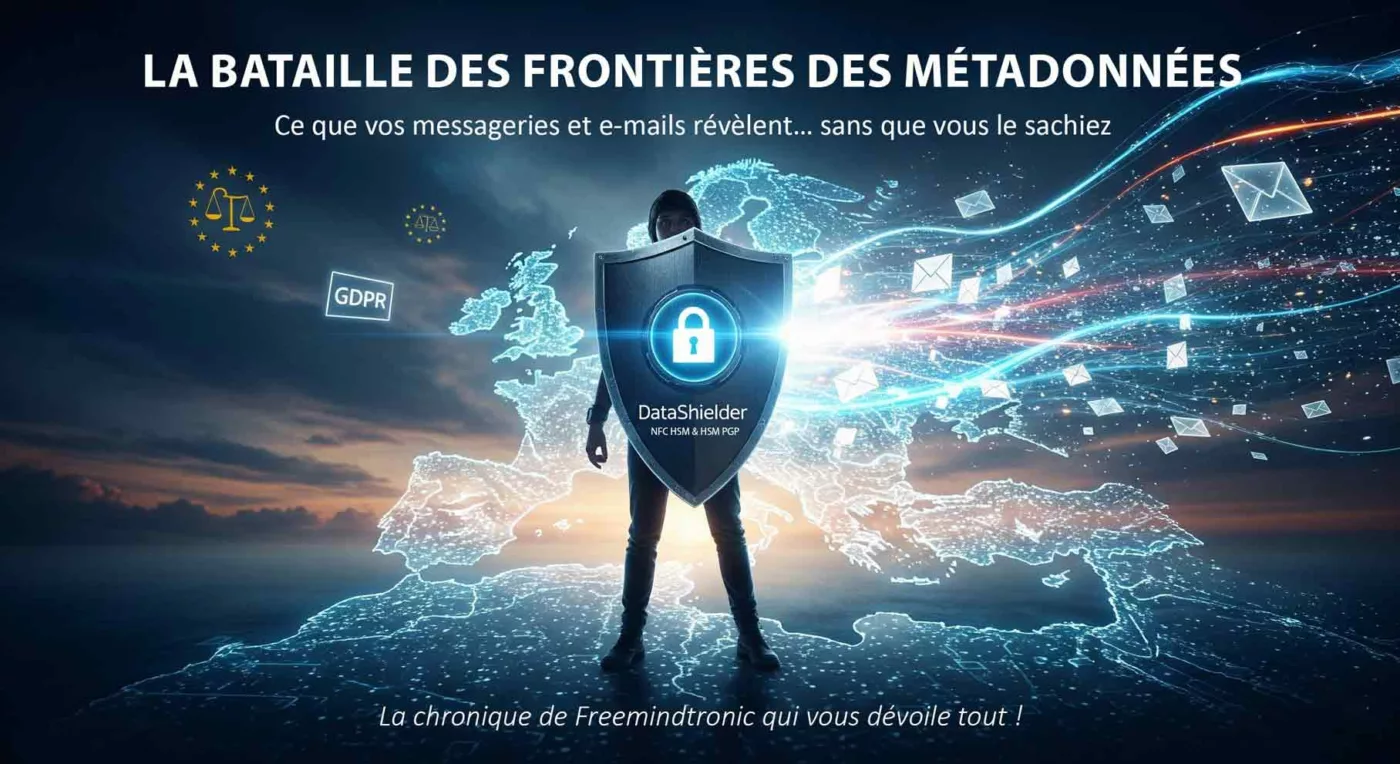
Affiche de cinéma "La Bataille des Frontières des Métadonnées" illustrant un défenseur avec un bouclier DataShielder protégeant l'Europe numérique. Le bouclier est verrouillé, symbolisant la protection de la confidentialité des métadonnées e-mail contre la surveillance. Des icônes GDPR et des e-mails stylisés flottent, représentant les enjeux légaux et la fuite de données. Le fond montre une carte de l'Europe illuminée par des circuits numériques. Le texte principal alerte sur ce que les messageries et e-mails révèlent sans votre savoir, promu par Freemindtronic.

La confidentialité des métadonnées e-mail est au cœur de la souveraineté numérique en Europe : prenez connaissance des risques, le cadre légal UE (RGPD/ePrivacy) et les contre-mesures DataShielder.

Résumé de la chronique — confidentialité métadonnées e-mail

Note de lecture — Pressé ? Le Résumé de la chronique vous livre l’essentiel en moins 4 minutes. Pour explorer l’intégralité du contenu technique, prévoyez environ ≈35 minutes de lecture.

⚡ Objectif

Comprendre ce que révèlent réellement les métadonnées e-mail (adresses IP, horodatages, destinataires, serveurs intermédiaires), pourquoi elles restent accessibles même lorsque le contenu est chiffré, et comment l’Union européenne encadre leur usage (RGPD, ePrivacy, décisions CNIL et Garante).

💥 Portée

Cet article s’adresse aux organisations et individus concernés par la confidentialité des communications : journalistes, ONG, entreprises, administrations.
>Il couvre les e-mails (SMTP, IMAP, POP), les messageries chiffrées de bout en bout, la téléphonie, la visioconférence, le web, les réseaux sociaux, l’IoT, le cloud, le DNS et même les blockchains.

🔑 Doctrine

Les métadonnées sont un invariant structurel : elles ne peuvent être supprimées du protocole mais peuvent être neutralisées et cloisonnées.
>Les solutions classiques (VPN, PGP, SPF/DKIM/DMARC, MTA-STS) protègent partiellement, mais la souveraineté numérique impose d’aller plus loin avec DataShielder HSM (NFC et HSM PGP) qui encapsule le contenu, réduit la télémétrie et compartimente les usages.

🌍 Différenciateur stratégique

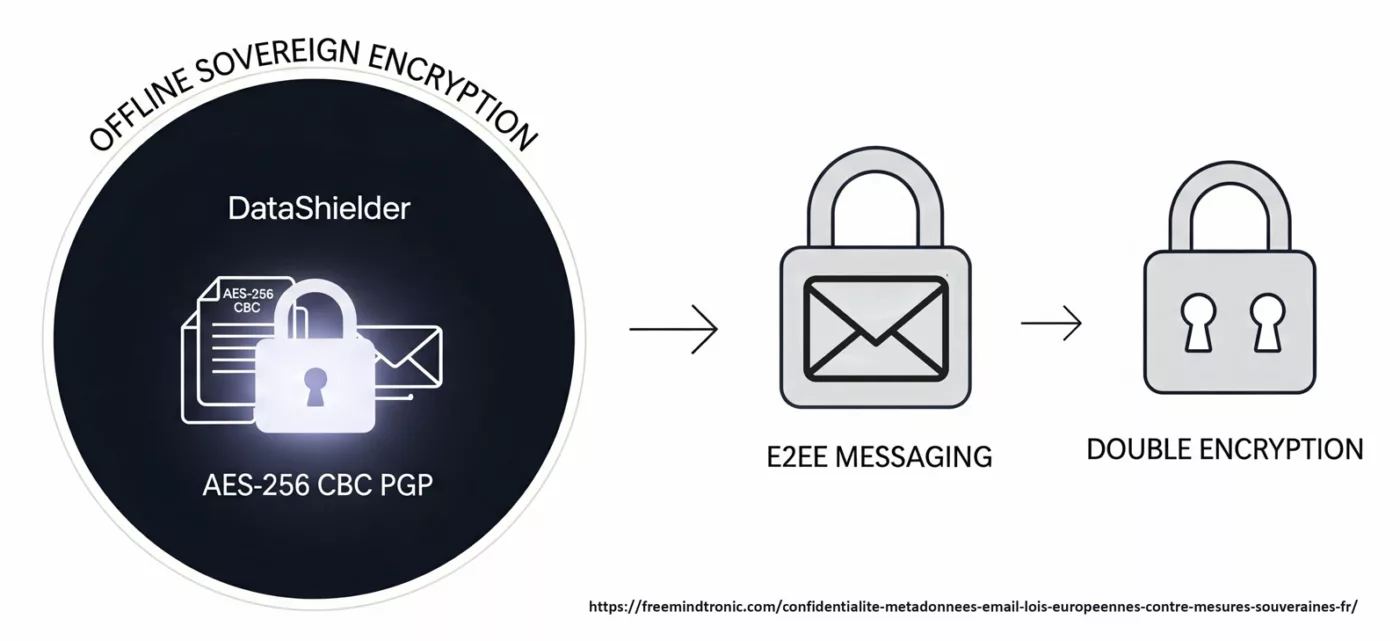
Contrairement aux approches purement logicielles ou cloud, DataShielder adopte une posture zero cloud, zero disque, zero DOM. Il chiffre en amont (offline), encapsule le message, et laisse ensuite la messagerie (chiffrée ou non) appliquer son propre chiffrement.
>Résultat double chiffrement, neutralisation des métadonnées de contenu (subject, pièces jointes, structure MIME) et opacité renforcée face aux analyses de trafic. Un différenciateur stratégique pour les communications sensibles dans l’espace européen et au-delà.


Note technique

Temps de lecture (résumé) : ≈ 4 minutes
Temps de lecture (intégral) : ~35 minutes
Niveau : Sécurité / Cyberculture / Digital Security
Posture : Encapsulation souveraine, défense en profondeur
Rubriques : Digital Security
Langues disponibles : FR · EN · CAT · ES
Type éditorial : Chronique
À propos de l’auteur : Jacques Gascuel, inventeur Freemindtronic® — architectures HSM souveraines, segmentation de clés, résilience hors-ligne, protection souveraine des communications.

TL;DR — Métadonnées, risques et cadre légal

Les métadonnées e-mail révèlent plus que le contenu. Elles tracent qui parle à qui, quand et via quels serveurs. Les solutions classiques (VPN, TLS, PGP) ne les masquent pas.
>Seule une approche souveraine comme DataShielder (NFC HSM & HSM PGP) permet de réduire la surface, neutraliser les métadonnées de contenu par encapsulation, et empêcher la corrélation abusive.
>En 2025, la Cour de cassation a confirmé que les métadonnées e-mail sont des données personnelles au sens du RGPD, même après rupture de contrat.
La CNIL a sanctionné SHEIN pour dépôt de traceurs sans consentement, renforçant l’exigence de granularité et de transparence.

TL;DR — Architecture souveraine et différenciateur

Face à la montée des attaques par IA générative et quishing, la neutralisation des métadonnées devient une exigence stratégique.
>DataShielder introduit un double chiffrement offline et un mode d’encapsulation segmentée certifié TRL9, rendant les métadonnées de contenu inexploitables par les intermédiaires.
>Ce mécanisme n’est pas un effet secondaire : il est volontairement mis en œuvre pour cloisonner les usages, segmenter les identités et créer une opacité cryptographique.
Un différenciateur souverain pour les communications sensibles dans l’espace européen et au-delà.


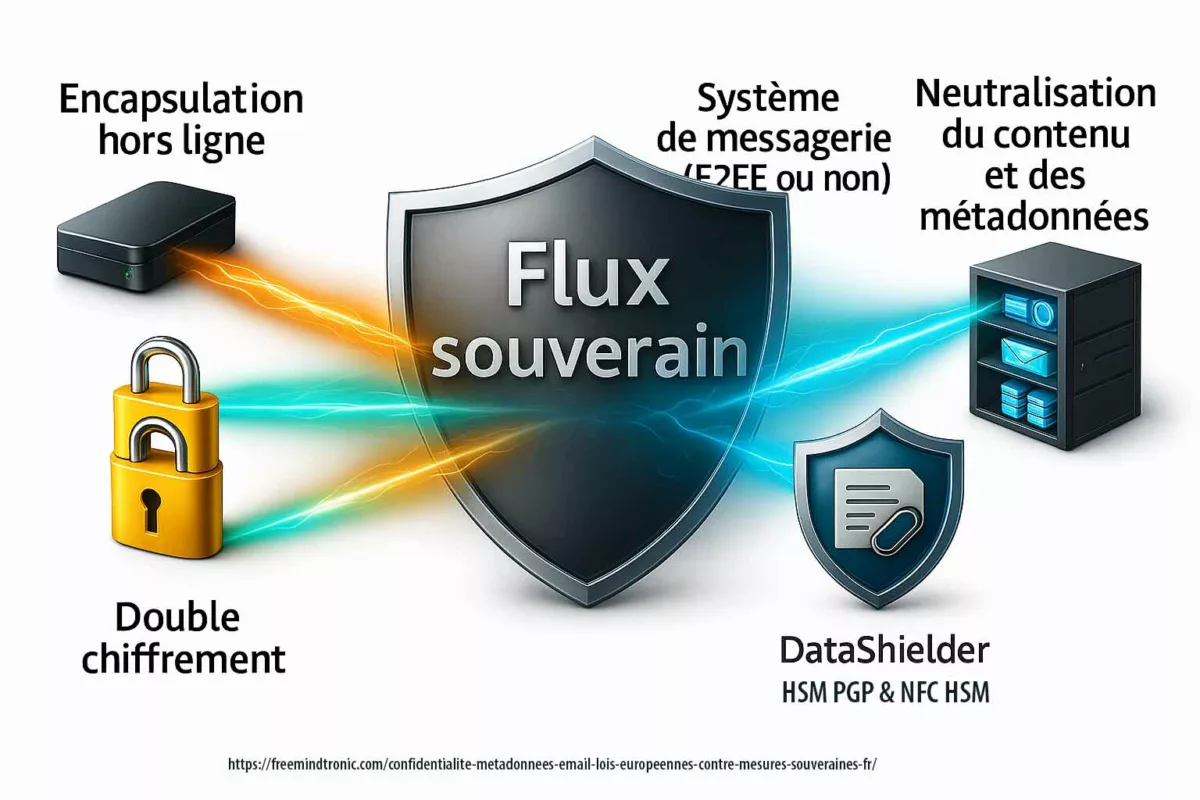
Infographie réaliste du « Flux souverain » de DataShielder montrant l’encapsulation hors ligne, le double chiffrement, le système de messagerie (E2EE ou non), la neutralisation du contenu et des métadonnées, et la segmentation des identités.
Schéma du Flux souverain : DataShielder encapsule les messages hors ligne, applique un double chiffrement, neutralise les métadonnées de contenu et segmente les identités pour une cybersécurité souveraine conforme au RGPD.


2024 2025 Cyber Doctrine Cyberculture

Quantum Threats to Encryption: RSA, AES & ECC Defense

2025 Cyber Doctrine Cyberculture

Souveraineté individuelle numérique : fondements et tensions globales

2024 Cyber Doctrine Cyberculture

Digital Authentication Security: Protecting Data in the Modern World

2025 Cyber Doctrine Cyberculture

Time Spent on Authentication: Detailed and Analytical Overview

2025 Cyber Doctrine Cyberculture

Sovereign Passwordless Authentication — Quantum-Resilient Security

2024 Cyber Doctrine Cyberculture Legal information

ANSSI Cryptography Authorization: Complete Declaration Guide

2024 Cyber Doctrine Cyberculture

ITAR Dual-Use Encryption: Navigating Compliance in Cryptography

2024 Cyber Doctrine Cyberculture

Encryption Dual-Use Regulation under EU Law

2025 Cyber Doctrine Cyberculture

Uncodified UK constitution & digital sovereignty

2025 Cyberculture Digital Security

Browser Fingerprinting Tracking: Metadata Surveillance in 2026

2023 Articles Cyberculture Technologies

NRE Cost Optimization for Electronics: A Comprehensive Guide

2026 Awards Cyberculture Digital Security Distinction Excellence EviOTP NFC HSM Technology EviPass EviPass NFC HSM technology EviPass Technology finalists PassCypher PassCypher

Quantum-Resistant Passwordless Manager — PassCypher finalist, Intersec Awards 2026 (FIDO-free, RAM-only)

2025 Cyberculture Cybersecurity Digital Security EviLink

CryptPeer messagerie P2P WebRTC : appels directs chiffrés de bout en bout

2025 Cyberculture

Louvre Security Weaknesses — ANSSI Audit Fallout

2025 Cyberculture Digital Security

Authentification multifacteur : anatomie, OTP, risques

2015 Cyberculture

Technology Readiness Levels: TRL10 Framework

2024 Cyberculture Digital Security

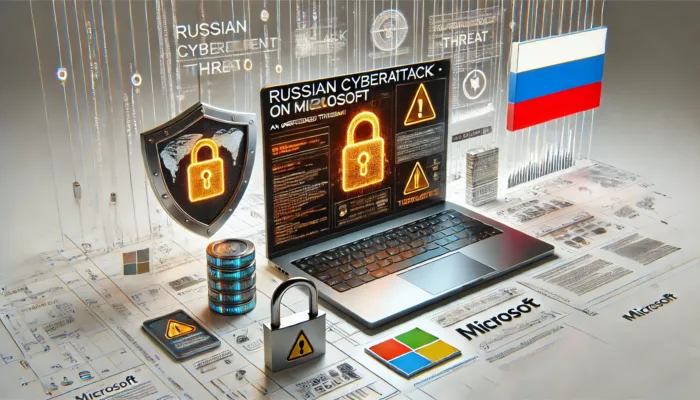
Russian Cyberattack Microsoft: An Unprecedented Threat

2025 Cyberculture

SMS vs RCS: Strategic Comparison Guide

2025 Cyberculture

Loi andorrane double usage 2025 (FR)

2025 Cyberculture

NGOs Legal UN Recognition

2025 Cyberculture Legal information

French IT Liability Case: A Landmark in IT Accountability

2024 Cyberculture

French Digital Surveillance: Escaping Oversight

2024 Cyberculture

Electronic Warfare in Military Intelligence

2021 Cyberculture Digital Security Phishing

Phishing Cyber victims caught between the hammer and the anvil

2024 Articles Cyberculture

EAN Code Andorra: Why It Shares Spain’s 84 Code

2024 Cyberculture

Cybercrime Treaty 2024: UN’s Historic Agreement

2024 Cyberculture DataShielder

Google Workspace Data Security: Legal Insights

2024 Cyberculture EviSeed SeedNFC HSM

Crypto Regulations Transform Europe’s Market: MiCA Insights

2024 Articles Cyberculture legal Legal information News

End-to-End Messaging Encryption Regulation – A European Issue

Articles Contactless passwordless Cyberculture EviOTP NFC HSM Technology EviPass NFC HSM technology multi-factor authentication Passwordless MFA

How to choose the best multi-factor authentication method for your online security

2024 Cyberculture Digital Security News Training

Andorra National Cyberattack Simulation: A Global First in Cyber Defense

Articles Cyberculture Digital Security Technical News

Protect Meta Account Identity Theft with EviPass and EviOTP

2024 Articles Cyberculture EviPass Password

Human Limitations in Strong Passwords Creation

2023 Articles Cyberculture EviCypher NFC HSM News Technologies

Telegram and the Information War in Ukraine

Articles Cyberculture EviCore NFC HSM Technology EviCypher NFC HSM EviCypher Technology

Communication Vulnerabilities 2023: Avoiding Cyber Threats

Articles Cyberculture NFC HSM technology Technical News

RSA Encryption: How the Marvin Attack Exposes a 25-Year-Old Flaw

2023 Articles Cyberculture Digital Security Technical News

Strong Passwords in the Quantum Computing Era

2023 Articles Cyberculture EviCore HSM OpenPGP Technology EviCore NFC HSM Browser Extension EviCore NFC HSM Technology Legal information Licences Freemindtronic

Unitary patent system: why some EU countries are not on board

2024 Crypto Currency Cryptocurrency Cyberculture Legal information

EU Sanctions Cryptocurrency Regulation: A Comprehensive Overview

2023 Articles Cyberculture Eco-friendly Electronics GreenTech Technologies

The first wood transistor for green electronics

2024 Cyberculture Legal information

Encrypted messaging: ECHR says no to states that want to spy on them

2018 Articles Cyberculture Legal information News

Why does the Freemindtronic hardware wallet comply with the law?

En cybersécurité et souveraineté numérique ↑ cette chronique appartient à la rubrique Cyberculture et s’inscrit dans l’outillage opérationnel souverain de Freemindtronic (HSM, segmentation de clés, encapsulation, résilience hors-ligne).


Définition — Qu’est-ce qu’une métadonnée ?

Le terme métadonnée désigne littéralement une donnée sur la donnée. C’est une information contextuelle qui décrit, encadre ou qualifie un contenu numérique sans en faire partie. Les métadonnées sont omniprésentes : elles accompagnent chaque fichier, chaque communication et chaque enregistrement technique.

  • Exemples courants — Par exemple, un document Word contient l’auteur et la date de modification. De même, une photo intègre les coordonnées GPS, tandis qu’un e-mail inclut l’adresse IP de l’expéditeur et l’heure d’envoi.
  • Fonction première — Faciliter le tri, la recherche et la gestion des données dans les systèmes numériques.
  • Effet secondaire — Exposer des traces exploitables pour le suivi, la surveillance ou la corrélation, même lorsque le contenu est chiffré.

⮞ Résumé

Les métadonnées sont des données de contexte. Elles ne disent pas ce qui est communiqué, mais révèlent plutôt comment, quand, où et par qui. Elles sont indispensables au fonctionnement des systèmes numériques, mais constituent aussi une surface d’exposition stratégique.


Quelles sont les métadonnées e-mail (RFC 5321/5322) ?

La confidentialité des métadonnées e-mail repose sur une distinction protocolaire essentielle. En effet, le contenu d’un message (corps du texte, pièces jointes) n’est pas la même chose que ses métadonnées. Les normes RFC 5321 (SMTP) et RFC 5322 (format des en-têtes) codifient ces informations. Elles définissent quelles données sont visibles et lesquelles sont cachées. Elles incluent : l’adresse expéditeur (From), le ou les destinataires (To, Cc), l’objet (Subject), l’horodatage (Date), l’identifiant unique (Message-ID) et la liste des relais SMTP traversés (Received headers).

Ces données ne disparaissent pas lors du chiffrement du message par PGP ou S/MIME. Elles restent exposées aux fournisseurs, FAI et opérateurs intermédiaires. En pratique, elles constituent une véritable cartographie sociale et technique de vos échanges.

Chez les journalistes, ces traces suffisent à révéler des contacts supposés confidentiels.
Du côté des ONG, elles exposent réseaux de partenaires, bailleurs de fonds et relais locaux.
Quant aux entreprises, elles révèlent les flux d’affaires, rythmes décisionnels et horaires d’activité. Cette granularité invisible rend les métadonnées extrêmement puissantes. Elles deviennent ainsi un outil de surveillance souvent plus efficace que le contenu lui-même.

⮞ Résumé

Définies par les RFC 5321/5322, les métadonnées e-mail regroupent les en-têtes et traces de transport. Elles sont indispensables au routage mais impossibles à masquer. Résultat : elles révèlent identité, chronologie et infrastructures des échanges, même lorsque le contenu est chiffré.

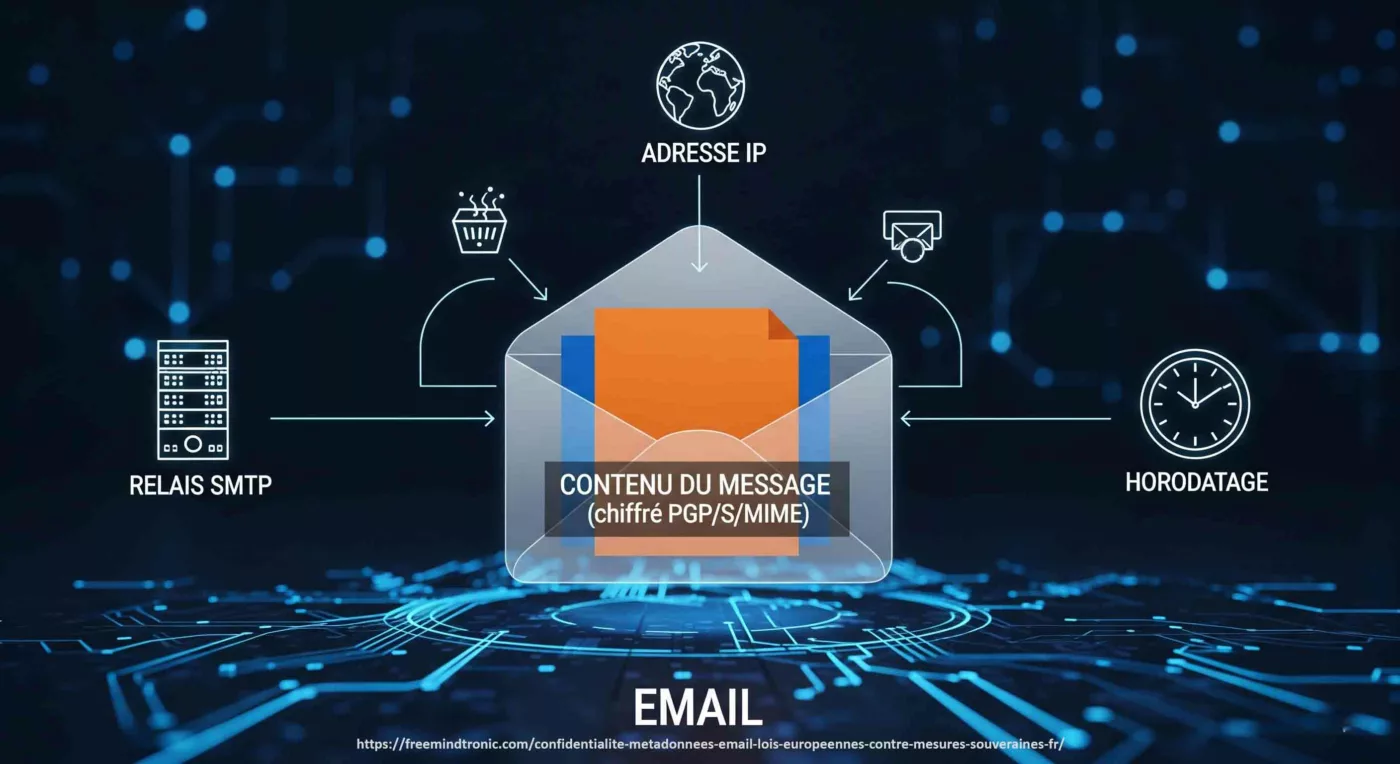
Diagramme technique montrant la confidentialité des métadonnées e-mail, la séparation entre contenu chiffré PGP/S/MIME et les métadonnées de transport non chiffrées (relais SMTP, adresse IP, horodatage) selon les RFC 5321 et 5322. Illustration des données visibles par les fournisseurs de messagerie et des risques de profilage
✪ Schéma — La confidentialité des métadonnées e-mail : Visualisation de l’enveloppe e-mail (email) contenant un message chiffré (contenu du message, chiffré PGP/S/MIME). Les métadonnées visibles (relais SMTP, adresse IP, horodatage) entourent l’enveloppe, illustrant les traces de transport non chiffrées selon les normes RFC 5321 et RFC 5322. Un invariant structurel du protocole SMTP.


Ce que voient les fournisseurs

La confidentialité des métadonnées e-mail se heurte à une réalité technique. En effet, les fournisseurs d’accès à Internet et les opérateurs de messagerie disposent d’une visibilité quasi totale sur les en-têtes et les flux. À chaque connexion, les serveurs enregistrent l’adresse IP de l’expéditeur et les horodatages. Ils notent également les serveurs relais traversés. Même si le contenu est chiffré, cette télémétrie reste exploitable.

Chez Google, l’infrastructure Gmail conserve systématiquement les en-têtes complets. Cela permet une corrélation fine entre utilisateurs et appareils.
Microsoft (Outlook/Exchange Online) applique des politiques similaires. Il intègre ces données aux systèmes de détection d’anomalies et de conformité.
De même, les fournisseurs européens tels qu’Orange ou SFR conservent également les journaux SMTP/IMAP/POP. Ils le font en vertu des obligations légales de conservation dictées par les régulateurs nationaux et européens.

Le minimum reste visible : l’adresse IP du serveur est toujours exposée. Par ailleurs, selon la configuration du client (webmail, application mobile, client lourd), l’adresse IP de l’utilisateur peut également apparaître dans les en-têtes. Cette exposition, cumulée aux métadonnées de routage, suffit à construire un profil technique. De plus, elle permet de créer un profil comportemental des correspondants.

⮞ Synthèse
Les fournisseurs (Google, Microsoft, Orange) conservent systématiquement les en-têtes et adresses IP. Même sous chiffrement, ces données restent visibles et permettent de profiler les échanges. Les adresses IP serveur sont toujours exposées, et selon le client utilisé, l’IP utilisateur peut l’être également.


Actualités récentes — e-mail (2024→2025)

CNIL — Pixels de suivi dans les e-mails : la CNIL a lancé une consultation publique afin de cadrer les tracking pixels par le consentement RGPD. Les synthèses publiques confirment la volonté d’encadrement strict (juin–juillet 2025).

UE — EDPB : rappel que les pixels traquent la lecture d’e-mails et constituent des traitements soumis au cadre RGPD/ePrivacy.

Gmail/Yahoo → Microsoft/Outlook : après Google/Yahoo (02/2024), Microsoft aligne ses exigences pour gros émetteurs (SPF, DKIM, DMARC) avec mesures renforcées à partir du 05/05/2025.

Italie — Garante : durcissement sur la rétention des métadonnées d’e-mail des salariés (référence 7 jours, prorogeable 48h) et première amende GDPR 2025 pour conservation illicite de métadonnées.

⮞ Synthèse e-mail

L’écosystème impose DMARC/SPF/DKIM aux gros émetteurs et encadre les pixels de suivi. La conformité devient un prérequis de délivrabilité, alors que la confidentialité des métadonnées e-mail reste un enjeu RGPD central.


Événements récents — La pertinence des métadonnées en 2025

Les derniers mois de l’année 2025 ont été marqués par des évolutions majeures. Jurisprudence, sanctions, protocoles et menaces émergentes confirment que les métadonnées ne sont plus un détail technique, mais un enjeu central de souveraineté numérique.

Actualités — Messageries & E2EE

Les débats autour du chiffrement de bout en bout et des métadonnées résiduelles s’intensifient. Plusieurs événements récents illustrent cette tension.

  • Proton : En juin et juillet 2025, Proton a mis à jour ses politiques de confidentialité et renforcé son système de blocage des pixels espions. Les URLs de suivi sont désormais bloquées par défaut, et un outil d’importation sécurisé permet de migrer depuis les webmails classiques sans exposer les métadonnées. Consulter les politiques de Proton.
  • WhatsApp (Meta) : En juin 2025, WhatsApp a étendu le chiffrement de bout en bout à tous les fichiers et plateformes, y compris WhatsApp Web, en s’appuyant sur le protocole Signal. Toutefois, l’introduction de publicités ciblées dans l’onglet “Updates” montre que les métadonnées restent exploitées à des fins commerciales. Lire l’analyse sur WhatsApp 2025.

Événements juridiques & techniques

L’enjeu des métadonnées e-mail ne cesse de croître. Voici les faits marquants qui confirment la pertinence de cette chronique.

  • Jurisprudence & droits des salariés : En juin 2025, la Cour de cassation a confirmé que les métadonnées e-mail sont des données personnelles, même après rupture de contrat. Ce droit d’accès postérieur renforce l’obligation de maîtrise souveraine des traces numériques.
  • Cybersécurité & IA générative : Le rapport HarfangLab “State of Cybersecurity 2025” révèle que 58 % des entreprises européennes considèrent désormais l’IA comme leur menace principale. Les attaques par quishing, deepfakes et scripts polymorphes se multiplient. Lire le rapport HarfangLab.

  • Sanctions CNIL & infrastructures centralisées : En septembre 2025, la CNIL a sanctionné Shein pour dépôt de traceurs sans consentement, et clôturé l’injonction contre Orange après vérification du retrait effectif des cookies tiers. Ces décisions confirment l’exigence de granularité et de traçabilité dans la gestion des métadonnées. Voir la décision CNIL contre Orange.

⮞ Synthèse

Ces développements confirment un signal fort : la confidentialité des métadonnées est désormais un enjeu juridique, stratégique et opérationnel. Elle dépasse les considérations techniques pour devenir un pilier de la souveraineté numérique. L’approche défendue par DataShielder™ — encapsulation offline, cloisonnement des usages, neutralisation granulaire — s’inscrit pleinement dans cette dynamique.


Statistiques francophones et européennes sur la confidentialité des métadonnées e-mail

📊 Tendances générales

La confidentialité des métadonnées e-mail n’est pas qu’un enjeu théorique : elle est mesurable. Plusieurs études en Europe et dans l’espace francophone démontrent l’ampleur du phénomène et ses impacts sur la vie privée, la cybersécurité et la souveraineté numérique.

🇪🇺 Europe et espace francophone

  • France — Selon la CNIL, plus de 72 % des plaintes liées à la vie privée en 2024 concernaient la collecte excessive de données de communication, dont les métadonnées e-mail. En 2025, la CNIL a renforcé sa stratégie européenne pour encadrer les flux transfrontaliers et les métadonnées techniques.

  • Union européenne — L’EDPB indique que 85 % des fournisseurs européens conservent les adresses IP et les en-têtes SMTP entre 6 mois et 2 ans. Les lignes directrices 01/2025 sur la pseudonymisation rappellent que les métadonnées doivent être cloisonnées dès la collecte.
  • Italie — En 2025, le Garante a limité la rétention des métadonnées de géolocalisation des salariés à 24h sans justification. Il a également fixé une limite stricte de 21 jours pour les métadonnées d’e-mails professionnels, sauf accord syndical ou autorisation de l’inspection du travail.
  • Suisse — L’OFCOM impose une rétention légale des métadonnées de messagerie de 6 mois, même pour les services sécurisés.
  • Belgique et Luxembourg — Les régulateurs télécom (IBPT et ILR) confirment que les fournisseurs locaux conservent systématiquement les journaux SMTP pour répondre aux demandes judiciaires, jusqu’à 18 mois.
  • Monaco — La CCIN applique une réglementation proche de la CNIL, avec conservation encadrée des métadonnées dans les services publics.

Francophonie hors UE

  • Canada (Québec) — Le CRTC impose une conservation proportionnée. En pratique, la durée moyenne varie entre 6 et 12 mois pour les journaux SMTP.
  • Maroc — L’ANRT oblige les opérateurs à conserver les métadonnées d’e-mail et de connexion pendant au moins 12 mois.
  • Sénégal — La CDP confirme que les fournisseurs doivent stocker les journaux de messagerie pour une durée minimale d’un an.

⮞ Synthèse

Dans l’espace francophone et l’Union européenne, la rétention des métadonnées e-mail est quasi-systématique : de 6 mois (Suisse) à 2 ans (France/UE). Elle s’étend aussi au Québec, au Maroc, au Sénégal, à Monaco et désormais à l’Italie, où des limites strictes sont imposées dans le cadre professionnel.
Face à cette standardisation, l’approche souveraine — encapsulation offline, cloisonnement des usages, neutralisation granulaire — devient non seulement pertinente, mais nécessaire.

Cartographie réglementaire — Durées de rétention par pays

Pays Durée de rétention Cadre légal
France Jusqu’à 2 ans CNIL, RGPD
Union européenne 6 mois à 2 ans EDPB, RGPD
Italie 24h (géoloc), 21 jours (e-mail pro) Garante, Statut des travailleurs
Suisse 6 mois OFCOM
Belgique / Luxembourg Jusqu’à 18 mois IBPT / ILR
Canada (Québec) 6 à 12 mois CRTC, LPRPDE
Maroc 12 mois ANRT
Sénégal 1 an CDP
Monaco Encadrée CCIN

Cette cartographie confirme que la rétention des métadonnées est encadrée, mais rarement minimisée. L’approche souveraine — cloisonnement, encapsulation, neutralisation — devient essentielle pour reprendre le contrôle.


Risques d’exploitation — profilage et surveillance via métadonnées

Les métadonnées e-mail sont un outil d’analyse d’une puissance redoutable. En agrégeant adresses IP, en-têtes SMTP et horodatages, il devient possible de reconstruire un graphe social. Ce graphe révèle qui échange avec qui, à quelle fréquence et dans quel contexte. Ce simple réseau de relations suffit d’ailleurs à cartographier des communautés entières, qu’il s’agisse de journalistes, d’ONG ou d’entreprises.

Dans le domaine économique, ces mêmes données nourrissent des systèmes de profilage publicitaire ou d’espionnage industriel. Les grandes plateformes peuvent ainsi corréler des adresses techniques avec des comportements d’achat. Elles les associent également à des connexions géographiques ou des cycles de production sensibles.

Les autorités publiques ne sont pas en reste. Plusieurs États européens recourent aux métadonnées pour des fins de surveillance judiciaire et de sécurité nationale. Or, la frontière entre usage légitime et exploitation abusive demeure fragile. C’est particulièrement visible avec les pixels de suivi intégrés dans les e-mails marketing. À ce sujet, l’ EDPB et la CNIL ont récemment rappelé qu’ils sont soumis à consentement explicite.


En additionnant ces vecteurs — publicité, espionnage, surveillance étatique — les métadonnées deviennent un levier central. Elles permettent en effet d’anticiper comportements, d’identifier des cibles et d’orienter des décisions. Leur exploitation abusive fragilise la vie privée et ouvre la porte à des dérives systémiques.

⮞ Résumé

Les métadonnées e-mail permettent de tracer des graphes sociaux, d’alimenter le profilage commercial et d’outiller la surveillance. Un usage légitime existe (sécurité, enquête judiciaire), mais l’exploitation abusive expose individus et organisations à un risque stratégique majeur.


Cadre légal UE — RGPD, ePrivacy et vie privée des e-mails

La confidentialité des métadonnées e-mail est encadrée par un arsenal juridique européen complexe. Le RGPD impose aux acteurs de limiter la collecte aux seules données nécessaires. Pourtant, les métadonnées de communication sont souvent conservées bien au-delà du principe de minimisation.

Le règlement ePrivacy, via son article 5(3), renforce l’exigence de consentement préalable pour tout dispositif de suivi, y compris les pixels invisibles insérés dans les e-mails marketing. En 2025, la CNIL a rappelé que ces traceurs électroniques constituent une donnée personnelle et doivent être soumis à un choix explicite de l’utilisateur.

En parallèle, certaines autorités nationales affinent leur doctrine. En juin 2025, le Garante italien a sanctionné une entreprise pour conservation excessive des métadonnées d’e-mails professionnels. Il a fixé une limite stricte : 21 jours maximum sans accord syndical ou autorisation de l’inspection du travail. Cette décision s’appuie sur l’article 4 du Statut des travailleurs et l’article 114 du Code italien de la vie privée.

À l’échelle européenne, le Comité européen de la protection des données (EDPB) a publié en 2025 ses lignes directrices 01/2025 sur la pseudonymisation. Elles précisent que les métadonnées doivent être cloisonnées dès la collecte, et que leur traitement à des fins de cybersécurité ou de conformité doit faire l’objet d’une analyse d’impact.

Le débat reste vif : faut-il autoriser la conservation massive des métadonnées pour la cybersécurité et la justice, ou renforcer le principe de proportionnalité pour éviter les dérives de surveillance généralisée ?

⮞ Résumé

Le RGPD et l’ePrivacy encadrent strictement l’usage des métadonnées e-mail. Consentement explicite, minimisation et cloisonnement sont des principes cardinaux. Mais leur mise en œuvre varie selon les États. Entre sécurité, droit du travail et vie privée, l’Europe cherche un équilibre encore fragile — et les métadonnées sont au cœur de cette tension.


Usage judiciaire des métadonnées — preuve, traçabilité et responsabilité

Les métadonnées e-mail et de messagerie sont devenues des éléments probatoires dans les enquêtes pénales. Leur croisement avec d’autres sources (logs réseau, DNS, cloud, géolocalisation) permet de reconstituer des chaînes d’action, d’authentifier des échanges, et d’établir des responsabilités techniques.

En juin 2025, la Cour de cassation a confirmé que les courriels professionnels, y compris leurs métadonnées (horodatage, destinataires, serveurs), sont des données personnelles au sens du RGPD. Cette reconnaissance ouvre la voie à leur exploitation comme preuve dans les litiges prud’homaux, mais aussi dans les enquêtes pénales.

Dans les affaires de cybercriminalité, les enquêteurs exploitent :

  • Les horodatages SMTP pour établir une chronologie d’envoi
  • Les adresses IP pour géolocaliser ou corréler des connexions
  • Les identifiants de canal (Telegram, Signal, Matrix) pour relier des pseudonymes à des actions
  • Les logs DNS et cloud pour confirmer l’usage d’un service à un instant donné

Dans l’affaire Telegram (2024–2025), les autorités françaises ont démontré l’usage criminel de la plateforme via l’analyse croisée de métadonnées réseau, de logs d’interconnexion et de signalements externes. Ce n’est pas le contenu des messages qui a été exploité, mais leur structure technique et leur fréquence d’usage.

⮞ Synthèse

Les métadonnées sont des preuves numériques à part entière. Leur traçabilité, leur horodatage et leur capacité à relier des identités techniques à des faits concrets en font un levier judiciaire puissant.
L’approche souveraine — encapsulation, cloisonnement, neutralisation — devient une stratégie défensive autant que préventive.


Défenses classiques — protocoles de messagerie et limites

Face aux risques pesant sur la confidentialité des métadonnées e-mail, plusieurs mécanismes techniques sont couramment déployés. Les standards SPF, DKIM et DMARC renforcent l’authentification des expéditeurs et réduisent les usurpations d’adresse. MTA-STS et TLS-RPT visent quant à eux à garantir la livraison sécurisée en forçant l’usage du chiffrement TLS entre serveurs de messagerie.

Ces dispositifs améliorent l’intégrité et l’authenticité du flux, mais ils laissent intacts les en-têtes de transport et les adresses IP. En clair, ils ne protègent pas les métadonnées elles-mêmes.

Les solutions de chiffrement de contenu, telles que PGP ou S/MIME, ajoutent une couche précieuse pour la confidentialité des messages. Toutefois, elles ne masquent que le corps du texte et les pièces jointes. Les champs sensibles comme Subject, To, From et les Received headers restent accessibles à tout fournisseur ou relais SMTP.

Enfin, certains utilisateurs se tournent vers des outils réseau comme le VPN ou Tor. Ces solutions peuvent anonymiser l’adresse IP côté client, mais elles ne neutralisent pas la conservation des en-têtes par les serveurs de messagerie. La défense reste donc partielle.

⮞ Résumé

SPF, DKIM, DMARC, MTA-STS et TLS-RPT sécurisent la messagerie, mais pas les métadonnées. PGP et S/MIME chiffrent le contenu, non les en-têtes. VPN et Tor masquent l’IP utilisateur, sans empêcher la collecte des traces par les serveurs.


Contre-mesures souveraines — DataShielder™ et protection des échanges

Pourquoi dépasser les limites des solutions classiques ?

Les solutions traditionnelles (VPN, PGP, SPF/DKIM/DMARC) protègent partiellement la confidentialité des métadonnées e-mail. Pour aller plus loin, Freemindtronic déploie des contre-mesures souveraines avec DataShielder™, une architecture matérielle conçue pour cloisonner les usages et réduire la surface d’exposition.

Conformité réglementaire et usage critique

En octobre 2024, DataShielder HSM NFC, classé produit à double usage civil et militaire selon le règlement (UE) 2021/821, a obtenu l’autorisation d’importation délivrée par l’ANSSI. Puis, en février 2025, sa réexportation vers les États membres de l’Union européenne a été validée, confirmant son usage en environnement critique.

Encapsulation segmentée et double chiffrement

En parallèle, un mode d’encapsulation segmentée avancée a été introduit dans DataShielder HSM PGP. Il permet de dissocier les métadonnées MIME (pièces jointes, structure, types MIME) en blocs chiffrés indépendants.
L’objet (Subject) reste volontairement visible pour préserver la recherche et l’ergonomie des messageries — un compromis stratégique assumé par l’inventeur.

Ensuite, les données encapsulées sont injectées dans les canaux de communication (SMTP, E2EE, cloud), qui les rechiffrent automatiquement. Ce double chiffrement anticipé complexifie toute tentative de corrélation abusive.

>Cette architecture est dédiée aux usages de contre-espionnage, où la segmentation des identités et la neutralisation des traces techniques sont des impératifs opérationnels.

Stockage souverain et cloisonnement hors ligne

DataShielder HSM NFC assure le stockage hors ligne des clés et identités numériques. Son isolement physique empêche toute fuite vers le cloud ou le disque dur, garantissant une maîtrise locale et segmentée.

De son côté, DataShielder HSM PGP desktop encapsule le message avant envoi en AES-256 CBC PGP avec des clés segmentées. Ce verrouillage souverain précède le chiffrement natif de la messagerie (PGP, S/MIME, E2EE), assurant une protection en deux couches.

Ce qui reste visible — et pourquoi

Seules les métadonnées de transport (adresses IP, serveurs traversés, horodatages) restent visibles, car elles sont indispensables au routage SMTP. Leur présence est un invariant technique, mais leur valeur est fortement réduite par l’opacité du contenu.

✓ Synthèse des contre-mesures souveraines

– Cloisonnement hors ligne des clés avec DataShielder HSM NFC
– Encapsulation offline → chiffrement AES-256 CBC PGP avec clés segmentées
– Double chiffrement : encapsulation souveraine + chiffrement standard messagerie
– Neutralisation des métadonnées de contenu (pièces jointes, structure MIME)
– Objet visible par choix stratégique pour garantir la recherche
– Réduction des traces locales et segmentation des identités

Distribution exclusive en France

Le distributeur officiel exclusif de DataShielder™ HSM NFC en France est AMG PRO. Spécialisé dans les équipements tactiques et les solutions de cybersécurité à double usage, AMG PRO assure la distribution auprès des administrations, des forces de l’ordre et des entreprises privées sensibles.

Cette exclusivité garantit une traçabilité souveraine, une conformité réglementaire et un accompagnement dédié pour les déploiements en environnement critique.

Les produits DataShielder™ sont également soutenus par Bleu Jour, partenaire technologique d’AMG PRO, reconnu pour ses solutions informatiques industrielles et ses engagements en matière de fabrication française.

Diagramme technique illustrant un processus de double chiffrement. Un premier cadenas (DataShielder) protège des documents via une encapsulation hors ligne (AES-256 CBC PGP) avant que le message ne soit envoyé dans une messagerie chiffrée de bout en bout (E2EE), garantissant une protection renforcée contre les données de traînée.
✪ Diagramme – Le double chiffrement combine une encapsulation hors ligne (DataShielder) avec le chiffrement de bout en bout de la messagerie pour une sécurité maximale.


Flux souverain — encapsulation offline et double chiffrement

Le flux souverain mis en œuvre par DataShielder™ repose sur un enchaînement précis, conçu pour neutraliser les métadonnées de contenu et compartimenter les usages. L’objectif est de réduire au strict minimum ce qui demeure exploitable par des tiers.

  1. Encapsulation offline — Le message et ses fichiers attachés sont d’abord chiffrés hors ligne en AES-256 CBC PGP avec des clés segmentées stockées dans DataShielder HSM NFC ou DataShielder HSM PGP desktop. Le contenu (texte, pièces jointes, structure MIME) devient totalement opaque.
  2. Double chiffrement — Une fois encapsulé, le message est remis à la messagerie, qui applique son propre protocole de chiffrement (PGP, S/MIME ou E2EE selon le service). Résultat : un verrouillage en deux couches.
  3. Neutralisation des métadonnées de contenu — Objet, pièces jointes et structure MIME sont encapsulés dans la charge utile chiffrée, empêchant toute analyse par les fournisseurs.
  4. Persistance des métadonnées de transport — Les seules informations visibles restent les adresses IP, les serveurs traversés et les horodatages. Elles sont indispensables au routage SMTP et ne peuvent être supprimées.

Cette architecture introduit une complexité analytique qui dépasse les capacités classiques de corrélation automatisée. Elle crée un bruit cryptographique rendant tout profilage ou interception beaucoup plus coûteux et incertain.

⮞ Résumé

Le flux souverain DataShielder combine encapsulation offline (AES-256 CBC PGP + clés segmentées, couvrant messages et pièces jointes) et chiffrement de messagerie (PGP, S/MIME ou E2EE). Résultat : double chiffrement, neutralisation des métadonnées de contenu et réduction de la corrélation. Seules les métadonnées de transport restent visibles pour le routage.


Messageries chiffrées de bout en bout (E2EE) et métadonnées résiduelles

Les services de messagerie chiffrée de bout en bout comme ProtonMail, Tutanota, Signal, Matrix, Olvid ou encore WhatsApp garantissent qu’aucun tiers ne peut lire le contenu des communications. Seuls l’expéditeur et le destinataire détiennent les clés nécessaires pour déchiffrer le message.

Toutefois, même avec l’E2EE, certaines informations restent visibles. Les métadonnées de transport (IP d’origine, relais SMTP, horodatages) ne peuvent être masquées. De plus, certaines métadonnées de contenu comme l’objet (Subject), la taille ou le type des pièces jointes (MIME) peuvent encore être accessibles aux fournisseurs de service.

En 2025, plusieurs évolutions confirment cette limite :

  • WhatsApp applique désormais le protocole Signal sur toutes ses plateformes, y compris WhatsApp Web et les fichiers partagés. Le contenu est chiffré, mais les métadonnées (fréquence, destinataires, IP) restent exploitables.
  • ProtonMail bloque désormais par défaut les pixels espions et URLs de suivi, et propose un outil d’importation sécurisé pour migrer depuis les webmails classiques sans exposer les métadonnées historiques.
  • Olvid, certifiée deux fois CSPN par l’ANSSI, fonctionne sans numéro ni adresse e-mail. Son architecture peer-to-peer sans serveur central garantit l’absence de collecte de métadonnées critiques. Elle est utilisée par des journalistes, des ONG, et des institutions sensibles.

C’est pourquoi l’approche souveraine de DataShielder™ complète ces messageries. En encapsulant message et fichiers en AES-256 CBC PGP hors ligne, via des clés segmentées, avant leur envoi, le contenu devient opaque pour les serveurs. Le service E2EE ajoute ensuite sa propre couche de chiffrement, aboutissant à un double chiffrement : offline souverain + chiffrement natif de la messagerie.

⮞ Résumé

Les messageries E2EE protègent le contenu, mais pas toutes les métadonnées. Avec DataShielder, messages et pièces jointes sont encapsulés offline, puis chiffrés à nouveau par l’E2EE. Résultat : un double verrouillage qui réduit la surface exploitable.
>Les évolutions 2025 confirment que même les messageries réputées sécurisées doivent être complétées par une encapsulation souveraine pour neutraliser les métadonnées résiduelles.


Au-delà de l’e-mail — métadonnées de toutes les communications

La problématique de la confidentialité des métadonnées ne se limite pas aux e-mails. Chaque service de communication numérique génère ses propres traces, souvent invisibles pour l’utilisateur mais hautement exploitables par les fournisseurs, plateformes et autorités.

  • Messageries instantanées — Slack, Teams, Messenger ou Telegram enregistrent les horaires de connexion, les groupes rejoints et les adresses IP associées.
  • VoIP et visioconférences — Zoom, Skype ou Jitsi exposent des données sur la durée des appels, les participants et les serveurs relais.
  • Téléphonie mobile et SMS — Les opérateurs conservent les métadonnées d’appel (numéros appelant/appelé, cell-ID, durée, localisation approximative).
  • Navigation web — Même sous HTTPS, l’adresse IP, les résolutions DNS et l’SNI TLS révèlent les sites visités.
  • Réseaux sociaux et cloud — Les plateformes comme Facebook, Google Drive ou Dropbox exploitent les journaux d’accès, les appareils utilisés et les partages de fichiers.
  • VPN et Tor — Ces solutions masquent l’adresse IP d’origine, mais ne suppriment pas les journaux conservés par certains nœuds ou opérateurs.

Pris séparément, ces éléments paraissent anodins. Agrégés, ils dessinent un profil comportemental complet capable de révéler des habitudes de travail, des relations sociales, voire des opinions politiques ou syndicales.

⮞ Résumé

Les métadonnées dépassent le cadre des e-mails : messageries instantanées, VoIP, SMS, web, réseaux sociaux et cloud en produisent continuellement. Isolées, elles semblent anodines ; agrégées, elles deviennent un outil de surveillance globale.


Autres infrastructures — IoT, cloud, blockchain et traces techniques

La confidentialité des métadonnées concerne aussi les infrastructures numériques et industrielles. Chaque interaction technique laisse une trace exploitable, souvent plus persistante que les communications humaines.

  • Objets connectés (IoT) — Assistants vocaux (Alexa, Google Home), montres médicales ou capteurs domotiques émettent en continu des journaux d’activité, incluant heures d’utilisation et identifiants uniques.
  • Stockage cloud et collaboration — Services comme Google Drive, OneDrive ou Dropbox conservent les horodatages d’accès, les appareils utilisés et les historiques de partage, même si les fichiers sont chiffrés.
  • DNS et métadonnées réseau — Chaque résolution DNS, chaque SNI TLS et chaque log de firewall expose la destination et la fréquence des connexions, indépendamment du contenu échangé.
  • Blockchain et crypto — Les transactions sont immuables et publiques ; les adresses utilisées constituent des métadonnées permanentes, traçables à grande échelle via l’analyse de graphe.

Ces infrastructures démontrent que les métadonnées sont devenues un invariant structurel du numérique. Elles ne peuvent être supprimées, mais doivent être neutralisées ou cloisonnées pour limiter leur exploitation abusive.

⮞ Résumé

IoT, cloud, DNS et blockchain produisent des métadonnées persistantes. Elles structurent l’infrastructure numérique mais exposent aussi des traces exploitables en continu, même en l’absence de contenu lisible.


Cybersécurité et espionnage — usages légitimes vs abusifs

Les métadonnées ont une valeur ambivalente. D’un côté, elles sont un outil essentiel pour la cybersécurité et la justice. Les journaux de connexion, les adresses IP et les horodatages permettent aux équipes SOC et aux enquêteurs de détecter des anomalies, d’identifier des attaques et d’établir des preuves judiciaires.

De l’autre, ces mêmes données deviennent un instrument d’espionnage lorsqu’elles sont exploitées sans cadre légal. Des acteurs étatiques ou industriels peuvent cartographier des réseaux de relations, anticiper des décisions stratégiques ou suivre en temps réel des organisations sensibles. Les campagnes publicitaires intrusives reposent également sur ces mécanismes de corrélation clandestine.

C’est précisément pour limiter ces usages abusifs que DataShielder™ apporte une réponse souveraine. L’encapsulation offline, le double chiffrement et la segmentation des identités réduisent les traces locales et complexifient la corrélation. Ainsi, les usages légitimes (cybersécurité, enquêtes judiciaires) demeurent possibles via les métadonnées de transport, mais l’exploitation abusive des métadonnées de contenu est neutralisée.

⮞ Résumé

Les métadonnées sont un outil à double usage : légitime pour la cybersécurité et la justice, mais aussi illégitime pour l’espionnage et le profilage abusif. La souveraineté consiste à encadrer les premiers et à neutraliser les seconds.


Cas d’usage réels — ONG, journalistes, PME

La problématique des métadonnées n’est pas théorique : elle se traduit en risques concrets pour les organisations et individus. Voici trois scénarios illustratifs où la souveraineté apportée par DataShielder™ change la donne.

Journalistes — Les métadonnées suffisent à révéler les contacts confidentiels d’une rédaction. Grâce à DataShielder HSM PGP, les messages et pièces jointes sont encapsulés offline, puis chiffrés à nouveau par la messagerie E2EE (ProtonMail, Signal). Les sources sont protégées contre les corrélations abusives.

ONG — Les réseaux de partenaires, bailleurs de fonds et relais locaux sont exposés via les horodatages et adresses IP. En combinant DataShielder HSM NFC pour la segmentation des identités et une messagerie chiffrée, les ONG cloisonnent leurs échanges et limitent les risques d’espionnage ou de surveillance intrusive.

PME — Les cycles de décision, flux d’affaires et horaires d’activité peuvent être déduits des simples en-têtes SMTP. Avec un déploiement DMARC + MTA-STS complété par DataShielder HSM, les entreprises réduisent les attaques par usurpation et renforcent la confidentialité de leurs communications internes.

⮞ Résumé

Journalistes, ONG et PME sont exposés différemment mais tous vulnérables aux métadonnées. Avec DataShielder, ils bénéficient d’une encapsulation offline, d’une segmentation des identités et d’une réduction des corrélations abusives.


Guide pratique — réduire l’exposition des métadonnées e-mail

Protéger la confidentialité des métadonnées e-mail nécessite d’allier standards techniques et mesures souveraines. Voici une check-list opérationnelle adaptée aux entreprises, ONG et administrations.

  • Authentification des domaines — Activer SPF, DKIM et DMARC (mode reject) pour limiter les usurpations et renforcer la confiance des échanges.
  • Transport sécurisé — Déployer MTA-STS et TLS-RPT pour imposer l’usage du chiffrement TLS entre serveurs de messagerie.
  • Neutralisation des traceurs — Bloquer le chargement automatique des images distantes et utiliser des filtres anti-pixels pour empêcher la collecte clandestine.
  • Minimisation de la rétention — Limiter la durée de conservation des journaux de messagerie. L’Italie impose par exemple quelques jours pour les e-mails salariés.
  • Encapsulation souveraine — Utiliser DataShielder HSM NFC ou HSM PGP desktop pour chiffrer offline messages et pièces jointes en AES-256 CBC PGP avec clés segmentées, avant tout envoi.

Ainsi, cette combinaison permet de réduire la surface d’exposition, de renforcer la souveraineté numérique et de compliquer toute tentative d’exploitation abusive des métadonnées.

⮞ Résumé

SPF, DKIM, DMARC, MTA-STS et TLS-RPT sécurisent le transport et l’authentification. Anti-pixels et rétention minimale limitent la collecte. DataShielder apporte la couche souveraine : encapsulation offline et neutralisation des métadonnées de contenu.


Signaux faibles 2025→2027 — tendances émergentes

Les prochaines années verront s’intensifier les débats autour de la confidentialité des métadonnées e-mail et des communications numériques. Plusieurs signaux faibles se dessinent déjà, annonçant des évolutions structurelles.

  • Encadrement renforcé du tracking — De nouvelles recommandations européennes devraient limiter l’usage des pixels invisibles et autres traceurs, avec des sanctions accrues pour non-conformité.
  • Généralisation de DMARC et MTA-STS — L’adoption de ces standards pourrait devenir quasi obligatoire, imposée par les grands opérateurs et les régulateurs nationaux.
  • Rétention ciblée et proportionnée — Plusieurs autorités envisagent d’encadrer plus strictement la durée de conservation des métadonnées, afin d’éviter la surveillance massive et permanente.
  • IA de corrélation massive — L’émergence d’outils d’intelligence artificielle capables de croiser logs, DNS, IP et données publiques rendra la corrélation de métadonnées plus rapide et intrusive.

  • Hybridation souveraine + cloud — Le modèle mixte associant encapsulation offline (DataShielder) et services cloud E2EE pourrait s’imposer comme standard pour les organisations sensibles.
  • Corrélation post-quantique — Premiers tests de corrélation SMTP par IA quantique simulée. La neutralisation des métadonnées devient une exigence stratégique.
  • Pseudonymisation dynamique — L’EDPB envisage d’imposer des journaux SMTP pseudonymisés dans les infrastructures publiques.

De faits, ces tendances confirment que la maîtrise des métadonnées deviendra un enjeu stratégique central entre 2025 et 2027, tant pour la souveraineté numérique que pour la cybersécurité européenne.

⮞ Résumé

D’ici 2027 : encadrement accru du tracking, généralisation des standards DMARC/MTA-STS, rétention plus stricte, montée en puissance de l’IA et hybridation souveraine + cloud. Les métadonnées deviennent un champ de bataille stratégique.

FAQ — questions fréquentes sur les métadonnées e-mail

PGP masque-t-il mes métadonnées ?

Non, pas complètement. PGP chiffre le contenu (texte + pièces jointes). Cependant, il laisse visibles les métadonnées de transport, comme les en-têtes SMTP (From, To, Date), les en-têtes Received, les adresses IP et les horodatages. Par conséquent, pour réduire l’exposition du contenu (objet, structure MIME), il est nécessaire de l’encapsuler en amont avec DataShielder HSM.

En 2025, plusieurs événements ont renforcé le cadre légal : la CNIL</strong a sanctionné Shein pour usage abusif de traceurs ; la Cour de cassation</strong a reconnu les métadonnées comme données personnelles ; et le Garante italien a limité leur rétention à 24h sans justification. Ces évolutions confirment que la confidentialité des métadonnées est désormais un enjeu juridique central.

Non, il n’anonymise pas les échanges. MTA-STS force le protocole TLS entre serveurs pour sécuriser le transport et limiter les attaques de type downgrade. Cependant, il n’anonymise ni les adresses IP ni les en-têtes. Les métadonnées nécessaires au routage SMTP restent donc observables.

Non, elle ne supprime pas toutes les métadonnées. DataShielder neutralise les métadonnées de contenu (objet, pièces jointes, structure MIME) via une encapsulation offline en AES-256 CBC PGP (clés segmentées). Ensuite, elle laisse la messagerie appliquer son chiffrement (PGP, S/MIME ou E2EE). En conséquence, les métadonnées de transport (IP, relais, horodatages) demeurent pour assurer le routage.

Oui, elles sont utiles à la cybersécurité. Elles servent notamment à la détection d’anomalies (SOC/SIEM) et aux enquêtes judiciaires. Toutefois, leur usage doit rester proportionné et conforme au cadre légal (RGPD/ePrivacy). L’approche souveraine consiste donc à neutraliser les métadonnées de contenu tout en conservant le minimum requis pour la sécurité et la conformité.

Selon le RGPD, les métadonnées (adresses IP, horodatages, etc.) sont considérées comme des données à caractère personnel. Par conséquent, leur collecte, leur stockage et leur traitement doivent être justifiés par une base légale valide. C’est pour cette raison que la CNIL et l’EDPB (Comité européen de la protection des données) exigent un consentement explicite pour leur usage.

En fait, DataShielder™ ne les supprime pas, car elles sont indispensables au routage des e-mails. En revanche, le système les rend moins utiles au profilage en les isolant du contenu. En effet, en encapsulant le message en amont, il s’assure que seules les informations de transport minimales restent visibles aux intermédiaires, ce qui complique l’agrégation de données.

Non. Si ces services sécurisent le contenu de manière très efficace, les métadonnées de transport (adresses IP, horodatage) restent visibles pour eux. Pour cette raison, ces fournisseurs peuvent être contraints par la loi de conserver ces traces. De plus, les courriels envoyés à des destinataires sur d’autres plateformes (Gmail, Outlook) révéleront toujours des métadonnées lisibles pour le fournisseur tiers.

C’est une notion clé. Bien que le contenu du message puisse être chiffré, les métadonnées révèlent une cartographie sociale et technique précise. Elles permettent d’établir qui parle à qui, quand, à quelle fréquence et d’où (géolocalisation par IP). Ces informations suffisent à reconstituer un graphe de connexions. Elles sont donc plus puissantes pour le profilage et la surveillance que le contenu lui-même.

C’est une distinction fondamentale. Le chiffrement en transit (par exemple, via TLS/SSL) protège le message pendant son voyage entre les serveurs, mais il ne le protège pas une fois qu’il est stocké. Le chiffrement au repos protège le message lorsqu’il est stocké sur un serveur ou un disque dur. Par conséquent, pour une sécurité complète, il faut les deux, car les messages peuvent être interceptés à l’arrivée (au repos) s’ils ne sont pas chiffrés.

Oui, mais c’est complexe. Les services de messagerie Web comme Gmail affichent l’adresse IP de l’expéditeur (celle du serveur Gmail). Cependant, des services comme ProtonMail suppriment l’adresse IP de l’expéditeur de l’en-tête du message. Il est également possible d’utiliser un VPN ou un service de relais comme Tor pour masquer votre adresse IP réelle.

⮞ Résumé

PGP et MTA-STS protègent respectivement le contenu et le transport, sans masquer les métadonnées de routage. Par conséquent, DataShielder HSM ajoute une encapsulation offline qui réduit l’exposition des métadonnées de contenu pour une meilleure confidentialité des métadonnées e-mail.

Perspectives stratégiques — souveraineté numérique et communications

La maîtrise des métadonnées e-mail et des traces associées dépasse la simple cybersécurité technique. En réalité, elle ouvre la voie à une doctrine souveraine qui articule la protection de la vie privée, la conformité réglementaire et la résilience face aux menaces hybrides.

Dans les années à venir, la convergence entre chiffrement de bout en bout, encapsulation hors ligne et infrastructures décentralisées redéfinira l’équilibre entre sécurité et efficacité. Par conséquent, une perspective clé sera la mise en place de standards européens contraignants sur la conservation des métadonnées. Ces standards devront intégrer à la fois les besoins judiciaires et les impératifs de protection individuelle. De plus, l’essor de l’IA de corrélation massive accentuera le besoin d’outils matériels souverains. Ainsi, des solutions comme DataShielder™ seront nécessaires pour rétablir une symétrie stratégique entre les citoyens, les entreprises et les institutions.

À plus long terme, il s’agira d’orchestrer une résilience hybride. Cette dernière combine des solutions locales (HSM hors ligne, cloisonnement segmenté) et des services cloud chiffrés. L’objectif est d’assurer la continuité opérationnelle même dans des scénarios de rupture géopolitique ou technologique.

⧉ Ce que nous n’avons pas couvert
Cette chronique s’est concentrée sur les métadonnées e-mail et leurs contre-mesures souveraines.
>Restent à approfondir : l’impact des réseaux quantiques émergents, les standards de pseudonymisation dynamique et les mécanismes de souveraineté algorithmique appliqués à la corrélation massive.
Ces thèmes feront l’objet de développements ultérieurs.

Side-Channel Attacks via HDMI and AI: An Emerging Threat

Side-channel attacks visualized through an HDMI cable emitting invisible electromagnetic waves intercepted by an AI system.

Side-channel attacks via HDMI are the focus of Jacques Gascuel’s analysis, which delves into their legal implications and global impact in cybersecurity. This ongoing review is updated regularly to keep you informed about advancements in these attack methods, the protective technologies from companies like Freemindtronic, and their real-world effects on cybersecurity practices and regulations.


Protecting Against HDMI Side-Channel Attacks

Side-channel attacks via HDMI, bolstered by AI, represent a growing threat in cybersecurity. These methods exploit electromagnetic emissions from HDMI cables to steal sensitive information from a distance. How can you protect yourself against these emerging forms of cyberattacks?


2025 Cyber Doctrine Cyberculture

Uncodified UK constitution & digital sovereignty

2025 Cyberculture Cybersecurity Digital Security EviLink

CryptPeer messagerie P2P WebRTC : appels directs chiffrés de bout en bout

2025 Cyber Doctrine Cyberculture

Souveraineté individuelle numérique : fondements et tensions globales

2025 Cyberculture

Louvre Security Weaknesses — ANSSI Audit Fallout

Understanding the Impact and Evolution of Side-Channel Attacks in Modern Cybersecurity

Side-channel attacks, also known as side-channel exploitation, involve intercepting electromagnetic emissions from HDMI cables to capture and reconstruct the data displayed on a screen. These attacks, which were previously limited to analog signals like VGA, have now become possible on digital signals thanks to advances in artificial intelligence.

A group of researchers from the University of the Republic in Montevideo, Uruguay, recently demonstrated that even digital signals, once considered more secure, can be intercepted and analyzed to reconstruct what is displayed on the screen. Their research, published under the title “Deep-TEMPEST: Using Deep Learning to Eavesdrop on HDMI from its Unintended Electromagnetic Emanations”, is available on the arXiv preprint server​ (ar5iv).

Complementing this, Freemindtronic, a company specializing in cybersecurity, has also published articles on side-channel attacks. Their work highlights different forms of these attacks, such as acoustic or thermal emissions, and proposes advanced strategies for protection. You can explore their research and recommendations for a broader understanding of the threats associated with side-channel attacks by following this link: Freemindtronic – Side-Channel Attacks.

Freemindtronic Solutions for Combating Side-Channel Attacks via HDMI

Freemindtronic’s PassCypher and DataShielder product lines incorporate advanced hardware security technologies, such as NFC HSM (Hardware Security Module) or HSM PGP containers, to provide enhanced protection against side-channel attacks.

How Do These Products Protect Against HDMI Attacks?

Freemindtronic’s PassCypher and DataShielder product lines incorporate advanced hardware security technologies, such as NFC HSM (Hardware Security Module) or HSM PGP containers, to provide enhanced protection against side-channel attacks.

  • PassCypher NFC HSM and PassCypher HSM PGP: These devices are designed to secure sensitive data exchanges using advanced cryptographic algorithms considered post-quantum, and secure key management methods through segmentation. Thanks to their hybrid HSM architecture, these devices ensure that cryptographic keys always remain in a secure environment, protected from both external and internal attacks, including those attempting to capture electromagnetic signals via HDMI. Even if an attacker managed to intercept signals, they would be unusable without direct access to the cryptographic keys, which remain encrypted even during use. Furthermore, credentials and passwords are decrypted only ephemerally in volatile memory, just long enough for auto-login and decryption.
  • DataShielder NFC HSM: This product goes even further by combining hardware encryption with NFC (Near Field Communication) technology. DataShielder NFC HSM is specifically designed to secure communications between phones and computers or exclusively on phones, ensuring that encryption keys are encrypted from the moment of creation and decrypted only in a secure environment. The messages remain encrypted throughout. This means that even if data were intercepted via a side-channel attack, it would remain indecipherable without the decryption keys stored within the HSM. Additionally, the NFC technology limits the communication range, reducing the risk of remote interception, as even the information transmitted via the NFC channel is encrypted with other segmented keys.

Why Are These Products Effective Against HDMI Attacks?

  • Segmented Cryptographic Key Protection: The hybrid HSMs integrated into these products ensure that cryptographic keys never leave the secure environment of the module. Even if an attacker were to capture HDMI signals, without access to the keys, the data would remain protected.
  • Encryption from NFC HSM or HSM PGP: Hybrid encryption, using keys stored in a secure enclave, is far more secure than software-only encryption because it is less likely to be bypassed by side-channel attacks. The PassCypher and DataShielder solutions use advanced AES-256 CBC PGP encryption, making it much harder for attackers to succeed.
  • Electromagnetic Isolation: These devices are designed to minimize electromagnetic emissions as much as possible and only on demand in milliseconds, making side-channel attacks extremely difficult to implement. Moreover, the data exchanged is encrypted within the NFC signal, significantly reducing the “attack surface” for electromagnetic signals. This prevents attackers from capturing exploitable signals.
  • Limitation of Communications: With NFC technology, communications are intentionally limited to short distances, greatly complicating attempts to intercept data remotely.

In summary

Freemindtronic’s PassCypher NFC HSM, PassCypher HSM PGP, and DataShielder NFC HSM products offer robust protection against side-channel attacks via HDMI. By integrating hardware security modules, advanced encryption algorithms, and limiting communications to very short distances, these devices ensure high-level security, essential for sensitive environments where data must be protected against all forms of attacks, including those using side-channel techniques.

To learn more about these products and discover how they can enhance your system’s security, visit Freemindtronic’s product pages:

Produit de Cyberdéfense de l’Année : Freemindtronic Finaliste aux National Cyber Awards 2024

Certificat de finaliste du DataShielder Auth NFC HSM pour le Produit de Cyberdéfense de l'Année 2024 aux National Cyber Awards

COMMUNIQUÉ DE PRESSE – DataShielder Auth NFC HSM conçu en Andorre par Freemindtronic Finaliste pour le Produit de Cyberdéfense de l’Année 2024!

Les National Cyber Awards 2024 célèbrent l’excellence des produits de cyberdéfense de l’année avec BAE Systems comme sponsor principal

Escaldes-Engordany, Andorre, 5 août 2024 – Cyber Defence Product of the Year, Freemindtronic Andorra, finaliste, annonce avec fierté sa sélection pour ce prestigieux prix aux National Cyber Awards 2024. Ces prix, désormais dans leur sixième édition, honorent les contributions et les réalisations exceptionnelles dans le domaine de la cybersécurité.

Alors que les menaces numériques s’intensifient, la cybersécurité devient de plus en plus cruciale. Les cyberattaques, y compris le vol d’identité, les ordres de transfert falsifiés, le vol de données sensibles, l’espionnage industriel à distance et de proximité, ainsi que le vol d’informations sensibles sur les téléphones (comme les SMS, les mots de passe, les codes 2FA, les certificats et les clés secrètes), présentent des risques extrêmement préjudiciables pour les entreprises, les gouvernements et les individus à l’échelle mondiale. Les National Cyber Awards, reconnus comme un gage d’excellence, établissent des normes dans l’industrie. Ils sont conçus pour encourager l’innovation, la résilience et la dévotion à la protection du paysage numérique. Ils favorisent l’amélioration continue et l’adoption des meilleures pratiques à l’échelle mondiale.

Cette année, les National Cyber Awards 2024 visent à récompenser ceux qui s’engagent en faveur de l’innovation cybernétique, de la réduction de la cybercriminalité et de la protection des citoyens en ligne. Gordon Corera, le célèbre correspondant de sécurité de la BBC, apporte son immense expertise à cet événement. Il couvre des questions critiques comme le terrorisme, la cybersécurité, l’espionnage et diverses préoccupations de sécurité mondiale. Il note que l’événement de 2024 promet une célébration de l’excellence et de l’innovation au sein de l’industrie de la cybersécurité. Cela offre des perspectives uniques d’une des voix principales de la sécurité internationale.

National Cyber Awards maintient l’Intégrité et l’Équité pour tous ses trophées

Leur jury indépendant maintient l’intégrité du processus d’évaluation des National Cyber Awards en adhérant à un code de conduite strict. Cela garantit un processus d’évaluation juste, transparent et rigoureux. Ils s’engagent pour empêcher toute pratique de paiement pour concourir. Ceci est essentiel pour maintenir les normes les plus élevées d’impartialité dans leurs récompenses.

La cérémonie de remise des prix comprend des catégories telles que les Services de Police et d’Application de la Loi, le Service Public, l’Innovation et la Défense, la Cyber dans les Entreprises, l’Éducation et l’Apprentissage. Les nominés et les lauréats seront célébrés pour leur impact significatif sur la sécurisation du cyberespace contre les menaces en constante évolution.

Freemindtronic Andorre a été sélectionné par le jury comme finaliste pour le Produit de Cyberdéfense de l’Année avec notre produit, DataShielder Auth NFC HSM.

Les organisateurs de l’événement nous ont notifié:

“Nous sommes ravis de vous informer que vous avez été sélectionné par notre panel de juges comme finaliste pour le Produit de Cyberdéfense de l’Année 2024! Il s’agit d’une réalisation exceptionnelle, compte tenu des centaines de candidatures que nous avons reçues cette année. Félicitations de la part de toute l’équipe des National Cyber Awards!”

Le dirigean de Freemindtronic déclare:

“Nous nous sentons honorés et reconnaissants d’être reconnus parmi les leaders de la cybersécurité. Être finaliste valide notre engagement envers l’innovation et la protection des données sensibles et des identités numériques contre les menaces en constante évolution, désormais assistées par l’intelligence artificielle. Nous sommes très honorés et fiers d’être nommés parmi les finalistes représentant le 10e plus petit pays du monde, Andorre, en tant qu’acteur industriel de la cyberdéfense. Au nom de l’équipe de Freemindtronic et de moi-même, nous félicitons tous les autres finalistes.”

Jacques Gascuel, PDG et Chef de la Recherche et du Développement, concepteur de solutions de contre-espionnage et détenteur de brevets au Royaume-Uni, sera présent à la cérémonie d’annonce des lauréats.

Cette deuxième nomination pour notre entreprise andorrane Freemindtronic par le jury des National Cyber Awards marque un autre jalon dans la conception et la fabrication de produits de contre-espionnage d’usage civil et militaire accessibles à tous. Nous avons été précédemment reconnus en 2021 comme “Highly Commended at National Cyber Awards” et finalistes pour deux années consécutives en 2021.

Message du Premier Ministre du Royaume-Uni pour les National Cyber Awards 2024

L’Honorable Keir Starmer, Premier Ministre du Royaume-Uni, commente les prix: “Les National Cyber Awards sont une merveilleuse façon de récompenser, de célébrer et de mettre en valeur le travail de ceux qui s’engagent à nous protéger. Veuillez transmettre mes plus chaleureuses félicitations aux lauréats qui sont une source d’inspiration pour tous ceux du secteur qui souhaitent protéger les autres.”

Les National Cyber Awards auront lieu à Londres le 23 septembre, la veille de l’Expo Cybernétique Internationale annuelle.

Les organisateurs félicitent tous les autres finalistes et attendent avec impatience de célébrer cet événement international avec nous le 23 septembre lors de la cérémonie de remise des prix! Si vous souhaitez vous joindre à nous pour une soirée de célébration et d’excitation, vous pouvez acheter des billets et des tables pour l’événement via le site web à l’adresse www.thenationalcyberawards.org.

Notes aux Rédacteurs

Qu’est-ce que les National Cyber Awards?

Les National Cyber Awards ont débuté en 2019 dans le but de célébrer l’excellence et l’innovation parmi ceux qui se consacrent à la cybersécurité. En effet, ces prix mettent en lumière les réalisations exceptionnelles de professionnels, d’entreprises et d’éducateurs des secteurs privé et public. D’ailleurs, des leaders de l’industrie, passionnés par l’élévation du domaine de la cybersécurité, ont conçu ces prix. Ainsi, ils reconnaissent et inspirent l’engagement à relever les défis en constante évolution de la cybersécurité.

En ce qui concerne leur mission, elle est d’identifier et de célébrer les contributions exceptionnelles dans le domaine. En outre, nous aspirons à fournir un critère d’excellence auquel tout le monde peut aspirer. De plus, nous envisageons un avenir où chaque innovation en cybersécurité internationale est reconnue et célébrée. Cette reconnaissance encourage l’amélioration continue et l’adoption des meilleures pratiques à l’échelle mondiale. Grâce au soutien de nos sponsors, la participation aux prix reste gratuite. En conséquence, chaque finaliste reçoit un billet gratuit pour la cérémonie, minimisant les barrières à l’entrée et rendant la participation accessible à tous.

http://www.thenationalcyberawards.org

Contact: Future Tech Events, Fergus Bruce, info@futuretechevents.com

Finalistes 2024 pour les National Cyber Awards dans la catégorie “Produit de Cyberdéfense de l’Année 2024”

Résumé du Candidat

  • Produit: DataShielder Auth NFC HSM
  • Catégorie: Produit de Cyberdéfense de l’Année 2024
  • Nom: Jacques Gascuel
  • Entreprise: Freemindtronic
  • Courriel: contact at freemindtronic.com
  • Biographie de l’Entreprise: Freemindtronic se distingue par sa spécialisation dans la conception, l’édition et la fabrication de solutions de contre-espionnage. En effet, notre dernière innovation, le DataShielder Auth NFC HSM, sert de solution de contre-espionnage à double usage pour les applications civiles et militaires. Notamment, nous avons présenté cette solution pour la première fois au public le 17 juin 2024 à Eurosatory 2024. Plus précisément, elle combat activement le vol d’identité, l’espionnage et l’accès aux données et messages sensibles et classifiés grâce au chiffrement post-quantum AES 256 CBC. De surcroît, elle fonctionne hors ligne, sans serveurs, sans bases de données, et sans nécessiter que les utilisateurs s’identifient ou changent leurs habitudes de stockage de données sensibles, de services de messagerie ou de protocoles de communication, tout en évitant les coûts d’infrastructure. C’est pourquoi nous avons spécialement conçu le DataShielder Auth NFC HSM pour combiner sécurité et discrétion. Concrètement, il se présente sous deux formes pratiques : une carte de la taille d’une carte de crédit et une étiquette NFC discrète. D’une part, la carte se glisse facilement dans un portefeuille, à côté de vos cartes bancaires NFC, et protège physiquement contre l’accès illicite. D’autre part, vous pouvez attacher l’étiquette NFC, similaire à un badge d’accès RFID, à un porte-clés ou la cacher dans un objet personnel. Ainsi, cette approche garantit que vous ayez toujours votre DataShielder Auth NFC HSM à portée de main, prêt à sécuriser vos communications, authentifier les collaborateurs et valider les donneurs d’ordres, le tout sans attirer l’attention.

Caractéristiques Additionnelles du Produit

  • Compatibilité avec Divers Systèmes de Communication: DataShielder Auth NFC HSM est compatible avec plusieurs systèmes de communication, y compris les e-mails, les chats, les webmails, les SMS, les MMS, les RCS et les services de messagerie instantanée publics et privés. Cette compatibilité universelle permet une intégration parfaite dans les environnements de communication existants. Cela assure une protection continue sans modifications significatives de l’infrastructure.
  • Protection Contre les Attaques Assistées par IA: DataShielder Auth NFC HSM fournit une protection avancée contre les attaques sophistiquées assistées par IA. Avec un chiffrement robuste et une authentification forte, le produit élimine les risques posés par les tentatives de vol d’identité utilisant des techniques avancées d’ingénierie sociale. Ainsi, il assure une sécurité améliorée pour les utilisateurs.
  • Méthodes de Gestion des Clés: Le produit utilise des modules de sécurité matériels dotés de la technologie NFC pour créer et gérer les clés de manière sécurisée. Les dispositifs DataShielder stockent de manière sécurisée les clés de chiffrement générées aléatoirement. Le système fonctionne sans serveurs ni bases de données. Cela offre un anonymat de bout en bout et réduit significativement les points potentiels de vulnérabilité.

Les produits DataShielder NFC HSM sont disponibles exclusivement en France à travers AMG Pro et internationalement à travers Fullsecure Andorra.

Nous remercions tous les membres du jury pour l’intérêt qu’ils ont montré envers notre dernier produit révolutionnaire, le DataShielder NFC HSM.

Jury des National Cyber Awards

  • Mary Haigh: CISO, BAE Systems
  • Rachael Muldoon: Avocate, Maitland Chambers
  • Shariff Gardner: Chef de la Défense, Militaire et Application de la Loi, Royaume-Uni, Irlande et Pays Nordiques, SANS Institute
  • Damon Hayes: Commandant Régional, National Crime Agency
  • Miriam Howe: Responsable de la Consultation Internationale, BAE Systems Digital Intelligence
  • Myles Stacey OBE: Conseiller Spécial du Premier Ministre, 10 Downing Street
  • Daniel Patefield: Chef de Programme, Cyber & National Security, techUK
  • Sir Dermot Turing: Administrateur, Bletchley Park Trust
  • Nicola Whiting MBE: Présidente du Jury
  • Oz Alashe MBE: PDG et Fondateur, CybSafe
  • Professeure Liz Bacon: Principale et Vice-Chancelière, Université d’Abertay
  • Richard Beck: Directeur de la Cybersécurité, QA
  • Martin Borret: Directeur Technique, IBM Security
  • Bronwyn Boyle: CISO, PPRO
  • Charlotte Clayson: Associée, Trowers & Hamlins LLP
  • Pete Cooper: Fondateur, Aerospace Village
  • Professeur Danny Dresner: Professeur de Cybersécurité, Université de Manchester
  • Ian Dyson QPM DL: Police de la Ville de Londres
  • Mike Fell OBE: Directeur de la Cybersécurité, NHS England
  • Tukeer Hussain: Responsable de la Stratégie, Département de la Culture, des Médias et des Sports
  • Dr Bob Nowill: Président, Cyber Security Challenge
  • Chris Parker MBE: Directeur, Gouvernement, Fortinet (Cybersécurité)
  • Dr Emma Philpott MBE: PDG, IASME Consortium Ltd
  • Peter Stuart Smith: Auteur
  • Rajinder Tumber MBE: Chef de l’Équipe de Consultance en Sécurité, Sky
  • Saba Ahmed: Directrice Générale, Accenture Security
  • Charles White: Directeur, The Cyber Scheme
  • Professeure Lisa Short: Areta Business Performance / XTCC
  • Emma Wright: Associée, Harbottle & Lewis LLP
  • Dr Budgie Dhanda MBE: Consultant en Gestion, PA Consulting
  • Jacqui Garrad: Directrice du Musée National de l’Informatique
  • Dr Vasileios Karagiannopoulos: Codirecteur du Centre de Cybercriminalité et Criminalité Économique, Université de Portsmouth
  • Debbie Tunstall: Directrice de Compte, Immersive Labs
  • Sarah Montague: HMRC


Découvrez nos autres distinctions, y compris notre reconnaissance en tant que finaliste en solution de Cyberdéfense de l’Année 2024, aux côtés de nos trophées et des médailles d’argent et d’or que nous avons remportées au cours de la dernière décennie. 🏆🌟👇


PassCypher finalista Intersec Awards 2026: gestor offline

PassCypher finalista Intersec Awards 2026 — Gestor sense contrasenya resistent a [...]

2 Comments

PassCypher Finaliste Intersec Awards 2026 — Souveraineté validée

PassCypher Finaliste officiel des Intersec Awards 2026 dans la catégorie “Best [...]

3 Comments

Quantum-Resistant Passwordless Manager — PassCypher finalist, Intersec Awards 2026 (FIDO-free, RAM-only)

Quantum-Resistant Passwordless Manager 2026 (QRPM) — Best Cybersecurity Solution Finalist by [...]

4 Comments


NEWS PROVIDED BY
The National Cyber ​​Awards 2024
August 2024

Autres langues disponibles : catalan et anglais. [Cliquez ici pour le catalan] [Cliquez ici pour l’anglais]


SHARE THIS ARTICLE


Producte de Ciberdefensa de l’Any 2024 – Freemindtronic Finalista

DataShielder Auth NFC HSM by Freemindtronic – Finalist for Cyber Defence Product of the Year 2024

COMUNICAT DE PREMSA – DataShielder Auth NFC HSM Fet a Andorra per Freemindtronic Finalista per al Producte de Ciberdefensa de l’Any 2024!

Els National Cyber Awards 2024 Celebren l’Excel·lència dels Productes de Ciberdefensa de l’Any amb BAE Systems com a Patrocinador Principal

Escaldes-Engordany, Andorra, 5 d’agost de 2024 – Freemindtronic Andorra, finalista del Producte de Ciberdefensa de l’Any, anuncia amb orgull la seva selecció per a aquest prestigiós premi als National Cyber Awards 2024. Aquests premis, ara en la seva sisena edició, honoren les contribucions i els èxits destacats en el camp de la ciberseguretat.

A mesura que les amenaces digitals s’intensifiquen, la importància de la ciberseguretat no es pot subestimar. Els ciberatacs, incloent-hi el robatori d’identitat, les ordres de transferència falses, el robatori de dades sensibles, l’espionatge industrial remot i de proximitat, i el robatori d’informació sensible dels telèfons (com SMS, contrasenyes, codis 2FA, certificats i claus secretes), presenten riscos extremadament perjudicials per a empreses, governs i individus a nivell global. Els National Cyber Awards, reconeguts com un segell d’excel·lència, estableixen estàndards en la indústria. Estan dissenyats per fomentar la innovació, la resiliència i la dedicació a la protecció del paisatge digital, promovent la millora contínua i l’adopció de les millors pràctiques a nivell mundial.

Enguany, els National Cyber Awards 2024 tenen com a objectiu premiar aquells compromesos amb la innovació cibernètica, la reducció de la ciberdelinqüència i la protecció dels ciutadans en línia. Gordon Corera, l’estimat corresponsal de seguretat de la BBC, aporta la seva extensa experiència a aquest esdeveniment, cobrint qüestions crítiques com el terrorisme, la ciberseguretat, l’espionatge i diverses preocupacions de seguretat global. Destaca que l’esdeveniment de 2024 promet una celebració d’excel·lència i innovació dins de la indústria de la ciberseguretat, oferint perspectives úniques d’una de les veus principals en seguretat internacional.

Mantenir la Integritat i l’Equitat per al Producte de Ciberdefensa de l’Any

El nostre jurat independent manté la integritat del procés d’avaluació dels National Cyber Awards adherint-se a un codi de conducta estricte. Això garanteix un procés d’avaluació just, transparent i robust. Estem compromesos a evitar qualsevol pràctica de pagament per jugar per mantenir els estàndards més alts d’imparcialitat en els nostres premis.

La cerimònia de lliurament de premis inclou categories com Serveis de Policia i Aplicació de la Llei, Servei Públic, Innovació i Defensa, Ciber en els Negocis, Educació i Aprenentatge. Els nominats i els guanyadors seran celebrats pel seu impacte significatiu en la seguretat del ciberespai contra les amenaces en evolució constant.

Freemindtronic Andorra ha estat seleccionat pel jurat com a finalista per al Producte de Ciberdefensa de l’Any amb el nostre producte, DataShielder Auth NFC HSM.

Els organitzadors de l’esdeveniment ens van notificar

“Ens complau informar-vos que heu estat seleccionats pel nostre jurat com a finalistes per al Producte de Ciberdefensa de l’Any 2024! Es tracta d’un assoliment destacat, tenint en compte els centenars de nominacions que hem rebut aquest any. Felicitats de part de tot l’equip dels National Cyber Awards!”

El CEO de Freemindtronic declara

“Ens sentim honorats i agraïts de ser reconeguts entre els líders en ciberseguretat. Ser finalistes valida el nostre compromís amb la innovació i la protecció de les dades sensibles i les identitats digitals contra les amenaces en constant evolució, ara assistides per la intel·ligència artificial. Ens sentim molt honorats i orgullosos de ser nominats entre els finalistes representant el desè país més petit del món, Andorra, com a actor industrial en ciberdefensa. En nom de l’equip de Freemindtronic i de mi mateix, felicitem tots els altres finalistes.”

Jacques Gascuel, CEO i Cap de Recerca i Desenvolupament, dissenyador de solucions de contraespionatge i titular de patents al Regne Unit, estarà present a la cerimònia d’anunci dels guanyadors.

Aquesta és la segona nominació per a la nostra empresa andorrana Freemindtronic pel jurat dels National Cyber Awards. Anteriorment vam ser reconeguts el 2021 com a “Highly Commended at National Cyber Awards” i com a finalistes per dos anys consecutius el 2021. Aquesta nominació de 2024 per a aquest prestigiós premi marca un altre pas important en el disseny i fabricació de productes de contraespionatge d’ús dual civil i militar accessibles per a tothom.

Missatge del Primer Ministre del Regne Unit per als National Cyber Awards 2024

L’Honorable Keir Starmer, Primer Ministre del Regne Unit, comenta sobre els premis: “Els National Cyber Awards són una manera meravellosa de recompensar, celebrar i mostrar el treball d’aquells compromesos a mantenir-nos segurs. Si us plau, transmeteu les meves més càlides felicitacions als guanyadors que són una inspiració per a tots els del sector que desitgen protegir els altres.”

Els National Cyber Awards tindran lloc a Londres el 23 de setembre, la nit de dilluns que precedeix l’Expo Cibernètica Internacional anual.

Els organitzadors feliciten tots els altres finalistes i esperen celebrar aquest esdeveniment internacional amb nosaltres el 23 de setembre a la cerimònia de lliurament de premis! Si voleu unir-vos a nosaltres per una nit de celebració i emoció, podeu comprar entrades i taules per a l’esdeveniment a través del lloc web a www.thenationalcyberawards.org.

Notes per als Editors

Què són els National Cyber Awards?

Els National Cyber Awards van començar el 2019 per celebrar l’excel·lència i la innovació entre aquells dedicats a la ciberseguretat. Aquests premis destaquen els èxits excepcionals de professionals, empreses i educadors tant del sector privat com públic. Líders de la indústria, apassionats per elevar el camp de la ciberseguretat, van concebre aquests premis. Reconeixen i inspiren el compromís per afrontar els reptes en constant evolució de la ciberseguretat.

La nostra missió és identificar i celebrar contribucions excepcionals en el camp. Aspirem a proporcionar un punt de referència d’excel·lència per a tothom. Envisionem un futur on cada innovació en ciberseguretat internacional sigui reconeguda i celebrada. Aquest reconeixement fomenta la millora contínua i l’adopció de les millors pràctiques a nivell mundial. Amb el suport dels nostres patrocinadors, la participació en els premis continua sent gratuïta. Cada finalista rep una entrada gratuïta per a la cerimònia, minimitzant les barreres d’entrada i fent que la participació sigui accessible per a tothom.

http://www.thenationalcyberawards.org

Contacte: Future Tech Events, Fergus Bruce, info@futuretechevents.com

Finalistes del 2024 per als National Cyber Awards en la categoria “Producte de Ciberdefensa de l’Any 2024”

Resum del Candidat

  • Producte: DataShielder Auth NFC HSM
  • Categoria: Producte de Ciberdefensa de l’Any 2024
  • Nom: Jacques Gascuel
  • Empresa: Freemindtronic
  • Correu Electrònic: contact at freemindtronic.com
  • Biografia de l’Empresa: Freemindtronic es especialitza en dissenyar, publicar i fabricar solucions de contraespionatge. La nostra última innovació, el DataShielder Auth NFC HSM, serveix com una solució de contraespionatge d’ús dual per a aplicacions civils i militars. Vam presentar aquesta solució per primera vegada al públic el 17 de juny de 2024 a Eurosatory 2024. Combate activament el robatori d’identitat, l’espionatge i l’accés a dades i missatges sensibles i classificats mitjançant xifratge post-quantum AES 256 CBC. A més, funciona fora de línia, sense servidors, sense bases de dades, i sense necessitat que els usuaris s’identifiquin o canviïn els seus hàbits d’emmagatzematge de dades sensibles, serveis de missatgeria o protocols de comunicació, tot evitant els costos d’infraestructura. Hem dissenyat especialment el DataShielder Auth NFC HSM per combinar seguretat i discreció. Ve en dues formes pràctiques: una targeta de la mida d’una targeta de crèdit i una etiqueta NFC discreta. La targeta es llisca fàcilment en una cartera, al costat de les teves targetes bancàries NFC, i protegeix físicament contra l’accés il·lícit. Mentrestant, pots enganxar l’etiqueta NFC, similar a una insígnia d’accés RFID, a un clauer o amagar-la en un objecte personal. Aquest enfocament assegura que sempre tinguis el teu DataShielder Auth NFC HSM a mà, llest per assegurar les teves comunicacions, autenticar col·laboradors i validar donants d’ordres, tot sense cridar l’atenció.

Característiques Addicionals del Producte

  • Compatibilitat amb Diversos Sistemes de Comunicació: DataShielder Auth NFC HSM és compatible amb múltiples sistemes de comunicació, incloent correus electrònics, xats, webmails, SMS, MMS, RCS i serveis de missatgeria instantània públics i privats. Aquesta compatibilitat universal permet una integració perfecta en entorns de comunicació existents, assegurant una protecció contínua sense canvis significatius en la infraestructura.
  • Protecció Contra Atacs Assistits per IA: DataShielder Auth NFC HSM proporciona protecció avançada contra atacs sofisticats assistits per IA. Amb un xifratge robust i una autenticació forta, el producte elimina els riscos plantejats per intents de robatori d’identitat mitjançant tècniques avançades d’enginyeria social, assegurant així una seguretat millorada per als usuaris.
  • Mètodes de Gestió de Claus: El producte utilitza mòduls de seguretat de maquinari amb tecnologia NFC per crear i gestionar claus de manera segura. Els dispositius DataShielder emmagatzemen de manera segura les claus de xifratge generades aleatòriament. El sistema funciona sense servidors ni bases de dades, oferint anonimat de punta a punta i reduint significativament els punts potencials de vulnerabilitat.

Els productes DataShielder NFC HSM estan disponibles exclusivament a França a través d’AMG Pro i internacionalment a través de Fullsecure Andorra.

Agraïm a tots els membres del jurat l’interès mostrat en el nostre últim producte revolucionari, el DataShielder NFC HSM.

Jurat dels National Cyber Awards

  • Mary Haigh: CISO, BAE Systems
  • Rachael Muldoon: Advocada, Maitland Chambers
  • Shariff Gardner: Cap de Defensa, Militar i Aplicació de la Llei, Regne Unit, Irlanda i Països Nòrdics, SANS Institute
  • Damon Hayes: Comandant Regional, National Crime Agency
  • Miriam Howe: Cap de Consultoria Internacional, BAE Systems Digital Intelligence
  • Myles Stacey OBE: Assessor Especial del Primer Ministre, 10 Downing Street
  • Daniel Patefield: Cap de Programa, Cyber & National Security, techUK
  • Sir Dermot Turing: Administrador, Bletchley Park Trust
  • Nicola Whiting MBE: Presidenta del Jurat
  • Oz Alashe MBE: CEO i Fundador, CybSafe
  • Professora Liz Bacon: Principal i Vicecanceller, Universitat d’Abertay
  • Richard Beck: Director de Ciberseguretat, QA
  • Martin Borret: Director Tècnic, IBM Security
  • Bronwyn Boyle: CISO, PPRO
  • Charlotte Clayson: Soci, Trowers & Hamlins LLP
  • Pete Cooper: Fundador, Aerospace Village
  • Professor Danny Dresner: Professor de Ciberseguretat, Universitat de Manchester
  • Ian Dyson QPM DL: Policia de la Ciutat de Londres
  • Mike Fell OBE: Director de Ciberseguretat, NHS England
  • Tukeer Hussain: Responsable de l’Estratègia, Departament de Cultura, Mitjans de Comunicació i Esports
  • Dr Bob Nowill: President, Cyber Security Challenge
  • Chris Parker MBE: Director, Govern, Fortinet (Ciberseguretat)
  • Dr Emma Philpott MBE: CEO, IASME Consortium Ltd
  • Peter Stuart Smith: Autor
  • Rajinder Tumber MBE: Cap de l’Equip de Consultoria en Seguretat, Sky
  • Saba Ahmed: Directora General, Accenture Security
  • Charles White: Director, The Cyber Scheme
  • Professora Lisa Short: Areta Business Performance / XTCC
  • Emma Wright: Soci, Harbottle & Lewis LLP
  • Dr Budgie Dhanda MBE: Consultor en Gestió, PA Consulting
  • Jacqui Garrad: Directora del Museu Nacional de la Informàtica
  • Dr Vasileios Karagiannopoulos: Codirector del Centre per a la Cibercriminalitat i la Criminalitat Econòmica, Universitat de Portsmouth
  • Debbie Tunstall: Directora de Comptes, Immersive Labs
  • Sarah Montague: HMRC


Explora els nostres reconeixements addicionals, incloent la nominació com a finalista del Producte de Ciberdefensa de l’Any, juntament amb els nostres trofeus i les medalles de plata i or que hem guanyat durant la darrera dècada. 🏆🌟👇


PassCypher finalista Intersec Awards 2026: gestor offline

PassCypher finalista Intersec Awards 2026 — Gestor sense contrasenya resistent a [...]

2 Comments

PassCypher Finaliste Intersec Awards 2026 — Souveraineté validée

PassCypher Finaliste officiel des Intersec Awards 2026 dans la catégorie “Best [...]

3 Comments

Quantum-Resistant Passwordless Manager — PassCypher finalist, Intersec Awards 2026 (FIDO-free, RAM-only)

Quantum-Resistant Passwordless Manager 2026 (QRPM) — Best Cybersecurity Solution Finalist by [...]

4 Comments


NEWS PROVIDED BY
The National Cyber ​​Awards 2024
August 2024

Altres idiomes disponibles: anglès i francès. [Cliqueu aquí per a francès] [Cliqueu aquí per a anglès]


SHARE THIS ARTICLE


Cyber Defence Product of the Year: Freemindtronic Finalist at National Cyber Awards 2024

DataShielder Auth NFC HSM by Freemindtronic – Finalist for Cyber Defence Product of the Year 2024

PRESS RELEASE – DataShielder Auth NFC HSM Made in Andorra by Freemindtronic Finalist for Cyber Defence Product of the Year 2024!

Escaldes-Engordany, Andorra, August 5, 2024 – Freemindtronic Andorra proudly announces that its DataShielder Auth NFC HSM has been selected as a finalist for the prestigious Cyber Defence Product of the Year award at the National Cyber Awards 2024. This highly regarded event, sponsored by BAE Systems, celebrates excellence in cybersecurity and innovation.

As digital threats continue to evolve, the importance of cybersecurity cannot be overstated. Cyber attacks such as identity theft, false transfer orders, theft of sensitive data, remote and proximity industrial espionage, and the interception of sensitive information from devices pose significant risks to businesses, governments, and individuals. The National Cyber Awards, recognized for their rigorous standards, aim to promote innovation, resilience, and best practices worldwide in the fight against these ever-growing threats.

A Notable Presence at the National Cyber Awards 2024

Freemindtronic’s CEO, Jacques Gascuel, attended the awards ceremony in London, proudly representing Andorra, one of the smallest countries in the world. Freemindtronic was honored to receive the Silver Certificate as a finalist in the Innovation & Defence category. The company was also thrilled to witness Lisa Ventura MBE, founder of Cyber Security Unity, receive the Highly Commended distinction.

Freemindtronic was the only foreign company to be named a finalist in the UK’s prestigious National Cyber Awards. “We are proud to represent Andorra on the global stage,” said Jacques Gascuel, who also had the honor of gifting The Cyber Trust organizers a NFC vCard DataShielder collector, designed specifically with the logo and robot of the National Cyber Awards 2024. Photos from this moment can be found in the official gallery.

CEO’s Statement:
“We look forward to competing again next year with our upcoming 2025 innovation. I want to thank the organizers for their warm welcome and congratulate all the finalists.”

DataShielder Auth NFC HSM: Among the Top Finalists

Freemindtronic’s DataShielder Auth NFC HSM was selected as a finalist due to its advanced capabilities in safeguarding against identity theft, sensitive data breaches, and industrial espionage. Utilizing AES-256 CBC post-quantum encryption, the device ensures optimal security and operates entirely offline, without the need for servers or databases.

A Special Conversation with Industry Experts

During the event, an insightful discussion took place between Jacques Gascuel, Graham Day of Genesys, and Lisa Ventura (who received the prestigious award). They discussed PassCypher HSM PGP Free, Freemindtronic’s free password manager. Graham Day pointed out that a password manager offering such advanced and comprehensive security for free might be met with skepticism by users, who may find it hard to believe such a solution could truly be free. However, the idea of allowing donations to support its development was seen as a more acceptable approach. They also discussed the paid version of PassCypher HSM PGP, which offers fully automated services with a patented segmented encryption system, sparking conversation about potential partnerships.

Message from the Prime Minister of the United Kingdom

The Prime Minister of the United Kingdom, the Right Honorable Keir Starmer, expressed his support for the National Cyber Awards:
“The National Cyber Awards are a wonderful way to reward, celebrate, and showcase the work of those committed to keeping us safe. Please pass on my warmest congratulations to the winners who are an inspiration to everyone in the sector.”

About the National Cyber Awards

The National Cyber Awards were established in 2019 to celebrate excellence and innovation in cybersecurity. They honor exceptional achievements in both the public and private sectors. These awards highlight the continuous efforts of professionals and organizations dedicated to addressing the ever-changing challenges of cybersecurity.

Innovation and Security with DataShielder Auth NFC HSM – A Finalist for Cyber Defence Product of the Year

The DataShielder Auth NFC HSM provides advanced protection against sophisticated AI-assisted attacks, making it a leader in the fight against digital identity theft and data espionage. Compatible with a variety of communication systems (including emails, SMS, MMS, RCS, and private messaging platforms), this device ensures seamless integration into existing infrastructures while offering robust security.

Freemindtronic’s dedication to privacy and security has been recognized for a second time by the National Cyber Awards. This latest achievement builds upon the company’s previous recognition as a Highly Commended finalist in 2021. The DataShielder Auth NFC HSM remains a dual-use solution for both civilian and military applications.

For more information, visit the official National Cyber Awards 2024 gallery to see Jacques Gascuel showcasing the DataShielder NFC HSM Defense and DataShielder NFC HSM Auth products.

Notes to Editors

What are The National Cyber Awards?

The National Cyber Awards began in 2019 to celebrate excellence and innovation among those dedicated to cybersecurity. These awards highlight the exceptional achievements of professionals, companies, and educators from both the private and public sectors. Industry leaders, passionate about elevating the field of cybersecurity, envisioned these awards. They recognize and inspire commitment to tackling the ever-evolving challenges of cybersecurity.

Our mission is to identify and celebrate outstanding contributions in the field. We aim to provide a benchmark of excellence for everyone to aspire to. We envision a future where every international cybersecurity innovation is recognized and celebrated. This recognition encourages continuous improvement and the adoption of best practices worldwide. With support from our sponsors, participation in the awards remains free. Each finalist receives a complimentary ticket to the ceremony, minimizing barriers to entry and making participation accessible to all.

http://www.thenationalcyberawards.org

Contact: Future Tech Events, Fergus Bruce, info@futuretechevents.com

2024 Finalists for The National Cyber Awards in the Category “Cyber Defence Product of the Year 2024”

Candidate Summary

  • Product: DataShielder Auth NFC HSM
  • Category: Cyber Defence Product of the Year 2024
  • Name: Jacques Gascuel
  • Company: Freemindtronic
  • Email: contact@freemindtronic.com
  • Company Bio: Freemindtronic specializes in designing, publishing, and manufacturing counter-espionage solutions. Our latest innovation, the DataShielder Auth NFC HSM, serves as a dual-use counter-espionage solution for both civilian and military applications. We first presented this solution to the public on June 17, 2024, at Eurosatory 2024. It actively combats identity theft, espionage, and access to sensitive and classified data and messages through AES 256 CBC post-quantum encryption. Furthermore, it operates offline, without servers, without databases, and without needing users to identify themselves or change their habits of storing sensitive data, messaging services, or communication protocols, all while avoiding infrastructure costs.

Additional Product Features

  • Compatibility with Various Communication Systems: DataShielder Auth NFC HSM supports multiple communication systems, including emails, chats, webmails, SMS, MMS, RCS, and both public and private instant messaging services. This universal compatibility allows seamless integration into existing communication environments, ensuring continuous protection without significant infrastructure changes.
  • Protection Against AI-Assisted Attacks: DataShielder Auth NFC HSM provides advanced protection against sophisticated AI-assisted attacks. With robust encryption and strong authentication, the product eliminates risks posed by identity theft attempts using advanced social engineering techniques, ensuring enhanced security for users.
  • Key Management Methods: The product utilizes hardware security modules with NFC technology to securely create and manage keys. The DataShielder devices securely store the randomly generated encryption keys. The system operates without servers or databases, offering end-to-end anonymity and significantly reducing potential points of vulnerability.

DataShielder NFC HSM products are exclusively available in France through AMG Pro and internationally through Fullsecure Andorra.

We thank all the members of the jury for their interest in our latest revolutionary product, the DataShielder NFC HSM.

Judges – The National Cyber Awards

  • Mary Haigh: CISO, BAE Systems
  • Rachael Muldoon: Barrister, Maitland Chambers
  • Shariff Gardner: Head of Defence, Military and Law Enforcement, UK, Ireland & Nordics, SANS Institute
  • Damon Hayes: Regional Commander, National Crime Agency
  • Miriam Howe: Head of International Consulting, BAE Systems Digital Intelligence
  • Myles Stacey OBE: Special Adviser to the Prime Minister, 10 Downing Street
  • Daniel Patefield: Head of Programme, Cyber & National Security, techUK
  • Sir Dermot Turing: Trustee, Bletchley Park Trust
  • Nicola Whiting MBE: Chair of Judges
  • Oz Alashe MBE: CEO & Founder, CybSafe
  • Professor Liz Bacon: Principal & Vice-Chancellor, Abertay University
  • Richard Beck: Director of Cyber, QA
  • Martin Borret: Technical Director, IBM Security
  • Bronwyn Boyle: CISO, PPRO
  • Charlotte Clayson: Partner, Trowers & Hamlins LLP
  • Pete Cooper: Founder, Aerospace Village
  • Professor Danny Dresner: Professor of Cyber Security, University of Manchester
  • Ian Dyson QPM DL: City of London Police
  • Mike Fell OBE: Director of Cyber, NHS England
  • Tukeer Hussain: Strategy Manager, Department for Culture, Media & Sport
  • Dr Bob Nowill: Chair, Cyber Security Challenge
  • Chris Parker MBE: Director, Government, Fortinet (Cybersecurity)
  • Dr Emma Philpott MBE: CEO, IASME Consortium Ltd
  • Peter Stuart Smith: Author
  • Rajinder Tumber MBE: Security Consultancy Team Lead, Sky
  • Saba Ahmed: Managing Director, Accenture Security
  • Charles White: Director, The Cyber Scheme
  • Professor Lisa Short: Areta Business Performance / XTCC
  • Emma Wright: Partner, Harbottle & Lewis LLP
  • Dr Budgie Dhanda MBE: Managing Consultant, PA Consulting
  • Jacqui Garrad: Museum Director, The National Museum of Computing
  • Dr Vasileios Karagiannopoulos: Co-Director of Centre for Cybercrime and Economic Crime, University of Portsmouth
  • Debbie Tunstall: Account Director, Immersive Labs
  • Sarah Montague: HMRC


Explore our additional accolades, including the Cyber Defence Product of the Year finalist recognition, alongside our trophies and the silver and gold medals we’ve earned over the past decade. 🏆🌟👇


PassCypher finalista Intersec Awards 2026: gestor offline

PassCypher finalista Intersec Awards 2026 — Gestor sense contrasenya resistent a [...]

2 Comments

PassCypher Finaliste Intersec Awards 2026 — Souveraineté validée

PassCypher Finaliste officiel des Intersec Awards 2026 dans la catégorie “Best [...]

3 Comments

Quantum-Resistant Passwordless Manager — PassCypher finalist, Intersec Awards 2026 (FIDO-free, RAM-only)

Quantum-Resistant Passwordless Manager 2026 (QRPM) — Best Cybersecurity Solution Finalist by [...]

4 Comments


NEWS PROVIDED BY
The National Cyber ​​Awards 2024
August 2024

Other languages available: French and Catalan. [Click here for French] [Click here for Catalan]


SHARE THIS ARTICLE


How the attack against Microsoft Exchange on December 13, 2023 exposed thousands of email accounts

Digital shield by Freemindtronic repelling cyberattack against Microsoft Exchange

How to protect yourself from the attack against Microsoft Exchange?

The attack against Microsoft Exchange was a serious security breach in 2023. Thousands of organizations worldwide were hacked by cybercriminals who exploited vulnerabilities in Microsoft’s email servers. How did this happen? What were the consequences? How did Microsoft react? And most importantly, how can you protect your data and communications? Read our comprehensive analysis and discover Freemindtronic’s technology solutions.


Cyberattack against Microsoft: discover the potential dangers of stalkerware spyware, one of the attack vectors used by hackers. Stay informed by browsing our constantly updated topics.


Cyberattack against Microsoft: How to Protect Yourself from Stalkerware, a book by Jacques Gascuel, the innovator behind advanced sensitive data security and safety systems, provides invaluable knowledge on how data encryption and decryption can prevent email compromise and other threats.


How the attack against Microsoft Exchange on December 13, 2023 exposed thousands of email accounts

On December 13, 2023, Microsoft was the target of a sophisticated attack by a hacker group called Lapsus$. This attack exploited another vulnerability in Microsoft Exchange, known as CVE-2023-23415, which allowed the attackers to execute remote code on the email servers using the ICMP protocol. The attackers were able to access the email accounts of more than 10,000 Microsoft employees, some of whom were working on sensitive projects such as the development of GTA VI or the launch of Windows 12. The attackers also published part of the stolen data on a website called DarkBeam, where they sold more than 750 million fraudulent Microsoft accounts. Microsoft reacted quickly by releasing a security patch on December 15, 2023, and collaborating with the authorities to arrest the perpetrators of the attack. One of the members of the Lapsus$ group, an Albanian hacker named Kurtaj, was arrested on December 20, 2023, thanks to the cooperation between the American and European intelligence services1234.

What were the objectives and consequences of the attack?

The attack against Microsoft Exchange affected more than 20,000 email servers worldwide, belonging to businesses, institutions and organizations from different sectors. These servers were vulnerable because they used outdated versions of the software, which no longer received security updates. The attack exploited a critical vulnerability known as ProxyLogon (CVE-2023-23415), allowing the attackers to execute remote code on the servers and access the email accounts. Despite the efforts to solve the problem, many vulnerable servers remained active, exposing the email accounts of about 30,000 high-level employees, including executives and engineers. The attackers were able to steal confidential information, such as internal projects, development plans, trade secrets or source codes.

What were the objectives of the attack?

The attack was attributed to Lapsus$, a hacker group linked to Russia. According to Microsoft, the group’s main objective was to gain access to sensitive information from various targets, such as government agencies, think tanks, NGOs, law firms, medical institutions, etc. The group also aimed to compromise the security and reputation of Microsoft, one of the leading technology companies in the world. The attack was part of a larger campaign that also involved the SolarWinds hack, which affected thousands of organizations in 2020.

What were the impacts of the attack?

The attack had serious impacts on the victims, both in terms of data loss and reputation damage. The data stolen by the attackers included personal and professional information, such as names, addresses, phone numbers, email addresses, passwords, bank details, credit card numbers, health records, etc. The attackers also leaked some of the data on the DarkBeam website, where they offered to sell the data to the highest bidder. This exposed the victims to potential identity theft, fraud, blackmail, extortion, or other cybercrimes. The attack also damaged the reputation of Microsoft and its customers, who were seen as vulnerable and unreliable by their partners, clients, and users. The attack also raised questions about the security and privacy of email communication, which is widely used in the digital world.

What were the consequences of the attack?

The attack had several consequences for Microsoft and its customers, who had to take urgent measures to mitigate the damage and prevent further attacks. Microsoft had to release a security patch for the vulnerability, and urge its customers to update their software as soon as possible. Microsoft also had to investigate the origin and extent of the attack, and cooperate with the authorities to identify and arrest the attackers. Microsoft also had to provide support and assistance to its customers, who had to deal with the aftermath of the attack. The customers had to check their email accounts for any signs of compromise, and change their passwords and security settings. They also had to notify their contacts, partners, and clients about the breach, and reassure them about the security of their data. They also had to monitor their online activities and accounts for any suspicious or fraudulent transactions. The attack also forced Microsoft and its customers to review and improve their security policies and practices, and adopt new solutions and technologies to protect their data and communication.

How did the attack succeed despite Microsoft’s defenses?

The attack was sophisticated and stealthy, using several techniques to bypass Microsoft’s defenses. First, the attackers exploited a zero-day vulnerability, which means that it was unknown to Microsoft and the public until it was discovered and reported. Second, the attackers used a proxy tool to disguise their origin and avoid detection. Third, the attackers used web shells to maintain persistent access to the servers and execute commands remotely. Fourth, the attackers used encryption and obfuscation to hide their malicious code and data. Fifth, the attackers targeted specific servers and accounts, rather than launching a massive attack that would have raised more suspicion.

What are the communication vulnerabilities exploited by the attack?

The attack exploited several communication vulnerabilities, such as:

  • Targeted phishing: The attackers sent fake emails to the victims, pretending to be from legitimate sources, such as Microsoft, their bank, or their employer. The emails contained malicious links or attachments, that led the victims to compromised websites or downloaded malware on their devices. The attackers then used the malware to access the email servers and accounts.
  • SolarWinds exploitation: The attackers also used the SolarWinds hack, which was a massive cyberattack that compromised the software company SolarWinds and its customers, including Microsoft. The attackers inserted a backdoor in the SolarWinds software, which allowed them to access the networks and systems of the customers who installed the software. The attackers then used the backdoor to access the email servers and accounts.
  • Brute force attack: The attackers also used a brute force attack, which is a trial-and-error method to guess the passwords or encryption keys of the email accounts. The attackers used automated tools to generate and test a large number of possible combinations, until they found the right one. The attackers then used the passwords or keys to access the email accounts.
  • SQL injection: The attackers also used a SQL injection, which is a technique to insert malicious SQL commands into a web application that interacts with a database. The attackers used the SQL commands to manipulate the database, and access or modify the data stored in it. The attackers then used the data to access the email accounts.

Why did the detection and defense systems of Microsoft Exchange not work?

The detection and defense systems of Microsoft Exchange did not work because the attackers used advanced techniques to evade them. For example, the attackers used a proxy tool to hide their IP address and location, and avoid being traced or blocked by firewalls or antivirus software. The attackers also used web shells to create a backdoor on the servers, and execute commands remotely, without being noticed by the system administrators or the security software. The attackers also used encryption and obfuscation to conceal their malicious code and data, and prevent them from being analyzed or detected by the security software. The attackers also used zero-day vulnerability, which was not known or patched by Microsoft, and therefore not protected by the security software.

How did Microsoft react to the attack?

Microsoft reacted to the attack by taking several actions, such as:

The main actions of Microsoft

  • Releasing a security patch: Microsoft released a security patch for the vulnerability exploited by the attack, and urged its customers to update their software as soon as possible. The patch fixed the vulnerability and prevented further attacks.
  • Investigating the attack: Microsoft investigated the origin and extent of the attack, and collected evidence and information about the attackers and their methods. Microsoft also cooperated with the authorities and other organizations to identify and arrest the attackers.
  • Providing support and assistance: Microsoft provided support and assistance to its customers, who were affected by the attack. Microsoft offered guidance and tools to help the customers check their email accounts for any signs of compromise, and change their passwords and security settings. Microsoft also offered free credit monitoring and identity theft protection services to the customers, who had their personal and financial data stolen by the attackers.

Microsoft also released patches for the vulnerabilities exploited by the attack

Microsoft also released patches for the other vulnerabilities exploited by the attack, such as the SolarWinds vulnerability, the brute force vulnerability, and the SQL injection vulnerability. Microsoft also improved its detection and defense systems, and added new features and functions to its software, to enhance the security and privacy of email communication.

What are the lessons to be learned from the attack?

The attack was a wake-up call for Microsoft and its customers, who had to learn from their mistakes and improve their security practices. Some of the lessons to be learned from the attack are:

Email security

Email is one of the most widely used communication tools in the digital world, but also one of the most vulnerable to cyberattacks. Therefore, it is essential to ensure the security and privacy of email communication, by applying some best practices, such as:

  • Using strong and unique passwords for each email account, and changing them regularly.
  • Using multi-factor authentication (MFA) to verify the identity of the email users, and prevent unauthorized access.
  • Using encryption to protect the content and attachments of the email messages, and prevent them from being read or modified by third parties.
  • Using digital signatures to verify the authenticity and integrity of the email messages, and prevent them from being spoofed or tampered with.
  • Using spam filters and antivirus software to block and remove malicious emails, and avoid clicking on suspicious links or attachments.
  • Using secure email providers and platforms, that comply with the latest security standards and regulations, and offer features such as end-to-end encryption, zero-knowledge encryption, or self-destructing messages.

Multi-factor authentication

Multi-factor authentication (MFA) is a security method that requires the user to provide two or more pieces of evidence to prove their identity, before accessing a system or a service. The pieces of evidence can be something the user knows (such as a password or a PIN), something the user has (such as a smartphone or a token), or something the user is (such as a fingerprint or a face scan). MFA can prevent unauthorized access to email accounts, even if the password is compromised, by adding an extra layer of security. Therefore, it is recommended to enable MFA for all email accounts, and use reliable and secure methods, such as biometric authentication, one-time passwords, or push notifications.

Principle of least privilege

The principle of least privilege (POLP) is a security concept that states that each user or system should have the minimum level of access or permissions required to perform their tasks, and nothing more. POLP can reduce the risk of data breaches, by limiting the exposure and impact of a potential attack. Therefore, it is advisable to apply POLP to email accounts, and assign different roles and privileges to different users, depending on their needs and responsibilities. For example, only authorized users should have access to sensitive or confidential information, and only administrators should have access to system settings or configuration.

Software update

Software update is a process that involves installing the latest versions or patches of the software, to fix bugs, improve performance, or add new features. Software update is crucial for email security, as it can prevent the exploitation of vulnerabilities that could allow attackers to access or compromise the email servers or accounts. Therefore, it is important to update the software regularly, and install the security patches as soon as they are available. It is also important to update the software of the devices that are used to access the email accounts, such as computers or smartphones, and use the latest versions of the browsers or the applications.

System monitoring

System monitoring is a process that involves observing and analyzing the activity and performance of the system, to detect and resolve any issues or anomalies. System monitoring is vital for email security, as it can help to identify and stop any potential attacks, before they cause any damage or disruption. Therefore, it is essential to monitor the email servers and accounts, and use tools and techniques, such as logs, alerts, reports, or audits, to collect and analyze the data. It is also essential to monitor the email traffic and behavior, and use tools and techniques, such as firewalls, intrusion detection systems, or anomaly detection systems, to filter and block any malicious or suspicious activity.

User awareness

User awareness is a state of knowledge and understanding of the users, regarding the security risks and threats that they may face, and the best practices and policies that they should follow, to protect themselves and the system. User awareness is key for email security, as it can prevent many human errors or mistakes, that could compromise the email accounts or expose the data. Therefore, it is important to educate and train the email users, and provide them with the necessary information and guidance, to help them recognize and avoid any phishing, malware, or social engineering attacks, that could target their email accounts.

What are the best practices to strengthen information security?

Information security is the practice of protecting the confidentiality, integrity, and availability of the information, from unauthorized or malicious access, use, modification, or destruction. Information security is essential for email communication, as it can ensure the protection and privacy of the data and messages that are exchanged. Some of the best practices to strengthen information security are:

  • Adopt the Zero Trust model: The Zero Trust model is a security approach that assumes that no user or system can be trusted by default, and that each request or transaction must be verified and authorized, before granting access or permission. The Zero Trust model can enhance information security, by reducing the attack surface and preventing the lateral movement of the attackers, within the system.
  • Use advanced protection solutions: Advanced protection solutions are security solutions that use artificial intelligence, machine learning, or other technologies, to detect and respond to the most sophisticated and complex cyberattacks, that could target the email accounts or data. Some of these solutions are endpoint detection and response (EDR), identity and access management (IAM), or data encryption solutions.
  • Hire cybersecurity experts: Cybersecurity experts are professionals who have the skills and knowledge to design, implement, and maintain the security of the system and the information, and to prevent, detect, and respond to any cyberattacks, that could affect the email accounts or data. Cybersecurity experts can help to strengthen information security, by providing advice, guidance, and support, to the email users and administrators.

How can Freemindtronic technology help to fight against this type of attack?

Freemindtronic offers innovative and effective technology solutions such as EviCypher NFC HSM and EviPass NFC HSM and EviOTP NFC HSM and other PGP HSMs. They can help businesses to fight against this type of attack based on Zero Day and other threats. Their technology is embedded in products such as DataShielder NFC HSM and DataShielder HSM PGP and DataShielder Defense or PassCypher NFC HSM or PassCypher HSM PGP. These products provide security and communication features for data, email and password management and offline OTP secret keys.

  • DataShielder NFC HSM is a portable device that allows to encrypt and decrypt data and communication on a computer or on an Android NFC smartphone. It uses a contactless hardware security module (HSM) that generates and stores encryption keys securely and segmented. It protects the keys that encrypt contactless communication. This has the effect of effectively fighting against all types of communication vulnerabilities, since the messages and attachments will remain encrypted even if they are corrupted. This function regardless of where the attack comes from, internal or external to the company. It is a counter-espionage solution. It also offers other features, such as password management, 2FA – OTP (TOTP and HOTP) secret keys. In addition, DataShielder works offline, without server and without database. It has a configurable multi-authentication system, strong authentication and secure key sharing.
  • DataShielder HSM PGP is an application that transforms all types of physical storage media (USB key, S, SSD, KeyChain / KeyStore) connected or not connected into HSM. It has the same features as its NFC HSM version. However, it also uses standard AES-256 and RSA 4096 algorithms, as well as OpenPGP algorithms. It uses its HSMs to manage and store PGP keys securely. In the same way, it protects email against phishing and other email threats. It also offers other features, such as digital signature, identity verification or secure key sharing.
  • DataShielder Defense is a dual-use platform for civilian and military use that offers many functions including all those previously mentioned. It also works in real time without server, without database from any type of HSM including NFC. It also has functions to add trust criteria to fight against identity theft. It protects data and communication against cyberattacks and data breaches.

In summary

To safeguard against the Microsoft Exchange attack, prioritize security updates and patches. Embrace Freemindtronic’s innovative solutions for enhanced protection. Stay vigilant against phishing and employ robust authentication methods. Opt for encryption to shield communications. Engage cybersecurity experts for advanced defense strategies. By adopting these measures, you can fortify your defenses against cyber threats and ensure your data’s safety.

Ledger Security Breaches from 2017 to 2026: How to Protect Yourself from Hackers

Realistic 16:9 illustration of Ledger Security Breaches featuring a broken digital chain surrounding compromised cryptocurrency data and hardware vulnerabilities.

Ledger Security Breaches have become a major indicator of vulnerabilities in the global crypto ecosystem. Beyond isolated technical flaws, it is the systemic correlations — hardware attacks, software exploits, third‑party data leaks, phishing scenarios — that shape today’s threat landscape, affecting individual users, exchanges, and trust infrastructures alike. Exploited by cybercriminals, state actors, and hybrid players, these breaches enable profiling, targeting, and manipulation of investors without necessarily compromising their private keys directly. Encryption protects private keys, but not relational, logistical, and behavioral metadata. This chronicle analyzes the major breaches from 2017 to 2026, their immediate and long‑term impacts, and the conditions for achieving true digital sovereignty against supply‑chain threats and third‑party dependencies.


Executive Summary — Ledger Security Breaches

⮞ Reading Note

This executive summary can be read in ≈ 3 to 4 minutes. It provides immediate insight into the central issue without requiring the full technical and historical analysis.

⚠️ Note on Supply Chain Resilience

The 2026 Global-e leak highlights what the CISA (Cybersecurity & Infrastructure Security Agency) defines as critical supply chain risks. According to their official guidelines, hardware security is only as strong as its weakest third-party link.

⚡ Key Findings

Since 2017, Ledger has faced several major breaches: seed phrase and firmware attacks, PCB modification, the 2020 database leak, the 2023 Connect Kit compromise, and the 2026 Global‑e data leak. These incidents show that threats arise not only from internal flaws but also from external dependencies and phishing vectors.

✦ Immediate Impact

  • Massive customer data exposure (292K in 2020, Global‑e in 2026)
  • Targeted phishing and harassment using personal information
  • Transaction manipulation and private-key compromise in controlled 2018 attack scenarios
  • Fragility of software supply chains and third‑party partners

⚠ Strategic Message

The real shift is not just technical compromise, but the repetition of breaches and their systemic exploitation. The threat becomes structural: automated phishing, doxxing, erosion of trust, and increased reliance on third parties. The risk is no longer occasional, but persistent.

The Shift from Trust to Proof

The repetition of Ledger Security Breaches proves that trust in a brand is not enough. Sovereignty requires proof. By implementing Segmented Key Authentication (WO2018154258), Freemindtronic moves control over critical secrets (seed phrases, private keys, credentials) from the vendor ecosystem directly into the user’s physical possession. This eliminates dependency on third-party infrastructure (e-commerce, update servers, logistics partners) for the custody and transfer of critical secrets.

⎔ Sovereign Countermeasure

There is no miracle solution against security breaches. Sovereignty means reducing exploitable surfaces: minimizing exposed data, using independent cold wallets (NFC HSM), strictly separating identity from usage, and maintaining constant vigilance against fraudulent communications.


Reading Parameters

Executive Summary: ≈ 3–4 min
Advanced Summary: ≈ 5–6 min
Full Chronicle: ≈ 30–40 min
First publication: December 16, 2023
Last update: January 7, 2026
Complexity level: High — security, crypto, supply‑chain
Technical density: ≈ 70 %
Languages available: EN · FR
Core focus: Ledger Security Breaches, crypto wallets, phishing, digital sovereignty
Editorial type: Chronicle — Freemindtronic Digital Security
Risk level: 9.2 / 10 financial, civil, and hybrid threats

Editorial Note — This chronicle is part of the Digital Security section. It explores Ledger Security Breaches as a revealing case of global crypto vulnerabilities, combining technical incidents, third‑party dependencies, and phishing threats. It extends analyses published on Digital Security. Content is written in accordance with the AI Transparency Declaration published by Freemindtronic Andorra — FM-AI-2025-11-SMD5.
Want to go further? The Advanced Summary places Ledger Security Breaches in a global dynamic — technological, regulatory, and societal — and prepares the reader for the full chronicle.


Infographic detailing the Ledger security breaches via Global-e in January 2026, showing exposed customer data vs. secure private keys.
Timeline and impact of the January 2026 Global-e breach: A new chapter in Ledger security breaches involving third-party e-commerce partners.


2025 2026 Digital Security

Vulnérabilité WhatsApp zero-click — Actions, contremesures et sécurité E2EE souveraine

Vulnérabilité WhatsApp zero-click — la faille critique CVE-2025-55177, associée à Apple CVE-2025-43300, permet l’exécution de [...]

2025 2026 Digital Security

WhatsApp zero-click vulnerability and runtime compromise

WhatsApp zero-click vulnerability — the critical flaw CVE-2025-55177, chained with Apple CVE-2025-43300, enables remote code [...]

2026 Cyber Doctrine Digital Security

Whisper Leak side-channel and LLM token leakage

Whisper Leak side-channel: token-length leakage, semantic inference, and the structural limits of HTTPS in large [...]

2023 2026 Digital Security Phishing

BITB Attacks: How to Avoid Phishing by iFrame

Browser-in-the-Browser (BITB) attacks: interface forgery through redirection iframes and the structural limits of browser trust. [...]

2026 Digital Security

Zero-knowledge vulnérable : attaques par downgrade contre Bitwarden, LastPass et Dashlane

Zero-knowledge vulnérable : les attaques par downgrade contre Bitwarden, LastPass et Dashlane révèlent comment la [...]

2026 Digital Security

Zero-Knowledge Downgrade Attacks — Structural Risks

Zero-Knowledge Downgrade Attacks: downgrade paths against Bitwarden, LastPass, and Dashlane show how cryptographic backward compatibility [...]

2025 Digital Security

Clickjacking des extensions DOM : DEF CON 33 révèle 11 gestionnaires vulnérables

Clickjacking d’extensions DOM : DEF CON 33 révèle une faille critique et les contre-mesures Zero-DOM

2025 Cyberculture Digital Security

Browser Fingerprinting Tracking: Metadata Surveillance in 2026

Browser Fingerprinting Tracking today represents one of the true cores of metadata intelligence. Far beyond [...]

2026 Digital Security

Browser Fingerprinting : le renseignement par métadonnées en 2026

Le browser fingerprinting constitue aujourd’hui l’un des instruments centraux du renseignement par métadonnées appliqué aux [...]

2023 2026 Digital Security

CVE-2023-32784 : Pourquoi PassCypher protège vos secrets

PassCypher HSM protège les secrets numériques. Il protège vos secrets numériques hors du périmètre du [...]

2023 2026 Digital Security

CVE-2023-32784 Protection with PassCypher NFC HSM

CVE-2023-32784 Protection with PassCypher NFC HSM safeguards your digital secrets. It protects your secrets beyond [...]

2026 Digital Security

Cyber espionnage zero day : marché, limites et doctrine souveraine

Cyber espionnage zero day : la fin des spywares visibles marque l’entrée dans une économie [...]

2026 Digital Security

Cyberattaque HubEE : Rupture silencieuse de la confiance numérique

Cyberattaque HubEE : rupture silencieuse de la confiance numérique. Cette attaque, qui a permis l’exfiltration [...]

2025 Digital Security

Persistent OAuth Flaw: How Tycoon 2FA Hijacks Cloud Access

Persistent OAuth Flaw — Tycoon 2FA Exploited — When a single consent becomes unlimited cloud [...]

2025 Digital Security

Tycoon 2FA failles OAuth persistantes dans le cloud | PassCypher HSM PGP

Faille OAuth persistante — Tycoon 2FA exploitée — Quand une simple autorisation devient un accès [...]

2025 Digital Security

OpenAI fuite Mixpanel : métadonnées exposées, phishing et sécurité souveraine

OpenAI fuite Mixpanel rappelle que même les géants de l’IA restent vulnérables dès qu’ils confient [...]

2025 Digital Security

OpenAI Mixpanel Breach Metadata – phishing risks and sovereign security with PassCypher

AI Mixpanel breach metadata is a blunt reminder of a simple rule: the moment sensitive [...]

2026 Crypto Currency Cryptocurrency Digital Security

Ledger Security Breaches from 2017 to 2026: How to Protect Yourself from Hackers

Ledger Security Breaches have become a major indicator of vulnerabilities in the global crypto ecosystem. [...]

2026 Digital Security

Failles de sécurité Ledger : Analyse 2017-2026 & Protections

Les failles de sécurité Ledger sont au cœur des préoccupations des investisseurs depuis 2017. Cette [...]

2025 Digital Security

Bot Telegram Usersbox : l’illusion du contrôle russe

Le bot Telegram Usersbox n’était pas un simple outil d’OSINT « pratique » pour curieux [...]

2025 Digital Security

Espionnage invisible WhatsApp : quand le piratage ne laisse aucune trace

Espionnage invisible WhatsApp n’est plus une hypothèse marginale, mais une réalité technique rendue possible par [...]

2025 Digital Security

Fuite données ministère interieur : messageries compromises et ligne rouge souveraine

Fuite données ministère intérieur. L’information n’est pas arrivée par une fuite anonyme ni par un [...]

2026 Digital Security

Silent Whisper espionnage WhatsApp Signal : une illusion persistante

Silent Whisper espionnage WhatsApp Signal est présenté comme une méthode gratuite permettant d’espionner des communications [...]

2026 Awards Cyberculture Digital Security Distinction Excellence EviOTP NFC HSM Technology EviPass EviPass NFC HSM technology EviPass Technology finalists PassCypher PassCypher

Quantum-Resistant Passwordless Manager — PassCypher finalist, Intersec Awards 2026 (FIDO-free, RAM-only)

Quantum-Resistant Passwordless Manager 2026 (QRPM) — Best Cybersecurity Solution Finalist by PassCypher sets a new [...]

2025 Cyberculture Cybersecurity Digital Security EviLink

CryptPeer messagerie P2P WebRTC : appels directs chiffrés de bout en bout

La messagerie P2P WebRTC sécurisée constitue le fondement technique et souverain de la communication directe [...]

2025 CyptPeer Digital Security EviLink

Missatgeria P2P WebRTC segura — comunicació directa amb CryptPeer

Missatgeria P2P WebRTC segura al navegador és l’esquelet tècnic i sobirà de la comunicació directa [...]

2025 Digital Security

Russia Blocks WhatsApp: Max and the Sovereign Internet

Step by step, Russia blocks WhatsApp and now openly threatens to “completely block” the messaging [...]

2020 Digital Security

WhatsApp Gold arnaque mobile : typologie d’un faux APK espion

WhatsApp Gold arnaque mobile — clone frauduleux d’application mobile, ce stratagème repose sur une usurpation [...]

2025 Digital Security

Spyware ClayRat Android : faux WhatsApp espion mobile

Spyware ClayRat Android illustre la mutation du cyberespionnage : plus besoin de failles, il exploite [...]

2025 Digital Security

Android Spyware Threat Clayrat : 2025 Analysis and Exposure

Android Spyware Threat: ClayRat illustrates the new face of cyber-espionage — no exploits needed, just [...]

2023 Digital Security

WhatsApp Hacking: Prevention and Solutions

WhatsApp hacking zero-click exploit (CVE-2025-55177) chained with Apple CVE-2025-43300 enables remote code execution via crafted [...]

2025 Digital Security Technical News

Sovereign SSH Authentication with PassCypher HSM PGP — Zero Key in Clear

SSH Key PassCypher HSM PGP establishes a sovereign SSH authentication chain for zero-trust infrastructures, where [...]

2025 Digital Security Tech Fixes Security Solutions Technical News

SSH Key PassCypher HSM PGP — Sécuriser l’accès multi-OS à un VPS

SSH Key PassCypher HSM PGP fournit une chaîne souveraine : génération locale de clés SSH [...]

2025 Digital Security Technical News

Générateur de mots de passe souverain – PassCypher Secure Passgen WP

Générateur de mots de passe souverain PassCypher Secure Passgen WP pour WordPress — le premier [...]

2025 Digital Security Technical News

Quantum computer 6100 qubits ⮞ Historic 2025 breakthrough

A 6,100-qubit quantum computer marks a turning point in the history of computing, raising unprecedented [...]

2025 Digital Security Technical News

Ordinateur quantique 6100 qubits ⮞ La percée historique 2025

Ordinateur quantique 6100 qubits marque un tournant dans l’histoire de l’informatique, soulevant des défis sans [...]

2025 Cyberculture Digital Security

Authentification multifacteur : anatomie, OTP, risques

Authentification Multifacteur : Anatomie souveraine Explorez les fondements de l’authentification numérique à travers une typologie [...]

2025 Digital Security

Clickjacking extensions DOM: Vulnerabilitat crítica a DEF CON 33

DOM extension clickjacking — el clickjacking d’extensions basat en DOM, mitjançant iframes invisibles, manipulacions del [...]

2025 Digital Security

DOM Extension Clickjacking — Risks, DEF CON 33 & Zero-DOM fixes

DOM extension clickjacking — a technical chronicle of DEF CON 33 demonstrations, their impact, and [...]

2025 Digital Security

Chrome V8 Zero-Day CVE-2025-10585 — Ton navigateur était déjà espionné ?

Chrome V8 zero-day CVE-2025-10585 — Votre navigateur n’était pas vulnérable. Vous étiez déjà espionné !

2025 Digital Security

Confidentialité métadonnées e-mail — Risques, lois européennes et contre-mesures souveraines

La confidentialité des métadonnées e-mail est au cœur de la souveraineté numérique en Europe : [...]

2025 Digital Security

Email Metadata Privacy: EU Laws & DataShielder

Email metadata privacy sits at the core of Europe’s digital sovereignty: understand the risks, the [...]

2025 Digital Security

Chrome V8 confusió RCE — Actualitza i postura Zero-DOM

Chrome V8 confusió RCE: aquesta edició exposa l’impacte global i les mesures immediates per reduir [...]

2025 Digital Security

Chrome V8 confusion RCE — Your browser was already spying

Chrome v8 confusion RCE: This edition addresses impacts and guidance relevant to major English-speaking markets [...]

2025 Digital Security

Passkeys Faille Interception WebAuthn | DEF CON 33 & PassCypher

Conseil RSSI / CISO – Protection universelle & souveraine EviBITB (Embedded Browser‑In‑The‑Browser Protection) est une [...]

2025 Cyberculture Digital Security

Reputation Cyberattacks in Hybrid Conflicts — Anatomy of an Invisible Cyberwar

Synchronized APT leaks erode trust in tech, alliances, and legitimacy through narrative attacks timed with [...]

2025 Digital Security

APT28 spear-phishing: Outlook backdoor NotDoor and evolving European cyber threats

Russian cyberattack on Microsoft by Midnight Blizzard (APT29) highlights the strategic risks to digital sovereignty. [...]

2024 Cyberculture Digital Security

Russian Cyberattack Microsoft: An Unprecedented Threat

Russian cyberattack on Microsoft by Midnight Blizzard (APT29) highlights the strategic risks to digital sovereignty. [...]

2024 Digital Security

Midnight Blizzard Cyberattack Against Microsoft and HPE: What are the consequences?

Midnight Blizzard Cyberattack against Microsoft and HPE: A detailed analysis of the facts, the impacts [...]

2025 Digital Security

eSIM Sovereignty Failure: Certified Mobile Identity at Risk

  Runtime Threats in Certified eSIMs: Four Strategic Blind Spots While geopolitical campaigns exploit the [...]

2025 Digital Security

APT29 Exploits App Passwords to Bypass 2FA

A silent cyberweapon undermining digital trust Two-factor authentication (2FA) was supposed to be the cybersecurity [...]

2015 Digital Security

Darknet Credentials Breach 2025 – 16+ Billion Identities Stolen

Underground Market: The New Gold Rush for Stolen Identities The massive leak of over 16 [...]

2025 Digital Security

Signal Clone Breached: Critical Flaws in TeleMessage

TeleMessage: A Breach That Exposed Cloud Trust and National Security Risks TeleMessage, marketed as a [...]

2025 Digital Security

APT29 Spear-Phishing Europe: Stealthy Russian Espionage

APT29 SpearPhishing Europe: A Stealthy LongTerm Threat APT29 spearphishing Europe campaigns highlight a persistent and [...]

2025 Digital Security

APT36 SpearPhishing India: Targeted Cyberespionage | Security

Understanding Targeted Attacks of APT36 SpearPhishing India APT36 cyberespionage campaigns against India represent a focused [...]

2025 Digital Security

Microsoft Outlook Zero-Click Vulnerability: Secure Your Data Now

Microsoft Outlook Zero-Click Vulnerability: How to Protect Your Data Now A critical Zero-Click vulnerability (CVE-2025-21298) [...]

2025 Digital Security

Microsoft Vulnerabilities 2025: 159 Flaws Fixed in Record Update

Microsoft: 159 Vulnerabilities Fixed in 2025 Microsoft has released a record-breaking security update in January [...]

2025 Digital Security

APT44 QR Code Phishing: New Cyber Espionage Tactics

APT44 Sandworm: The Elite Russian Cyber Espionage Unit Unmasking Sandworm’s sophisticated cyber espionage strategies and [...]

2025 Digital Security

BadPilot Cyber Attacks: Russia’s Threat to Critical Infrastructures

BadPilot Cyber Attacks: Sandworm’s New Weaponized Subgroup Understanding the rise of BadPilot and its impact [...]

2024 Digital Security

Salt Typhoon & Flax Typhoon: Cyber Espionage Threats Targeting Government Agencies

Salt Typhoon – The Cyber Threat Targeting Government Agencies Salt Typhoon and Flax Typhoon represent [...]

2024 Digital Security

BitLocker Security: Safeguarding Against Cyberattacks

Introduction to BitLocker Security If you use a Windows computer for data storage or processing, [...]

2024 Digital Security

Cyberattack Exploits Backdoors: What You Need to Know

Cyberattack Exploits Backdoors: What You Need to Know In October 2024, a cyberattack exploited backdoors [...]

2021 Cyberculture Digital Security Phishing

Phishing Cyber victims caught between the hammer and the anvil

Phishing is a fraudulent technique that aims to deceive internet users and to steal their [...]

2024 Digital Security

Google Sheets Malware: The Voldemort Threat

Sheets Malware: A Growing Cybersecurity Concern Google Sheets, a widely used collaboration tool, has shockingly [...]

2024 Articles Digital Security News

Russian Espionage Hacking Tools Revealed

Russian Espionage Hacking Tools: Discovery and Initial Findings Russian espionage hacking tools were uncovered by [...]

2024 Digital Security Spying Technical News

Side-Channel Attacks via HDMI and AI: An Emerging Threat

Understanding the Impact and Evolution of Side-Channel Attacks in Modern Cybersecurity Side-channel attacks, also known [...]

Digital Security Spying Technical News

Are fingerprint systems really secure? How to protect your data and identity against BrutePrint

Fingerprint Biometrics: An In-Depth Exploration of Security Mechanisms and Vulnerabilities It is a widely recognized [...]

2024 Digital Security Technical News

Apple M chip vulnerability: A Breach in Data Security

Apple M chip vulnerability: uncovering a breach in data security Researchers at the Massachusetts Institute [...]

Digital Security Technical News

Brute Force Attacks: What They Are and How to Protect Yourself

Brute-force Attacks: A Comprehensive Guide to Understand and Prevent Them Brute Force: danger and protection [...]

2024 Digital Security

OpenVPN Security Vulnerabilities Pose Global Security Risks

Critical OpenVPN Vulnerabilities Pose Global Security Risks OpenVPN security vulnerabilities have come to the forefront, [...]

2024 Digital Security

Google Workspace Vulnerability Exposes User Accounts to Hackers

How Hackers Exploited the Google Workspace Vulnerability Hackers found a way to bypass the email [...]

2023 Digital Security

Predator Files: The Spyware Scandal That Shook the World

Predator Files: How a Spyware Consortium Targeted Civil Society, Politicians and Officials Cytrox: The maker [...]

2023 Digital Security

5Ghoul: 5G NR Attacks on Mobile Devices

5Ghoul: How Contactless Encryption Can Secure Your 5G Communications from Modem Attacks 5Ghoul is a [...]

2024 Digital Security

Leidos Holdings Data Breach: A Significant Threat to National Security

A Major Intrusion Unveiled In July 2024, the Leidos Holdings data breach came to light, [...]

2024 Digital Security

RockYou2024: 10 Billion Reasons to Use Free PassCypher

RockYou2024: A Cybersecurity Earthquake The RockYou2024 data leak has shaken the very foundations of global [...]

2024 Digital Security

Europol Data Breach: A Detailed Analysis

May 2024: Europol Security Breach Highlights Vulnerabilities In May 2024, Europol, the European law enforcement [...]

2024 Digital Security

Dropbox Security Breach 2024: Phishing, Exploited Vulnerabilities

Phishing Tactics: The Bait and Switch in the Aftermath of the Dropbox Security Breach The [...]

Digital Security EviToken Technology Technical News

EviCore NFC HSM Credit Cards Manager | Secure Your Standard and Contactless Credit Cards

EviCore NFC HSM Credit Cards Manager is a powerful solution designed to secure and manage [...]

2024 Digital Security

Kapeka Malware: Comprehensive Analysis of the Russian Cyber Espionage Tool

Kapeka Malware: The New Russian Intelligence Threat   In the complex world of cybersecurity, a [...]

2024 Cyberculture Digital Security News Training

Andorra National Cyberattack Simulation: A Global First in Cyber Defense

Andorra Cybersecurity Simulation: A Vanguard of Digital Defense Andorra-la-Vieille, April 15, 2024 – Andorra is [...]

Articles Digital Security EviVault Technology NFC HSM technology Technical News

EviVault NFC HSM vs Flipper Zero: The duel of an NFC HSM and a Pentester

EviVault NFC HSM vs Flipper Zero: The duel of an NFC HSM and a Pentester [...]

Articles Cryptocurrency Digital Security Technical News

Securing IEO STO ICO IDO and INO: The Challenges and Solutions

Securing IEO STO ICO IDO and INO: How to Protect Your Crypto Investments Cryptocurrencies are [...]

2023 Articles Digital Security Technical News

Remote activation of phones by the police: an analysis of its technical, legal and social aspects

What is the new bill on justice and why is it raising concerns about privacy? [...]

Articles Cyberculture Digital Security Technical News

Protect Meta Account Identity Theft with EviPass and EviOTP

Protecting Your Meta Account from Identity Theft Meta is a family of products that includes [...]

2024 Digital Security

Cybersecurity Breach at IMF: A Detailed Investigation

Cybersecurity Breach at IMF: A Detailed Investigation Cybersecurity breaches are a growing concern worldwide. The [...]

2023 Articles Cyberculture Digital Security Technical News

Strong Passwords in the Quantum Computing Era

How to create strong passwords in the era of quantum computing? Quantum computing is a [...]

2024 Digital Security

PrintListener: How to Betray Fingerprints

PrintListener: How this Technology can Betray your Fingerprints and How to Protect yourself PrintListener revolutionizes [...]

2024 Articles Digital Security News

How the attack against Microsoft Exchange on December 13, 2023 exposed thousands of email accounts

How the attack against Microsoft Exchange on December 13, 2023 exposed thousands of email accounts [...]

2024 Articles Digital Security News Spying

How to protect yourself from stalkerware on any phone

What is Stalkerware and Why is it Dangerous? Stalkerware, including known programs like FlexiSpy, mSpy, [...]

2023 Articles DataShielder Digital Security Military spying News NFC HSM technology Spying

Pegasus: The cost of spying with one of the most powerful spyware in the world

Pegasus: The Cost of Spying with the Most Powerful Spyware in the World Pegasus is [...]

2024 Digital Security Spying

Ivanti Zero-Day Flaws: Comprehensive Guide to Secure Your Systems Now

What are Zero-Day Flaws and Why are They Dangerous? A zero-day flaw is a previously [...]

The chronicles displayed above ↑ belong to the Digital Security section. They extend the analysis of sovereign architectures, data black markets, and surveillance tools. This selection complements the present chronicle dedicated to the **Ledger Security Breaches (2017–2026)** and the systemic risks linked to hardware vulnerabilities, supply‑chain compromises, and third‑party providers.


Advanced Summary

This advanced summary frames Ledger Security Breaches (2017–2026) through a systemic lens. It does not focus only on technical incidents, but analyzes the full dependency chain — firmware, software, partners, and customer data — and explains why certain architectures make these failures structural, not accidental.

A sequence of breaches that reveals a security-model problem

Since 2017, Ledger has faced a series of major incidents: seed phrase recovery attacks, firmware replacement, physical device modifications, application-level vulnerabilities (Monero), the massive 2020 customer database leak, the 2023 software supply-chain compromise, and the 2026 Global-e order-data leak. Taken separately, each event can be labeled an “incident.” Taken together, they reveal a security model problem.

The common denominator is not low-level cryptography, but the recurring necessity for critical secrets (seed phrases, private keys, identity-related metadata) to pass at some point through a non-sovereign environment: proprietary firmware, the host computer, connected applications, update servers, or an e-commerce partner.

From component security to ecosystem vulnerability

Ledger historically relied on the robustness of the hardware component itself. But from 2020 onward, the attack surface shifted to the peripheral ecosystem: customer databases, logistics services, software dependencies, user interfaces, notifications, and support channels.

The 2026 Global-e leak marks a turning point. Even without direct private-key compromise, exposure of delivery and order metadata turns users into persistent targets: ultra-targeted phishing, “delivery” social engineering, doxxing, and, in extreme cases, physical threats. Security is no longer only digital — it becomes civil and personal.

Why phishing and hybrid attacks become inevitable

Once a user’s real identity is correlated with crypto ownership, phishing stops being opportunistic. It becomes industrial and personalized.

BITB attacks, fake updates, fake delivery incidents, or “compliance” scams exploit less a technical bug than the human factor, made vulnerable by exposed metadata.

In this context, hardening firmware or adding software warnings is not sufficient. The problem is not cryptographic signing — it is that the secret or its holder becomes identifiable, traceable, or remotely reachable.

Paradigm shift: from trust to hardware proof

Facing these structural limits, some approaches do not attempt to strengthen transaction signing — they aim to remove critical secrets from any connected ecosystem. Freemindtronic’s sovereign alternatives follow the opposite logic: instead of securing a connected stack, they seek to radically reduce dependencies. NFC HSM devices are battery-less, cable-less, and network-port-less, requiring no account, no server, and no cloud synchronization.

This paradigm shift is embodied by air-gap secret sharing: critical secrets (seed phrases, private keys, credentials for hot wallets or proprietary systems) can be transferred hardware → hardware from one SeedNFC HSM to another, via an RSA-4096 encrypted QR code using the recipient’s public key — without blockchain, without server, and without any transaction-signing function.

A structural answer to the failures observed since 2017

Where Ledger failures rely on supply chains, updates, and commercial relationships, sovereign architectures remove these breaking points by design. There is nothing to hack remotely, nothing to divert in a cloud, and nothing to extract from a third-party server. Even if visually exposed, an encrypted QR code remains unusable without physical possession of the recipient HSM.

This model does not promise “magic” security. It imposes deliberate responsibility: irreversibility of transfers, physical control, and operational discipline. But it eliminates the systemic attack vectors that have repeatedly surfaced since 2017.

Ledger Security Breaches (2017–2026): How to Protect Your Cryptocurrencies

Have you ever questioned the real level of security protecting your digital assets?
If you use a Ledger device, you may assume your funds are safe from hackers. Ledger is a French company widely recognized for its role in cryptocurrency security, offering hardware wallets designed to isolate private keys from online threats.

However, since 2017, Ledger Security Breaches have repeatedly challenged this assumption. Over time, multiple vulnerabilities have emerged—some exposing personal data, others enabling private-key compromise only in specific, controlled attack scenarios (e.g., physical access or manipulated environments). These weaknesses have allowed attackers not only to steal funds, but also to exploit users through phishing, identity correlation, and targeted coercion.

This chronicle provides a structured analysis of the major Ledger security incidents from 2017 to 2026. It explains how each breach was exploited, what risks they introduced, and why certain architectural choices amplify systemic exposure. Most importantly, it outlines practical and strategic approaches to reduce attack surfaces and regain control over cryptographic sovereignty.

Rather than focusing on fear or isolated failures, this analysis aims to help users understand the evolving threat landscape—and to distinguish between trust-based security and proof-based, sovereign architectures.

Ledger security incidents: How Hackers Exploited Them and How to Stay Safe

Ledger security breaches have exposed logistical and relational metadata (delivery address, purchase history, identity correlation), and in specific historical attack scenarios, enabled the compromise of private keys under controlled conditions. Ledger is a French company that provides secure devices to store and manage your funds. But since 2017, hackers have targeted Ledger’s e-commerce and marketing database, as well as its software and hardware products. In this article, you will discover the different breaches, how hackers exploited them, what their consequences were, and how you can protect yourself from these threats.


[/section]

Ledger Security Breaches (2017–2026): From Hardware Attacks to Systemic Supply-Chain Risk

Have you ever wondered how safe your cryptocurrencies are? If you are using a Ledger device, you might think that you are protected from hackers and thieves. Ledger is a French company that specializes in cryptocurrency security. It offers devices that allow you to store and manage your funds securely. These devices are called hardware wallets, and they are designed to protect your private keys from hackers and thieves.

However, since 2017, Ledger has been the target of multiple incidents that exposed logistical and relational metadata (delivery address, purchase history, identity correlation) and, in specific historical attack scenarios, enabled private-key compromise under controlled conditions. These breaches could allow hackers to steal your cryptocurrencies or harm you in other ways. In this article, we will show you the different breaches that were discovered, how they were exploited, what their consequences were, and how you can protect yourself from these threats.

Ledger Security Issues: The Seed Phrase Recovery Attack (February 2018)

The seed phrase is a series of words that allows you to restore access to a cryptocurrency wallet. It must be kept secret and secure, as it gives full control over the funds. In February 2018, a security researcher named Saleem Rashid discovered a breach in the Ledger Nano S, which allowed an attacker with physical access to the device to recover the seed phrase using a side-channel attack.

How did hackers exploit the breach?

The attack consisted of using an oscilloscope to measure the voltage variations on the reset pin of the device. These variations reflected the operations performed by the secure processor of the Ledger Nano S, which generated the seed phrase. By analyzing these variations, the attacker could reconstruct the seed phrase and access the user’s funds.

Simplified diagram of the attack

Figure Ledger Security Issues: The Seed Phrase Recovery Attack (February 2018)
Statistics on the breach

  • Number of potentially affected users: about 1 million
  • Total amount of potentially stolen funds: unknown
  • Date of discovery of the breach by Ledger: February 20, 2018
  • Author of the discovery of the breach: Saleem Rashid, a security researcher
  • Date of publication of the fix by Ledger: April 3, 2018

Scenarios of hacker attacks

  • Scenario of physical access: The attacker needs to have physical access to the device, either by stealing it, buying it second-hand, or intercepting it during delivery. The attacker then needs to connect the device to an oscilloscope and measure the voltage variations on the reset pin. The attacker can then use a software tool to reconstruct the seed phrase from the measurements.
  • Scenario of remote access: The attacker needs to trick the user into installing a malicious software on their computer, which can communicate with the device and trigger the reset pin. The attacker then needs to capture the voltage variations remotely, either by using a wireless device or by compromising the oscilloscope. The attacker can then use a software tool to reconstruct the seed phrase from the measurements.

Sources

1Breaking the Ledger Security Model – Saleem Rashid published on March 20, 2018.

2Ledger Nano S: A Secure Hardware Wallet for Cryptocurrencies? – Saleem Rashid published on November 20, 2018.

Ledger Security Flaws: The Firmware Replacement Attack (March 2018)

The firmware is the software that controls the operation of the device. It must be digitally signed by Ledger to ensure its integrity. In March 2018, the same researcher discovered another breach in the Ledger Nano S, which allowed an attacker to replace the firmware of the device with a malicious firmware, capable of stealing the private keys or falsifying the transactions.

How did hackers exploit the Ledger Security Breaches?

The attack consisted of exploiting a vulnerability in the mechanism of verification of the firmware signature. The attacker could create a malicious firmware that passed the signature check, and that installed on the device. This malicious firmware could then send the user’s private keys to the attacker, or modify the transactions displayed on the device screen.

Simplified diagram of the attack

Figure Ledger Security Flaws: The Firmware Replacement Attack (March 2018)

Statistics on the breach

  • Number of potentially affected users: about 1 million
  • Total amount of potentially stolen funds: unknown
  • Date of discovery of the breach by Ledger: March 20, 2018
  • Author of the discovery of the breach: Saleem Rashid, a security researcher
  • Date of publication of the fix by Ledger: April 3, 2018

Scenarios of hacker attacks

  • Scenario of physical access: The attacker needs to have physical access to the device, either by stealing it, buying it second-hand, or intercepting it during delivery. The attacker then needs to connect the device to a computer and install the malicious firmware on it. The attacker can then use the device to access the user’s funds or falsify their transactions.
  • Scenario of remote access: The attacker needs to trick the user into installing the malicious firmware on their device, either by sending a fake notification, a phishing email, or a malicious link. The attacker then needs to communicate with the device and send the user’s private keys or modify their transactions.

Sources

Ledger Security Incidents: The Printed Circuit Board Modification Attack (November 2018)

The printed circuit board is the hardware part of the device, which contains the electronic components. It must be protected against malicious modifications, which could compromise the security of the device. In November 2018, a security researcher named Dmitry Nedospasov discovered a breach in the Ledger Nano S, which allowed an attacker with physical access to the device to modify the printed circuit board and install a listening device, capable of capturing the private keys or modifying the transactions.

How did hackers exploit the breach?

The attack consisted of removing the case of the device, and soldering a microcontroller on the printed circuit board. This microcontroller could intercept the communications between the secure processor and the non-secure processor of the Ledger Nano S, and transmit them to the attacker via a wireless connection. The attacker could then access the user’s private keys, or modify the transactions displayed on the device screen.

Simplified diagram of the attack

figure Ledger Security Incidents: The Printed Circuit Board Modification Attack (November 2018)

Statistics on the breach

  • Number of potentially affected users: unknown
  • Total amount of potentially stolen funds: unknown
  • Date of discovery of the breach by Ledger: November 7, 2019
  • Author of the discovery of the breach: Dmitry Nedospasov, a security researcher
  • Date of publication of the fix by Ledger: December 17, 2020

Scenarios of hacker attacks

  • Scenario of physical access: The attacker needs to have physical access to the device, either by stealing it, buying it second-hand, or intercepting it during delivery. The attacker then needs to remove the case of the device and solder the microcontroller on the printed circuit board. The attacker can then use the wireless connection to access the user’s funds or modify their transactions.
  • Scenario of remote access: The attacker needs to compromise the wireless connection between the device and the microcontroller, either by using a jammer, a repeater, or a hacker device. The attacker can then intercept the communications between the secure processor and the non-secure processor, and access the user’s funds or modify their transactions.

Sources

  • [Breaking the Ledger Nano X – Dmitry Nedospasov] published on November 7, 2019.
  • [How to Verify the Authenticity of Your Ledger Device – Ledger Blog] published on December 17, 2020.

[/col]

[/row]

Ledger Security Breaches: Monero Application Vulnerability (March 2019)

Not all cryptocurrencies interact with hardware wallets in the same way.
In March 2019, a critical vulnerability was discovered in the Monero (XMR) application for Ledger devices.
Unlike the 2018 physical attacks, this flaw was located in the communication protocol between the Ledger device and the Monero desktop client.

How Was the Vulnerability Exploited?

The flaw allowed a malicious or compromised Monero client to send manipulated transaction data to the Ledger device.

By exploiting a bug in the handling of change outputs, an attacker could:

  • redirect funds to an address under their control without the user noticing on the Ledger screen, or
  • under specific and controlled conditions, reconstruct the Monero private spend key by observing multiple device–host exchanges.

In this scenario, the hardware wallet signed cryptographically valid transactions based on manipulated inputs originating from the host software.

Infographic illustrating a Monero transaction hijack via a malicious GUI wallet despite the use of a Ledger hardware wallet.

Incident Summary

  • Potentially affected users: Monero (XMR) holders using Ledger Nano S or Nano X
  • Reported loss: One documented case of approximately 1,600 XMR (~USD 83,000 at the time)
  • Date of discovery: March 4, 2019
  • Discoverers: Monero community & Ledger Donjon
  • Patch released: March 6, 2019 (Monero app version 1.5.1)

Attack Scenarios

  • Compromised software: The user interacts with an infected or unofficial Monero GUI wallet. During a legitimate transaction, the client silently alters transaction parameters to drain funds.
  • Key reconstruction (controlled scenario): An attacker with malware on the host computer could theoretically reconstruct the Monero private spend key by intercepting and correlating multiple device–PC exchanges.

Important clarification: This incident did not involve a mass leak of private keys.
It demonstrated that, under specific conditions and with a compromised host environment, private key compromise was technically possible due to application-layer design flaws.

Structural “Blind Signing” Vulnerability: Signing in the Dark by Design (Permanent)

Blind Signing is not a temporary flaw nor a bug that can be patched with a firmware update.
It is a structural design limitation inherent to hardware wallets when confronted with the growing complexity of smart contracts.


As of 2026, it represents the #1 fund-theft vector in Web3
, ahead of classic technical exploits.

Why Blind Signing Is Fundamentally Dangerous

A hardware wallet is supposed to enable conscious and verifiable validation of sensitive operations.
With Blind Signing, however, the device is unable to render the real intent of the contract being signed.

The user is typically presented with:

  • a generic “Data Present” message
  • unreadable hexadecimal strings
  • or a partial, non-human-interpretable description

The signature becomes an act of faith.
The user no longer validates a understood action, but complies with an opaque interface.

Diagram illustrating Blind Signing, showing a hardware wallet displaying 'Data Present' while a malicious smart contract drains funds.

Figure — Blind Signing: when the user signs a transaction whose real intent cannot be verified.

An Attack by Consent, Not by Circumvention

Unlike the 2018 Ledger incidents (seed recovery, firmware replacement, PCB modification),
Blind Signing does not attempt to break the hardware security.

It turns it against the user.

Everything is:

  • cryptographically valid
  • signed with the genuine private key
  • irreversible on the blockchain

There is no detectable malware, no key extraction, no firmware compromise.
The loss is legally and technically attributable to the signature itself.

Impact and Scope

  • Affected users: 100% of DeFi / NFT / Web3 users
  • Estimated losses: hundreds of millions of USD (cumulative)
  • Status: permanent and systemic risk
  • Root cause: inability to verify signed intent

Typical Attack Scenarios

  • Wallet drainers: a fake mint or airdrop leads to signing a contract that grants unlimited asset transfer rights.
  • Hidden infinite approvals: the user unknowingly signs a permanent authorization. The wallet is emptied later, without any further interaction.

Conclusion:
Blind Signing marks a critical rupture: the private key remains protected, but effective security disappears.

The question is no longer “Is my wallet secure?”, but:

“Am I able to prove what I am signing?”

Ledger Security Breaches: The Connect Kit Attack (December 2023)

The Connect Kit is a software that allows users to manage their cryptocurrencies from their computer or smartphone, by connecting to their Ledger device. It allows to check the balance, send and receive cryptocurrencies, and access services such as staking or swap.

The Connect Kit breach was discovered by the security teams of Ledger in December 2023. It was due to a vulnerability in a third-party component used by the Connect Kit. This component, called Electron, is a framework that allows to create desktop applications with web technologies. The version used by the Connect Kit was not up to date, and had a breach that allowed hackers to execute arbitrary code on the update server of the Connect Kit.

Technical validation: This type of supply chain attack is classified under CWE-494 (Download of Code Without Integrity Check). You can monitor similar hardware wallet vulnerabilities on the MITRE CVE Database.

How did hackers exploit the Ledger Security Breaches?

The hackers took advantage of this breach to inject malicious code into the update server of the Connect Kit. This malicious code was intended to be downloaded and executed by the users who updated their Connect Kit software. The malicious code aimed to steal the sensitive information of the users, such as their private keys, passwords, email addresses, or phone numbers.

Simplified diagram of the attack

Figure Ledger Security Breaches The Connect Kit Attack (December 2023)

Statistics on the breach

  • Number of potentially affected users: about 10,000
  • Total amount of potentially stolen funds: unknown
  • Date of discovery of the breach by Ledger: December 14, 2023
  • Author of the discovery of the breach: Pierre Noizat, director of security at Ledger
  • Date of publication of the fix by Ledger: December 15, 2023

Scenarios of hacker attacks

  • Scenario of remote access: The hacker needs to trick the user into updating their Connect Kit software, either by sending a fake notification, a phishing email, or a malicious link. The hacker then needs to download and execute the malicious code on the user’s device, either by exploiting a vulnerability or by asking the user’s permission. The hacker can then access the user’s information or funds.
  • Scenario of keyboard: The hacker needs to install a keylogger on the user’s device, either by using the malicious code or by another means. The keylogger can record the keystrokes of the user, and send them to the hacker. The hacker can then use the user’s passwords, PIN codes, or seed phrases to access their funds.
  • Scenario of screen: The hacker needs to install a screen recorder on the user’s device, either by using the malicious code or by another means. The screen recorder can capture the screen of the user, and send it to the hacker. The hacker can then use the user’s QR codes, addresses, or transaction confirmations to steal or modify their funds.

Sources

Ledger Security Breaches: The Data Leak (December 2020)

The database is the system that stores the information of Ledger customers, such as their names, addresses, phone numbers and email addresses. It must be protected against unauthorized access, which could compromise the privacy of customers. In December 2020, Ledger revealed that a breach in its database had exposed the logistical and relational metadata (delivery address, purchase history, identity correlation) of 292,000 customers, including 9,500 in France.

How did hackers exploit the breach?

The breach had been exploited by a hacker in June 2020, who had managed to access the database via a poorly configured API key. The hacker had then published the stolen data on an online forum, making them accessible to everyone. Ledger customers were then victims of phishing attempts, harassment, or threats from other hackers, who sought to obtain their private keys or funds.

Simplified diagram of the attack :

Statistics on the breach

  • Number of affected users: 292,000, including 9,500 in France
  • Total amount of potentially stolen funds: unknown
  • Date of discovery of the breach by Ledger: June 25, 2020
  • Author of the discovery of the breach: Ledger, after being notified by a researcher
  • Date of publication of the fix by Ledger: July 14, 2020

Scenarios of hacker attacks

  • Scenario of phishing: The hacker sends an email or a text message to the user, pretending to be Ledger or another trusted entity. The hacker asks the user to click on a link, enter their credentials, or update their device. The hacker then steals the user’s information or funds.
  • Scenario of harassment: The hacker calls or visits the user, using their logistical and relational metadata (delivery address, purchase history, identity correlation) to intimidate them. The hacker threatens the user to reveal their identity, harm them, or steal their funds, unless they pay a ransom or give their private keys.
  • Scenario of threats: The hacker uses the user’s logistical and relational metadata (delivery address, purchase history, identity correlation) to find their social media accounts, family members, or friends. The hacker then sends messages or posts to the user or their contacts, threatening to harm them or expose their cryptocurrency activities, unless they comply with their demands.

Sources:

Ledger Security Breaches: The Global-e Data Leak (January 2026)

In January 2026, Ledger disclosed a new breach caused by its e-commerce partner Global-e.
Attackers compromised Global-e’s cloud systems, exposing customer names, email addresses, and delivery contact details used for online orders.

Unlike previous incidents, no seed phrases, private keys, or payment card data were compromised.
However, this leak significantly increased the risk of targeted phishing, doxxing, and long-term social engineering attacks against Ledger customers.

Infographic illustrating the Global-e Ledger data leak (January 2026)

Figure — Global-e 2026 breach: how exposed order data enables phishing, doxxing, and coercive targeting.

Active Defense: Mitigating Global-e Leak Risks

The SeedNFC HSM ecosystem, combined with PassCypher HSM PGP, provides a structural response by shifting security into the user’s physical control:

  • Reduced purchase metadata exposure: minimizing the collection and retention of identifiable data (name, address, phone) limits the long-term impact of e-commerce and logistics leaks such as 2020 and Global-e (2026).
  • Hardware-based intent validation: critical actions require a physical NFC interaction, rendering remote phishing and fake-support attacks ineffective after a data leak.
  • Anti-BITB & Anti-Iframe protection: blocks fake Ledger Live interfaces and credential-harvesting windows commonly used in post-leak phishing campaigns.
  • Compromised credential detection: checks whether emails or passwords have appeared in previous breaches, preventing reuse and account takeover.
Global-e Breach Statistics
  • Affected users: Not publicly disclosed (investigation ongoing as of January 2026).
  • Exposed data: Customer names, emails, and delivery contact information.
  • Impact on sensitive assets: None (private keys and funds remained secure).
  • Date of discovery: January 4, 2026.
  • Breach origin: Global-e cloud infrastructure.
⚠️ Critical Alert: Dark Web Resale & Persistent Targeting

A data breach is permanent. Once an identity is associated with a hardware wallet purchase,
the individual remains a high-value target for years.

Sovereign defense: By managing keys and credentials in a hardware-only environment such as SeedNFC HSM,
users can de-link their digital identity from centralized e-commerce databases and recurring leaks.

Official Sources & Expert References

Escalation of Threats: From Delivery Phishing to Physical Coercion

The Global-e delivery-data leak does not merely enable email scams.
It fuels hybrid attacks where digital exposure transitions into real-world coercion.

“Delivery” Phishing: Precision Social Engineering

Attackers exploit order history to send ultra-credible SMS or emails:

  • Scenario: Fake courier messages (customs issue, address error, delayed shipment).
  • Trap: A cloned Ledger interface requesting a recovery phrase to “unlock” delivery.
  • Why it works: The victim is already expecting a shipment or update.

Physical Extortion & Home-Targeting

When physical addresses are exposed, the threat extends beyond cybercrime:

  • Targeted home visits: Criminal groups identify where crypto holders live.
  • Coercion: Victims are forced to sign irreversible transfers under threat.
  • Family pressure: Attacks may involve relatives to break resistance.

“A leaked Ledger delivery address acts as a marker: it tells criminals where the vault is and who holds the key.” This reality forces a fundamental rethink of how security tools are purchased and how identity is exposed.

Official Statements and Expert Sources

Global Reactions: Trust Erosion, Legal Pressure, and Community Backlash

The January 2026 Global-e order-data breach triggered a strong and immediate reaction across the global crypto ecosystem. Unlike earlier technical exploits, this incident reinforced a growing perception that the primary risk no longer lies in cryptography or hardware components, but in ecosystem-level dependencies: e-commerce partners, logistics providers, and identity-linked metadata.

Across English-speaking communities (Reddit, X, Discord, Telegram), the dominant sentiment was not surprise, but fatigue. For many users, Global-e represented the third major reminder—after 2020 and 2023—that hardware security alone does not guarantee user safety.

Recurring Themes in Anglophone Communities

  • Collapse of “secure-by-brand” trust: Ledger’s hardware is still widely perceived as technically robust, but confidence in the surrounding commercial and data-handling ecosystem has eroded.
  • Metadata as the real vulnerability: Users increasingly recognize that names, emails, delivery addresses, and purchase history enable profiling, targeting, and coercion—even when private keys remain secure.
  • Phishing industrialization: Highly personalized scams (fake delivery notices, fake compliance alerts, fake support cases) are now viewed as an unavoidable consequence of large-scale data leaks.

From Cybersecurity to Legal and Regulatory Exposure

In the United States, United Kingdom, and European Union, discussions rapidly shifted toward legal accountability and consumer protection, backed by official frameworks:

  • Class action risk (US / UK): Law firms are examining collective lawsuits for negligence and failure of duty of care, citing precedents in data breach litigation.
  • Regulatory scrutiny: Data-protection authorities like the CNIL (EU) and the ICO (UK) have emphasized strict third-party dependency management under GDPR.
  • Law-enforcement alerts: Agencies like Cybermalveillance.gouv.fr and the FBI (IC3) emphasize that crypto-related leaks increasingly enable hybrid crime, combining cyber-fraud with real-world intimidation.

Hybrid Threat Escalation: From Phishing to Physical Coercion

The Global-e breach illustrates a broader evolution of crypto-crime: the transition from purely digital theft to hybrid attack models, a trend confirmed by the INTERPOL Global Cybercrime reports.

Precision Phishing at Global Scale

Attackers leverage order metadata to craft highly credible messages. As reported by The Block, these campaigns include:

  • Fake courier notifications (customs delay, address issues)
  • Cloned Ledger Live portals requesting recovery phrases
  • Social-engineering scripts tailored to purchase history

Physical Targeting and Extortion Risks

Once physical addresses are exposed, risks extend beyond cybercrime, aligning with the Chainalysis Crypto Crime evolution analysis:

  • Home targeting: Criminal groups identify where high-value crypto holders live.
  • Forced transactions: Victims are coerced into signing irreversible transfers via physical threats.
  • Family leverage: Threats may extend to relatives to break resistance.

“A leaked delivery address does not steal funds—but it identifies the vault and the person holding the key.”

This realization has driven a growing demand for identity-minimizing, hardware-sovereign security models built on privacy-by-design principles —such as those prioritizing “Privacy by Design” by erasing all digital purchase records—to decouple asset protection from centralized logistics vulnerabilities.

Permanent Air-Gapped Secret Sharing: RSA-4096 Encrypted QR Between SeedNFC HSM Devices

SeedNFC implements a fully air-gapped secret-sharing mechanism based on an
RSA-4096 encrypted QR code using the recipient’s public key.
The recipient must be another SeedNFC HSM, ensuring that only that device can decrypt and
import the secret directly into hardware.

The QR code is only an encrypted transport container. It can be displayed locally, sent as an image,
or even shown during a video call. Without physical possession of the recipient SeedNFC HSM,
the content remains mathematically unusable.

  • Offline asymmetric encryption: the secret is never exposed in plaintext inside the QR code.
  • Zero infrastructure: no server, no account, no database, no cloud.
  • Operational + logical air-gap: sharing remains possible without any network connectivity.

This mechanism includes no revocation, no delay, and no expiration: the transfer is permanent by design.
It enables direct hardware → hardware transfer of critical secrets (seed phrases, private keys, access credentials)
between isolated HSM devices, with no software intermediary and no blockchain involvement.

Clarification: secret transfer ≠ transaction signing

SeedNFC HSM is not presented here as a transaction signer. Its role is upstream: to generate, store, and transfer secrets (seed phrases, private keys) or authentication data (IDs/passwords, hot-wallet access, proprietary systems) within a sovereign hardware boundary.

It can also store encrypted seed phrases from third-party wallets (Ledger, Trezor, software hot wallets, etc.) and their associated private keys, without depending on the original vendor’s firmware, software, or infrastructure.

Depending on the use case, data can be injected in a controlled way into an application field through Bluetooth HID keyboard emulation (e.g., migration, restore, login).

Web complement: for browser workflows, equivalent controlled input can be triggered via the Freemindtronic browser extension (explicit field selection). This eliminates exposure via clipboard, temporary files, or cloud sync, and strongly reduces risk from classic software keyloggers, since the user does not type anything.

Scope note: like any input, data may still become observable at the display point or on a compromised host (screen capture, application malware). The goal is to remove “copy/paste + file” vectors and human typing—not to make an infected system “invulnerable”.

Important: transferring a private key transfers ownership (full control over the associated funds).This is relevant for backup, migration, inheritance, or off-chain ownership transfer, but must be used with strict operational discipline.

Why this matters after data leaks: even if metadata is exposed, secrets can remain isolated and transferable without re-entering a connected vendor ecosystem.

Comparison with other crypto wallets

Ledger is not the only solution to secure your cryptocurrencies. There are other options, such as other hardware wallets, software wallets, or exchanges. Each option has its advantages and disadvantages, depending on your needs and preferences.

Other Hardware Wallets

For example, other hardware wallets, such as Trezor, offer similar features and security levels as Ledger, but they may have different designs, interfaces, or prices.

Software Wallets

Software wallets, such as Exodus or Electrum, are more convenient and accessible, but they are less secure and more vulnerable to malware or hacking.

Exchanges

Exchanges, such as Coinbase or Binance, are more user-friendly and offer more services, such as trading or staking, but they are more centralized and risky, as they can be hacked, shut down, or regulated.


Security Vector Traditional USB Wallet Freemindtronic NFC HSM
Physical Attack Surface High (USB ports, Battery, Screen) Minimal (No ports, No battery)
Data Persistence Risk of flash memory wear High (EviCore long-term integrity)
Side-Channel Leakage Possible (Power consumption analysis) Immune (Passive induction)


Cold Wallet Alternatives

Another option is to use a cold wallet, such as SeedNFC HSM, which is a patented HSM that uses NFC technology to create, store, and transfer cryptographic secrets (seed phrases, private keys, credentials) in an offline, hardware-only environment, without any connection to the internet or a computer. It also allows you to create up to 100 cryptocurrency wallets and check the balances from this NFC HSM.

Internationally Patented Sovereign Technology

To address the structural flaws identified in traditional hardware wallets, Freemindtronic uses a unique architecture protected by international patents (WIPO). These technologies ensure that the user remains the sole master of their security environment.

  • Access Control System Patent WO2017129887
    Guarantees physical-to-digital integrity by ensuring the HSM can only be triggered by a specific, intentional human action, preventing remote exploitation.
  • Segmented Key Authentication System Patent WO2018154258
    Provides a defense-in-depth mechanism where secrets are fragmented. This prevents a “single point of failure,” making “Connect Kit” type attacks or firmware replacements ineffective.


Technological, Regulatory, and Societal Projections

The future of cryptocurrency security is uncertain and challenging. Many factors can affect Ledger and its users, such as technological, regulatory, or societal changes.

Technological changes

It changes could bring new threats, such as quantum computing, which could break the encryption of Ledger devices, or new solutions, such as biometric authentication or segmented key authentication patented by Freemindtronic, which could improve the security of Ledger devices.

Regulatory changes

New rules or restrictions could affect Cold Wallet and Hardware Wallet manufacturers and users, such as Ledger. For example, KYC (Know Your Customer) or AML (Anti-Money Laundering) requirements could compromise the privacy and anonymity of Ledger users. They could also ban or limit the use of cryptocurrencies, which could reduce the demand and value of Ledger devices. On the other hand, other manufacturers who have anticipated these new legal constraints could have an advantage over Ledger. Here are some examples of regulatory changes that could affect Ledger and other crypto wallets:

  • MiCA, the proposed EU regulation on crypto-asset markets, aims to create a harmonized framework for crypto-assets and crypto-asset service providers in the EU. It also seeks to address the risks and challenges posed by crypto-assets, such as consumer protection, market integrity, financial stability and money laundering.The Markets in Crypto-Assets (MiCA) regulation, specifically Title V on service provider obligations, is now the gold standard. Freemindtronic technologies are designed to align with the Official Regulation (EU) 2023/1114, ensuring privacy while meeting compliance needs.
  • U.S. interagency report on stablecoins recommends that Congress consider new legislation to ensure that stablecoins and stablecoin arrangements are subject to a federal prudential framework. It also proposes additional features, such as limiting issuers to insured depository institutions, subjecting entities conducting stablecoin activities (e.g., digital wallets) to federal oversight, and limiting affiliations between issuers and commercial entities.
  • Revised guidance from the Financial Action Task Force (FATF) on virtual assets and virtual asset service providers (VASPs) clarifies the application of FATF standards to virtual assets and VASPs. It also introduces new obligations and recommendations for PSAVs, such as the implementation of the travel rule, licensing and registration of PSAVs, and supervision and enforcement of PSAVs.

These regulatory changes could have significant implications for Ledger and other crypto wallets. They could require them to comply with new rules and standards, to obtain new licenses or registrations, to implement new systems and processes, and to face new supervisory and enforcement actions.

Societal changes

Societal changes could influence the perception and adoption of Ledger and cryptocurrencies, such as increased awareness and education, which could increase the trust and popularity of Ledger devices, or increased competition and innovation, which could challenge the position and performance of Ledger devices. For example, the EviSeed NFC HSM technology allows the creation of up to 100 cryptocurrency wallets on 5 different blockchains chosen freely by the user.

Technological Alternatives for Absolute Sovereignty

The persistence of Ledger Security Breaches demonstrates that relying on a single centralized manufacturer creates a systemic risk. Today, decentralized alternatives developed by Freemindtronic in Andorra offer a paradigm shift: security based on hardware proof and physical intent, rather than brand trust.

Technologies such as EviCore NFC HSM and EviSeed NFC HSM are not just wallets; they are contactless cybersecurity ecosystems. Unlike Ledger, these devices are battery-less and cable-less, eliminating physical ports (USB/Bluetooth) as attack vectors.

Internationally Patented Security

Freemindtronic’s architecture is anchored by two fundamental international patents (WIPO) that solve the structural flaws found in traditional hardware wallets:

  • Segmented Key Authentication System (WO2018154258): Prevents the compromise of the whole seed or private key, even if the environment is attacked.
  • Access Control System (WO2017129887): Ensures that the HSM can only be triggered by the user’s physical intent via NFC, neutralizing remote software threats.

Unified Security: Hardware-Based Password Management

One of the most innovative features of the SeedNFC HSM is its integration of the EviPass NFC HSM technology. This addresses the “human factor” exploited in phishing scams.

  • Decentralized & Passwordless: Manage non-morphic passwords without ever storing them on a computer.
  • Physical Entropy: Immunity to keyloggers and screen recorders used in the Connect Kit attacks.
  • Contactless Convenience: Secure auto-fill by simply tapping your device.

Universal Access: Smartphone & Desktop Integration

On Android: Use native NFC for instant, battery-free hardware security.
On Desktop: Secure authentication directly in your browser via the Freemindtronic Extension.

Advanced “Air-Gap” Input: Keyboard Emulation

To bypass compromised clipboards, Fullsecure with Inputstick enables hardware-level data injection.

How it works: Your smartphone acts as a Bluetooth HID Keyboard, “typing” secrets directly into any device.

  • No Clipboard Exposure: Secrets never pass through the computer’s buffer.
  • Hardware Injection: Neutralizes software-based keyloggers relying on human keystroke capture.

Important clarification: transferring a private key is not a transaction. It is an off-chain transfer of ownership, granting full control over the associated assets.

Explore Fullsecure & Inputstick →

Active Defense: Neutralizing BITB & Redirection Attacks

The SeedNFC HSM ecosystem, when paired with the free PassCypher HSM PGP version and the browser extension, provides a unique multi-layered shield against modern web threats:

    • Anti-BITB (Browser-In-The-Browser): The extension features a dedicated anti-iframe system. It detects and blocks malicious windows that simulate fake login screens—a common tactic used to steal Ledger credentials.
    • Automated Corruption Check: Integrated with Have I Been Pwned, the system automatically checks if your IDs or passwords have been compromised in historical leaks, ensuring you never use “vulnerable” credentials.
    • End-to-End Encrypted Auto-fill: Sensitive data is encrypted directly within the SeedNFC HSM on your Android device. It is only decrypted at the final millisecond of injection into the browser, ensuring that no plain-text data ever resides in the computer’s memory.

How to use: Open the Freemindtronic Android App (where SeedNFC is embedded), tap your HSM to your phone, and let the secure bridge handle the encrypted injection directly into your Chrome or Edge browser.

Best Practices to Protect Yourself

  • Never share your seed phrase or private keys — no support, update, delivery, or compliance process ever requires them.
  • Assume all inbound communication is hostile by default — (email, SMS, phone, social media). Always verify via official, manually accessed channels.
  • Strictly separate identity from asset ownership — use a dedicated email, avoid real-name linkage, and minimize purchase metadata exposure.
  • Avoid blind signing whenever possible — never sign transactions or approvals you cannot fully interpret and verify.
  • Prefer sovereign, hardware-only cold storage — (e.g., patented NFC HSM architectures) that do not rely on vendor servers, firmware updates, or e-commerce ecosystems.
  • Keep secrets out of connected environments — avoid clipboards, cloud sync, screenshots, password files, and shared devices.
  • Use hardware-enforced authentication and password management — to neutralize phishing, BITB, and credential reuse.
  • Plan for irreversible scenarios — define secure procedures for backup, migration, inheritance, and off-chain ownership transfer.
  • Accept operational responsibility — sovereignty implies discipline, physical control, and acceptance that some actions cannot be undone.

Securing the Future: From Vulnerability to Digital Sovereignty

Since 2017, the trajectory of Ledger Security Breaches has served as a critical case study for the entire crypto ecosystem. While Ledger remains a pioneer in hardware security, the recurring incidents—ranging from early physical exploits to the massive 2026 Global‑e data leak—demonstrate that a “secure device” is no longer enough. The threat has shifted from the chip itself to the systemic supply chain and the exposure of relational data.

The January 2026 incident confirms a persistent reality: even when private keys remain shielded, the leak of customer metadata (names, emails, and order history) creates a permanent risk of targeted phishing, doxxing, and social engineering. This highlights the inherent danger of centralized e‑commerce databases and the fragility of relying on third‑party partners for a product whose core promise is absolute security.

The Sovereign Alternative: Security by Design

To break this cycle of dependency, the paradigm must shift toward decentralized hardware security. This is where patented technologies developed by Freemindtronic in Andorra provide a structural response:

  • Physical Intent & Access Control (WO2017129887): Eliminates the remote attack surface by requiring a physical, contactless validation that cannot be spoofed by malicious software updates.
  • Segmented Key Authentication (WO2018154258): Protects against systemic breaches (like the Connect Kit attack) by ensuring that secrets are never centralized or fully exposed, even in a compromised environment.

This model does not promise convenience. It requires strict operational discipline, physical control, and acceptance of irreversibility.

For Ledger users, vigilance remains the primary line of defense. Respecting strict digital hygiene—verifying every communication via the official Ledger help center and using dedicated, non‑identifiable contact info for purchases—is essential. However, for those seeking to eliminate the “third‑party risk” entirely, transitioning to battery‑less, contactless, and patented NFC HSM solutions represents the next step in achieving true digital sovereignty.

As the crypto landscape evolves through 2026 and beyond, the lesson is clear: Don’t just trust the brand—trust the architecture.

Technical Reference: The EviCore and SeedNFC architectures are based on WO2017129887 and WO2018154258 patents. Developed by Freemindtronic Andorra for absolute digital sovereignty.