Category Archives: Cyber Doctrine

Zero-knowledge governance 2026: cryptographic floors

Zero-knowledge gouvernance 2026 illustration académique sur l’émergence cryptographique et la souveraineté des paramètres cryptographiques

Zero-knowledge gouvernance 2026 : l’expression ne décrit plus seulement une confidentialité “sans clé côté fournisseur”. Désormais, elle engage une gouvernance cryptographique complète : plancher cryptographique non négociable, résistance au downgrade, négociation des paramètres KDF (PBKDF2, Argon2), entropie matérielle (hardware-rooted entropy) fondée sur une évaluation shannonienne de l’incertitude, et agilité cryptographique dans un monde post-quantique. Par conséquent, cette chronique clarifie la polysémie du terme et propose un cadre doctrinal, fondé sur des standards publics, sans posture polémique.


Résumé exécutif — Zero-knowledge gouvernance 2026

Constat

Le terme zero-knowledge s’est dilué. D’un côté, il renvoie aux Zero-Knowledge Proofs (ZKP) issus de la cryptographie académique. De l’autre, il désigne un modèle de chiffrement côté client où le fournisseur ne détient pas la clé. Cependant, ces deux acceptions restent conceptuellement distinctes.

Thèse doctrinale

En 2026, la question déterminante n’est plus seulement « le fournisseur voit-il la clé ? ». Désormais, on doit demander : « qui contrôle les paramètres cryptographiques et les chemins de négociation descendante ? » Ainsi, la discussion bascule vers la souveraineté des paramètres cryptographiques.

Ce que cette chronique apporte

Elle clarifie la différence entre ZKP et zero-knowledge encryption model. Ensuite, elle explicite pourquoi la gouvernance des paramètres KDF (itérations, mémoire, sel) définit un plancher cryptographique. Enfin, elle introduit deux pivots souvent absents : l’entropie matérielle et la gouvernance du cycle de vie des clés.

Angle moderne

La négociation descendante (downgrade) devient un angle doctrinal central : même si la clé reste côté client, un protocole tolérant des paramètres affaiblis peut réduire la robustesse effective sous certaines hypothèses de menace.

Point essentiel

Le zero-knowledge ne devient pas plus “vrai” parce qu’un éditeur l’affirme. En revanche, il devient plus robuste lorsque l’architecture impose un plancher cryptographique non négociable, documente les paramètres, verrouille les chemins de downgrade et explicite l’origine de l’entropie. Autrement dit, la maturité ne se mesure plus au slogan, mais à la gouvernance.

Note technique

Temps de lecture (express) : ~1 minutes
Temps de lecture (avancé) : ~2 minutes
Temps de lecture complet : ~50 minutes
Date de publication : 2026-02-21
Niveau : Cryptographie / Gouvernance / Architecture
Posture : Clarification doctrinale & gouvernance cryptographique
Catégorie : Digital Security
Langues disponibles : FR · EN (à venir)
Niveau d’impact : élevé (invariance paramétrique & modèle de confiance)

Note éditoriale —
Cette chronique n’évalue aucun fournisseur en particulier. Elle propose un cadre conceptuel pour qualifier l’usage du terme zero-knowledge à l’ère de la gouvernance cryptographique et l’émergence cryptographique. Cela s’inscrit dans la continuité de la déclaration de transparence de l’IA de de Freemindtronic (Andorre) — AI-2025-11-SMD5

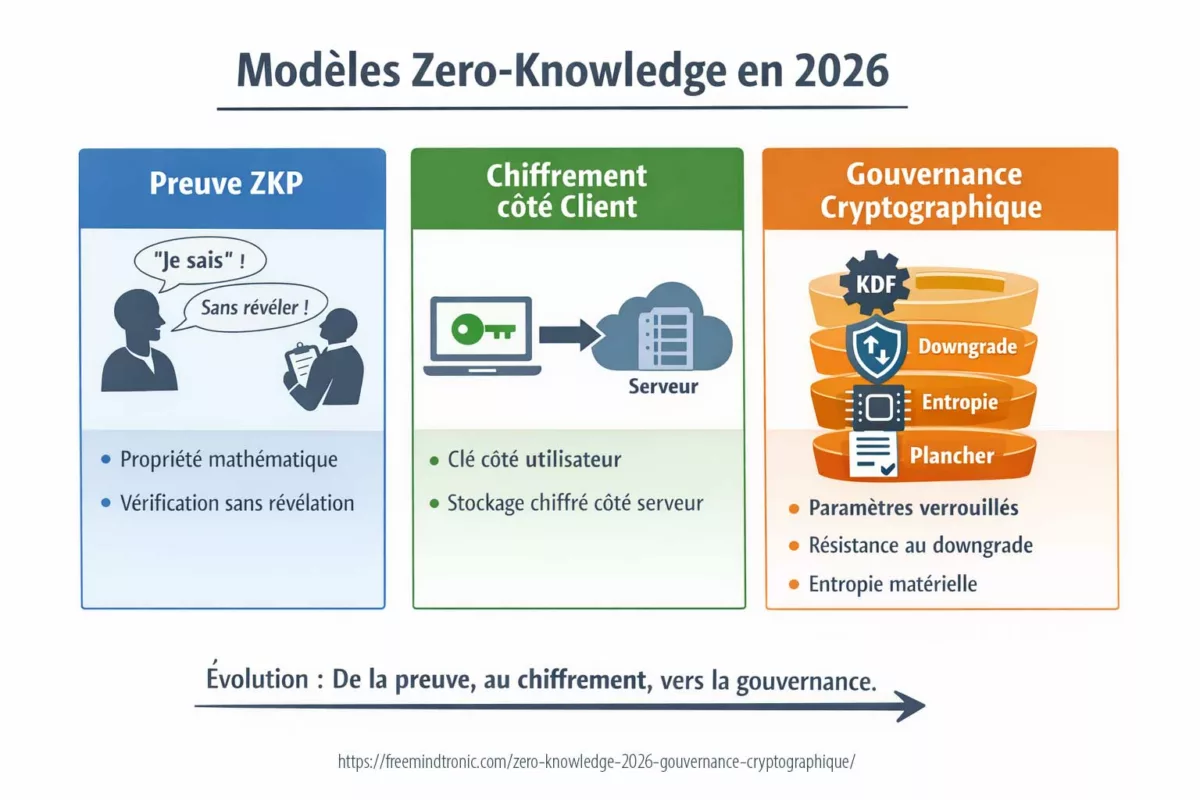
Cartographie conceptuelle : le terme zero-knowledge recouvre en 2026 trois réalités distinctes — propriété de preuve (ZKP), modèle de chiffrement côté client, et régime de gouvernance cryptographique. L’illustration suivante synthétise cette évolution doctrinale.

Schéma principe d’émergence cryptographique : clé non persistante issue de segments autonomes en architecture zero-knowledge
Représentation simplifiée du principe d’émergence cryptographique : la clé effective émerge localement de segments autonomes et disparaît après usage.

2024 Cyber Doctrine Cyberculture

Digital Authentication Security: Protecting Data in the Modern World

2025 Cyber Doctrine Cyberculture

Time Spent on Authentication: Detailed and Analytical Overview
2024 2025 Cyber Doctrine Cyberculture

Quantum Threats to Encryption: RSA, AES & ECC Defense

2025 Cyber Doctrine Cyberculture

Sovereign Passwordless Authentication — Quantum-Resilient Security

2024 Cyber Doctrine Cyberculture Legal information

ANSSI Cryptography Authorization: Complete Declaration Guide

Articles Cyber Doctrine EviCore NFC HSM Technology legal News Training

Dual-Use Encryption Products: a regulated trade for security and human rights

2024 Cyber Doctrine Cyberculture

ITAR Dual-Use Encryption: Navigating Compliance in Cryptography

2024 Cyber Doctrine Cyberculture

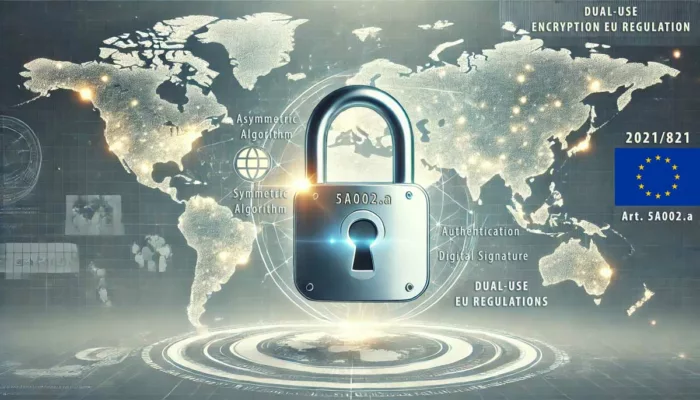
Encryption Dual-Use Regulation under EU Law

2025 Cyber Doctrine Cyberculture

Uncodified UK constitution & digital sovereignty

Cette chronique doctrinale appartient à la catégorie Digital Security. Elle prolonge le travail de clarification conceptuelle sur la souveraineté des paramètres cryptographiques et la robustesse des architectures zero-knowledge.

Résumé avancé — De la promesse “sans clé” à la gouvernance cryptographique

⮞ Reading Note

Ce résumé avancé prend ~6 minutes. Il relie la sémantique du zero-knowledge aux standards publics, puis introduit la gouvernance des paramètres et les limites irréversibles.

D’abord, la cryptographie académique définit le zero-knowledge comme une propriété formelle de preuve. Ensuite, l’industrie a transposé le terme à des architectures de chiffrement côté client. Pourtant, cette transposition a créé une polysémie : on parle du même mot pour des objets conceptuels différents. Or, dès que la confiance repose sur une expression ambiguë, le débat se fragmente.

Ainsi, on doit qualifier le terme. Lorsque l’on parle de ZKP, on traite de vérification sans divulgation. En revanche, lorsque l’on parle de zero-knowledge encryption model, on traite de confidentialité des données, de possession de clé et de modèle de menace. Cependant, même dans ce second cas, la possession de clé ne suffit plus.

En 2026, la robustesse dépend fortement de la gouvernance des paramètres cryptographiques : choix du KDF, itérations, mémoire, parallélisme, sel, rétrocompatibilité. Par conséquent, une architecture peut rester “zero-knowledge” au sens de la clé, tout en devenant fragile au sens du plancher cryptographique si elle tolère des paramètres affaiblis ou des chemins de downgrade.

⮞ Summary
Le débat se déplace : au lieu de demander si un fournisseur “voit la clé”, on doit vérifier s’il contrôle — ou influence — les paramètres et les rétrocompatibilités qui définissent la résistance réelle.

Chronique — Zero-knowledge en 2026 : ce que le terme signifie réellement

Constat : dilution du terme et polysémie

Le terme zero-knowledge s’est diffusé parce qu’il résume une promesse intuitive : “le service ne peut pas lire”. Toutefois, cette promesse se décline en plusieurs mécanismes. D’une part, elle renvoie à des preuves cryptographiques formelles. D’autre part, elle renvoie à des systèmes de stockage chiffré. En conséquence, le débat mélange parfois preuve, chiffrement et gouvernance.

Pour éviter les affirmations absolues, on doit donc préciser l’objet : parle-t-on d’une preuve, d’un modèle de chiffrement, ou d’un régime de gouvernance des paramètres ? Cette chronique propose un cadre d’analyse, sans prétendre imposer une norme.

Mutation doctrinale : de propriété cryptographique à régime de gouvernance

Pendant plusieurs décennies, le zero-knowledge a désigné une propriété : une preuve sans divulgation. Ensuite, l’industrie a transposé le terme vers une architecture : le chiffrement côté client avec non-possession de clé.

Cependant, en 2026, une troisième étape apparaît. Le zero-knowledge devient un régime de gouvernance cryptographique.

Autrement dit, il ne décrit plus uniquement :

  • Une propriété mathématique (ZKP),
  • Ni un modèle technique (clé côté client),

Il décrit désormais :

  • Un système de décision sur les paramètres,
  • Un contrôle des planchers cryptographiques,
  • Une gestion explicite des rétrocompatibilités,
  • Une invariance paramétrique documentée.

Ainsi, le débat contemporain ne porte plus seulement sur la visibilité des secrets, mais sur l’autorité exercée sur les paramètres qui conditionnent leur robustesse.

Thèse centrale reformulée :
En 2026, le zero-knowledge n’est plus seulement une propriété d’accès aux clés. Il devient un régime de gouvernance des paramètres cryptographiques et de leurs invariants.

Définition historique : origine académique du zero-knowledge (ZKP)

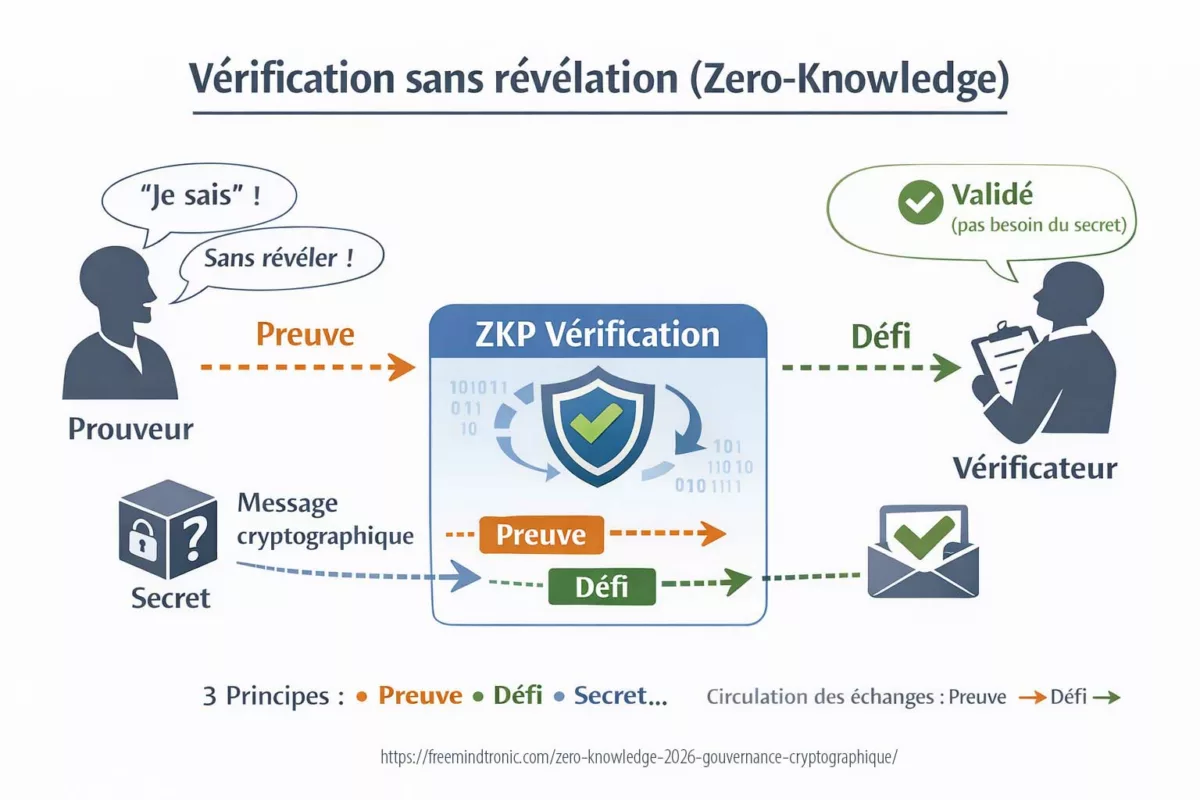
Les Zero-Knowledge Proofs (ZKP) décrivent une propriété où un vérificateur apprend uniquement la validité d’une assertion, sans obtenir d’information sur le secret. Goldwasser, Micali et Rackoff ont formalisé ce cadre et l’ont publié dans le Journal of the ACM. Ainsi, le “zero-knowledge” historique concerne un régime de preuve.

Référence académique : The Knowledge Complexity of Interactive Proof Systems (JACM).

Afin de clarifier la distinction entre la définition académique du Zero-Knowledge Proof (ZKP) et le modèle industriel de chiffrement zero-knowledge, le schéma suivant illustre le principe fondamental de vérification sans révélation du secret.

Schéma explicatif Zero-Knowledge Proof (ZKP) : vérification sans révélation du secret entre prouveur et vérificateur en cryptographie
Illustration pédagogique du fonctionnement d’un Zero-Knowledge Proof (ZKP) : le prouveur démontre qu’il connaît un secret sans jamais le divulguer au vérificateur.

Définition opérationnelle : modèle zero-knowledge de chiffrement côté client

Dans son sens opérationnel, le zero-knowledge signifie généralement que le fournisseur ne détient pas la clé de déchiffrement. Par conséquent, le déchiffrement s’effectue côté client. Toutefois, cette définition suppose un modèle de menace souvent passif : le serveur stocke du chiffré, mais ne manipule pas activement les paramètres.

Or, en pratique, la dérivation de clé dépend de standards paramétrables. Ainsi, PBKDF2 et Argon2 définissent des réglages qui modifient directement la résistance au brute force. Références officielles :

Limites contemporaines : négociation KDF, rétrocompatibilité, downgrade

Lorsque l’architecture laisse le protocole négocier des paramètres (itérations, mémoire, modes hérités), elle crée un espace de gouvernance. Ainsi, un système peut préserver la non-possession de clé tout en tolérant des paramètres affaiblis pour des raisons de compatibilité. Par conséquent, on doit distinguer “confidentialité nominale” et “robustesse effective”.

Autrement dit, la question moderne devient : le client accepte-t-il une négociation descendante ? Si oui, alors le plancher cryptographique devient négociable. Or, une fois que des paramètres faibles ont servi à dériver une clé, la correction exige généralement re-dérivation et re-chiffrement : on ne “répare” pas rétroactivement la robustesse.

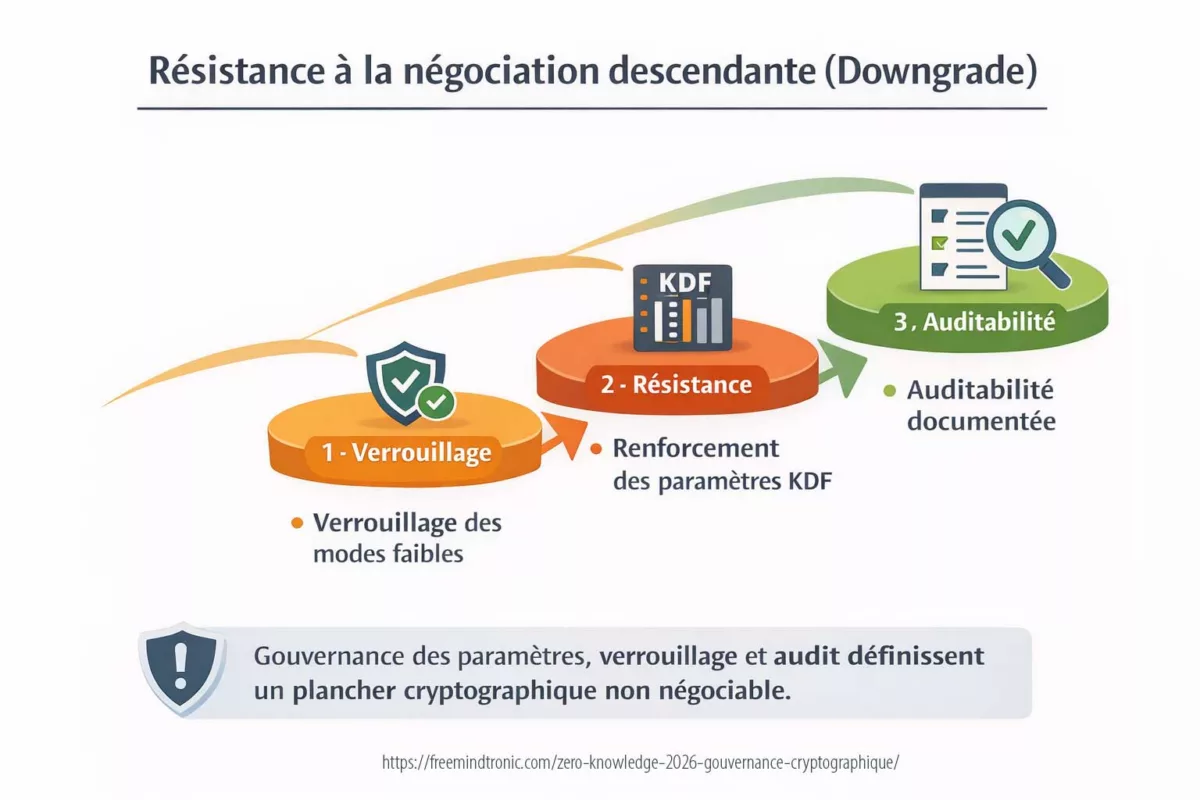
La résistance au downgrade cryptographique constitue aujourd’hui un critère déterminant de maturité zero-knowledge. Le schéma ci-dessous synthétise les trois piliers d’un plancher cryptographique non négociable : verrouillage, renforcement paramétrique et auditabilité.

Schéma résistance au downgrade cryptographique : verrouillage des paramètres KDF et plancher cryptographique non négociable
Schéma simplifié illustrant la résistance à la négociation descendante (downgrade) grâce au verrouillage des paramètres cryptographiques et à l’auditabilité.

Modèle de menace explicite du zero-knowledge en 2026

Toute qualification du zero-knowledge suppose un modèle de menace clairement défini. En l’absence de cette explicitation, le terme risque de devenir purement déclaratif.

En 2026, plusieurs hypothèses d’attaque doivent être distinguées :

1 — Attaquant passif côté serveur

Le fournisseur stocke des données chiffrées sans chercher à influencer les paramètres. Dans ce modèle classique, la non-possession de clé constitue la condition principale.

2 — Attaquant actif négociateur

Le serveur ou un intermédiaire peut influencer la négociation des paramètres (KDF, algorithmes, rétrocompatibilités). Ici, la robustesse dépend de l’invariance paramétrique et de la résistance au downgrade.

3 — Attaquant matériel ou local

L’attaquant cible la mémoire volatile, les dispositifs physiques ou les segments autonomes. Dans ce cas, la volatilité stricte et l’autonomie entropique deviennent déterminantes.

4 — Attaquant à capacité étendue (post-quantique)

L’hypothèse d’un adversaire disposant de capacités computationnelles avancées impose une réflexion sur l’agilité cryptographique et la migration ascendante.

Clarification doctrinale : Le zero-knowledge ne constitue pas une propriété absolue. Il est toujours qualifié relativement à un modèle de menace explicite.

Ainsi, la gouvernance cryptographique consiste à aligner les paramètres, l’entropie et les mécanismes d’invariance sur les hypothèses d’attaque retenues.

ISO/IEC 11770 : gouvernance du cycle de vie des clés

Ensuite, la doctrine de sécurité doit intégrer la gestion du cycle de vie des clés : génération, distribution, stockage, révocation. ISO/IEC 11770 formalise ces mécanismes. Ainsi, la sécurité ne se limite pas à l’algorithme : elle dépend aussi des processus et des responsabilités.

Référence officielle : ISO/IEC 11770 — Key Management.

Responsabilité et imputabilité cryptographique

À mesure que le zero-knowledge devient une question de gouvernance, une interrogation supplémentaire apparaît : qui assume la responsabilité du plancher cryptographique ?

Les standards définissent des mécanismes. Cependant, ils ne désignent pas toujours clairement l’autorité décisionnelle sur les paramètres.

Or, dans une architecture zero-knowledge contemporaine :

  • Quel acteur fixe le nombre minimal d’itérations ?
  • Qui décide de supprimer un mode hérité ?
  • Qui documente publiquement le plancher ?
  • Qui engage sa responsabilité en cas de paramètre insuffisant ?

Ainsi, la gouvernance cryptographique devient une question d’imputabilité.

En effet, un plancher non documenté rend la responsabilité diffuse. À l’inverse, un plancher explicitement publié crée un engagement technique et éditorial.

Point doctrinal : La maturité zero-knowledge implique une responsabilité explicite sur les paramètres, et non seulement une déclaration de non-possession de clé.

Vérifiabilité du plancher cryptographique

Déclarer un plancher cryptographique ne suffit pas. Encore faut-il qu’il soit vérifiable.

La robustesse doctrinale du zero-knowledge dépend de la capacité d’un utilisateur, d’un auditeur ou d’un expert indépendant à constater :

  • Les paramètres KDF effectivement utilisés (itérations, mémoire, parallélisme).
  • L’absence de modes hérités activables.
  • L’impossibilité technique d’un downgrade silencieux.
  • La conformité aux standards publics annoncés.

Auditabilité

La vérifiabilité peut reposer sur :

  • Une documentation publique des paramètres.
  • Des audits indépendants.
  • Une inspection du code lorsque cela est possible.
  • Des mécanismes d’attestation ou de preuve de configuration.

Limite doctrinale

Un plancher non documenté ou non vérifiable reste une déclaration unilatérale.

Principe :
En 2026, un zero-knowledge mature ne se contente pas d’affirmer la non-possession de clé. Il rend son plancher paramétrique observable et contrôlable.

La vérifiabilité devient ainsi un prolongement naturel de la gouvernance cryptographique.

Agilité cryptographique : perspective ENISA

Par ailleurs, la transition post-quantique réactive la notion d’agilité cryptographique. ENISA souligne l’intérêt d’architectures capables d’évoluer sans rupture systémique. Cependant, l’agilité ne justifie pas la permissivité au downgrade : elle organise la migration ascendante, pas la dégradation.

Référence ENISA : Post-Quantum Cryptography: current state and quantum mitigation.

Dimension quantique et gouvernance cryptographique

L’émergence des capacités de calcul quantique ne remet pas en cause l’ensemble de la cryptographie contemporaine. Elle affecte principalement certaines primitives asymétriques (RSA, ECC, Diffie–Hellman) via l’algorithme de Shor, ainsi que la recherche exhaustive via l’algorithme de Grover.

Impact différencié

Il convient de distinguer :

  • Cryptographie asymétrique classique : vulnérable à long terme (Shor).
  • Cryptographie symétrique bien dimensionnée : résistance réduite quadratiquement (Grover), mais conservant une sécurité exponentielle si les tailles de clés sont adaptées (ex. 256 bits).
  • Fonctions mémoire-hard (Argon2) : dépendance au coût matériel et énergétique, moins favorable aux accélérations quantiques massives.

Ainsi, le risque quantique impose une gouvernance adaptative des paramètres, mais ne rend pas obsolètes les architectures symétriques correctement dimensionnées.

Harvest now, decrypt later

Le risque stratégique majeur réside dans la capture actuelle de données chiffrées destinées à être déchiffrées ultérieurement lorsque les capacités quantiques seront suffisantes.

Dans ce contexte :

  • Les architectures à secret persistant sont structurellement exposées.
  • Les architectures à clé émergente strictement volatile réduisent la surface de captation différée.

Une clé qui n’existe qu’au moment de l’usage, puis disparaît, limite mécaniquement l’intérêt d’une captation longue durée.

Conséquence doctrinale

En 2026, la maturité zero-knowledge implique :

  • Une capacité de migration ascendante vers des primitives post-quantiques si nécessaire.
  • Une augmentation anticipée des tailles de clés symétriques.
  • Un refus des mécanismes asymétriques vulnérables à long terme.
  • Une réduction structurelle des secrets persistants.

Le quantique ne redéfinit pas le zero-knowledge ; il renforce l’exigence de gouvernance paramétrique et de limitation ontologique des secrets durables.

Approfondissements techniques

Pour une analyse détaillée des vulnérabilités asymétriques face aux capacités quantiques émergentes : Quantum threats to encryption

Pour une étude spécifique de la robustesse d’AES-256, de la segmentation de clé et de la résilience face à Grover : AES-256 CBC quantum security & key segmentation

Analyse des implications du quantique sur RSA et les mécanismes asymétriques classiques : Quantum computing and RSA encryption

Pour un aperçu des avancées récentes en calcul quantique et de leur portée réelle en matière cryptographique : Quantum computer 6100 qubits – Historic 2025 breakthrough.

Entropie informationnelle et entropie matérielle — Fondement shannonien

La robustesse d’un système zero-knowledge ne dépend pas uniquement d’un algorithme, ni même d’un nombre d’itérations KDF. Elle dépend en amont d’un paramètre plus fondamental : l’entropie.

Pour une application concrète de cette limite entropique dans le contexte de l’ère quantique et des mots de passe à haute imprévisibilité, voir : How to create and protect strong passwords in the age of quantum computing.

Claude Shannon a défini l’entropie informationnelle comme mesure mathématique de l’incertitude d’une source. En cryptographie, cette incertitude conditionne directement la résistance aux attaques exhaustives. Autrement dit, un secret à faible entropie reste structurellement vulnérable, quel que soit l’algorithme employé.

Ainsi, dans une architecture zero-knowledge, l’entropie initiale devient une frontière irréversible. Si la génération de clé repose sur une source faiblement entropique, aucune augmentation ultérieure du nombre d’itérations, ni aucun ajustement paramétrique, ne peut restaurer l’imprévisibilité perdue.

Cette réalité rejoint les exigences des standards contemporains, notamment la série NIST SP 800-90 relative aux générateurs de bits aléatoires. Cependant, au-delà des implémentations techniques, le principe reste shannonien : la sécurité ne peut dépasser l’entropie de sa source.

Principe doctrinal :
Le plancher cryptographique réel d’un système zero-knowledge est borné par l’entropie effective à la génération des clés. Si cette entropie est insuffisante, la limite devient structurelle et irréversible.

Par conséquent, lorsqu’on analyse la gouvernance cryptographique zero-knowledge, il ne suffit pas de vérifier la non-possession de clé ou la résistance au downgrade. Il faut également examiner la qualité informationnelle de la source d’entropie.

Pourquoi un cadre shannonien plutôt qu’une simple “méthode d’entropie” ?

Lorsqu’une architecture affirme générer de l’entropie, elle peut se référer à des méthodes techniques concrètes : générateur pseudo-aléatoire, TRNG matériel, bruit thermique, oscillations physiques, etc. Toutefois, ces mécanismes décrivent une implémentation. Ils ne définissent pas, en eux-mêmes, un cadre théorique de mesure.

Claude Shannon, dans sa théorie mathématique de l’information (1948), a introduit une mesure formelle de l’incertitude : l’entropie informationnelle. Cette mesure ne dépend pas d’un dispositif particulier ; elle modélise le degré d’imprévisibilité d’une source.

En se référant à Shannon, une architecture ne revendique pas un procédé spécifique de génération d’aléa. Elle adopte un cadre d’évaluation : la sécurité effective ne peut excéder l’entropie mesurable du secret initial.

Ainsi, le choix d’un cadre shannonien ne remplace pas les standards techniques (NIST SP 800-90, ISO/IEC 11770, RFC 9106). Il les précède conceptuellement. Il rappelle que :

  • Un secret de faible entropie reste vulnérable, même avec un algorithme robuste.
  • Un nombre élevé d’itérations KDF n’augmente pas l’espace de clés si l’entropie initiale est bornée.
  • La résistance exponentielle dépend directement du nombre effectif de bits d’incertitude.

Autrement dit, la référence à Shannon n’est pas un argument marketing. C’est un rappel mathématique : la sécurité cryptographique est plafonnée par l’entropie informationnelle du secret généré.

Dans cette perspective, la gouvernance cryptographique zero-knowledge doit examiner non seulement les algorithmes, mais aussi la qualité mesurable de la source d’incertitude. C’est pourquoi un cadre shannonien offre une base conceptuelle plus fondamentale qu’une simple description de méthode.

Entropie informationnelle : Shannon face aux méthodes de génération

Lorsqu’une architecture cryptographique affirme « générer de l’entropie », elle peut en réalité désigner des mécanismes très différents. Avant de comparer les approches, il convient de rappeler la base théorique.

1 — Le cadre fondamental : l’entropie selon Shannon (1948)

Claude Shannon a défini l’entropie informationnelle comme mesure mathématique de l’incertitude d’une variable aléatoire. Elle s’exprime par la formule :

H(X) = − Σ p(x) log₂ p(x)

Cette équation mesure le nombre moyen de bits d’incertitude d’une source. En cryptographie, cela signifie que la résistance théorique d’un secret dépend directement du nombre effectif de bits d’imprévisibilité.

Ainsi, si un secret possède 128 bits d’entropie réelle, sa résistance maximale correspond à un espace de 2¹²⁸ possibilités. En revanche, si l’entropie effective n’est que de 40 bits, l’espace réel n’est plus que de 2⁴⁰, indépendamment de l’algorithme utilisé.

Principe shannonien : La sécurité d’un système ne peut excéder l’entropie informationnelle du secret initial.

2 — Méthodes courantes de génération d’entropie

En pratique, plusieurs mécanismes techniques sont utilisés pour produire de l’aléa :

  • PRNG (Pseudo-Random Number Generator) : générateurs déterministes initialisés par une graine.
  • DRBG conformes NIST SP 800-90A : générateurs déterministes sécurisés.
  • TRNG (True Random Number Generator) : bruit thermique, oscillations électroniques, jitter.
  • HRNG (Hardware Random Number Generator) : circuits dédiés intégrés aux processeurs.
  • Sources environnementales : mouvements de souris, timings clavier, événements système.

Ces méthodes décrivent comment l’aléa est produit. Toutefois, elles ne répondent pas directement à la question fondamentale : quelle est l’entropie mesurable réellement obtenue ?

3 — Limites structurelles des approches purement techniques

Un PRNG, par définition, ne crée pas d’entropie ; il l’étend à partir d’une graine initiale. Si cette graine est faible, toute la séquence devient prédictible.

Un TRNG matériel peut produire un bruit physique robuste, mais il nécessite une validation statistique continue pour éviter les biais.

Les sources environnementales offrent souvent une entropie limitée et difficilement quantifiable.

Autrement dit, ces méthodes décrivent des mécanismes physiques ou logiciels. Elles ne constituent pas, en elles-mêmes, un cadre théorique de mesure de la sécurité.

4 — Pourquoi un cadre shannonien est plus pertinent doctrinalement

Se référer à Shannon ne signifie pas ignorer les méthodes techniques. Au contraire, cela impose une exigence supplémentaire : mesurer et borner l’entropie effective.

Le cadre shannonien permet :

  • De quantifier l’incertitude réelle d’un secret.
  • D’évaluer l’espace de recherche effectif d’un attaquant.
  • D’identifier une limite théorique indépendante des implémentations.
  • D’éviter la confusion entre « complexité algorithmique » et « imprévisibilité réelle ».

Ainsi, alors qu’une méthode technique décrit un processus, le cadre shannonien définit une borne mathématique. Il précède l’implémentation et structure son évaluation.

En conséquence, dans une analyse de gouvernance cryptographique zero-knowledge, la question pertinente devient :

Combien de bits d’entropie informationnelle mesurable possède réellement le secret généré ?

Cette question dépasse la simple description d’un générateur. Elle engage la sécurité exponentielle du système.

Application pratique d’un cadre shannonien — Freemindtronic

Dans le cadre de ses architectures de sécurité, Freemindtronic a fait le choix méthodologique d’utiliser un référentiel shannonien pour évaluer l’entropie lors de la génération de clés, de mots de passe et de segments cryptographiques.

Ce choix ne concerne pas l’algorithme de chiffrement lui-même — lequel repose sur des standards ouverts — mais la manière dont l’incertitude initiale est mesurée et contrôlée au moment de la génération du secret.

Concrètement, l’objectif est d’estimer le nombre effectif de bits d’entropie informationnelle produits au moment de la création. Cette évaluation s’inscrit dans une logique mathématique : la sécurité maximale atteignable ne peut excéder l’entropie mesurable du secret généré.

Ainsi, plutôt que de se limiter à la description d’un générateur pseudo-aléatoire ou matériel, l’architecture adopte une approche fondée sur la quantification de l’incertitude selon la théorie de l’information.

Ce positionnement s’inscrit dans une continuité académique. Il ne constitue pas une rupture avec les standards techniques (NIST SP 800-90, ISO/IEC 11770, RFC 9106), mais une couche conceptuelle supplémentaire visant à encadrer la génération des secrets.

Position méthodologique : L’entropie est évaluée comme une grandeur informationnelle mesurable, et non uniquement comme un processus technique de génération.

En conséquence, ce choix doctrinal vise à assurer une cohérence entre génération de secret, borne mathématique de sécurité et gouvernance cryptographique globale.

Zero-knowledge émergent non médié

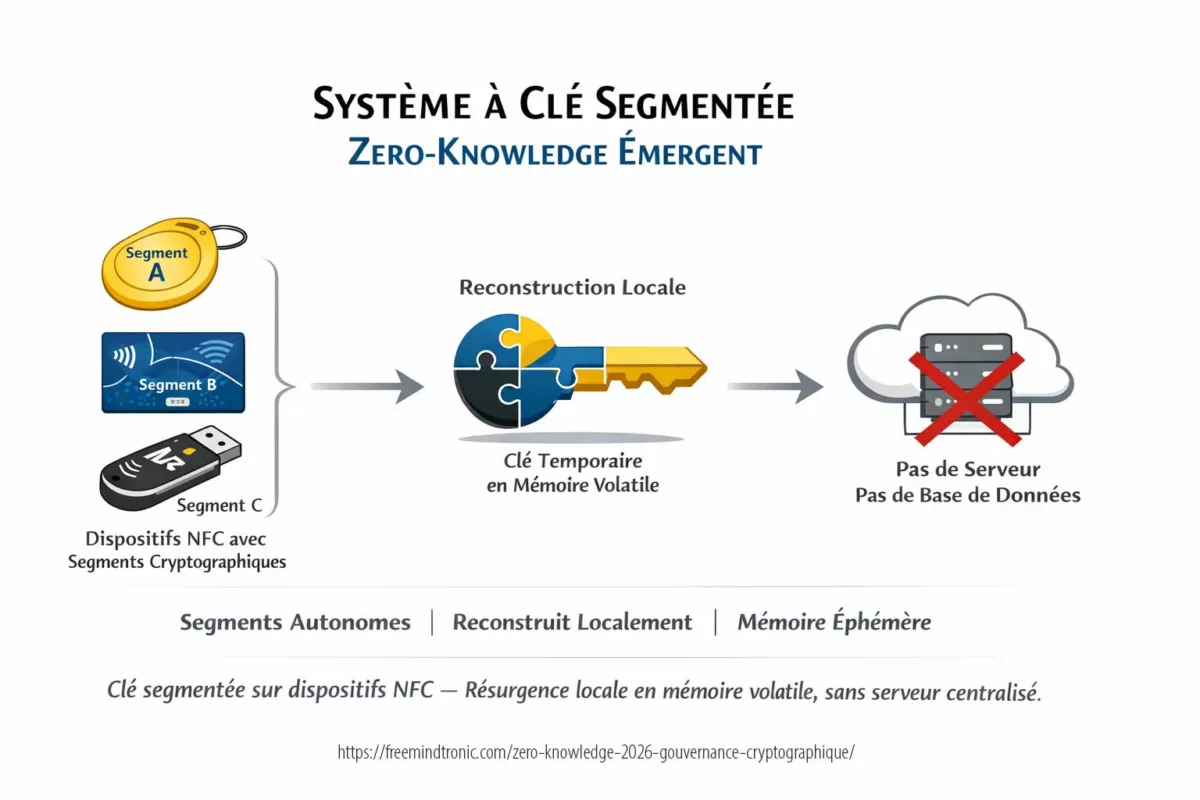
Le système décrit dans le brevet WO2018154258A1 repose sur une segmentation de clé distribuée sur plusieurs dispositifs physiques NFC, avec reconstruction locale et stockage exclusivement volatile.

Contrairement à un schéma classique de partage de secret, aucun secret maître persistant n’est découpé. Chaque segment constitue une entité cryptographique autonome.

La clé effective n’existe pas en permanence. Elle émerge temporairement d’une composition locale volontaire, puis disparaît après usage.

Schéma synthétique : dans une architecture à clé segmentée, la clé opérationnelle n’est jamais stockée de manière persistante. Elle est reconstruite localement en mémoire volatile, par concaténation contrôlée de segments cryptographiques autonomes (ex. dispositifs NFC, clé USB, SSD), puis effacée immédiatement après usage. Aucun serveur, aucune base de données centrale, aucune clé maîtresse persistante n’existent dans l’architecture.

Schéma zero-knowledge gouvernance 2026 : système à clé segmentée NFC, reconstruction locale en mémoire volatile, sans serveur ni base de données centrale
Architecture zero-knowledge émergente : clé segmentée sur dispositifs NFC autonomes, reconstruction locale temporaire en mémoire volatile, absence de serveur central — illustration du principe d’émergence cryptographique dans la gouvernance cryptographique 2026.

Cette architecture peut être qualifiée, au sens analytique, de « zero-knowledge émergent non médié ».

Elle ne repose pas sur la non-possession d’un tiers, mais sur l’inexistence structurelle de tout intermédiaire susceptible de détenir ou de négocier les paramètres.

La confidentialité découle donc d’une absence ontologique de médiation et d’une volatilité stricte de la clé effective.

5 — Intégration dans la matrice de gouvernance

Dans la matrice doctrinale, la dimension « entropie » doit donc être évaluée en termes shannoniens :

Dimension Question Risque si faible Irréversibilité
Entropie informationnelle Nombre effectif de bits d’incertitude mesurable ? Réduction exponentielle de l’espace de clés Critique

Une fois qu’un secret a été généré avec une entropie limitée, aucune augmentation ultérieure du nombre d’itérations KDF ni aucun changement d’algorithme ne peut restaurer rétroactivement l’incertitude perdue.

Limite irréversible : La perte d’entropie à la génération constitue une borne mathématique définitive. Elle ne peut être corrigée sans régénération complète du secret.

Par conséquent, le recours à Shannon ne relève pas d’un choix marketing ni d’une préférence technologique. Il s’agit d’un positionnement conceptuel : évaluer la sécurité à partir de sa limite informationnelle fondamentale.

Axiomes du zero-knowledge émergent

Afin de clarifier la nature spécifique d’une architecture à segments autonomes, on peut formuler quatre axiomes analytiques. Ces axiomes ne constituent pas une norme, mais un cadre de compréhension.

Axiome 1 — Inexistence persistante de la clé

La clé effective n’existe pas de manière durable. Elle apparaît uniquement lors de la composition volontaire des segments, puis disparaît après usage. Ainsi, il n’existe aucun secret central stocké en permanence.

Axiome 2 — Autonomie entropique des segments

Chaque segment possède une entropie propre et mesurable. La compromission d’un segment ne révèle ni la totalité de l’espace combinatoire ni les autres segments.

Axiome 3 — Composition locale non médiée

La reconstruction s’effectue localement, sans tiers intermédiaire, sans serveur et sans base de données centralisée. Par conséquent, aucune négociation distante des paramètres n’est possible.

Axiome 4 — Volatilité stricte post-usage

La clé effective et les données sensibles sont stockées exclusivement en mémoire volatile et effacées immédiatement après usage. Cette volatilité constitue une limite structurelle contre la persistance involontaire.

Formulation synthétique :
Le zero-knowledge émergent repose sur l’absence ontologique de clé persistante et sur une composition entropique locale strictement volatile.

Principe d’émergence cryptographique

Formulation analytique

On peut désigner comme émergence cryptographique toute architecture dans laquelle un secret opérationnel ne possède pas d’existence persistante préalable, mais résulte d’une composition locale temporaire de composants cryptographiques autonomes.

Voir le schéma de reconstruction locale à clé segmentée : Zero-knowledge émergent non médié.

Dans ce modèle :

  • Le secret effectif n’est pas stocké durablement.
  • Il apparaît uniquement au moment de l’usage.
  • Il disparaît immédiatement après l’opération.

Cette propriété distingue les architectures protégeant un secret préexistant des architectures produisant un secret temporaire par composition.

Hypothèses structurantes

L’émergence cryptographique suppose cumulativement :

  • L’absence de clé maîtresse persistante.
  • L’autonomie entropique des segments.
  • Une reconstruction strictement locale.
  • Une volatilité post-usage.

Conséquence informationnelle

Si l’on adopte un cadre shannonien, la robustesse maximale correspond à l’espace combinatoire résultant des entropies segmentaires mobilisées.

La sécurité devient alors fonction :

  • De l’indépendance entropique des segments.
  • De l’absence de secret global stocké.
  • De la suppression de surface d’attaque persistante.

Formalisation minimale

Considérons un ensemble fini de segments cryptographiques autonomes :

S = {S₁, S₂, …, Sₙ}, avec n ≥ 2

Le nombre minimal de segments est fixé à deux (n ≥ 2), condition nécessaire pour qu’il y ait composition et non simple stockage. Toutefois, n n’est pas borné supérieurement.

Chaque segment Sᵢ est associé à une variable aléatoire indépendante Xᵢ possédant une entropie informationnelle H(Xᵢ).

La clé opérationnelle K est obtenue par une fonction de composition locale :

K = f(S₁, S₂, …, Sₙ)

Dans le cas d’une concaténation contrôlée et sous hypothèse d’indépendance statistique :

H(K) ≥ Σ H(Xᵢ), pour i = 1 à n

La propriété d’émergence cryptographique peut alors être exprimée temporellement :

∀ t ∉ Δt : K(t) = ∅

Autrement dit, la clé opérationnelle n’a pas d’existence persistante globale ; elle est instanciée exclusivement en mémoire volatile pendant une fenêtre d’usage Δt.

On distingue ainsi formellement :

  • Les architectures à secret global persistant K₀,
  • Des architectures à secret émergent K(t) défini uniquement pour t ∈ Δt.

Cette formalisation constitue une modélisation informationnelle minimale. Elle ne prétend pas démontrer une sécurité formelle complète, mais permet de caractériser analytiquement l’émergence cryptographique comme absence structurelle de secret persistant.

Attribution et origine conceptuelle

Le principe d’émergence cryptographique formulé ci-dessus trouve son origine dans l’invention de Jacques Gascuel, mise en œuvre dans le brevet international WO2018154258 et déployée au sein de plusieurs produits conçus et fabriqués par Freemindtronic. Cette invention repose sur une architecture de clés segmentées autonomes, sans serveur, sans base de données centralisée et sans clé maîtresse persistante. La formalisation doctrinale proposée dans cette chronique ne constitue pas un élément du brevet en tant que tel, mais une conceptualisation analytique a posteriori visant à qualifier le modèle dans le cadre plus large du débat sur le zero-knowledge en 2026. Autrement dit :

  • L’architecture technique relève de l’invention de Jacques Gascuel.
  • La formalisation en « principe d’émergence cryptographique » constitue une mise en perspective théorique de cette invention.

Cette précision permet de distinguer clairement :

  • L’antériorité inventive (brevet),
  • La formalisation doctrinale (analyse conceptuelle).

Positionnement méthodologique

La formalisation présentée ici constitue une analyse conceptuelle a posteriori d’une architecture existante. Elle vise à proposer un cadre d’interprétation dans le débat contemporain sur la gouvernance cryptographique.

Elle ne revendique pas un statut de théorie mathématique formellement démontrée, mais une structuration analytique destinée à clarifier les distinctions architecturales.

Discussion critique et limites

Toute formalisation doctrinale doit expliciter ses limites.

1 — Limite de validation formelle

Le principe d’émergence cryptographique constitue une grille analytique. Il ne remplace pas une preuve de sécurité formelle ni une démonstration mathématique complète au sens académique.

2 — Dépendance à l’implémentation

L’absence de clé persistante réduit certaines surfaces d’attaque, mais la robustesse effective dépend toujours :

  • De la qualité entropique réelle des segments.
  • De l’absence de fuite mémoire.
  • De la résistance matérielle des dispositifs physiques.

3 — Hypothèse d’indépendance entropique

Le modèle suppose que les segments conservent une indépendance statistique suffisante. Toute corrélation non maîtrisée pourrait réduire l’espace combinatoire réel.

4 — Champ d’application

Le principe ne prétend pas s’appliquer universellement à toutes les architectures zero-knowledge. Il qualifie un sous-ensemble spécifique d’architectures compositionnelles non médiées.

Une architecture émergente ne devient robuste que si ses hypothèses sont effectivement vérifiées en pratique.

Distinction avec les modèles cryptographiques classiques

Pour éviter toute confusion doctrinale, il convient de distinguer cette architecture des modèles existants.

  • Shamir Secret Sharing : un secret préexistant est fragmenté. Ici, aucun secret maître persistant n’est découpé.
  • HSM split key : une clé centrale existe et est protégée par fragmentation. Ici, la clé n’existe qu’au moment de l’usage.
  • Multi-signature : validation distribuée par consensus. Ici, il n’existe ni réseau, ni validation distribuée.
  • Zero-knowledge cloud : modèle médié par un fournisseur non détenteur. Ici, l’absence structurelle de tiers supprime la médiation.

Ainsi, le modèle relève d’une logique compositionnelle émergente et non d’un simple partage de secret.

Matrice de gouvernance cryptographique

Pour structurer l’analyse sans imposer une classification officielle, la matrice suivante isole les dimensions de gouvernance. Ainsi, elle clarifie où se situe l’autorité : dans la clé, dans les paramètres, dans la rétrocompatibilité, ou dans la transparence.

Dimension Question Risque si faible Irréversibilité
Possession de clé Le fournisseur détient-il la clé ? Rupture de confidentialité Élevée
Gouvernance KDF Qui fixe itérations et mémoire ? Brute force facilité Moyenne à élevée
Résistance au downgrade Des modes faibles restent-ils acceptables ? Dégradation forcée Élevée
Origine de l’entropie La source est-elle matériellement robuste ? Secrets prédictibles Critique
Agilité cryptographique Migration ascendante maîtrisée ? Obsolescence / rupture Moyenne
Transparence Plancher documenté publiquement ? Opacité du modèle Variable

Typologie analytique (cadre d’analyse, non norme)

Enfin, pour qualifier les discours sans juger les acteurs, on peut utiliser une typologie analytique. Elle sert de grille, non de label. Ainsi, elle aide à comparer des architectures sans affirmer qu’une seule catégorie serait “la bonne”.

  • Zero-knowledge déclaratif — non-possession de clé revendiquée, gouvernance paramétrique peu explicitée.
  • Zero-knowledge négociable — paramètres ajustés par compatibilité, négociations possibles.
  • Zero-knowledge à paramètres verrouillésplancher cryptographique non négociable, refus explicite des modes faibles.
  • Zero-knowledge souverain — contrôle utilisateur + invariance paramétrique + transparence, avec gouvernance clairement documentée.

Limites contemporaines et points d’arrêt

Lorsqu’un système laisse l’incertitude régner sur les paramètres, il crée une dette cryptographique. Par conséquent, la prudence impose un point d’arrêt : on ne scelle pas des données critiques sous des hypothèses fragiles. De plus, lorsque des paramètres faibles ont déjà servi, on doit envisager une migration complète plutôt qu’un simple “réglage”.

Quand ne pas agir : Si les paramètres cryptographiques sont incertains, non documentés ou downgradeables, évite de déployer un chiffrement irréversible à grande échelle. Stoppe avant le scellement des données, puis clarifie le plancher cryptographique.

Limite humaine et gouvernance comportementale

Une architecture zero-knowledge peut être mathématiquement robuste et néanmoins fragilisée par des comportements humains inadéquats.

1 — Entropie comportementale insuffisante

Un mot de passe faible ou réutilisé réduit l’entropie effective, indépendamment des paramètres KDF.

2 — Sauvegarde non sécurisée

Exporter des secrets vers un support non protégé peut neutraliser les garanties architecturales.

3 — Mauvaise gestion des dispositifs physiques

Dans une architecture segmentée, la perte simultanée ou la conservation non maîtrisée de segments peut créer un risque opérationnel.

4 — Confusion entre simplicité et robustesse

La recherche d’ergonomie peut conduire à des compromis paramétriques.

Conclusion intermédiaire :
Le zero-knowledge n’est pas uniquement une propriété cryptographique. Il constitue également une discipline comportementale.

Ainsi, la gouvernance cryptographique doit intégrer non seulement les paramètres techniques, mais aussi les usages réels et les pratiques humaines.

Bibliographie académique

FAQ doctrinale

Zero-knowledge : ZKP et chiffrement côté client, c’est la même chose ?Définition

Deux concepts distincts

Non. Les ZKP décrivent une propriété de preuve sans divulgation. En revanche, le zero-knowledge de chiffrement décrit une architecture de confidentialité où le fournisseur ne détient pas la clé. Ainsi, les deux notions partagent un vocabulaire, mais elles ne décrivent pas le même objet.

Pourquoi la gouvernance des paramètres KDF devient-elle centrale ?Paramètres

Le plancher cryptographique définit la résistance

Parce que PBKDF2 et Argon2 dépendent d’itérations, de mémoire et d’un sel. Par conséquent, si ces paramètres sont négociables ou rétrocompatibles, la résistance au brute force peut baisser. Ainsi, la gouvernance des paramètres devient une condition de robustesse.

L’agilité cryptographique justifie-t-elle la négociation descendante ?Agilité

Agilité ≠ downgrade

Non. L’agilité organise une migration ascendante (post-quantique, modernisation). En revanche, le downgrade autorise une dégradation. Ainsi, même si l’agilité est nécessaire, elle ne doit pas ouvrir des chemins vers des paramètres faibles.

Pourquoi l’entropie est-elle une limite irréversible ?Entropie

La cryptographie dépend d’un phénomène physique

Parce que l’entropie détermine l’imprévisibilité. Ainsi, si la génération repose sur une source faible, augmenter les itérations plus tard ne reconstitue pas l’imprévisibilité initiale. Par conséquent, l’entropie constitue une frontière matérielle.

Glossaire

Zero-knowledge
Concept

Définition

Terme polysémique. Historiquement, il renvoie à une propriété de preuve (ZKP) où l’on démontre une assertion sans révéler le secret. En usage industriel, il désigne souvent un modèle de chiffrement côté client où le fournisseur ne détient pas la clé. En 2026, il implique aussi une gouvernance cryptographique : plancher non négociable, verrouillage du downgrade, paramètres KDF et entropie documentée.

Ancre interne : #zero-knowledge-definition

Zero-Knowledge Proofs (ZKP)
Preuve

Définition

Famille de protocoles permettant de prouver la validité d’une assertion sans divulguer l’information secrète. Les ZKP traitent de vérifiabilité et de non-divulgation, mais ne décrivent pas, à eux seuls, la gestion du cycle de vie des clés ni la gouvernance des paramètres.

Ancre interne : #zkp-definition

Gouvernance cryptographique
Doctrine

Définition

Ensemble des règles, responsabilités et mécanismes qui déterminent qui fixe les paramètres cryptographiques, comment ils évoluent, et ce qui est refusé (downgrade, modes hérités, paramètres faibles). Elle définit la robustesse effective plus sûrement qu’un slogan “sans clé côté fournisseur”.

Ancre interne : #gouvernance-cryptographique

Plancher cryptographique
Paramètres

Définition

Seuil minimal non négociable de paramètres (KDF, itérations, mémoire, longueurs de clés, politiques de refus, retrait des modes hérités). Il empêche qu’une architecture reste “zero-knowledge” nominalement tout en devenant fragile par compatibilité.

Ancre interne : #plancher-cryptographique

KDF (Key Derivation Function)
Dérivation

Définition

Fonction transformant un secret initial (mot de passe, matériau cryptographique) en clé exploitable. Les paramètres (itérations, mémoire, parallélisme, sel) conditionnent la résistance au brute force. Une gouvernance mature documente ces paramètres et interdit leur affaiblissement.

Ancre interne : #kdf-definition

Négociation descendante (downgrade)
Risque

Définition

Acceptation de paramètres plus faibles (ou d’algorithmes hérités) pour raisons de compatibilité. Même sans accès à la clé, un downgrade peut abaisser le plancher réel et créer une dette cryptographique difficile à corriger.

Ancre interne : #downgrade-definition

Agilité cryptographique
Migration

Définition

Capacité d’une architecture à migrer vers de nouveaux paramètres ou algorithmes sans rupture. L’agilité organise la montée en robustesse ; elle ne doit pas ouvrir des chemins de dégradation (downgrade).

Ancre interne : #agilite-cryptographique

entropie informationnelle (Shannon)
Mesure

Définition

Mesure mathématique de l’incertitude d’une source. En cryptographie, elle borne la sécurité maximale atteignable : un secret à faible entropie reste structurellement vulnérable, même avec un algorithme robuste ou un grand nombre d’itérations.

Ancre interne : #entropie-informationnelle

Entropie matérielle (hardware-rooted entropy)
Physique

Définition

Entropie issue de phénomènes physiques (TRNG/HRNG, bruit thermique, jitter). Elle renforce l’imprévisibilité à la génération. Une entropie insuffisante à la source crée une limite irréversible au niveau de sécurité.

Ancre interne : #entropie-materielle

Invariance paramétrique
Garantie

Définition

Propriété selon laquelle les paramètres critiques ne peuvent pas être réduits dynamiquement (par compatibilité, pression produit, ou interop legacy). Elle matérialise un plancher non négociable et rend le “zero-knowledge” plus robuste doctrinalement.

Ancre interne : #invariance-parametrique

principe d’émergence cryptographique
Architecture

Définition

Cadre analytique où la clé effective n’existe pas de manière persistante : elle émerge temporairement d’une composition locale de segments autonomes, puis est dissoute après usage. La sécurité dépend alors de l’autonomie entropique des segments et de l’absence de secret global stocké.

Ancre interne : #emergence-cryptographique

Cycle de vie des clés
Gestion

Définition

Ensemble des phases : génération, distribution, stockage, rotation, révocation et destruction. Une gouvernance zero-knowledge mature documente ces phases et identifie l’autorité responsable des décisions.

Ancre interne : #cycle-vie-cles

What We Didn’t Cover

Cette chronique a volontairement laissé de côté l’exposé mathématique détaillé de protocoles ZKP spécifiques (zk-SNARKs, zk-STARKs) et les preuves de sécurité formelles. Elle s’est concentrée sur la doctrine d’usage et la gouvernance des paramètres dans les architectures numériques.

Critère de qualification analytique

Pour qu’une architecture puisse être qualifiée de zero-knowledge en 2026, elle doit satisfaire cumulativement :

  • Non-possession de clé par un tiers.
  • plancher cryptographique documenté.
  • Refus explicite du downgrade.
  • Entropie mesurable à la génération.
  • Gouvernance explicite du cycle de vie.
  • Responsabilité clairement identifiable.

À défaut, le terme relève d’un usage déclaratif et non d’un régime de gouvernance.

Définition stabilisée du zero-knowledge en 2026

Afin d’éviter la confusion sémantique, on peut proposer une définition qualifiée :

Zero-knowledge (2026) désigne une architecture dans laquelle :

  • Le fournisseur ne détient pas la clé de déchiffrement,
  • Les paramètres cryptographiques disposent d’un plancher non négociable,
  • Les chemins de downgrade sont explicitement verrouillés,
  • L’entropie à la génération est mesurable et documentée,
  • La gouvernance des clés est conforme aux standards publics.

Cette définition ne constitue pas une norme officielle. Elle propose un cadre d’analyse destiné à clarifier le débat.

Ainsi, le terme retrouve une précision conceptuelle adaptée aux exigences contemporaines.

Perspective stratégique : vers une maturité sémantique

Le zero-knowledge ne disparaît pas. Il évolue.

D’abord, il fut une propriété mathématique.
Ensuite, il devint un modèle de chiffrement côté client.
Aujourd’hui, il s’inscrit dans une gouvernance paramétrique.

Par conséquent, la maturité du débat exige une précision sémantique.

Si l’industrie souhaite préserver la confiance :

  • Elle devra qualifier le terme au lieu de l’étendre indéfiniment.
  • Elle devra publier les planchers cryptographiques.
  • Elle devra verrouiller les rétrocompatibilités descendantes.
  • Elle devra expliciter la qualité entropique à la génération.

En 2026, la cryptographie ne se limite plus aux algorithmes. Elle devient une discipline de gouvernance, de responsabilité et de limites irréversibles.

Le zero-knowledge ne se mesure plus au slogan. Il se mesure à l’invariance des paramètres.

Uncodified UK constitution & digital sovereignty

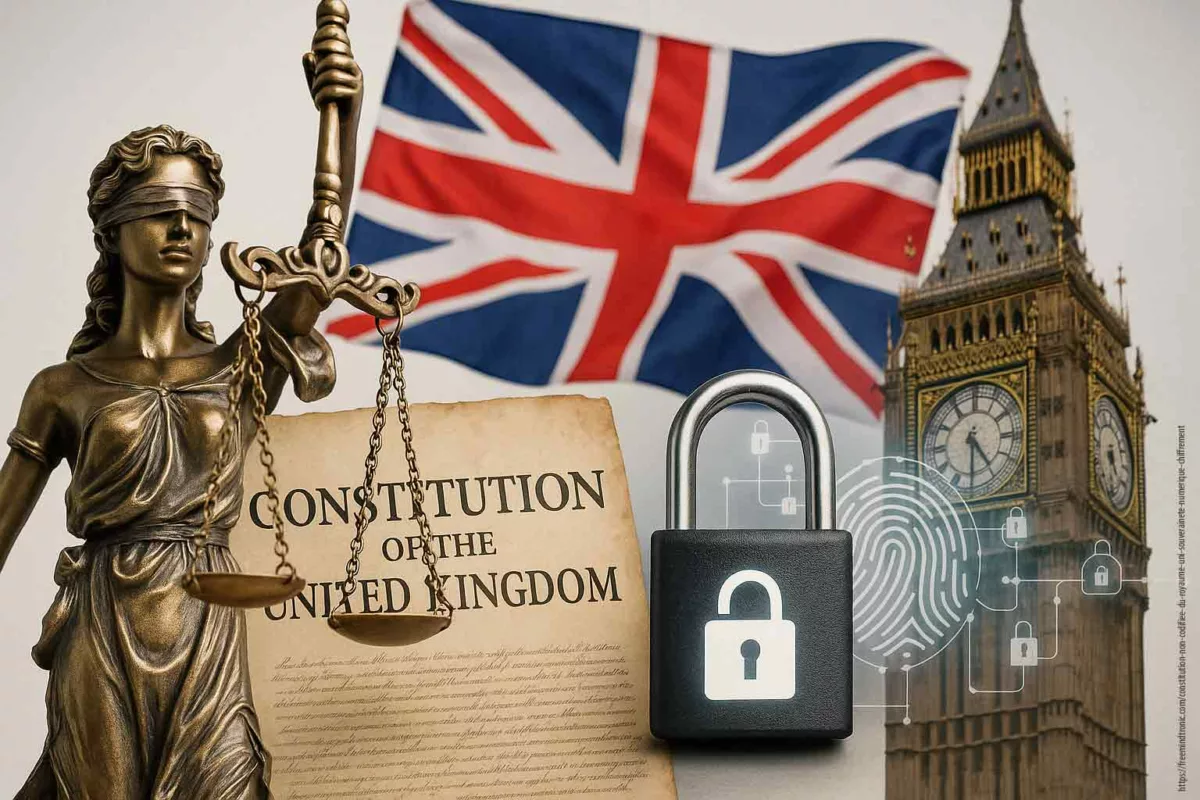
Illustration of the Uncodified UK constitution and digital sovereignty, showing the Houses of Parliament, a Union Jack shield, encrypted data streams and a padlock symbolising sovereign encryption and technical counter-powers

Uncodified UK constitution & digital sovereignty — A Freemindtronic cyber culture chronicle at the crossroads of British constitutional law, fundamental rights and sovereign encryption technologies protected by several patents granted in the United Kingdom.

Executive summary — Uncodified UK constitution

Uncodified constitution and British singularity

Lead-in — The United Kingdom looks like an anomaly among major democracies: it operates without a single written constitution. At the same time, it relies on one of the oldest and most influential political and judicial systems in the world. Moreover, between absolute parliamentary sovereignty, creative case-law and unwritten political conventions, this “blurred yet robust” architecture frames how the State may interfere with fundamental rights, privacy and, in the near future, encryption itself.

Quick read and digital stakes

Quick read (≈ 3 min): First, this chronicle is based on Nina Angela Fernando’s essay, À la défense de l’inécrit : le Royaume-Uni et sa constitution non codifiée, which we refer to here as the uncodified UK constitution. It then examines what it means, for cyber culture and digital sovereignty, to have a State whose constitution is essentially case-law, customary and legislative. In other words, it is not codified in a single supreme text.

Benefits and limits of both models

On the one hand, a written constitution would promise clarity, pedagogy and explicit safeguards against an “elective dictatorship”. It would guarantee a strict separation of powers, an entrenched catalogue of fundamental rights and a rigid amendment procedure. On the other hand, the British uncodified constitution offers extreme flexibility. It enables rapid adjustments in times of crisis (as Brexit clearly showed). However, this flexibility comes at the cost of theoretical legal uncertainty: core rights (life, privacy, freedom of expression) rest on ordinary statutes. Consequently, they can be reshaped by a determined parliamentary majority.

Sovereign technologies and technical checks and balances

In this context, the reflection directly reconnects with Freemindtronic’s DNA. Our technologies — offline encryption, segmented keys, access control without any third-party trust — are protected by several patents granted in the United Kingdom. They operate inside this flexible constitutional framework. Thus, they provide a form of technical counter-power. Even if the law is reconfigured, cryptographic protection remains governed by physics, mathematics and the user’s exclusive control of his or her keys.

Theoretical debate and concrete implications

Finally, this chronicle shows how a seemingly theoretical debate on codifying the British constitution actually sheds light on very concrete issues. It concerns a State’s ability to impose backdoors or not, the stability of fundamental rights, the role of judges and the strategic place of sovereign encryption technologies in an institutional environment that is constantly evolving.

Reading parameters

Reading time, executive summary: ≈ 3 minutes
Reading time, extended summary: ≈ 5 minutes
Reading time, full chronicle: ≈ 25 minutes
Publication date: 2025-12-09
Last update: 2025-12-09
Complexity level: Advanced — Constitutional law & cybersecurity
Technical density: ≈ 60%
Main language: EN. FR.
Specificity: Cyber culture chronicle — Uncodified UK constitution & digital sovereignty
Suggested reading path: Executive summary → Extended summary → Uncodified UK constitution → Rights & checks and balances → Technical sovereignty → Sovereign use case
Accessibility: Screen-reader friendly — structured anchors & semantic tags
Editorial type: Strategic chronicle — Cyber culture & legal geopolitics
Issue level: 8.3 / 10legal & technical sovereignty
About the author: Jacques Gascuel, inventor and founder of Freemindtronic Andorra, holder of several patents in smart electrical protection, wireless authentication and segmented keys, granted in particular in the United Kingdom.

Editorial note — This chronicle is part of the Freemindtronic Cyberculture collection. It is dedicated to sovereign architectures and large-scale data protection doctrines. It puts into perspective the uncodified UK constitution, digital sovereignty, and the relationships between political powers, judges and the technical counter-powers of sovereign encryption. This content extends the analyses published in the Cyberculture section. It follows Freemindtronic Andorra’s AI Transparency Declaration — FM-AI-2025-11-SMD5.

Key points

  • The United Kingdom does not have a single written constitution: its constitutional order rests on statutes, common law and conventions.
  • Parliamentary sovereignty allows rapid adjustments, yet it theoretically leaves open scenarios where fundamental rights could be restricted.
  • Judicial counter-powers (Supreme Court, GCHQ case-law, Miller, Ghaidan…) play a crucial role in protecting rights.
  • Freemindtronic patents granted in the UK frame sovereign encryption technologies which, in practice, constitute a technical counter-power within this institutional landscape.
  • A State’s legal sovereignty and the technical sovereignty of an encrypted infrastructure are two complementary dimensions of the same resilience strategy.

⮞ Preamble — The Uncodified UK constitution as a sovereignty laboratory

The Uncodified UK constitution makes the United Kingdom far more than an academic curiosity for constitutional lawyers. It turns the country into a living laboratory where, for centuries, institutions have actively tested different ways of articulating political power, fundamental rights and judicial oversight in real cases. Today, this evolving constitutional practice directly intersects with debates on digital sovereignty, surveillance and strong encryption.

At the same time, the United Kingdom is also a jurisdiction where Freemindtronic already protects its sovereign encryption and segmented-key architectures through patents granted in the UK. These patents take effect precisely while lawmakers, regulators and courts negotiate the limits of national security powers and the future of end-to-end encryption.

Consequently, this chronicle reads the Uncodified UK constitution as a kind of operating system for the State, which silently configures who may exercise power, who can challenge that power and under what conditions digital rights can be restricted. In parallel, it introduces another, complementary architecture: the technical counter-powers embodied by sovereign encryption, offline HSMs and local key control. Together, these legal and technical layers shape how far any actor can stretch its authority over data in a flexible but still rule-based constitutional order.

Extended summary — Uncodified UK constitution & digital sovereignty

From an unwritten constitution to technical guarantees

To go further, this extended summary sheds light on four major axes for cyber culture:

First, a constitutional order without a “sacred text”

In the United Kingdom, the constitution is not a single, supreme document but rather a bundle of sources: statutes (Bill of Rights 1689, Human Rights Act 1998…), case-law (Miller, Ghaidan, GCHQ…), political conventions (ministerial responsibility, the role of the Cabinet) and customs. This plasticity allows rapid adaptation to crises, as Brexit demonstrated, yet it also makes the system more difficult to read and understand for ordinary citizens.

Second, fundamental rights that are legally protected… but revisable.

Rights to life, privacy, freedom of expression or non-discrimination are, in practice, well protected through the ECHR as incorporated by the Human Rights Act 1998 and through dynamic jurisprudence. In theory, however, these rights remain anchored in ordinary statutes, which may be amended or repealed by a parliamentary majority, even if the political cost of such a move would be extremely high.

Third, a system of checks and balances largely built by judges.

The Supreme Court and higher courts act as a crucial safety net: they control governmental prerogatives (Miller), review the justiciability of certain royal prerogatives (GCHQ) and interpret ordinary statutes in light of convention rights (Ghaidan). This common-law constitutionalism works as a “backstop” that partially compensates for the absence of a codified constitutional text.

Finally, the rise of technical counter-powers.

Within this environment, sovereign offline encryption technologies, without servers or trusted third parties, become another form of counter-power. They make any future attempt to impose generalised backdoors or to centralise keys materially more difficult. Freemindtronic patents granted in the United Kingdom fit into this context: they legally formalise a technical sovereignty doctrine at the heart of a constitutional order that remains highly flexible.

⮞ Key insights — What you should remember

  • The Uncodified UK constitution combines political flexibility, strong parliamentary sovereignty and late but real judicial control.
  • Fundamental rights are protected by law and by the courts, yet they do not benefit from an entrenched “supreme text” as in some written constitutions.
  • Debates on codification reveal growing concern about possible concentration of powers — including in the digital and surveillance fields.
  • Freemindtronic technologies patented in the United Kingdom (wireless access control, segmented keys, offline HSMs) provide a technical complement to existing legal checks and balances.

Uncodified UK constitution: full chronicle & digital sovereignty

The chronicle that follows proposes a cross-reading: on the one hand, the Uncodified UK constitution as analysed by Nina Angela Fernando; on the other, the sovereign technical architectures developed by Freemindtronic and protected by patents granted in the UK. The objective is not to decide “for or against a written constitution”, but rather to show how these institutional choices shape and intersect with the issues of encryption, privacy and technical counter-powers.

Uncodified UK constitution: a democracy without a single text

Uncodified UK constitution: a “dispersed” constitution

The United Kingdom has no single document entitled “Constitution”. Instead, we find a set of sources:

  • Historic statutes (Magna Carta 1215, Bill of Rights 1689, Parliament Acts, Human Rights Act 1998, Constitutional Reform Act 2005, etc.);
  • Common law, where judges define and refine constitutional principles case by case;
  • Political conventions (for example, the Prime Minister must be a member of the House of Commons, the government must resign if it loses the confidence of the House);
  • Practices and usages recorded in documents such as the Cabinet Manual and, more recently, research papers from the House of Commons Library.

This system has two major strengths:

  • it is highly adaptable: Parliament can rapidly pass major reforms without a heavy constitutional amendment procedure;
  • it allows continuous interaction between the legislature, the courts and political conventions, instead of freezing power balances in an “untouchable” text.

However, this flexibility comes at a cost: it is difficult for a citizen — or even for a foreign lawyer — to clearly identify “where the constitution is” and which parts of this ensemble are genuinely untouchable.

Brexit: a stress test for the Uncodified UK constitution

Thus, Brexit served as a real stress test for this system. The question whether the government could trigger Article 50 of the Treaty on European Union without Parliament’s consent led to the judgment in R (Miller) v Secretary of State for Exiting the European Union [2017] UKSC 5. The Supreme Court held that:

  • the government could not, by simple use of the royal prerogative in foreign affairs, modify rights granted by an Act of Parliament;
  • therefore, explicit parliamentary authorisation was required to notify withdrawal from the EU.

In a State with a codified constitution, part of this question would have been answered directly in the text (distribution of powers, hierarchy of norms, treaty ratification and withdrawal procedures). In the United Kingdom, it is common law reasoning and judicial argumentation that, retrospectively, fixed the rule.

For cyber culture, this dimension is essential: it shows that the rules of the game on issues as central as sovereignty, treaties or (tomorrow) encryption and surveillance can be shaped through cases as they arise rather than fully anticipated in a stable constitutional text.

Uncodified UK constitution: fundamental rights and “elective dictatorship”

Uncodified UK constitution: Human Rights Act & ECHR as a shield

In practical terms, the protection of fundamental rights in the United Kingdom mainly relies on:

  • the European Convention on Human Rights (ECHR);
  • its incorporation into domestic law via the Human Rights Act 1998 (HRA).

This framework allows the courts:

  • to interpret domestic statutes, as far as possible, in a way that is compatible with the ECHR;
  • to issue a declaration of incompatibility between a statute and the Convention (without striking down the statute automatically, but creating strong political pressure to amend it);
  • to offer robust remedies to individuals whose rights have been violated.

Cases such as Daly, Ghaidan or A and others illustrate the courts’ ability to reinforce rights through imaginative and protective interpretation.

However, as Nina Angela Fernando stresses, the HRA is an ordinary statute. In theory, a future Parliament could:

  • repeal it outright; or
  • adopt a new, less protective national “Bill of Rights” in the name of sovereignty.

This is what Lord Hailsham famously called the risk of an “elective dictatorship”: a parliamentary majority produced by a majoritarian electoral system may concentrate power without the procedural safeguards of a rigid constitution.

A political impossibility… but not a mathematical one

In reality, many constraints make a brutal rollback of rights unlikely:

  • public opinion and civil society;
  • international commitments;
  • judicial resistance to overly restrictive interpretations;
  • the political and diplomatic cost of a clear break with the ECHR system.

Yet, for a security engineer or an architect of sovereign systems, the question is not framed in terms of political probability but rather in terms of the risk surface. A right that can, in theory, be weakened should, therefore, be doubled by a technical guarantee.

This is where sovereign encryption comes in: it makes it far more difficult, even for a determined State, to turn a legal hypothesis into an operational reality of mass surveillance.

Uncodified UK constitution: from judicial review to technical counter-powers

Institutional checks and balances

In the United Kingdom, checks and balances rest on several pillars:

  • the Parliament, which can scrutinise the executive (committees, questions, confidence votes);
  • the courts, which control the use of governmental powers and interpret statutes (GCHQ, Miller, Ghaidan…);
  • conventions and political culture, which impose unwritten standards of behaviour (ministerial responsibility, resignations, independent inquiries);
  • oversight bodies (parliamentary committees, independent authorities, sometimes under pressure but still active).

These mechanisms are real and often effective. Yet they remain anchored in the realm of law and politics. They intervene after the fact, once a bill, an administrative practice or an executive decision has already raised concerns.

Cryptographic checks and balances

Furthermore, Freemindtronic architectures introduce another type of checks and balances, this time at the technical level:

  • Local & offline encryption: secrets are encrypted and stored on media physically controlled by the user, without any dependency on a server.
  • Key segmentation: keys are fragmented or distributed according to schemes that prevent any single actor (provider, State, administrator) from unlocking the system alone.
  • No central trusted third party: no single authority holds master keys or can trigger global decryption.
  • Embedded traceability (black box): some devices record critical security events without feeding a central database.

Where the Uncodified UK constitution organises a political balance of powers, these architectures organise a cryptographic balance of powers. The objective is similar: to prevent a single centre of power from deciding, seeing or modifying everything.

Freemindtronic patents granted in the UK — An embodied technical sovereignty

Inventions rooted in British law

Freemindtronic technologies (smart electrical protection, wireless access control, segmented keys, offline HSMs) are protected by several patents granted in the United Kingdom, alongside their protection in France, across Europe and in other jurisdictions.

These patents notably cover:

  • systems for monitoring and protecting the power supply of an electrical device, with tamper-evident logging of events (a “black box” logic);
  • a wireless access control system that unlocks a device or service without relying on a connected biometric system or a remote server;
  • a segmented-key authentication system, in which critical secrets are never held in full by a single medium or a single actor.

The fact that these inventions are protected in the United Kingdom is more than a mere administrative detail: it means they are recognised and framed by British law in a country that is deeply engaged in debates about reconciling national security, privacy and digital sovereignty.

A technical doctrine at the heart of a flexible constitutional order

Within an uncodified constitutional order where:

  • legal balances can evolve rapidly;
  • surveillance laws can be revised at the margin or in depth;
  • debates on encryption and backdoors are recurrent,

Freemindtronic patents play a specific role:

  • they embody a technical sovereignty doctrine: no third-party servers, no central identity databases, no master keys;
  • they offer British public and private actors the possibility to adopt counter-espionage solutions that remain robust even if the legal environment tightens;
  • they demonstrate that digital sovereignty is not only defined in legal texts but also in the way technical architectures are designed, patented and deployed.

In this sense, these patents amount to a kind of “technical constitution”: they fix, in the field of engineering, principles of non-centralisation, key segmentation and local control that concretely limit what a power, even one that is legally sovereign, can do.

Key takeaways

  • The Uncodified UK constitution provides high political flexibility, framed by common law and the courts, but without a supreme textual shield.
  • Fundamental rights are well protected in practice, while remaining theoretically vulnerable to legislative reversals.
  • Freemindtronic patents granted in the UK embody a technical sovereignty that, by design, limits any actor’s capacity to centralise keys and power over data.
  • Technical counter-powers complement institutional counter-powers by making certain politically imaginable drifts technically impracticable.

Weak signals — Towards increased conflict over encryption

These elements are weak signals, yet they carry scenarios that deserve close monitoring from a digital sovereignty perspective.

  • Growing pressure on strong encryption: between terrorism, organised crime and espionage, political calls to “regulate” end-to-end encryption are multiplying in several democracies, including the United Kingdom.
  • Risk of “emergency laws”: in an uncodified system, a major crisis could justify, in the name of urgency, more intrusive surveillance laws, testing the resilience of the HRA and the courts.
  • Technical centralisation vs. sovereign architectures: the tension between centralised cloud solutions and sovereign offline devices will intensify, particularly in defence, energy, critical infrastructure and sensitive citizen data sectors.

Freemindtronic sovereign use case — Protecting secrets in a flexible constitutional State

⮞ Scenario — A controversial reform of surveillance powers

Let us imagine a hypothetical scenario in the United Kingdom:

  • A new wave of terrorist attacks or major cyberattacks hits the country.
  • The government proposes a legislative reform expanding powers to collect and access encrypted data.
  • In the name of national security, some authorities call for the option to impose backdoors or emergency access keys in encryption solutions deployed across the territory.

In a State with a rigid written constitution, such a reform would have to overcome explicit textual obstacles. In the United Kingdom, it would instead go through intense parliamentary debate, ex post judicial review and a fierce public opinion battle.

⮞ Role of Freemindtronic sovereign solutions

In this context, solutions such as DataShielder NFC HSM, PassCypher HSM PGP or SeedNFC HSM — which operate:

  • without servers;
  • without user databases;
  • without backdoors;
  • with keys generated and stored locally in offline HSMs;

provide several concrete guarantees:

  • Encryption keys are not centralised: there is no “master vault” that could be requisitioned or compromised.
  • Protected communications and data remain unexploitable without the material factors and segmented secrets held by legitimate users.
  • Any attempt to create, by law, a backdoor obligation would run into a technical reality: there is simply nothing to “open” remotely without voluntarily reconfiguring the devices themselves.

⮞ After the incident: limited damage, unusable data

Even in the worst-case scenario (system intrusion, disk theft, workstation compromise):

  • data protected by Freemindtronic architectures remain encrypted;
  • cryptographic secrets are not present in clear text in the memory of an OS vulnerable to infostealers;
  • an attacker — whether a cybercriminal, competitor or State actor — is left facing encrypted blocks that are mathematically unusable without the keys, even in the long term.

Thus, in a State where the constitution is uncodified and legal balances can evolve rapidly, these solutions play the role of a technical anchor of trust. They ensure that the protection of critical secrets does not depend exclusively on legal texts but also on physical and cryptographic properties that are hard to renegotiate.

Frequently asked questions — Uncodified UK constitution & digital sovereignty

Why is the UK constitution described as uncodified?

A constitutional order without a single text

Lawyers describe the British constitution as uncodified because it does not sit in a single, supreme document called “Constitution”. Instead, the Uncodified UK constitution rests on a dense set of sources: fundamental statutes (Bill of Rights 1689, Parliament Acts, Human Rights Act 1998…), common law, political conventions, long-standing usages and guidance documents such as the Cabinet Manual. As a result, the United Kingdom clearly does have a constitution, but this constitution remains dispersed and evolving. This long-term, pragmatic approach to constitutional law allows the UK to adapt quickly, while at the same time shaping the background rules that govern digital sovereignty and the future of sovereign encryption.

In practice, not really; in theory, it is more flexible

In practice, institutions under the Uncodified UK constitution strongly protect fundamental rights. Courts rely on the ECHR, the Human Rights Act 1998 and rich case-law to safeguard privacy, freedom of expression and due process. However, in strictly legal terms, Parliament still writes these guarantees into ordinary statutes and can, at least in theory, amend them. This legal flexibility fuels the classic debate on the risk of an “elective dictatorship”. Nevertheless, strong political, international and judicial constraints push back against any abrupt regression. In short, the system’s flexibility simultaneously enhances adaptability and demands constant democratic vigilance, particularly when legislation touches surveillance, data retention and digital sovereignty.

A second pillar for protecting rights

When rights to privacy, confidentiality of communications or freedom of expression depend mainly on ordinary statutes, architects of secure systems gain a clear lesson: they must add a technical guarantee. In this context, sovereign offline encryption, without any cloud dependency or trusted third party, acts as a powerful second pillar of protection. Even if the legal framework under the Uncodified UK constitution changes over time, data can still remain protected by mathematical and physical properties: segmented keys stored in hardware security modules (HSM), local key generation and distributed control of secrets. Consequently, digital sovereignty reinforces legal sovereignty by providing a layer of technical resilience that political shifts, legislative reforms or regulatory pressures cannot easily override.

Because technical sovereignty is embedded in legal sovereignty

When the UK grants several Freemindtronic patents, the Uncodified UK constitution does more than tolerate sovereign encryption. The British legal order then recognises and protects these inventions. In concrete terms, this patent portfolio anchors sovereign encryption architectures directly within UK law. These architectures include no central key vault, segmented keys and offline HSMs. As a result, these technologies limit key centralisation in any single authority. They also curb the concentration of technical power, whether in public or private hands. This situation shows very tangibly that digital sovereignty goes beyond constitutional principles or human-rights statutes. It also emerges from the patented design of systems. These designs stand at the crossroads of technological innovation, rule-of-law safeguards and long-term UK constitutional practice.

A theoretical risk mitigated by counter-powers… and by technology

In theory, the flexibility of the Uncodified UK constitution could make it easier to pass expansive surveillance laws rapidly, especially in times of crisis. However, institutional checks and balances — Parliament, independent courts, the ECHR system and public opinion — continuously constrain such attempts. In parallel, at the operational level, the deployment of sovereign encryption and offline HSM-based solutions adds a robust technical protection layer. These architectures decentralise control of keys and make mass decryption or blanket backdoors technically difficult, even if a statute were to authorise them. Ultimately, the combination of democratic institutions and sovereign encryption technologies creates a dynamic balance: UK constitutional law defines the rules of the game, while technical counter-powers make large-scale abuses of surveillance mathematically costly and operationally fragile.

What we have not (yet) covered

This chronicle does not explore:

  • the fine-grained doctrinal debates in British academia on codification (arguments by Bogdanor, Murkens, Allan, etc.);
  • the detailed evolution of surveillance and security legislation in the UK (Investigatory Powers, Online Safety, recent reforms);
  • the exhaustive mapping of Freemindtronic products and their sector-specific deployments in the United Kingdom.

These topics will be the subject of dedicated pieces. One will cover common-law constitutionalism, another surveillance-encryption law, and third Freemindtronic use cases in public and private sectors.

Strategic perspective — Legal sovereignty & technical sovereignty

At first sight, many observers confine the debate on codifying the UK constitution to public law lecture halls. In reality, this debate shapes the core of cyber culture and digital sovereignty.

  • A State with an Uncodified UK constitution builds its political stability on dynamic balances between statutes, courts, conventions and political culture.
  • Institutions in the United Kingdom do protect fundamental rights effectively even without a single constitutional text — yet political power relations continue to expose these rights to potential pressure.
  • In this context, technical counter-powers (sovereign encryption, key segmentation, absence of trusted third parties) play a decisive role and reinforce overall resilience.

For Freemindtronic, the fact that its patents operate under UK law is anything but anecdotal. The United Kingdom recognises and protects a rigorous technical doctrine built around one clear principle: those who physically hold the secrets exercise ultimate control, not any central authority.

As democracies reshape their approach to encryption regulation, the convergence between:

  • Legal sovereignty — distribution of powers, protection of rights, role of the judiciary; and
  • Technical sovereignty — offline architectures, absence of servers, segmented-key patent portfolio;

emerges as a major strategic issue. The Uncodified UK constitution shows that freedom never exists only on paper: institutions and practices embody it every day, and sovereign encryption technologies now make abuses of power mathematically costly.

Constitution non codifiée du Royaume-Uni | souveraineté numérique & chiffrement

Constitution non codifiée Royaume-Uni avec Big Ben, Lady Justice, drapeau britannique et cadenas numérique symbolisant la souveraineté numérique et le chiffrement souverain

Constitution non codifiée du Royaume-Uni & souveraineté numérique — Une chronique de cyber culture Freemindtronic, à l’intersection du droit constitutionnel britannique, des droits fondamentaux et des technologies de chiffrement souverain protégées par plusieurs brevets délivrés au Royaume-Uni.

Résumé express — Constitution non codifiée du Royaume-Uni

Constitution non codifiée et singularité britannique

Chapeau — Le Royaume-Uni est une anomalie apparente parmi les grandes démocraties : il fonctionne sans constitution écrite unique. Par ailleurs, il dispose d’un système politique et juridictionnel parmi les plus anciens et les plus influents du monde. De plus, entre souveraineté absolue du Parlement, jurisprudence créatrice et conventions politiques non écrites, cette architecture “floue mais robuste” encadre la manière dont l’État peut toucher aux droits fondamentaux, à la vie privée et, demain, au chiffrement.

Lecture rapide et enjeux numériques

Lecture rapide (≈ 3 min) : Tout d’abord, cette chronique s’appuie sur l’essai de Nina Angela Fernando, À la défense de l’inécrit : le Royaume-Uni et sa constitution non codifiée, que nous désignerons ici comme la Constitution non codifiée du Royaume-Uni. Elle examine ensuite ce que signifie, pour la cyber culture et la souveraineté numérique, l’existence d’un État dont la constitution est essentiellement jurisprudentielle, coutumière et législative. Autrement dit, elle n’est pas codifiée en un texte supérieur.

Avantages et limites des deux modèles

D’un côté, une constitution écrite promettrait clarté, pédagogie et verrous explicites contre la “dictature élective”. Elle garantirait séparation stricte des pouvoirs, catalogue de droits fondamentaux et procédure rigide de révision. En revanche, la constitution non codifiée britannique offre une flexibilité extrême. Elle permet des adaptations rapides aux crises (comme le Brexit). Toutefois, cette souplesse se paie d’une relative insécurité théorique : des droits majeurs (vie, vie privée, liberté d’expression) reposent sur des lois ordinaires. Par conséquent, ils sont modifiables par une majorité parlementaire déterminée.

Technologies souveraines et contre-pouvoir technique

Dans ce contexte, c’est ici que la réflexion rejoint directement l’ADN de Freemindtronic. Nos technologies — chiffrement offline, clés segmentées, contrôle d’accès sans tiers de confiance — sont protégées par plusieurs brevets délivrés au Royaume-Uni. Elles opèrent à l’intérieur même de ce cadre constitutionnel souple. Ainsi, elles proposent une forme de contre-pouvoir technique. Même si le droit se reconfigure, la protection cryptographique demeure gouvernée par la physique, les mathématiques et la maîtrise exclusive des clés par l’utilisateur.

Débat théorique et implications concrètes

Enfin, cette chronique montre comment un débat apparemment théorique sur la codification de la constitution britannique éclaire, en réalité, des enjeux très concrets. Il s’agit de la capacité d’un État à imposer ou non des portes dérobées. Mais aussi de la stabilité des droits fondamentaux, du rôle des juges et de la place stratégique des technologies souveraines de chiffrement dans un environnement institutionnel en constante évolution.

Paramètres de lecture

Temps de lecture résumé express : ≈ 3 minutes
Temps de lecture résumé enrichi : ≈ 5 minutes
Temps de lecture chronique complète : ≈ 25 minutes
Date de publication : 2025-12-09
Dernière mise à jour : 2025-12-09
Niveau de complexité : Avancé — Droit constitutionnel & cybersécurité
Densité technique : ≈ 60 %
Langue principale : FR. EN.
Spécificité : Chronique de cyber culture — Constitution non codifiée & souveraineté numérique
Ordre de lecture : Résumé → Résumé enrichi → Constitution non codifiée → Droits & contre-pouvoirs → Souveraineté technique → Cas d’usage souverain
Accessibilité : Optimisé pour lecteurs d’écran — ancres & balises structurées
Type éditorial : Chronique stratégique — Cyber culture & géopolitique du droit
Niveau d’enjeu : 8.3 / 10souveraineté juridique & technique
À propos de l’auteur : Jacques Gascuel, inventeur, fondateur de Freemindtronic Andorre, titulaire de plusieurs brevets en matière de protection électrique intelligente, d’authentification sans fil et de segmentation de clés, délivrés notamment au Royaume-Uni.

Note éditoriale — Cette chronique s’inscrit dans la collection Freemindtronic Cyberculture.Elle est dédiée aux architectures souveraines et aux doctrines de protection des droits fondamentaux à l’ère du numérique. Elle met en perspective la constitution non codifiée du Royaume-Uni, la souveraineté numérique, les rapports entre pouvoirs politiques, juges et contre-pouvoirs techniques du chiffrement souverain. Ce contenu prolonge les analyses publiées dans la rubrique Cyberculture. Il suit la Déclaration de transparence IA de Freemindtronic Andorra — FM-AI-2025-11-SMD5.

Points clés

  • Le Royaume-Uni ne dispose pas d’une constitution écrite unique : son ordre constitutionnel repose sur les lois, la common law et les conventions.
  • La souveraineté du Parlement permet des ajustements rapides, mais laisse théoriquement ouverts des scénarios de restriction des droits fondamentaux.
  • Les contre-pouvoirs juridictionnels (Cour suprême, jurisprudence GCHQ, Miller, Ghaidan…) jouent un rôle clé dans la protection des droits.
  • Les brevets Freemindtronic délivrés au Royaume-Uni encadrent des technologies de chiffrement souverain qui constituent, de fait, un contre-pouvoir technique dans ce paysage institutionnel.
  • La souveraineté juridique d’un État et la souveraineté technique d’une infrastructure chiffrée sont deux dimensions complémentaires d’une même stratégie de résilience.

Les billets affichés ci-dessus ↑ appartiennent à la même rubrique éditoriale Cyber culture — souveraineté numérique, géopolitique du droit & technologies de confiance. Ils prolongent l’analyse des liens entre architectures constitutionnelles, droits fondamentaux et chiffrement souverain dans l’écosystème Freemindtronic.

⮞ Préambule — Une constitution non écrite comme laboratoire de souveraineté

Le Royaume-Uni n’est pas seulement une curiosité académique pour les juristes : c’est un laboratoire vivant où se testent, depuis des siècles, différentes manières d’articuler pouvoir politique, droits fondamentaux et contrôle juridictionnel. C’est aussi un pays où Freemindtronic voit ses technologies protégées par des brevets délivrés en UK, au moment même où se discutent les limites de la surveillance, de la sécurité nationale et du chiffrement. Cette chronique propose de lire la constitution non codifiée britannique comme un “système d’exploitation” de l’État, et d’y confronter une autre architecture, celle des contre-pouvoirs techniques que représentent le chiffrement souverain et les HSM offline.

Résumé enrichi — Constitution non codifiée Royaume-Uni & souveraineté numérique

De l’inécrit constitutionnel aux garanties techniques

Pour aller plus loin, ce résumé enrichi éclaire quatre axes majeurs pour la cyber culture :

1. Tout d’abord, un ordre constitutionnel sans “texte sacré”.
lass=”yoast-text-mark” />>Au Royaume-Uni, la constitution n’est pas un document unique et suprême, mais un faisceau de sources : lois (Bill of Rights 1689, Human Rights Act 1998…), jurisprudence (Miller, Ghaidan, GCHQ…), conventions politiques (responsabilité ministérielle, rôle du Cabinet), et coutumes. Cette plasticité permet une adaptation rapide aux crises, comme l’a montré le Brexit, mais complique la lisibilité pour le citoyen.

2. Ensuite, des droits fondamentaux juridiquement protégés… mais révisables.
>Les droits à la vie, à la vie privée, à la liberté d’expression ou à la non-discrimination sont bien protégés en pratique, via la CEDH intégrée par le Human Rights Act 1998 et une jurisprudence dynamique. En théorie, ces droits restent cependant inscrits dans des lois ordinaires, modifiables ou abrogeables par une majorité parlementaire, même si le coût politique d’une telle démarche serait extrêmement élevé.

3. Un système de freins et contrepoids largement jurisprudentiel.
>La Cour suprême et les juridictions supérieures jouent un rôle-clé de garde-fou : contrôle des prérogatives gouvernementales (Miller), justiciabilité de certaines prérogatives royales (GCHQ), interprétation conventionnelle des lois ordinaires (Ghaidan). Le constitutionnalisme de common law fonctionne comme un “filet de sécurité” qui compense l’absence de texte constitutionnel codifié.

4. Enfin, l’entrée en scène des contre-pouvoirs techniques.
>Dans cet environnement, les technologies de chiffrement souverain offline, sans serveur ni tiers de confiance, deviennent une autre forme de contre-pouvoir. Elles rendent matériellement plus difficile toute tentative future d’imposer des portes dérobées généralisées ou de centraliser les clés. Les brevets Freemindtronic délivrés au Royaume-Uni s’inscrivent dans ce contexte : ils formalisent juridiquement une doctrine technique de souveraineté, au cœur d’un ordre constitutionnel pourtant très souple.

⮞ Key Insights — Ce qu’il faut retenir

  • La constitution non codifiée du Royaume-Uni combine flexibilité politique, forte souveraineté parlementaire et contrôle juridictionnel tardif mais réel.
  • Les droits fondamentaux y sont protégés par la loi et les juges, mais ne bénéficient pas d’un “blindage” textuel suprême comme dans certaines constitutions écrites.
  • Les débats sur la codification révèlent une inquiétude croissante face à la concentration possible des pouvoirs — y compris sur le numérique et la surveillance.
  • Les technologies Freemindtronic brevetées au Royaume-Uni (contrôle d’accès sans fil, segmentation de clés, HSM offline) constituent un complément technique aux contre-pouvoirs juridiques existants.

La chronique qui suit propose une lecture croisée : d’un côté, la constitution non codifiée du Royaume-Uni, telle qu’analysée par Nina Angela Fernando ; de l’autre, les architectures techniques souveraines développées par Freemindtronic et protégées par des brevets délivrés en UK. L’objectif n’est pas de trancher le débat “pour ou contre une constitution écrite”, mais de montrer comment ces choix institutionnels influencent et rencontrent les enjeux de chiffrement, de vie privée et de contre-pouvoirs techniques.

Constitution non codifiée Royaume-Uni : une démocratie sans texte unique

Constitution non codifiée Royaume-Uni : une constitution “dispersée”

Le Royaume-Uni n’a pas de document unique intitulé “Constitution”. À la place, on trouve un ensemble de sources :

  • des lois historiques (Magna Carta 1215, Bill of Rights 1689, Parliament Acts, Human Rights Act 1998, Constitutional Reform Act 2005, etc.) ;
  • la common law, où les juges définissent et affinent les principes constitutionnels au fil des affaires ;
  • des conventions politiques (par exemple : le Premier ministre doit être membre de la Chambre des communes, le gouvernement doit démissionner en cas de perte de confiance) ;
  • des pratiques et usages consignés dans des documents comme le Cabinet Manual et, plus récemment, des notes de recherche du House of Commons Library.

Ce système a deux grands atouts :

  • il est extrêmement adaptable : le Parlement peut voter rapidement des réformes majeures sans procédure de révision constitutionnelle lourde ;
  • il permet une interaction continue entre législateur, juges et conventions politiques, au lieu de figer les équilibres dans un texte “intouchable”.

Mais cette flexibilité a un prix : il est difficile pour un citoyen — voire pour un juriste étranger — d’identifier clairement “où se trouve” la constitution, et ce qui, dans cet ensemble, est réellement intangible.

Brexit : crash-test de la constitution non codifiée Royaume-Uni

Ainsi, le Brexit a servi de stress test à ce système. La question de savoir si le gouvernement pouvait déclencher l’article 50 du Traité sur l’Union européenne sans l’accord du Parlement a abouti à l’arrêt R (Miller) v Secretary of State for Exiting the European Union [2017] UKSC 5. La Cour suprême a jugé que :

  • le gouvernement ne pouvait pas, par simple usage de la prérogative royale en matière de relations extérieures, modifier des droits conférés par une loi du Parlement ;
  • il fallait donc une autorisation parlementaire explicite pour notifier le retrait à l’UE.

Dans un État à constitution codifiée, une partie de cette question aurait été tranchée par le texte lui-même (compétences de l’exécutif, hiérarchie des normes, procédure de ratification/dénonciation des traités). Au Royaume-Uni, c’est la common law et l’argumentation judiciaire qui, a posteriori, ont fixé la règle.

Pour la cyber culture, cette dimension est essentielle : elle montre que les règles du jeu sur des sujets aussi centraux que la souveraineté, les traités ou (demain) le chiffrement et la surveillance peuvent être dessinées au fil des affaires, plus qu’anticipées dans un texte constitutionnel stable.

Constitution non codifiée Royaume-Uni : droits fondamentaux et “dictature élective”

Constitution non codifiée Royaume-Uni : Human Rights Act & CEDH comme bouclier

Concrètement, la protection des droits fondamentaux au Royaume-Uni repose principalement sur :

  • la Convention européenne des droits de l’homme (CEDH) ;
  • son incorporation en droit interne via le Human Rights Act 1998 (HRA).

Ce dispositif permet aux tribunaux :

  • d’interpréter les lois internes autant que possible de manière compatible avec la CEDH ;
  • de déclarer une incompatibilité entre une loi et la Convention (sans l’annuler automatiquement, mais en créant une pression politique forte pour la modifier) ;</li>
  • d’offrir des voies de recours robustes aux justiciables en cas de violation de leurs droits.

Des arrêts comme Daly, Ghaidan ou A and others illustrent cette capacité des juges à renforcer les droits par une interprétation imaginative et protectrice.

Cependant, l’essai de Nina Angela Fernando insiste sur un point : le HRA est une loi ordinaire. En théorie, un futur Parlement pourrait :

  • l’abroger purement et simplement ;
  • ou adopter une nouvelle “Bill of Rights” nationale moins protectrice, au nom de la souveraineté.

C’est ce que Lord Hailsham désignait comme le risque de “dictature élective” : une majorité parlementaire, obtenue dans un système majoritaire, peut concentrer une grande partie du pouvoir, sans les garde-fous procéduraux d’une constitution rigide.

Une impossibilité politique… mais pas mathématique

Dans les faits, de nombreuses contraintes rendent peu probable une abrogation brutale des droits :

  • l’opinion publique et la société civile ;
  • les engagements internationaux ;
  • la résistance des juges à interpréter les textes de manière trop restrictive ;
  • le coût politique et diplomatique d’un retrait assumé du système CEDH.

Mais pour un ingénieur de sécurité ou un architecte de systèmes souverains, la question ne se pose pas en termes de probabilité politique, mais de surface de risque : un droit qui peut, en théorie, être affaibli, doit être doublé d’une garantie technique.

C’est là que les technologies de chiffrement souverain prennent le relais : elles rendent beaucoup plus difficile, même pour un État déterminé, de transformer une hypothèse juridique en réalité opérationnelle de surveillance de masse.

Constitution non codifiée Royaume-Uni : du contrôle juridictionnel aux contre-pouvoirs techniques

Checks & balances institutionnels

Au Royaume-Uni, les freins et contrepoids reposent sur plusieurs piliers :

  • le Parlement, qui peut contrôler l’exécutif (commissions, questions, votes de confiance) ;
  • les tribunaux, qui encadrent l’usage des prérogatives gouvernementales et l’interprétation des lois (GCHQ, Miller, Ghaidan…) ;
  • les conventions et la culture politique, qui imposent des comportements non écrits (responsabilité ministérielle, démissions, enquêtes indépendantes) ;
  • les organismes de contrôle (commissions parlementaires, autorités indépendantes, parfois fragilisées mais actives).

Ces mécanismes sont réels et souvent efficaces. Mais ils restent ancrés dans le champ du droit et de la politique. Ils interviennent après coup, lorsqu’un projet de loi, une pratique administrative ou une décision exécutive posent problème.

Checks & balances cryptographiques

De plus, les architectures Freemindtronic introduisent un autre type de freins et contrepoids, cette fois au niveau technique :

  • Chiffrement local & offline : les secrets sont chiffrés et stockés sur des supports que l’utilisateur contrôle physiquement, sans dépendance à un serveur.
  • Segmentation des clés : les clés sont fragmentées ou distribuées selon des logiques qui empêchent qu’un seul acteur (fournisseur, État, administrateur) puisse, à lui seul, déverrouiller le système.
  • Absence de tiers de confiance central</strong> : aucune autorité unique ne détient les clés maîtresses, ni la capacité de déclencher un déchiffrement global.
  • Traçabilité embarquée (boîte noire) : certains dispositifs enregistrent les événements de sécurité critiques, sans pour autant alimenter une base de données centralisée.

Là où la constitution non codifiée britannique organise un équilibre politique, ces architectures organisent un équilibre cryptographique. L’objectif est identique : empêcher qu’un seul centre de pouvoir ne puisse tout décider, tout voir, tout modifier.

Brevets Freemindtronic délivrés en UK — Une souveraineté technique incarnée

Des inventions ancrées dans le droit britannique

Les technologies Freemindtronic (protection électrique intelligente, contrôle d’accès sans fil, segmentation de clés, HSM offline) sont protégées par plusieurs brevets délivrés au Royaume-Uni, en parallèle de leur protection en France, en Europe et dans d’autres juridictions.

Ces brevets portent notamment sur :

  • des systèmes de surveillance et protection de l’alimentation d’un appareil électrique, avec enregistrement infalsifiable des événements (logique de “boîte noire”) ;
  • un système de contrôle d’accès sans fil, permettant de déverrouiller un support ou un service sans dépendre d’un système biométrique connecté ni d’un serveur ;
  • un système d’authentification à clé segmentée, où les secrets critiques ne sont jamais détenus entièrement par un seul support ou un seul acteur.

Le fait que ces inventions soient protégées au Royaume-Uni est plus qu’un détail administratif : cela signifie qu’elles sont reconnues et encadrées par le droit britannique, dans un pays qui réfléchit intensément à la manière de concilier sécurité nationale, vie privée et souveraineté numérique.

Une doctrine technique au cœur d’un ordre constitutionnel souple

Dans un ordre constitutionnel non codifié, où :

  • les équilibres juridiques peuvent évoluer rapidement ;
  • les lois de surveillance peuvent être révisées à la marge ou en profondeur ;
  • les débats sur le chiffrement et les “backdoors” sont récurrents,

les brevets Freemindtronic jouent un rôle singulier :

  • ils matérialisent une doctrine technique de souveraineté</strong> : pas de serveur tiers, pas de base de données d’identités, pas de clés maîtresses centralisées ;
  • ils offrent aux acteurs britanniques (publics et privés) la possibilité d’adopter des <strong>solutions de contre-espionnage qui demeurent robustes même si l’environnement juridique se durcit ;
  • ils démontrent que la souveraineté numérique ne se joue pas seulement dans les textes, mais aussi dans la manière dont les architectures techniques sont conçues, brevetées et déployées.

En ce sens, ces brevets sont une forme de “constitution technique” : ils fixent, dans le champ de l’ingénierie, des principes de non-centralisation, de segmentation des clés et de maîtrise locale qui limitent concrètement ce qu’un pouvoir, même juridiquement souverain, peut faire.

Les points clés à retenir sont :

  • La constitution non codifiée britannique offre une flexibilité politique élevée, encadrée par la common law et les juges, mais sans blindage textuel suprême.
  • Les droits fondamentaux y sont bien protégés en pratique, tout en restant théoriquement vulnérables à des revirements législatifs.
  • Les brevets Freemindtronic délivrés en UK concrétisent une souveraineté technique qui limite, par conception, la capacité de n’importe quel acteur à centraliser les clés et le pouvoir sur les données.
  • Les contre-pouvoirs techniques complètent les contre-pouvoirs institutionnels, en rendant certaines dérives politiquement imaginables techniquement impraticables.

Weak Signals — Vers une conflictualité accrue sur le chiffrement

Ces éléments relèvent de signaux faibles, mais porteurs de scénarios à surveiller pour la souveraineté numérique.

  • Pressions croissantes sur le chiffrement fort : entre terrorisme, criminalité organisée et espionnage, les appels politiques à “encadrer” le chiffrement end-to-end se multiplient dans plusieurs démocraties, y compris au Royaume-Uni.
  • Risque de “lois de circonstance” : dans un système non codifié, une crise majeure pourrait justifier, au nom de l’urgence, des lois de surveillance plus intrusives, testant la résistance du HRA et des juges.
  • Centralisation technique vs. architectures souveraines : la tension entre solutions cloud centralisées et dispositifs offline souverains va s’accentuer, notamment dans les secteurs de la défense, de l’énergie, des infrastructures critiques et des données sensibles de citoyens.

Cas d’usage souverain Freemindtronic — Protéger les secrets dans un État à constitution souple

⮞ Scénario — Une réforme controversée des pouvoirs de surveillance

Imaginons un scénario hypothétique au Royaume-Uni :

  • Une nouvelle vague d’attentats ou de cyberattaques majeures frappe le pays.
  • Le gouvernement propose une <strong>réforme législative élargissant les pouvoirs de collecte et d’accès aux données chiffrées.
  • Au nom de la sécurité nationale, certaines autorités demandent la possibilité d’imposer des <strong>backdoors ou des clés d’accès d’urgence dans les solutions de chiffrement déployées sur le territoire.

Dans un État à constitution écrite rigide, une telle réforme devrait franchir des obstacles textuels explicites. Au Royaume-Uni, elle passerait par un débat parlementaire intense, un contrôle juridictionnel a posteriori, et une bataille d’opinion.

⮞ Rôle des solutions souveraines Freemindtronic

Dans ce contexte, des solutions comme DataShielder NFC HSM, PassCypher HSM PGP ou SeedNFC HSM — fonctionnant :

  • sans serveur ;
  • sans base de données d’utilisateurs ;
  • sans backdoor ;
  • avec clés générées et stockées localement dans des HSM offline ;

apportent plusieurs garanties concrètes :

  • Les clés de chiffrement ne sont pas centralisées : il n’existe pas de “maître-coffre” susceptible d’être réquisitionné ou compromis.
  • Les communications et données protégées restent inexploitables sans les facteurs matériels et secrets segmentés détenus par les utilisateurs légitimes.
  • Une tentative de créer, par la loi, une obligation de backdoor se heurterait à une réalité technique : il n’y a rien à “ouvrir” à distance sans reconfigurer, volontairement, les dispositifs eux-mêmes.

⮞ Après l’incident : dommage limité, données inexploitables

Même dans le pire des cas (intrusion dans un système, vol de disques, compromission d’un poste de travail) :

  • les données protégées par des architectures Freemindtronic demeurent chiffrées ;
  • les secrets cryptographiques ne sont pas présents en clair dans la mémoire d’un OS vulnérable aux infostealers ;
  • un attaquant — qu’il soit cybercriminel, concurrent ou acteur étatique — se retrouve face à des blocs chiffrés mathématiquement inexploitables sans les clés, même à long terme.

Ainsi, dans un État où la constitution est non codifiée et où les équilibres juridiques peuvent évoluer rapidement, ces solutions jouent le rôle d’un ancrage de confiance technique. Elles garantissent que la protection des secrets critiques ne dépend pas exclusivement des textes, mais aussi de propriétés physiques et cryptographiques difficilement négociables.

Questions fréquentes — Constitution britannique & souveraineté numérique

Pourquoi la constitution du Royaume-Uni est-elle dite non codifiée ?

Un ordre constitutionnel sans texte unique

La constitution britannique est dite non codifiée car elle ne se trouve pas dans un seul texte supérieur intitulé “Constitution”. En revanche, elle repose sur un ensemble de sources : lois fondamentales (Bill of Rights 1689, Parliament Acts, Human Rights Act 1998…), common law, conventions politiques, usages et documents comme le Cabinet Manual. Ainsi, cela ne signifie pas que le Royaume-Uni n’a pas de constitution. Au contraire, elle existe mais reste dispersée et évolutive, ce qui reflète l’histoire pragmatique et l’adaptation continue du système britannique.

En pratique, non ; en théorie, il est plus souple

En pratique, les droits fondamentaux sont solidement protégés au Royaume-Uni grâce à la CEDH, au Human Rights Act 1998 et à une jurisprudence riche. En théorie, ces droits sont inscrits dans des lois ordinaires. Par conséquent, le Parlement pourrait les modifier. Cette souplesse alimente le débat sur le risque de “dictature élective”. Toutefois, elle est contrebalancée par de fortes contraintes politiques, internationales et juridictionnelles. En somme, la flexibilité du système est à la fois une force d’adaptation et une source de vigilance démocratique.

Une seconde jambe de la protection des droits

Lorsque les droits à la vie privée, au secret des correspondances ou à la liberté d’expression sont principalement garantis par des lois ordinaires, il est stratégique d’ajouter une garantie technique. En effet, le chiffrement souverain offline, sans tiers de confiance, fait office de seconde jambe. Ainsi, même si le cadre juridique se modifie, les données restent protégées par des propriétés mathématiques et physiques. Ni un vote ni une circulaire ne peuvent, à eux seuls, abolir ces garanties. En pratique, cela signifie que la souveraineté numérique complète la souveraineté juridique, en offrant une résilience technique face aux évolutions politiques.

Parce que la souveraineté technique s’inscrit dans la souveraineté juridique

Le fait que plusieurs brevets Freemindtronic soient délivrés en UK signifie que ces technologies sont reconnues et encadrées par le droit britannique. Elles s’intègrent donc à l’ordre juridique du pays. De plus, elles proposent des architectures qui limitent la centralisation des clés et du pouvoir technique. C’est une manière concrète de montrer que la souveraineté numérique ne se joue pas seulement dans les textes. Elle se manifeste aussi dans la conception brevetée des systèmes, ce qui illustre la convergence entre innovation technologique et légitimité institutionnelle.

Un risque théorique compensé par des contre-pouvoirs… et par la technique

La souplesse du système britannique pourrait, en théorie, faciliter l’adoption rapide de lois de surveillance élargies. Cependant, ce risque est limité par les contre-pouvoirs institutionnels (Parlement, juges, CEDH, opinion publique). En outre, sur le plan opérationnel, l’adoption de solutions de chiffrement souverain ajoute une couche de protection technique. Cela rend certaines dérives beaucoup plus difficiles à mettre en œuvre, même si elles étaient votées. Finalement, la combinaison entre institutions démocratiques et technologies souveraines constitue un équilibre dynamique face aux menaces de surveillance.

Ce que nous n’avons pas (encore) couvert

Cette chronique ne détaille pas :

  • les finesses doctrinales du débat universitaire britannique sur la codification (arguments de Bogdanor, Murkens, Allan, etc.) ;
  • les évolutions précises des lois de surveillance et de sécurité au Royaume-Uni (Investigatory Powers, Online Safety, réformes récentes) ;
  • la cartographie exhaustive des produits Freemindtronic et de leurs déclinaisons sectorielles au Royaume-Uni.

Ces sujets feront l’objet de billets dédiés : l’un centré sur le constitutionnalisme de common law, un autre sur les cadres juridiques de la surveillance et du chiffrement, et un troisième sur les cas d’usage concrets des technologies Freemindtronic dans les environnements britanniques publics et privés.

Perspective stratégique — Souveraineté juridique & souveraineté technique

Le débat sur la codification de la constitution du Royaume-Uni semble relever des amphithéâtres de droit public. En réalité, il touche au cœur des enjeux de cyber culture et de souveraineté numérique.

  • Un État à constitution non codifiée démontre que la stabilité politique peut reposer sur des équilibres dynamiques : lois, juges, conventions, culture politique.
  • Les droits fondamentaux peuvent y être protégés, même sans texte constitutionnel unique — mais restent tributaires des rapports de force politiques.
  • Dans ce contexte, les contre-pouvoirs techniques (chiffrement souverain, segmentation des clés, absence de tiers de confiance) deviennent essentiels à la résilience globale.

Pour Freemindtronic, le fait que ses brevets soient délivrés au Royaume-Uni n’est pas anecdotique : c’est la reconnaissance, au sein d’un ordre constitutionnel souple, d’une doctrine technique rigoureuse sur un point précis : le contrôle ultime des secrets appartient à ceux qui les détiennent physiquement, et non à une entité centrale.

À l’heure où les démocraties envisagent de nouvelles régulations du chiffrement, la convergence entre :

  • Souveraineté juridique — organisation des pouvoirs, protection des droits, rôle des juges ;
  • Souveraineté technique — architectures offline, absence de serveur, brevets de segmentation des clés ;

devient un enjeu stratégique majeur. La constitution non codifiée du Royaume-Uni rappelle que la liberté n’est jamais seulement écrite : elle est incarnée dans des pratiques, des institutions… et désormais, dans des technologies qui rendent les excès de pouvoir mathématiquement coûteux.

Sovereign Passwordless Authentication — Quantum-Resilient Security

Corporate visual showing sovereign passwordless authentication and RAM-only quantum-resistant cryptology by Freemindtronic

Quantum-Resilient Sovereign Passwordless Authentication stands as a core doctrine of modern cybersecurity. Far beyond the FIDO model, this approach restores full control of digital identity by eliminating reliance on clouds, servers, or identity federations. Designed to operate offline, it relies on proof-of-possession, volatile-memory execution (RAM-only), and segmented AES-256-CBC / PGP encryption, ensuring universal non-persistent authentication. Originating from Freemindtronic Andorra 🇦🇩, this architecture redefines the concept of passwordless through a sovereign, scientific lens aligned with NIST SP 800-63B, Microsoft, and ISO/IEC 29115 frameworks. This article explores its foundations, doctrinal differences from federated models, and its role in building truly sovereign cybersecurity.

Executive Summary — Foundations of the Sovereign Passwordless Authentication Model

Quick read (≈ 4 min): The term passwordless, often linked to the FIDO standard, actually refers to a family of authentication models — only a few of which ensure true sovereignty. The offline sovereign model designed by Freemindtronic Andorra 🇦🇩 eliminates any network or cloud dependency and is built upon proof-of-possession and volatile-memory operations.

This approach represents a doctrinal shift: it redefines digital identity through RAM-only cryptology, AES-256-CBC encryption, and PGP segmentation with zero persistence.
By removing all centralisation, this model enables universal, offline, and quantum-resilient authentication — fully aligned with NIST, Microsoft, and ISO/IEC frameworks.

⚙ A Sovereign Model in Action

Sovereign architectures fundamentally diverge from FIDO and OAuth models.
Where those rely on registration servers and identity federators, PassCypher HSM and PassCypher NFC HSM operate in complete air-gap isolation.
All critical operations — key generation, signing, verification, and destruction — occur exclusively in volatile memory.
This offline passwordless authentication demonstrates that cryptologic sovereignty can be achieved without depending on any third-party infrastructure.

🌍 Universal Scope

The sovereign passwordless model applies to all environments — industrial, military, healthcare, or defence.
It outlines a neutral, independent, and interoperable digital doctrine capable of protecting digital identities beyond FIDO or WebAuthn standards.

Reading Parameters

Quick summary reading time: ≈ 4 minutes
Advanced summary reading time: ≈ 6 minutes
Full article reading time: ≈ 35 minutes
Publication date: 2025-11-04
Last update: 2025-11-04
Complexity level: Expert — Cryptology & Sovereignty
Technical density: ≈ 78 %
Languages available: FR · EN
Specificity: Doctrinal analysis — Passwordless models, digital sovereignty
Reading order: Summary → Definitions → Doctrine → Architecture → Impacts
Accessibility: Screen-reader optimised — anchors & semantic tags
Editorial type: Cyberculture Chronicle — Doctrine & Sovereignty
Strategic significance: 8.3 / 10 normative and strategic scope
About the author: Jacques Gascuel, inventor and founder of Freemindtronic Andorra, expert in HSM architectures, cryptographic sovereignty, and offline security.

Editorial Note — This article will be progressively enriched in line with the international standardization of sovereign passwordless models and ongoing ISO/NIST developments related to offline authentication. This content is authored in accordance with the AI Transparency Declaration issued by Freemindtronic Andorra FM-AI-2025-11-SMD5

Sovereign Localisation (Offline)

PassCypher HSM and PassCypher NFC HSM devices embed 14 languages offline with no internet connection required.
This design guarantees linguistic confidentiality and technical neutrality in any air-gapped environment.

2024 2025 Cyber Doctrine Cyberculture

Quantum Threats to Encryption: RSA, AES & ECC Defense

2024 Cyber Doctrine Cyberculture Legal information

ANSSI Cryptography Authorization: Complete Declaration Guide

2024 Cyber Doctrine Cyberculture

Encryption Dual-Use Regulation under EU Law

2025 Cyber Doctrine Cyberculture

Uncodified UK constitution & digital sovereignty

2023 Articles Cyberculture Technologies

NRE Cost Optimization for Electronics: A Comprehensive Guide

2026 Awards Cyberculture Digital Security Distinction Excellence EviOTP NFC HSM Technology EviPass EviPass NFC HSM technology EviPass Technology finalists PassCypher PassCypher

Quantum-Resistant Passwordless Manager — PassCypher finalist, Intersec Awards 2026 (FIDO-free, RAM-only)

2025 Cyberculture Cybersecurity Digital Security EviLink

CryptPeer messagerie P2P WebRTC : appels directs chiffrés de bout en bout

2025 Cyberculture Digital Security

Authentification multifacteur : anatomie, OTP, risques

2024 Cyberculture Digital Security

Russian Cyberattack Microsoft: An Unprecedented Threat

2025 Cyberculture

NGOs Legal UN Recognition

2025 Cyberculture Legal information

French IT Liability Case: A Landmark in IT Accountability

2021 Cyberculture Digital Security Phishing

Phishing Cyber victims caught between the hammer and the anvil

2024 Cyberculture DataShielder

Google Workspace Data Security: Legal Insights

2024 Articles Cyberculture legal Legal information News

End-to-End Messaging Encryption Regulation – A European Issue

Articles Contactless passwordless Cyberculture EviOTP NFC HSM Technology EviPass NFC HSM technology multi-factor authentication Passwordless MFA

How to choose the best multi-factor authentication method for your online security

2024 Cyberculture Digital Security News Training

Andorra National Cyberattack Simulation: A Global First in Cyber Defense

Articles Cyberculture Digital Security Technical News

Protect Meta Account Identity Theft with EviPass and EviOTP

2024 Articles Cyberculture EviPass Password

Human Limitations in Strong Passwords Creation

2023 Articles Cyberculture EviCypher NFC HSM News Technologies

Telegram and the Information War in Ukraine

Articles Cyberculture EviCore NFC HSM Technology EviCypher NFC HSM EviCypher Technology

Communication Vulnerabilities 2023: Avoiding Cyber Threats

Articles Cyberculture NFC HSM technology Technical News

RSA Encryption: How the Marvin Attack Exposes a 25-Year-Old Flaw

2023 Articles Cyberculture Digital Security Technical News

Strong Passwords in the Quantum Computing Era

2023 Articles Cyberculture EviCore HSM OpenPGP Technology EviCore NFC HSM Browser Extension EviCore NFC HSM Technology Legal information Licences Freemindtronic

Unitary patent system: why some EU countries are not on board

2024 Crypto Currency Cryptocurrency Cyberculture Legal information

EU Sanctions Cryptocurrency Regulation: A Comprehensive Overview

2023 Articles Cyberculture Eco-friendly Electronics GreenTech Technologies

The first wood transistor for green electronics

2018 Articles Cyberculture Legal information News

Why does the Freemindtronic hardware wallet comply with the law?

The articles displayed above ↑ belong to the same editorial section Cyberculture — Doctrine and Sovereignty.
They extend the reflection on RAM-only cryptology, digital sovereignty, and the evolution toward passwordless authentication.
Each article deepens the doctrinal, technical, and regulatory foundations of sovereign cybersecurity as defined by the Freemindtronic Andorra model.

Advanced Summary — Doctrine and Strategic Scope of the Sovereign Passwordless Model

The sovereign passwordless authentication model is not a mere technological evolution but a doctrinal shift in how digital identity is authenticated.
While dominant standards such as FIDO2, WebAuthn, or OAuth rely on servers, identity federations, and cloud infrastructures, the sovereign model promotes controlled disconnection, volatile-memory execution, and proof-of-possession without persistence.
This approach reverses the traditional trust paradigm — transferring authentication legitimacy from the network to the user.

↪ A Threefold Doctrinal Distinction

Three major families now coexist within the passwordless ecosystem:

  • Cloud passwordless (e.g., Microsoft, Google) — Dependent on a server account, convenient but non-sovereign;
  • Federated passwordless (OAuth / OpenID Connect) — Centralised around a third-party identity provider, prone to data correlation;
  • Offline sovereign (PassCypher, NFC HSM) — Local execution, physical proof, complete absence of persistence.

↪ Strategic Foundation

By eliminating dependency on remote infrastructures, the sovereign passwordless model strengthens structural quantum resilience and ensures the geopolitical neutrality of critical systems.
It naturally aligns with regulatory frameworks such as GDPR, NIS2, and DORA, all of which require full control over identity data and cryptographic secrets.

⮞ Summary — Doctrine and Reach

  • The sovereign passwordless model removes both passwords and external dependencies.
  • It is based on proof-of-possession, embedded cryptology, and ephemeral memory.
  • It guarantees regulatory compliance and sovereign resilience against quantum threats.

↪ Geopolitical and Industrial Implications

This model provides a strategic advantage to organisations capable of operating outside cloud dependency.
For critical sectors — defence, energy, healthcare, and finance — it delivers unprecedented cryptologic autonomy and reduces exposure to transnational cyberthreats.
Freemindtronic Andorra 🇦🇩 exemplifies this transition through a European, neutral, and universal approach built around a fully offline, interoperable ecosystem.

✓ Applied Sovereignty

The RAM-only design and segmented encryption model (PGP + AES-256-CBC) form the foundation of a truly sovereign passwordless authentication.
Each session acts as a temporary cryptographic environment destroyed immediately after use.
This principle of absolute volatility prevents re-identification, interception, and post-execution compromise.

This Advanced Summary therefore marks the boundary between dependent passwordless authentication and true digital sovereignty.
The next section will outline the cryptographic foundations of this doctrine, illustrated through PassCypher HSM and PassCypher NFC HSM technologies.

[/ux_text]

Cryptographic Foundations of the Sovereign Passwordless Model

The sovereign passwordless authentication model is grounded in precise cryptographic principles engineered to operate without any network dependency or data persistence.
It merges the robustness of classical cryptology (PKI, AES) with modern RAM-only architectures to guarantee a truly independent passwordless authentication.
These three technical pillars sustain the coherence of a quantum-resilient system — achieved not through post-quantum algorithms (PQC), but through the structural absence of exploitable data.

🔹 Public Key Infrastructure (PKI)

The PKI (Public Key Infrastructure) remains the foundation of global digital trust, establishing a cryptographic link between identity and public key.
In the sovereign framework, this public key is never stored on a server; it is derived temporarily during a local challenge-response validated by a physical token.
This ephemeral derivation prevents replication, impersonation, or remote interception.
Its design aligns with international cryptographic frameworks including the NIST SP 800-63B (US), the ENISA standards (EU), Japan’s CRYPTREC recommendations, and China’s Cybersecurity Law and national encryption standards.

🔹 Local Biometrics

Local biometrics — fingerprint, facial, retinal, or voice recognition — reinforce proof-of-possession without transmitting any biometric model or image.
The sensor serves as a local trigger verifying user presence, while storing no persistent data.
This principle complies with major privacy and cybersecurity frameworks including GDPR (EU), CCPA (US), UK Data Protection Act, Japan’s APPI, and China’s PIPL and CSL laws on secure local data processing.

🔹 Embedded Cryptology and Segmented Architecture (RAM-only)

At its core, the sovereign passwordless model relies on embedded cryptology and segmented PGP encryption executed entirely in volatile memory.
In technologies such as PassCypher, each key is divided into independent fragments loaded exclusively in RAM at runtime.
These fragments are encrypted under a hybrid PGP + AES-256-CBC scheme, ensuring complete segregation of identities and secrets.

This dynamic segmentation prevents all persistence: once the session ends, all data is instantly destroyed.
The device leaves no exploitable trace, giving rise to a form of quantum resilience by design — not through algorithmic defence, but through the sheer absence of decryptable material.
This architecture also aligns with secure “air-gapped” operational environments widely adopted across defence, industrial, and financial infrastructures in the US, Europe, and Asia-Pacific.

⮞ Summary — Technical Foundations

  • Public keys are derived and validated locally, never persisted on remote servers.
  • Biometric verification operates offline, without storing models or identifiers.
  • Embedded RAM-only cryptology guarantees volatility and untraceability of secrets.
  • The system is quantum-resilient by design — not via PQC, but via absence of exploitable matter.

↪ Compliance and Independence

These principles ensure native compliance with global cybersecurity and privacy frameworks while maintaining full independence from proprietary standards.
Whereas FIDO-based architectures rely on persistence and synchronisation, the sovereign model establishes erasure as a security doctrine.
This approach introduces a new paradigm: zero persistence as the cornerstone of digital trust.

The next section presents the PassCypher case study — the first internationally recognised sovereign implementation of these cryptographic foundations, certified for RAM-only operation and structural quantum resilience across EU, US, and Asia-Pacific frameworks.

PassCypher — The Sovereign Passwordless Authentication Model

PassCypher, developed by Freemindtronic Andorra 🇦🇩, represents the first tangible implementation of the sovereign passwordless authentication model.
This technology, an official finalist at the Intersec Awards 2026 in Dubai, marks a major doctrinal milestone in global cybersecurity.
It demonstrates that universal, offline, RAM-only authentication can deliver structural resilience to quantum threats.

The international Intersec jury described the innovation as:

“Offline passwordless security resistant to quantum attacks.”

This recognition celebrates not only a product, but a sovereign engineering philosophy
a model where trust is localised, secrets are volatile, and validation depends on no external server.
Each session executes entirely in volatile memory (RAM-only), each key is fragmented and encrypted, and every identity is based on a physical proof-of-possession.

↪ RAM-only Architecture and Operation

Within PassCypher, PGP keys are divided into independent fragments, encrypted via a hybrid AES-256-CBC + PGP algorithm, and loaded temporarily into memory during execution.
When the session ends, fragments are erased instantly, leaving no exploitable trace.
No data is ever written, synchronised, or exported — rendering the system tamper-proof by design and quantum-resilient through non-persistence.

↪ Integration into Critical Environments

Compatible with Zero Trust and air-gapped infrastructures, PassCypher operates without servers, browser extensions, or identity federations.
It meets the compliance expectations of critical sectors — defence, healthcare, finance, and energy — by aligning with GDPR (EU), NIS2, DORA, CCPA (US), and APPI (Japan) frameworks while avoiding any externalisation of identity data.
This sovereign authentication approach guarantees total independence from cloud ecosystems and digital superpowers.

⮞ Summary — PassCypher Doctrine

  • RAM-only: all cryptographic operations occur in volatile memory, without storage.
  • Proof of possession: local validation using a physical NFC or HSM key.
  • Zero persistence: automatic erasure after each session.
  • Quantum-resilient: structural resilience without post-quantum algorithms (PQC).
  • Universal interoperability: works across all systems, independent of cloud services.

↪ Applied Sovereign Doctrine

PassCypher materialises a security-by-erasure philosophy.
By eliminating the very concept of a password, it replaces stored secrets with an ephemeral proof-of-possession.
This paradigm shift redefines digital sovereignty: trust no longer resides in a server, but in local, verifiable, and non-persistent execution.

Strategic Impact

The recognition of PassCypher at the Intersec Awards 2026 positions Freemindtronic Andorra 🇦🇩 at the forefront of the global transition toward sovereign authentication.
This neutral, interoperable model paves the way for an international standard built on controlled disconnection, embedded cryptology, and structural resilience to quantum threats.

The next section introduces an Enhanced Sovereign Glossary to standardise the technical terminology of the passwordless model — from proof-of-possession to quantum-resilient architecture.

Weaknesses of FIDO / Passkey Systems — Limits and Attack Vectors

The FIDO / passkey protocols represent significant progress in reducing password dependence.
However, and this must be clearly stated, they do not eliminate all vulnerabilities.
Several operational and tactical vectors persist — WebAuthn interception, OAuth persistence, clickjacking via extensions — all of which undermine sovereignty and non-traceability.
It is therefore essential to expose the known weaknesses and, in parallel, highlight sovereign counter-approaches that offer greater structural resilience.

⮞ Observed Weaknesses — Weak Signals within FIDO / WebAuthn Systems

Vulnerabilities of Federated Systems — Sovereign Mitigations

The table below summarises the main vulnerabilities observed in federated authentication systems (OAuth, WebAuthn, extensions) and the mitigation strategies proposed by sovereign RAM-only models.

Vulnerability Impact Exploitation Scenario Sovereign Mitigation
OAuth / 2FA Persistence Session hijacking, prolonged exposure Tokens stored in cloud/client reused by attacker Avoid persistence — use ephemeral RAM-only credentials and local proof-of-possession
WebAuthn Interception Authentication hijack, impersonation Man-in-the-browser / hijacking of registration or auth flow Remove WebAuthn dependency for sovereign contexts — local cryptographic challenge in volatile memory
Extension Clickjacking User action exfiltration, fake prompts Compromised browser extension simulates authentication UI Disable sensitive extensions — prefer hardware validation (NFC / HSM) and absence of browser-based UX
Metadata & Traceability Identity correlation, privacy leaks Identity federation produces exploitable logs and metadata Zero-leakage: no server registry, no sync, key segmentation in volatile memory

⮞ Summary — Why Sovereign Models Mitigate These Weaknesses

RAM-only architectures eliminate exploitation vectors linked to persistence, identity federation, and web interfaces.
They prioritise local proof-of-possession, embedded cryptology, and volatile-memory execution to ensure structural resilience.

⮞ Summary — Why FIDO Alone Is Not Enough for Sovereignty

  • FIDO improves UX-level security but often retains infrastructure dependency (servers, synchronisation).
  • Integration-chain attacks (extensions, OAuth flows, WebAuthn) reveal that the surface remains significant.
  • True sovereignty requires complementary principles: RAM-only execution, physical proof, zero persistence, and local cryptology.

✓ Recommended Sovereign Countermeasures

  • Adopt physical, non-exportable authenticators (NFC / HSM) validated locally.
  • Use ephemeral-first schemes: derivation → use → destruction in RAM.
  • Avoid any cloud synchronisation or storage of keys and metadata.
  • Strictly restrict and audit extensions and client components; prefer hardware UX validation.
  • Document and monitor weak signals (e.g., Tycoon 2FA, DEF CON findings) to adapt security policies.

In summary, while FIDO and passkeys remain valuable for mainstream security, they are insufficient to guarantee digital sovereignty.
For critical contexts, the sovereign alternative — built on local proof-of-possession and volatility — reduces the attack surface and eliminates exfiltration paths tied to cloud and federated systems.

The next section introduces an Enhanced Sovereign Glossary to unify the technical and operational terminology of this doctrine.

FIDO vs TOTP / HOTP — Two Authentication Philosophies

The debate between FIDO and TOTP/HOTP systems illustrates two radically different visions of digital trust.
On one side, FIDO promotes a federated, cloud-centric model based on public/private key pairs tied to identity servers.
On the other, TOTP and HOTP protocols — though older — represent a decentralised and local approach, conceptually closer to the sovereign paradigm.

Doctrinal Comparison — FIDO2 vs TOTP vs RAM-only

The following table highlights the core doctrinal and technical differences between FIDO2/WebAuthn, TOTP/HOTP, and the sovereign RAM-only approach.
It reveals how each model defines trust, cryptologic dependency, and strategic sovereignty.

🔹 Quick Definitions

  • FIDO2 / WebAuthn — Modern authentication standard based on public/private key pairs, managed through a browser or hardware authenticator, requiring a registration server.
  • TOTP / HOTP — One-time password (OTP) protocols based on a locally shared secret and a synchronised computation (time or counter).

🔹 Core Doctrinal Differences

Criterion FIDO2 / WebAuthn TOTP / HOTP Sovereign Approach (RAM-only)
Architecture Server + identity federation (browser, cloud) Local + time/counter synchronisation Offline, no synchronisation, no server
Secret Public/private key pair registered on a server Shared secret between client and server Ephemeral secret generated and destroyed in RAM
Interoperability Limited to FIDO-compatible platforms Universal (RFC 6238 / RFC 4226) Universal (hardware + protocol-independent cryptology)
Network Resilience Dependent on registration service Operates without cloud Designed for air-gapped environments
Sovereignty Low — dependent on major ecosystems Medium — partial control of the secret Total — local autonomy, zero persistence
Quantum-Resistance Dependent on algorithms (non-structural) None — reusable secret Structural — nothing remains to decrypt post-execution

🔹 Strategic Reading

FIDO prioritises UX convenience and global standardisation, but introduces structural dependencies on cloud and identity federation.
OTP protocols (TOTP/HOTP), though dated, retain the advantage of operating offline without browser constraints.
The sovereign model combines the simplicity of OTPs with the cryptologic strength of RAM-only segmentation — it removes shared secrets, replaces them with ephemeral challenges, and guarantees a purely local proof-of-possession.

⮞ Summary — Comparative Doctrine

  • FIDO: centralised architecture, cloud dependency, simplified UX but limited sovereignty.
  • TOTP/HOTP: decentralised and compatible, but vulnerable if the shared secret is exposed.
  • Sovereign RAM-only: merges the best of both — proof-of-possession, non-persistence, zero dependency.

🔹 Perspective

From a digital sovereignty standpoint, the RAM-only model emerges as the conceptual successor to TOTP:
it maintains the simplicity of local computation while eliminating shared secrets and persistent keys.
This represents a doctrinal evolution toward an authentication model founded on possession and volatility — the twin pillars of truly autonomous cybersecurity.

SSH vs FIDO — Two Paradigms of Passwordless Authentication

The history of passwordless authentication did not begin with FIDO — it is rooted in SSH key-based authentication, which has secured critical infrastructures for over two decades.
Comparing SSH and FIDO/WebAuthn reveals two fundamentally different visions of digital sovereignty:
one open and decentralised, the other standardised and centralised.

🔹 SSH — The Ancestor of Sovereign Passwordless

The SSH (Secure Shell) protocol is based on asymmetric key pairs (public / private).
The user holds their private key locally, and identity is verified via a cryptographic challenge.
No password is exchanged or stored — making SSH inherently passwordless.
Moreover, SSH can operate offline during initial key establishment and does not depend on any third-party identity server.

🔹 FIDO — The Federated Passwordless

By contrast, FIDO2/WebAuthn introduces a normative authentication framework where the public key is registered with an authentication server.
While cryptographically sound, this model depends on a centralised infrastructure (browser, cloud, federation).
Thus, FIDO simplifies user experience but transfers trust to third parties (Google, Microsoft, Apple, etc.), thereby limiting sovereignty.

🔹 Doctrinal Comparison

Criterion SSH (Public/Private Key) FIDO2 / WebAuthn Sovereign RAM-only Model
Architecture Direct client/server, local key Federated server via browser Offline, no dependency
User Secret Local private key (non-exportable) Stored in a FIDO authenticator (YubiKey, TPM, etc.) Fragmented, ephemeral in RAM
Interoperability Universal (OpenSSH, RFC 4251) Limited (WebAuthn API, browser required) Universal, hardware-based (NFC / HSM)
Cloud Dependency None Often required (federation, sync) None
Resilience High — offline capable Moderate — depends on provider Structural — no persistent data
Sovereignty High — open-source model Low — dependent on private vendors Total — local proof-of-possession
Quantum-Resistance RSA/ECC vulnerable long term RSA/ECC vulnerable — vendor dependent Structural — nothing to decrypt post-execution

🔹 Doctrinal Analysis

SSH and FIDO represent two distinct doctrines of passwordless identity:

  • SSH: technical sovereignty, independence, simplicity — but lacking a unified UX standard.
  • FIDO: global usability and standardisation — but dependent on centralised infrastructures.

The RAM-only model introduced by PassCypher merges both philosophies:
it preserves the local proof-of-possession of SSH while introducing ephemeral volatility that eliminates all persistence — even within hardware.

⮞ Summary — SSH vs FIDO

  • SSH is historically the first sovereign passwordless model — local, open, and self-hosted.
  • FIDO establishes cloud-standardised passwordless authentication — convenient but non-autonomous.
  • The RAM-only model represents the doctrinal synthesis: local proof-of-possession + non-persistence = full sovereignty.

🔹 Perspective

The future of passwordless authentication extends beyond simply removing passwords:
it moves toward architectural neutrality — a model in which the secret is neither stored, nor transmitted, nor reusable.
The SSH of the 21st century may well be PassCypher RAM-only: a cryptology of possession — ephemeral, structural, and universal.

FIDO vs OAuth / OpenID — The Identity Federation Paradox

Both FIDO2/WebAuthn and OAuth/OpenID Connect share a common philosophy: delegating identity management to a trusted third party.
While this model improves convenience, it introduces a strong dependency on cloud identity infrastructures.
In contrast, the sovereign RAM-only model places trust directly in physical possession and local cryptology, removing all external identity intermediaries.

Criterion FIDO2 / WebAuthn OAuth / OpenID Connect Sovereign RAM-only
Identity Management Local registration server Federation via Identity Provider (IdP) No federation — local identity only
Persistence Public key stored on a server Persistent bearer tokens None — ephemeral derivation and RAM erasure
Interoperability Native via browser APIs Universal via REST APIs Universal via local cryptology
Risks Identity traceability Token reuse / replay No storage, no correlation possible
Sovereignty Limited (third-party server) Low (cloud federation) Total — offline, RAM-only execution

⮞ Summary — FIDO vs OAuth

  • Both models retain server dependency and identity traceability.
  • The sovereign model eliminates identity federation and persistence entirely.
  • It establishes local trust without intermediaries, ensuring complete sovereignty.

TPM vs HSM — The Hardware Trust Dilemma

Hardware sovereignty depends on where the key physically resides.
The TPM (Trusted Platform Module) is built into the motherboard and tied to the manufacturer, while the HSM (Hardware Security Module) is an external, portable, and isolated component.
The sovereign RAM-only model goes one step further by removing even HSM persistence: keys exist only temporarily in volatile memory.

Criterion TPM HSM Sovereign RAM-only
Location Fixed on motherboard External module (USB/NFC) Volatile — memory only
Vendor Dependency Manufacturer-dependent (Intel, AMD…) Independent, often FIPS-certified Fully independent — sovereign
Persistence Permanent internal storage Encrypted internal storage None — auto-erased after session
Portability Non-portable Portable Universal (NFC key / mobile / portable HSM)
Sovereignty Low Medium Total

⮞ Summary — TPM vs HSM

  • TPM depends on the hardware manufacturer and operating system.
  • HSM offers more independence but still maintains persistence.
  • The RAM-only model ensures total hardware sovereignty through ephemeral, non-persistent execution.

FIDO vs RAM-only — Cloud-free Is Not Offline

Many confuse cloud-free with offline.
A FIDO system may operate without the cloud, but it still depends on a registration server and a browser.
The RAM-only model, by contrast, executes and destroys the key directly in volatile memory: no data is stored, synchronised, or recoverable.

Criterion FIDO2 / WebAuthn Sovereign RAM-only
Server Dependency Yes — registration and synchronisation required No — 100% local operation
Persistence Public key persisted on server None — destroyed after execution
Interoperability Limited to WebAuthn Universal — any cryptologic protocol
Quantum Resilience Non-structural Structural — nothing to decrypt
Sovereignty Low Total

⮞ Summary — FIDO vs RAM-only

  • FIDO still depends on browsers and registration servers.
  • RAM-only removes all traces and dependencies.
  • It is the only truly offline and sovereign model.

Password Manager Cloud vs Offline HSM — The True Secret Challenge

Cloud-based password managers promise simplicity and synchronisation but centralise secrets and expose users to large-scale compromise risks.
The Offline HSM / RAM-only approach ensures that identity data never leaves the hardware environment.

Criterion Cloud Password Manager Offline HSM / RAM-only
Storage Encrypted cloud, persistent Volatile RAM, no persistence
Data Control Third-party server User only
Interoperability Proprietary apps Universal (key, NFC, HSM)
Attack Surface High (cloud, APIs, browser) Near-zero — full air-gap
Sovereignty Low Total

⮞ Summary — Cloud vs Offline HSM

  • Cloud models centralise secrets and create systemic dependency.
  • The HSM/RAM-only approach returns full control to the user.
  • Result: sovereignty, security, and GDPR/NIS2 compliance.

FIDO vs Zero Trust — Authentication and Sovereignty

The Zero Trust paradigm (NIST SP 800-207) enforces continuous verification but does not prescribe how authentication should occur.
FIDO partially meets these principles, while the sovereign RAM-only model fully embodies them:
never trust, never store.

Zero Trust Principle FIDO Implementation Sovereign RAM-only Implementation
Verify explicitly Server validates the FIDO key Local validation via proof-of-possession
Assume breach Persistent sessions Ephemeral sessions, RAM-only
Least privilege Cloud role-based access Key segmentation per use (micro-HSM)
Continuous validation Server-based session renewal Dynamic local proof, no persistence
Protect data everywhere Cloud-side encryption Local AES-256-CBC + PGP encryption

⮞ Summary — FIDO vs Zero Trust

  • FIDO partially aligns with Zero Trust principles.
  • The sovereign model fully realises them — with no cloud dependency.
  • Result: a cryptologic, sovereign, RAM-only Zero Trust architecture.

FIDO Is Not an Offline System — Scientific Distinction Between “Hardware Authenticator” and Sovereign HSM

The term “hardware” in the FIDO/WebAuthn framework is often misunderstood as implying full cryptographic autonomy.
In reality, a FIDO2 key performs local cryptographic operations but still depends on a software and server environment (browser, OS, identity provider) to initiate and validate authentication.
Without this software chain, the key is inert — no authentication, signing, or verification is possible.
It is therefore not a true air-gapped system but rather an “offline-assisted” one.

FIDO Model — Doctrinal Diagram

  • Remote server (Relying Party): generates and validates the cryptographic challenge.
  • Client (browser or OS): carries the challenge via the WebAuthn API.
  • Hardware authenticator (FIDO key): signs the challenge using its non-exportable private key.

Thus, even though the FIDO key is physical, it remains dependent on a client–server protocol.
This architecture excludes true cryptographic sovereignty — unlike EviCore sovereign NFC HSMs used by PassCypher.

Doctrinal Comparison — The Five Passwordless Authentication Models

To grasp the strategic reach of the sovereign model, it must be viewed across the full spectrum of passwordless architectures.
Five doctrines currently dominate the global landscape: FIDO2/WebAuthn, Federated OAuth, Hybrid Cloud, Industrial Air-Gap, and Sovereign RAM-only.
The table below outlines their structural differences.

Model Persistence Dependency Resilience Sovereignty
FIDO2 / WebAuthn Public key stored on server Federated server / browser Moderate (susceptible to WebAuthn exploits) Low (cloud-dependent)
Federated OAuth Persistent tokens Third-party identity provider Variable (provider-dependent) Limited
Hybrid Cloud Partial (local cache) Cloud API / IAM Moderate Medium
Industrial Air-gap None Isolated / manual High Strong
Sovereign RAM-only (Freemindtronic) None (zero persistence) Zero server dependency Structural — quantum-resilient Total — local proof-of-possession

⮞ Summary — Position of the Sovereign Model

The sovereign RAM-only model is the only one that eliminates persistence, server dependency, and identity federation.
It relies solely on physical proof-of-possession and embedded cryptology, ensuring complete sovereignty and structural quantum resilience.

FIDO vs PKI / Smartcard — Normative Heritage and Cryptographic Sovereignty

Before FIDO, PKI (Public Key Infrastructure) and Smartcards already formed the backbone of strong authentication.
Guided by standards such as ISO/IEC 29115 and NIST SP 800-63B, they relied on proof-of-possession and hierarchical public key management.
While FIDO2/WebAuthn sought to modernise this legacy by removing passwords, it did so at the cost of increased browser and server dependency.
The sovereign RAM-only model retains PKI’s cryptologic rigour but eliminates persistence and hierarchy: keys are derived, used, and erased — without external infrastructure.

Criterion PKI / Smartcard FIDO2 / WebAuthn Sovereign RAM-only
Core Principle Proof-of-possession via X.509 certificate Challenge-response via browser Offline physical proof, no hierarchy
Architecture Hierarchical (CA / RA) Client-server / browser Autonomous, fully local
Persistence Key stored on card Public key stored on server None — ephemeral in volatile memory
Interoperability ISO 7816, PKCS#11 WebAuthn / proprietary APIs Universal (PGP, AES, NFC, HSM)
Normative Compliance ISO 29115, NIST SP 800-63B Partial (WebAuthn, W3C) Structural — compliant with ISO/NIST frameworks without dependency
Sovereignty High (national cards) Low (FIDO vendors / cloud) Total (local, non-hierarchical, RAM-only)

↪ Heritage and Doctrinal Evolution

The RAM-only sovereign model does not reject PKI; it preserves its proof-of-possession principle while removing hierarchical dependency and persistent storage.
Where FIDO reinterprets PKI through the browser, the sovereign model transcends it — internalising cryptology, replacing hierarchy with local proof, and erasing stored secrets permanently.

⮞ Summary — FIDO vs PKI / Smartcard

  • PKI ensures trust through hierarchy, FIDO through browsers, and the sovereign model through direct possession.
  • RAM-only inherits ISO/NIST cryptographic discipline — but without servers, CAs, or persistence.
  • Result: a post-PKI authentication paradigm — universal, sovereign, and structurally quantum-resilient.

FIDO/WebAuthn vs Username + Password + TOTP — Security, Sovereignty & Resilience

To clarify the debate, this section compares FIDO/WebAuthn with the traditional username + password + TOTP schema, adding the sovereign RAM-only reference.
It evaluates phishing resistance, attack surface, cloud dependency, and execution speed — critical factors in high-security environments such as defence, healthcare, finance, and energy.

🔹 Quick Definitions

  • FIDO/WebAuthn: public-key authentication (client/server) reliant on browsers and registration servers.
  • ID + Password + TOTP: traditional model using static credentials and time-based OTP — simple but vulnerable to MITM and phishing.
  • Sovereign RAM-only (PassCypher HSM PGP): local proof-of-possession with ephemeral cryptology executed in volatile memory — no server, no cloud, no persistence.
Criterion FIDO2 / WebAuthn Username + Password + TOTP Sovereign RAM-only (PassCypher HSM PGP)
Phishing Resistance ✅ Origin-bound (phishing-resistant) ⚠️ OTP phishable (MITM, MFA fatigue) ✅ Local validation — no browser dependency
Attack Surface Browser, extensions, registration servers Brute force, credential stuffing, OTP interception Total air-gap, local RAM challenge
Cloud / Federation Dependency ⚠️ Mandatory registration server 🛠️ Varies by IAM ❌ None — fully offline operation
Persistent Secret Public key stored server-side Password + shared OTP secret ✅ Ephemeral in RAM — zero persistence
User Experience (UX) Good — browser-native integration Slower — manual password & TOTP entry Ultra-fluid: 2–3 clicks (ID + Password) + 1 click for TOTP.
Full authentication ≈ under 4s — no typing, no network exposure.
Sovereignty / Neutrality ⚠️ Browser and FIDO server dependent 🛠️ Medium (self-hostable but persistent) ✅ Total — independent, offline, local
Compliance & Traceability Server-side WebAuthn logs / metadata Access logs, reusable OTPs GDPR/NIS2-compliant — no stored or transmitted data
Quantum Resilience Algorithm-dependent Low — reusable secrets ✅ Structural — nothing to decrypt post-use
Operational Cost FIDO keys + IAM integration Low but high user maintenance Local NFC HSM — one-time cost, zero server maintenance

🔹 Operational Analysis

Manual entry of username, password, and TOTP takes on average 12–20 seconds, with a high risk of human error.
In contrast, PassCypher HSM PGP automates these steps through embedded cryptology and local proof-of-possession:
2–3 clicks for ID + password, plus a third click for TOTP — full authentication in under 4 seconds, with no typing or network exposure.

⮞ Summary — Advantage of the Sovereign Model

  • FIDO removes passwords but depends on browsers and identity servers.
  • TOTP adds temporal security but remains vulnerable to interception and MFA fatigue.
  • PassCypher HSM PGP unites speed, sovereignty, and structural security: air-gap, zero persistence, hardware proof.

✓ Sovereign Recommendations

  • Replace manual password/TOTP entry with a RAM-only HSM module for automated authentication.
  • Adopt an ephemeral-first policy: derive → execute → destroy instantly in volatile memory.
  • Eliminate browser and extension dependencies — validate identities locally via air-gap.
  • Quantify performance gains and human error reduction in critical architectures.

FIDO Hardware with Biometrics (Fingerprint) vs NFC HSM PassCypher — Technical Comparison

Some modern FIDO keys integrate an on-device biometric sensor (match-on-device) to reduce the risk of misuse by third parties.
While this enhancement improves usability, it does not remove the software dependency (WebAuthn, OS, firmware) nor the persistence of private keys stored in the Secure Element.
In contrast, the NFC HSM PassCypher devices combine physical possession, configurable multifactor authentication, and segmented RAM-only architecture, ensuring total independence from server infrastructures.

Verifiable Technical Points

  • Match-on-device: Fingerprints are verified locally within the secure element. Templates are not exported but remain bound to proprietary firmware.
  • Fallback PIN: When biometric verification fails, a PIN or recovery phrase is required to access the key.
  • Liveness / Anti-spoofing: Resistance to fingerprint spoofing varies by manufacturer. Liveness detection algorithms are not standardised nor always disclosed.
  • Credential Persistence: FIDO private keys are stored permanently inside a secure element — they persist after usage.
  • Interface Dependency: FIDO relies on WebAuthn and requires a server interaction for validation, preventing full air-gap operation.

Comparative Table

Criterion Biometric FIDO Keys NFC HSM PassCypher
Secret Storage Persistent in secure element ⚠️ Segmented AES-256-CBC encryption; volatile keys erased after execution
Biometrics Match-on-device; local template; fallback PIN. Liveness check varies by vendor; methods are not standardised or always disclosed. 🛠️ Managed via NFC smartphone; combinable with contextual factors (e.g., geolocation zone).
Storage Capacity Limited credentials (typically 10–100 depending on firmware) Up to 100 secret labels (e.g. 50 TOTP + 50 ID/Password pairs)
Air-gap Capability No — requires browser, OS, and WebAuthn server Yes — fully offline architecture, zero network dependency
MFA Policies Fixed by manufacturer: biometrics + PIN Fully customisable: up to 15 factors and 9 trust criteria per secret
Post-compromise Resilience Residual risk if device and PIN are compromised No persistent data after session (RAM-only)
Cryptographic Transparency Proprietary firmware and algorithms Documented and auditable algorithms (EviCore / PassCypher)
UX / User Friction Requires WebAuthn + browser + OS; fallback PIN required 🆗 TOTP: manual PIN entry displayed on Android NFC app (standard OTP behaviour).
ID + Password: contactless auto-fill secured by NFC pairing between smartphone and Chromium browser.
Click field → encrypted request → NFC pass → field auto-filled.

Factual Conclusion

Biometric FIDO keys improve ergonomics and reduce casual misuse, but they do not alter the persistent nature of the model.
NFC HSM PassCypher, with their RAM-only operation, segmented cryptography, and zero server dependency, deliver a sovereign, auditable, and contextual solution for strong authentication without external trust.

Comparative UX Friction — Hardware Level

Ease of use is a strategic factor in authentication adoption. The following table compares hardware devices based on friction level, software dependency, and offline capability.

Hardware System User Friction Level Usage Details
FIDO Key (no biometrics) ⚠️ High Requires browser + WebAuthn server + physical button. No local control.
FIDO Key with Biometrics 🟡 Medium Local biometric + fallback PIN; depends on firmware and browser integration.
Integrated TPM (PC) ⚠️ High Transparent for user but system-bound, non-portable, not air-gapped.
Standard USB HSM 🟡 Medium Requires insertion, third-party software, and often a password. Limited customisation.
Smartcard / Chip Card ⚠️ High Needs physical reader, PIN, and middleware. High friction outside managed environments.
NFC HSM PassCypher ✅ Low to None Contactless use; automatic ID/Password filling; manual PIN for TOTP (standard OTP behaviour).

Strategic Reading

  • TOTP: Manual PIN entry is universal across OTP systems (Google Authenticator, YubiKey, etc.). PassCypher maintains this logic — but fully offline and RAM-only.
  • ID + Password: PassCypher uniquely provides contactless auto-login secured by cryptographic pairing between NFC smartphone and Chromium browser.
  • Air-gap: All other systems depend on an OS, browser, or server. PassCypher is the only one that operates in a 100% offline mode, including for auto-fill operations.

⮞ Summary

PassCypher NFC HSM achieves the lowest friction level possible for a sovereign, secure, and multifactor authentication system.
No other hardware model combines:

  • RAM-only execution
  • Contactless auto-login
  • Up to 15 configurable factors
  • Zero server dependency
  • Fluid UX on Android and PC

Sovereign Multifactor Authentication — The PassCypher NFC HSM Model

Beyond a hardware comparison, the PassCypher NFC HSM model, based on EviCore NFC HSM technology, embodies a true sovereign multifactor authentication doctrine.
It is founded on segmented cryptology and volatile memory, where each secret acts as an autonomous entity protected by encapsulated AES-256-CBC encryption layers.
Each derivation depends on contextual, physical, and logical criteria.
Even if one factor is compromised, the secret remains indecipherable without full reconstruction of the segmented key.

Architecture — 15 Modular Factors

Each NFC HSM PassCypher module can combine up to 15 authentication factors, including 9 configurable dynamic trust criteria per secret.
This granularity surpasses FIDO, TPM, and PKI standards, granting the user verifiable, sovereign control over their access policies.

Factor Description Purpose
1️⃣ NFC Pairing Key Authenticates the Android terminal using a unique pairing key. Initial HSM access.
2️⃣ Anti-counterfeit Key Hardware ECC BLS12-381 128-bit key integrated in silicon. HSM authenticity and exchange integrity.
3️⃣ Administrator Password Protects configuration and access policies. Hierarchical control.
4️⃣ User Password / Biometric Local biometric or cognitive factor on NFC smartphone. Interactive user validation.
5–13️⃣ Contextual Factors Up to 9 per secret: geolocation, BSSID, secondary password, device fingerprint, barcode, phone ID, QR code, time condition, NFC tap. Dynamic multi-context protection.
14️⃣ Segmented AES-256-CBC Encryption Encapsulation of each factor within a segmented key. Total cryptographic isolation.
15️⃣ RAM-only Erasure Instant destruction of derived keys post-use. Removes post-session attack vectors.

Cryptographic Doctrine — Segmented Key Encapsulation

The system is based on independent cryptographic segments, where each trust label is encapsulated and derived from the main key.
No session key exists outside volatile memory, guaranteeing non-reproducibility and non-persistence of secrets.

Cryptographic Outcomes

  • PGP AES-256-CBC encapsulation of each segment
  • No data persisted outside volatile memory
  • Combinatorial multifactor authentication
  • Native protection against cloning and reverse engineering
  • Post-quantum resilience by segmented design

This architecture positions PassCypher NFC HSM as the first truly sovereign, auditable, and non-persistent authentication model
fully operational without servers or external trust infrastructures.
It defines a new benchmark for post-quantum security and sovereign passwordless standardisation.

Zero Trust, Compliance, and Sovereignty in Passwordless Authentication

The sovereign passwordless model does not oppose the Zero Trust paradigm — it extends it.
Designed for environments where verification, segmentation, and non-persistence are essential, it translates the principles of NIST SP 800-207 into a hardware-based, disconnected logic.

Zero Trust Principle (NIST) Sovereign Implementation
Verify explicitly Local proof-of-possession via physical key
Assume breach Ephemeral RAM-only sessions — instant destruction
Least privilege Keys segmented by purpose (micro-HSM)
Continuous evaluation Dynamic authentication without persistent sessions
Protect data everywhere Embedded AES-256-CBC / PGP encryption — off-cloud
Visibility and analytics Local audit without persistent logs — RAM-only traceability

⮞ Summary — Institutional Compliance

The sovereign model is inherently compliant with GDPR, NIS2, DORA and ISO/IEC 27001 frameworks:
no data is exported, retained, or synchronised.
It exceeds Zero Trust principles by eliminating persistence itself and ensuring local traceability without network exposure.

Passwordless Timeline — From FIDO to Cryptologic Sovereignty

  • 2009: Creation of the FIDO Alliance.
  • 2014: Standardisation of FIDO UAF/U2F.
  • 2015: Freemindtronic Andorra 🇦🇩 launches the first NFC HSM PassCypher — an offline, passwordless authentication system based on proof-of-physical-possession.
    A foundational milestone in the emergence of a sovereign civilian model.
  • 2017: Integration of the WebAuthn standard within the W3C.
  • 2020: Introduction of passkeys (Apple/Google) and the first major cloud dependencies.
  • 2021: EviCypher — an authentication system using segmented cryptographic keys — wins the Gold Medal at the Geneva International Inventions Exhibition.
    Based on cryptographic fragmentation and volatile memory, it becomes the core technology powering PassCypher NFC HSM and PassCypher HSM PGP ecosystems.
  • 2021: PassCypher NFC HSM receives the Most Innovative Hardware Password Manager award at the RSA Conference 2021 Global InfoSec Awards, confirming the maturity of the civilian offline model.
  • 2022: Presentation at Eurosatory 2022 of a version dedicated to sovereign and defense use
    the PassCypher HSM PGP, featuring RAM-only architecture and EviCypher segmented cryptography, offering structural quantum resilience.
  • 2023: Public identification of vulnerabilities in WebAuthn, OAuth, and passkeys highlights the necessity of a truly sovereign offline model.
  • 2026: PassCypher is selected as an Intersec Awards finalist in Dubai, recognised as the Best Cybersecurity Solution for its civilian RAM-only sovereign model.

⮞ Summary — The Path Toward Cryptologic Sovereignty

From 2015 to 2026, Freemindtronic Andorra 🇦🇩 has built a sovereign continuum of innovation:
the invention of the NFC HSM PassCypher (civilian), the EviCypher technological foundation (Geneva Gold Medal 2021), international recognition (RSA 2021),
the RAM-only sovereign defense model (Eurosatory 2022), and institutional consecration (Intersec 2026).
This trajectory establishes the sovereign passwordless doctrine as a dual-use standard — civil and defense — based on proof-of-possession and segmented volatile cryptology.

Interoperability and Sovereign Migration

Organisations can progressively adopt the sovereign model without disruption.
Migration occurs in three phases:
hybrid (FIDO + local coexistence), air-gapped (offline validation), then sovereign (RAM-only).
Integrated NFC and HSM modules ensure backward compatibility while eliminating cloud dependencies.

✓ Sovereign Migration Methodology

  1. Identify cloud dependencies and OAuth federations.
  2. Introduce local PassCypher modules (HSM/NFC).
  3. Activate local proof-of-possession for critical access.
  4. Remove remaining synchronisations and persistence layers.
  5. Validate GDPR/NIS2 compliance through sovereign audit.

This model ensures backward compatibility, operational continuity, and a smooth transition toward cryptologic sovereignty.

Weak Signals — Quantum and AI

The acceleration of quantum computing and generative AI introduces unprecedented security challenges.
The sovereign model distinguishes itself through intrinsic resilience — it does not rely on computational strength but on the controlled disappearance of the secret.

  • Quantum Threats: Persistent PKI architectures become vulnerable to factorisation attacks.
  • AI-driven Attacks: Biometric systems can be bypassed using deepfakes or synthetic models.
  • Structural Resilience: The sovereign model avoids these threats by design — there is nothing to decrypt or reproduce.

⮞ Summary — Post-Quantum Doctrine

True resistance does not emerge from a new post-quantum algorithm, but from a philosophy:
the principle of the ephemeral secret.
This concept could inspire future European and international standards for sovereign passwordless authentication.

Official and Scientific Definitions of Passwordless

Understanding the term passwordless requires distinguishing between institutional definitions (NIST, ISO, Microsoft) and the scientific foundations of authentication.
These definitions demonstrate that passwordless authentication is not a product, but a method — based on proof of possession, proof of knowledge, and proof of existence of the user.

🔹 NIST SP 800-63B Definition

According to NIST SP 800-63B — Digital Identity Guidelines:

“Authentication establishes confidence in the identities of users presented electronically to an information system. Each authentication factor is based on something the subscriber knows, has, or is.”

In other words, authentication relies on three factor types:

  • Something you know — knowledge: a secret, PIN, or passphrase.
  • Something you have — possession: a token, card, or hardware key.
  • Something you are — inherence: a biometric or physical trait.

🔹 ISO/IEC 29115:2013 Definition

The ISO/IEC 29115 defines the Entity Authentication Assurance Framework (EAAF), which specifies four assurance levels (IAL, AAL, FAL) based on factor strength and independence.
AAL3 represents multi-factor passwordless authentication combining possession and inherence through a secure hardware token.
The PassCypher model aligns with the AAL3 logic — with no persistence or server dependency.

🔹 Microsoft Definition — Passwordless Authentication

From Microsoft Entra Identity documentation:

“Passwordless authentication replaces passwords with strong two-factor credentials resistant to phishing and replay attacks.”

However, these implementations still rely on cloud identity services and federated trust models — limiting sovereignty.

🔹 Doctrinal Synthesis

All definitions converge on one point:
Passwordless does not mean “without secret,” but rather “without persistent password.”
In a sovereign model, trust is local — proof is rooted in physical possession and ephemeral cryptology, not centralised identity.

⮞ Summary — Official Definitions

  • NIST defines three factors: know / have / are.
  • ISO 29115 formalises AAL3 as the reference for passwordless assurance.
  • Microsoft describes a phishing-resistant model, but still cloud-federated.
  • The Freemindtronic sovereign model transcends these by eliminating persistence and network dependency.

Sovereign Glossary (Enriched)

This glossary presents the key terms of sovereign passwordless authentication, founded on possession, volatility, and cryptologic independence.

Term Sovereign Definition Origin / Reference
Passwordless Authentication without password entry, based on possession and/or inherence, with no persistent secret. NIST SP 800-63B / ISO 29115
Sovereign Authentication No cloud, server, or federation dependency; validated locally in volatile memory. Freemindtronic Doctrine
RAM-only All cryptographic execution occurs in volatile memory only; no persistent trace. EviCypher (Geneva Gold Medal 2021)
Proof of Possession Validation through physical object (NFC key, HSM, card) ensuring real presence. NIST SP 800-63B
Segmented Key Key divided into volatile fragments, recomposed on demand without persistence. EviCypher / PassCypher
Quantum-resilient (Structural) Resilience achieved through absence of exploitable data post-execution. Freemindtronic Doctrine
Air-gapped System physically isolated from networks, preventing remote interception. NIST Cybersecurity Framework
Sovereign Zero Trust Extension of the Zero Trust model integrating disconnection and volatility as proof mechanisms. Freemindtronic Andorra 🇦🇩
Embedded Cryptology Encryption and signature operations executed directly on hardware (NFC, HSM, SoC). Freemindtronic Patent FR 1656118
Ephemerality (Volatility) Automatic destruction of secrets after use; security through erasure. Freemindtronic Andorra 🇦🇩 / RAM-only Doctrine

⮞ Summary — Unified Terminology

This glossary defines the foundational terminology of the sovereign passwordless doctrine,
distinguishing federated passwordless models from cryptologically autonomous architectures based on possession, volatility, and non-persistence.

Frequently Asked Questions — Sovereign Passwordless Authentication

What is sovereign passwordless authentication?

Core principle

Sovereign passwordless authentication operates entirely offline — no server, no cloud.
Verification relies on proof of possession (NFC/HSM) and RAM-only cryptology with zero persistence.

Why it matters

Trust is local, independent of any identity federation, enhancing digital sovereignty and reducing attack surfaces.

Key takeaway

Hardware validation, volatile memory execution, and zero data retention.

Important distinction

FIDO2/WebAuthn requires server registration and a federated browser.
The sovereign model performs the entire challenge in RAM, with no storage or sync.

Result

Quantum-resilient by design: after execution, nothing remains to decrypt.

Takeaway

Fewer intermediaries, more autonomy and control.

Definition

RAM-only means all cryptographic operations occur entirely in volatile memory.

Security impact

When the session ends, everything is destroyed — zero persistence, zero trace, zero reuse.

Key insight

Drastically reduces post-execution and exfiltration risks.

Principle

The user proves they physically possess a device (NFC key, HSM, or card). No memorised secret is required.

Advantage

Local hardware validation and network independence enable true sovereign passwordless authentication.

Essential idea

“What you have” replaces both passwords and federated identities.

Official framework

The NIST triad (know / have / are) is respected. ISO/IEC 29115 defines this as AAL3 (possession + inherence via hardware token).

The sovereign extension

Freemindtronic enhances this through zero persistence and RAM-only execution.

Key takeaway

Principle-level compliance, implementation-level independence.

Clear distinction

Passwordless = no entry of passwords.
Password-free = no storage of passwords.

Sovereign enhancement

Combines both: no entry, no persistence, local proof of possession.

Memorable point

Fewer dependencies, greater operational integrity.

Initial steps

  1. Audit cloud/OAuth dependencies.
  2. Deploy PassCypher NFC/HSM modules.
  3. Activate proof of possession for critical access.
  4. Remove synchronisation mechanisms.
  5. Validate GDPR/NIS2/DORA compliance.

Outcome

Gradual transition, continuous service, strengthened sovereignty.

Key concept

Ephemeral-first method: derive → use → destroy (RAM-only).

Core concept

Security is not only algorithmic — it’s based on the absence of exploitable material.

Mechanism

Key segmentation + volatility = no lasting secret after execution.

What to remember

Resilience through design, not brute cryptographic strength.

Main domains

Defense, Healthcare, Finance, Energy, and critical infrastructures.

Why

Need for offline operation, zero persistence, and proof of possession for compliance and exposure reduction.

Reference

See: PassCypher — Intersec 2026 finalist.

Yes

The PassCypher ecosystem (NFC HSM & HSM PGP) delivers RAM-only sovereign passwordless authentication — universal, offline, cloud-free, server-free, and federation-free.

Immediate benefits

Operational sovereignty, reduced attack surface, long-term compliance.

Key message

A practical, deployable path toward sovereign passwordless authentication.

Further Reading — Deepening Sovereignty in Passwordless Authentication

To explore the strategic scope of the sovereign passwordless model in greater depth, it is essential to understand how RAM-only cryptographic architectures are reshaping cybersecurity in a lasting way.
Through its innovations, Freemindtronic Andorra 🇦🇩 illustrates a coherent continuum: invention → doctrine → recognition.

🔹 Freemindtronic Internal Resources

🔹 Complementary Institutional References

🔹 Doctrinal Perspectives

The sovereign passwordless model does more than strengthen security — it defines a universal, neutral, and interoperable trust framework.
It prefigures the emergence of a European doctrine of sovereign authentication, structured around embedded cryptology, proof of possession, and controlled volatility.

⮞ Summary — Going Further

  • Explore the convergence between RAM-only and Zero Trust models.
  • Analyse cryptologic sovereignty in contrast to federated identity frameworks.
  • Follow the ongoing ISO/NIST standardisation of the sovereign passwordless model.
  • Assess quantum and AI impacts on decentralised authentication.

Manifesto Quote on Passwordless Authentication

“Passwordless does not mean the absence of a password — it means the presence of sovereignty:
the sovereignty of the user over their identity, of cryptology over the network, and of volatile memory over persistence.”
— Jacques Gascuel, Freemindtronic Andorra 🇦🇩

🔝 Back to top

Authentification sans mot de passe souveraine : sens, modèles et définitions officielles
Affiche claire illustrant l’authentification sans mot de passe passwordless souveraine par Freemindtronic Andorre

Authentification sans mot de passe souveraine s’impose comme une doctrine essentielle de la cybersécurité moderne. Loin de se limiter au modèle FIDO, cette approche vise à restaurer la maîtrise complète de l’identité numérique, en éliminant la dépendance au cloud, aux serveurs ou aux fédérations d’identité.Conçue pour fonctionner hors ligne, elle repose sur la preuve de possession, l’exécution en mémoire volatile (RAM-only) et le chiffrement segmenté AES-256-CBC / PGP, garantissant une authentification universelle sans persistance. Cette architecture, issue des travaux de Freemindtronic Andorre, redéfinit la notion de passwordless selon une perspective souveraine et scientifique, conforme aux cadres du NIST SP 800-63B, de Microsoft et de l’ISO/IEC 29115. Ce billet explore ses fondements, ses différences doctrinales avec les modèles fédérés et son rôle dans la construction d’une cybersécurité véritablement souveraine.

Résumé express — Les bases du modèle authentification sans mot de passe souverain

Lecture rapide (≈ 4 min) : Le terme passwordless, souvent associé au standard FIDO, désigne en réalité une famille de modèles d’authentification dont seuls certains garantissent la souveraineté. Le modèle souverain hors-ligne, porté par Freemindtronic Andorre, élimine toute dépendance réseau ou cloud et repose sur la preuve de possession et la mémoire volatile.
Cette approche incarne une rupture doctrinale : elle redéfinit l’identité numérique à travers une cryptologie RAM-only, un chiffrement AES-256-CBC et une segmentation PGP sans persistance.
En supprimant toute centralisation, le modèle garantit une authentification universelle, hors ligne et quantiquement résistante — conforme aux cadres NIST, Microsoft et ISO/IEC.

⚙ Un modèle souverain en action

Les architectures souveraines s’opposent fondamentalement aux modèles FIDO et OAuth. Là où ces derniers reposent sur des serveurs d’enregistrement et des fédérateurs d’identité, les solutions PassCypher HSM et PassCypher NFC HSM fonctionnent en air-gap total.
Elles exécutent toutes les opérations critiques — génération, signature, vérification et destruction des clés — en mémoire volatile.
Cette authentification sans mot de passe hors-ligne démontre que la souveraineté cryptologique peut être atteinte sans dépendre d’aucune infrastructure tierce.

🌍 Portée universelle

Ce modèle passwordless souverain s’applique à tous les environnements : systèmes industriels, militaires, de santé ou de défense. Il préfigure une doctrine numérique neutre, indépendante et interopérable, capable d’assurer la protection des identités numériques au-delà des standards FIDO ou WebAuthn.

Paramètres de lecture

Temps de lecture résumé express : ≈ 4 minutes
Temps de lecture résumé avancé : ≈ 6 minutes
Temps de lecture chronique complète : ≈ 35 minutes
Date de publication : 2025-11-04
Dernière mise à jour : 2025-11-04
Niveau de complexité : Expert — Cryptologie & Souveraineté
Densité technique : ≈ 78 %
Langues disponibles : FR · EN
Spécificité : Analyse doctrinale — Modèles passwordless, souveraineté numérique
Ordre de lecture : Résumé → Définitions → Doctrine → Architecture → Impacts
Accessibilité : Optimisé pour lecteurs d’écran — ancres & balises structurées
Type éditorial : Chronique Cyberculture — Doctrine et Souveraineté
Niveau d’enjeu : 8.3 / 10 — portée normative et stratégique
À propos de l’auteur : Jacques Gascuel, inventeur et fondateur de Freemindtronic Andorre, expert en architectures HSM, souveraineté cryptographique et sécurité hors-ligne.

Note éditoriale — Ce billet sera enrichi au fil de la normalisation internationale des modèles passwordless souverains et des travaux ISO/NIST relatifs à l’authentification hors-ligne. Ce contenu est rédigé conformément à la Déclaration de transparence de l’IA établie par Freemindtronic Andorre FM-AI-2025-11-SMD5

Localisation souveraine (offline)

Les produits PassCypher HSM et PassCypher NFC HSM sont disponibles en 14 langues embarquées sans connexion Internet. Cette conception garantit la confidentialité linguistique et la neutralité technique en environnement air-gap.

2024 2025 Cyber Doctrine Cyberculture

Quantum Threats to Encryption: RSA, AES & ECC Defense

2024 Cyber Doctrine Cyberculture Legal information

ANSSI Cryptography Authorization: Complete Declaration Guide

2024 Cyber Doctrine Cyberculture

Encryption Dual-Use Regulation under EU Law

2025 Cyber Doctrine Cyberculture

Uncodified UK constitution & digital sovereignty

2023 Articles Cyberculture Technologies

NRE Cost Optimization for Electronics: A Comprehensive Guide

2026 Awards Cyberculture Digital Security Distinction Excellence EviOTP NFC HSM Technology EviPass EviPass NFC HSM technology EviPass Technology finalists PassCypher PassCypher

Quantum-Resistant Passwordless Manager — PassCypher finalist, Intersec Awards 2026 (FIDO-free, RAM-only)

2025 Cyberculture Cybersecurity Digital Security EviLink

CryptPeer messagerie P2P WebRTC : appels directs chiffrés de bout en bout

2025 Cyberculture Digital Security

Authentification multifacteur : anatomie, OTP, risques

2024 Cyberculture Digital Security

Russian Cyberattack Microsoft: An Unprecedented Threat

2025 Cyberculture

NGOs Legal UN Recognition

2025 Cyberculture Legal information

French IT Liability Case: A Landmark in IT Accountability

2021 Cyberculture Digital Security Phishing

Phishing Cyber victims caught between the hammer and the anvil

2024 Cyberculture DataShielder

Google Workspace Data Security: Legal Insights

2024 Articles Cyberculture legal Legal information News

End-to-End Messaging Encryption Regulation – A European Issue

Articles Contactless passwordless Cyberculture EviOTP NFC HSM Technology EviPass NFC HSM technology multi-factor authentication Passwordless MFA

How to choose the best multi-factor authentication method for your online security

2024 Cyberculture Digital Security News Training

Andorra National Cyberattack Simulation: A Global First in Cyber Defense

Articles Cyberculture Digital Security Technical News

Protect Meta Account Identity Theft with EviPass and EviOTP

2024 Articles Cyberculture EviPass Password

Human Limitations in Strong Passwords Creation

2023 Articles Cyberculture EviCypher NFC HSM News Technologies

Telegram and the Information War in Ukraine

Articles Cyberculture EviCore NFC HSM Technology EviCypher NFC HSM EviCypher Technology

Communication Vulnerabilities 2023: Avoiding Cyber Threats

Articles Cyberculture NFC HSM technology Technical News

RSA Encryption: How the Marvin Attack Exposes a 25-Year-Old Flaw

2023 Articles Cyberculture Digital Security Technical News

Strong Passwords in the Quantum Computing Era

2023 Articles Cyberculture EviCore HSM OpenPGP Technology EviCore NFC HSM Browser Extension EviCore NFC HSM Technology Legal information Licences Freemindtronic

Unitary patent system: why some EU countries are not on board

2024 Crypto Currency Cryptocurrency Cyberculture Legal information

EU Sanctions Cryptocurrency Regulation: A Comprehensive Overview

2023 Articles Cyberculture Eco-friendly Electronics GreenTech Technologies

The first wood transistor for green electronics

2018 Articles Cyberculture Legal information News

Why does the Freemindtronic hardware wallet comply with the law?

Les billets affichés ci-dessus ↑ appartiennent à la même rubrique éditoriale Cyberculture — Doctrine et Souveraineté. Ils prolongent l’analyse des enjeux liés à la cryptologie RAM-only, à la souveraineté numérique et à la transition vers l’authentification sans mot de passe. Chaque article explore les fondements doctrinaux, techniques et normatifs qui définissent la cybersécurité souveraine selon le modèle Freemindtronic Andorre.

Résumé avancé — Doctrine et portée stratégique du modèle passwordless souverain

Le modèle passwordless souverain ne se définit pas comme une simple évolution technologique, mais comme une rupture doctrinale dans la manière d’envisager l’authentification numérique. Là où les standards dominants (FIDO2, WebAuthn, OAuth) s’appuient sur des serveurs, des fédérations d’identité et des infrastructures cloud, le modèle souverain prône la déconnexion maîtrisée, l’exécution en mémoire volatile et la preuve de possession sans persistance. Cette approche inverse le paradigme de confiance : elle transfère la légitimité de l’authentification du réseau vers l’utilisateur lui-même.

↪ Une triple distinction doctrinale

Trois grandes familles coexistent aujourd’hui dans l’écosystème passwordless :

  • Cloud passwordless (ex. : Microsoft, Google) — Dépendant d’un compte serveur, pratique mais non souverain ;
  • Fédéré passwordless (OAuth / OpenID Connect) — Centralisé autour d’un tiers d’identité, exposé à la corrélation de données ;
  • Souverain hors-ligne (PassCypher, HSM NFC) — Exécution locale, preuve matérielle, absence totale de persistance.

↪ Fondement stratégique

En supprimant la dépendance aux infrastructures distantes, le passwordless souverain renforce la résilience quantique structurelle et assure la neutralité géopolitique des systèmes critiques. Il s’intègre naturellement dans les cadres réglementaires comme le RGPD, la NIS2 ou le DORA, qui exigent une maîtrise complète des données d’identité et des secrets cryptographiques.

⮞ Résumé — Doctrine et portée

  • Le modèle passwordless souverain élimine le mot de passe et toute dépendance externe.
  • Il repose sur la preuve de possession, la cryptologie embarquée et la mémoire éphémère.
  • Il garantit la conformité réglementaire et la résilience souveraine face aux menaces quantiques.

↪ Implications géopolitiques et industrielles

Ce modèle confère un avantage stratégique majeur aux acteurs capables d’opérer hors des dépendances cloud. Pour les secteurs critiques — défense, énergie, santé, finance —, il offre une autonomie cryptologique inédite et réduit les surfaces d’exposition aux cyber-menaces transnationales.
Freemindtronic Andorre illustre cette transition par une approche européenne, neutre et universelle, articulée autour d’un écosystème entièrement hors-ligne et interopérable avec les architectures existantes.

✓ Souveraineté appliquée

L’approche RAM-only et la segmentation des clés (PGP + AES-256-CBC) constituent la base d’une authentification sans mot de passe réellement souveraine.
Chaque session agit comme un espace cryptographique temporaire, détruit après usage.
Ce principe de volatilité absolue prévient la ré-identification, l’interception et la compromission post-exécution.

Ce Résumé avancé trace donc la frontière entre l’authentification sans mot de passe dépendante et la souveraineté numérique réelle.
La section suivante détaillera les fondements cryptographiques de cette doctrine, illustrés par les technologies PassCypher HSM et PassCypher NFC HSM.

[/ux_text]

Fondements cryptographiques du passwordless souverain

Le modèle passwordless souverain repose sur des fondements cryptographiques précis, conçus pour fonctionner sans dépendance réseau ni persistance de données. Il combine des principes issus de la cryptologie classique (PKI, AES) et des architectures RAM-only modernes pour garantir une authentification sans mot de passe réellement indépendante. Ces trois piliers techniques assurent la cohérence d’un système résilient quantique sans recourir aux algorithmes post-quantiques (PQC).

🔹 Infrastructure à clé publique (PKI)

La PKI (Public Key Infrastructure) reste le socle de la confiance numérique. Elle permet d’établir un lien cryptographique entre une identité et une clé publique. Dans le contexte souverain, cette clé publique n’est jamais persistée sur un serveur : elle est dérivée temporairement lors d’un challenge-response local, validé par l’utilisateur via un jeton physique. Cette dérivation éphémère empêche toute forme de réplication, d’usurpation ou d’interception à distance.

🔹 Biométrie locale

La biométrie locale — empreinte, visage, rétine ou voix — renforce la preuve de possession sans transmettre d’image ni de modèle biométrique. Le capteur agit comme un déclencheur local : il valide la présence de l’utilisateur mais ne stocke aucune donnée persistante. Cette approche respecte les exigences de RGPD et de NIS2 en matière de vie privée et de sécurité des traitements locaux.

🔹 Cryptologie embarquée et architecture segmentée (RAM-only)

Le cœur du modèle passwordless souverain repose sur la cryptologie embarquée et la segmentation PGP exécutées en mémoire volatile. Dans les technologies comme PassCypher, chaque clé est divisée en fragments indépendants, chargés uniquement en RAM au moment de l’exécution. Ces fragments sont chiffrés selon un schéma hybride PGP + AES-256-CBC, garantissant un cloisonnement total des identités et des secrets.

Cette segmentation dynamique empêche toute forme de persistance : une fois la session terminée, toutes les données sont détruites instantanément. L’appareil ne conserve aucune trace exploitable, ce qui confère à ce modèle une résilience structurelle aux attaques quantiques : il n’existe tout simplement rien à décrypter après exécution.

⮞ Résumé — Fondements techniques

  • Les clés publiques sont dérivées et validées localement, sans enregistrement serveur.
  • La biométrie est traitée hors ligne, sans stockage de modèles persistants.
  • La cryptologie embarquée RAM-only assure la volatilité et la non-traçabilité des secrets.
  • Cette approche rend le système résilient quantique par conception — non par algorithme, mais par absence de matière exploitable.

↪ Conformité et indépendance

Ces principes garantissent une conformité native avec les réglementations internationales et une indépendance totale vis-à-vis des standards propriétaires. Là où les architectures FIDO reposent sur la persistance et la synchronisation, le modèle souverain favorise l’effacement comme norme de sécurité. Cette logique préfigure un nouveau paradigme : celui de la zéro persistance comme gage de confiance.

La section suivante présentera le cas PassCypher, première implémentation souveraine concrète de ces fondements cryptographiques, reconnue à l’international pour sa conformité RAM-only et sa résilience structurelle.

PassCypher — Le modèle souverain d’authentification sans mot de passe

PassCypher, développé par Freemindtronic Andorre, incarne la première implémentation concrète du modèle passwordless souverain.
Cette technologie, finaliste officiel des Intersec Awards 2026 à Dubaï, représente une avancée doctrinale majeure dans la cybersécurité mondiale.
Elle démontre qu’une authentification universelle, hors-ligne, RAM-only peut offrir une résilience structurelle aux menaces quantiques.

Le jury international de l’Intersec a qualifié cette technologie de :

« Sécurité hors-ligne sans mot de passe résistante aux attaques quantiques. »

Cette distinction ne récompense pas seulement un produit, mais une philosophie d’ingénierie souveraine : un modèle où la confiance est localisée, les secrets sont volatils, et la validation ne dépend d’aucun serveur externe. Chaque session s’exécute en mémoire vive (RAM-only), chaque clé est fragmentée et chiffrée, et chaque identité repose sur une preuve de possession physique.

↪ Architecture et fonctionnement RAM-only

Dans PassCypher, les clés PGP sont segmentées en fragments indépendants, chiffrés par un algorithme hybride AES-256-CBC + PGP, et chargés temporairement en mémoire lors de l’exécution.
Une fois la session terminée, les fragments sont effacés, supprimant toute trace exploitable.
Aucune donnée n’est écrite, synchronisée ou exportée — ce qui rend le système inviolable par conception et résilient quantique par absence de persistance.

↪ Intégration dans les environnements critiques

Compatible avec les architectures Zero Trust et air-gapped, PassCypher fonctionne sans serveur, sans extension et sans identité fédérée.
Il répond aux exigences des secteurs critiques — défense, santé, finance, énergie — en garantissant la conformité RGPD, NIS2 et DORA sans externalisation des données d’identité.
Cette authentification souveraine offre une indépendance totale vis-à-vis des écosystèmes cloud et des puissances numériques étrangères.

⮞ Résumé — Doctrine PassCypher

  • RAM-only : toutes les opérations s’exécutent en mémoire volatile, sans stockage.
  • Preuve de possession : validation locale par clé physique NFC ou HSM.
  • Zéro persistance : effacement automatique après usage.
  • résilient quantique : résilience structurelle sans post-quantique (PQC).
  • Interopérabilité universelle : fonctionne sur tous systèmes, sans dépendance cloud.

↪ Doctrine souveraine appliquée

PassCypher matérialise une philosophie de sécurité par effacement.
En supprimant la notion même de mot de passe, il remplace le secret stocké par la preuve de possession éphémère.
Ce basculement redéfinit la souveraineté numérique : la confiance ne dépend plus d’un serveur, mais d’un usage local, vérifiable et non persistant.

Impact stratégique

La reconnaissance de PassCypher aux Intersec Awards 2026 place Freemindtronic Andorre au cœur de la transition mondiale vers une authentification souveraine.
Ce modèle, neutre et interopérable, ouvre la voie à un standard international fondé sur la déconnexion maîtrisée, la cryptologie embarquée et la résilience structurelle face aux menaces quantiques.

Dans la section suivante, nous dresserons un glossaire souverain enrichi afin de normaliser la terminologie technique du modèle passwordless : de la preuve de possession à la résistance quantique structurelle.

Faiblesses des systèmes FIDO / passkeys — limites et vecteurs d’attaque

Les protocoles FIDO / passkeys incarnent un progrès notable pour réduire l’usage des mots de passe. Cependant, et c’est important de le dire, ils n’éliminent pas toutes les vulnérabilités. Ainsi, plusieurs vecteurs opérationnels et tactiques persistent — interception WebAuthn, persistance OAuth, clickjacking via extensions — qui remettent en cause la souveraineté et la non-traçabilité. Par conséquent, il convient d’exposer les faiblesses connues et d’indiquer, en regard, des approches souveraines plus résilientes.

⮞ Faiblesses observées — Signaux faibles dans les systèmes FIDO / WebAuthn

Vulnérabilités des systèmes fédérés — Atténuations souveraines

Ce tableau présente les principales failles observées dans les systèmes d’authentification fédérés (OAuth, WebAuthn, extensions) et les stratégies d’atténuation proposées par les modèles souverains RAM-only.

Vulnérabilité Impact Scénario d’exploitation Atténuation souveraine
Persistance OAuth / 2FA Session hijacking, exposition prolongée Jetons stockés côté cloud / client réutilisés par un assaillant Éviter la persistance — usage d’authentifiants éphémères RAM-only et preuve de possession locale
Interception WebAuthn Détournement d’authentification, usurpation Man-in-the-browser / hijacking du flux d’enregistrement ou d’auth Supprimer la dépendance WebAuthn pour les contextes souverains — défi cryptographique local en RAM
Clickjacking via extensions Exfiltration d’actions utilisateur, faux prompts Extension compromise simule l’UI d’authentification Neutraliser les extensions — validation matérielle locale (NFC/HSM) et absence d’UI web sensible
Métadonnées & traçabilité Correlabilité des identités, privacy leak Fédération d’identité produit logs et métadonnées exploitables Zéro-fuite : pas de registre serveur, pas de synchronisation, clés fragmentées en mémoire

⮞ Résumé — Pourquoi les modèles souverains atténuent ces failles

Les architectures RAM-only suppriment les vecteurs d’exploitation liés à la persistance, à la fédération d’identité et à l’interface web. Elles privilégient la preuve de possession locale, la cryptologie embarquée et l’exécution en mémoire volatile pour garantir une résilience structurelle.

⮞ Résumé — Pourquoi FIDO ne suffit pas pour la souveraineté

  • FIDO améliore la sécurité UX, mais conserve souvent une dépendance infrastructurelle (serveurs, synchronisation).
  • Les attaques axées sur la chaîne d’intégration (extensions, flux OAuth, WebAuthn) montrent que la surface reste significative.
  • En conséquence, la souveraineté exige des principes complémentaires : RAM-only, preuve matérielle, zéro persistance et cryptologie locale.

✓ Contremesures souveraines recommandées

  • Favoriser des authentifiants physiques et non exportables (NFC / HSM) validés localement.
  • Privilégier des schémas éphemeral-first : dérivation → usage → destruction en RAM.
  • Éviter toute synchronisation ou stockage cloud des clés et métadonnées.
  • Restreindre et auditer strictement les extensions et composants clients ; préférer l’UX matérielle pour la validation.
  • Documenter et monitorer les weak signals (ex. Tycoon 2FA, DEF CON findings) pour adapter les politiques de sécurité.

En somme, même si FIDO et les passkeys demeurent utiles, ils ne suffisent pas pour garantir la souveraineté numérique. Pour les contextes critiques, l’alternative souveraine — basée sur la preuve de possession locale et la volatilité — réduit la surface d’attaque et supprime les chemins d’exfiltration associés aux services cloud et aux flux fédérés.
La section suivante propose un glossaire souverain enrichi pour unifier la terminologie technique et opérationnelle de cette doctrine.

FIDO vs TOTP / HOTP — Deux philosophies de l’authentification

Le débat entre FIDO et les systèmes TOTP/HOTP illustre deux visions radicalement différentes de la confiance numérique. D’un côté, FIDO prône un modèle fédéré et cloud-centric, fondé sur des clés publiques liées à des serveurs d’identité. De l’autre, les protocoles TOTP et HOTP, bien que plus anciens, incarnent une approche décentralisée et locale, plus proche du paradigme souverain.

Comparatif doctrinal — FIDO2 vs TOTP vs RAM-only

Ce tableau présente les différences fondamentales entre les standards d’authentification FIDO2/WebAuthn, TOTP/HOTP et l’approche souveraine RAM-only. Il met en lumière les implications techniques, cryptologiques et stratégiques de chaque modèle.

🔹 Définitions rapides

  • FIDO2 / WebAuthn — Standard d’authentification moderne basé sur des clés publiques/privées, géré par un navigateur ou un authentificateur matériel, nécessitant un serveur d’enregistrement.
  • TOTP / HOTP — Protocoles d’authentification par mot de passe à usage unique (OTP), fondés sur un secret partagé local et un calcul synchronisé (temps ou compteur).

🔹 Principales différences doctrinales

Critère FIDO2 / WebAuthn TOTP / HOTP Approche souveraine (RAM-only)
Architecture Serveur + fédération d’identité (navigateur, cloud) Local + synchronisation horloge/compteur Hors ligne, sans synchronisation, sans serveur
Secret Clé publique/privée enregistrée sur serveur Secret partagé entre client et serveur Secret éphémère généré et détruit en RAM
Interopérabilité Limitée aux plateformes compatibles FIDO Universelle (RFC 6238 / RFC 4226) Universelle (matériel + protocole cryptologique indépendant)
Résilience réseau Dépend du service d’enregistrement Fonctionne sans cloud Conçu pour environnements air-gapped
Souveraineté Faible — dépendance aux grands écosystèmes Moyenne — contrôle partiel du secret Totale — autonomie locale, zéro persistance
Quantum-resistance Dépend des algorithmes utilisés (non structurelle) Nulle — secret réutilisable Structurelle — rien à déchiffrer post-exécution

🔹 Lecture stratégique

De fait, FIDO vise la convenance UX et la standardisation mondiale, mais introduit des dépendances structurelles au cloud et à la fédération d’identité.
Les protocoles OTP (TOTP/HOTP), bien que datés, ont l’avantage de fonctionner hors ligne et de ne rien imposer côté navigateur.
Le modèle souverain, quant à lui, combine la simplicité de l’OTP avec la robustesse cryptologique de la segmentation RAM-only : il supprime le secret partagé, le remplace par un défi éphémère et garantit ainsi une preuve de possession purement locale.

⮞ Résumé — Doctrine comparée

  • FIDO : architecture centralisée, dépendance cloud, UX simplifiée mais souveraineté limitée.
  • TOTP/HOTP : décentralisé, compatible, mais vulnérable si secret partagé exposé.
  • Souverain RAM-only : combine le meilleur des deux mondes — preuve de possession, absence de persistance, zéro dépendance.

🔹 Perspective

Ainsi, dans la logique de souveraineté numérique, le modèle RAM-only se positionne comme un successeur conceptuel du TOTP : il conserve la simplicité d’un calcul local, tout en éliminant le secret partagé et la persistance des clés.
Il s’agit d’une évolution doctrinale vers un modèle d’authentification fondé sur la possession et la volatilité — piliers d’une cybersécurité réellement autonome.

SSH vs FIDO — Deux paradigmes du passwordless

L’histoire du passwordless ne commence pas avec FIDO : elle s’enracine dans les authentifications par clé SSH, utilisées depuis plus de deux décennies dans les infrastructures critiques.
Ainsi, comparer SSH et FIDO/WebAuthn permet de comprendre deux visions opposées de la souveraineté numérique :
l’une ouverte et décentralisée, l’autre standardisée et centralisée.

🔹 SSH — L’ancêtre du passwordless souverain

Le protocole SSH (Secure Shell) repose sur une paire de clés asymétriques (publique / privée).
L’utilisateur détient sa clé privée localement et la preuve d’identité s’effectue par un défi cryptographique.
Aucun mot de passe n’est échangé ni stocké — le modèle est donc, par nature, passwordless.
Plus encore, SSH fonctionne totalement hors ligne pour l’établissement initial des clés et n’impose aucune dépendance à un serveur d’identité tiers.

🔹 FIDO — Le passwordless fédéré

À l’inverse, FIDO2/WebAuthn introduit un cadre d’authentification normé où la clé publique est enregistrée auprès d’un serveur d’authentification.
Le processus reste cryptographiquement sûr, mais dépend d’une infrastructure centralisée (navigateur, cloud, fédération).
De ce fait, FIDO simplifie l’expérience utilisateur tout en transférant la confiance vers des tiers (Google, Microsoft, Apple, etc.), ce qui limite la souveraineté.

🔹 Comparatif doctrinal

Critère SSH (clé publique/privée) FIDO2 / WebAuthn Modèle souverain RAM-only
Architecture Client/serveur direct, clé locale Serveur fédéré via navigateur Hors-ligne, sans dépendance
Secret utilisateur Clé privée locale non exportée Stockée dans un authentificateur FIDO (YubiKey, TPM, etc.) Fragmentée, éphémère en RAM
Interopérabilité Universelle (OpenSSH, RFC 4251) Limitée (API WebAuthn, navigateur requis) Universelle, matérielle (NFC/HSM)
Dépendance cloud Aucune Souvent obligatoire (fédération, synchro) Aucune
Résilience Forte, hors-ligne Moyenne, dépend du fournisseur Structurelle — aucune donnée persistante
Souveraineté Élevée — modèle open-source Faible — dépendance à des acteurs privés Totale — preuve de possession locale
Quantum-resistance Algorithmes RSA/ECC vulnérables au long terme Algorithmes RSA/ECC vulnérables — dépend du fournisseur Structurelle — aucune donnée à déchiffrer

🔹 Analyse doctrinale

Ainsi, SSH et FIDO incarnent deux doctrines du passwordless :

  • SSH : souveraineté technique, indépendance, simplicité — mais sans UX standardisée.
  • FIDO : ergonomie universelle, standardisation, mais dépendance aux infrastructures globales.

Le modèle RAM-only introduit par PassCypher fusionne ces deux visions :
il conserve la preuve locale de SSH, tout en ajoutant la volatilité éphémère qui élimine la persistance des secrets, y compris dans le matériel.

⮞ Résumé — SSH vs FIDO

  • SSH est historiquement le premier modèle passwordless souverain — local, ouvert et auto-hébergé.
  • FIDO introduit une normalisation cloud du passwordless, utile mais non autonome.
  • Le modèle RAM-only représente la synthèse doctrinale : preuve de possession locale + absence de persistance = souveraineté complète.

🔹 Perspective

De ce fait, le futur du passwordless ne se limite pas à l’authentification sans mot de passe :
il s’oriente vers la neutralité des architectures — un modèle où le secret n’est ni stocké, ni transmis, ni même réutilisable.
Le SSH du XXIᵉ siècle pourrait bien être le PassCypher RAM-only : une cryptologie de possession, éphémère et universelle.

FIDO vs OAuth / OpenID — Le paradoxe de la fédération d’identité

L’authentification FIDO2/WebAuthn et les protocoles OAuth/OpenID Connect partagent une même philosophie : déléguer la gestion de l’identité à un tiers de confiance. Ce modèle, bien que pratique, introduit une dépendance forte au cloud identity. En opposition, le modèle souverain RAM-only place la confiance directement dans la possession physique et la cryptologie locale, supprimant tout intermédiaire d’identité.

Critère FIDO2 / WebAuthn OAuth / OpenID Connect RAM-only souverain
Gestion d’identité Serveur d’enregistrement local Fédération via Identity Provider Aucune fédération — identité locale
Persistance Clé publique stockée sur serveur Jetons persistants (Bearer tokens) Aucune — dérivation et effacement RAM
Interopérabilité Native via navigateur Universelle via API REST Universelle via cryptologie locale
Risques Traçabilité des identités Réutilisation de tokens Aucun stockage, aucune corrélation
Souveraineté Limitée (serveur tiers) Faible (fédération cloud) Totale — hors ligne, RAM-only

⮞ Résumé — FIDO vs OAuth

  • Les deux modèles conservent une dépendance serveur et une traçabilité des identités.
  • Le modèle souverain supprime la fédération d’identité et la persistance.
  • Il établit une confiance locale, sans intermédiaire, garantissant la souveraineté totale.

TPM vs HSM — Le dilemme matériel de la confiance

La souveraineté matérielle repose sur le lieu où réside la clé. Le TPM (Trusted Platform Module) est intégré à la carte mère et dépend du constructeur, tandis que le HSM (Hardware Security Module) est un composant externe, portable et isolé. Le modèle RAM-only souverain va plus loin en supprimant même la persistance du HSM : les clés ne résident que temporairement en mémoire vive.

Critère TPM HSM RAM-only souverain
Localisation Fixé à la carte mère Module externe (USB/NFC) Volatile, en mémoire uniquement
Fournisseur Dépendant du constructeur (Intel, AMD…) Indépendant, souvent certifié FIPS Totalement indépendant — souverain
Persistance Stockage interne durable Stockage interne chiffré Aucune — effacement après session
Mobilité Non portable Portable Universelle (clé NFC / mobile / HSM portable)
Souveraineté Faible Moyenne Totale

⮞ Résumé — TPM vs HSM

  • Le TPM dépend du constructeur et de l’OS.
  • Le HSM offre plus d’indépendance mais conserve la persistance.
  • Le modèle RAM-only garantit une souveraineté matérielle totale.

FIDO vs RAM-only — Cloud-free n’est pas offline

Beaucoup confondent cloud-free et offline. Un système FIDO peut fonctionner sans cloud, mais reste dépendant d’un serveur d’enregistrement et d’un navigateur. Le modèle RAM-only, quant à lui, exécute et détruit la clé directement en mémoire volatile : aucune donnée n’est stockée, synchronisée ni récupérable.

Critère FIDO2/WebAuthn RAM-only souverain
Dépendance serveur Oui — enregistrement et synchronisation Non — fonctionnement 100 % local
Persistance Clé publique persistée Aucune — destruction après usage
Interopérabilité Limité à WebAuthn Universelle — tout protocole cryptographique
Résilience quantique Non structurelle Structurelle — rien à déchiffrer
Souveraineté Faible Totale

⮞ Résumé — FIDO vs RAM-only

  • FIDO reste dépendant du navigateur et du serveur.
  • RAM-only supprime toute trace et toute dépendance.
  • C’est le seul modèle véritablement “offline” et souverain.

Password Manager Cloud vs Offline HSM — Le vrai enjeu du secret

Les gestionnaires de mots de passe cloud promettent simplicité et synchronisation, mais ils centralisent les secrets et exposent les utilisateurs à des risques de compromission. L’approche Offline HSM / RAM-only garantit que les données d’identité ne quittent jamais le support matériel.

Critère Password Manager Cloud Offline HSM / RAM-only
Stockage Cloud chiffré, persistant RAM volatile, aucune persistance
Contrôle des données Serveur tiers Utilisateur seul
Interopérabilité Applications propriétaires Universelle (clé, NFC, HSM)
Surface d’attaque Élevée (cloud, API, navigateur) Quasi nulle — air-gap total
Souveraineté Faible Totale

⮞ Résumé — Password Manager Cloud vs Offline HSM

  • Le cloud centralise les secrets et crée des dépendances.
  • Le modèle HSM/RAM-only redonne le contrôle à l’utilisateur.
  • Résultat : souveraineté, sécurité, conformité RGPD/NIS2.

FIDO vs Zero Trust — Authentification et souveraineté

Le paradigme Zero Trust (NIST SP 800-207) impose la vérification permanente, mais ne définit pas la méthode d’authentification. FIDO s’y intègre en partie, mais le modèle souverain RAM-only en incarne l’application ultime : ne jamais faire confiance, ne rien stocker.

Principe Zero Trust Implémentation FIDO Implémentation RAM-only souveraine
Verify explicitly Serveur valide la clé FIDO Validation locale par preuve de possession
Assume breach Session persistante Session éphémère, RAM-only
Least privilege Basé sur rôles cloud Clés segmentées par usage (micro-HSM)
Continuous validation Basée sur sessions serveur Preuve dynamique locale, sans persistance
Protect data everywhere Chiffrement côté cloud Chiffrement local AES-256-CBC + PGP

⮞ Résumé — FIDO vs Zero Trust

  • FIDO applique partiellement les principes Zero Trust.
  • Le modèle souverain les concrétise intégralement, sans dépendance cloud.
  • Résultat : un Zero Trust cryptologique, souverain et RAM-only.

FIDO n’est pas un système hors-ligne : distinction scientifique entre “hardware authenticator” et HSM souverain

Le terme “hardware” dans la doctrine FIDO/WebAuthn est souvent interprété à tort comme synonyme d’autonomie cryptographique.
En réalité, une clé FIDO2 exécute des opérations cryptographiques locales, mais dépend d’un environnement logiciel et serveur (navigateur, OS, fournisseur d’identité) pour initier et valider le processus d’authentification.
Sans ce chaînage logiciel, la clé est inerte : aucune authentification, signature ou vérification n’est possible.
Elle ne constitue donc pas un système “air-gap”, mais une solution “offline-assisted”.

Schéma doctrinal du modèle FIDO

  • Serveur distant (Relying Party) : génère et valide le challenge cryptographique.
  • Client (navigateur ou OS) : transporte le challenge via l’API WebAuthn.
  • Authentificateur matériel (clé FIDO) : signe le challenge avec sa clé privée non exportable.

Ainsi, même si la clé FIDO est physique, elle dépend d’un protocole client–serveur.
Cette architecture exclut toute souveraineté cryptographique réelle, contrairement aux modules NFC HSM souverains EviCore utilisés par PassCypher.

Comparatif doctrinal élargi — Les cinq modèles d’authentification sans mot de passe

Pour comprendre la portée du modèle souverain, il est nécessaire de le replacer dans le spectre complet des architectures passwordless. Cinq doctrines dominent actuellement le marché mondial : FIDO2/WebAuthn, OAuth fédéré, hybride cloud, air-gapped industriel et souverain RAM-only. Le tableau suivant présente leurs différences structurelles.

Modèle Persistance Dépendance Résilience Souveraineté
FIDO2 / WebAuthn Clé publique stockée serveur Serveur fédéré / navigateur Moyenne (susceptible à WebAuthn) Faible (cloud dépendant)
OAuth fédéré Jetons persistants Tiers d’identité Variable (selon fournisseur) Limitée
Hybride cloud Partielle (cache local) API cloud / IAM Moyenne Moyenne
Air-gapped industriel Aucune Isolé / manuel Haute Forte
Souverain RAM-only (Freemindtronic) Aucune (zéro persistance) 0 dépendance serveur Structurelle — résilient quantique Totale — preuve de possession locale

⮞ Résumé — Position du modèle souverain

Le modèle RAM-only souverain est le seul à éliminer toute persistance, dépendance serveur ou fédération d’identité. Il ne repose que sur la preuve de possession physique et la cryptologie embarquée, garantissant une souveraineté complète et une résistance structurelle aux menaces quantiques.

FIDO vs PKI / Smartcard — Héritage normatif et souveraineté cryptographique

Avant FIDO, la PKI (Public Key Infrastructure) et les cartes à puce (Smartcards) constituaient déjà la colonne vertébrale de l’authentification forte. Ces modèles, encadrés par des normes telles que ISO/IEC 29115 et NIST SP 800-63B, reposaient sur la preuve de possession et la gestion hiérarchique des clés publiques.
Le standard FIDO2/WebAuthn a cherché à moderniser cet héritage en supprimant le mot de passe, mais au prix d’une dépendance accrue au navigateur et aux serveurs d’identité.
Le modèle RAM-only souverain, lui, reprend la rigueur cryptologique de la PKI tout en supprimant la persistance et la hiérarchie : les clés sont dérivées, utilisées puis effacées, sans infrastructure externe.

Critère PKI / Smartcard FIDO2 / WebAuthn RAM-only souverain
Principe fondamental Preuve de possession via certificat X.509 Challenge-response via navigateur Preuve matérielle hors ligne, sans hiérarchie
Architecture Hiérarchique (CA / RA) Client-serveur / navigateur Autonome, purement locale
Persistance Clé persistée sur carte Clé publique stockée côté serveur Aucune — clé éphémère en mémoire volatile
Interopérabilité Normes ISO 7816, PKCS#11 WebAuthn / API propriétaires Universelle (PGP, AES, NFC, HSM)
Conformité normative ISO 29115, NIST SP 800-63B Partielle (WebAuthn, W3C) Structurelle, conforme aux cadres ISO/NIST sans dépendance
Souveraineté Élevée (si carte nationale) Faible (tiers FIDO, cloud) Totale (locale, sans hiérarchie, RAM-only)

↪ Héritage et dépassement doctrinal

Le modèle RAM-only souverain ne s’oppose pas à la PKI : il en conserve la logique de preuve de possession tout en supprimant ses dépendances hiérarchiques et son stockage persistant.
Là où FIDO réinvente la PKI à travers le navigateur, le modèle souverain la transcende : il internalise la cryptologie, remplace la hiérarchie par la preuve locale et supprime tout secret stocké durablement.

⮞ Résumé — FIDO vs PKI / Smartcard

  • La PKI garantit la confiance par la hiérarchie, FIDO par le navigateur, le modèle souverain par la possession directe.
  • Le RAM-only hérite de la rigueur cryptographique ISO/NIST, mais sans serveur, ni CA, ni persistance.
  • Résultat : une authentification post-PKI, universelle, souveraine et intrinsèquement résistante aux menaces quantiques.

FIDO/WebAuthn vs identifiant + mot de passe + TOTP — Sécurité, souveraineté et résilience

Pour clarifier le débat, comparons l’authentification FIDO/WebAuthn avec le schéma classique identifiant + mot de passe + TOTP, en y ajoutant la référence RAM-only souverain.
Ce comparatif évalue la résistance au phishing, la surface d’attaque, la dépendance au cloud et la rapidité d’exécution — des paramètres essentiels pour les environnements à haute criticité (défense, santé, finance, énergie).

🔹 Définitions rapides

  • FIDO/WebAuthn : authentification à clé publique (client/serveur), dépendante du navigateur et de l’enrôlement serveur.
  • ID + MDP + TOTP : modèle traditionnel avec mot de passe statique et code OTP temporel — simple, mais exposé aux attaques MITM et phishing.
  • RAM-only souverain (PassCypher HSM PGP) : preuve de possession locale, cryptologie éphémère exécutée en mémoire volatile, sans serveur, ni cloud, ni persistance.
Critère FIDO2 / WebAuthn ID + MDP + TOTP RAM-only souverain (PassCypher HSM PGP)
Résistance au phishing ✅ Liaison origine/site (phishing-resistant) ⚠️ OTP phishable (MITM, proxy, fatigue MFA) ✅ Validation locale hors navigateur
Surface d’attaque Navigateur, extensions, serveur d’enrôlement Bruteforce/credential stuffing + interception OTP Air-gap total, défi cryptographique local en RAM
Dépendance cloud / fédération ⚠️ Serveur d’enrôlement obligatoire 🛠️ Variable selon IAM ❌ Aucune — fonctionnement 100 % hors-ligne
Secret persistant Clé publique stockée côté serveur Mot de passe + secret OTP partagés ✅ Éphémère en RAM, zéro persistance
UX / Friction Bonne — si intégration native navigateur Plus lente — saisie manuelle du MDP et du code TOTP Ultra fluide — 2 à 3 clics pour identifiant & MDP (2 étapes), +1 clic pour TOTP.
Authentification complète en moins de (≈ < 4 s), sans saisie, sans transfert réseau.
Souveraineté / Neutralité ⚠️ Dépend du navigateur et des serveurs FIDO 🛠️ Moyenne (auto-hébergeable mais persistant) ✅ Totale — indépendante, déconnectée, locale
Compliance et traçabilité Journaux serveur WebAuthn / métadonnées Logs d’accès et OTP réutilisables Conformité RGPD/NIS2 — aucune donnée stockée ni transmise
Résilience quantique Conditionnée aux algorithmes utilisés Faible — secrets réutilisables ✅ Structurelle — rien à déchiffrer après usage
Coût opérationnel Clés FIDO + intégration IAM Faible mais forte maintenance utilisateurs HSM NFC local — coût initial, zéro maintenance serveur

🔹 Analyse opérationnelle

La saisie manuelle d’un identifiant, d’un mot de passe et d’un code TOTP prend en moyenne 12 à 20 secondes, avec un risque d’erreur humaine élevé.
À l’inverse, PassCypher HSM PGP automatise ces étapes grâce à la cryptologie embarquée et à la preuve de possession locale :
2 à 3 clics suffisent pour saisir identifiant et mot de passe (en deux étapes), puis un 3e clic pour injecter le code TOTP, soit une authentification complète en moins de 4 secondes — sans frappe clavier, ni exposition réseau.

⮞ Résumé — Avantage du modèle souverain

  • FIDO supprime le mot de passe mais dépend du navigateur et du serveur d’identité.
  • TOTP ajoute une sécurité temporelle, mais reste vulnérable à l’interception et à la fatigue MFA.
  • PassCypher HSM PGP combine la rapidité, la souveraineté et la sécurité structurelle : air-gap, zéro persistance, preuve matérielle.

✓ Recommandations souveraines

  • Remplacer l’entrée manuelle MDP/TOTP par un module RAM-only HSM pour authentification automatisée.
  • Adopter une logique ephemeral-first : dérivation, exécution, destruction immédiate en mémoire volatile.
  • Supprimer la dépendance aux navigateurs et extensions — valider localement les identités en air-gap.
  • Évaluer le gain de performance et de réduction d’erreur humaine dans les architectures critiques.

FIDO hardware avec biométrie (empreinte) vs NFC HSM PassCypher — comparaison technique

Certaines clés FIDO intègrent désormais un capteur biométrique match-on-device pour réduire le risque d’utilisation par un tiers. Cette amélioration reste toutefois limitée : elle ne supprime pas la dépendance logicielle (WebAuthn, OS, firmware) ni la persistance des clés privées dans le Secure Element. À l’inverse, les NFC HSM PassCypher combinent possession matérielle, multiples facteurs d’authentification configurables et architecture RAM-only segmentée, garantissant une indépendance totale vis-à-vis des infrastructures serveur.

Points factuels et vérifiables

  • Match-on-device : Les empreintes sont vérifiées localement dans l’élément sécurisé. Le template biométrique n’est pas exporté, mais reste dépendant du firmware propriétaire.
  • Fallback PIN : En cas d’échec biométrique, un code PIN ou une phrase de secours est requis pour l’usage du périphérique.
  • Liveness / anti-spoofing : Le niveau de résistance à la reproduction d’empreintes varie selon les fabricants. Les algorithmes d’évaluation de “liveness” ne sont pas normalisés ni toujours publiés.
  • Persistance des crédentiels : Les clés privées FIDO sont stockées de façon permanente dans un secure element. Elles subsistent après usage.
  • Contrainte d’interface : L’usage FIDO repose sur WebAuthn et requiert une interaction serveur pour la vérification, limitant l’usage en mode 100% air-gap.

Tableau comparatif

Critère Clés FIDO biométriques NFC HSM PassCypher
Stockage du secret Persistant dans un secure element. ⚠️ Chiffrement segmenté AES-256-CBC, clés volatiles effacées après usage.
Biométrie Match-on-device ; template local ; fallback PIN. Le liveness est spécifique au fabricant et non normalisé ; demander les scores ou méthodologies. 🛠️ Gérée via smartphone NFC, combinable avec d’autres facteurs contextuels (ex. géozone).
Capacité de stockage Quelques credentials selon firmware (10–100 max selon modèles). Jusqu’à 100 labels secrets « Si 50 TOTP sont utilisés, il reste 50 couples ID/MDP (100 labels au total). ».
Air-gap Non — nécessite souvent un navigateur, un OS et un service WebAuthn. Oui — architecture 100% offline, aucune dépendance réseau.
Politiques MFA Fixées par constructeur : biométrie + PIN. Entièrement personnalisables : jusqu’à 15 facteurs et 9 critères de confiance par secret.
Résilience post-compromise Risque résiduel si la clé physique et le PIN sont compromis. Aucune donnée persistante après usage (RAM-only).
Transparence cryptographique Firmware et algorithmes propriétaires. Algorithmes documentés et audités (EviCore / PassCypher).
UX / Friction utilisateur Interaction WebAuthn + navigateur ; dépendance OS ; fallback PIN requis. 🆗 TOTP : saisie manuelle du code PIN affiché sur l’app Android NFC, comme tout gestionnaire OTP.

✅ ID+MDP : auto-remplissage sécurisé sans contact via appairage entre téléphone NFC et navigateur (Chromium). Un clic sur le champ → requête chiffrée → passage carte NFC → champ rempli automatiquement.

Conclusion factuelle

Les clés FIDO biométriques améliorent l’ergonomie et la sécurité d’usage, mais elles ne changent pas la nature persistante du modèle.

Les NFC HSM PassCypher, par leur fonctionnement RAM-only, leur segmentation cryptographique et leur indépendance serveur, apportent une réponse souveraine, auditable et contextuelle au besoin d’authentification forte sans confiance externe.

Comparatif du niveau de friction — UX matérielle

La fluidité d’usage est un critère stratégique dans l’adoption d’un système d’authentification. Ce tableau compare les principaux dispositifs matériels selon leur niveau de friction, leur dépendance logicielle et leur capacité à fonctionner en mode déconnecté.

Système hardware Friction utilisateur Détails d’usage
Clé FIDO sans biométrie ⚠️ Élevée Nécessite navigateur + serveur WebAuthn + bouton physique. Aucun contrôle local.
Clé FIDO avec biométrie 🟡 Moyenne Biométrie locale + fallback PIN. Dépend du firmware et du navigateur.
TPM intégré (PC) ⚠️ Élevée Invisible pour l’utilisateur mais dépendant du système, non portable, non air-gap.
HSM USB classique 🟡 Moyenne Requiert insertion, logiciel tiers, parfois mot de passe. Peu de personnalisation.
Smartcard / carte à puce ⚠️ Élevée Requiert lecteur physique, PIN, logiciel. Friction forte hors environnement dédié.
NFC HSM PassCypher ✅ Faible à nulle Sans contact, auto-remplissage ID+MDP, PIN TOTP manuel (comme tous OTP).

Lecture stratégique

  • TOTP : la saisie manuelle du code PIN est universelle (Google Authenticator, YubiKey, etc.). PassCypher ne fait pas exception, mais l’affichage est souverain (offline, RAM-only).
  • ID+MDP : PassCypher est le seul système à proposer un auto-login sans contact, sécurisé par appairage cryptographique entre smartphone NFC et navigateur Chromium.
  • Air-gap : tous les autres systèmes dépendent d’un OS, d’un navigateur ou d’un serveur. PassCypher est le seul à fonctionner en mode 100% offline, y compris pour l’auto-remplissage.

⮞ En resumé

PassCypher NFC HSM est au plus bas niveau de friction possible pour un système souverain, sécurisé et multifactoriel. Ainsi autre système hardware ne combine :

  • RAM-only
  • Auto-login sans contact
  • 15 facteurs configurables
  • Zéro dépendance serveur
  • UX fluide sur Android et PC

Authentification multifactorielle souveraine — Le modèle PassCypher NFC HSM

Au-delà du simple comparatif matériel, le modèle PassCypher NFC HSM basé sur la technologie EviCore NFC HSM représente une doctrine d’authentification multifactorielle souveraine, fondée sur la cryptologie segmentée et la mémoire volatile.
Chaque secret est une entité autonome, protégée par plusieurs couches de chiffrement AES-256-CBC encapsulées, dont la dérivation dépend de critères contextuels, physiques et logiques.
Ainsi, même en cas de compromission d’un facteur, le secret reste indéchiffrable sans la reconstitution complète de la clé segmentée.

Architecture à 15 facteurs modulaires

Chaque module NFC HSM PassCypher peut combiner jusqu’à 15 facteurs d’authentification, dont 9 critères de confiance dynamiques paramétrables par secret.
Cette granularité dépasse les standards FIDO, TPM et PKI, car elle confère à l’utilisateur un contrôle souverain et vérifiable de sa propre politique d’accès.

Facteur Description Usage
1️⃣ Clé d’appairage NFC Authentification du terminal Android via clé d’association unique. Accès initial au HSM.
2️⃣ Clé anti-contrefaçon Clé matérielle ECC BLS12-381 de 128 bits intégrée au silicium. Authenticité du HSM et intégrité des échanges.
3️⃣ Mot de passe administrateur Protection de la configuration et des politiques d’accès. Contrôle hiérarchique.
4️⃣ Mot de passe / empreinte utilisateur Facteur biométrique ou cognitif local sur le mobile NFC. Validation interactive utilisateur.
5–13️⃣ Facteurs contextuels Jusqu’à 9 critères par secret : géozone, BSSID, mot de passe secondaire, empreinte mobile, code-barres, ID du téléphone, QR-code, condition temporelle, tap NFC. Protection dynamique multi-contexte.
14️⃣ Chiffrement segmenté AES-256-CBC Encapsulation de chaque facteur dans une clé segmentée. Isolation cryptographique totale.
15️⃣ Effacement RAM-only Destruction immédiate des clés dérivées après utilisation. Suppression du vecteur d’attaque post-session.

Doctrine cryptographique — Clé segmentée et encapsulation

Le système repose sur un chiffrement par segments indépendants, où chaque label de confiance est encapsulé et dérivé de la clé principale.
Aucune clé de session n’existe hors mémoire volatile, garantissant une non-reproductibilité et une non-persistabilité des secrets.

Résultats cryptographiques

  • Encapsulation PGP AES-256-CBC de chaque segment.
  • Aucune donnée persistée hors mémoire volatile.
  • Authentification combinatoire multi-facteurs.
  • Protection native contre le clonage et la rétro-ingénierie.
  • Résistance post-quantique par conception segmentée.

Ce niveau de sophistication positionne PassCypher NFC HSM comme le premier modèle d’authentification réellement souverain, auditable et non persistant, capable d’opérer sans dépendance serveur ni infrastructure de confiance externe.
Il établit une nouvelle référence pour la sécurité post-quantique et la normalisation souveraine des systèmes passwordless.

Zero Trust, conformité et souveraineté sur l’authentification sans mot de passe

Le modèle passwordless souverain ne s’oppose pas au paradigme Zero Trust : il le prolonge. Conçu pour les environnements où la vérification, la segmentation et la non-persistance sont essentielles, il traduit les principes du NIST SP 800-207 dans une logique matérielle et déconnectée.

Principe Zero Trust (NIST) Implémentation souveraine
Verify explicitly Preuve de possession locale via clé physique
Assume breach Sessions éphémères RAM-only — destruction instantanée
Least privilege Clés segmentées par usage (micro-HSM)
Continuous evaluation Authentification dynamique sans session persistante
Protect data everywhere Chiffrement AES-256-CBC / PGP embarqué, hors cloud
Visibility and analytics Audit local sans journalisation persistante — traçabilité RAM-only

⮞ Résumé — Conformité institutionnelle

Le modèle souverain est intrinsèquement conforme aux exigences des cadres RGPD, NIS2, DORA et ISO/IEC 27001 : aucune donnée n’est exportée, conservée ou synchronisée. Il dépasse les critères Zero Trust en supprimant la persistance elle-même et en garantissant une traçabilité locale sans exposition réseau.

Chronologie du passwordless — De FIDO à la souveraineté cryptologique

  • 2009 : Création de la FIDO Alliance.
  • 2014 : Standardisation FIDO UAF/U2F.
  • 2015 : Lancement par Freemindtronic Andorre du premier NFC HSM PassCypher — authentification hors ligne, sans mot de passe, fondée sur la preuve de possession physique. Premier jalon d’un modèle souverain d’usage civil.
  • 2017 : Intégration du standard WebAuthn au W3C.
  • 2020 : Introduction des passkeys (Apple/Google) et premières dépendances cloud.
  • 2021 : La technologie EviCypher — système d’authentification à clé segmentée — reçoit la Médaille d’Or du Salon International des Inventions de Genève. Cette invention, fondée sur la fragmentation cryptographique et la mémoire volatile, deviendra la base technologique intégrée dans les écosystèmes PassCypher NFC HSM et PassCypher HSM PGP.
  • 2021 : Le PassCypher NFC HSM reçoit le prix Most Innovative Hardware Password Manager aux Global InfoSec Awards de la RSA Conference 2021. Cette reconnaissance internationale confirme la maturité du modèle civil hors ligne.
  • 2022 : Présentation à Eurosatory 2022 d’une version réservée aux usages régaliens et de défense du PassCypher HSM PGP — architecture RAM-only fondée sur la segmentation cryptographique EviCypher, offrant une résistance structurelle aux menaces quantiques.
  • 2023 : Identification publique de vulnérabilités WebAuthn, OAuth et passkeys, confirmant la nécessité d’un modèle souverain hors ligne.
  • 2026 : Sélection officielle de PassCypher comme finaliste des Intersec Awards à Dubaï, consacrant la version civile du modèle souverain RAM-only comme Meilleure Solution de Cybersécurité.

⮞ Résumé — L’évolution vers la souveraineté cryptologique

De 2015 à 2026, Freemindtronic Andorre a construit un continuum d’innovation souveraine : invention du NFC HSM PassCypher (civil), fondation technologique EviCypher (Médaille d’Or de Genève 2021), reconnaissance internationale (RSA 2021), déclinaison régalienne RAM-only (Eurosatory 2022) et consécration institutionnelle (Intersec 2026). Ce parcours établit la doctrine du passwordless souverain comme une norme technologique à double usage — civil et défense — fondée sur la preuve de possession et la cryptologie segmentée en mémoire volatile.

Interopérabilité et migration souveraine

Les organisations peuvent adopter progressivement le modèle souverain sans rupture. La migration s’effectue en trois étapes :
hybride (cohabitation FIDO + local), air-gapped (validation hors réseau), puis souveraine (RAM-only).
Des modules NFC et HSM intégrés permettent d’assurer la compatibilité ascendante tout en supprimant la dépendance aux clouds.

✓ Méthodologie de migration

  1. Identifier les dépendances cloud et fédérations OAuth.
  2. Introduire des modules locaux PassCypher (HSM/NFC).
  3. Activer la preuve de possession locale sur les accès critiques.
  4. Supprimer les synchronisations et persistances résiduelles.
  5. Valider la conformité RGPD/NIS2 par audit souverain.

Ce modèle assure la compatibilité ascendante, la continuité opérationnelle et une adoption progressive de la souveraineté cryptologique.

Weak Signals — Quantique et IA

La montée en puissance des ordinateurs quantiques et des IA génératives introduit des menaces inédites. Le modèle souverain s’en distingue par sa résilience intrinsèque : il ne repose pas sur la puissance de chiffrement, mais sur la disparition contrôlée du secret.

  • Quantum Threats : les architectures PKI persistantes deviennent vulnérables à la factorisation.
  • AI Attacks : la biométrie peut être contournée via deepfakes ou modèles synthétiques.
  • Résilience structurelle : le modèle souverain évite ces menaces par conception — rien n’existe à déchiffrer ni à reproduire.

⮞ Résumé — Doctrine post-quantique

La résistance ne vient pas d’un nouvel algorithme post-quantique, mais d’une philosophie : celle du secret éphémère. Ce principe pourrait inspirer les futures normes européennes et internationales d’authentification souveraine.

Définitions officielles et scientifiques du passwordless

La compréhension du mot passwordless exige de distinguer entre les définitions institutionnelles (NIST, ISO, Microsoft) et les fondements scientifiques de l’authentification.
Ces définitions démontrent que l’authentification sans mot de passe n’est pas un produit, mais une méthode : elle repose sur la preuve de possession, la preuve de connaissance et la preuve d’existence de l’utilisateur.

🔹 Définition NIST SP 800-63B

Selon le NIST SP 800-63B — Digital Identity Guidelines :

« L’authentification établit la confiance dans les identités des utilisateurs présentées électroniquement à un système d’information. Chaque facteur d’authentification repose sur quelque chose que l’abonné connaît, possède ou est. »

Autrement dit, l’authentification repose sur trois types de facteurs :

  • Ce que l’on sait (connaissance) : un secret, un code, une phrase clé.
  • Ce que l’on détient (possession) : un jeton, une carte, une clé matérielle.
  • Ce que l’on est (inhérence) : une caractéristique biométrique propre à l’utilisateur.

🔹 Définition ISO/IEC 29115 :2013

L’ISO/IEC 29115 définit le cadre d’assurance d’identité numérique (EAAF — Entity Authentication Assurance Framework).
Elle précise quatre niveaux d’assurance (IAL, AAL, FAL) selon la force et l’indépendance des facteurs utilisés.
Le niveau AAL3 correspond à une authentification multi-facteurs sans mot de passe, combinant possession et inhérence avec un jeton matériel sécurisé.
C’est à ce niveau que se situe le modèle PassCypher, conforme à la logique AAL3 sans persistance ni serveur.

🔹 Définition Microsoft — Passwordless Authentication

Dans la documentation Microsoft Entra Identity, la méthode passwordless est définie comme :

« L’authentification sans mot de passe remplace les mots de passe par des identifiants robustes à double facteur, résistants au phishing et aux attaques par rejeu. »

Cependant, ces solutions restent dépendantes de services cloud et d’identités fédérées, ce qui limite leur souveraineté.

🔹 Synthèse doctrinale

Les définitions convergent :
le passwordless ne signifie pas « sans secret », mais « sans mot de passe persistant ».
Dans un modèle souverain, la confiance est locale : la preuve repose sur la possession physique et la cryptologie éphémère, non sur un identifiant centralisé.

⮞ Résumé — Définitions officielles

  • Le NIST définit trois facteurs : savoir, avoir, être.
  • L’ISO 29115 formalise le niveau AAL3 comme référence de sécurité sans mot de passe.
  • Microsoft décrit un modèle phishing-resistant basé sur des clés fortes, mais encore fédéré.
  • Le modèle souverain Freemindtronic dépasse ces cadres en supprimant la persistance et la dépendance réseau.

Glossaire souverain enrichi

Ce glossaire présente les termes clés de l’authentification sans mot de passe souveraine, fondée sur la possession, la volatilité et l’indépendance cryptologique.

Terme Définition souveraine Origine / Référence
Passwordless Authentification sans saisie de mot de passe, fondée sur la possession et/ou l’inhérence, sans secret persistant. NIST SP 800-63B / ISO 29115
Authentification souveraine Sans dépendance cloud, serveur ou fédération ; vérifiée localement en mémoire volatile. Doctrine Freemindtronic
RAM-only Exécution cryptographique en mémoire vive uniquement ; aucune trace persistée. EviCypher (Médaille d’Or Genève 2021)
Preuve de possession Validation par objet physique (clé NFC, HSM, carte), garantissant la présence réelle. NIST SP 800-63B
Clé segmentée Clé divisée en fragments volatils, recomposés à la demande sans persistance. EviCypher / PassCypher
résilient quantique (structurel) Résilience par absence de matière exploitable après exécution. Doctrine Freemindtronic
Air-gapped Système physiquement isolé du réseau, empêchant toute interception distante. NIST Cybersecurity Framework
Zero Trust souverain Extension du modèle Zero Trust intégrant déconnexion et volatilité comme preuves. Freemindtronic Andorre
Cryptologie embarquée Chiffrement et signature exécutés sur support matériel (NFC, HSM, SoC). Brevet Freemindtronic FR 1656118
Éphémérité (Volatilité) Destruction automatique des secrets après usage ; sécurité par effacement. Freemindtronic Andorre / doctrine RAM-only

⮞ Résumé — Terminologie unifiée

Ce glossaire fixe les fondations terminologiques de la doctrine passwordless souveraine.
Il permet de distinguer les approches industrielles (passwordless fédéré) des modèles cryptologiquement autonomes, fondés sur la possession, la volatilité et la non-persistance.

Questions fréquentes — Authentification sans mot de passe souveraine

Qu’est-ce que le passwordless souverain ?

Ce point est essentiel !

Le passwordless souverain est une authentification sans mot de passe opérant hors ligne, sans serveur ni cloud. La vérification repose sur la preuve de possession (NFC/HSM) et la cryptologie RAM-only avec zéro persistance.

Pourquoi c’est important ?

La confiance est locale et ne dépend d’aucune fédération d’identité, ce qui renforce la souveraineté numérique et réduit la surface d’attaque.

Ce qu’il faut retenir.

Validation matérielle, exécution en mémoire volatile, aucune donnée durable.

C’est une question pertinente !

FIDO2/WebAuthn exige un enregistrement serveur et un navigateur fédérateur. Le modèle souverain effectue le défi entièrement en RAM, sans stockage ni synchronisation.

Par voie de conséquence

résilient quantique par conception : après usage, il n’existe rien à déchiffrer.

Donc ce que nous devons retenir.

Moins d’intermédiaires, plus d’indépendance et de maîtrise.

D’abord vérifier sa définition

RAM-only = toutes les opérations cryptographiques s’exécutent uniquement en mémoire vive.

Apprécier son impact sécurité

À la fin de la session, tout est détruit. Donc, zéro persistance, zéro trace, zéro réutilisation.

Que devons nous retenir ?

Réduction drastique des risques post-exécution et d’exfiltration.

Le principe

L’utilisateur prouve qu’il détient un élément physique (clé NFC, HSM, carte). Ainsi, aucun secret mémorisé n’est requis.

L’avantage

Validation matérielle locale et indépendance réseau pour une authentification sans mot de passe réellement souveraine.

Ce qu’il convient de retenir !

Le “ce que l’on a” remplace le mot de passe et la fédération.

Selon le Cadre officiel

La triade NIST (savoir / avoir / être) est respectée. L’ISO/IEC 29115 situe l’approche au niveau AAL3 (possession + inhérence via jeton matériel).

Le trou à combler est la valeur souveraineté

Le modèle Freemindtronic va plus loin grâce à la zéro persistance et à l’exécution en RAM.

Si vous deviez retenir l’essentiel ?

Conformité de principe, indépendance d’implémentation.

Excellent question important établir une veritable distinction !

Passwordless = sans saisie de mot de passe ; Password-free = sans stockage de mot de passe.

L’apport de notre modèle souverain

Il combine les deux : pas de saisie, pas de secret persistant, preuve de possession locale.

Retenez l’essentiel

Moins de dépendances, plus d’intégrité opérationnelle.

Par où commencer

  1. Auditer dépendances cloud/OAuth
  2. Déployer modules PassCypher NFC/HSM
  3. Activer la preuve de possession sur les accès critiques
  4. Supprimer la synchronisation
  5. Valider RGPD/NIS2/DORA.

Résultat obtenu

Transition progressive, continuité de service et souveraineté renforcée.

Mémoriser la méthode

Méthode ephemeral-first : dériver → utiliser → détruire (RAM-only).

Le concept de base !

La sécurité ne dépend pas seulement d’algorithmes ; elle dépend de l’absence de matière exploitable.

Quel est son mécanisme ?

Segmentation de clés + volatilité = après exécution, aucun secret durable n’existe.

Ce que vous avez besoin de retenir.

Résilience par conception, pas uniquement par force cryptographique.

En principe, tout le monde a besoin de securiser ses identifiant et mot de passe et notemment ses multi facteur d’authentification Domaines

Défense, santé, finance, énergie, infrastructures critiques.

Pourquoi

Besoins d’hors-ligne, de zéro persistance et de preuve de possession pour limiter l’exposition et garantir la conformité.

Référence

Voir : PassCypher finaliste Intersec 2026.

Oui

L’écosystème PassCypher (NFC HSM & HSM PGP) offre une authentification sans mot de passe RAM-only, universellement interopérable, sans cloud, sans serveur, sans fédération.

Bénéfices immédiat à moindre coût !

Souveraineté opérationnelle, réduction de la surface d’attaque, conformité durable.

À mémoriser

Une voie praticable et immédiatement déployable vers le passwordless souverain.

Pour aller plus loin — approfondir la souveraineté sur l’authentification sans mot de passe

Afin d’explorer plus en détail la portée stratégique du modèle passwordless souverain, il est essentiel de comprendre comment les architectures cryptographiques RAM-only transforment durablement la cybersécurité.
Ainsi, Freemindtronic Andorre illustre à travers ses innovations un continuum cohérent : invention, doctrine, reconnaissance.

🔹 Ressources internes Freemindtronic

🔹 Références institutionnelles complémentaires

🔹 Perspectives doctrinales

Ce modèle passwordless souverain ne se contente pas d’améliorer la sécurité : il établit un cadre de confiance universel, neutre et interopérable.
De ce fait, il préfigure l’émergence d’une doctrine européenne d’authentification souveraine, articulée autour de la cryptologie embarquée, de la preuve de possession et de la volatilité contrôlée.

⮞ Résumé — Pour aller plus loin

  • Explorer les liens entre RAM-only et Zero Trust.
  • Analyser la souveraineté cryptologique face aux modèles fédérés.
  • Suivre la normalisation ISO/NIST du passwordless souverain.
  • Évaluer les impacts quantiques et IA sur l’authentification décentralisée.

Citation manifeste sur authentification sans mot de passe

« Le passwordless ne signifie pas l’absence de mot de passe, mais la présence de souveraineté : celle de l’utilisateur sur son identité, de la cryptologie sur le réseau, et de la mémoire volatile sur la persistance. »
— Jacques Gascuel, Freemindtronic Andorre

🔝 Retour en haut

Llei andorrana doble ús Llei 10/2025: reforma estratègica del Codi de Duana
Imatge simbòlica de la Llei andorrana doble ús amb martell judicial i bandera d'Andorra

Anàlisi jurídica profunda de la llei andorrana de doble ús Llei 10/2025 del Codi de Duana d’Andorra

La Llei andorrana sobre el doble ús s’inscriu en una reforma estratègica del control de les exportacions. Davant les noves amenaces híbrides, es crea una base jurídica centrada en el dret duaner, la sobirania tecnològica i l’alineament parcial amb la UE. Identificació EORI, compliment UE i regulació criptogràfica esdevenen pilars d’aquesta seguretat reglamentària, convertint aquesta anàlisi en una referència en català per al control estratègic de la tecnologia.

El control de les exportacions de béns de doble ús esdevé un pilar de la sobirania tecnològica andorrana. Davant la complexitat creixent de les cadenes de valor, la criptologia exportada i les regulacions extraterritorials, Andorra anticipa aquests desafiaments mitjançant una reforma estratègica del seu marc duaner i reglamentari. Aquesta anàlisi jurídica especialitzada explora:

✔ Com Andorra articula el compliment UE i al mateix temps la autonomia sobirana a través de la Llei 10/2025.
✔ Per què el règim EORI i l’acord duaner Andorra–UE ofereixen un avantatge per a les exportacions estratègiques.
✔ Com estructurar una doctrina andorrana del doble ús, en coherència amb el Règim (UE) 2021/821.
✔ Quins són els futurs reptes: IA, ciberseguretat hardware, sobirania de cadenes crítiques.

Sobre l’autor — Inventor de tecnologies de doble ús i fundador de Freemindtronic Andorra, Jacques Gascuel desenvolupa solucions de protecció de dades i contraespionatge amb vocació civil i militar. Analitza aquí els aspectes estratègics de la llei andorrana sobre el doble ús des d’una perspectiva «privacy by design» conforme a les exigències reglamentàries internacionals.

1. Anàlisi estratègica de la Llei andorrana de doble ús: reforma del Codi de Duana 2025

El Consell General d’Andorra va aprovar la Llei 10/2025 el 13 de maig de 2025, publicada posteriorment al BOPA núm. 68 del 4 de juny de 2025. Aquesta llei suposa un punt d’inflexió clau en l’evolució del dret duaner andorrà, ja que busca l’alineació de la legislació nacional amb el Codi Duaner de la Unió Europea, segons estableix el Reglament (UE) núm. 952/2013 de 9 d’octubre de 2013 (EUR-Lex – CELEX:32013R0952).

En substitució de la Llei 17/2020, aquesta reforma introdueix una arquitectura moderna per a la regulació duanera. Consta de 296 articles repartits en nou títols. Concretament, facilita els tràmits duaners, impulsa la digitalització de les operacions i, sobretot, estableix un marc jurídic sòlid per al control dels fluxos sensibles, especialment pel que fa als béns de doble ús.

Per a més informació oficial, els textos són consultables aquí:

Així, aquesta nova legislació posiciona Andorra en una lògica de compliment reforçat i integració reguladora progressiva amb la Unió Europea.

2. Elements estructurants del nou Codi de Duana andorrà

Abans d’abordar les disposicions específiques de la Llei andorrana de doble ús, és útil revisar els punts estructurants del nou Codi de Duana, que reforcen l’eficiència i la transparència del sistema duaner andorrà.

2.1 Ampliació del perímetre duaner

  • El territori duaner andorrà inclou ara l’espai aeri i les aigües interiors, a més de les fronteres terrestres.
  • Aquesta ampliació pretén controlar de manera més estricta els fluxos de mercaderies a través de tots els modes de transport, especialment l’aeri i el multimodal.

2.2 Precisió terminològica essencial

El Codi redefineix conceptes clau per millorar la seguretat jurídica:

Terme Definició (segons la llei)
Estatut duaner Caràcter comunitari o no d’una mercaderia
Posada en lliure pràctica Règim que permet l’entrada al mercat andorrà
Representant duaner Mandatari autoritzat per realitzar els tràmits duaners en nom d’un tercer

2.3 Digitalització dels procediments

  • L’ús de sistemes electrònics esdevé obligatori per a totes les operacions.
  • Això inclou les declaracions d’importació/exportació, les sol·licituds d’autorització i les sol·licituds de reemborsament.
  • Aquesta mesura té per objectiu reduir els terminis de tramitació i reforçar la traçabilitat.

3. Sistema andorrà de drets, garanties i autoritzacions: cap a un control eficaç

Continuem l’anàlisi de la Llei andorrana de doble ús examinant ara l’estructura financera i procedimental que regula els fluxos duaners. Aquest pilar normatiu, lluny de ser secundari, assegura la seguretat dels ingressos públics i aporta previsibilitat i fiabilitat als operadors econòmics.

Aquesta part del nou Codi estableix un triplet coherent: gestió del deute duaner, implementació de garanties i disseny d’autoritzacions administratives. Aquests elements asseguren una governança rigorosa dels fluxos comercials de risc, especialment els relacionats amb tecnologies sensibles.

3.1 Regulació dels deutes duaners i garanties

La Llei 10/2025 introdueix un mecanisme coherent de càlcul, pagament i reemborsament dels drets de duana. A més, estableix normes precises sobre el deute duaner i exigeix, en determinats casos, garanties financeres dels operadors.

3.2 Règims econòmics duaners: fluïdesa amb condicions

  • Es clarifiquen els procediments de trànsit, dipòsit duaner, perfeccionament actiu i passiu.
  • El codi preveu una racionalització dels règims particulars, millorant la competitivitat de les empreses andorranes amb projecció internacional.

Aquesta estructuració pretén establir una logística més fluïda tot mantenint un alt nivell de supervisió.

3.3 Gestió de les autoritzacions duaneres: un gir normatiu

La nova llei estableix un sistema estructurat per a les sol·licituds, tramitació i emissió d’autoritzacions duaneres, fonamental per garantir la seguretat jurídica dels operadors econòmics.

L’administració duanera pot atorgar autoritzacions generals o específiques segons el tipus d’operació i el nivell de risc associat.

Un registre digital centralitzat recull totes les autoritzacions emeses, assegurant-ne la traçabilitat i verificabilitat.

El codi imposa un termini màxim de resposta per evitar bloquejos administratius.

Aquest sistema de gestió integrada augmenta la transparència i la previsibilitat, dos pilars essencials per reforçar la competitivitat duanera d’Andorra en el marc dels seus compromisos amb la Unió Europea.

4. Regulació específica de la Llei andorrana de doble ús

Ara entrem al nucli del dispositiu legal relatiu als béns de doble ús, un aspecte sensible de la Llei 10/2025.

4.1 Article 267.3.f: marc jurídic essencial

Text de referència: Reglament (UE) 2021/821

Aquesta disposició va entrar en vigor immediatament després de la publicació de la llei, el 5 de juny de 2025, segons la seva disposició final.

4.2 Decret d’aplicació 207/2025: modalitats pràctiques

El Decret 207/2025, publicat el 12 de juny de 2025, especifica els tràmits associats a l’autorització. Text oficial: BOPA Andorra – GR_2025_06_11_13_27_27

Aquest text preveu que:

  • Tota exportació de béns inclosos a l’annex I del Reglament (UE) 2021/821 requereix autorització duanera;
  • S’estableix una excepció per a les destinacions dins de la Unió Europea;
  • Es poden atorgar autoritzacions de llarga durada (fins a 12 mesos) per a fluxos regulars;
  • És obligatori declarar l’usuari final per garantir la traçabilitat dels usos finals.

4.3 Freemindtronic: un exemple de conformitat proactiva

Abans fins i tot de l’entrada en vigor de la Llei andorrana de doble ús, Freemindtronic ja havia iniciat, des de 2021, una acció exemplar. Avançant-se a les obligacions reguladores, l’empresa va estructurar els seus fluxos comercials sensibles dins un marc ètic i jurídic rigorós.

Des de 2021, Jacques Gascuel, director de Freemindtronic, va informar les més altes autoritats andorranes —inclòs el Cap de Govern Xavier Espot (https://fr.wikipedia.org/wiki/Xavier_Espot_Zamora) i la ministra d’Afers Exteriors Maria Ubach (https://fr.wikipedia.org/wiki/Maria_Ubach_Font)— del buit legal relatiu als productes de doble ús fabricats a Andorra.

Freemindtronic va proposar una Carta Ètica, acompanyada d’una documentació formalitzada des de 2022, per regular l’ús i exportació de les seves tecnologies criptogràfiques sensibles.

Mesures concretes:

  • Implementació d’un dispositiu d’informació regular a les autoritats andorranes;
  • Llicència d’exportació especial obtinguda el 2022 per a Eurosatory a través de COGES Events sota l’empara del GICAT, validada pel General Charles Beaudouin (LinkedIn);
  • Reconeixement implícit per part de l’ANSSI de la conformitat dels mòduls criptogràfics, en absència d’oposició en el termini previst pel Decret francès núm. 2007-663 del 2 de maig de 2007.

4.4 Documentació de conformitat internacional: model francès i procediment ANSSI

Per garantir una conformitat jurídica total en l’exportació de tecnologies sensibles, Freemindtronic també s’ha recolzat en els requisits francesos pel que fa al control dels mitjans de criptologia.

Els expedients s’han d’enviar a:

  • Per correu electrònic: controle [at] ssi.gouv.fr
  • O per correu postal: ANSSI, Bureau des contrôles réglementaires, 51 boulevard de la Tour-Maubourg, 75700 Paris 07 SP

El formulari principal, Annexe I, és disponible aquí: formulari PDF.

Aquest document inclou:

  • Identificació completa del sol·licitant;
  • Descripció tècnica dels productes;
  • Modalitats d’exportació previstes;
  • Compromisos de conformitat amb la legislació de la UE i nacional.

Gràcies a aquest rigor, Freemindtronic ha pogut exportar legalment els mòduls DataShielder NFC HSM Defense, amb la validació del seu soci exclusiu AMG Pro.

5. Cooperació andorrana i recursos pedagògics: una obertura estratègica

Mentre l’aplicació de la Llei andorrana sobre els béns de doble ús tot just comenca, els actors públics i privats poden tenir un paper estratègic en la difusió de bones pràctiques. Aquesta dinàmica representa una gran oportunitat per estructurar un ecosistema virtuós d’acompanyament normatiu i de sensibilització dels operadors econòmics.

En particular, Andorra disposa d’un potencial de co-construcció entre institucions i empreses innovadores, amb respecte a les seves prerrogatives respectives. En aquest context, esdevé pertinent desenvolupar eines d’ajuda per a la comprensió de la regulació i oferir informació clara i estructurada als professionals implicats.

5.1 Absència de guies institucionals: un buit a omplir

La regulació andorrana sobre els béns de doble ús, tot i estar publicada al BOPA, pateix actualment una manca de documentació aplicada. Encara no s’han publicat punts d’informació especialitzats, tutorials administratius o guies de conformitat per part de les institucions públiques.

5.2 Contribució de Freemindtronic: contingut pedagògic, guia pràctica i sensibilització

Basant-se en la seva experiència reguladora, Freemindtronic ha iniciat la redacció d’una guia pràctica de conformitat, co-marcable amb entitats com la Duana Andorrana (enllaç oficial).

Aquesta iniciativa té per objectiu:

  • Explicar de manera entenedora els procediments de sol·licitud d’autorització;
  • Proposar models tipus de documents conformes al Decret 207/2025;
  • Difondre les obligacions essencials per a l’exportació de béns sensibles.

5.3 Eines digitals disponibles

Paral·lelament, Freemindtronic ha publicat diversos recursos accessibles en línia sobre la regulació internacional dels productes de doble ús, en particular:

Aquests recursos es presenten com a complements informatius fiables als textos oficials i contribueixen a la implementació de la Llei andorrana sobre els béns de doble ús.

Alineació del règim andorrà amb la normativa internacional

El règim andorrà de control de les exportacions de doble ús  forma part d’un marc regulador global, on cada jurisdicció imposa estàndards específics per a la regulació i el seguiment dels fluxos comercials sensibles. A causa del seu acord duaner amb la Unió Europea, Andorra es beneficia de peculiaritats que influeixen en el seu enfocament de les exportacions i les exempcions aplicables.

No obstant això, la normativa vigent a les grans potències econòmiques – la Unió Europea, els Estats Units, el Regne Unit, Suïssa, els països de la Commonwealth – influeix en les obligacions dels exportadors andorrans. Aquesta dinàmica es reflecteix en:

  • L’adopció d’estàndards internacionals com els estàndards de Wassenaar i el Reglament de la UE 2021/821.
  • Harmonització gradual dels procediments d’exportació a mercats estratègics.
  • Restriccions a determinades categories de mercaderies segons destinacions i controls extraterritorials.

Per tal de comparar aquestes regulacions i avaluar el seu impacte en el comerç intracomunitari, a la taula següent es presenta un resum de la normativa internacional, les seves dates d’entrada en vigor i les seves implicacions per a Andorra.

Marc normatiu de les principals jurisdiccions

Jurisdicció Regulació Data d’entrada en vigor Data de curació Particularitats per a la
Unió Europea Reglament (UE) 2021/821 9 de setembre de 2021 Des del 2022 amb la guerra d’Ucraïna Lliure circulació dins de la UE, excepte l’article IV per a determinades mercaderies.
Estats Units (EAR) 15 CFR 730 i següents. 13 de setembre de 1979 2022 – Reforç de les sancions contra Rússia i la Xina Regla de minimis, extraterritorialitat, sancions de l’OFAC. Oficina d’Indústria i Seguretat
El Regne Unit Ordre de control d’exportacions 2008 17 de desembre de 2008 2022 – Alineació amb les sancions de la UE i els EUA contra Rússia Llicència a través de SPIRE, règim nacional post-Brexit. Control d’exportacions del Regne Unit
Suïssa Ordenança OCB, SR 946.202 1 de juliol de 2012 2023 – Adopció de sancions selectives Alineació amb la UE, però amb autoritzacions específiques. SECO suïssa
El Marroc Llei nº 42-18 17 de desembre de 2020 1 de gener de 2025 Llicència obligatòria a partir de l’1 de gener de 2025, amb una fase transitòria de tres mesos.
Ucraïna Llei d’Ucraïna sobre control d’exportacions 27 de juny de 2012 2022 – Sancions generalitzades contra Rússia Regulació estricta de les exportacions i control millorat de les mercaderies sensibles.
Israel Regulacions israelianes de doble ús 2016 2023 – Reforç dels controls militars d’exportació Estricte control de les exportacions, alineació parcial amb els estàndards de Wassenaar.
Rússia Regulacions russes sobre exportacions sensibles 2003 2022 – Enduriment de les restriccions a causa de les sancions internacionals Control estricte de les exportacions estratègiques.
Xina Regulacions de doble ús de la Xina 2020 2023 – Més dur amb les exportacions de semiconductors i IA Estricte règim de control i restriccions tecnològiques.
Singapur Normativa de control d’exportacions 2003 2022 – Augment de les restriccions a les tecnologies estratègiques Regulació estricta dels articles de doble ús.
Brazil Normativa brasilera sobre exportacions estratègiques 2011 2024 – Reforç de sancions i controls tecnològics Control d’exportacions a través del Ministeri de Comerç Exterior.

Efecte extraterritorial i singularitat andorrana

L’  efecte extraterritorial  de la normativa nord-americana (AEOI) i europea (Reglament UE 2021/821) afecta la gestió de les exportacions d’Andorra. No obstant això, gràcies a l’Acord Duaner de 1990, Andorra es beneficia d’una unió duanera parcial amb la UE, que permet la lliure circulació de  productes industrials (capítols 25 a 97 de l’aranzel duaner) un  cop introduïts a la cadena europea, sense tràmits addicionals.

Així, una anàlisi en profunditat suggereix que és possible exportar productes de doble ús d’Andorra a la Unió Europea sense autorització prèvia, subjecte a les condicions següents:

  • Compliment de les normes europees.
  • Identificació mitjançant un número EORI.
  • No hi ha restriccions específiques enumerades a l’annex IV del Reglament Europeu.

Aquesta peculiaritat normativa diferencia Andorra dels Estats membres de la UE, que han d’aplicar estrictes règims de control de les exportacions. No obstant això,  encara cal una major vigilància, especialment pel que fa als desenvolupaments legislatius internacionals que podrien reforçar els requisits duaners.

6. Alineació del règim andorrà amb les regulacions internacionals

La promulgació de la Llei andorrana sobre els béns de doble ús (Llei 10/2025) marca una evolució significativa dins de l’arquitectura normativa del país, en establir les primeres bases per a un control d’exportació reglamentat. Aquesta secció analitza l’abast material, els actors institucionals implicats i els efectes concrets per als operadors econòmics, en un context d’integració progressiva al marc europeu.

6.1 Lliure circulació dins de la UE

El Reglament (UE) 2021/821 permet, en general, la lliure circulació dels béns de doble ús dins del mercat interior de la UE, excepte per a productes especialment sensibles inclosos a l’Annex IV. Això implica que, un cop un bé forma part de l’àmbit de la UE, la seva reexportació cap a un altre Estat membre no requereix autorització addicional, llevat de casos particulars.

6.2 Andorra i la Unió Duanera Parcial

L’Acord del 1990 estableix una unió duanera parcial entre el Principat d’Andorra i la Unió Europea, que cobreix els capítols 25 a 97 del Tarifa Duaner Comuna. Aquest acord permet la lliure circulació de mercaderies, suprimint barreres aranzelàries per als productes concernits.

Segons les anàlisis del CEPS, els productes prèviament importats a Andorra des d’un Estat tercer i que disposin d’un número EORI poden circular lliurement per la UE sense formalitats addicionals, excepte els productes del tabac, que resten sotmesos a regulacions específiques.

6.3 Implicacions per als béns de doble ús

Una conclusió a verificar és si, sobre la base de l’acord duaner i el reglament europeu, esdevé possible exportar béns de doble ús des d’Andorra cap a la UE sense autorització prèvia andorrana, sota certes condicions:

  • Conformitat amb les regulacions europees;
  • Identificació clara mitjançant número EORI;
  • Absència de restricció específica (Annex IV del Reglament (UE) 2021/821).

Si aquestes condicions es compleixen, representaria una singularitat notable en relació amb les regulacions dels Estats membres de la UE.

6.4. Beneficis directes per als industrials andorrans del sector dual i defensa

La reforma duanera impulsada per la Llei 10/2025 i el seu decret d’aplicació proporciona als industrials andorrans condicions operatives estratègiques en un entorn altament regulat a escala internacional..

Oportunitat reguladora: Les empreses andorranes que desenvolupen o fabriquen tecnologies d’ús dual o militar poden ara exportar lliurement cap a la UE sense necessitat d’iniciar procediments d’autorització andorrans, excepte per als béns recollits a l’Annex IV.

En aquest sentit, diversos dispositius criptogràfics “fabricats a Andorra” de la gamma DataShielder NFC HSM o PGP HSM, malgrat estar classificats dins de la categoria 5, part 2 del Reglament (UE) 2021/821, no estan inclosos a l’Annex IV i per tant es beneficien plenament de l’exempció europea contemplada per aquesta nova normativa andorrana:

Impactes concrets:

  • Acceleració dels terminis de comercialització a la UE, suprimint una etapa d’autorització local sovint llarga i incerta;
  • Avantatge competitiu sobre els exportadors de la UE, que encara han de sol·licitar autoritzacions intraeuropees per als mateixos béns;
  • Simplificació dels tràmits duaners a través de la integració del règim EORI, valoritzable en tots els Estats membres;
  • Reforç de l’atractiu territorial per a implantacions industrials sobiranes, a la proximitat immediata del mercat europeu.

6.5 Il·lustracions pràctiques: models de conformitat

A tall d’il·lustració, es presenten dos models de documents inspirats en les annexes del Decret 207/2025 per facilitar l’adaptació immediata.

Model A – Formulari de sol·licitud d’autorització d’exportació de béns de doble ús

DESTINATARI:
Duana Andorrana – Despatx Central de Duana
Av. Fiter i Rossell, núm. 2, bloc A, Escaldes-Engordany, AD700

  1. Tipus de sol·licitud:
    [ ] Exportació puntual – Data estimada: ____
    [ ] Exportació recurrent – Període: del ____ al ____
  2. Exportador:
    Nom/Raó social: ____
    NRT: ____
  3. Destinatari:
    Nom/Raó social: ____
    Adreça completa: ____
    Activitat econòmica relacionada amb els béns: ____
    Lloc web: ____
  4. Destinatari final (si escau):
    Nom/Raó social: ____
    Adreça completa: ____
    Activitat: ____
    Lloc web: ____
  5. Béns a exportar:
    Codi TARIC (10 dígits): ____
    Descripció: ____
    Quantitat/Unitat: ____
    Valor (€): ____
    País d’origen: ____
    País de procedència: ____
  6. Dades contractuals:
    Data del contracte: ____
    Codi del règim duaner: ____
    Ús final detallat: ____
    Documents adjunts: [ ] Declaració de destinació final

Data, lloc, segell i signatura

Model B – Declaració de destinació final

DESTINATARI:
Duana Andorrana – Despatx Central de Duana
Av. Fiter i Rossell, núm. 2, bloc A, Escaldes-Engordany, AD700

  1. Exportador:
    Nom/Raó social: ____
    NRT: ____
  2. Comprador:
    Nom/Raó social: ____
    Adreça completa: ____
  3. Béns afectats:
    Descripció: ____
    Quantitat/Unitat: ____
  4. Ús previst:
    Activitat econòmica del comprador: ____
    Ús/destinació dels béns: ____

Em comprometo a:
– Utilitzar els béns exclusivament segons l’ús declarat;
– No reexportar-los sense autorització de les autoritats del país de destinació.

Data, lloc, signatura, segell, funció del signant

6.6. Sancions, embargaments i buit regulador a Andorra

Tot i que Andorra ha reforçat recentment el seu marc legislatiu amb la Llei andorrana sobre els béns de doble ús, en particular a través de l’article 267, paràgraf 3, lletra f de la Llei 10/2025, persisteix una zona grisa preocupant pel que fa a sancions i embargaments. Aquesta llei defineix les condicions d’autorització d’exportació per als béns sensibles criptogràfics, però no preveu cap mecanisme de control a posteriori ni dispositiu repressiu autònom en cas d’incompliment de les seves obligacions.

A les jurisdiccions europees i nord-americanes, aquesta mancança donaria lloc a un sistema detallat tant administratiu com penal. Per exemple, el Reglament (UE) 2021/821 estableix procediments clars per a la repressió d’infraccions, mentre que els Estats Units disposen d’un arsenal normatiu sòlid a través de l’EAR i de les sancions de l’OFAC. A Suïssa i a França, l’exportació no autoritzada de tecnologies de doble ús és objecte de sancions severes, inclosa la responsabilitat penal dels directius.

A l’inrevés, el marc jurídic exportador andorrà encara presenta mancances estructurals quant a la resposta davant infraccions. Aquesta absència d’un règim sancionador explícit obre un buit normatiu que pot exposar el país a riscos d’abús i posar en qüestió la seva cooperació internacional, especialment en el marc del Reglament europeu esmentat.

A tenir en compte: En absència d’un dispositiu autònom de sancions, Andorra podria ser objecte d’una invocació de responsabilitat extraterritorial per part dels seus socis comercials, especialment si les seves tecnologies de doble ús són desviades a usos prohibits.

6.7. Cap a una governança andorrana del doble ús: inspiració europea i marc operatiu

Davant les mancances detectades en el règim actual, sembla oportú consolidar progressivament una governança nacional andorrana del control d’exportació. Aquesta podria inspirar-se útilment en els dispositius implantats a França i Espanya, sense fer una transposició mecànica, sinó amb respecte per la sobirania jurídica d’Andorra.

Exemple francès:
El control dels béns de doble ús a França és competència de la Subdirecció de Comerç Internacional de Béns Estratègics (SBDU), vinculada a la Direcció General d’Empreses (DGE). Aquest organisme concedeix autoritzacions d’exportació en coordinació amb la Duana i el Ministeri de les Forces Armades a través del Servei d’Informació i Documentació (SID) per a un seguiment reforçat postexportació.
🔹 SBDU: Autoritat competent en matèria de control i emissió de llicències.
Ministeri d’Economia – Béns de doble ús
🔹 Coordinació amb la Duana: Seguiment dels fluxos comercials sensibles i verificació de conformitat.
Direcció General de Duanes i Drets Indirectes (DGDDI)
🔹 Ministeri de Defensa – SID: Anàlisi de riscos i control estratègic de les exportacions.
Servei d’Informació i Documentació (SID)
Exemple espanyol: La Secretaria d’Estat de Comerç (SECOMS) i la Junta Interministerial Reguladora del Comerç Exterior de Material de Defensa i de Doble Ús (JIMDDU) asseguren una coordinació interministerial centralitzada per decidir sobre les exportacions de material de defensa i doble ús.
🔹 SECOMS: Responsable de l’aplicació de regulacions sobre exportacions i importacions sensibles.
Ministeri d’Indústria, Comerç i Turisme
🔹 JIMDDU: Òrgan intergovernamental competent sobre exportacions estratègiques.
Decret oficial BOE 2023-21672
🔹 Informe semestral sobre exportacions de material de defensa i béns de doble ús:
Estadístiques i dades (2024)

En aquest context, Andorra podria instaurar un Comitè intergovernamental andorrà del doble ús, integrat per:

  • els ministeris d’Afers Exteriors, Finances i Justícia,
  • la Duana Andorrana,
  • experts en dret internacional i tecnologies sensibles,
  • representants del sector industrial habilitat.

Aquest comitè tindria el mandat d’elaborar una doctrina sobirana d’exportació, adoptar un decret d’aplicació autònom que defineixi sancions i controls, i coordinar la cooperació amb els socis europeus.

Aquesta inspiració té una legitimació especial, ja que els dos estats de referència – França i Espanya – són també coprínceps constitucionals d’Andorra. La seva influència institucional i arrelament històric confereixen a les seves pràctiques un estatus de referència compatible amb l’ordre jurídic andorrà.

Accions pràctiques a implementar des d’ara

  • Mantenir una matriu de conformitat que encreui les exigències de la Llei 10/2025, els règims extraterritorials (US EAR, UK OGEL…) i les obligacions contractuals amb els socis estrangers.
  • Verificar sistemàticament les llistes de control de la UE i altres jurisdiccions, en especial l’annex IV del Reglament (UE) 2021/821 abans de qualsevol exportació intraeuropea.
  • Formar els equips en normes de traçabilitat duanera i obligacions relatives als identificadors EORI, especialment per a exportacions cap a la UE.
  • Integrar clàusules de control d’exportació en tots els contractes que continguin elements tecnològics sensibles, incloent-hi restriccions de reexportació i compromisos de no desviació.
  • Implantar una vigilància activa sobre les autoritzacions generals d’exportació (GEA) europees i nacionals, incloent-hi modificacions d’abast o condicions d’ús.

7. Abast normatiu i perspectives d’aplicació

A la llum de les disposicions introduïdes per la Llei andorrana sobre els béns de doble ús i el seu decret d’aplicació, sembla evident que el legislador andorrà ha fet un pas estructurant cap a una convergència amb els estàndards europeus, tot preservant l’especificitat jurídica del Principat d’Andorra. L’articulació entre el dret intern, el dret de la Unió Europea i els règims extraterritorials internacionals (US EAR, UK, Wassenaar) exigeix a partir d’ara una vigilància constant per part dels operadors econòmics, a fi de garantir la conformitat dinàmica de les seves pràctiques exportadores.

En aquest sentit, la trajectòria anticipadora i ètica de Freemindtronic — il·lustrada per actuacions documentades i una doctrina de conformitat consolidada — constitueix un model transferible. Demostra que la iniciativa privada pot contribuir útilment a la construcció d’un règim jurídic coherent, en benefici tant de l’Estat com dels actors industrials.

Correspon ara a les autoritats andorranes competents continuar amb l’esforç d’acompanyament normatiu, en particular mitjançant la producció de doctrines administratives, guies oficials i la posada en marxa de formacions i finestretes especialitzades. En paral·lel, les empreses han d’institucionalitzar una vigilància reguladora integrada, articulada amb matrius d’impacte extraterritorial, per fer de la conformitat exportadora un veritable eix estratègic.

Així, la implementació efectiva i fluida d’aquest règim es fonamenta en una sinergia entre dret, tecnologia i responsabilitat compartida. Traça els contorns d’un nou pacte normatiu andorrà basat en la transparència, la seguretat jurídica i l’ambició d’un model econòmic obert però rigorosament regulat.

8. Enfocament comparatiu i prospectiu: cap a una doctrina andorrana del doble ús

La reforma del Codi de Duana mitjançant la Llei 10/2025, del 13 de maig, juntament amb el Reglament d’execució sobre l’exportació de béns de doble ús (Decret 207/2025), ofereix una oportunitat inèdita per al Principat d’Andorra de construir una doctrina pròpia en matèria de control estratègic, alineada però diferenciada dels règims europeus (UE), francès, espanyol i suís.

Comparacions doctrinals i marcs jurídics

França: el règim francès es fonamenta en el Codi de la defensa, l’ordre del 8 de juliol de 2015 per a les AIMG i l’ordre del 2 de juny de 2014 per a les LEMG, combinats amb decisions puntuals de suspensió de derogacions. Distingix rigorosament entre materials classificats (cat. ML) i béns de doble ús (cat. DU), i imposa procediments complexos i centralitzats, incloses les importacions temporals de materials amb finalitats d’exhibició.

Espanya: sota l’empara del Reial decret 679/2014, Espanya també aplica el Reglament (UE) 2021/821, amb una interpretació administrativa sovint conservadora. La classificació en matèria de criptologia o de components electrònics és sistemàtica, i l’exportació cap a països tercers (fora de la UE) està subjecta a un seguiment reforçat.

Suïssa: tot i no ser membre de la UE, Suïssa adopta una política d’equivalència basada en la Güterkontrollverordnung (GKV) i l’Ordenança sobre el material de guerra (OMG). L’autoritat SECO supervisa un règim fluid però rigorós, amb èmfasi en la transparència comercial i la conformitat extraterritorial.

Unió Europea: el Reglament (UE) 2021/821 (versió consolidada) estableix una base harmonitzada fonamentada en les llistes de control, els criteris de seguretat internacional i l’anàlisi de risc per país.

Reptes específics per a Andorra: cap a una doctrina nacional del doble ús

Recomanació estratègica: formalitzar una doctrina andorrana del doble ús a través d’una Carta oficial interinstitucional amb les empreses del sector, basada en el reglament (UE) 2021/821 i la pràctica d’exportació sobirana.

La Carta Ètica entre Freemindtronic i el Govern d’Andorra prefigura aquesta doctrina, integrant els principis de transparència, no proliferació, desenvolupament sostenible i sobirania jurídica. Constitueix una base rellevant per estendre la regulació a segments tecnològics emergents, com ara sistemes d’autenticació distribuïda, mitjans criptològics d’ús ciberdefensiu, o tecnologies fonamentades en ADN digital.

Perspectives d’evolució reguladora

La UE preveu ampliar l’àmbit d’aplicació del règim de doble ús a tecnologies crítiques com la intel·ligència artificial, la ciberseguretat i la cadena de blocs, en el marc de l’estratègia de seguretat econòmica europea (Comunicació COM(2023) 249 final). Andorra haurà d’anticipar aquests moviments per mantenir l’equivalència reguladora.

Reptes futurs i sobirania tecnològica andorrana

La dinàmica actual impulsa el país a estructurar una capacitat nacional de doctrina, supervisió i innovació reguladora sobre el doble ús, incloent:

  • IA i sistemes autònoms amb possibles usos militars o cibernètics;
  • Ciberseguretat avançada fora de xarxa amb arquitectura de confiança de maquinari (DataShielder NFC HSM);
  • Sobirania de les cadenes de valor i reducció de dependències extraterritorials (núvol, components, certificacions);
  • Normes d’exportació sobiranes integrant anàlisi del risc ètic i geopolític.
Acció proposada: creació d’un Comitè intergovernamental andorrà del doble ús, incloent actors industrials, experts en dret internacional i agències de seguretat, per pilotar una doctrina adaptativa conforme als compromisos internacionals i a la sobirania tecnològica d’Andorra.
Interès pràctic: un glossari clarifica els termes tècnics, normatius o jurídics complexos, com AIMG, LEMG, DU, reglament (UE) 2021/821, criptologia d’ús dual, conformitat extraterritorial, etc. Això evita sobrecarregar el cos del text i garanteix la llegibilitat per a públics diversos (juristes, industrials, administració, socis estrangers).

Glossari d’acrònims i termes especialitzats

  • AIMG : Autorització d’importació de material de guerra (França)
  • LEMG : Llicència d’exportació de material de guerra (França)
  • DU : Béns de doble ús (amb finalitat civil i militar)
  • Codi de Duana : Codi duaner d’Andorra
  • Reglament (UE) 2021/821 : Règim europeu de control dels béns de doble ús
  • EAR / ITAR : Normatives d’exportació nord-americanes amb abast extraterritorial
  • SECO : Autoritat suïssa encarregada del control d’exportacions (via GKV i OMG)
  • GKV : Ordenança suïssa sobre el control de béns (Güterkontrollverordnung)
  • OMG : Ordenança suïssa sobre el material de guerra
  • TARIC : Tarifa duanera integrada de la Unió Europea
  • EORI : Número d’identificació duaner europeu requerit per a importació/exportació
  • PDU : Plataforma francesa de declaració d’exportacions de béns de doble ús
  • COM(2023) 249 final : Comunicació de la Comissió Europea sobre l’estratègia de seguretat econòmica
  • Carta ètica DU : Acord entre el Govern d’Andorra i Freemindtronic per a la regulació sobirana de tecnologies duals concebudes, desenvolupades i fabricades a Andorra

Time Spent on Authentication: Detailed and Analytical Overview

Digital scale balancing time and money, representing the cost of login methods such as passwords, two-factor authentication, and facial recognition, in a professional setting.
Jacques Gascuel actively updates this subject with the latest developments, insights, and trends in authentication methods and technologies. I encourage readers to share comments or contact me directly with suggestions or additions to enrich the discussion.

In-Depth Analysis of Authentication Time Across Methods

Time Spent on Authentication is critical to digital security. This study explores manual methods, password managers, and tools like PassCypher NFC HSM or PassCypher HSM PGP, analyzing their efficiency, security, and impact. It highlights economic, environmental, and behavioral implications, emphasizing the role of advanced technologies in shaping faster, secure, and sustainable authentication practices globally.

Study Overview: Objectives and Scope

Understanding the cost of authentication time is crucial to improving productivity and adopting advanced authentication solutions.

This study examines the time spent on authentication across various methods, highlighting productivity impacts and exploring advanced tools such as PassCypher NFC HSM or PassCypher HSM PGP for secure and efficient login processes. It provides insights into manual and automated methods and their global adoption.

Objective of the Study

  • Quantify the time required to log in with pre-existing credentials stored on physical or digital media, with or without MFA.
  • Evaluate all authentication methods, including manual logins, digital tools, and advanced hardware solutions such as PassCypher NFC HSM or PassCypher HSM PGP.
  • Compare professional and personal contexts to highlight global productivity impacts

Authentication Methods Analyzed

Manual Methods

  • Paper-based storage: Users read passwords from paper and manually enter them.
  • Memorized credentials: Users rely on memory for manual entry.

Digital Manual Methods

  • File-based storage: Credentials stored in text files, spreadsheets, or notes, used via copy-paste.
  • Browser-based managers (no MFA): Autofill tools integrated into browsers.

Password Managers

  • Basic password manager (no MFA): Software tools enabling autofill without additional security.
  • Password manager (with MFA): Software requiring a master password and multi-factor authentication.

Hardware-Based Authentication

  • Non-NFC hardware managers: Devices requiring physical connection and PIN entry.
  • NFC-enabled hardware managers: Tools like PassCypher NFC HSM, utilizing contactless authentication.

Modern Authentication Methods

  • Passkeys and FIDO: Passwordless solutions using biometrics or hardware tokens.

Time Spent on Password Changes

Corporate Cybersecurity Policies and the Cost of Authentication Time

Policy Time Per Change (Minutes) Frequency (Per Year)
Monthly Password Changes 10 12
Quarterly Changes 10 4
Ad Hoc Changes (Forgotten) 15 2

Time-Intensive Scenarios

Denial of Service (DoS) Impact

Extended login delays during attacks lead to significant downtime:

  • Professional Users: 15–30 minutes per incident.
  • Personal Users: 10–20 minutes per incident.
Forgotten Passwords

Password recovery processes average 10 minutes but can extend to 30 minutes if additional verification is required.

Regional Comparisons of Credential Use and Time

Credential Usage Across Regions

Region Average Personal Credentials Average Professional Credentials
North America 80 120
Europe 70 110
Asia 50 90
Africa 30 50
South America 40 60
Regional Credential Usage: A Heatmap Overview

This diagrame present the differences in credential usage across global regions. This heatmap highlights the number of credentials used for personal and professional purposes, revealing regional trends in authentication practices and the adoption of advanced methods.

Heatmap showing credential usage by region for personal and professional contexts.
Heatmap visualizing the number of credentials used by individuals and professionals in different regions.

Cultural and Infrastructural Influences

In Asia, biometric solutions dominate due to advanced mobile ecosystems. North America shows a preference for NFC and password managers, while Africa and South America rely on manual methods due to slower technological adoption.

Behavioral Insights and Frustrations

Behavioral insights provide critical understanding of how users perceive and respond to the cost of authentication time.

Credential Change Frequency

Organizations enforce frequent password changes to meet cybersecurity standards, with monthly resets common in sectors like finance. Ad hoc changes often occur when users forget credentials.

MFA and DoS Impact

Complex MFA processes frustrate users, causing abandonment rates to rise. DoS attacks lead to login delays, resulting in significant productivity losses of up to 30 minutes per incident.

User Impact Analysis: MFA vs DoS Challenges

This mindmap explores the frustrations caused by complex multi-factor authentication (MFA) processes and delays from denial-of-service (DoS) attacks. Learn how these challenges affect user productivity and time spent on authentication.

Mindmap illustrating user frustrations from MFA processes and DoS-induced delays.
A mindmap visualizing the impact of MFA complexities and DoS-induced delays on user productivity.

Daily and Annual Time Allocation

Daily Login Frequency

User Type Logins/Day
Professional Users 10–15
Personal Users 5–7
Mixed Use (Both) 12–18
Daily Login Frequency: Comparing User Habits
Analyze the daily login habits of professional, personal, and mixed-use users. This bar chart provides insights into authentication frequency and its impact on productivity.
Bar chart comparing daily login frequency for professional, personal, and mixed-use users.
Bar chart showing the daily login habits of different user categories: professional, personal, and mixed-use.

Beyond the time spent on authentication, it’s crucial to consider its financial implications, especially in business or remote work contexts.

Accounting for the Cost of Authentication Time in Professional and Personal Contexts

The cost of authentication time is often underestimated, but when scaled across organizations, these delays translate into significant financial losses.

Overview: Time Is Money

Time spent on authentication, whether in professional, personal, or remote work contexts, often feels insignificant. However, scaled across an organization, these seemingly minor tasks translate into substantial financial losses. This section highlights the cost of time spent identifying oneself, managing passwords, and handling secure devices. We explore daily, monthly, and annual impacts across professional, private, and telework scenarios, demonstrating the transformative value of advanced solutions like PassCypher NFC HSM and PassCypher HSM PGP.

Key Scenarios for Time Allocation

Scenario Time Spent (Minutes) Frequency (Per Day) Monthly Total (Hours) Annual Total (Hours)
Searching for stored passwords 5 2 5 60
Manual entry of memorized credentials 3 5 7.5 90
Copy-pasting from files or managers 2 5 5 60
Unlocking secure USB devices 5 1 2.5 30
Recovering forgotten passwords 15 0.5 3.75 45
Total (Typical Professional User) 23.75 285

Financial Costs of Authentication Time

According to a study by Gartner companies dedicate up to 30% of IT tickets to password resets, with an average cost of $70 per request. By integrating solutions like PassCypher, these costs could be halved.

Based on industry reports and wage data from sources such as Gartner and the Bureau of Labor Statistics, the estimated average hourly wage for IT professionals ranges between $30 and $45, depending on experience, location, and sector. Considering a conservative estimate of $30 per hour, the financial impact of time spent on authentication becomes significant:

User Type Monthly Cost ($) Annual Cost ($)
Single Professional 712.50 8,550
Small Business (50 users) 35,625 427,500
Medium Enterprise (1,000 users) 712,500 8,550,000

Common References (2024–2025)

Geographic Area Approximate Gross Hourly Wage Source
USA (Gartner) $31.06/h (April 2025) Trading Economics
Eurozone (OECD) €30.2/h (2022, estimate) INSEE
France (INSEE 2024) €28.4/h average gross wage INSEE
UK ~£22/h → ~€26/h (weekly average wage of £716) Trading Economics
Global (IT sector) Between $30–$45/h depending on level BDM

Insight:

For a medium-sized enterprise, authentication time alone can lead to more than $8.5 million per year in lost productivity. This estimate does not include potential financial risks associated with security breaches, human errors, or compliance issues, which could significantly amplify overall costs.

Comparing Traditional and Advanced Authentication Solutions

Traditional authentication methods significantly increase costs due to inefficiencies, whereas advanced authentication solutions like PassCypher NFC HSM and PassCypher HSM PGP streamline processes, enhance security, and reduce expenses.

Traditional Authentication

  • Cumulative Costs: High due to time-intensive processes such as searching, memorizing, and manually entering passwords.
  • Risk Factors: Frequent errors, delays, and forgotten credentials lead to operational inefficiencies and increased support costs.

Advanced Authentication with PassCypher Solutions

  • Cumulative Costs: Significantly reduced with modern authentication tools.
  • Auto-Connection with PassCypher NFC HSM: Login times drop to less than 10 seconds, improving efficiency in high-frequency authentication tasks.
  • One-Step Login with PassCypher HSM PGP: Even single-step logins are completed in just 1 second, minimizing delays.
  • Dual-Stage Login with PassCypher HSM PGP: Two-step logins, including OTP validation, are completed in only 3 seconds, ensuring security without compromising speed.

Cost Reduction Example

A 50% decrease in authentication time for a 1,000-employee enterprise results in $4.25 million in annual savings, demonstrating the financial advantages of streamlined authentication solutions.

Telework and the Cost of Authentication Time

Remote work amplifies the cost of authentication time, with teleworkers spending considerable time accessing multiple systems daily. Advanced authentication solutions mitigate these delays.

Example: Remote Work

  • A teleworker accesses 10 different systems daily, spending 30 seconds per login.
  • Annual Cost Per Employee:
    • Time: ~21 hours (~1,250 minutes).
    • Financial: $630 per employee.

Enterprise Impact:

For a company with 1,000 remote workers, telework-related authentication costs can reach $630,000 annually.

Telework Costs and Authentication: Time Spent on Authentication

This diagram provides a detailed view of telework’s financial impacts, highlighting direct, indirect, and productivity-related costs. It emphasizes the significant savings in time spent on authentication achievable with advanced tools like PassCypher, reducing costs and enhancing productivity.

Sankey diagram showing the impacts of telework costs, including direct costs, indirect costs, productivity losses, and the role of advanced tools in reducing total costs, emphasizing time spent on authentication.
A Sankey diagram illustrating the breakdown of telework costs and the cost reductions achieved using advanced authentication tools, addressing time spent on authentication.

Solutions to Reduce Costs

Adopt Advanced Tools:

  • PassCypher NFC HSM: Offers auto-connection on Android NFC devices for login in <10 seconds, streamlining the process and eliminating manual input delays.
  • PassCypher HSM PGP: Enables one-click logins in <1 second, reducing dual-stage authentication to just 3 seconds.
  • Bluetooth Keyboard Emulator: Enhances NFC HSM devices by enabling universal credential usage across any system supporting USB HID Bluetooth keyboards, reducing login times to under 9 seconds.

Consolidate Authentication:

  • Single Sign-On (SSO): Minimize the need for multiple logins across platforms.

Train Employees:

  • Efficient password management practices help staff save time and reduce frustration.
Annual Authentication Costs for Businesses

This diagram compares the annual authentication costs for small, medium, and large businesses. It highlights the financial savings achieved with advanced methods like PassCypher NFC HSM, showcasing their cost-effectiveness compared to traditional solutions.

Bar chart comparing annual costs of traditional versus advanced authentication methods for small, medium, and large businesses.
A comparison of annual costs for traditional and advanced authentication solutions like PassCypher across businesses of different sizes.

Example of PassCypher NFC HSM in Action

With PassCypher NFC HSM:

  • Scenario: A professional logs in 15 times daily.
  • Time Saved: Traditional methods take 5 minutes daily (~20 seconds/login); NFC HSM reduces this to 15 seconds daily (~1 second/login).
  • Annual Time Saved: ~24 hours/user.
  • Financial Savings: $720/user annually; $720,000 for 1,000 users.

This showcases the transformative impact of modern tools in reducing costs and boosting productivity.

Annual Time Spent on Authentication

Authentication Method Professional (Hours/Year) Personal (Hours/Year)
Manual (paper-based storage) 80 60
Manual (memorized credentials) 55 37
File-based storage (text, Word, Excel) 47 31
Browser-based managers (no MFA) 28 20
Password manager (basic, no MFA) 28 20
Password manager (with MFA) 33 23
Non-NFC hardware password manager 37 25
NFC-enabled hardware password manager 27 19
PassCypher NFC HSM (Auto-Connection) 18 12
PassCypher NFC HSM (TOTP with MFA) 24 15
PassCypher HSM PGP (Segmented Key) 7 5
 IT Cost Savings Through Advanced Authentication

Adopting advanced authentication methods can reduce IT costs significantly. This line graph illustrates potential savings over five years, emphasizing the value of transitioning to modern tools like NFC and passwordless solutions.

Line graph illustrating IT cost savings from adopting advanced authentication methods.
A line graph showing projected IT cost savings over five years with modern authentication tools.

Economic Impact of Advanced Authentication Solutions

This suject highlights the economic implications of authentication practices, focusing on how advanced authentication solutions reduce the cost of authentication time and improve productivity.

IT Cost Reduction

Password resets account for up to 30% of IT tickets, costing $70 each. A 50% reduction could save companies with 1,000 employees $350,000 annually.

Productivity Gains

Switching to advanced methods like Passkeys or NFC saves 50 hours per user annually, translating to 50,000 hours saved for a 1,000-employee company, valued at $1.5 million annually.

Five-Year Cost Savings with Advanced Authentication

This diagram visualizes the financial benefits of adopting advanced authentication solutions. Over five years, companies can achieve significant cost savings, reflecting the economic advantages of modernizing authentication methods.

Timeline showing cost savings from advanced authentication methods over five years, from $50,000 in 2023 to $500,000 in 2027.
A timeline charting the financial benefits of transitioning to advanced authentication methods over a five-year period.

Environmental Impacts

The environmental impact of authentication processes is often underestimated. According to analysis from the Global e-Sustainability Initiative (GeSI), password resets place an additional load on data centers, significantly increasing energy consumption. Optimizing processes with modern tools like PassCypher NFC HSM can reduce this consumption by up to 25%, thereby cutting associated CO2 emissions.

Data Center Energy Costs

Extended authentication processes increase server workloads. Password resets alone involve multiple systems, significantly impacting energy use.

Global Energy Savings

Data centers represent a significant share of CO2 emissions from digital processes. According to the Global e-Sustainability Initiative (GeSI), optimizing authentication processes could reduce their carbon footprint by 10,000 metric tons annually

Energy and Carbon Footprint of Authentication Methods

Explore the environmental impact of authentication processes. This diagram compares energy usage and carbon emissions between traditional and modern methods, showcasing how advanced solutions can lead to a more sustainable future.

Diagram comparing energy consumption and carbon emissions for traditional and modern authentication methods.
A comparison of energy consumption and carbon emissions between traditional and modern authentication methods.

Future Trends in Advanced Authentication Solutions

Emerging technologies and advanced authentication solutions, such as AI-driven tools and passwordless methods, promise to further reduce the cost of authentication time.

Emerging Technologies

AI-driven authentication tools predict user needs and streamline processes. Wearables like smartwatches offer instant, secure login capabilities.

Passwordless Solution Adoption

Passkeys and FIDO technologies are expected to reduce global authentication time by 30% by 2030, marking a shift toward enhanced security and efficiency.

Key Trends in Passwordless Authentication

This diagram provides a detailed timeline of the evolution of passwordless authentication from 2023 to 2030. It outlines major advancements like the adoption of passkeys, the rise of wearable-based and AI-powered authentication, and the significant time savings these methods offer by 2030.

Timeline illustrating major milestones in passwordless authentication trends from 2023 to 2030, including technological advancements and adoption milestones.
A timeline showcasing key advancements in passwordless authentication methods and their impact on reducing time spent on authentication by 2030.

Statistical Insights and Visualizations

Authentication consumes 9 billion hours annually, with inefficient methods costing businesses over $1 million per year in lost productivity. Advanced tools like PassCypher NFC HSM can save users up to 50 hours annually.

Global Insights: Authentication Trends and Productivity

Explore the global trends in authentication, including the staggering time spent, productivity losses, and the savings achieved with advanced tools. This infographic provides a comprehensive overview of the current and future state of authentication practices.

Flowchart summarizing global authentication statistics, highlighting 9 billion hours spent annually, $1 million in productivity losses, and time saved with advanced tools.
A flowchart summarizing global statistics on authentication, emphasizing the time spent, annual productivity losses, and savings from advanced tools.

Sources and Official Studies

  • NIST SP 800-63B : Authoritative guidelines on authentication and credential lifecycle management, including best practices for reducing password reset costs.
  • Global e-Sustainability Initiative (GeSI) : Analysis of the environmental and energy implications of data centers, emphasizing sustainability in digital infrastructures.
  • Greenpeace : Research highlighting energy-saving strategies and their role in reducing the carbon footprint of IT systems.
  • FIDO Alliance : Insights into the rapid adoption of passwordless solutions, with statistics on the time saved and enhanced user convenience.
  • PassCypher NFC HSM Lite : A lightweight, secure solution for managing credentials and passwords with contactless ease.
  • PassCypher NFC HSM Master : Advanced features for managing contactless credentials and ensuring secure login processes across various environments.
  • Bluetooth Keyboard Emulator : An innovative device that allows secure, contactless use of credentials from NFC HSM devices across any system supporting USB HID Bluetooth keyboards. It ensures sub-9-second authentication, making it a universal tool for diverse systems, including proprietary software and IoT devices.
  • PassCypher HSM PGP : A secure, end-to-end encrypted password manager with advanced PGP support, enabling robust credential security.
  • Freemindtronic: Passwordless Password Manager : A detailed overview of Freemindtronic’s passwordless solutions, focusing on their ease of use and high security standards.

ANSSI Cryptography Authorization: Complete Declaration Guide
Flags of France and the European Union on a white background representing ANSSI cryptography authorization

Comprehensive Guide: Navigating Cryptographic Means Authorization

ANSSI cryptography authorization: Learn how to navigate the regulatory landscape for importing and exporting cryptographic products in France. This comprehensive guide covers the necessary steps, deadlines, and documentation required to comply with both national and European standards. Read on to ensure your operations meet all legal requirements.

2025 Digital Security Technical News

Sovereign SSH Authentication with PassCypher HSM PGP — Zero Key in Clear

2025 Digital Security Tech Fixes Security Solutions Technical News

SSH Key PassCypher HSM PGP — Sécuriser l’accès multi-OS à un VPS

2025 Digital Security Technical News

Générateur de mots de passe souverain – PassCypher Secure Passgen WP

2025 Digital Security Technical News

Quantum computer 6100 qubits ⮞ Historic 2025 breakthrough

2025 Digital Security Technical News

Ordinateur quantique 6100 qubits ⮞ La percée historique 2025

2025 Tech Fixes Security Solutions Technical News

SSH VPS Sécurisé avec PassCypher HSM

2025 PassCypher Password Products Technical News

Passwordless Password Manager: Secure, One-Click Simplicity to Redefine Access

Stay informed with our posts dedicated to Cyberculture to track its evolution through our regularly updated topics.

ANSSI cryptography authorization, authored by Jacques Gascuel, CEO of Freemindtronic, provides a detailed overview of the regulatory framework governing cryptographic products. This guide addresses the essential steps for compliance, including how to fill out the necessary forms, meet deadlines, and provide the required documentation. Stay informed on these critical updates and more through our tech solutions.

Complete Guide: Declaration and Application for Authorization for Cryptographic Means

In France, the import, export, supply, and transfer of cryptographic products are strictly regulated by Decree n°2007-663 of 2 May 2007. This decree sets the rules to ensure that operations comply with national and European standards. At the same time, EU Regulation 2021/821 imposes additional controls on dual-use items, including cryptographic products.

This guide explains in detail the steps to correctly fill in the declaration or authorization request form, as well as the deadlines and documents to be provided to comply with the ANSSI cryptography authorization requirements.

Download the XDA Form

Click this link to Download the declaration and authorization application form

Regulatory Framework: Decree No. 2007-663 and Regulation (EU) 2021/821

Decree No. 2007-663 of 2 May 2007 regulates all operations related to the import, export, supply, and transfer of cryptographic means. It clearly sets out the conditions under which these operations may be carried out in France by defining declaration and authorization regimes. To consult the decree, click this link: Decree n°2007-663 of 2 May 2007.

At the European level, Regulation (EU) 2021/821 concerns dual-use items, including cryptographic products. This regulation imposes strict controls on these products to prevent their misuse for military or criminal purposes. To view the regulation, click this link: Regulation (EU) 2021/821.

By following these guidelines, you can ensure that your operations comply with both national and European standards for cryptographic products. If you need further assistance or have any questions, feel free to reach out!

Fill out the XDA PDF Form

The official form must be completed and sent in two copies to the ANSSI. It is essential to follow the instructions carefully and to tick the appropriate boxes according to the desired operations (declaration, application for authorisation or renewal).

Address for submitting forms

French National Agency for the Security of Information Systems (ANSSI)Regulatory Controls Office51, boulevard de La Tour-Maubourg75700 PARIS 07 SP.

Contact:

  • Phone: +33 (0)1 71 75 82 75
  • Email: controle@ssi.gouv.fr

This form allows several procedures to be carried out according to Chapters II and III of the decree.
You can download the official form by following this PDF link.

  • Declaration of supply, transfer, import or export from or to the European Union or third countries.
  • Application for authorization or renewal of authorization for similar operations.

Paperless submission: new simplified procedure

Since 13 September 2022, an electronic submission procedure has been put in place to simplify the formalities. You can now submit your declarations and authorisation requests by email. Here are the detailed steps:

Steps to submit an online application:

  1. Email address: Send your request to controle@ssi.gouv.fr.
  2. Subject of the email: [formalities] Name of your company – Name of the product. Important: The object must follow this format without modification.
  3. Documents to be attached:
    • Completed form  (electronic version).
    • Scanned  and signed form.
    • All required attachments (accepted formats: .pdf, .xls, .doc).
  4. Large file management: If the size of the attachments exceeds 10 MB, divide your mailing into several emails according to the following nomenclature:
    • [Formalities] Name of your company – Product name – Part 1/x
    • [Formalities] Your Company Name – Product Name – Part 2/x

1. Choice of formalities to be carried out

The form offers different boxes to tick, depending on the formalities you wish to complete:

  • Reporting and Requesting Authorization for Any Cryptographic Medium Operation: By ticking this box, you submit a declaration for all supply, transfer, import or export operations, whether inside or outside the European Union. This covers all types of operations mentioned in the decree.
  • Declaration of supply, transfer from or to a Member State of the European Union, import and export to a State not belonging to the European Union of a means of cryptology: Use this box if you are submitting only a simple declaration without requesting authorisation for the operations provided for in Chapter II of the Decree.
  • Application for authorisation to transfer a cryptographic method to a Member State of the European Union and export to a State that does not belong to the European Union: This box is specific to operations that require prior authorisation, pursuant to Chapter III of the Decree.
  • Renewal of authorisation for the transfer to a Member State of the European Union and for the export of a means of cryptology: If you already have an authorization for certain operations and want to renew it, you will need to check this box.

1.1 Time Limits for Review and Notification of Decisions

This section should begin by explaining the time limits for the processing of applications or declarations based on the operation being conducted. Each subsequent point must address a specific formal procedure in the order listed in your request.

1.1.1 Declaration and Application for Authorization of Any Transaction Relating to a Means of Cryptology

This relates to general declarations for any cryptographic operation, whether it involves supply, transfer, import, or export of cryptographic means.

  • Examination Period: ANSSI will review the declaration or application for 1 month (extended to 2 months for cryptographic services or export to non-EU countries).
  • Result: If the declaration is compliant, ANSSI issues a certificate.
  • In Case of Silence: You may proceed with your operation and request a certificate confirming that the declaration was received if no response is provided within the specified time frame.

1.1.2 Declaration of Supply, Transfer, Import, and Export to Non-EU Countries of a Means of Cryptology

This section involves simple declarations of cryptographic means being supplied, transferred within the EU, imported, or exported outside the EU.

  • Examination Period: For supply, transfer, import, or export operations, ANSSI has 1 month to review the file. For services or exports outside the EU, the review period is 2 months.
  • Result: ANSSI will issue a certificate if the file is compliant.
  • In Case of Silence: After the deadlines have passed, you may proceed and request a certificate confirming compliance.

1.1.3 Application for Authorization to Transfer Cryptographic Means within the EU and Export to Non-EU Countries

This applies to requests for prior authorization required for transferring cryptographic means within the EU or exporting them to non-EU countries.

  • Examination Period: ANSSI will examine the application for authorization within 2 months.
  • Notification of Decision: The Prime Minister will make a final decision within 4 months.
  • In Case of Silence: If no response is provided, you receive implicit authorization valid for 1 year. You can also request a certificate confirming this authorization.

1.1.4 Application for Renewal of Authorization for Transfer within the EU and Export of Cryptographic Means

This relates to renewing an existing authorization for the transfer of cryptographic means.

  • Review Period: ANSSI will review the renewal application within 2 months.
  • Notification of Decision: The Prime Minister will issue a decision within 4 months.
  • In Case of Silence: If no decision is made, an implicit authorization valid for 1 year is granted. You can request a formal certificate to confirm this authorization.

1.1.5 Example Response from ANSSI for Cryptography Authorization Requests

When you submit a declaration or request for authorization, ANSSI typically provides a confirmation of receipt, which includes:

  • Subject: Confirmation of Receipt for Cryptography Declaration/Authorization
  • Date and Time of Submission: For example, “Monday 23 October 2022 13:15:13.”

The response confirms that ANSSI has received the request and outlines the next steps for review.

A: Information on the Registrant and/or Applicant, Person in charge of the administrative file and Person in charge of the technical elements.

This section must be filled in with the information of the declarant or applicant, whether it is a legal person (company, association) or a natural person. You should include information such as:

  • The name and address of the entity or individual.
  • Company name and SIRET number for companies.
  • Contact details of the person responsible for the administrative file and the person in charge of the technical aspects of the cryptology product.

Person in charge of technical aspects: This person is the direct contact with the ANSSI for technical questions relating to the means of cryptology.

B: Cryptographic Medium to which the Declaration and/or Application for Authorization Applies

This part concerns the technical information of the cryptology product:

B.2.1 Classify the medium into the corresponding category(ies)

You must indicate whether the product is hardware, software, or both, and specify its primary role (e.g., information security, network, etc.).

B.2.2 General description of the means

The technical part of the form requires a specific description of the cryptographic means. You will need to provide information such as:

  • Generic name of the medium (photocopier, telephone, antivirus software, etc.).
  • Brand, trade number, and product version .
  • Manufacturer and date of release.

Comments in the form:

  • The cryptographic means must identify the final product to be reported (not its subsets).
  • Functional description: Describe the use of the medium (e.g., secure storage, encrypted transmission).

B.2.3 Indicate which category the main function of the means (tick) relates to

  • Information security (means of encryption, cryptographic library, etc.)
  • Computer (operating system, server, virtualization software, etc.)
  • Sending, storing, receiving information (communication terminal, communication software,
  • management, etc.)
  • Network (monitoring software, router, base station, etc.)
  • If yes, specify:

B.3. Technical description of the cryptology services provided

B.3.2. Indicate which category(ies) the cryptographic function(s) of the means to be ticked refers to:

  • Authentification
  • Integrity
  • Confidentiality
  • Signature

B.3.3. Indicate the secure protocol(s) used by:

  • IPsec
  • SSH
  • VoIP-related protocols (such as SIP/RTP)
  • SSL/TLS
  • If yes, specify:

Comments in the form:

  • Cryptographic functionality: Specify how the product encrypts data (e.g., protection of files, messages, etc.).
  • Algorithms: List the algorithms and how they are used. For example, AES in CBC mode with a 256-bit key for data encryption.

B.3.4. Specify the cryptographic algorithms used and their maximum key lengths:

Table to be filled in: Algorithm / Mode / Associated key size / Function

This section requires detailing the cryptographic services that the product offers:

  • Secure protocol (SSL/TLS, IPsec, SSH, etc.).
  • Algorithms used and key size (RSA 2048, AES 256, etc.).
  • Encryption mode (CBC, CTR, CFB).

C: Case of a cryptographic device falling within category 3 of Annex 2 to Decree No. 2007-663 of 2 May 2007

This section must be completed if your product falls under category 3 of Annex 2 of the decree, i.e. cryptographic means marketed on the consumer market. You must provide specific explanations about:

  • Present the method of marketing the means of cryptology and the market for which it is intended
  • Explain why the cryptographic functionality of the medium cannot be easily changed by the user
  • Explain how the installation of the means does not require significant subsequent assistance from the supplier

D: Renewal of transfer or export authorization

If you are applying for the renewal of an existing authorisation, you must mention the references of the previous authorisation, including the file number, the authorisation number and the date of issue.

E: Attachments (check the boxes for the attachments)

To complete your file, you must provide a set of supporting documents, including:

  • General document presenting the company (electronic format preferred)
  • extract K bis from the Trade and Companies Register dated less than three months (or a
  • equivalent document for companies incorporated under foreign law)
  • Cryptographic Medium Commercial Brochure (electronic format preferred)
  • Technical brochure of the means of cryptology (electronic format preferred)
  • User manual (if available) (electronic format preferred)
  • Administrator Guide (if available) (electronic format preferred)

All of these documents must be submitted in accepted electronic formats, such as .pdf, .xls, or .doc.

F: Attestation

The person representing the notifier or applicant must sign and attest that the information provided in the form and attachments is accurate. In the event of a false declaration, the applicant is liable to sanctions in accordance with Articles 34 and 35 of Law No. 2004-575 on confidence in the digital economy.

G: Elements and technical characteristics to be communicated at the request of the national agency for the security of information systems (preferably to be provided in electronic format)

In addition, the ANSSI may request additional technical information to evaluate the cryptology product, such as:

  1. The elements necessary to implement the means of cryptology:
  2. two copies of the cryptographic medium;
  3. the installation guides of the medium;
  4. devices for activating the medium, if applicable (license number, activation number, hardware device, etc.);
  5. key injection or network activation devices, if applicable.
  6. The elements relating to the protection of the encryption process, namely the description of the measures

Techniques used to prevent tampering with encryption or management associated keys.

  1. Elements relating to data processing:
  2. the description of the pre-processing of the clear data before it is encrypted (compression, formatting, adding a header, etc.);
  3. the description of the post-processing of the encrypted data, after it has been encrypted (adding a header, formatting, packaging, etc.);
  4. three reference outputs of the means, in electronic format, made from a clear text and an arbitrarily chosen key, which will also be provided, in order to verify the implementation of the means in relation to its description.
  5. Elements relating to the design of the means of cryptology:
  6. the source code of the medium and the elements allowing a recompilation of the source code or the references of the associated compilers;
  7. the part numbers of the components incorporating the cryptology functions of the medium and the names of the manufacturers of each of these components;
  8. the cryptology functions implemented by each of these components;
  9. the technical documentation of the component(s) performing the cryptology functions;
  10. the types of memories (flash, ROM, EPROM, etc.) in which the cryptographic functions and parameters are stored as well as the references of these memories.

Validity and Renewal of ANSSI Cryptography Authorization

When ANSSI grants an authorization for cryptographic operations, it comes with a limited validity period. For operations that require explicit authorization, such as the transfer of cryptographic means within the EU or exports outside the EU, the certificate of authorization issued by ANSSI is valid for one year if no express decision is made within the given timeframe.

The renewal process must be initiated before the expiry of the certificate. ANSSI will review the completeness of the application within two months, and the decision is issued within four months. If ANSSI remains silent, implicit authorization is granted, which is again valid for a period of one year. This renewal ensures that your cryptographic operations remain compliant with the regulations established by Decree n°2007-663 and EU Regulation 2021/821, avoiding any legal or operational disruptions.

For further details on how to initiate a renewal or first-time application, refer to the official ANSSI process, ensuring all deadlines are respected for uninterrupted operations.

Legal Framework for Cryptographic Means: Key Requirements Under Decree No. 2007-663

Understanding the legal implications of Decree No. 2007-663 is crucial for any business engaged in cryptology-related operations, such as the import, export, or transfer of cryptographic products. This section outlines the legal framework governing declarations, authorizations, and specific cases for cryptographic means. Let’s delve into the essential points:

1. Formalities Under Chapters II and III of Decree No. 2007-663

Decree No. 2007-663 distinguishes between two regulatory regimes—declaration and authorization—depending on the nature of the cryptographic operation. These formalities aim to safeguard national security by ensuring cryptographic means are not misused.

  • Chapter II: Declaration Regime
    This section requires businesses to notify the relevant authorities, particularly ANSSI, when cryptographic products are supplied, transferred, imported, or exported. For example, when transferring cryptographic software within the European Union, companies must submit a declaration to ANSSI. This formality ensures that the movement of cryptographic products adheres to ANSSI cryptography authorization protocols. The primary goal is to regulate the flow of cryptographic tools and prevent unauthorized or illegal uses.
  • Chapter III: Authorization Regime
    Operations involving cryptographic means that pose higher security risks, especially when exporting to non-EU countries, require explicit authorization from ANSSI. The export of cryptographic products, such as encryption software, outside the European Union is subject to strict scrutiny. In these cases, companies must obtain ANSSI cryptography authorization, which evaluates potential risks before granting permission. Failure to secure this authorization could result in significant legal consequences, such as operational delays or penalties.

2. Request for Authorization or Renewal

If your operations involve cryptographic means that require prior approval, the Decree mandates that you apply for authorization or renewal. This is particularly relevant for:

  • Transfers within the EU: Even though the product remains within the European Union, if the cryptographic tool is sensitive, an authorization request must be submitted. This helps mitigate risks associated with misuse or unauthorized access to encrypted data.
  • Exports outside the EU: Exporting cryptographic means to non-EU countries is subject to even stricter controls. Businesses must renew their authorization periodically to ensure that all their ongoing operations remain legally compliant. This step is non-negotiable for companies dealing with dual-use items, as defined by EU Regulation 2021/821.

3. Category 3 Cryptographic Means (Annex 2)

Category 3 cryptographic means, outlined in Annex 2 of the Decree, apply to consumer-facing products that are less complex but still critical for security. These are often products marketed to the general public and must meet specific criteria:

  • Unmodifiable by End-Users: Cryptographic products under Category 3 must not be easily altered by end-users. This ensures the integrity of the product’s security features.
  • Limited Supplier Involvement: These products should be user-friendly, not requiring extensive assistance from the supplier for installation or continued use.

An example of a Category 3 product might be a mobile application that offers end-to-end encryption, ensuring ease of use for consumers while adhering to strict cryptographic security protocols.

Regulatory Framework and Implications

Decree No. 2007-663, alongside EU Regulation 2021/821, sets the groundwork for regulating cryptographic means in France and the broader European Union. Businesses must comply with these regulations, ensuring they declare or obtain the proper ANSSI cryptography authorization for all cryptographic operations. Compliance with these legal frameworks is non-negotiable, as they help prevent the misuse of cryptographic products for malicious purposes, such as espionage or terrorism.

Displaying ANSSI Cryptography Authorization: Transparency and Trust

Publicly showcasing your ANSSI cryptography authorization not only demonstrates regulatory compliance but also strengthens your business’s credibility. In fact, there are no legal restrictions preventing companies from making their authorization certificates visible. By displaying this certification, you reinforce transparency and trustworthiness, especially when dealing with clients or partners who prioritize data security and regulatory adherence.

Moreover, doing so can provide a competitive edge. Customers and stakeholders are reassured by visible compliance with both French and European standards, including Decree No. 2007-663 and EU Regulation 2021/821. Displaying this certificate prominently, whether on your website or in official communications, signals your business’s proactive stance on cybersecurity.

Final Steps to Ensure Compliance

Now that you understand the steps involved in ANSSI cryptography authorization, you are better equipped to meet the regulatory requirements for importing and exporting cryptographic means. By diligently completing the necessary forms, submitting the required documentation, and adhering to the outlined deadlines, you can streamline your operations and avoid potential delays or penalties. Moreover, by staying up-to-date with both French and European regulations, such as Decree No. 2007-663 and EU Regulation 2021/821, your business will maintain full compliance.

For any additional guidance, don’t hesitate to reach out to the ANSSI team or explore their resources further on their official website. By taking these proactive steps, you can ensure that your cryptographic operations remain fully compliant and seamlessly integrated into global standards.

Digital Authentication Security: Protecting Data in the Modern World

Digital Authentication Security showing a laptop and smartphone with biometric login, two-factor authentication, and security keys on a bright white background.

Digital Authentication Security by Jacques gascuel This article will be updated with any new information on the topic, and readers are encouraged to leave comments or contact the author with any suggestions or additions.  

How Digital Authentication Security Shields Our Data

Digital authentication security is essential in today’s connected world. Whether accessing bank accounts, social media, or work emails, authentication ensures that only authorized individuals can access sensitive information. With the growing sophistication of cyberattacks, securing our identity online has become critical. This article will explore the evolution of authentication methods, from simple passwords to multi-factor authentication, and how these technologies are essential for protecting both personal and professional data.

Digital Authentication Security: The Guardian of Our Digital World

In today’s digital life, authentication has become a vital process. Whether you are accessing your bank accounts, social media, or work emails, you are constantly required to prove your identity. But what is authentication exactly, and why has it become so essential in our digital world?
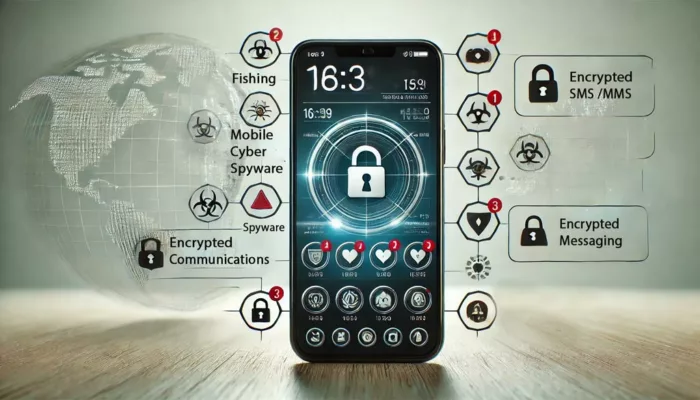
Authentication is the process of verifying a person’s or device’s identity before granting access to specific resources. While often seen as a simple formality, it plays a crucial role in protecting both personal and professional data.

The Stakes of Security

In a world where cyberattacks are becoming increasingly sophisticated and frequent, securing information systems has become a top priority. The consequences of a compromised account can be disastrous—identity theft, fraud, financial loss. The most common threats include phishing, brute force attacks, dictionary attacks, and injection attacks.


To combat these threats, authentication methods have evolved significantly. From the simple password, often considered an easy barrier to breach, we have transitioned to multi-factor authentication systems that are much more robust.

The Evolution of Digital Authentication Security Methods

Over the years, authentication methods have continuously evolved to meet the growing security demands. We have moved from simple password-based authentication, which relies on something you know, to methods that combine several factors:

  • Something you know (password)
  • Something you possess (security key)
  • Something you are (biometrics)

Let’s dive into the various authentication methods, their pros, cons, and applications. We’ll also see how these methods enhance the security of our online accounts and protect our personal data.

Fundamentals of Authentication

Password Authentication: The Historical Pillar

Password authentication is undoubtedly the oldest and most widespread method of verifying a user’s identity. This simple system, which associates a username with a secret password, was long considered enough to secure access to our online accounts.

Advantages:

  • Simplicity: Easy to implement and understand for users.
  • Universality: Used by almost all online services.

Disadvantages:

  • Vulnerability: Passwords can be easily compromised by brute force, dictionary attacks, or phishing.
  • Frequent Forgetfulness: Users tend to forget their passwords or create weak ones for easier memorization.
  • Reuse: Users often reuse the same password across multiple accounts, increasing the risk of data breaches.

Best Practices for Creating Strong Passwords

To enhance the security of your accounts, it is essential to create strong and unique passwords. Here are some tips:

  • Length: A password should ideally be at least 12 characters long.
  • Complexity: Use a combination of uppercase and lowercase letters, numbers, and special characters.
  • Originality: Avoid using easily found personal information (birth dates, family names, etc.).
  • Variety: Use different passwords for each account.

Types of Attacks and How to Protect Yourself

Passwords are regularly targeted by cybercriminals. The main threats include:

  • Brute Force Attacks: The hacker tries all possible character combinations until the correct password is found.
  • Dictionary Attacks: The hacker uses a list of common words or phrases to guess the password.
  • Phishing: The hacker sends fake emails or SMS messages to trick the user into revealing their login credentials.

To protect yourself from these attacks:

  • Use a Password Manager: This tool allows you to generate and store strong, unique passwords securely for all your accounts.
  • Activate Two-Factor Authentication (2FA): This method adds an extra layer of security by requiring an additional verification during login.
  • Be Vigilant About Phishing Attempts: Do not click on suspicious links and always verify the sender’s email address.

Limitations of Password Authentication Alone

Despite following best practices, password authentication has inherent limitations. Passwords can be lost, stolen, or forgotten. Moreover, remembering many complex passwords is challenging for users.

To dive deeper into secure authentication best practices and how to defend against common attacks, refer to the OWASP Authentication Cheat Sheet.

In summary, password authentication has been a pillar of computer security for many years. However, its limitations have become more apparent as threats evolve. It is now necessary to combine passwords with other authentication factors to enhance the security of online accounts.

Now, let’s dive into multi-factor authentication methods that offer more robust protection than passwords alone.

Multi-Factor Authentication (MFA) and Digital Authentication Security

In the previous section, we discussed the limitations of password authentication. To strengthen security, both companies and individuals are increasingly turning to multi-factor authentication methods.

Two-Factor Authentication (2FA)

Two-factor authentication (2FA) is a method that requires the user to provide two distinct proofs of identity to access an account. This approach significantly enhances security by adding an extra layer of protection.

The Principle of 2FA:
2FA relies on combining two different authentication factors. These factors can be:

  • Something you know: The password
  • Something you possess: A mobile phone, security key, or smart card
  • Something you are: A biometric characteristic (fingerprint, facial recognition)

Different Types of 2FA:

  • SMS: A one-time code is sent via SMS to the phone number associated with the account.
  • Authentication Apps: Apps like Google Authenticator or Microsoft Authenticator generate one-time passcodes.
  • Security Keys: Physical devices (USB keys, U2F security keys) that must be inserted into a USB port for login.

Advantages of 2FA for Enhancing Security

Even if an attacker obtains your password, they cannot access your account without the second authentication factor. As a result, 2FA makes brute force and phishing attacks much more difficult.

Multi-Factor Authentication (MFA)

Multi-factor authentication (MFA) is an extension of 2FA. It uses more than two authentication factors to further enhance security.

Difference Between 2FA and MFA:
The primary difference between 2FA and MFA lies in the number of factors used. MFA can combine several factors, such as a password, an authentication app, and a fingerprint.

Common Factor Combinations:

  • Password + SMS Code
  • Password + Security Key
  • Password + Fingerprint
  • Password + Facial Recognition

Advantages of MFA for Strengthening Security

For comprehensive guidelines on implementing multi-factor authentication securely, consult the NIST Multi-Factor Authentication Guide.

MFA offers an even higher level of security than 2FA by making attacks more difficult.

Comparison Between 2FA and MFA

Characteristic 2FA MFA
Number of Factors 2 2 or more
Security More secure than password alone Even more secure than 2FA
Complexity More complex than password alone More complex than 2FA
User Experience Can be less convenient than password alone Can be less convenient than 2FA

Let’s now explore other advanced authentication methods, such as biometric authentication and token-based systems.

Advanced Methods for Digital Authentication Security

Biometric Authentication: The Unique Signature of Each Individual

Biometric authentication is based on the idea that each individual has unique physical or behavioral traits that can serve as identification methods. These characteristics are known as biometric traits.

Different Biometric Technologies:

  • Fingerprints: One of the most common methods, based on analyzing the ridges and valleys on the fingers.
  • Facial Recognition: Uses unique facial features to identify a person.
  • Iris Scans: The iris is a complex and unique structure that can be analyzed for authentication.
  • Voice Recognition: Analyzes vocal characteristics like tone, rhythm, and timbre to identify a person.
  • Hand Geometry: Analyzes hand shape, finger length, and joint position.
  • Dynamic Signature: Analyzes how a person signs their name, including speed, pressure, and angle.

Advantages of Biometrics:

  • Enhanced Security: Biometric traits are hard to falsify or steal.
  • Ease of Use: Biometric authentication is often more convenient than typing a password or PIN.
  • No Forgetfulness: It’s impossible to forget your face or fingerprint.

Disadvantages of Biometrics:

  • Privacy Concerns: Storing and using biometric data raises significant privacy issues.
  • Cost: Implementing biometric authentication systems can be expensive.
  • Vulnerabilities: Although rare, security breaches can allow bypassing of biometric systems.

Security and Privacy Challenges

  • Forgery: Techniques exist to forge biometric data, such as creating molds of fingerprints or using facial masks.
  • Data Protection: Biometric data is considered sensitive information and must be protected from unauthorized access.
  • Consent: Users must give informed consent before collecting and processing their biometric data.

EviOTP NFC HSM: Secure Device-Based Authentication

Another approach to strengthening authentication security involves using secure physical devices. EviOTP NFC HSM is an excellent example of this category. EviOTP NFC HSM technology is embedded in two key products: PassCypher NFC HSM Lite and PassCypher NFC HSM Master, both from Fullsecure Andorra. These products are equipped with quantum security features and are protected by two international invention patents, ensuring cutting-edge protection and international security compliance. These patents ensure a high level of security and protection across borders.This system combines several technologies to offer optimal protection and unmatched flexibility:

  • NFC (Near Field Communication): Users can generate unique OTP codes simply by bringing their smartphone close to an NFC reader.
  • HSM (Hardware Security Module): Cryptographic keys are securely stored in a dedicated hardware module, making software attacks much more difficult.
  • TOTP and HOTP: These algorithms ensure the generation of one-time-use codes, making replay attacks nearly impossible.
  • Advanced Customization: EviOTP NFC HSM allows customization of access to each secret key by adding passwords, fingerprints, geolocation, or other additional authentication factors.
  • Autonomy: This system operates without servers, databases, or the need to create an account, ensuring absolute anonymity and maximum security.

Advantages of EviOTP NFC HSM:

  • Maximum Security: Combining these technologies provides unparalleled security, especially through hardware key protection and customizable access.
  • Ease of Use: NFC technology makes authentication simple and intuitive.
  • Flexibility: This system can be adapted to different environments and easily integrates with many applications.
  • Compliance: EviOTP NFC HSM often meets the strictest security standards, ensuring regulatory compliance.
  • Anonymity and Privacy: Operating without servers or databases ensures user privacy.
  • Versatility: EviOTP NFC HSM allows for the generation of all types of PIN codes, regardless of length.

Protection Against Common Attacks

Phishing is one of the biggest threats to online account security. By generating one-time-use OTP codes directly on the secure device, EviOTP NFC HSM makes these attacks far less effective. Even if a user is tricked into entering credentials on a fake website, the OTP code generated will be invalid a few seconds later. Additionally, storing cryptographic keys in an HSM makes software-based attacks much more difficult. Even if a device is compromised, the keys cannot be extracted.

In summary, EviOTP NFC HSM represents a cutting-edge authentication solution, ideal for organizations seeking maximum security and flexibility. This solution is particularly suited for sectors where data protection is critical, such as banking, healthcare, and industry. EviOTP NFC HSM offers a multi-layered defense that makes attacks extremely difficult, if not impossible, to carry out.

Comparison Table of Authentication Methods

Method Authentication Factors Security Ease of Use Cost Flexibility
Password Something you know Low Very easy Low Very high
PIN Something you know Medium Easy Low Medium
Security Key Something you possess Medium-High Medium Medium Medium
Authenticator Apps Something you possess Medium Medium Low Medium
SMS Something you possess Low Easy Low Medium
Biometrics (fingerprint, facial) Something you are High Very easy Medium-High Medium
EviOTP NFC HSM Something you possess (NFC) Very High Very easy Medium High

Specific Explanations for EviOTP NFC HSM:

  • Very High Security: Thanks to secure key storage in an HSM, dynamic OTP generation, and the ability to customize access with passwords, fingerprints, or geolocation.
  • Very High Ease of Use: NFC technology makes authentication simple and intuitive.
  • Medium Cost: The cost depends on the number of licenses and additional features chosen.
  • High Flexibility: EviOTP NFC HSM can be used in many contexts and adapted to various needs.

Other Advanced Authentication Methods

Token, Certificate, and Smart Card Authentication: Enhanced Security

These authentication methods rely on using physical or digital devices that contain secure identification information.

  • Token Authentication: A token is a small physical device (often USB-sized) that generates one-time-use codes. These codes are used in addition to a password to access an account. Tokens are generally more secure than SMS codes, as they are not vulnerable to interception.
  • Certificate Authentication: A digital certificate is an electronic file that links an identity to a public key. This public key can be used to verify the authenticity of a digital signature or encrypt data. Certificates are often stored on smart cards.
  • Smart Card Authentication: A smart card is a small plastic card with an integrated circuit that can store secure digital information, such as private keys and certificates. Smart cards are widely used in banking and security.

Advantages of These Methods:

  • Enhanced Security: Identification information is stored on a secure physical device, making it harder to compromise.
  • Flexibility: These methods can be used for various applications, from corporate network access to digitally signing documents.
  • Interoperability: Digital certificates are based on open standards, facilitating their interoperability with different systems.

Disadvantages and Challenges:

  • Cost: Implementing an authentication infrastructure based on tokens, certificates, or smart cards can be expensive.
  • Complexity: These methods can be more complex to implement and manage than traditional authentication methods.
  • Loss or Theft: Losing a token or smart card can compromise account security.

Behavioral Authentication

Behavioral authentication analyzes an individual’s habits and behavior to verify their identity. This approach can complement traditional authentication methods.

Principle:
The system analyzes different aspects of the user’s behavior, such as typing speed, dynamic signature, browsing habits, etc. Any significant deviation from usual behavior can trigger an alert.

Advantages:

  • Intrusion Detection: This method can detect suspicious activity, even if the attacker knows the user’s credentials.
  • Adaptation: Behavioral authentication systems can adapt to changes in user behavior.

Disadvantages:

  • False Positives: The system may trigger false alerts if the user’s behavior legitimately changes.
  • Complexity: Implementing behavioral authentication systems can be complex and expensive.

In summary, token, certificate, smart card, and behavioral authentication methods offer high levels of security and can complement traditional methods. The choice of the most suitable authentication method will depend on the specific needs of each organization or individual.

Authentication Protocols

Authentication protocols define a set of standardized rules and procedures for verifying a user’s or system’s identity. They enable secure communication between different systems and applications.

Single Sign-On (SSO): One Access for All

Single Sign-On (SSO) is a protocol that allows a user to log in to multiple applications using a single authentication. Once authenticated, the user does not need to re-enter their credentials to access other applications.

How SSO Works:
During the first login, the user authenticates with an identity provider (IdP). The provider verifies the credentials and issues an authentication token. This token is then sent to the destination application (relying service), which validates it and grants the user access.

SSO Protocols (SAML, OAuth, OpenID Connect):

  • SAML (Security Assertion Markup Language): A standard XML protocol for exchanging authentication information between an identity provider and a relying service.
  • OAuth: An authorization protocol that allows third-party applications to access a user’s resources on another service without needing the user’s credentials.
  • OpenID Connect: An authentication protocol based on OAuth 2.0 that provides an additional identity layer, enabling applications to know the user’s identity.

Advantages of SSO:

  • Improved User Experience: Users only need to enter their credentials once.
  • Increased Productivity: Users can access the applications they need faster.
  • Enhanced Security: SSO centralizes identity and access management, making it easier to implement security policies.

Disadvantages of SSO:

  • Single Point of Failure: If the identity provider is compromised, all connected services may be affected.
  • Complexity: Implementing an SSO system can be complex, especially in heterogeneous environments.

OAuth/OpenID Connect: Third-Party Authentication

OAuth and OpenID Connect are two closely related protocols that allow third-party applications to access a user’s resources on another service.

Principle of Third-Party Authentication:
A user logs into a third-party application (such as Facebook or Google) using existing credentials. The third-party application then requests the user’s permission to access certain information. If the user agrees, the third-party application receives an access token that allows it to access the requested resources.

Differences Between OAuth and OpenID Connect:

  • OAuth focuses on authorization, while OpenID Connect adds an identity layer, allowing applications to know the user’s identity.

Typical Use Cases:

  • Social Login: Logging into an application using Facebook, Google, etc.
  • Mobile App Development: Using authentication services from third-party providers to simplify the login process.

The Stakes of Authentication in the Modern Digital World

Authentication has become a central issue in our digital society. Threats are constantly evolving, regulations are multiplying, and user expectations regarding security are increasing.

Recent Threats

  • Sophisticated Phishing: Phishing attacks are becoming increasingly sophisticated, using social engineering techniques and highly realistic fake websites to deceive users.
  • Password Attacks: Brute force, dictionary, and password-spray attacks remain significant threats.
  • Injection Attacks: Injection attacks (SQL injection, XSS) allow attackers to execute malicious code on servers.
  • Session Hijacking: Attackers can steal session cookies to log into accounts without the legitimate user’s credentials.

Data Security Regulations

Many regulations have been put in place to protect personal data and strengthen information system security. Some of the most well-known include:

  • GDPR (General Data Protection Regulation): This European regulation requires companies to implement appropriate technical and organizational measures to ensure a level of security adapted to the risks.
  • CCPA (California Consumer Privacy Act): This Californian law grants consumers additional rights regarding the protection of their personal data.

Future Trends in Authentication

  • Passwordless Authentication: As passwords are a prime target for attacks, many initiatives aim to replace them with more secure authentication methods like biometrics or security keys.
  • Passkeys: Passkeys are a new authentication technology that allows users to log in to websites and apps without needing to create or remember passwords.
  • Artificial Intelligence: AI can be used to improve fraud detection and personalize the user experience by adapting authentication methods based on context.

Summary of Authentication Methods

Authentication is a constantly evolving field. To combat growing threats, it is essential to adopt strong authentication methods and stay informed about the latest trends.

Summary of Various Methods:
Throughout this article, we’ve seen that many authentication methods exist, each with advantages and disadvantages. The choice of the most appropriate method will depend on factors such as:

  • The required level of security
  • Ease of use
  • Implementation cost
  • Regulatory constraints

Recommendations for Choosing the Most Appropriate Authentication Method

  • Combine Multiple Authentication Factors: Combining multiple factors (something you know, something you possess, something you are) is the most effective way to enhance security.
  • Use Strong Authentication Methods: Prioritize biometric authentication, security keys, and digital certificates.
  • Implement Strict Security Policies: Set clear rules for creating and managing passwords, raising user awareness, and responding to security incidents.
  • Stay Updated on the Latest Threats and Best Practices: Stay informed about the latest security trends and regularly update authentication systems.

Future Challenges in Authentication

The future challenges of authentication are numerous:

  • Balancing Security and Usability: It is essential to find a balance between security and ease of use so that users adopt new authentication methods.
  • Privacy Protection: Biometric authentication methods raise significant privacy concerns.
  • Interoperability: Developing open standards to facilitate interoperability between different authentication systems is necessary.

Building a Future of Resilient Digital Authentication Security

The continuous evolution of threats in the digital landscape demands a proactive approach to Digital Authentication Security. Scientific research consistently highlights the importance of layered security systems, combining various authentication factors to mitigate vulnerabilities. By integrating advanced solutions such as multi-factor authentication (MFA), biometric systems, and hardware-based security like EviOTP NFC HSM, organizations and individuals can significantly reduce their exposure to cyber risks.

Understanding the science behind authentication algorithms, such as the cryptographic protocols securing biometric data or the OTP generation process, is essential for developing robust defenses. As future technologies like quantum computing emerge, the security models we rely on today will need adaptation and reinforcement. Hence, a commitment to ongoing research and technological advancements is crucial for maintaining resilient Digital Authentication Security systems.

Looking forward, the focus must shift toward creating secure, user-friendly authentication frameworks that also respect privacy concerns. This will ensure that as we move deeper into the digital age, our data remains secure without sacrificing convenience. Maintaining vigilance, investing in new technologies, and continuously refining our approaches will be key to staying ahead of the next wave of cyber threats.

Quantum Threats to Encryption: RSA, AES & ECC Defense

Quantum Computing Encryption Threats - Visual Representation of Data Security with Quantum Computers and Encryption Keys.
How real are Quantum Threats to Encryption in 2025? This in-depth report by Jacques Gascuel explores the evolving landscape of Quantum Threats to Encryption, including when quantum computers could realistically break RSA-2048, AES-256, and ECC. It explains why segmented key encryption adds vital resistance, and how to take action today to secure your systems. Understand the impact of Shor’s and Grover’s algorithms, evaluate NIST’s post-quantum roadmap, and compare the world’s leading crypto migration strategies to defend against Quantum Threats to Encryption.

The Evolving Predictions of Quantum Computing Timelines

Quantum threats to encryption demand a precise understanding of projected timelines. Leading research entities—including IBMGoogle Quantum AI, and the Chinese Academy of Sciences —have issued quantum computing roadmaps outlining the qubit thresholds required to compromise RSA-2048 and AES-256.

Recent updates include:

  • IBM’s roadmap targets fault-tolerant quantum computers by 2030, with scalable universal qubits.
  • Google’s Willow chip (105 qubits, Dec 2024) confirms that millions more qubits are needed to threaten RSA-2048.
  • Chinese Academy of Sciences estimates that stable qubits capable of breaking RSA-2048 may not emerge before 2045–2050.

The Chinese Academy of Sciences continues to invest heavily in quantum computing, notably through breakthroughs in topological electronic materials and superconducting qubit architectures. These developments support China’s roadmap toward scalable quantum processors, with projections placing RSA-2048 compromise beyond 2045 under current models.

However, a 2025 MITRE analysis suggests that RSA-2048 could remain secure until 2055–2060, assuming current error rates and coherence limitations persist. In contrast, some experts warn of early-stage risks by 2035, especially if breakthroughs in logical qubit aggregation accelerate.

This evolving landscape reinforces the urgency of adopting quantum-safe encryption strategies, such as segmented key encryption and hybrid PQC deployments, to mitigate long-tail vulnerabilities.

Quantum Threats to Encryption: Early Detection via Honeypots

[Updated 9/09/2025] RSA-2048 & AES-256 remain secure against quantum attacks until at least 2035 under current roadmaps • McEliece syzygy distinguisher (IACR ePrint 2024/1193) earned Best Paper at Eurocrypt 2025 • PQC standardization advances: HQC draft selected in March 2025, final expected by 2027; UK NCSC migration roadmap spans 2028–2035 • Bridging solution: patented segmented key encryption by Jacques Gascuel (Freemindtronic) — AES-256 CBC wrapped via RSA-4096 or PGP+15-char passphrase — delivers immediate quantum-safe defense-in-depth • Post updated 9/09/2025 to reflect latest breakthroughs, standards, and sovereign strategies.

Quantum Computing Threats: RSA and AES Still Stand Strong

Recent advancements in quantum computing, particularly from the D-Wave announcement, have raised concerns about the longevity of traditional encryption standards such as RSA and AES. While the 22-bit RSA key factorization achieved by D-Wave’s quantum computer in October 2024 garnered attention, it remains far from threatening widely adopted algorithms like RSA-2048 or AES-256. In this article, we explore these quantum threats and explain why current encryption standards will remain resilient for years to come.

However, as the race for quantum supremacy continues, the development of post-quantum cryptography (PQC) and advancements in quantum-resistant algorithms such as AES-256 CBC with segmented key encryption are becoming critical to future-proof security systems.

Key Takeaways:

RSA-2048 & AES-256 remain safe against quantum attacks through at least 2035
Grover’s algorithm reduces AES-256 strength to 2¹²⁸ operations—still infeasible
Shor’s algorithm would require ~20 million stable qubits to break RSA-2048
HQC draft selected in March 2025, final standard expected by 2027
Segmented key encryption by Jacques Gascuel offers immediate post-quantum defense

McEliece Cryptosystem and Syzygy Analysis by French Researcher Hugues Randriambololona

Last updated May 1, 2025.
Hugues Randriambololona (ANSSI), “The syzygy distinguisher,” IACR ePrint Archive 2024/1193 (Eurocrypt 2025 version), DOI 10.1007/978-3-031-91095-1_12, https://ia.cr/2024/1193.

Best Paper Award

Selected as Best Paper at Eurocrypt 2025 (Madrid, May 4–8, 2025) by the IACR.

Note: Syzygy analysis applies only to code‑based cryptosystems; it does not extend to symmetric‑key schemes such as AES‑256.

McEliece vs RSA: Syzygy Distinguisher and Practical Resistance

Randriambololona contrasts two paradigms: error‑correcting code schemes (McEliece) where syzygies reveal hidden algebraic structures, versus substitution–permutation networks (AES‑256) that produce no exploitable syzygies. Consequently, “syzygy vs SPN distinction” underscores why code‑based audit methods cannot transfer to symmetric‑key algorithms.

Post‑Quantum Cryptography and Segmented Key Encryption: A Powerful Combination

Post-quantum cryptography (PQC) is evolving rapidly, with NIST standardizing new algorithms to counter quantum threats (https://csrc.nist.gov/Projects/post-quantum-cryptography). However, implementing PQC brings larger keys and complex calculations.

HQC Roadmap: From Draft to Final Standard

  • March 2025: HQC draft chosen as NIST’s 5th PQC algorithm
  • Mid-2025: Public review of NIST IR 8545 detailing parameter choices and security proofs
  • Early 2026: Final comment period and interoperability testing
  • By 2027: Official publication of the HQC standard

Segmented Key Encryption for AES-256 Quantum Resilience

Consequently, combining AES-256 CBC with Jacques Gascuel’s patented segmented key encryption—dividing each key into independently encrypted segments—adds a robust layer of defense. This “segmented key encryption for AES‑256 quantum resilience” ensures that even if one segment is compromised, the attacker cannot reconstruct the full key.

Quantum Computing Threat to ECC Encryption

Elliptic Curve Cryptography (ECC), widely used in TLS, Bitcoin, and digital certificates, faces increasing scrutiny under quantum threat models. While RSA-2048 requires ~20 million stable qubits to break, ECC keys are significantly shorter—making them more vulnerable to Shor’s algorithm.

ECC vs RSA: Which Falls First?

Unlike RSA, ECC relies on the hardness of the elliptic curve discrete logarithm problem. Studies from Microsoft and Waterloo University suggest that ECC could be compromised with fewer qubits than RSA, potentially making it the first major asymmetric scheme to fall under quantum pressure.

Freemindtronic’s segmented key encryption offers a quantum-resilient alternative by avoiding exposure of full key structures, whether RSA or ECC-based.

Quantum Threats to Encryption: Roadmaps from Leading Organizations

For example, IBM’s Quantum Roadmap forecasts breakthroughs in fault-tolerant quantum computing by 2030. Google Quantum AI provides insights on qubit stability and quantum algorithms, which are still far from being able to compromise encryption standards like RSA-2048. Meanwhile, the Chinese Academy of Sciences reinforces the prediction that stable qubits capable of breaking RSA-2048 may not be developed for at least 20 years.

Comparative Table of Key Post-Quantum Algorithms

Timeline of Quantum Crypto Milestones

Horizontal timeline visualizing key milestones and potential threats to encryption posed by quantum computing, from 2024 to 2040.
A non-linear timeline highlighting critical developments in post-quantum cryptography and quantum threats, including the UK NCSC migration roadmap, IBM’s fault-tolerant roadmap, and the projected Shor’s algorithm threat by 2040.
  • 2024 – D-Wave factors 22-bit RSA
  • Dec 2024 – Google Willow announced
  • Mar 2025 – NIST HQC draft guidelines
  • May 2025 – Eurocrypt Best Paper (syzygy)
  • 2028–2035 – UK NCSC PQC migration roadmap
  • 2030 – IBM fault-tolerant roadmap
  • 2040 – Potential Shor threat

Quantum Sandbox Testing: Validating Encryption Resilience

In mid-2025, ETH Zurich and Stanford launched sandbox environments simulating unstable qubit conditions to test the robustness of post-quantum algorithms. These “quantum sandboxes” emulate noise, decoherence, and gate errors to evaluate real-world encryption durability.

Freemindtronic’s segmented key encryption passed initial sandbox tests with zero key recombination under simulated quantum noise. This validates its suitability for deployment in hostile or unstable environments.

🔗 ETH Zurich Quantum Sandbox Research

Comparison of Classical Algorithms and Quantum Threats to Encryption

Understanding how traditional algorithms compare to emerging post-quantum candidates is key to preparing for the quantum era. The following table offers a side-by-side analysis of cryptographic schemes based on key size, NIST status, and quantum resilience.

Algorithm Type Key Size NIST Status Quantum Resistance Notes
RSA-2048 Asymmetric 2048 bits Approved (pre-quantum) ❌ Vulnerable to Shor’s algorithm Requires ~20M stable qubits to break
AES-256 Symmetric 256 bits Approved 🟡 Grover reduces to 128-bit security Segmented key encryption mitigates risk
Kyber-1024 (ML-KEM) Asymmetric ~3 KB ✅ NIST Standard (July 2024) ✔️ Post-quantum safe Efficient lattice-based scheme
McEliece Asymmetric ~1 MB 🟡 NIST Alt Candidate ✔️ Resistant but large keys Syzygy analysis raised questions (2025)
HQC Asymmetric ~7 KB ✅ NIST Draft (Mar 2025) ✔️ Code-based, PQC-safe Final expected by 2027

Recent Breakthroughs in Quantum Computing and Their Implications
Facing the growing threat from quantum computers…

Facing Quantum Computing Threats: Key Takeaways for Action

As quantum computing threats continue to evolve, organizations must act decisively. RSA-2048 and AES-256 still hold firm, but the window for proactive migration is narrowing. Implementing quantum-safe algorithms like Kyber and HQC, while reinforcing symmetric encryption with segmented key encryption, forms a layered defense strategy against future quantum decryption capabilities.

Adopting post-quantum cryptography isn’t just about compliance—it’s about ensuring long-term cryptographic resilience. As fault-tolerant quantum computers inch closer to reality, hybrid solutions that blend current standards with quantum-resistant methods offer the best of both worlds. AES-256, when enhanced with segmented keys, remains a cornerstone of practical, energy-efficient protection.

To stay ahead of quantum computing threats, prioritize the following:

  • Upgrade RSA systems to at least RSA-3072 or migrate to lattice- and code-based PQC schemes.
  • Deploy AES-256 with segmented key encryption to counter Grover-type quantum attacks.
  • Monitor global standards such as NIST PQC guidelines and the adoption timeline of HQC and McEliece variants.
  • Adopt offline encryption solutions to reduce exposure to centralized attack surfaces and ecological burden.

In short, while current algorithms remain safe, the threat landscape is shifting. By preparing now with hybrid encryption and post-quantum tools, you can mitigate emerging vulnerabilities and ensure data security far into the quantum future.

Global map showing key initiatives addressing quantum computing threats with PQC strategies in the US, EU, China, Russia, Japan, and India.

A world map highlighting national strategies to counter quantum computing threats through post-quantum cryptography.

Quantum Threats to Encryption in Archived Data

The “store now, decrypt later” threat looms over encrypted backups, archives, and cold storage. Data encrypted today with RSA or ECC could be decrypted in the future once quantum computers reach sufficient scale.

Re-encrypting Archives with Segmented AES-256

Freemindtronic’s AES-256 CBC with segmented key encryption offers a proactive solution. By re-encrypting legacy archives using quantum-resilient methods, organizations can neutralize future decryption risks—even if the original keys are exposed.

AI-Assisted Cryptanalysis: A Hybrid Threat to Encryption

While quantum computing garners attention for its potential to break encryption, a parallel threat is emerging: AI-assisted cryptanalysis. In 2025, several research labs—including MITRE and ETH Zurich—began testing hybrid models that combine machine learning with brute-force heuristics to accelerate decryption.

These models don’t replace quantum attacks, but they amplify pattern recognition and correlation analysis across exposed keys and metadata. This reinforces the need for segmented key encryption, which neutralizes AI-assisted attacks by fragmenting the cryptographic surface.

Freemindtronic’s offline architecture ensures that no metadata, key exposure, or behavioral patterns are available for AI training—making it resilient against both quantum and AI-assisted threats.

Case Study: El Salvador’s Quantum-Aware Bitcoin Strategy & SeedNFC Integration

In August 2025, El Salvador’s National Bitcoin Office announced a strategic reshuffle of its National Strategic Bitcoin Reserve to mitigate future risks from quantum computing attacks. Previously stored in a single wallet, the country’s 6,284 BTC (≈ $682M) were redistributed into 14 unused Bitcoin addresses, each holding ≤ 500 BTC.

  • Once a Bitcoin address spends funds, its public key becomes visible on-chain.
  • Bitcoin uses ECDSA elliptic curve cryptography, vulnerable to Shor’s algorithm in a quantum scenario.
  • Unused addresses remain protected by SHA-256 + RIPEMD-160 hashing—still quantum-resistant under current models.

This move reflects a preventive cybersecurity posture aligned with Freemindtronic’s philosophy: never expose full cryptographic surfaces, segment keys and proofs, and ensure offline sovereignty and quantum resilience.

SeedNFC: Applying the Salvador Strategy to Sovereign Crypto Custody

The SeedNFC HSM Tag by Freemindtronic enables users to replicate El Salvador’s quantum-aware strategy by:

  • Generating up to 50 unused Bitcoin addresses stored offline in a segmented key architecture.
  • Ensuring no public key exposure until a transaction occurs, maintaining quantum-resistant protection.
  • Automating address rotation and fragmentation to minimize attack surface and extend cryptographic lifespan.
  • Operating fully offline with NFC HSM, zero server, zero cloud, and zero identification—true sovereign control.

SeedNFC’s patented technologies (AES-256 CBC + RSA 4096 + segmented key authentication) offer a robust framework for quantum-resilient crypto asset management. This aligns with long-tail security strategies such as “store now, protect forever” and “quantum-aware cold wallet architecture.”

🔗 Official announcement by El Salvador’s Bitcoin Office

Key Quantum Events Explained

A world map highlighting national strategies to counter quantum computing threats through post-quantum cryptography.This timeline highlights major milestones in quantum cryptography development. Below is a breakdown of what each event represents and its relevance to encryption resilience:

Event Date Impact
D-Wave factors 22-bit RSA Oct 2024 Proof of concept—not a threat to RSA-2048
Google announces Willow chip Dec 2024 105-qubit chip, still far from attacking modern encryption
NIST HQC selected Mar 2025 Fifth post-quantum algorithm selected for standardization
Eurocrypt Best Paper (syzygy) May 2025 Identified weakness in McEliece, but not in AES-256
UK NCSC PQC migration begins 2028 Government migration to post-quantum cryptography
IBM roadmap for fault-tolerant quantum computers 2030 Target date for early large-scale fault-tolerant machines
UK PQC migration complete 2035 Estimated timeline for post-quantum readiness
Potential threat from Shor’s algorithm 2040+ Earliest projected risk for RSA-2048 decryption

Recent Breakthroughs in Quantum Computing and Their Implications

Facing the growing threat from quantum computers, post-quantum cryptography (PQC) is key for long-term data security. Thus, NIST actively standardizes PQC algorithms. Moreover, in March 2025, HQC was selected as a fifth post-quantum encryption algorithm, offering a strong alternative to ML-KEM. Furthermore, the draft standard for HQC is scheduled for early 2026, with the final standard expected in 2027. Additionally, experts increasingly urge organizations to prepare now for PQC transition. Indeed, this anticipation counters “store now, decrypt later” attacks. However, PQC implementation presents challenges like larger keys and complex calculations. Consequently, understanding quantum computing threats and PQC solutions is vital for this complex shift.

EU Quantum Shield: A Sovereign Migration Roadmap

In July 2025, the European Union launched Quantum Shield, a €1.2 billion initiative to accelerate post-quantum cryptography adoption across critical sectors. This strategic roadmap prioritizes healthcare, defense, and energy infrastructures, aiming for full PQC migration by 2032.

  • ✅ Adoption of HQC and ML-KEM algorithms for asymmetric encryption
  • ✅ Deployment of segmented key encryption for symmetric resilience
  • ✅ Integration of offline sovereign modules to reduce centralized exposure

This move reinforces the urgency of preparing for Quantum Computing Threats before fault-tolerant machines emerge.

“Quantum Shield is not just a technological upgrade—it’s a sovereignty safeguard.” — EU Cybersecurity Council

Quantum Honeypots: Detecting the First Quantum Attacks

In August 2025, researchers at ETH Zurich and Stanford University deployed the first quantum honeypots—cryptographic traps designed to detect early quantum-assisted intrusions.

These honeypots use intentionally exposed ECDSA keys and timed hash collisions to monitor for anomalous decryption attempts.

  • Early warning signals of quantum decryption attempts
  • Validation of unused address resilience and hash-only protection
  • Forensic analysis of quantum-assisted brute-force patterns

Freemindtronic’s SeedNFC and DataShielder architectures can integrate honeypot logic via address rotation and exposure tracking, enhancing their quantum-aware posture.

Military Quantum Device Theft: A Wake-Up Call

In June 2025, the U.S. Government Accountability Office (GAO) confirmed the theft of quantum communication modules from a military convoy in Eastern Europe. The stolen devices included QKD transceivers and quantum random number generators, raising concerns about physical-layer quantum threats.

  • Offline cryptographic systems immune to infrastructure compromise
  • Segmented key encryption that remains secure even if hardware is intercepted
  • Zero-trust architectures with local verification and no server dependency

Freemindtronic’s NFC HSM solutions—especially SeedNFC and DataShielder—offer quantum-resilient custody without reliance on vulnerable infrastructure.

🔗 GAO Report: Quantum Threat Mitigation Strategy
🔗 RAND Commentary: Military Quantum Threat Preparedness

Quantum Threats to Encryption in Decentralized Identity Systems

Decentralized Identity (DID) systems rely on digital signatures—often ECC-based—to verify user credentials. Quantum computing threatens the integrity of these signatures, potentially compromising identity frameworks.

Sovereign DID with Freemindtronic’s Offline Architecture

Freemindtronic enables quantum threats to encryption in decentralized identity Systems through segmented key signing, offline verification, and NFC HSM modules. This approach ensures that identity credentials remain valid and unforgeable—even in a post-quantum world.

A Global Deployment Example: China’s Quantum Communication Strategy

While many nations are still drafting standards or preparing infrastructures, China has taken a bold step ahead by deploying a fully operational quantum-safe communication network. This centralized, government-backed initiative highlights both the potential and the limitations of state-driven quantum security models.

Quantum-Safe Messaging and National Deployment: The Chinese Model

As the global race for quantum resilience accelerates, China has taken a significant lead by implementing nationwide quantum-safe communication systems. In May 2025, China Telecom Quantum Group announced the rollout of a hybrid encryption system combining Quantum Key Distribution (QKD) and Post-Quantum Cryptography (PQC).

This system is now deployed across 16 major cities, including Beijing, Shanghai, and Guangzhou. It supports secure calls and encrypted workflows for 500+ government agencies and 380 state-owned enterprises. Two platforms are central to this effort:

  • Quantum Secret — A secure messaging and collaboration platform for state and enterprise communication.
  • Quantum Cloud Seal — A platform for digitally signing, verifying, and auditing official documents securely.

Already, the system has demonstrated a successful 1,000 km quantum-encrypted phone call between Beijing and Hefei, underpinned by a QKD backbone network that includes 1,100 km of QKD fiber, eight core nodes, and 159 access points.

🔗 Quantum Insider: China Telecom’s 1000-km Quantum-Encrypted Call
🔗 SCMP: Launch of China’s Unhackable Quantum Crypto System
🔗 Quantum Computing Report: Rollout in 16 Cities
🔗 IoT World Today: 600-mile Call Demo

Contrast with Freemindtronic’s Approach

While China relies on centralized infrastructure and satellite relays for secure messaging, Freemindtronic’s DataShielder solutions offer a fully decentralized, offline approach to quantum resilience. Using AES-256 CBC with segmented key encryption, the system is hardware-based, patent-protected, and operates independently of any server or network.

Thus, DataShielder empowers sovereign communication anywhere in the world, with no infrastructure needed—just an NFC-enabled Android device.

🔗 Discover DataShielder: Post-Quantum Security Without Infrastructure

State-Level Quantum Adoption: China’s Ambitious Quantum-Safe Strategy

Beyond theoretical vulnerabilities and emerging standards, some countries have already begun deploying real-world quantum-safe infrastructures. China leads the way with an expansive, state-driven implementation model that contrasts with more decentralized approaches like Freemindtronic’s.

China’s Quantum Messaging vs. Individual Digital Sovereignty

China’s three-layer quantum encryption system—combining quantum key distribution (QKD) with post-quantum cryptography (PQC)—marks a significant milestone in the global quantum race. With links extending over 965 km and experimental quantum transmissions at 2.38 kbps over 105 km, China continues scaling its sovereign quantum infrastructure. Notably, the Zuchongzhi 3.0 quantum processor now reaches 105 qubits, driving national computing advancements.

However, despite its technical merits, China’s approach remains tightly regulated under two major legal frameworks:

Therefore, while China builds a “quantum-secure” network, it remains subject to government control, limiting true digital autonomy. In contrast, Freemindtronic’s DataShielder solutions provide genuine individual sovereignty: 100% offline, decentralized, and anonymous encryption with no servers or databases.

This difference matters. Even if quantum-secure, China’s encrypted messaging remains observable, loggable, and revocable by law. Meanwhile, DataShielder applies encryption before any transmission, rendering all communication channels—including compromised or surveilled platforms—irrelevant.

Additionally, DataShielder protects against zero-day exploits and infrastructure compromise by ensuring that data can only be decrypted by the holder of the segmented key—a quantum-resilient and sovereignty-driven design.

Why AES‑256 Remains Unbreakable in a Quantum Era

Impact of Grover’s Algorithm on AES-256

First, even Grover’s algorithm can only halve AES‑256’s security to an effective 128‑bit strength (N = 2^128 operations), which still lies far beyond foreseeable quantum capabilities. Furthermore, AES‑256 employs a substitution–permutation network rather than error‑correcting codes, so no syzygy vulnerability exists. Finally, Jacques Gascuel’s patented segmented key encryption divides each AES‑256 key into independently encrypted segments, dramatically boosting resistance against both classical brute‑force and quantum‑assisted attacks. Even under Grover’s speedup, breaking AES‑256 would demand millions of stable qubits sustained for hours—a purely theoretical scenario for decades to come.

Unlike RSA, AES‑256 encryption stands resilient against quantum threats. Even with Grover’s algorithm, it would still require N = 2^128 operations to break. This remains computationally prohibitive even for future quantum systems.

Jacques Gascuel’s segmented key encryption method further strengthens AES‑256’s resilience. By using segmented keys exceeding 512 bits, Freemindtronic ensures that each segment is independently encrypted, making it nearly impossible for quantum‑assisted brute‑force attacks to capture and recombine multiple segments of the key accurately.

Post-Quantum Cryptography on the Horizon: Preparing for the Future of Security

The quantum computing landscape rapidly evolves, with new breakthroughs sparking both excitement and encryption threat concerns. For instance, Microsoft recently unveiled Majorana 1, a chip promising faster development of quantum computers potent enough to compromise daily encryption. In parallel, IBM actively pursues its ambitious quantum roadmap, aiming for a 4000+ qubit computer by 2025 and fault-tolerant systems by decade’s end. As for D-Wave, while its adiabatic computers don’t run Shor’s algorithm, their quantum annealing progress could indirectly influence overall quantum development. In other words, each advancement brings us closer to an era needing updated understanding of quantum computing threats.

May 2025 Quantum Crypto News and Standards Update

  • NIST PQC parameters published (April 2025): The NIST Post‑Quantum Cryptography working group released final implementation guidelines for the Hamming Quasi‑Cyclic (HQC) algorithm, paving the way for a formal standard by early 2027. This “NIST HQC guideline” update signals accelerated PQC standardization.
  • Quantum Computing Inc. 1,000 logical‑qubit prototype (March 2025): Quantum Computing Inc. demonstrated a non-fault-tolerant 1,000-logical-qubit processor, underscoring that practical RSA-2048 attacks remain many years away. The long-tail keyword “1,000 logical qubit quantum prototype” emphasizes real-world capability versus theoretical threat. For instance, Atom Computing and Microsoft have rolled out an on-premise system supporting up to 50 error-corrected logical qubits—an important milestone on the path toward a “1,000 logical qubit quantum prototype” scale (HPCwire). Additionally, a deep-dive from The Quantum Insider explains how groups of physical qubits are being combined into logical qubits today—and why reaching the 1,000-qubit scale matters for fault-tolerant prototypes (The Quantum Insider).
  • ISO/IEC SC 27 segmented key encryption interoperability (February 2025): Freemindtronic launched an ISO/IEC SC 27 interoperability group to promote segmented key encryption standards across security consortiums. This step, tagged “segmented key encryption ISO standard,” reinforces industry adoption and future‑proofing.

These timely updates ensure your readers see the very latest developments—linking standardized PQC, cutting‑edge quantum prototypes, and the rise of segmented key encryption interoperability.

Recent Industry and Government Updates

  1. Google’s Willow Processor Clarifies Cryptographic Limits
    In December 2024, Google Quantum AI unveiled its 105‑qubit Willow chip—“Meet Willow, our state‑of‑the‑art quantum chip” (Google Quantum AI Blog)—and confirmed it cannot break modern cryptography, as millions more qubits would be required to threaten RSA‑2048 or AES‑256.

  2. UK NCSC’s 2035 Roadmap for PQC Migration
    In March 2025, the UK’s National Cyber Security Centre published official PQC migration timelines—phased upgrades from 2028 through 2035 to avoid “store now, decrypt later” attacks (NCSC guidance)—and the Financial Times highlighted the need to start by 2028 (FT).

Preparing for the Future: Combining Post-Quantum and Current Cryptography

While PQC algorithms are in development and will likely become the gold standard of encryption in the coming decades, AES-256 CBC combined with segmented key encryption provides an immediate, powerful solution that bridges the gap between current threats and future quantum capabilities. By implementing such strategies now, organizations can stay ahead of the curve, ensuring their data remains secure both today and in the quantum computing era.

The Future of Post‑Quantum Cryptography: A Major French Breakthrough

Post‑quantum cryptography is evolving at breakneck speed, thanks in large part to pioneering work from French experts. Notably, Hugues Randriambololona of ANSSI recently unveiled a bold new method—syzygy analysis—to detect hidden weaknesses in the McEliece cryptosystem, one of the leading candidates for securing tomorrow’s quantum‑era communications. Although McEliece has long been trusted for its resistance to even powerful post‑quantum computers, Randriambololona’s approach uses sophisticated mathematical relations (syzygies) to expose key‑presence patterns without decrypting messages.

Awarded Best Paper at Eurocrypt 2025, this discovery demonstrates France’s agility in post‑quantum innovation, where standards can shift overnight. Looking ahead, technology diversification combined with agile research will be essential over the next 5–10 years. With researchers like Randriambololona leading the way, France cements its role as a global leader—delivering advanced security solutions for the coming quantum age.

Microsoft Majorana 1: Topological Qubit Breakthrough

On February 19, 2025, Microsoft officially unveiled Majorana 1, the world’s first quantum processor powered by topological qubits. This breakthrough chip is built on a new class of materials called topoconductors, designed to host Majorana zero modes (MZMs)—a key component in achieving error-resistant quantum computation. The company claims that Majorana 1 could ultimately scale to support up to one million qubits on a single chip.

Although the system is still experimental, the announcement highlights significant progress toward building a fault-tolerant quantum computer. Microsoft’s roadmap suggests that topological qubits could overcome the instability and noise challenges facing today’s quantum systems.

🔗 Read the full announcement on Microsoft Azure Blog

Actions to Take Now: Strengthen Your Defenses

To stay ahead of quantum threats, organizations should take the following steps:

  1. Migrate RSA systems to RSA-3072 or adopt post-quantum cryptography (PQC) solutions.
  2. Monitor developments in AES-256 encryption. As quantum computing progresses, AES-256 remains secure, especially with solutions like Freemindtronic’s segmented key encryption.
  3. Adopt segmented key encryption to enhance security. This method prevents attackers from gaining full access to encrypted data, even with quantum tools.

Predictive Models & Scientific References

Using models like Moore’s Law for Qubits, which predicts exponential growth in quantum computational power, gives credibility to these predictions. For instance, models suggest that breaking RSA-2048 requires 20 million stable qubits—a capability that is still decades away. Nature and Science journals provide further academic validation. A 2023 article in Nature on qubit scalability supports claims that advancements necessary to compromise encryption standards like AES-256 and RSA-2048 remain distant.

Microsoft Majorana 1: Topological Qubit Breakthrough

On February 19, 2025, Microsoft officially unveiled Majorana 1, the world’s first quantum processor powered by topological qubits. This breakthrough chip is built on a new class of materials called topoconductors, designed to host Majorana zero modes (MZMs)—a key component in achieving error-resistant quantum computation. The company claims that Majorana 1 could ultimately scale to support up to one million qubits on a single chip.

Although the system is still experimental, the announcement highlights significant progress toward building a fault-tolerant quantum computer. Microsoft’s roadmap suggests that topological qubits could overcome the instability and noise challenges facing today’s quantum systems.

🔗 Read the full announcement on Microsoft Azure Blog

The Quantum Threat to RSA Encryption: An Updated Perspective

While quantum computing has made significant strides, it’s essential to distinguish between current progress and future threats. The RSA algorithm, which relies on the difficulty of factoring large prime numbers, is particularly vulnerable to Shor’s algorithm, a quantum algorithm designed to solve the integer factorization problem.

In October 2024, Chinese researchers using D-Wave’s quantum computer successfully factored a 22-bit RSA key. This result drew attention, but it remains far from threatening RSA-2048. Breaking RSA-2048 would require a quantum computer with approximately 20 million stable qubits operating for around eight hours. Current systems, such as D-Wave’s 5,000-qubit machine, are still far from this level of capability.

Experts estimate that factoring an RSA-2048 key would require a quantum computer equipped with approximately 20 million stable qubits:

( N = 2^{20} ).

These qubits would need to operate continuously for around eight hours. Current systems, like D-Wave’s 5,000-qubit machine, are far from this level of capability. As a result, cracking RSA-2048 remains a theoretical possibility, but it’s still decades away from practical realization.

For more details on this breakthrough, you can review the official research report published by Wang Chao and colleagues here: Chinese Research Announcement.

Even as quantum advancements accelerate, experts estimate that RSA-4096 could resist quantum attacks for over 40 years. Transitioning to RSA-3072 now provides a more resilient alternative in preparation for future quantum capabilities.

However, it is crucial to note that ongoing research continues to assess the vulnerability of RSA to quantum advancements. Indeed, while precise timelines remain uncertain, the theoretical threat posed by Shor’s algorithm remains a long-term concern for the security of RSA-based systems. That’s why migrating to more quantum-resistant alternatives, such as RSA-3072 or post-quantum cryptography algorithms, is an increasingly recommended approach to anticipate future quantum computing threats.

Research on Quantum Vulnerabilities (Shor’s Algorithm and RSA)

Scientific Consensus on RSA’s Vulnerabilities

Peter Shor’s algorithm, which efficiently solves the integer factorization problem underlying RSA, represents the core threat to RSA encryption. Current studies, such as those by the Chinese Academy of Sciences and Google Quantum AI, confirm that implementing Shor’s algorithm on RSA-2048 requires 20 million stable qubits, along with sustained coherence for about eight hours. A 2022 study in Physical Review Letters also estimates that current quantum systems like IBM’s Eagle (127 qubits) and Osprey (433 qubits) are far from this capability.You can explore the original study here.

The Gidney and Ekerå Findings: Factoring RSA-2048

In 2021, Craig Gidney and Martin Ekerå conducted a groundbreaking study titled “How to Factor 2048-bit RSA Integers in 8 Hours Using 20 Million Noisy Qubits”. Their research outlines the quantum resources needed to break RSA-2048 encryption. They found that around 20 million noisy qubits, along with several hours of sustained quantum coherence, would be required to perform the task.

While Microsoft Research estimated that only 4,000 universal qubits are needed to theoretically break RSA-2048, Gidney and Ekerå’s model emphasizes a practical approach. They suggest that 20 million qubits are necessary for this computation within an 8-hour timeframe. This shows the gap between theory and real-world applications.

These results provide an important timeline for when quantum computing threats could materialize. They also highlight the urgent need to develop quantum-safe cryptography, as encryption systems like RSA-2048 may become vulnerable to future advancements in quantum technology.

Logical Qubits vs. Physical Qubits: A Key Distinction

It’s important to differentiate between logical and physical qubits when evaluating quantum computers’ potential to break encryption systems. Logical qubits are the idealized qubits used in models of algorithms like Shor’s. In practice, physical qubits must simulate each logical qubit, compensating for noise and errors, which significantly increases the number of qubits required.

For example, studies estimate that around 20 million physical qubits would be necessary to break RSA-2048 in eight hours. Machines like IBM’s Eagle (127 qubits) are far from this scale, underscoring why RSA-2048 remains secure for the foreseeable future.

The Role of Segmented Key Encryption in Quantum-Safe Security

As quantum systems develop, innovations like segmented key encryption will play a critical role in protecting sensitive data. Freemindtronic’s internationally patented segmented key encryption system divides encryption keys into multiple parts, each independently encrypted. This technique provides additional layers of security, making it more resilient against both classical and quantum attacks.

By splitting a 4096-bit key into smaller segments, a quantum computer would need to coordinate across significantly more qubits to decrypt each section. This adds complexity and makes future decryption attempts—quantum or classical—nearly impossible.

Universal Qubits vs. Adiabatic Qubits: Cryptographic Capabilities

It’s essential to differentiate between universal qubits, used in general-purpose quantum computers like those developed by IBM and Google, and adiabatic qubits, which are found in D-Wave’s systems designed for optimization problems.

While universal qubits can run advanced cryptographic algorithms like Shor’s algorithm, adiabatic qubits cannot. D-Wave’s machines, even with 5,000 qubits, are not capable of breaking encryption methods such as RSA-2048 or AES-256.

The recent D-Wave breakthrough in factoring a 22-bit RSA key was achieved using quantum annealing, which has limited cryptographic applications. When discussing the potential for breaking encryption, the focus should remain on universal quantum computers, which are necessary to run cryptographic algorithms like Shor’s.

You can explore more about Microsoft’s research here.

Adiabatic Qubits: Solving Optimization Problems

It’s important to note that D-Wave’s systems are not general-purpose quantum computers. Instead, they are quantum annealers, designed specifically to solve optimization problems. Quantum annealers cannot run cryptographic algorithms like Shor’s algorithm. Even with 5,000 qubits, D-Wave’s machines are incapable of breaking encryption keys like RSA-2048 or AES-256. This limitation is due to their design, which focuses on optimization tasks rather than cryptographic challenges.

The recent breakthroughs involving D-Wave, such as the factorization of a 22-bit RSA key, were achieved using quantum annealing. However, quantum annealing has a narrow application scope. These advancements are unrelated to the type of quantum computers needed for cryptographic attacks, such as factoring RSA-2048 with Shor’s algorithm. When discussing the potential for breaking encryption, the focus should remain on universal quantum computers—such as those developed by IBM and Google—that are capable of running Shor’s algorithm. You can learn more about D-Wave’s quantum optimization focus here.

What Are Quantum Annealers?

Quantum annealers, like those developed by D-Wave, are specialized quantum computing systems designed for solving optimization problems. These machines work by finding the lowest energy state, or the optimal solution, in a complex problem. While quantum annealers leverage aspects of quantum mechanics, they are not universal quantum computers. They cannot execute general-purpose algorithms like Shor’s algorithm, which is essential for cryptographic tasks such as factoring large numbers to break encryption keys like RSA-2048.

Quantum annealers excel in specific applications like optimization and sampling, but they are not designed to tackle cryptographic challenges. This is why, even though D-Wave’s machines have achieved notable results in their field, they do not pose the same level of threat to encryption that universal quantum computers do.

Implications for Quantum Computing Threats

The distinction between universal and adiabatic qubits is critical for assessing real-world quantum computing threats. While both qubit types push the field of quantum computing forward, only universal qubits can realistically pose a threat to cryptographic systems. For instance, Google Quantum AI achieved a milestone in quantum supremacy, demonstrating the increasing potential of universal qubits. However, they remain far from breaking today’s encryption standards. You can read more about Google’s achievement in quantum supremacy here.

IBM’s Quantum Roadmap: The Future of Universal Qubits

Similarly, IBM’s Quantum Roadmap predicts breakthroughs in fault-tolerant quantum computing by 2030. This progress will further enhance the potential of universal qubits to disrupt cryptographic systems. As universal qubits advance, the need for quantum-safe cryptography becomes increasingly urgent. IBM’s roadmap can be reviewed here.

Looking Ahead: The Evolution of Quantum Cryptographic Capabilities

As quantum computing evolves, it’s essential to understand the differences between universal qubits and adiabatic qubits in cryptography. Universal qubits, developed by Microsoft, Google, and IBM, have the potential to run advanced quantum algorithms like Shor’s algorithm, which could theoretically break encryption methods such as RSA-2048. In contrast, adiabatic qubits, used in D-Wave’s systems, are better suited for solving specific optimization problems rather than breaking encryption algorithms like RSA-2048.

Therefore, announcements from companies like Microsoft and D-Wave should not be directly compared in terms of cryptographic capabilities. Each company’s quantum advancements address different computational challenges.

The Need for Segmented Key Encryption

To mitigate the risks posed by quantum computing threats, innovations like segmented key encryption will be crucial. Jacques Gascuel’s internationally patented segmented key encryption system provides extra layers of security by splitting encryption keys into multiple parts. This method makes it significantly more difficult for quantum computers, even those with enhanced capabilities, to decrypt sensitive information. This system is designed to address both classical and quantum attacks, offering robust protection against evolving threats.

Preparing for the Future: Responding to Quantum Threats to Encryption

As quantum systems continue to develop, adopting quantum-safe cryptography and integrating advanced solutions like segmented key encryption will be essential. Even though universal qubits are still far from breaking modern encryption algorithms, the rapid evolution of quantum technologies means that organizations must prepare now. By doing so, they ensure their encryption strategies are resilient against both current and future threats posed by quantum computing threats.

ANSSI’s Guidance on Post-Quantum Migration for Critical Sectors

While no joint statement by the CNIL and ANSSI was issued on May 6, 2025, the ANSSI’s follow-up position paper emphasizes the urgent need for early preparation for quantum-safe cryptography, especially in critical sectors like healthcare and digital identity. This aligns with its official migration roadmap, recommending phased adoption well before 2028 to mitigate the “store now, decrypt later” threat.

🔗 ANSSI’s official views on post-quantum cryptography transition

ISO/IEC 23894: Toward Global Certification of PQC Systems

In February 2025, the ISO/IEC JTC 1/SC 27 committee initiated work on ISO/IEC 23894, a future standard for certifying post-quantum cryptographic systems. This framework will define interoperability, auditability, and resilience benchmarks for PQC implementations.

Freemindtronic actively monitors this development to ensure its segmented key encryption modules meet future certification requirements. This proactive alignment reinforces trust and regulatory readiness across sectors.

Quantum Threats to Encryption in PKI Migration Strategy

Public Key Infrastructure (PKI) underpins digital trust—TLS, S/MIME, code signing, and identity verification. Yet, most PKI systems rely on RSA or ECC, both vulnerable to quantum attacks.

Migrating Certificate Authorities to PQC

To mitigate quantum threats, certificate authorities must adopt post-quantum cryptography (PQC) standards like HQC and ML-KEM. Freemindtronic’s offline HSM modules support PQC-ready key generation and segmented key storage, enabling sovereign PKI migration without cloud dependencies.

AES-256 Resilience Against Quantum Threats to Encryption

AES-256 remains resilient even when factoring Grover’s algorithm, as breaking it would still require:

[
N = 2^{256} rightarrow N = 2^{128}
]

operations—an unachievable number for current or near-future quantum systems. Moreover, Freemindtronic’s DataShielder solutions ((DataShielder NFC HSM Lite, Master, ‘Auh’, M-Auth and HSM PGP) integrate segmented key encryption, adding layers of complexity and further enhancing AES-256’s quantum resilience.

However, it is important to emphasize that the scientific community continues to study the resistance of AES-256 to quantum algorithms. Although the estimated time required to break AES-256 with a powerful quantum computer remains prohibitive, research actively explores potential vulnerabilities. Therefore, combining AES-256 with innovative techniques like segmented key encryption, as offered by Freemindtronic with its DataShielder solutions, provides a crucial additional layer of security to strengthen protection against future quantum computing threats.

Current Research and Theses

Recent Theses & Academic Research

Theses and academic papers from institutions such as MIT, Stanford, and ETH Zurich often provide deep insights into post-quantum cryptography and quantum resilience. Specifically, the work of Peter Shor on Shor’s algorithm underpins much of the concern around RSA’s vulnerability to quantum computing. Mentioning Waterloo University’s Quantum-Safe Cryptography Group can also substantiate your argument on AES-256’s continued resilience when combined with techniques like segmented key encryption.

Research Supporting AES-256’s Resilience

AES-256’s Resilience in Current Research: The strength of AES-256 against Grover’s algorithm can be further supported by recent research published in Physical Review Letters and IEEE. These studies emphasize that even if quantum computers reduce the complexity of breaking AES-256 to 2^128 operations, this still remains infeasible for current quantum machines. Citing such studies will validate your claims regarding the security of AES-256 for the next 30 to 40 years, especially when using additional safeguards like segmented key encryption.

Estimating the Time to Crack AES-256 with Quantum Computers

Though AES-256 is secure for the foreseeable future, estimating the time it would take quantum computers to crack it offers valuable insights. Experts predict that a quantum system would need 20 million stable qubits to effectively execute Grover’s algorithm. Even with a reduction in security to AES-128 levels, quantum computers would still need to perform:

[
N = 2^{128}
]

operations. This remains computationally infeasible and poses significant challenges for quantum systems.

Currently, machines like D-Wave’s 5,000-qubit computer fall short of the qubit count required to compromise AES-256 encryption. Moreover, these qubits would need to maintain stability over extended periods to complete the necessary operations, further complicating such an attack. Consequently, AES-256 is expected to remain secure for at least the next 30 to 40 years, even with advancements in quantum computing.

Organizations should begin preparing for these future quantum threats by adopting solutions like Freemindtronic’s DataShielder, which utilizes segmented key encryption to add additional layers of protection. These segmented keys provide enhanced security, ensuring that sensitive data remains secure and future-proof against the looming quantum computing threats.

Advanced Techniques to Combat Quantum Computing Threats

To combat the emerging quantum threats, Freemindtronic has developed a patented segmented key encryption system, protected under patents in the USA, China, Europe, Spain, the UK, Japan, South Korea, and Algeria. This technique divides encryption keys into multiple segments, each of which is independently encrypted. To decrypt the data, an attacker would need to obtain and decrypt all segments of the key. Even with current quantum computers, achieving this is impossible.

For example, if you segment a 4096-bit key into four 1024-bit sections, a quantum computer would need to coordinate across significantly more qubits, thereby complicating the decryption process. This method effectively future-proofs encryption systems against quantum advancements and significantly strengthens the security of AES-256 CBC encryption.

Quantum Computing Threats: What’s Next for RSA and AES?

Shor’s Algorithm Timeline for RSA-2048

In October 2024, Chinese researchers using D-Wave’s quantum computer successfully factored a 22-bit RSA key showcases the potential of quantum computing. However, cracking RSA-2048 requires exponential advancements in quantum capabilities, far beyond today’s systems. Experts estimate that breaking RSA-2048 could take at least 30 years, while RSA-4096 may resist attacks for over 40 years.

To safeguard encryption during this period, NIST recommends transitioning to RSA-3072, which offers better quantum resistance than RSA-2048. Additionally, adopting post-quantum cryptography (PQC) solutions, especially for critical infrastructures, will ensure systems remain resilient as quantum technologies advance. For AES-256, it’s estimated that 295 million qubits would be required to crack it, reaffirming its continued security. With innovations like segmented key encryption, AES-256 will likely remain highly resistant to quantum computing for decades.

Freemindtronic Solutions for Enhanced Security

Freemindtronic provides cutting-edge tools to strengthen defenses against both classical and quantum threats. These solutions leverage AES-256 CBC with segmented keys, offering an extra layer of protection against quantum brute-force attacks.

Key solutions include:

  • DataShielder NFC HSM Lite: Implements AES-256 with segmented keys, resistant to quantum and classical brute-force attacks.
  • DataShielder NFC HSM Master: Provides secure key exchange and uses AES-256 CBC encryption.
  • PassCypher NFC HSM Lite: A robust encryption solution that integrates AES-256 and segmented keys for email and file security.
  • PassCypher NFC HSM Master: Offers additional security for file communications and authentication, using AES-256 encryption.
  • DataShielder HSM Auth: Strengthens authentication through secure key exchange.
  • DataShielder HSM M-Auth: Ensures secure key creation and exchange, combining traditional and quantum-resistant methods.
  • PassCypher HSM PGP: Protects email and file communications with strong encryption, ensuring security against phishing and MITM attacks.
  • PassCypher HSM PGP Free: A free version offering PGP encryption for secure communication.
  • SeedNFC HSM: Ensures secure cryptocurrency wallet management with AES-256 encryption, protecting wallets against quantum threats.
  • Keepser NFC HSM: Provides a hardware-based solution for secure password and key management, integrating AES-256 encryption.

The Future of Post-Quantum Cryptography

As quantum computing evolves, organizations must prepare for future encryption challenges. While post-quantum cryptography (PQC) solutions are emerging, systems like AES-256 with segmented key encryption will remain secure for the foreseeable future.

Actions to Strengthen Defenses

Organizations should take the following steps to stay ahead of quantum threats:

  1. Migrate RSA systems to RSA-3072 or adopt PQC solutions.
  2. Monitor AES-256 developments, as it remains secure, especially with solutions like segmented key encryption.
  3. Adopt segmented key encryption to enhance security. This method prevents attackers from gaining full access to encrypted data, even with quantum tools.

The Environmental Cost of Quantum Security

While quantum computing promises breakthroughs in encryption and computational power, its environmental impact remains a growing concern. The energy requirements to sustain millions of stable qubits—often under extreme cryogenic conditions—are immense. Operating a fault-tolerant quantum system capable of executing Shor’s algorithm for practical RSA-2048 decryption would demand enormous physical infrastructure and constant cooling near absolute zero.

This high energy footprint raises a critical question: even if quantum decryption becomes technically feasible, would it be sustainable at scale? In contrast, offline encryption solutions like Freemindtronic’s DataShielder, which require no servers, power-hungry data centers, or network connections, offer a low-energy, environmentally resilient alternative—immune to centralized infrastructure vulnerabilities and ecological limitations alike.

🌱 Energy Efficiency: Offline Encryption vs Quantum Infrastructure

Operating a fault-tolerant quantum computer requires cryogenic cooling near absolute zero, energy-intensive error correction, and massive infrastructure. A single quantum decryption session could consume megawatts of power.

In contrast, Freemindtronic’s SeedNFC and DataShielder modules operate fully offline, with near-zero energy consumption. They require no servers, no cloud, and no persistent connectivity—making them ideal for deployment in low-resource environments or critical infrastructure with strict energy budgets.

This ecological advantage complements their cryptographic resilience, offering a future-proof solution that’s both secure and sustainable.

Act Now to Counter Quantum Computing Threats

Quantum computing presents future risks to encryption standards like RSA-2048 and AES-256 CBC, but current advancements are far from threatening widely used systems. Organizations can counter quantum computing threats today by migrating to post-quantum cryptography and adopting segmented key encryption.

Freemindtronic’s patented solutions, such as DataShielder NFC HSM and PassCypher HSM PGP, ensure encryption systems are future-proof against the evolving quantum threat.