Tag Archives: Secure Authentication

WebAuthn API Hijacking: A CISO’s Guide to Nullifying Passkey Phishing

Movie poster-style image of a cracked passkey and fishing hook. Main title: 'WebAuthn API Hijacking', with secondary phrases: 'Passkeys Vulnerability', 'DEF CON 33', and 'Why PassCypher Is Not Vulnerable'. Relevant for cybersecurity in Andorra.

WebAuthn API Hijacking: A critical vulnerability, unveiled at DEF CON 33, demonstrates that synced passkeys can be phished in real time. Indeed, Allthenticate proved that a spoofable authentication prompt can hijack a live WebAuthn session.

Executive Summary — The WebAuthn API Hijacking Flaw

▸ Key Takeaway — WebAuthn API Hijacking

We provide a dense summary (≈ 1 min) for decision-makers and CISOs. For a complete technical analysis (≈ 13 min), however, you should read the full article.

Imagine an authentication method lauded as phishing-resistant — namely, synced passkeys — and then exploited live at DEF CON 33 (August 8–11, 2025, Las Vegas). So what was the vulnerability? It was a WebAuthn API Hijacking flaw (an interception attack on the authentication flow), which allowed for passkeys real-time prompt spoofing.

This single demonstration, in fact, directly challenges the proclaimed security of cloud-synced passkeys and opens the debate on sovereign alternatives. We saw two key research findings emerge at the event: first, real-time prompt spoofing (a WebAuthn interception attack), and second, DOM extension clickjacking. Notably, this article focuses exclusively on prompt spoofing because it undeniably undermines the “phishing-resistant” promise for vulnerable synced passkeys.

▸ Summary

The weak link is no longer cryptography; instead, it is the visual trigger. In short, attackers compromise the interface, not the cryptographic key.

Strategic Insight This demonstration, therefore, exposes a historical flaw: attackers can perfectly abuse an authentication method called “phishing-resistant” if they can spoof and exploit the prompt at the right moment.

Chronique à lire
Article to Read
Estimated reading time: ≈ 13 minutes (+4–5 min if you watch the embedded videos)
Complexity level: Advanced / Expert
Available languages: CAT · EN · ES · FR
Accessibility: Optimized for screen readers
Type: Strategic Article
Author: Jacques Gascuel, inventor and founder of Freemindtronic®, designs and patents sovereign hardware security systems for data protection, cryptographic sovereignty, and secure communications. As an expert in ANSSI, NIS2, GDPR, and SecNumCloud compliance, he develops by-design architectures capable of countering hybrid threats and ensuring 100% sovereign cybersecurity.

Official Sources

TL; DR

  • At DEF CON 33 (August 8–11, 2025), Allthenticate researchers demonstrated a WebAuthn API Hijacking path: attackers can hijack so-called “phishing-resistant” passkeys via real-time prompt spoofing.
  • The flaw does not reside in cryptographic algorithms; rather, it’s found in the user interface—the visual entry point.
  • Ultimately, this revelation demands a strategic revision: we must prioritize device-bound passkeys for sensitive use cases and align deployments with threat models and regulatory requirements.
2023 2026 Digital Security

CVE-2023-32784 : Pourquoi PassCypher protège vos secrets

2023 2026 Digital Security

CVE-2023-32784 Protection with PassCypher NFC HSM

2024 Digital Security

Why Encrypt SMS? FBI and CISA Recommendations

2025 Digital Security

Persistent OAuth Flaw: How Tycoon 2FA Hijacks Cloud Access

2026 Crypto Currency Cryptocurrency Digital Security

Ledger Security Breaches from 2017 to 2026: How to Protect Yourself from Hackers

2025 Cyberculture Digital Security

Browser Fingerprinting Tracking: Metadata Surveillance in 2026

2025 Digital Security

Bot Telegram Usersbox : l’illusion du contrôle russe

2026 Awards Cyberculture Digital Security Distinction Excellence EviOTP NFC HSM Technology EviPass EviPass NFC HSM technology EviPass Technology finalists PassCypher PassCypher

Quantum-Resistant Passwordless Manager — PassCypher finalist, Intersec Awards 2026 (FIDO-free, RAM-only)

2025 Cyberculture Cybersecurity Digital Security EviLink

CryptPeer messagerie P2P WebRTC : appels directs chiffrés de bout en bout

2025 CyptPeer Digital Security EviLink

Missatgeria P2P WebRTC segura — comunicació directa amb CryptPeer

2025 Digital Security

Russia Blocks WhatsApp: Max and the Sovereign Internet

2025 Digital Security

Spyware ClayRat Android : faux WhatsApp espion mobile

2025 Digital Security

Android Spyware Threat Clayrat : 2025 Analysis and Exposure

2023 Digital Security

WhatsApp Hacking: Prevention and Solutions

2025 Digital Security Technical News

Sovereign SSH Authentication with PassCypher HSM PGP — Zero Key in Clear

2025 Digital Security Tech Fixes Security Solutions Technical News

SSH Key PassCypher HSM PGP — Sécuriser l’accès multi-OS à un VPS

2025 Digital Security Technical News

Générateur de mots de passe souverain – PassCypher Secure Passgen WP

2025 Digital Security Technical News

Quantum computer 6100 qubits ⮞ Historic 2025 breakthrough

2025 Digital Security Technical News

Ordinateur quantique 6100 qubits ⮞ La percée historique 2025

2025 Cyberculture Digital Security

Authentification multifacteur : anatomie, OTP, risques

2025 Digital Security

Email Metadata Privacy: EU Laws & DataShielder

2025 Digital Security

Chrome V8 confusió RCE — Actualitza i postura Zero-DOM

2025 Digital Security

Chrome V8 confusion RCE — Your browser was already spying

2024 Cyberculture Digital Security

Russian Cyberattack Microsoft: An Unprecedented Threat

2025 Digital Security

Chrome V8 Zero-Day: CVE-2025-6554 Actively Exploited

2025 Digital Security

APT29 Exploits App Passwords to Bypass 2FA

2025 Digital Security

Signal Clone Breached: Critical Flaws in TeleMessage

2025 Digital Security

APT29 Spear-Phishing Europe: Stealthy Russian Espionage

2025 Digital Security

APT44 QR Code Phishing: New Cyber Espionage Tactics

2024 Digital Security

BitLocker Security: Safeguarding Against Cyberattacks

2024 Digital Security

French Minister Phone Hack: Jean-Noël Barrot’s G7 Breach

2024 Digital Security

Cyberattack Exploits Backdoors: What You Need to Know

2021 Cyberculture Digital Security Phishing

Phishing Cyber victims caught between the hammer and the anvil

2024 Digital Security

Google Sheets Malware: The Voldemort Threat

2024 Articles Digital Security News

Russian Espionage Hacking Tools Revealed

2024 Digital Security Spying Technical News

Side-Channel Attacks via HDMI and AI: An Emerging Threat

2024 Digital Security Technical News

Apple M chip vulnerability: A Breach in Data Security

Digital Security Technical News

Brute Force Attacks: What They Are and How to Protect Yourself

2023 Digital Security

Predator Files: The Spyware Scandal That Shook the World

2023 Digital Security Phishing

BITB Attacks: How to Avoid Phishing by iFrame

2023 Digital Security

5Ghoul: 5G NR Attacks on Mobile Devices

2024 Digital Security

Europol Data Breach: A Detailed Analysis

Digital Security EviToken Technology Technical News

EviCore NFC HSM Credit Cards Manager | Secure Your Standard and Contactless Credit Cards

2024 Cyberculture Digital Security News Training

Andorra National Cyberattack Simulation: A Global First in Cyber Defense

Articles Digital Security EviVault Technology NFC HSM technology Technical News

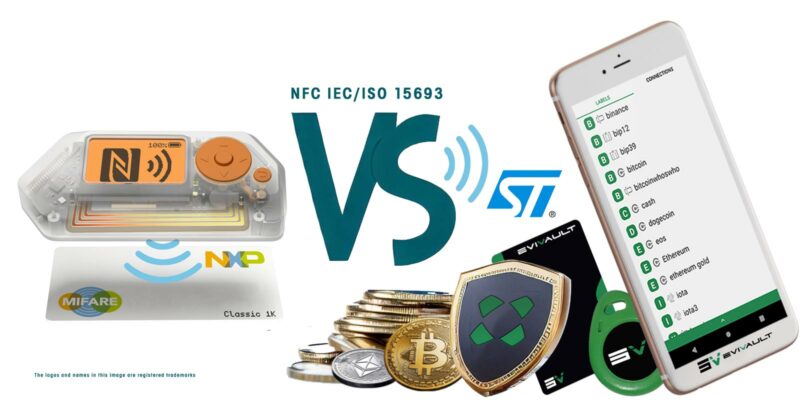
EviVault NFC HSM vs Flipper Zero: The duel of an NFC HSM and a Pentester

Articles Cryptocurrency Digital Security Technical News

Securing IEO STO ICO IDO and INO: The Challenges and Solutions

Articles Cyberculture Digital Security Technical News

Protect Meta Account Identity Theft with EviPass and EviOTP

2024 Digital Security

Cybersecurity Breach at IMF: A Detailed Investigation

2023 Articles Cyberculture Digital Security Technical News

Strong Passwords in the Quantum Computing Era

2024 Digital Security

PrintListener: How to Betray Fingerprints

2024 Articles Digital Security News Spying

How to protect yourself from stalkerware on any phone

2023 Articles DataShielder Digital Security Military spying News NFC HSM technology Spying

Pegasus: The cost of spying with one of the most powerful spyware in the world

2024 Digital Security Spying

Ivanti Zero-Day Flaws: Comprehensive Guide to Secure Your Systems Now

2024 Articles Compagny spying Digital Security Industrial spying Military spying News Spying Zero trust

KingsPawn A Spyware Targeting Civil Society

2024 Articles Digital Security EviKey NFC HSM EviPass News SSH

Terrapin attack: How to Protect Yourself from this New Threat to SSH Security

2024 Articles Digital Security News Phishing

Google OAuth2 security flaw: How to Protect Yourself from Hackers

In Sovereign Cybersecurity ↑ This article is part of our Digital Security section, continuing our research on zero-trust hardware exploits and countermeasures.

 ▸ Key Points

  • Confirmed Vulnerability: Cloud-synced passkeys (Apple, Google, Microsoft) are not 100% phishing-resistant.
  • New Threat: Real-time prompt spoofing exploits the user interface rather than cryptography.
  • Strategic Impact: Critical infrastructure and government agencies must migrate to device-bound credentials and sovereign offline solutions (NFC HSM, segmented keys).

What is a WebAuthn API Hijacking Attack?

A WebAuthn interception attack via a spoofable authentication prompt (WebAuthn API Hijacking) consists of imitating in real time the authentication window displayed by a system or browser. Consequently, the attacker does not seek to break the cryptographic algorithm; instead, they reproduce the user interface (UI) at the exact moment the victim expects to see a legitimate prompt. Visual lures, precise timing, and perfect synchronization make the deception indistinguishable to the user.

Simplified example:
A user thinks they are approving a connection to their bank account via a legitimate Apple or Google system prompt. In reality, they are interacting with a dialog box cloned by the attacker. As a result, the adversary captures the active session without alerting the victim.
▸ In short: Unlike “classic” phishing attacks via email or fraudulent websites, the real-time prompt spoofing takes place during authentication, when the user is most confident.

History of Passkey / WebAuthn Vulnerabilities

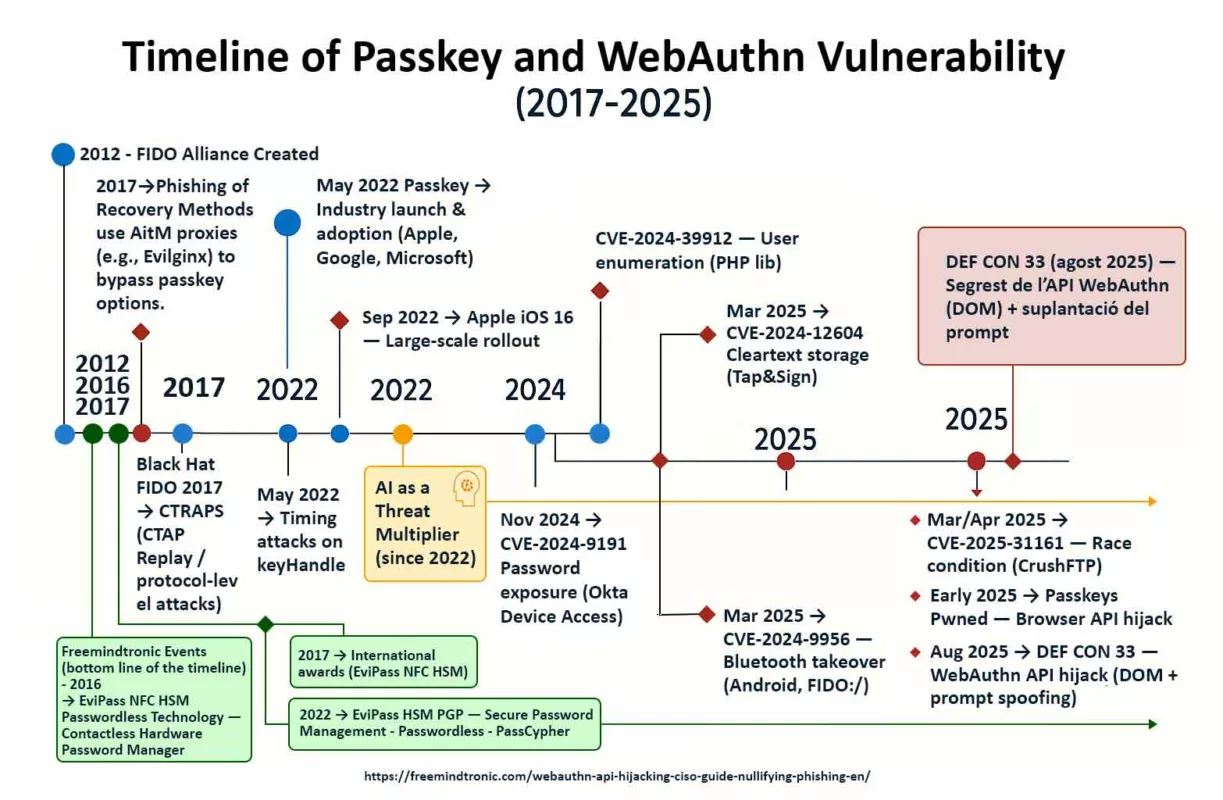
Despite their cryptographic robustness, passkeys — based on the open standards WebAuthn and FIDO2 from the FIDO Alliance — are not invulnerable. The history of vulnerabilities and recent research confirms that the key weakness often lies in the user interaction and the execution environment (browser, operating system). The industry officially adopted passkeys on May 5, 2022, following a commitment from Apple, Google, and Microsoft to extend their support on their respective platforms.

Timeline illustrating the accelerated evolution of Passkey and WebAuthn vulnerabilities from 2012 to 2025, including FIDO Alliance creation, phishing methods, CVEs, and the WebAuthn API Hijacking revealed at DEF CON 33.
Accelerated Evolution of Passkey and WebAuthn Vulnerabilities (2012-2025): A detailed timeline highlighting key security events, from the foundation of the FIDO Alliance to the emergence of AI as a threat multiplier and the definitive proof of the WebAuthn API Hijacking at DEF CON 33.

Timeline of Vulnerabilities

  • SquareX – Compromised Browsers (August 2025):

    At DEF CON 33, a demonstration showed that a malicious extension or script can intercept the WebAuthn flow to substitute keys. See the TechRadar analysis and the SecurityWeek report.

  • CVE-2025-31161 (March/April 2025):

    Authentication bypass in CrushFTP via a race condition. Official NIST Source.

  • CVE-2024-9956 (March 2025):

    Account takeover via Bluetooth on Android. This attack demonstrated that an attacker can remotely trigger a malicious authentication via a FIDO:/ intent. Analysis from Risky.Biz. Official NIST Source.

  • CVE-2024-12604 (March 2025):

    Cleartext storage of sensitive data in Tap&Sign, exploiting poor password management. Official NIST Source.

  • CVE-2025-26788 (February 2025):

    Authentication bypass in StrongKey FIDO Server. Detailed Source.

  • Passkeys Pwned – Browser-based API Hijacking (Early 2025):

    A research study showed that the browser, as a single mediator, can be a point of failure. Read the Security Boulevard analysis.

  • CVE-2024-9191 (November 2024):

    Password exposure via Okta Device Access. Official NIST Source.

  • CVE-2024-39912 (July 2024):

    User enumeration via a flaw in the PHP library web-auth/webauthn-lib. Official NIST Source.

  • CTRAPS-type Attacks (2024):

    These protocol-level attacks (CTAP) exploit authentication mechanisms for unauthorized actions. For more information on FIDO protocol-level attacks, see this Black Hat presentation on FIDO vulnerabilities.

  • First Large-Scale Rollout (September 2022):

    Apple was the first to deploy passkeys on a large scale with the release of iOS 16, making this technology a reality for hundreds of millions of users. Official Apple Press Release.

  • Industry Launch & Adoption (May 2022):

    The FIDO Alliance, joined by Apple, Google, and Microsoft, announced an action plan to extend passkey support across all their platforms. Official FIDO Alliance Press Release.

  • Timing Attacks on keyHandle (2022):

    A vulnerability allowing account correlation by measuring time variations in the processing of keyHandles. See IACR ePrint 2022 article.

  • Phishing of Recovery Methods (since 2017):

    Attackers use AitM proxies (like Evilginx, which appeared in 2017) to hide the passkey option and force a fallback to less secure methods that can be captured. More details on this technique.

AI as a Threat Multiplier

Artificial intelligence is not a security flaw, but a catalyst that makes existing attacks more effective. Since the emergence of generative AI models like GPT-3 (2020) and DALL-E 2 (2022), new capabilities for automating threats have appeared. These developments notably allow for:

  • Large-scale Attacks (since 2022): Generative AI enables attackers to create custom authentication prompts and phishing messages for a massive volume of targets, increasing the effectiveness of phishing of recovery methods.
  • Accelerated Vulnerability Research (since 2023): AI can be used to automate the search for security flaws, such as user enumeration or the detection of logical flaws in implementation code.
Historical Note — The risks associated with spoofable prompts in WebAuthn were already raised by the community in W3C GitHub issue #1965 (before the DEF CON 33 demonstration). This shows that the user interface has long been recognized as a weak link in so-called “phishing-resistant” authentication.

“These recent and historical vulnerabilities highlight the critical role of the browser and the deployment model (device-bound vs. synced). They reinforce the call for sovereign architectures that are disconnected from these vectors of compromise.”

Vulnerability of the Synchronization Model

One of the most debated passkeys security vulnerabilities does not concern the WebAuthn protocol itself, but its deployment model. Most publications on the subject differentiate between two types of passkeys:

  • Device-bound passkeys: Stored on a physical device (like a hardware security key or Secure Enclave). This model is generally considered highly secure because it is not synchronized via a third-party service.
  • Synced passkeys: Stored in a password manager or a cloud service (iCloud Keychain, Google Password Manager, etc.). These passkeys can be synchronized across multiple devices. For more details on this distinction, refer to the FIDO Alliance documentation.

The vulnerability lies here: if an attacker manages to compromise the cloud service account, they could potentially gain access to the synced passkeys across all the user’s devices. This is a risk that device-bound passkeys do not share. Academic research, such as this paper published on arXiv, explores this issue, highlighting that “the security of synced passkeys is primarily concentrated with the passkey provider.”

This distinction is crucial because the implementation of vulnerable synced passkeys contradicts the very spirit of a so-called phishing-resistant MFA, as synchronization introduces an intermediary and an additional attack surface. This justifies the FIDO Alliance’s recommendation to prioritize device-bound passkeys for maximum security.

The DEF CON 33 Demonstration – WebAuthn API Hijacking in Action

WebAuthn API Hijacking is the central thread of this section: we briefly explain the attack path shown at DEF CON 33 and how a spoofable prompt enabled real-time session takeover, before detailing the live evidence and the video highlights.

Passkeys Pwned — DEF CON 33 Talk on WebAuthn

During DEF CON 33, the Allthenticate team presented a talk titled “Passkeys Pwned: Turning WebAuthn Against Itself.”
This session demonstrated how attackers could exploit WebAuthn API Hijacking to
compromise synced passkeys in real time using a spoofable authentication prompt.

By using the provocative phrase “Passkeys Pwned,” the researchers deliberately emphasized that even so-called phishing-resistant credentials can be hijacked when the user interface itself is the weak link.

Evidence of WebAuthn API Hijacking at DEF CON 33

In Las Vegas, at the heart of DEF CON 33 (August 8–11, 2025), the world’s most respected hacker community witnessed a demonstration that made many squirm. In fact, researchers at Allthenticate showed live that a vulnerable synced passkey – despite being labeled “phishing-resistant” – could be tricked. So what did they do? They executed a WebAuthn API Hijacking attack (spoofing the system prompt) of the spoofable authentication prompt type (real-time prompt spoofing). They created a fake authentication dialog box, perfectly timed and visually identical to the legitimate UI. Ultimately, the user believed they were validating a legitimate authentication, but the adversary hijacked the session in real time. This proof of concept makes the “Passkeys WebAuthn Interception Flaw” tangible through a real-time spoofable prompt.

Video Highlights — WebAuthn API Hijacking in Practice

To visualize the sequence, watch the clip below: it shows how WebAuthn API Hijacking emerges from a simple UI deception that aligns timing and look-and-feel with the expected system prompt, leading to seamless session capture.

Official Authors & Media from DEF CON 33
▸ Shourya Pratap Singh, Jonny Lin, Daniel Seetoh — Allthenticate researchers, authors of the demo “Your Passkey is Weak: Phishing the Unphishable”.
Allthenticate Video on TikTok — direct explanation by the team.
DEF CON 33 Las Vegas Video (TikTok) — a glimpse of the conference floor.
Highlights DEF CON 33 (YouTube) — including the passkeys flaw.

▸ Summary

DEF CON 33 demonstrated that vulnerable synced passkeys can be compromised live when a spoofable authentication prompt is inserted into the WebAuthn flow.

Comparison – WebAuthn Interception Flaw: Prompt Spoofing vs. DOM Clickjacking

At DEF CON 33, two major research findings shook confidence in modern authentication mechanisms. Indeed, both exploit flaws related to the user interface (UX) rather than cryptography, but their vectors and targets differ radically.

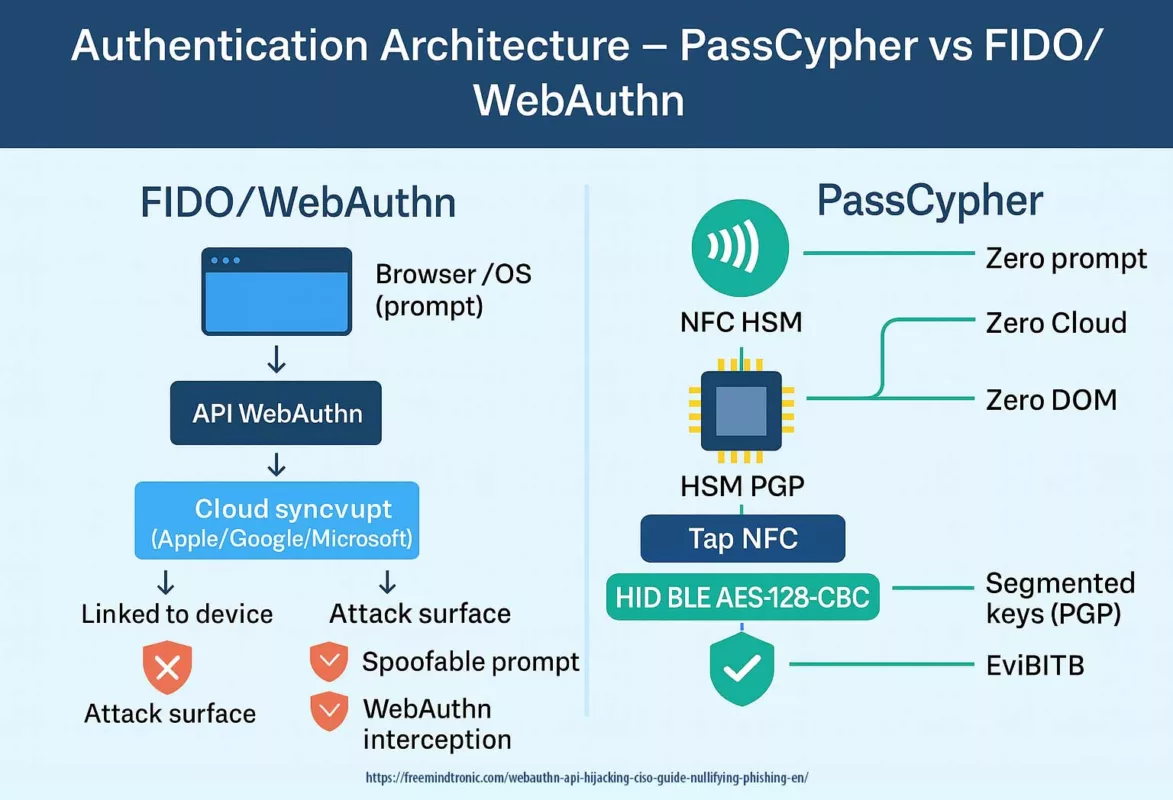
Architecture comparison of PassCypher vs FIDO WebAuthn authentication highlighting phishing resistance and prompt spoofing risks
Comparison of PassCypher and FIDO WebAuthn architectures showing why Passkeys are vulnerable to WebAuthn API hijacking while PassCypher eliminates prompt spoofing risks.

Real-Time Prompt Spoofing

  • Author: Allthenticate (Las Vegas, DEF CON 33).
  • Target: vulnerable synced passkeys (Apple, Google, Microsoft).
  • Vecteur: spoofable authentication prompt, perfectly timed to the legitimate UI (real-time prompt spoofing).
  • Impact: WebAuthn interception attack that causes “live” phishing; the user unknowingly validates a malicious request.

DOM Clickjacking

  • Authors: Another team of researchers (DEF CON 33).
  • Target: Credential managers, extensions, stored passkeys.
  • Vecteur: invisible iframes, Shadow DOM, malicious scripts to hijack autofill.
  • Impact: Silent exfiltration of credentials, passkeys, and crypto-wallet keys.

▸ Key takeaway: This article focuses exclusively on prompt spoofing, which illustrates a major WebAuthn interception flaw and challenges the promise of “phishing-resistant passkeys.” For a complete study on DOM clickjacking, please see the related article.

Strategic Implications – Passkeys and UX Vulnerabilities

As a result, the “Passkeys WebAuthn Interception Flaw” forces us to rethink authentication around prompt-less and cloud-less models.

  • We should no longer consider vulnerable synced passkeys to be invulnerable.
  • We must prioritize device-bound credentials for sensitive environments.
  • We need to implement UX safeguards: detecting anomalies in authentication prompts and using non-spoofable visual signatures.
  • We should train users on the threat of real-time phishing via a WebAuthn interception attack.
▸ Insight
It is not cryptography that is failing, but the illusion of immunity. WebAuthn interception demonstrates that the risk lies in the UX, not the algorithm.

Regulations & Compliance – MFA and WebAuthn Interception

Official documents such as the CISA guide on phishing-resistant MFA or the OMB M-22-09 directive insist on this point: authentication is “phishing-resistant” only if no intermediary can intercept or hijack the WebAuthn flow.
In theory, WebAuthn passkeys respect this rule. In practice, however, the implementation of vulnerable synced passkeys opens an interception flaw that attackers can exploit via a spoofable authentication prompt.

In Europe, both the NIS2 directive and the SecNumCloud certification reiterate the same requirement: no dependence on un-mastered third-party services.

As such, the “Passkeys WebAuthn Interception Flaw” contradicts the spirit of a so-called phishing-resistant MFA, because synchronization introduces an intermediary.

In other words, a US cloud managing your passkeys falls outside the scope of strict digital sovereignty.

▸ Summary

A vulnerable synced passkey can compromise the requirement for phishing-resistant MFA (CISA, NIS2) when a WebAuthn interception attack is possible.

European & Francophone Statistics – Real-time Phishing and WebAuthn Interception

Public reports confirm that advanced phishing attacks — including real-time techniques — represent a major threat in the European Union and the Francophone area.

  • European Union — ENISA: According to the Threat Landscape 2024 report, phishing and social engineering account for 38% of reported incidents in the EU, with a notable increase in Adversary-in-the-Middle methods and real-time prompt spoofing, associated with WebAuthn interception. Source: ENISA Threat Landscape 2024
  • France — Cybermalveillance.gouv.fr: In 2023, phishing generated 38% of assistance requests, with over 1.5M consultations related to this type of attack. Fake bank advisor scams jumped by +78% vs. 2022, often via spoofable authentication prompts. Source: 2023 Activity Report
  • Canada (Francophone) — Canadian Centre for Cyber Security: The National Cyber Threat Assessment 2023-2024 indicates that 65% of businesses expect to experience a phishing or ransomware attack. Phishing remains a preferred vector for bypassing MFA, including via WebAuthn flow interception. Source: Official Assessment
▸ Strategic Reading
Real-time prompt spoofing is not a lab experiment; it is part of a trend where phishing targets the authentication interface rather than algorithms, with increasing use of the WebAuthn interception attack.

Sovereign Use Case – Neutralizing WebAuthn Interception

In a practical scenario, a regulatory authority reserves synced passkeys for low-risk public portals. Conversely, the PassCypher choice eliminates the root cause of the “Passkeys WebAuthn Interception Flaw” by removing the prompt, the cloud, and any DOM exposure.
For critical systems (government, sensitive operations, vital infrastructure), it deploys PassCypher in two forms:

  • PassCypher NFC HSM — offline hardware authentication, with no server and BLE AES-128-CBC keyboard emulation. Consequently, no spoofable authentication prompt can exist.
  • PassCypher HSM PGP — sovereign management of inexportable segmented keys, with cryptographic validation that is cloud-free and synchronization-free.
    ▸ Result
    In this model, the prompt vector exploited during the WebAuthn interception attack at DEF CON 33 is completely eliminated from critical pathways.

Why PassCypher Eliminates the WebAuthn Interception Risk

PassCypher solutions stand in radical contrast to FIDO passkeys that are vulnerable to the WebAuthn interception attack:

  • No OS/browser prompt — thus no spoofable authentication prompt.
  • No cloud — no vulnerable synchronization or third-party dependency.
  • No DOM — no exposure to scripts, extensions, or iframes.
✓ Sovereignty: By removing the prompt, cloud, and DOM, PassCypher eliminates any anchor point for the WebAuthn interception flaw (prompt spoofing) revealed at DEF CON 33.

PassCypher NFC HSM — Eliminating the WebAuthn Prompt Spoofing Attack Vector

Allthenticate’s attack at DEF CON 33 proves that attackers can spoof any system that depends on an OS/browser prompt. PassCypher NFC HSM removes this vector: there is no prompt, no cloud sync, secrets are encrypted for life in a nano-HSM NFC, and validated by a physical tap. User operation:

  • Mandatory NFC tap — physical validation with no software interface.
  • HID BLE AES-128-CBC Mode — out-of-DOM transmission, resistant to keyloggers.
  • Zero-DOM Ecosystem — no secret ever appears in the browser.

▸ Summary

Unlike vulnerable synced passkeys, PassCypher NFC HSM neutralizes the WebAuthn interception attack because a spoofable authentication prompt does not exist.

WebAuthn API Hijacking Neutralized by PassCypher NFC HSM

Attack Type Vector Status
Prompt Spoofing Fake OS/browser dialog Neutralized (zero prompt)
Real-time Phishing Live-trapped validation Neutralized (mandatory NFC tap)
Keystroke Logging Keyboard capture Neutralized (encrypted HID BLE)

PassCypher HSM PGP — Segmented Keys Against Phishing

The other pillar, PassCypher HSM PGP, applies the same philosophy: no exploitable prompt.
Secrets (credentials, passkeys, SSH/PGP keys, TOTP/HOTP) reside in AES-256 CBC PGP encrypted containers, protected by a patented system of segmented keys.

  • No prompt — so there is no window to spoof.
  • Segmented keys — they are inexportable and assembled only in RAM.
  • Ephemeral decryption — the secret disappears immediately after use.
  • Zero cloud — there is no vulnerable synchronization.

▸ Summary

PassCypher HSM PGP eliminates the attack surface of the real-time spoofed prompt: it provides hardware authentication, segmented keys, and cryptographic validation with no DOM or cloud exposure.

Attack Surface Comparison

Criterion Synced Passkeys (FIDO) PassCypher NFC HSM PassCypher HSM PGP
Authentication Prompt Yes No No
Synchronization Cloud Yes No No
Exportable Private Key No (attackable UI) No No
WebAuthn Hijacking/Interception Present Absent Absent
FIDO Standard Dependency Yes No No
▸ Insight By removing the spoofable authentication prompt and cloud synchronization, the WebAuthn interception attack demonstrated at DEF CON 33 disappears completely.

Weak Signals – Trends Related to WebAuthn Interception

▸ Weak Signals Identified

  • The widespread adoption of real-time UI attacks, including WebAuthn interception via a spoofable authentication prompt.
  • A growing dependency on third-party clouds for identity, which increases the exposure of vulnerable synced passkeys.
  • A proliferation of bypasses through AI-assisted social engineering, applied to authentication interfaces.

Strategic Glossary

A review of the key concepts used in this article, for both beginners and advanced readers.

  • Passkey / Passkeys

    A passwordless digital credential based on the FIDO/WebAuthn standard, designed to be “phishing-resistant.

    • Passkey (singular): Refers to a single digital credential stored on a device (e.g., Secure Enclave, TPM, YubiKey).
    • Passkeys (plural): Refers to the general technology or multiple credentials, including synced passkeys stored in Apple, Google, or Microsoft clouds. These are particularly vulnerable to WebAuthn API Hijacking (real-time prompt spoofing demonstrated at DEF CON 33).
  • Passkeys Pwned

    Title of the DEF CON 33 talk by Allthenticate (“Passkeys Pwned: Turning WebAuthn Against Itself”). It highlights how WebAuthn API Hijacking can compromise synced passkeys in real time, proving that they are not 100% phishing-resistant.

  • Vulnerable synced passkeys

    Stored in a cloud (Apple, Google, Microsoft) and usable across multiple devices. They offer a UX advantage but a strategic weakness: dependence on a spoofable authentication prompt and the cloud.

  • Device-bound passkeys

    Linked to a single device (TPM, Secure Enclave, YubiKey). More secure because they lack cloud synchronization.

  • Prompt

    A system or browser dialog box that requests a user’s validation (Face ID, fingerprint, FIDO key). This is the primary target for spoofing.

  • WebAuthn Interception Attack

    Also known as WebAuthn API Hijacking, this attack manipulates the authentication flow by spoofing the system/browser prompt and imitating the user interface in real time. The attacker does not break cryptography, but intercepts the WebAuthn process at the UX level (e.g., a cloned fingerprint or Face ID prompt). See the official W3C WebAuthn specification and FIDO Alliance documentation.

  • Real-time prompt spoofing

    The live spoofing of an authentication window, which is indistinguishable to the user.

  • DOM Clickjacking

    An attack using invisible iframes and Shadow DOM to hijack autofill and steal credentials.

  • Zero-DOM

    A sovereign architecture where no secret is exposed to the browser or the DOM.

  • NFC HSM

    A secure hardware module that is offline and compatible with HID BLE AES-128-CBC.

  • Segmented keys

    Cryptographic keys that are split into segments and only reassembled in volatile memory.

  • Device-bound credential

    A credential attached to a physical device that is non-transferable and non-clonable.

▸ Strategic Purpose: This glossary shows why the WebAuthn interception attack targets the prompt and UX, and why PassCypher eliminates this vector by design.

Technical FAQ (Integration & Use Cases)

  • Q: Are there any solutions for vulnerable passkeys?

    A: Yes, in a hybrid model. Keep FIDO for common use cases and adopt PassCypher for critical access to eliminate WebAuthn interception vectors.

  • Q: What is the UX impact without a system prompt?

    A: The action is hardware-based (NFC tap or HSM validation). There is no spoofable authentication prompt or dialog box to impersonate, resulting in a total elimination of the real-time phishing risk.

  • Q: How can we revoke a compromised key?

    A: You simply revoke the HSM or the key itself. There is no cloud to purge and no third-party account to contact.

  • Q: Does PassCypher protect against real-time prompt spoofing?

    A: Yes. The PassCypher architecture completely eliminates the OS/browser prompt, thereby removing the attack surface exploited at DEF CON 33.

  • Q: Can we integrate PassCypher into a NIS2-regulated infrastructure?

    A: Yes. The NFC HSM and HSM PGP modules comply with digital sovereignty requirements and neutralize the risks associated with vulnerable synced passkeys.

  • Q: Are device-bound passkeys completely inviolable?

    A: No, but they do eliminate the risk of cloud-based WebAuthn interception. Their security then depends on the hardware’s robustness (TPM, Secure Enclave, YubiKey) and the physical protection of the device.

  • Q: Can a local malware reproduce a PassCypher prompt?

    A: No. PassCypher does not rely on a software prompt; the validation is hardware-based and offline, so no spoofable display exists.

  • Q: Why do third-party clouds increase the risk?

    A: Vulnerable synced passkeys stored in a third-party cloud can be targeted by Adversary-in-the-Middle or WebAuthn interception attacks if the prompt is compromised.

CISO/CSO Advice – Universal & Sovereign Protection

To learn how to protect against WebAuthn interception, it’s important to know that EviBITB (Embedded Browser-In-The-Browser Protection) is a built-in technology in PassCypher HSM PGP, including its free version. t automatically or manually detects and removes redirection iframes used in BITB and prompt spoofing attacks, thereby eliminating the WebAuthn interception vector.

  • Immediate Deployment: It is a free extension for Chromium and Firefox browsers, scalable for large-scale use without a paid license.
  • Universal Protection: It works even if the organization has not yet migrated to a prompt-free model.
  • Sovereign Compatibility: It works with PassCypher NFC HSM Lite (99 €) and the full PassCypher HSM PGP (129 €/year).
  • Full Passwordless: Both PassCypher NFC HSM and HSM PGP can completely replace FIDO/WebAuthn for all authentication pathways, with zero prompts, zero cloud, and 100% sovereignty.

Strategic Recommendation:
Deploy EviBITB immediately on all workstations to neutralize BITB/prompt spoofing, then plan the migration of critical access to a full-PassCypher model to permanently remove the attack surface.

Frequently Asked Questions for CISOs/CSOs

Q: What is the regulatory impact of a WebAuthn interception attack?

A: This type of attack can compromise compliance with “phishing-resistant” MFA requirements defined by CISA, NIS2, and SecNumCloud. In case of personal data compromise, the organization faces GDPR sanctions and a challenge to its security certifications.

Q: Is there a universal and free protection against BITB and prompt spoofing?

A: Yes. EviBITB is an embedded technology in PassCypher HSM PGP, including its free version. It blocks redirection iframes (Browser-In-The-Browser) and removes the spoofable authentication prompt vector exploited in WebAuthn interception. It can be deployed immediately on a large scale without a paid license.

Q: Are there any solutions for vulnerable passkeys?

A: Yes. PassCypher NFC HSM and PassCypher HSM PGP are complete sovereign passwordless solutions: they allow authentication, signing, and encryption without FIDO infrastructure, with zero spoofable prompts, zero third-party clouds, and a 100% controlled architecture.

Q: What is the average budget and ROI of a migration to a prompt-free model?

A: According to the Time Spent on Authentication study, a professional loses an average of 285 hours/year on classic authentications, representing an annual cost of about $8,550 (based on $30/h). PassCypher HSM PGP reduces this time to ~7 h/year, and PassCypher NFC HSM to ~18 h/year. Even with the full model (129 €/year) or the NFC HSM Lite (99 € one-time purchase), the breakeven point is reached in a few days to a few weeks, and net savings exceed 50 times the annual cost in a professional context.

Q: How can we manage a hybrid fleet (legacy + modern)?

A: Keep FIDO for low-risk uses while gradually replacing them with PassCypher NFC HSM and/or PassCypher HSM PGP in critical environments. This transition removes exploitable prompts and maintains application compatibility.

Q: What metrics should we track to measure the reduction in attack surface?

A: The number of authentications via system prompts vs. hardware authentication, incidents related to WebAuthn interception, average remediation time, and the percentage of critical accesses migrated to a sovereign prompt-free model.

CISO/CSO Action Plan

Priority Action Expected Impact
Implement solutions for vulnerable passkeys by replacing them with PassCypher NFC HSM (99 €) and/or PassCypher HSM PGP (129 €/year) Eliminates the spoofable prompt, removes WebAuthn interception, and enables sovereign passwordless access with a payback period of days according to the study on authentication time
Migrate to a full-PassCypher model for critical environments Removes all FIDO/WebAuthn dependency, centralizes sovereign management of access and secrets, and maximizes productivity gains measured by the study
Deploy EviBITB (embedded technology in PassCypher HSM PGP, free version included) Provides immediate, zero-cost protection against BITB and real-time phishing via prompt spoofing
Harden the UX (visual signatures, non-cloneable elements) Complicates UI attacks, clickjacking, and redress
Audit and log authentication flows Detects and tracks any attempt at flow hijacking or Adversary-in-the-Middle attacks
Align with NIS2, SecNumCloud, and GDPR Reduces legal risk and provides proof of compliance
Train users on spoofable interface threats Strengthens human vigilance and proactive detection

Strategic Outlook

The message from DEF CON 33 is clear: authentication security is won or lost at the interface. In other words, as long as the user validates graphical authentication prompts synchronized with a network flow, real-time phishing and WebAuthn interception will remain possible.

Thus, prompt-free and cloud-free models — embodied by sovereign HSMs like PassCypher — radically reduce the attack surface.

In the short term, generalize the use of device-bound solutions for sensitive applications. In the medium term, the goal is to eliminate the spoofable UI from critical pathways. Ultimately, the recommended trajectory will permanently eliminate the “Passkeys WebAuthn Interception Flaw” from critical pathways through a gradual transition to a full-PassCypher model, providing a definitive solution for vulnerable passkeys in a professional context.

Electronic Warfare in Military Intelligence

Realistic depiction of electronic warfare in military intelligence with modern equipment and personnel analyzing communication signals on white background

Electronic Warfare in Military Intelligence by Jacques gascuel I will keep this article updated with any new information, so please feel free to leave comments or contact me with suggestions or additions.his article will be updated with any new information on the topic, and readers are encouraged to leave comments or contact the author with any suggestions or additions.  

The Often Overlooked Role of Electronic Warfare in Military Intelligence

Electronic Warfare in Military Intelligence has become a crucial component of modern military operations. This discipline discreetly yet vitally protects communications and gathers strategic intelligence, providing armed forces with a significant tactical advantage in an increasingly connected world.

Historical Context: The Evolution of Electronic Warfare in Military Intelligence

From as early as World War II, electronic warfare established itself as a critical strategic lever. The Allies utilized jamming and interception techniques to weaken Axis forces. This approach was notably applied through “Operation Ultra,” which focused on deciphering Enigma messages. During the Cold War, major powers refined these methods. They incorporated intelligence and countermeasures to secure their own networks.

Today, with rapid technological advancements, electronic warfare combines state-of-the-art systems with sophisticated intelligence strategies. It has become a cornerstone of modern military operations.

These historical foundations underscore why electronic warfare has become indispensable. Today, however, even more advanced technologies and strategies are essential to counter new threats.

Interception and Monitoring Techniques in Electronic Warfare for Military Intelligence

In military intelligence, intercepting enemy signals is crucial. France’s 54th Electronic Warfare Regiment (54e RMRT), the only regiment dedicated to electronic warfare, specializes in intercepting adversary radio and satellite communications. By detecting enemy frequencies, they enable the armed forces to collect critical intelligence in real time. This capability enhances their ability to anticipate enemy actions.

DataShielder NFC HSM Master solutions bolster these capabilities by securing the gathered information with Zero Trust and Zero Knowledge architecture. This ensures the confidentiality of sensitive data processed by analysts in the field.

Current technological advancements paired with electronic warfare also spotlight the modern threats that armed forces must address.

Emerging Technologies and Modern Threats

Electronic warfare encompasses interception, jamming, and manipulation of signals to gain a strategic edge. In a context where conflicts occur both on the ground and in the invisible spheres of communications, controlling the electromagnetic space has become essential. Powers such as the United States, Russia, and China invest heavily in these technologies. This investment serves to disrupt enemy communications and safeguard their own networks.

Recent conflicts in Ukraine and Syria have highlighted the importance of these technologies in disrupting adversary forces. Moreover, new threats—such as cyberattacks, drones, and encrypted communications—compel armies to innovate. Integrating artificial intelligence (AI) and 5G accelerates these developments. DataShielder HSM PGP Encryption meets the need for enhanced protection by offering robust, server-free encryption, ideal for high-security missions where discretion is paramount.

While these technological advancements are crucial, they also pose complex challenges for the military and engineers responsible for their implementation and refinement.

Change to: Challenges of Electronic Warfare in Military Intelligence: Adaptation and Innovation

Despite impressive advancements, electronic warfare must continually evolve. The rapid pace of innovation renders cutting-edge equipment quickly obsolete. This reality demands substantial investments in research and development. It also requires continuous training for electronic warfare specialists.

DataShielder products, such as DataShielder NFC HSM Auth, play a pivotal role in addressing these challenges. For instance, NFC HSM Auth provides secure, anonymous authentication, protecting against identity theft and AI-assisted threats. By combining advanced security with ease of use, these solutions facilitate adaptation to modern threats while ensuring the protection of sensitive information.

These advances pave the way for emerging technologies, constantly reshaping the needs and methods of electronic warfare.

Analyzing Emerging Technologies: The Future of Electronic Warfare

Integrating advanced technologies like AI is vital for optimizing electronic warfare operations. AI automates interception and jamming processes, increasing military system responsiveness. DataShielder NFC HSM Auth fits seamlessly into this technological environment by protecting against identity theft, even when AI is involved. Post-quantum cryptography and other advanced security techniques in the DataShielder range ensure lasting protection against future threats.

To better understand the real-world application of these technologies, insights from field experts are essential.

Case Studies and Operational Implications: The Testimony of Sergeant Jérémy

Insights from the Field: The Realities of Electronic Warfare Operations

In the field of electronic warfare, the testimony of Sergeant Jérémy, a member of the 54th Transmission Regiment (54e RMRT), provides a deeper understanding of the challenges and operational reality of a job that is both technical, discreet, and demanding. Through his accounts of operations in Afghanistan, Jérémy illustrates how electronic warfare can save lives by providing essential support to ground troops.

Real-Time Threat Detection and Protection in Combat Zones

During his mission in Afghanistan, at just 19, Jérémy participated in radiogoniometry operations, identifying the location of electromagnetic emissions. In one convoy escort mission, his equipment detected signals from enemy forces, indicating a potential ambush. Thanks to this detection, he alerted his patrol leader, allowing the convoy to take defensive measures. This type of mission demonstrates how electronic warfare operators combine technical precision and composure to protect deployed units.

Tactical Jamming and Strategic Withdrawals

In another operation, Jérémy and his team helped special forces withdraw from a combat zone by jamming enemy communications. This temporary disruption halted adversary coordination, giving allied troops the necessary time to retreat safely. However, this technique is not without risks: while crucial, jamming also prevents allied forces from communicating, adding complexity and stress for operators. This mission underscores the delicate balance between protecting allies and disorganizing the enemy, a daily challenge for electronic warfare specialists.

The Role of Advanced Equipment in Electronic Warfare Missions

On missions, the 54e RMRT uses advanced interception, localization, and jamming equipment. These modern systems, such as radiogoniometry and jamming devices, have become essential for the French Army in electronic intelligence and neutralizing adversary communications. However, these missions are physically and psychologically demanding, requiring rigorous training and a capacity to work under high pressure. Sergeant Jérémy’s testimony reminds us of the operational reality behind each technology and demonstrates the rigor with which electronic warfare operators must adapt and respond.

To listen to the complete testimony of Sergeant Jérémy and learn more about his journey, you can access the full podcast here.

Examining the methods of other nations also reveals the varied approaches to electronic warfare.

International Military Doctrines in Electronic Warfare for Military Intelligence

Military doctrines in electronic warfare vary from one country to another. For example, the United States integrates electronic warfare and cyber operations under its “multi-domain operations.” Meanwhile, Russia makes electronic warfare a central element of hybrid operations, combining jamming, cyberattacks, and disinformation. This diversity shows how each country adapts these technologies based on its strategic goals and specific threats.

The growing importance of electronic warfare is also reflected in international alliances, where cooperation is essential to address modern threats.

NATO’s Role in Electronic Warfare

Electronic warfare is also crucial for military alliances such as NATO. Multinational exercises allow for testing and perfecting electronic warfare capabilities, ensuring that allied forces can protect their communications and disrupt those of the enemy. This cooperation strengthens the effectiveness of electronic warfare operations. It maximizes the resilience of allied networks against modern threats.

Recent events demonstrate how electronic warfare continues to evolve to meet the demands of modern battlefields.

Recent Developments in Electronic Warfare

In 2024, the U.S. military spent $5 billion on improving electronic warfare capabilities, notably during the Valiant Shield 2024 exercise. During this event, innovative technologies like DiSCO™ (Distributed Spectrum Collaboration and Operations) were tested. This technology enables real-time spectrum data sharing for the rapid reprogramming of electronic warfare systems. These developments highlight the growing importance of spectral superiority in modern conflicts.

In Ukraine, electronic warfare allowed Russian forces to jam communications and simulate signals to disorient opposing units. This capability underscores the need to strengthen GPS systems and critical communications.

In response to these developments, advanced technological solutions like those of DataShielder provide concrete answers.

Integrating DataShielder Solutions

In the face of rising identity theft and AI-assisted cyber espionage threats, innovative solutions like DataShielder NFC HSM Auth and DataShielder HSM PGP Encryption have become indispensable. Each DataShielder device operates without servers, databases, or user accounts, enabling end-to-end anonymity in real time. By encrypting data through a segmented AES-256 CBC, these products ensure that no trace of sensitive information remains on NFC-enabled Android phones or computers.

  • DataShielder NFC HSM Master: A robust counter-espionage tool that provides AES-256 CBC encryption with segmented keys, designed to secure communications without leaving any traces.
  • DataShielder NFC HSM Auth: A secure authentication module essential for preventing identity theft and AI-assisted fraud in high-risk environments.
  • DataShielder NFC HSM Starter Kit: This all-in-one kit offers complete data security with real-time, contactless encryption and authentication, ideal for organizations seeking to implement comprehensive protection from the outset.
  • DataShielder NFC HSM M-Auth: A flexible solution for mobile authentication, enabling secure identity verification and encryption without dependence on external networks.
  • DataShielder PGP HSM Encryption: Offering advanced PGP encryption, this tool ensures secure communication even in compromised network conditions, making it ideal for sensitive exchanges.

By leveraging these solutions, military intelligence and high-security organizations can securely encrypt and authenticate communications. DataShielder’s technology redefines how modern forces protect themselves against sophisticated cyber threats, making it a crucial component in electronic warfare.

The convergence between cyberwarfare and electronic warfare amplifies these capabilities, offering new opportunities and challenges.

Cyberwarfare and Electronic Warfare in Military Intelligence: A Strategic Convergence

Electronic warfare operations and cyberattacks, though distinct, are increasingly interconnected. While electronic warfare neutralizes enemy communications, cyberattacks target critical infrastructure. Together, they create a paralyzing effect on adversary forces. This technological convergence is now crucial for modern armies. Products like DataShielder NFC HSM Master and DataShielder HSM PGP Encryption guarantee secure communications against combined threats.

This convergence also raises essential ethical and legal questions for states.

Legal and Ethical Perspectives on Electronic Warfare

With its growing impact, electronic warfare raises ethical and legal questions. Should international conventions regulate its use? Should new laws be created to govern the interception and jamming of communications? These questions are becoming more pressing as electronic warfare technologies improve.

In this context, the future of electronic warfare points toward ever more effective technological innovations.

Looking Ahead: New Perspectives for Electronic Warfare in Military Intelligence

The future of electronic warfare will be shaped by AI integration and advanced cryptography—key elements for discreet and secure communications. DataShielder NFC HSM Master and DataShielder HSM PGP Encryption are examples of modern solutions. They ensure sensitive data remains protected against interception, highlighting the importance of innovation to counter emerging threats.

CVE-2023-32784 Protection with PassCypher NFC HSM

CVE-2023-32784 Protection with PassCypher NFC HSM and HSM PGP - Digital security solutions

CVE-2023-32784 Protection with PassCypher NFC HSM safeguards your digital secrets. It protects your secrets beyond the compromised operating system perimeter by using NFC/HSM PGP devices encrypted with AES-256 CBC. This ensures optimal protection against advanced attacks like CVE-2023-32784, where secrets stored in memory files like hiberfil.sys and pagefile.sys may be vulnerable to exfiltration. Learn how PassCypher can secure your data even in the event of a system compromise.

Executive Summary — Protect Your Digital Secrets Against CVE-2023-32784 with PassCypher

First, this executive summary (≈ 4 minutes) will provide an overview of the CVE-2023-32784 vulnerability and how PassCypher protects your secrets. Then, the advanced summary will delve into the mechanics of this vulnerability, the risks associated with hibernation and pagefile memory, and specific PassCypher solutions to counter these attacks.

⚡ Discovery and Security Mechanisms

The CVE-2023-32784 vulnerability was discovered in April 2023 and allows attackers to exfiltrate sensitive secrets stored in memory files such as hiberfil.sys and pagefile.sys. The patch to fix this vulnerability was released in May 2023 to secure these vulnerable access points and mitigate the risk of exfiltration. You can review the official patch link here: CVE Details – CVE-2023-32784.

PassCypher NFC HSM uses a Zero Trust architecture and advanced mechanisms such as segmented encryption and NFC contactless authentication to protect your secrets from these attacks. These technologies ensure that even if an attacker gains access to memory, the secrets remain protected.

Source: CVE Details – CVE-2023-32784

✦ Immediate Impacts

  • On the one hand, compromise becomes a persistent state of the terminal, not a one-time incident. Once memory artifacts are extracted, it is difficult to ensure that the system is no longer compromised.
  • On the other hand, security agents lose their ability to prove they are functioning correctly on a potentially compromised environment.
  • As a result, attribution and response become more uncertain, while the exposure window lengthens.

Source: NIST Cybersecurity Framework

⚠ Strategic Message

However, the key element is not just the vulnerability itself, but the trust logic: a compromised system, even without a known signature, can no longer guarantee reliable security. Trust in an environment where secrets are stored becomes fragile if these secrets are vulnerable to covert exfiltration through memory.

Source: NIST Special Publication 800-53: Security and Privacy Controls for Information Systems and Organizations

🛑 When Not to Act

  • First, do not reintroduce secrets (credentials, keys, sensitive data) on a terminal whose integrity has not been verified.
  • Next, do not stack layers of security software that may complicate auditing and increase the attack surface.
  • Finally, do not confuse service return with trust restoration: a quick recovery can mask persistent compromises.

✓ Sovereign Counter-Espionage Principle

Thus, reducing risk does not mean “cleaning” a compromised system but moving trust out of the compromised perimeter: off the OS, off memory, and if necessary off the network. This ensures that secrets remain protected even if the main system environment is compromised.

Reading Time Settings

Executive Summary Reading Time: ≈ 4 minutes
Advanced Summary Reading Time: ≈ 6 minutes
Full Chronicle Reading Time: ≈ 35–40 minutes
Publication Date: 2023-05-10
Last Updated: 2026-01-23
Complexity Level: Advanced — Cybersecurity & Digital Sovereignty
Technical Density: ≈ 65%
Primary Language: EN. FR.
Specificity: Strategic Chronicle — CVE-2023-32784 Vulnerability & Secrets Protection
Reading Order: Executive Summary → Advanced Summary → Zero-Day Exploits → PassCypher Solutions → Residual Risks

Editorial Note

This chronicle is part of the Digital Security section. It extends the analysis of zero-day vulnerabilities and the implications of losing secrets through memory, exploring how PassCypher positions itself as a robust solution against this type of compromise. It does not offer a miracle solution but an alternative security framework, based on sovereign points of failure. This chronicle follows the AI transparency statement of Freemindtronic Andorra — FM-AI-2025-11-SMD5.

Illustration showing the CVE-2023-32784 vulnerability and memory exfiltration risks, including hiberfil.sys, pagefile.sys, and RAM.

For Further Reading

Then, the Advanced Summary delves into the management of the CVE-2023-32784 vulnerability and the implications of advanced digital security.

Coinbase blockchain hack: How It Happened and How to Avoid It

How to Prevent Coinbase Blockchain Hack with EviVault NFC HSM Technology What happened to Coinbase [...]

Failles de sécurité Ledger : Analyse 2017-2026 & Protections

Les failles de sécurité Ledger sont au cœur des préoccupations des investisseurs depuis 2017. Cette [...]

1 Comment

DOM Extension Clickjacking — Risks, DEF CON 33 & Zero-DOM fixes

DOM extension clickjacking — a technical chronicle of DEF CON 33 demonstrations, their impact, and [...]

5 Comments

CVE-2023-32784 : Pourquoi PassCypher protège vos secrets

PassCypher HSM protège les secrets numériques. Il protège vos secrets numériques hors du périmètre du [...]

1 Comment

Reputation Cyberattacks in Hybrid Conflicts — Anatomy of an Invisible Cyberwar

Synchronized APT leaks erode trust in tech, alliances, and legitimacy through narrative attacks timed with [...]

Securing IEO STO ICO IDO and INO: The Challenges and Solutions

Securing IEO STO ICO IDO and INO: How to Protect Your Crypto Investments Cryptocurrencies are [...]

Cybersecurity Breach at IMF: A Detailed Investigation

Cybersecurity Breach at IMF: A Detailed Investigation Cybersecurity breaches are a growing concern worldwide. The [...]

Silent Whisper espionnage WhatsApp Signal : une illusion persistante

Silent Whisper espionnage WhatsApp Signal est présenté comme une méthode gratuite permettant d’espionner des communications [...]

CVE-2023-32784 Protection with PassCypher NFC HSM

CVE-2023-32784 Protection with PassCypher NFC HSM safeguards your digital secrets. It protects your secrets beyond [...]

5Ghoul: 5G NR Attacks on Mobile Devices

5Ghoul: How Contactless Encryption Can Secure Your 5G Communications from Modem Attacks 5Ghoul is a [...]

1 Comment

Espionnage invisible WhatsApp : quand le piratage ne laisse aucune trace

Espionnage invisible WhatsApp n’est plus une hypothèse marginale, mais une réalité technique rendue possible par [...]

Ivanti Zero-Day Flaws: Comprehensive Guide to Secure Your Systems Now

What are Zero-Day Flaws and Why are They Dangerous? A zero-day flaw is a previously [...]

Authentification multifacteur : anatomie, OTP, risques

Authentification Multifacteur : Anatomie souveraine Explorez les fondements de l’authentification numérique à travers une typologie [...]

Russian Espionage Hacking Tools Revealed

Russian Espionage Hacking Tools: Discovery and Initial Findings Russian espionage hacking tools were uncovered by [...]

Salt Typhoon & Flax Typhoon: Cyber Espionage Threats Targeting Government Agencies

Salt Typhoon – The Cyber Threat Targeting Government Agencies Salt Typhoon and Flax Typhoon represent [...]

2 Comments

Russian Cyberattack Microsoft: An Unprecedented Threat

Russian cyberattack on Microsoft by Midnight Blizzard (APT29) highlights the strategic risks to digital sovereignty. [...]

1 Comment

Browser Fingerprinting Tracking: Metadata Surveillance in 2026

Browser Fingerprinting Tracking today represents one of the true cores of metadata intelligence. Far beyond [...]

2 Comments

Strong Passwords in the Quantum Computing Era

How to create strong passwords in the era of quantum computing? Quantum computing is a [...]

2 Comments

Quantum computer 6100 qubits ⮞ Historic 2025 breakthrough

A 6,100-qubit quantum computer marks a turning point in the history of computing, raising unprecedented [...]

1 Comment

Quantum-Resistant Passwordless Manager — PassCypher finalist, Intersec Awards 2026 (FIDO-free, RAM-only)

Quantum-Resistant Passwordless Manager 2026 (QRPM) — Best Cybersecurity Solution Finalist by PassCypher sets a new [...]

4 Comments

WhatsApp Gold arnaque mobile : typologie d’un faux APK espion

WhatsApp Gold arnaque mobile — clone frauduleux d’application mobile, ce stratagème repose sur une usurpation [...]

ZenRAT: The malware that hides in Bitwarden and escapes antivirus software

How this malware hides in Bitwarden and escapes antivirus software to steal your information ZenRAT [...]

Google Sheets Malware: The Voldemort Threat

Sheets Malware: A Growing Cybersecurity Concern Google Sheets, a widely used collaboration tool, has shockingly [...]

Confidentialité métadonnées e-mail — Risques, lois européennes et contre-mesures souveraines

La confidentialité des métadonnées e-mail est au cœur de la souveraineté numérique en Europe : [...]

1 Comment

FormBook Malware: How to Protect Your Gmail and Other Data

How to Protect Your Gmail Account from FormBook Malware Introduction Imagine that you receive an [...]

Microsoft Outlook Zero-Click Vulnerability: Secure Your Data Now

Microsoft Outlook Zero-Click Vulnerability: How to Protect Your Data Now A critical Zero-Click vulnerability (CVE-2025-21298) [...]

Android Spyware Threat Clayrat : 2025 Analysis and Exposure

Android Spyware Threat: ClayRat illustrates the new face of cyber-espionage — no exploits needed, just [...]

1 Comment

Email Metadata Privacy: EU Laws & DataShielder

Email metadata privacy sits at the core of Europe’s digital sovereignty: understand the risks, the [...]

1 Comment

APT28 spear-phishing: Outlook backdoor NotDoor and evolving European cyber threats

Russian cyberattack on Microsoft by Midnight Blizzard (APT29) highlights the strategic risks to digital sovereignty. [...]

3 Comments

Persistent OAuth Flaw: How Tycoon 2FA Hijacks Cloud Access

Persistent OAuth Flaw — Tycoon 2FA Exploited — When a single consent becomes unlimited cloud [...]

1 Comment

BitLocker Security: Safeguarding Against Cyberattacks

Introduction to BitLocker Security If you use a Windows computer for data storage or processing, [...]

1 Comment

BadPilot Cyber Attacks: Russia’s Threat to Critical Infrastructures

BadPilot Cyber Attacks: Sandworm’s New Weaponized Subgroup Understanding the rise of BadPilot and its impact [...]

CryptPeer messagerie P2P WebRTC : appels directs chiffrés de bout en bout

La messagerie P2P WebRTC sécurisée constitue le fondement technique et souverain de la communication directe [...]

2 Comments

Phishing Cyber victims caught between the hammer and the anvil

Phishing is a fraudulent technique that aims to deceive internet users and to steal their [...]

Cyberattaque HubEE : Rupture silencieuse de la confiance numérique

Cyberattaque HubEE : rupture silencieuse de la confiance numérique. Cette attaque, qui a permis l’exfiltration [...]

Europol Data Breach: A Detailed Analysis

May 2024: Europol Security Breach Highlights Vulnerabilities In May 2024, Europol, the European law enforcement [...]

Predator Files: The Spyware Scandal That Shook the World

Predator Files: How a Spyware Consortium Targeted Civil Society, Politicians and Officials Cytrox: The maker [...]

PrintListener: How to Betray Fingerprints

PrintListener: How this Technology can Betray your Fingerprints and How to Protect yourself PrintListener revolutionizes [...]

Darknet Credentials Breach 2025 – 16+ Billion Identities Stolen

Underground Market: The New Gold Rush for Stolen Identities The massive leak of over 16 [...]

Protect US emails from Chinese hackers with EviCypher NFC HSM?

How EviCypher NFC HSM technology can protect emails from Chinese hackers The Chinese hack on [...]

APT29 Exploits App Passwords to Bypass 2FA

A silent cyberweapon undermining digital trust Two-factor authentication (2FA) was supposed to be the cybersecurity [...]

Clickjacking extensions DOM: Vulnerabilitat crítica a DEF CON 33

DOM extension clickjacking — el clickjacking d’extensions basat en DOM, mitjançant iframes invisibles, manipulacions del [...]

4 Comments

Tycoon 2FA failles OAuth persistantes dans le cloud | PassCypher HSM PGP

Faille OAuth persistante — Tycoon 2FA exploitée — Quand une simple autorisation devient un accès [...]

2 Comments

Générateur de mots de passe souverain – PassCypher Secure Passgen WP

Générateur de mots de passe souverain PassCypher Secure Passgen WP pour WordPress — le premier [...]

TETRA Security Vulnerabilities: How to Protect Critical Infrastructures

TETRA Security Vulnerabilities: How to Protect Critical Infrastructures from Cyberattacks TETRA (Terrestrial Trunked Radio) is [...]

Russia Blocks WhatsApp: Max and the Sovereign Internet

Step by step, Russia blocks WhatsApp and now openly threatens to “completely block” the messaging [...]

2 Comments

Chinese hackers Cisco routers: how to protect yourself?

How Chinese hackers infiltrate corporate networks via Cisco routers A Chinese-backed hacker group, known as [...]

Side-Channel Attacks via HDMI and AI: An Emerging Threat

Understanding the Impact and Evolution of Side-Channel Attacks in Modern Cybersecurity Side-channel attacks, also known [...]

eSIM Sovereignty Failure: Certified Mobile Identity at Risk

  Runtime Threats in Certified eSIMs: Four Strategic Blind Spots While geopolitical campaigns exploit the [...]

Protect Meta Account Identity Theft with EviPass and EviOTP

Protecting Your Meta Account from Identity Theft Meta is a family of products that includes [...]

Ledger Security Breaches from 2017 to 2026: How to Protect Yourself from Hackers

Ledger Security Breaches have become a major indicator of vulnerabilities in the global crypto ecosystem. [...]

4 Comments

Ordinateur quantique 6100 qubits ⮞ La percée historique 2025

Ordinateur quantique 6100 qubits marque un tournant dans l’histoire de l’informatique, soulevant des défis sans [...]

Remote activation of phones by the police: an analysis of its technical, legal and social aspects

What is the new bill on justice and why is it raising concerns about privacy? [...]

Google OAuth2 security flaw: How to Protect Yourself from Hackers

Google OAuth2 security flaw: Strategies Against Persistent Cookie Threats in Online Services Google OAuth2 security [...]

How to Recover and Protect Your SMS on Android

Recover and Protect Your SMS on Android: A Complete Guide First of all, SMS are [...]

Sovereign SSH Authentication with PassCypher HSM PGP — Zero Key in Clear

SSH Key PassCypher HSM PGP establishes a sovereign SSH authentication chain for zero-trust infrastructures, where [...]

1 Comment

Enhancing Crypto Wallet Security: How EviSeed and EviVault Could Have Prevented the $41M Crypto Heist

EviSeed and EviVault NFC HSM Technologies could have prevented the $41 million crypto theft by [...]

APT29 Spear-Phishing Europe: Stealthy Russian Espionage

APT29 SpearPhishing Europe: A Stealthy LongTerm Threat APT29 spearphishing Europe campaigns highlight a persistent and [...]

3 Comments

SSH Key PassCypher HSM PGP — Sécuriser l’accès multi-OS à un VPS

SSH Key PassCypher HSM PGP fournit une chaîne souveraine : génération locale de clés SSH [...]

1 Comment

How to protect yourself from stalkerware on any phone

What is Stalkerware and Why is it Dangerous? Stalkerware, including known programs like FlexiSpy, mSpy, [...]

WhatsApp Hacking: Prevention and Solutions

WhatsApp hacking zero-click exploit (CVE-2025-55177) chained with Apple CVE-2025-43300 enables remote code execution via crafted [...]

6 Comments

Dropbox Security Breach 2024: Phishing, Exploited Vulnerabilities

Phishing Tactics: The Bait and Switch in the Aftermath of the Dropbox Security Breach The [...]

Pegasus: The cost of spying with one of the most powerful spyware in the world

Pegasus: The Cost of Spying with the Most Powerful Spyware in the World Pegasus is [...]

Leidos Holdings Data Breach: A Significant Threat to National Security

A Major Intrusion Unveiled In July 2024, the Leidos Holdings data breach came to light, [...]

OpenAI fuite Mixpanel : métadonnées exposées, phishing et sécurité souveraine

OpenAI fuite Mixpanel rappelle que même les géants de l’IA restent vulnérables dès qu’ils confient [...]

1 Comment

Kevin Mitnick’s Password Hacking with Hashtopolis

Password hacking tool: how it works and how to protect yourself Password hacking is a [...]

Terrapin attack: How to Protect Yourself from this New Threat to SSH Security

Protect Yourself from the Terrapin Attack: Shield Your SSH Security with Proven Strategies SSH is [...]

Clickjacking des extensions DOM : DEF CON 33 révèle 11 gestionnaires vulnérables

Clickjacking d’extensions DOM : DEF CON 33 révèle une faille critique et les contre-mesures Zero-DOM

14 Comments

EviVault NFC HSM vs Flipper Zero: The duel of an NFC HSM and a Pentester

EviVault NFC HSM vs Flipper Zero: The duel of an NFC HSM and a Pentester [...]

ViperSoftX How to avoid the malware that steals your passwords

ViperSoftX: The Malware that Steals Your Cryptocurrencies and Passwords ViperSoftX is a malware that steals [...]

1 Comment

How the attack against Microsoft Exchange on December 13, 2023 exposed thousands of email accounts

How the attack against Microsoft Exchange on December 13, 2023 exposed thousands of email accounts [...]

1 Comment

EviCore NFC HSM Credit Cards Manager | Secure Your Standard and Contactless Credit Cards

EviCore NFC HSM Credit Cards Manager is a powerful solution designed to secure and manage [...]

Google Workspace Vulnerability Exposes User Accounts to Hackers

How Hackers Exploited the Google Workspace Vulnerability Hackers found a way to bypass the email [...]

OpenVPN Security Vulnerabilities Pose Global Security Risks

Critical OpenVPN Vulnerabilities Pose Global Security Risks OpenVPN security vulnerabilities have come to the forefront, [...]

Chrome V8 Zero-Day CVE-2025-10585 — Ton navigateur était déjà espionné ?

Chrome V8 zero-day CVE-2025-10585 — Votre navigateur n’était pas vulnérable. Vous étiez déjà espionné !

2 Comments

APT44 QR Code Phishing: New Cyber Espionage Tactics

APT44 Sandworm: The Elite Russian Cyber Espionage Unit Unmasking Sandworm’s sophisticated cyber espionage strategies and [...]

1 Comment

Cyberattack Exploits Backdoors: What You Need to Know

Cyberattack Exploits Backdoors: What You Need to Know In October 2024, a cyberattack exploited backdoors [...]

Vulnérabilité WhatsApp Zero-Click — Actions & Contremesures

Vulnérabilité WhatsApp zero-click (CVE-2025-55177) chaînée avec Apple CVE-2025-43300 permet l’exécution de code à distance via [...]

1 Comment

BITB Attacks: How to Avoid Phishing by iFrame
BITB Attacks: How to Avoid Phishing by iFrame We have all seen phishing attacks aren’t [...]

Are fingerprint systems really secure? How to protect your data and identity against BrutePrint

Fingerprint Biometrics: An In-Depth Exploration of Security Mechanisms and Vulnerabilities It is a widely recognized [...]

Fuite données ministère interieur : messageries compromises et ligne rouge souveraine

Fuite données ministère intérieur. L’information n’est pas arrivée par une fuite anonyme ni par un [...]

RockYou2024: 10 Billion Reasons to Use Free PassCypher

RockYou2024: A Cybersecurity Earthquake The RockYou2024 data leak has shaken the very foundations of global [...]

Apple M chip vulnerability: A Breach in Data Security

Apple M chip vulnerability: uncovering a breach in data security Researchers at the Massachusetts Institute [...]

Signal Clone Breached: Critical Flaws in TeleMessage

TeleMessage: A Breach That Exposed Cloud Trust and National Security Risks TeleMessage, marketed as a [...]

1 Comment

Midnight Blizzard Cyberattack Against Microsoft and HPE: What are the consequences?

Midnight Blizzard Cyberattack against Microsoft and HPE: A detailed analysis of the facts, the impacts [...]

2 Comments

Chrome V8 confusion RCE — Your browser was already spying

Chrome v8 confusion RCE: This edition addresses impacts and guidance relevant to major English-speaking markets [...]

2 Comments

Protect yourself from Pegasus spyware with EviCypher NFC HSM

How to protect yourself from Pegasus spyware with EviCypher NFC HSM Pegasus Spyware: what it [...]

What is Juice Jacking and How to Avoid It?

Juice Jacking: How to Avoid This Cyberattack Do you often use public USB chargers to [...]

Passkeys Faille Interception WebAuthn | DEF CON 33 & PassCypher

Conseil RSSI / CISO – Protection universelle & souveraine EviBITB (Embedded Browser‑In‑The‑Browser Protection) est une [...]

3 Comments

Bot Telegram Usersbox : l’illusion du contrôle russe

Le bot Telegram Usersbox n’était pas un simple outil d’OSINT « pratique » pour curieux [...]

Browser Fingerprinting : le renseignement par métadonnées en 2026

Le browser fingerprinting constitue aujourd’hui l’un des instruments centraux du renseignement par métadonnées appliqué aux [...]

Andorra National Cyberattack Simulation: A Global First in Cyber Defense
Andorra Cybersecurity Simulation: A Vanguard of Digital Defense Andorra-la-Vieille, April 15, 2024 – Andorra is [...]

The chronicles displayed above ↑ belong to the Digital Security section. They extend the analysis of zero-day vulnerabilities and systemic risks in cybersecurity. Therefore, they provide a strategic perspective on reducing risks regarding digital secrets and the importance of “sovereign points of failure.”

Advanced Summary — Understanding the CVE-2023-32784 Vulnerability

⮞ Reading Note

First, this advanced summary provides a detailed analysis of the CVE-2023-32784 vulnerability, its technical implications, and the risks of secret exfiltration through memory artifacts like hiberfil.sys and pagefile.sys. Then, the full chronicle will offer practical strategies to minimize the impact of this vulnerability, including robust security solutions like PassCypher.

Exploitation of CVE-2023-32784 — Zero-Day Attack on Digital Secrets

First, it is crucial to understand how the CVE-2023-32784 vulnerability can be exploited. This flaw allows an attacker to access digital secrets stored in sensitive memory files such as hiberfil.sys and pagefile.sys. These files may contain critical information such as passwords, encryption keys, and other user secrets. Indeed, attackers can use this vulnerability to exfiltrate data without leaving visible traces, making the attack difficult to detect until sensitive information has already been compromised.

Memory Dump and Pagefile Vulnerabilities

Hibernation and pagefile files are essential components for managing system resources in Windows environments. However, these files can become prime targets for attackers, as they contain portions of system memory, which may include unencrypted secrets. Indeed, when sensitive information is present in memory, it is often written to these files without any form of protection, making them vulnerable to unauthorized access. Once this vulnerability is exploited, an attacker can extract these secrets and use them for malicious purposes, such as credential theft or unauthorized access to secure systems.

Hiberfil and Sensitive Data Exfiltration

Another major attack vector is the exfiltration of secrets stored in the hiberfil.sys file. This file, used for managing hibernation states, contains a full copy of the RAM contents. As a result, if an attacker gains access to this file, they can easily extract sensitive data. However, using security solutions like PassCypher allows these sensitive memory files to be encrypted, preventing data exfiltration in case of a compromise.

Protect Your Secrets: PassCypher NFC HSM

PassCypher NFC HSM protects your digital secrets by storing them outside the compromised operating system, using segmented encryption and contactless NFC authentication. These mechanisms provide maximum protection against attacks like CVE-2023-32784, which exploit vulnerabilities in sensitive memory files like hiberfil.sys and pagefile.sys. Thanks to these technologies, even if the operating system is compromised, your secrets remain protected. Therefore, this solution offers an additional layer of protection, mitigating risks associated with zero-day attacks while enabling data security management at both the physical and network levels, outside the compromised OS perimeter.

Strategic Recommendations for Managing CVE-2023-32784

Businesses and users should implement multi-layered defense strategies to counter the risks associated with this vulnerability. Here are some strategic recommendations:

  • Encrypt hibernation and pagefile files: This prevents unauthorized access to sensitive information stored in system memory.
  • Use advanced protection solutions: Such as PassCypher, which protects your secrets even outside the operating system.
  • Monitor access to sensitive memory files: Implement continuous monitoring of hibernation and pagefile files to detect any unauthorized access attempts.
  • Review secure storage mechanisms: Use secure storage solutions outside the system perimeter for sensitive data, such as NFC physical keys or encrypted storage devices.

In summary, protecting sensitive secrets in a digital environment is becoming a priority as vulnerabilities like CVE-2023-32784 are discovered and exploited. PassCypher stands as an effective defense solution, but it is essential to maintain a proactive security approach by applying preventive measures and integrating robust tools into your system security architecture.

The full chronicle will detail the long-term implications of this vulnerability and how solutions like PassCypher help secure systems in an ever-evolving digital landscape.

Full Chronicle — Understanding and Countering CVE-2023-32784

First, this full chronicle explores in-depth the CVE-2023-32784 vulnerability and its impacts on digital security. Then, we will examine the mechanics of this flaw and best practices for preventing it. You will also discover how solutions like PassCypher can protect you.

Analysis of CVE-2023-32784: A Critical Flaw in Memory Management

The CVE-2023-32784 vulnerability is related to a flaw in the memory management of computer systems. Memory artifacts, such as hibernation files (hiberfil.sys) and pagefile files (pagefile.sys), can contain sensitive information. These files, used to improve system performance, become prime targets for attackers.

Indeed, these files can store secrets such as credentials, encryption keys, and other sensitive data. Once extracted, these data can be used for malicious attacks. This poses a major risk to business confidentiality.

Yes: Memory-Related Flaws Are Still a Concern

Vulnerabilities exposing digital secrets in memory — whether in:

  • the hibernation file (hiberfil.sys),
  • the pagefile (pagefile.sys),
  • or even active RAM memory

continue to be a real concern in 2025–2026.

This is due to the fundamental nature of computing: in order to run programs, sensitive data must sometimes temporarily reside in RAM, including keys, passwords, or authentication tokens. It’s an inherent risk, not a one-time unique vulnerability.

How These Types of Flaws Manifest Today

Memory Exfiltration

This is an attack type where an attacker accesses memory or system artifacts to extract secrets. This type of attack can occur via:

  • Memory dump (complete RAM extraction)
  • Access to swap/pagefile files
  • Accessible debugging
  • High-privilege malware
  • Zero-day exploits in the OS or drivers

Even if a patch fixes a specific vulnerability, another memory vector could be exploited as long as sensitive data is passing through memory unencrypted.

Wider Zero-Day Flaws

Every year, new zero-day vulnerabilities are discovered. Some allow an attacker to read memory or intercept unencrypted secrets — independent of hibernation/pagefile files. For example:

  • Flaws in the OS kernel
  • Flaws in system drivers
  • Flaws in virtualization tools
  • Flaws in memory managers

The ease of execution varies, but the potential impact remains: exfiltration of sensitive memory data.

Memory Leaks in Applications

Many applications, especially those handling secrets and keys, still have:

  • un cleaned buffers
  • uncleared memory allocations
  • clear-text sensitive strings left in RAM

Even modern products can present this type of risk if memory access is not strictly managed.

Evolution of Mitigation Measures in 2025–2026

Vendors have continued to improve protections:

  • Enhanced memory encryption
  • Windows uses Virtual Secure Mode,
  • Linux integrates distributions with strengthened protections (SELinux, AppArmor),
  • and macOS has memory write protections (AMFI).

However, no measure fully eliminates unencrypted memory as long as secrets are passing through it unencrypted.

Modern Mitigation Features

Mitigation Purpose
Memory encryption (TPM/SEV/SME) Hardware memory encryption
ASLR / CFG / DEP Application exploitation mitigation
Credential Guard (Windows) Isolation of secrets in a protected container
Kernel hardening Reducing exploitation vectors

These technologies reduce risks but do not eliminate them completely.

Recent Examples (2024–2026)

Although no flaw is exactly like CVE-2023-32784, several recent vulnerabilities have shown that:

  • secrets could be extracted through memory attacks
  • sensitive keys could be retrieved if they were stored unprotected in RAM.

For example, in the 2024–2025 years, there were:

  • Vulnerabilities in hypervisors allowing access to VM memory
  • Exploits in container tools leaving secrets in memory
  • Security failures in some antivirus or diagnostic tools exposing memory

These vulnerabilities are often classified as CVE with varying severity but a similar consequence: sensitive data in memory exposed.

Lessons and Sustainable Best Practices

What still causes risks today:

  • Programs storing secrets in clear text
  • Accessible memory dumps to attackers
  • Improperly isolated processes
  • Inadequate privileges

Source for Evolution of Memory Flaws:

PassCypher: A Solution to Protect Your Digital Secrets

To counter this vulnerability, PassCypher provides high-quality protection. PassCypher uses segmented encryption and segmented key authentication to secure your digital secrets. This ensures that, even if an attacker accesses memory, the data remains protected.

Furthermore, PassCypher allows you to store your keys and secrets outside the compromised operating system. This added security limits the impact of a compromise. As a result, you can keep your sensitive information secure against zero-day attacks.

Risks of System Memory Compromise with CVE-2023-32784

Exploiting CVE-2023-32784 has significant consequences. The main impact lies in the compromise of software trust. Once an attacker gains access to memory artifacts, they can modify or exfiltrate sensitive data without leaving traces.

Therefore, compromise becomes a persistent state. The integrity of the system is then questioned, making detection and repair tasks more difficult. Traditional security mechanisms are no longer sufficient against such threats.

Sovereign Counter-Espionage Strategy: Trust Beyond the OS

The effective solution to these threats relies on the principle of “sovereign counter-espionage.” This principle involves moving trust outside the compromised perimeter: off the OS, off memory, and even off the network. Thus, even in the event of terminal compromise, your secrets remain protected.

Therefore, PassCypher plays a crucial role in ensuring the security of your sensitive data. It protects your critical information even when the OS is compromised. This minimizes the risk of exfiltration and ensures the digital sovereignty of your systems.

Strategic Recommendations for Businesses

Here are some practical recommendations for businesses and users to protect against CVE-2023-32784:

  • Encrypt all sensitive information: Use robust solutions to protect secrets in memory and system files.
  • Apply multi-layered security: Combine physical and logical strategies to strengthen the protection of digital secrets.
  • Opt for secure storage: Protect your secrets with devices like PassCypher NFC, stored outside the compromised system.
  • Monitor sensitive files: Implement continuous monitoring of files like hiberfil.sys and pagefile.sys to detect unauthorized access attempts.
  • Train your teams: Educate your teams on secrets security and proactive management of zero-day attacks.

Resilience and Defense Against Zero-Day Attacks

In the face of zero-day attacks, it is essential to strengthen system resilience. Protection is not limited to known flaws but also includes preparation for unknown threats. A proactive security approach is critical, integrating advanced tools like encryption and secret management outside the OS perimeter.

In summary, a multi-layered and proactive defense is paramount to defend against complex and persistent attacks.

Now, explore the next section on CVE Detection Solutions, where we will detail advanced strategies for detecting vulnerabilities and zero-day attacks to strengthen the resilience of your systems.

Digital Sovereignty in the Face of Zero-Day Attacks

Digital sovereignty is a key issue in managing the risks associated with zero-day attacks. Businesses and governments must be capable of protecting their critical infrastructures from invisible intrusions. Implementing solutions like PassCypher, which provides protection beyond the operating system perimeter, ensures the confidentiality and security of sensitive data, even against vulnerabilities yet to be discovered.

The adoption of technologies that guarantee digital sovereignty is essential to limit exposure to international cyber threats. Source: The Role of Digital Sovereignty in Cybersecurity

Reducing Risks: Securing Digital Secrets

Facing vulnerabilities like “memory exfiltration,” it is crucial to protect digital secrets through advanced security solutions. PassCypher NFC HSM offers a robust solution for secure storage of sensitive data outside the operating system perimeter, ensuring that even in the event of system compromise, secrets remain protected using enhanced security mechanisms like AES-256 CBC encryption and key segmentation.


CVE Vulnerability Detection Solutions

Detecting CVE flaws like CVE-2023-32784 requires the use of advanced solutions to spot exploitation attempts before they lead to a compromise. Real-time detection solutions should be integrated to monitor the integrity of sensitive memory files and quickly identify unauthorized access attempts.

Additionally, behavior analysis tools can be used to detect suspicious activities on system files, such as hiberfil.sys and pagefile.sys, to interrupt attacks before they cause damage.

Advanced Threat Analysis: CVE and Zero-Day Attacks

Zero-day attacks, such as those exploiting CVE-2023-32784, are particularly difficult to detect as they use vulnerabilities that are unknown to software vendors. These attacks often target flaws in critical system components, such as memory management, to steal sensitive information without triggering alerts.

Therefore, advanced threat analysis is crucial to strengthen systems’ resilience against these attacks. Using behavior detection and threat analysis tools helps identify indicators of compromise before an attack can successfully exfiltrate sensitive data.

The Zero Trust Approach and Secret Protection

The Zero Trust model is based on the fundamental principle that no user or device, internal or external, should be implicitly trusted. Every access attempt, whether from an internal user or an external system, must be verified. By applying this model, companies can limit access to digital secrets, ensuring that no sensitive data is accessible by compromised systems.

Strategic Security Recommendations

In the face of CVE-2023-32784 vulnerability, it is essential to implement robust security measures and adopt a multi-layered defense strategy. Here are some practical recommendations:

  • Encrypt hibernation and pagefile files: This prevents unauthorized access to sensitive information stored in system memory.
  • Use advanced protection solutions: Such as PassCypher, which protects your secrets even outside the operating system.
  • Monitor access to sensitive memory files: Implement continuous monitoring of hibernation and pagefile files to detect any unauthorized access attempts.
  • Review secure storage mechanisms: Use secure storage solutions outside the system perimeter for sensitive data, such as NFC physical keys or encrypted storage devices.

Multi-Layer Defense: Understanding Resilience with PassCypher NFC HSM

To strengthen system resilience against zero-day vulnerabilities, a multi-layered approach is essential. PassCypher NFC HSM offers robust protection with encryption of sensitive memory files, off-OS storage, and proactive monitoring of sensitive system files like hiberfil.sys and pagefile.sys.

PassCypher HSM PGP: Advanced Protection Against Secrets Exfiltration (CVE-2023-32784)

PassCypher HSM PGP is an advanced, fully automated password management solution designed to protect your digital secrets even in the event of system compromise. Using AES-256 CBC PGP encryption, PassCypher HSM PGP ensures the security of information, particularly against vulnerabilities such as CVE-2023-32784, where secrets stored in memory files like hiberfil.sys and pagefile.sys may be compromised. The Zero Trust and Zero Knowledge architecture ensures that secrets remain private and secure, without leaving unauthorized access to your information.

The system encrypts your login credentials using AES-256 CBC PGP, stores them in secure containers, and decrypts them instantly in volatile memory. This approach ensures that no sensitive information is exposed in clear text, even in the event of an attack exploiting vulnerabilities like CVE-2023-32784. Data is immediately erased from memory once used, thus minimizing the risk of exfiltration through compromised memory artifacts.
This guarantees maximum security while ensuring immediate and uncompromised access to your credentials.

With PassCypher HSM PGP, even if an attacker exploits a vulnerability like CVE-2023-32784, your secrets are protected by cutting-edge encryption technologies, and they are wiped from memory immediately after use, significantly reducing the risk of data exfiltration.

For more details on how it works, check the official PassCypher HSM PGP Documentation.

Automated Protection and Secure Storage of Secrets

PassCypher HSM PGP offers a secure container system that automatically encrypts your sensitive information, such as passwords and credentials, using AES-256 CBC PGP encryption. This information is stored on secure physical media (USB, SSD, NAS, etc.), and is instantly decrypted in volatile memory only when used. Even if an attacker gains access to system memory via vulnerabilities like CVE-2023-32784, the data remains protected thanks to secure storage and immediate erasure after use.

Once your credentials are injected into the login fields, the decrypted data is immediately erased from memory, ensuring that no trace of your information remains after use. This approach guarantees the security of your data even if a system is compromised.

Zero Trust and Zero Knowledge: Strengthened Security Architectures

The Zero Trust architecture of PassCypher HSM PGP is based on the fundamental idea that nothing and no one can be implicitly trusted. This means that each access attempt, whether from an internal user or an external system, must be validated.

By combining this architecture with Zero Knowledge, PassCypher HSM PGP ensures that no sensitive data is stored on external servers and that no user identification or account creation is necessary. Everything is processed locally on the device, greatly reducing risks related to data exfiltration.

This allows PassCypher HSM PGP to protect against attacks like CVE-2023-32784, ensuring that data is never exposed in clear text or stored on a server, making it extremely difficult for attackers to access your information.

Segmented Key Management: Maximizing Information Security

PassCypher HSM PGP uses an innovative segmented key management approach, where each encryption key is divided into multiple segments stored on separate physical devices (such as USB keys, external SSDs, etc.). Even if one segment of the key is compromised, the other segments remain protected, ensuring that the information cannot be decrypted without full access to the various key segments.

This model adds an extra layer of security and prevents unauthorized data extraction. If an attacker gains access to part of your system, they will not be able to decrypt your credentials without access to the other physical segments of the key.

Anti-Phishing Protection and Advanced Threat Detection

PassCypher HSM PGP incorporates advanced protection mechanisms against phishing and other malicious attacks, such as redirects to malicious sites (typosquatting). The URL Sandbox technology encapsulates and encrypts the login site URL, preventing any manipulation or redirection to a malicious site. This protection is strengthened against attacks exploiting vulnerabilities like CVE-2023-32784, blocking attempts before they succeed.

Additionally, PassCypher HSM PGP detects and automatically neutralizes Browser-in-the-Browser (BITB) attacks and malicious redirects. These protections enhance user security, ensuring that they always connect to legitimate sites, even if the attacker tries to mislead them.

CVE Detection Solutions

Detecting CVE flaws like CVE-2023-32784 requires the use of advanced solutions to detect exploitation attempts before they cause a compromise. Integrating real-time detection solutions allows monitoring of the integrity of sensitive memory files and quickly identifying unauthorized access attempts.

Additionally, behavior analysis tools can be used to detect suspicious activities on system files, including hiberfil.sys and pagefile.sys, to stop attacks before they cause damage.

Advanced Threat Analysis: CVE and Zero-Day Attacks

Zero-day attacks, such as those exploiting CVE-2023-32784, are particularly difficult to detect because they target vulnerabilities unknown to software vendors. These attacks often exploit flaws in critical system components, such as memory management, to steal sensitive information without triggering alerts.

Therefore, advanced threat analysis is essential for reinforcing system resilience against these attacks. Using behavioral detection and threat analysis tools helps identify indicators of compromise before an attack can successfully exfiltrate sensitive data.

Digital Sovereignty in the Face of Zero-Day Attacks

Digital sovereignty is a key issue in managing the risks associated with zero-day attacks. Companies and governments must be able to protect their critical infrastructures against invisible intrusions. The implementation of solutions like PassCypher, which offers protection beyond the operating system, ensures the confidentiality and security of sensitive data, even when facing vulnerabilities that have not yet been discovered.

Adopting technologies that ensure digital sovereignty is essential to limit exposure to international cyber threats. Source: The Role of Digital Sovereignty in Cybersecurity

Reducing Risks: Securing Digital Secrets

In the face of “memory exfiltration” vulnerabilities, it is crucial to protect digital secrets through advanced security solutions. PassCypher NFC HSM offers a robust solution for securely storing sensitive data outside the operating system perimeter, ensuring that even in the case of a system compromise, secrets remain protected through enhanced security mechanisms such as AES-256 CBC encryption and key segmentation.

PassCypher HSM: A Trusted Solution

In an increasingly complex and vulnerable digital environment, attacks such as CVE-2023-32784 make it essential to have robust security solutions. PassCypher HSM provides advanced protection by storing data outside the compromised operating system and using mechanisms like segmented encryption and NFC contactless authentication.

Awarded as One of the Best Cybersecurity Solutions of 2026

PassCypher HSM was recently recognized as one of the top 5 cybersecurity solutions in 2026 at the InterSec Awards, a distinction that highlights its effectiveness and reliability in tackling advanced threats like those posed by CVE-2023-32784. This recognition further emphasizes PassCypher’s commitment to providing cutting-edge protection for sensitive data, even when the operating system is compromised.

To learn more about this recognition and how PassCypher continues to innovate in cybersecurity, visit PassCypher: Finalist at the InterSec Awards 2026.

Detection Solutions for CVE Vulnerabilities

Detecting CVE vulnerabilities like CVE-2023-32784 requires the use of advanced solutions to spot exploitation attempts before they lead to a breach. Real-time detection solutions can monitor the integrity of sensitive memory files and quickly identify unauthorized access attempts.

Additionally, behavioral analysis tools can be used to detect suspicious activities on system files, particularly hiberfil.sys and pagefile.sys, interrupting attacks before they cause harm.

Advanced Threat Analysis: CVE and Zero-Day Attacks

Zero-day attacks, such as those exploiting CVE-2023-32784, are particularly difficult to detect because they use vulnerabilities unknown to software vendors. These attacks often target critical system components, such as memory management, to steal sensitive information without triggering alerts.

Therefore, advanced threat analysis is essential for strengthening system resilience against such attacks. The use of behavioral detection tools and threat analysis allows for the identification of compromise indicators before an attack successfully exfiltrates sensitive data.

The Zero Trust Approach and Secret Protection

The Zero Trust model is based on the fundamental principle that no user or device, whether internal or external, should be implicitly trusted. Every access attempt, whether from an internal user or an external system, must be verified. By applying this model, businesses can limit access to digital secrets, ensuring that no sensitive data is accessible by compromised systems.

Strategic Security Recommendations

In the face of the CVE-2023-32784 vulnerability, it is imperative to implement robust security measures and adopt a multi-layer defense strategy. Here are some practical recommendations:

  • Encrypt hibernation and paging files: This prevents unauthorized access to sensitive data stored in system memory.
  • Use advanced protection solutions: Like PassCypher, which protects your secrets even outside the operating system.
  • Monitor access to sensitive memory files: Implement continuous monitoring of hibernation and paging files to detect any unauthorized access attempts.
  • Review secure storage mechanisms: Use secure storage solutions outside the system perimeter for sensitive data, such as NFC physical keys or encrypted storage devices.

Multi-Layer Defense: Understanding Resilience with PassCypher NFC HSM

To strengthen system resilience against Zero-Day vulnerabilities, a multi-layer defense approach is crucial. PassCypher NFC HSM offers robust protection with encryption of sensitive memory files, secure off-OS storage, and proactive monitoring of sensitive system files like hiberfil.sys and pagefile.sys.

Managing Digital Sovereignty in the Face of Zero-Day Attacks

Digital sovereignty is an essential concept when managing the risks associated with zero-day attacks. Governments and businesses need to ensure their critical infrastructures are protected from invisible intrusions. By implementing solutions like PassCypher, which offers protection beyond the compromised operating system, the confidentiality and security of sensitive data can be assured, even when vulnerabilities have not yet been discovered.

Adopting technologies that ensure digital sovereignty is key to reducing exposure to international cyber threats. Source: The Role of Digital Sovereignty in Cybersecurity

Reducing Risks: Securing Digital Secrets

With “memory exfiltration” vulnerabilities, it’s critical to protect digital secrets through advanced security solutions. PassCypher NFC HSM offers a robust solution for securely storing sensitive data outside of the operating system perimeter, ensuring that even if the system is compromised, your secrets remain protected through enhanced security mechanisms such as AES-256 CBC encryption and key segmentation.

FAQ – CVE-2023-32784 and Mitigation Measures

Q: What is CVE-2023-32784 and how does it work?

Definition of CVE-2023-32784

A: CVE-2023-32784 is a vulnerability that affects Windows operating systems. It allows attackers to exfiltrate sensitive data from memory files such as hiberfil.sys and pagefile.sys. These files, used for hibernation and virtual memory, may contain unencrypted data like passwords and encryption keys, making them susceptible to unauthorized access if exploited.

Q: How can I mitigate CVE-2023-32784 vulnerabilities?

Mitigation Measures

A: To mitigate CVE-2023-32784, it’s essential to implement encryption on sensitive memory files (like hiberfil.sys and pagefile.sys). Solutions such as PassCypher, which store secrets outside the compromised operating system perimeter and utilize AES-256 CBC encryption, provide an additional layer of protection even if the OS is compromised.

Q: What is the significance of the hiberfil.sys and pagefile.sys files?

Importance of Memory Files

A: These files store system memory contents when the computer is hibernating or when virtual memory is used. hiberfil.sys contains a snapshot of the system’s memory during hibernation, and pagefile.sys stores data from the system’s RAM to disk. Both can be vulnerable if they contain unencrypted sensitive information, making them attractive targets for attackers exploiting CVE-2023-32784.

Q: How does PassCypher protect against this vulnerability?

PassCypher Protection

A: PassCypher protects secrets by storing them outside the operating system and encrypting them with AES-256 CBC. It uses NFC/HSM devices for secure authentication and ensures that sensitive data, including encryption keys and passwords, remains protected even if the system memory is compromised. This reduces the risk of exfiltration through vulnerabilities like CVE-2023-32784.

Q: What are zero-day attacks and how are they related to CVE-2023-32784?

Zero-Day Attacks Explained

A: Zero-day attacks exploit vulnerabilities that are unknown to the software vendor and have not yet been patched. CVE-2023-32784 is a type of zero-day vulnerability that allows attackers to gain unauthorized access to sensitive data in memory files. Since this vulnerability was discovered after it had been exploited, it is classified as a zero-day attack.

Glossary: CVE and Security Terminology

CVE

What is CVE?

Common Vulnerabilities and Exposures. A publicly accessible database that catalogues and references security vulnerabilities discovered in software. CVEs are given unique identifiers to track and provide details about security weaknesses that may impact organizations and users.

Zero-Day

Understanding Zero-Day

An attack that exploits a previously unknown vulnerability in a software application or system, typically before the developer has had a chance to patch it. Zero-day vulnerabilities are dangerous because there are no available defenses against them at the time they are discovered.

Hiberfil.sys

The Role of Hiberfil.sys

A system file used by Windows to store the system’s state during hibernation. When the system enters hibernation, the contents of the RAM are saved to this file, allowing the system to resume where it left off upon rebooting. It may contain sensitive data, which can be targeted by attackers if not encrypted.

Pagefile.sys

About Pagefile.sys

A system file used by Windows to manage virtual memory. When the physical RAM is full, the system writes data to pagefile.sys to free up space. Like hiberfil.sys, pagefile.sys may contain sensitive data and is a potential target for attackers looking to exfiltrate information.

AES-256 CBC

What is AES-256 CBC?

Advanced Encryption Standard (AES) is a symmetric encryption algorithm widely used for securing data. AES-256 CBC (Cipher Block Chaining) is a specific mode of AES encryption that uses a 256-bit key and a chaining mechanism to ensure each block of data is encrypted with the previous one, enhancing security.

NFC/HSM

What is NFC/HSM?

NFC (Near Field Communication) is a short-range wireless technology used for secure data transfer. HSM (Hardware Security Module) is a physical device used to manage and safeguard digital keys. PassCypher uses NFC/HSM for secure authentication and encryption of sensitive data, even in the event of a system compromise.

Additional Resources

For more information on CVE vulnerabilities, digital security, and zero-day attacks, refer to the following resources: