Tag Archives: Cold Wallet

Failles de sécurité Ledger : Analyse 2017-2026 & Protections

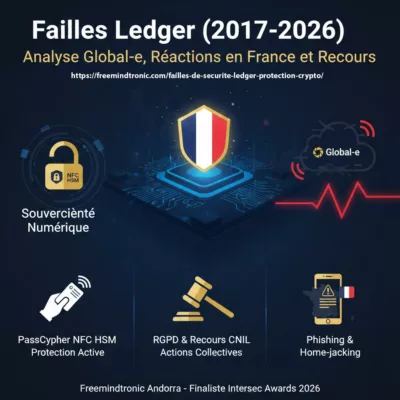
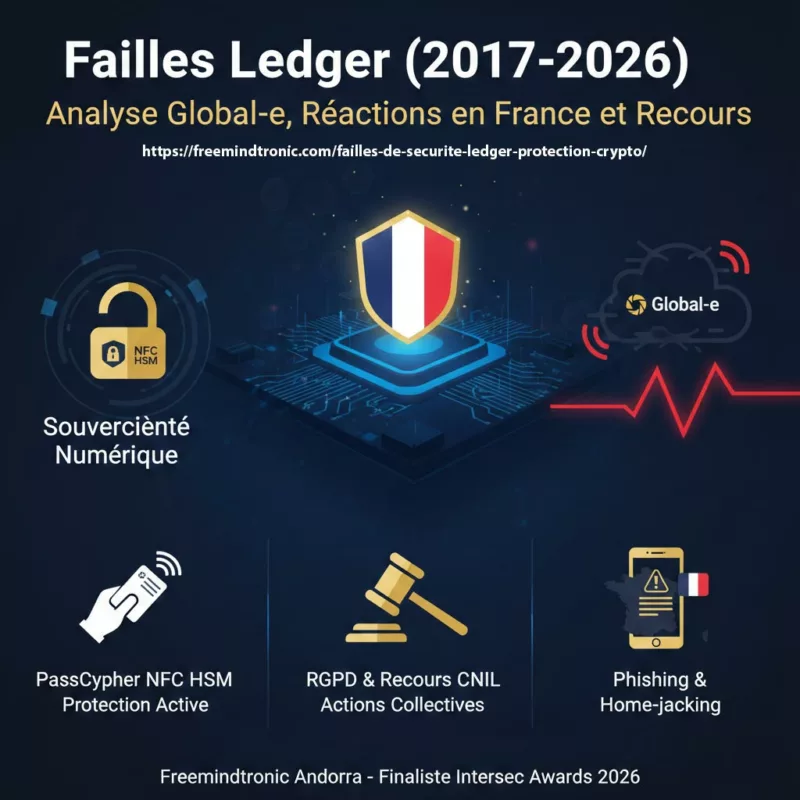
Infographie montrant la chaîne de risques de la faille Ledger 2026 : fuite Global-e, phishing SMS Chronopost, menaces de home-jacking et solutions de défense active NFC HSM.

Les failles de sécurité Ledger sont au cœur des préoccupations des investisseurs depuis 2017. Cette chronique analyse l’évolution des menaces, du vol de cryptomonnaies par manipulation de firmware à la fuite de données Global-e (2026). Au-delà du phishing Ledger massif, nous explorons les vulnérabilités de la chaîne d’approvisionnement et les risques de doxxing sur le Dark Web. Face à l’obsolescence de la confiance aveugle, la sécurité hardware doit évoluer vers des modèles décentralisés : des architectures qui sécurisent la création, la détention et le transfert des secrets critiques (seed phrases, clés privées, identifiants) — sans dépendance à un tiers et sans fonction de signature transactionnelle exposée.

Synthèse — Failles de Sécurité Ledger

⮞ Note de lecture

Cette synthèse se lit en ≈ 3 à 4 minutes. Elle offre une vision immédiate de la problématique centrale sans nécessiter la lecture de l’analyse technique et historique complète.

⚠️ Note sur la résilience de la Supply Chain

La fuite Global-e de 2026 met en lumière ce que la CISA (Cybersecurity & Infrastructure Security Agency) définit comme des risques critiques de la chaîne d’approvisionnement. Selon leurs directives officielles, la sécurité matérielle n’est aussi forte que son maillon tiers le plus faible.

⚡ Constats Clés

Depuis 2017, Ledger a fait face à plusieurs incidents majeurs : attaques sur la phrase de récupération et le firmware, modification de PCB, fuite de base de données en 2020, compromission du Connect Kit en 2023 et fuite de données Global-e en 2026. Ces incidents démontrent que les menaces ne proviennent pas seulement de failles internes, mais aussi des dépendances externes et des vecteurs de phishing.

✦ Impacts Immédiats

  • Exposition massive de données clients (292k en 2020, Global-e en 2026).
  • Phishing ciblé et harcèlement utilisant des informations personnelles.
  • Manipulation de transactions et vol de clés privées (attaques de 2018).
  • Fragilité des chaînes d’approvisionnement logicielles et des partenaires tiers.

⚠ Message Stratégique

Le véritable basculement n’est pas seulement technique, mais réside dans la répétition des failles et leur exploitation systémique. La menace devient structurelle : phishing automatisé, doxxing, érosion de la confiance et dépendance accrue envers des tiers. Le risque n’est plus occasionnel, mais persistant.

Le passage de la Confiance à la Preuve

La répétition des failles de sécurité Ledger prouve que la confiance en une marque ne suffit pas. La souveraineté exige des preuves. En implémentant l’Authentification par Clé Segmentée (WO2018154258), Freemindtronic déplace la sécurité du “serveur de mise à jour de la marque” directement dans la main de l’utilisateur. Cela élimine la dépendance envers des partenaires tiers comme Global-e pour la sécurité fondamentale de vos actifs.

⎔ Contre-mesure Souveraine

Il n’existe pas de solution miracle contre les failles de sécurité. La souveraineté signifie réduire les surfaces exploitables : minimiser les données exposées, utiliser des cold wallets indépendants (NFC HSM), séparer strictement l’identité de l’usage, et maintenir une vigilance constante face aux communications frauduleuses.

Paramètres de lecture

Synthèse exécutive : ≈ 3–4 min
Résumé avancé : ≈ 5–6 min
Chronique complète : ≈ 30–40 min
Première publication : 16 décembre 2023
Dernière mise à jour : 7 janvier 2026
Niveau de complexité : Élevé — sécurité, crypto, supply-chain
Densité technique : ≈ 70 %
Langues disponibles : EN · FR
Cœur de sujet : Failles Ledger, wallets crypto, phishing, souveraineté numérique
Type éditorial : Chronique — Freemindtronic Digital Security
Niveau de risque : 9.2 / 10 menaces financières, civiles et hybrides
Note éditoriale — Cette chronique fait partie de la section Digital Security. Elle explore les failles de sécurité Ledger comme un cas révélateur des vulnérabilités crypto mondiales, combinant incidents techniques, dépendances tierces et menaces de phishing. Elle prolonge les analyses publiées sur Digital Security. Contenu rédigé conformément à la Déclaration de Transparence IA de Freemindtronic Andorre — FM-AI-2025-11-SMD5.
Voulez-vous aller plus loin ? Le Résumé Avancé place les failles Ledger dans une dynamique globale — technologique, réglementaire et sociétale — et prépare le lecteur à la chronique complète.
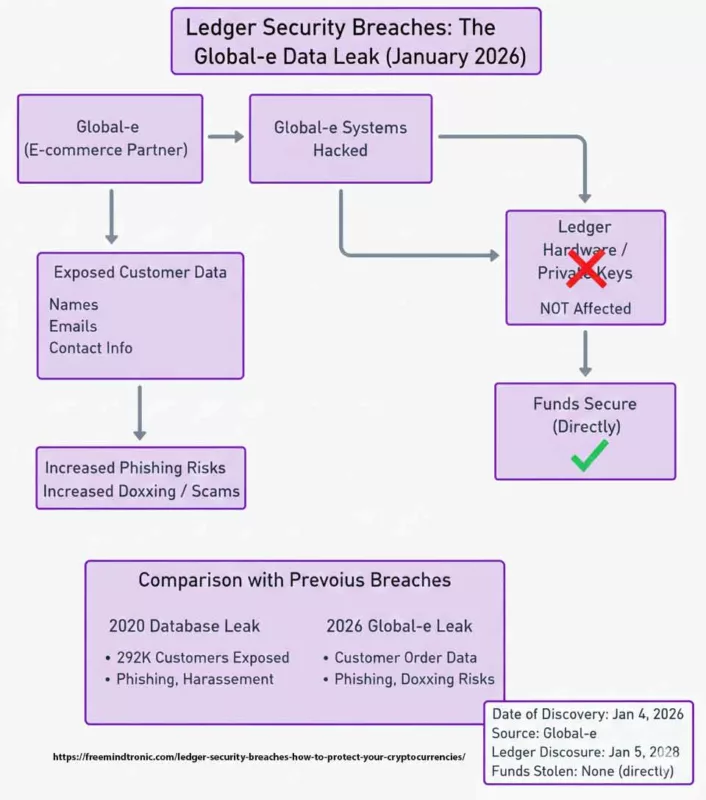
Infographic detailing the Ledger security breaches via Global-e in January 2026, showing exposed customer data vs. secure private keys.
Timeline and impact of the January 2026 Global-e breach: A new chapter in Ledger security breaches involving third-party e-commerce partners.

2026 Digital Security

Cyber espionnage zero day : marché, limites et doctrine souveraine

style=”text-align: center;”>Cyber espionnage zero day : la fin des spywares visibles marque l’entrée dans une [...]

2026 Digital Security

Cyberattaque HubEE : Rupture silencieuse de la confiance numérique

Cyberattaque HubEE : rupture silencieuse de la confiance numérique. Cette attaque, qui a permis l’exfiltration [...]

2026 Digital Security

Browser Fingerprinting : le renseignement par métadonnées en 2026

Le browser fingerprinting constitue aujourd’hui l’un des instruments centraux du renseignement par métadonnées appliqué aux [...]

2025 Digital Security

Persistent OAuth Flaw: How Tycoon 2FA Hijacks Cloud Access

Persistent OAuth Flaw — Tycoon 2FA Exploited — When a single consent becomes unlimited cloud [...]

2025 Digital Security

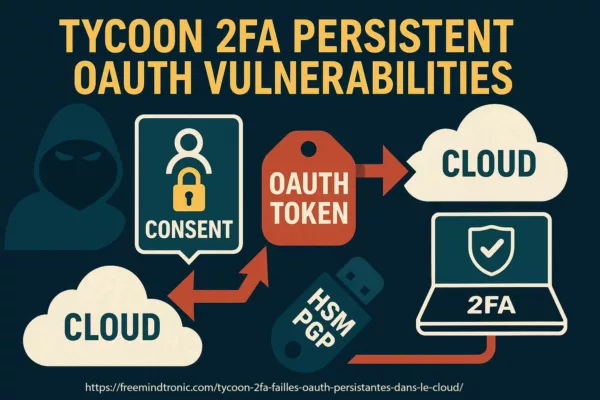
Tycoon 2FA failles OAuth persistantes dans le cloud | PassCypher HSM PGP

Faille OAuth persistante — Tycoon 2FA exploitée — Quand une simple autorisation devient un accès [...]

2025 Digital Security

OpenAI fuite Mixpanel : métadonnées exposées, phishing et sécurité souveraine

OpenAI fuite Mixpanel rappelle que même les géants de l’IA restent vulnérables dès qu’ils confient [...]

2025 Digital Security

OpenAI Mixpanel Breach Metadata – phishing risks and sovereign security with PassCypher

AI Mixpanel breach metadata is a blunt reminder of a simple rule: the moment sensitive [...]

2026 Crypto Currency Cryptocurrency Digital Security

Ledger Security Breaches from 2017 to 2026: How to Protect Yourself from Hackers

Ledger Security Breaches have become a major indicator of vulnerabilities in the global crypto ecosystem. [...]

2026 Digital Security

Failles de sécurité Ledger : Analyse 2017-2026 & Protections

Les failles de sécurité Ledger sont au cœur des préoccupations des investisseurs depuis 2017. Cette [...]

2025 Cyberculture Digital Security

Browser Fingerprinting Tracking: Metadata Surveillance in 2026

Browser Fingerprinting Tracking today represents one of the true cores of metadata intelligence. Far beyond [...]

2025 Digital Security

Bot Telegram Usersbox : l’illusion du contrôle russe

Le bot Telegram Usersbox n’était pas un simple outil d’OSINT « pratique » pour curieux [...]

2025 Digital Security

Espionnage invisible WhatsApp : quand le piratage ne laisse aucune trace

Espionnage invisible WhatsApp n’est plus une hypothèse marginale, mais une réalité technique rendue possible par [...]

2025 Digital Security

Fuite données ministère interieur : messageries compromises et ligne rouge souveraine

Fuite données ministère intérieur. L’information n’est pas arrivée par une fuite anonyme ni par un [...]

2026 Digital Security

Silent Whisper espionnage WhatsApp Signal : une illusion persistante

Silent Whisper espionnage WhatsApp Signal est présenté comme une méthode gratuite permettant d’espionner des communications [...]

2026 Awards Cyberculture Digital Security Distinction Excellence EviOTP NFC HSM Technology EviPass EviPass NFC HSM technology EviPass Technology finalists PassCypher PassCypher

Quantum-Resistant Passwordless Manager — PassCypher finalist, Intersec Awards 2026 (FIDO-free, RAM-only)

Quantum-Resistant Passwordless Manager 2026 (QRPM) — Best Cybersecurity Solution Finalist by PassCypher sets a new [...]

2025 Cyberculture Cybersecurity Digital Security EviLink

CryptPeer messagerie P2P WebRTC : appels directs chiffrés de bout en bout

La messagerie P2P WebRTC sécurisée constitue le fondement technique et souverain de la communication directe [...]

2025 CyptPeer Digital Security EviLink

Missatgeria P2P WebRTC segura — comunicació directa amb CryptPeer

Missatgeria P2P WebRTC segura al navegador és l’esquelet tècnic i sobirà de la comunicació directa [...]

2025 Digital Security

Russia Blocks WhatsApp: Max and the Sovereign Internet

Step by step, Russia blocks WhatsApp and now openly threatens to “completely block” the messaging [...]

2020 Digital Security

WhatsApp Gold arnaque mobile : typologie d’un faux APK espion

WhatsApp Gold arnaque mobile — clone frauduleux d’application mobile, ce stratagème repose sur une usurpation [...]

2025 Digital Security

Spyware ClayRat Android : faux WhatsApp espion mobile

Spyware ClayRat Android illustre la mutation du cyberespionnage : plus besoin de failles, il exploite [...]

2025 Digital Security

Android Spyware Threat Clayrat : 2025 Analysis and Exposure

Android Spyware Threat: ClayRat illustrates the new face of cyber-espionage — no exploits needed, just [...]

2023 Digital Security

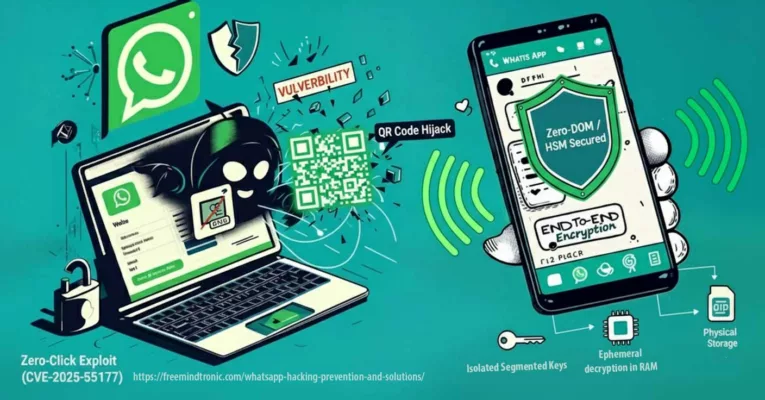
WhatsApp Hacking: Prevention and Solutions

WhatsApp hacking zero-click exploit (CVE-2025-55177) chained with Apple CVE-2025-43300 enables remote code execution via crafted [...]

2025 Digital Security Technical News

Sovereign SSH Authentication with PassCypher HSM PGP — Zero Key in Clear

SSH Key PassCypher HSM PGP establishes a sovereign SSH authentication chain for zero-trust infrastructures, where [...]

2025 Digital Security Tech Fixes Security Solutions Technical News

SSH Key PassCypher HSM PGP — Sécuriser l’accès multi-OS à un VPS

SSH Key PassCypher HSM PGP fournit une chaîne souveraine : génération locale de clés SSH [...]

2025 Digital Security Technical News

Générateur de mots de passe souverain – PassCypher Secure Passgen WP

Générateur de mots de passe souverain PassCypher Secure Passgen WP pour WordPress — le premier [...]

2025 Digital Security Technical News

Quantum computer 6100 qubits ⮞ Historic 2025 breakthrough

A 6,100-qubit quantum computer marks a turning point in the history of computing, raising unprecedented [...]

2025 Digital Security Technical News

Ordinateur quantique 6100 qubits ⮞ La percée historique 2025

Ordinateur quantique 6100 qubits marque un tournant dans l’histoire de l’informatique, soulevant des défis sans [...]

2025 Cyberculture Digital Security

Authentification multifacteur : anatomie, OTP, risques

Authentification Multifacteur : Anatomie souveraine Explorez les fondements de l’authentification numérique à travers une typologie [...]

2025 Digital Security

Clickjacking extensions DOM: Vulnerabilitat crítica a DEF CON 33

DOM extension clickjacking — el clickjacking d’extensions basat en DOM, mitjançant iframes invisibles, manipulacions del [...]

2025 Digital Security

DOM Extension Clickjacking — Risks, DEF CON 33 & Zero-DOM fixes

DOM extension clickjacking — a technical chronicle of DEF CON 33 demonstrations, their impact, and [...]

2025 Digital Security

Clickjacking des extensions DOM : DEF CON 33 révèle 11 gestionnaires vulnérables

Clickjacking d’extensions DOM : DEF CON 33 révèle une faille critique et les contre-mesures Zero-DOM

2025 Digital Security

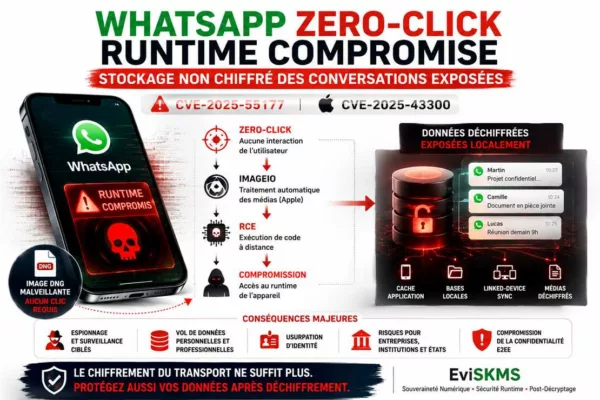
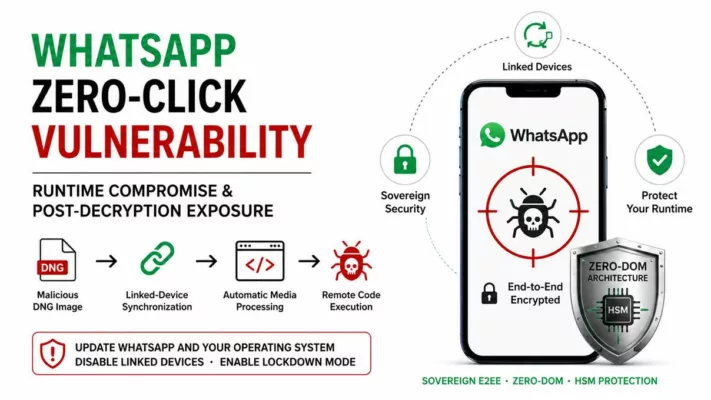
Vulnérabilité WhatsApp Zero-Click — Actions & Contremesures

Vulnérabilité WhatsApp zero-click (CVE-2025-55177) chaînée avec Apple CVE-2025-43300 permet l’exécution de code à distance via [...]

2025 Digital Security

Chrome V8 Zero-Day CVE-2025-10585 — Ton navigateur était déjà espionné ?

Chrome V8 zero-day CVE-2025-10585 — Votre navigateur n’était pas vulnérable. Vous étiez déjà espionné !

2025 Digital Security

Confidentialité métadonnées e-mail — Risques, lois européennes et contre-mesures souveraines

La confidentialité des métadonnées e-mail est au cœur de la souveraineté numérique en Europe : [...]

2025 Digital Security

Email Metadata Privacy: EU Laws & DataShielder

Email metadata privacy sits at the core of Europe’s digital sovereignty: understand the risks, the [...]

2025 Digital Security

Chrome V8 confusió RCE — Actualitza i postura Zero-DOM

Chrome V8 confusió RCE: aquesta edició exposa l’impacte global i les mesures immediates per reduir [...]

2025 Digital Security

Chrome V8 confusion RCE — Your browser was already spying

Chrome v8 confusion RCE: This edition addresses impacts and guidance relevant to major English-speaking markets [...]

2025 Digital Security

Passkeys Faille Interception WebAuthn | DEF CON 33 & PassCypher

Conseil RSSI / CISO – Protection universelle & souveraine EviBITB (Embedded Browser‑In‑The‑Browser Protection) est une [...]

2025 Cyberculture Digital Security

Reputation Cyberattacks in Hybrid Conflicts — Anatomy of an Invisible Cyberwar

Synchronized APT leaks erode trust in tech, alliances, and legitimacy through narrative attacks timed with [...]

2025 Digital Security

APT28 spear-phishing: Outlook backdoor NotDoor and evolving European cyber threats

Russian cyberattack on Microsoft by Midnight Blizzard (APT29) highlights the strategic risks to digital sovereignty. [...]

2024 Cyberculture Digital Security

Russian Cyberattack Microsoft: An Unprecedented Threat

Russian cyberattack on Microsoft by Midnight Blizzard (APT29) highlights the strategic risks to digital sovereignty. [...]

2024 Digital Security

Midnight Blizzard Cyberattack Against Microsoft and HPE: What are the consequences?

Midnight Blizzard Cyberattack against Microsoft and HPE: A detailed analysis of the facts, the impacts [...]

2025 Digital Security

eSIM Sovereignty Failure: Certified Mobile Identity at Risk

  Runtime Threats in Certified eSIMs: Four Strategic Blind Spots While geopolitical campaigns exploit the [...]

2025 Digital Security

APT29 Exploits App Passwords to Bypass 2FA

A silent cyberweapon undermining digital trust Two-factor authentication (2FA) was supposed to be the cybersecurity [...]

2015 Digital Security

Darknet Credentials Breach 2025 – 16+ Billion Identities Stolen

Underground Market: The New Gold Rush for Stolen Identities The massive leak of over 16 [...]

2025 Digital Security

Signal Clone Breached: Critical Flaws in TeleMessage

TeleMessage: A Breach That Exposed Cloud Trust and National Security Risks TeleMessage, marketed as a [...]

2025 Digital Security

APT29 Spear-Phishing Europe: Stealthy Russian Espionage

APT29 SpearPhishing Europe: A Stealthy LongTerm Threat APT29 spearphishing Europe campaigns highlight a persistent and [...]

2025 Digital Security

APT36 SpearPhishing India: Targeted Cyberespionage | Security

Understanding Targeted Attacks of APT36 SpearPhishing India APT36 cyberespionage campaigns against India represent a focused [...]

2025 Digital Security

Microsoft Outlook Zero-Click Vulnerability: Secure Your Data Now

Microsoft Outlook Zero-Click Vulnerability: How to Protect Your Data Now A critical Zero-Click vulnerability (CVE-2025-21298) [...]

2024 Digital Security

Why Encrypt SMS? FBI and CISA Recommendations

<div> </article></div> <script type=”application/ld+json”> { “@context”: “https://schema.org”, “@type”: “Article”, “mainEntityOfPage”: { “@type”: “WebPage”, “@id”: “https://freemindtronic.com/why-encrypt-sms-fbi-and-cisa-recommendations/” [...]

2025 Digital Security

Microsoft Vulnerabilities 2025: 159 Flaws Fixed in Record Update

Microsoft: 159 Vulnerabilities Fixed in 2025 Microsoft has released a record-breaking security update in January [...]

2025 Digital Security

APT44 QR Code Phishing: New Cyber Espionage Tactics

APT44 Sandworm: The Elite Russian Cyber Espionage Unit Unmasking Sandworm’s sophisticated cyber espionage strategies and [...]

2025 Digital Security

BadPilot Cyber Attacks: Russia’s Threat to Critical Infrastructures

BadPilot Cyber Attacks: Sandworm’s New Weaponized Subgroup Understanding the rise of BadPilot and its impact [...]

2024 Digital Security

Salt Typhoon & Flax Typhoon: Cyber Espionage Threats Targeting Government Agencies

Salt Typhoon – The Cyber Threat Targeting Government Agencies Salt Typhoon and Flax Typhoon represent [...]

2024 Digital Security

BitLocker Security: Safeguarding Against Cyberattacks

Introduction to BitLocker Security If you use a Windows computer for data storage or processing, [...]

2024 Digital Security

Cyberattack Exploits Backdoors: What You Need to Know

Cyberattack Exploits Backdoors: What You Need to Know In October 2024, a cyberattack exploited backdoors [...]

2021 Cyberculture Digital Security Phishing

Phishing Cyber victims caught between the hammer and the anvil

Phishing is a fraudulent technique that aims to deceive internet users and to steal their [...]

2024 Digital Security

Google Sheets Malware: The Voldemort Threat

Sheets Malware: A Growing Cybersecurity Concern Google Sheets, a widely used collaboration tool, has shockingly [...]

2024 Articles Digital Security News

Russian Espionage Hacking Tools Revealed

Russian Espionage Hacking Tools: Discovery and Initial Findings Russian espionage hacking tools were uncovered by [...]

2024 Digital Security Spying Technical News

Side-Channel Attacks via HDMI and AI: An Emerging Threat

Understanding the Impact and Evolution of Side-Channel Attacks in Modern Cybersecurity Side-channel attacks, also known [...]

Digital Security Spying Technical News

Are fingerprint systems really secure? How to protect your data and identity against BrutePrint

Fingerprint Biometrics: An In-Depth Exploration of Security Mechanisms and Vulnerabilities It is a widely recognized [...]

2024 Digital Security Technical News

Apple M chip vulnerability: A Breach in Data Security

Apple M chip vulnerability: uncovering a breach in data security Researchers at the Massachusetts Institute [...]

Digital Security Technical News

Brute Force Attacks: What They Are and How to Protect Yourself

Brute-force Attacks: A Comprehensive Guide to Understand and Prevent Them Brute Force: danger and protection [...]

2024 Digital Security

OpenVPN Security Vulnerabilities Pose Global Security Risks

Critical OpenVPN Vulnerabilities Pose Global Security Risks OpenVPN security vulnerabilities have come to the forefront, [...]

2024 Digital Security

Google Workspace Vulnerability Exposes User Accounts to Hackers

How Hackers Exploited the Google Workspace Vulnerability Hackers found a way to bypass the email [...]

2023 Digital Security

Predator Files: The Spyware Scandal That Shook the World

Predator Files: How a Spyware Consortium Targeted Civil Society, Politicians and Officials Cytrox: The maker [...]

2023 Digital Security Phishing

BITB Attacks: How to Avoid Phishing by iFrame

BITB Attacks: How to Avoid Phishing by iFrame We have all seen phishing attacks aren’t [...]

2023 Digital Security

5Ghoul: 5G NR Attacks on Mobile Devices

5Ghoul: How Contactless Encryption Can Secure Your 5G Communications from Modem Attacks 5Ghoul is a [...]

2024 Digital Security

Leidos Holdings Data Breach: A Significant Threat to National Security

A Major Intrusion Unveiled In July 2024, the Leidos Holdings data breach came to light, [...]

2024 Digital Security

RockYou2024: 10 Billion Reasons to Use Free PassCypher

RockYou2024: A Cybersecurity Earthquake The RockYou2024 data leak has shaken the very foundations of global [...]

2024 Digital Security

Europol Data Breach: A Detailed Analysis

May 2024: Europol Security Breach Highlights Vulnerabilities In May 2024, Europol, the European law enforcement [...]

2024 Digital Security

Dropbox Security Breach 2024: Phishing, Exploited Vulnerabilities

Phishing Tactics: The Bait and Switch in the Aftermath of the Dropbox Security Breach The [...]

Digital Security EviToken Technology Technical News

EviCore NFC HSM Credit Cards Manager | Secure Your Standard and Contactless Credit Cards

EviCore NFC HSM Credit Cards Manager is a powerful solution designed to secure and manage [...]

2024 Digital Security

Kapeka Malware: Comprehensive Analysis of the Russian Cyber Espionage Tool

Kapeka Malware: The New Russian Intelligence Threat   In the complex world of cybersecurity, a [...]

2024 Cyberculture Digital Security News Training

Andorra National Cyberattack Simulation: A Global First in Cyber Defense

Andorra Cybersecurity Simulation: A Vanguard of Digital Defense Andorra-la-Vieille, April 15, 2024 – Andorra is [...]

Articles Digital Security EviVault Technology NFC HSM technology Technical News

EviVault NFC HSM vs Flipper Zero: The duel of an NFC HSM and a Pentester

EviVault NFC HSM vs Flipper Zero: The duel of an NFC HSM and a Pentester [...]

Articles Cryptocurrency Digital Security Technical News

Securing IEO STO ICO IDO and INO: The Challenges and Solutions

Securing IEO STO ICO IDO and INO: How to Protect Your Crypto Investments Cryptocurrencies are [...]

2023 Articles Digital Security Technical News

Remote activation of phones by the police: an analysis of its technical, legal and social aspects

What is the new bill on justice and why is it raising concerns about privacy? [...]

Articles Cyberculture Digital Security Technical News

Protect Meta Account Identity Theft with EviPass and EviOTP

Protecting Your Meta Account from Identity Theft Meta is a family of products that includes [...]

2024 Digital Security

Cybersecurity Breach at IMF: A Detailed Investigation

Cybersecurity Breach at IMF: A Detailed Investigation Cybersecurity breaches are a growing concern worldwide. The [...]

2023 Articles Cyberculture Digital Security Technical News

Strong Passwords in the Quantum Computing Era

How to create strong passwords in the era of quantum computing? Quantum computing is a [...]

2024 Digital Security

PrintListener: How to Betray Fingerprints

PrintListener: How this Technology can Betray your Fingerprints and How to Protect yourself PrintListener revolutionizes [...]

2024 Articles Digital Security News

How the attack against Microsoft Exchange on December 13, 2023 exposed thousands of email accounts

How the attack against Microsoft Exchange on December 13, 2023 exposed thousands of email accounts [...]

2024 Articles Digital Security News Spying

How to protect yourself from stalkerware on any phone

What is Stalkerware and Why is it Dangerous? Stalkerware, including known programs like FlexiSpy, mSpy, [...]

2023 Articles DataShielder Digital Security Military spying News NFC HSM technology Spying

Pegasus: The cost of spying with one of the most powerful spyware in the world

Pegasus: The Cost of Spying with the Most Powerful Spyware in the World Pegasus is [...]

2024 Digital Security Spying

Ivanti Zero-Day Flaws: Comprehensive Guide to Secure Your Systems Now

What are Zero-Day Flaws and Why are They Dangerous? A zero-day flaw is a previously [...]

2024 Articles Compagny spying Digital Security Industrial spying Military spying News Spying Zero trust

KingsPawn A Spyware Targeting Civil Society

  QuaDream: KingsPawn spyware vendor shutting down in may 2023 QuaDream was a company that [...]

2024 Articles Digital Security EviKey NFC HSM EviPass News SSH

Terrapin attack: How to Protect Yourself from this New Threat to SSH Security

Protect Yourself from the Terrapin Attack: Shield Your SSH Security with Proven Strategies SSH is [...]

2024 Articles Digital Security News Phishing

Google OAuth2 security flaw: How to Protect Yourself from Hackers

Google OAuth2 security flaw: Strategies Against Persistent Cookie Threats in Online Services Google OAuth2 security [...]

2024 Articles Digital Security

Kismet iPhone: How to protect your device from the most sophisticated spying attack?

Kismet iPhone: How to protect your device from the most sophisticated spying attack using Pegasus [...]

Articles Digital Security EviCore NFC HSM Technology EviPass NFC HSM technology NFC HSM technology

TETRA Security Vulnerabilities: How to Protect Critical Infrastructures

TETRA Security Vulnerabilities: How to Protect Critical Infrastructures from Cyberattacks TETRA (Terrestrial Trunked Radio) is [...]

2023 Articles DataShielder Digital Security EviCore NFC HSM Technology EviCypher NFC HSM EviCypher Technology NFC HSM technology

FormBook Malware: How to Protect Your Gmail and Other Data

How to Protect Your Gmail Account from FormBook Malware Introduction Imagine that you receive an [...]

Les chroniques affichées ci-dessus ↑ appartiennent à la section Sécurité Numérique. Elles prolongent l’analyse des architectures souveraines, des marchés noirs de données et des outils de surveillance. Cette sélection complète la présente chronique dédiée aux Failles de Sécurité Ledger (2017–2026) et aux risques systémiques liés aux vulnérabilités matérielles, aux compromissions de la supply-chain et aux prestataires tiers.

Résumé avancé

Ce résumé avancé contextualise les failles de sécurité Ledger de 2017 à 2026 dans une lecture systémique. Il ne se limite pas aux incidents techniques, mais analyse la chaîne complète de dépendances — firmware, logiciels, partenaires, données clients — et explique pourquoi certaines architectures rendent ces failles structurelles, non accidentelles.

Une succession de failles qui révèle un problème de modèle

Depuis 2017, Ledger a été confronté à une série d’incidents majeurs : attaques par récupération de seed phrase, remplacement de firmware, modifications matérielles, vulnérabilités applicatives (Monero), fuite massive de données clients en 2020, compromission de la supply-chain logicielle en 2023, puis fuite de données liée à Global-e en 2026. Pris isolément, chacun de ces événements peut être qualifié d’« incident ». Pris ensemble, ils dessinent un problème de modèle de sécurité.

Le point commun n’est pas la cryptographie de bas niveau, mais la nécessité récurrente pour les secrets critiques (seed phrases, clés privées, métadonnées d’identité) de transiter, à un moment donné, par un environnement non souverain : firmware propriétaire, ordinateur hôte, application connectée, serveur de mise à jour ou partenaire e-commerce.

De la sécurité du composant à la vulnérabilité de l’écosystème

Ledger a historiquement misé sur la robustesse du composant matériel. Or, à partir de 2020, la surface d’attaque s’est déplacée vers l’écosystème périphérique : bases de données clients, services logistiques, dépendances logicielles, interfaces utilisateur, notifications et canaux de support.

La fuite Global-e de 2026 marque un tournant. Même sans compromission directe des clés privées, l’exposition des données de livraison transforme les utilisateurs en cibles persistantes : phishing ultra-ciblé, ingénierie sociale « livreur », doxxing et, dans les cas extrêmes, menaces physiques. La sécurité n’est alors plus seulement numérique ; elle devient civile et personnelle.

Pourquoi le phishing et les attaques hybrides deviennent inévitables

À partir du moment où l’identité réelle d’un utilisateur est corrélée à la possession d’actifs numériques, le phishing cesse d’être opportuniste. Il devient industriel et personnalisé.

Les attaques BITB, les fausses mises à jour, les faux incidents de livraison ou de conformité exploitent moins des failles techniques que le facteur humain, rendu vulnérable par l’exposition des métadonnées.

Dans ce contexte, renforcer un firmware ou ajouter une alerte logicielle ne suffit plus. Le problème n’est pas la signature cryptographique, mais le fait que le secret ou son détenteur soient identifiables, traçables ou sollicitables à distance.

Changement de paradigme : de la confiance à la preuve matérielle

Face à ces limites structurelles, certaines approches ne cherchent plus à renforcer la signature transactionnelle, mais à retirer les secrets critiques de tout écosystème connecté. Les alternatives souveraines proposées par Freemindtronic reposent sur une logique inverse. Plutôt que de chercher à sécuriser un écosystème connecté, elles visent à réduire radicalement les dépendances. Les dispositifs NFC HSM sont sans batterie, sans câble, sans port réseau, et ne nécessitent ni compte, ni serveur, ni synchronisation cloud.

Ce changement de paradigme se matérialise notamment par le partage de secrets en air-gap : les secrets critiques (seed phrases, clés privées, identifiants de connexion à des hot wallets ou systèmes propriétaires) peuvent être transférés matériel → matériel d’un SeedNFC HSM vers un autre, via un QR code chiffré RSA 4096 avec la clé publique du destinataire — sans blockchain, sans serveur et sans signature de transaction.

Une réponse structurelle aux failles observées depuis 2017

Là où les failles Ledger reposent sur des chaînes d’approvisionnement, des mises à jour ou des relations commerciales, les architectures souveraines suppriment ces points de rupture par conception. Il n’y a rien à pirater à distance, rien à détourner dans un cloud, rien à extraire d’un serveur tiers. Même exposé visuellement, un QR code chiffré reste inexploitable sans possession effective du HSM destinataire.

Ce modèle ne promet pas une sécurité « magique ». Il impose au contraire une responsabilité assumée : irrévocabilité des partages, contrôle physique, discipline opérationnelle. Mais il élimine les vecteurs d’attaque systémiques qui, depuis 2017, n’ont cessé de se répéter.

Failles de sécurité Ledger de 2017 à 2026 : Comment protéger vos cryptomonnaies

Vous êtes-vous déjà interrogé sur la réelle sécurité de vos actifs numériques ? Si vous utilisez un appareil Ledger, vous pensez probablement être à l’abri des pirates. Ledger est une entreprise française leader dans la sécurité des cryptomonnaies. Elle propose des portefeuilles matériels (hardware wallets) conçus pour isoler vos clés privées des menaces en ligne.

Pourtant, depuis 2017, les failles de sécurité Ledger se sont succédé, exposant parfois les données personnelles, voire les clés privées des utilisateurs. Ces vulnérabilités permettent à des attaquants de dérober vos fonds ou de nuire à votre vie privée. Cet article analyse les différentes brèches découvertes, leurs modes d’exploitation et les solutions pour vous protéger efficacement.

Failles de sécurité Ledger : L’attaque par récupération de Seed Phrase (Février 2018)

La phrase de récupération (seed phrase) est la clé maîtresse de votre portefeuille. En février 2018, le chercheur Saleem Rashid a découvert une faille sur le Ledger Nano S permettant à un attaquant ayant un accès physique à l’appareil de récupérer cette phrase via une attaque par canal auxiliaire (side-channel attack).

Comment les hackers ont-ils exploité cette faille ?

L’attaque consistait à utiliser un oscilloscope pour mesurer les variations de tension sur la broche de réinitialisation (reset pin) de l’appareil. Ces micro-fluctuations reflétaient les opérations du processeur sécurisé lors de la génération de la seed phrase. En analysant ces signaux, un attaquant pouvait reconstruire la phrase et prendre le contrôle total des fonds.
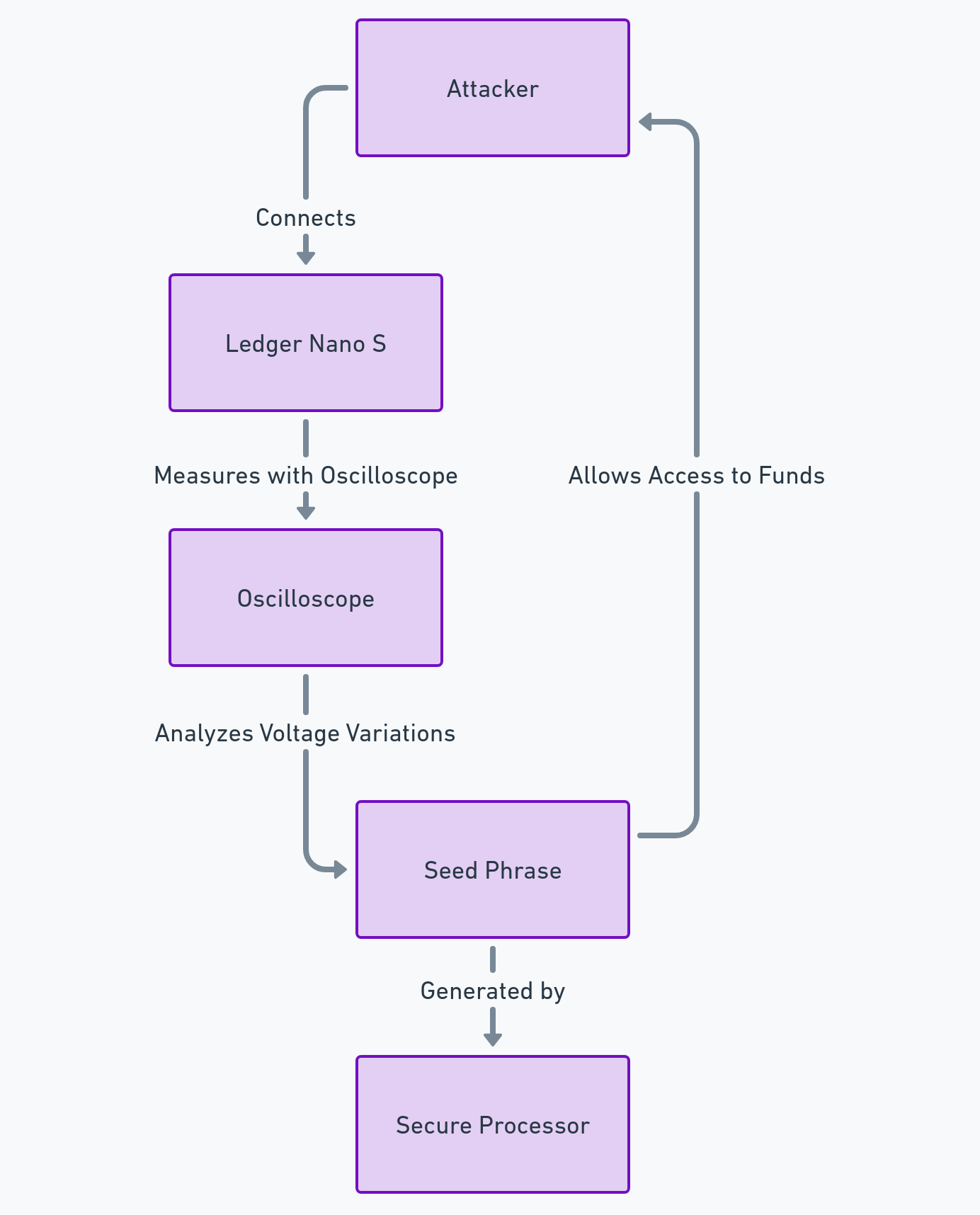
Schéma de l'attaque par récupération de seed phrase sur Ledger Nano S

Statistiques sur la faille
  • Utilisateurs potentiellement affectés : Environ 1 million
  • Montant total dérobé : Inconnu
  • Date de découverte : 20 février 2018
  • Auteur de la découverte : Saleem Rashid (Chercheur en sécurité)
  • Date du correctif : 3 avril 2018

Scénarios d’attaques

  • Accès physique : L’attaquant doit posséder l’appareil (vol, achat d’occasion ou interception durant la livraison). Il connecte le Ledger à un oscilloscope et utilise un logiciel pour extraire la phrase de récupération.
  • Accès à distance : Un hacker pourrait piéger l’utilisateur en installant un malware sur son ordinateur pour déclencher la broche de reset, tout en capturant les variations de tension via un équipement compromis à proximité.
  • Scénario d’accès à distance : L’attaquant doit inciter l’utilisateur à installer un logiciel malveillant sur son ordinateur. Ce programme communique avec le Ledger pour déclencher la broche de réinitialisation (reset pin). Le hacker capture ensuite les variations de tension à distance, soit via un dispositif sans fil, soit en compromettant l’oscilloscope utilisé. Un outil logiciel permet ensuite de reconstruire la phrase de récupération à partir des mesures.

Sources officielles

1 : Breaking the Ledger Security Model – Saleem Rashid (20 mars 2018).
2 : Analyse de la sécurité du Ledger Nano S – CryptoVantage.

Incidents de sécurité Ledger : Modification du circuit imprimé (PCB) — Novembre 2018

Le circuit imprimé (PCB) contient les composants électroniques du wallet. S’il est modifié physiquement, la sécurité est compromise. En novembre 2018, le chercheur Dmitry Nedospasov a montré qu’il était possible d’installer un microcontrôleur espion à l’intérieur du boîtier afin d’intercepter des échanges internes.

Comment l’attaque peut être menée ?

L’attaque consiste à ouvrir l’appareil et à ajouter une puce capable d’intercepter les communications entre les composants internes. Les données interceptées (transactions, signaux de validation, informations de session) peuvent ensuite être exfiltrées via un canal discret (ex. module radio dissimulé), selon le montage.
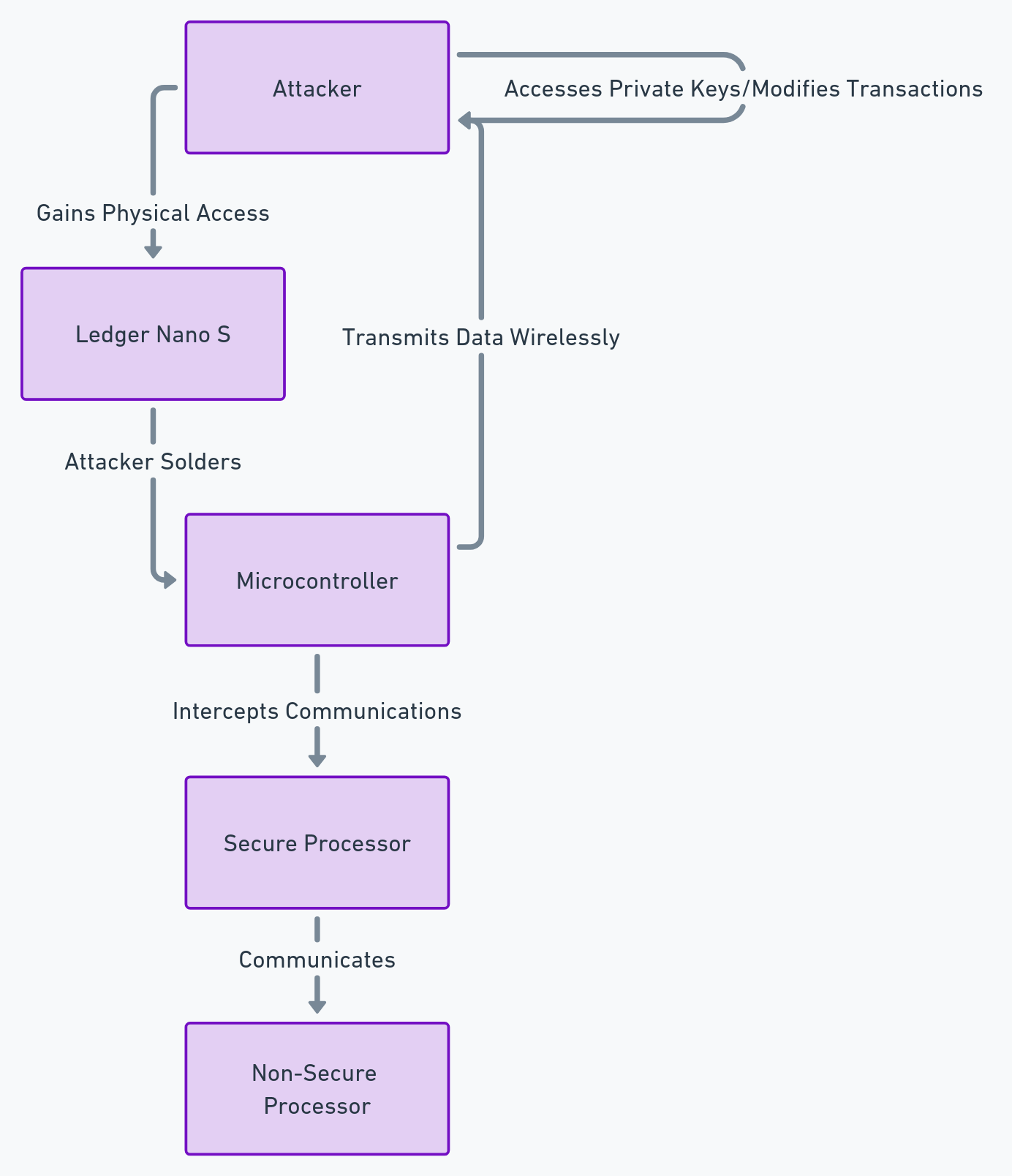
Scénarios d’attaque

  • Supply chain : interception du wallet avant réception (transport, reconditionnement, revente) pour installer le dispositif.
  • Accès physique : vol ou accès temporaire à l’appareil pour le modifier, puis restitution afin d’attendre une transaction.
  • Variante avancée : combinaison d’un poste hôte compromis (malware) et d’une instrumentation matérielle — scénario complexe et moins probable, mais théoriquement possible.

Sources

Défauts de sécurité Ledger : Attaque par remplacement de firmware — Mars 2018

Le firmware est le logiciel interne qui contrôle le fonctionnement du wallet matériel. Son intégrité repose sur un mécanisme de signature cryptographique censé empêcher l’installation de code non autorisé. En 2018, le chercheur Saleem Rashid a démontré qu’il était possible, sous certaines conditions, de contourner ce modèle sur le Ledger Nano S.

Comment l’attaque pouvait être exploitée

L’attaque reposait sur une faiblesse du processus de mise à jour et de vérification du firmware. Un attaquant capable d’installer un firmware modifié pouvait introduire un code malveillant se faisant passer pour légitime. Une fois en place, ce firmware était en mesure :

  • d’extraire ou reconstruire des clés privées,
  • de modifier les adresses de destination affichées à l’écran,
  • ou d’altérer silencieusement la logique de signature des transactions.

Schéma simplifié de l’attaque
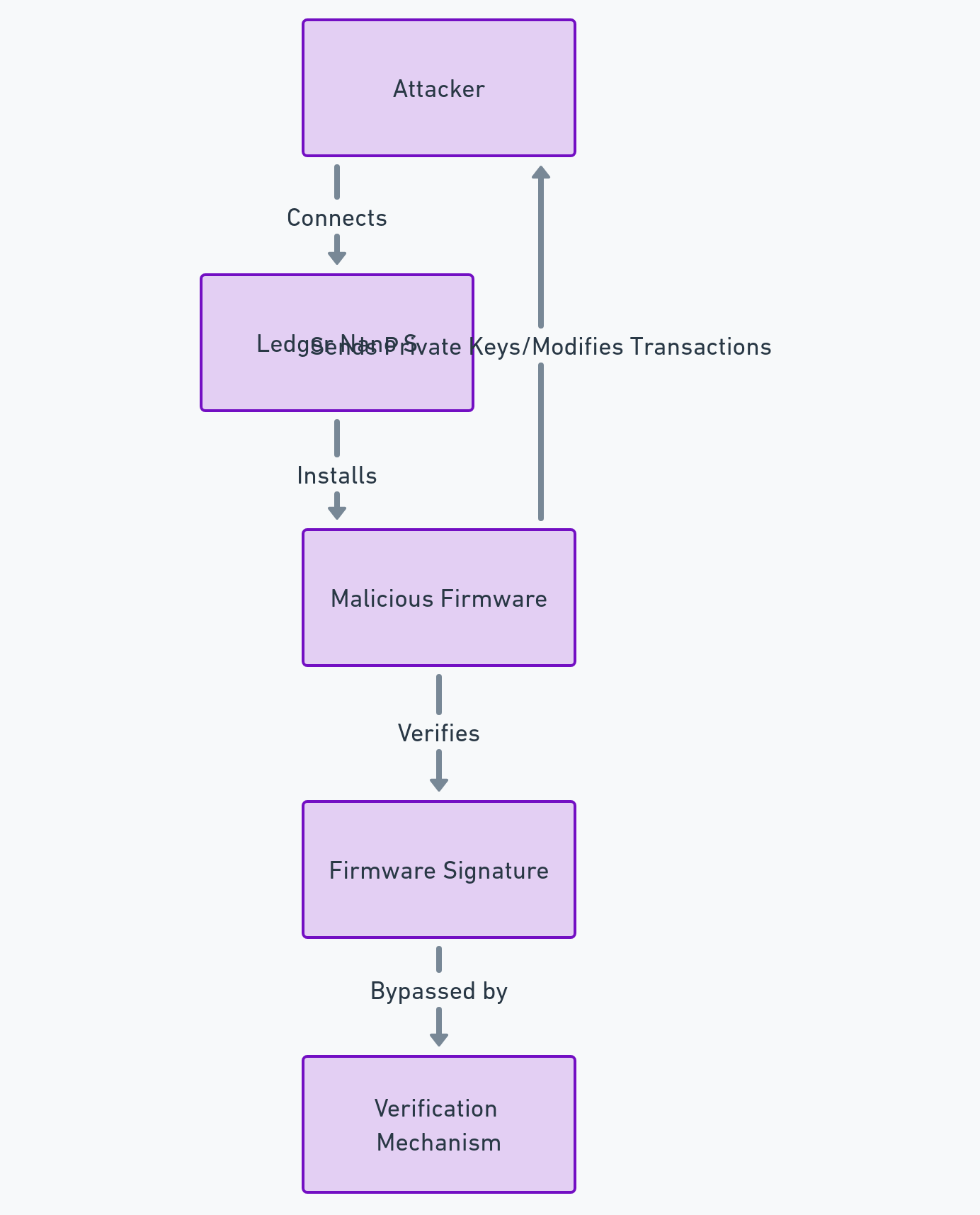
Données clés

  • Appareils concernés : Ledger Nano S (générations initiales)
  • Impact potentiel : Compromission totale du wallet après installation du firmware
  • Date de divulgation : Mars 2018
  • Correctif : Mise à jour firmware 1.4.1 (avril 2018)

Scénarios d’attaque

  • Accès physique : l’attaquant dispose temporairement du wallet (vol, interception, revente). Il installe un firmware modifié avant restitution ou utilisation ultérieure.
  • Ingénierie sociale : l’utilisateur est incité à installer une fausse mise à jour via un email ou un site frauduleux imitant Ledger.

⚠️ Point structurel : même si cette faille a été corrigée, elle illustre un risque fondamental : dès qu’un wallet dépend d’un processus de mise à jour centralisé, la confiance se déplace du matériel vers la chaîne logicielle.

Sources

De la faille corrigée au risque structurel

La vulnérabilité de remplacement de firmware découverte en 2018 a été corrigée rapidement par Ledger. Sur le plan strictement technique, le mécanisme de signature du firmware a été renforcé et l’attaque n’est plus exploitable dans les mêmes conditions.

Cependant, cet épisode révèle un point fondamental : la sécurité d’un hardware wallet ne dépend pas uniquement de la puce sécurisée, mais aussi de tout ce qui l’entoure — processus de mise à jour, interfaces logicielles, messages utilisateur et canaux de distribution.

À partir de 2019, la surface d’attaque ne se concentre plus sur la compromission du firmware lui-même, mais sur un vecteur plus insidieux : l’utilisateur devient le point faible.
Le contrôle ne passe plus par l’installation de code malveillant, mais par la signature volontaire d’actions que l’utilisateur ne peut pas réellement vérifier.

C’est dans ce contexte qu’émerge le problème du Blind Signing — non pas comme une faille ponctuelle, mais comme un risque permanent, inhérent à l’interaction entre hardware wallets et écosystèmes Web3 complexes.

En d’autres termes : après 2018, l’attaque ne cherche plus à tromper la machine, mais à convaincre l’humain de signer à l’aveugle.

Failles de sécurité Ledger : La vulnérabilité de l’application Monero (Mars 2019)

Toutes les cryptomonnaies ne sont pas gérées de la même manière par le hardware. En mars 2019, une faille critique a été découverte dans l’application Monero (XMR) pour Ledger. Contrairement aux failles physiques, celle-ci résidait dans le protocole de communication entre le wallet et le logiciel client sur ordinateur.

Comment les hackers ont-ils exploité cette faille ?

La faille permettait à un attaquant, via un logiciel client malveillant, de forcer le Ledger à envoyer des données de transaction erronées. En exploitant un bug dans la gestion du “change” (la monnaie rendue lors d’une transaction), le hacker pouvait détourner les fonds vers une adresse qu’il contrôlait, sans que l’utilisateur ne s’en aperçoive sur son écran, ou même extraire la clé de dépense privée (spend key) du Monero.
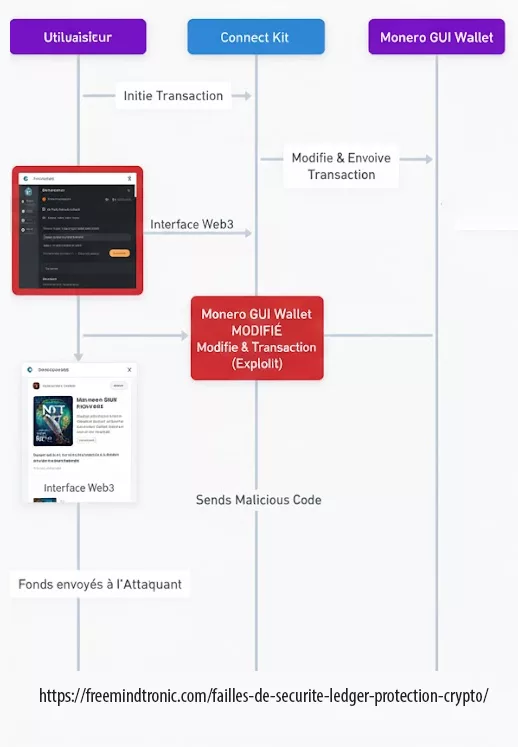
Schéma technique expliquant le risque de Blind Signing : l'utilisateur valide une transaction via un smart contract malveillant sans pouvoir en vérifier le contenu réel sur l'écran du wallet.
Infographie montrant le détournement d’une transaction Monero XMR par un portefeuille GUI malveillant malgré l’utilisation d’un hardware wallet Ledger..
  • Utilisateurs potentiellement affectés : Tous les détenteurs de Monero (XMR) sur Nano S et X
  • Montant total dérobé : Un cas rapporté de 1600 XMR (env. 83 000 $)
  • Date de découverte : 4 mars 2019
  • Auteur de la découverte : Communauté Monero & Ledger Donjon
  • Date du correctif : 6 mars 2019 (Version 1.5.1)

Scénarios d’attaques

  • Logiciel compromis : L’utilisateur utilise un portefeuille Monero GUI infecté ou non officiel. Lors d’une transaction légitime, le logiciel modifie les paramètres envoyés au Ledger pour vider le solde.
  • Extraction de clé : Un attaquant ayant infecté l’ordinateur de la victime pouvait techniquement reconstruire la clé privée Monero en interceptant plusieurs échanges de données entre l’appareil et le PC.

Vulnérabilité structurelle « Blind Signing » : la signature à l’aveugle par conception (Permanent)

Le Blind Signing n’est pas une faille ponctuelle ni un bug corrigeable par mise à jour. Il s’agit d’un défaut structurel inhérent à la conception même des hardware wallets face à la complexité croissante des smart contracts.

En 2026, il constitue le vecteur n°1 de vol de fonds en Web3, devant les exploits techniques classiques.

Pourquoi le Blind Signing est fondamentalement dangereux

Un hardware wallet est censé permettre une validation consciente et vérifiable des opérations sensibles. Or, dans le cas du Blind Signing, l’appareil est incapable de restituer l’intention réelle du contrat signé.

L’utilisateur se retrouve face à :

  • la mention générique « Data Present »
  • des chaînes hexadécimales illisibles
  • ou une description partielle, non interprétable humainement

La signature devient alors un acte de foi.
L’utilisateur ne valide plus une action comprise, mais obéit à une interface opaque.
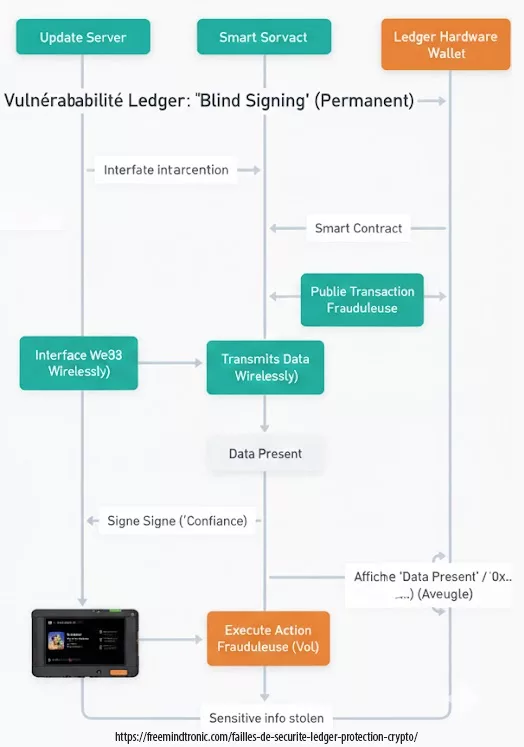
Schéma explicatif du Blind Signing montrant un Ledger affichant "Data Present" pendant qu'un smart contract frauduleux exécute un vol de fonds.

Figure — Le Blind Signing : quand l’utilisateur signe une transaction dont il ne peut pas vérifier l’intention réelle.

Une attaque par consentement, pas par contournement

Contrairement aux failles de 2018 (seed, firmware, PCB), le Blind Signing ne cherche pas à casser la sécurité matérielle.
Il la retourne contre l’utilisateur.

Tout est :

  • cryptographiquement valide
  • signé avec la vraie clé privée
  • irréversible sur la blockchain

Il n’y a ni malware détectable, ni extraction de clé, ni compromission du firmware. La perte est juridiquement et techniquement imputable à la signature elle-même.

Impact et portée

  • Utilisateurs concernés : 100 % des utilisateurs DeFi / NFT / Web3
  • Montants détournés : centaines de millions de dollars (cumulés)
  • Statut : risque permanent et systémique
  • Cause racine : impossibilité de vérifier l’intention signée

Scénarios d’attaques typiques

  • Drainer de portefeuille : un faux mint ou airdrop entraîne la signature d’un contrat autorisant le transfert illimité de tous les actifs.
  • Approbation infinie masquée : l’utilisateur signe une autorisation invisible. Le wallet est vidé ultérieurement, sans interaction supplémentaire.

Conclusion :
Le Blind Signing marque une rupture : la clé privée reste protégée, mais la sécurité réelle disparaît.
La question n’est plus « mon wallet est-il sécurisé ? », mais :

« Suis-je capable de prouver ce que je signe ? »

Failles de sécurité Ledger : L’attaque du Connect Kit (Décembre 2023)

Le Connect Kit est un logiciel permettant aux utilisateurs de gérer leurs cryptomonnaies depuis un ordinateur ou un smartphone en se connectant à leur appareil Ledger. Il permet de consulter les soldes, d’effectuer des transactions et d’accéder à des services de staking ou de swap.

La faille du Connect Kit a été découverte par les équipes de sécurité de Ledger en décembre 2023. Elle provenait d’une vulnérabilité dans un composant tiers, Electron, un framework utilisé pour créer des applications de bureau. La version obsolète utilisée présentait une brèche permettant aux hackers d’exécuter du code arbitraire sur le serveur de mise à jour.

Validation technique : Ce type d’attaque de la chaîne d’approvisionnement (Supply Chain Attack) est classé sous la référence CWE-494 (Téléchargement de code sans vérification d’intégrité). Vous pouvez suivre les vulnérabilités similaires sur la base de données MITRE CVE.

Comment les hackers ont-ils exploité cette faille ?

Les pirates ont injecté un code malveillant directement sur le serveur de mise à jour du Connect Kit. Ce code était ensuite téléchargé et exécuté par les utilisateurs mettant à jour leur logiciel, avec pour objectif de voler des informations sensibles : clés privées, mots de passe, emails et numéros de téléphone.

Schéma simplifié de l’attaque
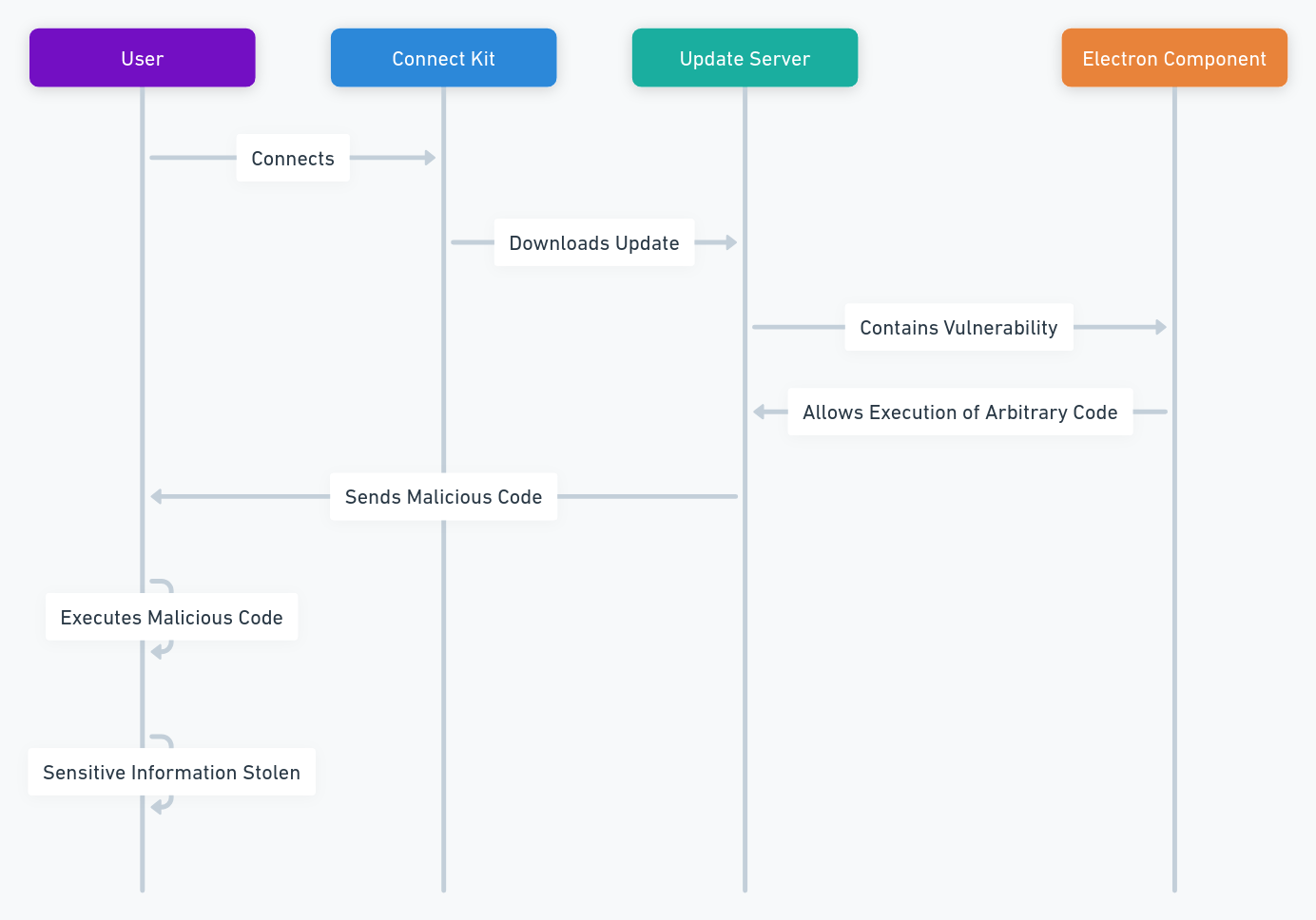
Schéma attaque Supply Chain Connect Kit Ledger

Statistiques sur la faille

  • Utilisateurs potentiellement affectés : Environ 10 000
  • Montant total des fonds dérobés : Inconnu
  • Date de découverte : 14 décembre 2023
  • Responsable de la découverte : Pierre Noizat, directeur de la sécurité chez Ledger
  • Date du correctif : 15 décembre 2023

Scénarios d’attaques

  • Accès à distance : Le hacker incite l’utilisateur à mettre à jour son Connect Kit via un faux email ou une notification de phishing. Le code malveillant s’exécute alors pour subtiliser les fonds.
  • Capture clavier (Keylogger) : Le code malveillant enregistre les frappes au clavier de l’utilisateur (codes PIN, phrases de secours) et les transmet au hacker.
  • Capture d’écran : Un enregistreur d’écran capture les QR codes, les adresses et les confirmations de transaction pour permettre au pirate de modifier les flux financiers.

Sources

Failles de sécurité Ledger : La fuite de données massive (Décembre 2020)

La base de données clients de Ledger stocke des informations telles que les noms, adresses, numéros de téléphone et emails. En décembre 2020, Ledger a révélé qu’une faille majeure avait exposé les données personnelles de 292 000 clients, dont 9 500 en France.

Comment les hackers ont-ils exploité la brèche ?

La faille a été exploitée dès juin 2020 via une clé API mal configurée. Le hacker a ensuite publié ces données sur un forum de hackers, les rendant accessibles à tous. Les clients de Ledger sont depuis la cible de campagnes de phishing ultra-personnalisées, de harcèlement et même de menaces physiques par des acteurs cherchant à obtenir leurs clés privées.

Schéma simplifié de l’attaque
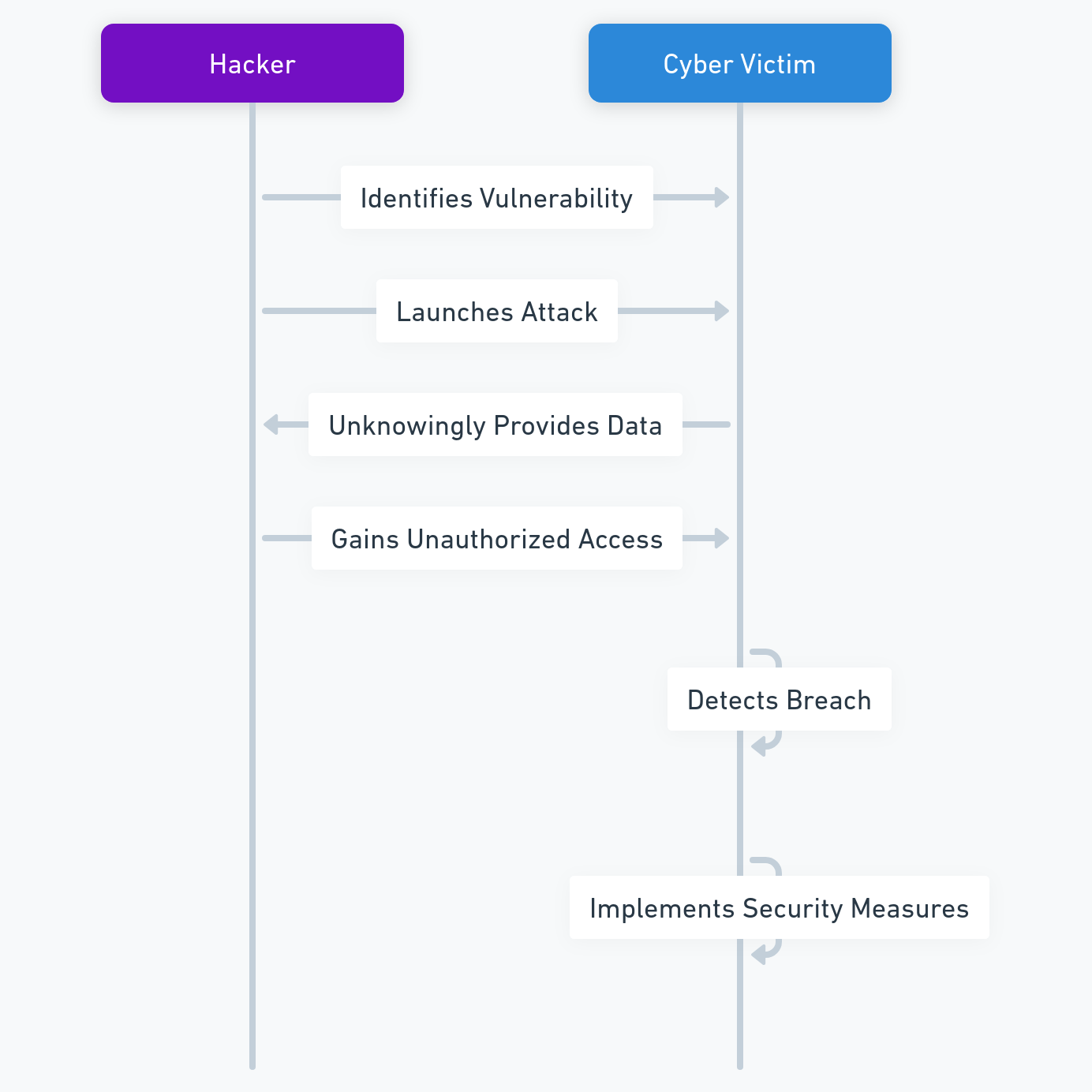
Schéma fuite de données Ledger 2020

Statistiques sur la faille

  • Nombre d’utilisateurs affectés : 292 000, dont 9 500 en France
  • Montant total des fonds potentiellement volés : Inconnu
  • Date de découverte par Ledger : 25 juin 2020
  • Auteur de la découverte : Ledger, après avoir été notifié par un chercheur
  • Date de publication du correctif : 14 juillet 2020

Scénarios d’attaques par hackers

  • Scénario de Phishing : Le hacker envoie un email ou un SMS en se faisant passer pour Ledger. Il demande à l’utilisateur de cliquer sur un lien, de saisir ses identifiants ou de mettre à jour son appareil sur un faux site pour voler ses fonds.
  • Scénario de Harcèlement : Le hacker utilise les données personnelles pour intimider l’utilisateur par téléphone. Il menace de révéler son identité ou de s’en prendre à ses biens si une rançon n’est pas versée en cryptomonnaies.
  • Scénario de Menaces : En croisant les données avec les réseaux sociaux, le hacker identifie les proches de la victime. Il envoie des messages menaçants pour forcer l’utilisateur à donner ses clés privées.

Source : Ledger Blog : Mise à jour sur la cybersécurité (Janvier 2021)

Failles de sécurité Ledger : La fuite de données Global‑e (Janvier 2026)

En janvier 2026, Ledger a révélé une nouvelle brèche causée par son partenaire e‑commerce Global‑e. Des hackers ont compromis les systèmes de ce prestataire, exposant les noms, adresses email et coordonnées de contact utilisés pour les commandes en ligne. Contrairement aux incidents précédents, aucune phrase de récupération (seed phrase), clé privée ou donnée de carte de paiement n’a été touchée. Cependant, cette fuite augmente considérablement les risques de phishing ciblé, de doxxing et d’escroqueries.

Infographie sur la faille Global-e Ledger Janvier 2026
Figure — Faille Global-e 2026 : comment l’exposition des données mène au phishing et au doxxing.
Défense Active : Neutraliser les risques de la fuite Global-e

L’écosystème SeedNFC HSM, couplé à PassCypher HSM PGP Free, apporte une réponse structurelle à ces risques en déplaçant la sécurité entre les mains de l’utilisateur :

  • Réduction des métadonnées d’achat : en minimisant la collecte et la rétention de données (nom, adresse, téléphone), on réduit l’impact des fuites e-commerce/logistiques type 2020 et Global-e (2026) : moins de doxxing, moins de phishing “livreur”, moins de ciblage physique.
  • Preuve d’intention matérielle : certaines opérations critiques exigent une action physique (NFC). Après une fuite de données, cela réduit l’efficacité des attaques à distance (phishing, faux support) car un attaquant ne peut pas “finaliser” l’action sans présence physique.
  • Anti-BITB & Anti-Iframe : réduit les faux écrans de connexion utilisés dans les campagnes de phishing post-fuite (fausses pages Ledger Live, faux support, redirections).
  • Détection d’identifiants compromis : vérifie si des emails/mots de passe ont déjà fuité afin d’éviter leur réutilisation (réduction du risque de prise de compte et d’ingénierie sociale).
Statistiques sur la faille Global-e
  • Nombre d’utilisateurs affectés : Non communiqué (enquête en cours en janv. 2026).
  • Données exposées : Noms, emails et coordonnées de livraison des commandes.
  • Impact sur les actifs sensibles : Aucun (clés privées et fonds en sécurité).
  • Date de découverte : 4 janvier 2026.
  • Source de la brèche : Système cloud de Global-e.
⚠️ Alerte Critique : Revente sur le Dark Web

Une fuite de données est permanente. Une fois votre nom associé à l’achat d’un portefeuille crypto, vous restez une cible prioritaire pour les années à venir.
Défense Souveraine : Pour dissocier votre identité numérique de ces fuites récurrentes, utilisez SeedNFC HSM. En gérant vos clés dans un environnement exclusivement matériel, vous éliminez la traçabilité via les bases de données e-commerce centralisées.

Finaliste : Intersec Expo Awards 2026

Sécurité Post-Quantique & Sans Mot de Passe

Le PassCypher HSM PGP de Freemindtronic (sans FIDO, RAM-only) est reconnu parmi les meilleures solutions mondiales pour lutter contre les cyberattaques sophistiquées.

Sources Officielles et Experts

Réactions en France : Entre Colère et Actions Collectives

La fuite Global-e de janvier 2026 a provoqué une onde de choc particulièrement vive dans la communauté crypto francophone. Déjà échaudés par les incidents de 2020 et 2023, de nombreux utilisateurs français expriment un sentiment de “trahison numérique” envers un fleuron national.

L’impact spécifique sur le marché français en 2026

  • Crise de confiance de la “French Tech” : Ledger, autrefois symbole de la souveraineté technologique française, fait face à une remise en question sans précédent. Sur les forums spécialisés (JVC, CryptoFR) et les canaux Telegram, l’indignation ne porte plus sur la robustesse du composant physique, mais sur la porosité répétée de l’écosystème de vente.
  • Ingénierie sociale “Livreur” : La France est la cible privilégiée d’une campagne de phishing SMS massive. Profitant des données de commande volées, des pirates simulent des anomalies de livraison Chronopost ou Colissimo. L’objectif : inciter l’utilisateur à saisir sa phrase de récupération sur un faux portail de “déblocage de colis”.
  • La psychose du “Home-jacking” : La divulgation des adresses physiques est le point le plus critique. Dans un contexte de hausse des vols ciblés, la publication de listes de “possesseurs de crypto” sur les forums du Dark Web expose les foyers français à des risques de menaces physiques et d’extorsion à domicile.

Vers une judiciarisation massive : Les recours en France

Pour les investisseurs français, la sécurité ne peut plus être uniquement logicielle ; elle doit être juridique et relationnelle. Plusieurs collectifs d’utilisateurs préparent des actions d’envergure :

  • Plaintes auprès de la CNIL : Des milliers de signalements ont été déposés en vertu du RGPD pour défaut de sécurisation des données par un tiers (Global-e). La responsabilité solidaire de Ledger est ici pointée du doigt.Déposer une plainte officielle à la CNIL
  • Signalements SignalConso : La DGCCRF a été saisie par de nombreux clients pour “pratiques commerciales trompeuses”, estimant que la promesse de sécurité absolue est rompue par les fuites répétées de métadonnées. Signaler un litige sur SignalConso
  • Action de groupe (Class Action) : Des cabinets d’avocats parisiens spécialisés en droit numérique étudient une action collective pour obtenir réparation du préjudice moral et du risque sécuritaire permanent induit par l’exposition des données.

« Le hardware est solide, mais la gestion des données est poreuse. En 2026, on ne peut plus accepter qu’une faille marketing mette en péril notre sécurité physique et l’anonymat de notre patrimoine. » – Synthèse des avis relevés sur les plateformes communautaires françaises.

Note de sécurité ANSSI : Les autorités recommandent la plus grande vigilance. Si vous êtes concerné, ne répondez à aucun appel téléphonique prétendant provenir de Ledger et privilégiez les solutions de stockage à froid (Cold Storage) ne nécessitant pas de partage de données identifiables lors de l’achat. Consulter les alertes sur Cybermalveillance.gouv.fr

L’escalade des menaces : Du Phishing Livreur au Home-jacking

La compromission des données de livraison via Global-e en janvier 2026 n’est pas qu’une simple fuite d’emails. Elle ouvre la porte à des attaques hybrides d’une violence et d’une précision inédites, transformant une vulnérabilité numérique en une menace vitale.

Le Phishing “Livreur” : L’arnaque de précision

C’est la menace la plus immédiate en France et en Europe. Les pirates utilisent l’historique de commande pour envoyer des SMS ultra-crédibles :

  • Le scénario : Un SMS simulant Chronopost ou Colissimo indique un “blocage de douane” ou une “adresse incomplète” pour votre colis Ledger.
  • Le piège : Le lien renvoie vers une copie parfaite de l’interface Ledger Live demandant votre phrase de 24 mots pour “débloquer” la livraison.
  • Pourquoi ça marche : Parce que l’utilisateur attend réellement un produit ou une mise à jour, rendant sa garde beaucoup plus basse.

Le Home-jacking et l’extorsion physique

C’est le risque le plus sombre lié à la divulgation des adresses physiques. Ce n’est plus un “mal français” mais un fléau mondial (UK, Espagne, USA, Brésil).

  • Ciblage à domicile : La liste Global-e permet à des groupes criminels locaux de planifier des “visites” à domicile. Contrairement à un cambriolage classique, le but est ici le Home-jacking : vous contraindre, sous la menace, à effectuer un transfert irréversible.
  • L’ultra-violence : Les faits divers internationaux rapportent des cas de séquestration et de mutilations (doigts coupés pour forcer l’accès ou terroriser la victime). En crypto, l’agresseur sait que s’il part avec les fonds, il n’y a pas de bouton “annuler”.
  • L’enlèvement de proches : La menace se déplace parfois sur les membres de la famille (conjoint, enfants) pour briser la résistance de l’investisseur.

« La fuite d’une adresse de livraison Ledger est une signature : elle indique aux criminels exactement où se trouve le coffre-fort et qui en a la clé. » Cette réalité impose une remise en question totale de la manière dont nous acquérons nos outils de sécurité.

Comparaison avec d’autres portefeuilles crypto

Ledger n’est pas la seule solution pour sécuriser vos cryptomonnaies. Il existe d’autres options, telles que d’autres portefeuilles matériels, des portefeuilles logiciels ou des plateformes d’échange. Chaque option présente des avantages et des inconvénients, selon vos besoins et vos préférences.

Autres Portefeuilles Matériels (Hardware Wallets)

Par exemple, d’autres portefeuilles comme Trezor offrent des fonctionnalités et des niveaux de sécurité similaires à Ledger, mais peuvent présenter des designs, des interfaces ou des tarifs différents.

Portefeuilles Logiciels (Software Wallets)

Les portefeuilles logiciels, comme Exodus ou Electrum, sont plus pratiques et accessibles, mais ils sont moins sécurisés et plus vulnérables aux logiciels malveillants ou au piratage informatique.

Plateformes d’Échange (Exchanges)

Les plateformes comme Coinbase ou Binance sont plus conviviales et offrent plus de services (trading, staking), mais elles sont centralisées et risquées : elles peuvent être piratées, fermées ou soumises à des restrictions réglementaires soudaines.

Vecteur de Sécurité Portefeuille USB Traditionnel Freemindtronic NFC HSM
Surface d’Attaque Physique Élevée (Ports USB, Batterie, Écran) Minimale (Sans port, Sans batterie)
Persistance des Données Risque d’usure de la mémoire flash Élevée (Intégrité long terme EviCore)
Fuite par Canal Auxiliaire Possible (Analyse de consommation électrique) Immunisé (Induction passive)

Alternatives en Cold Storage

Une autre option consiste à utiliser un “cold wallet” tel que le SeedNFC HSM. Il s’agit d’un HSM breveté utilisant la technologie NFC pour stocker et gérer vos cryptomonnaies hors ligne, sans aucune connexion Internet ou physique à un ordinateur. Il permet de créer jusqu’à 50 portefeuilles (Bitcoin & Ethereum, génération en un clic, stockage chiffré dans le HSM de la seed phrase, clé privée et adresse, plus QR de clé publique) et de consulter les soldes directement depuis ce HSM NFC.

Technologie Souveraine Brevetée Internationalement

Pour répondre aux failles structurelles identifiées dans les portefeuilles matériels traditionnels, Freemindtronic utilise une architecture unique protégée par des brevets internationaux (OMPI). Ces technologies garantissent que l’utilisateur reste le seul maître de son environnement de sécurité.

  • Système de Contrôle d’Accès — Brevet WO2017129887Garantit l’intégrité physique vers le numérique en s’assurant que le HSM ne peut être déclenché que par une action humaine spécifique et intentionnelle, empêchant toute exploitation à distance.
  • Système d’Authentification par Clé Segmentée — Brevet WO2018154258Offre un mécanisme de défense en profondeur où les secrets sont fragmentés. Cela évite un “point de défaillance unique”, rendant inefficaces les attaques de type “Connect Kit” ou les remplacements de firmware.
[/col] [/row]

Projections Technologiques, Réglementaires et Sociétales

L’avenir de la sécurité des cryptomonnaies est parsemé de défis. Plusieurs facteurs peuvent impacter Ledger et ses utilisateurs, qu’il s’agisse d’évolutions technologiques, législatives ou sociétales.

Évolutions Technologiques

Ces changements pourraient apporter de nouvelles menaces, comme l’informatique quantique capable de briser le chiffrement actuel, mais aussi de nouvelles solutions. L’authentification biométrique ou l’authentification par clé segmentée brevetée par Freemindtronic permettent déjà d’anticiper ces risques.

Évolutions Réglementaires

De nouvelles règles pourraient affecter les fabricants de Cold Wallets et leurs utilisateurs. Par exemple, les exigences de KYC (Know Your Customer) ou de lutte contre le blanchiment (AML) pourraient compromettre la vie privée et l’anonymat. Voici quelques exemples de cadres réglementaires majeurs :

  • Le règlement MiCA (Markets in Crypto-Assets), et spécifiquement le titre V sur les obligations des prestataires de services, est désormais la norme de référence. Les technologies de Freemindtronic sont conçues pour s’aligner sur le Règlement Officiel (UE) 2023/1114, garantissant la confidentialité tout en répondant aux besoins de conformité.
  • Le rapport inter-agences américain sur les stablecoins recommande que les portefeuilles numériques soient soumis à une surveillance fédérale.
  • Les directives révisées du GAFI (Financial Action Task Force) introduisent la “Travel Rule”, imposant l’échange d’informations sur les expéditeurs et destinataires de transactions virtuelles.

Évolutions Sociétales

La perception et l’adoption des cryptomonnaies évoluent vers une exigence de transparence. L’éducation accrue des utilisateurs augmente la méfiance envers les solutions centralisées. Par exemple, la technologie EviSeed NFC HSM répond à cette demande en permettant la création de jusqu’à 100 portefeuilles sur 5 blockchains différentes, choisies librement par l’utilisateur sans intermédiaire.

Alternatives technologiques pour une souveraineté absolue

La persistance des failles de sécurité Ledger démontre que s’appuyer sur un seul fabricant centralisé crée un risque systémique. Aujourd’hui, les alternatives décentralisées développées par Freemindtronic en Andorre proposent un changement de paradigme : une sécurité basée sur la preuve matérielle et l’intention physique, plutôt que sur la confiance envers une marque.

Les technologies telles que EviCore NFC HSM et EviSeed NFC HSM ne sont pas de simples portefeuilles ; ce sont des écosystèmes de cybersécurité sans contact. Contrairement à Ledger, ces dispositifs sont sans batterie et sans câble, éliminant les ports physiques (USB/Bluetooth) comme vecteurs d’attaque.

Sécurité brevetée internationalement

L’architecture de Freemindtronic s’appuie sur deux brevets internationaux fondamentaux (OMPI) qui résolvent les failles structurelles des portefeuilles matériels traditionnels :

  • Système d’Authentification par Clé Segmentée (WO2018154258) : Empêche la compromission de l’intégralité de la seed ou de la clé privée, même en cas d’attaque de l’environnement numérique.
  • Système de Contrôle d’Accès (WO2017129887) : Garantit que le HSM ne peut être déclenché que par l’intention physique de l’utilisateur via NFC, neutralisant les menaces logicielles distantes.

Partage définitif de secrets en air-gap : QR code chiffré entre SeedNFC HSM

SeedNFC met en œuvre un mécanisme de partage de secrets en air-gap total reposant sur un QR code chiffré en RSA 4096 avec la clé publique du destinataire.
Le destinataire est obligatoirement un autre SeedNFC HSM, garantissant que lui seul peut déchiffrer et importer le secret directement dans son module matériel.

Le QR code n’est qu’un vecteur de transport chiffré. Il peut être affiché localement, transmis sous forme d’image ou présenté en visioconférence.
Sans possession effective du SeedNFC HSM destinataire, le contenu demeure mathématiquement inexploitable.

  • Chiffrement asymétrique hors ligne : le secret n’est jamais exposé en clair dans le QR code.
  • Zéro infrastructure : aucun serveur, aucun compte, aucune base de données, aucun cloud.
  • Air-gap logique et opérationnel : le partage reste possible sans connexion réseau.

Ce mécanisme n’intègre ni révocation, ni temporisation, ni expiration : le partage est définitif, assumé comme tel.
Il autorise le transfert direct matériel → matériel de secrets critiques (seed phrases, clés privées, identifiants d’accès) entre deux HSM matériels isolés, sans intermédiaire logiciel et sans passage par la blockchain.

Clarification : transfert de secrets ≠ signature de transactions

SeedNFC HSM n’est pas présenté ici comme un signataire de transactions. Son rôle se situe en amont : créer, stocker et transférer des secrets (seed phrases, clés privées) ou des informations d’identification (identifiant/mot de passe, accès hot wallets, systèmes propriétaires) dans un cadre matériel souverain. Il peut notamment stocker de manière chiffrée des seed phrases issues de wallets tiers (Ledger, Trezor, hot wallets logiciels, etc.), ainsi que leurs clés privées associées, sans jamais dépendre du firmware, du logiciel ou de l’infrastructure du fabricant d’origine.

Selon le contexte, ces données peuvent aussi être saisies de manière contrôlée dans un champ applicatif via un mécanisme d’émulation clavier Bluetooth HID (ex. migration, restauration, connexion).

Complément : pour les usages Web, une saisie contrôlée équivalente peut être déclenchée via l’extension navigateur Freemindtronic (sélection explicite du champ). Ce qui a pour effet d’éliminer l’exposition via presse-papiers, fichiers temporaires ou synchronisations cloud, et réduit fortement les risques liés aux keyloggers logiciels classiques (capture de frappes), puisque l’utilisateur ne tape rien au clavier.

Note de périmètre : comme toute saisie, la donnée peut redevenir observable au point d’affichage ou sur un poste hôte compromis (capture d’écran, malware applicatif). L’objectif est de supprimer les vecteurs “copier-coller/fichiers” et la frappe humaine, pas de “rendre invulnérable” un système infecté.

Important : transférer une clé privée revient à transférer la propriété (accès total aux fonds associés). Ce mécanisme est donc pertinent pour des usages comme backup, migration, succession ou transfert de propriété hors-chaîne, mais il doit être utilisé avec une discipline opérationnelle stricte.

SeedNFC : génération native de wallets (Bitcoin & Ethereum)

Un seul SeedNFC HSM peut générer jusqu’à 50 portefeuilles Bitcoin et Ethereum en un clic, avec création automatique et stockage chiffré dans le HSM de la seed phrase, de la clé privée et de l’adresse, ainsi que la génération d’un QR code de clé publique pour la réception et la consultation.

Lecture transversale : pourquoi ce mécanisme répond aux failles Ledger depuis 2017

Depuis 2017, les failles de sécurité Ledger révèlent un même point de rupture : la nécessité pour la seed phrase ou la clé privée de transiter, à un moment, par un environnement logiciel, un firmware ou une infrastructure tierce.

Le mécanisme de partage de secrets de SeedNFC adopte une approche radicalement différente.
La seed ou la clé privée ne quitte jamais le domaine matériel souverain : elle est transférée directement d’un SeedNFC HSM vers un autre SeedNFC HSM, via un QR code chiffré avec la clé publique du destinataire.

Il n’existe aucun serveur à compromettre, aucun logiciel à détourner, aucune base client à fuiter, aucun partenaire tiers à infiltrer. Même exposé visuellement, le QR code reste inexploitable sans possession physique du HSM destinataire.

Ce modèle neutralise, par conception, les vecteurs d’attaque observés chez Ledger (firmware, supply-chain, phishing, e-commerce, partenaires logistiques), en supprimant la dépendance à toute infrastructure connectée.

Sécurité unifiée : Gestion des mots de passe par le matériel

Extension naturelle : la même logique matérielle peut aussi protéger des identifiants (hot wallets / services), cible privilégiée des campagnes de phishing amplifiées par les fuites de données.

Accès universel : Intégration Smartphone et Bureau

Sur Android : Utilisez le NFC natif pour une sécurité matérielle instantanée et sans batterie.
Sur Ordinateur : Authentification sécurisée directement dans votre navigateur via l’Extension Freemindtronic.

Accès universel : Extension navigateur & saisie contrôlée (crypto)

En complément des mécanismes air-gap (QR chiffré) et des modes de saisie universels, SeedNFC HSM peut interagir avec l’extension navigateur Freemindtronic pour faciliter certains usages Web/crypto.

Principe : l’utilisateur sélectionne explicitement un champ (ex. saisie d’une clé publique ou clé privée) et déclenche une injection contrôlée depuis le domaine matériel (HSM) vers le navigateur, sans copier-coller.
  • Anti-copier/coller : évite les fuites via presse-papiers, fichiers temporaires ou synchronisations.
  • Réduction du risque “keylogger” : l’utilisateur ne tape pas au clavier.
  • Contrôle d’intention : aucune injection sans action explicite de l’utilisateur (sélection du champ + action volontaire).

Note de périmètre : ce mécanisme ne constitue pas une signature de transaction. Il s’inscrit dans des usages de saisie sécurisée, migration, restauration ou transfert hors-chaîne de secrets. Comme toute saisie, un poste compromis peut rester observable au point d’affichage (capture d’écran / malware applicatif).

Lorsque l’usage ne passe pas par un navigateur web ou nécessite une compatibilité universelle avec des systèmes propriétaires, SeedNFC HSM propose également des modes de saisie matérielle alternatifs, sans dépendre du presse-papiers ni d’une interaction clavier humaine classique.

Saisie contrôlée sans copier-coller : émulation clavier (HID)

Dans certains scénarios sensibles (migration, restauration, accès à un hot wallet ou à un système propriétaire), la saisie d’un secret reste nécessaire.
L’émulation de clavier matériel (Bluetooth HID) de Freemindtronic permet alors d’éviter les vecteurs les plus exposés observés dans les incidents Ledger depuis 2017.

Cas d’usage : lorsque l’opération ne passe pas par un navigateur (ex. Ledger Live ou tout logiciel propriétaire via USB), l’émulation clavier permet une saisie contrôlée sans copier-coller.

Principe : le smartphone agit comme un clavier HID et injecte les données directement dans le champ applicatif cible, sans saisie humaine.
  • Suppression du copier-coller : aucun passage par le presse-papiers, les fichiers temporaires ou la mémoire applicative intermédiaire.
  • Réduction de l’exposition aux keyloggers classiques : l’utilisateur ne tape rien au clavier, ce qui rend inopérants les logiciels fondés exclusivement sur la capture de frappes clavier.
  • Canal chiffré : les données restent chiffrées jusqu’à l’injection finale (NFC HSM → Bluetooth chiffré), limitant les interceptions passives.

Note de périmètre : comme toute saisie, la donnée peut redevenir observable au point d’affichage ou sur un poste hôte compromis (capture d’écran, malware applicatif). L’objectif n’est pas de « sécuriser un OS infecté », mais de supprimer les vecteurs les plus exploités : frappe humaine, copier-coller, fichiers et synchronisations cloud.

Défense Active : Neutraliser les attaques BITB et les redirections

L’écosystème SeedNFC HSM, couplé à la version gratuite de PassCypher HSM PGP et à l’extension de navigateur, offre un bouclier multicouche contre les menaces web modernes :

  • Anti-BITB (Browser-In-The-Browser) : L’extension intègre un système anti-iframe dédié. Il détecte et bloque les fenêtres malveillantes simulant de faux écrans de connexion Ledger.
  • Vérification de Corruption : Intégré avec Have I Been Pwned, le système vérifie automatiquement si vos identifiants ont été compromis dans des fuites historiques.
  • Auto-remplissage chiffré de bout en bout : Les données sensibles sont chiffrées dans le HSM. Elles ne sont déchiffrées qu’à la milliseconde finale de l’injection dans le navigateur, garantissant qu’aucune donnée en clair ne réside en mémoire vive.

Utilisation : Ouvrez l’application Freemindtronic Android, posez votre HSM sur votre téléphone, et laissez le pont sécurisé gérer l’injection chiffrée directement dans votre navigateur Chrome ou Edge.

Meilleures pratiques pour se protéger

  • Ne partagez jamais votre seed phrase ou vos clés privées (email, messagerie, cloud, capture d’écran, documents, support) —
    aucune procédure légitime ne les exige.
  • Considérez toute communication entrante comme potentiellement hostile (email, SMS, appel, réseaux sociaux) et vérifiez systématiquement via un accès manuel aux canaux officiels.
  • Évitez la “signature à l’aveugle” : ne signez jamais une transaction, une approbation ou un contrat dont vous ne pouvez pas vérifier clairement l’intention.
  • Compartimentez strictement votre identité : utilisez un email dédié aux cryptomonnaies, évitez les noms réels, et limitez l’exposition des métadonnées d’achat et de livraison.
  • Privilégiez des solutions de cold storage souveraines (NFC HSM) qui éliminent les dépendances aux firmwares, serveurs, mises à jour distantes et écosystèmes e-commerce.
  • Maintenez les secrets hors des environnements connectés : évitez le presse-papiers, les fichiers temporaires, les captures d’écran,
    la synchronisation cloud et la frappe manuelle.
  • Utilisez des mécanismes d’authentification et de gestion de secrets matériels pour neutraliser le phishing, le BITB, les keyloggers logiciels et la réutilisation d’identifiants.
  • Anticipez les scénarios irréversibles : sauvegarde, migration, succession, transfert de propriété hors-chaîne doivent être définis à l’avance, avec des procédures claires.
  • Acceptez la responsabilité opérationnelle : la souveraineté implique discipline, contrôle physique et acceptation de l’irrévocabilité de certaines actions.

Sécuriser l’avenir : De la vulnérabilité à la souveraineté numérique

Depuis 2017, la trajectoire des failles de sécurité Ledger sert d’étude de cas critique pour tout l’écosystème crypto. Si Ledger reste un pionnier, la répétition des incidents — des premiers exploits physiques à la fuite massive Global‑e de 2026 — démontre qu’un “appareil sécurisé” ne suffit plus. La menace s’est déplacée de la puce vers la chaîne d’approvisionnement systémique et l’exposition des données relationnelles.

L’incident de janvier 2026 confirme une réalité persistante : même si les clés privées restent protégées, la fuite des métadonnées clients crée un risque permanent de phishing ciblé et d’ingénierie sociale. Cela souligne le danger inhérent aux bases de données e-commerce centralisées.

L’alternative souveraine : La sécurité par le design

Pour briser ce cycle de dépendance, le paradigme doit évoluer vers une sécurité matérielle décentralisée. C’est là que les technologies brevetées de Freemindtronic en Andorre apportent une réponse structurelle :

  • Intention physique et contrôle d’accès (WO2017129887) : Élimine la surface d’attaque distante par une validation sans contact infalsifiable.
  • Authentification par clé segmentée (WO2018154258) : Protège contre les failles systémiques en garantissant que les secrets ne sont jamais centralisés.

Pour les utilisateurs de Ledger, la vigilance reste la première ligne de défense. Cependant, pour ceux qui souhaitent éliminer totalement le “risque tiers”, la transition vers des solutions NFC HSM brevetées représente l’étape ultime vers une véritable souveraineté numérique.

“Ne faites pas seulement confiance à la marque, faites confiance à l’architecture.”

Référence technique : Les architectures EviCore et SeedNFC reposent sur les brevets WO2017129887 et WO2018154258. Développées par Freemindtronic Andorre pour une souveraineté numérique absolue.
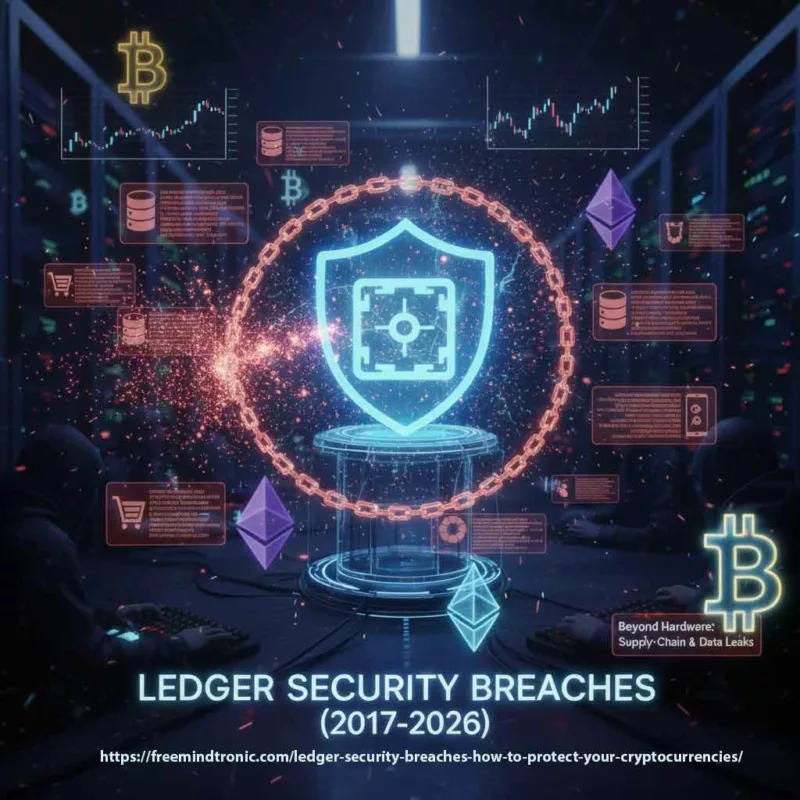
Ledger Security Breaches from 2017 to 2026: How to Protect Yourself from Hackers

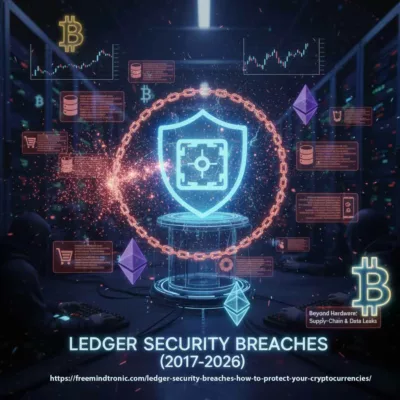
Realistic 16:9 illustration of Ledger Security Breaches featuring a broken digital chain surrounding compromised cryptocurrency data and hardware vulnerabilities.

Ledger Security Breaches have become a major indicator of vulnerabilities in the global crypto ecosystem. Beyond isolated technical flaws, it is the systemic correlations — hardware attacks, software exploits, third‑party data leaks, phishing scenarios — that shape today’s threat landscape, affecting individual users, exchanges, and trust infrastructures alike. Exploited by cybercriminals, state actors, and hybrid players, these breaches enable profiling, targeting, and manipulation of investors without necessarily compromising their private keys directly. Encryption protects private keys, but not relational, logistical, and behavioral metadata. This chronicle analyzes the major breaches from 2017 to 2026, their immediate and long‑term impacts, and the conditions for achieving true digital sovereignty against supply‑chain threats and third‑party dependencies.

Executive Summary — Ledger Security Breaches

⮞ Reading Note

This executive summary can be read in ≈ 3 to 4 minutes. It provides immediate insight into the central issue without requiring the full technical and historical analysis.

⚠️ Note on Supply Chain Resilience

The 2026 Global-e leak highlights what the CISA (Cybersecurity & Infrastructure Security Agency) defines as critical supply chain risks. According to their official guidelines, hardware security is only as strong as its weakest third-party link.

⚡ Key Findings

Since 2017, Ledger has faced several major breaches: seed phrase and firmware attacks, PCB modification, the 2020 database leak, the 2023 Connect Kit compromise, and the 2026 Global‑e data leak. These incidents show that threats arise not only from internal flaws but also from external dependencies and phishing vectors.

✦ Immediate Impact

  • Massive customer data exposure (292K in 2020, Global‑e in 2026)
  • Targeted phishing and harassment using personal information
  • Transaction manipulation and private-key compromise in controlled 2018 attack scenarios
  • Fragility of software supply chains and third‑party partners

⚠ Strategic Message

The real shift is not just technical compromise, but the repetition of breaches and their systemic exploitation. The threat becomes structural: automated phishing, doxxing, erosion of trust, and increased reliance on third parties. The risk is no longer occasional, but persistent.

The Shift from Trust to Proof

The repetition of Ledger Security Breaches proves that trust in a brand is not enough. Sovereignty requires proof. By implementing Segmented Key Authentication (WO2018154258), Freemindtronic moves control over critical secrets (seed phrases, private keys, credentials) from the vendor ecosystem directly into the user’s physical possession. This eliminates dependency on third-party infrastructure (e-commerce, update servers, logistics partners) for the custody and transfer of critical secrets.

⎔ Sovereign Countermeasure

There is no miracle solution against security breaches. Sovereignty means reducing exploitable surfaces: minimizing exposed data, using independent cold wallets (NFC HSM), strictly separating identity from usage, and maintaining constant vigilance against fraudulent communications.

Reading Parameters

Executive Summary: ≈ 3–4 min
Advanced Summary: ≈ 5–6 min
Full Chronicle: ≈ 30–40 min
First publication: December 16, 2023
Last update: January 7, 2026
Complexity level: High — security, crypto, supply‑chain
Technical density: ≈ 70 %
Languages available: EN · FR
Core focus: Ledger Security Breaches, crypto wallets, phishing, digital sovereignty
Editorial type: Chronicle — Freemindtronic Digital Security
Risk level: 9.2 / 10 financial, civil, and hybrid threats

Editorial Note — This chronicle is part of the Digital Security section. It explores Ledger Security Breaches as a revealing case of global crypto vulnerabilities, combining technical incidents, third‑party dependencies, and phishing threats. It extends analyses published on Digital Security. Content is written in accordance with the AI Transparency Declaration published by Freemindtronic Andorra — FM-AI-2025-11-SMD5.
Want to go further? The Advanced Summary places Ledger Security Breaches in a global dynamic — technological, regulatory, and societal — and prepares the reader for the full chronicle.
Infographic detailing the Ledger security breaches via Global-e in January 2026, showing exposed customer data vs. secure private keys.
Timeline and impact of the January 2026 Global-e breach: A new chapter in Ledger security breaches involving third-party e-commerce partners.

2026 Digital Security

Cyber espionnage zero day : marché, limites et doctrine souveraine

style=”text-align: center;”>Cyber espionnage zero day : la fin des spywares visibles marque l’entrée dans une [...]

2026 Digital Security

Cyberattaque HubEE : Rupture silencieuse de la confiance numérique

Cyberattaque HubEE : rupture silencieuse de la confiance numérique. Cette attaque, qui a permis l’exfiltration [...]

2026 Digital Security

Browser Fingerprinting : le renseignement par métadonnées en 2026

Le browser fingerprinting constitue aujourd’hui l’un des instruments centraux du renseignement par métadonnées appliqué aux [...]

2025 Digital Security

Persistent OAuth Flaw: How Tycoon 2FA Hijacks Cloud Access

Persistent OAuth Flaw — Tycoon 2FA Exploited — When a single consent becomes unlimited cloud [...]

2025 Digital Security

Tycoon 2FA failles OAuth persistantes dans le cloud | PassCypher HSM PGP

Faille OAuth persistante — Tycoon 2FA exploitée — Quand une simple autorisation devient un accès [...]

2025 Digital Security

OpenAI fuite Mixpanel : métadonnées exposées, phishing et sécurité souveraine

OpenAI fuite Mixpanel rappelle que même les géants de l’IA restent vulnérables dès qu’ils confient [...]

2025 Digital Security

OpenAI Mixpanel Breach Metadata – phishing risks and sovereign security with PassCypher

AI Mixpanel breach metadata is a blunt reminder of a simple rule: the moment sensitive [...]

2026 Crypto Currency Cryptocurrency Digital Security

Ledger Security Breaches from 2017 to 2026: How to Protect Yourself from Hackers

Ledger Security Breaches have become a major indicator of vulnerabilities in the global crypto ecosystem. [...]

2026 Digital Security

Failles de sécurité Ledger : Analyse 2017-2026 & Protections

Les failles de sécurité Ledger sont au cœur des préoccupations des investisseurs depuis 2017. Cette [...]

2025 Cyberculture Digital Security

Browser Fingerprinting Tracking: Metadata Surveillance in 2026

Browser Fingerprinting Tracking today represents one of the true cores of metadata intelligence. Far beyond [...]

2025 Digital Security

Bot Telegram Usersbox : l’illusion du contrôle russe

Le bot Telegram Usersbox n’était pas un simple outil d’OSINT « pratique » pour curieux [...]

2025 Digital Security

Espionnage invisible WhatsApp : quand le piratage ne laisse aucune trace

Espionnage invisible WhatsApp n’est plus une hypothèse marginale, mais une réalité technique rendue possible par [...]

2025 Digital Security

Fuite données ministère interieur : messageries compromises et ligne rouge souveraine

Fuite données ministère intérieur. L’information n’est pas arrivée par une fuite anonyme ni par un [...]

2026 Digital Security

Silent Whisper espionnage WhatsApp Signal : une illusion persistante

Silent Whisper espionnage WhatsApp Signal est présenté comme une méthode gratuite permettant d’espionner des communications [...]

2026 Awards Cyberculture Digital Security Distinction Excellence EviOTP NFC HSM Technology EviPass EviPass NFC HSM technology EviPass Technology finalists PassCypher PassCypher

Quantum-Resistant Passwordless Manager — PassCypher finalist, Intersec Awards 2026 (FIDO-free, RAM-only)

Quantum-Resistant Passwordless Manager 2026 (QRPM) — Best Cybersecurity Solution Finalist by PassCypher sets a new [...]

2025 Cyberculture Cybersecurity Digital Security EviLink

CryptPeer messagerie P2P WebRTC : appels directs chiffrés de bout en bout

La messagerie P2P WebRTC sécurisée constitue le fondement technique et souverain de la communication directe [...]

2025 CyptPeer Digital Security EviLink

Missatgeria P2P WebRTC segura — comunicació directa amb CryptPeer

Missatgeria P2P WebRTC segura al navegador és l’esquelet tècnic i sobirà de la comunicació directa [...]

2025 Digital Security

Russia Blocks WhatsApp: Max and the Sovereign Internet

Step by step, Russia blocks WhatsApp and now openly threatens to “completely block” the messaging [...]

2020 Digital Security

WhatsApp Gold arnaque mobile : typologie d’un faux APK espion

WhatsApp Gold arnaque mobile — clone frauduleux d’application mobile, ce stratagème repose sur une usurpation [...]

2025 Digital Security

Spyware ClayRat Android : faux WhatsApp espion mobile

Spyware ClayRat Android illustre la mutation du cyberespionnage : plus besoin de failles, il exploite [...]

2025 Digital Security

Android Spyware Threat Clayrat : 2025 Analysis and Exposure

Android Spyware Threat: ClayRat illustrates the new face of cyber-espionage — no exploits needed, just [...]

2023 Digital Security

WhatsApp Hacking: Prevention and Solutions

WhatsApp hacking zero-click exploit (CVE-2025-55177) chained with Apple CVE-2025-43300 enables remote code execution via crafted [...]

2025 Digital Security Technical News

Sovereign SSH Authentication with PassCypher HSM PGP — Zero Key in Clear

SSH Key PassCypher HSM PGP establishes a sovereign SSH authentication chain for zero-trust infrastructures, where [...]

2025 Digital Security Tech Fixes Security Solutions Technical News

SSH Key PassCypher HSM PGP — Sécuriser l’accès multi-OS à un VPS

SSH Key PassCypher HSM PGP fournit une chaîne souveraine : génération locale de clés SSH [...]

2025 Digital Security Technical News

Générateur de mots de passe souverain – PassCypher Secure Passgen WP

Générateur de mots de passe souverain PassCypher Secure Passgen WP pour WordPress — le premier [...]

2025 Digital Security Technical News

Quantum computer 6100 qubits ⮞ Historic 2025 breakthrough

A 6,100-qubit quantum computer marks a turning point in the history of computing, raising unprecedented [...]

2025 Digital Security Technical News

Ordinateur quantique 6100 qubits ⮞ La percée historique 2025

Ordinateur quantique 6100 qubits marque un tournant dans l’histoire de l’informatique, soulevant des défis sans [...]

2025 Cyberculture Digital Security

Authentification multifacteur : anatomie, OTP, risques

Authentification Multifacteur : Anatomie souveraine Explorez les fondements de l’authentification numérique à travers une typologie [...]

2025 Digital Security

Clickjacking extensions DOM: Vulnerabilitat crítica a DEF CON 33

DOM extension clickjacking — el clickjacking d’extensions basat en DOM, mitjançant iframes invisibles, manipulacions del [...]

2025 Digital Security

DOM Extension Clickjacking — Risks, DEF CON 33 & Zero-DOM fixes

DOM extension clickjacking — a technical chronicle of DEF CON 33 demonstrations, their impact, and [...]

2025 Digital Security

Clickjacking des extensions DOM : DEF CON 33 révèle 11 gestionnaires vulnérables

Clickjacking d’extensions DOM : DEF CON 33 révèle une faille critique et les contre-mesures Zero-DOM

2025 Digital Security

Vulnérabilité WhatsApp Zero-Click — Actions & Contremesures

Vulnérabilité WhatsApp zero-click (CVE-2025-55177) chaînée avec Apple CVE-2025-43300 permet l’exécution de code à distance via [...]

2025 Digital Security

Chrome V8 Zero-Day CVE-2025-10585 — Ton navigateur était déjà espionné ?

Chrome V8 zero-day CVE-2025-10585 — Votre navigateur n’était pas vulnérable. Vous étiez déjà espionné !

2025 Digital Security

Confidentialité métadonnées e-mail — Risques, lois européennes et contre-mesures souveraines

La confidentialité des métadonnées e-mail est au cœur de la souveraineté numérique en Europe : [...]

2025 Digital Security

Email Metadata Privacy: EU Laws & DataShielder

Email metadata privacy sits at the core of Europe’s digital sovereignty: understand the risks, the [...]

2025 Digital Security

Chrome V8 confusió RCE — Actualitza i postura Zero-DOM

Chrome V8 confusió RCE: aquesta edició exposa l’impacte global i les mesures immediates per reduir [...]

2025 Digital Security

Chrome V8 confusion RCE — Your browser was already spying

Chrome v8 confusion RCE: This edition addresses impacts and guidance relevant to major English-speaking markets [...]

2025 Digital Security

Passkeys Faille Interception WebAuthn | DEF CON 33 & PassCypher

Conseil RSSI / CISO – Protection universelle & souveraine EviBITB (Embedded Browser‑In‑The‑Browser Protection) est une [...]

2025 Cyberculture Digital Security

Reputation Cyberattacks in Hybrid Conflicts — Anatomy of an Invisible Cyberwar

Synchronized APT leaks erode trust in tech, alliances, and legitimacy through narrative attacks timed with [...]

2025 Digital Security

APT28 spear-phishing: Outlook backdoor NotDoor and evolving European cyber threats

Russian cyberattack on Microsoft by Midnight Blizzard (APT29) highlights the strategic risks to digital sovereignty. [...]

2024 Cyberculture Digital Security

Russian Cyberattack Microsoft: An Unprecedented Threat

Russian cyberattack on Microsoft by Midnight Blizzard (APT29) highlights the strategic risks to digital sovereignty. [...]

2024 Digital Security

Midnight Blizzard Cyberattack Against Microsoft and HPE: What are the consequences?

Midnight Blizzard Cyberattack against Microsoft and HPE: A detailed analysis of the facts, the impacts [...]

2025 Digital Security

eSIM Sovereignty Failure: Certified Mobile Identity at Risk

  Runtime Threats in Certified eSIMs: Four Strategic Blind Spots While geopolitical campaigns exploit the [...]

2025 Digital Security

APT29 Exploits App Passwords to Bypass 2FA

A silent cyberweapon undermining digital trust Two-factor authentication (2FA) was supposed to be the cybersecurity [...]

2015 Digital Security

Darknet Credentials Breach 2025 – 16+ Billion Identities Stolen

Underground Market: The New Gold Rush for Stolen Identities The massive leak of over 16 [...]

2025 Digital Security

Signal Clone Breached: Critical Flaws in TeleMessage

TeleMessage: A Breach That Exposed Cloud Trust and National Security Risks TeleMessage, marketed as a [...]

2025 Digital Security

APT29 Spear-Phishing Europe: Stealthy Russian Espionage

APT29 SpearPhishing Europe: A Stealthy LongTerm Threat APT29 spearphishing Europe campaigns highlight a persistent and [...]

2025 Digital Security

APT36 SpearPhishing India: Targeted Cyberespionage | Security

Understanding Targeted Attacks of APT36 SpearPhishing India APT36 cyberespionage campaigns against India represent a focused [...]

2025 Digital Security

Microsoft Outlook Zero-Click Vulnerability: Secure Your Data Now

Microsoft Outlook Zero-Click Vulnerability: How to Protect Your Data Now A critical Zero-Click vulnerability (CVE-2025-21298) [...]

2024 Digital Security

Why Encrypt SMS? FBI and CISA Recommendations

<div> </article></div> <script type=”application/ld+json”> { “@context”: “https://schema.org”, “@type”: “Article”, “mainEntityOfPage”: { “@type”: “WebPage”, “@id”: “https://freemindtronic.com/why-encrypt-sms-fbi-and-cisa-recommendations/” [...]

2025 Digital Security

Microsoft Vulnerabilities 2025: 159 Flaws Fixed in Record Update

Microsoft: 159 Vulnerabilities Fixed in 2025 Microsoft has released a record-breaking security update in January [...]

2025 Digital Security

APT44 QR Code Phishing: New Cyber Espionage Tactics

APT44 Sandworm: The Elite Russian Cyber Espionage Unit Unmasking Sandworm’s sophisticated cyber espionage strategies and [...]

2025 Digital Security

BadPilot Cyber Attacks: Russia’s Threat to Critical Infrastructures

BadPilot Cyber Attacks: Sandworm’s New Weaponized Subgroup Understanding the rise of BadPilot and its impact [...]

2024 Digital Security

Salt Typhoon & Flax Typhoon: Cyber Espionage Threats Targeting Government Agencies

Salt Typhoon – The Cyber Threat Targeting Government Agencies Salt Typhoon and Flax Typhoon represent [...]

2024 Digital Security

BitLocker Security: Safeguarding Against Cyberattacks

Introduction to BitLocker Security If you use a Windows computer for data storage or processing, [...]

2024 Digital Security

Cyberattack Exploits Backdoors: What You Need to Know

Cyberattack Exploits Backdoors: What You Need to Know In October 2024, a cyberattack exploited backdoors [...]

2021 Cyberculture Digital Security Phishing

Phishing Cyber victims caught between the hammer and the anvil

Phishing is a fraudulent technique that aims to deceive internet users and to steal their [...]

2024 Digital Security

Google Sheets Malware: The Voldemort Threat

Sheets Malware: A Growing Cybersecurity Concern Google Sheets, a widely used collaboration tool, has shockingly [...]

2024 Articles Digital Security News

Russian Espionage Hacking Tools Revealed

Russian Espionage Hacking Tools: Discovery and Initial Findings Russian espionage hacking tools were uncovered by [...]

2024 Digital Security Spying Technical News

Side-Channel Attacks via HDMI and AI: An Emerging Threat

Understanding the Impact and Evolution of Side-Channel Attacks in Modern Cybersecurity Side-channel attacks, also known [...]

Digital Security Spying Technical News

Are fingerprint systems really secure? How to protect your data and identity against BrutePrint

Fingerprint Biometrics: An In-Depth Exploration of Security Mechanisms and Vulnerabilities It is a widely recognized [...]

2024 Digital Security Technical News

Apple M chip vulnerability: A Breach in Data Security

Apple M chip vulnerability: uncovering a breach in data security Researchers at the Massachusetts Institute [...]

Digital Security Technical News

Brute Force Attacks: What They Are and How to Protect Yourself

Brute-force Attacks: A Comprehensive Guide to Understand and Prevent Them Brute Force: danger and protection [...]

2024 Digital Security

OpenVPN Security Vulnerabilities Pose Global Security Risks

Critical OpenVPN Vulnerabilities Pose Global Security Risks OpenVPN security vulnerabilities have come to the forefront, [...]

2024 Digital Security

Google Workspace Vulnerability Exposes User Accounts to Hackers

How Hackers Exploited the Google Workspace Vulnerability Hackers found a way to bypass the email [...]

2023 Digital Security

Predator Files: The Spyware Scandal That Shook the World

Predator Files: How a Spyware Consortium Targeted Civil Society, Politicians and Officials Cytrox: The maker [...]

2023 Digital Security Phishing

BITB Attacks: How to Avoid Phishing by iFrame

BITB Attacks: How to Avoid Phishing by iFrame We have all seen phishing attacks aren’t [...]

2023 Digital Security

5Ghoul: 5G NR Attacks on Mobile Devices

5Ghoul: How Contactless Encryption Can Secure Your 5G Communications from Modem Attacks 5Ghoul is a [...]

2024 Digital Security

Leidos Holdings Data Breach: A Significant Threat to National Security

A Major Intrusion Unveiled In July 2024, the Leidos Holdings data breach came to light, [...]

2024 Digital Security

RockYou2024: 10 Billion Reasons to Use Free PassCypher

RockYou2024: A Cybersecurity Earthquake The RockYou2024 data leak has shaken the very foundations of global [...]

2024 Digital Security

Europol Data Breach: A Detailed Analysis

May 2024: Europol Security Breach Highlights Vulnerabilities In May 2024, Europol, the European law enforcement [...]

2024 Digital Security

Dropbox Security Breach 2024: Phishing, Exploited Vulnerabilities

Phishing Tactics: The Bait and Switch in the Aftermath of the Dropbox Security Breach The [...]

Digital Security EviToken Technology Technical News

EviCore NFC HSM Credit Cards Manager | Secure Your Standard and Contactless Credit Cards

EviCore NFC HSM Credit Cards Manager is a powerful solution designed to secure and manage [...]

2024 Digital Security

Kapeka Malware: Comprehensive Analysis of the Russian Cyber Espionage Tool

Kapeka Malware: The New Russian Intelligence Threat   In the complex world of cybersecurity, a [...]

2024 Cyberculture Digital Security News Training

Andorra National Cyberattack Simulation: A Global First in Cyber Defense

Andorra Cybersecurity Simulation: A Vanguard of Digital Defense Andorra-la-Vieille, April 15, 2024 – Andorra is [...]

Articles Digital Security EviVault Technology NFC HSM technology Technical News

EviVault NFC HSM vs Flipper Zero: The duel of an NFC HSM and a Pentester

EviVault NFC HSM vs Flipper Zero: The duel of an NFC HSM and a Pentester [...]

Articles Cryptocurrency Digital Security Technical News

Securing IEO STO ICO IDO and INO: The Challenges and Solutions

Securing IEO STO ICO IDO and INO: How to Protect Your Crypto Investments Cryptocurrencies are [...]

2023 Articles Digital Security Technical News

Remote activation of phones by the police: an analysis of its technical, legal and social aspects

What is the new bill on justice and why is it raising concerns about privacy? [...]

Articles Cyberculture Digital Security Technical News

Protect Meta Account Identity Theft with EviPass and EviOTP

Protecting Your Meta Account from Identity Theft Meta is a family of products that includes [...]

2024 Digital Security

Cybersecurity Breach at IMF: A Detailed Investigation

Cybersecurity Breach at IMF: A Detailed Investigation Cybersecurity breaches are a growing concern worldwide. The [...]

2023 Articles Cyberculture Digital Security Technical News

Strong Passwords in the Quantum Computing Era

How to create strong passwords in the era of quantum computing? Quantum computing is a [...]

2024 Digital Security

PrintListener: How to Betray Fingerprints

PrintListener: How this Technology can Betray your Fingerprints and How to Protect yourself PrintListener revolutionizes [...]

2024 Articles Digital Security News

How the attack against Microsoft Exchange on December 13, 2023 exposed thousands of email accounts

How the attack against Microsoft Exchange on December 13, 2023 exposed thousands of email accounts [...]

2024 Articles Digital Security News Spying

How to protect yourself from stalkerware on any phone

What is Stalkerware and Why is it Dangerous? Stalkerware, including known programs like FlexiSpy, mSpy, [...]

2023 Articles DataShielder Digital Security Military spying News NFC HSM technology Spying

Pegasus: The cost of spying with one of the most powerful spyware in the world

Pegasus: The Cost of Spying with the Most Powerful Spyware in the World Pegasus is [...]

2024 Digital Security Spying

Ivanti Zero-Day Flaws: Comprehensive Guide to Secure Your Systems Now

What are Zero-Day Flaws and Why are They Dangerous? A zero-day flaw is a previously [...]

2024 Articles Compagny spying Digital Security Industrial spying Military spying News Spying Zero trust

KingsPawn A Spyware Targeting Civil Society

  QuaDream: KingsPawn spyware vendor shutting down in may 2023 QuaDream was a company that [...]

2024 Articles Digital Security EviKey NFC HSM EviPass News SSH

Terrapin attack: How to Protect Yourself from this New Threat to SSH Security

Protect Yourself from the Terrapin Attack: Shield Your SSH Security with Proven Strategies SSH is [...]

2024 Articles Digital Security News Phishing

Google OAuth2 security flaw: How to Protect Yourself from Hackers

Google OAuth2 security flaw: Strategies Against Persistent Cookie Threats in Online Services Google OAuth2 security [...]

2024 Articles Digital Security

Kismet iPhone: How to protect your device from the most sophisticated spying attack?

Kismet iPhone: How to protect your device from the most sophisticated spying attack using Pegasus [...]

Articles Digital Security EviCore NFC HSM Technology EviPass NFC HSM technology NFC HSM technology

TETRA Security Vulnerabilities: How to Protect Critical Infrastructures

TETRA Security Vulnerabilities: How to Protect Critical Infrastructures from Cyberattacks TETRA (Terrestrial Trunked Radio) is [...]

2023 Articles DataShielder Digital Security EviCore NFC HSM Technology EviCypher NFC HSM EviCypher Technology NFC HSM technology

FormBook Malware: How to Protect Your Gmail and Other Data

How to Protect Your Gmail Account from FormBook Malware Introduction Imagine that you receive an [...]

The chronicles displayed above ↑ belong to the Digital Security section. They extend the analysis of sovereign architectures, data black markets, and surveillance tools. This selection complements the present chronicle dedicated to the **Ledger Security Breaches (2017–2026)** and the systemic risks linked to hardware vulnerabilities, supply‑chain compromises, and third‑party providers.

Advanced Summary

This advanced summary frames Ledger Security Breaches (2017–2026) through a systemic lens. It does not focus only on technical incidents, but analyzes the full dependency chain — firmware, software, partners, and customer data — and explains why certain architectures make these failures structural, not accidental.

A sequence of breaches that reveals a security-model problem

Since 2017, Ledger has faced a series of major incidents: seed phrase recovery attacks, firmware replacement, physical device modifications, application-level vulnerabilities (Monero), the massive 2020 customer database leak, the 2023 software supply-chain compromise, and the 2026 Global-e order-data leak. Taken separately, each event can be labeled an “incident.” Taken together, they reveal a security model problem.

The common denominator is not low-level cryptography, but the recurring necessity for critical secrets (seed phrases, private keys, identity-related metadata) to pass at some point through a non-sovereign environment: proprietary firmware, the host computer, connected applications, update servers, or an e-commerce partner.

From component security to ecosystem vulnerability

Ledger historically relied on the robustness of the hardware component itself. But from 2020 onward, the attack surface shifted to the peripheral ecosystem: customer databases, logistics services, software dependencies, user interfaces, notifications, and support channels.

The 2026 Global-e leak marks a turning point. Even without direct private-key compromise, exposure of delivery and order metadata turns users into persistent targets: ultra-targeted phishing, “delivery” social engineering, doxxing, and, in extreme cases, physical threats. Security is no longer only digital — it becomes civil and personal.

Why phishing and hybrid attacks become inevitable

Once a user’s real identity is correlated with crypto ownership, phishing stops being opportunistic. It becomes industrial and personalized.

BITB attacks, fake updates, fake delivery incidents, or “compliance” scams exploit less a technical bug than the human factor, made vulnerable by exposed metadata.

In this context, hardening firmware or adding software warnings is not sufficient. The problem is not cryptographic signing — it is that the secret or its holder becomes identifiable, traceable, or remotely reachable.

Paradigm shift: from trust to hardware proof

Facing these structural limits, some approaches do not attempt to strengthen transaction signing — they aim to remove critical secrets from any connected ecosystem. Freemindtronic’s sovereign alternatives follow the opposite logic: instead of securing a connected stack, they seek to radically reduce dependencies. NFC HSM devices are battery-less, cable-less, and network-port-less, requiring no account, no server, and no cloud synchronization.

This paradigm shift is embodied by air-gap secret sharing: critical secrets (seed phrases, private keys, credentials for hot wallets or proprietary systems) can be transferred hardware → hardware from one SeedNFC HSM to another, via an RSA-4096 encrypted QR code using the recipient’s public key — without blockchain, without server, and without any transaction-signing function.

A structural answer to the failures observed since 2017

Where Ledger failures rely on supply chains, updates, and commercial relationships, sovereign architectures remove these breaking points by design. There is nothing to hack remotely, nothing to divert in a cloud, and nothing to extract from a third-party server. Even if visually exposed, an encrypted QR code remains unusable without physical possession of the recipient HSM.

This model does not promise “magic” security. It imposes deliberate responsibility: irreversibility of transfers, physical control, and operational discipline. But it eliminates the systemic attack vectors that have repeatedly surfaced since 2017.

Ledger Security Breaches (2017–2026): How to Protect Your Cryptocurrencies

Have you ever questioned the real level of security protecting your digital assets?
If you use a Ledger device, you may assume your funds are safe from hackers. Ledger is a French company widely recognized for its role in cryptocurrency security, offering hardware wallets designed to isolate private keys from online threats.

However, since 2017, Ledger Security Breaches have repeatedly challenged this assumption. Over time, multiple vulnerabilities have emerged—some exposing personal data, others enabling private-key compromise only in specific, controlled attack scenarios (e.g., physical access or manipulated environments). These weaknesses have allowed attackers not only to steal funds, but also to exploit users through phishing, identity correlation, and targeted coercion.

This chronicle provides a structured analysis of the major Ledger security incidents from 2017 to 2026. It explains how each breach was exploited, what risks they introduced, and why certain architectural choices amplify systemic exposure. Most importantly, it outlines practical and strategic approaches to reduce attack surfaces and regain control over cryptographic sovereignty.

Rather than focusing on fear or isolated failures, this analysis aims to help users understand the evolving threat landscape—and to distinguish between trust-based security and proof-based, sovereign architectures.

Ledger security incidents: How Hackers Exploited Them and How to Stay Safe

Ledger security breaches have exposed logistical and relational metadata (delivery address, purchase history, identity correlation), and in specific historical attack scenarios, enabled the compromise of private keys under controlled conditions. Ledger is a French company that provides secure devices to store and manage your funds. But since 2017, hackers have targeted Ledger’s e-commerce and marketing database, as well as its software and hardware products. In this article, you will discover the different breaches, how hackers exploited them, what their consequences were, and how you can protect yourself from these threats.

[/section]

Ledger Security Breaches (2017–2026): From Hardware Attacks to Systemic Supply-Chain Risk

Have you ever wondered how safe your cryptocurrencies are? If you are using a Ledger device, you might think that you are protected from hackers and thieves. Ledger is a French company that specializes in cryptocurrency security. It offers devices that allow you to store and manage your funds securely. These devices are called hardware wallets, and they are designed to protect your private keys from hackers and thieves.

However, since 2017, Ledger has been the target of multiple incidents that exposed logistical and relational metadata (delivery address, purchase history, identity correlation) and, in specific historical attack scenarios, enabled private-key compromise under controlled conditions. These breaches could allow hackers to steal your cryptocurrencies or harm you in other ways. In this article, we will show you the different breaches that were discovered, how they were exploited, what their consequences were, and how you can protect yourself from these threats.

Ledger Security Issues: The Seed Phrase Recovery Attack (February 2018)

The seed phrase is a series of words that allows you to restore access to a cryptocurrency wallet. It must be kept secret and secure, as it gives full control over the funds. In February 2018, a security researcher named Saleem Rashid discovered a breach in the Ledger Nano S, which allowed an attacker with physical access to the device to recover the seed phrase using a side-channel attack.

How did hackers exploit the breach?

The attack consisted of using an oscilloscope to measure the voltage variations on the reset pin of the device. These variations reflected the operations performed by the secure processor of the Ledger Nano S, which generated the seed phrase. By analyzing these variations, the attacker could reconstruct the seed phrase and access the user’s funds.

Simplified diagram of the attack

Figure Ledger Security Issues: The Seed Phrase Recovery Attack (February 2018)
Statistics on the breach
  • Number of potentially affected users: about 1 million
  • Total amount of potentially stolen funds: unknown
  • Date of discovery of the breach by Ledger: February 20, 2018
  • Author of the discovery of the breach: Saleem Rashid, a security researcher
  • Date of publication of the fix by Ledger: April 3, 2018

Scenarios of hacker attacks

  • Scenario of physical access: The attacker needs to have physical access to the device, either by stealing it, buying it second-hand, or intercepting it during delivery. The attacker then needs to connect the device to an oscilloscope and measure the voltage variations on the reset pin. The attacker can then use a software tool to reconstruct the seed phrase from the measurements.
  • Scenario of remote access: The attacker needs to trick the user into installing a malicious software on their computer, which can communicate with the device and trigger the reset pin. The attacker then needs to capture the voltage variations remotely, either by using a wireless device or by compromising the oscilloscope. The attacker can then use a software tool to reconstruct the seed phrase from the measurements.

Sources

1Breaking the Ledger Security Model – Saleem Rashid published on March 20, 2018.

2Ledger Nano S: A Secure Hardware Wallet for Cryptocurrencies? – Saleem Rashid published on November 20, 2018.

Ledger Security Flaws: The Firmware Replacement Attack (March 2018)

The firmware is the software that controls the operation of the device. It must be digitally signed by Ledger to ensure its integrity. In March 2018, the same researcher discovered another breach in the Ledger Nano S, which allowed an attacker to replace the firmware of the device with a malicious firmware, capable of stealing the private keys or falsifying the transactions.

How did hackers exploit the Ledger Security Breaches?

The attack consisted of exploiting a vulnerability in the mechanism of verification of the firmware signature. The attacker could create a malicious firmware that passed the signature check, and that installed on the device. This malicious firmware could then send the user’s private keys to the attacker, or modify the transactions displayed on the device screen.

Simplified diagram of the attack

Figure Ledger Security Flaws: The Firmware Replacement Attack (March 2018)

Statistics on the breach

  • Number of potentially affected users: about 1 million
  • Total amount of potentially stolen funds: unknown
  • Date of discovery of the breach by Ledger: March 20, 2018
  • Author of the discovery of the breach: Saleem Rashid, a security researcher
  • Date of publication of the fix by Ledger: April 3, 2018

Scenarios of hacker attacks

  • Scenario of physical access: The attacker needs to have physical access to the device, either by stealing it, buying it second-hand, or intercepting it during delivery. The attacker then needs to connect the device to a computer and install the malicious firmware on it. The attacker can then use the device to access the user’s funds or falsify their transactions.
  • Scenario of remote access: The attacker needs to trick the user into installing the malicious firmware on their device, either by sending a fake notification, a phishing email, or a malicious link. The attacker then needs to communicate with the device and send the user’s private keys or modify their transactions.

Sources

Ledger Security Incidents: The Printed Circuit Board Modification Attack (November 2018)

The printed circuit board is the hardware part of the device, which contains the electronic components. It must be protected against malicious modifications, which could compromise the security of the device. In November 2018, a security researcher named Dmitry Nedospasov discovered a breach in the Ledger Nano S, which allowed an attacker with physical access to the device to modify the printed circuit board and install a listening device, capable of capturing the private keys or modifying the transactions.

How did hackers exploit the breach?

The attack consisted of removing the case of the device, and soldering a microcontroller on the printed circuit board. This microcontroller could intercept the communications between the secure processor and the non-secure processor of the Ledger Nano S, and transmit them to the attacker via a wireless connection. The attacker could then access the user’s private keys, or modify the transactions displayed on the device screen.

Simplified diagram of the attack

figure Ledger Security Incidents: The Printed Circuit Board Modification Attack (November 2018)

Statistics on the breach

  • Number of potentially affected users: unknown
  • Total amount of potentially stolen funds: unknown
  • Date of discovery of the breach by Ledger: November 7, 2019
  • Author of the discovery of the breach: Dmitry Nedospasov, a security researcher
  • Date of publication of the fix by Ledger: December 17, 2020

Scenarios of hacker attacks

  • Scenario of physical access: The attacker needs to have physical access to the device, either by stealing it, buying it second-hand, or intercepting it during delivery. The attacker then needs to remove the case of the device and solder the microcontroller on the printed circuit board. The attacker can then use the wireless connection to access the user’s funds or modify their transactions.
  • Scenario of remote access: The attacker needs to compromise the wireless connection between the device and the microcontroller, either by using a jammer, a repeater, or a hacker device. The attacker can then intercept the communications between the secure processor and the non-secure processor, and access the user’s funds or modify their transactions.

Sources

  • [Breaking the Ledger Nano X – Dmitry Nedospasov] published on November 7, 2019.
  • [How to Verify the Authenticity of Your Ledger Device – Ledger Blog] published on December 17, 2020.
[/col] [/row]

Ledger Security Breaches: Monero Application Vulnerability (March 2019)

Not all cryptocurrencies interact with hardware wallets in the same way.
In March 2019, a critical vulnerability was discovered in the Monero (XMR) application for Ledger devices.
Unlike the 2018 physical attacks, this flaw was located in the communication protocol between the Ledger device and the Monero desktop client.

How Was the Vulnerability Exploited?

The flaw allowed a malicious or compromised Monero client to send manipulated transaction data to the Ledger device.

By exploiting a bug in the handling of change outputs, an attacker could:

  • redirect funds to an address under their control without the user noticing on the Ledger screen, or
  • under specific and controlled conditions, reconstruct the Monero private spend key by observing multiple device–host exchanges.

In this scenario, the hardware wallet signed cryptographically valid transactions based on manipulated inputs originating from the host software.

Infographic illustrating a Monero transaction hijack via a malicious GUI wallet despite the use of a Ledger hardware wallet.

Incident Summary

  • Potentially affected users: Monero (XMR) holders using Ledger Nano S or Nano X
  • Reported loss: One documented case of approximately 1,600 XMR (~USD 83,000 at the time)
  • Date of discovery: March 4, 2019
  • Discoverers: Monero community & Ledger Donjon
  • Patch released: March 6, 2019 (Monero app version 1.5.1)

Attack Scenarios

  • Compromised software: The user interacts with an infected or unofficial Monero GUI wallet. During a legitimate transaction, the client silently alters transaction parameters to drain funds.
  • Key reconstruction (controlled scenario): An attacker with malware on the host computer could theoretically reconstruct the Monero private spend key by intercepting and correlating multiple device–PC exchanges.

Important clarification: This incident did not involve a mass leak of private keys.
It demonstrated that, under specific conditions and with a compromised host environment, private key compromise was technically possible due to application-layer design flaws.

Structural “Blind Signing” Vulnerability: Signing in the Dark by Design (Permanent)

Blind Signing is not a temporary flaw nor a bug that can be patched with a firmware update.
It is a structural design limitation inherent to hardware wallets when confronted with the growing complexity of smart contracts.


As of 2026, it represents the #1 fund-theft vector in Web3
, ahead of classic technical exploits.

Why Blind Signing Is Fundamentally Dangerous

A hardware wallet is supposed to enable conscious and verifiable validation of sensitive operations.
With Blind Signing, however, the device is unable to render the real intent of the contract being signed.

The user is typically presented with:

  • a generic “Data Present” message
  • unreadable hexadecimal strings
  • or a partial, non-human-interpretable description

The signature becomes an act of faith.
The user no longer validates a understood action, but complies with an opaque interface.

Diagram illustrating Blind Signing, showing a hardware wallet displaying 'Data Present' while a malicious smart contract drains funds.

Figure — Blind Signing: when the user signs a transaction whose real intent cannot be verified.

An Attack by Consent, Not by Circumvention

Unlike the 2018 Ledger incidents (seed recovery, firmware replacement, PCB modification),
Blind Signing does not attempt to break the hardware security.

It turns it against the user.

Everything is:

  • cryptographically valid
  • signed with the genuine private key
  • irreversible on the blockchain

There is no detectable malware, no key extraction, no firmware compromise.
The loss is legally and technically attributable to the signature itself.

Impact and Scope

  • Affected users: 100% of DeFi / NFT / Web3 users
  • Estimated losses: hundreds of millions of USD (cumulative)
  • Status: permanent and systemic risk
  • Root cause: inability to verify signed intent

Typical Attack Scenarios

  • Wallet drainers: a fake mint or airdrop leads to signing a contract that grants unlimited asset transfer rights.
  • Hidden infinite approvals: the user unknowingly signs a permanent authorization. The wallet is emptied later, without any further interaction.

Conclusion:
Blind Signing marks a critical rupture: the private key remains protected, but effective security disappears.

The question is no longer “Is my wallet secure?”, but:

“Am I able to prove what I am signing?”

Ledger Security Breaches: The Connect Kit Attack (December 2023)

The Connect Kit is a software that allows users to manage their cryptocurrencies from their computer or smartphone, by connecting to their Ledger device. It allows to check the balance, send and receive cryptocurrencies, and access services such as staking or swap.

The Connect Kit breach was discovered by the security teams of Ledger in December 2023. It was due to a vulnerability in a third-party component used by the Connect Kit. This component, called Electron, is a framework that allows to create desktop applications with web technologies. The version used by the Connect Kit was not up to date, and had a breach that allowed hackers to execute arbitrary code on the update server of the Connect Kit.

Technical validation: This type of supply chain attack is classified under CWE-494 (Download of Code Without Integrity Check). You can monitor similar hardware wallet vulnerabilities on the MITRE CVE Database.

How did hackers exploit the Ledger Security Breaches?

The hackers took advantage of this breach to inject malicious code into the update server of the Connect Kit. This malicious code was intended to be downloaded and executed by the users who updated their Connect Kit software. The malicious code aimed to steal the sensitive information of the users, such as their private keys, passwords, email addresses, or phone numbers.

Simplified diagram of the attack

Figure Ledger Security Breaches The Connect Kit Attack (December 2023)

Statistics on the breach

  • Number of potentially affected users: about 10,000
  • Total amount of potentially stolen funds: unknown
  • Date of discovery of the breach by Ledger: December 14, 2023
  • Author of the discovery of the breach: Pierre Noizat, director of security at Ledger
  • Date of publication of the fix by Ledger: December 15, 2023

Scenarios of hacker attacks

  • Scenario of remote access: The hacker needs to trick the user into updating their Connect Kit software, either by sending a fake notification, a phishing email, or a malicious link. The hacker then needs to download and execute the malicious code on the user’s device, either by exploiting a vulnerability or by asking the user’s permission. The hacker can then access the user’s information or funds.
  • Scenario of keyboard: The hacker needs to install a keylogger on the user’s device, either by using the malicious code or by another means. The keylogger can record the keystrokes of the user, and send them to the hacker. The hacker can then use the user’s passwords, PIN codes, or seed phrases to access their funds.
  • Scenario of screen: The hacker needs to install a screen recorder on the user’s device, either by using the malicious code or by another means. The screen recorder can capture the screen of the user, and send it to the hacker. The hacker can then use the user’s QR codes, addresses, or transaction confirmations to steal or modify their funds.

Sources

Ledger Security Breaches: The Data Leak (December 2020)

The database is the system that stores the information of Ledger customers, such as their names, addresses, phone numbers and email addresses. It must be protected against unauthorized access, which could compromise the privacy of customers. In December 2020, Ledger revealed that a breach in its database had exposed the logistical and relational metadata (delivery address, purchase history, identity correlation) of 292,000 customers, including 9,500 in France.

How did hackers exploit the breach?

The breach had been exploited by a hacker in June 2020, who had managed to access the database via a poorly configured API key. The hacker had then published the stolen data on an online forum, making them accessible to everyone. Ledger customers were then victims of phishing attempts, harassment, or threats from other hackers, who sought to obtain their private keys or funds.

Simplified diagram of the attack :

Statistics on the breach

  • Number of affected users: 292,000, including 9,500 in France
  • Total amount of potentially stolen funds: unknown
  • Date of discovery of the breach by Ledger: June 25, 2020
  • Author of the discovery of the breach: Ledger, after being notified by a researcher
  • Date of publication of the fix by Ledger: July 14, 2020

Scenarios of hacker attacks

  • Scenario of phishing: The hacker sends an email or a text message to the user, pretending to be Ledger or another trusted entity. The hacker asks the user to click on a link, enter their credentials, or update their device. The hacker then steals the user’s information or funds.
  • Scenario of harassment: The hacker calls or visits the user, using their logistical and relational metadata (delivery address, purchase history, identity correlation) to intimidate them. The hacker threatens the user to reveal their identity, harm them, or steal their funds, unless they pay a ransom or give their private keys.
  • Scenario of threats: The hacker uses the user’s logistical and relational metadata (delivery address, purchase history, identity correlation) to find their social media accounts, family members, or friends. The hacker then sends messages or posts to the user or their contacts, threatening to harm them or expose their cryptocurrency activities, unless they comply with their demands.

Sources:

Ledger Security Breaches: The Global-e Data Leak (January 2026)

In January 2026, Ledger disclosed a new breach caused by its e-commerce partner Global-e.
Attackers compromised Global-e’s cloud systems, exposing customer names, email addresses, and delivery contact details used for online orders.

Unlike previous incidents, no seed phrases, private keys, or payment card data were compromised.
However, this leak significantly increased the risk of targeted phishing, doxxing, and long-term social engineering attacks against Ledger customers.

Infographic illustrating the Global-e Ledger data leak (January 2026)

Figure — Global-e 2026 breach: how exposed order data enables phishing, doxxing, and coercive targeting.
Active Defense: Mitigating Global-e Leak Risks

The SeedNFC HSM ecosystem, combined with PassCypher HSM PGP, provides a structural response by shifting security into the user’s physical control:

  • Reduced purchase metadata exposure: minimizing the collection and retention of identifiable data (name, address, phone) limits the long-term impact of e-commerce and logistics leaks such as 2020 and Global-e (2026).
  • Hardware-based intent validation: critical actions require a physical NFC interaction, rendering remote phishing and fake-support attacks ineffective after a data leak.
  • Anti-BITB & Anti-Iframe protection: blocks fake Ledger Live interfaces and credential-harvesting windows commonly used in post-leak phishing campaigns.
  • Compromised credential detection: checks whether emails or passwords have appeared in previous breaches, preventing reuse and account takeover.
Global-e Breach Statistics
  • Affected users: Not publicly disclosed (investigation ongoing as of January 2026).
  • Exposed data: Customer names, emails, and delivery contact information.
  • Impact on sensitive assets: None (private keys and funds remained secure).
  • Date of discovery: January 4, 2026.
  • Breach origin: Global-e cloud infrastructure.
⚠️ Critical Alert: Dark Web Resale & Persistent Targeting

A data breach is permanent. Once an identity is associated with a hardware wallet purchase,
the individual remains a high-value target for years.

Sovereign defense: By managing keys and credentials in a hardware-only environment such as SeedNFC HSM,
users can de-link their digital identity from centralized e-commerce databases and recurring leaks.

Official Sources & Expert References

Escalation of Threats: From Delivery Phishing to Physical Coercion

The Global-e delivery-data leak does not merely enable email scams.
It fuels hybrid attacks where digital exposure transitions into real-world coercion.

“Delivery” Phishing: Precision Social Engineering

Attackers exploit order history to send ultra-credible SMS or emails:

  • Scenario: Fake courier messages (customs issue, address error, delayed shipment).
  • Trap: A cloned Ledger interface requesting a recovery phrase to “unlock” delivery.
  • Why it works: The victim is already expecting a shipment or update.

Physical Extortion & Home-Targeting

When physical addresses are exposed, the threat extends beyond cybercrime:

  • Targeted home visits: Criminal groups identify where crypto holders live.
  • Coercion: Victims are forced to sign irreversible transfers under threat.
  • Family pressure: Attacks may involve relatives to break resistance.

“A leaked Ledger delivery address acts as a marker: it tells criminals where the vault is and who holds the key.” This reality forces a fundamental rethink of how security tools are purchased and how identity is exposed.

Official Statements and Expert Sources

Global Reactions: Trust Erosion, Legal Pressure, and Community Backlash

The January 2026 Global-e order-data breach triggered a strong and immediate reaction across the global crypto ecosystem. Unlike earlier technical exploits, this incident reinforced a growing perception that the primary risk no longer lies in cryptography or hardware components, but in ecosystem-level dependencies: e-commerce partners, logistics providers, and identity-linked metadata.

Across English-speaking communities (Reddit, X, Discord, Telegram), the dominant sentiment was not surprise, but fatigue. For many users, Global-e represented the third major reminder—after 2020 and 2023—that hardware security alone does not guarantee user safety.

Recurring Themes in Anglophone Communities

  • Collapse of “secure-by-brand” trust: Ledger’s hardware is still widely perceived as technically robust, but confidence in the surrounding commercial and data-handling ecosystem has eroded.
  • Metadata as the real vulnerability: Users increasingly recognize that names, emails, delivery addresses, and purchase history enable profiling, targeting, and coercion—even when private keys remain secure.
  • Phishing industrialization: Highly personalized scams (fake delivery notices, fake compliance alerts, fake support cases) are now viewed as an unavoidable consequence of large-scale data leaks.

From Cybersecurity to Legal and Regulatory Exposure

In the United States, United Kingdom, and European Union, discussions rapidly shifted toward legal accountability and consumer protection, backed by official frameworks:

  • Class action risk (US / UK): Law firms are examining collective lawsuits for negligence and failure of duty of care, citing precedents in data breach litigation.
  • Regulatory scrutiny: Data-protection authorities like the CNIL (EU) and the ICO (UK) have emphasized strict third-party dependency management under GDPR.
  • Law-enforcement alerts: Agencies like Cybermalveillance.gouv.fr and the FBI (IC3) emphasize that crypto-related leaks increasingly enable hybrid crime, combining cyber-fraud with real-world intimidation.

Hybrid Threat Escalation: From Phishing to Physical Coercion

The Global-e breach illustrates a broader evolution of crypto-crime: the transition from purely digital theft to hybrid attack models, a trend confirmed by the INTERPOL Global Cybercrime reports.

Precision Phishing at Global Scale

Attackers leverage order metadata to craft highly credible messages. As reported by The Block, these campaigns include:

  • Fake courier notifications (customs delay, address issues)
  • Cloned Ledger Live portals requesting recovery phrases
  • Social-engineering scripts tailored to purchase history

Physical Targeting and Extortion Risks

Once physical addresses are exposed, risks extend beyond cybercrime, aligning with the Chainalysis Crypto Crime evolution analysis:

  • Home targeting: Criminal groups identify where high-value crypto holders live.
  • Forced transactions: Victims are coerced into signing irreversible transfers via physical threats.
  • Family leverage: Threats may extend to relatives to break resistance.

“A leaked delivery address does not steal funds—but it identifies the vault and the person holding the key.”

This realization has driven a growing demand for identity-minimizing, hardware-sovereign security models built on privacy-by-design principles —such as those prioritizing “Privacy by Design” by erasing all digital purchase records—to decouple asset protection from centralized logistics vulnerabilities.

Permanent Air-Gapped Secret Sharing: RSA-4096 Encrypted QR Between SeedNFC HSM Devices

SeedNFC implements a fully air-gapped secret-sharing mechanism based on an
RSA-4096 encrypted QR code using the recipient’s public key.
The recipient must be another SeedNFC HSM, ensuring that only that device can decrypt and
import the secret directly into hardware.

The QR code is only an encrypted transport container. It can be displayed locally, sent as an image,
or even shown during a video call. Without physical possession of the recipient SeedNFC HSM,
the content remains mathematically unusable.

  • Offline asymmetric encryption: the secret is never exposed in plaintext inside the QR code.
  • Zero infrastructure: no server, no account, no database, no cloud.
  • Operational + logical air-gap: sharing remains possible without any network connectivity.

This mechanism includes no revocation, no delay, and no expiration: the transfer is permanent by design.
It enables direct hardware → hardware transfer of critical secrets (seed phrases, private keys, access credentials)
between isolated HSM devices, with no software intermediary and no blockchain involvement.

Clarification: secret transfer ≠ transaction signing

SeedNFC HSM is not presented here as a transaction signer. Its role is upstream: to generate, store, and transfer secrets (seed phrases, private keys) or authentication data (IDs/passwords, hot-wallet access, proprietary systems) within a sovereign hardware boundary.

It can also store encrypted seed phrases from third-party wallets (Ledger, Trezor, software hot wallets, etc.) and their associated private keys, without depending on the original vendor’s firmware, software, or infrastructure.

Depending on the use case, data can be injected in a controlled way into an application field through Bluetooth HID keyboard emulation (e.g., migration, restore, login).

Web complement: for browser workflows, equivalent controlled input can be triggered via the Freemindtronic browser extension (explicit field selection). This eliminates exposure via clipboard, temporary files, or cloud sync, and strongly reduces risk from classic software keyloggers, since the user does not type anything.

Scope note: like any input, data may still become observable at the display point or on a compromised host (screen capture, application malware). The goal is to remove “copy/paste + file” vectors and human typing—not to make an infected system “invulnerable”.

Important: transferring a private key transfers ownership (full control over the associated funds).This is relevant for backup, migration, inheritance, or off-chain ownership transfer, but must be used with strict operational discipline.

Why this matters after data leaks: even if metadata is exposed, secrets can remain isolated and transferable without re-entering a connected vendor ecosystem.

Comparison with other crypto wallets

Ledger is not the only solution to secure your cryptocurrencies. There are other options, such as other hardware wallets, software wallets, or exchanges. Each option has its advantages and disadvantages, depending on your needs and preferences.

Other Hardware Wallets

For example, other hardware wallets, such as Trezor, offer similar features and security levels as Ledger, but they may have different designs, interfaces, or prices.

Software Wallets

Software wallets, such as Exodus or Electrum, are more convenient and accessible, but they are less secure and more vulnerable to malware or hacking.

Exchanges

Exchanges, such as Coinbase or Binance, are more user-friendly and offer more services, such as trading or staking, but they are more centralized and risky, as they can be hacked, shut down, or regulated.

Security Vector Traditional USB Wallet Freemindtronic NFC HSM
Physical Attack Surface High (USB ports, Battery, Screen) Minimal (No ports, No battery)
Data Persistence Risk of flash memory wear High (EviCore long-term integrity)
Side-Channel Leakage Possible (Power consumption analysis) Immune (Passive induction)

Cold Wallet Alternatives

Another option is to use a cold wallet, such as SeedNFC HSM, which is a patented HSM that uses NFC technology to create, store, and transfer cryptographic secrets (seed phrases, private keys, credentials) in an offline, hardware-only environment, without any connection to the internet or a computer. It also allows you to create up to 100 cryptocurrency wallets and check the balances from this NFC HSM.

Internationally Patented Sovereign Technology

To address the structural flaws identified in traditional hardware wallets, Freemindtronic uses a unique architecture protected by international patents (WIPO). These technologies ensure that the user remains the sole master of their security environment.

  • Access Control System Patent WO2017129887
    Guarantees physical-to-digital integrity by ensuring the HSM can only be triggered by a specific, intentional human action, preventing remote exploitation.
  • Segmented Key Authentication System Patent WO2018154258
    Provides a defense-in-depth mechanism where secrets are fragmented. This prevents a “single point of failure,” making “Connect Kit” type attacks or firmware replacements ineffective.

Technological, Regulatory, and Societal Projections

The future of cryptocurrency security is uncertain and challenging. Many factors can affect Ledger and its users, such as technological, regulatory, or societal changes.

Technological changes

It changes could bring new threats, such as quantum computing, which could break the encryption of Ledger devices, or new solutions, such as biometric authentication or segmented key authentication patented by Freemindtronic, which could improve the security of Ledger devices.

Regulatory changes

New rules or restrictions could affect Cold Wallet and Hardware Wallet manufacturers and users, such as Ledger. For example, KYC (Know Your Customer) or AML (Anti-Money Laundering) requirements could compromise the privacy and anonymity of Ledger users. They could also ban or limit the use of cryptocurrencies, which could reduce the demand and value of Ledger devices. On the other hand, other manufacturers who have anticipated these new legal constraints could have an advantage over Ledger. Here are some examples of regulatory changes that could affect Ledger and other crypto wallets:

  • MiCA, the proposed EU regulation on crypto-asset markets, aims to create a harmonized framework for crypto-assets and crypto-asset service providers in the EU. It also seeks to address the risks and challenges posed by crypto-assets, such as consumer protection, market integrity, financial stability and money laundering.The Markets in Crypto-Assets (MiCA) regulation, specifically Title V on service provider obligations, is now the gold standard. Freemindtronic technologies are designed to align with the Official Regulation (EU) 2023/1114, ensuring privacy while meeting compliance needs.
  • U.S. interagency report on stablecoins recommends that Congress consider new legislation to ensure that stablecoins and stablecoin arrangements are subject to a federal prudential framework. It also proposes additional features, such as limiting issuers to insured depository institutions, subjecting entities conducting stablecoin activities (e.g., digital wallets) to federal oversight, and limiting affiliations between issuers and commercial entities.
  • Revised guidance from the Financial Action Task Force (FATF) on virtual assets and virtual asset service providers (VASPs) clarifies the application of FATF standards to virtual assets and VASPs. It also introduces new obligations and recommendations for PSAVs, such as the implementation of the travel rule, licensing and registration of PSAVs, and supervision and enforcement of PSAVs.

These regulatory changes could have significant implications for Ledger and other crypto wallets. They could require them to comply with new rules and standards, to obtain new licenses or registrations, to implement new systems and processes, and to face new supervisory and enforcement actions.

Societal changes

Societal changes could influence the perception and adoption of Ledger and cryptocurrencies, such as increased awareness and education, which could increase the trust and popularity of Ledger devices, or increased competition and innovation, which could challenge the position and performance of Ledger devices. For example, the EviSeed NFC HSM technology allows the creation of up to 100 cryptocurrency wallets on 5 different blockchains chosen freely by the user.

Technological Alternatives for Absolute Sovereignty

The persistence of Ledger Security Breaches demonstrates that relying on a single centralized manufacturer creates a systemic risk. Today, decentralized alternatives developed by Freemindtronic in Andorra offer a paradigm shift: security based on hardware proof and physical intent, rather than brand trust.

Technologies such as EviCore NFC HSM and EviSeed NFC HSM are not just wallets; they are contactless cybersecurity ecosystems. Unlike Ledger, these devices are battery-less and cable-less, eliminating physical ports (USB/Bluetooth) as attack vectors.

Internationally Patented Security

Freemindtronic’s architecture is anchored by two fundamental international patents (WIPO) that solve the structural flaws found in traditional hardware wallets:

  • Segmented Key Authentication System (WO2018154258): Prevents the compromise of the whole seed or private key, even if the environment is attacked.
  • Access Control System (WO2017129887): Ensures that the HSM can only be triggered by the user’s physical intent via NFC, neutralizing remote software threats.

Unified Security: Hardware-Based Password Management

One of the most innovative features of the SeedNFC HSM is its integration of the EviPass NFC HSM technology. This addresses the “human factor” exploited in phishing scams.

  • Decentralized & Passwordless: Manage non-morphic passwords without ever storing them on a computer.
  • Physical Entropy: Immunity to keyloggers and screen recorders used in the Connect Kit attacks.
  • Contactless Convenience: Secure auto-fill by simply tapping your device.

Universal Access: Smartphone & Desktop Integration

On Android: Use native NFC for instant, battery-free hardware security.
On Desktop: Secure authentication directly in your browser via the Freemindtronic Extension.

Advanced “Air-Gap” Input: Keyboard Emulation

To bypass compromised clipboards, Fullsecure with Inputstick enables hardware-level data injection.

How it works: Your smartphone acts as a Bluetooth HID Keyboard, “typing” secrets directly into any device.

  • No Clipboard Exposure: Secrets never pass through the computer’s buffer.
  • Hardware Injection: Neutralizes software-based keyloggers relying on human keystroke capture.

Important clarification: transferring a private key is not a transaction. It is an off-chain transfer of ownership, granting full control over the associated assets.

Explore Fullsecure & Inputstick →

Active Defense: Neutralizing BITB & Redirection Attacks

The SeedNFC HSM ecosystem, when paired with the free PassCypher HSM PGP version and the browser extension, provides a unique multi-layered shield against modern web threats:

    • Anti-BITB (Browser-In-The-Browser): The extension features a dedicated anti-iframe system. It detects and blocks malicious windows that simulate fake login screens—a common tactic used to steal Ledger credentials.
    • Automated Corruption Check: Integrated with Have I Been Pwned, the system automatically checks if your IDs or passwords have been compromised in historical leaks, ensuring you never use “vulnerable” credentials.
    • End-to-End Encrypted Auto-fill: Sensitive data is encrypted directly within the SeedNFC HSM on your Android device. It is only decrypted at the final millisecond of injection into the browser, ensuring that no plain-text data ever resides in the computer’s memory.

How to use: Open the Freemindtronic Android App (where SeedNFC is embedded), tap your HSM to your phone, and let the secure bridge handle the encrypted injection directly into your Chrome or Edge browser.

Best Practices to Protect Yourself

  • Never share your seed phrase or private keys — no support, update, delivery, or compliance process ever requires them.
  • Assume all inbound communication is hostile by default — (email, SMS, phone, social media). Always verify via official, manually accessed channels.
  • Strictly separate identity from asset ownership — use a dedicated email, avoid real-name linkage, and minimize purchase metadata exposure.
  • Avoid blind signing whenever possible — never sign transactions or approvals you cannot fully interpret and verify.
  • Prefer sovereign, hardware-only cold storage — (e.g., patented NFC HSM architectures) that do not rely on vendor servers, firmware updates, or e-commerce ecosystems.
  • Keep secrets out of connected environments — avoid clipboards, cloud sync, screenshots, password files, and shared devices.
  • Use hardware-enforced authentication and password management — to neutralize phishing, BITB, and credential reuse.
  • Plan for irreversible scenarios — define secure procedures for backup, migration, inheritance, and off-chain ownership transfer.
  • Accept operational responsibility — sovereignty implies discipline, physical control, and acceptance that some actions cannot be undone.

Securing the Future: From Vulnerability to Digital Sovereignty

Since 2017, the trajectory of Ledger Security Breaches has served as a critical case study for the entire crypto ecosystem. While Ledger remains a pioneer in hardware security, the recurring incidents—ranging from early physical exploits to the massive 2026 Global‑e data leak—demonstrate that a “secure device” is no longer enough. The threat has shifted from the chip itself to the systemic supply chain and the exposure of relational data.

The January 2026 incident confirms a persistent reality: even when private keys remain shielded, the leak of customer metadata (names, emails, and order history) creates a permanent risk of targeted phishing, doxxing, and social engineering. This highlights the inherent danger of centralized e‑commerce databases and the fragility of relying on third‑party partners for a product whose core promise is absolute security.

The Sovereign Alternative: Security by Design

To break this cycle of dependency, the paradigm must shift toward decentralized hardware security. This is where patented technologies developed by Freemindtronic in Andorra provide a structural response:

  • Physical Intent & Access Control (WO2017129887): Eliminates the remote attack surface by requiring a physical, contactless validation that cannot be spoofed by malicious software updates.
  • Segmented Key Authentication (WO2018154258): Protects against systemic breaches (like the Connect Kit attack) by ensuring that secrets are never centralized or fully exposed, even in a compromised environment.

This model does not promise convenience. It requires strict operational discipline, physical control, and acceptance of irreversibility.

For Ledger users, vigilance remains the primary line of defense. Respecting strict digital hygiene—verifying every communication via the official Ledger help center and using dedicated, non‑identifiable contact info for purchases—is essential. However, for those seeking to eliminate the “third‑party risk” entirely, transitioning to battery‑less, contactless, and patented NFC HSM solutions represents the next step in achieving true digital sovereignty.

As the crypto landscape evolves through 2026 and beyond, the lesson is clear: Don’t just trust the brand—trust the architecture.

Technical Reference: The EviCore and SeedNFC architectures are based on WO2017129887 and WO2018154258 patents. Developed by Freemindtronic Andorra for absolute digital sovereignty.

Protect Your Data from AMOS Malware

AMOS malware protection with Keepser NFC Cold Xallet


AMOS Malware Protection by Jacques gascuel
This article will be updated with any new information on the topic, and readers are encouraged to leave comments or contact the author with any suggestions or additions.
Related topic :
CryptBot malware

Protect Your Mac from AMOS Malware

Are you worried about the threat of AMOS malware on your Mac? Keep your data safe with Keepser Cold Wallet. Learn how this technology can protect your sensitive information from this dangerous malware.

2026 Awards Cyberculture Digital Security Distinction Excellence EviOTP NFC HSM Technology EviPass EviPass NFC HSM technology EviPass Technology finalists PassCypher PassCypher

Quantum-Resistant Passwordless Manager — PassCypher finalist, Intersec Awards 2026 (FIDO-free, RAM-only)

2025 Cyberculture Legal information

French IT Liability Case: A Landmark in IT Accountability

2025 PassCypher Password Products Technical News

Passwordless Password Manager: Secure, One-Click Simplicity to Redefine Access

2024 Articles Technical News

Best 2FA MFA Solutions for 2024: Focus on TOTP & HOTP

2024 Articles Cyberculture Legal information

ANSSI Cryptography Authorization: Complete Declaration Guide

2024 Articles Technical News

New Microsoft Uninstallable Recall: Enhanced Security at Its Core

2024 Articles Cyberculture

EAN Code Andorra: Why It Shares Spain’s 84 Code

2024 Articles Digital Security News

Russian Espionage Hacking Tools Revealed

AMOS Malware Protection with Keepser Cold Wallet

The Threat of AMOS Malware on macOS

AMOS malware is a growing threat to macOS users. Hackers are marketing a new malware for the macOS operating system. Named Atomic Macos Stealer or AMOS, this malicious software is designed to steal user data for $1,000 per month. It extracts passwords from the keychain, steals files on disks, cookies, as well as cards and identification information stored in the browser and tries to extract data from 50 different cryptocurrency wallets. Buyers also benefit from a complete web dashboard to brute force MetaMask.

How AMOS Malware Works

AMOS is capable of accessing iCloud keychain passwords, system information, files from the desktop and documents folder, as well as the Mac password. It is able to infiltrate applications such as Chrome and Firefox and extract autofill information, passwords, cookies, wallets and credit card information. Cryptocurrency wallets such as Electrum, Binance and Atomic are specific targets.

The malware is being propagated using an unsigned disk image file called Setup.dmg. Once executed, the file prompts the victim to enter their system password on a bogus prompt. This allows the malware to escalate privileges and carry out its malicious activities. This technique is similar to that used by other macOS malware, such as MacStealer.

How to Protect Against AMOS Malware

The increase in the deployment of macOS stealer malware by non-state actors highlights the need for users to be cautious when downloading and installing software. The cybersecurity industry recommends that users only download and install software from trustworthy sources, enable two-factor authentication, review app permissions, and refrain from opening suspicious links received via email or SMS messages.

The Solution: Keepser Cold Wallet with EviVault Technology

However, there is a solution to protect your sensitive data against AMOS malware. For only €387, you can purchase two NFC Cold Wallet Keepser from Keepser Group with EviVault technology from Freemindtronic SL. These wallets allow you to store offline and physically externalized from macOS and/or PC computers the private keys and/or seed phrases of cryptocurrency wallets as well as identifier and password pairs. Thus, it will simply be impossible to extract sensitive data from a computer that is not physically present in these computers, even for this AMOS malware.

By using EviVault NFC Cold Wallet technologies from Freemindtronic embedded in Keepser products, you can protect your sensitive data against malware attacks such as AMOS or Cryptbot. These wallets also work on macOS, providing additional protection to Mac users.

The Benefits of EviVault Technology

Thanks to EviVault technology developed by Freemindtronic, the Keepser Cold Wallet is a unique ultra-secure cold storage solution for cryptocurrency wallets, offering anonymous, offline and contactless use via NFC technology, as well as compatibility with NFC Android phones and computer systems via a browser extension.

It’s like they say: “Why pay €1,000 per month to steal sensitive data when you can pay €387 one shot for AMOS malware protection without subscription to protect against it (and other malware like Cryptbot)!” 😉

It is important to take seriously the threats posed by malware such as AMOS and to take the necessary measures to protect your sensitive data. By using advanced technologies such as EviVault NFC Cold Wallet from Freemindtronic embedded in Keepser products, you can ensure that your data is secure.