Category Archives: 2024

ANSSI Cryptography Authorization: Complete Declaration Guide

Flags of France and the European Union on a white background representing ANSSI cryptography authorization

Comprehensive Guide: Navigating Cryptographic Means Authorization

ANSSI cryptography authorization: Learn how to navigate the regulatory landscape for importing and exporting cryptographic products in France. This comprehensive guide covers the necessary steps, deadlines, and documentation required to comply with both national and European standards. Read on to ensure your operations meet all legal requirements.

2025 Digital Security Technical News

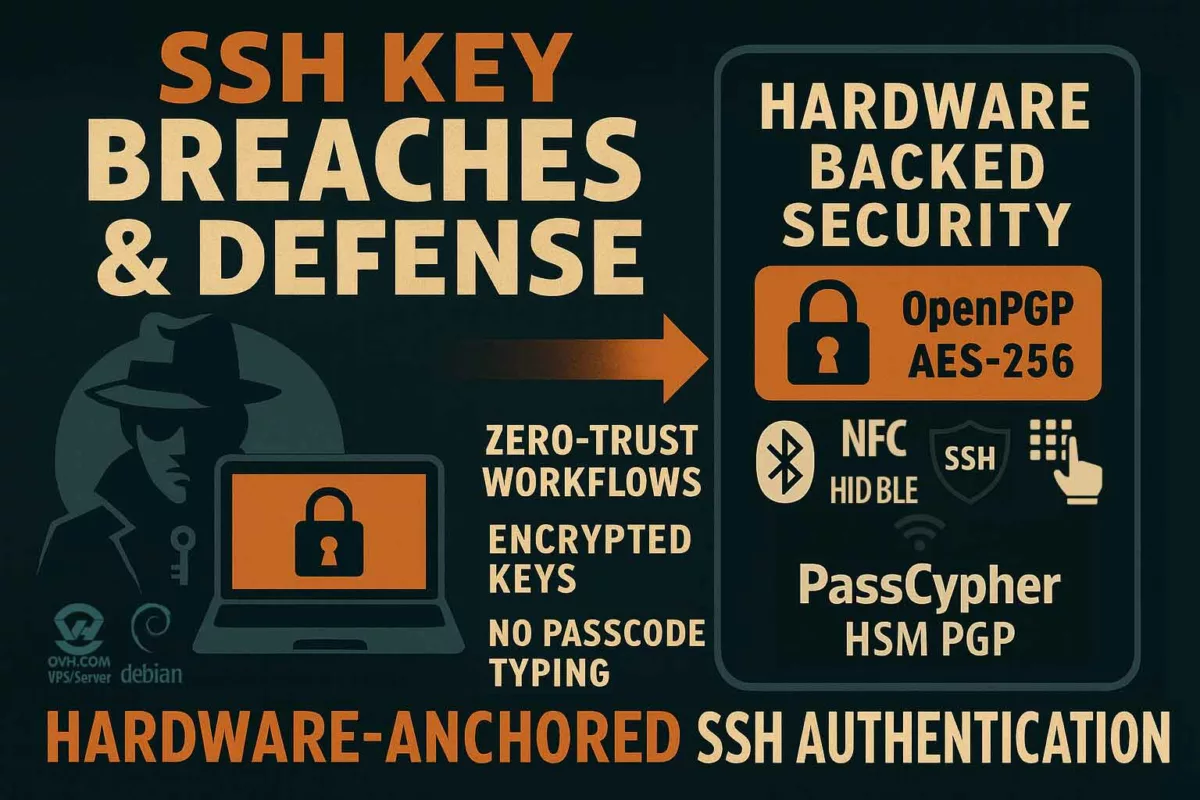
Sovereign SSH Authentication with PassCypher HSM PGP — Zero Key in Clear

2025 Digital Security Tech Fixes Security Solutions Technical News

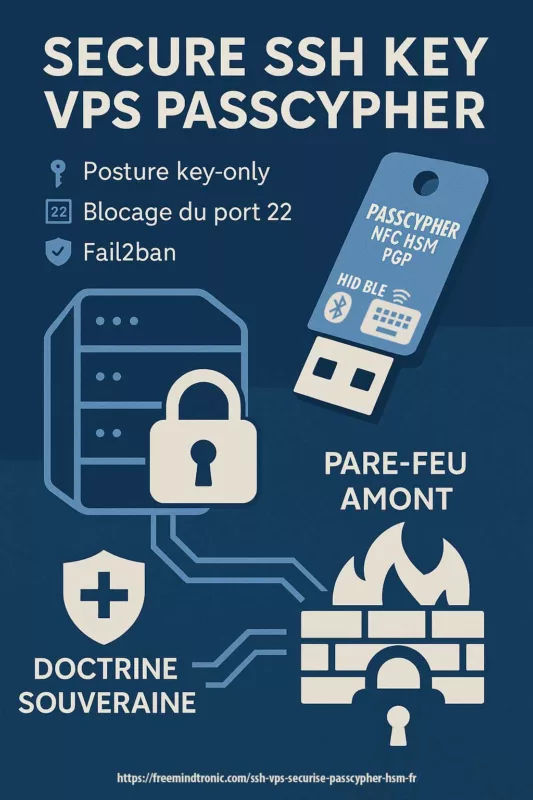
SSH Key PassCypher HSM PGP — Sécuriser l’accès multi-OS à un VPS

2025 Digital Security Technical News

Générateur de mots de passe souverain – PassCypher Secure Passgen WP

2025 Digital Security Technical News

Quantum computer 6100 qubits ⮞ Historic 2025 breakthrough

2025 Digital Security Technical News

Ordinateur quantique 6100 qubits ⮞ La percée historique 2025

2025 Tech Fixes Security Solutions Technical News

SSH VPS Sécurisé avec PassCypher HSM

2025 PassCypher Password Products Technical News

Passwordless Password Manager: Secure, One-Click Simplicity to Redefine Access

Stay informed with our posts dedicated to Cyberculture to track its evolution through our regularly updated topics.

ANSSI cryptography authorization, authored by Jacques Gascuel, CEO of Freemindtronic, provides a detailed overview of the regulatory framework governing cryptographic products. This guide addresses the essential steps for compliance, including how to fill out the necessary forms, meet deadlines, and provide the required documentation. Stay informed on these critical updates and more through our tech solutions.

Complete Guide: Declaration and Application for Authorization for Cryptographic Means

In France, the import, export, supply, and transfer of cryptographic products are strictly regulated by Decree n°2007-663 of 2 May 2007. This decree sets the rules to ensure that operations comply with national and European standards. At the same time, EU Regulation 2021/821 imposes additional controls on dual-use items, including cryptographic products.

This guide explains in detail the steps to correctly fill in the declaration or authorization request form, as well as the deadlines and documents to be provided to comply with the ANSSI cryptography authorization requirements.

Download the XDA Form

Click this link to Download the declaration and authorization application form

Regulatory Framework: Decree No. 2007-663 and Regulation (EU) 2021/821

Decree No. 2007-663 of 2 May 2007 regulates all operations related to the import, export, supply, and transfer of cryptographic means. It clearly sets out the conditions under which these operations may be carried out in France by defining declaration and authorization regimes. To consult the decree, click this link: Decree n°2007-663 of 2 May 2007.

At the European level, Regulation (EU) 2021/821 concerns dual-use items, including cryptographic products. This regulation imposes strict controls on these products to prevent their misuse for military or criminal purposes. To view the regulation, click this link: Regulation (EU) 2021/821.

By following these guidelines, you can ensure that your operations comply with both national and European standards for cryptographic products. If you need further assistance or have any questions, feel free to reach out!

Fill out the XDA PDF Form

The official form must be completed and sent in two copies to the ANSSI. It is essential to follow the instructions carefully and to tick the appropriate boxes according to the desired operations (declaration, application for authorisation or renewal).

Address for submitting forms

French National Agency for the Security of Information Systems (ANSSI)Regulatory Controls Office51, boulevard de La Tour-Maubourg75700 PARIS 07 SP.

Contact:

  • Phone: +33 (0)1 71 75 82 75
  • Email: controle@ssi.gouv.fr

This form allows several procedures to be carried out according to Chapters II and III of the decree.
You can download the official form by following this PDF link.

  • Declaration of supply, transfer, import or export from or to the European Union or third countries.
  • Application for authorization or renewal of authorization for similar operations.

Paperless submission: new simplified procedure

Since 13 September 2022, an electronic submission procedure has been put in place to simplify the formalities. You can now submit your declarations and authorisation requests by email. Here are the detailed steps:

Steps to submit an online application:

  1. Email address: Send your request to controle@ssi.gouv.fr.
  2. Subject of the email: [formalities] Name of your company – Name of the product. Important: The object must follow this format without modification.
  3. Documents to be attached:
    • Completed form  (electronic version).
    • Scanned  and signed form.
    • All required attachments (accepted formats: .pdf, .xls, .doc).
  4. Large file management: If the size of the attachments exceeds 10 MB, divide your mailing into several emails according to the following nomenclature:
    • [Formalities] Name of your company – Product name – Part 1/x
    • [Formalities] Your Company Name – Product Name – Part 2/x

1. Choice of formalities to be carried out

The form offers different boxes to tick, depending on the formalities you wish to complete:

  • Reporting and Requesting Authorization for Any Cryptographic Medium Operation: By ticking this box, you submit a declaration for all supply, transfer, import or export operations, whether inside or outside the European Union. This covers all types of operations mentioned in the decree.
  • Declaration of supply, transfer from or to a Member State of the European Union, import and export to a State not belonging to the European Union of a means of cryptology: Use this box if you are submitting only a simple declaration without requesting authorisation for the operations provided for in Chapter II of the Decree.
  • Application for authorisation to transfer a cryptographic method to a Member State of the European Union and export to a State that does not belong to the European Union: This box is specific to operations that require prior authorisation, pursuant to Chapter III of the Decree.
  • Renewal of authorisation for the transfer to a Member State of the European Union and for the export of a means of cryptology: If you already have an authorization for certain operations and want to renew it, you will need to check this box.

1.1 Time Limits for Review and Notification of Decisions

This section should begin by explaining the time limits for the processing of applications or declarations based on the operation being conducted. Each subsequent point must address a specific formal procedure in the order listed in your request.

1.1.1 Declaration and Application for Authorization of Any Transaction Relating to a Means of Cryptology

This relates to general declarations for any cryptographic operation, whether it involves supply, transfer, import, or export of cryptographic means.

  • Examination Period: ANSSI will review the declaration or application for 1 month (extended to 2 months for cryptographic services or export to non-EU countries).
  • Result: If the declaration is compliant, ANSSI issues a certificate.
  • In Case of Silence: You may proceed with your operation and request a certificate confirming that the declaration was received if no response is provided within the specified time frame.

1.1.2 Declaration of Supply, Transfer, Import, and Export to Non-EU Countries of a Means of Cryptology

This section involves simple declarations of cryptographic means being supplied, transferred within the EU, imported, or exported outside the EU.

  • Examination Period: For supply, transfer, import, or export operations, ANSSI has 1 month to review the file. For services or exports outside the EU, the review period is 2 months.
  • Result: ANSSI will issue a certificate if the file is compliant.
  • In Case of Silence: After the deadlines have passed, you may proceed and request a certificate confirming compliance.

1.1.3 Application for Authorization to Transfer Cryptographic Means within the EU and Export to Non-EU Countries

This applies to requests for prior authorization required for transferring cryptographic means within the EU or exporting them to non-EU countries.

  • Examination Period: ANSSI will examine the application for authorization within 2 months.
  • Notification of Decision: The Prime Minister will make a final decision within 4 months.
  • In Case of Silence: If no response is provided, you receive implicit authorization valid for 1 year. You can also request a certificate confirming this authorization.

1.1.4 Application for Renewal of Authorization for Transfer within the EU and Export of Cryptographic Means

This relates to renewing an existing authorization for the transfer of cryptographic means.

  • Review Period: ANSSI will review the renewal application within 2 months.
  • Notification of Decision: The Prime Minister will issue a decision within 4 months.
  • In Case of Silence: If no decision is made, an implicit authorization valid for 1 year is granted. You can request a formal certificate to confirm this authorization.

1.1.5 Example Response from ANSSI for Cryptography Authorization Requests

When you submit a declaration or request for authorization, ANSSI typically provides a confirmation of receipt, which includes:

  • Subject: Confirmation of Receipt for Cryptography Declaration/Authorization
  • Date and Time of Submission: For example, “Monday 23 October 2022 13:15:13.”

The response confirms that ANSSI has received the request and outlines the next steps for review.

A: Information on the Registrant and/or Applicant, Person in charge of the administrative file and Person in charge of the technical elements.

This section must be filled in with the information of the declarant or applicant, whether it is a legal person (company, association) or a natural person. You should include information such as:

  • The name and address of the entity or individual.
  • Company name and SIRET number for companies.
  • Contact details of the person responsible for the administrative file and the person in charge of the technical aspects of the cryptology product.

Person in charge of technical aspects: This person is the direct contact with the ANSSI for technical questions relating to the means of cryptology.

B: Cryptographic Medium to which the Declaration and/or Application for Authorization Applies

This part concerns the technical information of the cryptology product:

B.2.1 Classify the medium into the corresponding category(ies)

You must indicate whether the product is hardware, software, or both, and specify its primary role (e.g., information security, network, etc.).

B.2.2 General description of the means

The technical part of the form requires a specific description of the cryptographic means. You will need to provide information such as:

  • Generic name of the medium (photocopier, telephone, antivirus software, etc.).
  • Brand, trade number, and product version .
  • Manufacturer and date of release.

Comments in the form:

  • The cryptographic means must identify the final product to be reported (not its subsets).
  • Functional description: Describe the use of the medium (e.g., secure storage, encrypted transmission).

B.2.3 Indicate which category the main function of the means (tick) relates to

  • Information security (means of encryption, cryptographic library, etc.)
  • Computer (operating system, server, virtualization software, etc.)
  • Sending, storing, receiving information (communication terminal, communication software,
  • management, etc.)
  • Network (monitoring software, router, base station, etc.)
  • If yes, specify:

B.3. Technical description of the cryptology services provided

B.3.2. Indicate which category(ies) the cryptographic function(s) of the means to be ticked refers to:

  • Authentification
  • Integrity
  • Confidentiality
  • Signature

B.3.3. Indicate the secure protocol(s) used by:

  • IPsec
  • SSH
  • VoIP-related protocols (such as SIP/RTP)
  • SSL/TLS
  • If yes, specify:

Comments in the form:

  • Cryptographic functionality: Specify how the product encrypts data (e.g., protection of files, messages, etc.).
  • Algorithms: List the algorithms and how they are used. For example, AES in CBC mode with a 256-bit key for data encryption.

B.3.4. Specify the cryptographic algorithms used and their maximum key lengths:

Table to be filled in: Algorithm / Mode / Associated key size / Function

This section requires detailing the cryptographic services that the product offers:

  • Secure protocol (SSL/TLS, IPsec, SSH, etc.).
  • Algorithms used and key size (RSA 2048, AES 256, etc.).
  • Encryption mode (CBC, CTR, CFB).

C: Case of a cryptographic device falling within category 3 of Annex 2 to Decree No. 2007-663 of 2 May 2007

This section must be completed if your product falls under category 3 of Annex 2 of the decree, i.e. cryptographic means marketed on the consumer market. You must provide specific explanations about:

  • Present the method of marketing the means of cryptology and the market for which it is intended
  • Explain why the cryptographic functionality of the medium cannot be easily changed by the user
  • Explain how the installation of the means does not require significant subsequent assistance from the supplier

D: Renewal of transfer or export authorization

If you are applying for the renewal of an existing authorisation, you must mention the references of the previous authorisation, including the file number, the authorisation number and the date of issue.

E: Attachments (check the boxes for the attachments)

To complete your file, you must provide a set of supporting documents, including:

  • General document presenting the company (electronic format preferred)
  • extract K bis from the Trade and Companies Register dated less than three months (or a
  • equivalent document for companies incorporated under foreign law)
  • Cryptographic Medium Commercial Brochure (electronic format preferred)
  • Technical brochure of the means of cryptology (electronic format preferred)
  • User manual (if available) (electronic format preferred)
  • Administrator Guide (if available) (electronic format preferred)

All of these documents must be submitted in accepted electronic formats, such as .pdf, .xls, or .doc.

F: Attestation

The person representing the notifier or applicant must sign and attest that the information provided in the form and attachments is accurate. In the event of a false declaration, the applicant is liable to sanctions in accordance with Articles 34 and 35 of Law No. 2004-575 on confidence in the digital economy.

G: Elements and technical characteristics to be communicated at the request of the national agency for the security of information systems (preferably to be provided in electronic format)

In addition, the ANSSI may request additional technical information to evaluate the cryptology product, such as:

  1. The elements necessary to implement the means of cryptology:
  2. two copies of the cryptographic medium;
  3. the installation guides of the medium;
  4. devices for activating the medium, if applicable (license number, activation number, hardware device, etc.);
  5. key injection or network activation devices, if applicable.
  6. The elements relating to the protection of the encryption process, namely the description of the measures

Techniques used to prevent tampering with encryption or management associated keys.

  1. Elements relating to data processing:
  2. the description of the pre-processing of the clear data before it is encrypted (compression, formatting, adding a header, etc.);
  3. the description of the post-processing of the encrypted data, after it has been encrypted (adding a header, formatting, packaging, etc.);
  4. three reference outputs of the means, in electronic format, made from a clear text and an arbitrarily chosen key, which will also be provided, in order to verify the implementation of the means in relation to its description.
  5. Elements relating to the design of the means of cryptology:
  6. the source code of the medium and the elements allowing a recompilation of the source code or the references of the associated compilers;
  7. the part numbers of the components incorporating the cryptology functions of the medium and the names of the manufacturers of each of these components;
  8. the cryptology functions implemented by each of these components;
  9. the technical documentation of the component(s) performing the cryptology functions;
  10. the types of memories (flash, ROM, EPROM, etc.) in which the cryptographic functions and parameters are stored as well as the references of these memories.

Validity and Renewal of ANSSI Cryptography Authorization

When ANSSI grants an authorization for cryptographic operations, it comes with a limited validity period. For operations that require explicit authorization, such as the transfer of cryptographic means within the EU or exports outside the EU, the certificate of authorization issued by ANSSI is valid for one year if no express decision is made within the given timeframe.

The renewal process must be initiated before the expiry of the certificate. ANSSI will review the completeness of the application within two months, and the decision is issued within four months. If ANSSI remains silent, implicit authorization is granted, which is again valid for a period of one year. This renewal ensures that your cryptographic operations remain compliant with the regulations established by Decree n°2007-663 and EU Regulation 2021/821, avoiding any legal or operational disruptions.

For further details on how to initiate a renewal or first-time application, refer to the official ANSSI process, ensuring all deadlines are respected for uninterrupted operations.

Legal Framework for Cryptographic Means: Key Requirements Under Decree No. 2007-663

Understanding the legal implications of Decree No. 2007-663 is crucial for any business engaged in cryptology-related operations, such as the import, export, or transfer of cryptographic products. This section outlines the legal framework governing declarations, authorizations, and specific cases for cryptographic means. Let’s delve into the essential points:

1. Formalities Under Chapters II and III of Decree No. 2007-663

Decree No. 2007-663 distinguishes between two regulatory regimes—declaration and authorization—depending on the nature of the cryptographic operation. These formalities aim to safeguard national security by ensuring cryptographic means are not misused.

  • Chapter II: Declaration Regime
    This section requires businesses to notify the relevant authorities, particularly ANSSI, when cryptographic products are supplied, transferred, imported, or exported. For example, when transferring cryptographic software within the European Union, companies must submit a declaration to ANSSI. This formality ensures that the movement of cryptographic products adheres to ANSSI cryptography authorization protocols. The primary goal is to regulate the flow of cryptographic tools and prevent unauthorized or illegal uses.
  • Chapter III: Authorization Regime
    Operations involving cryptographic means that pose higher security risks, especially when exporting to non-EU countries, require explicit authorization from ANSSI. The export of cryptographic products, such as encryption software, outside the European Union is subject to strict scrutiny. In these cases, companies must obtain ANSSI cryptography authorization, which evaluates potential risks before granting permission. Failure to secure this authorization could result in significant legal consequences, such as operational delays or penalties.

2. Request for Authorization or Renewal

If your operations involve cryptographic means that require prior approval, the Decree mandates that you apply for authorization or renewal. This is particularly relevant for:

  • Transfers within the EU: Even though the product remains within the European Union, if the cryptographic tool is sensitive, an authorization request must be submitted. This helps mitigate risks associated with misuse or unauthorized access to encrypted data.
  • Exports outside the EU: Exporting cryptographic means to non-EU countries is subject to even stricter controls. Businesses must renew their authorization periodically to ensure that all their ongoing operations remain legally compliant. This step is non-negotiable for companies dealing with dual-use items, as defined by EU Regulation 2021/821.

3. Category 3 Cryptographic Means (Annex 2)

Category 3 cryptographic means, outlined in Annex 2 of the Decree, apply to consumer-facing products that are less complex but still critical for security. These are often products marketed to the general public and must meet specific criteria:

  • Unmodifiable by End-Users: Cryptographic products under Category 3 must not be easily altered by end-users. This ensures the integrity of the product’s security features.
  • Limited Supplier Involvement: These products should be user-friendly, not requiring extensive assistance from the supplier for installation or continued use.

An example of a Category 3 product might be a mobile application that offers end-to-end encryption, ensuring ease of use for consumers while adhering to strict cryptographic security protocols.

Regulatory Framework and Implications

Decree No. 2007-663, alongside EU Regulation 2021/821, sets the groundwork for regulating cryptographic means in France and the broader European Union. Businesses must comply with these regulations, ensuring they declare or obtain the proper ANSSI cryptography authorization for all cryptographic operations. Compliance with these legal frameworks is non-negotiable, as they help prevent the misuse of cryptographic products for malicious purposes, such as espionage or terrorism.

Displaying ANSSI Cryptography Authorization: Transparency and Trust

Publicly showcasing your ANSSI cryptography authorization not only demonstrates regulatory compliance but also strengthens your business’s credibility. In fact, there are no legal restrictions preventing companies from making their authorization certificates visible. By displaying this certification, you reinforce transparency and trustworthiness, especially when dealing with clients or partners who prioritize data security and regulatory adherence.

Moreover, doing so can provide a competitive edge. Customers and stakeholders are reassured by visible compliance with both French and European standards, including Decree No. 2007-663 and EU Regulation 2021/821. Displaying this certificate prominently, whether on your website or in official communications, signals your business’s proactive stance on cybersecurity.

Final Steps to Ensure Compliance

Now that you understand the steps involved in ANSSI cryptography authorization, you are better equipped to meet the regulatory requirements for importing and exporting cryptographic means. By diligently completing the necessary forms, submitting the required documentation, and adhering to the outlined deadlines, you can streamline your operations and avoid potential delays or penalties. Moreover, by staying up-to-date with both French and European regulations, such as Decree No. 2007-663 and EU Regulation 2021/821, your business will maintain full compliance.

For any additional guidance, don’t hesitate to reach out to the ANSSI team or explore their resources further on their official website. By taking these proactive steps, you can ensure that your cryptographic operations remain fully compliant and seamlessly integrated into global standards.

New Microsoft Uninstallable Recall: Enhanced Security at Its Core

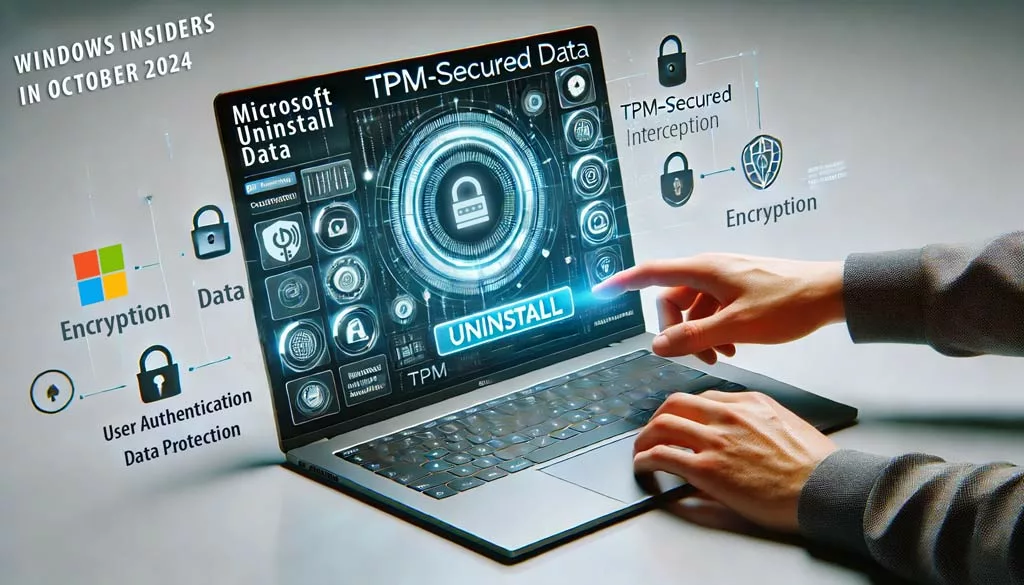
laptop displaying Microsoft Uninstallable Recall feature, highlighting TPM-secured data and uninstall option, with a user's hand interacting, on a white background.

Unveil Microsoft’s Enhanced Uninstallable Recall for Total Data Security

Microsoft Uninstallable Recall: Learn how Microsoft has significantly upgraded the security of its Recall activity journal, now featuring an easy-to-use uninstall option and protection through a secure enclave with stronger authentication. Read the full article to explore these advanced security features and improvements.

2025 Digital Security Technical News

Sovereign SSH Authentication with PassCypher HSM PGP — Zero Key in Clear

2025 Digital Security Tech Fixes Security Solutions Technical News

SSH Key PassCypher HSM PGP — Sécuriser l’accès multi-OS à un VPS

2025 Digital Security Technical News

Générateur de mots de passe souverain – PassCypher Secure Passgen WP

2025 Digital Security Technical News

Quantum computer 6100 qubits ⮞ Historic 2025 breakthrough

2025 Digital Security Technical News

Ordinateur quantique 6100 qubits ⮞ La percée historique 2025

2025 Tech Fixes Security Solutions Technical News

SSH VPS Sécurisé avec PassCypher HSM

2025 PassCypher Password Products Technical News

Passwordless Password Manager: Secure, One-Click Simplicity to Redefine Access

Stay informed with our posts dedicated to Technical News to track its evolution through our regularly updated topics.

Microsoft’s Uninstallable Recall, written by Jacques Gascuel, CEO of Freemindtronic, fixes earlier security issues by processing data in a TPM-secured enclave and giving users complete control over data. You can uninstall Recall easily, wiping all data for enhanced privacy. Stay informed on these security updates and more in our tech solutions.

Microsoft’s Revamped Recall System

Microsoft recently overhauled its Recall feature, which had faced criticism for security and privacy issues. The new version delivers enhanced protection and better control over personal data, responding directly to concerns raised by users and privacy experts.

Key Features of Microsoft’s New Uninstallable Recall

Recall is an activity journal that allows users to retrieve information based on past actions, utilizing AI-analyzed screenshots. In its first iteration, the tool faced backlash because data was stored insecurely, making it easily accessible to others sharing the same device.

Microsoft responded by overhauling the architecture of Recall. Now, all data processing occurs within a Trusted Platform Module (TPM)-protected secure enclave. Access to information requires Windows Hello authentication or a PIN, ensuring that only authorized users can unlock the encrypted data.

Enhanced Data Protection with Microsoft’s Uninstallable Recall

Microsoft significantly improved the security architecture of Recall. All data is now encrypted and stored within the TPM chip, and multi-factor authentication further protects user information. Recent updates to Recall ensure that sensitive information is automatically filtered out, including passwords, personal identification numbers, and credit card details.

These changes align with the security mechanisms found in BitLocker, which also uses TPM to safeguard encryption keys. Freemindtronic has noted the similarities between Recall and BitLocker’s multi-layer encryption and user-focused security enhancements.

How to Enable and Remove Microsoft’s New Recall

With the updated Uninstallable Recall, Microsoft gives users full control over the feature. Recall is opt-in—it remains off unless activated by the user, and it can be uninstalled easily at any time. Microsoft has confirmed that when Recall is uninstalled, all related data is permanently deleted, further addressing privacy concerns.

Additional Security Measures

Microsoft also introduced several improvements to Recall, including:

  • Private browsing compatibility: Users can now prevent Recall from saving sessions during private browsing.
  • Sensitive content filtering: By default, Recall filters out sensitive data such as passwords and personal details.
  • Custom permissions: Users can choose what data Recall tracks and restrict it to specific apps or activities.

These updates reflect Microsoft’s commitment to providing robust data protection, and as seen in similar tools like BitLocker, Microsoft emphasizes TPM-based encryption to secure user data​. Freemindtronic highlighted that BitLocker uses multi-layer encryption and TPM to secure sensitive information from unauthorized access​.

Business and Consumer Advantages of Microsoft’s Enhanced Recall

These enhancements have significant implications for both businesses and individual users. Companies can benefit from the enhanced data protection, especially when managing sensitive information across multiple devices. Users working in shared environments can rest assured knowing their personal data is encrypted and secured, even if the device is shared.

Moreover, this follows a pattern of Microsoft’s continuous security efforts, as seen in the resolution of BitLocker access issues caused by a faulty Crowdstrike update. The incident demonstrated the importance of robust encryption and key management tools like PassCypher NFC HSM.

Availability of the Uninstallable Recall Feature

The new Recall feature will be available to Windows Insiders in October 2024. It is integrated with Copilot+ PCs, designed to provide comprehensive security without sacrificing usability​.

Why Microsoft’s Recall Is a Step Forward in Data Security

With the Uninstallable Recall, Microsoft demonstrates its commitment to developing tools that balance user privacy and productivity. The integration of TPM-encrypted data storage, biometric authentication, and flexible permissions makes Recall one of the most secure data management systems available today, alongside established solutions like BitLocker.

Digital Authentication Security: Protecting Data in the Modern World

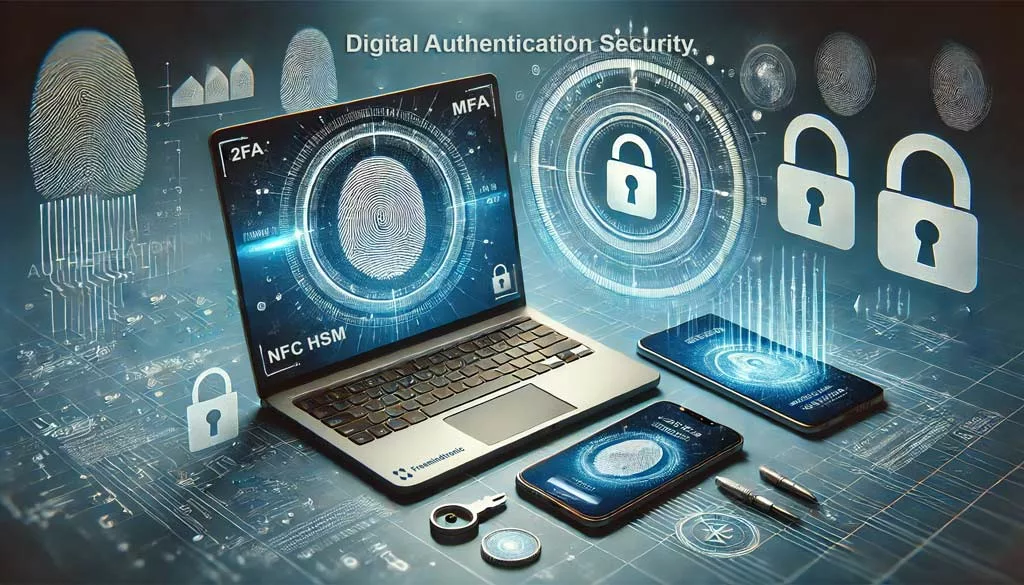
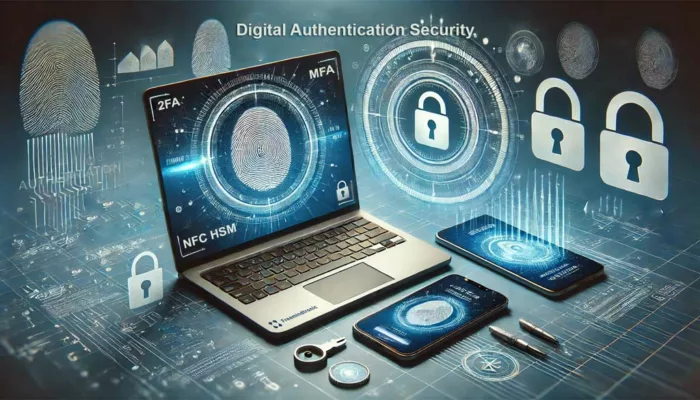
Digital Authentication Security showing a laptop and smartphone with biometric login, two-factor authentication, and security keys on a bright white background.

Digital Authentication Security by Jacques gascuel This article will be updated with any new information on the topic, and readers are encouraged to leave comments or contact the author with any suggestions or additions.  

How Digital Authentication Security Shields Our Data

Digital authentication security is essential in today’s connected world. Whether accessing bank accounts, social media, or work emails, authentication ensures that only authorized individuals can access sensitive information. With the growing sophistication of cyberattacks, securing our identity online has become critical. This article will explore the evolution of authentication methods, from simple passwords to multi-factor authentication, and how these technologies are essential for protecting both personal and professional data.

2025 Cyber Doctrine Cyberculture

Uncodified UK constitution & digital sovereignty

2025 Cyberculture Cybersecurity Digital Security EviLink

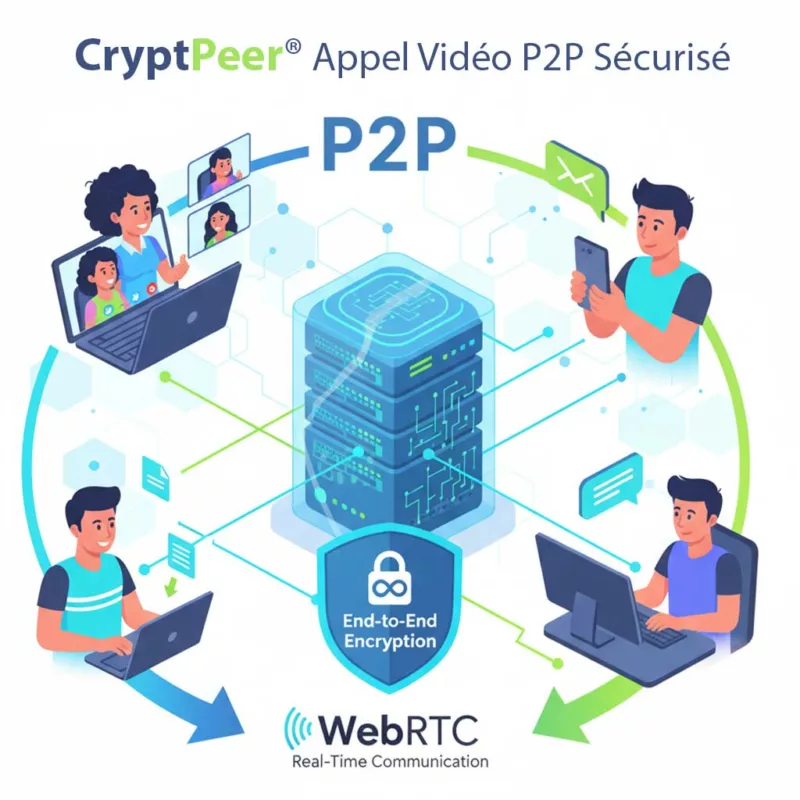
CryptPeer messagerie P2P WebRTC : appels directs chiffrés de bout en bout

2025 Cyber Doctrine Cyberculture

Souveraineté individuelle numérique : fondements et tensions globales

2025 Cyberculture

Louvre Security Weaknesses — ANSSI Audit Fallout

Digital Authentication Security: The Guardian of Our Digital World

In today’s digital life, authentication has become a vital process. Whether you are accessing your bank accounts, social media, or work emails, you are constantly required to prove your identity. But what is authentication exactly, and why has it become so essential in our digital world?

Authentication is the process of verifying a person’s or device’s identity before granting access to specific resources. While often seen as a simple formality, it plays a crucial role in protecting both personal and professional data.

The Stakes of Security

In a world where cyberattacks are becoming increasingly sophisticated and frequent, securing information systems has become a top priority. The consequences of a compromised account can be disastrous—identity theft, fraud, financial loss. The most common threats include phishing, brute force attacks, dictionary attacks, and injection attacks.

To combat these threats, authentication methods have evolved significantly. From the simple password, often considered an easy barrier to breach, we have transitioned to multi-factor authentication systems that are much more robust.

The Evolution of Digital Authentication Security Methods

Over the years, authentication methods have continuously evolved to meet the growing security demands. We have moved from simple password-based authentication, which relies on something you know, to methods that combine several factors:

  • Something you know (password)
  • Something you possess (security key)
  • Something you are (biometrics)

Let’s dive into the various authentication methods, their pros, cons, and applications. We’ll also see how these methods enhance the security of our online accounts and protect our personal data.

Fundamentals of Authentication

Password Authentication: The Historical Pillar

Password authentication is undoubtedly the oldest and most widespread method of verifying a user’s identity. This simple system, which associates a username with a secret password, was long considered enough to secure access to our online accounts.

Advantages:

  • Simplicity: Easy to implement and understand for users.
  • Universality: Used by almost all online services.

Disadvantages:

  • Vulnerability: Passwords can be easily compromised by brute force, dictionary attacks, or phishing.
  • Frequent Forgetfulness: Users tend to forget their passwords or create weak ones for easier memorization.
  • Reuse: Users often reuse the same password across multiple accounts, increasing the risk of data breaches.

Best Practices for Creating Strong Passwords

To enhance the security of your accounts, it is essential to create strong and unique passwords. Here are some tips:

  • Length: A password should ideally be at least 12 characters long.
  • Complexity: Use a combination of uppercase and lowercase letters, numbers, and special characters.
  • Originality: Avoid using easily found personal information (birth dates, family names, etc.).
  • Variety: Use different passwords for each account.

Types of Attacks and How to Protect Yourself

Passwords are regularly targeted by cybercriminals. The main threats include:

  • Brute Force Attacks: The hacker tries all possible character combinations until the correct password is found.
  • Dictionary Attacks: The hacker uses a list of common words or phrases to guess the password.
  • Phishing: The hacker sends fake emails or SMS messages to trick the user into revealing their login credentials.

To protect yourself from these attacks:

  • Use a Password Manager: This tool allows you to generate and store strong, unique passwords securely for all your accounts.
  • Activate Two-Factor Authentication (2FA): This method adds an extra layer of security by requiring an additional verification during login.
  • Be Vigilant About Phishing Attempts: Do not click on suspicious links and always verify the sender’s email address.

Limitations of Password Authentication Alone

Despite following best practices, password authentication has inherent limitations. Passwords can be lost, stolen, or forgotten. Moreover, remembering many complex passwords is challenging for users.

To dive deeper into secure authentication best practices and how to defend against common attacks, refer to the OWASP Authentication Cheat Sheet.

In summary, password authentication has been a pillar of computer security for many years. However, its limitations have become more apparent as threats evolve. It is now necessary to combine passwords with other authentication factors to enhance the security of online accounts.

Now, let’s dive into multi-factor authentication methods that offer more robust protection than passwords alone.

Multi-Factor Authentication (MFA) and Digital Authentication Security

In the previous section, we discussed the limitations of password authentication. To strengthen security, both companies and individuals are increasingly turning to multi-factor authentication methods.

Two-Factor Authentication (2FA)

Two-factor authentication (2FA) is a method that requires the user to provide two distinct proofs of identity to access an account. This approach significantly enhances security by adding an extra layer of protection.

The Principle of 2FA:
2FA relies on combining two different authentication factors. These factors can be:

  • Something you know: The password
  • Something you possess: A mobile phone, security key, or smart card
  • Something you are: A biometric characteristic (fingerprint, facial recognition)

Different Types of 2FA:

  • SMS: A one-time code is sent via SMS to the phone number associated with the account.
  • Authentication Apps: Apps like Google Authenticator or Microsoft Authenticator generate one-time passcodes.
  • Security Keys: Physical devices (USB keys, U2F security keys) that must be inserted into a USB port for login.

Advantages of 2FA for Enhancing Security

Even if an attacker obtains your password, they cannot access your account without the second authentication factor. As a result, 2FA makes brute force and phishing attacks much more difficult.

Multi-Factor Authentication (MFA)

Multi-factor authentication (MFA) is an extension of 2FA. It uses more than two authentication factors to further enhance security.

Difference Between 2FA and MFA:
The primary difference between 2FA and MFA lies in the number of factors used. MFA can combine several factors, such as a password, an authentication app, and a fingerprint.

Common Factor Combinations:

  • Password + SMS Code
  • Password + Security Key
  • Password + Fingerprint
  • Password + Facial Recognition

Advantages of MFA for Strengthening Security

For comprehensive guidelines on implementing multi-factor authentication securely, consult the NIST Multi-Factor Authentication Guide.

MFA offers an even higher level of security than 2FA by making attacks more difficult.

Comparison Between 2FA and MFA

Characteristic 2FA MFA
Number of Factors 2 2 or more
Security More secure than password alone Even more secure than 2FA
Complexity More complex than password alone More complex than 2FA
User Experience Can be less convenient than password alone Can be less convenient than 2FA

Let’s now explore other advanced authentication methods, such as biometric authentication and token-based systems.

Advanced Methods for Digital Authentication Security

Biometric Authentication: The Unique Signature of Each Individual

Biometric authentication is based on the idea that each individual has unique physical or behavioral traits that can serve as identification methods. These characteristics are known as biometric traits.

Different Biometric Technologies:

  • Fingerprints: One of the most common methods, based on analyzing the ridges and valleys on the fingers.
  • Facial Recognition: Uses unique facial features to identify a person.
  • Iris Scans: The iris is a complex and unique structure that can be analyzed for authentication.
  • Voice Recognition: Analyzes vocal characteristics like tone, rhythm, and timbre to identify a person.
  • Hand Geometry: Analyzes hand shape, finger length, and joint position.
  • Dynamic Signature: Analyzes how a person signs their name, including speed, pressure, and angle.

Advantages of Biometrics:

  • Enhanced Security: Biometric traits are hard to falsify or steal.
  • Ease of Use: Biometric authentication is often more convenient than typing a password or PIN.
  • No Forgetfulness: It’s impossible to forget your face or fingerprint.

Disadvantages of Biometrics:

  • Privacy Concerns: Storing and using biometric data raises significant privacy issues.
  • Cost: Implementing biometric authentication systems can be expensive.
  • Vulnerabilities: Although rare, security breaches can allow bypassing of biometric systems.

Security and Privacy Challenges

  • Forgery: Techniques exist to forge biometric data, such as creating molds of fingerprints or using facial masks.
  • Data Protection: Biometric data is considered sensitive information and must be protected from unauthorized access.
  • Consent: Users must give informed consent before collecting and processing their biometric data.

EviOTP NFC HSM: Secure Device-Based Authentication

Another approach to strengthening authentication security involves using secure physical devices. EviOTP NFC HSM is an excellent example of this category. EviOTP NFC HSM technology is embedded in two key products: PassCypher NFC HSM Lite and PassCypher NFC HSM Master, both from Fullsecure Andorra. These products are equipped with quantum security features and are protected by two international invention patents, ensuring cutting-edge protection and international security compliance. These patents ensure a high level of security and protection across borders.This system combines several technologies to offer optimal protection and unmatched flexibility:

  • NFC (Near Field Communication): Users can generate unique OTP codes simply by bringing their smartphone close to an NFC reader.
  • HSM (Hardware Security Module): Cryptographic keys are securely stored in a dedicated hardware module, making software attacks much more difficult.
  • TOTP and HOTP: These algorithms ensure the generation of one-time-use codes, making replay attacks nearly impossible.
  • Advanced Customization: EviOTP NFC HSM allows customization of access to each secret key by adding passwords, fingerprints, geolocation, or other additional authentication factors.
  • Autonomy: This system operates without servers, databases, or the need to create an account, ensuring absolute anonymity and maximum security.

Advantages of EviOTP NFC HSM:

  • Maximum Security: Combining these technologies provides unparalleled security, especially through hardware key protection and customizable access.
  • Ease of Use: NFC technology makes authentication simple and intuitive.
  • Flexibility: This system can be adapted to different environments and easily integrates with many applications.
  • Compliance: EviOTP NFC HSM often meets the strictest security standards, ensuring regulatory compliance.
  • Anonymity and Privacy: Operating without servers or databases ensures user privacy.
  • Versatility: EviOTP NFC HSM allows for the generation of all types of PIN codes, regardless of length.

Protection Against Common Attacks

Phishing is one of the biggest threats to online account security. By generating one-time-use OTP codes directly on the secure device, EviOTP NFC HSM makes these attacks far less effective. Even if a user is tricked into entering credentials on a fake website, the OTP code generated will be invalid a few seconds later. Additionally, storing cryptographic keys in an HSM makes software-based attacks much more difficult. Even if a device is compromised, the keys cannot be extracted.

In summary, EviOTP NFC HSM represents a cutting-edge authentication solution, ideal for organizations seeking maximum security and flexibility. This solution is particularly suited for sectors where data protection is critical, such as banking, healthcare, and industry. EviOTP NFC HSM offers a multi-layered defense that makes attacks extremely difficult, if not impossible, to carry out.

Comparison Table of Authentication Methods

Method Authentication Factors Security Ease of Use Cost Flexibility
Password Something you know Low Very easy Low Very high
PIN Something you know Medium Easy Low Medium
Security Key Something you possess Medium-High Medium Medium Medium
Authenticator Apps Something you possess Medium Medium Low Medium
SMS Something you possess Low Easy Low Medium
Biometrics (fingerprint, facial) Something you are High Very easy Medium-High Medium
EviOTP NFC HSM Something you possess (NFC) Very High Very easy Medium High

Specific Explanations for EviOTP NFC HSM:

  • Very High Security: Thanks to secure key storage in an HSM, dynamic OTP generation, and the ability to customize access with passwords, fingerprints, or geolocation.
  • Very High Ease of Use: NFC technology makes authentication simple and intuitive.
  • Medium Cost: The cost depends on the number of licenses and additional features chosen.
  • High Flexibility: EviOTP NFC HSM can be used in many contexts and adapted to various needs.

Other Advanced Authentication Methods

Token, Certificate, and Smart Card Authentication: Enhanced Security

These authentication methods rely on using physical or digital devices that contain secure identification information.

  • Token Authentication: A token is a small physical device (often USB-sized) that generates one-time-use codes. These codes are used in addition to a password to access an account. Tokens are generally more secure than SMS codes, as they are not vulnerable to interception.
  • Certificate Authentication: A digital certificate is an electronic file that links an identity to a public key. This public key can be used to verify the authenticity of a digital signature or encrypt data. Certificates are often stored on smart cards.
  • Smart Card Authentication: A smart card is a small plastic card with an integrated circuit that can store secure digital information, such as private keys and certificates. Smart cards are widely used in banking and security.

Advantages of These Methods:

  • Enhanced Security: Identification information is stored on a secure physical device, making it harder to compromise.
  • Flexibility: These methods can be used for various applications, from corporate network access to digitally signing documents.
  • Interoperability: Digital certificates are based on open standards, facilitating their interoperability with different systems.

Disadvantages and Challenges:

  • Cost: Implementing an authentication infrastructure based on tokens, certificates, or smart cards can be expensive.
  • Complexity: These methods can be more complex to implement and manage than traditional authentication methods.
  • Loss or Theft: Losing a token or smart card can compromise account security.

Behavioral Authentication

Behavioral authentication analyzes an individual’s habits and behavior to verify their identity. This approach can complement traditional authentication methods.

Principle:
The system analyzes different aspects of the user’s behavior, such as typing speed, dynamic signature, browsing habits, etc. Any significant deviation from usual behavior can trigger an alert.

Advantages:

  • Intrusion Detection: This method can detect suspicious activity, even if the attacker knows the user’s credentials.
  • Adaptation: Behavioral authentication systems can adapt to changes in user behavior.

Disadvantages:

  • False Positives: The system may trigger false alerts if the user’s behavior legitimately changes.
  • Complexity: Implementing behavioral authentication systems can be complex and expensive.

In summary, token, certificate, smart card, and behavioral authentication methods offer high levels of security and can complement traditional methods. The choice of the most suitable authentication method will depend on the specific needs of each organization or individual.

Authentication Protocols

Authentication protocols define a set of standardized rules and procedures for verifying a user’s or system’s identity. They enable secure communication between different systems and applications.

Single Sign-On (SSO): One Access for All

Single Sign-On (SSO) is a protocol that allows a user to log in to multiple applications using a single authentication. Once authenticated, the user does not need to re-enter their credentials to access other applications.

How SSO Works:
During the first login, the user authenticates with an identity provider (IdP). The provider verifies the credentials and issues an authentication token. This token is then sent to the destination application (relying service), which validates it and grants the user access.

SSO Protocols (SAML, OAuth, OpenID Connect):

  • SAML (Security Assertion Markup Language): A standard XML protocol for exchanging authentication information between an identity provider and a relying service.
  • OAuth: An authorization protocol that allows third-party applications to access a user’s resources on another service without needing the user’s credentials.
  • OpenID Connect: An authentication protocol based on OAuth 2.0 that provides an additional identity layer, enabling applications to know the user’s identity.

Advantages of SSO:

  • Improved User Experience: Users only need to enter their credentials once.
  • Increased Productivity: Users can access the applications they need faster.
  • Enhanced Security: SSO centralizes identity and access management, making it easier to implement security policies.

Disadvantages of SSO:

  • Single Point of Failure: If the identity provider is compromised, all connected services may be affected.
  • Complexity: Implementing an SSO system can be complex, especially in heterogeneous environments.

OAuth/OpenID Connect: Third-Party Authentication

OAuth and OpenID Connect are two closely related protocols that allow third-party applications to access a user’s resources on another service.

Principle of Third-Party Authentication:
A user logs into a third-party application (such as Facebook or Google) using existing credentials. The third-party application then requests the user’s permission to access certain information. If the user agrees, the third-party application receives an access token that allows it to access the requested resources.

Differences Between OAuth and OpenID Connect:

  • OAuth focuses on authorization, while OpenID Connect adds an identity layer, allowing applications to know the user’s identity.

Typical Use Cases:

  • Social Login: Logging into an application using Facebook, Google, etc.
  • Mobile App Development: Using authentication services from third-party providers to simplify the login process.

The Stakes of Authentication in the Modern Digital World

Authentication has become a central issue in our digital society. Threats are constantly evolving, regulations are multiplying, and user expectations regarding security are increasing.

Recent Threats

  • Sophisticated Phishing: Phishing attacks are becoming increasingly sophisticated, using social engineering techniques and highly realistic fake websites to deceive users.
  • Password Attacks: Brute force, dictionary, and password-spray attacks remain significant threats.
  • Injection Attacks: Injection attacks (SQL injection, XSS) allow attackers to execute malicious code on servers.
  • Session Hijacking: Attackers can steal session cookies to log into accounts without the legitimate user’s credentials.

Data Security Regulations

Many regulations have been put in place to protect personal data and strengthen information system security. Some of the most well-known include:

  • GDPR (General Data Protection Regulation): This European regulation requires companies to implement appropriate technical and organizational measures to ensure a level of security adapted to the risks.
  • CCPA (California Consumer Privacy Act): This Californian law grants consumers additional rights regarding the protection of their personal data.

Future Trends in Authentication

  • Passwordless Authentication: As passwords are a prime target for attacks, many initiatives aim to replace them with more secure authentication methods like biometrics or security keys.
  • Passkeys: Passkeys are a new authentication technology that allows users to log in to websites and apps without needing to create or remember passwords.
  • Artificial Intelligence: AI can be used to improve fraud detection and personalize the user experience by adapting authentication methods based on context.

Summary of Authentication Methods

Authentication is a constantly evolving field. To combat growing threats, it is essential to adopt strong authentication methods and stay informed about the latest trends.

Summary of Various Methods:
Throughout this article, we’ve seen that many authentication methods exist, each with advantages and disadvantages. The choice of the most appropriate method will depend on factors such as:

  • The required level of security
  • Ease of use
  • Implementation cost
  • Regulatory constraints

Recommendations for Choosing the Most Appropriate Authentication Method

  • Combine Multiple Authentication Factors: Combining multiple factors (something you know, something you possess, something you are) is the most effective way to enhance security.
  • Use Strong Authentication Methods: Prioritize biometric authentication, security keys, and digital certificates.
  • Implement Strict Security Policies: Set clear rules for creating and managing passwords, raising user awareness, and responding to security incidents.
  • Stay Updated on the Latest Threats and Best Practices: Stay informed about the latest security trends and regularly update authentication systems.

Future Challenges in Authentication

The future challenges of authentication are numerous:

  • Balancing Security and Usability: It is essential to find a balance between security and ease of use so that users adopt new authentication methods.
  • Privacy Protection: Biometric authentication methods raise significant privacy concerns.
  • Interoperability: Developing open standards to facilitate interoperability between different authentication systems is necessary.

Building a Future of Resilient Digital Authentication Security

The continuous evolution of threats in the digital landscape demands a proactive approach to Digital Authentication Security. Scientific research consistently highlights the importance of layered security systems, combining various authentication factors to mitigate vulnerabilities. By integrating advanced solutions such as multi-factor authentication (MFA), biometric systems, and hardware-based security like EviOTP NFC HSM, organizations and individuals can significantly reduce their exposure to cyber risks.

Understanding the science behind authentication algorithms, such as the cryptographic protocols securing biometric data or the OTP generation process, is essential for developing robust defenses. As future technologies like quantum computing emerge, the security models we rely on today will need adaptation and reinforcement. Hence, a commitment to ongoing research and technological advancements is crucial for maintaining resilient Digital Authentication Security systems.

Looking forward, the focus must shift toward creating secure, user-friendly authentication frameworks that also respect privacy concerns. This will ensure that as we move deeper into the digital age, our data remains secure without sacrificing convenience. Maintaining vigilance, investing in new technologies, and continuously refining our approaches will be key to staying ahead of the next wave of cyber threats.

Quantum Threats to Encryption: RSA, AES & ECC Defense

Quantum Computing Encryption Threats - Visual Representation of Data Security with Quantum Computers and Encryption Keys.

Quantum Threats to Encryption: RSA, AES, ECC, post-quantum cryptography (PQC), Store Now Decrypt Later exposure, logical qubits, and sovereign segmented encryption under realistic quantum timelines. This Chronicle analyzes when quantum computers could realistically threaten RSA-2048, ECC, and AES-256, why fault-tolerant qubits remain the decisive bottleneck, and how sovereign cybersecurity architectures can reduce long-term exposure before cryptographically relevant quantum systems emerge. It explains the operational limits of Shor’s and Grover’s algorithms, clarifies the migration doctrines promoted by NIST, NSA CNSA 2.0, ENISA, ANSSI, and UK NCSC, and evaluates why hybrid cryptography and segmented key encryption matter now—not after a quantum breakthrough occurs.

Executive summary

Context

Quantum computing has entered a decisive strategic phase. Between 2024 and 2026, announcements from IBM Quantum, Google Quantum AI, Microsoft Quantum, and Chinese sovereign quantum programs intensified public concern regarding Quantum Threats to Encryption. Yet most public narratives confuse:

  • experimental qubit demonstrations,
  • marketing announcements,
  • real cryptographic capability.

In practice, no current quantum system can operationally break RSA-2048 or AES-256 at industrial scale. However, the strategic issue no longer concerns immediate collapse. The strategic issue concerns:

  • long-term exposure persistence.

Purpose

This Chronicle separates:

  • scientific reality,
  • engineering bottlenecks,
  • geopolitical narratives,
  • operational cybersecurity consequences.

It explains:

  • why RSA and ECC remain structurally vulnerable to Shor’s algorithm,
  • why AES-256 remains highly resilient under Grover’s algorithm,
  • why logical qubits—not raw qubit counts—define real capability,
  • why “Store Now, Decrypt Later” already changes intelligence strategy,
  • why sovereign segmented architectures may become decisive.

Scope

Scope includes:

  • RSA, ECC, AES-256, and PQC exposure models,
  • Shor’s and Grover’s algorithms,
  • logical versus physical qubits,
  • NIST PQC standards and HQC diversification,
  • NSA CNSA 2.0 migration doctrine,
  • Store Now Decrypt Later operational reality,
  • hybrid migration architectures,
  • segmented key encryption doctrine,
  • sovereign cybersecurity implications.

Out of scope:

  • speculative AGI scenarios,
  • classified offensive quantum programs,
  • vendor marketing claims lacking reproducibility.

Design doctrine

This Chronicle treats confidentiality as:

an architectural lifecycle problem,

not merely:

a mathematical problem.

The decisive issue is not:

“Will a quantum computer appear tomorrow?”

The decisive issue is:

“Will encrypted assets intercepted today remain confidential in twenty years?”

Strategic differentiator

Many publications frame post-quantum security as:

  • a migration timeline issue.

This Chronicle frames it differently:

  • as a sovereignty and exposure problem.

Once encrypted archives, PKI chains, identity systems, diplomatic traffic, and strategic communications are harvested at scale:

  • future decryption becomes irreversible.

Technical note

Express reading time: ≈ 3–4 minutes
Advanced reading time: ≈ 5–6 minutes
Full Chronicle: ≈ 35–40 minutes
Publication date: 2026-05-14
Level: Quantum Security / Cryptography / Sovereign Cybersecurity
Posture: Migration-aware, hybrid-PQC, sovereignty-oriented
Category: Digital Security
Available languages: EN · FR · CAT · ES
Impact level: 9.5 / 10 — long-tail cryptographic sovereignty risk

Editorial note — This Chronicle belongs to Digital Security. It extends Freemindtronic’s doctrine regarding:

  • sovereign encryption,
  • offline cybersecurity architectures,
  • segmented key management,
  • post-quantum resilience.

The issue addressed is not:

  • immediate decryption collapse.

The issue addressed is:

  • future retrospective exposure.

Specifically, this Chronicle documents why:

  • Store Now, Decrypt Later strategies already transform intelligence collection doctrine long before practical quantum attacks become operational.

It also explains why:

  • hybrid migration alone may prove insufficient if exposure persistence remains uncontrolled.

This work continues Freemindtronic publications regarding:

  • cyber sovereignty,
  • segmented encryption doctrine,
  • AI-assisted cyber exposure,
  • minimal-observability architectures.

Key takeaway

Quantum threats to encryption are real. However:

  • practical cryptographic collapse remains constrained by fault-tolerant engineering, coherence stability, logical qubit scalability, and energy cost.

RSA and ECC face long-term structural exposure under Shor’s algorithm. AES-256 remains strategically resilient under Grover’s algorithm, especially when reinforced through:

  • offline architectures,
  • segmented key encryption,
  • minimal metadata exposure,
  • hybrid post-quantum migration.

The strategic mistake is neither panic nor denial. The strategic mistake is waiting too long before reducing long-term exposure.

2024 2025 Cyber Doctrine Cyberculture

Quantum Threats to Encryption: RSA, AES & ECC Defense

2026 Cyber Doctrine Digital Security

Whisper Leak side-channel and LLM token leakage

2025 Cyber Doctrine Cyberculture

Souveraineté individuelle numérique : fondements et tensions globales

2024 Cyber Doctrine Cyberculture

Digital Authentication Security: Protecting Data in the Modern World

2025 Cyber Doctrine Cyberculture

Time Spent on Authentication: Detailed and Analytical Overview

2025 Cyber Doctrine Cyberculture

Sovereign Passwordless Authentication — Quantum-Resilient Security

2024 Cyber Doctrine Cyberculture Legal information

ANSSI Cryptography Authorization: Complete Declaration Guide

Articles Cyber Doctrine EviCore NFC HSM Technology legal News Training

Dual-Use Encryption Products: a regulated trade for security and human rights

2024 Cyber Doctrine Cyberculture

ITAR Dual-Use Encryption: Navigating Compliance in Cryptography

2024 Cyber Doctrine Cyberculture

Encryption Dual-Use Regulation under EU Law

2025 Cyber Doctrine Cyberculture

Uncodified UK constitution & digital sovereignty

2026 Cyber Doctrine

Zero-knowledge governance 2026: cryptographic floors

Advanced summary — how real are quantum threats in 2026?

Quantum threats to encryption are simultaneously:

  • real,
  • misunderstood,
  • strategically uneven.

Public debate often oscillates between:

  • apocalyptic narratives,
  • dismissive skepticism.

Both positions distort reality.

Shor’s algorithm genuinely threatens:

  • RSA,
  • ECC,
  • Diffie-Hellman,
  • traditional PKI ecosystems.

Mathematically, the danger is not speculative.

Under sufficiently large fault-tolerant universal quantum systems:

Integer factorization → polynomial-time solvable

This fundamentally changes asymmetric cryptography.

However, the engineering challenge remains immense.

Real-world cryptographic attacks require:

  • stable logical qubits,
  • massive error correction,
  • long-duration coherence,
  • industrial-scale cryogenic infrastructure.

This is why timelines continue shifting.

By contrast, AES-256 behaves differently under quantum pressure.

Grover’s algorithm does not “break” AES mathematically.

Instead, it reduces brute-force complexity approximately from:

2²⁵⁶ → 2¹²⁸

Even after that reduction:

  • AES-256 remains operationally prohibitive to attack.

This distinction is critical.

The timeline shift — why quantum predictions keep moving

For more than three decades, quantum computing lived inside a paradox.

Physicists understood the mathematics. Cryptographers understood the implications. Intelligence agencies understood the strategic consequences. Yet industry lacked the engineering capability required to transform theoretical quantum computation into operational cryptanalytic power.

That distinction still defines the entire debate surrounding Quantum Threats to Encryption.

In 1994, Peter Shor introduced an algorithm capable of changing modern cryptography forever. At the time, the discovery appeared almost abstract because no quantum computer could execute it at meaningful scale. Classical encryption continued to dominate global infrastructure without immediate disruption.

Three decades later, the mathematics remains unchanged.

What changed is the geopolitical urgency surrounding its possible implementation.

When IBM Quantum published successive fault-tolerant roadmaps, public attention focused primarily on raw qubit counts. Shortly afterward, Google Quantum AI shifted the conversation toward logical qubits, coherence duration, and quantum error correction. Meanwhile, Microsoft Quantum pursued a radically different strategy through Majorana-based topological qubits designed to reduce fault-correction overhead itself.

At the same time, China accelerated sovereign deployment through hybrid quantum-secure infrastructure combining:

  • quantum communication networks,
  • state-operated telecom systems,
  • post-quantum cryptography,
  • centralized infrastructure governance.

The quantum race therefore evolved into something far more complex than a scientific competition.

It became:

  • a sovereignty race,
  • a cybersecurity race,
  • an infrastructure race,
  • and increasingly, an intelligence race.

Strategic inflection point

The quantum transition did not begin when quantum computers became operationally dangerous.

It began when governments, standards agencies, and critical infrastructures started behaving as if post-quantum migration had already become inevitable.

That psychological threshold may ultimately matter more than the first practical quantum attack itself.

Yet despite accelerating announcements, practical cryptographic collapse remains constrained by one decisive bottleneck:
fault-tolerant scalability.

The challenge is no longer proving that quantum mechanics works computationally.

The challenge is sustaining stable quantum operations long enough to execute cryptographically relevant workloads under industrial conditions.

That requirement introduces simultaneous constraints involving:

  • logical qubit stability,
  • continuous error correction,
  • cryogenic coherence,
  • electromagnetic isolation,
  • and extreme synchronization precision.

Unlike classical processors, quantum systems cannot simply “scale upward” through transistor miniaturization. Every additional layer of error correction introduces energy cost, architectural complexity, and instability amplification.

This explains why quantum timelines constantly shift.

The mathematics behind quantum cryptanalysis already exists.

Industrial fault tolerance does not.

Mathematical perspective — RSA factorization complexity

RSA security fundamentally depends on one deceptively simple relationship:

N = p times q

where p and q are extremely large prime numbers.

Classically, factoring large integers remains computationally prohibitive at sufficient scale. However, Shor’s algorithm theoretically reduces the problem toward polynomial-time complexity under a sufficiently large fault-tolerant quantum computer:

O((log N)^3)

This theoretical transition explains why RSA, ECC, and Diffie-Hellman remain structurally exposed in long-term quantum scenarios.

Craig Gidney and Martin Ekerå significantly reshaped modern cryptographic forecasting when they estimated that practical RSA-2048 factorization would likely require:

  • millions of physical qubits,
  • thousands of stable logical qubits,
  • and sustained coherent execution lasting several hours.

Their work transformed the conversation surrounding “Store Now, Decrypt Later” strategies because it reframed quantum threats as a long-term archival risk rather than an immediate operational collapse.

Read the Gidney & Ekerå quantum resource estimate study.

Why qubit announcements are frequently misunderstood

Public narratives often confuse raw qubit quantity with cryptographic capability.

That interpretation is deeply misleading.

A quantum processor containing several thousand noisy physical qubits does not automatically threaten RSA-2048 or ECC if:

  • error rates remain unstable,
  • logical coherence collapses rapidly,
  • fault correction fails continuously,
  • or Shor’s algorithm cannot execute reliably.

This is precisely why cybersecurity agencies increasingly evaluate quantum announcements according to:

  • logical qubit maturity,
  • coherence stability,
  • fault-tolerant execution capability,
  • and realistic cryptanalytic feasibility.

Error-correction scaling problem

The practical difficulty emerges from quantum error correction itself:

1 logical qubit gg 10^3 – 10^4 physical qubits

This ratio varies according to architecture, coherence quality, and error thresholds. Consequently, public announcements regarding raw physical qubit counts rarely translate into immediate cryptographic capability.

Quantum realism versus quantum marketing

The cybersecurity ecosystem increasingly suffers from a dangerous confusion between:

  • laboratory milestones,
  • commercial positioning,
  • scientific experimentation,
  • and operational cryptographic threat.

Quantum supremacy demonstrations may represent extraordinary scientific achievements without creating immediate cryptanalytic capability against:

  • RSA-2048,
  • ECC infrastructures,
  • AES-256,
  • or sovereign PKI ecosystems.

This distinction matters strategically because fear-driven migration can become as dangerous as delayed migration itself.

Poorly executed post-quantum deployment may:

  • break trust chains,
  • create interoperability failures,
  • fragment infrastructure governance,
  • or introduce immature cryptographic dependencies.

That is why agencies such as:

now promote measured migration strategies centered around:

  • crypto agility,
  • hybrid deployment,
  • inventory visibility,
  • and phased interoperability testing.

⮞ Summary

Quantum progress is real.

Quantum cryptographic collapse remains hypothetical.

The decisive variable is no longer whether quantum computation is scientifically possible.

The decisive variable is whether fault-tolerant quantum systems can sustain stable cryptanalytic execution at industrial scale before defensive migration fundamentally reshapes global cryptographic infrastructure.

The paradox of quantum cybersecurity is therefore profound.

The first practical quantum attack may occur long after institutions already transformed their infrastructures in anticipation of it.

Yet if organizations wait until operational attacks become publicly visible, migration may already be too late for archives harvested decades earlier.

That is why quantum resilience is no longer merely a mathematical discussion.

It has become a doctrine of time, exposure, sovereignty, and irreversible confidentiality preservation.

The timeline shift — why quantum predictions keep moving

For more than three decades, quantum computing lived inside a paradox.

Physicists understood the mathematics. Cryptographers understood the implications. Intelligence agencies understood the strategic consequences. Yet industry lacked the engineering capability required to transform theoretical quantum computation into operational cryptanalytic power.

That distinction still defines the entire debate surrounding Quantum Threats to Encryption.

In 1994, Peter Shor introduced an algorithm capable of changing modern cryptography forever. At the time, the discovery appeared almost abstract because no quantum computer could execute it at meaningful scale. Classical encryption continued to dominate global infrastructure without immediate disruption.

Three decades later, the mathematics remains unchanged.

What changed is the geopolitical urgency surrounding its possible implementation.

When IBM Quantum published successive fault-tolerant roadmaps, public attention focused primarily on raw qubit counts. Shortly afterward, Google Quantum AI shifted the conversation toward logical qubits, coherence duration, and quantum error correction. Meanwhile, Microsoft Quantum pursued a radically different strategy through Majorana-based topological qubits designed to reduce fault-correction overhead itself.

At the same time, China accelerated sovereign deployment through hybrid quantum-secure infrastructure combining:

  • quantum communication networks,
  • state-operated telecom systems,
  • post-quantum cryptography,
  • centralized infrastructure governance.

The quantum race therefore evolved into something far more complex than a scientific competition.

It became:

  • a sovereignty race,
  • a cybersecurity race,
  • an infrastructure race,
  • and increasingly, an intelligence race.

Strategic inflection point

The quantum transition did not begin when quantum computers became operationally dangerous.

It began when governments, standards agencies, and critical infrastructures started behaving as if post-quantum migration had already become inevitable.

That psychological threshold may ultimately matter more than the first practical quantum attack itself.

Yet despite accelerating announcements, practical cryptographic collapse remains constrained by one decisive bottleneck:
fault-tolerant scalability.

The challenge is no longer proving that quantum mechanics works computationally.

The challenge is sustaining stable quantum operations long enough to execute cryptographically relevant workloads under industrial conditions.

That requirement introduces simultaneous constraints involving:

  • logical qubit stability,
  • continuous error correction,
  • cryogenic coherence,
  • electromagnetic isolation,
  • and extreme synchronization precision.

Unlike classical processors, quantum systems cannot simply “scale upward” through transistor miniaturization. Every additional layer of error correction introduces energy cost, architectural complexity, and instability amplification.

This explains why quantum timelines constantly shift.

The mathematics behind quantum cryptanalysis already exists.

Industrial fault tolerance does not.

Mathematical perspective — RSA factorization complexity

RSA security fundamentally depends on one deceptively simple relationship:

N = p times q

where p and q are extremely large prime numbers.

Classically, factoring large integers remains computationally prohibitive at sufficient scale. However, Shor’s algorithm theoretically reduces the problem toward polynomial-time complexity under a sufficiently large fault-tolerant quantum computer:

O((log N)^3)

This theoretical transition explains why RSA, ECC, and Diffie-Hellman remain structurally exposed in long-term quantum scenarios.

Craig Gidney and Martin Ekerå significantly reshaped modern cryptographic forecasting when they estimated that practical RSA-2048 factorization would likely require:

  • millions of physical qubits,
  • thousands of stable logical qubits,
  • and sustained coherent execution lasting several hours.

Their work transformed the conversation surrounding “Store Now, Decrypt Later” strategies because it reframed quantum threats as a long-term archival risk rather than an immediate operational collapse.

Read the Gidney & Ekerå quantum resource estimate study.

Why qubit announcements are frequently misunderstood

Public narratives often confuse raw qubit quantity with cryptographic capability.

That interpretation is deeply misleading.

A quantum processor containing several thousand noisy physical qubits does not automatically threaten RSA-2048 or ECC if:

  • error rates remain unstable,
  • logical coherence collapses rapidly,
  • fault correction fails continuously,
  • or Shor’s algorithm cannot execute reliably.

This is precisely why cybersecurity agencies increasingly evaluate quantum announcements according to:

  • logical qubit maturity,
  • coherence stability,
  • fault-tolerant execution capability,
  • and realistic cryptanalytic feasibility.

Error-correction scaling problem

The practical difficulty emerges from quantum error correction itself:

1 logical qubit gg 10^3 – 10^4 physical qubits

This ratio varies according to architecture, coherence quality, and error thresholds. Consequently, public announcements regarding raw physical qubit counts rarely translate into immediate cryptographic capability.

Quantum realism versus quantum marketing

The cybersecurity ecosystem increasingly suffers from a dangerous confusion between:

  • laboratory milestones,
  • commercial positioning,
  • scientific experimentation,
  • and operational cryptographic threat.

Quantum supremacy demonstrations may represent extraordinary scientific achievements without creating immediate cryptanalytic capability against:

  • RSA-2048,
  • ECC infrastructures,
  • AES-256,
  • or sovereign PKI ecosystems.

This distinction matters strategically because fear-driven migration can become as dangerous as delayed migration itself.

Poorly executed post-quantum deployment may:

  • break trust chains,
  • create interoperability failures,
  • fragment infrastructure governance,
  • or introduce immature cryptographic dependencies.

That is why agencies such as:

now promote measured migration strategies centered around:

  • crypto agility,
  • hybrid deployment,
  • inventory visibility,
  • and phased interoperability testing.

⮞ Summary

Quantum progress is real.

Quantum cryptographic collapse remains hypothetical.

The decisive variable is no longer whether quantum computation is scientifically possible.

The decisive variable is whether fault-tolerant quantum systems can sustain stable cryptanalytic execution at industrial scale before defensive migration fundamentally reshapes global cryptographic infrastructure.

The paradox of quantum cybersecurity is therefore profound.

The first practical quantum attack may occur long after institutions already transformed their infrastructures in anticipation of it.

Yet if organizations wait until operational attacks become publicly visible, migration may already be too late for archives harvested decades earlier.

That is why quantum resilience is no longer merely a mathematical discussion.

It has become a doctrine of time, exposure, sovereignty, and irreversible confidentiality preservation.

Logical versus physical qubits — the engineering wall behind quantum mythology

One of the most damaging misconceptions in mainstream discussions about quantum computing concerns the word itself:
qubit.

Public communication often treats all qubits as equivalent.

They are not.

This confusion profoundly distorts the real state of quantum capability.

When technology headlines announce:

  • 1,000 qubits,
  • 5,000 qubits,
  • or even 10,000 qubits,

many readers instinctively assume that practical cryptographic collapse is approaching.

That interpretation is incorrect.

The overwhelming majority of currently announced qubits remain:

  • noisy,
  • unstable,
  • short-lived,
  • and unsuitable for sustained fault-tolerant cryptographic computation.

The distinction between:

  • physical qubits,
  • and logical qubits

therefore becomes the central reality separating laboratory progress from operational quantum cryptanalysis.

Physical qubits are fragile quantum hardware elements

Physical qubits represent the raw hardware layer of quantum systems.

Depending on the architecture, they may rely on:

  • superconducting circuits,
  • trapped ions,
  • photonic systems,
  • neutral atoms,
  • or experimental topological structures.

Unlike classical bits, qubits suffer from continuous instability.

They are vulnerable to:

  • thermal fluctuations,
  • electromagnetic interference,
  • environmental noise,
  • decoherence,
  • measurement disturbance.

In practice, quantum information decays extremely rapidly unless sophisticated correction mechanisms stabilize the system continuously.

This creates a brutal engineering constraint:
raw qubit quantity alone means very little.

The decoherence problem

Quantum states remain usable only while coherence survives.

Quantum coherence time is typically represented as:

T_2

The longer the coherence time, the longer quantum operations can execute before information collapses into noise.

Cryptographically relevant quantum systems require:

  • long coherence duration,
  • extremely low error rates,
  • continuous stabilization,
  • and synchronized correction.

Without those conditions, Shor’s algorithm cannot execute reliably at operational scale.

Logical qubits are the real strategic resource

Logical qubits are fundamentally different.

A logical qubit is not a single hardware element.

It is a stabilized quantum abstraction created through:

  • massive redundancy,
  • continuous error correction,
  • synchronized control systems,
  • and fault-tolerant computation.

In many projected architectures:

  • hundreds,
  • thousands,
  • or even tens of thousands

of physical qubits may be required to create one stable logical qubit.

This is the hidden reality rarely visible in marketing announcements.

The surface-code correction model

Most current fault-tolerant roadmaps rely heavily on surface-code error correction.

Its objective is simple in principle:
detect quantum errors faster than they accumulate.

The challenge is colossal in practice.

The logical error rate approximately depends on:

  • physical error rate,
  • code distance,
  • measurement fidelity,
  • synchronization precision.

The system must continuously detect and correct errors without destroying the quantum state itself.

That requirement transforms quantum computing into one of the most complex synchronization problems ever attempted in engineering history.

Why fault tolerance changes everything

A quantum computer capable of threatening RSA-2048 is not simply:

  • a larger quantum computer.

It is:

  • a stable,
  • fault-tolerant,
  • energy-sustainable,
  • industrially synchronized quantum infrastructure.

That distinction explains why quantum timelines continue shifting despite continuous progress.

Why millions of qubits may still be insufficient

One of the most frequently misunderstood projections concerns RSA factorization estimates.

Studies from:

  • Craig Gidney,
  • Martin Ekerå,
  • IBM Quantum researchers,
  • Google Quantum AI teams

suggest that practical RSA-2048 attacks may require:

  • millions of physical qubits,
  • thousands of stable logical qubits,
  • hours of coherent computation,
  • continuous fault correction.

This estimate changes the public narrative completely.

The issue is no longer:
“Can quantum computation exist?”

The issue becomes:
“Can industrial-scale fault tolerance exist economically and sustainably?”

That engineering barrier remains unresolved.

Why D-Wave systems do not threaten RSA

Quantum communication frequently confuses:

  • quantum annealers,
  • and universal gate-based quantum computers.

They are not equivalent.

D-Wave systems specialize primarily in optimization problems using quantum annealing.

They do not execute universal fault-tolerant Shor-style cryptanalysis against RSA or ECC infrastructures.

This distinction matters enormously because:

  • high qubit counts alone do not imply cryptographic capability,
  • annealing architectures differ fundamentally from gate-based systems,
  • universality remains essential for practical Shor execution.

Consequently, sensationalist headlines often exaggerate operational cryptographic risk by ignoring architectural differences entirely.

⚠ Strategic clarification

A 5,000-qubit noisy annealer may remain cryptographically irrelevant.

Meanwhile, a much smaller fault-tolerant universal system could become strategically transformative.

The decisive variable is not raw qubit quantity.

The decisive variable is stable logical capability.

Why Microsoft’s topological approach matters

Microsoft’s quantum strategy differs significantly from:

  • IBM’s superconducting approach,
  • Google’s coherence optimization strategy,
  • IonQ’s trapped-ion systems.

Microsoft focuses heavily on:
topological qubits.

The objective is to reduce error-correction overhead directly at the hardware level.

If successful, topological architectures could dramatically lower:

  • physical qubit requirements,
  • correction complexity,
  • synchronization burden,
  • energy consumption.

However, practical implementation remains experimental and controversial.

This uncertainty explains why quantum roadmaps remain probabilistic rather than deterministic.

The energy reality behind cryptographically relevant quantum systems

Another overlooked issue concerns energy economics.

Fault-tolerant quantum systems require:

  • cryogenic cooling near absolute zero,
  • continuous stabilization,
  • massive electrical precision,
  • persistent synchronization layers,
  • advanced fabrication environments.

As systems scale:

  • cooling requirements increase,
  • electrical stability constraints intensify,
  • infrastructure concentration accelerates.

Consequently, practical quantum cryptanalysis may remain restricted to:

  • major states,
  • national laboratories,
  • strategic intelligence agencies,
  • or hyperscale technological coalitions.

Quantum supremacy therefore does not automatically imply universal attacker democratization.

The real timeline variable is engineering maturity

This is why predictions continuously move.

The mathematical theory already exists.

The engineering maturity does not.

Quantum cryptanalysis requires convergence between:

  • fault tolerance,
  • error correction,
  • energy sustainability,
  • industrial synchronization,
  • and scalable manufacturing.

Any weakness inside one layer destabilizes the entire architecture.

That is why serious quantum-security analysts increasingly avoid deterministic dates.

The real issue is not whether quantum progress continues.

It certainly will.

The real issue is:
when fault-tolerant quantum systems become economically sustainable at cryptographically relevant scale.

✓ Strategic interpretation

Quantum cybersecurity is no longer constrained primarily by mathematics.

It is constrained by industrial physics.

That distinction explains why:

  • migration urgency exists now,
  • while operational cryptographic collapse may still remain years away.

The danger comes from the permanence of harvested exposure, not from tomorrow morning’s decryption capability.

Store Now, Decrypt Later — the silent accumulation of future exposure

Among all quantum-security concepts, none reshaped strategic thinking more profoundly than:
Store Now, Decrypt Later.

Often abbreviated:
SNDL.

The principle appears deceptively simple.

An adversary intercepts encrypted communications today:

  • diplomatic traffic,
  • VPN sessions,
  • satellite communications,
  • industrial archives,
  • government exchanges,
  • financial records.

The encrypted data may remain unreadable now.

However, if the attacker preserves:

  • ciphertext,
  • public keys,
  • metadata,
  • protocol context,
  • identity traces,

future fault-tolerant quantum systems may eventually decrypt those archives retroactively.

This changes the entire philosophy of cybersecurity timing.

The threat begins before decryption becomes possible

Traditional cybersecurity logic assumed:

  • if encrypted content survives today,
  • confidentiality survives today.

Quantum reality changes that assumption.

The moment encrypted information becomes interceptable and permanently archivable, future exposure begins immediately.

That is why quantum migration urgency exists years before practical cryptographic collapse.

The threat timeline no longer begins at:
“successful decryption.”

The threat timeline begins at:
“successful collection.”

The strategic asymmetry of SNDL

Defenders must protect information continuously.

Attackers only need:

  • one successful interception,
  • one preserved archive,
  • and enough patience.

Once archives are harvested permanently, future confidentiality becomes impossible to retroactively restore.

Logical versus physical qubits — the engineering wall behind quantum mythology

One of the most damaging misconceptions in mainstream discussions about quantum computing concerns the word itself:
qubit.

Public communication often treats all qubits as equivalent.

They are not.

This confusion profoundly distorts the real state of quantum capability.

When technology headlines announce:

  • 1,000 qubits,
  • 5,000 qubits,
  • or even 10,000 qubits,

many readers instinctively assume that practical cryptographic collapse is approaching.

That interpretation is incorrect.

The overwhelming majority of currently announced qubits remain:

  • noisy,
  • unstable,
  • short-lived,
  • and unsuitable for sustained fault-tolerant cryptographic computation.

The distinction between:

  • physical qubits,
  • and logical qubits

therefore becomes the central reality separating laboratory progress from operational quantum cryptanalysis.

Physical qubits are fragile quantum hardware elements

Physical qubits represent the raw hardware layer of quantum systems.

Depending on the architecture, they may rely on:

  • superconducting circuits,
  • trapped ions,
  • photonic systems,
  • neutral atoms,
  • or experimental topological structures.

Unlike classical bits, qubits suffer from continuous instability.

They are vulnerable to:

  • thermal fluctuations,
  • electromagnetic interference,
  • environmental noise,
  • decoherence,
  • measurement disturbance.

In practice, quantum information decays extremely rapidly unless sophisticated correction mechanisms stabilize the system continuously.

This creates a brutal engineering constraint:
raw qubit quantity alone means very little.

The decoherence problem

Quantum states remain usable only while coherence survives.

Quantum coherence time is typically represented as:

T_2

The longer the coherence time, the longer quantum operations can execute before information collapses into noise.

Cryptographically relevant quantum systems require:

  • long coherence duration,
  • extremely low error rates,
  • continuous stabilization,
  • and synchronized correction.

Without those conditions, Shor’s algorithm cannot execute reliably at operational scale.

Logical qubits are the real strategic resource

Logical qubits are fundamentally different.

A logical qubit is not a single hardware element.

It is a stabilized quantum abstraction created through:

  • massive redundancy,
  • continuous error correction,
  • synchronized control systems,
  • and fault-tolerant computation.

In many projected architectures:

  • hundreds,
  • thousands,
  • or even tens of thousands

of physical qubits may be required to create one stable logical qubit.

This is the hidden reality rarely visible in marketing announcements.

The surface-code correction model

Most current fault-tolerant roadmaps rely heavily on surface-code error correction.

Its objective is simple in principle:
detect quantum errors faster than they accumulate.

The challenge is colossal in practice.

The logical error rate approximately depends on:

  • physical error rate,
  • code distance,
  • measurement fidelity,
  • synchronization precision.

The system must continuously detect and correct errors without destroying the quantum state itself.

That requirement transforms quantum computing into one of the most complex synchronization problems ever attempted in engineering history.

Why fault tolerance changes everything

A quantum computer capable of threatening RSA-2048 is not simply:

  • a larger quantum computer.

It is:

  • a stable,
  • fault-tolerant,
  • energy-sustainable,
  • industrially synchronized quantum infrastructure.

That distinction explains why quantum timelines continue shifting despite continuous progress.

Why millions of qubits may still be insufficient

One of the most frequently misunderstood projections concerns RSA factorization estimates.

Studies from:

  • Craig Gidney,
  • Martin Ekerå,
  • IBM Quantum researchers,
  • Google Quantum AI teams

suggest that practical RSA-2048 attacks may require:

  • millions of physical qubits,
  • thousands of stable logical qubits,
  • hours of coherent computation,
  • continuous fault correction.

This estimate changes the public narrative completely.

The issue is no longer:
“Can quantum computation exist?”

The issue becomes:
“Can industrial-scale fault tolerance exist economically and sustainably?”

That engineering barrier remains unresolved.

Why D-Wave systems do not threaten RSA

Quantum communication frequently confuses:

  • quantum annealers,
  • and universal gate-based quantum computers.

They are not equivalent.

D-Wave systems specialize primarily in optimization problems using quantum annealing.

They do not execute universal fault-tolerant Shor-style cryptanalysis against RSA or ECC infrastructures.

This distinction matters enormously because:

  • high qubit counts alone do not imply cryptographic capability,
  • annealing architectures differ fundamentally from gate-based systems,
  • universality remains essential for practical Shor execution.

Consequently, sensationalist headlines often exaggerate operational cryptographic risk by ignoring architectural differences entirely.

⚠ Strategic clarification

A 5,000-qubit noisy annealer may remain cryptographically irrelevant.

Meanwhile, a much smaller fault-tolerant universal system could become strategically transformative.

The decisive variable is not raw qubit quantity.

The decisive variable is stable logical capability.

Why Microsoft’s topological approach matters

Microsoft’s quantum strategy differs significantly from:

  • IBM’s superconducting approach,
  • Google’s coherence optimization strategy,
  • IonQ’s trapped-ion systems.

Microsoft focuses heavily on:
topological qubits.

The objective is to reduce error-correction overhead directly at the hardware level.

If successful, topological architectures could dramatically lower:

  • physical qubit requirements,
  • correction complexity,
  • synchronization burden,
  • energy consumption.

However, practical implementation remains experimental and controversial.

This uncertainty explains why quantum roadmaps remain probabilistic rather than deterministic.

The energy reality behind cryptographically relevant quantum systems

Another overlooked issue concerns energy economics.

Fault-tolerant quantum systems require:

  • cryogenic cooling near absolute zero,
  • continuous stabilization,
  • massive electrical precision,
  • persistent synchronization layers,
  • advanced fabrication environments.

As systems scale:

  • cooling requirements increase,
  • electrical stability constraints intensify,
  • infrastructure concentration accelerates.

Consequently, practical quantum cryptanalysis may remain restricted to:

  • major states,
  • national laboratories,
  • strategic intelligence agencies,
  • or hyperscale technological coalitions.

Quantum supremacy therefore does not automatically imply universal attacker democratization.

The real timeline variable is engineering maturity

This is why predictions continuously move.

The mathematical theory already exists.

The engineering maturity does not.

Quantum cryptanalysis requires convergence between:

  • fault tolerance,
  • error correction,
  • energy sustainability,
  • industrial synchronization,
  • and scalable manufacturing.

Any weakness inside one layer destabilizes the entire architecture.

That is why serious quantum-security analysts increasingly avoid deterministic dates.

The real issue is not whether quantum progress continues.

It certainly will.

The real issue is:
when fault-tolerant quantum systems become economically sustainable at cryptographically relevant scale.

✓ Strategic interpretation

Quantum cybersecurity is no longer constrained primarily by mathematics.

It is constrained by industrial physics.

That distinction explains why:

  • migration urgency exists now,
  • while operational cryptographic collapse may still remain years away.

The danger comes from the permanence of harvested exposure, not from tomorrow morning’s decryption capability.

Store Now, Decrypt Later — the silent accumulation of future exposure

Among all quantum-security concepts, none reshaped strategic thinking more profoundly than:
Store Now, Decrypt Later.

Often abbreviated:
SNDL.

The principle appears deceptively simple.

An adversary intercepts encrypted communications today:

  • diplomatic traffic,
  • VPN sessions,
  • satellite communications,
  • industrial archives,
  • government exchanges,
  • financial records.

The encrypted data may remain unreadable now.

However, if the attacker preserves:

  • ciphertext,
  • public keys,
  • metadata,
  • protocol context,
  • identity traces,

future fault-tolerant quantum systems may eventually decrypt those archives retroactively.

This changes the entire philosophy of cybersecurity timing.

The threat begins before decryption becomes possible

Traditional cybersecurity logic assumed:

  • if encrypted content survives today,
  • confidentiality survives today.

Quantum reality changes that assumption.

The moment encrypted information becomes interceptable and permanently archivable, future exposure begins immediately.

That is why quantum migration urgency exists years before practical cryptographic collapse.

The threat timeline no longer begins at:
“successful decryption.”

The threat timeline begins at:
“successful collection.”

The strategic asymmetry of SNDL

Defenders must protect information continuously.

Attackers only need:

  • one successful interception,
  • one preserved archive,
  • and enough patience.

Once archives are harvested permanently, future confidentiality becomes impossible to retroactively restore.

Post-quantum migration — why the world already acts before quantum collapse exists

One of the most revealing transformations in cybersecurity since 2024 is not technological.

It is psychological.

For decades, post-quantum cryptography remained largely confined to:

  • academic laboratories,
  • mathematical conferences,
  • government cryptographic agencies,
  • and niche strategic research programs.

That period is over.

Today, governments, intelligence agencies, cloud providers, telecom operators, hyperscalers, defense contractors, and critical infrastructure organizations increasingly behave as if post-quantum migration is no longer optional.

This shift matters enormously.

Because it reveals a strategic consensus:
the risk is now considered inevitable enough to justify immediate preparation.

NIST changed the global cybersecurity timeline

The turning point accelerated when the National Institute of Standards and Technology (NIST) finalized major post-quantum cryptographic standards.

For the first time, governments and industries received standardized migration targets.

That decision transformed post-quantum cryptography from:

  • a theoretical research field,

into:

  • an operational governance issue.

The most important standards include:

  • ML-KEM (FIPS 203) derived from CRYSTALS-Kyber,
  • ML-DSA (FIPS 204) derived from CRYSTALS-Dilithium,
  • SLH-DSA (FIPS 205) based on SPHINCS+,
  • and the continued evaluation of HQC.

These standards now influence:

  • government procurement,
  • critical infrastructure compliance,
  • future PKI design,
  • long-term archival strategies,
  • cloud security architectures.

Why standardization changes everything

Before standardization:

  • organizations hesitated,
  • vendors waited,
  • migration remained speculative.

After standardization:

  • roadmaps become enforceable,
  • compliance frameworks evolve,
  • procurement requirements shift,
  • risk governance becomes measurable.

The strategic transition therefore begins long before practical quantum attacks exist.

NSA CNSA 2.0 accelerated sovereign awareness

Another major inflection point emerged through:
NSA CNSA 2.0.

The document profoundly influenced international cybersecurity doctrine because it effectively acknowledged:

  • RSA and ECC face structural long-term exposure,
  • migration requires years or decades,
  • crypto agility becomes mandatory,
  • inventory visibility becomes strategic.

This was not merely technical guidance.

It was a geopolitical signal.

Once major intelligence ecosystems publicly begin migration planning, the rest of the world inevitably follows.

The migration challenge is infrastructural, not mathematical

One of the greatest public misunderstandings concerns the nature of migration itself.

Replacing cryptography is not like updating a mobile application.

Modern cryptography is deeply embedded inside:

  • industrial control systems,
  • banking infrastructure,
  • government identity ecosystems,
  • embedded hardware,
  • telecommunications,
  • military systems,
  • cloud trust architectures.

Many infrastructures were designed decades ago.

Some cannot be easily upgraded at all.

Others depend on:

  • legacy firmware,
  • fixed silicon,
  • regulatory certification chains,
  • vendor interoperability constraints.

Consequently, migration itself becomes one of the largest cybersecurity engineering transitions in modern history.

Why hybrid cryptography dominates real-world strategy

No serious organization expects instantaneous replacement of classical cryptography.

Instead, hybrid deployment increasingly dominates operational planning.

Hybrid cryptography combines:

  • classical algorithms,
  • post-quantum algorithms,
  • parallel authentication paths,
  • segmented transition models.

The objective is not immediate perfection.

The objective is continuity.

Organizations need to maintain:

  • interoperability,
  • trust persistence,
  • operational stability,
  • regulatory compliance.

during a transition that may span decades.

✓ Operational reality

The greatest near-term cybersecurity danger may not be quantum cryptanalysis itself.

It may be poorly executed migration:

  • broken certificate chains,
  • incompatible infrastructures,
  • identity failures,
  • operational fragmentation.

Migration discipline therefore matters as much as cryptographic strength.

Why PKI infrastructures face systemic pressure

Public Key Infrastructure represents one of the most exposed strategic layers in the quantum transition.

Modern PKI underpins:

  • TLS authentication,
  • software signing,
  • government identity systems,
  • enterprise authentication,
  • secure email,
  • mobile trust ecosystems.

Most current PKI deployments still rely heavily on:

  • RSA,
  • ECC.

This creates systemic migration pressure across virtually the entire digital economy.

The challenge is staggering because PKI migration affects simultaneously:

  • certificate authorities,
  • hardware security modules,
  • browsers,
  • mobile ecosystems,
  • embedded systems,
  • industrial hardware.

Failure inside one layer may cascade across entire trust ecosystems.

Why China follows a radically different quantum strategy

The geopolitical dimension becomes even clearer when examining China’s approach.

Unlike Western migration models centered primarily on standards and interoperability, China increasingly combines:

  • Quantum Key Distribution (QKD),
  • PQC deployment,
  • state-operated infrastructure,
  • centralized governance.

Projects associated with:

  • China Telecom Quantum Group,
  • Quantum Secret,
  • Quantum Cloud Seal

illustrate this sovereign infrastructure strategy.

The Chinese model prioritizes:

  • centralized resilience,
  • national coordination,
  • state-managed observability.

This creates a strategic paradox.

A system may become:

  • quantum resistant,

while simultaneously becoming:

  • fully centralized,
  • highly observable,
  • state-controlled.

⮞ Sovereignty paradox

Quantum-safe infrastructure does not automatically guarantee digital freedom.

A cryptographically resilient system may still centralize:

  • identity visibility,
  • behavioral monitoring,
  • institutional control.

Future cybersecurity competition therefore concerns both:

  • encryption strength,
  • and sovereignty architecture.

Why Freemindtronic’s doctrine diverges fundamentally

Freemindtronic’s sovereign approach follows a radically different philosophy.

Instead of maximizing centralized visibility, the doctrine prioritizes:

  • offline operation,
  • segmented key encryption,
  • NFC HSM isolation,
  • distributed trust,
  • minimal metadata exposure.

This architecture assumes that future threats will increasingly combine:

  • quantum acceleration,
  • AI-assisted inference,
  • mass metadata aggregation,
  • behavioral correlation.

Consequently, resilience depends not only on stronger algorithms.

It depends on reducing observable attack surfaces themselves.

Why crypto agility becomes the decisive capability

One lesson increasingly dominates quantum-security strategy:
no algorithm should be treated as eternal.

History repeatedly demonstrates that:

  • cryptographic assumptions evolve,
  • new attacks emerge,
  • mathematical certainty remains temporary.

This is precisely why:

  • cryptographic diversity,
  • layered defense,
  • migration flexibility,
  • segmented architectures

become strategically essential.

Future resilience may depend less on finding:
“the perfect algorithm”

and more on maintaining:
“the ability to evolve continuously without systemic collapse.”

Key strategic insight

The quantum transition is not a future event.

It is already underway operationally through:

  • migration planning,
  • inventory mapping,
  • hybrid deployment,
  • sovereign infrastructure redesign.

The organizations adapting earliest are not necessarily the ones expecting immediate quantum collapse.

They are the ones recognizing that cryptographic lifecycles now extend beyond the lifespan of current computational assumptions.

AI-assisted cryptanalysis — when quantum acceleration converges with machine-scale inference

Quantum computing is not the only force transforming future cryptographic risk.

Artificial intelligence increasingly changes the structure of cyber operations themselves.

This evolution matters because many future attacks may not depend exclusively on:

  • breaking encryption mathematically.

Instead, they may depend on:

  • correlating metadata,
  • predicting behavior,
  • mapping identities,
  • reconstructing exposure patterns.

AI fundamentally amplifies those capabilities.

Why AI changes cybersecurity economics

Modern AI systems excel at:

  • pattern recognition,
  • correlation analysis,
  • anomaly detection,
  • behavioral inference,
  • predictive modeling.

Those capabilities already transform:

  • fraud detection,
  • advertising systems,
  • intelligence analysis,
  • cyber threat monitoring.

The same mechanisms can also accelerate offensive operations dramatically.

Poorly segmented infrastructures become increasingly vulnerable to:

  • credential mapping,
  • identity correlation,
  • behavioral fingerprinting,
  • metadata exploitation.

Even before practical quantum decryption exists.

The future threat model is hybrid, not isolated

For years, cybersecurity discussions separated threats into categories:

  • cryptography,
  • artificial intelligence,
  • network intrusion,
  • identity compromise.

That separation increasingly disappears.

Future attack ecosystems will likely combine:

  • AI-assisted reconnaissance,
  • automated metadata analysis,
  • large-scale behavioral profiling,
  • and eventually quantum-assisted cryptanalysis.

This convergence changes the strategic landscape profoundly.

A future attacker may not need to break every encryption layer directly.

Instead, the attacker may:

  • identify weak exposure points,
  • predict user behavior,
  • reconstruct fragmented identities,
  • prioritize vulnerable archives automatically.

Quantum capability then becomes an accelerator inside a broader intelligence ecosystem.

Metadata becomes the real battlefield

One of the most underestimated realities of modern cybersecurity is that metadata often matters more than encrypted content itself.

Metadata reveals:

  • who communicates,
  • when communications occur,
  • how often exchanges happen,
  • which infrastructures interact,
  • what behavioral patterns emerge.

Even perfectly encrypted content may still expose strategic intelligence through metadata continuity.

AI systems are exceptionally effective at exploiting those patterns.

This creates a dangerous asymmetry:

  • encrypted content may survive,
  • while strategic visibility collapses.

⚠ The hidden exposure problem

Future quantum resilience will not depend exclusively on:

  • algorithmic robustness.

It will increasingly depend on:

  • metadata minimization,
  • behavioral fragmentation,
  • reduced observability,
  • distributed trust architectures.

A perfectly encrypted infrastructure that continuously leaks metadata may still become strategically transparent.

Why centralized cloud architectures amplify long-term exposure

Modern digital ecosystems increasingly centralize:

  • identity management,
  • authentication,
  • communications,
  • storage,
  • behavioral telemetry.

This concentration improves:

  • scalability,
  • automation,
  • service continuity.

However, it also creates unprecedented aggregation surfaces.

Large centralized infrastructures allow attackers to:

  • harvest massive metadata volumes,
  • correlate identities globally,
  • build long-term behavioral models,
  • archive cryptographic material continuously.

The strategic danger is cumulative.

Every year of uninterrupted centralized exposure strengthens future retrospective attack capability.

Why segmented architectures resist AI-scale inference

This is precisely where segmented key encryption becomes strategically important.

Freemindtronic’s doctrine assumes that future adversaries increasingly rely on:

  • correlation capability,
  • visibility continuity,
  • data concentration,
  • behavioral persistence.

Segmented architectures directly weaken those assumptions.

Instead of exposing:

  • one centralized trust structure,

they fragment:

  • authentication,
  • storage,
  • identity visibility,
  • key reconstruction paths.

This transforms cybersecurity economics fundamentally.

The attacker no longer faces:

  • a purely mathematical problem.

The attacker faces:

  • an operational fragmentation problem.

Why offline infrastructures matter again

For years, cybersecurity favored:

  • continuous connectivity,
  • cloud synchronization,
  • centralized orchestration.

Quantum-era threat models increasingly reverse that logic.

Offline infrastructures now regain strategic relevance because they reduce:

  • continuous observability,
  • mass interception capability,
  • metadata aggregation,
  • behavioral telemetry persistence.

This explains the growing strategic value of:

  • offline NFC HSM systems,
  • segmented authentication,
  • local sovereign encryption,
  • distributed trust architectures.

The objective is not technological nostalgia.

The objective is reducing:
persistent attack visibility.

✓ Sovereign architecture principle

The safest cryptographic surface is not necessarily the one using the newest algorithm.

The safest surface is often the one adversaries cannot:

  • continuously observe,
  • aggregate,
  • profile,
  • or archive at industrial scale.

The environmental cost of quantum computing — the overlooked limit to quantum supremacy

Quantum computing discussions frequently focus on:

  • speed,
  • cryptographic disruption,
  • scientific breakthroughs.

Far fewer discussions examine:
energy sustainability.

Yet energy economics may become one of the decisive constraints limiting large-scale quantum deployment.

Quantum computing requires extreme physical conditions

Most modern quantum systems require:

  • cryogenic cooling near absolute zero,
  • continuous electromagnetic stabilization,
  • ultra-precise synchronization,
  • persistent error correction,
  • highly specialized fabrication environments.

Superconducting systems often operate around:

15 text{ millikelvin}

which is colder than deep space itself.

Maintaining such environments continuously at industrial scale demands enormous infrastructure.

Error correction multiplies energy consumption

The energy problem intensifies dramatically under fault-tolerant architectures.

Every additional logical qubit requires:

  • more physical qubits,
  • more synchronization,
  • more cooling,
  • more correction cycles,
  • more control electronics.

Consequently, practical cryptographically relevant systems may consume energy at scales far beyond current public expectations.

This creates a major strategic implication.

Even if quantum cryptanalysis becomes technically feasible:

  • economic scalability may remain constrained,
  • state concentration may intensify,
  • deployment capability may remain limited to hyperscale infrastructures.

The quantum-energy paradox

Quantum systems promise computational acceleration.

Yet sustaining fault-tolerant quantum computation may require:

  • massive electrical infrastructure,
  • continuous cooling chains,
  • specialized semiconductor ecosystems,
  • rare industrial expertise.

This creates a paradox.

The same technology capable of accelerating cryptanalysis may also become:

  • extremely expensive,
  • ecologically demanding,
  • strategically centralized.

In practice, future quantum capability may resemble:

  • nuclear infrastructure,
  • space launch systems,
  • or strategic semiconductor fabrication.

Meaning:

  • rare,
  • state-level,
  • and geopolitically concentrated.

⮞ Strategic implication

Quantum supremacy does not automatically imply universal attacker democratization.

The first cryptographically relevant quantum systems may remain accessible only to:

  • major intelligence powers,
  • state coalitions,
  • or hyperscale sovereign infrastructures.

That distinction profoundly changes threat modeling priorities.

Why ecological resilience becomes a cybersecurity issue

Future cybersecurity competition may increasingly involve:

  • cryptographic efficiency,
  • energy sustainability,
  • infrastructure resilience,
  • decentralized operational cost.

This is where sovereign offline architectures gain additional relevance.

Freemindtronic’s doctrine intentionally minimizes:

  • cloud dependency,
  • continuous synchronization,
  • massive centralized telemetry,
  • persistent infrastructure overhead.

Offline segmented architectures therefore create:

  • cryptographic resilience,
  • operational resilience,
  • and ecological resilience simultaneously.

Why sustainability may shape future cryptographic architectures

The future of cybersecurity may not belong exclusively to:

  • the most powerful infrastructures.

It may belong to:

  • the most sustainable infrastructures.

Systems requiring:

  • minimal visibility,
  • minimal energy concentration,
  • minimal metadata persistence,
  • minimal centralized exposure

may ultimately prove more resilient than infinitely scalable centralized ecosystems.

Strategic perspective

The future cybersecurity race may involve three simultaneous competitions:

  • cryptographic competition,
  • AI-scale intelligence competition,
  • energy sustainability competition.

Quantum resilience therefore becomes:

  • a technological issue,
  • a geopolitical issue,
  • and an ecological issue simultaneously.

Signals watch — how the quantum transition already reshapes global cybersecurity

Most technological revolutions do not arrive suddenly.

They emerge through signals.

Weak signals first.
Then operational indicators.
Then irreversible structural transformations.

Quantum cybersecurity now entered that transitional phase.

The decisive mistake would therefore be waiting for a spectacular “RSA collapse moment” before reacting.

History rarely works that way.

Cybersecurity transformations generally occur progressively:

  • through procurement decisions,
  • through infrastructure redesign,
  • through migration doctrine,
  • through silent shifts in strategic assumptions.

That evolution is already visible globally.

The first weak signal was linguistic

One of the earliest indicators appeared almost invisibly:
language itself changed.

For years, organizations discussed:

  • encryption standards,
  • certificate management,
  • key rotation,
  • traditional compliance.

Today, strategic documents increasingly emphasize:

  • crypto agility,
  • algorithmic flexibility,
  • migration readiness,
  • quantum resilience.

This linguistic shift matters.

Because institutions do not redesign vocabulary randomly.

They redesign vocabulary when assumptions change internally.

The rise of terms such as:

  • “hybrid cryptography,”
  • “post-quantum readiness,”
  • “retrospective exposure,”
  • “harvest now, decrypt later”

reveals that long-term cryptographic permanence is no longer considered guaranteed.

The second signal was inventory urgency

Another major signal emerged through cryptographic inventory programs.

Governments increasingly demand visibility regarding:

  • where RSA remains deployed,
  • which ECC systems persist,
  • how certificates propagate,
  • which archives possess long confidentiality lifecycles.

This evolution may appear administrative.

In reality, it is strategic.

Because organizations only begin mapping cryptographic dependencies when they expect future replacement to become unavoidable.

This explains why:

now repeatedly emphasize:

  • inventory visibility,
  • lifecycle analysis,
  • crypto-agility governance.

Why inventory becomes geopolitical

An organization incapable of identifying:

  • where vulnerable cryptography exists,
  • which archives remain exposed,
  • how trust chains propagate

cannot realistically migrate before future exposure accumulates irreversibly.

Quantum resilience therefore begins with visibility itself.

The third signal is hybrid deployment expansion

Another decisive indicator now appears operationally:
hybrid cryptography is no longer experimental.

Post-quantum algorithms increasingly enter:

  • VPN infrastructures,
  • TLS experimentation,
  • cloud trust models,
  • critical infrastructure pilots.

This trend matters because infrastructure operators rarely deploy immature cryptographic layers casually.

Hybrid deployment indicates:

  • serious migration preparation,
  • long-term transition planning,
  • acceptance that RSA/ECC replacement eventually becomes necessary.

Even when practical quantum attacks remain distant.

The strongest signal is psychological normalization

Perhaps the most important transformation is psychological.

Until recently, quantum cybersecurity discussions often sounded speculative.

Today, the tone changed dramatically.

Major organizations increasingly speak as if:

  • migration is inevitable,
  • timelines remain uncertain,
  • but preparation cannot wait.

That psychological normalization changes the global security ecosystem profoundly.

Because once institutions collectively accept:

  • future cryptographic transition,

entire industries begin reorganizing around that expectation.

Why “Store Now, Decrypt Later” became strategically dominant

The acceleration of SNDL awareness may represent the strongest operational signal of all.

For years, cybersecurity focused primarily on:

  • active intrusion,
  • malware,
  • ransomware,
  • real-time compromise.

Quantum risk changed the timeline.

Now, strategic actors increasingly recognize that:

  • future attacks begin through present interception.

This realization transformed:

  • government archival strategy,
  • military communications doctrine,
  • critical infrastructure planning,
  • long-term confidentiality governance.

Because the exposure horizon now extends decades into the future.

⚠ The irreversible asymmetry

If encrypted archives are harvested today and quantum capability emerges later:

  • future confidentiality cannot be retroactively restored.

This is why migration urgency exists before cryptographic collapse itself.

The strategic danger is persistence of exposure over time.

China’s deployment strategy became a geopolitical signal

Another major signal emerged through sovereign infrastructure deployment.

China’s expansion of:

  • quantum-safe telecom systems,
  • QKD integration,
  • state-managed quantum infrastructure

demonstrated that quantum security is no longer confined to laboratory experimentation.

It is now:

  • an infrastructure race,
  • a sovereignty race,
  • a geopolitical trust race.

This development forced Western infrastructures to accelerate migration planning politically as much as technically.

The AI convergence signal is accelerating silently

Perhaps the least visible yet most dangerous signal concerns AI-assisted cyber operations.

Large-scale AI systems increasingly improve:

  • metadata analysis,
  • behavioral mapping,
  • identity correlation,
  • credential prediction.

This convergence matters because future quantum capability may not operate independently.

Instead, AI systems may identify:

  • which archives matter most,
  • which identities remain vulnerable,
  • which infrastructures expose reusable trust chains.

Quantum computation then becomes:

  • a selective accelerator inside a broader intelligence architecture.

Why sovereign architectures gain strategic legitimacy again

For years, cybersecurity favored:

  • centralization,
  • cloud concentration,
  • global synchronization.

Quantum-era threat models increasingly reverse that trajectory.

Offline architectures.
Segmented trust models.
Distributed authentication.
Reduced metadata visibility.

Those approaches increasingly regain strategic legitimacy because they directly reduce:

  • continuous observability,
  • mass harvesting capability,
  • AI-scale behavioral inference.

This explains why sovereign cybersecurity doctrines increasingly prioritize:

  • exposure minimization,
  • rather than pure computational resistance alone.

✓ Strategic interpretation

Weak signals indicate preparation.

Operational signals indicate transition.

Geopolitical signals indicate irreversible restructuring of digital trust architectures.

The quantum transition therefore already exists — not yet through cryptographic collapse, but through strategic behavior change worldwide.

Quantum honeypots — preparing to detect the first real quantum-assisted intrusions

One of the most fascinating evolutions in post-quantum defense no longer concerns encryption itself.

It concerns detection.

Historically, cybersecurity evolved through phases:

  • prevention first,
  • detection later,
  • behavioral intelligence eventually.

Quantum cybersecurity now begins entering that same transition.

Because many researchers increasingly assume that:
the first operational quantum-assisted intrusions may not be publicly announced immediately.

They may instead appear first through:

  • behavioral anomalies,
  • unexpected decryption patterns,
  • cryptographic irregularities,
  • or abnormal trust-chain activity.

Why quantum detection matters strategically

Classical cybersecurity increasingly relies on:

  • intrusion detection systems,
  • behavioral telemetry,
  • deception environments,
  • forensic intelligence.

Quantum-era security will likely evolve similarly.

The objective becomes:

  • detecting cryptographic anomalies before widespread compromise occurs.

This is where quantum honeypots emerge conceptually.

What quantum honeypots actually do

Quantum honeypots intentionally expose monitored cryptographic environments designed to:

  • simulate vulnerable infrastructures,
  • observe unusual decryption attempts,
  • detect abnormal timing patterns,
  • capture reconnaissance behavior.

Their objective is not necessarily blocking attacks directly.

Their objective is:
early warning.

Some experimental initiatives associated with:

  • ETH Zurich,
  • Stanford research groups,
  • advanced blockchain security studies

already explore how exposed ECDSA structures may function as quantum-warning sensors.

The first quantum intrusions may initially resemble ordinary anomalies

One of the central difficulties of future quantum-assisted attacks is that they may not appear spectacular initially.

There may be:

  • no public declaration,
  • no visible “quantum weapon,”
  • no cinematic moment where encryption suddenly collapses.

Instead, the first indicators may emerge indirectly through:

  • unexpected certificate compromises,
  • unusual signature reconstruction patterns,
  • abnormal authentication behavior,
  • or impossible cryptographic timing sequences.

This resembles earlier transitions in cybersecurity history.

Long before the public fully understood:

  • APT operations,
  • supply-chain attacks,
  • nation-state cyber operations,

specialized analysts first detected:

  • behavioral inconsistencies,
  • silent persistence patterns,
  • statistical irregularities.

Quantum-assisted attacks may evolve similarly.

Why ECDSA ecosystems attract particular attention

Researchers increasingly monitor ECDSA-based infrastructures because they combine several characteristics:

  • massive public-key exposure,
  • global visibility,
  • persistent blockchain archives,
  • reusable cryptographic structures.

This creates an ideal observation environment.

If future attackers begin experimenting with:

  • partial quantum-assisted signature recovery,
  • advanced probabilistic attacks,
  • hybrid AI-quantum cryptanalysis,

blockchain ecosystems may reveal the earliest detectable operational traces.

That possibility explains why Bitcoin researchers increasingly debate:

  • public-key exposure reduction,
  • address reuse minimization,
  • migration timing.

The intelligence dimension of quantum detection

Quantum honeypots also introduce a geopolitical dimension rarely discussed publicly.

Because once states suspect:

  • another actor may possess early quantum-assisted capability,

detection itself becomes strategic intelligence.

The objective shifts toward:

  • estimating adversary maturity,
  • observing operational methodology,
  • mapping cryptographic targeting priorities.

In that context, quantum telemetry becomes as important as encryption itself.

Why deception architectures may return massively

Cybersecurity repeatedly demonstrates that:
perfect prevention rarely exists.

Consequently, deception increasingly returns as a strategic defense doctrine.

Future quantum defense ecosystems may therefore combine:

  • hybrid PQC migration,
  • behavioral anomaly detection,
  • segmented architectures,
  • quantum honeypots,
  • AI-assisted forensic analysis.

This evolution matters because future resilience may depend not only on resisting attacks—
but on identifying them before systemic compromise spreads.

Key insight

The first practical quantum-assisted intrusions may not initially be recognized publicly as “quantum attacks.”

They may first appear as unexplained cryptographic anomalies detected by specialized behavioral monitoring systems.

Quantum threats to decentralized identity systems

For years, decentralized identity systems promised a new digital trust model.

Instead of depending entirely on centralized authorities:

  • individuals could theoretically regain control over credentials,
  • authentication,
  • digital sovereignty.

However, quantum computing now introduces a profound paradox.

Many decentralized identity ecosystems rely heavily on:

  • ECC signatures,
  • persistent public verification,
  • distributed trust transparency.

Those same strengths may eventually become structural weaknesses under future quantum conditions.

Why decentralized identity creates long-term exposure

Traditional centralized infrastructures often rotate:

  • certificates,
  • keys,
  • trust relationships.

By contrast, decentralized systems frequently emphasize permanence.

Public signatures may remain visible indefinitely.

Credential chains may remain archived permanently.

Trust relationships may remain mathematically observable for decades.

This persistence creates a dangerous asymmetry in a future Shor-capable environment.

Because once public cryptographic material becomes permanently exposed:

  • future retrospective analysis becomes possible indefinitely.

The blockchain visibility paradox

Blockchain ecosystems illustrate this challenge clearly.

Their transparency provides:

  • auditability,
  • distributed verification,
  • public integrity.

Yet transparency also creates:

  • massive cryptographic observability.

Future adversaries may therefore possess:

  • years of archived public keys,
  • historical transaction graphs,
  • signature relationships,
  • identity correlations.

The issue is therefore no longer simply algorithmic resistance.

It becomes:
long-term exposure persistence.

Why reusable public keys matter so much

Many users underestimate a decisive operational detail.

In several blockchain ecosystems:

  • public-key reuse dramatically increases exposure duration.

Once an address repeatedly exposes:

  • the same public key,

future attackers gain:

  • more observational time,
  • more archival material,
  • more behavioral continuity.

That continuity may eventually simplify:

  • future cryptanalytic targeting,
  • identity reconstruction,
  • AI-assisted correlation analysis.

Why sovereign offline identity models become attractive again

This explains why sovereign cybersecurity doctrines increasingly favor:

  • offline identity validation,
  • segmented authentication,
  • minimal metadata generation,
  • reduced public observability.

The objective changes fundamentally.

Instead of maximizing global visibility:

  • the goal becomes minimizing persistent exposure.

Freemindtronic’s offline NFC HSM doctrine follows precisely this logic.

Authentication occurs locally.

Key exposure decreases dramatically.

Metadata generation shrinks.

Continuous centralized observation becomes far more difficult.

The future identity war may concern visibility more than encryption

This evolution changes the philosophy of digital identity itself.

For decades, cybersecurity primarily asked:

  • “Can identity systems resist forgery?”

Future quantum-era systems may increasingly ask:

  • “How much identity information remains continuously observable over decades?”

That distinction is profound.

Because a mathematically secure identity system may still become strategically fragile if:

  • its trust relationships remain permanently exposed to future intelligence analysis.

✓ Sovereign identity principle

Future identity resilience may depend less on permanent transparency—
and more on minimizing persistent cryptographic observability over time.

Quantum threats to PKI infrastructures — the silent fragility of digital trust

Most people rarely think about Public Key Infrastructure.

Yet PKI silently supports nearly every modern trust system.

Every day, billions of operations depend on:

  • TLS certificates,
  • software signing,
  • enterprise authentication,
  • government identity systems,
  • secure communications.

And most of those infrastructures still depend primarily on:

  • RSA,
  • ECC.

That dependency creates one of the largest migration challenges in digital history.

Why PKI migration is far harder than replacing algorithms

Public discussions often simplify post-quantum migration.

As if organizations simply needed to:

  • replace one algorithm with another.

Reality is dramatically more complex.

PKI infrastructures involve:

  • certificate authorities,
  • hardware security modules,
  • embedded firmware,
  • browsers,
  • mobile operating systems,
  • industrial devices,
  • critical infrastructure controllers.

A failure inside one layer may cascade across entire ecosystems.

That is why migration timelines extend over many years.

Sometimes decades.

The hidden dependency problem

Another major difficulty concerns invisible dependencies.

Many organizations simply do not fully know:

  • where cryptographic systems remain embedded.

Legacy infrastructures often contain:

  • forgotten certificates,
  • obsolete trust chains,
  • unsupported hardware,
  • unmaintained authentication logic.

Those hidden dependencies become dangerous during migration.

Because replacing cryptography inside one environment may unexpectedly disrupt:

  • authentication continuity,
  • industrial operations,
  • critical service availability.

Why hybrid cryptography dominates the transition phase

This complexity explains why hybrid cryptography now dominates strategic planning globally.

Hybrid models combine:

  • classical cryptography,
  • post-quantum algorithms,
  • parallel trust validation.

The objective is not elegance.

The objective is operational continuity.

Organizations need time to:

  • test interoperability,
  • identify hidden dependencies,
  • avoid catastrophic trust failures.

The migration race already reshapes geopolitical strategy

Quantum migration is no longer confined to research laboratories.

It now influences:

  • defense procurement,
  • telecommunication policy,
  • digital sovereignty planning,
  • critical infrastructure modernization.

This shift became unmistakable once major institutions publicly acknowledged that:
post-quantum migration must begin before practical quantum attacks exist.

That statement alone changed the global cybersecurity doctrine.

NIST transformed post-quantum cryptography from theory into operational policy

For years, post-quantum cryptography remained largely academic.

Then the National Institute of Standards and Technology (NIST) fundamentally altered the landscape through its post-quantum standardization process.

The publication of:

  • ML-KEM (FIPS 203),
  • ML-DSA (FIPS 204),
  • SLH-DSA (FIPS 205),

marked a historic transition.

Quantum resilience stopped being speculative research.

It became:

  • an engineering roadmap,
  • a procurement issue,
  • a sovereignty issue.

Meanwhile, the continued evaluation of HQC reinforced another strategic principle:
cryptographic diversity matters.

Why no serious institution expects “one perfect algorithm”

One of the major lessons of cryptographic history is simple:

  • every dominant standard eventually faces pressure.

DES collapsed.

SHA-1 weakened.

RSA itself now faces long-term quantum exposure.

Consequently, modern post-quantum strategy increasingly avoids:

  • single-algorithm dependence.

That explains why:

  • lattice-based cryptography,
  • code-based cryptography,
  • hash-based signatures,

are all being explored simultaneously.

The future will likely belong not to:

  • one universally dominant primitive,

but to:

  • crypto agility,
  • algorithmic diversity,
  • adaptive layered architectures.

The NSA CNSA 2.0 doctrine accelerated strategic urgency

The publication of the NSA CNSA 2.0 guidance represented another decisive moment.

Because the message became impossible to ignore.

The doctrine effectively acknowledged that:

  • RSA and ECC face unavoidable long-term exposure,
  • migration delays increase strategic risk,
  • inventory visibility becomes essential.

This changed the behavior of:

  • governments,
  • critical infrastructure providers,
  • telecommunications operators,
  • financial institutions.

The discussion was no longer:

  • “Will migration happen?”

The discussion became:

  • “How can migration occur without operational collapse?”

Europe adopts a slower but sovereignty-oriented approach

European institutions evolved differently.

Organizations such as:

increasingly emphasize:

  • migration governance,
  • critical dependency visibility,
  • resilience continuity,
  • strategic autonomy.

The European posture generally appears more cautious than the American approach.

However, it increasingly prioritizes:
digital sovereignty and operational continuity.

China follows an entirely different philosophy

China’s strategy diverges fundamentally from Western models.

Rather than focusing primarily on decentralized interoperability, China increasingly combines:

  • Quantum Key Distribution (QKD),
  • PQC deployment,
  • state-controlled telecom infrastructure,
  • centralized governance.

Projects associated with:

  • Quantum Secret,
  • Quantum Cloud Seal,
  • national quantum communication backbones,

illustrate this sovereign centralized posture.

This model may provide:

  • high institutional resilience,
  • rapid national deployment capability.

Yet it also increases:

  • centralized observability,
  • state visibility,
  • institutional control.

The geopolitical fracture is becoming philosophical

Quantum migration increasingly reveals a deeper geopolitical divergence.

The United States emphasizes:

  • standardization leadership,
  • industrial coordination,
  • hybrid migration.

Europe increasingly emphasizes:

  • regulatory resilience,
  • digital sovereignty,
  • trust continuity.

China increasingly emphasizes:

  • state-coordinated infrastructure control,
  • centralized deployment capability.

Meanwhile, decentralized sovereign-security doctrines such as Freemindtronic’s approach prioritize:

  • offline resilience,
  • segmented key architectures,
  • minimal metadata exposure.

These models do not simply reflect technical preferences.

They reflect fundamentally different visions of:

  • trust,
  • visibility,
  • control,
  • digital autonomy.

⮞ Strategic interpretation

The post-quantum transition is not merely a cryptographic migration.

It is becoming a geopolitical restructuring of global digital trust architectures.

Freemindtronic doctrine — decentralized quantum resilience and exposure minimization

Most cybersecurity strategies continue to focus primarily on:

  • stronger algorithms,
  • larger infrastructures,
  • centralized monitoring.

Freemindtronic’s doctrine follows a radically different direction.

The objective is not only to resist future decryption.

The objective is to reduce observable exposure itself.

That distinction changes everything.

Why exposure matters more than raw computational resistance

Future quantum systems may eventually accelerate:

  • factorization,
  • discrete logarithms,
  • certain search operations.

However, quantum systems cannot decrypt:

  • data they cannot observe,
  • segments they cannot reconstruct,
  • metadata they cannot aggregate.

This principle sits at the center of sovereign segmented encryption doctrine.

Because future attacks will likely depend not only on mathematics—
but also on:

  • visibility,
  • continuity,
  • centralization.

Why centralized cloud dependency becomes strategically dangerous

Modern infrastructures increasingly concentrate:

  • credentials,
  • authentication flows,
  • behavioral telemetry,
  • metadata.

This concentration creates:

  • high-value intelligence targets.

AI-assisted analysis amplifies this danger further.

Because centralized visibility allows:

  • pattern recognition,
  • identity correlation,
  • credential mapping,
  • behavioral prediction.

Long before practical quantum attacks emerge, exposure accumulation already begins.

Why offline architectures radically change attacker economics

Freemindtronic’s sovereign model intentionally minimizes:

  • continuous online visibility,
  • persistent metadata exposure,
  • centralized credential concentration.

Offline architectures alter the attack surface fundamentally.

Attackers can no longer rely on:

  • mass telemetry aggregation,
  • continuous remote observation,
  • centralized cloud interception.

Instead, operational complexity increases dramatically.

That complexity becomes strategically valuable.

DataShielder — segmented encryption as sovereign architecture

DataShielder embodies this doctrine operationally.

Its architecture combines:

  • AES-256 CBC encryption,
  • segmented key structures,
  • offline NFC HSM isolation,
  • zero-server dependency.

This creates several strategic consequences.

First:

  • cryptographic material remains decentralized.

Second:

  • metadata leakage decreases dramatically.

Third:

  • cloud interception becomes far less useful.

Finally:

  • AI-assisted large-scale visibility weakens significantly.

Why segmented key encryption changes future quantum assumptions

Classical cryptographic models often assume:

  • a monolithic key structure.

Segmented architectures disrupt this assumption.

Attackers must now:

  • identify multiple segments,
  • capture independent components,
  • correlate fragmented information,
  • reconstruct separated authentication logic.

This transforms the problem from:

  • pure mathematics

into:

  • multi-dimensional operational compromise.

Even future quantum acceleration may not simplify:

  • missing metadata,
  • offline-isolated fragments,
  • distributed sovereign custody.

The migration race already reshapes geopolitical strategy

Quantum migration is no longer confined to research laboratories.

It now influences:

  • defense procurement,
  • telecommunication policy,
  • digital sovereignty planning,
  • critical infrastructure modernization.

This shift became unmistakable once major institutions publicly acknowledged that:
post-quantum migration must begin before practical quantum attacks exist.

That statement alone changed the global cybersecurity doctrine.

NIST transformed post-quantum cryptography from theory into operational policy

For years, post-quantum cryptography remained largely academic.

Then the National Institute of Standards and Technology (NIST) fundamentally altered the landscape through its post-quantum standardization process.

The publication of:

  • ML-KEM (FIPS 203),
  • ML-DSA (FIPS 204),
  • SLH-DSA (FIPS 205),

marked a historic transition.

Quantum resilience stopped being speculative research.

It became:

  • an engineering roadmap,
  • a procurement issue,
  • a sovereignty issue.

Meanwhile, the continued evaluation of HQC reinforced another strategic principle:
cryptographic diversity matters.

Why no serious institution expects “one perfect algorithm”

One of the major lessons of cryptographic history is simple:

  • every dominant standard eventually faces pressure.

DES collapsed.

SHA-1 weakened.

RSA itself now faces long-term quantum exposure.

Consequently, modern post-quantum strategy increasingly avoids:

  • single-algorithm dependence.

That explains why:

  • lattice-based cryptography,
  • code-based cryptography,
  • hash-based signatures,

are all being explored simultaneously.

The future will likely belong not to:

  • one universally dominant primitive,

but to:

  • crypto agility,
  • algorithmic diversity,
  • adaptive layered architectures.

The NSA CNSA 2.0 doctrine accelerated strategic urgency

The publication of the NSA CNSA 2.0 guidance represented another decisive moment.

Because the message became impossible to ignore.

The doctrine effectively acknowledged that:

  • RSA and ECC face unavoidable long-term exposure,
  • migration delays increase strategic risk,
  • inventory visibility becomes essential.

This changed the behavior of:

  • governments,
  • critical infrastructure providers,
  • telecommunications operators,
  • financial institutions.

The discussion was no longer:

  • “Will migration happen?”

The discussion became:

  • “How can migration occur without operational collapse?”

Europe adopts a slower but sovereignty-oriented approach

European institutions evolved differently.

Organizations such as:

increasingly emphasize:

  • migration governance,
  • critical dependency visibility,
  • resilience continuity,
  • strategic autonomy.

The European posture generally appears more cautious than the American approach.

However, it increasingly prioritizes:
digital sovereignty and operational continuity.

China follows an entirely different philosophy

China’s strategy diverges fundamentally from Western models.

Rather than focusing primarily on decentralized interoperability, China increasingly combines:

  • Quantum Key Distribution (QKD),
  • PQC deployment,
  • state-controlled telecom infrastructure,
  • centralized governance.

Projects associated with:

  • Quantum Secret,
  • Quantum Cloud Seal,
  • national quantum communication backbones,

illustrate this sovereign centralized posture.

This model may provide:

  • high institutional resilience,
  • rapid national deployment capability.

Yet it also increases:

  • centralized observability,
  • state visibility,
  • institutional control.

The geopolitical fracture is becoming philosophical

Quantum migration increasingly reveals a deeper geopolitical divergence.

The United States emphasizes:

  • standardization leadership,
  • industrial coordination,
  • hybrid migration.

Europe increasingly emphasizes:

  • regulatory resilience,
  • digital sovereignty,
  • trust continuity.

China increasingly emphasizes:

  • state-coordinated infrastructure control,
  • centralized deployment capability.

Meanwhile, decentralized sovereign-security doctrines such as Freemindtronic’s approach prioritize:

  • offline resilience,
  • segmented key architectures,
  • minimal metadata exposure.

These models do not simply reflect technical preferences.

They reflect fundamentally different visions of:

  • trust,
  • visibility,
  • control,
  • digital autonomy.

⮞ Strategic interpretation

The post-quantum transition is not merely a cryptographic migration.

It is becoming a geopolitical restructuring of global digital trust architectures.

Freemindtronic doctrine — decentralized quantum resilience and exposure minimization

Most cybersecurity strategies continue to focus primarily on:

  • stronger algorithms,
  • larger infrastructures,
  • centralized monitoring.

Freemindtronic’s doctrine follows a radically different direction.

The objective is not only to resist future decryption.

The objective is to reduce observable exposure itself.

That distinction changes everything.

Why exposure matters more than raw computational resistance

Future quantum systems may eventually accelerate:

  • factorization,
  • discrete logarithms,
  • certain search operations.

However, quantum systems cannot decrypt:

  • data they cannot observe,
  • segments they cannot reconstruct,
  • metadata they cannot aggregate.

This principle sits at the center of sovereign segmented encryption doctrine.

Because future attacks will likely depend not only on mathematics—
but also on:

  • visibility,
  • continuity,
  • centralization.

Why centralized cloud dependency becomes strategically dangerous

Modern infrastructures increasingly concentrate:

  • credentials,
  • authentication flows,
  • behavioral telemetry,
  • metadata.

This concentration creates:

  • high-value intelligence targets.

AI-assisted analysis amplifies this danger further.

Because centralized visibility allows:

  • pattern recognition,
  • identity correlation,
  • credential mapping,
  • behavioral prediction.

Long before practical quantum attacks emerge, exposure accumulation already begins.

Why offline architectures radically change attacker economics

Freemindtronic’s sovereign model intentionally minimizes:

  • continuous online visibility,
  • persistent metadata exposure,
  • centralized credential concentration.

Offline architectures alter the attack surface fundamentally.

Attackers can no longer rely on:

  • mass telemetry aggregation,
  • continuous remote observation,
  • centralized cloud interception.

Instead, operational complexity increases dramatically.

That complexity becomes strategically valuable.

DataShielder — segmented encryption as sovereign architecture

DataShielder embodies this doctrine operationally.

Its architecture combines:

  • AES-256 CBC encryption,
  • segmented key structures,
  • offline NFC HSM isolation,
  • zero-server dependency.

This creates several strategic consequences.

First:

  • cryptographic material remains decentralized.

Second:

  • metadata leakage decreases dramatically.

Third:

  • cloud interception becomes far less useful.

Finally:

  • AI-assisted large-scale visibility weakens significantly.

Why segmented key encryption changes future quantum assumptions

Classical cryptographic models often assume:

  • a monolithic key structure.

Segmented architectures disrupt this assumption.

Attackers must now:

  • identify multiple segments,
  • capture independent components,
  • correlate fragmented information,
  • reconstruct separated authentication logic.

This transforms the problem from:

  • pure mathematics

into:

  • multi-dimensional operational compromise.

Even future quantum acceleration may not simplify:

  • missing metadata,
  • offline-isolated fragments,
  • distributed sovereign custody.

SeedNFC — quantum-aware sovereignty for Bitcoin custody

SeedNFC extends the same doctrine into cryptocurrency security.

This matters because Bitcoin ecosystems face a unique quantum paradox.

Bitcoin was designed to eliminate centralized trust.

Yet many wallets unintentionally create:

  • persistent public-key visibility,
  • long-term signature exposure,
  • durable transaction traceability.

Under future Shor-capable environments, those characteristics may eventually become exploitable at scale.

SeedNFC therefore prioritizes:

  • offline sovereign custody,
  • reduced public-key reuse,
  • segmented authentication,
  • minimal observable exposure.

The objective is not “perfect theoretical immunity.”

The objective is:
long-term exposure minimization.

Why quantum resilience begins before migration

Many organizations still misunderstand a decisive strategic reality.

Post-quantum resilience does not begin:

  • after cryptographic collapse.

It begins:

  • during exposure management.

That means:

  • inventory visibility,
  • metadata reduction,
  • segmentation,
  • offline isolation,
  • crypto agility,

already matter today.

Because once adversaries harvest:

  • encrypted archives,
  • identity graphs,
  • public-key relationships,
  • credential ecosystems,

future retrospective decryption may eventually become irreversible.

The future attack surface is becoming behavioral

Traditional cryptography focused primarily on:

  • mathematical hardness.

Future attack models increasingly target:

  • metadata continuity,
  • identity persistence,
  • behavioral predictability,
  • observability concentration.

This evolution explains why:

  • AI-assisted cryptanalysis,
  • quantum acceleration,
  • mass telemetry aggregation,

are converging strategically.

The future battle may concern:
who controls visibility itself.

✓ Sovereign doctrine

The safest cryptographic infrastructure is not necessarily the most visible, centralized, or computationally powerful.

The safest infrastructure may ultimately be the one that minimizes persistent exposure before future computation transforms exposure into permanent intelligence.

AI-assisted cryptanalysis — the parallel acceleration nobody can ignore

Quantum computing dominates headlines.

Yet another transformation already progresses operationally:
AI-assisted cryptanalysis.

Unlike fault-tolerant quantum systems, AI infrastructure already exists at industrial scale.

And unlike theoretical quantum projections, AI-assisted inference already impacts cybersecurity daily.

This distinction matters enormously.

Because future cryptographic fragility may emerge through:

  • the convergence of AI and quantum capabilities,

rather than through quantum computing alone.

Why AI changes cybersecurity before quantum maturity

Modern AI systems excel at:

  • pattern recognition,
  • behavioral modeling,
  • anomaly detection,
  • correlation analysis.

This transforms offensive capability dramatically.

Because many attacks no longer depend exclusively on:

  • breaking encryption mathematically.

Instead, attackers increasingly exploit:

  • metadata continuity,
  • credential reuse,
  • human behavioral repetition,
  • identity correlations.

The rise of exposure intelligence

Future intelligence operations may increasingly combine:

  • AI inference,
  • telemetry aggregation,
  • massive historical archives,
  • eventual quantum acceleration.

This creates a dangerous compounding effect.

Because even before practical Shor-capable systems exist:

  • AI can already map relationships,
  • predict behavior,
  • identify weak trust chains.

Quantum systems may later accelerate exploitation.

Why metadata becomes strategically critical

Metadata increasingly matters as much as encryption itself.

Who communicates with whom.

How frequently.

Under which authentication structures.

Across which trust relationships.

For how long.

AI systems thrive on continuity.

That means infrastructures generating:

  • persistent telemetry,
  • centralized logs,
  • continuous behavioral visibility,

gradually become easier to model.

Over years, those models may become extraordinarily powerful.

Quantum + AI convergence changes the threat model completely

For decades, cryptography assumed:

  • mathematical resistance was the central problem.

Future systems may instead confront:

  • AI-enhanced exposure analysis,
  • behavioral intelligence automation,
  • quantum-assisted cryptanalytic acceleration.

This changes the philosophy of defense itself.

The objective can no longer remain:

  • “strong encryption only.”

The objective increasingly becomes:

  • reduced observability,
  • reduced metadata continuity,
  • reduced centralized visibility.

Why segmented architectures resist AI better

Segmented architectures create strategic friction for AI systems.

Because AI models depend heavily on:

  • large continuous datasets,
  • correlated behavioral patterns,
  • persistent telemetry continuity.

Offline segmented infrastructures intentionally disrupt:

  • global visibility,
  • single-point observability,
  • centralized aggregation.

This weakens:

  • predictive capability itself.

That is why segmentation is not only:

  • a cryptographic strategy.

It is also:

  • an anti-correlation strategy.

The future battlefield may concern intelligence dominance more than brute-force decryption

This may become the defining strategic shift of the coming decade.

Quantum systems may eventually weaken certain mathematical assumptions.

But AI systems may already determine:

  • which infrastructures are most exposed,
  • which identities matter most,
  • which trust chains remain vulnerable.

Consequently, the future cybersecurity race may no longer concern:

  • raw computational power alone.

It may increasingly concern:

  • who controls visibility,
  • who controls telemetry,
  • who controls behavioral intelligence.

⮞ Summary

The future threat landscape is no longer:
“Quantum versus classical.”

It increasingly becomes:
“Quantum acceleration combined with AI-scale exposure intelligence.”

The environmental cost of quantum computing — the overlooked constraint

Public imagination often portrays quantum computing as an almost magical leap in computation.

Reality is far more physical.

And far more expensive.

Because large-scale fault-tolerant quantum systems require enormous industrial infrastructure.

Why cryogenic infrastructure changes everything

Most advanced quantum systems operate near absolute zero.

That means:

  • extreme cryogenic cooling,
  • continuous thermal stabilization,
  • persistent energy-intensive synchronization.

These environments are extraordinarily difficult to maintain.

Even small thermal instability may:

  • destroy coherence,
  • increase noise,
  • invalidate computation.

Consequently, practical quantum infrastructure demands:

  • massive energy reliability.

Fault tolerance multiplies infrastructure requirements

Another overlooked issue concerns error correction.

Because useful logical qubits require:

  • huge quantities of physical qubits.

This multiplies:

  • hardware complexity,
  • energy consumption,
  • synchronization requirements,
  • cooling demands.

In practice, a cryptographically relevant quantum computer may require infrastructure comparable to:

  • large scientific facilities,
  • specialized industrial environments.

This dramatically limits:

  • who can realistically operate such systems.

Why HQC matters in the NIST diversification strategy

This context explains the growing strategic importance of HQC (Hamming Quasi-Cyclic).

Unlike lattice-based systems such as:

  • ML-KEM,
  • ML-DSA,

HQC belongs to the family of:

  • code-based cryptography.

That distinction matters enormously.

Because future cryptographic resilience may depend less on:

  • finding one perfect primitive,

and more on:

  • avoiding systemic monoculture.

NIST’s continued interest in HQC therefore reflects a strategic principle:
diversity itself becomes resilience.

The post-quantum era may punish monocultures brutally

Modern digital ecosystems increasingly depend on:

  • globalized standards,
  • shared libraries,
  • common trust chains.

This creates efficiency.

But it also creates:

  • systemic fragility.

If one dominant cryptographic family eventually weakens:

  • entire infrastructures may become simultaneously vulnerable.

That risk explains why future sovereign architectures increasingly prioritize:

  • crypto agility,
  • segmented trust models,
  • algorithmic diversity.

The future belongs to adaptability

Perhaps the greatest misconception surrounding post-quantum cryptography is believing:

  • migration is a final destination.

It is not.

Post-quantum security is not:

  • a permanent state.

It is:

  • a continuous adaptation process.

Future resilience will likely depend on:

  • how rapidly infrastructures can evolve,
  • how efficiently exposure can be reduced,
  • how flexibly cryptographic layers can change.

That means the strongest future systems may not necessarily be:

  • the most mathematically elegant.

They may instead be:

  • the most operationally agile.

⮞ Summary

The future of post-quantum resilience depends less on one “perfect” algorithm—
and more on diversification, crypto agility, segmented architectures, and long-term operational adaptability.

When not to act — the strategic non-action principle

One of the most underestimated dangers in cybersecurity is panic-driven transformation.

Quantum fear can become operationally destructive when organizations:

  • rush migration blindly,
  • deploy immature cryptographic stacks,
  • break interoperability prematurely.

This creates a paradox rarely acknowledged publicly.

Poor migration may weaken infrastructures faster than quantum computers themselves.

Why premature migration can become dangerous

Post-quantum deployment affects:

  • PKI ecosystems,
  • certificate authorities,
  • embedded devices,
  • industrial infrastructure,
  • identity systems,
  • critical software dependencies.

A rushed migration may trigger:

  • authentication failures,
  • trust-chain fragmentation,
  • certificate incompatibilities,
  • service disruption.

In critical infrastructure, those failures may become catastrophic.

Why cryptographic inventory matters before migration

Many institutions still lack:

  • complete visibility over their cryptographic dependencies.

That creates a strategic blind spot.

Because organizations cannot safely migrate systems they do not fully understand.

Before any large-scale transition, institutions increasingly need:

  • cryptographic inventory mapping,
  • lifecycle analysis,
  • dependency visibility,
  • hybrid interoperability testing.

Without that preparation, migration itself becomes:

  • an attack surface.

The real urgency concerns long-lifecycle data

Not all systems face identical risk horizons.

Some data loses value rapidly.

Other information remains sensitive for:

  • 10 years,
  • 20 years,
  • 50 years,
  • or permanently.

That distinction changes migration priorities dramatically.

Long-lifecycle exposure includes:

  • government archives,
  • military intelligence,
  • medical records,
  • industrial secrets,
  • identity infrastructures.

Those environments require earlier preparation because:

  • retrospective decryption risk already exists today.

The strategic objective is continuity, not speed alone

Successful post-quantum transition depends on balance.

Too little preparation creates:

  • future exposure.

Too much rushed transformation creates:

  • present instability.

That is why mature cybersecurity doctrine increasingly emphasizes:

  • measured migration,
  • crypto agility,
  • hybrid coexistence,
  • operational continuity.

Why strategic patience is sometimes the strongest defense

Cybersecurity history repeatedly demonstrates that:

  • technological transitions rarely succeed through panic.

Strong resilience usually emerges through:

  • progressive adaptation,
  • careful validation,
  • continuous governance.

The same principle now applies to post-quantum migration.

Organizations must prepare early.

But they must migrate intelligently.

⚠ Strategic doctrine

Do not migrate because headlines generate fear.

Migrate because your cryptographic lifecycle analysis demonstrates measurable long-term exposure requiring controlled adaptation.

Freemindtronic sovereign use cases — operational quantum resilience in practice

Many publications discuss quantum resilience abstractly.

Far fewer explore how sovereign architectures operate concretely under future exposure models.

Freemindtronic technologies provide operational examples of how:

  • segmentation,
  • offline processing,
  • minimal metadata exposure,

can already reduce future cryptographic risk today.

Use case — DataShielder and sovereign confidentiality

DataShielder applies a doctrine fundamentally different from cloud-centric cybersecurity.

The objective is not simply encrypting information.

The objective is reducing:

  • observable exposure itself.

DataShielder combines:

  • AES-256 CBC encryption,
  • segmented key management,
  • offline NFC HSM isolation,
  • zero-server dependency.

This architecture changes several attack assumptions simultaneously.

Because:

  • keys remain decentralized,
  • metadata visibility decreases,
  • telemetry continuity weakens,
  • cloud interception loses strategic value.

In a future environment where:

  • AI inference,
  • mass telemetry analysis,
  • quantum acceleration

may converge operationally, this reduction of exposure becomes strategically decisive.

Use case — PassCypher and segmented secret management

PassCypher extends sovereign segmentation into:

  • credential protection,
  • offline secret storage,
  • distributed authentication logic.

Instead of centralizing trust:

  • the system fragments observable exposure.

This matters because future attackers will likely target:

  • credential correlation,
  • identity continuity,
  • behavioral repetition.

Segmented secret architectures reduce:

  • single-point compromise potential.

Use case — SeedNFC and Bitcoin quantum resilience

SeedNFC applies sovereign cryptographic doctrine directly to Bitcoin custody.

This matters because cryptocurrency ecosystems occupy a unique position in the quantum debate.

Unlike traditional infrastructures:

  • blockchains preserve historical signatures permanently,
  • public-key relationships remain globally observable,
  • transaction histories persist indefinitely.

This permanence transforms cryptocurrency into one of the most visible long-term quantum exposure surfaces ever created.

Why Bitcoin creates a strategic asymmetry

Bitcoin’s transparency provides extraordinary advantages:

  • auditability,
  • distributed trust,
  • consensus verification.

Yet that same transparency also produces:

  • persistent cryptographic visibility.

If future Shor-capable systems eventually emerge, archived blockchain ecosystems may provide:

  • years of exposed public keys,
  • historic transaction relationships,
  • observable signature continuity.

That possibility explains why many researchers increasingly recommend:

  • minimizing public-key reuse,
  • rotating addresses aggressively,
  • reducing long-term cryptographic observability.

Why SeedNFC focuses on exposure minimization

SeedNFC therefore follows a deliberately sovereign posture.

The objective is not claiming:

  • “quantum immunity.”

The objective is reducing:

  • persistent visibility,
  • continuous exposure,
  • centralized compromise potential.

This includes:

  • offline sovereign storage,
  • NFC-isolated authentication,
  • segmented validation logic,
  • minimal public-key persistence.

Such architecture changes the operational assumptions of future attackers significantly.

The future cryptocurrency battle may concern observability more than cryptography alone

Public debate often simplifies the question:

  • “Will quantum computers break Bitcoin?”

Reality is far more nuanced.

The decisive issue may not be:

  • whether ECDSA becomes theoretically vulnerable.

The decisive issue may instead concern:

  • how much cryptographic material remains permanently observable before migration occurs.

This distinction changes the philosophy of long-term digital asset protection fundamentally.

✓ Sovereign security principle

The strongest future protection may not come solely from stronger algorithms.

It may come from reducing what future adversaries can continuously observe, archive, correlate, and centralize today.

Limitations and counter-arguments — separating strategic realism from quantum mythology

Quantum cybersecurity discussions often oscillate between:

  • panic,
  • skepticism,
  • marketing exaggeration.

Both extremes distort strategic understanding.

A serious analysis requires acknowledging uncertainty explicitly.

Timeline uncertainty remains unavoidable

No institution can currently predict precisely:

  • when fault-tolerant quantum systems will mature,
  • whether topological qubits will scale,
  • how rapidly error correction will improve,
  • which architectural breakthroughs may emerge unexpectedly.

That uncertainty is structural.

Quantum engineering remains one of the most complex technological challenges in modern history.

Consequently, all timelines remain:

  • probabilistic rather than deterministic.

Why quantum hype repeatedly distorts public perception

Commercial announcements frequently amplify confusion.

Media narratives often blur the distinction between:

  • experimental qubits,
  • logical fault-tolerant qubits,
  • practical cryptanalytic capability.

As a result, public discourse sometimes incorrectly assumes:

  • larger qubit counts automatically imply imminent RSA collapse.

This is deeply misleading.

A noisy quantum processor with thousands of unstable qubits does not necessarily possess meaningful cryptanalytic capability.

Fault tolerance remains the decisive barrier.

Post-quantum cryptography itself may evolve significantly

Another important limitation concerns PQC algorithms themselves.

History repeatedly demonstrates that:

  • cryptographic confidence evolves over time.

Algorithms once considered robust sometimes weaken unexpectedly.

New mathematical approaches occasionally emerge suddenly.

Future research may therefore:

  • strengthen certain PQC systems,
  • challenge others,
  • transform migration priorities again.

That uncertainty reinforces the importance of:

  • crypto agility,
  • algorithmic diversification,
  • segmented architectures.

Offline architectures are not magical immunity

Sovereign offline infrastructures dramatically reduce exposure.

However, no architecture eliminates risk completely.

Offline systems still require:

  • secure operational discipline,
  • physical protection,
  • trusted lifecycle governance,
  • human reliability.

Poor operational behavior can compromise even highly resilient systems.

That is why sovereign cybersecurity remains:

  • both technological and procedural.

The greatest danger may still be institutional inertia

Ironically, the largest long-term risk may not be quantum computers themselves.

It may be:

  • delayed preparation,
  • incomplete visibility,
  • migration paralysis.

Because once encrypted archives are:

  • harvested,
  • copied,
  • distributed,

future retrospective exposure may become irreversible.

Why strategic realism matters more than prediction certainty

Cybersecurity history consistently rewards:

  • adaptive resilience,
  • continuous preparation,
  • operational flexibility.

It rarely rewards:

  • absolute certainty.

That principle applies fully to quantum resilience.

Organizations do not need perfect prediction.

They need:

  • visibility,
  • crypto agility,
  • migration readiness,
  • exposure minimization.

⮞ Strategic clarification

Quantum resilience is not a final technological destination.

It is a continuously evolving operational discipline combining cryptography, governance, sovereignty, exposure management, and long-term adaptation.

Glossary — quantum threats to encryption and post-quantum resilience

Shor’s algorithm
The asymmetric cryptography disruptor

Why Shor’s algorithm changes RSA and ECC security assumptions

Introduced by mathematician Peter Shor in 1994, Shor’s algorithm demonstrated theoretically that sufficiently powerful quantum computers could solve:

  • integer factorization,
  • discrete logarithm problems

exponentially faster than classical systems.

This directly threatens:

  • RSA,
  • ECC,
  • Diffie-Hellman,
  • large parts of current PKI infrastructure.

The RSA security assumption relies fundamentally on the practical difficulty of factoring:

n = p × q

where:

  • p and q are very large prime numbers.

Classically, recovering:

  • p and q from n

becomes computationally infeasible at large scale.

Shor’s algorithm theoretically changes that assumption completely under fault-tolerant quantum conditions.

However, practical execution still requires:

  • millions of physical qubits,
  • stable logical qubits,
  • massive error correction.

Therefore, the threat remains strategic rather than immediate.

Grover’s algorithm
Quadratic acceleration against symmetric encryption

How Grover’s algorithm affects AES-256

Unlike Shor’s algorithm, Grover’s algorithm does not mathematically break AES.

Instead, it accelerates brute-force search quadratically.

Classically, exhaustive AES-256 search requires approximately:

2²⁵⁶

possible operations.

Under idealized Grover conditions, effective complexity becomes approximately:

√(2²⁵⁶) = 2¹²⁸

This remains computationally enormous.

Consequently, AES-256 continues to be considered highly resilient for long-term protection, especially when reinforced through:

  • segmented key architectures,
  • offline processing,
  • reduced metadata exposure.
Logical qubits
The real measure of quantum capability

Why logical qubits matter more than physical qubits

Public discourse frequently confuses:

  • physical qubits,
  • logical qubits.

This confusion radically distorts perceived quantum capability.

Physical qubits are highly unstable quantum components vulnerable to:

  • noise,
  • decoherence,
  • measurement instability,
  • thermal fluctuation.

Logical qubits emerge only after:

  • massive error correction,
  • continuous synchronization,
  • fault-tolerant stabilization.

This distinction is decisive because:

  • one logical qubit may require thousands of physical qubits.

Therefore:

  • raw qubit counts alone rarely indicate operational cryptanalytic capability.

This explains why:

  • “1,000 qubits” in a press announcement does not imply “1,000 cryptographically useful qubits.”

The real industrial challenge remains:

  • sustained fault tolerance at scale.
Store Now, Decrypt Later
The retrospective exposure doctrine

Why archived encrypted data already faces long-term strategic risk

Store Now, Decrypt Later (SNDL) describes a long-term intelligence strategy:

  • intercept encrypted traffic today,
  • archive it for years,
  • decrypt it once sufficient quantum capability emerges.

This doctrine particularly concerns:

  • government archives,
  • military communications,
  • health records,
  • industrial secrets,
  • diplomatic exchanges.

However, retrospective decryption is not automatic.

Successful future exploitation still requires:

  • preserved ciphertext,
  • public-key exposure,
  • protocol visibility,
  • sufficient fault-tolerant quantum systems.

For RSA infrastructures, the public modulus:

n = p × q

remains intentionally exposed through certificates.

That exposure explains why:

  • harvested encrypted archives already possess long-term intelligence value.

Yet architectures based on:

  • forward secrecy,
  • ephemeral keys,
  • segmented encryption,
  • offline processing

can reduce retrospective feasibility considerably.

Segmented key encryption
Reducing exposure through cryptographic fragmentation

How segmented encryption changes attacker economics

Traditional encryption often relies on:

  • centralized cryptographic structures.

Segmented key encryption follows a radically different philosophy.

Instead of exposing:

  • one monolithic key structure,

cryptographic material becomes divided into:

  • independently protected segments.

This changes the attack surface fundamentally.

Future adversaries must:

  • capture multiple elements,
  • preserve them over time,
  • correlate metadata,
  • reconstruct fragmented logic.

Consequently:

  • cryptanalysis becomes an operational intelligence problem rather than pure mathematics alone.

Freemindtronic applies this doctrine through:

  • offline NFC HSM architectures,
  • zero server dependency,
  • distributed sovereignty-oriented security.

FAQ — quantum threats to encryption, RSA, AES, ECC, and post-quantum migration

Can quantum computers break RSA-2048 today?
No operational capability exists today

Why RSA-2048 remains operationally secure in 2026

No currently available quantum computer can practically break RSA-2048.

Although Shor’s algorithm theoretically threatens RSA, real-world cryptanalytic execution would require:

  • millions of physical qubits,
  • thousands of stable logical qubits,
  • extreme fault tolerance,
  • hours of coherent computation.

Current systems remain dramatically below this threshold.

According to research by:

fault tolerance—not theoretical mathematics—remains the decisive bottleneck.

Does Store Now, Decrypt Later guarantee future decryption?
No — exposure conditions still matter

Why future quantum decryption still depends on operational exposure

Store Now, Decrypt Later assumes adversaries preserve:

  • ciphertext,
  • public-key material,
  • protocol visibility,
  • sufficient future quantum capability.

However, future decryption remains conditional.

Architectures using:

  • forward secrecy,
  • ephemeral keys,
  • offline processing,
  • segmented encryption,
  • minimal metadata retention

can significantly reduce retrospective attack feasibility.

Therefore, long-term quantum resilience depends not only on:

  • algorithm strength,

but also on:

  • exposure persistence.
Is AES-256 still secure against quantum attacks?
Yes — under current scientific consensus

Why AES-256 remains strategically resilient

Grover’s algorithm theoretically reduces AES-256 effective complexity from:

2²⁵⁶ → 2¹²⁸

Yet:

  • 2¹²⁸ operations remain astronomically large.

Executing Grover’s algorithm operationally would still require:

  • advanced fault-tolerant quantum systems far beyond foreseeable infrastructure.

That is why:

continue recommending AES-256 for long-term protection when implemented correctly.

Why is ECC considered more exposed than RSA?
Shorter keys alter Shor scaling dynamics

Why elliptic-curve ecosystems face elevated quantum pressure

ECC relies on the elliptic-curve discrete logarithm problem.

Under Shor’s algorithm:

  • ECC may require fewer logical qubits than RSA for equivalent compromise.

This matters because ECC dominates:

  • mobile cryptography,
  • TLS optimization,
  • cryptocurrency ecosystems,
  • decentralized identity systems.

Blockchain infrastructures create additional long-term exposure because:

  • public keys often remain permanently observable.

Consequently:

  • ECC migration urgency may exceed RSA urgency in several strategic sectors.

Should organizations migrate immediately to PQC?
Preparation matters more than panic

Why rushed migration may create dangerous instability

Organizations should begin immediately:

  • cryptographic inventory mapping,
  • hybrid interoperability testing,
  • lifecycle analysis,
  • migration planning.

However:

  • rushed deployment of immature PQC infrastructures may weaken operational resilience.

Migration failures may affect:

  • PKI continuity,
  • certificate ecosystems,
  • identity infrastructures,
  • critical interoperability.

This explains why:

  • hybrid cryptography dominates current strategic doctrine.
What is the safest long-term quantum resilience strategy?
Reduce exposure before future computation matures

Why sovereignty matters more than mathematics alone

Long-term resilience no longer depends exclusively on:

  • algorithm complexity.

The next generation of cyber resilience increasingly depends on:

  • exposure minimization,
  • distributed trust,
  • offline processing,
  • segmented encryption,
  • metadata reduction,
  • hybrid post-quantum migration.

This is why sovereign architectures become strategically important.

The future challenge is no longer only:

“Can encryption resist future computation?”

The deeper challenge becomes:

“How much exploitable cryptographic visibility remains available to future adversaries?”

Architectures minimizing:

  • centralized exposure,
  • continuous telemetry,
  • cloud dependency,
  • persistent public-key observability

may ultimately prove more resilient than infrastructures relying only on stronger algorithms.

What We Didn’t Cover

Scope boundaries and strategic exclusions

This Chronicle focused deliberately on:

  • realistic quantum threats to encryption,
  • fault-tolerant quantum timelines,
  • post-quantum migration strategy,
  • Store Now, Decrypt Later exposure,
  • segmented key encryption doctrine,
  • sovereign cyber resilience.

Several highly technical or classified domains were intentionally excluded because they require:

  • dedicated mathematical treatment,
  • continuous validation,
  • experimental reproducibility.

This Chronicle therefore did not deep-dive into:

  • formal lattice cryptanalysis proofs,
  • surface-code engineering mathematics,
  • detailed quantum error-correction thresholds,
  • specific side-channel attack implementations,
  • classified national quantum programs,
  • vendor-by-vendor hardware benchmarking.

Likewise, this publication intentionally avoided:

  • speculative AGI scenarios,
  • unverifiable “quantum supremacy” narratives,
  • fear-driven collapse predictions.

The objective was not sensationalism.

The objective was operational clarity.

Strategic outlook — preparing before the quantum threshold

Quantum computing does not merely threaten encryption.

It challenges the entire architecture of digital trust developed during the Internet era.

For decades, cybersecurity strategy assumed:

  • mathematical hardness guaranteed long-term confidentiality,
  • centralized infrastructures improved scalability,
  • cloud concentration increased operational efficiency.

That historical equilibrium is beginning to fracture.

The post-quantum transition reveals a deeper structural reality:

  • visibility itself becomes strategic exposure.

This is why the future of cybersecurity may no longer revolve exclusively around:

“Can encrypted content be mathematically broken?”

The more decisive geopolitical question increasingly becomes:

“Who controls exposure, metadata, observability, and cryptographic sovereignty before future computation industrializes decryption capability?”

That shift changes everything.

The end of the classical trust model

The classical Internet security model depended heavily on:

  • RSA-based PKI,
  • ECC trust chains,
  • certificate authorities,
  • cloud-centralized identity systems.

Quantum pressure reveals the fragility of this architecture over long time horizons.

Even before practical quantum attacks exist, adversaries can already:

  • harvest encrypted archives,
  • aggregate metadata,
  • map trust relationships,
  • preserve cryptographic visibility for future exploitation.

Consequently:

  • future resilience depends increasingly on reducing persistent observability itself.

The geopolitical divergence accelerates

The world is no longer converging toward one cybersecurity doctrine.

Instead, three major strategic models are emerging simultaneously.

1. Standardization-driven migration

The United States and allied ecosystems increasingly prioritize:

  • NIST-led PQC standardization,
  • hybrid migration governance,
  • crypto agility,
  • large-scale interoperability.

This model prioritizes:

  • industrial continuity.

Official references:

2. Centralized sovereign quantum infrastructure

China increasingly combines:

  • QKD deployment,
  • state-operated telecom infrastructure,
  • centralized quantum governance,
  • national cyber sovereignty.

This model prioritizes:

  • state-controlled resilience.

Official references:

3. Decentralized sovereign resilience

A third doctrine increasingly emerges around:

  • offline architectures,
  • segmented encryption,
  • minimal metadata exposure,
  • distributed sovereignty.

This posture assumes:

  • future attack capability becomes unavoidable eventually.

Therefore:

  • reducing visibility matters more than maximizing centralization.

Why AI changes the equation further

Quantum computing alone does not define the future threat landscape.

AI-assisted intelligence amplification increasingly transforms:

  • metadata exploitation,
  • behavioral correlation,
  • credential prediction,
  • trust-chain analysis.

This convergence changes the meaning of cybersecurity itself.

The next strategic frontier may not involve:

  • breaking encryption directly.

Instead, it may involve:

  • mapping entire exposure ecosystems around encrypted infrastructures.

In such an environment:

  • segmentation becomes a defensive intelligence strategy,
  • offline processing becomes a sovereignty mechanism,
  • metadata minimization becomes operational resilience.

The energy paradox of quantum power

Another strategic contradiction now emerges:

  • large-scale fault-tolerant quantum systems may become extraordinarily expensive energetically.

Quantum capability requires:

  • cryogenic cooling,
  • continuous synchronization,
  • massive error correction,
  • persistent infrastructure stability.

Therefore:

  • future quantum capability may remain concentrated among major states and industrial actors.
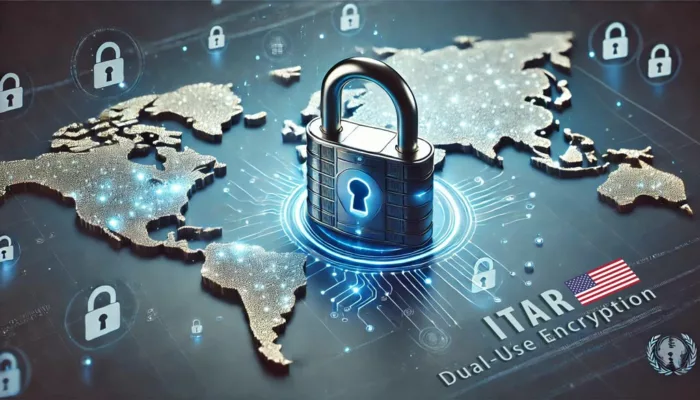
This creates a paradox.

Quantum supremacy does not automatically imply:

  • universal quantum attack democratization.

Capability concentration itself may become:

  • a geopolitical asymmetry.

The real strategic mistake

The greatest danger is neither:

  • panic,
  • nor denial.

The greatest danger is strategic inertia.

Organizations delaying:

  • inventory mapping,
  • crypto agility,
  • hybrid migration preparation,
  • exposure reduction strategies

may eventually discover that:

  • retrospective exposure cannot be reversed once archives have already been harvested at scale.

The future of cyber sovereignty

Quantum resilience is no longer purely a cryptographic discussion.

It becomes simultaneously:

  • a governance issue,
  • an infrastructure issue,
  • an intelligence issue,
  • an energy issue,
  • a sovereignty issue.

The organizations most likely to adapt successfully will not necessarily be those deploying the fastest migration.

They will be those capable of:

  • reducing unnecessary exposure before future computation makes persistent exposure permanent.

Strategic Outlook

The post-quantum era may ultimately redefine cybersecurity around one decisive principle:

The strongest long-term defense is not only the ability to encrypt.
It is the ability to reduce what future adversaries will still be able to observe, aggregate, preserve, and exploit decades later.

EAN Code Andorra: Why It Shares Spain’s 84 Code

Ultra-realistic image illustrating Andorra's shared EAN code with Spain, featuring a barcode starting with 84 and a map connecting Andorra and Spain.
Update: August 29, 2024 Jacques Gascuel discusses the crucial intersection of Telegram and cybersecurity in light of Pavel Durov’s arrest. Featured in our Cyberculture section, this analysis underscores the evolving responsibilities of tech leaders and the importance of balancing privacy with security. Stay informed as this topic may be updated, and thank you for following our Cyberculture updates.

Everything You Need to Know About EAN Codes: Andorra’s Shared 84 Code with Spain

EAN Code Andorra plays a crucial role in identifying products, but why does Andorra, despite being a co-principality with France, share its EAN code with Spain? In this article, we will explore the EAN coding system, explain how it works, and uncover the reasons why Andorra uses the 84 code with Spain. Additionally, you’ll find a complete guide that helps you understand this unique coding arrangement.

2025 Cyber Doctrine Cyberculture

Uncodified UK constitution & digital sovereignty

2025 Cyberculture Cybersecurity Digital Security EviLink

CryptPeer messagerie P2P WebRTC : appels directs chiffrés de bout en bout

2025 Cyber Doctrine Cyberculture

Souveraineté individuelle numérique : fondements et tensions globales

2025 Cyberculture

Louvre Security Weaknesses — ANSSI Audit Fallout

Key Highlights: EAN Code Andorra & Spain’s Shared 84 Code

  1. EAN Code Andorra: All About EAN Codes and Their Importance: Andorra shares the 84 code with Spain, mainly due to strong trade relationships.
  2. What Is an EAN Code and Why Is It Important?: EAN codes play a critical role in global product identification, especially in retail and supply chains.
  3. How EAN Codes Are Structured: The structure of EAN codes consists of a country prefix, product number, and check digit.
  4. Complete List of EAN Codes by Country (Updated in 2024): A comprehensive list of EAN codes for countries with assigned EAN-13 codes, updated for 2024.
  5. Why Does Andorra Share Its EAN Code with Spain?: Andorra shares its EAN code with Spain due to economic ties and logistical efficiency.
  6. Examples of Valid EAN Codes for Andorra: Valid EAN codes for Andorran products, starting with the prefix 84.
  7. How the Shared EAN Code Works: How GS1 manages Andorra’s shared EAN code with Spain.
  8. Benefits of Sharing the Code: Advantages for Andorra in sharing its EAN code with Spain, such as cost reduction and logistical efficiency.
  9. How to Verify the Validity of EAN and UPC Codes: Methods for checking the validity of EAN and UPC codes using the check digit.
  10. UPC and EAN: Differences and Correspondence: The difference between UPC and EAN codes and how they correspond.
  11. Alternatives to GS1 for Obtaining EAN Codes: Exploring alternatives like resellers, online platforms, and local agencies for obtaining EAN codes.
  12. Finding the Best EAN Code Solution for Your Business: Determining the right EAN code acquisition strategy depending on your business needs.

All About EAN Codes and Their Importance

EAN Code Andorra illustrates how the EAN (European Article Number) system operates on a global scale. GS1 actively manages this system, which ensures that every product crossing international borders has a unique identifier. Over 100 countries rely on EAN codes to track and identify goods efficiently.

Businesses that engage in international trade must assign EAN codes to their products. These codes play a critical role in streamlining logistics and improving product traceability. By adopting this system, companies guarantee that their products are correctly identified, no matter where they are shipped or sold. As a result, they meet global standards, enhancing both their credibility and operational efficiency in the global market.

What Is an EAN Code and Why Is It Important?

An EAN code allows businesses to identify and track products globally with ease. These codes play a critical role in retail, supply chain management, and product traceability systems. By using EAN codes, businesses automate inventory management and streamline commercial transactions. As a result, companies can manage their stock more efficiently, reduce errors, and ensure their products are easily traceable from production to sale. This makes EAN codes indispensable for businesses operating in today’s fast-paced global market.

How EAN Codes Are Structured

An EAN-13 code is made up of the following elements:

  • The first 3 digits are the country prefix, representing where the company is registered.
  • The next 9 digits identify the company and its specific product.
  • The final digit is a check digit, calculated to verify the accuracy of the code.

Complete List of EAN Codes by Country (Updated in 2024)

In this section, you’ll find the complete list of 195 countries, highlighting which ones have their own EAN code and which do not. These EAN codes, managed by GS1, are crucial for identifying products in global commerce. By 2024, around 130 countries have been assigned a unique EAN code, while others either share a code with neighboring countries or do not require one. This table allows you to quickly determine if your country has a unique EAN code or shares one.

Countries with Assigned EAN Codes

Below is the list of countries that have been assigned a specific EAN-13 code by GS1. This assignment ensures proper product identification and traceability, helping businesses streamline international trade and manage stock efficiently. By using these codes, companies can ensure their products comply with global standards for accurate identification across borders.

Country EAN-13 Code
Algeria 613
Andorra (with Spain) 84
Argentina 779
Armenia 485
Australia 93
Austria 90 to 91
Belgium 54
Bolivia 777
Brazil 789 to 790
Bulgaria 380
Canada 00 to 13
Chile 780
China 690 to 695
Colombia 770 to 771
Croatia 385
Cyprus 529
Czech Republic 859
Denmark 57
Egypt 622
El Salvador 741
Finland 64
France 300 to 379
Georgia 486
Germany 400 to 440
Greece 520
Honduras 742
Hungary 599
Iceland 569
India 890
Indonesia 899
Iraq 626
Ireland 539
Israel 729
Italy 80 to 83
Japan 45 and 49
Kazakhstan 487
Kenya 616
Latvia 475
Lithuania 477
Luxembourg 54
Malaysia 955
Malta 535
Mexico 750
Netherlands 87
New Zealand 94
Nicaragua 743
North Macedonia 531
Norway 70
Panama 745
Paraguay 784
Peru 775
Philippines 480
Poland 590
Portugal 560
Romania 594
Russia 460 to 469
Saudi Arabia 628
Serbia 860
Singapore 888
Slovakia 858
Slovenia 383
South Africa 600 to 601
South Korea 880
Spain (with Andorra) 84
Sri Lanka 479
Sweden 73
Switzerland 76
Taiwan 471
Thailand 885
Tunisia 619
Turkey 869
Ukraine 482
United Kingdom 50
United States 00 to 13
Venezuela 759
Vietnam 893

Countries Without Assigned EAN Codes

On the other hand, several countries have not been assigned their own EAN code. In many cases, these countries either do not participate extensively in international trade, or they share a code with a larger neighboring country. For businesses or consumers looking to identify whether their country has a unique EAN code, here is the list of countries that do not have a dedicated EAN code:

Country EAN-13 Code
Afghanistan Not assigned
Albania Not assigned
Antigua and Barbuda Not assigned
Aruba Not assigned
Bahamas Not assigned
Barbados Not assigned
Belize Not assigned
Bhutan Not assigned
Botswana Not assigned
Burundi Not assigned
Cape Verde Not assigned
Central African Republic Not assigned
Chad Not assigned
Comoros Not assigned
Congo (Brazzaville) Not assigned
Congo (Kinshasa) Not assigned
Djibouti Not assigned
Dominica Not assigned
East Timor Not assigned
Eritrea Not assigned
Eswatini (Swaziland) Not assigned
Fiji Not assigned
Gabon Not assigned
Gambia Not assigned
Grenada Not assigned
Guinea Not assigned
Guinea-Bissau Not assigned
Guyana Not assigned
Haiti Not assigned
Jamaica Not assigned
Kiribati Not assigned
Laos Not assigned
Lesotho Not assigned
Liberia Not assigned
Libya Not assigned
Madagascar Not assigned
Maldives Not assigned
Mali Not assigned
Mauritania Not assigned
Micronesia Not assigned
Monaco Not assigned (Shares with France)
Mongolia Not assigned
Montenegro Not assigned
Mozambique Not assigned
Myanmar Not assigned
Namibia Not assigned
Nepal Not assigned
Niger Not assigned
Palau Not assigned
Papua New Guinea Not assigned
Rwanda Not assigned
Samoa Not assigned
Sao Tome and Principe Not assigned
Seychelles Not assigned
Sierra Leone Not assigned
Solomon Islands Not assigned
Somalia Not assigned
South Sudan Not assigned
St Kitts and Nevis Not assigned
St Lucia Not assigned
St Vincent and Grenadines Not assigned
Sudan Not assigned
Suriname Not assigned
Syria Not assigned
Tonga Not assigned
Turkmenistan Not assigned
Tuvalu Not assigned
Uganda Not assigned
Uzbekistan Not assigned
Vanuatu Not assigned
Yemen Not assigned
Zambia Not assigned
Zimbabwe Not assigned

In summary, as of 2024, 130 countries have been officially assigned EAN codes, while the remaining countries either share a code with another nation or have not yet been assigned a code. This distinction helps businesses and consumers understand the status of EAN codes for their respective countries, ensuring that products are correctly identified and managed in the international market.

Why Does Andorra Share Its EAN Code with Spain?

Andorra, though a co-principality with both France and Spain, actively chooses to share Spain’s EAN 84 code rather than having its own unique code. This decision is primarily driven by practical and economic factors.
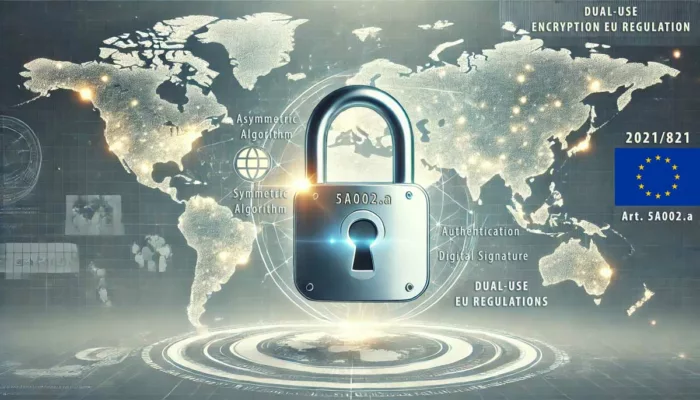
First and foremost, Andorra maintains strong economic ties with Spain. Over the years, Andorra has relied on Spain for the majority of its imports, including essential goods such as food, fuel, and other products. This long-standing relationship naturally led Andorran businesses to align themselves more closely with Spain in terms of trade and logistics.

In addition, the small size of Andorra’s market makes it less feasible to maintain a unique EAN code. With a relatively small population and limited market activity, it isn’t cost-effective for Andorra to have its own system. Sharing Spain’s code helps reduce costs and streamline processes, enabling Andorran companies to integrate smoothly into Spain’s commercial network.

Moreover, logistical efficiency plays a critical role in this choice. By using Spain’s well-established commercial infrastructure, Andorra simplifies its logistics and stock management processes. This allows Andorran businesses to focus on their core operations without worrying about managing separate systems for product identification. As a result, they ensure compliance with global trade standards and enhance their ability to participate in international markets.

In the end, Andorra’s decision to share the EAN code with Spain reflects practical realities and strategic choices. Leveraging Spain’s infrastructure for logistics and distribution, Andorran companies enjoy smoother operations, lower costs, and easier access to global markets, all while ensuring that their products meet international standards for identification and trade.

Examples of Valid EAN Codes for Andorra

For Andorra, the EAN-13 code starts with 84. Here are some examples of valid EAN codes for products registered in Andorra:

  • 8400000000012
  • 8400000000029
  • 8400000000036

These codes follow the standard EAN-13 structure, with the prefix “84” indicating Andorra/Spain, followed by a product reference number and a calculated check digit.

How the Shared EAN Code Works

GS1 manages the EAN 84 code that Andorra shares with Spain. Andorran companies register their products for international trade and use Spain’s infrastructure to handle logistics and distribution. This setup ensures that Andorran businesses can efficiently enter global markets without needing their own EAN code.

Other small countries, such as Monaco and San Marino, also share EAN codes with larger neighbors like France and Italy. They benefit from the same logistics and distribution advantages, which simplifies their participation in international trade. By sharing these codes, smaller nations ensure full compliance with global standards, while avoiding the complexities of managing their own code.

Benefits of Sharing the Code

There are several advantages to Andorra sharing its EAN code with Spain:

  • Simplified Trade: Andorran products can move freely between Andorra and Spain without needing recoding.
  • Cost Reduction: Companies in Andorra avoid the expense of obtaining and managing a separate EAN code.
  • Efficient Stock Management: Sharing a code allows businesses to use the same product tracking systems as Spanish companies.

How to Verify the Validity of EAN and UPC Codes

Ensuring that your EAN or UPC codes are valid is essential for avoiding errors in product tracking and inventory management. This section explains how to verify codes by calculating the check digit and ensuring compliance with international standards.

Differences Between EAN and UPC Codes

  • UPC (Universal Product Code): This is a 12-digit barcode primarily used in North America.
  • EAN (European Article Number): A 13-digit barcode used internationally, particularly in Europe.

Both codes refer to the same products, but the EAN adds a digit to comply with global standards.

Steps to Verify EAN Codes Using the Check Digit

You can verify the validity of an EAN code by calculating its check digit. Let’s take the example of the EAN code 0659436219502 and follow these steps:

  1. Multiply the digits:
    • Multiply the odd-positioned digits (1st, 3rd, 5th, etc.) by 1.
    • Multiply the even-positioned digits (2nd, 4th, 6th, etc.) by 3.
  2. Add the results: Add the results of your multiplications:
    • (0 * 1) + (6 * 3) + (5 * 1) + (9 * 3) + (4 * 1) + (3 * 3) + (6 * 1) + (2 * 3) + (1 * 1) + (9 * 3) + (5 * 1) + (0 * 3) = 110.
  3. Determine the check digit:
    • Find the number that, when added to your total, will make it a multiple of 10.
    • In this case, the total is 110, which is already a multiple of 10, so the check digit is 0.
  4. Confirm the code:
    • With the check digit 0, the full EAN code 0659436219502 is valid.

How to Verify the Validity of EAN and UPC Codes

Verifying the validity of your EAN or UPC codes is essential for preventing errors in product tracking and inventory management. To confirm that your codes are correct, you can calculate the check digit. This simple process confirms whether the code follows the proper structure. However, to ensure full compliance with global standards, you should consider using tools like Verified by GS1.

By using GS1’s verification service, you can easily check if your product’s code is registered and recognized worldwide. This step not only guarantees that your EAN or UPC code meets international standards, but it also enhances your credibility in the market. As a result, you can ensure smooth operations across the supply chain, minimizing the risk of errors and maintaining trust with your partners and customers.

UPC and EAN: Differences and Correspondence for Andorran Products

While UPC and EAN codes differ in length, they both identify the same product globally. The UPC code typically consists of 12 digits, mainly used in North America, while the EAN code has 13 digits and is used internationally, including in Andorra, which shares the EAN 84 code with Spain.

Here’s how UPC and EAN codes correspond for the same Andorran product:

Product UPC EAN (Andorra)
Andorran Product 1 012345678905 84012345678905
Andorran Product 2 123456789012 84123456789012
Andorran Product 3 234567890123 84234567890123

In these examples, you can see that the EAN codes begin with 84, representing Andorra/Spain, and are structured similarly to UPC codes, with the addition of an extra digit to comply with international standards.

Alternatives to GS1 for Obtaining EAN Codes

While GS1 is the global authority responsible for assigning EAN codes, there are several alternative methods to obtain these codes. These options are often better suited for small businesses or start-ups that may be looking for more cost-effective solutions. Let’s explore these alternatives and their advantages.

EAN Code Resellers

First, you can consider purchasing EAN codes from resellers. These resellers buy unused EAN codes from GS1 and then sell them at a reduced price. As a result, this option can be much more affordable. However, you need to keep in mind that these codes might not be registered under your company in the GS1 database, which could lead to potential issues when it comes to product traceability.

Online Platforms

Another convenient option involves using online platforms like Nationwide Barcode and Buyabarcode.com, which provide EAN codes quickly and at a lower cost. In this case, you benefit from faster access to the codes. However, because these codes might not be directly linked to your company in the official GS1 system, this could cause traceability challenges with larger retailers or international partners.

Local or Regional Solutions

In some regions, local agencies offer EAN codes specifically for use within that country or area. These local solutions are usually cheaper, making them a good choice for businesses that operate regionally. On the downside, these codes may not be recognized internationally, limiting your opportunities for global trade.

Finding the Best EAN Code Solution for Your Business

When you sell products internationally or work with large retailers, obtaining your EAN codes directly from GS1 ensures full recognition and traceability across global markets. This choice provides the highest level of confidence that your products will meet international standards. It helps your business thrive in a competitive environment.

On the other hand, if your business operates primarily in local or regional markets, you should consider exploring more affordable alternatives. You could turn to EAN resellers or local agencies, which offer flexibility at a lower cost. These options still allow you to meet the needs of smaller markets. At the same time, they give you room to scale when necessary. In many cases, this approach proves more cost-effective for businesses that don’t require global compliance right away.

Throughout this guide, you’ve discovered how EAN codes work and learned why Andorra shares the 84 code with Spain. You’ve also found out how to verify code validity. Whether you run a small business with local reach or a large enterprise with global aspirations, understanding the best approach to EAN code acquisition empowers you to make the right decision for your business. In the end, choosing the right path sets your products up for success. It ensures they can be tracked and managed smoothly, no matter where they are sold.

Unlock Write-Protected USB Easily (Free Methods Only)

USB drive inserted into a laptop with shield and gear icons, symbolizing unlocking write-protected USB and troubleshooting solutions.

A USB drive that suddenly becomes write-protected is a common issue on modern Windows systems. If you are trying to unlock write-protected USB media on Windows 10 or Windows 11 without using third-party software, this guide explains the exact causes, limits, and safe recovery paths.

Express Summary — Unlock Write-Protected USB (Windows)

⮞ Reading Note

This express digest takes ≈ 4 minutes. It delivers the essentials: root causes, fastest fixes, and the point where you must stop and preserve data.

⚡ The discovery

A USB drive that was writable yesterday suddenly becomes read-only: Windows blocks copy, delete, rename, and even simple edits. This can be a physical lock, a Windows restriction (policy/registry), a logical read-only flag, or a firmware-level protection mode when NAND memory is failing.

✦ Immediate impact

  • File operations fail (copy, delete, rename) with “write-protected” errors
  • Formatting may be blocked (if protection is firmware-enforced)
  • Security risk: a USB used across systems increases exposure to malware and policy locks

⚠ Strategic message — when unlocking is the wrong objective

Write protection is not always a malfunction. In modern systems, it is often a deliberate safety boundary. Windows may enforce it by policy; USB controllers may enforce it to prevent irreversible data corruption when flash memory degradation is detected.

The critical mistake is to assume that every write-protected state must be unlocked. The real objective is classification: identifying whether the device is in a reversible state or has reached a hardware-defined end-of-life condition, where further action becomes harmful.

⎔ Sovereign countermeasure

Reduce reliance on “trusting the endpoint”: isolate sensitive secrets from general-purpose systems, enforce controlled workflows for removable storage, and treat USB drives as semi-disposable assets with rotation and health monitoring.

Want to go further?

Le advanced summary clarifies the modern causes (Windows 11 policies, BitLocker To Go edge cases, firmware fail-safe) and prepares the full Chronicle.

Reading parameters

Express summary: ≈ 4 min
Advanced summary: ≈ 6 min
Full Chronicle : ≈ 35–40 min
Publication date : 2024-01-01
Last updated : 2026-01-03
Complexity level : Advanced — Windows storage policies & removable media
Technical density : ≈ 65 %
Available languages : EN · FR · ES · CAT
Thematic focus : USB write protection, DiskPart, CHKDSK, BitLocker To Go, firmware lock
Editorial type : Tech Fix — Reference Guide (Freemindtronic)
Impact level : 7.8 / 10 — data integrity & operational continuity

Editorial note — This Chronicle belongs to the Tech Fixes & Security Solutions section. It examines USB write-protection mechanisms through an operational lens focused on classification, data preservation, and an explicit understanding of hardware limits. It places logical locks, system-level restrictions, and irreversible firmware protections into perspective, while explaining why certain situations no longer fall under repair but instead signal the end of a device lifecycle. This content extends the analyses published in Tech Fixes & Security Solutions and follows a principle of operational sovereignty, where knowing when to stop takes precedence over executing generic, automated fixes.

Références officielles
Microsoft DiskPart documentation
Microsoft CHKDSK documentation
Microsoft BitLocker overview
Microsoft removable storage access control

Unlock write-protected USB decision tree showing when to stop recovery attempts

The posts displayed above ↑ belong to the same editorial section: Tech Fixes & Security Solutions. They extend this Chronicle by covering practical remediation patterns, operational diagnostics, and resilient handling of security and integrity incidents across the Freemindtronic ecosystem.

Advanced Summary — When write protection becomes a system behavior (2024)

This complements the express digest. It does not repeat the steps; it explains why write protection has become more common on Windows 11-era systems and why some USB sticks become permanently read-only.

In 2024, removable storage sits at the intersection of three forces: security policy hardening (corporate and consumer), file-system integrity controls (especially with exFAT on unstable media), and controller-level protection mechanisms that activate when flash memory degradation is detected. As a result, “write-protected” may mean:

  • Policy lock — Windows prevents writes by design (registry/group policy/device control)
  • Logical lock — disk attributes or metadata errors mark the volume read-only
  • Encryption boundary — BitLocker To Go introduces states where writes are blocked until properly unlocked
  • Firmware lock — the controller refuses writes to avoid corrupting data when NAND cells are failing

Key Insights

  • DiskPart can clear flags, not firmware fail-safes.
  • CHKDSK fixes file-system structures, not dying flash memory.
  • If formatting fails repeatedly, prioritize data extraction and replacement.

What Is a USB Flash Drive — Hardware Basics You Need to Understand

Before attempting to unlock a write-protected USB, it is essential to understand what a USB flash drive actually is. Contrary to common assumptions, a USB stick is not a simple passive storage device. It is a compact embedded system combining multiple hardware components that actively manage data integrity and lifespan.

USB flash drive internal components showing controller chip and NAND flash memory
✪ USB flash drive internals — The controller and NAND memory that determine write protection behavior and device lifespan.

At its core, a USB flash drive contains two critical elements: a USB controller and NAND flash memory.

The USB controller: the decision-maker

The controller is a microcontroller that manages all read and write operations. It implements wear-leveling algorithms, error correction (ECC), bad block management, and firmware-level safety rules. When the controller detects that NAND memory has reached critical wear thresholds or repeated I/O failures, it can intentionally enforce a permanent read-only state.

NAND flash memory: finite by design

NAND flash memory stores data using cells with a limited number of write cycles. Once these limits are exceeded, data integrity can no longer be guaranteed. At that point, the controller prioritizes preservation of readable data over continued writes.

Why this matters for write protection

This hardware reality explains why some write-protected USB drives cannot be unlocked by software tools. Registry edits, DiskPart commands, or formatting attempts operate at the operating-system level. They cannot override firmware decisions made by the controller to protect failing NAND memory.

Understanding this distinction is key: some write protection states are reversible, while others signal the end of the device lifecycle.


Unlock write-protected USB on Windows (Reference 2024)

When a USB flash drive becomes read-only, Windows is reacting to a specific signal: policy restriction, file-system inconsistency, encryption boundary, or controller-level protection.

Common causes of USB write protection (2024)

Before “fixing”, classify. A reversible lock can be cleared safely. A firmware lock should be treated as an end-of-life signal: extract data, replace the device, and update your workflow.

  • Physical switch (rare, but real)
  • Registry / policy restrictions (common on reused PCs)
  • Disk attributes (logical read-only)
  • File-system corruption (especially after unsafe ejection)
  • BitLocker To Go states (locked volumes / permission boundary)
  • Firmware fail-safe (NAND wear, controller protection)

Common causes to unlock a write-protected USB including firmware lock, BitLocker, file-system errors, and disk attributes
✪ Common causes — How to classify USB write protection before attempting to unlock a write-protected USB device.

Method 1 — Check the physical lock

This sounds obvious, but it’s often overlooked.

  1. Remove the USB drive from your computer.
  2. Inspect its casing (or SD adapter) for a small LOCK / UNLOCK switch.
  3. Toggle the switch to the unlocked position.
  4. Reinsert the USB drive and test it again.

If the device remains write-protected, move on to software-based solutions.

If your device (or SD adapter) has a lock switch, it overrides everything. Toggle to unlock, reinsert, and retest.

Method 2 — Remove USB Write Protection Using the Windows Registry

This method targets Windows policies that explicitly block writing to removable drives.

Warning: Editing the registry incorrectly can affect system stability. Follow the steps exactly.

Unlock write-protected USB by editing Windows Registry StorageDevicePolicies WriteProtect value
✪ Registry-based fix — Clearing the WriteProtect value to unlock a write-protected USB on Windows systems.

Registry: StorageDevicePolicies

  1. Open Regedit as admin.
  2. Go to HKEY_LOCAL_MACHINESYSTEMCurrentControlSetControlStorageDevicePolicies
  3. Set WriteProtect to 0 (DWORD).
  4. Restart Windows.

If StorageDevicePolicies does not exist, you can create it and add WriteProtect. This is typical on systems that inherited restrictions.

Unlock write-protected USB by editing the Windows Registry StorageDevicePolicies WriteProtect value
✪ Registry policy control — The StorageDevicePolicies WriteProtect value determines whether Windows enforces read-only access on removable USB storage.
Important — diagnostic boundary
From this point onward, each method is also a diagnostic test.
If a method completes successfully but the device state does not change, this is not a failure — it is a signal.

Method 3 — Use DiskPart to Clear the Read-Only Attribute

DiskPart allows you to modify disk attributes directly at the system level. This method is frequently searched under queries such as diskpart clear readonly USB or USB write-protected cannot format.

  1. Open Command Prompt (Admin).
  2. Type the following commands, pressing Enter after each one:
diskpart
list disk
select disk X
attributes disk clear readonly
exit
Unlock write-protected USB using DiskPart to clear the disk read-only attribute on Windows
✪ DiskPart method — Clearing the logical read-only disk attribute to unlock a write-protected USB on Windows.

Be precise when selecting disk X. If this works, the issue was likely logical.

Safely remove and reconnect the USB device.

Method 4 — CHKDSK: repair file-system errors

If corruption exists, Windows may mount read-only. CHKDSK repairs structural issues:

chkdsk X: /f

Replace X: with the USB letter. If errors reappear soon after, the medium is unstable.

Unlock write-protected USB using CHKDSK to repair file-system errors on Windows
✪ CHKDSK method — Repairing file-system errors that can cause a USB drive to mount as read-only on Windows.

Method 5 — Unlock Write-Protected USB when BitLocker To Go blocks writes (Windows 10/11)

If the USB drive is encrypted, BitLocker can block write operations while the volume remains locked, only partially unlocked, or opened under a session that lacks write permission. Before attempting any fix, verify the items below.

  • The volume is fully unlocked (not just visible in File Explorer).
  • You are using an account/session with permission to write to the volume.
  • Device policies do not restrict writes to encrypted removable media.

Method 6 — Unlock Write-Protected USB caused by Group Policy or removable storage write control

On some Windows systems, removable storage writes are blocked intentionally. This is common on managed or reused PCs where administrators enforce restrictions under Removable Storage Access or BitLocker removable drive policies. If you control the device, review policy settings; if the machine is managed, the restriction may be enforced centrally.

Method 7 — Event Viewer signals: distinguish file-system integrity issues from hardware I/O failure

If the same USB drive repeatedly flips to read-only, Windows logs often reveal whether you are dealing with file-system corruption or repeated disk I/O errors. Open Event Viewer and review Windows Logs → System. Look for recurring warnings/errors from sources such as Disk or Ntfs. Persistent I/O errors strongly correlate with controller fail-safes and end-of-life behavior.

Method 8 — Reformat to remove USB write protection (Last Resort, data loss expected)

If the drive remains accessible but still appears locked, formatting may restore normal behavior — but it will erase all data. Only proceed after extracting anything you can.

  1. Open File Explorer → right-click the USB drive.
  2. Select Format.
  3. Choose exFAT or FAT32 (based on your compatibility needs).
  4. Uncheck Quick Format if available and you want a deeper pass.
  5. Start the process.

If formatting fails with a write-protection error, the USB memory controller is likely enforcing read-only at firmware level. Treat this as end-of-life: extract readable data and replace the device.

Prevention (2024 hygiene)

  • Always use “Safely remove hardware” (reduces corruption)
  • Avoid using the same USB across high-risk machines
  • Prefer exFAT for cross-platform, NTFS for Windows-only + permissions (context dependent)
  • Rotate removable media and retire devices showing repeated errors
⮞ Weak Signals (2024)
As ransomware and device-control policies expand, “write protection” increasingly appears as a security boundary, not a random malfunction. Expect more controlled removable-storage environments — and more firmware fail-safes on low-cost media.

Manufacturer-specific USB behaviors (forums vs reality)

Community forums often suggest “magic fixes” for write-protected USB drives. Some of these tricks work — but only because certain manufacturers implement specific controller behaviors.

  • Consumer flash drives frequently switch to read-only mode when internal error thresholds are reached. This is a protective firmware behavior, not a Windows bug.
  • Many models use conservative wear-leveling. Repeated CHKDSK or formatting attempts may accelerate the transition to permanent read-only mode.
  • USB flash controllers often expose limited recovery states; when write protection appears, it usually reflects internal health checks rather than logical flags.
  • Some drives historically supported recovery utilities, but success rates vary and are highly model-dependent.

Forum advice often ignores a critical distinction: logical locks can be cleared, but controller-enforced locks cannot. Applying aggressive “fixes” repeatedly may worsen data integrity.

Forum tricks — what works, what to avoid

Many online discussions recommend extreme or repetitive actions to unlock write-protected USB drives. Here is a technical reality check.

✔ Sometimes useful — Clearing read-only flags with DiskPart when the issue is purely logical.

✔ Reasonable — Running CHKDSK once to repair file-system metadata after unsafe removal.

⚠ Risky — Repeated formatting attempts after firmware-level write protection appears.

✖ Dangerous — Low-level controller reflashing tools shared on forums (high data-loss risk).

✖ Misleading — Registry “tweaks” claiming to unlock all USB drives regardless of hardware state.

A recurring forum myth is that persistence will eventually “break” write protection. In reality, modern controllers are designed to resist exactly that.

Decision checkpoint — when to stop trying

Before attempting another fix, ask these questions:

  • Does DiskPart fail to clear the read-only attribute?
  • Does formatting fail immediately with write-protection errors?
  • Do Windows logs report repeated I/O or medium errors?

If the answer is “yes” to all three, the safest action is to stop write attempts, extract readable data, and replace the device.

✓ Operational guidance
Treat persistent write protection as an end-of-life signal, not a challenge to overcome.

Real-world case — when nothing changes

Field feedback (user comment):

“no use all the tips tried but it is in the same stage”

This type of feedback is common — and important. It reflects a scenario where all documented methods are executed correctly, yet the USB device remains write-protected with no observable change.

From a technical standpoint, this outcome is not a failure of the steps. It is a diagnostic result.

When a USB drive stays in the same state after:

  • clearing logical read-only flags,
  • checking registry or policy restrictions,
  • running CHKDSK,
  • and attempting formatting,

the most likely explanation is firmware-level write protection enforced by the USB controller. This protection is intentional and designed to prevent further data corruption when internal error thresholds or NAND wear limits are reached.

In such cases, persistence does not increase success. It increases risk. No change is not failure — it is the diagnosis.

✓ Operational takeaway
When no method alters the device state, stop write attempts. Extract readable data if possible, then replace the device. Lack of change is not failure — it is a signal

Known non-recoverable USB write-protection scenarios

Not all write-protected USB situations are recoverable. Based on field experience and controller behavior, the following scenarios are generally considered non-reversible.

  • Persistent write protection after DiskPart and formatting attempts
    When logical flags are cleared but the device remains read-only and formatting fails immediately, the controller is likely enforcing a permanent lock.
  • Repeated I/O or medium errors reported by the operating system
    These signals often indicate failing NAND cells. Write protection is triggered to prevent silent data corruption.
  • USB drives that suddenly switch to read-only after heavy use
    Consumer-grade flash drives may enter irreversible read-only mode once internal wear thresholds are exceeded.
  • Write-protected devices that remain readable but never writable again
    This is a classic end-of-life behavior: data extraction remains possible, but write access is permanently disabled.
  • Failures that persist across multiple systems and operating systems
    If the same USB device is read-only on different machines, the cause is almost certainly hardware-level.
⚠ Important
Attempting aggressive fixes in these scenarios can accelerate data loss. Once firmware-level protection is suspected, preservation takes priority over correction.

Logical lock vs Firmware lock — comparison table

Criteria Logical / Policy Lock Firmware / Controller Lock
Origin Windows registry, group policy, disk attributes, file-system errors USB controller firmware (NAND wear, internal error thresholds)
DiskPart effect ✓ Clears read-only flags ✖ No effect
CHKDSK effect ✓ Repairs file-system metadata ✖ No effect on hardware
Formatting ✓ Usually possible ✖ Fails immediately
Data recovery chance High Limited to read-only extraction
Recommended action Proceed with policy/flag/file-system fixes Stop write attempts, extract data, replace device

USB write protection — decision tree

USB becomes write-protected
│
├─ Does the device have a physical lock?
│   ├─ YES → Unlock switch → Retest
│   └─ NO
│
├─ Can DiskPart clear readonly?
│   ├─ YES → Logical lock resolved
│   └─ NO
│
├─ Does CHKDSK repair errors?
│   ├─ YES → Monitor device stability
│   └─ NO
│
├─ Does formatting fail immediately?
│   ├─ YES → Firmware / controller lock
│   │        → Extract data (read-only)
│   │        → Replace USB device
│   └─ NO
│
└─ Check policies / BitLocker states
    └─ Adjust governance or unlock volume

Glossary — USB & Storage Terms

This internal glossary clarifies key technical terms used throughout this Chronicle. Click a term to reveal its definition.

USB write-protection concepts

Write-Protected USBClick
A USB drive in a read-only state where write operations (copy, delete, modify, format) are blocked. Causes include physical locks, Windows policies, disk attributes, file-system corruption, encryption states, or firmware-level protection.
Read-Only AttributeClick
A logical flag set at the disk or volume level that prevents write operations. DiskPart can clear it when firmware does not enforce the lock.

Windows and system-level mechanisms

DiskPartClick
A built-in Windows command-line utility used to manage disks, partitions, and attributes. It clears logical flags but cannot override controller-enforced protection.
CHKDSKClick
A Windows utility that scans and repairs file-system structures (allocation tables, metadata). It does not repair physical flash memory degradation.
BitLocker To GoClick
Microsoft’s removable-drive encryption feature. If the volume is locked or restricted by policy, writes may be blocked until it is properly unlocked and authorized.
Removable Storage PolicyClick
A Windows security rule that restricts read or write access to removable media. It often explains sudden write protection on managed or previously managed systems.

Storage hardware and controller behavior

Firmware LockClick
A protection mode enforced by the USB controller firmware, often triggered when NAND wear or internal error thresholds reach critical levels. This state is usually irreversible.
NAND Flash MemoryClick
The non-volatile memory used in USB flash drives. NAND cells have limited write cycles; excessive wear can trigger controller-level write protection.
USB ControllerClick
The microcontroller inside a USB drive that manages read/write operations, wear-leveling, error correction, and fail-safe mechanisms.
Wear-LevelingClick
A technique that distributes writes across NAND cells to extend lifespan. When wear becomes excessive, the controller may enforce read-only mode.

Operational and lifecycle concepts

File System (exFAT / NTFS)Click
The structure used to organize data on a USB drive. exFAT supports cross-platform use, while NTFS adds permissions and journaling but may be less tolerant of unsafe removal on unstable media.
Safely Remove HardwareClick
A Windows feature that flushes pending writes before disconnection. It reduces file-system corruption and lowers the chance of read-only mounting.
End-of-Life (EOL)Click
A state where a USB drive is no longer reliable for writes due to hardware degradation. The safe approach is to extract readable data and replace the device.

Frequently Asked Questions — USB write protection

Understanding sudden write protection

In most cases, write protection does not appear randomly. Instead, it is triggered by a specific condition. For example, a physical lock may be enabled, Windows may enforce a storage policy, or disk attributes may mark the device as read-only. Additionally, file-system corruption after unsafe removal, encryption states such as BitLocker To Go, or controller fail-safes activated by failing flash memory can all lead to a sudden read-only state.

What DiskPart can — and cannot — do

DiskPart is effective when the issue is purely logical. It clears read-only flags set at the disk or volume level. However, if the USB controller itself enforces write protection at firmware level, DiskPart has no authority to override it. In that case, the command completes, but the device state remains unchanged.

Why formatting is sometimes blocked immediately

When formatting fails instantly with write-protection errors, this usually indicates firmware-enforced protection. In other words, the controller has detected critical NAND wear or repeated I/O errors and has intentionally disabled write access to prevent further data corruption.

Reversible locks versus end-of-life signals

Not necessarily. Logical locks or policy-based restrictions are often reversible. By contrast, firmware-level write protection typically marks the device as having reached end-of-life. In this scenario, the priority shifts from repair to data preservation.

When persistence becomes counterproductive

Once DiskPart, CHKDSK, and formatting attempts all fail, continuing to force write operations rarely improves the outcome. On the contrary, repeated attempts may accelerate data loss. At this point, stopping is not giving up — it is the correct operational decision.

When no change is itself a diagnosis

If all documented methods were applied correctly and the USB device remains in the same state, this is not a failure of the guide. Rather, it strongly suggests firmware-level write protection enforced by the USB controller. This protection is intentional and designed to preserve remaining readable data once internal error thresholds or NAND wear limits are reached. Therefore, further write attempts are discouraged. The recommended action is to extract readable data if possible, then replace the device.

What CHKDSK actually repairs

CHKDSK repairs file-system structures and metadata inconsistencies. However, it does not repair physical flash memory. If errors reappear quickly after repair, the storage medium itself is likely degrading.

Interpreting repeated formatting failures

Often, yes. When formatting consistently fails under write-protection errors, firmware enforcement or hardware degradation is the most likely cause. In such cases, the safest approach is to focus on data extraction and device replacement rather than recovery attempts.

Reducing future write-protection incidents

To reduce recurrence, treat removable media as semi-disposable assets. Rotate USB drives regularly, retire devices showing early warning signs, always eject safely, and avoid mixing the same USB device between high-risk and trusted environments.

⧉ What We Didn’t Cover

Manufacturer-specific recovery tools, controller reflashing, NAND chip-off forensics, and high-risk low-level repairs were intentionally excluded due to low reliability and high data-loss risk.

Why this guide cannot be reduced to a single answer

Modern generative systems excel at summarizing procedures. However, USB write protection is not a single problem with a single fix. It is a classification problem.

This Chronicle deliberately separates logical locks, policy restrictions, encryption states, and firmware-enforced protection. Collapsing these into a single “solution” increases the risk of data loss and misdiagnosis.

In other words, this guide is not designed to be consumed as a static answer, but as a decision framework. Its value lies in the reasoning path, not in isolated commands.

Sovereign knowledge vs generated answers

The rise of generative systems changes how information is accessed. Instead of navigating documents, users increasingly receive synthesized answers. While efficient, this shift introduces a structural risk: context compression.

USB write protection is not a single problem with a universal fix. It is a classification problem involving hardware limits, operating system policies, encryption states, and controller-level safeguards. Reducing this complexity to a single generated answer increases the likelihood of misdiagnosis and data loss.

This Chronicle deliberately preserves decision paths, failure boundaries, and stop conditions. Its purpose is not to produce an output, but to support informed judgment at each step.

In this sense, sovereign knowledge is not opposed to automation. It defines the conditions under which automation must stop and responsibility returns to the operator.

Editorial note — Freemindtronic perspective

Freemindtronic publications are built around a clear constraint. From the outset, they must remain usable even when access to information becomes mediated, filtered, or partially opaque.

Consequently, for technical domains such as removable storage, security controls, or data integrity, blindly executing isolated commands is no longer sufficient. Instead, operational clarity emerges from knowing when not to act, when to stop, and when preservation outweighs correction.

This Chronicle directly reflects that editorial stance. It does not promise universal fixes. Rather, it maps operational boundaries and highlights concrete signals indicating when a device has reached a non-recoverable state.

Moreover, in environments increasingly shaped by centralized platforms and automated mediation, maintaining local reasoning capacity is no longer optional. It becomes a practical form of operational sovereignty.

⮞ Editorial stance
Sovereignty begins where automated answers end — precisely at the moment informed responsibility is required.

Related topic — Evikey NFC and hardware-level resilience for USB storage

EviKey NFC HSM USB drive with indetectable mode at Freemindtronic EviKey Technology contactless data storage hardened cut in half lengthwisey Freemindtronic Andorra
EviKey NFC HSM USB drive with undetectable mode at Freemindtronic EviKey Technology contactless data storage hardened cut in half lengthwisey Freemindtronic Andorra

This Chronicle explains how and why USB drives become write-protected, including scenarios caused by firmware fail-safes, flash memory degradation, or integrity violations. In this context, it is important to highlight architectures that significantly reduce these risks at the hardware level.

Evikey NFC integrates multiple layers of physical and electronic protection designed to mitigate the most common causes of flash memory degradation and controller-enforced write protection. These protections operate autonomously, without relying on the operating system or software drivers.

Integrated protections against flash memory degradation

  • Automatic electronic protection against overvoltage and undervoltage, preventing electrical stress on the controller and NAND memory.
  • Advanced ESD protection rated at 2 × 27 kV on the data channel, drastically reducing damage from electrostatic discharge.
  • Thermal control and cutoff mechanisms, acting as a protective circuit breaker in abnormal temperature conditions.
  • Full military-grade resin encapsulation, making the device fully waterproof and mechanically resistant, with durability comparable to hardened steel.

Embedded diagnostics and forensic traceability

Unlike conventional USB flash drives, Evikey NFC embeds an immutable internal black box that records security and operational events. This traceability can be consulted contactlessly via NFC using an Android device, without requiring the USB to be mounted by the operating system.

  • Non-tamperable event logging of electrical, thermal, and security incidents.
  • Self-diagnostic system reporting the operational health of the device.
  • Tracking of flash memory write counts since first use, enabling objective assessment of NAND wear.

Impact on write-protection diagnosis

Because Evikey NFC eliminates most external causes of flash memory damage, any unexpected write-protection state can be analyzed with greater clarity. If a device becomes locked, the diagnostic process can quickly distinguish between:

  • Write protection intentionally enforced by the Evikey NFC security model, or
  • External or environmental factors unrelated to flash degradation.

Notably, the flash memory itself does not rely on traditional physical write-lock mechanisms, as access control is handled upstream through contactless authentication. This architectural choice removes an entire class of ambiguous failure states commonly encountered with standard USB drives.

As a result, Evikey NFC does not aim to unlock failing USB devices. Instead, it prevents most of the conditions that lead to irreversible firmware-level write protection and significantly simplifies diagnosis if a lock state occurs.

For readers interested in the technical foundations and concrete implementations of this architecture, the following official Freemindtronic resources provide detailed documentation:

Concrete implementations of this architecture are available as secure, contactless USB devices:

When recovery mechanisms reach their limits, resilient hardware design becomes the decisive factor.

Strategic Outlook

In 2024, a “write-protected USB” rarely represents an isolated malfunction. More often, it signals the visible edge of a deeper rule: a security policy, an integrity control, or a hardware fail-safe.

Therefore, the most effective response is not brute force. Instead, it relies on classification, data preservation, and disciplined operational hygiene. Once removable storage is treated as an asset with a defined lifecycle, the incident ceases to be surprising and becomes manageable.

This is why this Chronicle does not end with a fix, but with a boundary: a point where action stops and responsibility begins.

Google Sheets Malware: The Voldemort Threat

Google Sheets interface showing malware activity, with the keyphrase 'Google Sheets Malware Voldemort' subtly integrated into the image, representing cyber espionage.
Jacques Gascuel analyzes Google Sheets Malware Threats in the “Digital Security” topic, covering technical details, legal implications, and global cybersecurity impact. Stay informed on evolving threats and defense strategies from companies like Freemindtronic, influencing international cybersecurity practices.

Google Sheets Malware Threats

On August 29, 2024, Russian operatives from the SVR launched the Voldemort malware in an espionage campaign targeting Mongolian officials. This incident highlights the increasing role of malware in cyber warfare. By understanding these tactics, nations and organizations can effectively safeguard their data and systems against these emerging threats.

2025 Cyber Doctrine Cyberculture

Uncodified UK constitution & digital sovereignty

2025 Cyberculture Cybersecurity Digital Security EviLink

CryptPeer messagerie P2P WebRTC : appels directs chiffrés de bout en bout

2025 Cyber Doctrine Cyberculture

Souveraineté individuelle numérique : fondements et tensions globales

2025 Cyberculture

Louvre Security Weaknesses — ANSSI Audit Fallout

Sheets Malware: A Growing Cybersecurity Concern

Google Sheets, a widely used collaboration tool, has shockingly become a playground for cybercriminals. Recent cybersecurity research uncovered a sophisticated malware campaign leveraging Google Sheets’ features for large-scale cyberespionage. The malware, dubbed “Voldemort,” is engineered to infiltrate systems, exfiltrate sensitive data, and execute commands remotely. It masks its malicious activities within normal Google Sheets operations, making detection extremely challenging.

Understanding the Google Sheets Malware”

The emergence of Google Sheets malware signals a major shift in cybercriminal strategies. While Google Sheets was once seen as a simple collaboration tool, it is now exploited for cyberespionage operations. The malware uses the cloud-based and collaborative nature of Google Sheets, which complicates detection.

How Google Sheets Malware Operates

Voldemort malware inserts itself into Google Sheets, allowing it to perform its tasks discreetly. It executes several key actions, making it a powerful tool for cybercriminals.

Exfiltrating Sensitive Data with Google Sheets Malware

Voldemort is designed to infiltrate targeted systems and steal sensitive data, including login credentials, personal information, and trade secrets. By using Google Sheets, the malware can exfiltrate this data unnoticed, blending seamlessly with regular operations. Security systems often fail to detect this unauthorized activity because it looks legitimate.

Remote Command Execution Through Google Sheets Malware

Beyond data theft, Voldemort enables cybercriminals to execute remote commands on infected machines. Google Sheets becomes their command center, where attackers send instructions to the malware, enabling it to perform specific actions. This method conceals malicious activity within legitimate network traffic.

The Appeal of Google Sheets for Cybercriminals

Google Sheets has become an attractive tool for cybercriminals for several reasons:

  • Simplicity of Use: Google Sheets is intuitive and widely understood. This ease of use makes it easy for attackers to set up their malicious infrastructure.
  • Global Reach: With millions of users globally, Google Sheets provides a vast attack surface. This widespread use increases the potential impact of any malware deployed within it.
  • Difficulty of Detection: Malicious activities conducted through Google Sheets can easily blend in with legitimate use. This complicates efforts to identify and mitigate threats effectively.

The Consequences of Google Sheets Malware Attacks

The discovery of Google Sheets malware like Voldemort highlights the constant evolution of cyber threats. The consequences of such attacks can be severe. These include the theft of sensitive data, significant reputational damage, business disruptions, and substantial financial losses. This threat underscores the importance of vigilance and robust cybersecurity practices.

Discovery and Updates on the Voldemort Malware Campaign

In August 2024, Proofpoint researchers uncovered a sophisticated cyberespionage campaign that utilized Google Sheets as a Command-and-Control (C2) platform. The malware, named Voldemort, primarily targeted sectors such as insurance, aerospace, and finance. Over time, it became evident that the campaign affected more than 70 organizations across 18 verticals, including healthcare and transportation​.

Since its discovery, Voldemort gained attention for its advanced phishing tactics, including sending over 20,000 emails impersonating tax authorities from various countries such as the U.S., U.K., France, Germany, and Japan. These emails contained Google AMP Cache URLs, which redirected victims to a landing page that examined the user’s operating system. If the system ran Windows, the malware used the search-ms protocol and disguised PDF files to initiate DLL side-loading for system infection​

One of Voldemort’s most unique features is its use of Google Sheets to exfiltrate data and execute remote commands. This method blends malicious activity with legitimate operations, making it extremely difficult for traditional security tools to detect. By storing stolen data in Google Sheets cells, the malware ensures a low detection profile, making it highly effective in evading security protocols .

Additionally, the malware exploits legitimate software like Cisco WebEx via DLL side-loading and executes Python scripts from remote WebDAV shares to collect system information, steal credentials, and execute malicious commands​

Researchers recommend mitigating future attacks by:

  • Blocking suspicious URLs,
  • Monitoring for unusual network traffic,
  • Restricting PowerShell execution,
  • And implementing advanced defenses like sandboxing and encryption to protect against this and similar advanced threats.

For more information, you can access the full Proofpoint report titled The Malware That Must Not Be Named: Suspected Espionage Campaign Delivers ‘Voldemort’.

The Role of Artificial Intelligence in Cybersecurity

AI is increasingly playing a dual role in cybersecurity. Cybercriminals are using AI to develop more advanced malware, customizing attacks based on their targets’ behaviors and automating large-scale attacks. On the other hand, cybersecurity professionals are also leveraging AI to enhance threat detection and response capabilities, which helps counter these threats more effectively.

Challenges Posed by Remote Work and Google Sheets Malware

Remote work has heightened the risks of using tools like Google Sheets. Employees often access sensitive data from unsecured personal devices, expanding the security perimeter. This makes it harder to protect against malware like Voldemort. Additionally, remote work environments often lead to lower employee vigilance, increasing the risk of human error, which attackers can exploit.

Advanced Solutions for Protecting Against Google Sheets Malware

As malware like Voldemort continues to evolve and exploit collaborative tools such as Google Sheets, it’s crucial to implement advanced security solutions that offer robust protection. Freemindtronic Andorre provides a range of cutting-edge tools designed to counter cyberespionage, identity theft, and data breaches. These solutions help safeguard users and organizations from sophisticated threats like the Voldemort malware, which employs phishing, malicious URLs, and command-and-control tactics through Google Sheets.

PassCypher NFC HSM: Comprehensive Protection Against Phishing and Credential Theft

PassCypher NFC HSM is a cutting-edge identity and password manager that offers quantum-secure encryption and robust protection against phishing, typosquatting, and credential theft.

  • Automatic URL Sandboxing: PassCypher NFC HSM automatically registers the original website during the first login and verifies future logins against the saved URL, preventing redirections to malicious sites. This protects users from phishing tactics like those employed by the Voldemort malware.
  • EviOTP Technology for Enhanced Authentication: PassCypher NFC HSM integrates EviOTP (NFC HSM TOTP & HOTP) technology, generating one-time passwords for two-factor authentication (2FA). This ensures additional security, even if credentials are compromised.
  • Auto-Fill and Contactless Login: Using NFC-enabled Android devices, PassCypher NFC HSM allows secure, contactless login and auto-fill of credentials without storing them locally. This makes it impossible for malware like Voldemort to intercept or steal login information, as all NFC communications are encrypted.

Pairing with PassCypher HSM PGP/Free for Extended Protection on Computers

By pairing PassCypher NFC HSM with PassCypher HSM PGP Free or PassCypher HSM PGP over a local network, you unlock additional security features tailored for use on computers. This combination actively enhances protection by incorporating EviBITB technology, which effectively counters Browser-in-the-Browser (BITB) attacks. Furthermore, it continuously monitors the Darknet for any signs of compromised credentials, immediately alerting you if your credentials appear in pwned databases.

This extended layer of protection proves especially valuable when using PassCypher NFC HSM for auto-fill operations on computers. It ensures that your credentials remain secure across multiple platforms, shielding you from phishing attacks and Voldemort-style credential theft.

DataShielder NFC HSM: Comprehensive Data Encryption and Protection

DataShielder NFC HSM provides advanced encryption and secure key management, protecting data from sophisticated threats like Voldemort:

  • Upfront Encryption and Contactless Security: DataShielder NFC HSM ensures that data is encrypted at the source, before it is transmitted or stored. This upfront encryption eliminates any risk of exfiltration in plaintext by malware. The contactless security feature adds another layer of protection for mobile work environments.
  • Pairing with PassCypher HSM PGP for Extended Security: When paired with PassCypher HSM PGP, DataShielder NFC HSM benefits from BITB protection, Darknet monitoring, and sandbox URL security. This allows for enhanced cross-device protection, ensuring that data remains secure even if accessed on different platforms.

By deploying these advanced solutions, organizations and individuals can effectively protect against Google Sheets malware like Voldemort and mitigate the risk of cyberattacks that target credentials, personal data, and sensitive information.

These products are available in France through AMG PRO, providing easy access to top-tier security solutions.

Legal Implications of Google Sheets Malware Attacks

Malware attacks targeting collaborative tools like Google Sheets raise several legal questions:

  • Responsibility of Software Vendors: Are vendors like Google responsible for security vulnerabilities in their products that are exploited by cybercriminals?
  • Corporate Responsibility: To what extent are companies liable for data breaches resulting from malware attacks on tools like Google Sheets?
  • Data Protection Compliance: How can organizations balance the need for collaboration with stringent data protection requirements?

Best Practices for Protecting Against Google Sheets Malware

To protect against Google Sheets malware, individuals and organizations should implement the following security measures:

  • Be Wary of Suspicious Emails and Links: Always verify the authenticity of email senders before opening attachments or clicking on links.
  • Use Strong Passwords and Two-Factor Authentication: Protect accounts with strong, unique passwords and enable two-factor authentication (2FA) for an added layer of security.
  • Regularly Update Software: Ensure that all software, including browsers and operating systems, is up-to-date with the latest security patches.
  • Deploy Reliable Security Tools: Use trusted antivirus and firewall solutions to protect against malware and other cyber threats.
  • Raise Employee Awareness: Conduct regular cybersecurity training to educate employees on the risks of phishing, malware, and other threats. Simulate attacks to test their resilience and preparedness.

Securing Collaborative Tools in the Enterprise

To protect collaborative tools like Google Sheets, businesses must implement robust security measures. First, train employees regularly on cybersecurity risks and conduct simulations to ensure they are prepared. Then, enforce strict access controls by limiting privileges and requiring strong authentication. Additionally, ensure device and data security by encrypting sensitive information and updating systems regularly. Finally, monitor for suspicious activity and collaborate with vendors to stay informed about the latest threats and security patches.

Maintaining Vigilance and Adapting

As cyber threats like Voldemort evolve, it becomes essential for organizations and individuals to take action. By recognizing the tactics used in these attacks and implementing robust security measures, such as PassCypher and DataShielder, you can effectively counter these risks. Moreover, adopting these solutions ensures that your data remains secure in the face of increasingly sophisticated malware. Going forward, staying informed and continually improving your cybersecurity defenses will keep you one step ahead, safeguarding both your operations and sensitive information.

Russian Espionage Hacking Tools Revealed

Operation Dual Face - Russian Espionage Hacking Tools in a high-tech cybersecurity control room showing Russian involvement
Jacques Gascuel provides an in-depth analysis of Russian espionage hacking tools in the “Digital Security” topic, focusing on their technical details, legal implications, and global cybersecurity impact. Regular updates keep you informed about the evolving threats, defense strategies from companies like Freemindtronic, and their influence on international cybersecurity practices and regulations.

Russian Espionage: How Western Hacking Tools Were Turned Against Their Makers

Russian espionage hacking tools came into focus on August 29, 2024, when operatives linked to the SVR (Foreign Intelligence Service of Russia) adapted and weaponized Western-developed spyware. This espionage campaign specifically targeted Mongolian government officials. The subject explored in this “Digital Security” topic delves into the technical details, methods used, global implications, and strategies nations can implement to detect and protect against such sophisticated threats.

2025 Cyber Doctrine Cyberculture

Uncodified UK constitution & digital sovereignty

2025 Cyberculture Cybersecurity Digital Security EviLink

CryptPeer messagerie P2P WebRTC : appels directs chiffrés de bout en bout

2025 Cyber Doctrine Cyberculture

Souveraineté individuelle numérique : fondements et tensions globales

2025 Cyberculture

Louvre Security Weaknesses — ANSSI Audit Fallout

Russian Espionage Hacking Tools: Discovery and Initial Findings

Russian espionage hacking tools were uncovered by Google’s Threat Analysis Group (TAG) on August 29, 2024, during an investigation prompted by unusual activity on Mongolian government websites. These sites had been compromised for several months. Russian hackers, linked to the SVR, embedded sophisticated malware into these sites to target the credentials of government officials, particularly those from the Ministry of Foreign Affairs.

Compromised Websites can be accessed at the Government of Mongolia. It’s recommended to use secure, up-to-date devices when visiting.

Historical Context of Espionage

Espionage has been a fundamental part of statecraft for centuries. The practice dates back to ancient civilizations, with documented use in places like ancient China and Egypt, where it played a vital role in military and political strategies. In modern times, espionage continues to be a key tool for nations to protect their interests, gather intelligence, and navigate the complex web of international relations.

Despite its prevalence, espionage remains largely unregulated by international law. Countries develop or acquire various tools and technologies to conduct espionage, often pushing the boundaries of legality and ethics. This lack of regulation means that espionage is widely accepted, if not officially sanctioned, as a necessary element of national security.

Global Dynamics of Cyber Espionage

In the evolving landscape of cyber espionage, the relationships between nation-states are far from straightforward. While Russia’s Foreign Intelligence Service (SVR) has notoriously employed cyberattacks against Western nations, it’s critical to note that these tactics aren’t limited to clear-cut adversaries. Recently, Chinese Advanced Persistent Threat (APT) groups have targeted Russian systems. This development underscores that cyber espionage transcends traditional geopolitical boundaries, illustrating that even ostensibly neutral or allied nations may engage in sophisticated cyber operations against one another. Even countries that appear neutral or allied on the global stage engage in sophisticated cyber operations against one another. This complexity underscores a broader trend in cyber espionage, where alliances in the physical world do not always translate to cyberspace. Consider splitting complex sentences like this to improve readability: “As a result, this growing web of cyber operations challenges traditional perceptions of global espionage. It compels nations to reassess their understanding of cyber threats, which may come from unexpected directions. Nations must now consider potential cyber threats from all fronts, including those from unexpected quarters.

Recent Developments in Cyber Espionage

Add a transitional sentence before this, such as “In recent months, the landscape of cyber espionage has evolved, with new tactics emerging that underscore the ongoing threat. APT29, known for its persistent cyber operations, has recently weaponized Western-developed spyware tools, turning them against their original creators. This alarming trend exemplifies the adaptive nature of cyber threats. In particular, the group’s activities have exploited new vulnerabilities within the Mongolian government’s digital infrastructure, demonstrating their ongoing commitment to cyber espionage. Moreover, these developments signal a critical need for continuous vigilance and adaptation in cybersecurity measures. As hackers refine their methods, the importance of staying informed about the latest tactics cannot be overstated. This topic brings the most current insights into focus, ensuring that readers understand the immediacy and relevance of these cyber threats in today’s interconnected world.

Who Are the Russian Hackers?

The SVR (Sluzhba Vneshney Razvedki), Russia’s Foreign Intelligence Service, manages intelligence and espionage operations outside Russia. It succeeded the First Chief Directorate (FCD) of the KGB and operates directly under the president’s oversight. For more information, you can visit their official website.

APT29, also known as Cozy Bear, is the group responsible for this operation. With a history of conducting sophisticated cyber espionage campaigns, APT29 has consistently targeted governmental, diplomatic, and security institutions worldwide. Their persistent activities have made APT29 a significant threat to global cybersecurity.

Methodology: How Russian Espionage Hacking Tools Were Deployed

Compromise Procedure:

  1. Initial Breach:
    To begin with, APT29 gained unauthorized access to several official Mongolian government websites between November 2023 and July 2024. The attackers exploited known vulnerabilities that had, unfortunately, remained effective on outdated systems, even though patches were available from major vendors such as Google and Apple. Furthermore, the tools used in these attacks included commercial spyware similar to those developed by companies like NSO Group and Intellexa, which had been adapted and weaponized by Russian operatives.
  2. Embedding Malicious Code:
    Subsequently, after gaining access, the attackers embedded sophisticated JavaScript code into the compromised web pages. In particular, this malicious code was meticulously designed to harvest login credentials, cookies, and other sensitive information from users visiting these sites. Moreover, the tools employed were part of a broader toolkit adapted from commercial surveillance software, which APT29 had repurposed to advance the objectives of Operation Dual Face.
  3. Data Exfiltration:
    Finally, once the data was collected, Russian operatives exfiltrated it to SVR-controlled servers. As a result, they were able to infiltrate email accounts and secure communications of Mongolian government officials. Thus, the exfiltrated data provided valuable intelligence to the SVR, furthering Russia’s geopolitical objectives in the region.

Detecting Russian Espionage Hacking Tools

Effective detection of Russian espionage hacking tools requires vigilance. Governments must constantly monitor their websites for unusual activity. Implement advanced threat detection tools that can identify and block malicious scripts. Regular security audits and vulnerability assessments are essential to protect against these threats.

Enhancing Defense Against Operation Dual Face with Advanced Cybersecurity Tools

In response to sophisticated espionage threats like Operation Dual Face, it is crucial to deploy advanced cybersecurity solutions. Russian operatives have reverse-engineered and adapted elements from Western-developed hacking tools to advance their own cyber espionage goals, making robust defense strategies more necessary than ever. Products like DataShielder NFC HSM Master, PassCypher NFC HSM Master, PassCypher HSM PGP Password Manager, and DataShielder HSM PGP Encryption offer robust defenses against the types of vulnerabilities exploited in this operation.

DataShielder NFC HSM secures communications with AES-256 CBC encryption, preventing unauthorized access to sensitive emails and documents. This level of encryption would have protected the Mongolian government’s communications from interception. PassCypher NFC HSM provides strong defenses against phishing and credential theft, two tactics prominently used in Operation Dual Face. Its automatic URL sandboxing feature protects against phishing attacks, while its NFC HSM integration ensures that even if attackers gain entry, they cannot extract stored credentials without the NFC HSM device.

DataShielder HSM PGP Encryption revolutionizes secure communication for businesses and governmental entities worldwide. Designed for Windows and macOS, this tool operates serverless and without databases, enhancing security and user privacy. It offers seamless encryption directly within web browsers like Chromium and Firefox, making it an indispensable tool in advanced security solutions. With its flexible licensing system, users can choose from various options, including hourly or lifetime licenses, ensuring cost-effective and transient usage on any third-party computer.

Additionally, DataShielder NFC HSM Auth offers a formidable defense against identity fraud and CEO fraud. This device ensures that sensitive communications, especially in high-risk environments, remain secure and tamper-proof. It is particularly effective in preventing unauthorized wire transfers and protecting against Business Email Compromise (BEC).

These tools provide advanced encryption and authentication features that directly address the weaknesses exploited in Operation Dual Face. By integrating them into their cybersecurity strategies, nations can significantly reduce the risk of falling victim to similar cyber espionage campaigns in the future.

Global Reactions to Russian Espionage Hacking Tools

Russia’s espionage activities, particularly their use of Western hacking tools, have sparked significant diplomatic tensions. Mongolia, backed by several allied nations, called for an international inquiry into the breach. Online forums and cybersecurity communities have actively discussed the implications. Many experts emphasize the urgent need for improved global cyber norms and cooperative defense strategies to combat Russian espionage hacking tools.

Global Strategy of Russian Cyber Espionage

Russian espionage hacking tools, prominently featured in the operation against Mongolia, are part of a broader global strategy. The SVR, leveraging the APT29 group (also known as Cozy Bear), has conducted cyber espionage campaigns across multiple countries, including North America and Europe. These campaigns often target key sectors, with industries like biotechnology frequently under threat. When mentioning specific industries, ensure accurate references based on the most recent data or reports. If this is speculative or generalized, it may be appropriate to state, “…and key industries, including, but not limited to, biotechnology.”

The Historical Context of Espionage

Espionage is a practice as old as nations themselves. Countries worldwide have relied on it for centuries. The first documented use of espionage dates back to ancient civilizations, where it played a vital role in statecraft, particularly in ancient China and Egypt. In modern times, nations continue to employ espionage to safeguard their interests. Despite its widespread use, espionage remains largely unregulated by international law. Like many other nations, Russia develops or acquires espionage tools as part of its strategy to protect and advance its national interests.

Mongolia’s Geopolitical Significance

Mongolia’s geopolitical importance, particularly its position between Russia and China, likely made it a target for espionage. The SVR probably sought to gather intelligence not only on Mongolia but also on its interactions with Western nations. This broader strategy aligns with Russia’s ongoing efforts to extend its geopolitical influence through cyber means.

The Need for International Cooperation

The persistence of these operations, combined with the sophisticated methods employed, underscores the critical need for international cooperation in cybersecurity. As espionage remains a common and historically accepted practice among nations, the development and use of these tools are integral to national security strategies globally. However, the potential risks associated with their misuse emphasize the importance of vigilance and robust cybersecurity measures.

Global Reach of Russian Espionage Hacking Tools

In the evolving landscape of modern cyber espionage, Russian hacking tools have increasingly gained significant attention. Specifically, while Mongolia was targeted in the operation uncovered on August 29, 2024, it is important to recognize that this activity forms part of a broader, more concerning pattern. To confirm these findings, it is essential to reference authoritative reports and articles. For instance, according to detailed accounts by the UK National Cyber Security Centre (NCSC) and the US Cybersecurity and Infrastructure Security Agency (CISA), the SVR, acting through APT29 (Cozy Bear), has executed cyber espionage campaigns across multiple countries. These reports highlight the SVR’s extensive involvement in global cyber espionage, which significantly reinforces the credibility of these claims. Moreover, these operations frequently target governmental institutions, critical infrastructure, and key industries, such as biotechnology.

Given Mongolia’s strategic location between Russia and China, it was likely selected as a target for specific reasons. The SVR may have aimed to gather intelligence on Mongolia’s diplomatic relations, especially its interactions with Western nations. This broader strategy aligns closely with Russia’s ongoing efforts to extend its geopolitical influence through cyber means.

The sophistication and persistence of these operations clearly underscore the urgent need for international cooperation in cybersecurity. As nations continue to develop and deploy these tools, the global community must, therefore, remain vigilant and proactive in addressing the formidable challenges posed by cyber espionage.

Historical Context and Comparative Analysis

Historical Precedents
Russia’s use of reverse-engineered spyware mirrors previous incidents involving Chinese state-sponsored actors who adapted Western tools for cyber espionage. This pattern highlights the growing challenge of controlling the spread and misuse of advanced cyber tools in international espionage. Addressing these challenges requires coordinated global responses.

Future Implications and Predictions

Long-Term Impact
The proliferation of surveillance technologies continues to pose a significant threat to global cybersecurity. Nations must urgently collaborate to establish robust international agreements. These agreements will govern the sale, distribution, and use of such tools. Doing so will help prevent their misuse by hostile states.

Visual and Interactive Elements

Operation Dual Face: Timeline and Attack Flow

Timeline:
This visual representation spans from November 2023, marking the initial breach, to the discovery of the cyberattack in August 2024. The timeline highlights the critical stages of the operation, showcasing the progression and impact of the attack.

Attack Flow:
The flowchart details the attackers’ steps, showing the process from exploiting vulnerabilities, embedding malicious code, to exfiltrating data.

Global Impact:
A map (if applicable) displays the geographical spread of APT29’s activities, highlighting other nations potentially affected by similar tactics.

A detailed timeline illustrating the stages of the Operation Dual Face cyberattack, from the initial breach in November 2023 to the discovery in August 2024.
The timeline of Operation Dual Face showcases the critical stages from the initial breach to the discovery of the cyberattack, highlighting the progression and impact of the attack.

Moving Forward

The Russian adaptation and deployment of Western-developed spyware in Operation Dual Face underscore the significant risks posed by the uncontrolled proliferation of cyber-surveillance tools. The urgent need for international collaboration is clear. Establishing ethical guidelines and strict controls is essential, especially as these technologies continue to evolve and pose new threats.

For further insights on the spyware tools involved, please refer to the detailed articles:

AES-256 CBC, Quantum Security, and Key Segmentation: A Rigorous Scientific Approach

Highly realistic 3D padlock representing AES-256 CBC encryption with advanced key segmentation, featuring fingerprint scanner, facial recognition, and secure server segments on a white background.

Quantum Security in AES-256 CBC & PGP: Evaluating Resistance with Key Segmentation

As quantum computing rapidly evolves, AES-256 CBC encryption stands at the forefront of security discussions. In this post, we explore how AES-256 and its PGP variant remain resilient against quantum threats. Our analysis focuses on key segmentation, a cutting-edge approach in quantum data protection, and offers both theoretical and practical insights to safeguard sensitive information in a post-quantum world.

2025 Digital Security Technical News

Sovereign SSH Authentication with PassCypher HSM PGP — Zero Key in Clear

2025 Digital Security Tech Fixes Security Solutions Technical News

SSH Key PassCypher HSM PGP — Sécuriser l’accès multi-OS à un VPS

2025 Digital Security Technical News

Générateur de mots de passe souverain – PassCypher Secure Passgen WP

2025 Digital Security Technical News

Quantum computer 6100 qubits ⮞ Historic 2025 breakthrough

2025 Digital Security Technical News

Ordinateur quantique 6100 qubits ⮞ La percée historique 2025

2025 Tech Fixes Security Solutions Technical News

SSH VPS Sécurisé avec PassCypher HSM

2025 PassCypher Password Products Technical News

Passwordless Password Manager: Secure, One-Click Simplicity to Redefine Access

Stay informed with our posts dedicated to Technical News to track its evolution through our regularly updated topics.

AES-256 CBC encryption is at the forefront of our Tech News, where we explore how quantum threats are being addressed with key segmentation. Gain insights into how these advancements, highlighted by Jacques Gascuel, enhance data security in a post-quantum era. Stay updated with our latest tech solutions.

Background: The Foundations of Quantum Security in AES-256

Understanding AES-256 in Classical Cryptography

AES (Advanced Encryption Standard), especially its 256-bit variant, provides robust protection for sensitive data. The robustness of AES-256 arises from the complexity of its encryption operations, which require a 256-bit key. This key length makes brute-force attacks nearly impossible on classical computers. Furthermore, the National Institute of Standards and Technology (NIST) has standardized AES-256, leading to its widespread global adoption across various applications, from securing communications to protecting databases.

Quantum Algorithms: A New Threat to Encryption Security

Quantum computing brings significant challenges to symmetric encryption systems such as AES-256 CBC. With the potential of quantum computers to exploit algorithms like Grover’s, the encryption community is actively preparing for these future risks. AES-256 CBC, while robust, faces a quantum computing landscape that demands further adaptation. Two quantum algorithms, in particular, pose significant risks:

    • Shor’s Algorithm: This algorithm threatens asymmetric encryption systems like RSA by factoring integers in polynomial time, compromising systems reliant on the difficulty of this operation.
    • Grover’s Algorithm: Grover’s Algorithm significantly impacts symmetric encryption systems by providing a quadratic speedup. For AES-256 CBC, it reduces the required operations from 2^{256} to 2^{128}. While still theoretical, ongoing research into quantum cryptanalysis suggests that quantum collision attacks could pose additional risks to cryptographic hashing functions used alongside AES-256-based encryption. As such, integrating key segmentation not only mitigates these threats but adds an extra layer of defense against quantum-enabled adversaries.

The Impact of Quantum Attacks on AES-256 Encryption

Grover’s algorithm, a significant development in quantum computing, could reduce the security level of AES-256. Although the attack would still require substantial computational power, we must consider quantum-resilient methods to ensure AES-256 remains secure in the long term. As a result, key segmentation becomes critical in reinforcing AES-256 CBC encryption against these potential vulnerabilities.

Recent NIST Guidelines and Quantum-Resilient Encryption

As part of its ongoing efforts to strengthen encryption standards, the National Institute of Standards and Technology (NIST) has begun integrating quantum-resilient cryptographic algorithms into its guidelines. AES-256 CBC, while still secure against classical attacks, requires advanced mitigation strategies, like key segmentation, to address quantum threats. These updates highlight the importance of future-proofing encryption mechanisms against Grover’s algorithm and other quantum-enabled techniques.

Why Key Segmentation is Crucial for Enhancing Encryption Security

Key segmentation has emerged as a groundbreaking solution to meet the growing demand for quantum-resistant encryption. By dividing the AES-256 CBC encryption key into multiple segments stored across distinct physical devices, unauthorized access becomes exponentially more difficult. This method ensures quantum resilience, making access to the entire key nearly impossible with today’s technology.

Recent NIST Updates on AES-256 and Post-Quantum Security

In light of quantum threats, the National Institute of Standards and Technology (NIST) has recently revisited its AES-256 encryption standards. While the core technical elements remain unchanged, NIST’s ongoing refinements emphasize the importance of post-quantum cryptography and quantum-resilient defenses like key segmentation​(NIST). By aligning encryption practices with evolving standards, organizations can better prepare for the future of quantum data protection.

Advanced Quantum Security with Key Segmentation

Key Segmentation as Quantum Defense

“Key segmentation offers a highly effective defense against quantum threats. By leveraging multiple layers of security, this technique disperses the encryption key across various secure devices. Each segment, individually encrypted, becomes a critical barrier to unauthorized access. Even if a quantum-enabled adversary applies Grover’s algorithm, the complexity involved in retrieving all key segments ensures that quantum attacks remain theoretical for the foreseeable future. In the world of Quantum Data Protection, key segmentation stands out as a powerful tool for safeguarding data.”

Moreover, by integrating segmented keys with quantum-resilient algorithms, organizations can future-proof their data security strategies.

Quantum-Ready AES-256 CBC

“While many encryption systems brace for the impact of quantum computing, AES-256 CBC, fortified with key segmentation, remains one of the most quantum-resistant methods available. The encryption landscape is shifting rapidly, with technologies like quantum computers pushing the limits of traditional systems. By ensuring that encryption keys are not stored in a single location but are segmented across multiple devices, Quantum Security reaches new heights. This synergy between quantum-resilient algorithms, such as lattice-based cryptography, and key segmentation forms a multi-faceted defense against emerging quantum threats. As NIST finalizes post-quantum cryptographic standards, integrating these algorithms with segmented key systems will be critical in maintaining robust data protection.y ensuring that encryption keys are not stored in a single location, but are divided across multiple devices, Quantum Security reaches new heights. This advancement guarantees that AES-256 CBC will continue to protect critical data in the face of emerging quantum threats.

Thus, transitioning to a segmented key approach ensures that sensitive information is protected from even the most advanced quantum-based attacks.

Innovation: Detailed Analysis of Key Segmentation in AES-256

Theoretical Concept of Key Segmentation

Key segmentation involves distributing the encryption key across several segments, each stored on a distinct physical device, such as an NFC token or a secured mobile device. This approach leverages security through dispersion, ensuring that an attacker must gather and correctly assemble all segments to access the complete key.

This concept draws inspiration from principles like multiparty computation (MPC) and secret sharing schemes, such as Shamir’s secret sharing, which divides a secret into multiple parts that must be combined to reconstruct the original secret.

Advanced Implementation: Key Segment Types and Quantum Attack Resistance

Variety in Key Segmentation

Key segments can vary significantly depending on the implementation, adding further layers of security. The segments can be cumulative, ordered, or involve suppression by addition. For example:

  • SSID Keys: Segments could be based on SSID keys identifying specific wireless networks, adding location-based authentication.
  • Geo-Zone Segments: Key segments could be tied to specific geographic zones, becoming active only when the user is within a designated area.
  • Barcode Segments: Segments could be encoded within a barcode, requiring physical access to scan and retrieve the segment.
  • Password Segments: Traditional passwords can serve as key segments, enhancing security by requiring correct input alongside other segments.
  • Telephone UID: A segment could derive from the unique identifier (UID) of a mobile phone, ensuring that the device itself becomes part of the authentication process.

These segments are integrated into products like PassCypher NFC HSM, SeedNFC HSM, and DataShielder NFC HSM. By adding trust criteria such as SSID, geo-zone, or UID, the system ensures that authentication is only possible when all trust conditions are met, even under potential quantum attack scenarios.

Encapsulation and Secure Storage of Key Segments

Variants of key segmentation further enhance security by encapsulating one or more criteria within encryption, while others are stored in different secure memories, protected by unique keys initially generated randomly. For instance:

  • Encapsulation in Encryption: Some segments are securely encapsulated within the encryption process, accessible only during decryption.
  • Distributed Secure Storage: Other segments might be stored in separate secure memories, each protected by a different cryptographic key, ensuring that even if one memory is compromised, the attacker would still need to access the others.

These implementations are particularly effective in quantum-resistant security products like PassCypher NFC HSM Lite and DataShielder PGP HSM.

Practical Implementation of Key Segmentation

Consider a system that uses AES-256 encryption to secure sensitive data. The 256-bit key is divided into three segments:

  1. Segment 1: Stored on a primary mobile device, such as a smartphone.
  2. Segment 2: Stored on an NFC token, hidden in a secure location.
  3. Segment 3: Stored on another mobile device or secondary token, held by an authorized supervisor.

These segments are never transmitted in plaintext. Instead, they are combined only when needed for decrypting data. The primary mobile device retrieves the segments through near-field communication (NFC), assembles them in a predefined order, and then uses the complete key for decryption.

Best Practices for Implementing Key Segmentation

For organizations transitioning to quantum-resilient encryption, it is vital to establish best practices in the deployment of key segmentation. Regularly refreshing key segments, implementing geo-zoning and device-based segmentation, and using multiple layers of encryption per segment ensures greater protection against quantum threats. Additionally, ensuring strict access control and monitoring the integrity of devices storing these segments can prevent potential breaches. These practices form a robust security framework in the face of advancing quantum capabilities.

Enhancing AES-256 CBC Security with Key Segmentation: A Quantum-Resistant Approach

Key segmentation provides a powerful layer of security against quantum attacks. Even if a quantum adversary applies Grover’s algorithm to crack one segment, they only gain a fraction of the key. Recent research highlights that combining key segmentation with quantum-resilient algorithms ensures even greater protection. Segmentation forces attackers to reconstruct the entire key through multiple independent channels, making such attacks exponentially harder to execute.

Combining this system with rigorous access and device management makes it extremely difficult for an attacker to compromise. Regularly renewing key segments can prevent long-term reconstruction attempts, ensuring ongoing security.

Quantum Security Best Practices

As quantum technologies evolve, adopting best practices in Quantum Data Protection becomes essential. Regularly renewing key segments and maintaining strict access control protocols ensure that encryption remains robust against even the most sophisticated quantum attacks. Additionally, employing geo-zoning and device-based key segmentation adds further layers of complexity. These practices not only strengthen encryption but also create a more dynamic and responsive security infrastructure.”

By adopting these advanced security measures, organizations can protect their data well into the quantum era.

Technical Deep Dive with DataShielder NFC HSM and DataShielder HSM PGP

Implementing Key Segmentation in DataShielder Products

For those with a technical interest, key segmentation can be implemented in encryption hardware and software like DataShielder NFC HSM and DataShielder HSM PGP. These products offer robust security by securely storing and managing cryptographic keys. By integrating key segmentation, these systems can further enhance security, distributing encryption key segments across multiple DataShielder devices to ensure that no single device holds the entire key.

Integration Points with Existing Systems

Integrating key segmentation with existing encryption systems requires careful planning. In DataShielder products, segmentation occurs where keys are generated and stored. The software supports the retrieval and reassembly of key segments only when all segments are present. This approach ensures that even if a single device is compromised, the encryption key remains secure.

Protecting the Innovation: Patent for Key Segmentation

The innovation of key segmentation as a robust solution to quantum threats has been formally recognized and protected under a patent. Invented by Jacques Gascuel, this patent is exploited by Freemindtronic in various implementations, such as PassCypher NFC HSM, PassCypher HSM PGP, SeedNFC HSM, SeedNFC PGP, and EviKey NFC HSM. The patent has been granted in multiple jurisdictions, including the USA, Japan, South Korea, China, the European Unitary Patent, Spain, the United Kingdom, and Algeria. You can refer to the patent documentation for more details on this patented technology.

Comparing AES-256 CBC with Other Encryption Methods in the Face of Quantum Computing

Risk Modeling in Encryption

Without key segmentation, encryption methods like AES-256 rely on a “monolithic” security approach. In this scenario, the single encryption key serves as the main barrier to protection. If compromised, the entire system becomes vulnerable.

Key segmentation distributes the risk across multiple points. Risk modeling demonstrates that the chance of an attacker accessing all key segments and reconstructing them is exponentially lower. Attack vectors multiply and become interdependent, requiring significant computational power for quantum attacks and physical access to multiple secured devices.

Computational Complexity with Key Segmentation

A brute-force attack on AES-256 encryption without segmentation, using Grover’s algorithm, has a complexity of 21282^{128}. However, in a system with key segmentation, even if one segment is cracked, the attacker faces additional complexity. Each segment adds to the challenge, especially when combined with its correct integration into the complete key. The overall complexity of such an attack could meet or even exceed the original complexity, depending on the number of segments and the encryption scheme used for each segment.

Risk Mitigation Strategies for AES-256 CBC: Leveraging Key Segmentation

Redundancy in Storage Locations

To mitigate risks associated with key segmentation, implementing redundancy in storage locations is crucial. Storing multiple copies of each key segment in different secure locations ensures that the loss or compromise of one location does not endanger the entire key.

Backup Protocols

Effective backup protocols are essential for maintaining the integrity of key segments. Regularly backing up key segments and ensuring these backups are encrypted and stored securely can prevent data loss due to hardware failure or other unforeseen events.

Managing Segment Loss

In cases where a key segment device is lost or compromised, organizations must have protocols in place for quickly invalidating the compromised segment and generating a new one. This process should be seamless to avoid interruptions in operations while maintaining the security of the encryption key.

Application of Key Segmentation to AES-256 PGP Encryption

Overview of AES-256 PGP Security

AES-256 is also a crucial component in PGP (Pretty Good Privacy). PGP is a well-known encryption program that provides cryptographic privacy and authentication. It combines AES-256 encryption with public-key cryptography to secure files, emails, and other digital communications. In PGP, symmetric key encryption (AES-256) is typically used for data encryption, while asymmetric encryption secures the symmetric key itself.

Addressing Quantum Threats in PGP

PGP, like standard AES-256, faces significant challenges from quantum computing. Asymmetric algorithms traditionally used in PGP, such as RSA and DSA, are particularly vulnerable to Shor’s algorithm. Shor’s algorithm can break these in polynomial time. Although more resistant, the symmetric AES-256 encryption within PGP still faces threats from Grover’s algorithm, potentially reducing the effective security level to that of a 128-bit key.

Enhancing AES-256 CBC PGP Security with Key Segmentation

Key segmentation can significantly enhance PGP’s resistance to quantum attacks. In this context, key segmentation involves dividing the symmetric key used for AES-256 encryption into multiple segments, as described earlier. These segments are then distributed across various secure devices. Additionally, transitioning to quantum-resistant algorithms or applying similar segmentation to the asymmetric keys used in PGP could further bolster security.

Practical Implementation of Key Segmentation in PGP Systems

PGP users can implement key segmentation by following these steps:

  1. Segmenting the Symmetric Key: The AES-256 key used in PGP encryption is divided into multiple segments, which are then stored on different secure devices.
  2. Securing the Asymmetric Key: Transitioning to quantum-resistant algorithms for the asymmetric keys used in PGP or segmenting these keys similarly.
  3. Ensuring Compatibility: Ensuring that the key segmentation process is compatible with existing PGP workflows and software. This might require updates or patches to PGP software to maintain security.

Quantum-Resilient Algorithms and Key Segmentation Synergy

As quantum computing progresses, experts are developing quantum-resilient algorithms designed to withstand quantum cryptographic attacks. When these algorithms are combined with key segmentation, they offer a synergistic defense. This approach splits the encryption key across multiple independent devices, ensuring that even if one algorithmic defense falters, the segmented structure adds a nearly insurmountable barrier for attackers. Such integration will be essential for quantum data protection in the coming years.

Strengthening AES-256 CBC PGP Security with Key Segmentation

Integrating key segmentation allows AES-256 PGP to maintain a higher level of security against quantum threats. Even if a quantum computer attempts to exploit Grover’s algorithm, the attacker would still need to reconstruct the key segments. This requirement adds a significant barrier to unauthorized decryption. Therefore, key segmentation provides an effective defense mechanism.

Case Study: Applying Key Segmentation to Encryption in a Sensitive Environment

Consider a large financial institution using AES-256 encryption to protect its customer databases. The institution decides to implement key segmentation to guard against future quantum threats. The encryption key is divided into segments stored on devices held by different departments, such as IT, security, and management. To access a sensitive database, a user must retrieve each segment using a primary mobile device. The key is then reconstructed and used to decrypt the data.

Results and Benefits of Implementing Key Segmentation

Penetration testing simulations show that the data remains secure even if one segment is stolen. The requirement to retrieve all segments in a specific order prevents any successful attack. Additionally, the use of varied segment types, such as SSID keys, geo-zone restrictions, and UID-based segments, adds layers of complexity that make unauthorized access nearly impossible. Cost-benefit analysis reveals that while key segmentation involves initial implementation and training costs, the security and data protection gains are substantial. Therefore, key segmentation proves to be a highly effective security measure.

Resistance to Quantum Attacks: Key Segmentation Without a Trusted Third Party

Key segmentation can resist quantum attacks without the need for a trusted third party. The segmented key components are distributed across multiple secure devices, each functioning independently. This decentralization ensures that even with the advent of quantum technology, an attacker would face a monumental challenge in reconstructing the key without access to all segments. The absence of a single trusted authority also reduces the risk of central points of failure, making the system more robust against both internal and external threats.

Future Perspectives: Developing Post-Quantum Cryptography (PQC)

As quantum computing advances, developing post-quantum cryptography (PQC) becomes increasingly critical. NIST leads the efforts to establish new cryptographic standards resistant to quantum attacks. These emerging algorithms could complement key segmentation strategies, offering an additional layer of protection. For example, integrating quantum-resistant algorithms with segmented keys could further enhance security, providing a comprehensive defense against future threats.

Comparing Key Segmentation with Other Quantum-Resistant Strategies

While key segmentation offers a robust solution, it is essential to compare it with other quantum-resistant strategies to provide a broader understanding of the landscape. Alternatives such as lattice-based cryptography, hash-based signatures, and multivariate quadratic equations present different approaches to quantum resistance.

  • Lattice-Based Cryptography: This method relies on the hardness of lattice problems, which are believed to be resistant to quantum attacks. However, unlike key segmentation, which disperses the risk, lattice-based methods focus on computational complexity.
  • Hash-Based Signatures: These signatures offer security based on the collision resistance of cryptographic hash functions. They provide a different approach from key segmentation but can be combined to enhance overall security.
  • Multivariate Quadratic Equations: These equations are used in cryptographic systems considered resistant to quantum attacks. When combined with key segmentation, they could provide an even more robust defense.

Technical Deep Dive: DataShielder NFC HSM and DataShielder HSM PGP

For users with a technical interest, implementing key segmentation in encryption hardware and software, such as DataShielder NFC HSM and DataShielder HSM PGP, offers a practical and secure approach to quantum-resistant cryptography. These products can store and manage cryptographic keys securely, ensuring that each segment is protected independently.

In practice, key segmentation within these systems distributes segments across multiple devices, ensuring that no single device holds the entire key. Integrating with existing systems requires careful consideration of segment retrieval, reassembly, and compatibility with existing encryption workflows. By securing each segment with independent cryptographic keys and implementing rigorous access controls, DataShielder products significantly reduce the risk of key compromise.

Conclusion: Enhancing AES-256 Quantum Security with Key Segmentation

This scientific evaluation shows that AES-256 encryption, including its use in PGP, is theoretically vulnerable to Grover’s attacks. However, key segmentation provides an innovative and robust solution. By dividing the key into segments stored on secured devices, this additional barrier significantly complicates any attempts to compromise the system, whether from external attackers or internal threats.

Future Perspectives on Quantum Security

Key segmentation is likely to become a standard in high-security environments, especially as quantum computing advances. Researchers must continue to explore segmentation mechanisms, improve their management, and integrate them into broader cybersecurity systems. Future standards, such as those being developed by NIST for post-quantum cryptography, could incorporate these concepts to create even more robust solutions. Therefore, the ongoing development of quantum-resistant security measures remains crucial.

Telegram and Cybersecurity: The Arrest of Pavel Durov

High-security control room focused on Telegram with cybersecurity warnings and a figure representing a tech leader.
Update: September 20, 2024 Jacques Gascuel discusses the crucial intersection of Telegram and cybersecurity in light of recent events, including the ban on Telegram by Ukrainian military personnel and Pavel Durov’s arrest. Featured in our Cyberculture section, this analysis highlights the evolving responsibilities of tech leaders and the critical role of solutions like DataShielder in securing sensitive communications. Stay informed as this topic may be updated, and thank you for following our Cyberculture updates.

Telegram’s Impact on Digital Security

The arrest of Telegram’s CEO sheds light on critical cybersecurity issues, particularly the delicate balance between privacy and national security. By exploring the legal challenges and global implications for encrypted messaging, this factual and respectful perspective highlights how technologies like DataShielder could potentially reshape the future of digital privacy.

2025 Cyber Doctrine Cyberculture

Uncodified UK constitution & digital sovereignty

2025 Cyberculture Cybersecurity Digital Security EviLink

CryptPeer messagerie P2P WebRTC : appels directs chiffrés de bout en bout

2025 Cyber Doctrine Cyberculture

Souveraineté individuelle numérique : fondements et tensions globales

2025 Cyberculture

Louvre Security Weaknesses — ANSSI Audit Fallout

Telegram and Cybersecurity: A Critical Moment

On August 24, 2024, French authorities arrested Pavel Durov, the founder and CEO of Telegram, at Le Bourget airport in Paris. This event marks a turning point in how authorities handle cybersecurity and hold tech leaders accountable. The arrest highlights the ongoing struggle to balance user privacy with national security.

Now let’s look at how Pavel Durov’s arrest represents a pivotal moment in the balance between privacy and cybersecurity on encrypted platforms like Telegram.

The Arrest of Pavel Durov: A Turning Point for Telegram

Pavel Durov’s arrest marks a pivotal moment for Telegram and the broader cybersecurity landscape. French authorities accuse him of failing to prevent criminal activities on Telegram, such as drug trafficking, cyberbullying, and promoting terrorism. This situation underscores the significant responsibility tech leaders hold in overseeing their platforms, particularly when encryption is a key feature.

The Challenge of Balancing Legal Compliance and Platform Responsibility

Telegram’s legal challenges stem from the need to balance robust user privacy with compliance to legal standards. Authorities argue that Telegram could have implemented more stringent moderation tools and policies. However, the specific charges against Durov reveal the inherent difficulties in managing an encrypted platform where even metadata might be insufficient to preempt criminal activities. The legal demands for cooperation, such as providing access to encrypted data, clash directly with Telegram’s privacy-centric approach, setting a critical precedent for other platforms.

Implications for Future Platform Management

The absence of these preventative steps highlights the increasing global pressure on tech companies to balance the protection of user privacy with the need to comply with legal requirements. This case has broader implications for how encrypted messaging services, including platforms like Signal and WhatsApp, manage their responsibilities to prevent criminal misuse while maintaining user trust.

The case against Telegram underscores growing pressure on tech companies to navigate the delicate balance between privacy and legal compliance.

Official Charges Against Pavel Durov

French authorities have accused Pavel Durov of serious crimes connected to his role in managing Telegram. They allege that the platform has become a safe haven for criminal activities, including drug trafficking, money laundering, terrorism, and the distribution of child sexual abuse material. According to the charges, Durov failed to implement adequate measures to prevent these illegal activities and did not cooperate sufficiently with law enforcement agencies. This case underscores the growing tension between maintaining user privacy and ensuring national and international security.

For further details, you can access the official press release from the Tribunal Judiciaire de Paris here.

Legal Charges Against Pavel Durov: A Closer Look

French authorities have outlined a series of severe charges against Pavel Durov, emphasizing the serious legal implications for Telegram. The charges include:

  • Complicity in Administering an Online Platform for Illegal Transactions: This involves accusations of enabling organized crime through Telegram’s platform.
  • Failure to Cooperate with Law Enforcement: Authorities allege that Telegram refused to provide necessary information or documents, hindering lawful interception efforts.
  • Complicity in Child Pornography-Related Crimes: This includes the possession, distribution, and access to child pornography facilitated through Telegram.
  • Complicity in Drug Trafficking: Telegram is accused of being a medium for drug-related transactions.
  • Complicity in Unauthorized Use of Technology: The charges suggest the use of unauthorized technology or equipment to facilitate illegal activities.
  • Fraud and Organized Crime Involvement: Telegram is also linked to fraud and broader organized crime activities.

These charges underscore the complexity of managing an encrypted messaging platform in compliance with both privacy norms and legal obligations.

The Role of Telegram’s Encryption in Legal Challenges

Telegram’s encryption, designed to protect privacy, is central to these legal disputes, creating tension between privacy and security. Law enforcement argues that encryption, while essential for data protection, should not impede criminal investigations. This debate raises crucial questions about the extent of access authorities should have to encrypted communications, especially when linked to criminal activities. The outcome of Durov’s case could set a global precedent, shaping how governments might regulate encrypted messaging services in the future.

Challenges and Comparisons in Implementing Content Moderation in E2EE Platforms

The technical feasibility and effectiveness of content moderation in encrypted messaging platforms like Telegram are central to the accusations against Durov. Authorities have highlighted that Telegram could have implemented more stringent measures, similar to those attempted by other platforms, to prevent the misuse of its services.

While WhatsApp uses metadata analysis to curb abuse, Signal relies on user reporting, and Apple’s client-side scanning has sparked privacy concerns. Each approach shows different ways platforms balance privacy with legal compliance.

Technical Feasibility and Regulatory Expectations in Detecting Cybercriminal Activity on Encrypted Messaging Platforms

When discussing the challenges of regulating encrypted messaging platforms like Telegram, it’s crucial to address the technical feasibility of these regulatory demands. Authorities often push for various methods to detect and prevent cybercriminal activities on these platforms, but the technical limitations of such methods are frequently overlooked.

The Challenge of Implementing Effective Measures

Encrypted messaging platforms are designed to protect user privacy and data security. These platforms make it nearly impossible for administrators to access the content of communications. This design presents significant challenges when regulatory bodies demand that platforms implement mechanisms such as metadata analysis, user reporting, or client-side scanning to detect illegal activities.

  • Metadata Analysis offers some insights by tracking message timestamps, user IDs, IP addresses, and other metadata. However, it cannot reveal the actual content of messages. This limitation often reduces the effectiveness of metadata as a tool for comprehensive law enforcement action.
  • User Reporting relies heavily on the user base to identify and report illegal activities. While this approach is useful, it is inherently reactive. It cannot prevent the initial dissemination of illegal content, making it less effective in real-time enforcement.
  • Client-Side Scanning seeks to detect illegal content before it is encrypted. However, this method raises serious privacy concerns. Additionally, its effectiveness can be completely undermined by advanced encryption tools like DataShielder NFC HSM. These tools encrypt content before it even reaches the messaging platform, making any scanning by the platform ineffective.

The Ineffectiveness of Regulatory Demands

Given these technical challenges, it is vital to question the legitimacy and practicality of some regulatory demands. Insisting on the implementation of solutions that are unlikely to work could lead to a false sense of security. Worse, it might compromise the security of the platform without addressing the underlying issues.

For example, regulatory bodies might mandate platforms to implement client-side scanning. Yet, if users employ tools like DataShielder NFC HSM, which encrypt content before it interacts with the platform, such scanning becomes useless. This scenario illustrates the futility of imposing unrealistic technical demands without considering their actual effectiveness.

Broader Implications for Legal Frameworks

These technical limitations highlight the need for regulatory frameworks to be grounded in a clear understanding of what is technically possible. Imposing blanket requirements on platforms like Telegram, without considering the practical challenges, can lead to unintended consequences. For instance, pushing for unrealistic solutions could weaken user privacy and platform security without effectively deterring criminal activities.

It is crucial that any regulatory approach be both practical and effective. This means understanding the capabilities and limitations of current technology and crafting laws that genuinely enhance security without undermining the core privacy protections that encrypted messaging platforms offer.

Practical Challenges and the Ineffectiveness of Certain Regulatory Demands

The Complexity of Regulating Encrypted Messaging Platforms

When authorities attempt to regulate encrypted messaging platforms like Telegram, they face inherent technical challenges. Authorities, in their efforts to combat illegal activities, often propose measures such as client-side scanning and metadata analysis. These methods aim to detect and prevent cybercriminal activities. While these approaches might seem effective in theory, their practical application—especially on platforms like Telegram—proves to be far less straightforward.

The Limitations of Client-Side Scanning

Client-side scanning aims to detect illegal content on devices before encryption. This process intends to catch illicit content early by scanning files directly on the user’s device. However, several significant challenges arise with this method:

  • Privacy Concerns: Scanning files on the user’s device before encryption fundamentally disrupts the trust between users and the platform. This approach compromises users’ expectations of privacy, which is a core principle of platforms like Telegram. Users may begin to question the security of their communications, knowing their data is subject to scrutiny before being encrypted.
  • Circumvention with Advanced Encryption Tools: Privacy-conscious users, or those with malicious intent, can bypass client-side scanning by using third-party encryption tools like DataShielder NFC HSM. These tools encrypt data on the user’s device before it even interacts with the messaging platform. Consequently, any scanning or analysis conducted by Telegram or similar platforms becomes ineffective, as the content is already encrypted beyond their reach.

The Challenges of Metadata Analysis

Metadata analysis is another method proposed to track and prevent illegal activities without directly accessing message content. By analyzing metadata—such as timestamps, user identifiers, IP addresses, and communication patterns—law enforcement agencies hope to infer suspicious activities. However, this method also encounters significant limitations:

  • Limited Insight: Metadata can provide some context but cannot reveal the actual content of communications. For instance, while it may show frequent communication between two parties, it cannot indicate whether the communication is innocuous or illegal. This limitation reduces its effectiveness as a standalone method for crime prevention.
  • Anonymization through Advanced Tools: Tools like DataShielder NFC HSM anonymize operations by encrypting messages and files before they interact with the platform. This means that while metadata might still be collected by the platform, it does not contain useful information about the encrypted content, which complicates any attempts to infer the nature of the communication.

Implications of Ineffective Regulatory Measures

The insistence on regulatory demands such as client-side scanning and metadata analysis, without a clear understanding of their limitations, could lead to a false sense of security. Policymakers might believe they have established effective safeguards. However, these measures could be easily circumvented by those who are technically adept. This not only fails to address the underlying issues but could also compromise the platform’s integrity. Consequently, users might be pushed toward more secure, yet potentially less compliant, tools and methods.

Implications for Other Encrypted Messaging Platforms

The ongoing legal challenges faced by Telegram could have far-reaching consequences for other encrypted messaging platforms. If Durov is held accountable for failing to moderate content effectively, it may lead to increased regulatory pressure on companies like Signal, WhatsApp, and others to introduce similar measures. This could ultimately result in a shift in how these platforms balance user privacy with legal and ethical responsibilities.

Impact on Users and Companies

Consequences for Users

For users in restrictive regions, any weakening of Telegram’s cybersecurity could be perceived as a direct threat, leading to a loss of trust and potential migration to other platforms perceived as more secure.

Repercussions for Tech Companies

Durov’s arrest could set a precedent, forcing other tech companies to reassess their encryption strategies and law enforcement cooperation. New regulations could drive up compliance costs, impacting innovation and how companies balance security with privacy.

Telegram and Cybersecurity: Legal Implications and Precedents for the Tech Industry

Telegram and Cybersecurity Legal Precedents

Durov’s case isn’t the first of its kind. Similar cases, like Apple’s refusal to weaken its encryption for U.S. authorities, highlight the tension between national security and data privacy. Such cases often set benchmarks for future legal decisions, emphasizing the importance of Telegram and cybersecurity.

mpact on Leadership Responsibility in Telegram and Cybersecurity

Durov’s situation could lead to stricter legal standards, holding tech leaders accountable for both platform management and preventing criminal misuse. This may push the development of more comprehensive Telegram and cybersecurity measures to ensure platforms can’t be exploited for illegal activities.

Latest Developments in the Telegram CEO Case

In a significant update to the ongoing legal saga surrounding Pavel Durov, the CEO of Telegram, French authorities have officially indicted him on several serious charges. These include:

  • Dissemination of Child Abuse Imagery: Allegations that Telegram facilitated the sharing of illicit content.
  • Involvement in Drug Trafficking: The platform allegedly enabled transactions related to illegal drugs.
  • Non-compliance with Law Enforcement Requests: Refusal to provide necessary information to authorities.
  • Complicity in Money Laundering: Suspected use of the service for laundering proceeds from criminal activities.
  • Unauthorized Provision of Encryption Services: Accusations of offering cryptographic services without proper declarations.

As part of his judicial supervision, Durov has been barred from leaving France, required to post a bail amounting to approximately $5.5 million, and is mandated to report to a police station twice weekly.

Global Tech Executives and Telegram’s Cybersecurity Implications

This indictment marks a groundbreaking moment in the regulation of digital platforms. It raises the stakes for tech executives worldwide, who may now face criminal liability for content hosted on their platforms. The precedent set by this case could have wide-ranging implications for how digital services operate, particularly in jurisdictions with stringent content moderation laws.

French Legal System’s Approach to Telegram and Cybersecurity

French authorities are demonstrating a strict approach to regulating encrypted messaging platforms, emphasizing the need for compliance with national laws, even when it conflicts with the platform’s global operations. This case could prompt other nations to adopt similar legal strategies, increasing pressure on tech companies to enhance their collaboration with law enforcement, regardless of the potential conflicts with privacy policies.

Continued Monitoring and Updates

As this case evolves, it is crucial to stay informed about new developments. The situation is fluid, with potential implications for tech regulation globally. We will continue to update this article with factual, objective, and timely information to ensure our readers have the most current understanding of this critical issue.

The Potential Expansion of the Case: Toward Global Prosecution of Encrypted Messaging Services?

Durov’s arrest, tied to Telegram and cybersecurity concerns, raises significant questions about the future of end-to-end encrypted messaging services. This case could lead to similar prosecutions against other global platforms, challenging the security and privacy standards they provide.

International Reactions to the Arrest of Pavel Durov

European Commission’s Position on the Telegram Case

The European Commission has clarified its stance regarding the ongoing Telegram case in France. According to a spokesperson from the Commission, “The Digital Services Act (DSA) does not define what is illegal, nor does it establish criminal offenses; hence, it cannot be invoked for arrests. Only national or international laws that define a criminal offense can be used for such actions.” The Commission emphasized that while they are closely monitoring the situation, they are not directly involved in the criminal proceedings against Pavel Durov. They remain open to cooperating with French authorities if necessary. For more details, refer to the official statement from the European Commission.

Reactions from Russia on Pavel Durov’s Arrest

The Russian government has expressed concerns over the arrest of Pavel Durov, citing it as a potential overreach by French authorities. Russian officials suggested that the case could be politically motivated and have called for the fair treatment of Durov under international law. They also warned that such actions could strain diplomatic relations, though no official link was provided for this claim.

The United States’ Cautious Approach

The United States has taken a more reserved stance regarding the arrest of Telegram’s CEO. American officials highlighted the importance of balancing cybersecurity with civil liberties. They expressed concerns that the arrest could set a troubling precedent for tech companies operating globally, especially those that prioritize user privacy. However, they acknowledged the need for cooperation in fighting crime, particularly in the digital space. Again, no direct link was provided.

United Arab Emirates’ Perspective

The UAE, where Pavel Durov has residency, has not issued an official statement regarding his arrest. However, sources suggest that the UAE government is monitoring the situation closely, considering Durov’s significant contributions to the tech industry within the country. The arrest has sparked debates within the UAE about balancing innovation and legal compliance, particularly regarding encrypted communications. For the official stance from the UAE, refer to the Ministry of Foreign Affairs.

In summury

The international reactions to the arrest of Pavel Durov underscore the far-reaching consequences of this legal action. From the European Commission’s cautious distancing to Russia’s concerns about rights violations, and the United States’ balanced approach, each response reflects broader concerns about the regulation of encrypted messaging services. As the case continues, these international perspectives will play a crucial role in shaping the future of digital privacy and security.

Broader Implications of Telegram and Cybersecurity Case

The indictment of Pavel Durov, CEO of Telegram, signals a profound shift in how global authorities might treat encrypted messaging platforms. This legal action could set a precedent, compelling tech executives to rethink their approach to content moderation and legal compliance. If Durov is held accountable for the illegal activities on Telegram, other platforms could face similar scrutiny, potentially leading to a global reassessment of encryption and privacy standards.

Broader implications of this case suggest a potential shift in how governments and tech companies will approach encryption and digital privacy, with possible global legal ramifications.

Reflection on Platform vs. Publisher Responsibilities

The case raises critical questions about the blurred line between platforms and publishers. Historically, platforms like Telegram have operated under the assumption that they are not responsible for user-generated content. However, this case challenges that notion, suggesting that platforms could bear legal responsibility for failing to prevent illegal activities. This shift could force companies to implement more rigorous content moderation, fundamentally altering how they operate.

Erosion of End-to-End Encryption

One of the most significant consequences of this case could be the erosion of end-to-end encryption. Governments might use the legal challenges faced by Telegram as justification to push for backdoors in encrypted services. This would compromise user privacy, making it easier for law enforcement to access communications but also increasing the risk of unauthorized access by malicious actors.

Global Legal Ramifications

The outcome of this case could influence legal frameworks around the world. Nations observing the French approach might adopt similar strategies, increasing the pressure on encrypted platforms to comply with local laws. This could result in a patchwork of regulations that complicate the operation of global services like Telegram, forcing them to navigate conflicting legal requirements.

Impact on Innovation and Trust

Innovation in the tech industry could suffer if companies are required to prioritize compliance over creativity. The fear of legal repercussions might stifle the development of new features, particularly those related to encryption and privacy. Additionally, trust between users and platforms could be eroded if companies are perceived as being too willing to cooperate with authorities, even at the expense of user privacy.

Trust and User Behavior

Users may lose trust in encrypted messaging platforms, fearing that their private communications could be compromised. This loss of trust could drive users to seek out alternative platforms that offer stronger privacy protections, potentially leading to a fragmented market with users dispersed across multiple, less regulated services.

The Blurred Line Between Platform and Publisher

The Telegram case highlights the blurred line between platform and publisher responsibilities. If platforms are held accountable for user-generated content, they may need to adopt editorial practices akin to those of publishers. This shift could fundamentally change the nature of digital platforms, turning them from neutral conduits into active gatekeepers of content.

Upholding the Presumption of Innocence for Pavel Durov

Despite the severity of the accusations against Pavel Durov, the presumption of innocence remains a fundamental legal principle. According to Article 9 of the French Code of Criminal Procedure, “Any person suspected or prosecuted is presumed innocent until their guilt has been established.” Additionally, this article emphasizes that violations of this presumption must be prevented, remedied, and punished according to the law. Until a court of law proves Durov’s guilt, he retains the right to be considered innocent. This principle is particularly important in high-profile cases, where public opinion may be influenced by the gravity of the charges. As the judicial process unfolds, it is essential to remember that guilt must be established beyond a reasonable doubt.

Telegram: A Global Tool with Multiple Uses

Global Adoption of Telegram

Today, Telegram and cybersecurity concerns intersect more than ever, with over 900 million active users each month. People use the platform for both personal and professional communication, as well as to share information within community groups. Telegram’s technical flexibility and strong privacy features make it particularly popular in regions where freedom of expression is restricted. It has also become vital for human rights activists, journalists, and political dissidents.

Governmental and Military Uses of Telegram

Beyond civilian use, Telegram and cybersecurity have critical roles in governmental and military contexts, especially during armed conflicts. For instance, during the war between Russia and Ukraine, Telegram was central. Both Ukrainian and Russian authorities, as well as activists, used the platform to share information, coordinate operations, and engage in information and disinformation campaigns. Military forces from both sides also relied on Telegram for tactical communications, leveraging encryption to secure strategic exchanges.

However, the same encryption that protects sensitive data also attracts terrorist groups and criminals. This further intensifies governments’ concerns over how to regulate these technologies.

A Complex Legal Challenge: The Investigation’s Background

The investigation that led to Pavel Durov’s arrest began in March 2024. At that time, French authorities increased their surveillance of online criminal activities. The Central Office for the Fight against Crime Related to Information and Communication Technologies (OCLCTIC) played a crucial role. They gathered evidence indicating that Telegram and its encryption were being misused by criminal organizations. By analyzing metadata and potential encryption vulnerabilities, investigators collected enough evidence to issue a European arrest warrant against Durov.

Cybersecurity Analysis: Metadata and Encryption Weaknesses

The arrest of Pavel Durov raises critical questions about how law enforcement bypasses robust security mechanisms like end-to-end encryption. This encryption aims to keep communications inaccessible to any external entity, including platform administrators, but vulnerabilities can still be exploited.

Metadata Analysis in Cybersecurity

Telegram and cybersecurity often intersect around metadata, which typically isn’t end-to-end encrypted. Metadata includes details like message timestamps, user IDs, IP addresses, and device information. While it doesn’t reveal content directly, it can establish behavior patterns, identify contact networks, and geolocate users. In the Telegram investigation, French authorities likely used this metadata to trace suspect connections and map criminal activities.

Encryption Weaknesses in Cybersecurity

Even well-designed end-to-end encryption can harbor weaknesses, often due to flaws in protocol implementation or key management. If a malicious actor, including an insider, introduces a backdoor, it can compromise the system’s security. Detailed investigations might also reveal errors in key management or temporary data storage on the platform’s servers.

Known Security Flaws in Telegram’s Cybersecurity

Since its inception, Telegram and cybersecurity have been challenged by several security flaws, sometimes questioning its encryption’s robustness. Notable incidents include:

  • 2015: SMS Interception Attack – Researchers found that intercepting SMS verification codes allowed attackers to control user accounts, highlighting a weakness in Telegram’s two-step verification process.
  • 2016: Encryption Key Incident – Security experts criticized Telegram’s key generation and storage methods, which could be vulnerable to sophisticated attacks. Telegram improved its key management algorithm, but the incident raised concerns about its overall security.
  • 2020: Leak of Data on 42 Million Iranian Users – A significant database containing data on 42 million Iranian users leaked online. Although Telegram attributed it to a third-party scraper, it exposed gaps in user data protection.
  • 2022: Vulnerability in Animated Stickers – A vulnerability in animated stickers allowed attackers to execute arbitrary code on users’ devices. Telegram quickly patched this, but it showed that even minor features could pose security risks.

These security flaws, though corrected, demonstrate that Telegram isn’t invulnerable. Some of these vulnerabilities may have aided French authorities in gathering evidence. For instance, exploiting metadata could have been easier due to errors in key management or flaws in Telegram’s temporary data storage. These weaknesses might have enabled investigators to bypass end-to-end encryption partially and collect the necessary evidence to justify a European arrest warrant against Pavel Durov.

Human Rights Perspective: Freedom and Privacy

Pavel Durov’s arrest and the responsibilities of digital platforms like Telegram raise serious human rights concerns, particularly regarding freedom of expression and the right to privacy.

This section addresses the human rights concerns raised by the arrest of Pavel Durov, focusing on the balance between freedom of expression and privacy in the context of cybersecurity.

Freedom of Expression in Cybersecurity

Telegram and cybersecurity are key when examining how Telegram supports human rights activists, journalists, and political dissidents in authoritarian regimes where freedom of expression is tightly restricted. The platform offers secure, uncensored communication, enabling these groups to organize and voice their opinions. Telegram remains one of the few tools available to bypass government censorship and share sensitive information without fear of reprisal.

This role makes Telegram a target for authoritarian governments seeking to control information flow. For instance, in Russia, where Telegram was temporarily blocked, the government attempted to force the platform to hand over users’ encryption keys to Russian security services. Eventually, Russian authorities lifted the block after admitting their inability to technically prevent Telegram’s usage.

Privacy Rights in Digital Platforms

Privacy is another essential human right, particularly in online communication. Telegram’s end-to-end encryption is designed to protect users’ privacy by preventing unauthorized access to their communications. However, French authorities face a complex dilemma in attempting to break this encryption for national security reasons. They must balance protecting users’ privacy with the need to prevent serious crimes such as terrorism and drug trafficking.

The debates on this issue are complex and often controversial. Governments argue for access to encrypted communications to ensure public safety. Meanwhile, human rights advocates fear that weakening encryption could compromise user security, particularly for those living under repressive regimes.

Security and Innovation: Striking a Balance

The Pavel Durov case highlights a challenge for tech companies: innovating while balancing security and privacy. Platforms like Telegram, which emphasize confidentiality and security, face growing pressure to create mechanisms allowing authorities access to user data in specific situations.

Challenges of Innovation

Telegram and cybersecurity pressures now drive companies to find solutions that protect privacy while complying with legal demands. Companies might develop limited-access keys, only usable under strict judicial orders, to maintain system security without compromising user privacy.

Limits and Risks in Cybersecurity

Weakening encryption, however, presents significant risks. A backdoor could be exploited by malicious actors, not just authorities, compromising user security across the board. Companies must navigate these challenges carefully, considering both ethical and technical implications. The Telegram and cybersecurity landscape reflects these complexities, with tech companies increasingly scrutinized over their encryption practices.

Impact on Users and Companies

Consequences for Users

For users in restrictive regions, any weakening of Telegram’s cybersecurity could be perceived as a direct threat, leading to a loss of trust and potential migration to other platforms perceived as more secure.

Repercussions for Tech Companies

Durov’s arrest could set a precedent, forcing other tech companies to reassess their encryption strategies and law enforcement cooperation. New regulations could drive up compliance costs, impacting innovation and how companies balance security with privacy.

Legal Implications and Precedents for the Tech Industry

Durov’s case may establish a new legal benchmark, especially considering the detailed charges related to complicity in organized crime, child pornography, and drug trafficking. Such charges against a tech leader are rare and signal a potential shift in how legal systems globally might hold tech companies accountable. The investigation led by French authorities could inspire similar actions in other jurisdictions, forcing tech companies to reconsider their platform management and data protection policies.

Analysis of Different Legal Frameworks

Recognizing the global differences in Telegram and cybersecurity regulations is crucial.

Comparison of Approaches

  • Europe: The GDPR enforces strict data protection but allows exceptions for public safety, showing the balance between privacy and security.
  • United States: The Patriot Act grants broad powers to access user data, pressuring companies like Apple to weaken security for government cooperation.
  • Russia: Strict surveillance laws demand companies like Telegram provide direct access to communications, leading to legal conflicts with Pavel Durov.

The Potential Expansion of the Case: Toward Global Prosecution of Encrypted Messaging Services?

Durov’s arrest, tied to Telegram and cybersecurity concerns, raises significant questions about the future of end-to-end encrypted messaging services. This case could lead to similar prosecutions against other global platforms, challenging the security and privacy standards they provide.

Broadening the Scope: Global Repercussions and the Role of Advanced Encryption Solutions

As the case against Durov unfolds, it highlights the global implications for encrypted messaging platforms. The use of advanced encryption solutions like DataShielder underscores the difficulties law enforcement agencies face when attempting to penetrate these communications. The ability of such tools to encrypt data even before it interacts with the platform challenges the effectiveness of existing and proposed regulatory measures. This raises important questions about the future direction of tech regulation and the potential need for new approaches that balance privacy, security, and legal compliance.

Motivations Behind Prosecutions

Governments are increasingly targeting private communications to combat terrorism, cybercrime, and drug trafficking. Telegram and cybersecurity are central to this issue, as end-to-end encryption blocks even service providers from accessing user messages. If French authorities successfully demonstrate flaws in Telegram and cybersecurity, other nations might replicate these strategies, pressuring platforms to weaken their encryption.

Imitation of the French Model

The approach taken by French authorities toward Telegram and cybersecurity could inspire other governments to adopt similar tactics, increasing demands for platforms to introduce “backdoors” or cooperate more closely with law enforcement.

Global Implications for Other Market Players

Durov’s case may prompt legal actions against other tech giants like WhatsApp, Signal, and Viber, which operate under various jurisdictions. Each country could leverage this case to justify stricter measures against encrypted messaging services, posing significant challenges for Telegram and cybersecurity on a global scale.

This section explores how the legal challenges faced by Telegram may influence global market players like WhatsApp and Signal, potentially leading to stricter regulations and reshaping encryption standards.

An Open Debate: Toward a Global Reassessment of Encrypted Messaging?

Durov’s arrest sparks critical debates on the future of Telegram and cybersecurity. As governments push for greater access to private communications, the tension between national security and privacy protection intensifies. This case raises fundamental questions about the extent to which authorities should bypass encryption and how these actions impact the rights to privacy and freedom of expression.

Could this case set a precedent, encouraging other countries to adopt similar measures? The outcome could shape the future balance between security and individual liberties in the digital age.

DataShielder: Anonymity and Security for Advanced Cybersecurity

Telegram and cybersecurity challenges underscore the importance of innovative solutions like DataShielder. Originally designed as a counter-espionage tool, DataShielder redefines data protection and anonymity standards with its post-quantum encryption based on AES-256 CBC or AES-256 CBC PGP with segmented keys. This ensures the security of all communications, whether civilian or military, while maintaining digital sovereignty.

Freemindtronic partners with selected distributors, such as AMG PRO in France, to ensure ethical distribution, making sure this powerful technology adheres to human rights principles.

Enhanced Counter-Espionage Capabilities with DataShielder NFC HSM Auth on Telegram

When used with Telegram, DataShielder NFC HSM Auth enhances counter-espionage by using a hardware security module that stores encryption keys to encrypt files or messages on your mobile device or computer before they reach messaging apps. This method discreetly bypasses Telegram’s authentication system, relying instead on the preconfigured authentication within DataShielder NFC HSM Auth. Only the authorized recipient can decrypt the message, ensuring user identities remain confidential. Such technology would have made it extremely difficult to collect evidence against Telegram’s CEO. Since June 2024, this powerful counter-espionage tool has been ethically distributed to the civil sector.

Universal Encryption on Android NFC Mobile Devices

DataShielder NFC HSM is designed to encrypt messages and sensitive data using an Android NFC-enabled phone before employing any messaging service on the device. This design ensures that messages are encrypted before using a preferred messaging service, such as Telegram, without relying on the messaging service itself. By leveraging NFC technology, users can protect their communications, maintaining encryption integrity regardless of the platform used.

The Impact of DataShielder in the Telegram Case

Using DataShielder with Telegram could have significantly hindered the investigation. Messages encrypted before transmission and never stored in plain text would have been inaccessible, even if intercepted. While DataShielder does not alter metadata, its stealthy operation complicates detection and traceability, reinforcing Telegram and cybersecurity.

A Technological Advancement in the Service of Security and Confidentiality

DataShielder goes beyond traditional Telegram and cybersecurity solutions by transforming standard messaging systems, including emails, into defense-level end-to-end encrypted systems. With robust encryption, adaptable for civilian and military needs, DataShielder ensures sensitive communications remain secure and inaccessible to interception attempts.

Universal Messaging Security

DataShielder uses RSA-4096 or AES-256 CBC PGP encryption, which operates without relying on servers, databases, or identifiers. This approach ensures that even if a breach occurs, the encrypted content stays secure and remains inaccessible to unauthorized entities. DataShielder enhances security by enabling encryption across various platforms, including Gmail, Outlook, LinkedIn, Telegram, Yandex, Yahoo, Andorra Telecom, and Roundcube. This cross-platform compatibility showcases DataShielder’s versatility and adaptability, offering a robust solution for maintaining privacy and security in diverse communication channels.

Flexibility and Resilience

DataShielder HSM PGP and DataShielder NFC HSM Master or DataShielder NFC HSM Lite versions, provides unmatched flexibility in managing encryption keys while ensuring total security and anonymity. These versions cater to a wide range of needs, from civilian to military applications, and deliver a high level of protection against unauthorized access. By adapting to strategic needs, DataShielder protects sensitive communications across all levels, whether in civilian or military contexts. This adaptability makes DataShielder a vital tool in modern cybersecurity, especially as digital communications face increasing threats.

The DataShielder Ecosystem

DataShielder offers its ecosystem in 13 languages, setting new standards for data protection and anonymity in digital communication. Freemindtronic, the company behind DataShielder, empowers users globally to secure any communication service with a post-quantum encryption solution. This capability is particularly crucial in addressing ongoing challenges in Telegram and cybersecurity. As cyber threats evolve, the need for secure, encrypted communication grows more critical. By providing a comprehensive, multilingual platform, DataShielder ensures that users worldwide can benefit from its advanced security features, regardless of their language or region.

Distinction from the State of the Art in End-to-End Messaging

ProtonMail, Signal, and WhatsApp have established high standards in secure messaging with their end-to-end encryption. However, DataShielder elevates this standard by transforming these systems into true defense-level solutions. By integrating NFC HSM or HSM PGP modules, DataShielder ensures that even if traditional messaging servers like iMessage or Threema are compromised, messages remain inaccessible without these devices. This additional layer of security underscores DataShielder’s commitment to delivering the highest level of protection, making it an essential tool for those who require secure communication channels.

Future Developments

Jacques Gascuel, the inventor of these counter-espionage solutions, announced the development of a new technology that will further enhance Telegram and cybersecurity. This innovation will integrate encryption and authentication based on human DNA, a groundbreaking advancement in the field of cybersecurity. Reserved for the governmental market, this development is expected to significantly impact the cybersecurity landscape by addressing emerging threats and strengthening protections against technological abuse. As cybersecurity challenges continue to evolve, such innovations will be crucial in maintaining the integrity and security of digital communications. To learn more, interested parties are encouraged to watch Jacques Gascuel’s presentation at Eurosatory presentation.

The Impact of Telegram on Cybersecurity

Context of the Ban in Kyiv

Recently, the Ukrainian government has prohibited the use of Telegram by military personnel and officials on official devices. This decision, made in the context of ongoing conflict, aims to enhance the security of military communications. Authorities are particularly concerned about potential leaks of sensitive information and the risks of espionage. Thus, this measure highlights the challenges communication platforms face in crisis situations.

Reactions and Implications

The ban raises critical questions about the responsibilities of communication platforms. On one hand, this decision reflects the pressing need for heightened security in sensitive communications. On the other hand, it underscores that even applications renowned for their security features, such as Telegram, can harbor vulnerabilities. For instance, concerns have emerged regarding the ease with which adversaries could intercept unprotected communications.

Linking to Broader Issues

In parallel, the arrest of Pavel Durov, the founder of Telegram, sheds light on the legal challenges faced by tech leaders. Indeed, as governments ramp up efforts to regulate encrypted messaging services, companies must navigate the delicate balance between national security requirements and user privacy protection. Consequently, recent decisions emphasize the importance of finding equilibrium between safety and confidentiality.

Security Technologies: DataShielder as a Solution

In this context, employing advanced solutions like DataShielder NFC HSM Defense is essential for securing communications on Telegram, especially for sensitive governmental services such as defense. DataShielder provides robust encryption that protects messages before they even reach the messaging app. Therefore, users can have confidence that their communications remain secure, even in the face of potential threats.

The Importance of Using DataShielder NFC HSM Defense

  1. End-to-End Encryption: DataShielder utilizes AES-256 encryption, ensuring that messages are encrypted from the sender’s device to the recipient, rendering them inaccessible even if intercepted.
  2. Offline Functionality: The DataShielder system operates without servers or databases, providing a significant advantage in environments where data sovereignty is paramount. Consequently, there is no risk of sensitive data being stored or accessed by unauthorized parties.
  3. Real-Time Protection: By leveraging NFC technology, DataShielder allows for real-time encryption and decryption of messages, providing an additional layer of security that adapts to evolving threats.
  4. Operational Security for Military Applications: For defense services, where the stakes are exceptionally high, DataShielder ensures that sensitive information remains confidential. Thus, military personnel can communicate securely, minimizing the risk of intelligence breaches.
  5. Compliance with Regulations: As regulatory scrutiny increases on tech platforms, using DataShielder helps organizations comply with legal requirements related to data protection and national security.

Moving Forward

With these developments in mind, the need for proactive measures in cybersecurity becomes clear. Utilizing solutions like DataShielder not only safeguards sensitive data but also enhances resilience against contemporary threats. In this evolving landscape, prioritizing robust security technologies is essential for maintaining the integrity of communications in critical sectors.