Category Archives: News

French IT Liability Case: A Landmark in IT Accountability

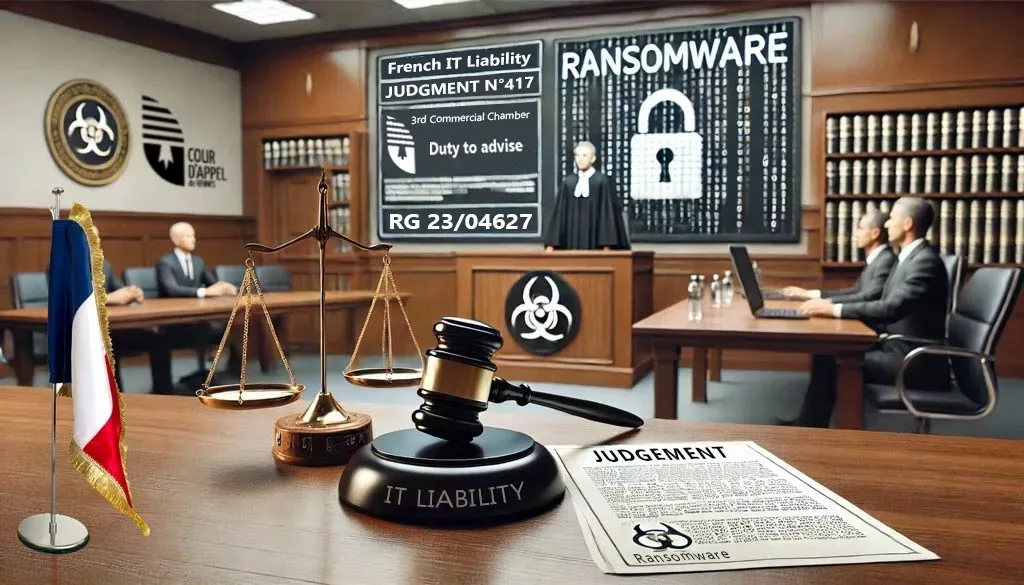
Courtroom scene with a judge's gavel and legal documents on a wooden desk in the foreground, symbolizing a ruling on IT liability. A screen in the background displays a ransomware warning, emphasizing the case's digital focus.

French IT Liability Case: A Historic Legal Precedent

The French IT Liability Case has established a historic precedent, redefining the legal obligations of IT providers under French law. The Rennes Court of Appeal condemned MISMO to pay €50,000 in damages for failing its advisory obligations, highlighting the vital importance of proactive cybersecurity measures to safeguard clients against ransomware attacks. This case not only reshapes IT provider responsibilities but also offers valuable insights into the evolving relationship between technology and the law.

2025 Cyber Doctrine Cyberculture

Uncodified UK constitution & digital sovereignty
2025 Cyberculture Cybersecurity Digital Security EviLink

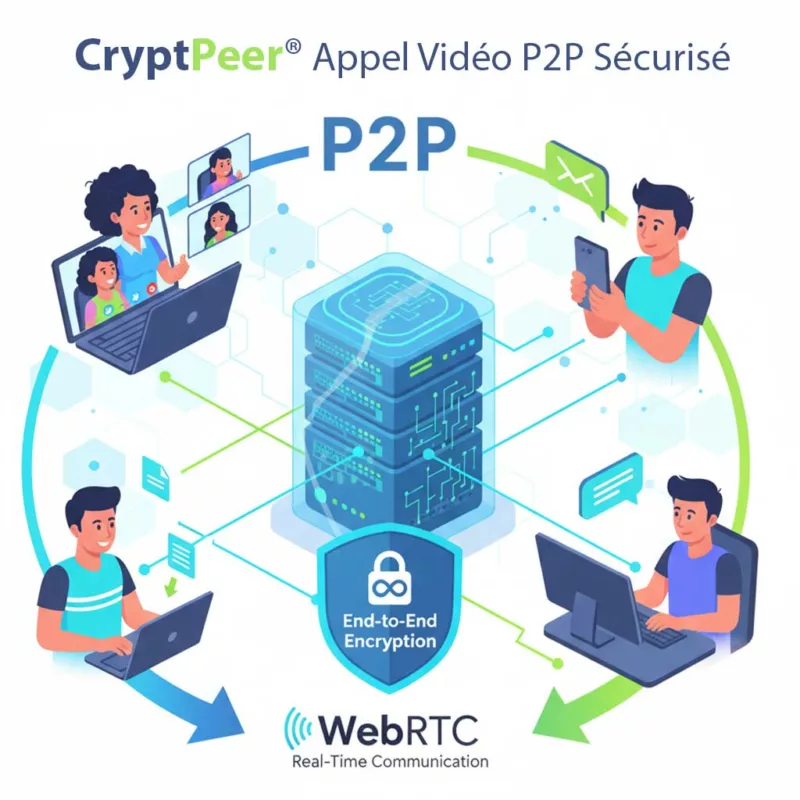
CryptPeer messagerie P2P WebRTC : appels directs chiffrés de bout en bout

2025 Cyber Doctrine Cyberculture

Souveraineté individuelle numérique : fondements et tensions globales
2025 Cyberculture

Louvre Security Weaknesses — ANSSI Audit Fallout

French IT Accountability Case: Jacques Gascuel provides the latest insights and analysis on the evolving legal landscape and cybersecurity obligations for IT providers. Your comments and suggestions are welcome to further enrich the discussion and address evolving cybersecurity challenges.

The Context of the French IT Liability Case

The Rennes French Court of Appeal examined case RG n° 23/04627 involving S.A.S. [L] INDUSTRIE, a manufacturing company, and its IT provider, S.A.S. MISMO. Following a ransomware attack in 2020 that paralyzed [L] INDUSTRIE’s operations, the company alleged that MISMO had failed in its contractual obligations to advise and secure its IT infrastructure.

This ruling underscores the importance of clear contractual terms, proactive cybersecurity measures, and the legal obligations of IT providers in safeguarding their clients’ operations. For full details, refer to the official court decision.

Timeline of the Case

A three-year legal journey highlights the complexity of IT liability disputes, with a final decision reached on November 19, 2024, after all appeals were exhausted.

Key Milestones:

  • July 2019: Contract signed between [L] INDUSTRIE and MISMO to update IT infrastructure.
  • November 2019: Installation of equipment by MISMO.
  • June 17, 2020: Ransomware attack paralyzes [L] INDUSTRIE.
  • July 30, 2020: [L] INDUSTRIE raises concerns about shortcomings in the IT system.
  • July 17, 2023: First decision from the Nantes Commercial Court, rejecting [L] INDUSTRIE’s claims.
  • July 27, 2023: Appeal lodged by [L] INDUSTRIE.
  • September 24, 2024: Public hearing at the Rennes Court of Appeal.
  • November 19, 2024: Final decision: MISMO ordered to pay €50,000 in damages.

French IT Liability Case: A Historic Legal Precedent

The French IT Liability Case establishes a historic legal precedent, defining the obligations of IT providers under French law, particularly regarding cybersecurity measures and contractual responsibilities. This ruling marks a new era in jurisprudence for IT liability.

Obligations in IT Contracts Highlighted by the French IT Liability Case

The decision of the Rennes Court of Appeal has garnered significant attention from legal experts, particularly those specializing in IT law and contractual disputes:

  • Maître Bressand, a specialist in IT and contractual disputes, highlights that clients dissatisfied with IT services frequently invoke breaches of the duty of advice and pre-contractual information to nullify or terminate contracts. He emphasizes that this decision reinforces the necessity for IT providers to document all recommendations and contractual agreements meticulously (Bressand Avocat).
  • The Solvoxia Avocats Firm, in their analysis from November 2024, notes that even in cases where contract termination is attributed to shared fault, IT providers may still be liable to compensate clients for damages. This underscores the criticality of fulfilling advisory obligations to mitigate risks (Solvoxia Avocats).
These perspectives illustrate the evolving expectations for IT providers in France to ensure compliance with legal obligations and prevent potential disputes through proactive advisory roles.

Counterarguments from IT Providers:

IT providers may argue that they cannot foresee every potential cybersecurity threat or implement all best practices without significant client investment. Many providers claim that clients often reject higher-cost solutions, such as disconnected backups or advanced firewalls, citing budget constraints. Additionally, providers may argue that contractual limitations should shield them from certain liabilities when clients fail to follow provided recommendations. Despite these challenges, courts across Europe continue to emphasize the proactive role IT providers must play in cybersecurity.

International Reactions: A Global Perspective

EU Context: Aligning with NIS2 Directive

The French IT Liability Case resonates with the goals of the NIS2 Directive, adopted by the European Union to enhance cybersecurity across member states. The directive emphasizes:

  • Proactive risk management: IT providers must anticipate and mitigate risks to critical infrastructure.
  • Clear contractual obligations: Providers must outline cybersecurity responsibilities transparently in service agreements.
  • Incident reporting: Mandatory reporting of major security breaches to relevant authorities.

This case highlights similar principles, particularly the obligation of advice and the need for detailed documentation of IT service provider responsibilities. For more information, refer to the European Commission’s NIS2 Directive overview.

Comparative Jurisprudence: Cases Across Europe

  • Germany: No recent specific cases mirror the Rennes case directly. However, German courts, under the IT Security Act 2.0, have held IT service providers accountable for failing to implement industry-standard measures. These rulings stress the importance of advising clients on state-of-the-art cybersecurity measures.
  • United Kingdom: The UK’s Data Protection Act 2018, combined with GDPR, imposes strong obligations on IT providers. While no specific case comparable to the Rennes decision has emerged recently, there is growing emphasis on documenting advisory roles and ensuring client understanding of potential risks.

Global Expert Opinions

International experts have commented on the broader implications of this case:

EU Perspective: A cybersecurity consultant at the European Union Agency for Cybersecurity (ENISA) emphasized:

“This decision aligns with the NIS2 Directive’s push for accountability, showcasing the importance of IT providers as guardians of digital infrastructure.

Academic Insight: Prof. John Smith, University of Oxford, remarked:

“This case sets a legal precedent that encourages IT providers across Europe to rethink how they frame their service agreements, ensuring transparency and proactive risk management.”

Obligations in IT Contracts Highlighted by the French IT Liability Case

In contractual relationships, the type of obligation—result, means, or advice—defines the scope of responsibility. Understanding these distinctions is key to assessing liability in cases like this one.

1. Obligation of Result in the French IT Liability Case

An obligation of result requires the service provider to achieve a clearly defined outcome. Failure to deliver the promised result typically constitutes a breach of contract unless an event of force majeure occurs.

  • Example in IT: Delivering a functioning server with pre-configured backups as specified in a contract.
  • Relevance to the Case: MISMO was not explicitly bound by an obligation of result to guarantee cybersecurity, as the contract lacked precise terms regarding disconnected backups or external security.

2. Obligation of Means in the French IT Liability Case

With an obligation of means, the provider commits to using all reasonable efforts and skills to achieve the desired outcome, but without guaranteeing it. Liability arises only if the provider fails to demonstrate diligence.

  • Example in IT: Regularly updating software, installing antivirus tools, and following industry best practices.
  • Relevance to the Case: MISMO claimed to have fulfilled its obligation of means, arguing that [L] INDUSTRIE’s configuration choices were the primary cause of the ransomware attack.

3. Obligation of Advice in the French IT Liability Case

The obligation of advice is particularly critical in technical fields like IT. It requires the provider to proactively inform clients about risks, suggest best practices, and propose solutions tailored to their needs. This decision by the court reinforces the significance of the obligation of advice as a cornerstone of IT service contracts. Providers must now anticipate potential risks, such as ransomware vulnerabilities, and recommend appropriate countermeasures to their clients. Failing to do so can result in legal liabilities and damage to their professional reputation.

  • Example in IT: Advising on disconnected backups or flagging the risks of integrating backup systems into Active Directory.
  • Relevance to the Case: The court ruled that MISMO failed its obligation of advice by not recommending critical safeguards, such as isolated backups, which could have mitigated the impact of the ransomware attack. This decision sets a precedent, urging IT providers to go beyond standard measures and provide proactive, well-documented advice tailored to each client’s needs.

Comparative Table: Types of Obligations in the French IT Liability Case

Type of Obligation Definition Example IT Relevance to the Case Example from the Rennes Case
Result The provider must guarantee a specific, defined outcome. (Article 1231-1: Compensation for non-performance of contractual obligations) Delivering a fully operational server with backups as specified in a contract. Not applicable here, as the contract did not include explicit cybersecurity guarantees. The contract lacked provisions requiring disconnected or external backups to be implemented.
Means The provider must employ all reasonable efforts and expertise to achieve the objective. (Article 1217: Remedies for contractual breaches) Regularly updating software, configuring antivirus tools, and implementing best practices. MISMO claimed they fulfilled this obligation by maintaining the system, but inconsistencies in implementation were noted. MISMO argued they had installed antivirus software but failed to monitor its effectiveness consistently.
Advice The provider must proactively inform the client of risks and suggest tailored solutions. (Article 1112-1: Pre-contractual duty of information and advice) Advising on disconnected backups or warning about vulnerabilities in Active Directory integration. The court ruled MISMO breached this obligation by not recommending isolated backups to mitigate ransomware risks. MISMO failed to advise [L] INDUSTRIE on the importance of air-gapped backups, leaving critical data exposed to ransomware.

To further clarify the legal foundation of these obligations, the following Civil Code articles are critical to understanding their application.

Civil Code Connections for IT Obligations

Connecting Obligations to the French Civil Code

Understanding the legal foundations of IT obligations is essential for providers to align their practices with French law. The following articles provide critical legal context:

  1. Article 1231-1: Focuses on compensation for non-performance of contractual obligations. For obligations of result, it underscores the importance of explicitly defined deliverables in contracts.
  2. Article 1217: Covers remedies available in cases of contractual breaches, including compensation, specific performance, and contract termination. This article is relevant to obligations of means, where diligence and reasonable efforts are assessed.
  3. Article 1112-1: Establishes the pre-contractual duty of information and advice, requiring providers to inform clients of critical risks and suggest appropriate solutions. This is pivotal for obligations of advice, where courts assess the quality of recommendations made by providers.

These legal provisions clarify the responsibilities of IT providers and their alignment with contractual obligations, offering actionable guidance for both providers and clients.

Context and Historical Background

The Legal Framework Governing IT Obligations

French law imposes specific obligations on IT service providers to inform, advise, and implement solutions that meet clients’ needs. This case sets a significant precedent by clarifying these obligations and emphasizing the need for IT providers to document their advisory roles comprehensively. Key legal references include:

  • Article 1103: Legally formed contracts are binding on those who made them.
  • Article 1112-1: Pre-contractual duty of information. A party who knows information that is crucial to the other party’s consent must inform them.
  • Article 1217: Addresses the consequences of a contractual breach, including damages and interest.
  • Article 1604: The seller’s obligation to deliver. The seller must deliver the agreed-upon item.
  • Article 1231-2: Governs liability for harm caused by contractual failures.
  • Article 1231-4: Stipulates that damages must correspond to the loss directly linked to the contractual fault.

This legal framework underscores MISMO’s failure to fulfill its duty of advice, highlighting the critical role IT providers play in protecting clients from cybersecurity risks. Providers are now expected to clearly outline the risks and recommended solutions in formalized documentation, ensuring transparency and accountability in their advisory roles.

Technical Insights: What Went Wrong in the French IT Liability Case

While MISMO’s defenses highlighted gaps in the client’s internal practices, such as misconfigured firewalls and excessive privileged accounts, the court ruled that the provider’s duty of advice superseded these client-side shortcomings. However, IT providers may argue that the lack of a detailed and enforceable contract limits their ability to mandate best practices.

The Ransomware Attack

On June 17, 2020, a ransomware attack encrypted [L] INDUSTRIE’s data, including backups. The attack exploited several vulnerabilities:

  • Weak internal configuration (e.g., excessive privileged accounts).
  • Backup servers integrated into Active Directory, making them accessible to attackers.
  • Absence of disconnected or external backups.

Lessons from the Attack

  1. Disconnected Backups: Essential for restoring data even if primary systems are compromised.
  2. Centralized Threat Detection: The lack of unified antivirus left endpoints vulnerable.
  3. Misconfigured Firewalls: Open-source firewalls without robust updates increased risks.
  4. Cloud-based Solutions: Offsite backups enable faster recovery and greater resilience.

SMEs: Cybersecurity Challenges and Protection Strategies

Why SMEs Are Vulnerable

  1. Limited Resources: SMEs often lack budgets for comprehensive cybersecurity.
  2. Absence of Expertise: Few SMEs employ dedicated IT or cybersecurity staff.
  3. Frequent Targets: Cybercriminals exploit SMEs as entry points to larger networks.

Key Statistics

How SMEs Can Protect Themselves

  1. Backup Solutions: Implement air-gapped and offsite backups.
  2. Employee Training: Educate staff on recognizing phishing attempts.
  3. Proactive Investment: Adopt affordable antivirus and firewalls.

Best Practices for IT Providers to Avoid Legal Disputes

  1. Document Recommendations: Provide detailed reports on identified risks and suggested solutions.
  2. Offer Advanced Options: Propose enhanced security measures, even at additional costs.
  3. Educate Clients: Explain the long-term impacts of cybersecurity choices.
  4. Regular Updates: Ensure systems are updated with the latest patches and security tools.
  5. Proactively educate clients about legal obligations for IT service providers, including risk mitigation strategies for ransomware attack

FAQs: Frequently Asked Questions

Clear definitions of obligations (result, means, or advice).
Specific deliverables and associated timelines.
Protocols for incident response and recovery.
Collect emails and reports detailing agreements and communications.
Engage an independent expert to audit the system.
Compare the provider’s actions to industry standards.
Backup solutions: Veeam, Acronis.
Firewalls: Fortinet, Palo Alto Networks.
Email filtering: Barracuda, Proofpoint.
IT providers must comply with obligations of result, means, and advice. These include delivering defined outcomes, employing reasonable efforts to meet objectives, and proactively advising clients on risks and tailored solutions.
This case emphasizes the obligation of advice, requiring IT providers to recommend proactive and customized cybersecurity measures. Providers failing to fulfill this obligation may face legal consequences.
Document all recommendations and cybersecurity measures.
Offer advanced security options and explain their benefits.
Regularly update systems with security patches and tools.
The EU’s NIS2 Directive enforces stringent cybersecurity measures, including mandatory incident reporting and proactive risk assessments. These principles align with the obligations outlined in the French IT Liability Case.

Product Solutions for IT Providers and Clients

Aligning Obligations with PassCypher and DataShielder

The French IT Liability Case highlights the critical need for IT providers to meet their advisory obligations and implement robust cybersecurity measures. Freemindtronic’s PassCypher and DataShielder product lines provide comprehensive tools that directly address these legal and operational requirements, helping providers and clients mitigate risks effectively.

PassCypher NFC HSM and PassCypher HSM PGP: Reinforcing Authentication and Email Security

  • Passwordless Security: Eliminating traditional passwords reduces the risk of credential compromise, a key entry point for ransomware attacks. PassCypher solutions enable one-click, encrypted logins without ever displaying credentials on-screen or storing them in plaintext.
  • Sandboxing and Anti-BITB: Advanced protections proactively block phishing attempts, typosquatting, and malicious attachments, mitigating risks from email-based threats—the initial attack vector in the case.
  • Zero Trust and Zero Knowledge: Operating entirely offline, these solutions ensure that credentials are managed securely, anonymized, and never stored on external servers or databases.
  • Legal Compliance: PassCypher aligns with GDPR and the NIS2 Directive by providing secure, documented processes for authentication and email security.

DataShielder NFC HSM and DataShielder HSM PGP: Advanced Encryption and Backup Security

  • Disconnected Backups: DataShielder enables the management of secure, air-gapped backups, a key safeguard against ransomware. This approach aligns with best practices emphasized in the court decision.
  • End-to-End Encryption: With AES-256 and RSA 4096-bit encryption, DataShielder ensures the confidentiality and integrity of sensitive data, mitigating risks from unauthorized access.
  • Proactive Risk Management: DataShielder allows IT providers to recommend tailored solutions, such as isolated backup systems and encrypted key sharing, ensuring compliance with advisory obligations.
  • Compliance Documentation: Providers can generate secure, encrypted reports demonstrating proactive measures, fulfilling legal and contractual requirements.

Combined Benefits for IT Providers and Clients

  1. Transparency and Trust: By adopting PassCypher and DataShielder, IT providers can deliver clear, documented solutions addressing unique cybersecurity challenges.
  2. Client Confidence: These tools demonstrate a commitment to protecting client operations, enhancing trust and long-term partnerships.
  3. Litigation Protection: Meeting advisory obligations with advanced tools reduces liability risks, as emphasized in the French IT Liability Case.
  4. Holistic Protection: Combined, these solutions provide comprehensive protection from the initial compromise (emails) to ensuring business continuity through secure backups.

PassCypher and DataShielder represent proactive, integrated solutions that address the cybersecurity gaps highlighted in the French IT Liability Case. Their adoption enables IT providers to safeguard client operations, fulfill legal obligations, and build resilient, trusted partnerships.

Conclusion: Redefining IT Responsibilities

The Rennes Court’s decision sets an important precedent for IT service providers, emphasizing the need for clear contracts and proactive advice. For businesses, this case highlights the necessity of:

  • Conducting regular audits of IT configurations and backup systems.
  • Demanding proactive advisory services from IT providers to mitigate potential risks.
  • Encouraging businesses to engage in ongoing cybersecurity training to enhance organizational resilience.
  • Demanding detailed documentation and recommendations from providers.
  • Staying informed about legal obligations and cybersecurity standards.

The Future of IT Provider Relationships

  1. Certifications: ISO 27001 and GDPR compliance will become essential.
  2. Cybersecurity Insurance: A growing standard for providers and clients.
  3. Outsourced Security Services: SMEs will increasingly rely on managed services to mitigate risks.

Call to Action: Download our guide to securing SMEs or contact our experts for a personalized IT audit.

Time Spent on Authentication: Detailed and Analytical Overview

Digital scale balancing time and money, representing the cost of login methods such as passwords, two-factor authentication, and facial recognition, in a professional setting.
Jacques Gascuel actively updates this subject with the latest developments, insights, and trends in authentication methods and technologies. I encourage readers to share comments or contact me directly with suggestions or additions to enrich the discussion.

In-Depth Analysis of Authentication Time Across Methods

Time Spent on Authentication is critical to digital security. This study explores manual methods, password managers, and tools like PassCypher NFC HSM or PassCypher HSM PGP, analyzing their efficiency, security, and impact. It highlights economic, environmental, and behavioral implications, emphasizing the role of advanced technologies in shaping faster, secure, and sustainable authentication practices globally.

2025 Cyber Doctrine Cyberculture

Uncodified UK constitution & digital sovereignty

2025 Cyberculture Cybersecurity Digital Security EviLink

CryptPeer messagerie P2P WebRTC : appels directs chiffrés de bout en bout

2025 Cyber Doctrine Cyberculture

Souveraineté individuelle numérique : fondements et tensions globales

2025 Cyberculture

Louvre Security Weaknesses — ANSSI Audit Fallout

Study Overview: Objectives and Scope

Understanding the cost of authentication time is crucial to improving productivity and adopting advanced authentication solutions.

This study examines the time spent on authentication across various methods, highlighting productivity impacts and exploring advanced tools such as PassCypher NFC HSM or PassCypher HSM PGP for secure and efficient login processes. It provides insights into manual and automated methods and their global adoption.

Objective of the Study

  • Quantify the time required to log in with pre-existing credentials stored on physical or digital media, with or without MFA.
  • Evaluate all authentication methods, including manual logins, digital tools, and advanced hardware solutions such as PassCypher NFC HSM or PassCypher HSM PGP.
  • Compare professional and personal contexts to highlight global productivity impacts

Authentication Methods Analyzed

Manual Methods

  • Paper-based storage: Users read passwords from paper and manually enter them.
  • Memorized credentials: Users rely on memory for manual entry.

Digital Manual Methods

  • File-based storage: Credentials stored in text files, spreadsheets, or notes, used via copy-paste.
  • Browser-based managers (no MFA): Autofill tools integrated into browsers.

Password Managers

  • Basic password manager (no MFA): Software tools enabling autofill without additional security.
  • Password manager (with MFA): Software requiring a master password and multi-factor authentication.

Hardware-Based Authentication

  • Non-NFC hardware managers: Devices requiring physical connection and PIN entry.
  • NFC-enabled hardware managers: Tools like PassCypher NFC HSM, utilizing contactless authentication.

Modern Authentication Methods

  • Passkeys and FIDO: Passwordless solutions using biometrics or hardware tokens.

Time Spent on Password Changes

Corporate Cybersecurity Policies and the Cost of Authentication Time

Policy Time Per Change (Minutes) Frequency (Per Year)
Monthly Password Changes 10 12
Quarterly Changes 10 4
Ad Hoc Changes (Forgotten) 15 2

Time-Intensive Scenarios

Denial of Service (DoS) Impact

Extended login delays during attacks lead to significant downtime:

  • Professional Users: 15–30 minutes per incident.
  • Personal Users: 10–20 minutes per incident.
Forgotten Passwords

Password recovery processes average 10 minutes but can extend to 30 minutes if additional verification is required.

Regional Comparisons of Credential Use and Time

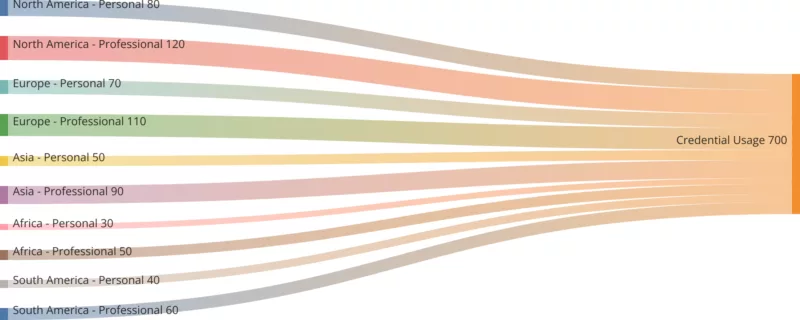
Credential Usage Across Regions

Region Average Personal Credentials Average Professional Credentials
North America 80 120
Europe 70 110
Asia 50 90
Africa 30 50
South America 40 60
Regional Credential Usage: A Heatmap Overview

This diagrame present the differences in credential usage across global regions. This heatmap highlights the number of credentials used for personal and professional purposes, revealing regional trends in authentication practices and the adoption of advanced methods.

Heatmap showing credential usage by region for personal and professional contexts.
Heatmap visualizing the number of credentials used by individuals and professionals in different regions.

Cultural and Infrastructural Influences

In Asia, biometric solutions dominate due to advanced mobile ecosystems. North America shows a preference for NFC and password managers, while Africa and South America rely on manual methods due to slower technological adoption.

Behavioral Insights and Frustrations

Behavioral insights provide critical understanding of how users perceive and respond to the cost of authentication time.

Credential Change Frequency

Organizations enforce frequent password changes to meet cybersecurity standards, with monthly resets common in sectors like finance. Ad hoc changes often occur when users forget credentials.

MFA and DoS Impact

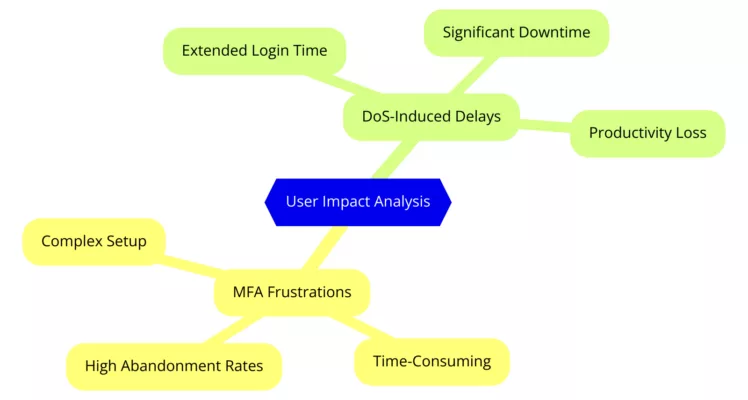
Complex MFA processes frustrate users, causing abandonment rates to rise. DoS attacks lead to login delays, resulting in significant productivity losses of up to 30 minutes per incident.

User Impact Analysis: MFA vs DoS Challenges

This mindmap explores the frustrations caused by complex multi-factor authentication (MFA) processes and delays from denial-of-service (DoS) attacks. Learn how these challenges affect user productivity and time spent on authentication.

Mindmap illustrating user frustrations from MFA processes and DoS-induced delays.
A mindmap visualizing the impact of MFA complexities and DoS-induced delays on user productivity.

Daily and Annual Time Allocation

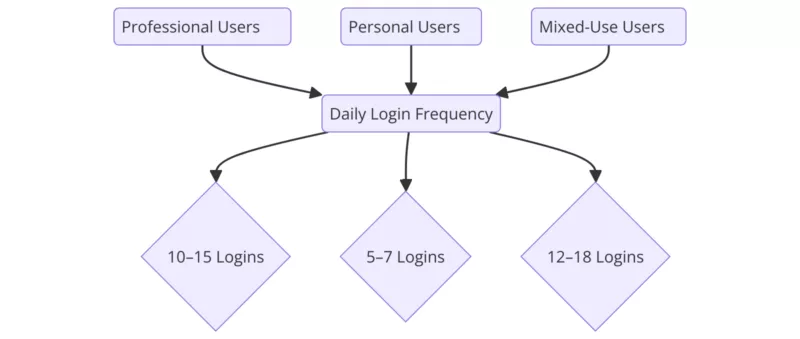
Daily Login Frequency

User Type Logins/Day
Professional Users 10–15
Personal Users 5–7
Mixed Use (Both) 12–18
Daily Login Frequency: Comparing User Habits
Analyze the daily login habits of professional, personal, and mixed-use users. This bar chart provides insights into authentication frequency and its impact on productivity.
Bar chart comparing daily login frequency for professional, personal, and mixed-use users.
Bar chart showing the daily login habits of different user categories: professional, personal, and mixed-use.

Beyond the time spent on authentication, it’s crucial to consider its financial implications, especially in business or remote work contexts.

Accounting for the Cost of Authentication Time in Professional and Personal Contexts

The cost of authentication time is often underestimated, but when scaled across organizations, these delays translate into significant financial losses.

Overview: Time Is Money

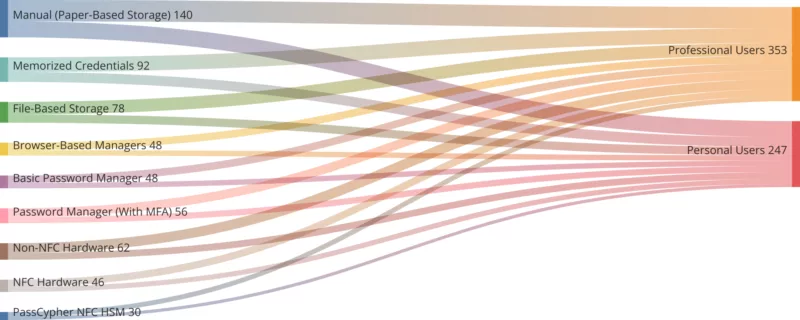
Time spent on authentication, whether in professional, personal, or remote work contexts, often feels insignificant. However, scaled across an organization, these seemingly minor tasks translate into substantial financial losses. This section highlights the cost of time spent identifying oneself, managing passwords, and handling secure devices. We explore daily, monthly, and annual impacts across professional, private, and telework scenarios, demonstrating the transformative value of advanced solutions like PassCypher NFC HSM and PassCypher HSM PGP.

Key Scenarios for Time Allocation

Scenario Time Spent (Minutes) Frequency (Per Day) Monthly Total (Hours) Annual Total (Hours)
Searching for stored passwords 5 2 5 60
Manual entry of memorized credentials 3 5 7.5 90
Copy-pasting from files or managers 2 5 5 60
Unlocking secure USB devices 5 1 2.5 30
Recovering forgotten passwords 15 0.5 3.75 45
Total (Typical Professional User) 23.75 285

Financial Costs of Authentication Time

According to a study by Gartner companies dedicate up to 30% of IT tickets to password resets, with an average cost of $70 per request. By integrating solutions like PassCypher, these costs could be halved.

Based on industry reports and wage data from sources such as Gartner and the Bureau of Labor Statistics, the estimated average hourly wage for IT professionals ranges between $30 and $45, depending on experience, location, and sector. Considering a conservative estimate of $30 per hour, the financial impact of time spent on authentication becomes significant:

User Type Monthly Cost ($) Annual Cost ($)
Single Professional 712.50 8,550
Small Business (50 users) 35,625 427,500
Medium Enterprise (1,000 users) 712,500 8,550,000

Common References (2024–2025)

Geographic Area Approximate Gross Hourly Wage Source
USA (Gartner) $31.06/h (April 2025) Trading Economics
Eurozone (OECD) €30.2/h (2022, estimate) INSEE
France (INSEE 2024) €28.4/h average gross wage INSEE
UK ~£22/h → ~€26/h (weekly average wage of £716) Trading Economics
Global (IT sector) Between $30–$45/h depending on level BDM

Insight:

For a medium-sized enterprise, authentication time alone can lead to more than $8.5 million per year in lost productivity. This estimate does not include potential financial risks associated with security breaches, human errors, or compliance issues, which could significantly amplify overall costs.

Comparing Traditional and Advanced Authentication Solutions

Traditional authentication methods significantly increase costs due to inefficiencies, whereas advanced authentication solutions like PassCypher NFC HSM and PassCypher HSM PGP streamline processes, enhance security, and reduce expenses.

Traditional Authentication

  • Cumulative Costs: High due to time-intensive processes such as searching, memorizing, and manually entering passwords.
  • Risk Factors: Frequent errors, delays, and forgotten credentials lead to operational inefficiencies and increased support costs.

Advanced Authentication with PassCypher Solutions

  • Cumulative Costs: Significantly reduced with modern authentication tools.
  • Auto-Connection with PassCypher NFC HSM: Login times drop to less than 10 seconds, improving efficiency in high-frequency authentication tasks.
  • One-Step Login with PassCypher HSM PGP: Even single-step logins are completed in just 1 second, minimizing delays.
  • Dual-Stage Login with PassCypher HSM PGP: Two-step logins, including OTP validation, are completed in only 3 seconds, ensuring security without compromising speed.

Cost Reduction Example

A 50% decrease in authentication time for a 1,000-employee enterprise results in $4.25 million in annual savings, demonstrating the financial advantages of streamlined authentication solutions.

Telework and the Cost of Authentication Time

Remote work amplifies the cost of authentication time, with teleworkers spending considerable time accessing multiple systems daily. Advanced authentication solutions mitigate these delays.

Example: Remote Work

  • A teleworker accesses 10 different systems daily, spending 30 seconds per login.
  • Annual Cost Per Employee:
    • Time: ~21 hours (~1,250 minutes).
    • Financial: $630 per employee.

Enterprise Impact:

For a company with 1,000 remote workers, telework-related authentication costs can reach $630,000 annually.

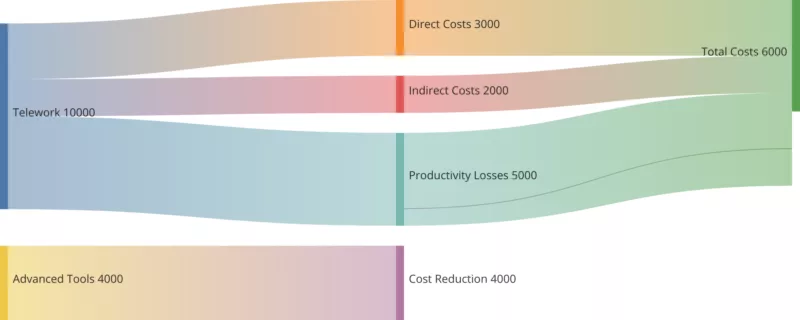
Telework Costs and Authentication: Time Spent on Authentication

This diagram provides a detailed view of telework’s financial impacts, highlighting direct, indirect, and productivity-related costs. It emphasizes the significant savings in time spent on authentication achievable with advanced tools like PassCypher, reducing costs and enhancing productivity.

Sankey diagram showing the impacts of telework costs, including direct costs, indirect costs, productivity losses, and the role of advanced tools in reducing total costs, emphasizing time spent on authentication.
A Sankey diagram illustrating the breakdown of telework costs and the cost reductions achieved using advanced authentication tools, addressing time spent on authentication.

Solutions to Reduce Costs

Adopt Advanced Tools:

  • PassCypher NFC HSM: Offers auto-connection on Android NFC devices for login in <10 seconds, streamlining the process and eliminating manual input delays.
  • PassCypher HSM PGP: Enables one-click logins in <1 second, reducing dual-stage authentication to just 3 seconds.
  • Bluetooth Keyboard Emulator: Enhances NFC HSM devices by enabling universal credential usage across any system supporting USB HID Bluetooth keyboards, reducing login times to under 9 seconds.

Consolidate Authentication:

  • Single Sign-On (SSO): Minimize the need for multiple logins across platforms.

Train Employees:

  • Efficient password management practices help staff save time and reduce frustration.
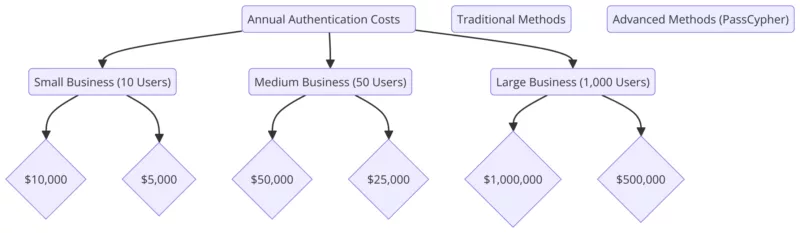
Annual Authentication Costs for Businesses

This diagram compares the annual authentication costs for small, medium, and large businesses. It highlights the financial savings achieved with advanced methods like PassCypher NFC HSM, showcasing their cost-effectiveness compared to traditional solutions.

Bar chart comparing annual costs of traditional versus advanced authentication methods for small, medium, and large businesses.
A comparison of annual costs for traditional and advanced authentication solutions like PassCypher across businesses of different sizes.

Example of PassCypher NFC HSM in Action

With PassCypher NFC HSM:

  • Scenario: A professional logs in 15 times daily.
  • Time Saved: Traditional methods take 5 minutes daily (~20 seconds/login); NFC HSM reduces this to 15 seconds daily (~1 second/login).
  • Annual Time Saved: ~24 hours/user.
  • Financial Savings: $720/user annually; $720,000 for 1,000 users.

This showcases the transformative impact of modern tools in reducing costs and boosting productivity.

Annual Time Spent on Authentication

Authentication Method Professional (Hours/Year) Personal (Hours/Year)
Manual (paper-based storage) 80 60
Manual (memorized credentials) 55 37
File-based storage (text, Word, Excel) 47 31
Browser-based managers (no MFA) 28 20
Password manager (basic, no MFA) 28 20
Password manager (with MFA) 33 23
Non-NFC hardware password manager 37 25
NFC-enabled hardware password manager 27 19
PassCypher NFC HSM (Auto-Connection) 18 12
PassCypher NFC HSM (TOTP with MFA) 24 15
PassCypher HSM PGP (Segmented Key) 7 5
 IT Cost Savings Through Advanced Authentication

Adopting advanced authentication methods can reduce IT costs significantly. This line graph illustrates potential savings over five years, emphasizing the value of transitioning to modern tools like NFC and passwordless solutions.

Line graph illustrating IT cost savings from adopting advanced authentication methods.
A line graph showing projected IT cost savings over five years with modern authentication tools.

Economic Impact of Advanced Authentication Solutions

This suject highlights the economic implications of authentication practices, focusing on how advanced authentication solutions reduce the cost of authentication time and improve productivity.

IT Cost Reduction

Password resets account for up to 30% of IT tickets, costing $70 each. A 50% reduction could save companies with 1,000 employees $350,000 annually.

Productivity Gains

Switching to advanced methods like Passkeys or NFC saves 50 hours per user annually, translating to 50,000 hours saved for a 1,000-employee company, valued at $1.5 million annually.

Five-Year Cost Savings with Advanced Authentication

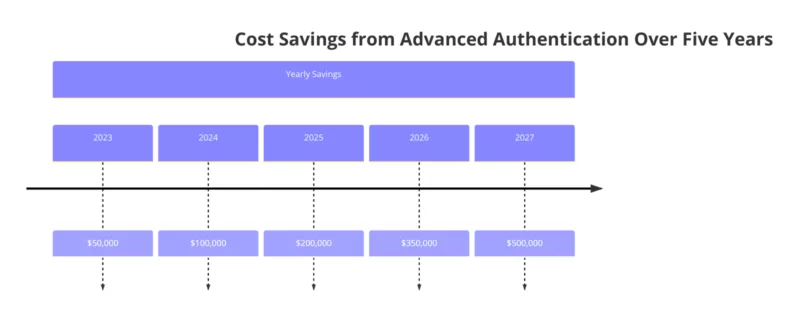
This diagram visualizes the financial benefits of adopting advanced authentication solutions. Over five years, companies can achieve significant cost savings, reflecting the economic advantages of modernizing authentication methods.

Timeline showing cost savings from advanced authentication methods over five years, from $50,000 in 2023 to $500,000 in 2027.
A timeline charting the financial benefits of transitioning to advanced authentication methods over a five-year period.

Environmental Impacts

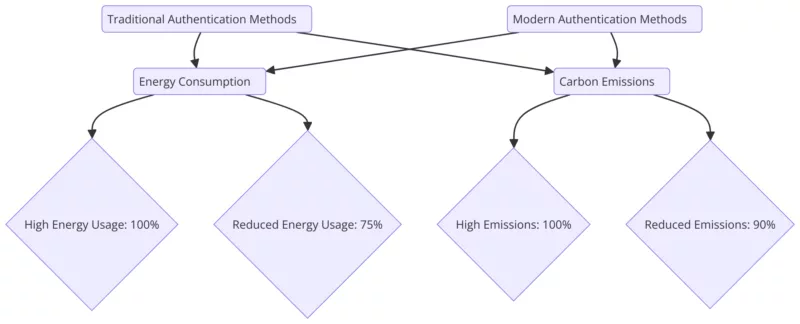
The environmental impact of authentication processes is often underestimated. According to analysis from the Global e-Sustainability Initiative (GeSI), password resets place an additional load on data centers, significantly increasing energy consumption. Optimizing processes with modern tools like PassCypher NFC HSM can reduce this consumption by up to 25%, thereby cutting associated CO2 emissions.

Data Center Energy Costs

Extended authentication processes increase server workloads. Password resets alone involve multiple systems, significantly impacting energy use.

Global Energy Savings

Data centers represent a significant share of CO2 emissions from digital processes. According to the Global e-Sustainability Initiative (GeSI), optimizing authentication processes could reduce their carbon footprint by 10,000 metric tons annually

Energy and Carbon Footprint of Authentication Methods

Explore the environmental impact of authentication processes. This diagram compares energy usage and carbon emissions between traditional and modern methods, showcasing how advanced solutions can lead to a more sustainable future.

Diagram comparing energy consumption and carbon emissions for traditional and modern authentication methods.
A comparison of energy consumption and carbon emissions between traditional and modern authentication methods.

Future Trends in Advanced Authentication Solutions

Emerging technologies and advanced authentication solutions, such as AI-driven tools and passwordless methods, promise to further reduce the cost of authentication time.

Emerging Technologies

AI-driven authentication tools predict user needs and streamline processes. Wearables like smartwatches offer instant, secure login capabilities.

Passwordless Solution Adoption

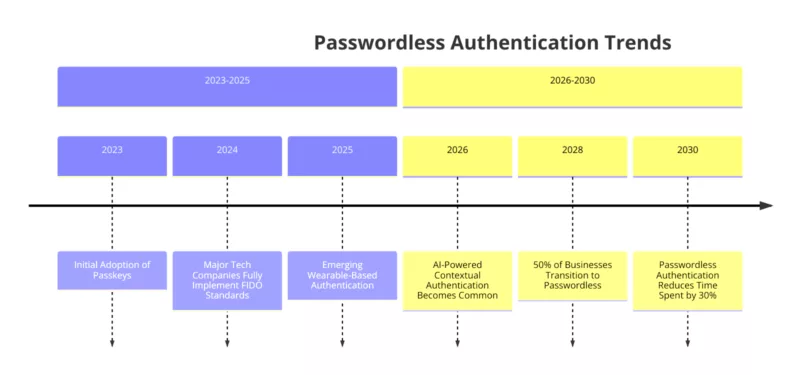
Passkeys and FIDO technologies are expected to reduce global authentication time by 30% by 2030, marking a shift toward enhanced security and efficiency.

Key Trends in Passwordless Authentication

This diagram provides a detailed timeline of the evolution of passwordless authentication from 2023 to 2030. It outlines major advancements like the adoption of passkeys, the rise of wearable-based and AI-powered authentication, and the significant time savings these methods offer by 2030.

Timeline illustrating major milestones in passwordless authentication trends from 2023 to 2030, including technological advancements and adoption milestones.
A timeline showcasing key advancements in passwordless authentication methods and their impact on reducing time spent on authentication by 2030.

Statistical Insights and Visualizations

Authentication consumes 9 billion hours annually, with inefficient methods costing businesses over $1 million per year in lost productivity. Advanced tools like PassCypher NFC HSM can save users up to 50 hours annually.

Global Insights: Authentication Trends and Productivity

Explore the global trends in authentication, including the staggering time spent, productivity losses, and the savings achieved with advanced tools. This infographic provides a comprehensive overview of the current and future state of authentication practices.

Flowchart summarizing global authentication statistics, highlighting 9 billion hours spent annually, $1 million in productivity losses, and time saved with advanced tools.
A flowchart summarizing global statistics on authentication, emphasizing the time spent, annual productivity losses, and savings from advanced tools.

Sources and Official Studies

  • NIST SP 800-63B : Authoritative guidelines on authentication and credential lifecycle management, including best practices for reducing password reset costs.
  • Global e-Sustainability Initiative (GeSI) : Analysis of the environmental and energy implications of data centers, emphasizing sustainability in digital infrastructures.
  • Greenpeace : Research highlighting energy-saving strategies and their role in reducing the carbon footprint of IT systems.
  • FIDO Alliance : Insights into the rapid adoption of passwordless solutions, with statistics on the time saved and enhanced user convenience.
  • PassCypher NFC HSM Lite : A lightweight, secure solution for managing credentials and passwords with contactless ease.
  • PassCypher NFC HSM Master : Advanced features for managing contactless credentials and ensuring secure login processes across various environments.
  • Bluetooth Keyboard Emulator : An innovative device that allows secure, contactless use of credentials from NFC HSM devices across any system supporting USB HID Bluetooth keyboards. It ensures sub-9-second authentication, making it a universal tool for diverse systems, including proprietary software and IoT devices.
  • PassCypher HSM PGP : A secure, end-to-end encrypted password manager with advanced PGP support, enabling robust credential security.
  • Freemindtronic: Passwordless Password Manager : A detailed overview of Freemindtronic’s passwordless solutions, focusing on their ease of use and high security standards.

Passwordless Password Manager: Secure, One-Click Simplicity to Redefine Access

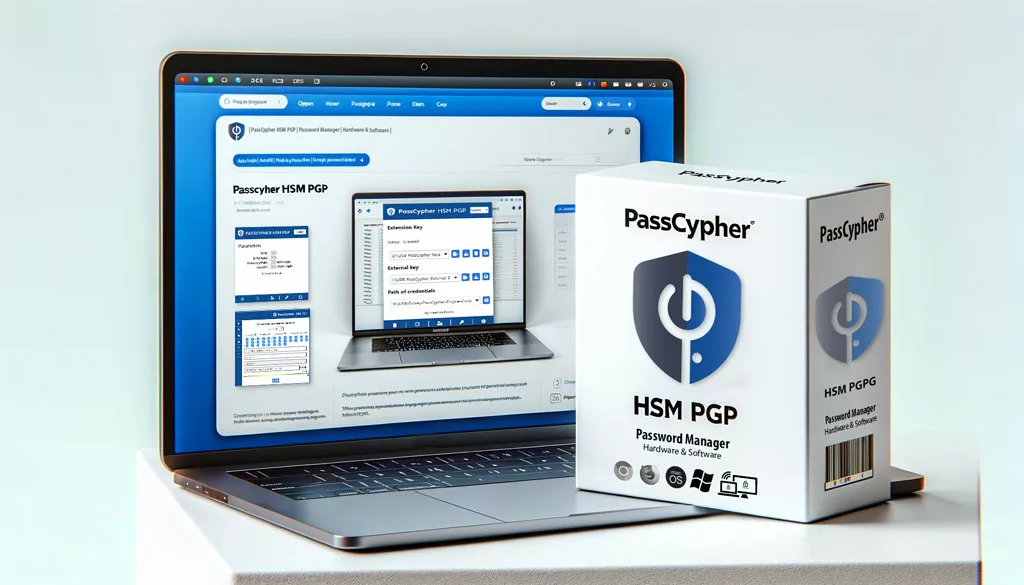
PassCypher HSM PGP password manager software box and laptop displaying web browser interface

Passwordless Password Manager: Secure, One-Click Simplicity to Redefine Access by Jacques Gascuel – Discover how advanced encryption, combined with innovative licensing and eco-friendly design, transforms PassCypher HSM PGP into a true game-changer in modern password management. Share your thoughts or suggestions!

PassCypher at a Glance: Revolutionizing Passwordless Password Managers

  • Passwordless Authentication: Experience seamless access with a fully offline and serverless system.
  • Quantum Resistance: Safeguard your data against current and future threats using AES-256 CBC encryption and patented segmented key technology.
  • Eco-Friendly Design: Minimize your carbon footprint with a serverless and databaseless architecture that consumes less energy.
  • Universal Compatibility: Works effortlessly with any system, requiring no updates, plugins, or complex integrations.
  • Data Sovereignty: Ensure full control over your data with local storage, fully compliant with GDPR, NIS2, and other international standards.

Ideal for: Businesses, government agencies, critical industries, and any organization seeking a secure, scalable, and sustainable solution.

PassCypher HSM PGP: The Ultimate Passwordless Password Manager for 2025

This cutting-edge solution eliminates traditional passwords, replacing them with robust, AES-256 encrypted containers and segmented key authentication. Operating entirely offline without servers or databases, PassCypher provides unmatched data sovereignty and resilience against cyber threats. Ideal for organizations seeking compliance with regulations like NIS2 or GDPR, it ensures quantum-resistant security while simplifying access with one-click authentication. Whether you’re protecting enterprise systems or personal accounts, PassCypher delivers secure, eco-friendly, and future-proof password management.

PassCypher HSM PGP goes beyond traditional password management by integrating advanced cryptographic tools directly into its platform. These features include the secure creation of SSH key pairs and AES-256 encryption keys, empowering users to streamline security processes while maintaining maximum control over sensitive data. Ideal for modern organizations, PassCypher adapts to the evolving needs of professionals and teams working in dynamic environments.

Passwordless Cybersecurity Tailored for Businesses of All Sizes

PassCypher HSM PGP provides unmatched security for businesses, whether you’re a startup, an SME, or a multinational corporation:

  • Small Businesses: Benefit from affordable, flexible licensing and streamlined access management.
  • Large Enterprises: Ensure secure, scalable access for teams, with compliance-ready features and robust protection against ransomware.
  • Critical Industries: Protect sensitive data with quantum-resistant encryption and zero-server architecture.

Hardware-Based Licensing for SMEs: PassCypher’s hardware licenses offer cost-effective, scalable solutions, enabling SMEs to enhance security without overstretching budgets. These licenses are ideal for dynamic teams requiring secure, flexible access.

👉 Learn how PassCypher transforms security for businesses of all sizes: Read more.

Why Businesses Need a Passwordless Password Manager?

  • Simplify Access: Say goodbye to complex credentials and reduce login frustrations.
  • Enhance Security: Protect against phishing, keyloggers, and other cyber threats.
  • Boost Productivity: With one-click simplicity, employees can focus on what matters

Ready to secure your enterprise? Get started with PassCypher today!

Explore More Digital Security Insights

🔽 Discover related the other articles on cybersecurity threats, advanced solutions, and strategies to protect sensitive communications and critical systems.

2025 Digital Security Technical News

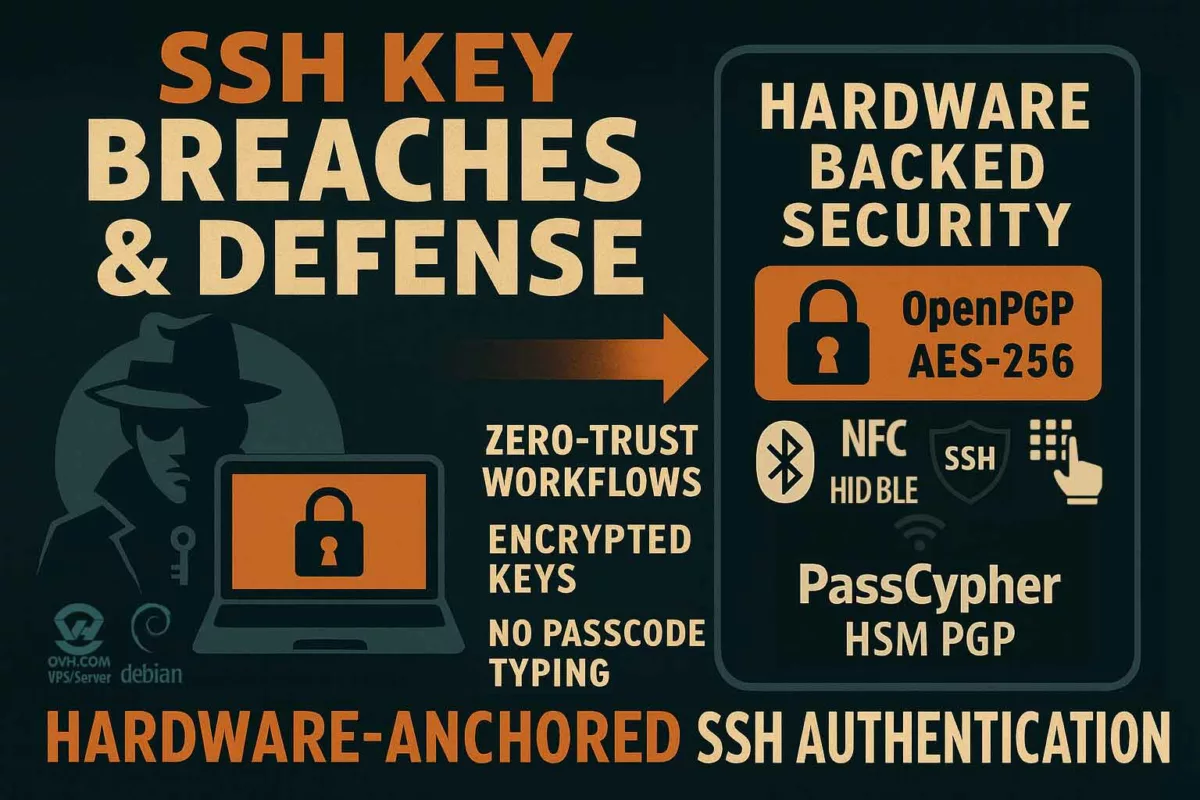
Sovereign SSH Authentication with PassCypher HSM PGP — Zero Key in Clear

2025 Digital Security Tech Fixes Security Solutions Technical News

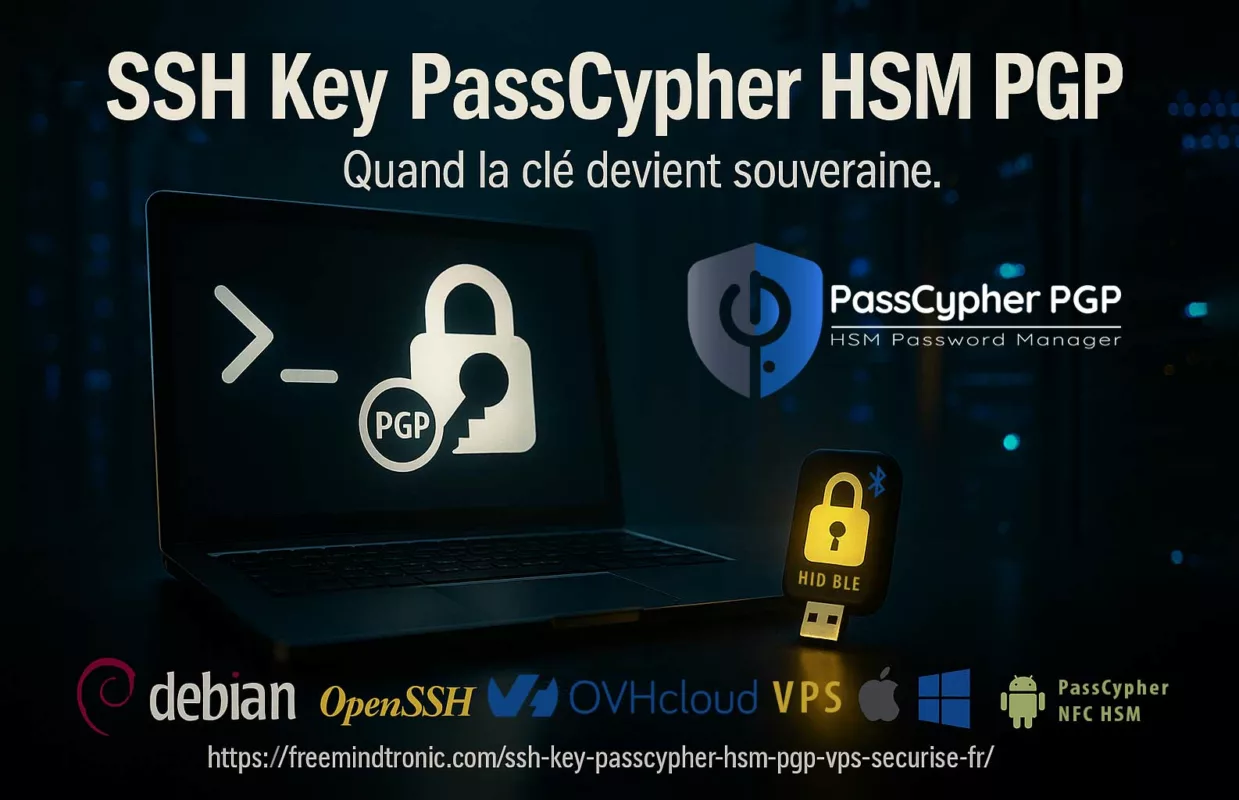
SSH Key PassCypher HSM PGP — Sécuriser l’accès multi-OS à un VPS

2025 Digital Security Technical News

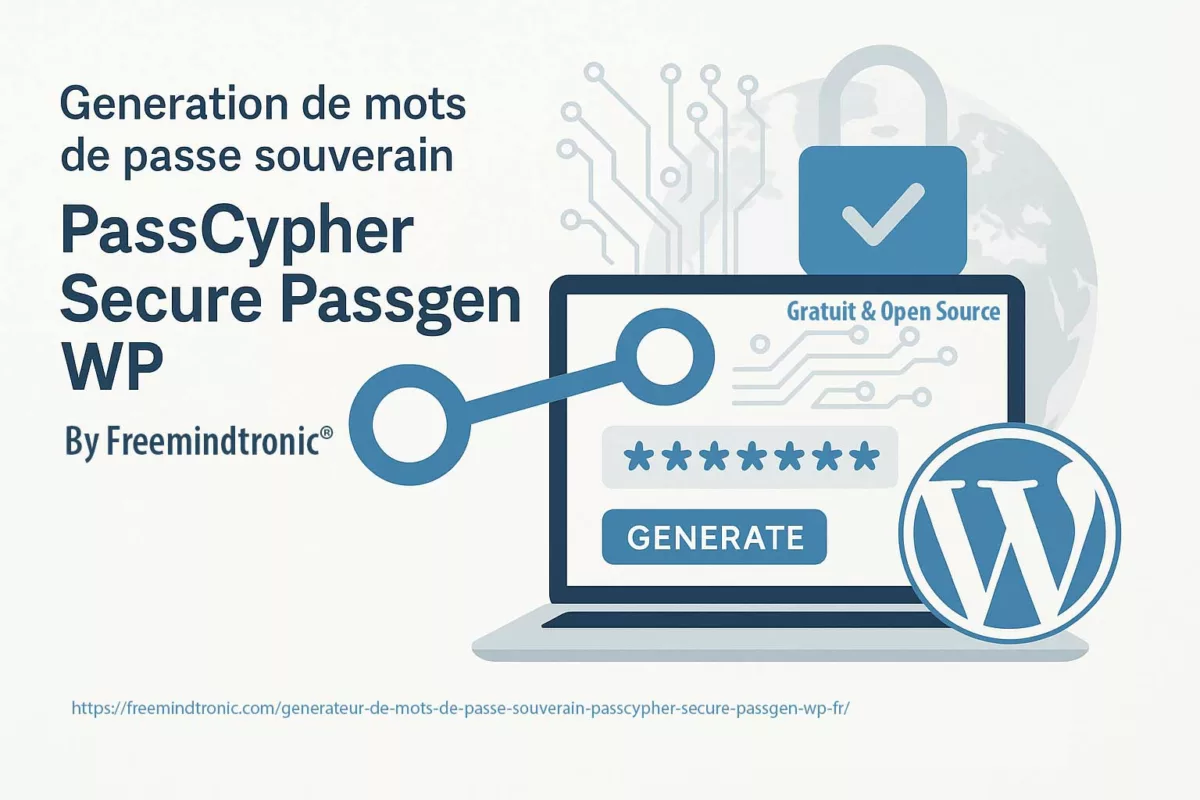
Générateur de mots de passe souverain – PassCypher Secure Passgen WP

2025 Digital Security Technical News

Quantum computer 6100 qubits ⮞ Historic 2025 breakthrough

2025 Digital Security Technical News

Ordinateur quantique 6100 qubits ⮞ La percée historique 2025

2025 Tech Fixes Security Solutions Technical News

SSH VPS Sécurisé avec PassCypher HSM

2025 PassCypher Password Products Technical News

Passwordless Password Manager: Secure, One-Click Simplicity to Redefine Access

The Ultimate Passwordless Password Manager

In today’s digital landscape, where cyber threats grow more sophisticated, having a robust password manager is essential. The PassCypher HSM PGP transforms access control with seamless, secure, and innovative management.

How PassCypher HSM PGP Redefines Passwordless Security

PassCypher HSM PGP introduces groundbreaking advancements that redefine what it means to be a Passwordless Password Manager. By seamlessly combining security, efficiency, and compatibility, PassCypher stands out as the most innovative solution for today’s evolving cybersecurity landscape.

Advanced Technologies Empowering Passwordless Security

  1. Segmented Key Technology: Unlike traditional multi-factor authentication (MFA), PassCypher uses segmented keys that eliminate reliance on vulnerable servers. This ensures enhanced data protection by distributing the key components securely.
  2. Complete Offline Operation: PassCypher operates entirely without servers or centralized databases. This serverless, databaseless design ensures total data sovereignty and eliminates risks associated with cloud dependency.
  3. Quantum-Resistant Encryption: Equipped with AES-256 CBC encryption, PassCypher is built to resist quantum computing threats, offering unparalleled security for decades to come.
  4. Universal Compatibility: Designed to work seamlessly with existing websites, applications, and systems, PassCypher eliminates the need for updates, plugins, or specialized integrations.
  5. Integrated Cryptographic Tools: Seamlessly generate secure SSH key pairs and AES-256 encryption keys, empowering professionals to maintain secure workflows with ease.

Revolutionary Auto-Login and Step-Up Authentication

PassCypher HSM PGP redefines secure access with its two-step and one-click authentication method. This cutting-edge approach combines speed, simplicity, and end-to-end security, streamlining the login process like never before.

How It Works:

PassCypher offers two streamlined methods for different security scenarios:

  1. Two-Step Auto-Login:
    • Step 1: The user clicks the small arrow icon next to the login field. This action automatically completes and validates the username or email securely.
    • Step 2: After validation, the user clicks the arrow icon next to the password field to auto-fill and validate the password, completing the login.

    This method is ideal for platforms requiring both username and password for access.

  2. One-Click Authentication:
    For services requiring only one credential (e.g., username or email), a single click on the arrow icon fills and validates the required field instantly.
Key Advantages:
  • Ultra-Simple Workflow: A seamless process requiring just one or two clicks ensures effortless access without sacrificing security.
  • End-to-End Security: Credentials are decrypted exclusively in volatile memory during auto-fill. The encrypted containers stored on the hardware remain untouched and fully secure.
  • No Data Exposure: Credentials are never stored or transmitted in plaintext, eliminating risks of interception or compromise.
Why It Matters:

PassCypher HSM PGP revolutionizes the traditionally cumbersome two-factor authentication process by automating it with segmented key technology. All operations are conducted offline within encrypted containers, ensuring absolute protection against phishing, brute-force attacks, and other cyber threats.

Result: A streamlined, ultra-secure user experience that takes seconds to complete while safeguarding your most sensitive information.

Validate Password Strength in Real Time with Entropy Metrics

PassCypher HSM PGP includes a Shannon-based entropy gauge, enabling users to assess password strength in real time. This gauge calculates the entropy of each password, ensuring compliance with security best practices and protecting against brute-force attacks.

Why It Matters:

  • Robust Passwords: The entropy gauge ensures that passwords meet the highest security standards by evaluating their randomness and complexity.
  • Proven Methodology: Based on the renowned Shannon entropy formula, this feature relies on mathematically sound principles to assess and enforce password security.
  • User-Friendly Design: Provides clear visual feedback, guiding users to create stronger passwords effortlessly.

This innovative feature positions PassCypher as a forward-thinking solution for password security.

Advanced Auto-Login and Step-Up Authentication

Streamlined Two-Step Authentication for Modern Needs

PassCypher HSM PGP revolutionizes security workflows by integrating Step-Up Authentication, a widely used method that adds an extra layer of protection. Here’s how it works:

  • The login field is completed and validated first.
  • Only after successful validation does the password field appear, allowing the user to input and validate the password separately.

With PassCypher, these steps are automated using segmented key technology:

  • Auto-Fill Efficiency: Users simply click the auto-fill arrow twice—once for the login and once for the password—streamlining the process while maintaining enterprise-grade 2FA compatibility.
  • Enhanced Security: This dual-step process aligns with modern authentication protocols while preserving the simplicity of passwordless workflows.

By merging ease of use with robust security, PassCypher bridges the gap between traditional 2FA and the future of passwordless authentication, offering a solution that meets the needs of both individuals and enterprises.

SSH Key Management for Developers

A New Standard in Secure Authentication and Encryption

PassCypher HSM PGP sets a new benchmark for passwordless security by integrating essential tools for secure authentication and encryption directly into its platform. These built-in capabilities simplify the creation and management of cryptographic keys, ensuring robust protection for sensitive systems and services.

SSH Key Pair Creation:

Generate password-protected SSH key pairs with an integrated real-time entropy gauge based on Shannon’s formula. This ensures the creation of strong, secure keys resistant to phishing, brute-force attacks, and unauthorized access attempts.

AES-256 Encryption Key Generation:

Easily create AES-256 CBC encryption keys in `.pem` format, secured by passwords. This feature provides an additional layer of flexibility for encrypting sensitive data and securing communications, meeting enterprise-grade security standards.

Secure SSH Key Authentication with Entropy Validation:

PassCypher enhances security by ensuring that passwords used for securing SSH key pairs meet the highest security standards. The built-in Shannon-based entropy gauge provides real-time feedback, empowering developers and IT professionals to create robust, uncrackable passwords with confidence.

Why These Features Matter:

  1. Simplified Security: All essential cryptographic tools are available within a single platform, eliminating the need for additional software or integrations.
  2. Enhanced Productivity: Streamline workflows by unifying secure key creation, passwordless access management, and advanced encryption tools in the same intuitive interface.
  3. Future-Ready Design: PassCypher’s built-in tools are tailored to meet the evolving needs of professionals and organizations demanding cutting-edge security solutions for tomorrow’s challenges.

Key Features of PassCypher HSM PGP as a Passwordless Password Manager

  • Zero Trust and Zero-Knowledge Architecture: Data remains encrypted and inaccessible to unauthorized parties.
  • Segmented Key Sharing: Enables secure collaboration without compromising data integrity.
  • Eco-Friendly Design: Serverless architecture reduces energy consumption while aligning with sustainability goals.
  • Universal Compatibility: Functions with existing systems, requiring no updates or prior integrations.
  • Quantum-Resistant Encryption: AES-256 encryption ensures protection against current and future threats.
  • Built-in Cryptographic Tools: Generate SSH key pairs and AES-256 encryption keys with ease, empowering users to manage security workflows directly within the PassCypher platform.
  • Customizable Algorithms: Choose from RSA (2048, 3072, 4096), ECDSA (256, 384, 521), and ed25519 to tailor encryption strength and meet specific security requirements.
  • Password Protection with Entropy Control: Ensure robust security with a real-time Shannon-based entropy gauge, allowing users to create and validate strong passwords based on proven mathematical principles.

PassCypher HSM PGP vs. FIDO2/Passkeys

While both PassCypher HSM PGP and FIDO2/Passkeys aim to eliminate traditional passwords, their architectures differ significantly:

Feature PassCypher HSM PGP FIDO2/Passkeys
Cryptographic Key Strength AES-256, quantum-resistant AES-256 (non-quantum safe)
Server Dependence Fully offline Relies on cloud servers
Compatibility Universal Platform-specific
Data Sovereignty Full local control Cloud-based storage
Ease of Use One-click, segmented keys Requires integration

PassCypher surpasses FIDO2 by offering offline operation, universal compatibility, and quantum-resistant encryption.

Visual Comparison

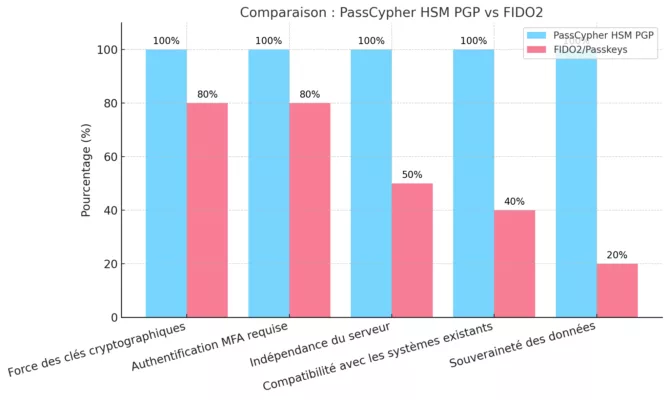
Diagramme à barres verticales comparant PassCypher HSM PGP et FIDO2/Passkeys sur cinq critères : force des clés cryptographiques, authentification MFA, indépendance du serveur, compatibilité avec les systèmes existants, et souveraineté des données.
Ce graphique illustre la supériorité de PassCypher sur FIDO2, avec 100% dans tous les critères contre des scores plus faibles pour FIDO2.

This chart highlights how PassCypher outperforms FIDO2 on critical criteria like compatibility, data sovereignty, and cryptographic strength.

Tailored Solutions for Every Industry

PassCypher adapts to the unique challenges of various industries:

  • Financial Services: Prevent targeted attacks with serverless design and quantum-resistant encryption.
  • Healthcare: Ensure compliance with data privacy laws such as GDPR and HIPAA.
  • Technology: Protect intellectual property and sensitive data from emerging quantum threats.
  • Sovereign and Regalian Needs: With its serverless and databaseless architecture, PassCypher ensures full data sovereignty, end-to-end anonymization, and compliance with national security standards for government agencies and critical infrastructure.

Why PassCypher Outperforms Traditional and FIDO2 Passwordless Solutions

PassCypher HSM PGP revolutionizes cybersecurity with its unique databaseless and serverless architecture. Unlike traditional password managers and FIDO2/Passkeys, it offers unmatched security, universal compatibility, and compliance with global regulations like GDPR and NIS2—all while maintaining eco-friendly efficiency.

Criterion PassCypher HSM PGP FIDO2/Passkeys Traditional Managers
Server Independence Fully serverless Requires cloud servers Requires cloud servers
Data Sovereignty Full local control Cloud-dependent Centralized storage
Quantum-Resistant Keys AES-256 CBC + segmented keys Limited protection No quantum resistance
Ease of Use One-click, secure logins Integration-dependent Manual input
Environmental Impact Reduced energy use, no data centers High due to cloud reliance High due to cloud reliance
Compliance (GDPR/NIS2) Simplified by offline design Complex, cloud-based storage Requires additional safeguards

Key Advantages of PassCypher HSM PGP

  1. Complete Server Independence

    PassCypher operates entirely offline, eliminating reliance on cloud servers or centralized databases. This ensures total data sovereignty and enhances resilience against server outages or cyberattacks targeting cloud infrastructures.

  2. Universal Compatibility

    PassCypher works seamlessly with both legacy and modern systems without requiring updates, prior integrations, or ecosystem-specific dependencies. Unlike FIDO2/Passkeys, it delivers immediate functionality across diverse IT environments.

  3. Enhanced Security with Quantum Resistance

    • PassCypher Combines Advanced Encryption with Patented Segmented Key Technology
      PassCypher HSM PGP delivers unmatched security by combining AES-256 CBC encryption with a patented segmented key system. This innovative design generates encryption keys by concatenating multiple cryptographic segments stored independently on secure hardware. As a result, it creates a robust defense mechanism that stops unauthorized access, even in the face of quantum computing advancements.
    • Why Quantum Computers Struggle to Break PassCypher’s Security
      While quantum algorithms like Grover’s can theoretically speed up brute-force attacks, real-world limitations significantly reduce their effectiveness. Grover’s steps cannot be parallelized, and quantum hardware remains resource-intensive. Additionally, PassCypher’s segmented key design introduces extra layers of complexity. Each segment functions independently, ensuring the combined key is far more challenging to compromise than traditional AES-256 implementations.
      👉 Learn more from the NIST Post-Quantum Cryptography FAQ: NIST FAQ
    • Patented Technology Redefines Security Standards
      Unlike conventional encryption methods, PassCypher’s patented system secures encryption keys by storing them in distinct segments across multiple devices. These segments are concatenated to form a final encryption key, adding an extra level of defense that surpasses the standard AES-256 algorithm. This approach not only withstands classical attacks but also introduces a groundbreaking method to mitigate quantum threats effectively.
      👉 Explore additional resources: The Quantum Resistance of AES-256 and IJARCS AES-256 Quantum Resistance
    • Future-Ready for Evolving Threats
      PassCypher’s segmented key technology is specifically designed to address current and future cybersecurity challenges. This system strengthens enterprise-level protection while ensuring compliance with global standards like GDPR and NIS2. With a focus on scalability and adaptability, PassCypher offers peace of mind for organizations looking to safeguard their most sensitive data.
  4. Simplified Regulatory Compliance

    The databaseless architecture of PassCypher aligns perfectly with GDPR, NIS2, and similar global regulations by storing all data locally on user devices. This approach eliminates risks tied to cloud-based breaches and simplifies regulatory audits.

  5. Streamlined User Experience

    With one-click authentication powered by segmented key technology, PassCypher reduces login friction and accelerates secure access, improving productivity for enterprise teams.

  6. Uncompromised Sovereignty

    PassCypher guarantees complete independence by operating without servers, databases, or account creation. This aligns with the highest standards for national and enterprise-level data sovereignty, making it ideal for critical industries and government entities.

  7. Eco-Friendly and Energy Efficient

    PassCypher’s serverless architecture reduces reliance on energy-intensive data centers, minimizing its carbon footprint. This makes it a sustainable cybersecurity solution for businesses prioritizing environmental responsibility.

  8. One-Click Authentication

    PassCypher simplifies secure access for employees and teams, reducing login times while ensuring robust protection.

  9. Seamless Auto-Login and Auto-Fill with Two-Step Validation

    PassCypher HSM PGP enhances productivity with its auto-login and auto-fill functionality, streamlining access to online accounts while maintaining robust security:

    • Two-Step Validation Simplified: This feature mimics common two-factor authentication (2FA) workflows, where the user first validates their login credentials (username) and then their password. PassCypher automates this process with a two-click system, making it both fast and secure.
    • Visual Assistance: A small arrow icon appears in login fields, guiding the user to complete the process effortlessly. Click once to fill in the username, and again to auto-fill and validate the password.
    • Enhanced Security Against Phishing: With sandbox validation of URLs and seamless segmented key authentication, users are safeguarded against common online threats.

Key Takeaways:

  • Advanced Patented Technology: PassCypher’s segmented key design creates an encryption system that is resilient to both classical and quantum threats.
  • Proven Quantum Resistance: Backed by research from NIST and other credible sources, PassCypher incorporates AES-256 encryption to ensure long-term security.
  • Optimized for Enterprises: The system offers a seamless, scalable solution tailored to meet the needs of businesses seeking durable and compliant cybersecurity strategies.

Comparative Table: PassCypher HSM PGP vs. FIDO2/Passkeys

Criterion PassCypher HSM PGP FIDO2/Passkeys
Server Independence Yes No
Data Sovereignty Fully local Cloud-dependent
Compatibility Universal, works with all systems Requires integrations
Quantum-Resistant Encryption Yes No
Ease of Deployment Immediate, no updates required Requires ecosystem support

Streamlined Visual Comparison

Stacked bar chart comparing PassCypher HSM PGP and traditional password managers on server independence, authentication method, quantum-resistant encryption, database dependence, and user experience, emphasizing PassCypher's independence and quantum resistance.

A consolidated view comparing the critical features of PassCypher HSM PGP and traditional password managers highlights its unique strengths in security, independence, and resilience.

Discover how PassCypher HSM PGP can revolutionize your cybersecurity infrastructure.
Contact us for tailored enterprise solutions today!

Technical Superiority: Segmented Encryption and Passwordless Serverless Design

Why Segmented Encryption Matters

PassCypher HSM PGP introduces two segmented keys, which are concatenated to form a final AES-256 encryption key. This method ensures:

  • Elimination of weak passwords: No user-generated passwords mean brute-force attacks are obsolete.
  • Mitigation of centralized vulnerabilities: Serverless design avoids database breaches.

Key Advantages:

  • Quantum-Resistant Security: AES-256 protects against emerging quantum threats.
  • Zero Cloud Reliance: All operations are localized, ensuring total privacy.
  • One-Click Authentication: Simplifies access with segmented keys.

Zero Trust and Zero-Knowledge Architecture in a Passwordless Password Manager

PassCypher HSM PGP embraces the foundational principles of a passwordless password manager. Its zero trust and zero-knowledge architecture not only ensure that data remains encrypted but also make it inaccessible to all unauthorized parties—even the system itself. This design enforces strict verification protocols for every interaction, eliminating trust assumptions and guaranteeing data integrity.

Passwordless Authentication and Zero Trust Architecture

Passwordless authentication is more than just a trend—it’s the future of secure access. PassCypher HSM PGP integrates a Zero Trust Architecture that demands strict verification for every access attempt. By eliminating assumptions of trust, it ensures data remains encrypted and inaccessible to unauthorized parties. Transitioning to passwordless solutions not only strengthens security but also simplifies workflows, making your systems more efficient.

Centralized Security Without SSO

Traditional single sign-on systems often become points of vulnerability. PassCypher redefines centralized security by introducing segmented key sharing, which is a critical feature of its passwordless password manager. This ensures robust management while eliminating the risks of centralized failure points, providing seamless yet secure access.

Segmented Key Sharing for Passwordless Password Manager

Collaboration without compromise. With segmented key sharing, PassCypher allows authorized users to securely access encrypted data while maintaining strict compartmentalization. Unique key pairs not only ensure secure collaboration but also align perfectly with the principles of a passwordless password manager. This approach demonstrates how PassCypher HSM PGP surpasses traditional password managers by offering unparalleled security.

Segmented Key Sharing: Essential for Modern Passwordless Password Managers

Segmented key sharing isn’t just a feature—it’s the cornerstone of modern passwordless password managers. PassCypher HSM PGP uses segmented keys stored on separate devices, ensuring data remains uncompromised even in the face of advanced threats. This approach enables secure collaboration, granting access only to authorized users while maintaining strict data compartmentalization. By adopting segmented key sharing, businesses can strengthen security without sacrificing flexibility.

Hardware-Based Licensing for Enhanced Security

PassCypher’s hardware-based licensing breaks away from identity-driven models. Users can securely share a single device while maintaining unique segmented keys, offering unmatched flexibility for dynamic, multi-user environments. Moreover, this innovative approach aligns with the ethos of a passwordless password manager by providing both security and simplicity.

Advanced Container and Key Management

Most importantly, PassCypher supports virtually unlimited secure storage across USB drives, SSDs, and cloud solutions. Each container is pre-encrypted using AES-256, offering unparalleled protection for sensitive information. This flexibility cements its place as a leading passwordless password manager for organizations needing advanced data management. For those seeking a guide on implementing passwordless security solutions for small businesses, PassCypher offers an excellent starting point.

Eco-Friendly Design: A Sustainable Approach to a Passwordless Password Manager

In a world where sustainability is key, PassCypher takes the lead with its serverless architecture. By eliminating reliance on energy-intensive data centers, it not only offers an eco-friendly passwordless password manager but also prioritizes both security and environmental responsibility. The PassCypher HSM PGP is designed with sustainability in mind. With its energy-efficient serverless architecture, PassCypher champions sustainable security without compromising on protection.

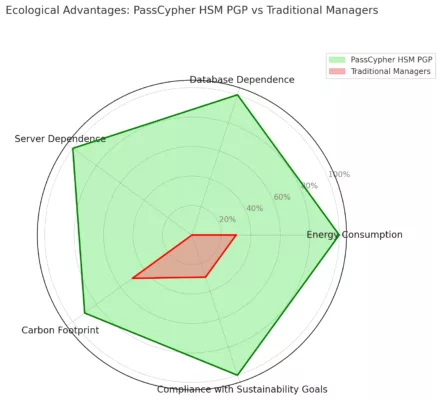
Radar chart comparing ecological advantages of PassCypher HSM PGP and traditional password managers across five criteria: energy consumption, database dependence, server dependence, carbon footprint, and compliance with sustainability goals. PassCypher shows full compliance on most criteria, while traditional managers lag behind.
This radar chart illustrates the ecological superiority of PassCypher HSM PGP over traditional password managers, focusing on energy consumption, independence from servers and databases, reduced carbon footprint, and compliance with sustainability goals.

Passwordless Authentication Redefined

The foundation of PassCypher’s innovation lies in eliminating traditional passwords. By eliminating traditional credentials, it replaces passwords with AES-256 encrypted containers and segmented keys. As a premier As a leader in password-free access solutions, it guarantees password manager, it ensures:

  • No Typing Risks: Keyloggers and screen captures are rendered obsolete.
  • Silent, Secure Authentication: Seamless processes with no audible or visible risks.
  • Instant Access: Single-click authentication without compromising security.

These features collectively redefine what it means to be a passwordless password manager, showcasing how it simplifies security while surpassing traditional methods.

Protection Against Common Threats

PassCypher neutralizes a wide range of cyber threats, including phishing, replay attacks, and keylogging. By encrypting data in containers and, at the same time, preventing plaintext password exposure, it delivers multi-layered protection. That underscores its status as a top-tier passwordless cybersecurity solution. These benefits highlight the advantages of a passwordless password manager in modern cybersecurity.

Flexible Licensing Options for the Leading Passwordless Password Manager

Furthermore, PassCypher’s innovative pricing model ties licenses to hardware, thereby providing both flexibility and anonymity. Whether for short-term use or long-term projects, its hardware-based licensing makes it the most adaptable passwordless password manager available.

Table: Sliding scale of fees

License Type 1 to 9 licenses 10 to 49 licenses 50 to 99 licenses 100 to 249 licenses 250 and over
Day (7 €/day) 7 € €6.50 6 € €5.50 On quote
Week (10 €/week) 10 € 9 € €8.50 8 € On quote
Month (15 €/month) 15 € €13.50 €12.50 12 € On quote
One Year (129 €/year) 129 € 119 € 109 € 99 € On quote
Two Years (€199/2 years) 199 € 179 € 169 € 159 € On quote

Tailored to meet unique business requirements, custom licenses enhance the versatility of this passwordless password manager.

Eliminate Servers: The Future of Password Management

In a world where centralized data storage creates significant vulnerabilities, PassCypher HSM PGP takes a revolutionary approach by operating without servers or databases. Its databaseless and serverless architecture sets a new standard for secure and resilient cybersecurity solutions.

Key Advantages of Databaseless and Serverless Design:

  1. Elimination of Central Points of Failure
    • Without relying on centralized databases or servers, PassCypher removes critical failure points. This ensures uninterrupted functionality even during server outages or targeted cyberattacks.
  2. Simplified Regulatory Compliance
    • By storing all data locally on the user’s device, PassCypher makes compliance with stringent regulations like GDPR and NIS2 straightforward. No cross-border data transfer means enhanced privacy and sovereignty.
  3. Enhanced Resilience Against Cyber Threats
    • Traditional centralized systems are frequent targets for cyberattacks, including ransomware and database breaches. PassCypher’s decentralized design eliminates these risks, safeguarding sensitive data from exploitation.
  4. Uncompromised User Privacy
    • With no external databases or servers to access, user data remains entirely private, ensuring that even service providers cannot intercept sensitive information.
  5. Performance Benefits
    • A databaseless design eliminates the need for database queries, delivering faster authentication and encryption processes for a seamless user experience.

Why It Matters

The serverless and databaseless architecture of PassCypher HSM PGP isn’t just an innovation; it’s a necessity in today’s cybersecurity landscape. By removing reliance on external infrastructure, PassCypher provides businesses and individuals with unparalleled security, privacy, and performance.

This serverless, databaseless architecture positions PassCypher HSM PGP as the ideal solution for individuals and enterprises seeking the best cybersecurity solutions for 2025.

Comparison with popular password managers

Before diving into the comparison, here’s an overview: The following table highlights the standout features of PassCypher HSM PGP compared to other password managers. It demonstrates how PassCypher sets a new benchmark in passwordless security.

Technical Features

Feature PassCypher HSM PGP LastPass Dashlane 1Password Bitwarden
Server Independence Fully offline and serverless Server-dependent Server-dependent Server-dependent Server-dependent
Authentication Method Segmented key-based MFA Password/Biometric Password/Biometric Password/Biometric Password/Biometric
Security Framework AES-256 + sandbox validation AES-256, password encryption AES-256, password encryption AES-256, password encryption AES-256, password encryption
Quantum-Resistant Encryption Yes No No No No
Database Dependence None—databaseless architecture Centralized database storage Centralized database storage Centralized database storage Centralized database storage

Key Takeaways

The technical superiority of PassCypher HSM PGP is clear—it operates entirely offline, ensuring full independence from servers while offering quantum-resistant encryption. With no database dependency, it guarantees unmatched security for enterprises and individuals alike.

User Experience and Flexibility

Feature PassCypher HSM PGP LastPass Dashlane 1Password Bitwarden
User Experience One-click, segmented keys Manual password input Manual password input Manual password input Manual password input
Data Sovereignty Full local control (no third-party ties) Tied to servers Tied to servers Tied to servers Tied to servers
Eco-Friendly Design Serverless, reduced energy consumption Requires cloud servers Requires cloud servers Requires cloud servers Requires cloud servers
Pricing Model Flexible, hardware-based: licenses for a day, week, month, or year Subscription-based Subscription-based Subscription-based Subscription-based
Protection Against Keylogging Full (no password entry required) Partial (relies on input security) Partial (relies on input security) Partial (relies on input security) Partial (relies on input security)
Multi-User Flexibility Yes—unlimited users per hardware license No—licenses tied to individual users No—licenses tied to individual users No—licenses tied to individual users No—licenses tied to individual users

Key Takeaways

PassCypher redefines user convenience with one-click authentication and segmented key-sharing. Its hardware-based licensing model and eco-friendly design make it a leader in passwordless security solutions for businesses and individuals in 2025.

How does a databaseless architecture simplify compliance?

A databaseless architecture eliminates the risks associated with centralized storage by ensuring that all sensitive data is stored locally on the user’s device. This design minimizes the attack surface for data breaches, making it easier for businesses to comply with regulations such as GDPR and NIS2. Additionally, it simplifies audit and reporting processes by removing complex data management systems, ensuring total data sovereignty for enterprises.

Why PassCypher HSM PGP’s Pricing Model Stands Out

PassCypher’s revolutionary hardware-based pricing model is decoupled from personal or organizational identities, ensuring anonymity and flexibility, key aspects of a passwordless password manager. Users can purchase licenses by the day, week, month, or year, with no financial commitments. Unlike competitors that tie licenses to individual users, PassCypher’s licenses are bound to the hardware, allowing multiple people to securely share the same device. This innovative pricing model supports an infinite number of users, making it ideal for teams or enterprises needing scalable cybersecurity solutions. With no need for recurring subscriptions and the ability to buy short-term licenses, PassCypher offers unmatched affordability for individuals and businesses alike.

  • Unlimited Users: Multiple users can securely share a single license.
  • No Engagement: Flexible durations adapt to any need without long-term commitments.
  • Transparent Costs: Simple, hardware-bound pricing eliminates hidden fees.

This ensures that the pricing model directly ties into the comparison, highlighting why PassCypher offers greater flexibility and affordability compared to competitors. Choose the placement based on where you’d like to emphasize the pricing model’s role in differentiating PassCypher.

Key Insights: Why PassCypher HSM PGP Stands Out in 2025

Server Independence

Unlike competitors such as LastPass or Dashlane, which rely on cloud infrastructure, PassCypher HSM PGP operates entirely offline. Its serverless architecture guarantees total data sovereignty, eliminating risks associated with server breaches, downtimes, or data leaks.

Advanced Authentication

PassCypher employs segmented key-based multi-factor authentication (MFA). This approach offers superior security compared to traditional password or biometric methods, providing robust protection for sensitive data without relying on fragile systems.

Quantum-Resistant Security

Designed for future threats, PassCypher incorporates encryption technologies resilient to quantum computing attacks—a critical feature missing in most competitors. This ensures long-term security for individuals and enterprises.

Streamlined, Secure Access for Teams and Enterprises

PassCypher redefines usability by replacing manual password input with one-click authentication using segmented keys. This approach not only reduces user friction but also eliminates keylogging risks, offering a seamless and secure experience. Balancing security and usability is critical for teams and enterprises. PassCypher achieves this balance with a seamless, one-click authentication process, simplifying secure access across the board.

Hardware-Based Licensing for SMEs

PassCypher’s flexible hardware licenses provide affordable, scalable solutions tailored for small and medium enterprises (SMEs). This ensures secure, streamlined access without breaking budgets, making it an ideal choice for organizations of all sizes.

Database-Free Design

PassCypher is a truly databaseless solution, storing all user data locally. In contrast, traditional password managers like 1Password and Bitwarden rely on centralized databases, which are vulnerable to breaches. With PassCypher, there are no central points of failure, ensuring enhanced privacy and security.

Eco-Friendly and Sustainable

With its serverless architecture, PassCypher consumes significantly less energy compared to cloud-based solutions that require constant server operations. This makes it a sustainable choice aligned with modern environmental goals.

Unparalleled Sovereignty

With no reliance on servers or databases, PassCypher ensures complete independence. This is particularly advantageous for businesses and governments prioritizing data sovereignty, regulatory compliance, and national security. The end-to-end anonymity it offers makes it uniquely positioned for critical industries and sensitive operations.

End-to-End Anonymity

PassCypher delivers complete anonymity by eliminating the need for user accounts, personal information, or master passwords. This approach ensures unparalleled privacy and prevents any third-party access to sensitive data, setting a new standard in the industry.

Supports NIS2 Compliance for Essential and Important Entities

The NIS2 Directive sets stringent cybersecurity requirements for essential and important entities across the European Union, including sectors like finance, healthcare, energy, and telecommunications. PassCypher HSM PGP addresses these needs with:

  • Robust Encryption: AES-256 encryption and segmented key authentication meet the directive’s requirements for strong cybersecurity measures.
  • Serverless Design: Its fully offline architecture eliminates vulnerabilities associated with centralized servers and databases, ensuring resilience against cyber threats.
  • Data Sovereignty: By operating entirely locally, PassCypher simplifies compliance with NIS2’s focus on securing sensitive data.
  • Simplified Risk Management: PassCypher reduces the complexity of incident response and regulatory reporting through its zero-trust architecture and lack of centralized failure points.

For organizations striving to meet NIS2 compliance, PassCypher HSM PGP offers a future-ready, secure solution that aligns with the directive’s key objectives.

The Impact of PassCypher’s Unique Features on Modern Cybersecurity

PassCypher HSM PGP’s unique combination of serverless, database-free design, quantum-resistant encryption, and end-to-end anonymity ensures that it stands apart from traditional password managers. Whether you’re a business seeking the best passwordless solutions for enterprises or an individual prioritizing secure authentication without relying on centralized databases, PassCypher offers an unmatched cybersecurity solution.

This updated section highlights databaseless architecture, server independence, and the innovative features that make PassCypher the most advanced passwordless password manager for 2025.

With cybersecurity evolving rapidly, every feature of PassCypher is designed to address the challenges of today’s digital landscape. Let’s explore how these innovations transform modern cybersecurity for businesses and individuals alike.

Future-Proof Quantum-Resistant Encryption

PassCypher redefines security by integrating quantum-resistant AES-256 CBC encryption with its patented segmented key technology. This innovative combination delivers unparalleled protection against current and emerging threats, including quantum computing. Designed for scalability and durability, PassCypher ensures your data remains secure for decades, setting a new standard for passwordless password managers in 2024 and beyond.

Preparing for the Quantum Computing Era

PassCypher’s advanced encryption and segmented key approach provide a robust defense against quantum threats. While algorithms like Grover’s aim to expedite brute-force attacks, real-world limitations—such as the inability to parallelize steps effectively—significantly reduce their impact. PassCypher takes this a step further by introducing additional layers of complexity with segmented key design, making unauthorized access exponentially more challenging.

Learn More About Quantum-Resistant Encryption

Explore detailed insights on protecting data against quantum threats:

Why Passwordless Password Managers Are the Future of Cybersecurity

Passwordless password managers are the future of cybersecurity, and PassCypher HSM PGP is leading the way. By eliminating traditional credentials, it neutralizes vulnerabilities like phishing and brute-force attacks. Moreover, its quantum-resistant encryption ensures long-term protection against emerging threats. With PassCypher, organizations can confidently transition to a security model that anticipates and mitigates future risks, providing unparalleled peace of mind.

Future-Proof Security Against Quantum Computing Threats

As quantum computing evolves, traditional encryption faces new risks. PassCypher addresses these challenges with innovative, quantum-resistant technologies.

👉 Understand the impact of quantum computing on traditional encryption.
👉 Discover best practices for quantum-resistant password creation.

Resilience Against Ransomware Attacks

Ransomware attacks pose a critical threat to modern businesses. PassCypher ensures data security through AES-256 CBC encrypted containers and its serverless architecture, making sensitive information inaccessible to attackers.

  • Encrypted Containers: Protect critical data from unauthorized encryption or tampering.
  • Serverless Architecture: Eliminates centralized vulnerabilities, ensuring continuity even during attacks.

👉 Learn more about resilience against ransomware.

Passwordless Security Redefined with PassCypher

PassCypher HSM PGP fully embraces passwordless principles by replacing traditional passwords with AES-256 encrypted containers and segmented keys. This innovative approach eliminates the need for users to manage passwords while enhancing security and maintaining simplicity.

PassCypher HSM PGP vs. FIDO2/Passkeys: Key Compatibility Advantages

PassCypher HSM PGP stands out by offering universal compatibility with existing systems, requiring no prior integration or updates, unlike FIDO2/Passkeys. This flexibility ensures seamless deployment across all environments without ecosystem-specific constraints.

Distinct Advantages:
  • Immediate Functionality: No dependency on website or application updates.
  • Universal Compatibility: Works with legacy and modern systems alike.

Unmatched Data Sovereignty

PassCypher HSM PGP ensures complete control over cryptographic keys and user data through its offline, serverless design. Unlike FIDO2/Passkeys, which often rely on cloud storage, PassCypher eliminates third-party dependencies, simplifying compliance with regulations like GDPR.

Core Benefits:
  • Local Key Storage: Cryptographic keys are stored entirely on the user’s device.
  • Regulatory Compliance: No data crosses borders, ensuring privacy and sovereignty.

Enhanced User Experience

PassCypher combines strong security with ease of use:

  • One-Click Authentication: Simplifies secure access for users and teams.
  • CAPTCHA v3 Compatibility: Ensures smooth workflows without unnecessary interruptions.

Comparative Table: PassCypher vs. FIDO2

Criterion FIDO2 Passkeys PassCypher HSM PGP
Server Independence No Yes
Data Sovereignty Cloud-dependent Fully local
Compatibility Requires integration Immediate and universal

By combining segmented key technology with complete offline functionality, PassCypher HSM PGP surpasses traditional passwordless solutions, providing an unmatched blend of security, compatibility, and sovereignty.

In a world where traditional passwords are increasingly vulnerable, PassCypher introduces a groundbreaking approach to redefine access control. Discover how this passwordless solution sets new benchmarks in secure authentication.

How Does PassCypher HSM PGP, the Most Innovative Passwordless Manager 2025, Work

Understanding how PassCypher HSM PGP operates highlights its status as a premier passwordless password manager. The system leverages segmented keys stored securely on hardware, enabling seamless authentication and encryption. By eliminating the need for traditional credentials, users experience a simplified yet secure process. Explore how PassCypher HSM PGP works to see its innovative technology in action.

Explore how PassCypher can revolutionize your business. Contact us for enterprise solutions.

Why It Matters

PassCypher HSM PGP isn’t just another product; it’s a transformative passwordless password manager. By combining advanced encryption, sustainability, and user-centric innovation, it sets a new standard for data security. Experience the future of cybersecurity today.

FAQs: Everything You Need to Know About PassCypher HSM PGP and Passwordless Password Manager Cybersecurity

What is PassCypher HSM PGP, and why is it a Passwordless Password Manager?

In addition to replacing traditional passwords, PassCypher HSM PGP introduces advanced segmented key authentication and AES-256 encrypted containers. Unlike traditional solutions, it operates with a databaseless and serverless design, ensuring robust security and complete data sovereignty.

How does PassCypher HSM PGP outperform traditional password managers?

PassCypher HSM PGP surpasses traditional password managers in several ways:

  • It eliminates password vulnerabilities by replacing them with segmented key authentication.
  • Moreover, it operates entirely offline, which ensures total data sovereignty.
  • It simplifies access with single-click authentication.
    In comparison to popular password managers, PassCypher provides unmatched security and independence.

Why is segmented key technology crucial for modern cybersecurity?

Segmented key technology divides encryption keys into parts stored on separate devices. Consequently, this prevents a single point of failure and enhances data protection. This innovation ensures PassCypher HSM PGP stands out as a leader among passwordless solutions.

How can small businesses implement a passwordless password manager cybersecurity solution?

To integrate PassCypher HSM PGP:

  • Transition from conventional password managers to segmented key-based systems.
  • Train your team on how to use hardware-based authentication.
  • Gradually replace outdated methods with PassCypher’s eco-friendly and scalable solutions.
    This practical guide simplifies how to implement a passwordless password manager effectively.

For a detailed guide, explore our Practical Guide to Passwordless Security Solutions for Small Businesses.

What are the key advantages of a passwordless password manager?

A passwordless password manager like PassCypher HSM PGP offers:

  • Enhanced protection against phishing and keylogging.
  • Streamlined user experiences with single-click access.
  • Full independence from cloud servers.
  • Scalability for small businesses and enterprises alike.
    These features make it one of the most advanced cybersecurity solutions for 2025.

How does PassCypher protect against common cyber threats?

PassCypher protects against:

  • Phishing attacks: By validating URLs within a secure sandbox.
  • Replay attacks: Through encrypted segmented key sharing.
  • Keylogging risks: By removing the need for typed passwords.
    Its robust defense mechanisms solidify PassCypher’s position as the leading passwordless solution for enterprises.

What licensing options does PassCypher offer?

PassCypher provides flexible plans, including:

  • Ephemeral Licenses: Day (7 €), Week (10 €), Month (15 €).
  • Annual Licenses: One Year (129 €), Two Years (199 €).
  • Custom Licenses: Designed for unique business needs.
    This flexibility ensures businesses can scale their passwordless password manager effortlessly.

What makes PassCypher eco-friendly?

PassCypher’s serverless design reduces reliance on energy-intensive data centers. By using local hardware and segmented keys, it minimizes its environmental impact, combining sustainability with advanced passwordless authentication methods.

How does a databaseless architecture simplify compliance?

A databaseless architecture eliminates the risks associated with centralized storage by ensuring that all sensitive data is stored locally on the user’s device. This design minimizes the attack surface for data breaches, making it easier for businesses to comply with regulations such as GDPR and NIS2. Additionally, it simplifies audit and reporting processes by removing complex data management systems, ensuring total data sovereignty for enterprises.

Which industries benefit most from passwordless cybersecurity?

Industries such as finance, healthcare, technology, and government gain the most from PassCypher’s passwordless framework. Its advanced segmented key technology ensures optimal security, even for enterprises handling sensitive data.

How does PassCypher prepare for quantum computing threats?

PassCypher uses AES-256 CBC encryption and segmented keys to remain resilient against quantum computing attacks. This forward-thinking approach makes it one of the most advanced cybersecurity solutions to protect enterprise data in the future.

Why should businesses adopt Passwordless Password Manager in 2025?

  • Robust defenses against emerging threats.
  • Simplified user workflows, improving productivity.
  • Future-proof encryption technologies for long-term security.
    PassCypher demonstrates why it is the best choice for businesses aiming to transition to secure authentication solutions.

What is PassCypher HSM PGP, and why is its database-free design significant?

PassCypher HSM PGP is a passwordless password manager that operates without relying on any databases. By storing all information locally, it ensures maximum privacy, security, and performance.

How does PassCypher’s database-free design protect against cyber threats?

With no centralized database to target, PassCypher eliminates vulnerabilities associated with server breaches, ensuring unmatched resilience against cyberattacks.

What are the benefits of a databaseless and serverless architecture?

PassCypher’s zero-database and no-server architecture ensures:

  • No central points of failure: Resilience against server outages and database breaches.
  • Enhanced compliance: Full alignment with regulations like GDPR, thanks to its privacy-first design.
  • Improved performance: Faster, localized encryption and authentication processes.
  • Eco-friendly security: Minimal energy consumption without reliance on cloud-based infrastructures.

Why is PassCypher’s databaseless architecture the future of cybersecurity?

With cyber threats targeting centralized systems more aggressively than ever, the databaseless architecture of PassCypher ensures:

  • Greater privacy: No data leaves the device, reducing exposure to third-party breaches.
  • Higher adaptability: Perfect for industries like healthcare, finance, and government that demand stringent security.
  • Long-term scalability: Operates without costly server infrastructure or database maintenance.

What are the benefits of a passwordless manager for small businesses

A passwordless manager like PassCypher HSM PGP helps small businesses improve productivity, enhance security, and reduce the risk of cyberattacks. It offers cost-effective, flexible licensing and a user-friendly experience tailored for teams of any size.

How does PassCypher protect against phishing and ransomware attacks?

PassCypher uses sandbox URL validation to block phishing attempts and prevents ransomware by encrypting data in secure containers. Its databaseless architecture ensures no centralized vulnerabilities can be exploited.

Is PassCypher compatible with GDPR and FIDO2 standards?

Yes, PassCypher is fully compliant with GDPR, as it ensures complete data sovereignty and user privacy. While it offers alternatives to FIDO2 passkeys, its offline architecture provides a more secure and independent solution.

What industries can benefit most from PassCypher?

Industries such as healthcare, finance, government, and technology can greatly benefit from PassCypher’s robust passwordless solutions. More importantly, its unparalleled security for sensitive data makes it a preferred choice for organizations with high compliance and privacy standards.”

How does PassCypher address common business challenges?

To begin with, PassCypher simplifies access management, which helps businesses save time and resources. Additionally, it reduces operational costs and strengthens cybersecurity against emerging threats. This combination of benefits makes it an ideal solution for both small businesses and large enterprises looking to modernize their security frameworks.

What sets PassCypher apart from FIDO2 solutions?

First and foremost, unlike FIDO2-based systems that rely heavily on cloud infrastructure, PassCypher operates entirely offline. As a result, it ensures full data sovereignty, enhanced privacy, and robust protection against centralized breaches, providing an unmatched level of independence for users.

Can PassCypher HSM PGP be integrated with existing systems?

Yes, PassCypher seamlessly integrates with existing IT infrastructures. Furthermore, this integration enables businesses to enhance their cybersecurity without disrupting workflows, ensuring a smooth transition to passwordless authentication solutions.

What is the environmental impact of PassCypher?

When it comes to sustainability, PassCypher’s serverless architecture significantly reduces energy consumption. This not only minimizes environmental impact but also provides a sustainable cybersecurity solution for environmentally conscious organizations seeking to balance security and eco-friendliness.

Why is PassCypher HSM PGP completely independent of servers and databases?

PassCypher HSM PGP is built on a serverless and database-free architecture to ensure:

  • Maximum Security: By eliminating centralized servers and databases, PassCypher removes critical failure points often targeted by cyberattacks like data breaches.
  • Total Privacy: All data is stored locally on the user’s device, ensuring complete data sovereignty and strict compliance with privacy regulations like GDPR.
  • Increased Resilience: Unlike server-dependent solutions, PassCypher continues to operate seamlessly, even during network outages or cloud service disruptions.
  • Eco-Friendly Design: The absence of server infrastructure significantly reduces energy consumption, minimizing its environmental footprint.

By embracing these principles, PassCypher redefines password and access management with a solution that is resilient, private, and sustainable.

How does PassCypher help with ISO27001 or GDPR compliance?

PassCypher HSM PGP is designed with a databaseless and serverless architecture, ensuring total data sovereignty. All information is stored locally on the user’s device, eliminating risks associated with centralized databases.

  • ISO27001: PassCypher meets strict information security requirements through its segmented key authentication model and AES-256 encryption.
  • GDPR: By removing the need for servers or databases, PassCypher guarantees data privacy and minimizes the risk of personal data breaches.

Can it be used with mobile devices?

PassCypher HSM PGP is not directly compatible with mobile devices. However, it works seamlessly with PassCypher NFC HSM (Lite or Master), which is compatible with Android phones.

With the Freemindtronic Android application integrating PassCypher, a pairing system allows hybrid use:

  • On mobile with PassCypher NFC HSM: Manage credentials and passwords directly on an Android device.
  • Paired with PassCypher HSM PGP: A QR code system enables transferring credentials and passwords between the two systems without transferring entire containers, ensuring the security of sensitive data.

Learn more about:

How does PassCypher HSM PGP align with the NIS2 Directive?

PassCypher HSM PGP’s serverless and databaseless architecture significantly reduces energy consumption compared to cloud-reliant competitors. By operating entirely offline and avoiding energy-intensive data centers, it aligns with corporate sustainability goals, offering a cybersecurity solution that combines robust protection with environmental responsibility.

How does PassCypher HSM PGP align with the NIS2 Directive?

PassCypher HSM PGP replaces traditional passwords with randomly generated credentials that are at least equivalent in security to FIDO/Passkey standards. These high-strength passwords are stored within an AES-256 CBC-encrypted container and accessed via a segmented key pair, ensuring top-tier security. Users benefit from one-click authentication, where the system retrieves and applies these credentials automatically, enabling secure logins in under one second. This streamlined process enhances both security and user experience, making it ideal for enterprise environments.

ANSSI Cryptography Authorization: Complete Declaration Guide

Flags of France and the European Union on a white background representing ANSSI cryptography authorization

Comprehensive Guide: Navigating Cryptographic Means Authorization

ANSSI cryptography authorization: Learn how to navigate the regulatory landscape for importing and exporting cryptographic products in France. This comprehensive guide covers the necessary steps, deadlines, and documentation required to comply with both national and European standards. Read on to ensure your operations meet all legal requirements.

2025 Digital Security Technical News

Sovereign SSH Authentication with PassCypher HSM PGP — Zero Key in Clear

2025 Digital Security Tech Fixes Security Solutions Technical News

SSH Key PassCypher HSM PGP — Sécuriser l’accès multi-OS à un VPS

2025 Digital Security Technical News

Générateur de mots de passe souverain – PassCypher Secure Passgen WP

2025 Digital Security Technical News

Quantum computer 6100 qubits ⮞ Historic 2025 breakthrough

2025 Digital Security Technical News

Ordinateur quantique 6100 qubits ⮞ La percée historique 2025

2025 Tech Fixes Security Solutions Technical News

SSH VPS Sécurisé avec PassCypher HSM

2025 PassCypher Password Products Technical News

Passwordless Password Manager: Secure, One-Click Simplicity to Redefine Access

Stay informed with our posts dedicated to Cyberculture to track its evolution through our regularly updated topics.

ANSSI cryptography authorization, authored by Jacques Gascuel, CEO of Freemindtronic, provides a detailed overview of the regulatory framework governing cryptographic products. This guide addresses the essential steps for compliance, including how to fill out the necessary forms, meet deadlines, and provide the required documentation. Stay informed on these critical updates and more through our tech solutions.

Complete Guide: Declaration and Application for Authorization for Cryptographic Means

In France, the import, export, supply, and transfer of cryptographic products are strictly regulated by Decree n°2007-663 of 2 May 2007. This decree sets the rules to ensure that operations comply with national and European standards. At the same time, EU Regulation 2021/821 imposes additional controls on dual-use items, including cryptographic products.

This guide explains in detail the steps to correctly fill in the declaration or authorization request form, as well as the deadlines and documents to be provided to comply with the ANSSI cryptography authorization requirements.

Download the XDA Form

Click this link to Download the declaration and authorization application form

Regulatory Framework: Decree No. 2007-663 and Regulation (EU) 2021/821

Decree No. 2007-663 of 2 May 2007 regulates all operations related to the import, export, supply, and transfer of cryptographic means. It clearly sets out the conditions under which these operations may be carried out in France by defining declaration and authorization regimes. To consult the decree, click this link: Decree n°2007-663 of 2 May 2007.

At the European level, Regulation (EU) 2021/821 concerns dual-use items, including cryptographic products. This regulation imposes strict controls on these products to prevent their misuse for military or criminal purposes. To view the regulation, click this link: Regulation (EU) 2021/821.

By following these guidelines, you can ensure that your operations comply with both national and European standards for cryptographic products. If you need further assistance or have any questions, feel free to reach out!

Fill out the XDA PDF Form

The official form must be completed and sent in two copies to the ANSSI. It is essential to follow the instructions carefully and to tick the appropriate boxes according to the desired operations (declaration, application for authorisation or renewal).

Address for submitting forms

French National Agency for the Security of Information Systems (ANSSI)Regulatory Controls Office51, boulevard de La Tour-Maubourg75700 PARIS 07 SP.

Contact:

  • Phone: +33 (0)1 71 75 82 75
  • Email: controle@ssi.gouv.fr

This form allows several procedures to be carried out according to Chapters II and III of the decree.
You can download the official form by following this PDF link.

  • Declaration of supply, transfer, import or export from or to the European Union or third countries.
  • Application for authorization or renewal of authorization for similar operations.

Paperless submission: new simplified procedure

Since 13 September 2022, an electronic submission procedure has been put in place to simplify the formalities. You can now submit your declarations and authorisation requests by email. Here are the detailed steps:

Steps to submit an online application:

  1. Email address: Send your request to controle@ssi.gouv.fr.
  2. Subject of the email: [formalities] Name of your company – Name of the product. Important: The object must follow this format without modification.
  3. Documents to be attached:
    • Completed form  (electronic version).
    • Scanned  and signed form.
    • All required attachments (accepted formats: .pdf, .xls, .doc).
  4. Large file management: If the size of the attachments exceeds 10 MB, divide your mailing into several emails according to the following nomenclature:
    • [Formalities] Name of your company – Product name – Part 1/x
    • [Formalities] Your Company Name – Product Name – Part 2/x

1. Choice of formalities to be carried out

The form offers different boxes to tick, depending on the formalities you wish to complete:

  • Reporting and Requesting Authorization for Any Cryptographic Medium Operation: By ticking this box, you submit a declaration for all supply, transfer, import or export operations, whether inside or outside the European Union. This covers all types of operations mentioned in the decree.
  • Declaration of supply, transfer from or to a Member State of the European Union, import and export to a State not belonging to the European Union of a means of cryptology: Use this box if you are submitting only a simple declaration without requesting authorisation for the operations provided for in Chapter II of the Decree.
  • Application for authorisation to transfer a cryptographic method to a Member State of the European Union and export to a State that does not belong to the European Union: This box is specific to operations that require prior authorisation, pursuant to Chapter III of the Decree.
  • Renewal of authorisation for the transfer to a Member State of the European Union and for the export of a means of cryptology: If you already have an authorization for certain operations and want to renew it, you will need to check this box.

1.1 Time Limits for Review and Notification of Decisions

This section should begin by explaining the time limits for the processing of applications or declarations based on the operation being conducted. Each subsequent point must address a specific formal procedure in the order listed in your request.

1.1.1 Declaration and Application for Authorization of Any Transaction Relating to a Means of Cryptology

This relates to general declarations for any cryptographic operation, whether it involves supply, transfer, import, or export of cryptographic means.

  • Examination Period: ANSSI will review the declaration or application for 1 month (extended to 2 months for cryptographic services or export to non-EU countries).
  • Result: If the declaration is compliant, ANSSI issues a certificate.
  • In Case of Silence: You may proceed with your operation and request a certificate confirming that the declaration was received if no response is provided within the specified time frame.

1.1.2 Declaration of Supply, Transfer, Import, and Export to Non-EU Countries of a Means of Cryptology

This section involves simple declarations of cryptographic means being supplied, transferred within the EU, imported, or exported outside the EU.

  • Examination Period: For supply, transfer, import, or export operations, ANSSI has 1 month to review the file. For services or exports outside the EU, the review period is 2 months.
  • Result: ANSSI will issue a certificate if the file is compliant.
  • In Case of Silence: After the deadlines have passed, you may proceed and request a certificate confirming compliance.

1.1.3 Application for Authorization to Transfer Cryptographic Means within the EU and Export to Non-EU Countries

This applies to requests for prior authorization required for transferring cryptographic means within the EU or exporting them to non-EU countries.

  • Examination Period: ANSSI will examine the application for authorization within 2 months.
  • Notification of Decision: The Prime Minister will make a final decision within 4 months.
  • In Case of Silence: If no response is provided, you receive implicit authorization valid for 1 year. You can also request a certificate confirming this authorization.

1.1.4 Application for Renewal of Authorization for Transfer within the EU and Export of Cryptographic Means

This relates to renewing an existing authorization for the transfer of cryptographic means.

  • Review Period: ANSSI will review the renewal application within 2 months.
  • Notification of Decision: The Prime Minister will issue a decision within 4 months.
  • In Case of Silence: If no decision is made, an implicit authorization valid for 1 year is granted. You can request a formal certificate to confirm this authorization.

1.1.5 Example Response from ANSSI for Cryptography Authorization Requests

When you submit a declaration or request for authorization, ANSSI typically provides a confirmation of receipt, which includes:

  • Subject: Confirmation of Receipt for Cryptography Declaration/Authorization
  • Date and Time of Submission: For example, “Monday 23 October 2022 13:15:13.”

The response confirms that ANSSI has received the request and outlines the next steps for review.

A: Information on the Registrant and/or Applicant, Person in charge of the administrative file and Person in charge of the technical elements.

This section must be filled in with the information of the declarant or applicant, whether it is a legal person (company, association) or a natural person. You should include information such as:

  • The name and address of the entity or individual.
  • Company name and SIRET number for companies.
  • Contact details of the person responsible for the administrative file and the person in charge of the technical aspects of the cryptology product.

Person in charge of technical aspects: This person is the direct contact with the ANSSI for technical questions relating to the means of cryptology.

B: Cryptographic Medium to which the Declaration and/or Application for Authorization Applies

This part concerns the technical information of the cryptology product:

B.2.1 Classify the medium into the corresponding category(ies)

You must indicate whether the product is hardware, software, or both, and specify its primary role (e.g., information security, network, etc.).

B.2.2 General description of the means

The technical part of the form requires a specific description of the cryptographic means. You will need to provide information such as:

  • Generic name of the medium (photocopier, telephone, antivirus software, etc.).
  • Brand, trade number, and product version .
  • Manufacturer and date of release.

Comments in the form:

  • The cryptographic means must identify the final product to be reported (not its subsets).
  • Functional description: Describe the use of the medium (e.g., secure storage, encrypted transmission).

B.2.3 Indicate which category the main function of the means (tick) relates to

  • Information security (means of encryption, cryptographic library, etc.)
  • Computer (operating system, server, virtualization software, etc.)
  • Sending, storing, receiving information (communication terminal, communication software,
  • management, etc.)
  • Network (monitoring software, router, base station, etc.)
  • If yes, specify:

B.3. Technical description of the cryptology services provided

B.3.2. Indicate which category(ies) the cryptographic function(s) of the means to be ticked refers to:

  • Authentification
  • Integrity
  • Confidentiality
  • Signature

B.3.3. Indicate the secure protocol(s) used by:

  • IPsec
  • SSH
  • VoIP-related protocols (such as SIP/RTP)
  • SSL/TLS
  • If yes, specify:

Comments in the form:

  • Cryptographic functionality: Specify how the product encrypts data (e.g., protection of files, messages, etc.).
  • Algorithms: List the algorithms and how they are used. For example, AES in CBC mode with a 256-bit key for data encryption.

B.3.4. Specify the cryptographic algorithms used and their maximum key lengths:

Table to be filled in: Algorithm / Mode / Associated key size / Function

This section requires detailing the cryptographic services that the product offers:

  • Secure protocol (SSL/TLS, IPsec, SSH, etc.).
  • Algorithms used and key size (RSA 2048, AES 256, etc.).
  • Encryption mode (CBC, CTR, CFB).

C: Case of a cryptographic device falling within category 3 of Annex 2 to Decree No. 2007-663 of 2 May 2007

This section must be completed if your product falls under category 3 of Annex 2 of the decree, i.e. cryptographic means marketed on the consumer market. You must provide specific explanations about:

  • Present the method of marketing the means of cryptology and the market for which it is intended
  • Explain why the cryptographic functionality of the medium cannot be easily changed by the user
  • Explain how the installation of the means does not require significant subsequent assistance from the supplier

D: Renewal of transfer or export authorization

If you are applying for the renewal of an existing authorisation, you must mention the references of the previous authorisation, including the file number, the authorisation number and the date of issue.

E: Attachments (check the boxes for the attachments)

To complete your file, you must provide a set of supporting documents, including:

  • General document presenting the company (electronic format preferred)
  • extract K bis from the Trade and Companies Register dated less than three months (or a
  • equivalent document for companies incorporated under foreign law)
  • Cryptographic Medium Commercial Brochure (electronic format preferred)
  • Technical brochure of the means of cryptology (electronic format preferred)
  • User manual (if available) (electronic format preferred)
  • Administrator Guide (if available) (electronic format preferred)

All of these documents must be submitted in accepted electronic formats, such as .pdf, .xls, or .doc.

F: Attestation

The person representing the notifier or applicant must sign and attest that the information provided in the form and attachments is accurate. In the event of a false declaration, the applicant is liable to sanctions in accordance with Articles 34 and 35 of Law No. 2004-575 on confidence in the digital economy.

G: Elements and technical characteristics to be communicated at the request of the national agency for the security of information systems (preferably to be provided in electronic format)

In addition, the ANSSI may request additional technical information to evaluate the cryptology product, such as:

  1. The elements necessary to implement the means of cryptology:
  2. two copies of the cryptographic medium;
  3. the installation guides of the medium;
  4. devices for activating the medium, if applicable (license number, activation number, hardware device, etc.);
  5. key injection or network activation devices, if applicable.
  6. The elements relating to the protection of the encryption process, namely the description of the measures

Techniques used to prevent tampering with encryption or management associated keys.

  1. Elements relating to data processing:
  2. the description of the pre-processing of the clear data before it is encrypted (compression, formatting, adding a header, etc.);
  3. the description of the post-processing of the encrypted data, after it has been encrypted (adding a header, formatting, packaging, etc.);
  4. three reference outputs of the means, in electronic format, made from a clear text and an arbitrarily chosen key, which will also be provided, in order to verify the implementation of the means in relation to its description.
  5. Elements relating to the design of the means of cryptology:
  6. the source code of the medium and the elements allowing a recompilation of the source code or the references of the associated compilers;
  7. the part numbers of the components incorporating the cryptology functions of the medium and the names of the manufacturers of each of these components;
  8. the cryptology functions implemented by each of these components;
  9. the technical documentation of the component(s) performing the cryptology functions;
  10. the types of memories (flash, ROM, EPROM, etc.) in which the cryptographic functions and parameters are stored as well as the references of these memories.

Validity and Renewal of ANSSI Cryptography Authorization

When ANSSI grants an authorization for cryptographic operations, it comes with a limited validity period. For operations that require explicit authorization, such as the transfer of cryptographic means within the EU or exports outside the EU, the certificate of authorization issued by ANSSI is valid for one year if no express decision is made within the given timeframe.

The renewal process must be initiated before the expiry of the certificate. ANSSI will review the completeness of the application within two months, and the decision is issued within four months. If ANSSI remains silent, implicit authorization is granted, which is again valid for a period of one year. This renewal ensures that your cryptographic operations remain compliant with the regulations established by Decree n°2007-663 and EU Regulation 2021/821, avoiding any legal or operational disruptions.

For further details on how to initiate a renewal or first-time application, refer to the official ANSSI process, ensuring all deadlines are respected for uninterrupted operations.

Legal Framework for Cryptographic Means: Key Requirements Under Decree No. 2007-663

Understanding the legal implications of Decree No. 2007-663 is crucial for any business engaged in cryptology-related operations, such as the import, export, or transfer of cryptographic products. This section outlines the legal framework governing declarations, authorizations, and specific cases for cryptographic means. Let’s delve into the essential points:

1. Formalities Under Chapters II and III of Decree No. 2007-663

Decree No. 2007-663 distinguishes between two regulatory regimes—declaration and authorization—depending on the nature of the cryptographic operation. These formalities aim to safeguard national security by ensuring cryptographic means are not misused.

  • Chapter II: Declaration Regime
    This section requires businesses to notify the relevant authorities, particularly ANSSI, when cryptographic products are supplied, transferred, imported, or exported. For example, when transferring cryptographic software within the European Union, companies must submit a declaration to ANSSI. This formality ensures that the movement of cryptographic products adheres to ANSSI cryptography authorization protocols. The primary goal is to regulate the flow of cryptographic tools and prevent unauthorized or illegal uses.
  • Chapter III: Authorization Regime
    Operations involving cryptographic means that pose higher security risks, especially when exporting to non-EU countries, require explicit authorization from ANSSI. The export of cryptographic products, such as encryption software, outside the European Union is subject to strict scrutiny. In these cases, companies must obtain ANSSI cryptography authorization, which evaluates potential risks before granting permission. Failure to secure this authorization could result in significant legal consequences, such as operational delays or penalties.

2. Request for Authorization or Renewal

If your operations involve cryptographic means that require prior approval, the Decree mandates that you apply for authorization or renewal. This is particularly relevant for:

  • Transfers within the EU: Even though the product remains within the European Union, if the cryptographic tool is sensitive, an authorization request must be submitted. This helps mitigate risks associated with misuse or unauthorized access to encrypted data.
  • Exports outside the EU: Exporting cryptographic means to non-EU countries is subject to even stricter controls. Businesses must renew their authorization periodically to ensure that all their ongoing operations remain legally compliant. This step is non-negotiable for companies dealing with dual-use items, as defined by EU Regulation 2021/821.

3. Category 3 Cryptographic Means (Annex 2)

Category 3 cryptographic means, outlined in Annex 2 of the Decree, apply to consumer-facing products that are less complex but still critical for security. These are often products marketed to the general public and must meet specific criteria:

  • Unmodifiable by End-Users: Cryptographic products under Category 3 must not be easily altered by end-users. This ensures the integrity of the product’s security features.
  • Limited Supplier Involvement: These products should be user-friendly, not requiring extensive assistance from the supplier for installation or continued use.

An example of a Category 3 product might be a mobile application that offers end-to-end encryption, ensuring ease of use for consumers while adhering to strict cryptographic security protocols.

Regulatory Framework and Implications

Decree No. 2007-663, alongside EU Regulation 2021/821, sets the groundwork for regulating cryptographic means in France and the broader European Union. Businesses must comply with these regulations, ensuring they declare or obtain the proper ANSSI cryptography authorization for all cryptographic operations. Compliance with these legal frameworks is non-negotiable, as they help prevent the misuse of cryptographic products for malicious purposes, such as espionage or terrorism.

Displaying ANSSI Cryptography Authorization: Transparency and Trust

Publicly showcasing your ANSSI cryptography authorization not only demonstrates regulatory compliance but also strengthens your business’s credibility. In fact, there are no legal restrictions preventing companies from making their authorization certificates visible. By displaying this certification, you reinforce transparency and trustworthiness, especially when dealing with clients or partners who prioritize data security and regulatory adherence.

Moreover, doing so can provide a competitive edge. Customers and stakeholders are reassured by visible compliance with both French and European standards, including Decree No. 2007-663 and EU Regulation 2021/821. Displaying this certificate prominently, whether on your website or in official communications, signals your business’s proactive stance on cybersecurity.

Final Steps to Ensure Compliance

Now that you understand the steps involved in ANSSI cryptography authorization, you are better equipped to meet the regulatory requirements for importing and exporting cryptographic means. By diligently completing the necessary forms, submitting the required documentation, and adhering to the outlined deadlines, you can streamline your operations and avoid potential delays or penalties. Moreover, by staying up-to-date with both French and European regulations, such as Decree No. 2007-663 and EU Regulation 2021/821, your business will maintain full compliance.

For any additional guidance, don’t hesitate to reach out to the ANSSI team or explore their resources further on their official website. By taking these proactive steps, you can ensure that your cryptographic operations remain fully compliant and seamlessly integrated into global standards.

New Microsoft Uninstallable Recall: Enhanced Security at Its Core

laptop displaying Microsoft Uninstallable Recall feature, highlighting TPM-secured data and uninstall option, with a user's hand interacting, on a white background.

Unveil Microsoft’s Enhanced Uninstallable Recall for Total Data Security

Microsoft Uninstallable Recall: Learn how Microsoft has significantly upgraded the security of its Recall activity journal, now featuring an easy-to-use uninstall option and protection through a secure enclave with stronger authentication. Read the full article to explore these advanced security features and improvements.

2025 Digital Security Technical News

Sovereign SSH Authentication with PassCypher HSM PGP — Zero Key in Clear

2025 Digital Security Tech Fixes Security Solutions Technical News

SSH Key PassCypher HSM PGP — Sécuriser l’accès multi-OS à un VPS

2025 Digital Security Technical News

Générateur de mots de passe souverain – PassCypher Secure Passgen WP

2025 Digital Security Technical News

Quantum computer 6100 qubits ⮞ Historic 2025 breakthrough

2025 Digital Security Technical News

Ordinateur quantique 6100 qubits ⮞ La percée historique 2025

2025 Tech Fixes Security Solutions Technical News

SSH VPS Sécurisé avec PassCypher HSM

2025 PassCypher Password Products Technical News

Passwordless Password Manager: Secure, One-Click Simplicity to Redefine Access

Stay informed with our posts dedicated to Technical News to track its evolution through our regularly updated topics.

Microsoft’s Uninstallable Recall, written by Jacques Gascuel, CEO of Freemindtronic, fixes earlier security issues by processing data in a TPM-secured enclave and giving users complete control over data. You can uninstall Recall easily, wiping all data for enhanced privacy. Stay informed on these security updates and more in our tech solutions.

Microsoft’s Revamped Recall System

Microsoft recently overhauled its Recall feature, which had faced criticism for security and privacy issues. The new version delivers enhanced protection and better control over personal data, responding directly to concerns raised by users and privacy experts.

Key Features of Microsoft’s New Uninstallable Recall

Recall is an activity journal that allows users to retrieve information based on past actions, utilizing AI-analyzed screenshots. In its first iteration, the tool faced backlash because data was stored insecurely, making it easily accessible to others sharing the same device.

Microsoft responded by overhauling the architecture of Recall. Now, all data processing occurs within a Trusted Platform Module (TPM)-protected secure enclave. Access to information requires Windows Hello authentication or a PIN, ensuring that only authorized users can unlock the encrypted data.

Enhanced Data Protection with Microsoft’s Uninstallable Recall

Microsoft significantly improved the security architecture of Recall. All data is now encrypted and stored within the TPM chip, and multi-factor authentication further protects user information. Recent updates to Recall ensure that sensitive information is automatically filtered out, including passwords, personal identification numbers, and credit card details.

These changes align with the security mechanisms found in BitLocker, which also uses TPM to safeguard encryption keys. Freemindtronic has noted the similarities between Recall and BitLocker’s multi-layer encryption and user-focused security enhancements.

How to Enable and Remove Microsoft’s New Recall

With the updated Uninstallable Recall, Microsoft gives users full control over the feature. Recall is opt-in—it remains off unless activated by the user, and it can be uninstalled easily at any time. Microsoft has confirmed that when Recall is uninstalled, all related data is permanently deleted, further addressing privacy concerns.

Additional Security Measures

Microsoft also introduced several improvements to Recall, including:

  • Private browsing compatibility: Users can now prevent Recall from saving sessions during private browsing.
  • Sensitive content filtering: By default, Recall filters out sensitive data such as passwords and personal details.
  • Custom permissions: Users can choose what data Recall tracks and restrict it to specific apps or activities.

These updates reflect Microsoft’s commitment to providing robust data protection, and as seen in similar tools like BitLocker, Microsoft emphasizes TPM-based encryption to secure user data​. Freemindtronic highlighted that BitLocker uses multi-layer encryption and TPM to secure sensitive information from unauthorized access​.

Business and Consumer Advantages of Microsoft’s Enhanced Recall

These enhancements have significant implications for both businesses and individual users. Companies can benefit from the enhanced data protection, especially when managing sensitive information across multiple devices. Users working in shared environments can rest assured knowing their personal data is encrypted and secured, even if the device is shared.

Moreover, this follows a pattern of Microsoft’s continuous security efforts, as seen in the resolution of BitLocker access issues caused by a faulty Crowdstrike update. The incident demonstrated the importance of robust encryption and key management tools like PassCypher NFC HSM.

Availability of the Uninstallable Recall Feature

The new Recall feature will be available to Windows Insiders in October 2024. It is integrated with Copilot+ PCs, designed to provide comprehensive security without sacrificing usability​.

Why Microsoft’s Recall Is a Step Forward in Data Security

With the Uninstallable Recall, Microsoft demonstrates its commitment to developing tools that balance user privacy and productivity. The integration of TPM-encrypted data storage, biometric authentication, and flexible permissions makes Recall one of the most secure data management systems available today, alongside established solutions like BitLocker.

Digital Authentication Security: Protecting Data in the Modern World

Digital Authentication Security showing a laptop and smartphone with biometric login, two-factor authentication, and security keys on a bright white background.

Digital Authentication Security by Jacques gascuel This article will be updated with any new information on the topic, and readers are encouraged to leave comments or contact the author with any suggestions or additions.  

How Digital Authentication Security Shields Our Data

Digital authentication security is essential in today’s connected world. Whether accessing bank accounts, social media, or work emails, authentication ensures that only authorized individuals can access sensitive information. With the growing sophistication of cyberattacks, securing our identity online has become critical. This article will explore the evolution of authentication methods, from simple passwords to multi-factor authentication, and how these technologies are essential for protecting both personal and professional data.

2025 Cyber Doctrine Cyberculture

Uncodified UK constitution & digital sovereignty

2025 Cyberculture Cybersecurity Digital Security EviLink

CryptPeer messagerie P2P WebRTC : appels directs chiffrés de bout en bout

2025 Cyber Doctrine Cyberculture

Souveraineté individuelle numérique : fondements et tensions globales

2025 Cyberculture

Louvre Security Weaknesses — ANSSI Audit Fallout

Digital Authentication Security: The Guardian of Our Digital World

In today’s digital life, authentication has become a vital process. Whether you are accessing your bank accounts, social media, or work emails, you are constantly required to prove your identity. But what is authentication exactly, and why has it become so essential in our digital world?

Authentication is the process of verifying a person’s or device’s identity before granting access to specific resources. While often seen as a simple formality, it plays a crucial role in protecting both personal and professional data.

The Stakes of Security

In a world where cyberattacks are becoming increasingly sophisticated and frequent, securing information systems has become a top priority. The consequences of a compromised account can be disastrous—identity theft, fraud, financial loss. The most common threats include phishing, brute force attacks, dictionary attacks, and injection attacks.

To combat these threats, authentication methods have evolved significantly. From the simple password, often considered an easy barrier to breach, we have transitioned to multi-factor authentication systems that are much more robust.

The Evolution of Digital Authentication Security Methods

Over the years, authentication methods have continuously evolved to meet the growing security demands. We have moved from simple password-based authentication, which relies on something you know, to methods that combine several factors:

  • Something you know (password)
  • Something you possess (security key)
  • Something you are (biometrics)

Let’s dive into the various authentication methods, their pros, cons, and applications. We’ll also see how these methods enhance the security of our online accounts and protect our personal data.

Fundamentals of Authentication

Password Authentication: The Historical Pillar

Password authentication is undoubtedly the oldest and most widespread method of verifying a user’s identity. This simple system, which associates a username with a secret password, was long considered enough to secure access to our online accounts.

Advantages:

  • Simplicity: Easy to implement and understand for users.
  • Universality: Used by almost all online services.

Disadvantages:

  • Vulnerability: Passwords can be easily compromised by brute force, dictionary attacks, or phishing.
  • Frequent Forgetfulness: Users tend to forget their passwords or create weak ones for easier memorization.
  • Reuse: Users often reuse the same password across multiple accounts, increasing the risk of data breaches.

Best Practices for Creating Strong Passwords

To enhance the security of your accounts, it is essential to create strong and unique passwords. Here are some tips:

  • Length: A password should ideally be at least 12 characters long.
  • Complexity: Use a combination of uppercase and lowercase letters, numbers, and special characters.
  • Originality: Avoid using easily found personal information (birth dates, family names, etc.).
  • Variety: Use different passwords for each account.

Types of Attacks and How to Protect Yourself

Passwords are regularly targeted by cybercriminals. The main threats include:

  • Brute Force Attacks: The hacker tries all possible character combinations until the correct password is found.
  • Dictionary Attacks: The hacker uses a list of common words or phrases to guess the password.
  • Phishing: The hacker sends fake emails or SMS messages to trick the user into revealing their login credentials.

To protect yourself from these attacks:

  • Use a Password Manager: This tool allows you to generate and store strong, unique passwords securely for all your accounts.
  • Activate Two-Factor Authentication (2FA): This method adds an extra layer of security by requiring an additional verification during login.
  • Be Vigilant About Phishing Attempts: Do not click on suspicious links and always verify the sender’s email address.

Limitations of Password Authentication Alone

Despite following best practices, password authentication has inherent limitations. Passwords can be lost, stolen, or forgotten. Moreover, remembering many complex passwords is challenging for users.

To dive deeper into secure authentication best practices and how to defend against common attacks, refer to the OWASP Authentication Cheat Sheet.

In summary, password authentication has been a pillar of computer security for many years. However, its limitations have become more apparent as threats evolve. It is now necessary to combine passwords with other authentication factors to enhance the security of online accounts.

Now, let’s dive into multi-factor authentication methods that offer more robust protection than passwords alone.

Multi-Factor Authentication (MFA) and Digital Authentication Security

In the previous section, we discussed the limitations of password authentication. To strengthen security, both companies and individuals are increasingly turning to multi-factor authentication methods.

Two-Factor Authentication (2FA)

Two-factor authentication (2FA) is a method that requires the user to provide two distinct proofs of identity to access an account. This approach significantly enhances security by adding an extra layer of protection.

The Principle of 2FA:
2FA relies on combining two different authentication factors. These factors can be:

  • Something you know: The password
  • Something you possess: A mobile phone, security key, or smart card
  • Something you are: A biometric characteristic (fingerprint, facial recognition)

Different Types of 2FA:

  • SMS: A one-time code is sent via SMS to the phone number associated with the account.
  • Authentication Apps: Apps like Google Authenticator or Microsoft Authenticator generate one-time passcodes.
  • Security Keys: Physical devices (USB keys, U2F security keys) that must be inserted into a USB port for login.

Advantages of 2FA for Enhancing Security

Even if an attacker obtains your password, they cannot access your account without the second authentication factor. As a result, 2FA makes brute force and phishing attacks much more difficult.

Multi-Factor Authentication (MFA)

Multi-factor authentication (MFA) is an extension of 2FA. It uses more than two authentication factors to further enhance security.

Difference Between 2FA and MFA:
The primary difference between 2FA and MFA lies in the number of factors used. MFA can combine several factors, such as a password, an authentication app, and a fingerprint.

Common Factor Combinations:

  • Password + SMS Code
  • Password + Security Key
  • Password + Fingerprint
  • Password + Facial Recognition

Advantages of MFA for Strengthening Security

For comprehensive guidelines on implementing multi-factor authentication securely, consult the NIST Multi-Factor Authentication Guide.

MFA offers an even higher level of security than 2FA by making attacks more difficult.

Comparison Between 2FA and MFA

Characteristic 2FA MFA
Number of Factors 2 2 or more
Security More secure than password alone Even more secure than 2FA
Complexity More complex than password alone More complex than 2FA
User Experience Can be less convenient than password alone Can be less convenient than 2FA

Let’s now explore other advanced authentication methods, such as biometric authentication and token-based systems.

Advanced Methods for Digital Authentication Security

Biometric Authentication: The Unique Signature of Each Individual

Biometric authentication is based on the idea that each individual has unique physical or behavioral traits that can serve as identification methods. These characteristics are known as biometric traits.

Different Biometric Technologies:

  • Fingerprints: One of the most common methods, based on analyzing the ridges and valleys on the fingers.
  • Facial Recognition: Uses unique facial features to identify a person.
  • Iris Scans: The iris is a complex and unique structure that can be analyzed for authentication.
  • Voice Recognition: Analyzes vocal characteristics like tone, rhythm, and timbre to identify a person.
  • Hand Geometry: Analyzes hand shape, finger length, and joint position.
  • Dynamic Signature: Analyzes how a person signs their name, including speed, pressure, and angle.

Advantages of Biometrics:

  • Enhanced Security: Biometric traits are hard to falsify or steal.
  • Ease of Use: Biometric authentication is often more convenient than typing a password or PIN.
  • No Forgetfulness: It’s impossible to forget your face or fingerprint.

Disadvantages of Biometrics:

  • Privacy Concerns: Storing and using biometric data raises significant privacy issues.
  • Cost: Implementing biometric authentication systems can be expensive.
  • Vulnerabilities: Although rare, security breaches can allow bypassing of biometric systems.

Security and Privacy Challenges

  • Forgery: Techniques exist to forge biometric data, such as creating molds of fingerprints or using facial masks.
  • Data Protection: Biometric data is considered sensitive information and must be protected from unauthorized access.
  • Consent: Users must give informed consent before collecting and processing their biometric data.

EviOTP NFC HSM: Secure Device-Based Authentication

Another approach to strengthening authentication security involves using secure physical devices. EviOTP NFC HSM is an excellent example of this category. EviOTP NFC HSM technology is embedded in two key products: PassCypher NFC HSM Lite and PassCypher NFC HSM Master, both from Fullsecure Andorra. These products are equipped with quantum security features and are protected by two international invention patents, ensuring cutting-edge protection and international security compliance. These patents ensure a high level of security and protection across borders.This system combines several technologies to offer optimal protection and unmatched flexibility:

  • NFC (Near Field Communication): Users can generate unique OTP codes simply by bringing their smartphone close to an NFC reader.
  • HSM (Hardware Security Module): Cryptographic keys are securely stored in a dedicated hardware module, making software attacks much more difficult.
  • TOTP and HOTP: These algorithms ensure the generation of one-time-use codes, making replay attacks nearly impossible.
  • Advanced Customization: EviOTP NFC HSM allows customization of access to each secret key by adding passwords, fingerprints, geolocation, or other additional authentication factors.
  • Autonomy: This system operates without servers, databases, or the need to create an account, ensuring absolute anonymity and maximum security.

Advantages of EviOTP NFC HSM:

  • Maximum Security: Combining these technologies provides unparalleled security, especially through hardware key protection and customizable access.
  • Ease of Use: NFC technology makes authentication simple and intuitive.
  • Flexibility: This system can be adapted to different environments and easily integrates with many applications.
  • Compliance: EviOTP NFC HSM often meets the strictest security standards, ensuring regulatory compliance.
  • Anonymity and Privacy: Operating without servers or databases ensures user privacy.
  • Versatility: EviOTP NFC HSM allows for the generation of all types of PIN codes, regardless of length.

Protection Against Common Attacks

Phishing is one of the biggest threats to online account security. By generating one-time-use OTP codes directly on the secure device, EviOTP NFC HSM makes these attacks far less effective. Even if a user is tricked into entering credentials on a fake website, the OTP code generated will be invalid a few seconds later. Additionally, storing cryptographic keys in an HSM makes software-based attacks much more difficult. Even if a device is compromised, the keys cannot be extracted.

In summary, EviOTP NFC HSM represents a cutting-edge authentication solution, ideal for organizations seeking maximum security and flexibility. This solution is particularly suited for sectors where data protection is critical, such as banking, healthcare, and industry. EviOTP NFC HSM offers a multi-layered defense that makes attacks extremely difficult, if not impossible, to carry out.

Comparison Table of Authentication Methods

Method Authentication Factors Security Ease of Use Cost Flexibility
Password Something you know Low Very easy Low Very high
PIN Something you know Medium Easy Low Medium
Security Key Something you possess Medium-High Medium Medium Medium
Authenticator Apps Something you possess Medium Medium Low Medium
SMS Something you possess Low Easy Low Medium
Biometrics (fingerprint, facial) Something you are High Very easy Medium-High Medium
EviOTP NFC HSM Something you possess (NFC) Very High Very easy Medium High

Specific Explanations for EviOTP NFC HSM:

  • Very High Security: Thanks to secure key storage in an HSM, dynamic OTP generation, and the ability to customize access with passwords, fingerprints, or geolocation.
  • Very High Ease of Use: NFC technology makes authentication simple and intuitive.
  • Medium Cost: The cost depends on the number of licenses and additional features chosen.
  • High Flexibility: EviOTP NFC HSM can be used in many contexts and adapted to various needs.

Other Advanced Authentication Methods

Token, Certificate, and Smart Card Authentication: Enhanced Security

These authentication methods rely on using physical or digital devices that contain secure identification information.

  • Token Authentication: A token is a small physical device (often USB-sized) that generates one-time-use codes. These codes are used in addition to a password to access an account. Tokens are generally more secure than SMS codes, as they are not vulnerable to interception.
  • Certificate Authentication: A digital certificate is an electronic file that links an identity to a public key. This public key can be used to verify the authenticity of a digital signature or encrypt data. Certificates are often stored on smart cards.
  • Smart Card Authentication: A smart card is a small plastic card with an integrated circuit that can store secure digital information, such as private keys and certificates. Smart cards are widely used in banking and security.

Advantages of These Methods:

  • Enhanced Security: Identification information is stored on a secure physical device, making it harder to compromise.
  • Flexibility: These methods can be used for various applications, from corporate network access to digitally signing documents.
  • Interoperability: Digital certificates are based on open standards, facilitating their interoperability with different systems.

Disadvantages and Challenges:

  • Cost: Implementing an authentication infrastructure based on tokens, certificates, or smart cards can be expensive.
  • Complexity: These methods can be more complex to implement and manage than traditional authentication methods.
  • Loss or Theft: Losing a token or smart card can compromise account security.

Behavioral Authentication

Behavioral authentication analyzes an individual’s habits and behavior to verify their identity. This approach can complement traditional authentication methods.

Principle:
The system analyzes different aspects of the user’s behavior, such as typing speed, dynamic signature, browsing habits, etc. Any significant deviation from usual behavior can trigger an alert.

Advantages:

  • Intrusion Detection: This method can detect suspicious activity, even if the attacker knows the user’s credentials.
  • Adaptation: Behavioral authentication systems can adapt to changes in user behavior.

Disadvantages:

  • False Positives: The system may trigger false alerts if the user’s behavior legitimately changes.
  • Complexity: Implementing behavioral authentication systems can be complex and expensive.

In summary, token, certificate, smart card, and behavioral authentication methods offer high levels of security and can complement traditional methods. The choice of the most suitable authentication method will depend on the specific needs of each organization or individual.

Authentication Protocols

Authentication protocols define a set of standardized rules and procedures for verifying a user’s or system’s identity. They enable secure communication between different systems and applications.

Single Sign-On (SSO): One Access for All

Single Sign-On (SSO) is a protocol that allows a user to log in to multiple applications using a single authentication. Once authenticated, the user does not need to re-enter their credentials to access other applications.

How SSO Works:
During the first login, the user authenticates with an identity provider (IdP). The provider verifies the credentials and issues an authentication token. This token is then sent to the destination application (relying service), which validates it and grants the user access.

SSO Protocols (SAML, OAuth, OpenID Connect):

  • SAML (Security Assertion Markup Language): A standard XML protocol for exchanging authentication information between an identity provider and a relying service.
  • OAuth: An authorization protocol that allows third-party applications to access a user’s resources on another service without needing the user’s credentials.
  • OpenID Connect: An authentication protocol based on OAuth 2.0 that provides an additional identity layer, enabling applications to know the user’s identity.

Advantages of SSO:

  • Improved User Experience: Users only need to enter their credentials once.
  • Increased Productivity: Users can access the applications they need faster.
  • Enhanced Security: SSO centralizes identity and access management, making it easier to implement security policies.

Disadvantages of SSO:

  • Single Point of Failure: If the identity provider is compromised, all connected services may be affected.
  • Complexity: Implementing an SSO system can be complex, especially in heterogeneous environments.

OAuth/OpenID Connect: Third-Party Authentication

OAuth and OpenID Connect are two closely related protocols that allow third-party applications to access a user’s resources on another service.

Principle of Third-Party Authentication:
A user logs into a third-party application (such as Facebook or Google) using existing credentials. The third-party application then requests the user’s permission to access certain information. If the user agrees, the third-party application receives an access token that allows it to access the requested resources.

Differences Between OAuth and OpenID Connect:

  • OAuth focuses on authorization, while OpenID Connect adds an identity layer, allowing applications to know the user’s identity.

Typical Use Cases:

  • Social Login: Logging into an application using Facebook, Google, etc.
  • Mobile App Development: Using authentication services from third-party providers to simplify the login process.

The Stakes of Authentication in the Modern Digital World

Authentication has become a central issue in our digital society. Threats are constantly evolving, regulations are multiplying, and user expectations regarding security are increasing.

Recent Threats

  • Sophisticated Phishing: Phishing attacks are becoming increasingly sophisticated, using social engineering techniques and highly realistic fake websites to deceive users.
  • Password Attacks: Brute force, dictionary, and password-spray attacks remain significant threats.
  • Injection Attacks: Injection attacks (SQL injection, XSS) allow attackers to execute malicious code on servers.
  • Session Hijacking: Attackers can steal session cookies to log into accounts without the legitimate user’s credentials.

Data Security Regulations

Many regulations have been put in place to protect personal data and strengthen information system security. Some of the most well-known include:

  • GDPR (General Data Protection Regulation): This European regulation requires companies to implement appropriate technical and organizational measures to ensure a level of security adapted to the risks.
  • CCPA (California Consumer Privacy Act): This Californian law grants consumers additional rights regarding the protection of their personal data.

Future Trends in Authentication

  • Passwordless Authentication: As passwords are a prime target for attacks, many initiatives aim to replace them with more secure authentication methods like biometrics or security keys.
  • Passkeys: Passkeys are a new authentication technology that allows users to log in to websites and apps without needing to create or remember passwords.
  • Artificial Intelligence: AI can be used to improve fraud detection and personalize the user experience by adapting authentication methods based on context.

Summary of Authentication Methods

Authentication is a constantly evolving field. To combat growing threats, it is essential to adopt strong authentication methods and stay informed about the latest trends.

Summary of Various Methods:
Throughout this article, we’ve seen that many authentication methods exist, each with advantages and disadvantages. The choice of the most appropriate method will depend on factors such as:

  • The required level of security
  • Ease of use
  • Implementation cost
  • Regulatory constraints

Recommendations for Choosing the Most Appropriate Authentication Method

  • Combine Multiple Authentication Factors: Combining multiple factors (something you know, something you possess, something you are) is the most effective way to enhance security.
  • Use Strong Authentication Methods: Prioritize biometric authentication, security keys, and digital certificates.
  • Implement Strict Security Policies: Set clear rules for creating and managing passwords, raising user awareness, and responding to security incidents.
  • Stay Updated on the Latest Threats and Best Practices: Stay informed about the latest security trends and regularly update authentication systems.

Future Challenges in Authentication

The future challenges of authentication are numerous:

  • Balancing Security and Usability: It is essential to find a balance between security and ease of use so that users adopt new authentication methods.
  • Privacy Protection: Biometric authentication methods raise significant privacy concerns.
  • Interoperability: Developing open standards to facilitate interoperability between different authentication systems is necessary.

Building a Future of Resilient Digital Authentication Security

The continuous evolution of threats in the digital landscape demands a proactive approach to Digital Authentication Security. Scientific research consistently highlights the importance of layered security systems, combining various authentication factors to mitigate vulnerabilities. By integrating advanced solutions such as multi-factor authentication (MFA), biometric systems, and hardware-based security like EviOTP NFC HSM, organizations and individuals can significantly reduce their exposure to cyber risks.

Understanding the science behind authentication algorithms, such as the cryptographic protocols securing biometric data or the OTP generation process, is essential for developing robust defenses. As future technologies like quantum computing emerge, the security models we rely on today will need adaptation and reinforcement. Hence, a commitment to ongoing research and technological advancements is crucial for maintaining resilient Digital Authentication Security systems.

Looking forward, the focus must shift toward creating secure, user-friendly authentication frameworks that also respect privacy concerns. This will ensure that as we move deeper into the digital age, our data remains secure without sacrificing convenience. Maintaining vigilance, investing in new technologies, and continuously refining our approaches will be key to staying ahead of the next wave of cyber threats.

Quantum Threats to Encryption: RSA, AES & ECC Defense

Quantum Computing Encryption Threats - Visual Representation of Data Security with Quantum Computers and Encryption Keys.
How real are Quantum Threats to Encryption in 2025? This in-depth report by Jacques Gascuel explores the evolving landscape of Quantum Threats to Encryption, including when quantum computers could realistically break RSA-2048, AES-256, and ECC. It explains why segmented key encryption adds vital resistance, and how to take action today to secure your systems. Understand the impact of Shor’s and Grover’s algorithms, evaluate NIST’s post-quantum roadmap, and compare the world’s leading crypto migration strategies to defend against Quantum Threats to Encryption.

The Evolving Predictions of Quantum Computing Timelines

Quantum threats to encryption demand a precise understanding of projected timelines. Leading research entities—including IBMGoogle Quantum AI, and the Chinese Academy of Sciences —have issued quantum computing roadmaps outlining the qubit thresholds required to compromise RSA-2048 and AES-256.

Recent updates include:

  • IBM’s roadmap targets fault-tolerant quantum computers by 2030, with scalable universal qubits.
  • Google’s Willow chip (105 qubits, Dec 2024) confirms that millions more qubits are needed to threaten RSA-2048.
  • Chinese Academy of Sciences estimates that stable qubits capable of breaking RSA-2048 may not emerge before 2045–2050.

The Chinese Academy of Sciences continues to invest heavily in quantum computing, notably through breakthroughs in topological electronic materials and superconducting qubit architectures. These developments support China’s roadmap toward scalable quantum processors, with projections placing RSA-2048 compromise beyond 2045 under current models.

However, a 2025 MITRE analysis suggests that RSA-2048 could remain secure until 2055–2060, assuming current error rates and coherence limitations persist. In contrast, some experts warn of early-stage risks by 2035, especially if breakthroughs in logical qubit aggregation accelerate.

This evolving landscape reinforces the urgency of adopting quantum-safe encryption strategies, such as segmented key encryption and hybrid PQC deployments, to mitigate long-tail vulnerabilities.

2025 Cyber Doctrine Cyberculture

Uncodified UK constitution & digital sovereignty

2025 Cyberculture Cybersecurity Digital Security EviLink

CryptPeer messagerie P2P WebRTC : appels directs chiffrés de bout en bout

2025 Cyber Doctrine Cyberculture

Souveraineté individuelle numérique : fondements et tensions globales

2025 Cyberculture

Louvre Security Weaknesses — ANSSI Audit Fallout

Quantum Threats to Encryption: Early Detection via Honeypots

[Updated 9/09/2025] RSA-2048 & AES-256 remain secure against quantum attacks until at least 2035 under current roadmaps • McEliece syzygy distinguisher (IACR ePrint 2024/1193) earned Best Paper at Eurocrypt 2025 • PQC standardization advances: HQC draft selected in March 2025, final expected by 2027; UK NCSC migration roadmap spans 2028–2035 • Bridging solution: patented segmented key encryption by Jacques Gascuel (Freemindtronic) — AES-256 CBC wrapped via RSA-4096 or PGP+15-char passphrase — delivers immediate quantum-safe defense-in-depth • Post updated 9/09/2025 to reflect latest breakthroughs, standards, and sovereign strategies.

Quantum Computing Threats: RSA and AES Still Stand Strong

Recent advancements in quantum computing, particularly from the D-Wave announcement, have raised concerns about the longevity of traditional encryption standards such as RSA and AES. While the 22-bit RSA key factorization achieved by D-Wave’s quantum computer in October 2024 garnered attention, it remains far from threatening widely adopted algorithms like RSA-2048 or AES-256. In this article, we explore these quantum threats and explain why current encryption standards will remain resilient for years to come.

However, as the race for quantum supremacy continues, the development of post-quantum cryptography (PQC) and advancements in quantum-resistant algorithms such as AES-256 CBC with segmented key encryption are becoming critical to future-proof security systems.

Key Takeaways:

RSA-2048 & AES-256 remain safe against quantum attacks through at least 2035
Grover’s algorithm reduces AES-256 strength to 2¹²⁸ operations—still infeasible
Shor’s algorithm would require ~20 million stable qubits to break RSA-2048
HQC draft selected in March 2025, final standard expected by 2027
Segmented key encryption by Jacques Gascuel offers immediate post-quantum defense

McEliece Cryptosystem and Syzygy Analysis by French Researcher Hugues Randriambololona

Last updated May 1, 2025.
Hugues Randriambololona (ANSSI), “The syzygy distinguisher,” IACR ePrint Archive 2024/1193 (Eurocrypt 2025 version), DOI 10.1007/978-3-031-91095-1_12, https://ia.cr/2024/1193.

Best Paper Award

Selected as Best Paper at Eurocrypt 2025 (Madrid, May 4–8, 2025) by the IACR.

Note: Syzygy analysis applies only to code‑based cryptosystems; it does not extend to symmetric‑key schemes such as AES‑256.

McEliece vs RSA: Syzygy Distinguisher and Practical Resistance

Randriambololona contrasts two paradigms: error‑correcting code schemes (McEliece) where syzygies reveal hidden algebraic structures, versus substitution–permutation networks (AES‑256) that produce no exploitable syzygies. Consequently, “syzygy vs SPN distinction” underscores why code‑based audit methods cannot transfer to symmetric‑key algorithms.

Post‑Quantum Cryptography and Segmented Key Encryption: A Powerful Combination

Post-quantum cryptography (PQC) is evolving rapidly, with NIST standardizing new algorithms to counter quantum threats (https://csrc.nist.gov/Projects/post-quantum-cryptography). However, implementing PQC brings larger keys and complex calculations.

HQC Roadmap: From Draft to Final Standard

  • March 2025: HQC draft chosen as NIST’s 5th PQC algorithm
  • Mid-2025: Public review of NIST IR 8545 detailing parameter choices and security proofs
  • Early 2026: Final comment period and interoperability testing
  • By 2027: Official publication of the HQC standard

Segmented Key Encryption for AES-256 Quantum Resilience

Consequently, combining AES-256 CBC with Jacques Gascuel’s patented segmented key encryption—dividing each key into independently encrypted segments—adds a robust layer of defense. This “segmented key encryption for AES‑256 quantum resilience” ensures that even if one segment is compromised, the attacker cannot reconstruct the full key.

Quantum Computing Threat to ECC Encryption

Elliptic Curve Cryptography (ECC), widely used in TLS, Bitcoin, and digital certificates, faces increasing scrutiny under quantum threat models. While RSA-2048 requires ~20 million stable qubits to break, ECC keys are significantly shorter—making them more vulnerable to Shor’s algorithm.

ECC vs RSA: Which Falls First?

Unlike RSA, ECC relies on the hardness of the elliptic curve discrete logarithm problem. Studies from Microsoft and Waterloo University suggest that ECC could be compromised with fewer qubits than RSA, potentially making it the first major asymmetric scheme to fall under quantum pressure.

Freemindtronic’s segmented key encryption offers a quantum-resilient alternative by avoiding exposure of full key structures, whether RSA or ECC-based.

Quantum Threats to Encryption: Roadmaps from Leading Organizations

For example, IBM’s Quantum Roadmap forecasts breakthroughs in fault-tolerant quantum computing by 2030. Google Quantum AI provides insights on qubit stability and quantum algorithms, which are still far from being able to compromise encryption standards like RSA-2048. Meanwhile, the Chinese Academy of Sciences reinforces the prediction that stable qubits capable of breaking RSA-2048 may not be developed for at least 20 years.

Comparative Table of Key Post-Quantum Algorithms

Timeline of Quantum Crypto Milestones

Horizontal timeline visualizing key milestones and potential threats to encryption posed by quantum computing, from 2024 to 2040.
A non-linear timeline highlighting critical developments in post-quantum cryptography and quantum threats, including the UK NCSC migration roadmap, IBM’s fault-tolerant roadmap, and the projected Shor’s algorithm threat by 2040.
  • 2024 – D-Wave factors 22-bit RSA
  • Dec 2024 – Google Willow announced
  • Mar 2025 – NIST HQC draft guidelines
  • May 2025 – Eurocrypt Best Paper (syzygy)
  • 2028–2035 – UK NCSC PQC migration roadmap
  • 2030 – IBM fault-tolerant roadmap
  • 2040 – Potential Shor threat

Quantum Sandbox Testing: Validating Encryption Resilience

In mid-2025, ETH Zurich and Stanford launched sandbox environments simulating unstable qubit conditions to test the robustness of post-quantum algorithms. These “quantum sandboxes” emulate noise, decoherence, and gate errors to evaluate real-world encryption durability.

Freemindtronic’s segmented key encryption passed initial sandbox tests with zero key recombination under simulated quantum noise. This validates its suitability for deployment in hostile or unstable environments.

🔗 ETH Zurich Quantum Sandbox Research

Comparison of Classical Algorithms and Quantum Threats to Encryption

Understanding how traditional algorithms compare to emerging post-quantum candidates is key to preparing for the quantum era. The following table offers a side-by-side analysis of cryptographic schemes based on key size, NIST status, and quantum resilience.

Algorithm Type Key Size NIST Status Quantum Resistance Notes
RSA-2048 Asymmetric 2048 bits Approved (pre-quantum) ❌ Vulnerable to Shor’s algorithm Requires ~20M stable qubits to break
AES-256 Symmetric 256 bits Approved 🟡 Grover reduces to 128-bit security Segmented key encryption mitigates risk
Kyber-1024 (ML-KEM) Asymmetric ~3 KB ✅ NIST Standard (July 2024) ✔️ Post-quantum safe Efficient lattice-based scheme
McEliece Asymmetric ~1 MB 🟡 NIST Alt Candidate ✔️ Resistant but large keys Syzygy analysis raised questions (2025)
HQC Asymmetric ~7 KB ✅ NIST Draft (Mar 2025) ✔️ Code-based, PQC-safe Final expected by 2027

Recent Breakthroughs in Quantum Computing and Their Implications
Facing the growing threat from quantum computers…

Facing Quantum Computing Threats: Key Takeaways for Action

As quantum computing threats continue to evolve, organizations must act decisively. RSA-2048 and AES-256 still hold firm, but the window for proactive migration is narrowing. Implementing quantum-safe algorithms like Kyber and HQC, while reinforcing symmetric encryption with segmented key encryption, forms a layered defense strategy against future quantum decryption capabilities.

Adopting post-quantum cryptography isn’t just about compliance—it’s about ensuring long-term cryptographic resilience. As fault-tolerant quantum computers inch closer to reality, hybrid solutions that blend current standards with quantum-resistant methods offer the best of both worlds. AES-256, when enhanced with segmented keys, remains a cornerstone of practical, energy-efficient protection.

To stay ahead of quantum computing threats, prioritize the following:

  • Upgrade RSA systems to at least RSA-3072 or migrate to lattice- and code-based PQC schemes.
  • Deploy AES-256 with segmented key encryption to counter Grover-type quantum attacks.
  • Monitor global standards such as NIST PQC guidelines and the adoption timeline of HQC and McEliece variants.
  • Adopt offline encryption solutions to reduce exposure to centralized attack surfaces and ecological burden.

In short, while current algorithms remain safe, the threat landscape is shifting. By preparing now with hybrid encryption and post-quantum tools, you can mitigate emerging vulnerabilities and ensure data security far into the quantum future.

Global map showing key initiatives addressing quantum computing threats with PQC strategies in the US, EU, China, Russia, Japan, and India.

A world map highlighting national strategies to counter quantum computing threats through post-quantum cryptography.

Quantum Threats to Encryption in Archived Data

The “store now, decrypt later” threat looms over encrypted backups, archives, and cold storage. Data encrypted today with RSA or ECC could be decrypted in the future once quantum computers reach sufficient scale.

Re-encrypting Archives with Segmented AES-256

Freemindtronic’s AES-256 CBC with segmented key encryption offers a proactive solution. By re-encrypting legacy archives using quantum-resilient methods, organizations can neutralize future decryption risks—even if the original keys are exposed.

AI-Assisted Cryptanalysis: A Hybrid Threat to Encryption

While quantum computing garners attention for its potential to break encryption, a parallel threat is emerging: AI-assisted cryptanalysis. In 2025, several research labs—including MITRE and ETH Zurich—began testing hybrid models that combine machine learning with brute-force heuristics to accelerate decryption.

These models don’t replace quantum attacks, but they amplify pattern recognition and correlation analysis across exposed keys and metadata. This reinforces the need for segmented key encryption, which neutralizes AI-assisted attacks by fragmenting the cryptographic surface.

Freemindtronic’s offline architecture ensures that no metadata, key exposure, or behavioral patterns are available for AI training—making it resilient against both quantum and AI-assisted threats.

Case Study: El Salvador’s Quantum-Aware Bitcoin Strategy & SeedNFC Integration

In August 2025, El Salvador’s National Bitcoin Office announced a strategic reshuffle of its National Strategic Bitcoin Reserve to mitigate future risks from quantum computing attacks. Previously stored in a single wallet, the country’s 6,284 BTC (≈ $682M) were redistributed into 14 unused Bitcoin addresses, each holding ≤ 500 BTC.

  • Once a Bitcoin address spends funds, its public key becomes visible on-chain.
  • Bitcoin uses ECDSA elliptic curve cryptography, vulnerable to Shor’s algorithm in a quantum scenario.
  • Unused addresses remain protected by SHA-256 + RIPEMD-160 hashing—still quantum-resistant under current models.

This move reflects a preventive cybersecurity posture aligned with Freemindtronic’s philosophy: never expose full cryptographic surfaces, segment keys and proofs, and ensure offline sovereignty and quantum resilience.

SeedNFC: Applying the Salvador Strategy to Sovereign Crypto Custody

The SeedNFC HSM Tag by Freemindtronic enables users to replicate El Salvador’s quantum-aware strategy by:

  • Generating up to 50 unused Bitcoin addresses stored offline in a segmented key architecture.
  • Ensuring no public key exposure until a transaction occurs, maintaining quantum-resistant protection.
  • Automating address rotation and fragmentation to minimize attack surface and extend cryptographic lifespan.
  • Operating fully offline with NFC HSM, zero server, zero cloud, and zero identification—true sovereign control.

SeedNFC’s patented technologies (AES-256 CBC + RSA 4096 + segmented key authentication) offer a robust framework for quantum-resilient crypto asset management. This aligns with long-tail security strategies such as “store now, protect forever” and “quantum-aware cold wallet architecture.”

🔗 Official announcement by El Salvador’s Bitcoin Office

Key Quantum Events Explained

A world map highlighting national strategies to counter quantum computing threats through post-quantum cryptography.This timeline highlights major milestones in quantum cryptography development. Below is a breakdown of what each event represents and its relevance to encryption resilience:

Event Date Impact
D-Wave factors 22-bit RSA Oct 2024 Proof of concept—not a threat to RSA-2048
Google announces Willow chip Dec 2024 105-qubit chip, still far from attacking modern encryption
NIST HQC selected Mar 2025 Fifth post-quantum algorithm selected for standardization
Eurocrypt Best Paper (syzygy) May 2025 Identified weakness in McEliece, but not in AES-256
UK NCSC PQC migration begins 2028 Government migration to post-quantum cryptography
IBM roadmap for fault-tolerant quantum computers 2030 Target date for early large-scale fault-tolerant machines
UK PQC migration complete 2035 Estimated timeline for post-quantum readiness
Potential threat from Shor’s algorithm 2040+ Earliest projected risk for RSA-2048 decryption

Recent Breakthroughs in Quantum Computing and Their Implications

Facing the growing threat from quantum computers, post-quantum cryptography (PQC) is key for long-term data security. Thus, NIST actively standardizes PQC algorithms. Moreover, in March 2025, HQC was selected as a fifth post-quantum encryption algorithm, offering a strong alternative to ML-KEM. Furthermore, the draft standard for HQC is scheduled for early 2026, with the final standard expected in 2027. Additionally, experts increasingly urge organizations to prepare now for PQC transition. Indeed, this anticipation counters “store now, decrypt later” attacks. However, PQC implementation presents challenges like larger keys and complex calculations. Consequently, understanding quantum computing threats and PQC solutions is vital for this complex shift.

EU Quantum Shield: A Sovereign Migration Roadmap

In July 2025, the European Union launched Quantum Shield, a €1.2 billion initiative to accelerate post-quantum cryptography adoption across critical sectors. This strategic roadmap prioritizes healthcare, defense, and energy infrastructures, aiming for full PQC migration by 2032.

  • ✅ Adoption of HQC and ML-KEM algorithms for asymmetric encryption
  • ✅ Deployment of segmented key encryption for symmetric resilience
  • ✅ Integration of offline sovereign modules to reduce centralized exposure

This move reinforces the urgency of preparing for Quantum Computing Threats before fault-tolerant machines emerge.

“Quantum Shield is not just a technological upgrade—it’s a sovereignty safeguard.” — EU Cybersecurity Council

Quantum Honeypots: Detecting the First Quantum Attacks

In August 2025, researchers at ETH Zurich and Stanford University deployed the first quantum honeypots—cryptographic traps designed to detect early quantum-assisted intrusions.

These honeypots use intentionally exposed ECDSA keys and timed hash collisions to monitor for anomalous decryption attempts.

  • Early warning signals of quantum decryption attempts
  • Validation of unused address resilience and hash-only protection
  • Forensic analysis of quantum-assisted brute-force patterns

Freemindtronic’s SeedNFC and DataShielder architectures can integrate honeypot logic via address rotation and exposure tracking, enhancing their quantum-aware posture.

Military Quantum Device Theft: A Wake-Up Call

In June 2025, the U.S. Government Accountability Office (GAO) confirmed the theft of quantum communication modules from a military convoy in Eastern Europe. The stolen devices included QKD transceivers and quantum random number generators, raising concerns about physical-layer quantum threats.

  • Offline cryptographic systems immune to infrastructure compromise
  • Segmented key encryption that remains secure even if hardware is intercepted
  • Zero-trust architectures with local verification and no server dependency

Freemindtronic’s NFC HSM solutions—especially SeedNFC and DataShielder—offer quantum-resilient custody without reliance on vulnerable infrastructure.

🔗 GAO Report: Quantum Threat Mitigation Strategy
🔗 RAND Commentary: Military Quantum Threat Preparedness

Quantum Threats to Encryption in Decentralized Identity Systems

Decentralized Identity (DID) systems rely on digital signatures—often ECC-based—to verify user credentials. Quantum computing threatens the integrity of these signatures, potentially compromising identity frameworks.

Sovereign DID with Freemindtronic’s Offline Architecture

Freemindtronic enables quantum threats to encryption in decentralized identity Systems through segmented key signing, offline verification, and NFC HSM modules. This approach ensures that identity credentials remain valid and unforgeable—even in a post-quantum world.

A Global Deployment Example: China’s Quantum Communication Strategy

While many nations are still drafting standards or preparing infrastructures, China has taken a bold step ahead by deploying a fully operational quantum-safe communication network. This centralized, government-backed initiative highlights both the potential and the limitations of state-driven quantum security models.

Quantum-Safe Messaging and National Deployment: The Chinese Model

As the global race for quantum resilience accelerates, China has taken a significant lead by implementing nationwide quantum-safe communication systems. In May 2025, China Telecom Quantum Group announced the rollout of a hybrid encryption system combining Quantum Key Distribution (QKD) and Post-Quantum Cryptography (PQC).

This system is now deployed across 16 major cities, including Beijing, Shanghai, and Guangzhou. It supports secure calls and encrypted workflows for 500+ government agencies and 380 state-owned enterprises. Two platforms are central to this effort:

  • Quantum Secret — A secure messaging and collaboration platform for state and enterprise communication.
  • Quantum Cloud Seal — A platform for digitally signing, verifying, and auditing official documents securely.

Already, the system has demonstrated a successful 1,000 km quantum-encrypted phone call between Beijing and Hefei, underpinned by a QKD backbone network that includes 1,100 km of QKD fiber, eight core nodes, and 159 access points.

🔗 Quantum Insider: China Telecom’s 1000-km Quantum-Encrypted Call
🔗 SCMP: Launch of China’s Unhackable Quantum Crypto System
🔗 Quantum Computing Report: Rollout in 16 Cities
🔗 IoT World Today: 600-mile Call Demo

Contrast with Freemindtronic’s Approach

While China relies on centralized infrastructure and satellite relays for secure messaging, Freemindtronic’s DataShielder solutions offer a fully decentralized, offline approach to quantum resilience. Using AES-256 CBC with segmented key encryption, the system is hardware-based, patent-protected, and operates independently of any server or network.

Thus, DataShielder empowers sovereign communication anywhere in the world, with no infrastructure needed—just an NFC-enabled Android device.

🔗 Discover DataShielder: Post-Quantum Security Without Infrastructure

State-Level Quantum Adoption: China’s Ambitious Quantum-Safe Strategy

Beyond theoretical vulnerabilities and emerging standards, some countries have already begun deploying real-world quantum-safe infrastructures. China leads the way with an expansive, state-driven implementation model that contrasts with more decentralized approaches like Freemindtronic’s.

China’s Quantum Messaging vs. Individual Digital Sovereignty

China’s three-layer quantum encryption system—combining quantum key distribution (QKD) with post-quantum cryptography (PQC)—marks a significant milestone in the global quantum race. With links extending over 965 km and experimental quantum transmissions at 2.38 kbps over 105 km, China continues scaling its sovereign quantum infrastructure. Notably, the Zuchongzhi 3.0 quantum processor now reaches 105 qubits, driving national computing advancements.

However, despite its technical merits, China’s approach remains tightly regulated under two major legal frameworks:

Therefore, while China builds a “quantum-secure” network, it remains subject to government control, limiting true digital autonomy. In contrast, Freemindtronic’s DataShielder solutions provide genuine individual sovereignty: 100% offline, decentralized, and anonymous encryption with no servers or databases.

This difference matters. Even if quantum-secure, China’s encrypted messaging remains observable, loggable, and revocable by law. Meanwhile, DataShielder applies encryption before any transmission, rendering all communication channels—including compromised or surveilled platforms—irrelevant.

Additionally, DataShielder protects against zero-day exploits and infrastructure compromise by ensuring that data can only be decrypted by the holder of the segmented key—a quantum-resilient and sovereignty-driven design.

Why AES‑256 Remains Unbreakable in a Quantum Era

Impact of Grover’s Algorithm on AES-256

First, even Grover’s algorithm can only halve AES‑256’s security to an effective 128‑bit strength (N = 2^128 operations), which still lies far beyond foreseeable quantum capabilities. Furthermore, AES‑256 employs a substitution–permutation network rather than error‑correcting codes, so no syzygy vulnerability exists. Finally, Jacques Gascuel’s patented segmented key encryption divides each AES‑256 key into independently encrypted segments, dramatically boosting resistance against both classical brute‑force and quantum‑assisted attacks. Even under Grover’s speedup, breaking AES‑256 would demand millions of stable qubits sustained for hours—a purely theoretical scenario for decades to come.

Unlike RSA, AES‑256 encryption stands resilient against quantum threats. Even with Grover’s algorithm, it would still require N = 2^128 operations to break. This remains computationally prohibitive even for future quantum systems.

Jacques Gascuel’s segmented key encryption method further strengthens AES‑256’s resilience. By using segmented keys exceeding 512 bits, Freemindtronic ensures that each segment is independently encrypted, making it nearly impossible for quantum‑assisted brute‑force attacks to capture and recombine multiple segments of the key accurately.

Post-Quantum Cryptography on the Horizon: Preparing for the Future of Security

The quantum computing landscape rapidly evolves, with new breakthroughs sparking both excitement and encryption threat concerns. For instance, Microsoft recently unveiled Majorana 1, a chip promising faster development of quantum computers potent enough to compromise daily encryption. In parallel, IBM actively pursues its ambitious quantum roadmap, aiming for a 4000+ qubit computer by 2025 and fault-tolerant systems by decade’s end. As for D-Wave, while its adiabatic computers don’t run Shor’s algorithm, their quantum annealing progress could indirectly influence overall quantum development. In other words, each advancement brings us closer to an era needing updated understanding of quantum computing threats.

May 2025 Quantum Crypto News and Standards Update

  • NIST PQC parameters published (April 2025): The NIST Post‑Quantum Cryptography working group released final implementation guidelines for the Hamming Quasi‑Cyclic (HQC) algorithm, paving the way for a formal standard by early 2027. This “NIST HQC guideline” update signals accelerated PQC standardization.
  • Quantum Computing Inc. 1,000 logical‑qubit prototype (March 2025): Quantum Computing Inc. demonstrated a non-fault-tolerant 1,000-logical-qubit processor, underscoring that practical RSA-2048 attacks remain many years away. The long-tail keyword “1,000 logical qubit quantum prototype” emphasizes real-world capability versus theoretical threat. For instance, Atom Computing and Microsoft have rolled out an on-premise system supporting up to 50 error-corrected logical qubits—an important milestone on the path toward a “1,000 logical qubit quantum prototype” scale (HPCwire). Additionally, a deep-dive from The Quantum Insider explains how groups of physical qubits are being combined into logical qubits today—and why reaching the 1,000-qubit scale matters for fault-tolerant prototypes (The Quantum Insider).
  • ISO/IEC SC 27 segmented key encryption interoperability (February 2025): Freemindtronic launched an ISO/IEC SC 27 interoperability group to promote segmented key encryption standards across security consortiums. This step, tagged “segmented key encryption ISO standard,” reinforces industry adoption and future‑proofing.

These timely updates ensure your readers see the very latest developments—linking standardized PQC, cutting‑edge quantum prototypes, and the rise of segmented key encryption interoperability.

Recent Industry and Government Updates

  1. Google’s Willow Processor Clarifies Cryptographic Limits
    In December 2024, Google Quantum AI unveiled its 105‑qubit Willow chip—“Meet Willow, our state‑of‑the‑art quantum chip” (Google Quantum AI Blog)—and confirmed it cannot break modern cryptography, as millions more qubits would be required to threaten RSA‑2048 or AES‑256.

  2. UK NCSC’s 2035 Roadmap for PQC Migration
    In March 2025, the UK’s National Cyber Security Centre published official PQC migration timelines—phased upgrades from 2028 through 2035 to avoid “store now, decrypt later” attacks (NCSC guidance)—and the Financial Times highlighted the need to start by 2028 (FT).

Preparing for the Future: Combining Post-Quantum and Current Cryptography

While PQC algorithms are in development and will likely become the gold standard of encryption in the coming decades, AES-256 CBC combined with segmented key encryption provides an immediate, powerful solution that bridges the gap between current threats and future quantum capabilities. By implementing such strategies now, organizations can stay ahead of the curve, ensuring their data remains secure both today and in the quantum computing era.

The Future of Post‑Quantum Cryptography: A Major French Breakthrough

Post‑quantum cryptography is evolving at breakneck speed, thanks in large part to pioneering work from French experts. Notably, Hugues Randriambololona of ANSSI recently unveiled a bold new method—syzygy analysis—to detect hidden weaknesses in the McEliece cryptosystem, one of the leading candidates for securing tomorrow’s quantum‑era communications. Although McEliece has long been trusted for its resistance to even powerful post‑quantum computers, Randriambololona’s approach uses sophisticated mathematical relations (syzygies) to expose key‑presence patterns without decrypting messages.

Awarded Best Paper at Eurocrypt 2025, this discovery demonstrates France’s agility in post‑quantum innovation, where standards can shift overnight. Looking ahead, technology diversification combined with agile research will be essential over the next 5–10 years. With researchers like Randriambololona leading the way, France cements its role as a global leader—delivering advanced security solutions for the coming quantum age.

Microsoft Majorana 1: Topological Qubit Breakthrough

On February 19, 2025, Microsoft officially unveiled Majorana 1, the world’s first quantum processor powered by topological qubits. This breakthrough chip is built on a new class of materials called topoconductors, designed to host Majorana zero modes (MZMs)—a key component in achieving error-resistant quantum computation. The company claims that Majorana 1 could ultimately scale to support up to one million qubits on a single chip.

Although the system is still experimental, the announcement highlights significant progress toward building a fault-tolerant quantum computer. Microsoft’s roadmap suggests that topological qubits could overcome the instability and noise challenges facing today’s quantum systems.

🔗 Read the full announcement on Microsoft Azure Blog

Actions to Take Now: Strengthen Your Defenses

To stay ahead of quantum threats, organizations should take the following steps:

  1. Migrate RSA systems to RSA-3072 or adopt post-quantum cryptography (PQC) solutions.
  2. Monitor developments in AES-256 encryption. As quantum computing progresses, AES-256 remains secure, especially with solutions like Freemindtronic’s segmented key encryption.
  3. Adopt segmented key encryption to enhance security. This method prevents attackers from gaining full access to encrypted data, even with quantum tools.

Predictive Models & Scientific References

Using models like Moore’s Law for Qubits, which predicts exponential growth in quantum computational power, gives credibility to these predictions. For instance, models suggest that breaking RSA-2048 requires 20 million stable qubits—a capability that is still decades away. Nature and Science journals provide further academic validation. A 2023 article in Nature on qubit scalability supports claims that advancements necessary to compromise encryption standards like AES-256 and RSA-2048 remain distant.

Microsoft Majorana 1: Topological Qubit Breakthrough

On February 19, 2025, Microsoft officially unveiled Majorana 1, the world’s first quantum processor powered by topological qubits. This breakthrough chip is built on a new class of materials called topoconductors, designed to host Majorana zero modes (MZMs)—a key component in achieving error-resistant quantum computation. The company claims that Majorana 1 could ultimately scale to support up to one million qubits on a single chip.

Although the system is still experimental, the announcement highlights significant progress toward building a fault-tolerant quantum computer. Microsoft’s roadmap suggests that topological qubits could overcome the instability and noise challenges facing today’s quantum systems.

🔗 Read the full announcement on Microsoft Azure Blog

The Quantum Threat to RSA Encryption: An Updated Perspective

While quantum computing has made significant strides, it’s essential to distinguish between current progress and future threats. The RSA algorithm, which relies on the difficulty of factoring large prime numbers, is particularly vulnerable to Shor’s algorithm, a quantum algorithm designed to solve the integer factorization problem.

In October 2024, Chinese researchers using D-Wave’s quantum computer successfully factored a 22-bit RSA key. This result drew attention, but it remains far from threatening RSA-2048. Breaking RSA-2048 would require a quantum computer with approximately 20 million stable qubits operating for around eight hours. Current systems, such as D-Wave’s 5,000-qubit machine, are still far from this level of capability.

Experts estimate that factoring an RSA-2048 key would require a quantum computer equipped with approximately 20 million stable qubits:

( N = 2^{20} ).

These qubits would need to operate continuously for around eight hours. Current systems, like D-Wave’s 5,000-qubit machine, are far from this level of capability. As a result, cracking RSA-2048 remains a theoretical possibility, but it’s still decades away from practical realization.

For more details on this breakthrough, you can review the official research report published by Wang Chao and colleagues here: Chinese Research Announcement.

Even as quantum advancements accelerate, experts estimate that RSA-4096 could resist quantum attacks for over 40 years. Transitioning to RSA-3072 now provides a more resilient alternative in preparation for future quantum capabilities.

However, it is crucial to note that ongoing research continues to assess the vulnerability of RSA to quantum advancements. Indeed, while precise timelines remain uncertain, the theoretical threat posed by Shor’s algorithm remains a long-term concern for the security of RSA-based systems. That’s why migrating to more quantum-resistant alternatives, such as RSA-3072 or post-quantum cryptography algorithms, is an increasingly recommended approach to anticipate future quantum computing threats.

Research on Quantum Vulnerabilities (Shor’s Algorithm and RSA)

Scientific Consensus on RSA’s Vulnerabilities

Peter Shor’s algorithm, which efficiently solves the integer factorization problem underlying RSA, represents the core threat to RSA encryption. Current studies, such as those by the Chinese Academy of Sciences and Google Quantum AI, confirm that implementing Shor’s algorithm on RSA-2048 requires 20 million stable qubits, along with sustained coherence for about eight hours. A 2022 study in Physical Review Letters also estimates that current quantum systems like IBM’s Eagle (127 qubits) and Osprey (433 qubits) are far from this capability.You can explore the original study here.

The Gidney and Ekerå Findings: Factoring RSA-2048

In 2021, Craig Gidney and Martin Ekerå conducted a groundbreaking study titled “How to Factor 2048-bit RSA Integers in 8 Hours Using 20 Million Noisy Qubits”. Their research outlines the quantum resources needed to break RSA-2048 encryption. They found that around 20 million noisy qubits, along with several hours of sustained quantum coherence, would be required to perform the task.

While Microsoft Research estimated that only 4,000 universal qubits are needed to theoretically break RSA-2048, Gidney and Ekerå’s model emphasizes a practical approach. They suggest that 20 million qubits are necessary for this computation within an 8-hour timeframe. This shows the gap between theory and real-world applications.

These results provide an important timeline for when quantum computing threats could materialize. They also highlight the urgent need to develop quantum-safe cryptography, as encryption systems like RSA-2048 may become vulnerable to future advancements in quantum technology.

Logical Qubits vs. Physical Qubits: A Key Distinction

It’s important to differentiate between logical and physical qubits when evaluating quantum computers’ potential to break encryption systems. Logical qubits are the idealized qubits used in models of algorithms like Shor’s. In practice, physical qubits must simulate each logical qubit, compensating for noise and errors, which significantly increases the number of qubits required.

For example, studies estimate that around 20 million physical qubits would be necessary to break RSA-2048 in eight hours. Machines like IBM’s Eagle (127 qubits) are far from this scale, underscoring why RSA-2048 remains secure for the foreseeable future.

The Role of Segmented Key Encryption in Quantum-Safe Security

As quantum systems develop, innovations like segmented key encryption will play a critical role in protecting sensitive data. Freemindtronic’s internationally patented segmented key encryption system divides encryption keys into multiple parts, each independently encrypted. This technique provides additional layers of security, making it more resilient against both classical and quantum attacks.

By splitting a 4096-bit key into smaller segments, a quantum computer would need to coordinate across significantly more qubits to decrypt each section. This adds complexity and makes future decryption attempts—quantum or classical—nearly impossible.

Universal Qubits vs. Adiabatic Qubits: Cryptographic Capabilities

It’s essential to differentiate between universal qubits, used in general-purpose quantum computers like those developed by IBM and Google, and adiabatic qubits, which are found in D-Wave’s systems designed for optimization problems.

While universal qubits can run advanced cryptographic algorithms like Shor’s algorithm, adiabatic qubits cannot. D-Wave’s machines, even with 5,000 qubits, are not capable of breaking encryption methods such as RSA-2048 or AES-256.

The recent D-Wave breakthrough in factoring a 22-bit RSA key was achieved using quantum annealing, which has limited cryptographic applications. When discussing the potential for breaking encryption, the focus should remain on universal quantum computers, which are necessary to run cryptographic algorithms like Shor’s.

You can explore more about Microsoft’s research here.

Adiabatic Qubits: Solving Optimization Problems

It’s important to note that D-Wave’s systems are not general-purpose quantum computers. Instead, they are quantum annealers, designed specifically to solve optimization problems. Quantum annealers cannot run cryptographic algorithms like Shor’s algorithm. Even with 5,000 qubits, D-Wave’s machines are incapable of breaking encryption keys like RSA-2048 or AES-256. This limitation is due to their design, which focuses on optimization tasks rather than cryptographic challenges.

The recent breakthroughs involving D-Wave, such as the factorization of a 22-bit RSA key, were achieved using quantum annealing. However, quantum annealing has a narrow application scope. These advancements are unrelated to the type of quantum computers needed for cryptographic attacks, such as factoring RSA-2048 with Shor’s algorithm. When discussing the potential for breaking encryption, the focus should remain on universal quantum computers—such as those developed by IBM and Google—that are capable of running Shor’s algorithm. You can learn more about D-Wave’s quantum optimization focus here.

What Are Quantum Annealers?

Quantum annealers, like those developed by D-Wave, are specialized quantum computing systems designed for solving optimization problems. These machines work by finding the lowest energy state, or the optimal solution, in a complex problem. While quantum annealers leverage aspects of quantum mechanics, they are not universal quantum computers. They cannot execute general-purpose algorithms like Shor’s algorithm, which is essential for cryptographic tasks such as factoring large numbers to break encryption keys like RSA-2048.

Quantum annealers excel in specific applications like optimization and sampling, but they are not designed to tackle cryptographic challenges. This is why, even though D-Wave’s machines have achieved notable results in their field, they do not pose the same level of threat to encryption that universal quantum computers do.

Implications for Quantum Computing Threats

The distinction between universal and adiabatic qubits is critical for assessing real-world quantum computing threats. While both qubit types push the field of quantum computing forward, only universal qubits can realistically pose a threat to cryptographic systems. For instance, Google Quantum AI achieved a milestone in quantum supremacy, demonstrating the increasing potential of universal qubits. However, they remain far from breaking today’s encryption standards. You can read more about Google’s achievement in quantum supremacy here.

IBM’s Quantum Roadmap: The Future of Universal Qubits

Similarly, IBM’s Quantum Roadmap predicts breakthroughs in fault-tolerant quantum computing by 2030. This progress will further enhance the potential of universal qubits to disrupt cryptographic systems. As universal qubits advance, the need for quantum-safe cryptography becomes increasingly urgent. IBM’s roadmap can be reviewed here.

Looking Ahead: The Evolution of Quantum Cryptographic Capabilities

As quantum computing evolves, it’s essential to understand the differences between universal qubits and adiabatic qubits in cryptography. Universal qubits, developed by Microsoft, Google, and IBM, have the potential to run advanced quantum algorithms like Shor’s algorithm, which could theoretically break encryption methods such as RSA-2048. In contrast, adiabatic qubits, used in D-Wave’s systems, are better suited for solving specific optimization problems rather than breaking encryption algorithms like RSA-2048.

Therefore, announcements from companies like Microsoft and D-Wave should not be directly compared in terms of cryptographic capabilities. Each company’s quantum advancements address different computational challenges.

The Need for Segmented Key Encryption

To mitigate the risks posed by quantum computing threats, innovations like segmented key encryption will be crucial. Jacques Gascuel’s internationally patented segmented key encryption system provides extra layers of security by splitting encryption keys into multiple parts. This method makes it significantly more difficult for quantum computers, even those with enhanced capabilities, to decrypt sensitive information. This system is designed to address both classical and quantum attacks, offering robust protection against evolving threats.

Preparing for the Future: Responding to Quantum Threats to Encryption

As quantum systems continue to develop, adopting quantum-safe cryptography and integrating advanced solutions like segmented key encryption will be essential. Even though universal qubits are still far from breaking modern encryption algorithms, the rapid evolution of quantum technologies means that organizations must prepare now. By doing so, they ensure their encryption strategies are resilient against both current and future threats posed by quantum computing threats.

ANSSI’s Guidance on Post-Quantum Migration for Critical Sectors

While no joint statement by the CNIL and ANSSI was issued on May 6, 2025, the ANSSI’s follow-up position paper emphasizes the urgent need for early preparation for quantum-safe cryptography, especially in critical sectors like healthcare and digital identity. This aligns with its official migration roadmap, recommending phased adoption well before 2028 to mitigate the “store now, decrypt later” threat.

🔗 ANSSI’s official views on post-quantum cryptography transition

ISO/IEC 23894: Toward Global Certification of PQC Systems

In February 2025, the ISO/IEC JTC 1/SC 27 committee initiated work on ISO/IEC 23894, a future standard for certifying post-quantum cryptographic systems. This framework will define interoperability, auditability, and resilience benchmarks for PQC implementations.

Freemindtronic actively monitors this development to ensure its segmented key encryption modules meet future certification requirements. This proactive alignment reinforces trust and regulatory readiness across sectors.

Quantum Threats to Encryption in PKI Migration Strategy

Public Key Infrastructure (PKI) underpins digital trust—TLS, S/MIME, code signing, and identity verification. Yet, most PKI systems rely on RSA or ECC, both vulnerable to quantum attacks.

Migrating Certificate Authorities to PQC

To mitigate quantum threats, certificate authorities must adopt post-quantum cryptography (PQC) standards like HQC and ML-KEM. Freemindtronic’s offline HSM modules support PQC-ready key generation and segmented key storage, enabling sovereign PKI migration without cloud dependencies.

AES-256 Resilience Against Quantum Threats to Encryption

AES-256 remains resilient even when factoring Grover’s algorithm, as breaking it would still require:

[
N = 2^{256} rightarrow N = 2^{128}
]

operations—an unachievable number for current or near-future quantum systems. Moreover, Freemindtronic’s DataShielder solutions ((DataShielder NFC HSM Lite, Master, ‘Auh’, M-Auth and HSM PGP) integrate segmented key encryption, adding layers of complexity and further enhancing AES-256’s quantum resilience.

However, it is important to emphasize that the scientific community continues to study the resistance of AES-256 to quantum algorithms. Although the estimated time required to break AES-256 with a powerful quantum computer remains prohibitive, research actively explores potential vulnerabilities. Therefore, combining AES-256 with innovative techniques like segmented key encryption, as offered by Freemindtronic with its DataShielder solutions, provides a crucial additional layer of security to strengthen protection against future quantum computing threats.

Current Research and Theses

Recent Theses & Academic Research

Theses and academic papers from institutions such as MIT, Stanford, and ETH Zurich often provide deep insights into post-quantum cryptography and quantum resilience. Specifically, the work of Peter Shor on Shor’s algorithm underpins much of the concern around RSA’s vulnerability to quantum computing. Mentioning Waterloo University’s Quantum-Safe Cryptography Group can also substantiate your argument on AES-256’s continued resilience when combined with techniques like segmented key encryption.

Research Supporting AES-256’s Resilience

AES-256’s Resilience in Current Research: The strength of AES-256 against Grover’s algorithm can be further supported by recent research published in Physical Review Letters and IEEE. These studies emphasize that even if quantum computers reduce the complexity of breaking AES-256 to 2^128 operations, this still remains infeasible for current quantum machines. Citing such studies will validate your claims regarding the security of AES-256 for the next 30 to 40 years, especially when using additional safeguards like segmented key encryption.

Estimating the Time to Crack AES-256 with Quantum Computers

Though AES-256 is secure for the foreseeable future, estimating the time it would take quantum computers to crack it offers valuable insights. Experts predict that a quantum system would need 20 million stable qubits to effectively execute Grover’s algorithm. Even with a reduction in security to AES-128 levels, quantum computers would still need to perform:

[
N = 2^{128}
]

operations. This remains computationally infeasible and poses significant challenges for quantum systems.

Currently, machines like D-Wave’s 5,000-qubit computer fall short of the qubit count required to compromise AES-256 encryption. Moreover, these qubits would need to maintain stability over extended periods to complete the necessary operations, further complicating such an attack. Consequently, AES-256 is expected to remain secure for at least the next 30 to 40 years, even with advancements in quantum computing.

Organizations should begin preparing for these future quantum threats by adopting solutions like Freemindtronic’s DataShielder, which utilizes segmented key encryption to add additional layers of protection. These segmented keys provide enhanced security, ensuring that sensitive data remains secure and future-proof against the looming quantum computing threats.

Advanced Techniques to Combat Quantum Computing Threats

To combat the emerging quantum threats, Freemindtronic has developed a patented segmented key encryption system, protected under patents in the USA, China, Europe, Spain, the UK, Japan, South Korea, and Algeria. This technique divides encryption keys into multiple segments, each of which is independently encrypted. To decrypt the data, an attacker would need to obtain and decrypt all segments of the key. Even with current quantum computers, achieving this is impossible.

For example, if you segment a 4096-bit key into four 1024-bit sections, a quantum computer would need to coordinate across significantly more qubits, thereby complicating the decryption process. This method effectively future-proofs encryption systems against quantum advancements and significantly strengthens the security of AES-256 CBC encryption.

Quantum Computing Threats: What’s Next for RSA and AES?

Shor’s Algorithm Timeline for RSA-2048

In October 2024, Chinese researchers using D-Wave’s quantum computer successfully factored a 22-bit RSA key showcases the potential of quantum computing. However, cracking RSA-2048 requires exponential advancements in quantum capabilities, far beyond today’s systems. Experts estimate that breaking RSA-2048 could take at least 30 years, while RSA-4096 may resist attacks for over 40 years.

To safeguard encryption during this period, NIST recommends transitioning to RSA-3072, which offers better quantum resistance than RSA-2048. Additionally, adopting post-quantum cryptography (PQC) solutions, especially for critical infrastructures, will ensure systems remain resilient as quantum technologies advance. For AES-256, it’s estimated that 295 million qubits would be required to crack it, reaffirming its continued security. With innovations like segmented key encryption, AES-256 will likely remain highly resistant to quantum computing for decades.

Freemindtronic Solutions for Enhanced Security

Freemindtronic provides cutting-edge tools to strengthen defenses against both classical and quantum threats. These solutions leverage AES-256 CBC with segmented keys, offering an extra layer of protection against quantum brute-force attacks.

Key solutions include:

  • DataShielder NFC HSM Lite: Implements AES-256 with segmented keys, resistant to quantum and classical brute-force attacks.
  • DataShielder NFC HSM Master: Provides secure key exchange and uses AES-256 CBC encryption.
  • PassCypher NFC HSM Lite: A robust encryption solution that integrates AES-256 and segmented keys for email and file security.
  • PassCypher NFC HSM Master: Offers additional security for file communications and authentication, using AES-256 encryption.
  • DataShielder HSM Auth: Strengthens authentication through secure key exchange.
  • DataShielder HSM M-Auth: Ensures secure key creation and exchange, combining traditional and quantum-resistant methods.
  • PassCypher HSM PGP: Protects email and file communications with strong encryption, ensuring security against phishing and MITM attacks.
  • PassCypher HSM PGP Free: A free version offering PGP encryption for secure communication.
  • SeedNFC HSM: Ensures secure cryptocurrency wallet management with AES-256 encryption, protecting wallets against quantum threats.
  • Keepser NFC HSM: Provides a hardware-based solution for secure password and key management, integrating AES-256 encryption.

The Future of Post-Quantum Cryptography

As quantum computing evolves, organizations must prepare for future encryption challenges. While post-quantum cryptography (PQC) solutions are emerging, systems like AES-256 with segmented key encryption will remain secure for the foreseeable future.

Actions to Strengthen Defenses

Organizations should take the following steps to stay ahead of quantum threats:

  1. Migrate RSA systems to RSA-3072 or adopt PQC solutions.
  2. Monitor AES-256 developments, as it remains secure, especially with solutions like segmented key encryption.
  3. Adopt segmented key encryption to enhance security. This method prevents attackers from gaining full access to encrypted data, even with quantum tools.

The Environmental Cost of Quantum Security

While quantum computing promises breakthroughs in encryption and computational power, its environmental impact remains a growing concern. The energy requirements to sustain millions of stable qubits—often under extreme cryogenic conditions—are immense. Operating a fault-tolerant quantum system capable of executing Shor’s algorithm for practical RSA-2048 decryption would demand enormous physical infrastructure and constant cooling near absolute zero.

This high energy footprint raises a critical question: even if quantum decryption becomes technically feasible, would it be sustainable at scale? In contrast, offline encryption solutions like Freemindtronic’s DataShielder, which require no servers, power-hungry data centers, or network connections, offer a low-energy, environmentally resilient alternative—immune to centralized infrastructure vulnerabilities and ecological limitations alike.

🌱 Energy Efficiency: Offline Encryption vs Quantum Infrastructure

Operating a fault-tolerant quantum computer requires cryogenic cooling near absolute zero, energy-intensive error correction, and massive infrastructure. A single quantum decryption session could consume megawatts of power.

In contrast, Freemindtronic’s SeedNFC and DataShielder modules operate fully offline, with near-zero energy consumption. They require no servers, no cloud, and no persistent connectivity—making them ideal for deployment in low-resource environments or critical infrastructure with strict energy budgets.

This ecological advantage complements their cryptographic resilience, offering a future-proof solution that’s both secure and sustainable.

Act Now to Counter Quantum Computing Threats

Quantum computing presents future risks to encryption standards like RSA-2048 and AES-256 CBC, but current advancements are far from threatening widely used systems. Organizations can counter quantum computing threats today by migrating to post-quantum cryptography and adopting segmented key encryption.

Freemindtronic’s patented solutions, such as DataShielder NFC HSM and PassCypher HSM PGP, ensure encryption systems are future-proof against the evolving quantum threat.

EAN Code Andorra: Why It Shares Spain’s 84 Code

Ultra-realistic image illustrating Andorra's shared EAN code with Spain, featuring a barcode starting with 84 and a map connecting Andorra and Spain.
Update: August 29, 2024 Jacques Gascuel discusses the crucial intersection of Telegram and cybersecurity in light of Pavel Durov’s arrest. Featured in our Cyberculture section, this analysis underscores the evolving responsibilities of tech leaders and the importance of balancing privacy with security. Stay informed as this topic may be updated, and thank you for following our Cyberculture updates.

Everything You Need to Know About EAN Codes: Andorra’s Shared 84 Code with Spain

EAN Code Andorra plays a crucial role in identifying products, but why does Andorra, despite being a co-principality with France, share its EAN code with Spain? In this article, we will explore the EAN coding system, explain how it works, and uncover the reasons why Andorra uses the 84 code with Spain. Additionally, you’ll find a complete guide that helps you understand this unique coding arrangement.

2025 Cyber Doctrine Cyberculture

Uncodified UK constitution & digital sovereignty

2025 Cyberculture Cybersecurity Digital Security EviLink

CryptPeer messagerie P2P WebRTC : appels directs chiffrés de bout en bout

2025 Cyber Doctrine Cyberculture

Souveraineté individuelle numérique : fondements et tensions globales

2025 Cyberculture

Louvre Security Weaknesses — ANSSI Audit Fallout

Key Highlights: EAN Code Andorra & Spain’s Shared 84 Code

  1. EAN Code Andorra: All About EAN Codes and Their Importance: Andorra shares the 84 code with Spain, mainly due to strong trade relationships.
  2. What Is an EAN Code and Why Is It Important?: EAN codes play a critical role in global product identification, especially in retail and supply chains.
  3. How EAN Codes Are Structured: The structure of EAN codes consists of a country prefix, product number, and check digit.
  4. Complete List of EAN Codes by Country (Updated in 2024): A comprehensive list of EAN codes for countries with assigned EAN-13 codes, updated for 2024.
  5. Why Does Andorra Share Its EAN Code with Spain?: Andorra shares its EAN code with Spain due to economic ties and logistical efficiency.
  6. Examples of Valid EAN Codes for Andorra: Valid EAN codes for Andorran products, starting with the prefix 84.
  7. How the Shared EAN Code Works: How GS1 manages Andorra’s shared EAN code with Spain.
  8. Benefits of Sharing the Code: Advantages for Andorra in sharing its EAN code with Spain, such as cost reduction and logistical efficiency.
  9. How to Verify the Validity of EAN and UPC Codes: Methods for checking the validity of EAN and UPC codes using the check digit.
  10. UPC and EAN: Differences and Correspondence: The difference between UPC and EAN codes and how they correspond.
  11. Alternatives to GS1 for Obtaining EAN Codes: Exploring alternatives like resellers, online platforms, and local agencies for obtaining EAN codes.
  12. Finding the Best EAN Code Solution for Your Business: Determining the right EAN code acquisition strategy depending on your business needs.

All About EAN Codes and Their Importance

EAN Code Andorra illustrates how the EAN (European Article Number) system operates on a global scale. GS1 actively manages this system, which ensures that every product crossing international borders has a unique identifier. Over 100 countries rely on EAN codes to track and identify goods efficiently.

Businesses that engage in international trade must assign EAN codes to their products. These codes play a critical role in streamlining logistics and improving product traceability. By adopting this system, companies guarantee that their products are correctly identified, no matter where they are shipped or sold. As a result, they meet global standards, enhancing both their credibility and operational efficiency in the global market.

What Is an EAN Code and Why Is It Important?

An EAN code allows businesses to identify and track products globally with ease. These codes play a critical role in retail, supply chain management, and product traceability systems. By using EAN codes, businesses automate inventory management and streamline commercial transactions. As a result, companies can manage their stock more efficiently, reduce errors, and ensure their products are easily traceable from production to sale. This makes EAN codes indispensable for businesses operating in today’s fast-paced global market.

How EAN Codes Are Structured

An EAN-13 code is made up of the following elements:

  • The first 3 digits are the country prefix, representing where the company is registered.
  • The next 9 digits identify the company and its specific product.
  • The final digit is a check digit, calculated to verify the accuracy of the code.

Complete List of EAN Codes by Country (Updated in 2024)

In this section, you’ll find the complete list of 195 countries, highlighting which ones have their own EAN code and which do not. These EAN codes, managed by GS1, are crucial for identifying products in global commerce. By 2024, around 130 countries have been assigned a unique EAN code, while others either share a code with neighboring countries or do not require one. This table allows you to quickly determine if your country has a unique EAN code or shares one.

Countries with Assigned EAN Codes

Below is the list of countries that have been assigned a specific EAN-13 code by GS1. This assignment ensures proper product identification and traceability, helping businesses streamline international trade and manage stock efficiently. By using these codes, companies can ensure their products comply with global standards for accurate identification across borders.

Country EAN-13 Code
Algeria 613
Andorra (with Spain) 84
Argentina 779
Armenia 485
Australia 93
Austria 90 to 91
Belgium 54
Bolivia 777
Brazil 789 to 790
Bulgaria 380
Canada 00 to 13
Chile 780
China 690 to 695
Colombia 770 to 771
Croatia 385
Cyprus 529
Czech Republic 859
Denmark 57
Egypt 622
El Salvador 741
Finland 64
France 300 to 379
Georgia 486
Germany 400 to 440
Greece 520
Honduras 742
Hungary 599
Iceland 569
India 890
Indonesia 899
Iraq 626
Ireland 539
Israel 729
Italy 80 to 83
Japan 45 and 49
Kazakhstan 487
Kenya 616
Latvia 475
Lithuania 477
Luxembourg 54
Malaysia 955
Malta 535
Mexico 750
Netherlands 87
New Zealand 94
Nicaragua 743
North Macedonia 531
Norway 70
Panama 745
Paraguay 784
Peru 775
Philippines 480
Poland 590
Portugal 560
Romania 594
Russia 460 to 469
Saudi Arabia 628
Serbia 860
Singapore 888
Slovakia 858
Slovenia 383
South Africa 600 to 601
South Korea 880
Spain (with Andorra) 84
Sri Lanka 479
Sweden 73
Switzerland 76
Taiwan 471
Thailand 885
Tunisia 619
Turkey 869
Ukraine 482
United Kingdom 50
United States 00 to 13
Venezuela 759
Vietnam 893

Countries Without Assigned EAN Codes

On the other hand, several countries have not been assigned their own EAN code. In many cases, these countries either do not participate extensively in international trade, or they share a code with a larger neighboring country. For businesses or consumers looking to identify whether their country has a unique EAN code, here is the list of countries that do not have a dedicated EAN code:

Country EAN-13 Code
Afghanistan Not assigned
Albania Not assigned
Antigua and Barbuda Not assigned
Aruba Not assigned
Bahamas Not assigned
Barbados Not assigned
Belize Not assigned
Bhutan Not assigned
Botswana Not assigned
Burundi Not assigned
Cape Verde Not assigned
Central African Republic Not assigned
Chad Not assigned
Comoros Not assigned
Congo (Brazzaville) Not assigned
Congo (Kinshasa) Not assigned
Djibouti Not assigned
Dominica Not assigned
East Timor Not assigned
Eritrea Not assigned
Eswatini (Swaziland) Not assigned
Fiji Not assigned
Gabon Not assigned
Gambia Not assigned
Grenada Not assigned
Guinea Not assigned
Guinea-Bissau Not assigned
Guyana Not assigned
Haiti Not assigned
Jamaica Not assigned
Kiribati Not assigned
Laos Not assigned
Lesotho Not assigned
Liberia Not assigned
Libya Not assigned
Madagascar Not assigned
Maldives Not assigned
Mali Not assigned
Mauritania Not assigned
Micronesia Not assigned
Monaco Not assigned (Shares with France)
Mongolia Not assigned
Montenegro Not assigned
Mozambique Not assigned
Myanmar Not assigned
Namibia Not assigned
Nepal Not assigned
Niger Not assigned
Palau Not assigned
Papua New Guinea Not assigned
Rwanda Not assigned
Samoa Not assigned
Sao Tome and Principe Not assigned
Seychelles Not assigned
Sierra Leone Not assigned
Solomon Islands Not assigned
Somalia Not assigned
South Sudan Not assigned
St Kitts and Nevis Not assigned
St Lucia Not assigned
St Vincent and Grenadines Not assigned
Sudan Not assigned
Suriname Not assigned
Syria Not assigned
Tonga Not assigned
Turkmenistan Not assigned
Tuvalu Not assigned
Uganda Not assigned
Uzbekistan Not assigned
Vanuatu Not assigned
Yemen Not assigned
Zambia Not assigned
Zimbabwe Not assigned

In summary, as of 2024, 130 countries have been officially assigned EAN codes, while the remaining countries either share a code with another nation or have not yet been assigned a code. This distinction helps businesses and consumers understand the status of EAN codes for their respective countries, ensuring that products are correctly identified and managed in the international market.

Why Does Andorra Share Its EAN Code with Spain?

Andorra, though a co-principality with both France and Spain, actively chooses to share Spain’s EAN 84 code rather than having its own unique code. This decision is primarily driven by practical and economic factors.

First and foremost, Andorra maintains strong economic ties with Spain. Over the years, Andorra has relied on Spain for the majority of its imports, including essential goods such as food, fuel, and other products. This long-standing relationship naturally led Andorran businesses to align themselves more closely with Spain in terms of trade and logistics.

In addition, the small size of Andorra’s market makes it less feasible to maintain a unique EAN code. With a relatively small population and limited market activity, it isn’t cost-effective for Andorra to have its own system. Sharing Spain’s code helps reduce costs and streamline processes, enabling Andorran companies to integrate smoothly into Spain’s commercial network.

Moreover, logistical efficiency plays a critical role in this choice. By using Spain’s well-established commercial infrastructure, Andorra simplifies its logistics and stock management processes. This allows Andorran businesses to focus on their core operations without worrying about managing separate systems for product identification. As a result, they ensure compliance with global trade standards and enhance their ability to participate in international markets.

In the end, Andorra’s decision to share the EAN code with Spain reflects practical realities and strategic choices. Leveraging Spain’s infrastructure for logistics and distribution, Andorran companies enjoy smoother operations, lower costs, and easier access to global markets, all while ensuring that their products meet international standards for identification and trade.

Examples of Valid EAN Codes for Andorra

For Andorra, the EAN-13 code starts with 84. Here are some examples of valid EAN codes for products registered in Andorra:

  • 8400000000012
  • 8400000000029
  • 8400000000036

These codes follow the standard EAN-13 structure, with the prefix “84” indicating Andorra/Spain, followed by a product reference number and a calculated check digit.

How the Shared EAN Code Works

GS1 manages the EAN 84 code that Andorra shares with Spain. Andorran companies register their products for international trade and use Spain’s infrastructure to handle logistics and distribution. This setup ensures that Andorran businesses can efficiently enter global markets without needing their own EAN code.

Other small countries, such as Monaco and San Marino, also share EAN codes with larger neighbors like France and Italy. They benefit from the same logistics and distribution advantages, which simplifies their participation in international trade. By sharing these codes, smaller nations ensure full compliance with global standards, while avoiding the complexities of managing their own code.

Benefits of Sharing the Code

There are several advantages to Andorra sharing its EAN code with Spain:

  • Simplified Trade: Andorran products can move freely between Andorra and Spain without needing recoding.
  • Cost Reduction: Companies in Andorra avoid the expense of obtaining and managing a separate EAN code.
  • Efficient Stock Management: Sharing a code allows businesses to use the same product tracking systems as Spanish companies.

How to Verify the Validity of EAN and UPC Codes

Ensuring that your EAN or UPC codes are valid is essential for avoiding errors in product tracking and inventory management. This section explains how to verify codes by calculating the check digit and ensuring compliance with international standards.

Differences Between EAN and UPC Codes

  • UPC (Universal Product Code): This is a 12-digit barcode primarily used in North America.
  • EAN (European Article Number): A 13-digit barcode used internationally, particularly in Europe.

Both codes refer to the same products, but the EAN adds a digit to comply with global standards.

Steps to Verify EAN Codes Using the Check Digit

You can verify the validity of an EAN code by calculating its check digit. Let’s take the example of the EAN code 0659436219502 and follow these steps:

  1. Multiply the digits:
    • Multiply the odd-positioned digits (1st, 3rd, 5th, etc.) by 1.
    • Multiply the even-positioned digits (2nd, 4th, 6th, etc.) by 3.
  2. Add the results: Add the results of your multiplications:
    • (0 * 1) + (6 * 3) + (5 * 1) + (9 * 3) + (4 * 1) + (3 * 3) + (6 * 1) + (2 * 3) + (1 * 1) + (9 * 3) + (5 * 1) + (0 * 3) = 110.
  3. Determine the check digit:
    • Find the number that, when added to your total, will make it a multiple of 10.
    • In this case, the total is 110, which is already a multiple of 10, so the check digit is 0.
  4. Confirm the code:
    • With the check digit 0, the full EAN code 0659436219502 is valid.

How to Verify the Validity of EAN and UPC Codes

Verifying the validity of your EAN or UPC codes is essential for preventing errors in product tracking and inventory management. To confirm that your codes are correct, you can calculate the check digit. This simple process confirms whether the code follows the proper structure. However, to ensure full compliance with global standards, you should consider using tools like Verified by GS1.

By using GS1’s verification service, you can easily check if your product’s code is registered and recognized worldwide. This step not only guarantees that your EAN or UPC code meets international standards, but it also enhances your credibility in the market. As a result, you can ensure smooth operations across the supply chain, minimizing the risk of errors and maintaining trust with your partners and customers.

UPC and EAN: Differences and Correspondence for Andorran Products

While UPC and EAN codes differ in length, they both identify the same product globally. The UPC code typically consists of 12 digits, mainly used in North America, while the EAN code has 13 digits and is used internationally, including in Andorra, which shares the EAN 84 code with Spain.

Here’s how UPC and EAN codes correspond for the same Andorran product:

Product UPC EAN (Andorra)
Andorran Product 1 012345678905 84012345678905
Andorran Product 2 123456789012 84123456789012
Andorran Product 3 234567890123 84234567890123

In these examples, you can see that the EAN codes begin with 84, representing Andorra/Spain, and are structured similarly to UPC codes, with the addition of an extra digit to comply with international standards.

Alternatives to GS1 for Obtaining EAN Codes

While GS1 is the global authority responsible for assigning EAN codes, there are several alternative methods to obtain these codes. These options are often better suited for small businesses or start-ups that may be looking for more cost-effective solutions. Let’s explore these alternatives and their advantages.

EAN Code Resellers

First, you can consider purchasing EAN codes from resellers. These resellers buy unused EAN codes from GS1 and then sell them at a reduced price. As a result, this option can be much more affordable. However, you need to keep in mind that these codes might not be registered under your company in the GS1 database, which could lead to potential issues when it comes to product traceability.

Online Platforms

Another convenient option involves using online platforms like Nationwide Barcode and Buyabarcode.com, which provide EAN codes quickly and at a lower cost. In this case, you benefit from faster access to the codes. However, because these codes might not be directly linked to your company in the official GS1 system, this could cause traceability challenges with larger retailers or international partners.

Local or Regional Solutions

In some regions, local agencies offer EAN codes specifically for use within that country or area. These local solutions are usually cheaper, making them a good choice for businesses that operate regionally. On the downside, these codes may not be recognized internationally, limiting your opportunities for global trade.

Finding the Best EAN Code Solution for Your Business

When you sell products internationally or work with large retailers, obtaining your EAN codes directly from GS1 ensures full recognition and traceability across global markets. This choice provides the highest level of confidence that your products will meet international standards. It helps your business thrive in a competitive environment.

On the other hand, if your business operates primarily in local or regional markets, you should consider exploring more affordable alternatives. You could turn to EAN resellers or local agencies, which offer flexibility at a lower cost. These options still allow you to meet the needs of smaller markets. At the same time, they give you room to scale when necessary. In many cases, this approach proves more cost-effective for businesses that don’t require global compliance right away.

Throughout this guide, you’ve discovered how EAN codes work and learned why Andorra shares the 84 code with Spain. You’ve also found out how to verify code validity. Whether you run a small business with local reach or a large enterprise with global aspirations, understanding the best approach to EAN code acquisition empowers you to make the right decision for your business. In the end, choosing the right path sets your products up for success. It ensures they can be tracked and managed smoothly, no matter where they are sold.

Russian Espionage Hacking Tools Revealed

Operation Dual Face - Russian Espionage Hacking Tools in a high-tech cybersecurity control room showing Russian involvement
Jacques Gascuel provides an in-depth analysis of Russian espionage hacking tools in the “Digital Security” topic, focusing on their technical details, legal implications, and global cybersecurity impact. Regular updates keep you informed about the evolving threats, defense strategies from companies like Freemindtronic, and their influence on international cybersecurity practices and regulations.

Russian Espionage: How Western Hacking Tools Were Turned Against Their Makers

Russian espionage hacking tools came into focus on August 29, 2024, when operatives linked to the SVR (Foreign Intelligence Service of Russia) adapted and weaponized Western-developed spyware. This espionage campaign specifically targeted Mongolian government officials. The subject explored in this “Digital Security” topic delves into the technical details, methods used, global implications, and strategies nations can implement to detect and protect against such sophisticated threats.

2025 Cyber Doctrine Cyberculture

Uncodified UK constitution & digital sovereignty

2025 Cyberculture Cybersecurity Digital Security EviLink

CryptPeer messagerie P2P WebRTC : appels directs chiffrés de bout en bout

2025 Cyber Doctrine Cyberculture

Souveraineté individuelle numérique : fondements et tensions globales

2025 Cyberculture

Louvre Security Weaknesses — ANSSI Audit Fallout

Russian Espionage Hacking Tools: Discovery and Initial Findings

Russian espionage hacking tools were uncovered by Google’s Threat Analysis Group (TAG) on August 29, 2024, during an investigation prompted by unusual activity on Mongolian government websites. These sites had been compromised for several months. Russian hackers, linked to the SVR, embedded sophisticated malware into these sites to target the credentials of government officials, particularly those from the Ministry of Foreign Affairs.

Compromised Websites can be accessed at the Government of Mongolia. It’s recommended to use secure, up-to-date devices when visiting.

Historical Context of Espionage

Espionage has been a fundamental part of statecraft for centuries. The practice dates back to ancient civilizations, with documented use in places like ancient China and Egypt, where it played a vital role in military and political strategies. In modern times, espionage continues to be a key tool for nations to protect their interests, gather intelligence, and navigate the complex web of international relations.

Despite its prevalence, espionage remains largely unregulated by international law. Countries develop or acquire various tools and technologies to conduct espionage, often pushing the boundaries of legality and ethics. This lack of regulation means that espionage is widely accepted, if not officially sanctioned, as a necessary element of national security.

Global Dynamics of Cyber Espionage

In the evolving landscape of cyber espionage, the relationships between nation-states are far from straightforward. While Russia’s Foreign Intelligence Service (SVR) has notoriously employed cyberattacks against Western nations, it’s critical to note that these tactics aren’t limited to clear-cut adversaries. Recently, Chinese Advanced Persistent Threat (APT) groups have targeted Russian systems. This development underscores that cyber espionage transcends traditional geopolitical boundaries, illustrating that even ostensibly neutral or allied nations may engage in sophisticated cyber operations against one another. Even countries that appear neutral or allied on the global stage engage in sophisticated cyber operations against one another. This complexity underscores a broader trend in cyber espionage, where alliances in the physical world do not always translate to cyberspace. Consider splitting complex sentences like this to improve readability: “As a result, this growing web of cyber operations challenges traditional perceptions of global espionage. It compels nations to reassess their understanding of cyber threats, which may come from unexpected directions. Nations must now consider potential cyber threats from all fronts, including those from unexpected quarters.

Recent Developments in Cyber Espionage

Add a transitional sentence before this, such as “In recent months, the landscape of cyber espionage has evolved, with new tactics emerging that underscore the ongoing threat. APT29, known for its persistent cyber operations, has recently weaponized Western-developed spyware tools, turning them against their original creators. This alarming trend exemplifies the adaptive nature of cyber threats. In particular, the group’s activities have exploited new vulnerabilities within the Mongolian government’s digital infrastructure, demonstrating their ongoing commitment to cyber espionage. Moreover, these developments signal a critical need for continuous vigilance and adaptation in cybersecurity measures. As hackers refine their methods, the importance of staying informed about the latest tactics cannot be overstated. This topic brings the most current insights into focus, ensuring that readers understand the immediacy and relevance of these cyber threats in today’s interconnected world.

Who Are the Russian Hackers?

The SVR (Sluzhba Vneshney Razvedki), Russia’s Foreign Intelligence Service, manages intelligence and espionage operations outside Russia. It succeeded the First Chief Directorate (FCD) of the KGB and operates directly under the president’s oversight. For more information, you can visit their official website.

APT29, also known as Cozy Bear, is the group responsible for this operation. With a history of conducting sophisticated cyber espionage campaigns, APT29 has consistently targeted governmental, diplomatic, and security institutions worldwide. Their persistent activities have made APT29 a significant threat to global cybersecurity.

Methodology: How Russian Espionage Hacking Tools Were Deployed

Compromise Procedure:

  1. Initial Breach:
    To begin with, APT29 gained unauthorized access to several official Mongolian government websites between November 2023 and July 2024. The attackers exploited known vulnerabilities that had, unfortunately, remained effective on outdated systems, even though patches were available from major vendors such as Google and Apple. Furthermore, the tools used in these attacks included commercial spyware similar to those developed by companies like NSO Group and Intellexa, which had been adapted and weaponized by Russian operatives.
  2. Embedding Malicious Code:
    Subsequently, after gaining access, the attackers embedded sophisticated JavaScript code into the compromised web pages. In particular, this malicious code was meticulously designed to harvest login credentials, cookies, and other sensitive information from users visiting these sites. Moreover, the tools employed were part of a broader toolkit adapted from commercial surveillance software, which APT29 had repurposed to advance the objectives of Operation Dual Face.
  3. Data Exfiltration:
    Finally, once the data was collected, Russian operatives exfiltrated it to SVR-controlled servers. As a result, they were able to infiltrate email accounts and secure communications of Mongolian government officials. Thus, the exfiltrated data provided valuable intelligence to the SVR, furthering Russia’s geopolitical objectives in the region.

Detecting Russian Espionage Hacking Tools

Effective detection of Russian espionage hacking tools requires vigilance. Governments must constantly monitor their websites for unusual activity. Implement advanced threat detection tools that can identify and block malicious scripts. Regular security audits and vulnerability assessments are essential to protect against these threats.

Enhancing Defense Against Operation Dual Face with Advanced Cybersecurity Tools

In response to sophisticated espionage threats like Operation Dual Face, it is crucial to deploy advanced cybersecurity solutions. Russian operatives have reverse-engineered and adapted elements from Western-developed hacking tools to advance their own cyber espionage goals, making robust defense strategies more necessary than ever. Products like DataShielder NFC HSM Master, PassCypher NFC HSM Master, PassCypher HSM PGP Password Manager, and DataShielder HSM PGP Encryption offer robust defenses against the types of vulnerabilities exploited in this operation.

DataShielder NFC HSM secures communications with AES-256 CBC encryption, preventing unauthorized access to sensitive emails and documents. This level of encryption would have protected the Mongolian government’s communications from interception. PassCypher NFC HSM provides strong defenses against phishing and credential theft, two tactics prominently used in Operation Dual Face. Its automatic URL sandboxing feature protects against phishing attacks, while its NFC HSM integration ensures that even if attackers gain entry, they cannot extract stored credentials without the NFC HSM device.

DataShielder HSM PGP Encryption revolutionizes secure communication for businesses and governmental entities worldwide. Designed for Windows and macOS, this tool operates serverless and without databases, enhancing security and user privacy. It offers seamless encryption directly within web browsers like Chromium and Firefox, making it an indispensable tool in advanced security solutions. With its flexible licensing system, users can choose from various options, including hourly or lifetime licenses, ensuring cost-effective and transient usage on any third-party computer.

Additionally, DataShielder NFC HSM Auth offers a formidable defense against identity fraud and CEO fraud. This device ensures that sensitive communications, especially in high-risk environments, remain secure and tamper-proof. It is particularly effective in preventing unauthorized wire transfers and protecting against Business Email Compromise (BEC).

These tools provide advanced encryption and authentication features that directly address the weaknesses exploited in Operation Dual Face. By integrating them into their cybersecurity strategies, nations can significantly reduce the risk of falling victim to similar cyber espionage campaigns in the future.

Global Reactions to Russian Espionage Hacking Tools

Russia’s espionage activities, particularly their use of Western hacking tools, have sparked significant diplomatic tensions. Mongolia, backed by several allied nations, called for an international inquiry into the breach. Online forums and cybersecurity communities have actively discussed the implications. Many experts emphasize the urgent need for improved global cyber norms and cooperative defense strategies to combat Russian espionage hacking tools.

Global Strategy of Russian Cyber Espionage

Russian espionage hacking tools, prominently featured in the operation against Mongolia, are part of a broader global strategy. The SVR, leveraging the APT29 group (also known as Cozy Bear), has conducted cyber espionage campaigns across multiple countries, including North America and Europe. These campaigns often target key sectors, with industries like biotechnology frequently under threat. When mentioning specific industries, ensure accurate references based on the most recent data or reports. If this is speculative or generalized, it may be appropriate to state, “…and key industries, including, but not limited to, biotechnology.”

The Historical Context of Espionage

Espionage is a practice as old as nations themselves. Countries worldwide have relied on it for centuries. The first documented use of espionage dates back to ancient civilizations, where it played a vital role in statecraft, particularly in ancient China and Egypt. In modern times, nations continue to employ espionage to safeguard their interests. Despite its widespread use, espionage remains largely unregulated by international law. Like many other nations, Russia develops or acquires espionage tools as part of its strategy to protect and advance its national interests.

Mongolia’s Geopolitical Significance

Mongolia’s geopolitical importance, particularly its position between Russia and China, likely made it a target for espionage. The SVR probably sought to gather intelligence not only on Mongolia but also on its interactions with Western nations. This broader strategy aligns with Russia’s ongoing efforts to extend its geopolitical influence through cyber means.

The Need for International Cooperation

The persistence of these operations, combined with the sophisticated methods employed, underscores the critical need for international cooperation in cybersecurity. As espionage remains a common and historically accepted practice among nations, the development and use of these tools are integral to national security strategies globally. However, the potential risks associated with their misuse emphasize the importance of vigilance and robust cybersecurity measures.

Global Reach of Russian Espionage Hacking Tools

In the evolving landscape of modern cyber espionage, Russian hacking tools have increasingly gained significant attention. Specifically, while Mongolia was targeted in the operation uncovered on August 29, 2024, it is important to recognize that this activity forms part of a broader, more concerning pattern. To confirm these findings, it is essential to reference authoritative reports and articles. For instance, according to detailed accounts by the UK National Cyber Security Centre (NCSC) and the US Cybersecurity and Infrastructure Security Agency (CISA), the SVR, acting through APT29 (Cozy Bear), has executed cyber espionage campaigns across multiple countries. These reports highlight the SVR’s extensive involvement in global cyber espionage, which significantly reinforces the credibility of these claims. Moreover, these operations frequently target governmental institutions, critical infrastructure, and key industries, such as biotechnology.

Given Mongolia’s strategic location between Russia and China, it was likely selected as a target for specific reasons. The SVR may have aimed to gather intelligence on Mongolia’s diplomatic relations, especially its interactions with Western nations. This broader strategy aligns closely with Russia’s ongoing efforts to extend its geopolitical influence through cyber means.

The sophistication and persistence of these operations clearly underscore the urgent need for international cooperation in cybersecurity. As nations continue to develop and deploy these tools, the global community must, therefore, remain vigilant and proactive in addressing the formidable challenges posed by cyber espionage.

Historical Context and Comparative Analysis

Historical Precedents
Russia’s use of reverse-engineered spyware mirrors previous incidents involving Chinese state-sponsored actors who adapted Western tools for cyber espionage. This pattern highlights the growing challenge of controlling the spread and misuse of advanced cyber tools in international espionage. Addressing these challenges requires coordinated global responses.

Future Implications and Predictions

Long-Term Impact
The proliferation of surveillance technologies continues to pose a significant threat to global cybersecurity. Nations must urgently collaborate to establish robust international agreements. These agreements will govern the sale, distribution, and use of such tools. Doing so will help prevent their misuse by hostile states.

Visual and Interactive Elements

Operation Dual Face: Timeline and Attack Flow

Timeline:
This visual representation spans from November 2023, marking the initial breach, to the discovery of the cyberattack in August 2024. The timeline highlights the critical stages of the operation, showcasing the progression and impact of the attack.

Attack Flow:
The flowchart details the attackers’ steps, showing the process from exploiting vulnerabilities, embedding malicious code, to exfiltrating data.

Global Impact:
A map (if applicable) displays the geographical spread of APT29’s activities, highlighting other nations potentially affected by similar tactics.

A detailed timeline illustrating the stages of the Operation Dual Face cyberattack, from the initial breach in November 2023 to the discovery in August 2024.
The timeline of Operation Dual Face showcases the critical stages from the initial breach to the discovery of the cyberattack, highlighting the progression and impact of the attack.

Moving Forward

The Russian adaptation and deployment of Western-developed spyware in Operation Dual Face underscore the significant risks posed by the uncontrolled proliferation of cyber-surveillance tools. The urgent need for international collaboration is clear. Establishing ethical guidelines and strict controls is essential, especially as these technologies continue to evolve and pose new threats.

For further insights on the spyware tools involved, please refer to the detailed articles: