Tag Archives: Datashielder

Russian Cyberattack Microsoft: An Unprecedented Threat

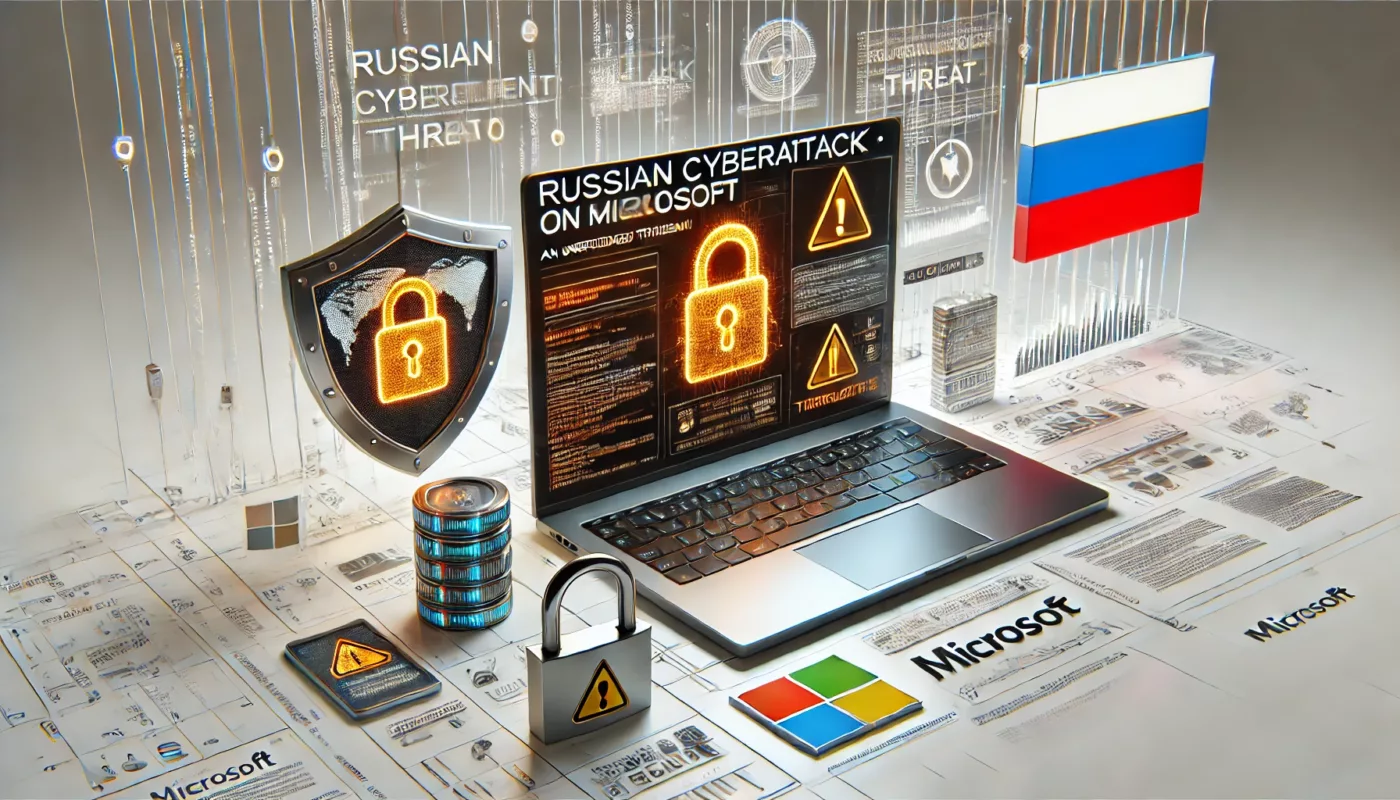
Cybersecurity theme with shield, padlock, and computer screen displaying warning signs, highlighting the Russian cyberattack on Microsoft.

Russian cyberattack on Microsoft by Midnight Blizzard (APT29) highlights the strategic risks to digital sovereignty. Discover how the group exploited password spraying, malicious OAuth applications, and legacy exposure — and the sovereign countermeasures offered by DataShielder and PassCypher.

Executive Summary — Midnight Blizzard (APT29) vs Microsoft

Reading note — Short on time? This Executive Summary gets you the essentials in 3 minutes. Full analysis: ≈15 minutes.

⚡ Objective

Understand how Midnight Blizzard (aka APT29, Cozy Bear) leveraged password spraying, malicious OAuth apps, and legacy exposure to access Microsoft’s internal email and escalate risks across tenants — and how sovereign HSM controls would have contained impact.

💥 Scope

Microsoft corporate mailboxes, executive communications, and internal collaboration workflows; spillover risk to customers and partners via token reuse and app-consent abuse.

🔑 Doctrine

APT29 favors low-noise, cloud-adjacent persistence without obvious malware. Defenders must harden identity (conditional access), monitor OAuth consent creation, rate-limit auth anomalies, and treat encrypted-egress analytics as first-class telemetry.

🌍 Strategic differentiator

Unlike cloud-only defenses, DataShielder & PassCypher adopt a zero cloud, zero disk, zero DOM posture with segmented-key HSM custody (NFC/PGP). Result ⮞ encrypted content remains unreadable even under mailbox compromise; credentials/OTP remain offline and non-replayable.

Technical Note

Reading time (summary): ≈ 3 minutes
Reading time (full): ≈ 15 minutes
Level: Cyberculture / Digital Security
Posture: Identity-first hardening, sovereign encryption (HSM)
Section: Digital Security
Language: FR · EN · CAT · ES
Editorial type: Chronicle
About the author: Jacques Gascuel — Inventor of Freemindtronic®, expert in sovereign HSM architectures, segmented keys (NFC/PGP), and offline, resilient communications.

TL;DR —
Midnight Blizzard (APT29) combined password spraying with malicious OAuth to access Microsoft internal mail. Even with rapid containment (SFI), token-based lateralization and app-consent persistence raised downstream risk. DataShielder keeps content end-to-end encrypted with volatile-memory decryption only; PassCypher stores credentials/OTP offline in HSM, defeating replay and loginless phishing sequences.

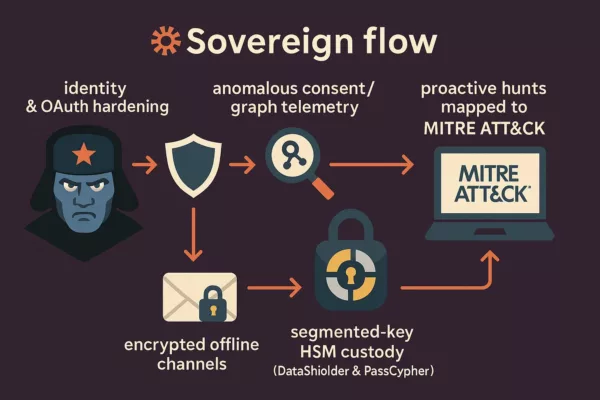
Russian Cyberattack Microsoft — Sovereign flow diagram showing identity hardening, OAuth monitoring, encrypted offline channels, and HSM custody with DataShielder and PassCypher
✺ Sovereign flow — Russian Cyberattack Microsoft: From Midnight Blizzard attack chain to identity & OAuth hardening, detection of anomalous consent/graph telemetry, then escalation to encrypted offline channels and segmented HSM custody with DataShielder & PassCypher, enabling proactive MITRE ATT&CK hunts.

Microsoft Admits Russian Cyberattack Was Worse Than Expected

Update context. On 12 January 2024, Microsoft detected unauthorized access linked to Midnight Blizzard (aka APT29 / NOBELIUM / Cozy Bear). Subsequent disclosures showed the breach was more extensive than first reported, including access to executive and security/legal mailboxes, large-scale password spraying, and malicious OAuth app abuse with token replay.

What changed vs. initial reports

  • Discovery of legacy account exposure used as the initial foothold, then pivot to internal email.
  • Evidence of token-based lateralization (OAuth consent misuse) across tenants and partners.
  • Tenfold increase in password-spray attempts in the weeks that followed, expanding downstream risk.

Why it matters

Midnight Blizzard is a state-sponsored actor assessed as part of Russia’s foreign-intelligence ecosystem, historically targeting governments, NGOs, and IT/service providers in the US and Europe. The campaign underscores how cloud-adjacent identity abuse (OAuth, tokens, legacy accounts) can bypass classical malware-centric defenses and compromise digital sovereignty at scale.

Freemindtronic Insight. This incident highlights the strategic value of sovereign encryption solutions like DataShielder NFC HSM and PGP HSM, which ensure that even compromised inboxes remain unreadable without physical access and multi-factor authentication.

Authoritative references

See Microsoft’s Secure Future Initiative (SFI), Microsoft’s incident communications on Midnight Blizzard (MSRC/On the Issues), and the U.S. CISA Emergency Directive ED-24-02 for official guidance and required mitigations.

This section is part of our in-depth coverage of the Russian Cyberattack Microsoft incident involving Midnight Blizzard.

Background & Technical Details — Russian Cyberattack Microsoft

⮞ Summary. Midnight Blizzard (APT29) exploited password spraying and malicious OAuth apps to infiltrate Microsoft. The intrusion chain combined legacy account exposure, weak consent monitoring, and stealthy cloud persistence — making it a benchmark case for sovereign cybersecurity doctrine.

The Russian Cyberattack Microsoft incident, orchestrated by Midnight Blizzard (APT29/Cozy Bear), revealed a sophisticated combination of password spraying at scale (CISA ED-24-02) and the abuse of malicious OAuth applications. By exploiting a legacy non-production account, attackers gained foothold into Microsoft’s corporate mailboxes, including executive and legal teams.

This operation mirrors past campaigns such as SolarWinds supply-chain compromise, but with a focus on cloud tokens and stealth persistence. The breach emphasized weaknesses in tenant isolation, consent governance, and token refresh lifecycles.

Technical analysis shows how Midnight Blizzard avoided traditional endpoint detections by staying cloud-adjacent: no heavy malware, only abused credentials and trusted OAuth flows. This approach drastically reduced IOC visibility and prolonged dwell time inside Microsoft systems.

Microsoft responded with its Secure Future Initiative (SFI), which prioritizes identity hardening, OAuth monitoring, and sovereign-aligned mitigations. Still, the attack highlights a systemic risk: when cloud identity is compromised, mailbox confidentiality collapses unless sovereign HSM solutions (DataShielder, PassCypher) are enforced.

Immediate Response from Microsoft

On January 12, 2024, Microsoft detected unauthorized access to its internal systems. The security team immediately activated a response process to investigate and mitigate the attack. Midnight Blizzard compromised a legacy non-production test account, gaining access to several internal email accounts, including those of senior executives and critical teams like cybersecurity and legal​.

Impact of Compromised Emails from the Russian Cyberattack

Midnight Blizzard managed to exfiltrate internal Microsoft emails, including sensitive information shared between the company and its clients. The attackers used this information to attempt access to other systems and increased the volume of password spray attacks by tenfold in February 2024. This led to an increased risk of compromise for Microsoft’s clients​.

Statistical Consequences of the Russian Cyberattack on Microsoft

  • Increase in Attacks: In February 2024, the volume of password spray attacks was ten times higher than in January 2024.
  • Multiple Targets: The compromised emails allowed Midnight Blizzard to target not only Microsoft but also its clients, thereby increasing the risk of compromise across various organizations.
  • Access to Internal Repositories: The attackers were able to access some source code repositories and internal systems, although no customer-facing systems were compromised​.

Statistical Consequences of the Russian Cyberattack on Microsoft

⮞ Summary. The Russian Cyberattack Microsoft triggered a tenfold surge in password-spray attempts, exposed executive mailboxes, and forced large-scale remediation. Official directives (CISA ED-24-02) confirm measurable systemic impact beyond Microsoft itself.

Analysis of the Midnight Blizzard (APT29) incident highlights the statistical footprint left on Microsoft and its ecosystem. According to CISA Emergency Directive ED-24-02, downstream exposure went far beyond initial intrusion:

  • 10× increase in password-spray attacks during February 2024 compared to January, escalating brute-force telemetry.
  • Multiple targets compromised: from Microsoft executive teams to strategic partners, amplifying the risk of supply-chain lateralization.
  • Internal repositories accessed: some source code and mailbox content exfiltrated — while Microsoft stressed that no customer-facing systems were breached.
  • Regulatory alert: U.S. federal agencies were ordered by CISA to reset credentials and secure Entra ID/Azure privileged authentication tools.

This statistical aftermath confirms the systemic risks of cloud-identity compromise: once OAuth tokens and mailbox credentials are stolen, propagation extends across tenants and partners. Without sovereign HSM custody (DataShielder & PassCypher), organizations remain exposed to credential replay and stealth exfiltration.

Ongoing Escalation & Data Reuse — Russian Cyberattack Microsoft

⮞ Summary. Post-breach monitoring revealed that Midnight Blizzard (APT29) continued to reuse exfiltrated data, OAuth tokens and stolen credentials. The Russian Cyberattack Microsoft extended into follow-on phishing, token replay and cloud-persistence campaigns across multiple tenants.

After the January 2024 compromise, APT29/Midnight Blizzard did not stop at Microsoft’s initial remediation. Instead, the group weaponized data already stolen to sustain access and broaden espionage reach. According to CISA alerts and Microsoft’s own Secure Future Initiative (SFI), adversaries systematically:

  • Replayed OAuth tokens harvested from compromised accounts to bypass fresh credential resets.
  • Exfiltrated mail archives used to craft targeted spear-phishing campaigns against partners and governments.
  • Leveraged leaked correspondence to execute disinformation and hybrid-conflict narratives.
  • Expanded persistence through new malicious OAuth application consents, evading traditional MFA checks.

This escalation phase illustrates that the Russian Cyberattack Microsoft was not a one-time event but an ongoing campaign with iterative exploitation. For defenders, this confirms the need for sovereign cryptographic containment: while cloud identities can be replayed, DataShielder and PassCypher ensure that exfiltrated data remains undecipherable and credentials are non-replayable due to offline segmented-key HSM custody.

October 2024 RDP Spear-Phishing Campaign — Russian Cyberattack Microsoft

⮞ Summary. In October 2024, Midnight Blizzard (APT29) escalated the Russian Cyberattack Microsoft with a large spear-phishing wave delivering .RDP files. These attachments initiated covert remote desktop sessions, bypassing traditional email security and extending persistence.

On October 16, 2024, Microsoft confirmed that Midnight Blizzard actors were distributing .RDP attachments in targeted phishing campaigns. When opened, the files automatically launched remote desktop sessions to attacker-controlled infrastructure, effectively granting adversaries direct access to victim environments.

This new tactic leveraged trusted file types and signed components to evade standard email filters and sandboxing. The campaign primarily targeted government entities, NGOs, and IT providers in Europe and North America, aligning with APT29’s long-term espionage doctrine.

According to CISA alerts and ENISA threat bulletins, the malicious RDP sessions allowed attackers to:

  • Establish persistent remote control bypassing traditional login prompts.
  • Harvest additional credentials through Windows authentication requests inside the RDP session.
  • Deploy secondary payloads undetected by endpoint monitoring, as the activity was masked as legitimate remote access.

For defenders, this October 2024 escalation illustrates how Russian APTs adapt quickly, shifting from OAuth abuse to remote desktop weaponization. Without sovereign safeguards, even encrypted mail channels remain insufficient against file-based phishing vectors.

Here, DataShielder and PassCypher deliver layered resilience: offline decryption ensures malicious .RDP payloads cannot auto-open decrypted content, while HSM-segmented key custody prevents credential replay inside remote sessions.

Midnight Blizzard Threat Timeline (HC3) — Russian Cyberattack Microsoft

⮞ Summary. A June 2024 HC3 briefing outlined a multi-year evolution of Midnight Blizzard (APT29) tactics. The Russian Cyberattack Microsoft is a continuation of this timeline, showing a shift from classic phishing to OAuth persistence and cloud token exploitation.

The U.S. Department of Health and Human Services Health Sector Cybersecurity Coordination Center (HC3) published a June 2024 threat profile detailing APT29’s operational history. Key stages align with the escalation observed in the Russian Cyberattack Microsoft:

  • 2018–2020: Initial reliance on spear-phishing and credential harvesting, including campaigns against U.S. and European institutions.
  • 2020–2021: SolarWinds supply-chain compromise, marking APT29’s ability to exploit trusted third-party software ecosystems.
  • 2022–2023: Transition to cloud identity abuse, including malicious OAuth applications and stealthy persistence.
  • 2024: Large-scale escalation with Microsoft corporate mailbox compromise, password spraying at scale, and token replay — culminating in October spear-phishing via .RDP files.

According to CISA and ENISA, APT29 demonstrates a doctrine of hybrid conflict cyber-espionage: combining stealth persistence, identity abuse, and information operations. This timeline confirms the progressive escalation model of Midnight Blizzard campaigns.

Defensive takeaways: only sovereign HSM architectures (e.g., DataShielder, PassCypher) can neutralize token replay and ensure that exfiltrated data remains encrypted and non-exploitable across campaign phases.

Advanced Encryption and Security Solutions

Sovereign posture. Adopt end-to-end encryption with zero cloud, zero disk, zero DOM and segmented-key custody to make exfiltrated data cryptographically unusable under mailbox compromise.

To resist state-grade threats, organizations should enforce robust encryption with sovereign key custody. Technologies like
DataShielder NFC HSM, DataShielder HSM PGP, and DataShielder Auth NFC HSM encrypt emails and attachments end-to-end while keeping decryption keys offline inside an HSM (NFC/PGP).

If Midnight Blizzard had accessed an executive mailbox protected by DataShielder, message bodies and files would have remained unreadable. Decryption occurs only in volatile memory after physical HSM presence and multi-factor checks. This neutralizes token replay and limits the blast radius of OAuth or identity abuse.

Beyond confidentiality, the sovereign design simplifies incident response: keys are never hosted in the provider’s cloud, and credentials or OTPs managed with segmented keys are not replayable across OAuth/RDP sessions.

Global Reactions and Security Measures

This attack highlights the ongoing risks posed by well-funded state actors. In response, Microsoft launched the Secure Future Initiative (SFI). This initiative aims to strengthen the security of legacy systems and improve internal processes to defend against such cyber threats. The company has also adopted a transparent approach, quickly sharing details of the attack and closely collaborating with government agencies to mitigate risks​.

Microsoft’s Secure Future Initiative (SFI) aims to harden legacy infrastructure. In parallel, CISA and ENISA coordinate sectoral resilience guidance for critical operators.

Best Practices in Cybersecurity to Prevent Russian Cyberattacks

To protect against these threats, companies must adopt robust security measures. Multi-factor authentication and continuous system monitoring are crucial. Additionally, implementing regular security updates is essential. The CISA emergency directive ED 24-02 requires affected federal agencies to analyze the content of exfiltrated emails, reset compromised credentials, and secure authentication tools for privileged Azure accounts​ (CISA)​.

Beyond classical defenses, sovereign encryption and segmented HSM custody ensure that even if OAuth tokens or mailboxes are compromised, sensitive data remains cryptographically unusable.

Comparison with Other Cyberattacks

This attack is reminiscent of other major incidents, such as those against SolarWinds and Colonial Pipeline. These attacks demonstrate the evolving techniques of attackers and the importance of maintaining constant vigilance. Companies must be ready to respond quickly and communicate transparently with stakeholders to minimize damage and restore trust​.

See CISA SolarWinds advisory and Colonial Pipeline cyberattack report for context.

The Sovereign Takeaway — Russian Cyberattack Microsoft

⮞ Summary. The Russian Cyberattack Microsoft by Midnight Blizzard (APT29) illustrates how identity abuse, OAuth persistence, and hybrid operations converge to weaken global resilience.
Only a sovereign HSM posture — with DataShielder and PassCypher — ensures that exfiltrated data or stolen tokens remain cryptographically unusable.

This doctrine of zero cloud, zero disk, zero DOM with segmented HSM custody is what transforms a breach into a contained incident rather than a systemic crisis. It marks the line between conventional cloud security and sovereign cryptographic resilience.

Further Reading: For extended analysis, see our chronicle on the Midnight Blizzard cyberattack against Microsoft & HPE, authored by Jacques Gascuel.

Strategic Aftermath — Outlook beyond the Russian Cyberattack Microsoft

⮞ Summary. Beyond incident response, organizations must assume that identity- and token-based compromise will recur.
A sovereign posture treats cloud identity as ephemeral and sensitive content as persistently encrypted under offline HSM custody.

In the wake of the Russian Cyberattack Microsoft, three shifts are non-negotiable. First, identity becomes telemetry-driven: conditional access, consent creation, and token lifecycles are continuously scored, not merely logged. Second, communications become sovereign by default: message bodies and files remain unreadable without physical HSM presence, even if mailboxes are accessed. Third, credentials and OTPs leave the cloud: segmented-key custody prevents reuse across OAuth, Graph, or RDP flows.

  • Containment by design — Enforce zero cloud, zero disk, zero DOM decryption paths; treat tokens as hostile until proven otherwise.
  • Operational continuity — Maintain an out-of-band sovereign channel for IR, so investigations never depend on compromised tenants.
  • Partner hygiene — Require OAuth consent baselines and cross-tenant anomaly sharing; audit refresh-token lifetimes.

Practically, this outlook translates into DataShielder for end-to-end content encryption with volatile-memory decryption, and PassCypher for offline credential custody and non-replayable OTP. Together, they narrow the blast radius of future APT29-style campaigns while preserving mission continuity.

Real-world sovereign use case — Russian Cyberattack Microsoft (executive mailbox compromised)

  1. During the Russian Cyberattack Microsoft (Midnight Blizzard / APT29), an executive’s mailbox is accessed via token replay.
  2. Emails & attachments remain unreadable: content is end-to-end encrypted with DataShielder; decryption occurs only in volatile memory after NFC HSM presence.
  3. Credentials & OTP are never exposed: PassCypher stores them offline with segmented keys, preventing replay inside OAuth/RDP sessions.
  4. Operations continue seamlessly: an out-of-band sovereign channel maintains secure communications during incident response, with no cloud keys to rotate.
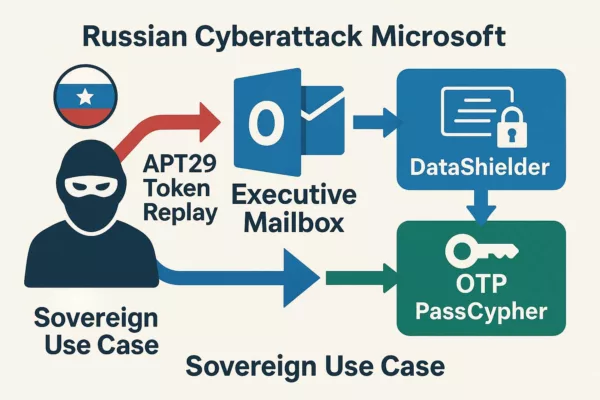
Russian Cyberattack Microsoft — APT29 token replay on executive mailbox stopped by DataShielder encryption and PassCypher sovereign HSM credentials
✪ Illustration — Russian Cyberattack Microsoft: Executive mailbox compromised by APT29 token replay, contained by DataShielder sovereign encryption and PassCypher offline HSM custody.

Related links — Russian APT actors

Weak Signals — Trends to Watch Beyond the Russian Cyberattack Microsoft

These evolutions are consistent with the Russian hybrid warfare doctrine, where cyber-espionage (APT29) and influence operations converge to destabilize strategic sectors.

⮞ Summary. The Russian Cyberattack Microsoft highlights systemic risks. Weak signals suggest APT29 and affiliated Russian actors will expand beyond OAuth abuse, experimenting with AI-driven phishing, encrypted command channels, and regulatory blind spots.

Looking ahead, the aftermath of the Midnight Blizzard (APT29) intrusion offers insights into future trends in Russian cyber-espionage:

  • AI-augmented spear-phishing: Generative AI may increase the credibility and linguistic adaptation of phishing lures, complicating detection (ENISA reports).
  • Encrypted C2 channels inside cloud apps: Expect wider abuse of collaboration platforms (Teams, SharePoint) with end-to-end encrypted exfiltration masquerading as normal traffic.
  • OAuth & token lifecycle attacks: Beyond classic consent abuse, attackers may pivot to refresh token manipulation and multi-cloud federation exploits.
  • Hybrid conflict synchronization: Cyber intrusions paired with influence campaigns targeting elections, energy policy, and EU institutional trust.
  • Regulatory misalignment: While frameworks such as EU CRA and NIS2 strengthen defenses, uneven adoption leaves OIV/OES with exploitable gaps.

These signals reinforce the necessity of sovereign cryptographic architectures. With DataShielder and PassCypher, organizations can enforce offline key segmentation, volatile-memory decryption, and encrypted egress control, making exfiltrated data strategically useless to adversaries.

Dropbox Security Breach 2024: Phishing, Exploited Vulnerabilities

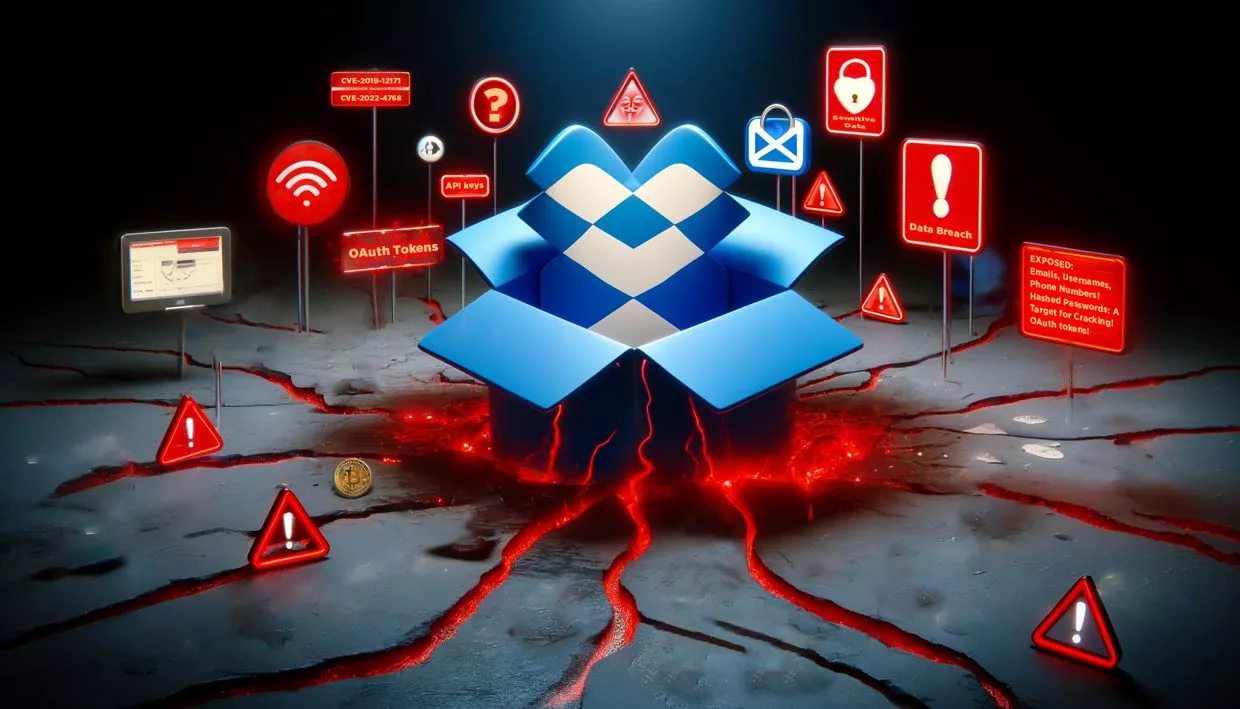
A realistic depiction of the 2024 Dropbox security breach, featuring a cracked Dropbox logo with compromised data such as emails, user credentials, and security tokens spilling out. The background includes red flashing alerts and warning symbols, highlighting the seriousness of the breach.

Delving into the 2░0░2░4░Dropbox Security Breach: A Chronicle of Vulnerabilities, Exfiltrated Data

In 2024, a shadow fell over cloud storage security. The Dropbox breach exposed a shocking vulnerability, leaving user data at risk. This deep dive explores the attack, the data compromised, and why encryption remains your ultimate defense. Dive in and learn how to fortify your digital assets.

2025 Digital Security

Russia Blocks WhatsApp: Max and the Sovereign Internet

2025 Digital Security

Bot Telegram Usersbox : l’illusion du contrôle russe

2025 CyptPeer Digital Security EviLink

Missatgeria P2P WebRTC segura — comunicació directa amb CryptPeer

2025 Cyberculture Cybersecurity Digital Security EviLink

CryptPeer messagerie P2P WebRTC : appels directs chiffrés de bout en bout

2026 Awards Cyberculture Digital Security Distinction Excellence EviOTP NFC HSM Technology EviPass EviPass NFC HSM technology EviPass Technology finalists PassCypher PassCypher

Quantum-Resistant Passwordless Manager — PassCypher finalist, Intersec Awards 2026 (FIDO-free, RAM-only)

2025 Digital Security

Persistent OAuth Flaw: How Tycoon 2FA Hijacks Cloud Access

2025 Digital Security

Android Spyware Threat Clayrat : 2025 Analysis and Exposure

2025 Digital Security

Spyware ClayRat Android : faux WhatsApp espion mobile

2025 Digital Security Technical News

Sovereign SSH Authentication with PassCypher HSM PGP — Zero Key in Clear

Dropbox Security Breach. Stay updated with our latest insights.

Europol

Dropbox Security Breach: Password Managers and Encryption as Defense By Jacques Gascuel, this article examines the crucial role password managers and encryption play in mitigating the risks of cyberattacks like the Dropbox Security Breach

Phishing Tactics: The Bait and Switch in the Aftermath of the Dropbox Security Breach

The 2024 Dropbox Security Breach stands as a stark reminder of the ever-evolving cyberthreat landscape and the urgent need for robust security measures. In this comprehensive article, we’ll unravel the intricate details of this breach, examining the tactics employed by attackers, the vast amount of sensitive data compromised, and the far-reaching consequences for affected users. We’ll also delve into the underlying security vulnerabilities exploited and discuss essential measures to prevent similar incidents in the future. Finally, we’ll explore the crucial role of advanced encryption solutions, such as DataShielder and PassCypher, in safeguarding sensitive data stored in the cloud. Through this in-depth analysis, you’ll gain a clear understanding of the Dropbox breach, its impact, and the proactive steps you can take to enhance your own cybersecurity posture.

Crafting Convincing Emails

Attackers meticulously crafted phishing emails, often disguised as notifications or security alerts, to deceive employees.

  • Crafting Convincing Emails: Attackers meticulously crafted phishing emails, often disguised as notifications or security alerts, to deceive employees.
  • Exploiting Human Trust: By leveraging the trust employees had in Dropbox, attackers successfully persuaded them to divulge sensitive information.
  • MFA Circumvention: The compromise of MFA codes highlights the need for additional layers of security beyond passwords.
Diagram illustrating the stages of the 2024 Dropbox Security Breach attack flow.
This diagram depicts the stages of the 2024 Dropbox Security Breach, from phishing emails to data exfiltration and its aftermath.

Dropbox Security Breach Attack Flow: Unraveling the Steps of the Cyberattack

  • Phishing Emails: Attackers send out phishing emails to Dropbox employees, mimicking legitimate communications.
  • Credential Harvesting: Employees fall victim to phishing tactics and reveal their credentials, including MFA codes.
  • Unauthorized Access: Attackers gain unauthorized access to Dropbox Sign infrastructure using compromised credentials.
  • Exploiting Automated Tools: Attackers exploit automated system configuration tools to manipulate accounts and escalate privileges.
  • Data Exfiltration: Attackers extract a vast amount of sensitive data, including emails, usernames, phone numbers, hashed passwords, API keys, OAuth tokens, and MFA data.

Exploited Vulnerabilities: A Technical Analysis

The attackers behind the Dropbox breach exploited a combination of vulnerabilities to gain unauthorized access and exfiltrate sensitive data.

Specific CVEs Exploited

  • CVE-2019-12171: This vulnerability allowed attackers to store credentials in cleartext in memory, posing a significant security risk.
  • CVE-2022-4768: This critical vulnerability in Dropbox Merou affected the add_public_key function, leading to injection attacks.
  • Automated System Configuration Tools: The exploitation of these tools highlights the need for robust access controls and security measures.

Exfiltrated Data: The Scope of the Breach

The sheer volume of data compromised in the Dropbox breach is staggering, raising serious concerns about the potential impact on affected users.

Types of Data Exposed

  • Exposed Emails: Attackers now possess email addresses, potentially enabling them to launch targeted phishing attacks or engage in email scams.
  • Vulnerable Usernames: Usernames, often coupled with leaked passwords or other personal information, could be used to gain unauthorized access to other online accounts.
  • Misused Phone Numbers: Exposed phone numbers could be used for unwanted calls, text messages, or even attempts to reset passwords or gain access to other accounts.
  • Hashed Passwords: A Target for Cracking: While not directly readable, hashed passwords could be subjected to brute-force attacks or other cracking techniques to recover the original passwords.
  • Compromised Authentication Tokens: API keys and OAuth tokens, used for app authentication, could enable attackers to impersonate users and access their Dropbox accounts or other connected services.

The Dropbox Breach Fallout: Unraveling the Impact and Consequences

The ramifications of the Dropbox breach extend far beyond the compromised data itself. The incident has had a profound impact on both affected users and Dropbox as a company.

Consequences of the Breach

  • User Privacy Concerns: The exposure of personal information has left users feeling vulnerable and at risk of identity theft, phishing attacks, and other cyber threats.
  • Reputational Damage: Dropbox’s reputation as a secure cloud storage provider has taken a significant hit, potentially affecting user trust and future business prospects.
  • Financial Costs: Dropbox has incurred substantial expenses in investigating the breach, notifying affected users, and implementing additional security measures.

Lessons Learned: Preventing Future Breaches and Strengthening Security

In the aftermath of the Dropbox breach, it’s crucial to identify key takeaways and implement preventive measures to safeguard against future incidents.

Essential Security Practices

  • Secure Service Accounts: Implement strong passwords for service accounts and enforce strict access controls, adhering to the principle of least privilege. Consider using Privileged Access Management (PAM) solutions to manage and monitor service account activity.
  • Regular Penetration Testing: Conduct regular penetration tests (pen tests) to identify and remediate vulnerabilities in systems and networks before they can be exploited by attackers. Engage qualified security professionals to simulate real-world attack scenarios.
  • Continuous Monitoring and Incident Response: Establish a robust incident response plan to effectively address security breaches. This plan should include procedures for identifying, containing, and remediating incidents.
  • Patch Management: Prioritize timely patching of software and systems with the latest security updates. Implement a comprehensive patch management strategy to ensure the prompt deployment of critical security updates.

Beyond the Breach: Enhancing Proactive Defense with Advanced Encryption

While robust security practices are essential for preventing breaches, additional layers of protection can further safeguard data. Advanced encryption solutions play a pivotal role in this regard. Here, we’ll delve into two such solutions – DataShielder HSM PGP and NFC HSM, and PassCypher HSM PGP and NFC HSM – and explore how they address the vulnerabilities exploited in the 2024 Dropbox breach.

DataShielder HSM PGP and NFC HSM

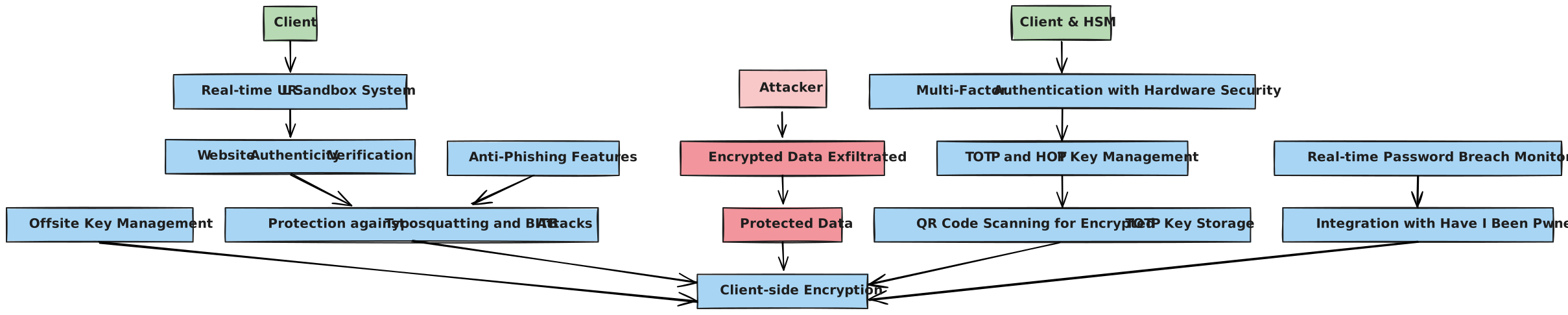
DataShielder HSM PGP and NFC HSM provide client-side encryption for data stored in the cloud. By encrypting data at rest and in transit (as depicted in the following diagram [Insert DataShielder Diagram Here]), DataShielder ensures that even if an attacker gains access to cloud storage, the data remains inaccessible. This robust protection is achieved through:

  • Client-Side Encryption: Data is encrypted on the user’s device before being uploaded to the cloud.
  • Hardware Security Module (HSM) or NFC HSM: Encryption keys are stored within a secure HSM or NFC HSM, offering physical separation and robust protection against unauthorized access.
  • Offsite Key Management: Encryption keys are never stored on the cloud or user devices, further minimizing the risk of compromise (as illustrated in the diagram).
  • Post-Quantum Encryption: Additionally, DataShielder incorporates post-quantum encryption algorithms to safeguard against future advancements in code-breaking techniques.

Diagram showing DataShielder HSM PGP and DataShielder NFC HSM encryption process for Dropbox security breach protection.

DataShielder HSM PGP and NFC HSM: Ensuring Dropbox security breach protection with AES-256 encryption and offsite key management

PassCypher HSM PGP and NFC HSM

PassCypher HSM PGP and NFC HSM go beyond traditional password management, offering a comprehensive security suite that directly addresses the vulnerabilities exploited in the 2024 Dropbox breach. Here’s how PassCypher strengthens your defenses:

  • Multi-Factor Authentication (MFA) with Hardware Security: PassCypher NFC HSM offers additional protection for logins by securely managing Time-based One-Time Passwords (TOTP) and HOTP keys. Users can scan a QR code to automatically store the encrypted TOTP secret key within the NFC HSM, adding a layer of hardware-based authentication beyond passwords.
  • Real-Time Password Breach Monitoring: PassCypher HSM PGP integrates with Have I Been Pwned (HIBP), a constantly updated database of compromised passwords. This real-time monitoring allows users to be instantly notified if their passwords appear in any known breaches.
  • Phishing Prevention: In addition to the URL sandbox system and protection against typosquatting and BITB attacks mentioned earlier, PassCypher’s comprehensive approach empowers users to identify and avoid malicious attempts (as detailed in the diagram).
  • Client-Side Encryption: PassCypher utilizes client-side encryption to ensure data remains protected even if attackers manage to exfiltrate it (as shown in the diagram).


Diagram illustrating PassCypher HSM PGP and PassCypher NFC HSM, focusing on Dropbox security breach protection

By combining these features, PassCypher HSM PGP and NFC HSM provide a robust defense against the social engineering tactics and credential theft exploited in the Dropbox breach.

Statistics of the 2024 Dropbox Security Breach

While verifying the exact number of users affected by data breaches can be challenging, security experts estimate that the Dropbox breach could have impacted a substantial number of users. Some reports suggest that the breach may have affected up to 26 billion records, making it one of the largest data breaches in history. However, it is crucial to note that this figure is unconfirmed and may not reflect the actual number of individuals impacted.

Key Takeaways for Enhanced Cybersecurity

  • Uncertain Numbers: The exact number of affected users remains unclear, highlighting the challenges in verifying breach statistics.
  • Potential for Massive Impact: The estimated 26 billion records underscore the potential scale of the breach and its far-reaching consequences.
  • Importance of Reliable Sources: Relying on reputable sources for breach information is crucial to ensure accurate and up-to-date data.

Conclusion: A Call for Vigilance and Enhanced Security in the Wake of the Dropbox Security Breach

The 2024 Dropbox security breach serves as a stark reminder of the ever-evolving cyberthreat landscape and the urgent need for vigilant security practices. Organizations must prioritize robust security measures, including strong access controls, regular vulnerability assessments, and timely patching. Additionally, advanced encryption solutions, such as DataShielder HSM PGP and NFC HSM and PassCypher HSM PGP and NFC HSM, can provide an extra layer of protection for sensitive data.

Key Takeaways for Enhanced Cybersecurity

  • Collective Responsibility: Cybersecurity is a shared responsibility, requiring collaboration between organizations and individuals.
  • Continuous Learning and Awareness: Staying informed about emerging threats and adopting best practices are essential for effective cybersecurity.
  • Protecting Sensitive Data: Prioritizing data protection through robust security measures and advanced encryption is paramount.

The 2024 Dropbox security breach serves as a cautionary tale, highlighting the vulnerabilities that can exist even in large, established organizations. By learning from this incident and implementing the recommendations discussed, we can collectively strengthen our cybersecurity posture and protect our valuable data from the ever-evolving threat landscape.

Encrypted messaging: ECHR says no to states that want to spy on them

ECHR landmark ruling in favor of encrypted messaging, featuring EviCypher NFC HSM technology by Freemindtronic.

Protecting encrypted messaging: the ECHR decision

Encrypted messaging is vital for digital privacy and free speech, but complex to protect. The historic ECHR decision of February 13, 2024 supports strong encryption against government surveillance. We discuss the importance of this decision. You will discover EviCypher NFC HSM encryption technology from Freemindtronic, guardian of this decision but for all messaging services in the world.

Stay informed in our posts dedicated to Cyberculture to follow its evolution thanks to our regularly updated topics

Learn more through this Cyberculture section on your data encryption rights to protect your personal and professional data written by Jacques Gascuel, creator of data security solutions. Stay informed and secure with our regular news.

Encrypted messaging: ECHR says no to states that want to spy on them

The historic judgment of the European Court of Human Rights (ECHR) elevates encrypted messaging to the rank of guardian of privacy and freedom of expression. But this also poses security and public order problems. On February 13, 2024, she spoke out in favor of strong encryption, against state interference.

The ECHR has rejected Russian authorities’ request to Telegram, a messaging application, to provide private keys for encrypting its users’ communications, or to install backdoors that would allow authorities to access them. The Court considered that this request violated the rights to privacy and correspondence, as well as freedom of expression, of Telegram users.

The context of the case

The case background Six journalists and human rights activists challenged the request of the Russian authorities to Telegram before the ECHR. They claimed that this request violated their fundamental rights. They relied on Articles 8 and 10 of the European Convention on Human Rights. These articles protect the right to privacy and correspondence, and the right to freedom of expression.

The reasoning of the Court

The Court’s reasoning The Court acknowledged that the request of the Russian authorities had a legitimate aim of national security and crime prevention. However, it found that the interference with the rights of the applicants was not proportionate to the aim pursued. It emphasised that encryption plays a vital role in ensuring the confidentiality of communications and the protection of personal data. It held that the request of the Russian authorities was too general and vague. It did not offer enough safeguards against abuse. It could deter people from using encrypted messaging services.

The Court also noted that encryption helps citizens and businesses to defend themselves against the misuse of information technologies, such as hacking, identity theft, data breach, fraud and undue disclosure of confidential information. It stated that this should be duly taken into account when assessing the measures that could weaken encryption.

The Court further observed that, in order to be useful to the authorities, the information must be decrypted at some point. It suggested that the authorities should use other means to obtain the necessary information, such as undercover operations, metadata analysis and international cooperation.

The consequences of the decision

The decision’s implications The decision of the Court is final and binding for Russia. It has to implement it within a reasonable time. It also has a broader impact. It sets out principles applicable to all member states of the Council of Europe, which comprises 47 countries. It sends a strong signal in favour of the respect of fundamental rights on the internet. It aligns with the position of several international organisations, such as the UN, the EU or the OSCE. They have stressed the importance of encryption for the protection of human rights online.

The official link of the ECHR decision is: AFFAIRE PODCHASOV c. RUSSIE and AFFAIRE PODCHASOV c. RUSSIE and AFFAIRE PODCHASOV c. RUSSIE. You can access it by clicking on the title or copying the address in your browser.

The position of other countries in the world

Encryption of communications is not a consensual topic. Countries have different, even opposite, positions on the issue. Here are some examples:

  • The Netherlands have argued for the right to strong encryption. They considered it a human right that must be safeguarded, in the country’s own interest.
  • The United States have repeatedly asked technology companies to provide them with access to encrypted data. They invoked the need to fight terrorism. These requests have been challenged by companies, such as Apple. They refused to create backdoors in their encryption systems.
  • China adopted a cybersecurity law in 2016. It requires companies to cooperate with authorities to provide encryption keys or means to bypass encryption. This law has been denounced by human rights defenders. They fear that it will be used to strengthen the surveillance and censorship of the Chinese regime.
  • The European Union adopted a directive on the protection of personal data in 2016. It recognizes encryption as a technical measure suitable for ensuring the security of data. The EU also supported the development of end-to-end encryption. It funded projects such as the free software Signal, which allows to encrypt calls and messages.

These examples show the divergences and convergences between different countries on the subject of encryption. They also reveal the political, economic and social issues that are at stake.

The world’s reactions to the ECHR decision on Encrypted Messaging

The ECHR decision on Encrypted Messaging has sparked different reactions in the world. Some countries praised the judgment, which boosts the protection of human rights on the internet. Other countries slammed the position of the Court, which undermines, according to them, the judicial cooperation and the national security.

The supporters of the ECHR decision

The Netherlands are among the countries that supported the ECHR decision. They argued for the right to strong encryption, considering it a human right that must be safeguarded, in the country’s own interest. The European Union also backed the Court, reminding that encryption is a technical measure suitable to ensure the security of data, in accordance with the directive on the protection of personal data adopted in 2016. The EU also stressed that it funds the development of end-to-end encryption, through projects such as the free software Signal, which allows to encrypt calls and messages.

The opponents of the ECHR decision

The United States are among the countries that opposed the ECHR decision. They have repeatedly asked technology companies to provide them with access to encrypted data, invoking the need to fight terrorism. These requests have been challenged by companies, such as Apple, which have refused to create backdoors in their encryption systems. China also expressed its disagreement with the Court, stating that encryption of communications fosters the dissemination of illegal or dangerous content, such as terrorist propaganda, child pornography or hate speech. China recalled that it has adopted in 2016 a cybersecurity law, which requires companies to cooperate with authorities to provide encryption keys or means to bypass encryption.

The non-signatories of the European

Convention on Human Rights Some countries have not reacted to the ECHR decision, because they are not signatories of the European Convention on Human Rights. This is the case for example of Russia, which ceased to be a member of the Council of Europe on March 16, 2022, after the invasion of Ukraine decided by the Kremlin. The country no longer participates in the activities of the ECHR. This is also the case of many countries in Africa, Asia or Latin America, which are not part of the Council of Europe and which have not ratified the Convention.

The signatory countries of the European Convention on Human Rights

The European Convention on Human Rights is an international treaty adopted by the Council of Europe in 1950, which aims to protect human rights and fundamental freedoms in the states parties. It entered into force in 1953, after being ratified by ten countries: Belgium, Denmark, France, Ireland, Italy, Luxembourg, the Netherlands, Norway, Sweden and the United Kingdom .

Since then, the Convention has been ratified by 36 other countries, bringing the total number of states parties to 46. They are: Albania, Germany, Andorra, Armenia, Austria, Azerbaijan, Bosnia and Herzegovina, Bulgaria, Cyprus, Croatia, Estonia, Finland, Georgia, Greece, Hungary, Iceland, Latvia, Liechtenstein, Lithuania, Malta, Moldova, Monaco, Montenegro, North Macedonia, Poland, Portugal, Romania, Russia, San Marino, Serbia, Slovakia, Slovenia, Spain, Czech Republic, Turkey and Ukraine.

All these countries recognize the jurisdiction of the European Court of Human Rights (ECHR), which is in charge of ensuring the respect of the Convention. The ECHR can be seized by any person, group of persons or non-governmental organization who claims to be a victim of a violation of the Convention by one of the states parties. The ECHR can also be seized by a state party who alleges that another state party has violated the Convention. The ECHR delivers judgments that are final and binding for the states parties.

An innovative and sovereign alternative: the EviCypher NFC HSM technology

Facing the challenges of encryption of communications, some users may look for an alternative more innovative and sovereign than the traditional messaging applications. This is the case of the EviCypher NFC HSM technology, developed by the Andorran company Freemindtronic. This technology makes it possible to generate, store, manage and use AES-256 encryption keys to encrypt all communication systems, such as WhatsApp, sms, mms, rcs, Telegram, webmail, email client, private messaging like Linkedin, Skype, X and even via postal mail with encrypted QR code messages, etc.

EviCypher NFC HSM: A Secure and Innovative Solution for Encrypted Messaging

Firstly, it guarantees the confidentiality and integrity of data, even if the messaging services are compromised for any reason, including by a court order. Indeed, it is physically impossible for Freemindtronic, the manufacturer of the DataShielder products, to provide encryption keys generated randomly by the user. These keys are stored encrypted in AES-256 via segmented keys in the HSM and NFC HSM. Only the user holds the decryption keys, which he can erase at any time.

Secondly, it preserves the anonymity and sovereignty of users, because it works without server and without database. It does not require internet connection, nor user account, nor phone number, nor email address. It leaves no trace of its use, nor of its user. It does not depend on the policies or regulations of the countries or companies that provide the communication services.

Thirdly, it offers an extreme portability and availability of encryption keys, thanks to the NFC technology. The user can carry his encryption keys on a physical support, such as a card, a bracelet, a key ring, etc. He can use them with any device compatible with NFC, such as a smartphone, a tablet, a computer, etc. He can also share them with other trusted users, in a simple and secure way.

Lastly, it is compatible with the EviCore NFC HSM or EviCore HSM technology, which allows to secure the access to equipment and applications. The user can thus use the same physical support to encrypt his communications and to authenticate on his different digital services.

The EviCypher NFC HSM technology guarantees the confidentiality and integrity of data, even if the messaging services are compromised for any reason, including by a court order. Indeed, it is physically impossible for Freemindtronic, the manufacturer of the DataShielder products, to provide encryption keys generated randomly by the user. These keys are stored encrypted in AES-256 via segmented keys in the HSM and NFC HSM. Only the user holds the decryption keys, which he can erase at any time.

Transforming Encrypted Messaging with EviCypher NFC HSM

The European Court of Human Rights (ECHR) decisively highlights encrypted messaging’s vital role in protecting privacy and freedom of speech. EviCypher NFC HSM, aligning perfectly with these principles, emerges as a pioneering solution. It confronts the challenges of state surveillance and privacy breaches head-on, providing unmatched defense for private communications. EviCypher NFC HSM goes beyond the ECHR’s conventional security and privacy requirements. It crafts an inviolable communication platform that honors users’ privacy rights profoundly. With its innovative approach, EviCypher NFC HSM introduces new data protection standards, forging a robust barrier against government intrusion.

Global Reach and User Empowerment

EviCypher NFC HSM’s technology has a broad global impact, seamlessly addressing the varied encryption landscapes worldwide. It provides a consistent answer to privacy and security issues, disregarding geographic limits. This global applicability makes EviCypher NFC HSM an indispensable tool for users worldwide, solidifying its position as a guardian of global privacy.

Despite potential skepticism about new technologies, the user-friendly and accessible nature of EviCypher NFC HSM aims to dispel such doubts. It promotes wider adoption among those seeking to enhance their communication security. Its compatibility with diverse devices and straightforward operation simplify encryption, facilitating an effortless shift towards secure communication practices.

EviCypher NFC HSM: A Beacon of User Autonomy

EviCypher NFC HSM technology deeply commits to empowering users. It allows individuals to generate, store, and manage their encryption keys independently, giving them direct control. This autonomy not only improves data security but also demonstrates a strong commitment to protecting users’ fundamental rights. It resonates with the values emphasized across the discussion, providing an effective way to strengthen online privacy and security. EviCypher NFC HSM marks a significant leap forward in the movement towards a more secure and private digital landscape.

This technologie HSM stands out as a state-of-the-art, self-sufficient solution, perfectly in line with the ECHR’s decisions and the worldwide need for secure encrypted communication. It leads the charge in advancing user autonomy and security, signaling a crucial evolution in encrypted messaging towards unparalleled integrity.

Incorporating EviCypher’s distinctive features—its operation without servers or databases, interoperability, and backward compatibility with all current communication systems, such as email, SMS, MMS, RCS, and social media messaging, even extending to physical mail via encrypted QR codes—highlights its adaptability and innovative spirit. EviCypher’s resistance to zero-day vulnerabilities, due to encrypting communications upfront, further underscores its exceptional security. Operating anonymously and offline, it provides instant usability without requiring user identification or account creation, ensuring seamless compatibility across phone, computer, and communication systems.

Summary at encrypted messaging

Encrypted Messaging is crucial for the digital society. It protects internet users’ privacy and freedom of expression. But it also challenges security and public order. The European Court of Human Rights (ECHR) supported strong encryption on February 13, 2024. It defended the right to encryption, against states that want to access it. Several international organizations agree with this position. They emphasize the importance of encryption for human rights online. However, the ECHR decision sparked diverse reactions worldwide. Different countries have different views on encryption.

Our conclusion on Encrypted Messaging

EviCypher NFC HSM technology is an innovative and sovereign alternative for Encrypted Messaging. Users can generate, store, manage and use AES-256 encryption keys. They can encrypt all communication systems, such as WhatsApp, sms, mms, rcs, Telegram, webmail, email client, etc. EviCypher NFC HSM technology ensures data confidentiality and integrity. It works even if messaging services are compromised. It preserves users’ anonymity and sovereignty. It does not need server or database. It offers extreme portability and availability of encryption keys, thanks to NFC technology. It is compatible with EviCore NFC HSM or EviCore HSM technology. They secure access to equipment and applications.

DataShielder products provide EviCypher NFC HSM technology. They are contactless encryption devices, guardians of keys and secrets. Freemindtronic, an Andorran company specialized in NFC security, designs and manufactures them.

Pegasus: The cost of spying with one of the most powerful spyware in the world

Pegasus The Cost of Spying with the Most Powerful Spyware
Pegasus by Jacques Gascuel: This article will be updated with any new information on the topic.

Pegasus: The Cost of Spying

Pegasus is a powerful spyware that has been used by several countries to spy on political figures, journalists, human rights activists or opponents. How does it work, who has been spied on, what are the consequences, and how much does it cost? Find out in this article.

2025 Digital Security

Russia Blocks WhatsApp: Max and the Sovereign Internet

2025 Digital Security

Bot Telegram Usersbox : l’illusion du contrôle russe

2025 CyptPeer Digital Security EviLink

Missatgeria P2P WebRTC segura — comunicació directa amb CryptPeer

2025 Cyberculture Cybersecurity Digital Security EviLink

CryptPeer messagerie P2P WebRTC : appels directs chiffrés de bout en bout

2026 Awards Cyberculture Digital Security Distinction Excellence EviOTP NFC HSM Technology EviPass EviPass NFC HSM technology EviPass Technology finalists PassCypher PassCypher

Quantum-Resistant Passwordless Manager — PassCypher finalist, Intersec Awards 2026 (FIDO-free, RAM-only)

2025 Digital Security

Persistent OAuth Flaw: How Tycoon 2FA Hijacks Cloud Access

Pegasus: The Cost of Spying with the Most Powerful Spyware in the World

Pegasus is a spyware developed by the Israeli company NSO Group. It allows to remotely monitor the activities of a mobile phone. According to an investigation conducted by a consortium of international media, several countries have used this software to spy on political figures, journalists, human rights activists or opponents.

The scandal of Pegasus has provoked a global outcry. It has raised many questions about the legality, the ethics and the consequences of this cyber-surveillance. How does Pegasus work? Who has been spied on by Pegasus? Who is responsible for the spying? What are the consequences of the spying? And most importantly, how much does Pegasus cost?

In this article, we will try to answer these questions in detail. We will use reliable and verified sources of information. We will also present some statistics and comparisons to give you an idea of the scale and the impact of Pegasus.

What is Pegasus?

Pegasus is a spyware, also called spy software. It allows to remotely monitor the activities of a mobile phone. It can access the messages, the calls, the contacts, the photos, the videos, the location, the microphone or the camera of the target phone. It can also activate or deactivate certain functions of the phone, such as Wi-Fi or Bluetooth.

Pegasus: a spyware that raises many questions

Pegasus is a powerful spyware that the NSO group designed. It can monitor and steal data and activities from mobile phones secretly. The NSO group is an Israeli company founded in 2010 by former members of Unit 8200; the Israeli military intelligence service. The company claims that its software aims to fight terrorism and organized crime; such as pedophiles or cartel leaders. It also claims that it only sells it to governments or authorized security agencies; with the approval of the Israeli Ministry of Defense. The countries that acquire these systems must respect their commitments stipulated in the license.

However, a consortium of international media outlets revealed that many countries have used Pegasus for other purposes. They have monitored various people, including politicians, journalists, human rights activists and political opponents. This raises many questions about the protection of privacy and human rights in the digital age. It also exposes the vulnerabilities and challenges of cybersecurity in a world where surveillance technologies are becoming more powerful and discreet.

Pegasus works by exploiting security flaws in the operating systems of phones, such as iOS or Android. It can infect a phone in two ways: either by sending a malicious link to the target phone, which must click on it to be infected; or by using a technique called “zero-click”, which allows to infect a phone without any interaction from the user.

Pegasus is a very sophisticated and discreet software. It can self-destruct or camouflage itself to avoid being detected. It can also adapt to security updates of operating systems to continue working. According to NSO Group, Pegasus is able to target more than 50,000 phone numbers in the world.

Unveiling Pegasus Attack Vectors: Stealth and Subterfuge in Cyber Espionage

In the Shadows of Cyber Espionage: Pegasus Strikes Unseen

In the realm of cyber espionage, Pegasus has mastered the art of covert infiltration, employing a spectrum of attack vectors designed to leave its targets unaware and defenseless. As a specialized journalist in the field of espionage, we delve into the clandestine world of Pegasus, shedding light on the methods it employs to breach digital fortresses.

Email: The Trojan Horse

Pegasus’s espionage campaign often commences with a seemingly innocuous email. The target receives a carefully crafted message, concealing a malicious payload. This deception operates with remarkable subtlety, bypassing traditional safeguards. Victims unknowingly execute the payload, granting Pegasus a foothold into their digital lives.

SMS Intrigue: Texts That Betray

SMS messages can become instruments of betrayal when wielded by Pegasus. Crafted to exploit vulnerabilities in messaging apps, these seemingly harmless texts harbor malicious intent. Clicking on a compromised message can be all it takes for Pegasus to silently infiltrate a device.

Web of Deceit: Navigating Vulnerabilities

Pegasus’s reach extends into the very fabric of the internet. Web browsers, portals to information and connectivity, can become gateways for intrusion. By exploiting unpatched browser vulnerabilities, Pegasus sidesteps user interaction, infiltrating systems silently.

WhatsApp’s Vulnerable Connection

Even encrypted platforms like WhatsApp are not impervious to Pegasus’s advances. The spyware capitalizes on vulnerabilities in this widely used messaging app. A simple call on WhatsApp can translate into a gateway for Pegasus’s covert surveillance.

Zero-Click: A Stealthy Intrusion

The pinnacle of Pegasus’s subterfuge is the “Zero-Click” attack vector. Unlike other methods, “Zero-Click” requires no user interaction whatsoever. It preys upon deep-seated operating system vulnerabilities. Pegasus slips in unnoticed, operating in the shadows, and evading all user alerts.

The Stealth Within Pegasus: An Unseen Hand

Pegasus’s ability to infiltrate devices without leaving a trace raises profound concerns regarding detection and defense. Victims may remain oblivious to their compromised status, and traditional security measures struggle to counteract this stealthy foe.

Pegasus Continues to Threaten iPhone User Privacy and Security

In the ever-evolving landscape of digital security, the Pegasus spyware remains a significant threat to iPhone users’ privacy and security. Despite Apple’s rigorous efforts to enhance iOS safeguards, the sophisticated surveillance tool developed by the Israeli firm NSO Group has continually adapted, finding new ways to infiltrate the defenses of one of the world’s most popular smartphones.

Apple’s Proactive Measures Against Pegasus

Apple has been at the forefront of the battle against cyber threats, releasing timely security updates and patches aimed at thwarting Pegasus’s advanced techniques. The company’s commitment to user privacy has led to the development of new security features designed to protect sensitive information from unauthorized access. However, the dynamic nature of cyber threats, exemplified by Pegasus, poses an ongoing challenge to even the most secure platforms.

The Impact on iPhone Users

For iPhone users, the threat of Pegasus spyware is more than just a privacy concern; it’s a direct attack on their freedom of expression and the security of their personal data. The ability of Pegasus to covertly monitor conversations, access encrypted messages, and even activate cameras and microphones without consent has raised alarms worldwide. This level of surveillance capability not only endangers individual users but also threatens the integrity of global communications networks.

Recent Revelations in Jordan Amplify Global Pegasus Concerns

In 2024, shocking reports emerged, spotlighting Jordan’s use of Pegasus against journalists and activists. This development underscores the pervasive reach of NSO Group’s spyware. Allegedly, the Jordanian authorities targeted individuals crucial to civil society. These actions have stoked fears about privacy invasions and press freedom suppression. Amidst Israel-Jordan tensions, this move signals a worrying trend of using cyberweapons to stifle dissent. Consequently, global watchdogs are calling for stringent controls on spyware sales and usage. This incident not only highlights the urgent need for robust digital rights protections but also raises significant ethical questions about surveillance technologies’ global impact.

India’s Pegasus Scandal: A Deep Dive into Surveillance and Democracy

The year 2023 brought to light India’s alleged surveillance of journalists and opposition figures using Pegasus. This revelation has sparked a nationwide debate on privacy, press freedom, and democratic values. High-profile journalists and political dissenters reportedly fell victim to this covert tool, leading to widespread condemnation. Despite government denials and a lack of cooperation with Supreme Court probes, the issue remains unresolved. Such use of Pegasus not only threatens individual freedoms but also undermines the very fabric of democratic societies. As countries grapple with the dual use of surveillance technologies, the call for transparent, regulated, and ethical practices has never been louder. This situation serves as a crucial reminder of the delicate balance between national security and personal liberties.

How Pegasus spied on the Catalan independence movement and the Spanish government

Pegasus, a powerful spyware designed by the NSO Group, has the capability to clandestinely monitor and steal data and activities from mobile phones. A consortium of international media outlets exposed the fact that numerous countries have employed Pegasus to conduct surveillance on various individuals, including political figures, journalists, human rights activists, and political opponents.

In Spain, the Pegasus scandal unfolded, implicating over 60 individuals associated with the Catalan independence movement. According to a report from Citizen Lab, Pegasus was utilized to target these individuals between 2017 and 2020. In an alarming twist, the Spanish government itself accused Pegasus of spying on its own officials in 2021.

The Catalan independence movement under surveillance

The Catalan independence movement represents a political and social endeavor that aims to secure Catalonia’s independence from Spain. This movement gained significant momentum in 2017 when the Catalan government conducted an unauthorized referendum on self-determination. In response, the Spanish government took action by suspending Catalonia’s autonomy and apprehending several of its leaders.

Citizen Lab’s report revealed that Pegasus had specifically targeted more than 60 individuals associated with the Catalan independence movement from 2017 to 2020. This list includes notable figures such as three presidents of the Generalitat of Catalonia: Artur Mas, Quim Torra, and Pere Aragonès. These individuals have taken legal action, filing a complaint against Paz Esteban and the NSO Group. Paz Esteban serves as the director of CNI, Spain’s intelligence service.

Additional alleged victims encompass Members of the European Parliament, lawyers, journalists, and activists. For example, Carles Puigdemont, the former president of Catalonia who sought refuge in Belgium following the referendum, was also subjected to Pegasus surveillance. The list further includes Roger Torrent, the former speaker of the Catalan parliament, and Jordi Cañas, a pro-union Member of the European Parliament.

The Spanish government under attack

The situation escalated in significance when the Spanish government disclosed that Pegasus had also surveilled its own officials in 2021. The government attributed this to an “external attack” but refrained from identifying the perpetrators. Various media outlets hinted at the possibility of Moroccan involvement, occurring against the backdrop of a diplomatic standoff between the two nations.

Prime Minister Pedro Sánchez and Defense Minister Margarita Robles were among the primary targets. In February 2021, while on an official visit to Morocco, their mobile phones fell victim to Pegasus infections8. This compromise allowed the spyware access to their messages, calls, contacts, photos, videos, location, microphone, and camera.

Additionally, Foreign Minister Arancha González Laya and Interior Minister Fernando Grande-Marlaska faced Pegasus surveillance in May 2021. This intrusion occurred during their management of a migration crisis in Ceuta, a Spanish enclave in North Africa that witnessed a mass influx of Moroccan migrants.

The outcry of the victims

Those who have potentially or definitively fallen victim to Pegasus expressed their outrage and concerns surrounding this spying scandal. They vehemently decried it as a grave infringement upon their fundamental rights and vociferously demanded both explanations and accountability. Furthermore, they sought access to the findings of the judicial investigation and the data collected by the spyware.

For example, Quim Torra expressed feeling “violated” and “humiliated” by the intrusive spying. He squarely pointed fingers at the Spanish state and demanded an apology from Prime Minister Sánchez. Torra also declared his intent to pursue legal action against NSO Group and CNI.

Likewise, Pedro Sánchez conveyed his profound worry and anger regarding the spying. He committed to seeking clarifications from Morocco and Israel while simultaneously reinforcing his government’s cybersecurity measures.

What are the consequences of the spying?

Spying by Pegasus inflicted severe consequences on the victims, as well as society and democracy. It violated the victims’ right to privacy, freedom of expression, freedom of information, and presumption of innocence. Additionally, it jeopardized the security, reputation, and well-being of the victims.

Pegasus’ spying activities also eroded trust and cooperation among various actors and institutions. It fostered an atmosphere of suspicion and hostility between Spain and Morocco, neighboring countries with historical and economic ties. Furthermore, it deepened divisions between Madrid and Barcelona, two regions with political and cultural distinctions. The spying undermined the credibility and legitimacy of the Spanish government and its intelligence service.

Moreover, Pegasus’ spying efforts raised awareness and concerns regarding the dangers and abuses of cyber-surveillance. It revealed the lack of control and accountability over the use of spyware by governments and private companies. The spying underscored the necessity for enhanced protection and regulation for human rights defenders, journalists, activists, and other vulnerable groups.

The cost of Pegasus by country: an estimation based on the available sources

NSO Group, an Israeli company specialized in cyber-surveillance, developed Pegasus, a spyware capable of infecting smartphones and accessing their data, including messages, photos, contacts, and location. Pegasus can also activate the microphone and camera of the phone, effectively turning it into a spying tool. But how much does it cost to use Pegasus? And which countries can afford it? This section will attempt to answer these questions based on the available information.

Firstly, the cost of using Pegasus depends on several factors, such as the number of phones targeted, the duration of surveillance, and the type of contract signed with NSO Group. According to The Guardian’s estimate, which relies on internal documents from NSO Group dating back to 2016, a license to monitor 50 smartphones cost 20.7 million euros per year at that time. Similarly, a license for monitoring 100 smartphones cost 41.4 million euros per year. It remains uncertain whether these prices have changed since 2016 or if NSO Group has offered discounts or rebates to certain clients.

Subsequently, the estimated cost of Pegasus by country derives from the number of phones targeted and the operation’s duration, using the average cost provided by The Guardian. These data are approximations and may vary depending on the sources. For instance, Saudi Arabia targeted approximately 15,000 numbers with Pegasus, according to Le Monde, but The Washington Post suggests a figure of 10,000. Likewise, Le Monde indicates that Morocco commenced using Pegasus in 2017, whereas Citizen Lab asserts it was in 2016.

Here is a summary table of the estimates of the cost of Pegasus by country:

Country Number of Phones Targeted Duration of Operation (years) Estimated Cost (in millions of euros)
Spain 60 6 248.4
Saudi Arabia 10 000 5 2070
Azerbaijan 5 000 4 828
Bahrain 3 000 3 372.6
Kazakhstan 1 500 2 124.2
Mexico 15 000 2 1242
Morocco 10 000 5 2070
Rwanda 3 500 4 579.6
Hungary 300 4 49.8
India 1 000 3 124.2
United Arab Emirates 10 000 5 2070

Finally, the total estimated cost of Pegasus for these ten countries would be about 10.5 billion euros over a period of five years.

The cost of Pegasus compared to other indicators

In addition to these estimates, we can also compare the cost of Pegasus with other indicators or expenditures, such as the average income or the budget of a country. This can help us to gain insight into the scale and impact of Pegasus.

For instance, according to Statista, Spain’s average annual income per capita in 2020 was $30,722. El País reported the budget of the Spanish Intelligence Agency (CNI) to be $331 million in 2020, while El Mundo stated that Catalonia’s budget was $40 billion in the same year.

Here is a summary table of the data:

Source Estimated Cost of Pegasus
Le Monde $7 to $20 million per year for 50 to 100 smartphones
TEHTRIS $9 million for 10 targets, $650,000 for a single target
Alain Jourdan $500 million for Spain (Source credibility unclear)
Average Income in Spain (2020) $30,722 per year
Budget of CNI (Spanish Intelligence Agency, 2020) $331 million
Budget of Catalonia (2020) $40 billion

The table demonstrates that Pegasus costs are very high compared to other indicators or expenditures. For instance, according to our previous estimation in the preceding section, Spain would have expended about 248.4 million euros over six years to monitor 60 phones with Pegasus. This amount equals approximately 8 times the budget of the Spanish Intelligence Agency (CNI) in 2020 or about 6% of Catalonia’s budget in the same year. Furthermore, this sum is equivalent to about 8,000 times the average annual income per capita in Spain in 2020.

In conclusion comparison

This comparison highlights that Pegasus represents a significant expense for its users, funds that could have been allocated to other purposes or needs. Moreover, it emphasizes the disproportionate nature of Pegasus costs concerning its victims, often ordinary citizens or government employees.

Assessing the cost of Pegasus with certainty is challenging because it depends on several factors, such as the number of phones targeted, the duration of surveillance, and the type of contract NSO Group signed. To obtain a clearer and more comprehensive view of the cost and scope of Pegasus use, access to NSO Group’s and its clients’ internal data would be necessary.

Statistics on Pegasus: a glimpse into the scale and diversity of Pegasus espionage

NSO Group, an Israeli company specialized in cyber-surveillance, developed Pegasus, a spyware. Pegasus can infect smartphones and access their data, such as messages, photos, contacts, and location. Pegasus can also activate the microphone and camera of the phone, turning it into a spying tool.

But who are the victims of Pegasus? And how many are they? In this section, we will present some statistics based on the available data.

It is important to note that these statistics are not comprehensive, as a sample of 50,000 phone numbers selected by NSO Group’s clients as potential targets forms the basis for them. Forbidden Stories and Amnesty International obtained this sample and shared it with a consortium of media outlets that conducted an investigation. The actual number of Pegasus targets may be much higher, as NSO Group claims to have more than 60 clients in 40 countries.

According to The Guardian’s analysis of the sample:

  • More than 1,000 individuals in 50 different countries have been confirmed as successfully infected with Pegasus.
  • Over 600 politicians and government officials, including heads of state, prime ministers, and cabinet ministers, were identified as potential targets.
  • More than 180 journalists working for prominent media outlets like CNN, The New York Times, Al Jazeera, or Le Monde were selected as potential targets.
  • Over 85 human rights activists, including members of organizations like Amnesty International and Human Rights Watch, were identified as potential targets.

According to Le Monde’s analysis of the same sample:

  • Morocco selected more than 15,000 individuals as potential targets between 2017 and 2019.
  • Mexico selected over 10,000 potential targets between 2016 and 2017.
  • Saudi Arabia selected more than 1,400 potential targets between 2016 and 2019.
  • India selected over 800 potential targets between 2017 and 2019.

Here is a summary table of the key findings from both sources:

Data Source Key Findings
The Guardian (Sample of 50,000 Numbers) Over:

  • 1,000 infections in 50 countries
  • 600 politicians and government officials targeted
  • 180 journalists selected as potential targets
  • 85 human rights activists identified as potential targets
Le Monde (Sample of 50,000 Numbers) Over:

  • 15,000 potential targets in Morocco (2017-2019)
  • 10,000 potential targets in Mexico (2016-2017)
  • 1,400 potential targets in Saudi Arabia (2016-2019)
  • 800 potential targets in India (2017-2019)

These statistics reveal Pegasus surveillance’s extensive reach and diversity, affecting a wide range of individuals and countries with varying motivations and interests. Moreover, they show that Pegasus surveillance has been ongoing for several years without anyone detecting or stopping it.

In conclusion, these statistics provide a glimpse into the scale and diversity of Pegasus espionage. However, they are not exhaustive and may not fully reflect the true extent of Pegasus surveillance. To have a clearer and more complete picture of the victims and the consequences of Pegasus, access to the internal data of NSO Group and its clients would be necessary.

Pegasus Datasheet: a summary of the features and capabilities of Pegasus spyware

Pegasus is a spyware developed by the Israeli company NSO Group, designed for remote monitoring of mobile phone activities. Pegasus can infect smartphones and access their data, such as messages, calls, contacts, photos, videos, location, microphone, and camera. Pegasus can also control some functions of the phone, such as enabling or disabling Wi-Fi, Bluetooth, and more. Pegasus can infect phones through different methods, such as malicious link delivery or the insidious “zero-click” technique, which does not require any user interaction. The duration and frequency of Pegasus surveillance depend on the contract signed with NSO Group, which can vary from client to client.

Below is a datasheet detailing Pegasus, including price estimates and periodicity:

CHARACTERISTIC VALUE ATTACK VECTOR
Name Pegasus  
Developer NSO Group  
Type Spyware  
Function Remote monitoring of mobile phone activities  
Infection Method Malicious link delivery or the insidious “zero-click” technique Email, SMS, Web Browsing, WhatsApp, Zero-Click
Data Access Messages, calls, contacts, photos, videos, location, microphone, camera  
Function Access Capable of enabling/disabling Wi-Fi, Bluetooth, and more  
Periodicity Varied, dependent on contract duration and frequency of updates  
Price Estimate $7 to $20 million per year for 50 to 100 smartphones

Assessing the Pegasus Threat Level After Security Updates and Utilizing Anti-Pegasus Tools

Pegasus is a spyware that exploits security flaws in the operating systems of phones, such as iOS or Android. To reduce the level of threat of Pegasus, one of the ways is to update and patch these operating systems regularly, to fix the vulnerabilities that Pegasus can use.

How security updates can protect the devices from Pegasus

In September 2021, Apple released iOS 14.8 and macOS 11.6 as security updates to protect its devices from the zero-click exploit used by Pegasus. Citizen Lab discovered this exploit, called FORCEDENTRY, in August 2021. FORCEDENTRY allowed Pegasus to infect iPhones without any user interaction. Apple urged its users to install the updates as soon as possible to protect themselves from Pegasus.

Google also released security updates for Android devices in August 2021, according to Linternaute. These updates fixed several vulnerabilities that Pegasus or other spyware could exploit. Google did not specify if these vulnerabilities were related to Pegasus, but it advised its users to update their devices regularly to ensure their security.

However, updating and patching the operating systems may not be enough to prevent or detect Pegasus infections. Pegasus can adapt to security updates and use new exploits that security experts have not yet discovered or fixed.

Advanced Detection and Protection Against Pegasus Spyware

In the ongoing effort to combat the sophisticated Pegasus spyware, cybersecurity experts have developed advanced tools and methods to detect and neutralize such threats. Kaspersky, a leader in global cybersecurity, has recently unveiled a groundbreaking approach that enhances our capability to identify and mitigate the impact of iOS spyware including Pegasus, as well as newer threats like Reign and Predator.

Kaspersky’s Innovative Detection Method

Leveraging the untapped potential of forensic artifacts, Kaspersky’s Global Research and Analysis Team (GReAT) has introduced a lightweight yet powerful method to detect signs of sophisticated spyware infections. By analyzing the Shutdown.log found within the iOS sysdiagnose archive, researchers can now identify anomalies indicative of a Pegasus infection, such as unusual “sticky” processes. This method provides a minimally intrusive, resource-efficient way to pinpoint potential spyware compromises.

Empowering Users with Self-Check Capabilities

To democratize the fight against spyware, Kaspersky has developed a self-check tool available to the public. This utility, based on Python3 scripts, allows users to independently extract, analyze, and interpret data from the Shutdown.log file. Compatible with macOS, Windows, and Linux, this tool offers a practical solution for users to assess their devices’ integrity.

Comprehensive User Protection Strategies

Beyond detection, protecting devices from sophisticated spyware demands a multifaceted approach. Kaspersky recommends several proactive measures to enhance device security:

  • Reboot Daily: Regular reboots can disrupt the persistence mechanisms of spyware like Pegasus, which often relies on zero-click vulnerabilities for infection.
  • Enable Lockdown Mode: Apple’s Lockdown Mode has shown effectiveness in thwarting malware infections by minimizing the attack surface available to potential exploiters.
  • Disable iMessage and Facetime: Given their popularity as vectors for exploitation, disabling these services can significantly reduce the risk of infection.
  • Stay Updated: Promptly installing the latest iOS updates ensures that known vulnerabilities are patched, closing off avenues for spyware exploitation.
  • Exercise Caution with Links: Avoid clicking on unsolicited links, a common method for delivering spyware through social engineering tactics.
  • Regular Checks: Utilizing tools like MVT (Mobile Verification Toolkit) and Kaspersky’s utilities to analyze backups and sysdiagnose archives can aid in early detection of malware.

By integrating these practices, users can significantly bolster their defenses against the most advanced spyware, reducing the likelihood of successful infiltration and ensuring greater digital security and privacy.

Technological Innovations in Spyware Defense: The Case of DataShielder NFC HSM

As nations grapple with policy measures to regulate the use of commercial spyware, technological innovators like Freemindtronic are stepping up to offer robust defenses for individuals against invasive tools like Pegasus. The DataShielder NFC HSM Defense, equipped with EviCore NFC HSM technology, represents a leap forward in personal cybersecurity, offering a suite of features designed to safeguard data and communications from sophisticated spyware threats.

DataShielder NFC HSM: A Closer Look

DataShielder NFC HSM Defense utilizes contactless encryption and segmented key authentication, securely stored within an NFC HSM, to protect users’ digital lives. This groundbreaking approach ensures that secret keys, the cornerstone of digital security, remain out of reach from spyware, thus maintaining the confidentiality and integrity of sensitive information across various communication protocols.

DataShielder NFC HSM Defense: a solution against spyware

Another technology can help users protect themselves from Pegasus and other spyware. This is DataShielder NFC HSM Defense with EviCore NFC HSM, a solution that effectively fights against applications and spyware such as Pegasus. It is an alternative that secures contactless encryption and segmented key authentication system stored encrypted in NFC HSM. Thus, the secret keys are physically externalized and not accessible to the spyware. DataShielder NFC HSM Defense with EviCypher NFC HSM encrypts all types of sensitive data without ever logging the data unencrypted. The user can encrypt all types of data from his contactless phone in volatile memory, including Email, SMS, MMS, RCS, Chat, all messaging in general, all types of messaging, including satellite, without ever saving his texts unencrypted. DataShielder NFC HSM also works in air gap as well as on all types of NFC, Wifi, Bluetooth, Lan, Wan, Camera communication protocols that it encrypts end-to-end from NFC HSM

DataShielder NFC HSM Defense: additional features

In the Defense version of DataShielder NFC HSM, it integrates EviCall NFC HSM technology, which allows users to physically outsource phone contacts and make calls by automatically erasing the call histories of the phone, including encrypted and unencrypted SMS linked to that call number.

DataShielder NFC HSM also includes Evipass NFC HSM contactless password manager technology. It is therefore compatible with EviCore NFC HSM Browser Extension technology. In particular, it carries out all types of autofill and autologin operations. Thus, DataShielder NFC HSM not only allows you to connect by autofilling the traditional login and password identification fields on the phone, whether through applications or online accounts. But also also and on the types of online accounts (lan and wan), applications, software. DataShielder NFC HSM Defense also includes EviKeyboard BLE technology which also extends the use of keys greater than 256 bit. This virtual Bluetooth keyboard allows you to authenticate on the command line, on all types of home automation, electronic, motherboard bios, TMP2.0 key, which accepts the connection of a keyboard on a USB port. All these operations are end-to-end encrypted from NFC HSM up to more than 50 meters away via Bluetooth encrypted in AES-128.

To encrypt sensitive data from their phone, the user will do it from their secret keys only stored in their NFC HSM. They can also do it from their computer using the NFC HSM. This is possible thanks to the interoperability and backward compatibility of the DataShielder NFC HSM Defense ecosystem, which works independently but is interoperable on all Android computer and telephone systems with NFC technology. For example, users can encrypt files, photos, videos, and audio on their phones without ever exposing them to security breaches on the phone or computer.

This is the EviCypher NFC HSM technology dedicated to the encryption and management of AES 256 and RSA 4096 encryption keys.

Similarly, DataShielder also includes EviOTP NFC HSM technology, also in DataShielder NFC HSM Defense, which secures and manages OTP (TOTP and HOTP) secret keys.

Here are all the links : EviPass NFC HSMEviOTP NFC HSMEviCypher NFC HSMEviCall NFC HSM, EviKeyboard BLE

DataShielder NFC HSM Defense vs Pegasus: a comparison table

Data Pegasus DataShielder NFC HSM Defense
Messages, chats Can read and record them unencrypted Encrypts them end-to-end with keys physically externalized in the NFC HSM
Phone contacts Can access and modify them Externalizes and encrypts them in the NFC HSM
Emails Can intercept and read them Encrypts them with the OpenPGP protocol and signs them with the NFC HSM
Photos Can access and copy them Encrypts them with the NFC HSM and stores them in a secure space
Videos Can watch and record them Encrypts them with the NFC HSM and stores them in a secure space
Encrypted messages scanned from the camera Can decrypt them if he has access to the encryption key Encrypts them with the NFC HSM and does not leave any trace of the encryption key
Conversation histories from contacts stored in the NFC HSM Can access and analyze them Erases them automatically after each call or message
Usernames and passwords Can steal and use them Externalizes and encrypts them in the NFC HSM with EviPass technology
Secret keys of OTP Can compromise and impersonate them Externalizes them physically in the NFC HSM with EviOTP technology

Bridging the Gap Between Technology and Privacy

In an era where spyware like Pegasus poses unprecedented threats to personal privacy and security, solutions like DataShielder NFC HSM Defense emerge as essential tools in the individual’s cybersecurity arsenal. By leveraging such technologies, users can significantly mitigate the risk of spyware infections, reinforcing the sanctity of digital privacy in the face of evolving surveillance tactics.

The level of threat of Pegasus in different cases

The level of threat of Pegasus depends on many factors, such as the type and version of the operating system, the frequency and quality of the updates and patches, the availability and effectiveness of the tools, and the behavior and awareness of the users. It is therefore difficult to measure it precisely or universally, as it may vary according to different scenarios and situations.

However, we can try to give some estimates or ranges of levels, based on assumptions or approximations. For example, we can use a scale from 1 (lowest) to 10 (highest) to indicate how likely it is for a device to be infected by Pegasus in different cases:

Case Level of threat
A device with an outdated operating system that has not been updated for a long time 9/10
A device with an updated operating system that has been patched recently 5/10
A device with an updated operating system that has been patched recently and uses antivirus software 3/10
A device with an updated operating system that has been patched recently and uses antivirus software and VPN software 2/10
A device with an updated operating system that has been patched recently and uses antivirus software, VPN software, and anti-spyware software 1/10
A device with an updated operating system that has been patched recently and uses DataShielder NFC HSM 0/10

Latest affairs related to Pegasus

Since the revelations of Forbidden Stories and Amnesty International in July 2021, several new developments have occurred in relation to Pegasus spying. Here are some of them:

  • October 2023, The former head of the Spanish intelligence services has been charged with spying on the regional president of Catalonia, Pere Aragonès, using the Pegasus software, the Spanish justice announced on Monday. Paz Esteban, who was dismissed last year by the government of Pedro Sánchez after the scandal broke out, has been summoned by the Barcelona judge in charge of the case on December 131. The judge said that the facts reported by the moderate separatist leader have the “characteristics” of “possible criminal offenses such as illegal wiretapping and computer espionage
  • In October 2021, Paz Esteban López, the former head of CNI, was charged with crimes against privacy and misuse of public funds for allegedly ordering the spying on Catalan politicians with Pegasus. She is the first high-ranking official to face legal consequences for using Pegasus in Spain.
  • In September 2021, NSO Group announced that it was temporarily suspending its services to several government clients after being accused of facilitating human rights abuses with Pegasus. The company did not specify which clients were affected by this decision.
  • In August 2021, Apple released an urgent security update for its devices after discovering a zero-click exploit that allowed Pegasus to infect iPhones without any user interaction. The exploit, called FORCEDENTRY, was used by NSO Group to target activists, journalists and lawyers around the world. Apple urged its users to install the update as soon as possible to protect themselves from Pegasus.
  • In July 2021, the French government launched an investigation into the alleged spying on President Emmanuel Macron and other senior officials by Morocco using Pegasus. Morocco denied any involvement in the spying and sued Amnesty International and Forbidden Stories for defamation. France also summoned the Israeli ambassador to Paris to demand explanations about NSO Group’s activities.
  • In July 2021, the Israeli government formed a task force to review the allegations against NSO Group and its export licenses. The task force included representatives from the defense, justice and foreign ministries, as well as from the Mossad and the Shin Bet. The task force was expected to report its findings within a few weeks.

These developments show that Pegasus spying has triggered legal, diplomatic and political reactions in different countries. They also show that Pegasus spying has exposed the vulnerabilities and the challenges of cybersecurity in the digital age.

International Policy Measures Against Spyware Misuse

In a landmark move reflecting growing global concern over the misuse of commercial spyware, the United States announced in February 2024 its decision to impose visa restrictions on individuals involved in the abuse of such technologies. This policy, aimed at curbing the proliferation of weapons-grade commercial spyware like Pegasus, marks a significant stride in international efforts to safeguard against digital espionage threats to national security, privacy, and human rights.

The US Stance on Spyware Regulation

The Biden administration’s policy will potentially impact major US allies, including Israel, India, Jordan, and Hungary, underscoring the administration’s commitment to countering the misuse of spyware. This comes on the heels of earlier measures, such as placing Israel’s NSO Group on a commerce department blacklist and prohibiting the US government’s use of commercial spyware, signaling a robust stance against the unregulated spread of spyware technologies.

Global Implications and Diplomatic Efforts

Secretary of State Antony Blinken’s statement linking the misuse of spyware to severe human rights violations highlights the gravity with which the US views the global spyware issue. The policy introduces a mechanism for enforcing visa restrictions on those believed to be involved in or benefiting from the misuse of spyware, sending a strong message about the US’s intolerance for such practices.

A Step Towards Greater Accountability

By targeting individuals involved in the surveillance, harassment, and intimidation of journalists, activists, and dissenters, the US aims to foster a more accountable and ethical global spyware industry. This visa ban, applicable even to individuals from visa waiver countries, represents an “important signal” about the risks associated with the spyware sector, emphasizing the need for international cooperation in addressing these challenges.

Spyware with multiple detrimental impacts

Pegasus is not only a spyware with a high financial cost for its users, but it also entails, whether it is used legitimately or not, a human, social, political and environmental cost for its victims and society as a whole. It is difficult to precisely quantify the cost of the damages caused by the use of Pegasus due to numerous factors and variables that can vary across countries, sectors and periods. However, we can provide some rough estimates and examples to illustrate the scope and diversity of the impacts of the use of Pegasus.

Financial Cost

The financial cost of the damages inflicted by Pegasus can be measured on several fronts:

  • Cost to Victims: Individuals spied on by Pegasus may suffer direct or indirect financial losses, stemming from breaches of their privacy, disclosure of personal or professional information, manipulation, or theft of their financial or tax-related data. For example, a journalist might lose their job or credibility due to information revealed by Pegasus; a lawyer could lose a lawsuit or a client due to a disclosed strategy, and an activist might lose funding or security due to an exposed campaign.
  • Cost to Businesses: Companies targeted by Pegasus may face direct or indirect financial losses related to intellectual property violation, unfair competition, industrial espionage, corruption, and more. For instance, a business could lose a contract or market share because of exposed bids; its reputation and trustworthiness could suffer due to a Pegasus-related scandal, and its competitiveness and profitability could diminish from a compromised trade secret.
  • Cost to States: Nations subject to Pegasus espionage may experience direct or indirect financial losses tied to sovereignty violations, threats to national security, interference in domestic and foreign affairs, among others. An example includes a country’s stability or legitimacy being jeopardized due to a Pegasus-facilitated coup; a nation losing influence or alliances because of negotiations undermined by Pegasus; or a state’s development or environment suffering from a Pegasus-sabotaged project.

Geopolitical Cost

The geopolitical cost of Pegasus-induced damages can be measured on various fronts:

  • Cost to International Relations: The use of Pegasus by some states to spy on others can lead to diplomatic tensions, armed conflicts, economic sanctions, and cooperation ruptures. For example, the espionage of French President Emmanuel Macron by Morocco triggered a crisis between the two nations; spying on Indian Prime Minister Narendra Modi by China escalated their border dispute, and Israeli espionage of Iranian President Hassan Rouhani compromised the nuclear agreement between the two countries.
  • Cost to International Organizations: Pegasus’ deployment by certain states to spy on international organizations can result in violations of international law, human rights abuses, and hindrances to multilateralism. For instance, spying on UN Secretary-General Antonio Guterres by the United States undermined the organization’s independence and impartiality. Similarly, espionage targeting the International Criminal Court by Israel threatened international justice and peace, while spying on the World Health Organization by China disrupted pandemic management.

Economic Cost

The economic cost of the damages caused by Pegasus can be assessed across different dimensions:

  • Cost to Economic Growth: The use of Pegasus by certain states or private actors to spy on other states or private actors can lead to market distortions, productivity losses, capital flight, and offshoring. For example, the espionage targeting the airline company Emirates by Qatar reduced its competitiveness and profitability. Similarly, spying on the oil company Petrobras by the United States triggered an economic and political crisis in Brazil. Additionally, spying on Mexico’s central bank by Venezuela facilitated money laundering and terrorism financing.
  • Cost to Innovation: The utilization of Pegasus by certain states or private actors to spy on other states or private actors can result in patent theft, counterfeiting, hacking, and cyberattacks. For instance, spying on pharmaceutical company Pfizer by China allowed the latter to replicate its COVID-19 vaccine. Simultaneously, espionage against technology giant Apple by North Korea enabled the creation of its smartphone. Furthermore, spying on space company SpaceX by Russia allowed the latter to sabotage its launches.

Human, Social, and Environmental Cost

The human, social, and environmental cost of Pegasus-induced damages can be measured across several aspects:

  • Cost to Human Rights: The use of Pegasus by certain states or private actors to spy on vulnerable individuals or groups can result in violations of the right to life, freedom, security, dignity, and more. For example, the spying on journalist Jamal Khashoggi by Saudi Arabia led to his assassination. Similarly, espionage targeting activist Edward Snowden by the United States led to his exile. Additionally, the espionage of dissident Alexei Navalny by Russia resulted in his poisoning.
  • Cost to Democracy: The deployment of Pegasus by certain states or private actors to spy on political or social actors can lead to infringements on pluralism, transparency, participation, representativeness, and more. For instance, spying on French President Emmanuel Macron by Russia attempted to influence the 2017 French presidential election. Similarly, spying on the Yellow Vest movement by Morocco aimed to weaken the French social movement in 2018. Additionally, espionage against President Joe Biden by Iran sought to infiltrate his transition team in 2020.
  • Cost to the Environment: The use of Pegasus by certain states or private actors to spy on organizations or individuals committed to environmental protection can result in damage to biodiversity, climate, natural resources, and more. For example, spying on Greenpeace by Japan hindered its efforts against whale hunting. Similarly, espionage against the WWF by Brazil facilitated deforestation in the Amazon. Additionally, the spying on climate activist Greta Thunberg by Russia aimed to discredit her climate movement.
  • Cost to Intangibles: The use of Pegasus by certain states or private actors to spy on individuals or groups with symbolic, cultural, moral, or spiritual value can result in losses of meaning, trust, hope, or faith. For instance, espionage against Pope Francis by Turkey undermined his moral and religious authority. Similarly, spying on the Dalai Lama by China compromised his spiritual and political status. Additionally, the espionage of Nelson Mandela by South Africa tarnished his historical and humanitarian legacy.

The Risk of Diplomatic Conflict Arising from Pegasus

The utilization of Pegasus by some states to spy on others can give rise to the risk of diplomatic conflict, which can have severe consequences for international peace and security. The likelihood of diplomatic conflict depends on several factors, including:

  • Intensity and Duration of Espionage: The more extensive and prolonged the espionage, the more likely it is to provoke a strong and lasting reaction from the spied-upon state.
  • Nature and Status of Targets: More important and sensitive targets are more likely to trigger a strong and immediate reaction from the spied-upon state. For instance, spying on a head of state or a minister is more serious than spying on a bureaucrat or diplomat.
  • Relationship and Context Between States: States with tense or conflictual relationships are more likely to provoke a strong and hostile reaction from the spied-upon state. For instance, espionage between rival or enemy states is more serious than espionage between allied or neutral states.

The risk of diplomatic conflict can manifest at various levels:

  • Bilateral Level: This is the most direct and frequent level, where two states clash due to espionage. Possible reactions include official protests, summoning or expelling an ambassador, breaking or freezing diplomatic relations, etc.
  • Regional Level: This level involves a state seeking support from its neighbors or regional partners to bolster its position or condemn the espionage. Possible reactions include joint declarations, collective resolutions, economic or political sanctions, etc.
  • International Level: At this level, a state calls upon international organizations or global actors to support its position or condemn the espionage. Possible reactions include referring the matter to an international court, resolutions by the UN Security Council, humanitarian or military sanctions, etc.

The risk of diplomatic conflict can have various consequences:

  • Political Consequences: It can lead to a deterioration or rupture of relations between the involved states, a loss of credibility or legitimacy on the international stage, internal political instability or crisis, etc.
  • Economic Consequences: It can result in reduced or suspended trade between the involved states, a loss of competitiveness or growth, capital flight or frozen investments, etc.
  • Social Consequences: It can lead to increased or exacerbated tensions or violence among the populations of the involved states, a loss of trust or solidarity, a rise or reinforcement of nationalism or extremism, etc.

Conclusion: Navigating the Pegasus Quagmire with Innovative Defenses

The saga of Pegasus spyware unveils a complex tableau of financial, human, social, political, and environmental ramifications. Pinpointing the exact toll it takes presents a formidable challenge, given the myriad of factors at play. Throughout this article, we’ve endeavored to shed light on the extensive impacts, offering insights and quantifications to bring clarity to this global concern.

Moreover, Pegasus not only incurs a direct cost but also sows the seeds of potential diplomatic strife, pitting states against each other in an invisible battlefield. The severity of these confrontations hinges on the espionage’s scope, the targets’ sensitivity, and the intricate web of international relations. Such conflicts, manifesting across various levels, can significantly strain political ties, disrupt economies, and fracture societies.

In this digital quagmire, the innovative counter-espionage technologies developed by Freemindtronic emerge as a beacon of hope. They offer a testament to the power of leveraging cutting-edge solutions to fortify our digital defenses against the invasive reach of spyware like Pegasus. By integrating such advanced protective measures, individuals and organizations can significantly enhance their cybersecurity posture, safeguarding their most sensitive data and communications in an increasingly surveilled world.

This piece aims to illuminate the shadowy dynamics of Pegasus spyware, drawing back the curtain on its profound implications. For those keen to explore further, we invite you to consult the sources listed below. They serve as gateways to a deeper understanding of Pegasus’s pervasive influence, the ongoing efforts to counteract its invasive reach, and the pivotal role of technologies like those from Freemindtronic in these endeavors.

In a world where digital surveillance perpetually evolves, staying informed, vigilant, and equipped with the latest in counter-espionage technology is paramount. As we navigate these challenges, let us engage in ongoing dialogue, advocate for stringent regulatory measures, and champion the development of robust cybersecurity defenses. Together, we can confront the challenges posed by Pegasus and similar technologies, safeguarding our collective privacy, security, and democratic values in the digital age.

Sources

In crafting this article, we have drawn upon a selection of reputable and verified web sources. Our sources are chosen for their commitment to presenting facts objectively and respecting the presumption of innocence.

This article has been meticulously crafted, drawing upon a diverse array of reputable and verified web sources. These sources have been selected for their unwavering commitment to factual accuracy, objective presentation, and respect for the presumption of innocence. Our investigation delves deep into the complex web of surveillance technology, focusing on the notorious Pegasus spyware developed by NSO Group and the global efforts to detect, regulate, and mitigate its invasive reach. The article sheds light on groundbreaking detection methods, international policy measures against spyware misuse, and the pressing need for enhanced cybersecurity practices.

We analyzed many sources including:

In summary

Additional references from a range of international publications provide further insights into the deployment, implications, and countermeasures associated with Pegasus spyware across various countries, including Saudi Arabia, Azerbaijan, Bahrain, Kazakhstan, Mexico, Morocco, Rwanda, Hungary, India, and the United Arab Emirates. These articles collectively highlight the global challenge posed by Pegasus, the evolving landscape of digital espionage, and the concerted efforts required to safeguard privacy and security in the digital age.

Estimating the Global Reach and Financial Implications of Pegasus Spyware

The deployment of Pegasus spyware across various nations reveals not only the extensive reach of NSO Group’s surveillance tool but also underscores the significant financial and ethical costs associated with its use. The following insights, derived from reputable news sources, offer a glimpse into the scale of Pegasus’s deployment worldwide and its impact on targeted countries:

  1. According to the French Le Monde, Saudi Arabia targeted about 15,000 phone numbers with Pegasus. The cost of one license can be as high as Rs 70 lakh. With one license, multiple smartphones can be tracked. As per past estimates of 2016, for spying on just 10 people using Pegasus, NSO Group charges a minimum of around Rs 9 crore.
  2. The American The Washington Post reported that Saudi Arabia started using Pegasus in 2018. The FBI also confirmed that it obtained NSO Group’s powerful Pegasus spyware in 2019, suggesting that it bought access to the Israeli surveillance tool to “stay abreast of emerging technologies and tradecraft”.
  3. The British The Guardian stated that Azerbaijan aimed at about 5,000 phone numbers with Pegasus. The country is among the 10 governments that have been the most aggressive in deploying the spyware against their own citizens and those of other countries.
  4. As per the American The Washington Post, Azerbaijan began using Pegasus in 2019. The country has been accused of using the spyware to target journalists, activists, and opposition figures, as well as foreign diplomats and politicians.
  5. In the case reported by the French Le Monde, Bahrain focused on about 3,000 phone numbers with Pegasus. The country has been using the spyware since 2020 to target dissidents, human rights defenders, and members of the royal family.
  6. Mentioned in the American The Washington Post, Bahrain initiated Pegasus use in 2020. The country is one of the NSO Group’s oldest customers, having signed a contract with the company in 2016.
  7. As disclosed by the British The Guardian, Kazakhstan directed attention towards approximately 1,500 phone numbers with Pegasus. The country has been using the spyware since 2021 to target journalists, activists, and opposition figures, as well as foreign diplomats and politicians.
  8. According to the American The Washington Post, Kazakhstan commenced Pegasus usage in 2021. The country is one of the newest customers of NSO Group, having signed a contract with the company in 2020.
  9. According to claims made by the Mexican Aristegui Noticias, Mexico targeted about 15,000 phone numbers with Pegasus. The country is the largest known client of NSO Group, having spent at least $61m on the spyware between 2011 and 2017.
  10. As reported by the American The Washington Post, Mexico began Pegasus use in 2020. The country has been using the spyware to target journalists, activists, lawyers, and politicians, as well as the relatives of the 43 students who disappeared in 2014.
  11. As detailed in the French Le Monde, Morocco focused on about 10,000 phone numbers with Pegasus. The country is one of the most prolific users of the spyware, having targeted journalists, activists, lawyers, and politicians, as well as foreign heads of state and government.
  12. Confirmed by the Canadian organization Citizen Lab, Morocco initiated Pegasus usage in 2016. The country is one of the oldest customers of NSO Group, having signed a contract with the company in 2014.
  13. According to findings reported by the British The Guardian, Rwanda honed in on around 3,500 phone numbers with Pegasus. The country has been using the spyware to target dissidents, journalists, and human rights defenders, as well as foreign critics and rivals.
  14. As indicated by the American The Washington Post, Rwanda started Pegasus usage in 2019. The country is one of the newest customers of NSO Group, having signed a contract with the company in 2018.
  15. In the report from the French Le Monde, Hungary aimed at about 300 phone numbers with Pegasus. The country is the only EU member state known to have used the spyware, having targeted journalists, activists, lawyers, and opposition figures.
  16. As conveyed by the Hungarian Direkt36, Hungary initiated Pegasus use in 2018. The country is one of the newest customers of NSO Group, having signed a contract with the company in 2017.
  17. As outlined in the Indian The Wire, India directed attention towards approximately 1,000 phone numbers with Pegasus. The country is one of the largest users of the spyware, having targeted journalists, activists, lawyers, and politicians, as well as the leader of the main opposition party.
  18. According to the British The Guardian, India began Pegasus use in 2019. The country is one of the newest customers of NSO Group, having signed a contract with the company in 2018.
  19. According to the information provided by the French Le Monde, the United Arab Emirates honed in on around 10,000 phone numbers with Pegasus. The country is one of the most aggressive users of the spyware, having targeted journalists, activists, lawyers, and politicians, as well as foreign heads of state and government.
  20. Confirmed by the Canadian organization Citizen Lab, the United Arab Emirates started Pegasus usage in 2016. The country is one of the oldest customers of NSO Group, having signed a contract with the company in 2013.
  21. According to the European Parliament recommendation of 15 June 2023, the EU and its Member States have been affected by the use of Pegasus and equivalent surveillance spyware, which constitutes a serious threat to the rule of law, democracy, human rights and fundamental freedoms. The recommendation calls for a global moratorium on the sale and use of such technologies until robust safeguards are established.
  22. According to the article by Malwarebytes, Pegasus spyware and how it exploited a WebP vulnerability, the spyware exploited a vulnerability in the WebP image format, which allows for lossless compression and restoration of pixels. The article explains how the attackers created specially crafted image files that caused a buffer overflow in the libwebp library, used by several programs and browsers to support the WebP format.
  23. According to the article by ZDNet, ‘Lawful intercept’ Pegasus spyware found deployed in 45 countries, the spyware has been used by government agencies across the world to conduct cross-border surveillance, violating international law and human rights. The article cites a report by Citizen Lab, which identified 45 countries where Pegasus operators may be conducting surveillance operations.
  24. According to the article by The Guardian, Experts warn of new spyware threat targeting journalists and political opponents, a new spyware with hacking capabilities comparable to Pegasus has emerged, developed by an Israeli company called Candiru. The article cites a report by Citizen Lab, which found evidence that the spyware has been used to target journalists, political opposition figures and an employee of an NGO.

DataShielder HSM Fortress Award 2023: Andorran Data Encryption Solution

DataShielder HSM, FullSecure's Andorran solution featuring Freemindtronic technologies, wins the 2023 Fortress Award

DataShielder HSM, Fullsecure’s Andorran data encryption solution featuring Freemindtronic technologies, wins the 2023 Fortress Award

We are proud to announce that our Andorran DataShielder HSM solution from Fullsecure, developed by Freemindtronic, has won the Fortress 2023 Cyber Security Award in encryption in the product and service category. This award, awarded by the Business Intelligence Group, recognizes the excellence and innovation of companies around the world, products and people in the field of cybersecurity. DataShielder HSM from Fullsecure is a serverless encryption solution that uses EviCore HSM OpenPGP technology from Freemindtronic. This technology creates Hybrid Hardware Security Modules (H-HSM) on any device, such as computers, phones, cloud storage, HDs, SSDs, SD cards, and USB media. By combining hardware and software, the hardware securely stores keys, ensuring high-level security, while the software handles encryption and signing. This hybrid approach leverages the strengths of both components, providing robust security and flexibility.

DataShielder HSM is an innovative solution that manages and generates various types of tokens (identifiers, passwords, certificates, encryption keys, etc.) on any medium, whether connected or not. It offers high security and performance by encrypting, signing, and authenticating data with keys stored in self-created secure hardware modules. DataShielder HSM transforms any device into a Hardware Security Module (HSM) without the need for servers or databases, ensuring total anonymity, untraceability, and undetectability. The DataShielder HSM range is a comprehensive ecosystem that addresses numerous safety and cybersecurity needs, particularly in mobility.

DataShielder HSM also incorporates the EviSign technology developed by Freemindtronic, which allows electronically signing documents with a legally recognized value. EviSign uses the OpenPGP protocol to ensure the integrity, authenticity and non-repudiation of signatures. EviSign is compatible with all document formats (PDF, Word, Excel, etc.) and can be used with any NFC reader or smartphone.

The Fortress 2023 Cyber Security Award acknowledges the work and expertise of Freemindtronic, who offers innovative and adapted solutions to the current and future challenges of cybersecurity. Freemindtronic is proud of this distinction and thank the jury of the contest as well as their customers and partners for their trust and support.

DataShielder HSM was presented in a Dual-Use version in June 2022 at Coges Eurosatory (https://www.eurosatory.com), the international defense and security exhibition. This version allows DataShielder HSM Hybrid Encryption Solutions to be used for both civil and military applications, offering a level of protection adapted to each context. The Dual-Use version of DataShielder HSM will soon be available in a civilian version by the end of October 2023, to meet the growing demand from individuals and professionals keen to protect their sensitive data.

We are very proud that DataShielder HSM from Fullsecure has been awarded the Fortress Cyber Security Award 2023”, said Christine Bernard, director of Fullsecure. “Our solution provides an innovative and adapted response to the current and future challenges of cybersecurity. We thank the Business Intelligence Group for this distinction, as well as our customers and partners for their trust and support.

“We are also very happy to be the first Andorran company to have applied for the Fortress Cyber ​​​​Security Award created in 2018 by the Business Intelligence Group. The Business Intelligence Group is an organization that recognizes true talent and superior performance in the business world. Its Fortress Cyber ​​Security Award aims to identify and recognize the world’s leading companies and products working to protect our data and electronic assets against a growing threat from hackers.”

Fortress Cyber security Award 2023 logo
Dylan DA COSTA FERNANDES gerent programador de DataShielder HSM a Freemindtronic premi Fortress Cybersecurity award 2023
Eric Casanova programador de DataShielder HSM a Freemindtronic premi Fortress Cybersecurity award 2023
Hugo Goncalves Oliveira co-gerent programador de DataShielder HSM a Freemindtronic premi Fortress Cybersecurity award 2023
Alex Garcia Sanchez programador de DataShielder HSM a Freemindtronic premi Fortress Cybersecurity award 2023
Adrian Serrano Gómez programador de DataShielder HSM a Freemindtronic premi Fortress Cybersecurity award 2023
Victor Gil Feliu programador de DataShielder HSM a Freemindtronic premi Fortress Cybersecurity award 2023
Jacques Gascuel Inventor de datashielder HSM CEO de Freemindtronic Andorra el Premi Fortress 2023 cat

DataShielder HSM OpenPGP: Una solució de xifratge 100% andorrana

En resum, DataShielder HSM OpenPGP és una solució innovadora que permet crear mòduls de seguretat hardware (HSM) en qualsevol tipus de suport (ordinador, telèfon, núvol, HD, SSD, SD, clau USB) per xifrar i signar qualsevol tipus de dada. Aquesta solució utilitza la tecnologia EviCore HSM OpenPGP desenvolupada per Freemindtronic, una empresa andorrana titular de patents internacionals i líder en les tecnologies NFC HSM. Aquesta tecnologia ofereix un alt nivell de seguretat i rendiment.

Es tracta del primer producte dedicat a la gestió de claus de xifratge i de xifratge per HSM 100% andorrà. En efecte, l’equip de desenvolupament de DataShielder HSM OpenPGP és 100% d’una formació de la Universitat d’Andorra, l’única universitat pública del país. La Universitat d’Andorra és reconeguda per la seva excel·lència acadèmica i la seva recerca innovadora en els àmbits de les ciències, l’enginyeria i les tecnologies de la informació. L’equip de desenvolupament de DataShielder HSM OpenPGP va ser coordinat per un enginyer de programari de la Universitat Politècnica de Catalunya (UPC) i professor de la Universitat d’Andorra. Això fa de DataShielder HSM OpenPGP el primer sistema de xifratge d’origen andorrà a haver rebut un premi internacional, el “Fortress Cybersecurity Award”.

Aquesta solució testimonia el saber fer i el potencial d’Andorra en el camp de la ciberseguretat i el xifratge de les dades. DataShielder HSM OpenPGP és una solució que respon a les necessitats actuals i futures de les empreses i els particulars que volen protegir les seves dades sensibles al núvol o als sistemes informàtics, oferint una nova solució en el camp de la sobirania de les dades.

You will soon be able to learn more about the DataShielder HSM product line at Fullsecure. Without waiting you can already learn more about the Freemindtronic technologies embedded in DataShielder HSM, by clicking on the following links:

To learn more about the Fortress 2023 Cyber Security Award and other winners, you can visit the following sites:

Premsa Nacional d’Andorra:

DataShielder HSM de la revista de tecnologia Freemindtronic Fullsecure i incrustada Bondia 29 de setembre de 2023
Diari Andorra dijous 5 octubre del 2023: Fullsecure Guanya el Premi Fortress Andorra national press

News provided by Fortress® Cybersecurity Award 2023 from Business Intelligence Group

The Business Intelligence Group was founded with the mission of recognizing true talent and superior performance in the business world. Unlike other industry award programs, these programs are judged by business executives having experience and knowledge. The organization’s proprietary and unique scoring system selectively measures performance across multiple business domains and rewards those companies whose achievements stand above those of their peers.

May 31, 2023 Related Link: https://www.bintelligence.com/posts/105-people-companies-and-products-named-in-2023-fortress-cyber-security-awards

2025 Cyberculture Cybersecurity Digital Security EviLink

CryptPeer messagerie P2P WebRTC : appels directs chiffrés de bout en bout

2026 Awards Cyberculture Digital Security Distinction Excellence EviOTP NFC HSM Technology EviPass EviPass NFC HSM technology EviPass Technology finalists PassCypher PassCypher

Quantum-Resistant Passwordless Manager — PassCypher finalist, Intersec Awards 2026 (FIDO-free, RAM-only)

2023 Awards Fortress Cyber Security Award

DataShielder HSM Fortress Award 2023: Andorran Data Encryption Solution

2022 Awards Cybersecurity EviCypher Technology

Gold Globee Winner 2022 Cyber Computer NFC

Awards CES Awards Keepser New

Keepser Group Award CES 2022

2022 Events EviCypher NFC HSM Exhibitions Licences Freemindtronic NFC Contactless

Secure Card CES 2022

2021 Cybersecurity Distinction Excellence EviCypher Technology finalists

E&T Innovation Awards Cybersecurity

2021 Awards Communications Distinction Excellence EviCypher Technology finalists IT

E&T Innovation Awards Communications & IT

2021 Distinction Excellence The National Cyber Awards

Highly Commended at National Cyber Awards: Freemindtronic’s 2021 Success

2021 Awards Distinction Excellence finalists

Finalists The National Cyber Awards 2021

Awards EviCypher Technology International Inventions Geneva

Geneva International Exhibition of Inventions 2021

Awards Global Infosec Awards News Press

List of Winners Global Infosec Awards 2021

2021 Awards International Inventions Geneva

EviCypher Gold Medal 2021 of the Geneva International Inventions

To improve in English: If you want to download images, Freemindtronic logo, you can access the Freemindtronic media kit, which contains various files and information related to the company and its products or awards. You will find the link to the media kit at the end of this article. In addition, if you prefer to read this article in another language, or download the press release, you can choose from the following options:

  • Download the press release in English by clicking here
  • Llegeix aquest article en català clica aquí

We hope you enjoyed this article and that you learned something interesting about Freemindtronic and its innovative technology.

[Kit de mitjans de Freemindtronic]
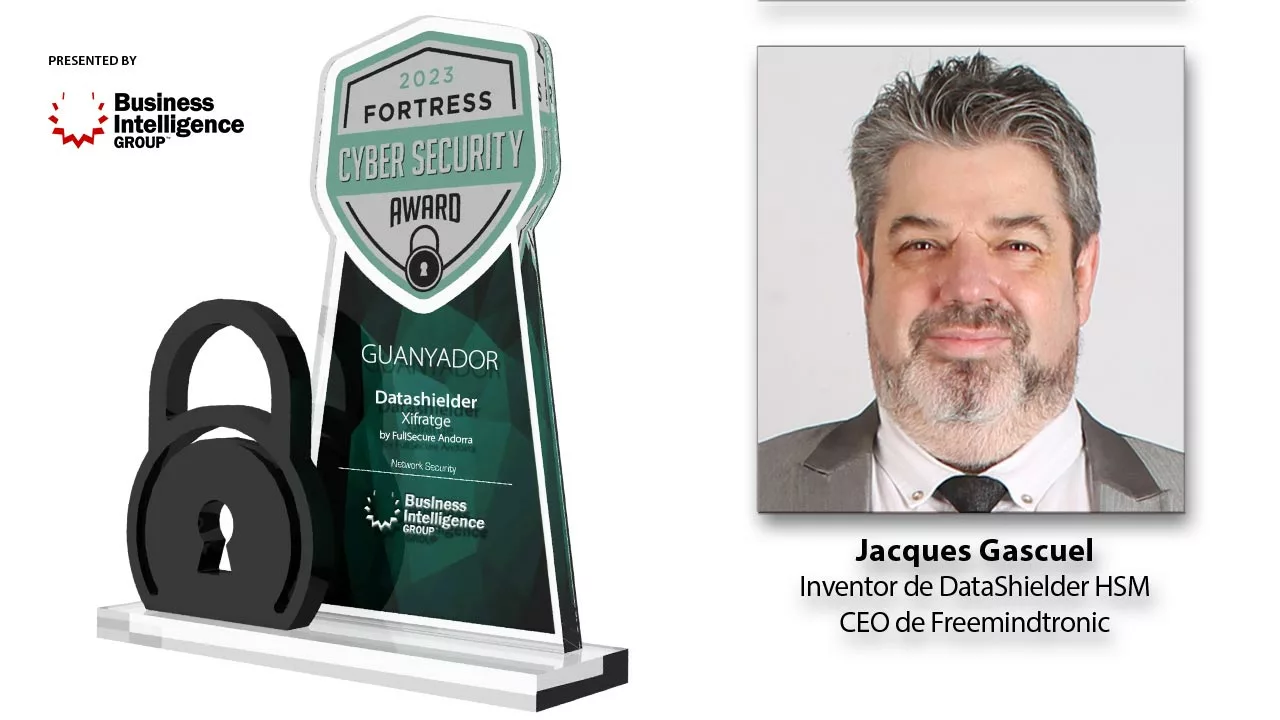
Serverless Cryptography Solution – FIC 2023

datashielder serverless cryptography solution team Sesame Expertises Region Hauts de France FIC 2023 Freemindtronic Andorra

DataShielder: Freemindtronic’s innovation at FIC 2023


DataShielder is a serverless cryptography solution that Freemindtronic presented at the International Cybersecurity Forum (FIC) 2023, which took place in Lille Grand Palais from 5 to 7 April 2023. The FIC is the leading European event on issues of security and digital trust. It brings together all cybersecurity actors, whether public or private, national or international. FIC visitors were able to attend demonstrations to discover all the features and benefits offered by DataShielder. The demonstrations took place on the stand of the Hauts-de-France region with Sésame Expertises, official partner of Freemindtronic.

DataShielder electronic signature compatible with eIDAS, GDPR, ISO/IEC 27001
Contact for demos on Sesame Expertises booth C9-12

Upload PDF press release (en) click here

Trophée du commerce 2009 Freemindtronic — Mister Ink & Invention FullProtect

Trophée du Commerce 2009 décerné à FREEMINDTRONIC / MISTER-INK par la CCI de Toulouse pour une activité de R&D électronique à Boulogne-sur-Gesse.

Trophée du Commerce 2009 Freemindtronic – FullProtect & Mister Ink, décerné par la Chambre de Commerce et d’Industrie de Toulouse pour une activité de recherche et développement électronique à Boulogne-sur-Gesse. Derrière ce projet de recharge de cartouches d’encre d’origine se cache une innovation de rupture en protection électrique intelligente : FullProtect, disjoncteur–régulateur capable de diagnostiquer un impact de foudre de catégorie 5 et d’enregistrer chaque anomalie dans une boîte noire infalsifiable, distinguée par une médaille d’argent au Salon International des Inventions de Genève 2010 et protégée par le brevet FR2941572 (voir Patentscope et Freemindtronic — FullProtect Genève 2010).

Résumé express

Lecture rapide (≈ 2 min) : En 2009, au cœur de la CCI de Toulouse, le Trophée du Commerce 2009 Freemindtronic attribué à Jacques Gascuel pour le projet Freemindtronic dépasse largement le cadre d’un simple magasin informatique de proximité. En arrière-plan, une activité de recherche et développement électronique conçoit, dans un cadre vertueux, une machine de recharge de cartouches d’encre d’origine pour réduire les déchets et prolonger la vie des cartouches d’imprimantes, sans recourir aux cartouches compatibles. C’est dans ce contexte de R&D qu’émerge une autre innovation de rupture : un système électronique avancé de protection électrique intelligente, capable de surveiller, analyser et consigner les anomalies sur les réseaux électriques continu et alternatif, jusqu’à diagnostiquer un impact de foudre de catégorie 5 (INERIS – Normes NF EN 62305).

Le Trophée du Commerce 2009 Freemindtronic, organisé par la CCI de Toulouse, marque une étape clé : il fait émerger une innovation qui, l’année suivante, sera médaillée d’argent au Salon International des Inventions de Genève et, en 2011, consolidée par la délivrance du brevet FR2941572. Cette distinction locale s’inscrit dans la continuité des concours consulaires pour le commerce de proximité, tout en révélant ici une technologie de sûreté électrique de niveau international.

Ce récit montre comment un Trophée consulaire local peut devenir le point de départ d’une trajectoire internationale en ingénierie de sûreté électrique et en protection d’infrastructures sensibles.

Points clés

  • Un Trophée du Commerce 2009 décerné par la CCI de Toulouse à un projet de recharge de cartouches d’encre.
  • Derrière l’activité commerciale : un système embarqué FullProtect de protection électrique intelligente avec boîte noire infalsifiable.
  • Une continuité très nette : → Trophée local 2009 → Demande de brevet FR2941572 (2009) → Médaille d’argent mondiale Genève 2010

Paramètres de lecture

Temps de lecture résumé express : ≈ 2 minutes
Temps de lecture résumé enrichi : ≈ 3 minutes
Temps de lecture chronique complète : ≈ 22 minutes
Date de publication : 2009-10-28
Dernière mise à jour : 2025-11-28
Niveau de complexité : Intermédiaire + — Innovation électronique & histoire consulaire
Densité technique : ≈ 55 %
Langue principale : FR . CAT .EN
Spécificité : Chronique historique — Trophée du Commerce 2009 & invention FullProtect
Ordre de lecture : Résumé → Résumé enrichi → Trophée 2009 & innovation → Genève & brevet → Contexte CCI → Portée actuelle
Accessibilité : Optimisé pour lecteurs d’écran — ancres & balises structurées
Type éditorial : Chronique stratégique — Distinction consulaire & innovation
Niveau d’enjeu : 7.6 / 10impact technologique & territorial
À propos de l’auteur : Jacques Gascuel, inventeur, lauréat du Trophée du Commerce 2009 et médaille d’argent au Salon International des Inventions de Genève 2010, fondateur des technologies Freemindtronic.

Note éditoriale — Cette chronique est rédigée conformément à la méthode Freemindtronic (Express / Enrichi / Chronicle) et sera enrichie au fil de l’évolution des Trophées du Commerce et des usages modernes de la protection électrique intelligente.

2026 Awards Cyberculture Digital Security Distinction Excellence EviOTP NFC HSM Technology EviPass EviPass NFC HSM technology EviPass Technology finalists PassCypher PassCypher

Quantum-Resistant Passwordless Manager — PassCypher finalist, Intersec Awards 2026 (FIDO-free, RAM-only)

2025 Cyberculture Cybersecurity Digital Security EviLink

CryptPeer messagerie P2P WebRTC : appels directs chiffrés de bout en bout

Awards EviCypher Technology International Inventions Geneva

Geneva International Exhibition of Inventions 2021

2021 Awards International Inventions Geneva

EviCypher Gold Medal 2021 of the Geneva International Inventions

Awards CES Awards Keepser New

Keepser Group Award CES 2022

Les billets affichés ci-dessus ↑ appartiennent à la même rubrique éditoriale Awards — Sécurité électronique & infrastructures. Ils prolongent l’analyse des liens entre Trophées consulaires, brevets d’invention, protection électrique et cybersécurité souveraine dans l’écosystème Freemindtronic.

⮞ Préambule — Un Trophée consulaire, une trajectoire internationale

Freemindtronic adresse ses remerciements sincères à la Chambre de Commerce et d’Industrie de Toulouse, aux membres du jury et aux institutions partenaires pour la qualité et la rigueur des Trophées du Commerce 2009. Cette distinction, décernée dans un cadre consulaire local, a servi de catalyseur à une innovation en protection électrique intelligente qui sera ensuite reconnue au niveau mondial. Elle illustre la capacité des concours CCI à détecter très tôt des projets dont la portée dépasse le territoire qui les a vus naître.

Résumé enrichi

Filiation consulaire et trajectoire 2001–2011

Ce résumé enrichi complète ce premier niveau de lecture. Il replace l’épisode Freemindtronic dans une histoire consulaire plus vaste, structurée par les Chambres de Commerce et d’Industrie.

Depuis plusieurs décennies, le réseau des CCI anime un grand concours national, le Challenge national du commerce et des services. Ce concours distingue commerçants et unions commerciales à travers les Mercure d’Or et les Panonceaux d’Or. Au tournant des années 2000, cette culture de distinction ne reste plus cantonnée au niveau national. Elle descend dans les territoires sous forme de Trophées du Commerce portés par les CCI locales.

Dès 2001, la CCI de Toulouse met en place ses propres Trophées du Commerce pour valoriser le commerce de proximité, l’innovation de service et la revitalisation des centres-villes en Haute-Garonne. Lorsque l’édition 2009 récompense Freemindtronic, elle ne distingue pas seulement une machine de recharge de cartouches d’encre d’origine. Elle révèle aussi une architecture électronique avancée de sûreté électrique, capable de quitter l’échelle du magasin pour rejoindre celle des infrastructures critiques.

Entre 2001 et 2011, la trajectoire qui se dessine est claire : un socle de concours consulaires à l’échelle nationale et une déclinaison territoriale à Toulouse. Elle montre ensuite la capacité de cet écosystème à accompagner une innovation locale jusqu’à la scène internationale (Genève) et à sa consolidation juridique (brevet FR2941572). Le Trophée du Commerce 2009 Freemindtronic apparaît ainsi comme l’un des maillons visibles d’une chaîne de reconnaissance, construite sur plus d’un demi-siècle d’ingénierie consulaire.

⮞ Key Insights — Ce qu’il faut retenir

  • Le Trophée du Commerce 2009 s’inscrit dans une filiation consulaire qui remonte au Challenge national du commerce et des services et à ses Mercure d’Or / Panonceaux d’Or.
  • Au début des années 2000, les CCI territoriales, dont la CCI de Toulouse, créent leurs propres Trophées pour territorialiser cette culture de distinction.
  • L’édition 2009 de Haute-Garonne repère, derrière un service de proximité, une innovation de sûreté électrique à potentiel international.
  • La période 2001–2011 montre comment un dispositif consulaire local peut servir de levier de trajectoire à une invention. Elle illustre le passage depuis la vitrine commerciale jusqu’aux plateformes internationales de l’innovation.

Chronique complète sur les Trophées du Commerce Français

La chronique du Trophée du Commerce 2009 Freemindtronic commence dans une salle consulaire de Toulouse et se poursuit sur les plateformes internationales de la protection électrique. Elle relie une petite commune rurale, Boulogne-sur-Gesse, aux scènes prestigieuses du Salon International des Inventions de Genève et aux bases de données de l’Organisation Mondiale de la Propriété Intellectuelle.

Timeline 2009–2011 — Du Trophée au brevet

  • 2009 : Trophée du Commerce 2009 Freemindtronic — reconnaissance consulaire au niveau local.
  • 2010 : médaille d’argent au Salon International des Inventions de Genève pour la technologie FullProtect.
  • 2011 : délivrance du brevet FR2941572 pour le système de protection électrique avec boîte noire infalsifiable.

Innovation Freemindtronic — Cœur du Trophée du Commerce 2009

Le projet Freemindtronic, lauréat du Trophée du Commerce 2009, est officiellement présenté comme une solution de recharge de cartouches d’encre d’origine. L’objectif est clair : limiter les déchets, prolonger la durée de vie des imprimantes et proposer une alternative crédible aux logiques de remplacement systématique.

De M@X Informatique à la naissance de Freemindtronic

En 2005, Jacques Gascuel fonde le réseau de magasins M@X Informatique, centré sur un service alors atypique : la réparation immédiate d’ordinateurs au comptoir devant le client. Cette approche directe et transparente instaure un lien de confiance avec une clientèle de proximité. À cette activité s’ajoute bientôt une première en France : la recharge de cartouches d’encre sous la marque Mister Ink, d’abord à Boulogne-sur-Gesse, puis à Saint-Gaudens, Tarbes, Samatan et Toulouse. Cette étape illustre comment un service de proximité devient le socle d’une trajectoire innovante.

Traçabilité animale — un premier jalon technologique

Avant même FullProtect, l’inventeur explore un autre domaine. Il pose un premier jalon technologique avec un système de traçabilité des animaux, objet d’une demande de brevet en 2007 (FR2898011). Basé sur le protocole ZigBee, technologie émergente depuis 2003, ce dispositif couvre les NAC et les animaux de compagnie. Il s’applique aussi aux cheptels bovins et ovins issus d’élevages labellisés. Grâce à des capteurs de température, il permet un pré‑diagnostic vétérinaire, incluant la détection du vêlage. Il assure également une traçabilité complète jusqu’au consommateur de viande. Sous la forme d’un véritable passeport électronique, ce projet est mené avec un docteur vétérinaire enseignant à Samatan. Il révèle déjà la démarche de l’inventeur : concevoir des systèmes embarqués capables de collecter, tracer et sécuriser des événements réels.

Naissance de Freemindtronic et émergence de FullProtect

En 2008, Jacques Gascuel crée la marque Freemindtronic, dédiée à la recherche et développement de systèmes électroniques embarqués. C’est dans ce cadre que naît une rupture : une architecture de protection électrique intelligente capable de surveiller, diagnostiquer et consigner les anomalies. La technologie FullProtect s’intègre d’abord discrètement aux activités de maintenance informatique et de recyclage de cartouches portées par M@X Informatique et Mister Ink, préparant le terrain pour une reconnaissance internationale.

L’innovation Mister Ink — une machine pour recycler les cartouches d’encre

Au cœur de Mister Ink, une pièce maîtresse illustre cet esprit : une machine de recharge de cartouches par dépression automatique, conçue en co‑conception franco‑chinoise. Elle permet de traiter les cartouches d’origine en contrôlant précisément les paramètres de recharge afin de garantir leur fiabilité, sans recourir aux cartouches compatibles, grands générateurs de déchets. L’objectif est clair : recycler l’existant plutôt que produire du jetable.

FullProtect — le cœur électronique caché derrière la vitrine

Mais derrière cette vitrine commerciale se cache un cœur électronique beaucoup plus ambitieux :

  • un système embarqué de protection électrique intelligente, capable de surveiller finement les variations de tension, de courant et la qualité du réseau ;
  • une boîte noire infalsifiable enregistrant chaque anomalie électrique (surtensions, microcoupures, perturbations aléatoires, défauts de charge) ;
  • une capacité à détecter, analyser et diagnostiquer un impact de foudre de catégorie 5.

Ce noyau électronique, qui deviendra FullProtect, dépasse rapidement le seul usage de la machine de recharge : il pose les bases d’une architecture de sûreté électrique applicable à de nombreux environnements (industrie, infrastructures critiques, télécommunications, IT, etc.). Sa fiabilité a été confirmée par des tests réalisés chez Airbus à Toulouse, démontrant la pertinence de cette innovation dans des contextes industriels exigeants.

Genève 2010 — Médaille d’argent mondiale

En 2010, cette innovation issue du Trophée du Commerce 2009 Freemindtronic franchit une nouvelle étape. Présentée au Salon International des Inventions de Genève dans la catégorie computer science, electronics, software, communications media, electricity, multimedia, la technologie FullProtect obtient la médaille d’argent mondiale de l’invention.

Cette distinction confirme deux éléments majeurs :

  • la solidité technique de la solution (capacité à surveiller et protéger finement des systèmes électriques complexes) ;
  • la pertinence internationale d’une invention née dans le cadre d’un Trophée consulaire local.

La page officielle Freemindtronic — FullProtect Genève 2010 retrace cette étape, qui ancre définitivement l’histoire du Trophée du Commerce 2009 dans une trajectoire d’innovation mondiale.

Brevet FR2941572 — Boîte noire & protection électrique intelligente

Pour sécuriser juridiquement l’invention, un brevet est déposé en 2009. Publié en 2010 et délivré en 2011, le brevet FR2941572 décrit un système de protection électrique intelligente avec enregistrement infalsifiable des événements.

Ce brevet couvre notamment :

  • la détection et l’analyse des défauts électriques (variations, surcharges, défauts d’alimentation, perturbations aléatoires),
  • la mise en sécurité des équipements connectés (coupure, limitation, isolation),
  • le journal horodaté et sécurisé des événements critiques, dans une logique de boîte noire.

Accessible via Patentscope (WIPO), ce brevet donne une base solide à la diffusion industrielle de la technologie et consacre le passage du projet Trophée du Commerce à un statut d’invention protégée à l’international.

Jury & partenaires — CCI Toulouse & Haute-Garonne

La cérémonie 2009 se déroule à la CCI de Toulouse, en présence d’un jury présidé par Michel Roux et incluant notamment Claude Tranzoni, aux côtés de représentants des services départementaux et des structures consulaires.

Sur le certificat remis au lauréat, les logos racontent une histoire de coopération :

  • CCI Toulouse
  • Conseil Général de la Haute-Garonne
  • Mairie de Toulouse
  • Chambre de Métiers et de l’Artisanat
  • Chambre de Commerce et d’Industrie de Toulouse
  • et plusieurs partenaires économiques locaux

Ce dispositif illustre le rôle structurant des institutions consulaires dans l’accompagnement des commerces et l’émergence de projets innovants.

Impact aujourd’hui — Héritage du Trophée du Commerce 2009 Freemindtronic

Aujourd’hui, les Trophées du Commerce poursuivent cette mission dans un format national renouvelé, coordonné par le réseau des CCI. Ils restent centrés sur :

  • le commerce de proximité et la revitalisation des centres-villes ;
  • l’innovation dans les services, la relation client et la transformation des points de vente ;
  • la mise en avant d’initiatives exemplaires susceptibles d’inspirer d’autres territoires.

Le Trophée du Commerce 2009 de Freemindtronic reste un cas d’école : un exemple où un concours consulaire repère une innovation de fond dont la portée s’étend bien au-delà de la vitrine commerciale et des frontières du département.

Contexte consulaire — Du Challenge national aux Trophées du Commerce

Derrière les sigles CCI, Mercure d’Or ou Panonceau d’Or, il y a surtout des histoires d’hommes, de femmes et de commerces de terrain, parfois perdus dans des bourgs ruraux, qui décrochent une reconnaissance nationale.

Avant et après 2009, le Trophée Freemindtronic s’inscrit dans une histoire consulaire plus large. Les Trophées du Commerce prolongent en réalité un grand concours national qui a structuré la reconnaissance des commerçants pendant plus d’un demi-siècle.

Les origines — Challenge national du commerce et des services

Pendant des décennies, CCI France et le réseau des Chambres de Commerce et d’Industrie organisent le Challenge national du commerce et des services, en partenariat avec la FFAC et la Fondation MMA.

  • Récompenses phares : Mercure d’Or (commerçants) et Panonceaux d’Or (associations de commerçants).
  • Objectifs : valoriser les commerces indépendants, les unions commerciales et la revitalisation des centres-villes.

On trouve encore des Mercure d’Or 2023 : ce socle historique sert de base aux futurs Trophées du Commerce.

2001–2010 — Trophées du Commerce locaux

Au tournant des années 2000, les CCI territoriales créent leurs propres Trophées du Commerce locaux (ou « Trophées du commerce et de l’artisanat ») :

  • Portés par les CCI territoriales (par exemple la CCI de Toulouse pour la Haute-Garonne),
  • en lien avec les collectivités locales (ville, département, région),
  • centrés sur le commerce de proximité, les centres-villes, les vitrines et l’innovation commerciale.

Des sources locales (comme Entreprise Toulouse – 2009 ou La Dépêche du Midi – 10e édition) attestent que ces Trophées existaient déjà bien avant le rebranding national de 2024–2025. Le Trophée du Commerce 2009 Freemindtronic s’inscrit dans cette génération de concours locaux, organisés par la CCI de Toulouse / Haute-Garonne.

2024–2026 — Refonte nationale « Les Trophées du Commerce »

À partir de 2024–2025, CCI France opère un rebranding national :

  • les Trophées du Commerce « succèdent au Challenge national du commerce et des services » ;
  • le concours est structuré à trois niveaux : départemental, régional, national ;
  • des campagnes « Trophées du Commerce 2025–2026 » sont déployées dans de nombreux territoires.

Les Trophées conservent leur ADN : commerce de proximité, centres-villes, innovation, développement durable et transition écologique. Le cycle 2025–2026 renforce cette visibilité nationale, avec partenaires récurrents et cérémonies à l’échelle de la France entière.

Dans cette perspective, le Trophée du Commerce 2009 de Haute-Garonne n’est pas un épisode isolé. Il devient un maillon identifiable d’une chaîne continue allant du Challenge national des années 1970 aux Trophées du Commerce nationaux 2025–2026, et un exemple emblématique de la manière dont un prix local peut révéler une innovation de niveau international.

Les points clés à retenir sont :

  • Les Trophées du Commerce agissent comme un dispositif pérenne de valorisation du commerce de proximité, issu d’une architecture consulaire construite depuis plus de 50 ans.
  • Le Trophée 2009 a servi de tremplin à une invention de sûreté électrique distinguée à Genève et protégée par brevet international.
  • Les concours consulaires peuvent être de véritables accélérateurs d’innovation pour des technologies critiques (énergie, infrastructures, sécurité).

Signaux forts identifiés

Ces éléments ne relèvent plus de simples indices émergents : ils traduisent des dynamiques fortes déjà à l’œuvre.

  • Schéma : Des concours « commerce » révèlent des innovations de niveau « infrastructures critiques ».
  • Facteur : Besoin croissant de traçabilité des anomalies électriques (boîtes noires, diagnostics d’incidents).
  • Tendance : Convergence entre sûreté électrique, cybersécurité et protection de données dans un paradigme souverain.

Cas d’usage souverain Freemindtronic — FullProtect embarqué dans Evikey & Evidisk NFC

⮞ Continuité technologique réelle — FullProtect dans Evikey & Evidisk NFC

Le système de protection électrique intelligente FullProtect — disjoncteur–régulateur avec boîte noire infalsifiable — n’est pas intégré aux familles PassCypher ou DataShielder. Il est physiquement embarqué dans des supports de stockage souverains de type clés USB et SSD sécurisés, conçus par Freemindtronic.

Evikey NFC Secure USB Flash Drive Premium — Clé USB sécurisée, déverrouillable sans contact via NFC, intégrant un disjoncteur–régulateur FullProtect avec boîte noire. Elle protège à la fois :

  • les données (accès conditionné, verrouillage automatique, effacement logique),
  • et l’électronique elle-même (surtensions, anomalies électriques, événements extrêmes).

Evikey NFC Secure USB Drive Pro — Version professionnelle de la clé USB sécurisée sans contact, intégrant également le noyau FullProtect. Elle bénéficie d’un disjoncteur–régulateur embarqué avec journalisation des événements électriques, offrant un niveau de résilience physique rarement atteint sur un support de stockage amovible.

EviDisk SSD NFC (hors catalogue) — Support SSD sécurisé sans contact, également équipé du système FullProtect. Il transpose la logique de disjoncteur–régulateur avec boîte noire au monde du stockage SSD, pour des usages nécessitant une combinaison de :

  • protection du stockage de données,
  • protection contre les risques électriques, thermiques et d’usage,
  • traçabilité par boîte noire d’événements aléatoires et extrêmes,
  • auto-diagnostic de l’origine des défaillances (électriques, thermiques ou liées à l’utilisation).

⮞ Triple rôle des supports Evikey NFC / Evidisk SSD NFC

Les dispositifs Evikey NFC et EviDisk SSD NFC incarnent une convergence rare entre :

  • Protection logique des données : accès conditionné, verrouillage souverain et contrôle par détenteur légitime via NFC.
  • Protection physique & électrique : présence d’un disjoncteur–régulateur FullProtect qui limite, coupe ou adapte l’alimentation en cas d’anomalie électrique, thermique ou de défaut d’usage.
  • Traçabilité embarquée : boîte noire infalsifiable enregistrant les événements électriques et thermiques critiques (surtensions, sous-tensions, surintensités, régulations anormales, défauts d’usage et cyber sûreté contre les attaques par force brute).

Cette combinaison fait d’Evikey / Evidisk NFC non pas de simples supports de stockage, mais de véritables modules souverains de confiance, capables de protéger à la fois :

  • l’information (données stockées),
  • le support lui-même (composants électroniques),
  • et de fournir des preuves techniques en cas d’incident électrique majeur.

Ainsi, la filiation directe entre le Trophée du Commerce 2009 Freemindtronic et l’invention FullProtect se lit aujourd’hui dans les produits Evikey NFC et Evidisk SSD NFC : ce sont eux qui portent concrètement, dans le catalogue Freemindtronic, le disjoncteur–régulateur avec boîte noire infalsifiable issu de cette innovation récompensée.

Questions fréquentes sur le Trophée du Commerce 2009 & FullProtect

Le Trophée du Commerce 2009 est-il un prix local ou national ?

Un prix local inscrit dans une tradition nationale

Le Trophée du Commerce 2009 est un prix local organisé par la CCI de Toulouse pour la Haute-Garonne. Il s’inscrit cependant dans une tradition nationale portée par le réseau des CCI depuis les années 1970, à travers le Challenge national du commerce et des services, qui a longtemps structuré la reconnaissance des commerçants en France. Le Trophée 2009 constitue ainsi une déclinaison territoriale de cette filiation consulaire.

De la vitrine commerciale à l’innovation de rupture

Dès l’origine, Freemindtronic n’est pas un simple magasin informatique. L’entreprise propose une innovation de service : la réparation immédiat d’ordinateurs au comptoir devant le client, pratique encore marginale à l’époque. Elle investit ensuite dans la recherche et développement pour créer un service inédit en France : la recharge de cartouches d’encre par dépression, via une machine spécialement conçue. Cette activité, baptisée Mister Ink, est implantée dans le Comminges (Haute-Garonne). Derrière cette vitrine commerciale se développe pourtant une innovation de rupture : un système embarqué de protection électrique intelligente, capable d’auto-diagnostiquer des défauts électriques allant de la très basse tension à la haute tension.

  • Mesure et analyse des anomalies électriques.
  • Mise en sécurité des équipements connectés.
  • Enregistrement infalsifiable des événements critiques dans une « boîte noire ».

Ce noyau technologique dépasse donc largement le cadre du commerce de proximité et ouvre la voie à une reconnaissance internationale :

  • Médaille d’argent au Salon International des Inventions de Genève 2010.
  • Brevet FR2941572 délivré en 2011.

Deux étapes complémentaires de reconnaissance

Le Trophée du Commerce 2009 constitue un premier niveau de reconnaissance pour l’innovation FullProtect, dans un cadre consulaire local. La médaille d’argent obtenue au Salon International des Inventions de Genève 2010 valide ensuite cette invention dans un environnement international spécialisé en recherche et développement, confirmant sa portée technique et inventive.

Le socle juridique et technique de FullProtect

Le brevet FR2941572 (demandé en 2009, publié en 2010 et délivré en 2011) formalise juridiquement l’invention FullProtect. Il décrit un système de protection électrique intelligente doté d’une boîte noire infalsifiable, capable de consigner les incidents électriques, y compris un impact de foudre de catégorie 5. Ce brevet constitue le socle de la propriété intellectuelle de FullProtect et une base pour ses applications industrielles.

Une tradition consulaire toujours vivante

Les Trophées du Commerce existent toujours, sous une forme renouvelée coordonnée par CCI France. Depuis 2024, ils succèdent officiellement au Challenge national du commerce et des services et sont désormais structurés en étapes départementales, régionales et nationales. Ils continuent ainsi à valoriser le commerce de proximité, l’innovation et la revitalisation des centres-villes.

De la sûreté électrique à la sécurité souveraine

FullProtect représente une première génération d’architecture embarquée de protection, centrée sur la sûreté électrique et la traçabilité des événements. Les solutions souveraines actuelles de Freemindtronic (DataShielder, PassCypher, SeedNFC, etc.) prolongent cette logique dans le domaine de la protection des données, des identités numériques et des secrets cryptographiques. Elles n’intègrent pas directement le module électrique FullProtect, mais s’inscrivent dans la même philosophie de sécurité souveraine et de maîtrise des risques.

Ce que nous n’avons pas (encore) couvert

Cette chronique ne détaille pas :

  • les spécifications électroniques complètes du système FullProtect (schémas, composants, algorithmes de détection),
  • les déclinaisons industrielles ultérieures de la technologie dans des environnements critiques (énergie, transport, défense),
  • les autres projets lauréats des Trophées du Commerce 2009 en Haute-Garonne ou au niveau national.

Ces points feront l’objet de billets dédiés, centrés respectivement sur l’analyse technique détaillée, les cas d’usage sectoriels et la cartographie des concours consulaires dans le temps.

Perspective stratégique — Vers de nouveaux standards de protection

En retraçant le chemin qui mène d’un Trophée du Commerce 2009 à une médaille internationale et à un brevet d’invention, cette chronique met en lumière un mouvement de fond : les concours consulaires peuvent jouer un rôle stratégique dans la détection précoce de technologies critiques.

L’exemple de Freemindtronic et de la technologie FullProtect montre qu’un projet né dans le cadre du commerce de proximité peut ouvrir la voie à de futurs standards de protection, à la fois électriques et numériques.

À l’heure où les infrastructures deviennent à la fois plus interconnectées et plus vulnérables, l’approche combinant :

  • détection fine des anomalies,
  • boîte noire infalsifiable,
  • architecture embarquée souveraine,

préfigure des modèles de résilience globale qui lient désormais sûreté électrique, cybersécurité et protection des données.

Dans cette perspective, le Trophée du Commerce 2009 ne relève pas d’un simple souvenir de vitrine : il devient un repère dans l’histoire des innovations de confiance issues des territoires et appelées à structurer la sécurité des infrastructures de demain.