Tag Archives: end-to-end encryption

Russia Blocks WhatsApp: Max and the Sovereign Internet

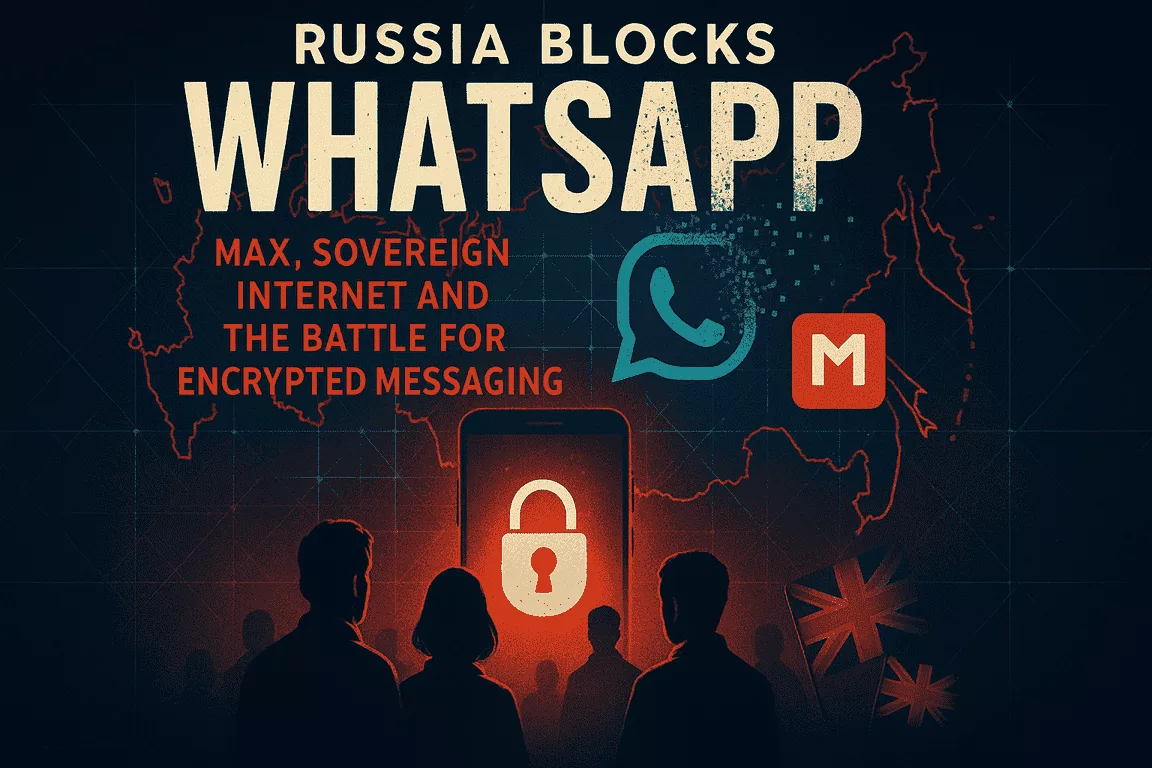
Movie-style poster for the English chronicle “Russia Blocks WhatsApp: Max and the Sovereign Internet”, with WhatsApp fading into the Max superapp over a split Russian digital map.

Step by step, Russia blocks WhatsApp and now openly threatens to “completely block” the messaging app, accused of enabling terrorist plots, sabotage and large-scale fraud. Behind this offensive, the story goes far beyond a legal dispute between Roskomnadzor and Meta. Moscow actively tries to replace a global end-to-end encrypted messenger with a domestic ecosystem that authorities can fully monitor, centred on the Max superapp and the architecture of the Russian sovereign Internet.

Executive Summary — What “Russia blocks WhatsApp” really means

Quick read ≈ 4 min — Russia’s communications regulator Roskomnadzor now states that it may move towards a full ban on WhatsApp if the messenger does not comply with Russian laws against crime, terrorism and “extremism”.

Context — From tolerance to programmed rupture

For years, Moscow tolerated WhatsApp even after it labelled Meta (Facebook, Instagram) an “extremist organisation”. The app had become indispensable to the daily lives of tens of millions of Russians. However, as the Russian sovereign Internet takes shape, this compromise becomes less and less sustainable. The progressive blocking of calls, followed by the threat of a full ban, signals a shift towards an assumed incompatibility between global end-to-end encryption and Russia’s surveillance strategy.

Legal foundation — A framework designed for access to communications

At the same time, the laws on data localisation, the Yarovaya package and the Sovereign Internet law create a legal framework tailored for state access to communications. These texts require telecom operators and messaging services to hand over content, metadata and decryption capabilities to security services. By design, WhatsApp cannot decrypt users’ messages. Therefore, to appear “compliant” with Russian law, the app would have to weaken its security model (backdoors, client-side scanning) or effectively leave the Russian market.

Strategic principle — Replacing WhatsApp with the Max superapp

In parallel, Russia promotes a national alternative, Max, developed by VK and marketed as the “national messenger”. VK positions Max as a superapp that combines chat, payments and e-government services. The app does not offer verifiable end-to-end encryption. Consequently, the more difficult and risky WhatsApp becomes to use, the more Russians drift towards Max, where security services enjoy maximum visibility over data flows.

Sovereign stakes — From counter-terrorism to social control

Official Russian discourse now frames WhatsApp as a major vector for fraud, sabotage and terrorism. Yet Russian statistics still show that classic phone calls remain the leading fraud channel. Moreover, in a system where “extremism” covers opposition movements, NGOs and the LGBT community, asking WhatsApp to “exclude criminal activities” effectively means building a political police inside the messenger. The sequence “Russia threatens to completely block WhatsApp” therefore reveals a deeper strategic choice: replacing global encrypted services with controlled national solutions, and redefining digital sovereignty around surveillance rather than around encryption.

Reading Parameters

Executive summary: ≈ 4 min
Core analysis: ≈ 10–12 min
Full chronicle: ≈ 25–30 min
Publication date: 2025-11-29
Last update: 2025-11-29
Complexity level: Sovereign & Geopolitical
Technical density: ≈ 70%
Languages available: FR · EN
Main focus: Russia blocks WhatsApp, Roskomnadzor, Max, sovereign Internet, end-to-end encryption
Editorial type: Chronicle — Freemindtronic Cyberculture Series
Strategic impact: 8.4 / 10 — sovereignty & encrypted communications

Editorial note — This chronicle belongs to the Freemindtronic Cyberculture collection. It analyses the sequence “Russia blocks WhatsApp” through the lens of sovereign communication architectures and state doctrines for controlling the Internet. It compares pressure on WhatsApp, the rise of the Max superapp and the Russian sovereign Internet with alternative architectures based on local encryption and hardware devices for protecting secrets.
In the Freemindtronic doctrine, sovereignty does not mean simply the ability to intercept. It means the capacity to design systems that do not need backdoors. While Russia seeks to regain control by weakening global encrypted messengers in favour of a national superapp such as Max, solutions like DataShielder HSM PGP and DataShielder NFC HSM illustrate a 100% serverless approach (local encryption, offline HSM). In parallel, CryptPeer adds a peer-to-peer layer with a self-hostable, self-portable relay server that only handles already encrypted streams and holds no decryption keys. In every case, the data remains unusable, even if the messaging infrastructure is seized or blocked.

Table of Contents

Key Insights — Main fault lines

  • The sequence “Russia blocks WhatsApp” results from a gradual strategy: Yarovaya laws, sovereign Internet, Meta as “extremist”, then increasing pressure on encrypted messengers.
  • Russia does not primarily reproach WhatsApp for failing to fight crime. Instead, the state sees the app as structurally incompatible with full state surveillance.
  • The Max superapp plays the role of domestic replacement for WhatsApp, without verifiable end-to-end encryption, deeply integrated with payments and e-government services and supervised by the security apparatus.
  • Official fraud statistics still show that traditional phone calls remain the main vector. This point relativises the narrative that presents WhatsApp as the primary problem.
  • Serverless or keyless architectures — local HSMs (DataShielder NFC HSM, DataShielder HSM PGP) and self-hostable relay servers with no keys (CryptPeer) — offer an alternative where no state can demand a single exploitable central backdoor.

Context — How “Russia blocks WhatsApp” went from scenario to real threat

Section summary — In 2022, Russia labelled Meta an “extremist organisation” but spared WhatsApp. In 2025, restrictions on calls and the tightening of the sovereign Internet changed the equation. Roskomnadzor now openly mentions a full WhatsApp ban. This evolution is no accident. It closes a phase of constrained tolerance and opens a phase of programmed rupture.

2022 — Meta labelled “extremist”, WhatsApp spared

In March 2022, shortly after the full-scale invasion of Ukraine, a Russian court declared Meta an “extremist organisation”. Authorities blocked Facebook and Instagram in Russia. However, one detail immediately attracted attention. The ruling explicitly stated that it did not apply to WhatsApp, which remained the main messaging app of the Meta group in Russia.

A messenger embedded in everyday life

At that time, WhatsApp permeated Russian society. Families, small businesses and local administrations relied on it. Schools, universities and some public services also used it to coordinate day-to-day information. A brutal ban would have disrupted the daily lives of millions of people. At that stage, no credible domestic alternative could fully replace the app.

The rise of the Russian sovereign Internet

Gradually, however, the technical and political context shifted. On one side, the architecture of the Russian sovereign Internet (Runet) took shape. Telecom operators deployed Deep Packet Inspection equipment and centralised routing capabilities. They also implemented technical mechanisms able to isolate the Runet from the wider Internet when the state decides to do so. On the other side, political discourse hardened around “information warfare”. Authorities increasingly invoked “extremism” and the fight against allegedly hostile foreign platforms.

2025 — From call restrictions to an explicit “Russia blocks WhatsApp” threat

On 13 August 2025, Russia crossed a new threshold in this gradual strategy. Roskomnadzor announced restrictions on audio calls via WhatsApp and Telegram. Officials justified the decision by referring to the fight against fraud and terrorism. Text messages remained technically possible. Nevertheless, in many regions, users already experienced a degraded service and unreliable voice calls.

A few months later, Roskomnadzor publicly mentioned the option of a complete ban on WhatsApp in Russia if the app did not adapt to Russian law. The regulator framed the situation as a binary choice. Either WhatsApp complies with Russian requirements on data and decryption, or it accepts disconnection from the Runet.

A political turn, not a simple technical incident

In other words, the phrase “Russia blocks WhatsApp” no longer describes a distant scenario. It now points to a political horizon that Russian authorities assume and openly discuss. In this context, it becomes important to analyse the legal foundation that makes this scenario plausible. That foundation also reveals the deeper logic behind the confrontation with WhatsApp and the trajectory chosen by the Russian state.

Section summary — Three pillars make WhatsApp’s position increasingly untenable: data localisation, the Yarovaya package and the sovereign Internet law. Together, they aim at a Runet where no mass communication service escapes state interception.

To understand why Russia can threaten a complete WhatsApp ban, we need to look at the legal architecture built over the past decade. This architecture rests on three complementary pillars.

Data localisation — Keeping personal data “within reach”

First, the data localisation law requires that Russian citizens’ personal data stay on servers located inside Russia. Services that refuse localisation face fines and, ultimately, blocking. Roskomnadzor maintains a list of offenders and orchestrates technical sanctions.

For a global messaging service like WhatsApp, this requirement already creates a serious constraint. The infrastructure of the app is distributed and designed for an Internet without hard borders. Forcing a strict separation between “Russian data” and “non-Russian data” means challenging the very design of the platform.

Yarovaya package — Mass storage and decryption obligations

Next comes the Yarovaya package, adopted in 2016. It requires telecom operators and “organisers of information distribution” to:

  • store the content of communications for several months,
  • retain metadata for a longer period,
  • and, crucially, provide security services with the means to decrypt communications, including handing over encryption keys.

In plain language, any messenger used at scale in Russia must at least in theory deliver the content of conversations in cleartext when authorities request it. This requirement collides directly with genuine end-to-end encryption, where the provider holds no decryption keys.

Sovereign Internet — DPI and central control over the Runet

Finally, the Sovereign Internet law completes the framework:

  • ISPs must install Deep Packet Inspection (DPI) equipment under Roskomnadzor’s control;
  • the state can redirect, filter, throttle or cut specific services;
  • the Russian Internet segment (Runet) can be isolated from the global network in case of crisis or political decision.

Taken together, these three pillars (“data localisation”, “Yarovaya”, “sovereign Internet”) converge towards a model where, on paper, no mass communication service remains out of reach. This applies to hosting, to encryption and to network routing.

Within such a normative universe, a global messenger with end-to-end encryption like WhatsApp becomes a legal and technical anomaly. This anomaly largely explains why the sequence “Russia blocks WhatsApp” does not simply reflect a passing mood. Instead, it expresses a deep conflict between two philosophies of encryption.

WhatsApp — End-to-end encryption at the heart of the “Russia blocks WhatsApp” conflict

Section summary — WhatsApp encrypts messages end to end. Meta cannot decrypt content, even under state pressure. To become “compliant” with Russian law, the messenger would have to abandon or severely weaken its security model, or withdraw from the Russian market. This tension lies at the heart of the phrase “Russia blocks WhatsApp”.

A technical model built around end-to-end encryption

Once we understand the legal framework, we can return to WhatsApp’s technical model. The messenger relies on end-to-end encryption (E2EE). Concretely:

  • the app encrypts messages on the sender’s device;
  • only the recipient’s device can decrypt them;
  • Meta has no direct access to cleartext content, only to metadata.

A Russian demand incompatible with WhatsApp’s design

We can now compare this model with Russian legal requirements. In an E2EE system, laws that demand providers to submit keys or plaintext content cannot be satisfied without a deep redesign of the service. The tension does not simply come from political refusal. It arises from a design incompatibility between the messenger and the Russian legal environment.

Three theoretical outcomes for WhatsApp in Russia

To become compliant with Russia, WhatsApp only sees three realistic options:

  1. Introduce a backdoor or client-side scanning. In this scenario, the app would scan messages on the device before encryption, detect prohibited content or behaviour and send reports to servers that authorities can query.
  2. Abandon end-to-end encryption for all or part of Russian users. The service would then revert to a model where servers can read messages and hand them over to security services.
  3. Refuse and accept a full ban, thereby becoming a niche app mainly used via VPNs and technical workarounds.

Two irreconcilable models of sovereignty over communications

So far, Meta publicly defends E2EE as essential for protecting private communications. As a result, the phrase “Russia blocks WhatsApp” functions less as a rhetorical threat and more as a collision point between two security models. One model treats encryption as a strong shield, including against states. The other rejects the idea that a mass-market service might escape state surveillance.

From this point on, it becomes useful to place this impasse within a clear timeline. That timeline retraces Russia’s previous attempts to control encrypted messengers.

Programmed escalation — Telegram, Meta, then WhatsApp

Section summary — The threat of a full WhatsApp ban does not come out of nowhere. It follows a sequence: failed attempt to block Telegram, Meta labelled “extremist”, deployment of the sovereign Internet, restrictions on WhatsApp/Telegram calls, then the prospect of a complete cut-off.

To gauge the significance of the current threat, we must look back at previous episodes and see how they prepare the ground.

Attempted Telegram ban (2018–2020)

In 2018, Russian authorities tried to block Telegram after the company refused to hand over encryption keys. Roskomnadzor ordered the blocking of millions of IP addresses, including infrastructure that belonged to Amazon and Google. Collateral damage proved massive, while Telegram remained largely accessible through mirrors and circumvention tools. In 2020, the regulator officially abandoned the ban.

This failed attempt revealed two important lessons. First, without a fully operational sovereign Internet, blocking a popular messenger remains technically difficult and politically costly. Second, regulatory pressure alone does not suffice when the state lacks a credible alternative platform to propose.

Meta as “extremist”, WhatsApp tolerated (2022)

In 2022, Russia took a new step by declaring Meta an “extremist organisation”. Authorities blocked Facebook and Instagram. Yet the court ruling explicitly spared WhatsApp. This choice reflected a form of pragmatic realism: target social networks that the Kremlin viewed as politically sensitive, while preserving the messenger that much of the population relied on.

Sovereign Internet, legal hardening and call restrictions (2024–2025)

Between 2024 and 2025, the landscape changed again. DPI equipment became widespread. The notion of “extremism” broadened. New provisions criminalised even the online search for content branded “extremist”. In parallel, lawmakers increasingly targeted the use of VPNs to access such content.

On 13 August 2025, Roskomnadzor announced targeted restrictions on audio calls via WhatsApp and Telegram, once again justified by “anti-fraud” and “anti-terrorism” arguments. In practice, voice communications deteriorated to the point of becoming unusable in many areas, while text messages continued to function.

A few months later, the threat of a full WhatsApp ban in Russia entered the public debate. Consequently, the sequence “Russia blocks WhatsApp” does not fall from the sky. It extends a gradual escalation, technically prepared and politically deliberate.

This escalation only makes sense because, in parallel, a domestic alternative was already under construction: the Max superapp, designed to replace WhatsApp within the Russian sovereign Internet ecosystem.

Max — Domestic superapp and WhatsApp replacement

Section summary — Max, developed by VK, is more than a messenger. It acts as a superapp that aggregates chat, payments, e-government and digital identity. It does not offer verifiable end-to-end encryption and positions itself as the “sovereign” replacement for WhatsApp in an increasingly closed Runet.

An “all-in-one” superapp at the heart of the Runet

As Russia turns up the pressure on WhatsApp, another key piece already sits on the board. This is the Max superapp, developed by VK Group and promoted as the “national messenger”.

VK presents Max as an “all-in-one” application:

  • one-to-one and group messaging;
  • payments, digital wallet and transfers;
  • access to selected government services (Gosuslugi);
  • planned integration with digital identity and electronic signatures.

Limited encryption and structural compatibility with the sovereign Internet

Two features weigh heavily in the balance. The first concerns encryption.

Public information and independent analyses indicate that Max does not provide verifiable end-to-end encryption. At best, the app encrypts traffic in transit. In practice, the operator can still read messages and deliver them to authorities when required. This design makes the superapp structurally compatible with the requirements of the Russian sovereign Internet.

Mandatory pre-installation and growing dependency

The second feature concerns distribution. From 1 September 2025, Russian regulations require Max to be pre-installed on all smartphones and tablets sold in the country. At the same time, several administrations already encourage or impose its use for communication with parents, schools and public services. Step by step, Max becomes a compulsory gateway to digital everyday life.

From WhatsApp to Max — An assumed substitution strategy

In this context, the phrase “Russia blocks WhatsApp” does not simply describe a punitive measure. It forms part of a broader substitution strategy.

The more painful or risky the use of WhatsApp becomes, the more Max imposes itself as the default channel. It turns into the unavoidable hub to communicate, pay and interact with the state. As a result, the potential WhatsApp ban and the rise of Max reinforce each other.

This dynamic forces analysts to examine Moscow’s narrative that justifies this shift — fraud, terrorism, extremism. Understanding that discourse helps to see how the sequence “Russia blocks WhatsApp” also serves a wider project of social control.

Fraud, terrorism, extremism — Official narrative vs reality

Section summary — Moscow justifies pressure on WhatsApp by invoking the fight against fraud and terrorism. However, official figures still show that classic phone calls remain the main fraud channel. Above all, Russia’s definition of “criminal” behaviour is extremely broad, covering opposition movements, NGOs and the LGBT community.

An official storyline centred on fraud and terrorism

In its press releases, Roskomnadzor claims that WhatsApp and Telegram have become central tools for:

  • mass fraud and financial scams;
  • recruitment for terrorism and sabotage;
  • coordination of criminal actions and “extremism”.

At first glance, this narrative appears consistent with public-security concerns. However, official data paint a more nuanced picture.

The Central Bank of Russia tells a different story

Reports from the Central Bank of Russia highlight another reality. They show that:

  • traditional phone calls still represent the main fraud channel;
  • encrypted messengers remain only one vector among many;
  • restrictions on WhatsApp/Telegram calls mainly triggered a rebound in classic voice traffic rather than eliminating fraud.

In other words, the “fraud” angle operates as a legitimising narrative at least as much as a technical justification. This gap opens the way to a second, more political shift.

An ever-expanding definition of “criminal behaviour”

At the same time, constant references to “criminal activities” and “extremism” play a structuring role. By 2025, these categories in Russia cover:

  • organisations linked to Alexei Navalny, labelled “extremist” and then “terrorist”;
  • the international LGBT movement, classified as an extremist organisation;
  • numerous NGOs, independent media and human-rights organisations;
  • many anti-war expressions and criticisms of the army.

Gradually, the boundary between actual criminality and political dissent becomes blurred. The language of criminal law then reshapes public space instead of merely addressing precise offences.

From anti-fraud measures to an embedded political police

Within this context, demanding that WhatsApp “exclude criminal activity” means several concrete things:

  • proactively censoring conversations on sensitive topics;
  • identifying people who participate in these exchanges;
  • and sending data to the relevant security agencies.

An end-to-end encrypted messenger cannot deliver this programme without sacrificing its security model. Adding such functions would effectively turn the app into a tool for political surveillance.

Therefore, the sequence “Russia threatens to completely block WhatsApp” acts as a revealing moment. The state asks a global tool to become an embedded political-police device, which WhatsApp neither can nor wants to be. This observation leads directly to Roskomnadzor’s pivotal role as legal enforcer, technical orchestrator and official narrator of the confrontation.

Roskomnadzor — Technical and political hub of the Runet

Section summary — Roskomnadzor does not behave like a simple administrative watchdog. Instead, it conducts the Russian sovereign Internet. It manages censorship, steers DPI equipment, oversees data localisation and coordinates the replacement of global services with domestic solutions.

A regulator at the core of the sovereign Internet

To understand Roskomnadzor’s role, we must look at its operational responsibilities. The agency cumulates several key functions within the Russian sovereign Internet:

  • it maintains the central blocklist of sites and online services subject to restriction;
  • it monitors compliance with data localisation obligations;
  • it supervises the roll-out of DPI equipment at ISPs;
  • it coordinates throttling or cut-off operations on foreign services (social networks, VPNs, video platforms, analytics tools, etc.).

In other words, Roskomnadzor does not merely issue rules. It also orchestrates their technical enforcement within the Runet’s infrastructure.

Technical arm of a progressive Runet lockdown

In the official narrative, Roskomnadzor acts to “protect citizens” and ensure “infrastructure stability”. In practice, however, it has become the technical arm of a policy aimed at progressively locking down the Runet. Its statements on WhatsApp therefore carry significance far beyond the messaging app itself. They signal the overall direction of Russian digital policy.

The threat of a full ban as strategic signalling

The threat of a full WhatsApp ban illustrates this signalling role particularly well. It fits into a coherent pattern of actions and messages:

  • pressure on foreign services that the state labels as “non-cooperative”;
  • active promotion of the Max superapp as a “patriotic” alternative;
  • constant reminders of data-sharing, localisation and decryption obligations.

Each statement by Roskomnadzor therefore goes beyond a warning to a single platform. It contributes to redefining what remains tolerated within the Russian digital space.

A triptych that redefines freedom of communication

The triptych “Russia blocks WhatsApp”, “Max as national superapp” and “sovereign Internet” sketches a new model. Under this model, freedom of communication becomes conditional on alignment with the surveillance architecture. Mass-market messengers appear legitimate only if they fully integrate into this control framework.

The next step consists in projecting this model into the future through several realistic scenarios. These scenarios help evaluate how far Runet lockdown and the marginalisation of global encrypted services might go.

Prospective scenarios — What future for the Russian Internet?

Section summary — Three trajectories stand out: a de facto progressive ban, an opaque deal with client-side surveillance, or an assumed rupture with a full ban. In each case, the Runet becomes more closed, more monitored and more dependent on domestic solutions such as Max.

Starting from the current situation, we can outline several realistic trajectories for the relationship between Russia, WhatsApp and the sovereign Internet.

Scenario 1 — Progressive de facto ban

In the first scenario, the state does not announce a brutal “ban”. Instead, authorities organise a slow erosion of WhatsApp usage.

  • call restrictions remain in place for the long term;
  • file transfers are throttled or intermittently disrupted;
  • new accounts sometimes struggle to register;
  • official discourse describes the service as “unreliable” or “dangerous”.

In such a scenario, WhatsApp does not fully disappear from the Runet, but its use concentrates among:

  • more tech-savvy users, able to manage VPNs and circumvention tools;
  • cross-border communications with the diaspora and foreign partners.

Consequently, “Russia blocks WhatsApp” becomes a day-to-day reality without a single spectacular decision. At the same time, Max automatically gathers mass-market users.

Scenario 2 — Opaque deal with client-side surveillance

The second scenario revolves around a discreet compromise. WhatsApp remains accessible in Russia, but only at the price of client-side scanning or specific integrations.

For example, authorities could demand:

  • automatic analysis of selected content on the device before encryption;
  • mandatory reporting of patterns associated with “extremism” or fraud;
  • enhanced logging of metadata for domestic security agencies.

This trajectory would not formally break end-to-end encryption, yet it would seriously weaken its substance. Security would then depend less on cryptography and more on the integrity of control mechanisms imposed by the Russian state.

Scenario 3 — Assumed rupture and a full WhatsApp ban in Russia

The third scenario involves an openly total rupture with WhatsApp.

  • the state blocks the messenger at network level;
  • using VPNs to access it becomes criminalised or treated as suspicious behaviour;
  • Max becomes the near-exclusive entry point for everyday communication, e-government and part of the payment ecosystem.

In this configuration, the Runet looks increasingly like a state intranet. Data flows are filtered, global services are replaced by local equivalents, and the remaining pockets of real encryption move to marginal, high-risk niches.

Whatever the scenario, one open question remains. How can encryption sovereignty survive when the messaging infrastructure lies under the control of a state that rejects the very idea of opacity? At this point, sovereign architectures outside mainstream platforms become crucial.

Weak signals — Balkanisation and control-oriented superapps

Weak-signals block

1. Accelerated Balkanisation of the Internet — Russia’s trajectory reinforces a vision of the Internet split into spheres (Russia, China, Western bloc, etc.), each with its own platforms, “sovereign clouds” and surveillance rules. The sequence “Russia blocks WhatsApp” now serves as a textbook case of this Balkanisation.

2. Superapps as state-control vectors — After WeChat in China, Max in Russia illustrates a model where a single app concentrates messaging, payments, e-government and identity. The more central the superapp becomes, the broader the surface for state control grows.

3. Permanent security narrative — Anti-fraud, child protection, counter-terrorism: these themes, legitimate in themselves, increasingly act as rhetorical levers to challenge end-to-end encryption and to normalise backdoors.

4. Fault lines around encryption — The encryption issue no longer concerns authoritarian regimes only. Several democracies now debate “lawful access” and “exceptional access” backdoors. These debates provide rhetorical ammunition to states that want to go significantly further.

5. Strategic role of off-platform solutions — As global messengers become trapped between states with conflicting demands, off-jurisdiction solutions based on local encryption gain importance: serverless models (DataShielder NFC HSM, DataShielder HSM PGP) and models with a self-hostable relay server that never holds keys (CryptPeer). In both cases, the server cannot decrypt messages, which radically changes the balance of power.

In the background, these weak signals suggest that answering the formula “Russia blocks WhatsApp” cannot remain a narrow debate about messengers. It must address the design of encryption architectures at the level of states, organisations and individuals.

Sovereign use case — Protecting messages beyond any future “Russia blocks WhatsApp” scenario

Section summary — When the messaging infrastructure is controlled by a state, confidentiality depends on that state’s goodwill. Serverless architectures using HSMs and segmented keys (DataShielder), or relay-server architectures with no keys (CryptPeer), offer an alternative: no central key to hand over and no database to seize.

A textbook case: when the state controls the messenger and can block WhatsApp

Ultimately, the sequence “Russia blocks WhatsApp” raises a broader question. What happens when a state demands that a messaging provider hand over content, metadata or encryption keys? As long as security depends on a central platform, that platform becomes the obvious pressure point. It concentrates technical, legal and economic leverage.

In a centralised model:

  • even encrypted messaging relies on servers and infrastructure that a state can compel;
  • the provider may face pressure to add exceptions, backdoors or client-side scanning mechanisms;
  • users do not control where their data resides or how it flows across borders.

In short, the promise of encryption remains fragile if the root of trust stays concentrated in a single actor.

Reducing trust in platforms with segmented-key HSMs

Architectures like DataShielder and CryptPeer start from a different premise. They aim to minimise the trust placed in platforms and networks, and to move the root of security as close as possible to the user.

  • DataShielder NFC HSM and DataShielder HSM PGP: there is no decryption server and no central database. The system can operate 100% offline, without cloud or account. A hardware HSM (NFC HSM or HSM PGP) performs encryption. Keys (AES-256, RSA-4096 depending on the use case) are generated and stored locally. A system of segmented keys splits trust between the Main Operator and module holders.
  • CryptPeer: end-to-end encryption occurs at the peers. A self-hostable, self-portable relay server only receives already encrypted data. It holds no encryption or decryption keys. The server simply forwards packets and cannot read content or reconstruct secrets shared between peers.

Encryption encapsulation — One encrypted message inside another

Even when users continue to rely on a mainstream messenger such as WhatsApp or Telegram, they can shift the balance by using encryption encapsulation.

Concretely:

  • the user encrypts sensitive content locally inside an NFC HSM (for example, DataShielder NFC HSM);
  • what travels through WhatsApp appears only as an opaque encrypted block;
  • even if the messenger or network becomes compromised, the attacker sees nothing more than “encryption inside encryption”.

From a state’s perspective, demanding keys from the messenger provider then becomes ineffective. Critical keys are not held by that provider. They reside in sovereign hardware HSMs or cryptographic pairs managed at peer level, as with CryptPeer. Meanwhile, the relay server only sees encrypted data it cannot open.

Encryption sovereignty beyond WhatsApp and Max

In a world where “Russia blocks WhatsApp” may become a precedent, these architectures serve as demonstrators. They show that it is possible to:

  • keep using mainstream messengers for ergonomics;
  • make data structurally unusable without the HSM or peer key, even in case of seizure or blocking;
  • remain compliant with export-control frameworks for dual-use encryption goods, such as the one that applies to DataShielder in Europe.

In other words, real sovereignty does not boil down to a choice between WhatsApp and Max. It lies in the ability to design systems where neither Moscow nor any other state can demand an exploitable central backdoor. This boundary separates nominal security from true operational encryption sovereignty.

To be linked with other Freemindtronic chronicles and publications

FAQ — Russia blocks WhatsApp, Max and the sovereign Internet

Frequently asked questions about “Russia blocks WhatsApp”

A clash between end-to-end encryption and the sovereign Internet

The threat of a complete WhatsApp ban does not operate as a simple one-off political gesture. Instead, it stems from a structural clash between, on one side, a end-to-end encrypted messenger that Meta cannot decrypt and, on the other, a Russian legal framework (data localisation, Yarovaya law, sovereign Internet) that expects communication services to hand over content and decryption capabilities to authorities.
As long as WhatsApp maintains its E2EE security model, it remains structurally non-compliant with Moscow’s expectations. This position makes the threat of a ban logical within the doctrine of the Russian sovereign Internet.

Partial restrictions today, threat of a full ban tomorrow

At this stage, Russia already restricts audio calls on WhatsApp (and on Telegram), which seriously degrades everyday use of the messenger. Text messages remain accessible for most users, but the threat of a “complete ban” now appears explicitly in Roskomnadzor’s statements.
In practice, Russia is moving towards a scenario where:

  • “normal” WhatsApp use becomes increasingly difficult;
  • key features such as calls and large file transfers are targeted first;
  • remaining use concentrates among people able to handle VPNs and workarounds, with growing legal risks.

Max, domestic superapp and pivot of Russia’s sovereign Internet

Max, developed by VK, is promoted as the national messenger. It does much more than simply replicate WhatsApp:

  • it combines messaging, payments, digital wallet and access to some government services;
  • it is pre-installed on smartphones sold in Russia and pushed by public bodies;
  • it does not provide verifiable end-to-end encryption, which makes it compatible with the sovereign Internet framework.

By progressively making WhatsApp more difficult to use, the state creates a trap effect. Citizens who want to keep communicating and interacting with public services are strongly incentivised to move to Max, where state visibility is maximal.

VPNs, circumvention and the rising risk of criminalisation

Technically, any WhatsApp ban can be partly bypassed using VPNs, proxies and anti-censorship tools. However, Russian authorities now deploy DPI capabilities that allow them to detect and disrupt some VPN traffic. In addition:

  • accessing banned content and using blocked services can be treated as suspicious behaviour;
  • recent laws already target the search for “extremist” content online;
  • legal and technical pressure is likely to increase against VPN providers themselves.

Therefore, circumvention remains technically possible, but it becomes increasingly risky and uncertain from a legal and operational standpoint, especially in an environment where “extremism” receives a very broad definition.

From simple regulation to the power to cut, filter and isolate

Most states regulate the Internet: data protection, crime fighting, platform oversight. The Russian sovereign Internet goes further by combining:

  • forced localisation of data and large-scale storage of communications;
  • deployment of Deep Packet Inspection equipment at ISPs, under Roskomnadzor’s control;
  • the legal and technical capacity to isolate the Runet from the global Internet upon political decision.

This evolution moves from regulation to a real-time intervention capability on traffic, services and architectures. It offers enough leverage to de facto invalidate security models such as large-scale end-to-end encryption.

Local encryption, HSMs and keyless relay servers

When the messaging infrastructure is controlled by the state, confidentiality cannot rely solely on a provider’s goodwill. Two major families of architectures stand out:

  • No decryption server models such as DataShielder NFC HSM and DataShielder HSM PGP: a hardware HSM performs encryption, without cloud or central database. Keys are generated and stored locally, using segmented keys, which makes it impossible to hand over a single “master key” to any state.
  • Keyless relay server models such as CryptPeer: peers encrypt directly between themselves. A self-hostable, self-portable relay server only forwards already encrypted traffic, without holding any encryption or decryption keys. Even if the server is seized, contents remain unusable.

These designs do not remove the need to comply with local laws, but they show that engineers can build systems where no central entity holds all keys. This choice drastically limits the impact of political pressure on a single provider.

A global fault line around encryption

No. While the “Russia blocks WhatsApp” sequence looks particularly stark, the encryption debate already extends far beyond authoritarian regimes. In several democracies, policymakers periodically advocate “lawful access” backdoors or “exceptional access” to encrypted messaging for counter-terrorism or child protection.
The Russian case acts as a magnifying mirror. It shows how far a state can go when it controls a sovereign Internet, domestic superapps and a permanent security narrative. It also reminds us that, once societies accept the principle of a backdoor, the boundary between legitimate and political uses becomes extremely difficult to define.

What we did not cover

This chronicle focuses on the “Russia blocks WhatsApp” sequence, the legal and technical architecture of the Russian sovereign Internet, the rise of Max and sovereign encryption architectures.

It deliberately leaves aside several dimensions that could justify dedicated chronicles:

  • a detailed map of the global superapp ecosystem and their governance models (WeChat, Max, future superapps in other geopolitical zones);
  • a fine-grained comparison of legal frameworks on encryption (Europe, United States, Russia, China) and their possible convergence around the idea of “lawful” backdoors;
  • an operational analysis of Russian DPI capabilities (equipment types, vendors, crisis-time scenarios);
  • a deeper exploration of overlay-encryption strategies (DataShielder, CryptPeer, other serverless or keyless models) tailored to an increasingly fragmented Internet.

These topics can be developed in future Cyberculture chronicles, with a specific focus on operational encryption sovereignty in a Balkanised Internet.

Official sources and references

  • “Yarovaya” laws — Federal Laws No. 374-FZ and 375-FZ of 06.07.2016, official text (Russian) on the Russian legal portal: http://pravo.gov.ru; English overview: https://en.wikipedia.org/wiki/Yarovaya_law
  • Federal Law No. 90-FZ on the “sovereign Internet” (amending the communications and information laws) — official text available via the legal portal: http://pravo.gov.ru; comparative analyses in NGO reports (Access Now, Human Rights Watch).
  • Roskomnadzor releases on WhatsApp, Telegram and Max (call restrictions, potential full ban, promotion of Max as national messenger): https://rkn.gov.ru
  • Central Bank of Russia — data on fraud and financial losses linked to social-engineering attacks and communication channels (official reports and statistical bulletins): https://www.cbr.ru
  • Court decision classifying Meta as an “extremist organisation” and explicitly excluding WhatsApp from the ban — documents and releases from the Russian Prosecutor General’s Office: https://genproc.gov.ru, with additional context from international press coverage.
  • Analyses of the Max superapp and its role within the Russian sovereign Internet — Russian specialised media and digital-sovereignty observatories (e.g. reports by journalists and NGOs, financial press analysis).


French Minister Phone Hack: Jean-Noël Barrot’s G7 Breach

French Minister at G7 holding a hacked smartphone, with a Bahraini minister warning him about a cyberattack.
French Minister Phone Hack: Jean-Noël Barrot by Jacques Gascuel – This post in the Digital Security section highlights a cybersecurity wake-up call, addressing the growing cyber threats to government agencies and presenting solutions for secure communication. Updates will be provided as new information becomes available. Feel free to share your comments or suggestions.

Phone Hack of French Minister Jean-Noël Barrot: A Cybersecurity Wake-Up Call

The phone hack of French Minister Jean-Noël Barrot during the G7 summit in November 2024 in Italy highlights critical vulnerabilities in high-level government communications. This sophisticated attack underscores the escalating cyber threats targeting global leaders. In this article, we examine the circumstances surrounding this breach, its profound implications for national security, and innovative solutions, such as DataShielder NFC HSM Defense, to effectively prevent such attacks in the future.

The G7 Summit and Its Strategic Importance

On November 24, 2024, Jean-Noël Barrot, the French Minister for Europe and Foreign Affairs, attended a bilateral meeting in Rome with his Italian counterpart, Antonio Tajani. This meeting laid the groundwork for discussions at the G7 Summit, held on November 25–26, 2024, in Fiuggi, near Rome.

The summit brought together foreign ministers from G7 nations to address critical global issues, including:

The war in Ukraine, with a focus on international coordination and humanitarian efforts.
Rising tensions in the Middle East, particularly the impact of regional conflicts on global stability.
Cybersecurity and disinformation, emerging as key topics amidst escalating cyber threats targeting governments and public institutions.
This context underscores the sensitivity of the discussions and the importance of secure communication channels, especially for high-level officials like Minister Barrot.

Explore More Digital Security Insights

🔽 Discover related articles on cybersecurity threats, advanced solutions, and strategies to protect sensitive communications and critical systems.

2025 Digital Security

Russia Blocks WhatsApp: Max and the Sovereign Internet

2025 Digital Security

Bot Telegram Usersbox : l’illusion du contrôle russe

2025 CyptPeer Digital Security EviLink

Missatgeria P2P WebRTC segura — comunicació directa amb CryptPeer

2025 Cyberculture Cybersecurity Digital Security EviLink

CryptPeer messagerie P2P WebRTC : appels directs chiffrés de bout en bout

2026 Awards Cyberculture Digital Security Distinction Excellence EviOTP NFC HSM Technology EviPass EviPass NFC HSM technology EviPass Technology finalists PassCypher PassCypher

Quantum-Resistant Passwordless Manager — PassCypher finalist, Intersec Awards 2026 (FIDO-free, RAM-only)

2025 Digital Security

Persistent OAuth Flaw: How Tycoon 2FA Hijacks Cloud Access

How the French Minister Phone Hack Exposed Cybersecurity Flaws

On November 25, 2024, cybercriminals targeted Jean-Noël Barrot, the French Foreign Minister, during the G7 summit. They launched the attack when Barrot unknowingly clicked on a malicious link sent through Signal, immediately granting them access to sensitive data. This breach underscores the urgent need for advanced encryption for national security to protect high-level communications from sophisticated cyber threats.

Shortly after, Bahrain’s Foreign Minister, Abdullatif Bin Rashid Al Zayani, noticed suspicious messages originating from Barrot’s device. This unusual activity quickly raised alarms and prompted further investigation. The incident demonstrates the importance of government cybersecurity solutions capable of mitigating threats from phishing, spyware, and other evolving attack vectors. (Mediapart)

Initial Investigations by ANSSI: Why Speed Matters

The Agence nationale de la sécurité des systèmes d’information (ANSSI), recognized for its ANSSI accreditation at the highest security levels (“Secret Défense”), quickly ruled out well-known spyware like Pegasus or Predator. However, the investigation faced delays due to Minister Barrot’s diplomatic commitments.

For detailed insights into similar spyware threats:

Phishing: When the Hunter Becomes the Prey

Ironically, Jean-Noël Barrot, who spearheaded a 2023 law against phishing, fell victim to this very tactic. This incident underscores how even cybersecurity-savvy individuals can be deceived by increasingly sophisticated attacks. This case underscores the critical need for robust tools in phishing attack mitigation. As attackers evolve their methods, even trusted platforms like Signal are exploited to orchestrate highly targeted phishing attacks.

Lessons from the Incident

  • Phishing Evolution: Attackers exploit human vulnerabilities with precise, targeted messages.
  • No One Is Immune: Even those fighting cyber threats can fall prey to them, highlighting the importance of robust defenses.

This case emphasizes the need for constant vigilance and tools like DataShielder NFC HSM Defense to mitigate such risks.

A Case Study: The French Minister’s Messaging Practices

In a public statement on November 29, 2023, Jean-Noël Barrot, French Minister for Europe and Foreign Affairs, revealed on X (formerly Twitter) that he and his team have been using Olvid, an ANSSI-certified messaging application, since July 2022. The minister described Olvid as “the most secure instant messaging platform in the world,” emphasizing its encryption and privacy features.

“It is French, certified by @ANSSI_FR, encrypted, and does not collect any personal data. We have been using it with my team since July 2022. In December, the entire government will use @olvid_io, the most secure instant messaging tool in the world.”
Jean-Noël Barrot on X

Despite Olvid’s certification, the G7 summit breach in November 2024 occurred via Signal, another widely used secure messaging app. This raises critical questions:

  • Inconsistent Platform Use: Even with access to highly secure tools like Olvid, alternative platforms such as Signal were still employed, exposing potential gaps in security practices.
  • Persistent Human Vulnerabilities: Cybercriminals exploited human behavior, with Minister Barrot unknowingly clicking on a malicious link—a reminder that even the most secure tools cannot compensate for user error.

How DataShielder Could Have Prevented This Breach

Unlike standalone secure messaging apps, DataShielder NFC HSM Defense provides proactive multichannel encryption, ensuring the security of all communication types, including SMS, MMS, RCS, and messaging platforms such as Signal and Olvid. Sensitive communication protection is a cornerstone of DataShielder NFC HSM Defense. This advanced tool offers significant counter-espionage benefits, including:

  • Cross-Platform Security: All communications are encrypted with AES-256 CBC, a quantum-resistant algorithm, via an NFC-secured device with patented segmented keys and multifactor authentication. This ensures robust protection across any platform used.
  • Device Compromise Mitigation: Even if an Android phone, computer, or cloud-based messaging service is compromised, encrypted messages and files remain completely inaccessible. This ensures that sensitive data is protected against unauthorized access, whether from legitimate or illegitimate actors.
  • Automated Call and Contact Protection: Sensitive contact data is securely stored outside the device, preventing theft. Additionally, all traces of calls, SMS, MMS, and related logs are automatically erased from the phone after use, significantly reducing the risk of exposure. Powered by the innovative EviCall NFC HSM technology, this feature ensures unparalleled communication security. Watch the video below to see how EviCall protects calls and contact information:

For additional details, visit: EviCall NFC HSM – Phone & Contact Security

  • Seamless Integration: Officials can maintain their current habits on any platform while benefiting from elevated security levels, eliminating reliance on platform-specific encryption protocols.

By leveraging DataShielder NFC HSM Defense, governments can bridge the gap between user convenience and robust security, ensuring that high-level communications are safeguarded against sophisticated attacks exploiting human vulnerabilities or platform inconsistencies.

The Challenges of Risk Management at the Highest Levels

Jean-Noël Barrot’s refusal to hand over his hacked phone to ANSSI investigators raises questions about balancing confidentiality and collaboration. The incident also highlights the broader G7 cybersecurity challenges, particularly the complexity of securing sensitive communications in a rapidly evolving threat landscape. Solutions like DataShielder NFC HSM Defense are pivotal in addressing these challenges while safeguarding data sovereignty.

Implications of Non-Cooperation

  • Delayed Investigations: Slows response times to attacks.
  • Public Trust: Questions arise about leadership transparency and risk management.
  • Solutions: DataShielder NFC HSM Defense allows secure investigation without exposing sensitive data, ensuring both collaboration and confidentiality.

Such tools could resolve the dilemma of balancing privacy with the need for swift cybersecurity responses.

Institutional Trust and National Cybersecurity: The Role of the ANSSI

The involvement of ANSSI in managing incidents like the French Minister Phone Hack raises important questions about institutional trust and operational protocols. While ANSSI is the national authority for cybersecurity, accredited to handle even the most sensitive information, this case exposes potential hesitations among top officials to fully cooperate during crises. As an organization with ANSSI accreditation, the agency is responsible for certifying tools used in national defense. Yet, the hesitations highlight a need for greater institutional trust, especially in the context of the G7 cybersecurity challenges.

Why ANSSI’s Role Is Pivotal

As the leading agency for protecting France’s critical infrastructures and sensitive information systems, ANSSI holds the highest levels of security clearance, including “Secret Défense” and “Très Secret Défense.” It has the technical expertise and legal mandate to investigate cyber incidents affecting government officials, such as:

  • Cyberattack response to safeguard critical systems and recover compromised data.
  • Certification of security solutions used in national defense and high-level communications.
  • Collaboration with international agencies to combat global cyber threats.

These capabilities make ANSSI indispensable in incidents like the G7 phone hack, where sensitive diplomatic communications are at risk.

Perceived Hesitations: A Question of Trust?

Despite ANSSI’s credentials, Minister Jean-Noël Barrot’s delayed cooperation in submitting his device for forensic analysis raises questions:

  • Could there be a lack of trust in sharing sensitive data with ANSSI, even though it operates under strict confidentiality protocols?
  • Is this delay a reflection of the need for even greater assurances regarding data sovereignty and privacy during investigations?

While ANSSI adheres to strict security standards, the hesitations underscore a potential gap between technical accreditation and political confidence. This gap is where tools like DataShielder could make a critical difference.

DataShielder: Bridging the Gap Between Security and Trust

Solutions like DataShielder NFC HSM Defense address both the technical and trust-related challenges highlighted in this case:

  1. Preserving Data Sovereignty: DataShielder ensures that encrypted communications remain inaccessible to any unauthorized party, even during forensic investigations.
  2. Facilitating Confidential Collaboration: With tools like encrypted logs and automated data management, sensitive data can be analyzed without compromising its confidentiality.
  3. Building Institutional Confidence: The use of DataShielder demonstrates a proactive approach to protecting national interests, providing additional assurance to government leaders that their data remains fully secure and private.

Key Takeaway

The French Minister Phone Hack not only underscores the need for robust cybersecurity tools but also highlights the importance of strengthening trust between national institutions and decision-makers. By integrating advanced encryption solutions like DataShielder, governments can ensure both the security and confidence needed to navigate the complex challenges of modern cyber threats.

How DataShielder Could Have Changed the Game

The French Minister Phone Hack highlights the urgent need for advanced cybersecurity tools. If Jean-Noël Barrot had used DataShielder NFC HSM Defense, this innovative solution could have provided unparalleled safeguards while enabling seamless collaboration with cybersecurity investigators like ANSSI. Sensitive communications and data could have remained secure, even under intense scrutiny, mitigating risks associated with platform vulnerabilities or human errors.
Moreover, DataShielder aligns with international cybersecurity standards such as NIS2, positioning governments at the forefront of digital security while offering a proactive defense against escalating global cyber threats.

These challenges underline why solutions like DataShielder NFC HSM Defense are critical to addressing the rising threats effectively and safeguarding sensitive communications at all levels.

Unmatched Security and Encryption with DataShielder

DataShielder NFC HSM Defense ensures end-to-end encryption for all communication channels, including SMS, MMS, RCS, and messaging platforms like Signal, Olvid, and LinkedIn, using AES-256 CBC encryption, a quantum-resistant algorithm.

  • Automated Protection: Sensitive contacts are stored securely outside devices, and all traces of calls, messages, and logs are automatically erased after use, ensuring no exploitable data remains.
  • Device Compromise Mitigation: Even if devices or platforms are breached, encrypted data remains inaccessible, preserving confidentiality.

Seamless Integration and Compatibility

DataShielder’s Zero Trust and Zero Knowledge architecture eliminates reliance on third-party platforms while ensuring user convenience:

  • Cross-Platform Functionality: Works with the DataShielder HSM PGP, EviCypher Webmail, and Freemindtronic Extension to encrypt and decrypt communications across all devices, including mini-computers like Raspberry Pi.
  • User-Friendly Interface: Compatible with existing habits and workflows without sacrificing security.

Future-Proof Cybersecurity

DataShielder ensures communications are protected against emerging threats with:

  • Resilience Against Quantum Attacks: Leveraging AES-256 CBC encryption.
  • Sensitive communication protection: Maintaining full control of critical information while mitigating risks of compromise.

Phishing: A Persistent Threat to National Security

Phishing remains one of the most dangerous cyberattack vectors, with over 90% of cyberattacks originating from phishing emails, as reported by StationX. This alarming statistic underscores the critical need for robust security solutions like DataShielder to counter this pervasive threat.
Attackers now employ advanced tactics, such as highly convincing links and exploiting trusted platforms like Signal, to bypass basic defenses. This highlights the urgency for government cybersecurity solutions that integrate spyware protection tools and advanced encryption technologies, ensuring sensitive communications remain secure against evolving threats.

Expanding Risks Beyond Messaging Apps

Although Minister Barrot indicated that the attack originated from a link received via Signal, this incident is part of a broader trend of cyberattacks targeting communication platforms. These attacks are not limited to cybercriminals but often involve **state-sponsored cyberespionage groups** seeking to exploit trusted channels to gain access to sensitive government communications.
On December 4, 2024, the FBI and CISA (Cybersecurity and Infrastructure Security Agency) issued a joint advisory warning about the rise of SMS-based phishing attacks (smishing). These attacks use malicious links to lure victims into compromising their devices, exposing sensitive data. The advisory highlighted that these techniques are increasingly used by advanced persistent threats (APTs), often linked to nation-states.
The advisory emphasized that all communication platforms—SMS, messaging apps like Signal, and even emails—are vulnerable without robust security practices. Key recommendations include:

  • Using strong encryption tools to safeguard communication.
  • Carefully verifying links before clicking to avoid malicious redirects.
  • Adopting advanced security devices, such as the DataShielder NFC HSM Defense, which protects sensitive communications even during espionage attempts. By encrypting data and implementing proactive defense mechanisms, this tool ensures that even if a platform is compromised, critical information remains secure.

This broader threat landscape underscores the increasing sophistication of cyberespionage actors and cybercriminals alike, who exploit trusted communication channels to target high-level government officials and agencies. In light of evolving cyber threats, these measures are indispensable for protecting national security and ensuring secure communication channels.

With advanced features like Zero Trust architecture and quantum-resistant encryption, tools like DataShielder provide unparalleled sensitive communication protection against both cybercriminal and cyberespionage threats.

Recent Hacks Targeting French and European Officials

Confirmed Espionage or Acknowledged Incidents

Over the years, reports and investigations have highlighted multiple high-ranking French officials as alleged targets of spyware like Pegasus and Predator. While some cases have been acknowledged, others remain under investigation or unverified. These incidents underscore vulnerabilities in governmental communication systems and the critical need for advanced cybersecurity measures.

Examples of High-Profile Targets
  1. Emmanuel Macron (President of France, 2021) – Confirmed as a target of Pegasus. Source
  2. Édouard Philippe (Former Prime Minister, 2021) – His phone was targeted by Pegasus. Source
  3. Jean-Yves Le Drian (Minister of Foreign Affairs, 2021) – Confirmed as a target of Pegasus. Source
  4. Christophe Castaner (Former Minister of the Interior, 2021) – Confirmed targeted by Pegasus. Source
  5. Gérald Darmanin (Minister of the Interior, 2021) – His phone was also targeted by Pegasus. Source
  6. Bruno Le Maire (Minister of Economy, Finance, and Recovery, 2021) – His phone was targeted by Pegasus. Source
  7. François Molins (General Prosecutor at the Court of Cassation, 2021) – His phone was targeted by Pegasus. Source
  8. Richard Ferrand (President of the National Assembly, 2021) – His phone was targeted by Pegasus. Source
  9. Éric Dupond-Moretti (Minister of Justice, 2021) – His phone was infected by Pegasus. Source
  10. François Bayrou (High Commissioner for Planning, 2021) – His phone was infected by Pegasus. Source
  11. Marielle de Sarnez (Former Minister of European Affairs, 2021) – Confirmed as a target of Pegasus. Source

Potential Targets (Presence on Pegasus List)

Some officials were identified as potential targets based on their presence in leaked surveillance lists, though there is no conclusive evidence of device compromise.

Examples of Potential Targets
  1. Jean-Noël Barrot (Minister for Europe and Foreign Affairs, 2024) Source
  2. Florence Parly (Former Minister of the Armed Forces, 2023) Source
  3. Jacqueline Gourault (Minister of Territorial Cohesion, 2020) source
  4. Julien Denormandie (Minister of Agriculture, 2020) source
  5. Emmanuelle Wargon (Minister of Housing, 2020) source
  6. Sébastien Lecornu (Minister of Overseas Territories, 2020) source
  7. Jean-Michel Blanquer (Minister of Education, 2019) source
  8. François de Rugy (Minister of Ecological Transition, 2019) source

Given these challenges, it becomes imperative to explore innovative solutions to address espionage risks effectively.

Challenges in Understanding the Full Extent of Espionage

Why Is the Full Extent of Espionage Unclear?

Understanding the full scope of spyware-related incidents involving government officials is fraught with challenges due to the complex nature of such cases.

Key Factors Contributing to Ambiguity
  • Secrecy of Investigations: Details are often classified to protect evidence and avoid tipping off attackers.
  • Political Sensitivity: Acknowledging vulnerabilities in official communication channels may erode public trust.
  • Unconfirmed Compromises: Being listed as a potential target does not guarantee successful exploitation.

Strengthening French Cybersecurity with NFC Smartphones and DataShielder NFC HSM Defense

Sophisticated cyberattacks, such as the hacking of Jean-Noël Barrot’s phone, have exposed critical vulnerabilities in government communication systems. These threats highlight the urgent need to prioritize digital sovereignty and protect sensitive government communications. Combining French-designed NFC smartphones with the DataShielder NFC HSM Defense offers an effective and cost-controlled cybersecurity solution.

French Smartphone Brands Equipped with NFC Technology

Several French smartphone brands stand out for their NFC-equipped models, which integrate seamlessly with the DataShielder NFC HSM Defense. These brands, including Wiko, Archos, Kapsys, and Crosscall, cater to diverse users ranging from professionals to public agencies. Their NFC capabilities make them ideal for secure communication.

Brands Already Serving French Government Entities

Certain brands, including Crosscall and Kapsys, already supply French government entities, making them strong candidates for further adoption of advanced encryption solutions.

  • Crosscall: Widely trusted by law enforcement and field professionals for its durable designs and reliability in harsh conditions.
  • Kapsys: Kapsys delivers secure communication tools tailored for users requiring accessibility features and users with specific accessibility needs.

This established trust demonstrates the potential for these brands to further integrate cutting-edge tools like the DataShielder NFC HSM Defense into their offerings.

Unlocking Strategic Potential Through Collaboration

French smartphone brands can accelerate their contribution to national cybersecurity efforts by partnering with AMG Pro, the exclusive distributor of DataShielder NFC HSM Defense in France. Such collaboration enables the creation of comprehensive security packages, bundling NFC-enabled smartphones with state-of-the-art encryption technology.

A Strategic Synergy for Digital Sovereignty

Through collaboration with AMG Pro, French smartphone brands could:

By partnering with AMG Pro, French brands can:

  • Enhance their reputation as leaders in sovereign technology through the integration of advanced cybersecurity tools.
  • Offer comprehensive turnkey solutions, seamlessly combining smartphones with robust encryption to address the specific requirements of government entities.
  • Contribute to advancing French digital sovereignty by promoting locally developed solutions designed to secure critical operations.

A Clear Path Toward Secure and Sovereign Communications

This strategy aligns with both economic priorities and national security goals, providing a robust response to the growing threat of cyberattacks. By leveraging French innovation and integrating advanced tools like the DataShielder NFC HSM Defense, French smartphone brands can pave the way for a secure, sovereign future in government communications.

Preventive Strategies for Modern Cyber Threats

The Importance of Preventive Measures

Governments must prioritize robust encryption tools like DataShielder NFC HSM Defense to counter espionage and cyber threats effectively.

Advantages of DataShielder
  • Strong Encryption: Protecting communications with AES-256 CBC encryption, resistant to interception and exploitation.
  • Proactive Surveillance Mitigation: Safeguarding sensitive communications, even if devices are targeted.
  • User-Centric Security: Minimizing risks by automating data protection and erasure to counter human error.

Governments and organizations must prioritize these measures to mitigate risks and navigate the complexities of modern espionage.

Global Repercussions of Spyware Attacks

Global Impacts of Pegasus Spyware on World Leaders

Beyond France, global leaders have faced similar surveillance threats, highlighting the need for advanced encryption technologies to protect sensitive information.

Key Insight

These revelations emphasize the urgent need for robust encryption tools like DataShielder NFC HSM Defense to secure communications and mitigate risks. As cyber threats evolve, governments must adopt advanced measures to protect sensitive information.

Cyber Threats Across Europe: Why Encryption Is Vital

The issue of spyware targeting government officials is not limited to France.

European Parliament Members Targeted

In February 2024, traces of spyware were discovered on phones belonging to members of the European Parliament’s Subcommittee on Security and Defence. These findings emphasize the global scale of cyber surveillance and the need for robust security measures across governments. (Salt Typhoon Cyber Threats)

Key Takeaway

Cybersecurity is no longer optional—it is a strategic necessity for national sovereignty.

Why Encryption Tools Like DataShielder Are Crucial for Sensitive Communications

The French Minister Phone Hack demonstrates how advanced encryption for national security can mitigate risks associated with breaches. Tools like DataShielder NFC HSM Defense offer a proactive defense by ensuring end-to-end encryption for sensitive communications, making them an indispensable part of government cybersecurity solutions.This tool ensures comprehensive security for sensitive communications across platforms, safeguarding national interests.

Key Benefits of DataShielder

  1. Comprehensive Protection: Encrypts SMS, emails, chats, and files.
  2. Technological Independence: Operates without servers or central databases, reducing vulnerabilities.
  3. French Innovation: Built with 100% French-made origine components from French STMicroelectronics, leveraging patents by Freemindtronic founder Jacques Gascuel.
  4. Local Manufacturing: Designed and produced in France and Andorra, ensuring sovereignty and compliance.
  5. Ease of Use: Compatible with both mobile and desktop devices.

Cybersecurity: A Collective Responsibility

The hack targeting Jean-Noël Barrot shows that cybersecurity is not just an individual responsibility—it’s a collaborative effort.

Steps to Strengthen Cybersecurity

  1. Awareness Campaigns: Regular training for government officials to recognize cyber threats.
  2. Collaboration Across Agencies: Seamless cooperation for quick responses to threats.
  3. Adopting Encryption Tools: Technologies like DataShielder protect critical communications while ensuring compliance.

Governments must prioritize education, collaboration, and technology to safeguard national security.

Why Choose DataShielder?

  • Comprehensive Protection: Encrypt SMS, emails, chats, and files.
  • Technological Independence: Operates without servers or central databases, significantly reducing vulnerabilities.
  • French and Andorran Innovation: Built with French-origin components and patents.

From Personal Devices to National Threats: The Ripple Effects of Cyberattacks

Breaches like the French Minister Phone Hack illustrate how compromised devices can have far-reaching implications for national security. Employing advanced encryption for national security through tools like DataShielder ensures that government cybersecurity solutions remain robust and future-proof.

Consequences of Breached Devices

  • Diplomatic Risks: Compromised communications, such as those during the G7 summit, can strain alliances or expose strategic vulnerabilities, potentially leading to geopolitical tensions.
  • Classified Data Leaks: Exposing sensitive plans or confidential discussions could provide adversaries with critical intelligence, undermining national interests.

How DataShielder NFC HSM Defense Helps

  • Encrypted Protection: Ensures sensitive data remains secure even during investigations, preventing unauthorized access to classified information.
  • Automatic Data Management: Removes sensitive logs, safeguarding user privacy while streamlining investigative processes.

Such tools bridge the gap between personal device security and national cybersecurity needs. Adopting tools like DataShielder is not just a technological upgrade—it’s a strategic necessity to safeguard national interests in a rapidly evolving digital landscape.

Strengthening Cybersecurity with Encryption Tools

Adopting tools like DataShielder NFC HSM and HSM PGP is a proactive step toward protecting sensitive communications. These devices provide security for governments, organizations, and individuals, ensuring sovereignty over critical data.

Secure Your Communications with DataShielder

To address the growing risks of cyber threats, DataShielder NFC HSM and HSM PGP provide robust encryption solutions designed to protect sensitive communications for both sovereign entities and professional applications.

Exclusivity in France

For users in France, DataShielder products are distributed exclusively through AMG Pro, offering tailored solutions to meet local regulatory and operational needs.

Availability in Other Countries

For international users, these solutions are available via FullSecure in Andorra. Explore the range of products below:

Available from FullSecure in Andorra. Explore the range of products below:

Key Takeaways for Cybersecurity

The phone hack of French Foreign Minister Jean-Noël Barrot and similar breaches targeting other officials underline the critical need for strong cybersecurity protocols. Robust encryption tools like DataShielder NFC HSM and HSM PGP not only protect against known threats like Pegasus but also future-proof sensitive data from emerging cyber risks.

Now that we’ve highlighted the unique strengths of DataShielder, let’s discuss how governments can integrate this solution effectively to mitigate cyber threats and enhance operational security.

Implementing DataShielder in Government Operations

The French Minister Phone Hack demonstrates that advanced encryption solutions like DataShielder NFC HSM Defense are no longer optional—they are essential. Governments must act decisively to address escalating cyber threats and protect sensitive communications.

Why DataShielder Is the Answer:

  1. Fortify Communications
    Cyberattacks on high-ranking officials, as seen in the G7 breach, expose the vulnerability of current systems. DataShielder offers unmatched encryption, shielding classified communications from prying eyes and ensuring uninterrupted confidentiality.
  2. Enable Secure Investigations
    By facilitating seamlThis tool facilitates seamless collaborationess collaboration with cybersecurity agencies like ANSSI while preserving the confidentiality of encrypted content, DataShielder strikes a perfect balance between privacy and judicial cooperation. This allows investigators to focus on analyzing attack methods without risking sensitive data.
  3. Set a Gold Standard
    Adopting DataShielder demonstrates a commitment to proactive cybersecurity measures. It establishes a precedent for managing sensitive data with operational transparency and national sovereignty, setting an example for global cybersecurity practices.

Protecting the Future

Integrating DataShielder NFC HSM Defense into government operations is not just a technological upgrade—it’s a necessary step toward a secure digital future. By equipping officials with cutting-edge tools, governments can:

  • Safeguard classified data from cybercriminals and state-sponsored actors, ensuring the highest levels of security.
  • Streamline investigative processes without compromising privacy, making crisis responses faster and more effective.
  • Build public trust by showcasing robust and transparent management of cyber threats and national security.

Closing the Loop: A Unified Cybersecurity Strategy

As highlighted in the Key Takeaways for Cybersecurity, the need for robust encryption tools has never been more urgent. DataShielder NFC HSM Defense aligns perfectly with the priorities of governments seeking to protect national sovereignty and sensitive operations. With a future-proof solution like DataShielder, governments can confidently face emerging cyber risks, safeguard communications, and maintain trust in an increasingly digital world.

Adopting advanced encryption tools like DataShielder NFC HSM Defense is no longer optional—it is a strategic necessity. By acting decisively, governments can safeguard sensitive communications, protect national sovereignty, and set global standards in cybersecurity.

French Digital Surveillance: Escaping Oversight

Hyper-realistic depiction of French Digital Surveillance, featuring Paris cityscape with digital networks, surveillance cameras, and facial recognition grids.
French Digital Surveillance by Jacques Gascuel: This subject will be updated with any new information as it becomes available to ensure accuracy and relevance. Readers are encouraged to leave comments or contact the author with suggestions or additions to enrich the discussion.

French Surveillance: Data Sharing and Hacking Concerns

French surveillance practices include data-sharing with the NSA and state hacking activities. These raise pressing privacy and legal concerns. Without robust oversight, these actions risk undermining democratic values and citizens’ trust. This complicates balancing national security and personal freedoms in the digital era. Join the conversation on the evolving balance between national security and individual freedoms. Discover actionable reforms that could shape the future of digital governance.

2025 Cyberculture Cybersecurity Digital Security EviLink

CryptPeer messagerie P2P WebRTC : appels directs chiffrés de bout en bout

2025 Cyberculture

Louvre Security Weaknesses — ANSSI Audit Fallout

2026 Awards Cyberculture Digital Security Distinction Excellence EviOTP NFC HSM Technology EviPass EviPass NFC HSM technology EviPass Technology finalists PassCypher PassCypher

Quantum-Resistant Passwordless Manager — PassCypher finalist, Intersec Awards 2026 (FIDO-free, RAM-only)

A Growing Threat to Privacy

Social media platforms like Facebook and X are critical tools for public discourse. They are also prime targets for intelligence monitoring, further complicating oversight.

French intelligence’s surveillance practices face increasing scrutiny due to significant oversight gaps. Recent reports reveal significant gaps in oversight, allowing these agencies to monitor social media platforms like Facebook and X (formerly Twitter) without robust legal frameworks. Concerns about privacy, state accountability, and democratic safeguards are escalating. Moreover, these operations extend to international data-sharing agreements and advanced hacking activities, raising further questions about the ethical implications of mass surveillance in a democratic society.

As these concerns grow, understanding the legal and ethical challenges of oversight becomes essential.

A Systemic Lack of Oversight in French Digital Surveillance

French intelligence agencies rely on vague legal provisions to justify mass surveillance activities. These operations often bypass judicial or legislative scrutiny, leaving citizens vulnerable. For instance, the Commission nationale de contrôle des techniques de renseignement (CNCTR) identified major failings in its June 2024 report, including:

  • Retaining excessive amounts of data without justification.
  • Transcribing intercepted communications unlawfully.

These practices highlight a lack of transparency, especially in collaborations with foreign entities like the (National Security Agency). A Le Monde investigation revealed that the DGSE (Direction Générale de la Sécurité Extérieure) has transmitted sensitive data to the NSA as part of intelligence cooperation. The collaboration between the DGSE and the NSA highlights the lack of transparency in international data-sharing agreements. This data-sharing arrangement, criticized for its opacity, raises concerns about the potential misuse of information and its impact on the privacy of French citizens. (Source: Le Monde)

Advocacy groups, including La Quadrature du Net (LQDN), have called for urgent reforms to address these issues and safeguard citizens’ rights. (LQDN Report)

The Role of CNCTR in French Digital Surveillance

The Commission Nationale de Contrôle des Techniques de Renseignement (CNCTR), established in 2015, serves as the primary independent oversight body for surveillance practices in France. Every technique employed by intelligence services—whether it involves wiretapping, geolocation, or image capture—requires a consultative opinion from this commission before receiving final approval from the Prime Minister.

According to Serge Lasvignes, CNCTR president since 2021, this oversight is crucial in limiting potential abuses. In an official statement, he asserted:

“The law is now well understood and accepted by the services. Does this fully prevent deviations from the legal framework? No. But in such cases, the Prime Minister’s legal and political responsibility would clearly be engaged.”

This declaration highlights the need to strengthen both legislative frameworks and political accountability to prevent misconduct.

For instance, in 2022, the CNCTR intervened to revise proposed geolocation practices that lacked sufficient safeguards, showcasing its importance as a counterbalance to unchecked power.

In its June 2024 report, the CNCTR also identified critical failings, such as excessive data retention and the unlawful transcription of intercepted communications. While most of its recommendations are adhered to, the commission remains concerned about the opacity of international collaborations, including data-sharing agreements with the NSA.

For further information on the CNCTR’s role and reports, visit their official website.

Impact on Society: Real-World Examples

The societal effects of unchecked French digital surveillance are vast and troubling. Here are key examples:

Case Description Implications
Yellow Vest Movement Authorities digitally profiled activists, raising concerns about suppressing political dissent. Reduced trust in government institutions and limitations on free expression.
Terror Investigations Monitoring social media helped thwart attacks but revealed accountability gaps. Increased risks of misuse, particularly against marginalized groups.
Public Figures Journalists and influencers faced unwarranted surveillance. Threats to press freedom and public discourse.
Whistleblower Case A whistleblower reported intercepted encrypted communications, prompting legal challenges. Showcases the misuse of surveillance tools against individuals.

An Expanding Scope of Surveillance

According to the 2023 annual report by the Commission Nationale de Contrôle des Techniques de Renseignement (CNCTR), 24,209 individuals were placed under surveillance in France in 2023. This marks a 15% increase compared to 2022 and a 9% rise from 2019. The report highlights a significant shift in priorities: the prevention of delinquency and organized crime has become the primary reason for surveillance, surpassing counter-terrorism efforts. This trend raises critical questions about the impact on individual freedoms and the urgent need for enhanced regulatory oversight.

Surveillance Trends: Key Figures at a Glance

The CNCTR’s latest findings underscore the significant expansion of surveillance practices in France. For instance:

“15% increase in surveillance activities in 2023 compared to 2022.”

“24,209 individuals were surveilled in France last year—raising critical questions about privacy and oversight.”

These statistics highlight the urgency of addressing the balance between national security and individual freedoms. As surveillance trends evolve, these figures serve as a stark reminder of the potential implications for democratic safeguards and personal privacy.

Targeting Vulnerable Groups: A Hidden Cost of Surveillance

While surveillance aims to ensure societal security, its impact on vulnerable groups—especially journalists, activists, and marginalized communities—raises critical ethical and human rights concerns. These groups are disproportionately subjected to invasive monitoring, exposing them to significant risks.

Journalists Under Threat

Investigative reporters often face unwarranted surveillance, threatening press freedom and undermining their ability to hold power accountable. The Pegasus Project, spearheaded by Amnesty International, revealed how governments misuse spyware like Pegasus to monitor human rights defenders, political leaders, journalists, and lawyers unlawfully. Such practices jeopardize not only individual safety but also the broader democratic fabric. (Source: Amnesty International)

Activists and Human Rights Defenders

Surveillance tools are frequently deployed to suppress dissent and intimidate human rights advocates. Authoritarian regimes exploit advanced technologies and restrictive laws to silence civic movements and criminalize activism. The Internews Civic Defenders Program highlights the increasing use of digital repression against activists, aiming to counteract these oppressive practices. (Source: Internews)

Marginalized Communities and Algorithmic Bias

Certain demographics, including individuals from diverse ethnic or religious backgrounds and those identifying as LGBTQ+, are often disproportionately affected by profiling and algorithmic bias. Surveillance disproportionately targets these groups, exacerbating existing inequalities. A report from The Century Foundation underscores how marginalized communities are subjected to coercive monitoring that is rarely applied in affluent areas, further entrenching systemic disparities. (Source: The Century Foundation)

Advocacy for Equitable Surveillance Practices

Organizations like Amnesty International continue to expose the human rights violations perpetrated through covert cyber surveillance. Their research emphasizes the urgent need for regulatory reforms to address the global spyware crisis and ensure equitable surveillance practices. (Source: Amnesty International)

The Role of Advocacy in Amplifying Awareness

NGOs like Amnesty International and La Quadrature du Net consistently expose the societal impacts of surveillance, urging the adoption of privacy-first policies through public reports and awareness campaigns.

The Call for Change

The disproportionate targeting of these vulnerable groups highlights the critical need for ethical oversight and accountability in surveillance practices. Balancing security needs with respect for privacy and human rights is not just a legal obligation but a moral imperative.

Public Perception of French Digital Surveillance

A recent survey highlights public concerns:

Survey Question Response Percentage
Do you believe surveillance protects privacy? Yes 28%
Do you support stricter oversight? Yes 72%
Are you aware of GDPR protections? No 65%

These findings underscore the necessity of raising awareness and ensuring transparency in how surveillance operations align with citizens’ rights.

Chronology of French Surveillance Developments

French digital surveillance has evolved significantly over time. Here’s a timeline of key events:

Year Event Significance
2001 U.S. Patriot Act introduced Established mass digital surveillance; influenced global approaches to intelligence.
2015 France expanded surveillance powers after terror attacks. Allowed broader interception of digital communications.
2018 Introduction of GDPR in the European Union Strengthened personal data protections but revealed gaps in intelligence operations compliance.
2024 CNCTR report highlighted illegal practices in French surveillance. Exposed excessive retention and transcription of intercepted data.

These cases illustrate how unchecked surveillance can lead to societal and legal challenges, particularly when boundaries are not clearly defined.

Technological Aspects of French Digital Surveillance

Technology plays a pivotal role in shaping the scope and efficiency of French digital surveillance.

Tools Utilized in French Digital Surveillance

French intelligence employs a variety of advanced tools to enhance its surveillance capabilities, including:

  • Facial Recognition:
    Widely deployed in public spaces to identify individuals of interest, facial recognition technology remains a cornerstone of surveillance efforts. However, its use raises concerns about potential misuse. Reports by Privacy International emphasize the need for clear legal frameworks to govern its application. In France, a 2024 draft law sought to reinforce restrictions, underscoring ongoing debates over ethical implications and accountability.
  • Data Interception Software (e.g., Pegasus, Predator):
    Advanced spyware like Pegasus and Predator exemplify powerful yet controversial surveillance tools. Predator, developed by the Greek firm Cytrox, has been linked to European surveillance campaigns, including potential use in France. Its capabilities, such as unauthorized access to encrypted communications, device microphones, and cameras, parallel those of Pegasus, raising concerns about privacy violations and ethical misuse. Advocacy groups, including Amnesty International, continue to push for stricter international regulation of such invasive technologies. Learn more about Predator in this analysis of the Predator Files.
  • Open-Source Intelligence (OSINT):
    French intelligence leverages OSINT to analyze publicly available data from social media platforms, online forums, and public records. This approach complements traditional methods and offers valuable insights without direct access to private communications. However, it also raises concerns about privacy erosion and the ethical boundaries of data collection.

Future Trends in Digital Surveillance

Emerging technologies like AI and machine learning are expected to transform surveillance practices further by:

  • Enhancing predictive analytics: These tools can identify potential threats but also raise concerns about bias and accuracy.
  • Automating large-scale data collection: This significantly increases monitoring capabilities while amplifying privacy risks.

While these advancements improve efficiency, they also underscore the need for ethical governance to address privacy and oversight challenges. The ongoing debates surrounding AI-driven surveillance reflect the delicate balance between technological progress and the protection of fundamental rights.

French Digital Surveillance vs. Global Practices

Country Practices Legal Framework
United States Despite the massive surveillance authorized by the Patriot Act, the United States introduced mechanisms like the Freedom Act in 2015, limiting some practices after public criticism. Well-defined but broad.
China Unlike France, China openly embraces its intentions of total surveillance. Millions of cameras equipped with facial recognition specifically target political dissidents. State-controlled; no limits.
Germany Germany has adopted a more transparent approach with parliamentary committees overseeing intelligence services while remaining GDPR-compliant. GDPR-compliant, transparent.

These comparisons have sparked international reactions to French surveillance policies, with many global actors urging stricter regulations.
France, with its vague and poorly enforced legal boundaries, stands out as a country where surveillance practices escape effective regulation. The addition of international data-sharing with the NSA and state-sponsored hacking further differentiates its practices. The European Data Protection Supervisor (EDPS) calls for harmonized regulations that balance national security with individual freedoms, setting a model for ethical surveillance.

These global examples underscore the urgent need for France to harmonize its surveillance practices with international norms, balancing security with civil liberties.

GDPR Challenges and Legal Implications: Exploring the Impact of GDPR on Surveillance Practices

GDPR Principle Challenge for French Intelligence Implication
Data Minimization Intelligence agencies retain excessive data without clear justification. These conflicts often lead to legal challenges to government data retention, as individuals and advocacy groups push back against excessive surveillance practices.
Purpose Limitation Surveillance often lacks specific, legitimate purposes. Risk of surveillance being contested in court.
Accountability Intelligence operations bypass GDPR rules under “national security” claims. Undermines public trust and legal protections for individuals.

By refining GDPR to explicitly address intelligence activities, the EU can establish a robust framework that safeguards privacy without compromising security.

Legal challenges, such as lawsuits citing GDPR violations, have led to partial reforms in intelligence data processing. In 2022, an NGO filed a lawsuit against the Ministry of the Interior for excessive retention of personal data, violating the GDPR’s data minimization principles. This case led to a temporary reduction in surveillance capabilities until compliance with GDPR was ensured. This case led to a temporary reduction in surveillance capabilities until compliance with GDPR was ensured.However, compliance remains inconsistent.

While systemic reforms are essential, individuals can also adopt tools to safeguard their privacy and mitigate the risks of unchecked surveillance. Here are practical solutions designed to empower users in the digital age.

The Road Ahead: Potential Legislative Changes

As digital technologies evolve, so too must the laws governing their use. In France, ongoing debates focus on:

  • Expanding GDPR Protections: Advocacy groups propose including surveillance-specific amendments to address gaps in oversight.
  • Increased Transparency: Legislators are exploring requirements for annual public reports on intelligence operations.
    At the European level, new directives could harmonize surveillance practices across member states, ensuring that privacy remains a core principle of digital governance.

Empowering Individuals Against Surveillance: A Practical Solution

While government surveillance raises legitimate concerns about privacy and security, individuals can take proactive steps to safeguard their communications and data. Tools like DataShielder NFC HSM and DataShielder HSM PGP provide robust encryption solutions, ensuring that sensitive information remains confidential and inaccessible to unauthorized parties.

  • DataShielder NFC HSM: This device encrypts communications using AES-256 and RSA 4096 protocols, offering end-to-end protection for messages across various platforms. It operates offline, ensuring no data passes through third-party servers, a critical advantage in the era of mass surveillance.
  • DataShielder HSM PGP: Designed for secure email and document exchanges, this tool leverages advanced PGP encryption to keep sensitive data private. Its compatibility with platforms like EviCypher Webmail further enhances its utility for users seeking anonymity and data integrity.

“This device helps individuals take proactive steps in protecting communications with encryption tools, ensuring that no third-party servers access their data” Peut être raccourcie ainsi : “This device ensures secure communications, keeping data away from third-party servers.”

Real-world applications of tools like DataShielder demonstrate their importance:

  • Protecting professional communications: Lawyers and journalists use encrypted devices to safeguard sensitive exchanges.
  • Securing personal data: Activists and whistleblowers rely on tools like DataShielder NFC HSM to prevent unauthorized access to their data.
    These examples underscore the necessity of integrating robust encryption into everyday practices to combat digital overreach effectively.

How Other Countries Handle Digital Surveillance Oversight

Different nations employ diverse strategies to balance surveillance and privacy. For instance:

  • Germany: The BND (Federal Intelligence Service) operates under strict oversight by a parliamentary committee, ensuring transparency and accountability.
  • United States: The NSA’s activities are supervised by the Foreign Intelligence Surveillance Court (FISC), although criticized for limited transparency.
    These examples highlight the need for robust mechanisms like France’s CNCTR to ensure checks and balances in intelligence operations.

Legal Challenges

Cases have emerged where GDPR was cited to challenge excessive data retention by intelligence agencies. For example:

  • Case X: A journalist successfully sued an agency for retaining personal data without proper justification, leading to partial reforms in data processing rules.

Survey Data: Public Perception of Surveillance

Recent surveys reveal increasing public concern, providing valuable insights into public opinion on government monitoring:

  • 56% of respondents believe current practices infringe on privacy rights.
  • 72% support stronger oversight mechanisms to ensure accountability.

This data underscores the growing demand for transparency and legal reforms.

A Call for Reflection: French Digital Surveillance and Democracy

French digital surveillance raises pressing questions about the balance between security and privacy. While safeguarding national security is essential, these measures must respect democratic values.

Joseph A. Cannataci, UN Special Rapporteur on Privacy, aptly states:
“Privacy is not something that people can give up; it is a fundamental human right that underpins other freedoms.”
(Source: OHCHR)

Beyond legal and technical considerations, digital surveillance raises profound ethical questions. How do we reconcile collective security with individual freedoms? What is the psychological toll on citizens who feel constantly monitored?

As Benjamin Franklin once remarked, “Those who would give up essential liberty to purchase a little temporary safety, deserve neither liberty nor safety.” This statement remains relevant in discussions about modern surveillance systems and democratic values.

Citizens play a crucial role in shaping the future of surveillance policies. By:

  • Following CNCTR reports to stay informed about intelligence practices.
  • Using encryption tools like DataShielder to protect their communications.
  • Supporting advocacy groups such as La Quadrature du Net, which campaign for greater accountability and transparency.
    Together, these actions can create a safer, more transparent digital landscape that respects both security and individual freedoms.

As artificial intelligence and machine learning reshape surveillance, Ethical governance is essential for aligning national security with democratic values. Reforming French digital surveillance policies offers an opportunity to align security practices with transparency and accountability. As a citizen, you can protect your digital privacy by adopting tools like DataShielder. Advocate for stronger oversight by engaging with reports from the CNCTR and supporting initiatives for ethical governance to ensure privacy and security coexist harmoniously in a digital age. Such measures can redefine trust in democratic institutions and set a global benchmark for ethical digital governance.