Feb
BitLocker Security — Windows encryption, recovery mode, TPM 2.0, physical attacks and cryptographic sovereignty — November 2026.
BitLocker Security: Historical Reference, Vulnerabilities, TPM Attacks and Encryption (2006–2026)
[bws_pdfprint display=’print’]BitLocker Security — express summary
At the volume level, BitLocker protects Windows data using AES encryption. Its effectiveness, however, depends on the complete chain of trust governing access to cryptographic keys, from the TPM and boot environment to recovery procedures and system memory.
On November 10, 2026, Microsoft disclosed two additional physical security bypass vulnerabilities: CVE-2026-97015 (CVSS 6.8) and CVE-2026-119832 (CVSS 5.9). These disclosures follow the public YellowKey vulnerability (CVE-2026-45585) in May 2026.
None of these disclosures establishes a mathematical break of AES. This guide explains the distinction between encryption strength and operational security, how to recover access after Windows updates, and how independent encryption and external secret management can complement BitLocker.
Immediate action: install applicable security updates, verify protection status and recovery credentials, and assess pre-boot authentication according to your physical threat model.
Reading parameters
Initial publication: February 10, 2024
Last updated: November 16, 2026
Language: EN
Complexity: Intermediate / expert
Editorial type: Living historical, scientific and technical cybersecurity reference
Main topic: BitLocker security
Secondary topics: TPM 2.0, WinRE, Secure Boot, recovery keys, physical attacks, AES and independent encryption.
Author: Jacques Gascuel, inventor and founder of Freemindtronic®.
Publication status
Documentary security analysis, not an independent laboratory qualification or product certification. Vulnerability ratings are attributed to their published records. No unpublished exploit or proprietary implementation is disclosed.
- Express summary
- Executive summary
- 1. Latest BitLocker vulnerabilities — November 2026
- 2. YellowKey — CVE-2026-45585
- 3. BitLocker encryption architecture and trust boundaries
- 4. Physical attacks, TPM and forensic risks
- 5. How to fix BitLocker Recovery Mode after a Windows update
- 6. Secure configuration and verification
- 7. Freemindtronic — independent cryptographic protection
- PassCypher NFC HSM — up to 512-bit secret generation
- EviKeyboard and EviBLE — external credential management
- YellowKey mitigation through sovereign pre-boot authentication
- Historical timeline of BitLocker security (2006–2026)
- BitUnlocker (2025): Windows Recovery Environment vulnerabilities
- BlackLotus, BitPixie and BitLocker downgrade attacks
- Secure Boot certificate expiration and BitLocker in 2026
- Scientific research: the hardware isolation gap in BitLocker forensics
- Self-encrypting SSDs, TCG Opal and Microsoft eDrive
- BitLocker recovery key sovereignty and lifecycle management
- BitLocker sleep, hibernation and shutdown security
- BitCracker, GPU password guessing and TPM anti-hammering
- Post-quantum security: AES-128, AES-256 and TPM algorithms
- Permanent BitLocker attack taxonomy and countermeasure matrix
- Editorial change log and evidence policy
- 8. Limits, evidence and scope of validity
- 9. Conclusion
- 10. Selected bibliography and security references
- 11. Technical glossary
- Historical editorial provenance
- 12. Frequently asked questions
Executive summary
Full-volume encryption reduces exposure when a device is lost, stolen or powered off. It does not guarantee confidentiality after the volume has been unlocked. The November 2026 disclosures reinforce the importance of evaluating authorisation, recovery, hardware trust and memory exposure separately.
Key points
- Physical access is a prerequisite for the two newly disclosed November CVEs.
- TPM + PIN reduces selected pre-boot risks but is not universal protection.
- Recovery credentials must be protected independently.
- Separately encrypted files may remain protected after a volume encryption bypass.
1. Latest BitLocker vulnerabilities — November 2026
The following selected disclosures are attributed to Microsoft. The scores are CVSS 3.1 base scores, not a universal assessment of organisational risk.
| CVE | Published | CVSS 3.1 | Weakness | Access | Privileges |
|---|---|---|---|---|---|
| CVE-2026-97015 | 10 Nov 2026 | 6.8 / Medium | Heap memory overflow (CWE-122) | Physical | None |
| CVE-2026-119832 | 10 Nov 2026 | 5.9 / Medium | Improper permissions | Physical | Low |
| CVE-2026-45585 (YellowKey) | 19 May 2026 | See advisory | Security bypass | Physical | See advisory |
Both November records describe low-complexity physical attacks without user interaction. CISA assessments dated November 10–11 recorded no known exploitation at that time; this is not proof that exploitation has never occurred.
Historical disclosures from 2022 and 2024
The original reference discussed CVE-2022-41099 and CVE-2024-38058. The historical text dated the disclosures to November 2022 and January 2024 and described manual administrative mitigation. Its associations with KB5012170 and KB5024487, respectively, and its historical release-date claims remain unverified. Consult MSRC for the actual affected products and applicable fixes; these legacy associations are not patch instructions.
Selected Windows version thresholds
| Windows version | CVE-2026-97015 | CVE-2026-119832 |
|---|---|---|
| 11 26H2 | 26300.9711 | 26300.9974 |
| 11 26H1 | 28000.3231 | 28000.3501 |
| 11 25H2 | 26200.9711 | 26200.9974 |
| 11 24H2 | 26100.9711 | 26100.9974 |
| 11 23H2 | 22631.7652 | 22631.7711 |
| 10 22H2 | 19045.7807 | 19045.7846 |
| 10 21H2 | 19044.7807 | 19044.7846 |
Selected fixed-version thresholds from the vulnerability records, not a complete product or KB list. Verify applicable updates and servicing eligibility with Microsoft.
2. YellowKey — CVE-2026-45585
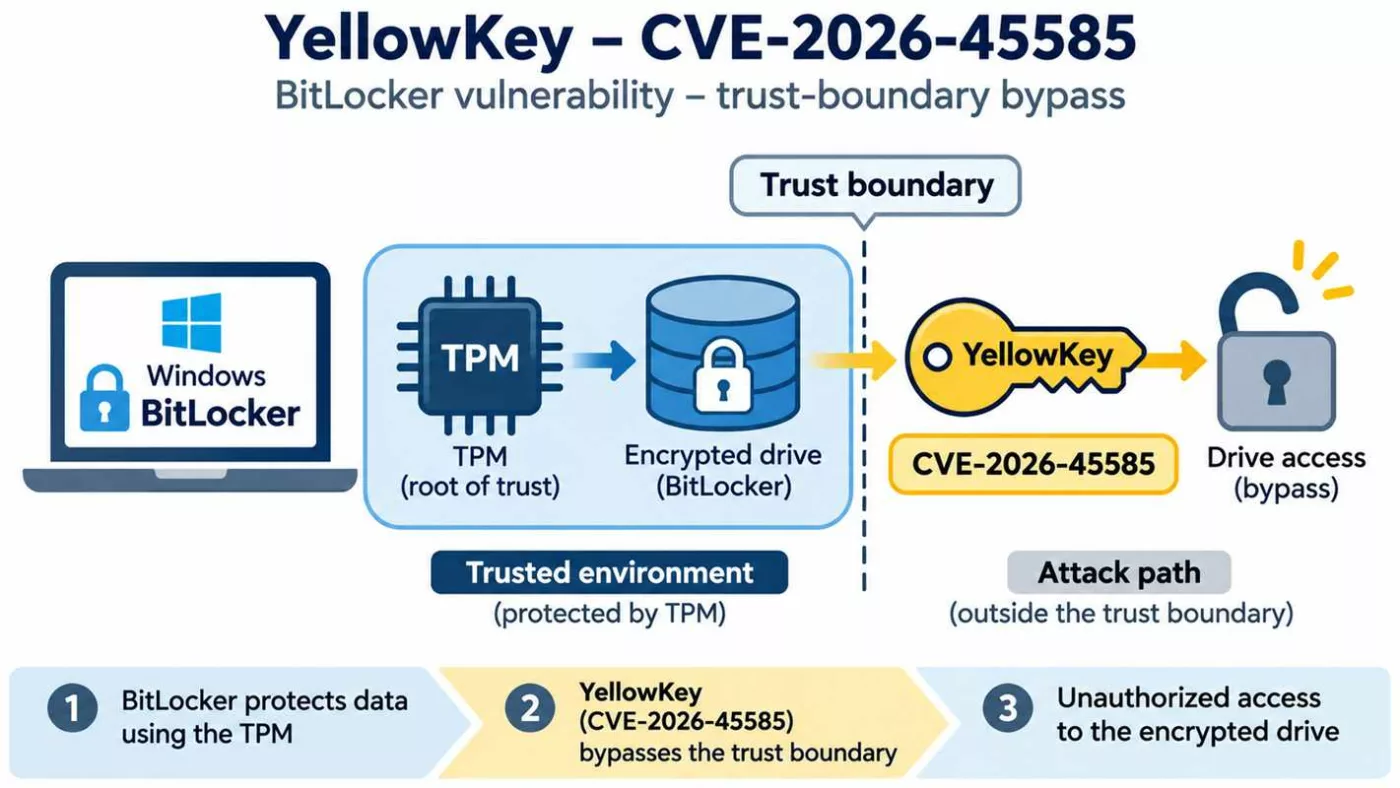
Microsoft published the YellowKey record on May 19, 2026 after a public proof of concept became available. The case concerns a security bypass associated with Windows recovery mechanisms. It illustrates why trusted recovery paths must be included in an encryption threat model.
Consult the current vendor advisory for updates and mitigation details. Microsoft identifies TPM + PIN as a mitigation for the documented scenario; claims of alternative variants should not be treated as established without reproducible evidence. A vulnerability alone does not establish intentional backdoor design.
Official CVE record · Microsoft advisory
Practical hardware-based mitigation: PassCypher NFC HSM, capable of generating secrets of up to 512 bits, can facilitate TPM + PIN adoption through independent hardware-based credential storage and automated input using EviKeyboard with InputStick or proprietary end-to-end encrypted EviBLE HID technology. See sovereign pre-boot authentication and YellowKey mitigation.
Historical context: The reference first published on 10 February 2024 is integrated into the thematic chapters below. Its 2025 recovery-guide revision is retained through the historical incident and configuration guidance. BitLocker also protects removable media and virtual drives; secure disposal depends on effective encryption and key custody.
3. BitLocker encryption architecture and trust boundaries
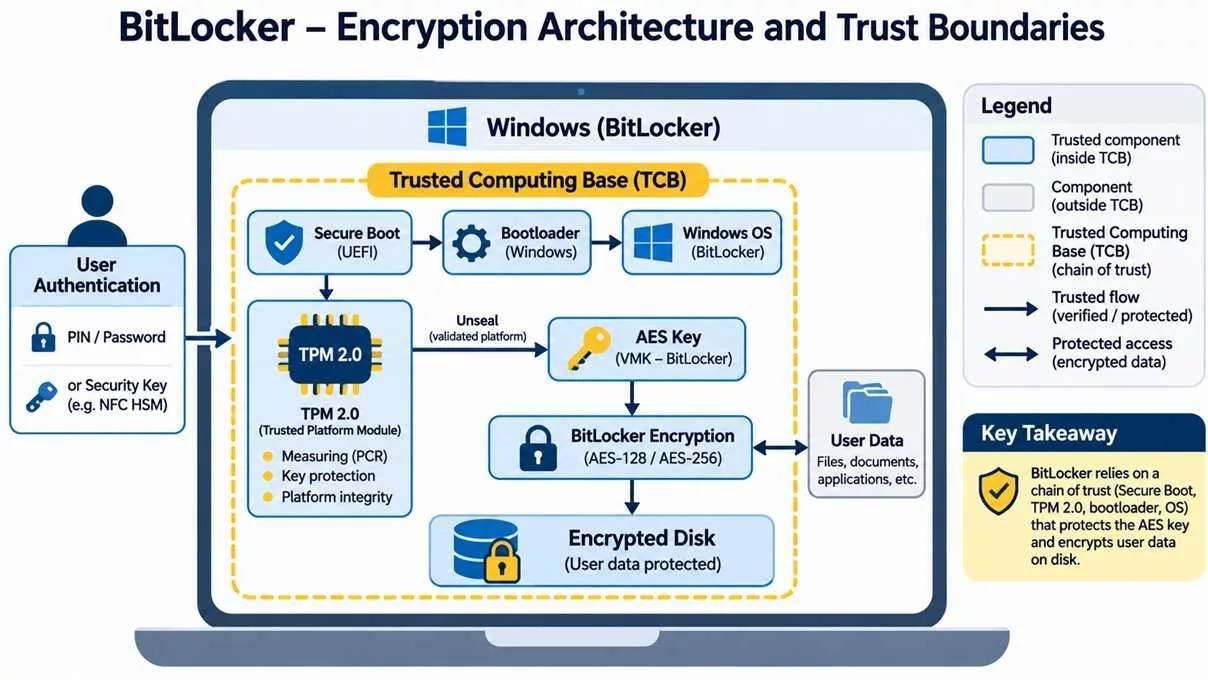
Architecturally, BitLocker encrypts volumes using AES, including XTS-AES configurations. The Full Volume Encryption Key (FVEK) encrypts volume data; the Volume Master Key (VMK) protects the FVEK. Key protectors govern access to the VMK. A TPM can bind key release to platform measurements and additional authentication conditions.
TPM 2.0 is not a general-purpose RAM protection mechanism. After unlocking, cryptographic material may be available in host memory. Secure Boot authenticates boot components; measured boot records measurements. These functions are complementary, not interchangeable.
Platform measurements + configured authentication
                 ↓
       Key protector authorisation
                 ↓
         Volume Master Key (VMK)
                 ↓
      Full Volume Encryption Key (FVEK)
                 ↓
          Encrypted volume data
This simplified diagram represents the normal unlocking path, not every recovery or protector configuration.
4. Physical attacks, TPM and forensic risks
TPM 1.2 and TPM 2.0 also support cryptographic identity and signature operations. Biometric authentication may use TPM-backed credentials, but this does not mean that biometric templates or all disk keys reside inside the TPM.
TPM 1.2 and TPM 2.0 provide protected key operations, random number generation and signatures. The latter extends algorithm support and authorisation capabilities; neither directly controls host RAM. Platform compatibility and implementation quality remain important.
4.1 Cold boot and memory remanence
Physical controls include locks, safes and secure storage. Hardware and software acquisition tools may be costly or difficult to obtain, although some attacks use inexpensive equipment. These practical constraints are not guarantees of confidentiality.
Residual RAM contents can expose active encryption material on susceptible devices. TPM anti-dictionary protections do not prevent extraction of keys already present in memory. Prefer complete shutdown before loss of physical control and evaluate platform-specific memory protections.
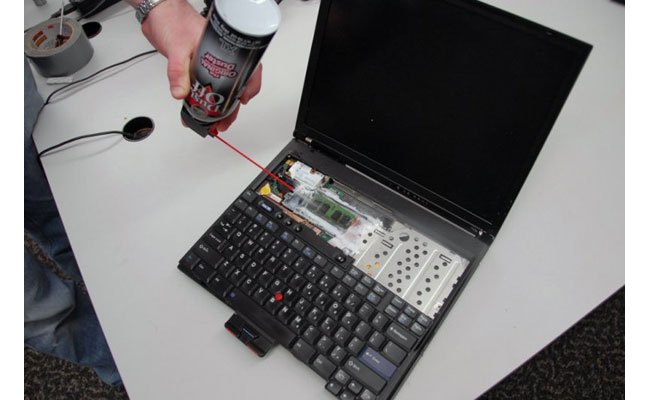
Cold Boot research demonstrated that residual DRAM contents decay over time and that cooling can prolong retention on susceptible hardware. Live RAM analysis is a related but distinct forensic technique. Capacity to recover usable keys depends on memory state, equipment and platform protections. Firmware-supported Memory Overwrite Request (MOR) can reduce exposure; neither a startup PIN nor TPM lockout invalidates keys already recovered.
Scientific reference: Halderman et al. (2008).
4.2 DMA attacks
DMA-capable peripherals can threaten host memory on vulnerable systems. Enable Kernel DMA Protection where supported and restrict untrusted peripherals.
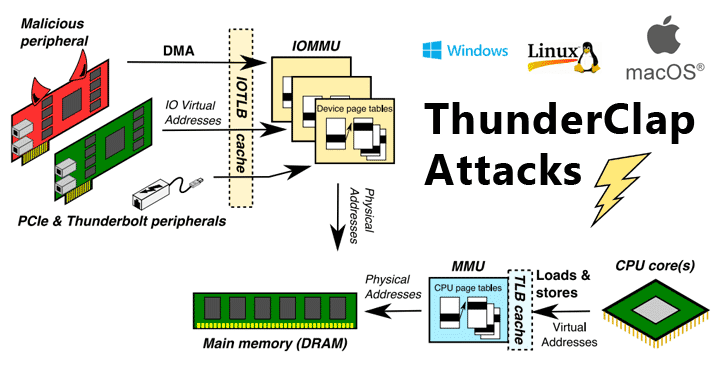
Thunderclap (2019) examined IOMMU isolation across Windows, Linux and macOS. FireWire, Thunderbolt and external PCIe require appropriate port and DMA policies; PCILeech is a historical example of a memory acquisition tool. Encrypting external storage protects its contents, not the host against malicious DMA. See Thunderclap research.
4.3 TPM communication and faulTPM
Published research has demonstrated interception of discrete TPM communications on selected systems and attacks against specific firmware TPM implementations. These findings do not imply that every TPM is vulnerable. The Raspberry Pi Pico demonstration discussed in the original article illustrates the importance of hardware-specific qualification.
Discrete TPM buses, SRTM and firmware TPMs
TPM-only mode allows normal unattended unlocking. Historically, discrete TPM bus interception using inexpensive hardware has illustrated why physical access matters. Stacksmashing’s Raspberry Pi Pico demonstration used a susceptible laptop and Dislocker; it is distinct from the Bus Pirate, a multiprotocol electronic interface supporting SPI, I2C, UART, 1-wire, 2-wire, 3-wire and HD44780 LCD interfaces. Results must not be generalised to every TPM or bus.
Separately, SRTM power-state and measurement attacks and AMD faulTPM research challenge different trust assumptions. Historical references to Intel and Dell platforms require model-specific evidence. Physical isolation, tamper-evident seals, protected bus design (including hardware-specific SPI access controls or firewalls where available), firmware updates and appropriate pre-boot authentication reduce selected risks. Intel CSME and remote attestation may contribute to platform integrity assessment, but are not universal countermeasures.
4.4 TPM implementation defects
CVE-2023-1017 and CVE-2023-1018 concern memory-boundary defects in TPM implementations, not inherently physical fault injection. Consult the hardware vendor for affected firmware and fixes.
Historical reports also identified affected Lenovo systems with Nuvoton TPM implementations. Verify the actual firmware and vendor advisory rather than assuming that all devices share the defects or that BitLocker keys can always be extracted.
4.5 Hardware debugging and fault injection
Hardware debug interfaces such as Intel DCI and fault injection can create additional attack surfaces under specific platform conditions. Disable unauthorised debugging and assess firmware protections. No universal BitLocker decryption capability is established by these attack categories.
Fault injection explores voltage, temperature, radiation and electrical glitching effects on hardware. In contrast, Intel DCI debugging can expose live memory on suitably configured platforms, potentially including the VMK. On a suitably exposed platform, CPU halt and debug-based memory acquisition may enable forensic decryption without the Windows login password or recovery password; this remains configuration-dependent. These are distinct from TPM command-parser defects. Fault-resistant hardware and restricted debug access are relevant controls; remote attestation can report selected measurements but cannot establish immunity.
5. How to fix BitLocker Recovery Mode after a Windows update
Windows updates, firmware changes and changes to measured boot state can trigger recovery. The July 2024 update incident remains a useful historical example. Do not assume a particular PCR change is the cause on every device.
Historical case: July 2024 recovery incident
KB5040442 was associated in the historical article with unexpected recovery prompts. The original explanation attributed this to PCR4, but that causal attribution is unverified. Firmware, bootloader and hardware changes can alter measured state. Review release notes, prepare recovery backups and avoid removing PCR measurements simply to suppress prompts. The incident illustrates the importance of update preparation and vendor communication.
Recovery procedure
- Record the recovery key identifier shown on screen.
- Retrieve the matching 48-digit recovery password from your authorised backup or organisation.
- Enter it on the trusted recovery screen.
- After booting, verify Windows update status and BitLocker protection.
- If recovery repeats, consult the device vendor or IT administrator before changing firmware, TPM or PCR settings.
Do not clear the TPM, remove protectors or weaken PCR policy merely to suppress recovery prompts. If you cannot recover the credentials, there is no supported universal method to decrypt an intact protected volume.
Microsoft account recovery keys (if backed up to that account).
6. Secure configuration and verification
Consider hardware and software compatibility before deployment. In addition, choose used-space-only or full-volume encryption according to whether previously stored data may remain in unused sectors. For existing devices, assess residual data before selecting the faster option.
Use a supported Windows edition and servicing channel. Full BitLocker management is available on supported Pro, Enterprise and Education editions; qualifying Home devices may offer Device Encryption. Select encryption and protector policies before deployment, preserve recovery credentials and use TPM + PIN where physical risks justify it.
Activation and encryption choices
Check TPM status in Windows Security or TPM management. If required, consult the manufacturer before enabling TPM in UEFI (entry keys can include F2, F12, Del or Esc) or updating firmware. Choose supported protectors for the volume type: TPM + PIN, startup key, password or recovery protector as applicable. Certificate-based protectors have specialised removable-drive uses.
Choose AES-CBC or XTS-AES according to compatibility requirements; XTS-AES is preferred for modern fixed volumes. Evaluate AES-128 versus AES-256, hardware acceleration and performance. Open Manage BitLocker in Control Panel, select the volume, back up recovery credentials and follow the activation wizard. Encryption duration varies with volume size and data.
Verification commands
Run these read-only commands from an elevated PowerShell session:
Get-BitLockerVolume
Get-Tpm
Confirm-SecureBootUEFI
reagentc /info
winver
Verify that protection is on, identify protector types, check the installed Windows version and confirm WinRE status. Avoid publishing recovery passwords or identifying key material in diagnostic logs.
7. Freemindtronic — independent cryptographic protection
Externalizing credential storage and separately encrypting sensitive data introduces additional trust boundaries. EviPass NFC HSM and PassCypher can complement credential management. EviCypher NFC HSM and DataShielder provide a separate encryption approach. EviKeyboard BLE provides a complementary credential input mechanism.
These technologies are not patches for BitLocker CVEs. External storage of secrets does not itself guarantee that credentials entered into a compromised host remain confidential. Independently encrypted files can remain protected after BitLocker is bypassed if their keys and plaintext are not accessible to the attacker.
PassCypher NFC HSM, EviPass, EviKeyboard and EviBLE
The original account describes password-free contactless credential management and smartphone-assisted remote input into BIOS or disk-startup fields, where supported by the host. The historical USB HID analysis distinguishes the USB controller, chipset, processor and TPM; input buffers along this path may expose secrets. Product-specific transport and pairing properties require verification for the deployed version.
Contactless credential storage and smartphone-assisted input can reduce reliance on locally stored secrets. EviKeyboard BLE can deliver supported pre-boot credentials through USB HID where firmware accepts the keyboard. The historical article describes AES-128 CBC for its BLE transport; this product-specific claim requires version-specific verification. Host USB buffers, chipset and input processing may still expose credentials in memory. Physical acquisition requires suitable access and equipment, while memory volatility can limit recovery.
PassCypher’s historical features include sandboxed URL checks, anti-typosquatting, password integrity checks and Browser-in-the-Browser (BTIB) phishing protections. These reduce selected risks but cannot eliminate deception. High-entropy generated passwords must comply with the actual protector’s length and character restrictions; a generated secret exceeding 256 bits does not make a BitLocker PIN a 256-bit key.
High-entropy secret generation: up to 512 bits
PassCypher NFC HSM can generate cryptographic secrets of up to 512 bits, exceeding the nominal key length of AES-256. A uniformly random 512-bit secret has a theoretical search space of 2512 possibilities, compared with 2256 for a 256-bit key.
This generation capacity enables users to create highly unpredictable authentication secrets without relying on human memory or predictable password construction.
However, BitLocker imposes its own authentication format, length and character restrictions. PassCypher can generate secrets adapted to these constraints, including complex enhanced startup PINs. The effective entropy depends on the accepted character set, secret length and generation method.
This capability does not transform AES-256 into AES-512 or provide BitLocker with 512-bit encryption strength.
External hardware-based BitLocker credential management
PassCypher NFC HSM enables independent hardware-based custody of BitLocker startup PINs and recovery passwords. Consequently, users can manage these sensitive credentials outside the computer they protect, without requiring memorisation of complex authentication secrets.
Freemindtronic provides two complementary credential delivery approaches:
- EviKeyboard with InputStick: smartphone-assisted credential input through an external USB HID keyboard emulator, including supported BIOS, UEFI and BitLocker pre-boot environments.
- EviBLE HID: Freemindtronic’s proprietary end-to-end encrypted Bluetooth Low Energy secure keyboard emulation technology for credential delivery through compatible endpoints.
These approaches must be distinguished from native operating system Bluetooth keyboard pairing. Pre-boot operation requires a compatible receiving interface recognised by the target firmware and BitLocker environment.
The 48-digit BitLocker recovery password can also be managed independently within the NFC HSM. Its native format and cryptographic properties remain defined by Microsoft.
Mitigating YellowKey through sovereign pre-boot authentication
Microsoft identifies TPM + PIN as a mitigation against the documented YellowKey vulnerability (CVE-2026-45585).
By combining external hardware-based secret management with automated credential input, PassCypher NFC HSM, EviKeyboard and EviBLE can facilitate the adoption of stronger pre-boot authentication without the inconvenience of memorising complex PINs.
The mitigation against YellowKey derives from the TPM + PIN configuration documented by Microsoft, rather than from an increase in AES key length.
The effectiveness of this architecture against CVE-2026-97015 and CVE-2026-119832 remains subject to specific technical qualification. External credential custody and encrypted transmission do not prevent every attack against a compromised host or recovery environment. Applicable Microsoft security updates remain essential.
DataShielder and EviCypher
The historical design describes AES-256 independent data encryption, randomly generated and segmented keys, external HSM/NFC HSM custody and transient operational key destruction, including HSM PGP contexts. These mechanisms can reduce exposure to TPM bus interception and fault injection when the independent trust boundary remains intact. Key erasure effectiveness and plaintext exposure require implementation-specific assessment; no near-zero recovery probability is established here.
Post-quantum algorithms do not inherently resolve memory corruption, access control defects or insecure key release.
Historical timeline of BitLocker security (2006–2026)
BitLocker emerged with Windows Vista in 2006–2007. Since then, its threat model has evolved from disk theft towards hardware, firmware, recovery and identity attacks. The following selected milestones distinguish product evolution from security research.
| Period | Milestone | Security significance |
|---|---|---|
| 2006–2007 | Windows Vista | Initial BitLocker deployment. |
| 2008 | Halderman et al. — Lest We Remember: Cold Boot Attacks on Encryption Keys (2008) | Memory remanence challenges data-at-rest assumptions. |
| 2009 | Windows 7 / BitLocker To Go | Removable storage protection. |
| 2012–2013 | Windows 8 / 8.1 | UEFI Secure Boot and wider device encryption. |
| 2015 | Windows 10 version 1511 | XTS-AES support. |
| 2018–2019 | Meijer and van Gastel — Self-encrypting deception, IEEE S&P 2019 | SSD firmware becomes a critical trust dependency. |
| 2021 | Windows 11 | TPM 2.0 baseline on supported hardware. |
| 2022–2023 | BlackLotus and TPM research | Boot trust and hardware implementation risks. |
| 2024 | Freemindtronic reference; July recovery incident; BitPixie research | Operational recovery and downgrade exposure. |
| 2025 | BitUnlocker | Recovery-path trust defects. |
| 2026 | YellowKey; academic survey; Secure Boot CA transition; November CVEs | Continuing evolution of attack surfaces. |
Further reading: Microsoft — BitLocker overview and Kenchaiah et al. — The Hardware Isolation Gap, Electronics 15(9), 1959 (6 May 2026). This is a selected chronology, not an exhaustive CVE register.
BitUnlocker (2025): Windows Recovery Environment vulnerabilities
Microsoft researchers Netanel Ben Simon and Alon Leviev presented BitUnlocker at Black Hat USA 2025 and DEF CON 33. Their findings concern the conditions under which recovery software can access a protected volume. Consequently, a trusted recovery environment must be evaluated as part of the security boundary.
| CVE | Affected trust decision |
|---|---|
| CVE-2025-48800 | Authorisation of scheduled recovery operations |
| CVE-2025-48003 | Trust verification of recovery applications |
| CVE-2025-48804 | Integrity verification of recovery boot images |
| CVE-2025-48818 | Boot configuration and recovery decryption authorisation |
Mitigation and relevance to YellowKey
All four discoveries received fixes in July 2025. Moreover, Microsoft recommends TPM + PIN and secure boot-component version enforcement (REVISE). YellowKey is a later disclosure involving recovery trust; however, common attack surfaces do not establish a shared root cause. Source: Microsoft STORM — BitUnlocker (13 August 2025).
BlackLotus, BitPixie and BitLocker downgrade attacks
Administrative UEFI passwords and restriction of legacy boot options can complement revocation policy. However, they do not replace supported security updates or validated recovery media.
BlackLotus and UEFI bootkits
BlackLotus illustrates how a vulnerable signed boot component can undermine Secure Boot. CVE-2022-21894 concerns a Secure Boot bypass, whereas CVE-2023-24932 underlies subsequent revocation guidance. Neither is a mathematical attack against AES. See Microsoft — BlackLotus investigation guidance (2023).
BitPixie and REVISE
BitPixie research highlighted risks from older vulnerable boot components in configurations that still trust them. In particular, installing a newer boot manager does not necessarily revoke an older signed version. Therefore, version enforcement and revocation are distinct from ordinary patch installation. See MSRC — CVE-2023-21563 and Microsoft KB5025885 — Secure Boot revocation guidance.
Historical CVE-2023-21563 analysis highlights physical access, vulnerable boot components and potential key exposure on affected Windows configurations. Apply applicable revocations, restrict legacy boot paths and secure UEFI administration. Validate recovery media before enforcement; remote attestation can supplement integrity monitoring.
Evil Maid attacks
An unattended device can be altered before its owner returns. For example, a compromised boot path could attempt to capture later authentication input. Secure Boot, measured boot, physical custody and tamper evidence reduce selected risks. However, none alone guarantees integrity against every physical adversary.
Secure Boot certificate expiration and BitLocker in 2026
Microsoft is transitioning from its 2011 Secure Boot certificate hierarchy to replacement certificates issued in 2023. This transition affects boot trust rather than AES encryption keys.
| Legacy certificate | Expiration period |
|---|---|
| Microsoft Corporation KEK CA 2011 | June 2026 |
| Microsoft UEFI CA 2011 | June 2026 |
| Microsoft Windows Production PCA 2011 | October 2026 |
Operational continuity and recovery
Expiration does not automatically decrypt a volume or prevent a previously working machine from booting. Nevertheless, systems that fail to receive updated trust material may lose access to future boot protections. Administrators should inventory firmware compatibility, recovery credentials, Secure Boot trust databases and revocation status. Before deploying revocations, test recovery media and maintain a supported recovery path.
Official guidance: Microsoft — Secure Boot certificate expiration and CA updates and Microsoft KB5025885 — Secure Boot revocation guidance.
Scientific research: the hardware isolation gap in BitLocker forensics
The review The Hardware Isolation Gap: A Systematic Survey of BitLocker Forensics in the TPM 2.0 Era, published on 6 May 2026 in Electronics, examines research from 2006 to 2025. It provides a useful synthesis of changing forensic access opportunities as BitLocker became more closely integrated with platform hardware.
How to interpret forensic evidence
Compare the device state, TPM implementation, protector, firmware, attacker access and evidence-acquisition method before generalising any result. In particular, reported success rates in a research corpus are not universal probabilities for real-world devices. Furthermore, a survey is not an independent reproduction of each experiment, and its historical coverage predates subsequent 2026 disclosures.
Reference: Kenchaiah et al. — The Hardware Isolation Gap, Electronics 15(9), 1959 (6 May 2026).
Forensic preservation
In authorised investigations, preserve chain of custody and document the initial power state, encryption status, evidence handling and every state change. A running system and a powered-off encrypted device present different evidentiary risks. Avoid uncontrolled changes that could destroy volatile evidence or trigger recovery.
Self-encrypting SSDs, TCG Opal and Microsoft eDrive
Self-encrypting drives (SEDs) perform cryptographic operations in storage hardware. TCG Opal defines storage security management capabilities, while Microsoft eDrive historically enabled compatible hardware encryption integration. However, a hardware encryption claim does not establish the security of firmware or authentication.
Research disclosed in 2018 and published at IEEE Security and Privacy in 2019 identified serious defects in selected commercial SSDs. The findings also challenged historical BitLocker configurations that delegated encryption to the drive. See Meijer and van Gastel — Self-encrypting deception, IEEE S&P 2019.
Software versus hardware encryption
| Mode | Trust dependency | Verification |
|---|---|---|
| Software BitLocker | Windows cryptographic implementation and host key handling | Check reported encryption method and policy. |
| Hardware encryption | SSD firmware, access enforcement and drive lifecycle | Check model, firmware and vendor advisories. |
Microsoft subsequently advised reviewing hardware encryption policy. Changing a policy does not necessarily migrate an existing encrypted volume. Therefore, plan any supported migration with backups and recovery validation. See Microsoft ADV180028 — self-encrypting drives.
Credential theft and social engineering
Impersonation of Microsoft or technical support can induce a user to disclose a recovery password or credential. Verify requests independently, train users and report suspicious activity. TPM lockout limits applicable authentication attempts, not disclosure of valid credentials.
BitLocker recovery key sovereignty and lifecycle management
Recovery passwords can also be printed or saved in a protected file or encrypted external drive. The historical article mentioned Azure Key Vault as a possible custom custody service; it is not a standard native BitLocker recovery escrow destination. Any such integration requires separate access controls and recovery validation.
The 48-digit recovery password constitutes an alternative access mechanism. Accordingly, its custody can be as important as the choice of AES key length. Device Encryption may automatically escrow recovery information under supported account or organisational configurations.
| Custody model | Benefits | Risks |
|---|---|---|
| Microsoft account | Convenient account-based recovery | Account compromise or loss of access. |
| Microsoft Entra ID / AD DS | Managed organisational recovery | Privileged administrator access and directory compromise. |
| Offline controlled backup | Independent custody | Loss, theft or insufficient redundancy. |
| Separate application encryption | Independent confidentiality boundary | Additional key lifecycle and plaintext exposure risks. |
Offline options include a protected file, removable medium or printed copy. An organisation may separately manage protected escrow through a key-management service such as Azure Key Vault, subject to its own integration and access controls; this is not presented as a native BitLocker backup destination. Separate application encryption is an additional boundary, not a recovery-password custody model.
Recovery lifecycle
Maintain an inventory of recovery identifiers without publishing secrets. Additionally, restrict retrieval, log authorised access, validate backups and rotate exposed recovery protectors through supported procedures. Separate recovery credentials from the device they protect. For organisations, document delegation, revocation and disaster recovery. See Microsoft — BitLocker recovery process.
BitLocker sleep, hibernation and shutdown security
Physical risk changes with the power state. For example, locking the Windows desktop does not relock the system volume. Likewise, sleep or Modern Standby can retain sensitive material in memory.
| State | Security consideration |
|---|---|
| Running / locked | Volume normally remains unlocked. |
| Sleep / Modern Standby | RAM may retain active keys. |
| Hibernation | Memory state is saved to storage; protection depends on configuration and resume authentication. |
| Full shutdown | Active keys normally cease to be available, subject to residual memory and platform-specific risks. |
| Fast Startup | Hybrid shutdown differs from a full shutdown. |
For sensitive travel or unattended equipment, favour a validated shutdown or appropriately protected hibernation policy. Furthermore, assess DMA protection and pre-boot authentication according to the actual platform. Source: Microsoft — BitLocker countermeasures.
BitCracker, GPU password guessing and TPM anti-hammering
GPU acceleration can reduce the cost of testing guesses against certain password-protected encryption metadata. BitCracker is a research example of this attack class. However, password guessing is not equivalent to brute-forcing the full AES key space, and feasibility depends on protector type, entropy and derivation costs. See BitCracker research project.
TPM anti-hammering constrains applicable hardware authorisation attempts. In contrast, offline guessing against extractable password-protected material can have different constraints. Therefore, use suitable high-entropy credentials and do not equate a startup PIN with a disk encryption key. Artificial intelligence may prioritise likely guesses, but it does not eliminate cryptographic search complexity.
Post-quantum security: AES-128, AES-256 and TPM algorithms
Grover’s algorithm provides a theoretical quadratic advantage for ideal unstructured search. Thus, AES-256 offers a larger nominal security margin against quantum key search than AES-128. However, logical circuit depth, error correction and physical resources prevent interpreting this as a practical present-day attack.
Shor’s algorithm instead concerns mathematical problems underlying RSA and elliptic-curve cryptography. Consequently, consider signatures, attestation and key establishment separately from symmetric volume encryption. TPM 2.0 is not inherently a post-quantum specification.
Limits of post-quantum protection
XTS-AES protects storage confidentiality but is not a general authenticated-encryption construction. Moreover, replacing public-key algorithms with PQC cannot repair unsafe recovery authorisation, memory corruption or credential theft. References: NIST FIPS 197 — AES, NIST SP 800-38E — XTS-AES and NIST — Post-Quantum Cryptography.
Permanent BitLocker attack taxonomy and countermeasure matrix
The table separates attack targets from countermeasures. These measures reduce specific risks rather than guaranteeing immunity. No demonstrated mathematical AES break is implied by the listed practical attacks.
| Attack family | Target / prerequisite | Defensive focus |
|---|---|---|
| Cold boot / RAM analysis | Residual or live memory | Power-state policy and physical custody |
| DMA / Thunderclap | Accessible memory via peripherals | IOMMU, DMA policy and port control |
| TPM bus interception | Exposed discrete TPM communications | Pre-boot authentication and platform assessment |
| faulTPM | Specific firmware TPM implementation | Vendor updates and hardware assessment |
| Fault injection / Intel DCI | Physical hardware or debug interface | Disable unauthorised debug; hardware assurance |
| BlackLotus / BitPixie | Boot integrity or rollback | Revocation and secure version enforcement |
| BitUnlocker / YellowKey | Recovery trust | Supported updates, WinRE and protector policy |
| Evil Maid | Unattended device | Custody, boot integrity and tamper evidence |
| Phishing / recovery theft | User or escrowed credentials | Access governance and education |
| SSD firmware defects | Delegated storage encryption | Firmware assurance and software mode assessment |
| GPU guessing | Weak password protector | Entropy and protector selection |
| Quantum search | Theoretical cryptographic search | Algorithm agility and security margin |
Editorial change log and evidence policy
10 February 2024: initial publication, as recorded by the author. 2024–2025: historical revisions preserved in the supplied corpus. 16 November 2026: updated vulnerability review, historical timeline, forensic literature, boot trust, recovery sovereignty, SSD security and quantum analysis.
Historical material has been consolidated into the relevant thematic chapters; outdated technical claims are qualified in context. The reference distinguishes vendor advisories, research reports and editorial analysis. It does not represent a complete vulnerability inventory or independent experimental qualification.
8. Limits, evidence and scope of validity
The November vulnerability descriptions do not establish the exact exploit path, VMK extraction, TPM compromise or the ability to bypass a startup PIN. CVSS ratings describe standardised impact and prerequisites; physical exposure must be evaluated in context.
This publication does not claim independent reproduction of the 2026 vulnerabilities, universal resistance of complementary products, or certification of any device configuration.
9. Conclusion
Overall, BitLocker remains a useful defence for data at rest. Its security must be evaluated across the complete authorisation and recovery chain. Maintaining supported software, securing pre-boot authentication and recovery credentials, and applying independent encryption where justified provide complementary layers of protection.
Breaking an encryption algorithm is not necessary when the mechanism that authorizes decryption can be compromised.
10. Selected bibliography and security references
- Microsoft Security Update Guide
- Microsoft BitLocker documentation
- CIRCL — CVE-2026-97015
- CIRCL — CVE-2026-119832
- CVE Program — YellowKey
- NVD — CVE-2023-1017 and CVE-2023-1018
- CISA Known Exploited Vulnerabilities
- Microsoft STORM — BitUnlocker (13 August 2025)
- Kenchaiah et al. — The Hardware Isolation Gap, Electronics 15(9), 1959 (6 May 2026)
- Meijer and van Gastel — Self-encrypting deception, IEEE S&P 2019
- Halderman et al. — Lest We Remember: Cold Boot Attacks on Encryption Keys (2008)
- Microsoft — BitLocker countermeasures
- Microsoft — Secure Boot certificate expiration and CA updates
- Microsoft KB5025885 — Secure Boot revocation guidance
- Microsoft — BitLocker recovery process
- NIST SP 800-38E — XTS-AES
- NIST FIPS 197 — AES
- NIST — Post-Quantum Cryptography
- Microsoft ADV180028 — self-encrypting drives
- Microsoft — BlackLotus investigation guidance (2023)
- MSRC — CVE-2023-21563
- BitCracker research project
11. Technical glossary
AESDefinition
XTS-AESDefinition
TPMDefinition
PCRDefinition
VMKDefinition
FVEKDefinition
WinREDefinition
DMADefinition
CVSSDefinition
HSMDefinition
PQCDefinition
TCBDefinition
REVISEDefinition
DBXDefinition
SEDDefinition
IOMMUDefinition
SRTMDefinition
SVNDefinition
EscrowDefinition
GroverDefinition
12. Frequently asked questions about BitLocker security
CVE-2026-97015 and CVE-2026-119832 are physical security bypass vulnerabilities disclosed November 10.
No cryptographic break of AES is established by these disclosures.
CVE-2026-45585 is a publicly disclosed security bypass. Consult the Microsoft advisory.
Generally no. Apply security updates and verify protection instead.
No. It mitigates selected pre-boot risks.
Yes, provided independent keys and plaintext remain inaccessible to the attacker.
BitLocker is an encryption feature included in Microsoft Windows. It protects your data by encrypting the entire disk, making the protected volume unreadable without valid unlocking material. See the architecture chapter for TPM and key protectors.
BitLocker can encrypt internal hard drives, external USB drives (using BitLocker To Go), and even virtual hard drives (VHD). It is a versatile solution for securing various types of storage.
Eligible Windows Home devices may support Device Encryption.
Performance varies with workload and hardware. AES-NI acceleration can reduce overhead.
To activate BitLocker on Windows 11, go to Settings > Privacy & Security > Device Encryption. If the option isn’t available, search for Manage BitLocker in the Control Panel. Follow the instructions to enable BitLocker on the desired drive.
To deactivate BitLocker, navigate to Settings > Privacy & Security > Device Encryption > Manage BitLocker. Select the drive you want to decrypt and choose Turn off BitLocker. Keep in mind that this process will decrypt your data and may take some time.
Automatic encryption depends on device eligibility and setup/account conditions.
BitLocker may request a recovery key if a Windows update changes the system configuration or boot files. To prevent this, ensure that you save your recovery key securely and update your firmware and drivers.
You can retrieve your BitLocker recovery key from:
Your Microsoft account (if backed up there)
A USB flash drive (if you saved it there)
A printed copy you stored securely
Your organisation’s IT department if using a company-managed device
There is no supported universal recovery bypass; vulnerabilities can nevertheless bypass protection in specific configurations.
Ensure you have the correct recovery key. If the drive is inaccessible, you may use BitLocker repair tools like the repair-bde command in Windows to attempt data recovery.
BIOS updates or hardware changes can trigger BitLocker recovery mode. Ensure you have your recovery key before making such changes. Afterward, re-enable BitLocker to restore normal functionality.
BitLocker primarily uses AES (Advanced Encryption Standard) with 128-bit or 256-bit key lengths, depending on your configuration. AES-256 offers stronger encryption for highly sensitive data.
BitLocker protects data from unauthorised access but does not prevent malware infections. Use antivirus software alongside BitLocker for comprehensive protection.
Yes, BitLocker supports multi-factor authentication by combining a TPM with a PIN or a startup key on a USB drive.
Encryption supports compliance but does not by itself establish GDPR compliance.
BitLocker encrypts data using AES, which prevents unauthorised access even if the physical drive is removed. With a TPM and PIN, the encryption key remains secure.
Yes, BitLocker can be used without a TPM by enabling the “Allow BitLocker without a compatible TPM” policy and using a password or USB startup key for authentication.
No, BitLocker is a Windows-exclusive feature. However, tools like Dislocker can be used on Linux or Mac to access BitLocker-encrypted drives.
To use BitLocker, you need:
A compatible version of Windows (Pro, Enterprise, or Education)
A TPM 1.2 or 2.0 chip (optional)
A modern processor with encryption acceleration for optimal performance
Yes, BitLocker To Go is specifically designed to encrypt external drives like USB sticks and portable hard drives.
Recent vulnerabilities include:
CVE-2023-1017 and CVE-2023-1018 affecting TPM 2.0
Risks from physical attacks like Cold Boot or Bus Pirate attacks
Ensure regular firmware updates and use multi-factor authentication to mitigate these risks.
If no valid protector remains available, there is no supported universal recovery method. Maintain independent, verified backups.
Updates for these vulnerabilities include TPM firmware patches that address buffer overflow risks. Regularly updating your TPM firmware ensures protection against these and other emerging threats.
Updating your TPM firmware helps mitigate recent vulnerabilities like CVE-2023-1017 and CVE-2023-1018, ensuring your device maintains optimal security against physical and software-based attacks.
External credential storage does not guarantee that input is never exposed on a compromised host.
The historical product description specifies AES-256 credential encryption and NFC-enabled access. Protection after device loss depends on the deployed pairing, authentication and key custody controls. See the product analysis.
Yes, PassCypher is designed to work seamlessly with tools like DataShielder and EviCypher, creating a comprehensive security ecosystem for protecting sensitive data.
DataShielder provides a separate AES-256 encryption layer under independent key custody. See the architectural analysis and limitations.
Independent keys and plaintext may still be exposed during active processing depending on implementation.
Yes, DataShielder supports encryption for external drives, adding an additional layer of security to portable storage devices encrypted with BitLocker.