Tag Archives: brexit

Constitution non codifiée du Royaume-Uni | souveraineté numérique & chiffrement
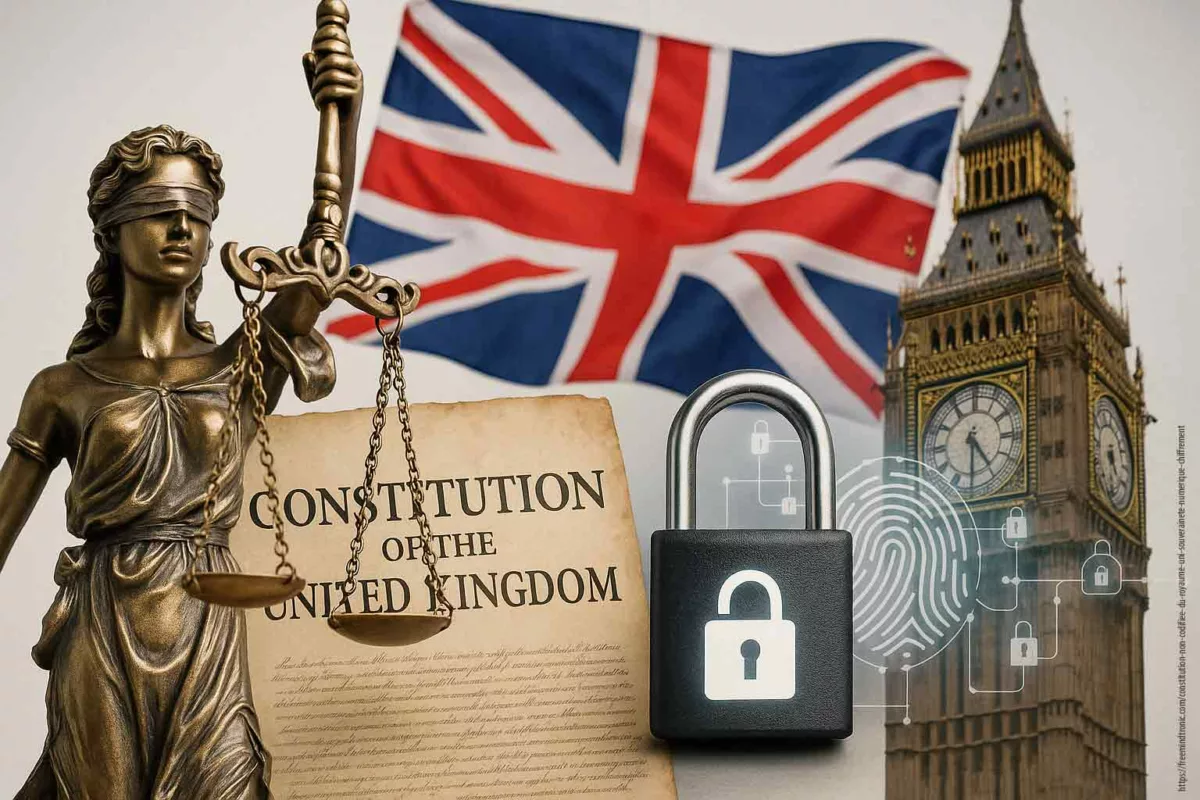
Constitution non codifiée Royaume-Uni avec Big Ben, Lady Justice, drapeau britannique et cadenas numérique symbolisant la souveraineté numérique et le chiffrement souverain

Constitution non codifiée du Royaume-Uni & souveraineté numérique — Une chronique de cyber culture Freemindtronic, à l’intersection du droit constitutionnel britannique, des droits fondamentaux et des technologies de chiffrement souverain protégées par plusieurs brevets délivrés au Royaume-Uni.

Résumé express — Constitution non codifiée du Royaume-Uni

Constitution non codifiée et singularité britannique

Chapeau — Le Royaume-Uni est une anomalie apparente parmi les grandes démocraties : il fonctionne sans constitution écrite unique. Par ailleurs, il dispose d’un système politique et juridictionnel parmi les plus anciens et les plus influents du monde. De plus, entre souveraineté absolue du Parlement, jurisprudence créatrice et conventions politiques non écrites, cette architecture “floue mais robuste” encadre la manière dont l’État peut toucher aux droits fondamentaux, à la vie privée et, demain, au chiffrement.

Lecture rapide et enjeux numériques

Lecture rapide (≈ 3 min) : Tout d’abord, cette chronique s’appuie sur l’essai de Nina Angela Fernando, À la défense de l’inécrit : le Royaume-Uni et sa constitution non codifiée, que nous désignerons ici comme la Constitution non codifiée du Royaume-Uni. Elle examine ensuite ce que signifie, pour la cyber culture et la souveraineté numérique, l’existence d’un État dont la constitution est essentiellement jurisprudentielle, coutumière et législative. Autrement dit, elle n’est pas codifiée en un texte supérieur.

Avantages et limites des deux modèles

D’un côté, une constitution écrite promettrait clarté, pédagogie et verrous explicites contre la “dictature élective”. Elle garantirait séparation stricte des pouvoirs, catalogue de droits fondamentaux et procédure rigide de révision. En revanche, la constitution non codifiée britannique offre une flexibilité extrême. Elle permet des adaptations rapides aux crises (comme le Brexit). Toutefois, cette souplesse se paie d’une relative insécurité théorique : des droits majeurs (vie, vie privée, liberté d’expression) reposent sur des lois ordinaires. Par conséquent, ils sont modifiables par une majorité parlementaire déterminée.

Technologies souveraines et contre-pouvoir technique

Dans ce contexte, c’est ici que la réflexion rejoint directement l’ADN de Freemindtronic. Nos technologies — chiffrement offline, clés segmentées, contrôle d’accès sans tiers de confiance — sont protégées par plusieurs brevets délivrés au Royaume-Uni. Elles opèrent à l’intérieur même de ce cadre constitutionnel souple. Ainsi, elles proposent une forme de contre-pouvoir technique. Même si le droit se reconfigure, la protection cryptographique demeure gouvernée par la physique, les mathématiques et la maîtrise exclusive des clés par l’utilisateur.

Débat théorique et implications concrètes

Enfin, cette chronique montre comment un débat apparemment théorique sur la codification de la constitution britannique éclaire, en réalité, des enjeux très concrets. Il s’agit de la capacité d’un État à imposer ou non des portes dérobées. Mais aussi de la stabilité des droits fondamentaux, du rôle des juges et de la place stratégique des technologies souveraines de chiffrement dans un environnement institutionnel en constante évolution.

Paramètres de lecture

Temps de lecture résumé express : ≈ 3 minutes
Temps de lecture résumé enrichi : ≈ 5 minutes
Temps de lecture chronique complète : ≈ 25 minutes
Date de publication : 2025-12-09
Dernière mise à jour : 2025-12-09
Niveau de complexité : Avancé — Droit constitutionnel & cybersécurité
Densité technique : ≈ 60 %
Langue principale : FR. EN.
Spécificité : Chronique de cyber culture — Constitution non codifiée & souveraineté numérique
Ordre de lecture : Résumé → Résumé enrichi → Constitution non codifiée → Droits & contre-pouvoirs → Souveraineté technique → Cas d’usage souverain
Accessibilité : Optimisé pour lecteurs d’écran — ancres & balises structurées
Type éditorial : Chronique stratégique — Cyber culture & géopolitique du droit
Niveau d’enjeu : 8.3 / 10souveraineté juridique & technique
À propos de l’auteur : Jacques Gascuel, inventeur, fondateur de Freemindtronic Andorre, titulaire de plusieurs brevets en matière de protection électrique intelligente, d’authentification sans fil et de segmentation de clés, délivrés notamment au Royaume-Uni.

Note éditoriale — Cette chronique s’inscrit dans la collection Freemindtronic Cyberculture.Elle est dédiée aux architectures souveraines et aux doctrines de protection des droits fondamentaux à l’ère du numérique. Elle met en perspective la constitution non codifiée du Royaume-Uni, la souveraineté numérique, les rapports entre pouvoirs politiques, juges et contre-pouvoirs techniques du chiffrement souverain. Ce contenu prolonge les analyses publiées dans la rubrique Cyberculture. Il suit la Déclaration de transparence IA de Freemindtronic Andorra — FM-AI-2025-11-SMD5.

Points clés

  • Le Royaume-Uni ne dispose pas d’une constitution écrite unique : son ordre constitutionnel repose sur les lois, la common law et les conventions.
  • La souveraineté du Parlement permet des ajustements rapides, mais laisse théoriquement ouverts des scénarios de restriction des droits fondamentaux.
  • Les contre-pouvoirs juridictionnels (Cour suprême, jurisprudence GCHQ, Miller, Ghaidan…) jouent un rôle clé dans la protection des droits.
  • Les brevets Freemindtronic délivrés au Royaume-Uni encadrent des technologies de chiffrement souverain qui constituent, de fait, un contre-pouvoir technique dans ce paysage institutionnel.
  • La souveraineté juridique d’un État et la souveraineté technique d’une infrastructure chiffrée sont deux dimensions complémentaires d’une même stratégie de résilience.

Les billets affichés ci-dessus ↑ appartiennent à la même rubrique éditoriale Cyber culture — souveraineté numérique, géopolitique du droit & technologies de confiance. Ils prolongent l’analyse des liens entre architectures constitutionnelles, droits fondamentaux et chiffrement souverain dans l’écosystème Freemindtronic.

⮞ Préambule — Une constitution non écrite comme laboratoire de souveraineté

Le Royaume-Uni n’est pas seulement une curiosité académique pour les juristes : c’est un laboratoire vivant où se testent, depuis des siècles, différentes manières d’articuler pouvoir politique, droits fondamentaux et contrôle juridictionnel. C’est aussi un pays où Freemindtronic voit ses technologies protégées par des brevets délivrés en UK, au moment même où se discutent les limites de la surveillance, de la sécurité nationale et du chiffrement. Cette chronique propose de lire la constitution non codifiée britannique comme un “système d’exploitation” de l’État, et d’y confronter une autre architecture, celle des contre-pouvoirs techniques que représentent le chiffrement souverain et les HSM offline.

Résumé enrichi — Constitution non codifiée Royaume-Uni & souveraineté numérique

De l’inécrit constitutionnel aux garanties techniques

Pour aller plus loin, ce résumé enrichi éclaire quatre axes majeurs pour la cyber culture :

1. Tout d’abord, un ordre constitutionnel sans “texte sacré”.
lass=”yoast-text-mark” />>Au Royaume-Uni, la constitution n’est pas un document unique et suprême, mais un faisceau de sources : lois (Bill of Rights 1689, Human Rights Act 1998…), jurisprudence (Miller, Ghaidan, GCHQ…), conventions politiques (responsabilité ministérielle, rôle du Cabinet), et coutumes. Cette plasticité permet une adaptation rapide aux crises, comme l’a montré le Brexit, mais complique la lisibilité pour le citoyen.

2. Ensuite, des droits fondamentaux juridiquement protégés… mais révisables.
>Les droits à la vie, à la vie privée, à la liberté d’expression ou à la non-discrimination sont bien protégés en pratique, via la CEDH intégrée par le Human Rights Act 1998 et une jurisprudence dynamique. En théorie, ces droits restent cependant inscrits dans des lois ordinaires, modifiables ou abrogeables par une majorité parlementaire, même si le coût politique d’une telle démarche serait extrêmement élevé.

3. Un système de freins et contrepoids largement jurisprudentiel.
>La Cour suprême et les juridictions supérieures jouent un rôle-clé de garde-fou : contrôle des prérogatives gouvernementales (Miller), justiciabilité de certaines prérogatives royales (GCHQ), interprétation conventionnelle des lois ordinaires (Ghaidan). Le constitutionnalisme de common law fonctionne comme un “filet de sécurité” qui compense l’absence de texte constitutionnel codifié.

4. Enfin, l’entrée en scène des contre-pouvoirs techniques.
>Dans cet environnement, les technologies de chiffrement souverain offline, sans serveur ni tiers de confiance, deviennent une autre forme de contre-pouvoir. Elles rendent matériellement plus difficile toute tentative future d’imposer des portes dérobées généralisées ou de centraliser les clés. Les brevets Freemindtronic délivrés au Royaume-Uni s’inscrivent dans ce contexte : ils formalisent juridiquement une doctrine technique de souveraineté, au cœur d’un ordre constitutionnel pourtant très souple.

⮞ Key Insights — Ce qu’il faut retenir

  • La constitution non codifiée du Royaume-Uni combine flexibilité politique, forte souveraineté parlementaire et contrôle juridictionnel tardif mais réel.
  • Les droits fondamentaux y sont protégés par la loi et les juges, mais ne bénéficient pas d’un “blindage” textuel suprême comme dans certaines constitutions écrites.
  • Les débats sur la codification révèlent une inquiétude croissante face à la concentration possible des pouvoirs — y compris sur le numérique et la surveillance.
  • Les technologies Freemindtronic brevetées au Royaume-Uni (contrôle d’accès sans fil, segmentation de clés, HSM offline) constituent un complément technique aux contre-pouvoirs juridiques existants.

La chronique qui suit propose une lecture croisée : d’un côté, la constitution non codifiée du Royaume-Uni, telle qu’analysée par Nina Angela Fernando ; de l’autre, les architectures techniques souveraines développées par Freemindtronic et protégées par des brevets délivrés en UK. L’objectif n’est pas de trancher le débat “pour ou contre une constitution écrite”, mais de montrer comment ces choix institutionnels influencent et rencontrent les enjeux de chiffrement, de vie privée et de contre-pouvoirs techniques.

Constitution non codifiée Royaume-Uni : une démocratie sans texte unique

Constitution non codifiée Royaume-Uni : une constitution “dispersée”

Le Royaume-Uni n’a pas de document unique intitulé “Constitution”. À la place, on trouve un ensemble de sources :

  • des lois historiques (Magna Carta 1215, Bill of Rights 1689, Parliament Acts, Human Rights Act 1998, Constitutional Reform Act 2005, etc.) ;
  • la common law, où les juges définissent et affinent les principes constitutionnels au fil des affaires ;
  • des conventions politiques (par exemple : le Premier ministre doit être membre de la Chambre des communes, le gouvernement doit démissionner en cas de perte de confiance) ;
  • des pratiques et usages consignés dans des documents comme le Cabinet Manual et, plus récemment, des notes de recherche du House of Commons Library.

Ce système a deux grands atouts :

  • il est extrêmement adaptable : le Parlement peut voter rapidement des réformes majeures sans procédure de révision constitutionnelle lourde ;
  • il permet une interaction continue entre législateur, juges et conventions politiques, au lieu de figer les équilibres dans un texte “intouchable”.

Mais cette flexibilité a un prix : il est difficile pour un citoyen — voire pour un juriste étranger — d’identifier clairement “où se trouve” la constitution, et ce qui, dans cet ensemble, est réellement intangible.

Brexit : crash-test de la constitution non codifiée Royaume-Uni

Ainsi, le Brexit a servi de stress test à ce système. La question de savoir si le gouvernement pouvait déclencher l’article 50 du Traité sur l’Union européenne sans l’accord du Parlement a abouti à l’arrêt R (Miller) v Secretary of State for Exiting the European Union [2017] UKSC 5. La Cour suprême a jugé que :

  • le gouvernement ne pouvait pas, par simple usage de la prérogative royale en matière de relations extérieures, modifier des droits conférés par une loi du Parlement ;
  • il fallait donc une autorisation parlementaire explicite pour notifier le retrait à l’UE.

Dans un État à constitution codifiée, une partie de cette question aurait été tranchée par le texte lui-même (compétences de l’exécutif, hiérarchie des normes, procédure de ratification/dénonciation des traités). Au Royaume-Uni, c’est la common law et l’argumentation judiciaire qui, a posteriori, ont fixé la règle.

Pour la cyber culture, cette dimension est essentielle : elle montre que les règles du jeu sur des sujets aussi centraux que la souveraineté, les traités ou (demain) le chiffrement et la surveillance peuvent être dessinées au fil des affaires, plus qu’anticipées dans un texte constitutionnel stable.

Constitution non codifiée Royaume-Uni : droits fondamentaux et “dictature élective”

Constitution non codifiée Royaume-Uni : Human Rights Act & CEDH comme bouclier

Concrètement, la protection des droits fondamentaux au Royaume-Uni repose principalement sur :

  • la Convention européenne des droits de l’homme (CEDH) ;
  • son incorporation en droit interne via le Human Rights Act 1998 (HRA).

Ce dispositif permet aux tribunaux :

  • d’interpréter les lois internes autant que possible de manière compatible avec la CEDH ;
  • de déclarer une incompatibilité entre une loi et la Convention (sans l’annuler automatiquement, mais en créant une pression politique forte pour la modifier) ;</li>
  • d’offrir des voies de recours robustes aux justiciables en cas de violation de leurs droits.

Des arrêts comme Daly, Ghaidan ou A and others illustrent cette capacité des juges à renforcer les droits par une interprétation imaginative et protectrice.

Cependant, l’essai de Nina Angela Fernando insiste sur un point : le HRA est une loi ordinaire. En théorie, un futur Parlement pourrait :

  • l’abroger purement et simplement ;
  • ou adopter une nouvelle “Bill of Rights” nationale moins protectrice, au nom de la souveraineté.

C’est ce que Lord Hailsham désignait comme le risque de “dictature élective” : une majorité parlementaire, obtenue dans un système majoritaire, peut concentrer une grande partie du pouvoir, sans les garde-fous procéduraux d’une constitution rigide.

Une impossibilité politique… mais pas mathématique

Dans les faits, de nombreuses contraintes rendent peu probable une abrogation brutale des droits :

  • l’opinion publique et la société civile ;
  • les engagements internationaux ;
  • la résistance des juges à interpréter les textes de manière trop restrictive ;
  • le coût politique et diplomatique d’un retrait assumé du système CEDH.

Mais pour un ingénieur de sécurité ou un architecte de systèmes souverains, la question ne se pose pas en termes de probabilité politique, mais de surface de risque : un droit qui peut, en théorie, être affaibli, doit être doublé d’une garantie technique.

C’est là que les technologies de chiffrement souverain prennent le relais : elles rendent beaucoup plus difficile, même pour un État déterminé, de transformer une hypothèse juridique en réalité opérationnelle de surveillance de masse.

Constitution non codifiée Royaume-Uni : du contrôle juridictionnel aux contre-pouvoirs techniques

Checks & balances institutionnels

Au Royaume-Uni, les freins et contrepoids reposent sur plusieurs piliers :

  • le Parlement, qui peut contrôler l’exécutif (commissions, questions, votes de confiance) ;
  • les tribunaux, qui encadrent l’usage des prérogatives gouvernementales et l’interprétation des lois (GCHQ, Miller, Ghaidan…) ;
  • les conventions et la culture politique, qui imposent des comportements non écrits (responsabilité ministérielle, démissions, enquêtes indépendantes) ;
  • les organismes de contrôle (commissions parlementaires, autorités indépendantes, parfois fragilisées mais actives).

Ces mécanismes sont réels et souvent efficaces. Mais ils restent ancrés dans le champ du droit et de la politique. Ils interviennent après coup, lorsqu’un projet de loi, une pratique administrative ou une décision exécutive posent problème.

Checks & balances cryptographiques

De plus, les architectures Freemindtronic introduisent un autre type de freins et contrepoids, cette fois au niveau technique :

  • Chiffrement local & offline : les secrets sont chiffrés et stockés sur des supports que l’utilisateur contrôle physiquement, sans dépendance à un serveur.
  • Segmentation des clés : les clés sont fragmentées ou distribuées selon des logiques qui empêchent qu’un seul acteur (fournisseur, État, administrateur) puisse, à lui seul, déverrouiller le système.
  • Absence de tiers de confiance central</strong> : aucune autorité unique ne détient les clés maîtresses, ni la capacité de déclencher un déchiffrement global.
  • Traçabilité embarquée (boîte noire) : certains dispositifs enregistrent les événements de sécurité critiques, sans pour autant alimenter une base de données centralisée.

Là où la constitution non codifiée britannique organise un équilibre politique, ces architectures organisent un équilibre cryptographique. L’objectif est identique : empêcher qu’un seul centre de pouvoir ne puisse tout décider, tout voir, tout modifier.

Brevets Freemindtronic délivrés en UK — Une souveraineté technique incarnée

Des inventions ancrées dans le droit britannique

Les technologies Freemindtronic (protection électrique intelligente, contrôle d’accès sans fil, segmentation de clés, HSM offline) sont protégées par plusieurs brevets délivrés au Royaume-Uni, en parallèle de leur protection en France, en Europe et dans d’autres juridictions.

Ces brevets portent notamment sur :

  • des systèmes de surveillance et protection de l’alimentation d’un appareil électrique, avec enregistrement infalsifiable des événements (logique de “boîte noire”) ;
  • un système de contrôle d’accès sans fil, permettant de déverrouiller un support ou un service sans dépendre d’un système biométrique connecté ni d’un serveur ;
  • un système d’authentification à clé segmentée, où les secrets critiques ne sont jamais détenus entièrement par un seul support ou un seul acteur.

Le fait que ces inventions soient protégées au Royaume-Uni est plus qu’un détail administratif : cela signifie qu’elles sont reconnues et encadrées par le droit britannique, dans un pays qui réfléchit intensément à la manière de concilier sécurité nationale, vie privée et souveraineté numérique.

Une doctrine technique au cœur d’un ordre constitutionnel souple

Dans un ordre constitutionnel non codifié, où :

  • les équilibres juridiques peuvent évoluer rapidement ;
  • les lois de surveillance peuvent être révisées à la marge ou en profondeur ;
  • les débats sur le chiffrement et les “backdoors” sont récurrents,

les brevets Freemindtronic jouent un rôle singulier :

  • ils matérialisent une doctrine technique de souveraineté</strong> : pas de serveur tiers, pas de base de données d’identités, pas de clés maîtresses centralisées ;
  • ils offrent aux acteurs britanniques (publics et privés) la possibilité d’adopter des <strong>solutions de contre-espionnage qui demeurent robustes même si l’environnement juridique se durcit ;
  • ils démontrent que la souveraineté numérique ne se joue pas seulement dans les textes, mais aussi dans la manière dont les architectures techniques sont conçues, brevetées et déployées.

En ce sens, ces brevets sont une forme de “constitution technique” : ils fixent, dans le champ de l’ingénierie, des principes de non-centralisation, de segmentation des clés et de maîtrise locale qui limitent concrètement ce qu’un pouvoir, même juridiquement souverain, peut faire.

Les points clés à retenir sont :

  • La constitution non codifiée britannique offre une flexibilité politique élevée, encadrée par la common law et les juges, mais sans blindage textuel suprême.
  • Les droits fondamentaux y sont bien protégés en pratique, tout en restant théoriquement vulnérables à des revirements législatifs.
  • Les brevets Freemindtronic délivrés en UK concrétisent une souveraineté technique qui limite, par conception, la capacité de n’importe quel acteur à centraliser les clés et le pouvoir sur les données.
  • Les contre-pouvoirs techniques complètent les contre-pouvoirs institutionnels, en rendant certaines dérives politiquement imaginables techniquement impraticables.

Weak Signals — Vers une conflictualité accrue sur le chiffrement

Ces éléments relèvent de signaux faibles, mais porteurs de scénarios à surveiller pour la souveraineté numérique.

  • Pressions croissantes sur le chiffrement fort : entre terrorisme, criminalité organisée et espionnage, les appels politiques à “encadrer” le chiffrement end-to-end se multiplient dans plusieurs démocraties, y compris au Royaume-Uni.
  • Risque de “lois de circonstance” : dans un système non codifié, une crise majeure pourrait justifier, au nom de l’urgence, des lois de surveillance plus intrusives, testant la résistance du HRA et des juges.
  • Centralisation technique vs. architectures souveraines : la tension entre solutions cloud centralisées et dispositifs offline souverains va s’accentuer, notamment dans les secteurs de la défense, de l’énergie, des infrastructures critiques et des données sensibles de citoyens.

Cas d’usage souverain Freemindtronic — Protéger les secrets dans un État à constitution souple

⮞ Scénario — Une réforme controversée des pouvoirs de surveillance

Imaginons un scénario hypothétique au Royaume-Uni :

  • Une nouvelle vague d’attentats ou de cyberattaques majeures frappe le pays.
  • Le gouvernement propose une <strong>réforme législative élargissant les pouvoirs de collecte et d’accès aux données chiffrées.
  • Au nom de la sécurité nationale, certaines autorités demandent la possibilité d’imposer des <strong>backdoors ou des clés d’accès d’urgence dans les solutions de chiffrement déployées sur le territoire.

Dans un État à constitution écrite rigide, une telle réforme devrait franchir des obstacles textuels explicites. Au Royaume-Uni, elle passerait par un débat parlementaire intense, un contrôle juridictionnel a posteriori, et une bataille d’opinion.

⮞ Rôle des solutions souveraines Freemindtronic

Dans ce contexte, des solutions comme DataShielder NFC HSM, PassCypher HSM PGP ou SeedNFC HSM — fonctionnant :

  • sans serveur ;
  • sans base de données d’utilisateurs ;
  • sans backdoor ;
  • avec clés générées et stockées localement dans des HSM offline ;

apportent plusieurs garanties concrètes :

  • Les clés de chiffrement ne sont pas centralisées : il n’existe pas de “maître-coffre” susceptible d’être réquisitionné ou compromis.
  • Les communications et données protégées restent inexploitables sans les facteurs matériels et secrets segmentés détenus par les utilisateurs légitimes.
  • Une tentative de créer, par la loi, une obligation de backdoor se heurterait à une réalité technique : il n’y a rien à “ouvrir” à distance sans reconfigurer, volontairement, les dispositifs eux-mêmes.

⮞ Après l’incident : dommage limité, données inexploitables

Même dans le pire des cas (intrusion dans un système, vol de disques, compromission d’un poste de travail) :

  • les données protégées par des architectures Freemindtronic demeurent chiffrées ;
  • les secrets cryptographiques ne sont pas présents en clair dans la mémoire d’un OS vulnérable aux infostealers ;
  • un attaquant — qu’il soit cybercriminel, concurrent ou acteur étatique — se retrouve face à des blocs chiffrés mathématiquement inexploitables sans les clés, même à long terme.

Ainsi, dans un État où la constitution est non codifiée et où les équilibres juridiques peuvent évoluer rapidement, ces solutions jouent le rôle d’un ancrage de confiance technique. Elles garantissent que la protection des secrets critiques ne dépend pas exclusivement des textes, mais aussi de propriétés physiques et cryptographiques difficilement négociables.

Questions fréquentes — Constitution britannique & souveraineté numérique

Pourquoi la constitution du Royaume-Uni est-elle dite non codifiée ?

Un ordre constitutionnel sans texte unique

La constitution britannique est dite non codifiée car elle ne se trouve pas dans un seul texte supérieur intitulé “Constitution”. En revanche, elle repose sur un ensemble de sources : lois fondamentales (Bill of Rights 1689, Parliament Acts, Human Rights Act 1998…), common law, conventions politiques, usages et documents comme le Cabinet Manual. Ainsi, cela ne signifie pas que le Royaume-Uni n’a pas de constitution. Au contraire, elle existe mais reste dispersée et évolutive, ce qui reflète l’histoire pragmatique et l’adaptation continue du système britannique.

En pratique, non ; en théorie, il est plus souple

En pratique, les droits fondamentaux sont solidement protégés au Royaume-Uni grâce à la CEDH, au Human Rights Act 1998 et à une jurisprudence riche. En théorie, ces droits sont inscrits dans des lois ordinaires. Par conséquent, le Parlement pourrait les modifier. Cette souplesse alimente le débat sur le risque de “dictature élective”. Toutefois, elle est contrebalancée par de fortes contraintes politiques, internationales et juridictionnelles. En somme, la flexibilité du système est à la fois une force d’adaptation et une source de vigilance démocratique.

Une seconde jambe de la protection des droits

Lorsque les droits à la vie privée, au secret des correspondances ou à la liberté d’expression sont principalement garantis par des lois ordinaires, il est stratégique d’ajouter une garantie technique. En effet, le chiffrement souverain offline, sans tiers de confiance, fait office de seconde jambe. Ainsi, même si le cadre juridique se modifie, les données restent protégées par des propriétés mathématiques et physiques. Ni un vote ni une circulaire ne peuvent, à eux seuls, abolir ces garanties. En pratique, cela signifie que la souveraineté numérique complète la souveraineté juridique, en offrant une résilience technique face aux évolutions politiques.

Parce que la souveraineté technique s’inscrit dans la souveraineté juridique

Le fait que plusieurs brevets Freemindtronic soient délivrés en UK signifie que ces technologies sont reconnues et encadrées par le droit britannique. Elles s’intègrent donc à l’ordre juridique du pays. De plus, elles proposent des architectures qui limitent la centralisation des clés et du pouvoir technique. C’est une manière concrète de montrer que la souveraineté numérique ne se joue pas seulement dans les textes. Elle se manifeste aussi dans la conception brevetée des systèmes, ce qui illustre la convergence entre innovation technologique et légitimité institutionnelle.

Un risque théorique compensé par des contre-pouvoirs… et par la technique

La souplesse du système britannique pourrait, en théorie, faciliter l’adoption rapide de lois de surveillance élargies. Cependant, ce risque est limité par les contre-pouvoirs institutionnels (Parlement, juges, CEDH, opinion publique). En outre, sur le plan opérationnel, l’adoption de solutions de chiffrement souverain ajoute une couche de protection technique. Cela rend certaines dérives beaucoup plus difficiles à mettre en œuvre, même si elles étaient votées. Finalement, la combinaison entre institutions démocratiques et technologies souveraines constitue un équilibre dynamique face aux menaces de surveillance.

Ce que nous n’avons pas (encore) couvert

Cette chronique ne détaille pas :

  • les finesses doctrinales du débat universitaire britannique sur la codification (arguments de Bogdanor, Murkens, Allan, etc.) ;
  • les évolutions précises des lois de surveillance et de sécurité au Royaume-Uni (Investigatory Powers, Online Safety, réformes récentes) ;
  • la cartographie exhaustive des produits Freemindtronic et de leurs déclinaisons sectorielles au Royaume-Uni.

Ces sujets feront l’objet de billets dédiés : l’un centré sur le constitutionnalisme de common law, un autre sur les cadres juridiques de la surveillance et du chiffrement, et un troisième sur les cas d’usage concrets des technologies Freemindtronic dans les environnements britanniques publics et privés.

Perspective stratégique — Souveraineté juridique & souveraineté technique

Le débat sur la codification de la constitution du Royaume-Uni semble relever des amphithéâtres de droit public. En réalité, il touche au cœur des enjeux de cyber culture et de souveraineté numérique.

  • Un État à constitution non codifiée démontre que la stabilité politique peut reposer sur des équilibres dynamiques : lois, juges, conventions, culture politique.
  • Les droits fondamentaux peuvent y être protégés, même sans texte constitutionnel unique — mais restent tributaires des rapports de force politiques.
  • Dans ce contexte, les contre-pouvoirs techniques (chiffrement souverain, segmentation des clés, absence de tiers de confiance) deviennent essentiels à la résilience globale.

Pour Freemindtronic, le fait que ses brevets soient délivrés au Royaume-Uni n’est pas anecdotique : c’est la reconnaissance, au sein d’un ordre constitutionnel souple, d’une doctrine technique rigoureuse sur un point précis : le contrôle ultime des secrets appartient à ceux qui les détiennent physiquement, et non à une entité centrale.

À l’heure où les démocraties envisagent de nouvelles régulations du chiffrement, la convergence entre :

  • Souveraineté juridique — organisation des pouvoirs, protection des droits, rôle des juges ;
  • Souveraineté technique — architectures offline, absence de serveur, brevets de segmentation des clés ;

devient un enjeu stratégique majeur. La constitution non codifiée du Royaume-Uni rappelle que la liberté n’est jamais seulement écrite : elle est incarnée dans des pratiques, des institutions… et désormais, dans des technologies qui rendent les excès de pouvoir mathématiquement coûteux.

Unitary patent system: why some EU countries are not on board

Unitary Patent system European why some EU countries are not on board

Unitary patent system by Jacques Gascuel: This article will be updated with any new information on the topic.  

Why some EU countries don’t want the unitary patent

The unitary patent system promises to simplify and unify patent protection in Europe. But not all EU countries are on board. Discover why some countries like Spain have opted out and what it means for inventors.

Why some EU countries are not on board

What is the unitary patent?

The unitary patent is a new scheme that allows inventors and innovative companies to protect their inventions in 17 EU member states by filing a single request to the European Patent Office (EPO) 1. It is an alternative option to the classical European patent, which requires individual validation and maintenance in each country where the patent holder wants to benefit from protection 1. The unitary patent  entered into force on 1 June 2023, after the ratification of the Agreement on a Unified Patent Court (UPC Agreement) by 17 states participating in enhanced cooperation 2. It is expected that more EU states will join this scheme in the future 1.

The unitary patent is based on the European patent granted by the EPO under the rules of the European Patent Convention (EPC), so nothing changes in the pre-grant phase and the same high standards of quality search and examination apply. After a European patent is granted, the patent holder can request unitary effect, thereby obtaining a European patent with unitary effect (unitary patent) that provides uniform protection in initially 17 EU member states.

What is the current status of the unitary patent?

The unitary patent system is a new scheme that allows inventors and innovative companies to protect their inventions in 17 EU member states by filing a single request to the European Patent Office (EPO) . It is an alternative option to the classical European patent, which requires individual validation and maintenance in each country where the patent holder wants to benefit from protection . The unitary patent is expected to start in early 2023, after the ratification of the Agreement on a Unified Patent Court (UPC Agreement) by 17 states participating in enhanced cooperation . It is expected that more EU states will join this scheme in the future.

The UPC Agreement

The UPC Agreement is an international treaty that establishes the Unified Patent Court (UPC), a supranational specialised court that will have exclusive jurisdiction to settle disputes relating to unitary patents and European patents . The UPC Agreement was signed by 25 EU member states in 2013, but it requires the ratification by at least 13 states, including France, Germany and Italy, to enter into force.

As of June 2021, 16 states have ratified the UPC Agreement, including France and Italy . Germany has also ratified the UPC Agreement in December 2020, but its ratification is pending before the German Constitutional Court, which has received two constitutional complaints against it . The German government has expressed its intention to deposit its instrument of ratification as soon as possible after the resolution of these complaints . The UK, which was initially one of the mandatory ratifying states, has withdrawn from the unitary patent system after leaving the EU in 2020.

The main obstacle and challenges

The main remaining obstacle for the implementation of the unitary patent system is therefore the outcome of the German constitutional complaints. If they are dismissed or overcome, Germany could deposit its instrument of ratification and trigger the entry into force of the UPC Agreement within three months . However, if they are upheld or delayed, Germany could be prevented from joining the unitary patent or cause further uncertainties and complications for its launch.

Other challenges for the implementation of the unitary patentinclude the practical and logistical arrangements for the operation of the Unified Patent Court, such as the recruitment and training of judges, the establishment of IT systems and facilities, and the adoption of procedural rules and guidelines . Moreover, some legal and political issues may arise from the withdrawal of the UK from the unitary patent, such as the impact on the linguistic regime of the unitary patent, the distribution of the workload and the cases among the different divisions of the Unified Patent Court, and the compatibility of the UPC Agreement with EU law.

What are the advantages?

The unitary patent system offers several advantages for inventors and innovative companies who want to protect their innovations in the EU. Among these advantages, we can mention:

  • The simplification of the procedure: the patent holder no longer needs to carry out complex and costly procedures with national offices to validate their European patent in each country 1.
  • They only need to request unitary effect from the EPO, which is their single interlocutor 2.
  • The reduction of costs: the patent holder no longer has to pay validation fees, translation fees, representation fees or annual national fees to keep their patent in force in the countries covered by the unitary patent 1.
  • They only pay a single annual fee to the EPO, which is calculated according to a progressive scale 3.
  • The legal certainty: the patent holder benefits from a uniform protection in all countries where the unitary patent takes effect, without risk of fragmentation or divergence between national rights 1.
  • They can also enforce their rights before a supranational specialised court, the Unified Patent Court (UPC), which has exclusive jurisdiction to settle disputes relating to infringement and validity of unitary patents.

How does the unitary patent compare with other patent systems?

The unitary patent system is not the only option for obtaining patent protection in multiple countries. There are other regional or international patent systems that offer different advantages and disadvantages for inventors and innovative companies. Here are some examples:

The European Patent Convention (EPC)

The EPC is an international treaty that allows applicants to file a single application at the European Patent Office (EPO) and obtain a European patent that can be validated in up to 38 contracting states . The EPC is not affected by the unitary patent system and will continue to operate in parallel with it. The EPC offers more flexibility than the unitary patent, as applicants can choose which countries they want to validate their European patent in. However, it also involves more costs and formalities than the unitary patent, as applicants have to pay validation fees, translation fees and annual national fees in each country where they want to maintain their European patent.

The Patent Cooperation Treaty (PCT)

The PCT is an international treaty that allows applicants to file a single international application at a national or regional office and obtain an international search report and a preliminary examination report on their invention . The PCT does not grant patents directly, but facilitates the entry into national or regional phases in up to 153 contracting states . The PCT offers more time than the unitary patent system, as applicants can delay their decision on which countries they want to pursue their patent protection in for up to 30 or 31 months from the priority date . However, it also involves more complexity than the unitary patent, as applicants have to comply with different requirements and procedures in each country where they enter the national or regional phase.

The Eurasian Patent Convention (EAPC)

The EAPC is an international treaty that allows applicants to file a single application at the Eurasian Patent Office (EAPO) and obtain a Eurasian patent that can be validated in up to 8 contracting states . The EAPC is not related to the unitary patent system and operates independently from it. The EAPC offers more simplicity than the unitary patent, as applicants do not have to pay any validation fees or translation fees in the countries where they want to validate their Eurasian patent . However, it also involves more risk than the unitary paten system, as applicants cannot opt out of the jurisdiction of the Eurasian Court of Patent Disputes, which can invalidate their Eurasian patent in all contracting states.

How Freemindtronic’s international patents are related to the unitary patent

Freemindtronic is an Andorran company that creates innovative solutions for security, cyber-security and counter-espionage, using contactless technology (NFC). We have several inventions that are protected by international patents in the fields of embedded systems, access control and segmented key authentication. For example, our patented technologies EviCore NFC HSM, which manage encryption keys in an NFC HSM device, EviCore HSM OpenPGP, which manage encryption keys in a security element of phones, EviVault NFC HSM Cold Wallet operating without contact, EviKey NFC a contactless secured USB key and the technology EviCypher NFC HSM which encrypts all types of data. These technologies implement our patents and especially the one based on the segmented key authentication system. The latter received the gold medal of international inventions of Geneva 2021.

Our patent options

Our patents are based on the European patent granted by the European Patent Office (EPO) under the rules of the European Patent Convention (EPC). Therefore, we could benefit from the unitary patent system, which is a new scheme that allows inventors and innovative companies to protect their inventions in 17 EU member states by filing a single request to the EPO. However, we would also have to consider the disadvantages and risks of the unitary patent, such as the risk of total invalidation, the lack of flexibility and the exclusion of some countries. Moreover, we would have to deal with the legal issues of the unitary patent for non-participating countries, such as cross-border infringement cases and jurisdictional conflicts.

Our patent strategy

We have opted for the unitary patent only for our segmented key authentication system, and we have added some non-participating countries to our other European patents. The reasons behind this choice are related to our market strategy, our innovation potential and our risk assessment. For instance, we have decided to use the unitary patent for our segmented key authentication system because we consider it as our core invention and we want to protect it in a uniform and effective way in most EU countries. On the other hand, we have decided to add some non-participating countries to our other European patents because we want to preserve our flexibility and avoid possible invalidation challenges in those countries.

Conclusion

Our international patents are relevant examples of how the unitary patent system can affect inventors and innovative companies in Europe, both positively and negatively. They illustrate the opportunities and challenges that the unitary patent poses for innovation and competitiveness in the EU.

How can legal issues of the unitary patent for non-participating countries be resolved?

The legal issues of the unitary patent system for non-participating countries are complex and not yet fully resolved. One of the main questions is how to deal with cross-border infringement cases involving unitary patents and national patents. For instance, if an inventor from a non-participating country, such as Spain, wants to enforce his rights on his classic European patent in a participating country, such as France, where a unitary patent holder claims to infringe his patent, which law should he consider? Well, the question is not easy to answer, because he will have to take into account many international standards. In the end, this very important aspect will be “subjected” to a very complex situation that will necessarily be defined with the successive application of the law.

Another question is how to ensure a fair balance between the rights and obligations of unitary patent holders and national patent holders in non-participating countries. For example, if a unitary patent holder wants to enforce their rights in a non-participating country, such as Poland, where a national patent holder is allegedly infringing their patent, which court should they go to? Well, the answer is not clear, as it will depend on the interpretation and application of various international agreements. In principle, the unitary patent holder should go to the national court of Poland, but they may face some difficulties or disadvantages in comparison with the national patent holder, such as higher costs, longer procedures or different standards of proof.

One possible way to resolve these legal issues is to harmonise the rules and practices of the unitary patent and the national patent systems in Europe. This could be achieved by adopting common standards and guidelines for patent examination, grant, validity and enforcement, as well as by establishing mechanisms for cooperation and coordination between the UPC and the national courts. Another possible way is to extend the scope and coverage of the unitary patent and the UPC to all EU member states and other EPC contracting states. This could be achieved by encouraging and facilitating their participation in the enhanced cooperation and ratification of the UPC Agreement.

However, these solutions may face some practical and political challenges, such as the lack of consensus or willingness among the different stakeholders, the respect for national sovereignty and diversity, or the compatibility with EU law and international obligations. Therefore, it is important that the unitary patent and its legal implications are carefully monitored and evaluated, and that its benefits and drawbacks are balanced and communicated to all parties involved.

What are the disadvantages?

The unitary patent system is not without disadvantages for some actors in the patent market. Among these disadvantages, we can mention:

  • The risk of total invalidation: the patent holder faces the possibility that their patent will be cancelled in all countries where it takes effect, if the UPC finds that it does not meet the requirements of patentability. They do not have the possibility to limit or amend their patent to avoid this fatal outcome.
  • The lack of flexibility: the patent holder cannot choose the countries where they want to protect their invention, nor renounce their patent in some countries to avoid paying fees or to circumvent legal obstacles. They must accept or refuse unitary effect as a whole.
  • The exclusion of some countries: the patent holder cannot benefit from protection in all EU member states, since some countries have decided not to participate in the unitary patent or have not yet ratified the UPC Agreement 1.
  • This is notably the case of Spain, which is one of the few EU countries that does not intend to be part of the unitary patent

What are the best practices or strategies for using or avoiding the unitary patent?

The unitary patent system offers a new opportunity for inventors and innovative companies who want to protect their inventions in Europe. However, it also poses some challenges and risks that need to be carefully considered. Depending on their needs and goals, they may decide to use or avoid the unitary patent, or to combine it with other patent systems. Here are some factors to consider when making this decision:

The scope of protection

The unitary patent system provides a uniform protection in 17 EU member states, which may cover a large part of the European market. However, it does not cover all EU member states, nor non-EU countries that are part of the EPC or the PCT. Therefore, inventors and innovative companies should assess whether the unitary patent covers their target markets, or whether they need to seek additional protection in other countries.

The cost of protection

The unitary patent reduces the cost of protection in Europe, as it eliminates the need to pay validation fees, translation fees and annual national fees in each country where the unitary patent takes effect. However, it also introduces a single annual fee for the unitary patent, which is calculated according to a progressive scale . Therefore, inventors and innovative companies should compare the cost of the unitary patent with the cost of other patent systems, and consider whether they need protection in all countries covered by the unitary patent, or whether they can save money by choosing a smaller number of countries.

The risk of invalidation

The unitary patent increases the risk of invalidation in Europe, as it exposes the unitary patent to a single challenge before the UPC, which can invalidate it in all countries where it takes effect. Moreover, the UPC is a new court that may have some uncertainties and inconsistencies in its interpretation and application of the law. Therefore, inventors and innovative companies should evaluate the strength and validity of their inventions, and consider whether they want to avoid this risk by opting out of the UPC for their European patents, or by using other patent systems that allow them to limit or amend their patents in case of invalidation challenges.

The enforcement of rights

The unitary patent facilitates the enforcement of rights in Europe, as it allows the holders of unitary patents to sue infringers before the UPC, which can grant pan-European injunctions and damages. However, it also exposes them to counterclaims for invalidity before the UPC, which can invalidate their unitary patents in all countries where they take effect. Therefore, inventors and innovative companies should assess the likelihood and impact of infringement and invalidity actions, and consider whether they want to benefit from this facilitation by opting in to the UPC for their European patents, or whether they want to retain more control over their litigation strategy by using national courts or other patent systems.

Why do some EU countries not want to join the unitary patent

The reasons for some EU countries’ exclusion from the unitary patent are diverse. Spain, for example, considers that the linguistic regime of the unitary patent, which relies on the three official languages of the EPO (English, French and German), is discriminatory and harms its economic and cultural interests. It believes that Spanish, which is the second most spoken native language in the world, should be recognised as an official language of the unitary patent, or at least, that the holders of unitary patents should be required to provide a full translation in Spanish of their patents. It also fears that the unitary patent will strengthen the dominant position of the English-speaking and German-speaking countries in the field of innovation and will reduce the development opportunities of Spanish companies.

Croatia, on the other hand, has not joined enhanced cooperation for setting up the unitary patent, because it joined the EU after the launch of this initiative. However, it has expressed its interest in joining the unitary patent in the future.

Poland and the Czech Republic have participated in enhanced cooperation, but have not signed or ratified the UPC Agreement, which is a prerequisite for being part of the unitary patent 2. These countries have invoked economic and legal reasons to justify their withdrawal. Poland has estimated that the unitary patent would have a negative impact on its national budget and on its competitiveness. The Czech Republic has expressed doubts about the compatibility of the unitary patent with EU law and about the quality of automatic translations .

Slovakia has also participated in enhanced cooperation, but has opposed the regulation on the unitary patent and has challenged it before the Court of Justice of the EU (CJEU). It has argued that the regulation was contrary to the principle of equal treatment between the member states and the official languages of the EU. It has also questioned the legal basis of the regulation and its respect for national competences in the field of industrial property. The CJEU rejected its request in 2015.

Hungary has ratified the UPC Agreement in 2018, but has denounced it in 2020, following a decision of its Constitutional Court that declared that the Agreement was incompatible with its Constitution. The Court considered that the Agreement infringed on Hungary’s sovereignty in the matter of intellectual property and that it violated the principle of separation of powers by entrusting the settlement of disputes relating to patents to a supranational court not integrated into the Hungarian judicial system.

Here is a table that summarizes that gives the list of European countries that accept the unitary patent and the European countries that have excluded themselves from the unitary patent:

Country Status Reason
Germany Accepts Participates in enhanced cooperation and has ratified the UPC Agreement
Austria Accepts Participates in enhanced cooperation and has ratified the UPC Agreement
Belgium Accepts Participates in enhanced cooperation and has ratified the UPC Agreement
Bulgaria Accepts Participates in enhanced cooperation and has ratified the UPC Agreement
Cyprus Accepts Participates in enhanced cooperation and has ratified the UPC Agreement
Croatia Excluded Has not joined enhanced cooperation
Denmark Accepts Participates in enhanced cooperation and has ratified the UPC Agreement
Spain Excluded Has opposed enhanced cooperation and has challenged the linguistic regime of the unitary patent
Estonia Accepts Participates in enhanced cooperation and has ratified the UPC Agreement
Finland Accepts Participates in enhanced cooperation and has ratified the UPC Agreement
France Accepts Participates in enhanced cooperation and has ratified the UPC Agreement
Greece Accepts Participates in enhanced cooperation and has ratified the UPC Agreement
Hungary Excluded Has ratified the UPC Agreement but has denounced it following a decision of its Constitutional Court
Ireland Accepts Participates in enhanced cooperation but has not yet ratified the UPC Agreement
Italy Accepts Participates in enhanced cooperation and has ratified the UPC Agreement
Latvia Accepts Participates in enhanced cooperation and has ratified the UPC Agreement
Lithuania Accepts Participates in enhanced cooperation and has ratified the UPC Agreement
Luxembourg Accepts Participates in enhanced cooperation and has ratified the UPC Agreement
Malta Accepts Participates in enhanced cooperation and has ratified the UPC Agreement
Netherlands Accepts Participates in enhanced cooperation and has ratified the UPC Agreement
Poland Excluded Participates in enhanced cooperation but has not signed or ratified the UPC Agreement
Portugal Accepts Participates in enhanced cooperation and has ratified the UPC Agreement
Czech Republic Excluded Participates in enhanced cooperation but has not signed or ratified the UPC Agreement
Romania Accepts Participates in enhanced cooperation but has not yet ratified the UPC Agreement
Slovakia Excluded Has opposed enhanced cooperation and has challenged the regulation on the unitary patent
Slovenia Accepts Participates in enhanced cooperation and has ratified the UPC Agreement
Sweden Accepts Participates in enhanced cooperation and has ratified the UPC Agreement

What are the consequences of these countries’ exclusion from the unitary patent?

The exclusion of these countries from the unitary patent has consequences for both the holders of unitary patents and the national patent holders in these countries. For the holders of unitary patents, this means that they cannot protect their inventions in these countries through the unitary patent, but they have to resort to the classical European patent or the national patent . They therefore have to bear the costs and formalities related to the validation and maintenance of their patent in these countries, as well as the risks of a fragmented protection and legal uncertainty . For the national patent holders in these countries, this means that they cannot benefit from the advantages of the unitary patent, but they have to face the increased competition of the holders of unitary patents in the other EU countries . They also have to adapt to the rules and procedures of the UPC, which can be seized by the holders of unitary patents to assert their rights against them or to challenge the validity of their classical European patents .

What are the legal issues of the unitary patent for non-participating countries?

The legal issues of the unitary patent system for non-participating countries are complex and not yet fully resolved. One of the main questions is how to deal with cross-border infringement cases involving unitary patents and national patents. For example, if an inventor from a non-participating country, such as Spain, wants to exercise their rights on their classical European patent in a participating country, such as France, where a unitary patent holder is allegedly infringing their patent, which law should they take into account? Well, the question is not easy to answer, as it will have to take into account many international norms. In the end, this very important aspect will be “subjected” to a very complex situation that will necessarily be defined with the successive application of the law.

Another question is how to ensure a fair balance between the interests of the holders of unitary patents and those of national patent holders in non-participating countries. For instance, if a national patent holder in Spain wants to challenge the validity of a unitary patent that covers an invention similar to theirs, how can they do so without having to go before the UPC, which may not be accessible or convenient for them? Conversely, if a unitary patent holder wants to enforce their rights against a national patent holder in Spain who is allegedly infringing their patent, how can they do so without having to go before a national court that may not be familiar or favourable with the unitary patent? These questions raise issues of jurisdiction, recognition and enforcement of judgments, as well as substantive law harmonisation.

These legal issues are likely to generate uncertainty and litigation for both unitary patent holders and national patent holders in non-participating countries. They may also create barriers and distortions in the internal market and affect innovation and competitiveness. Therefore, it is desirable that these issues are addressed and clarified as soon as possible, either by legislative or judicial means.

Conclusion

The unitary patent is a new scheme that offers a simplified, economical and uniform protection in 17 EU member states. It is accompanied by a Unified Patent Court, which has exclusive jurisdiction to settle disputes relating to unitary patents. The unitary patent has advantages and disadvantages for inventors and innovative companies, depending on their strategy and market. Spain is one of the few EU countries that does not intend to join the unitary patent, mainly for linguistic reasons. Its exclusion has consequences for both unitary patent holders and Spanish actors in the patent market. The unitary patent also raises legal issues for non-participating countries, which are not yet fully resolved.

In conclusion, the unitary patent system is a major innovation in the field of intellectual property in Europe, but it also poses significant challenges for its implementation and acceptance. It aims to foster innovation and competitiveness in the EU, but it also creates disparities and conflicts between participating and non-participating countries. It offers a simplified and uniform protection for inventors and innovative companies, but it also exposes them to risks and uncertainties in cross-border litigation. It is therefore important that the unitary patent is carefully monitored and evaluated, and that its benefits and drawbacks are balanced and communicated to all stakeholders.

(1) https://www.epo.org/applying/european/unitary/unitary-patent.html

(2) https://www.epo.org/applying/european/unitary.html

(3) https://www.gov.uk/guidance/the-unitary-patent-and-unified-patent-court